DEFINITION
A historical record of a work’s public display, including its installation in a gallery; inclusion in a special or online exhibition and any loan during which the work was on public view, even if not part of a formal exhibition.
SUBCATEGORIES
- 24.1. Exhibition/Loan Description
- 24.2. Exhibition Title or Name
- 24.3. Exhibition Type
- 24.4. Exhibition Curator
- 24.5. Exhibition Organizer
- 24.6. Exhibition Sponsor
- 24.7. Exhibition Venue
- 24.8. Exhibition Object Number
- 24.9. Exhibition Object/Work Label/Identification
- 24.10. Remarks
- 24.11. Citations
- Examples
GENERAL DISCUSSION
This category documents the occasions when a work was loaned or exhibited outside its normal context. This includes those times when a work was part of a special exhibition within its repository or when it is loaned for exhibition purposes. Exhibition history is also used to record the “showing” of contemporary performance pieces; the installation of works, such as sculpture, in public places; the hanging of works in architectural interiors such as churches; and the inclusion of works in shows at commercial galleries.
Each occasion when a work is exhibited or loaned should be documented separately; the subcategories in this category repeat as a group for each subsequent exhibition or loan. Gaps or uncertainties in a work’s exhibition or loan history should be indicated.
This category may be used for recent exhitions as well as to recreate historical exhibitions or displays, such as the Austellung “Entartete Kunst” held at the Archäologischer Institut, Munich, in 1937.1
RELATED CATEGORIES and ACCESS
The exhibition catalogs; a citation for the Web site for online exhibitions; publications of symposia held in conjunction with the exhibition; and published reviews should be recorded in the subcategory.
Information about the provenance or ownership of a work as derived from the exhibition record should be detailed in .
The title under which the object/work was exhibited should be recorded in the category. It may also be repeated in .
Researchers will wish to identify an exhibition by its title; the venues at which it was shown; the location of these venues; the sponsoring organization; and the exhibition date. Researchers may use this category for the following purposes: to establish the whereabouts of a work in a given time period; to gain insight into how a work might have influenced another artist, a collector, or a researcher; to establish the activities of the artist, documenting where he or she exhibited or sold works, how his or her work changed over time, and how he or she was known in a community during a time period; to study patronage by individual collectors, dealers, and civic institutions that collect and exhibit works of art; and to provide documentary support for the date, titles, attribution, and ownership of the work at a particular time.
24.1 Exhibition/Loan Description
DEFINITION
A prose description including the title or name of the exhibition, its location, and other pertinent information.
EXAMPLE
- Michelangelo: Draftsman/Architect. National Gallery of Art (Washington, DC, USA). 9 October-11 December 1988. Organized by the National Gallery with Casa Buonarroti in Florence, the Royal Library, Windsor Castle, and the Olivetti Company, Milan. A larger version was shown at the Musée du Louvre. The exhibition was coordinated at the National Gallery by David A. Brown. Gaillard Ravenel and Mark Leithauser designed the exhibition and Gordon Anson designed the lighting. Supported by an indemnity from the Federal Council on the Arts and the Humanities.
DISCUSSION and GUIDELINES
Optional: Recording exhibition and loan information is optional. This subcategory is used to present pertinent information about the exhibition in a prose form that is easily legible for end-users.
Form and syntax
Use sentence case. You may use complete sentences and/or phrases. Begin the first word of the description with an uppercase letter, and end the note with a period. Follow rules for standard English grammar (if the record is in another language, use grammar rules appropriate to that language). If you quote or paraphrase information from a published source, cite the source in .
Present the information in the following order, as pertinent: title, dates, institutions and individuals that organized, coordinated, designed, and provided financial support for the exhibition or loan.
TERMINOLOGY/FORMAT
Free-text: This is not a controlled field. Important information in the description should be indexed in the other subcategories and in other subcategories throughout the record, as necessary.
24.2 Exhibition Title or Name
DEFINITION
The title or name of the exhibition as formulated by the organizing institution.
EXAMPLES
- Michelangelo: Draftsman/Architect
- Circa 1492: The Age of Exploration
- Homecoming: William H. Johnson and Afro-America, 1938-1946
-
Anglo-Jewish Historical Exhibition, 1887 [
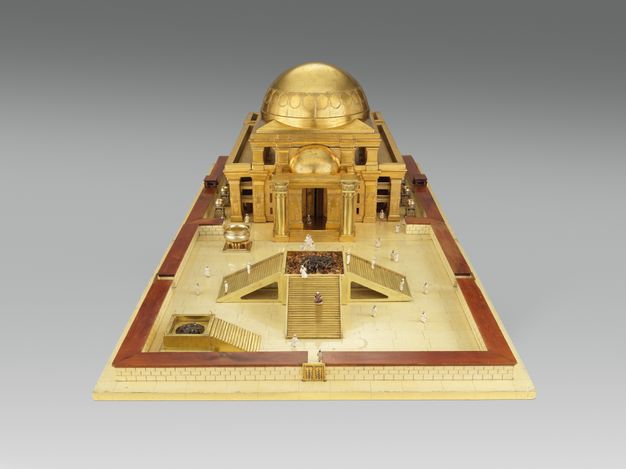 Figure 107
Architectural model of the temple of King Solomon in Jerusalem, 1883;
designer: After a design by Thomas Newberry (English writer, 1811-1901);
carver and gilder: Messrs. Bartlet (British gilders, active late 19th c) and W. Spurrier (British silversmiths, active late 19th century);
Gilded wood, gilded carton pierre, gilded silver, gilded bronze, enamel, and linen, Overall measurement, including forecourt: Length: 7’ 8” (234 cm); Width: 3’ 8” (112 cm);
The Metropolitan Museum of Art (New York, New York), Gift of Albert Kalimian, in honor of Victoria Kalimian and in memory of Rouhollah Kalimian, and in celebration of the Museum’s 150th Anniversary, 2019, 2019.66.1a–o–.95 © The Metropolitan Museum of Art. All Rights Reserved.] - The Earl and Countess of Arundel: Renaissance Collectors
- Internationale Bauausstellung Berlin 1987
- “Degenerate Art”: The Fate of the Avant-Garde in Nazi Germany
-
Salon des Indépendants of 1889 [
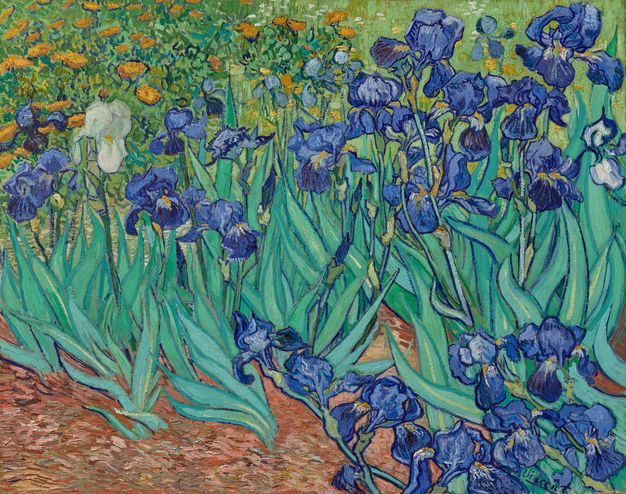 Figure 17
Irises (painting), 1889;
artist: Vincent van Gogh (Dutch painter and draftsman, 1853-1890);
oil on canvas, 71 x 93 cm;
J. Paul Getty Museum (Los Angeles, California), 90.PA.20 © The J. Paul Getty Trust. All Rights Reserved.] - Royal Academy Salon of 1785
DISCUSSION and GUIDELINES
Optional: Recording exhibition and loan information is optional. However, if any exhibition information is recorded, it is recommended to record the title in this subcategory.
Form and sytax
Record the title verbatim as found on the title page of authoritative sources published by the institution(s) where the exhibition took place. Transcribe the punctuation and capitalization as found on the title page. Authoritative published sources include printed catalogs of the exhibition, official Web sites for online exhibitions, and permanent collection catalogs.
If no authoritative published source is available, use whatever reliable source is available for the name of the exhibition, but for capitalization and punctuation, use rules found in . Use these rules if the title is found in the repository’s curatorial and registrarial files; catalogues raisonnés published by someone other than the repository; auction catalogs; sale catalogs; and contemporary news or journal articles.
Use repeating instances of this subcategory to record all variant titles by which the exhibition was known.
If the title or name of an exhibition is unknown, record “unknown,” but include an indication of the subject or theme of the exhibition in the subcategory, if known.
TERMINOLOGY/FORMAT
Free text: This is not a controlled field. If there is important information in the title of the exhibition (e.g., patron name(s), subject(s), etc.), index this information in the pertinent controlled subcategory elsewhere in the record.
24.3 Exhibition Type
DEFINITION
An indication of the type of exhibition or loan.
EXAMPLES
- exhibition
- online exhibition
- inhouse exhibition
- loan
- extended loan
DISCUSSION and GUIDELINES
Optional: Record a term describing the type of exhibition or loan being recorded in these subcategories. Use lower case.
TERMINOLOGY/FORMAT
Controlled list: Control this subcategory with a controlled list, using the terms listed in the “Examples” section above, and others as necessary.
24.4 Exhibition Curator
DEFINITION
The name of names of those responsible for the exhibition’s intellectual content, including the selection and interpretation of works.
EXAMPLES
- DeGrazia, Diane
- Pfeiffer, Bruce Brooks
- Hirst, Michael
- Jaffé, David
- European Sculpture and Decorative Arts (Metropolitan Museum)
DISCUSSION and GUIDELINES
Optional: Identify the person or persons who planned and organized the exhibition. A corporate body (e.g., a curatorial department) may be named as curator.
When more than one individual was involved in curating an exhibition, identify them in repeating instances of this subcategory. Use the subcategory to assign the majority of the responsibility to one person when appropriate, with the others designated as contributing curators.
TERMINOLOGY/FORMAT
Authority: Ideally, this subcategory would be linked to the , which contains names and biographical information for all persons and corporate bodies associated with the object/work. The authority may be populated with terminology from published sources, such as LC Name Authorities, Canadiana Authorities, and Union List of Artist Names (ULAN).
Free text: If this category is free-text, the use of consistent forms of personal and corporate names is recommended.
24.5 Exhibition Organizer
DEFINITION
The name and location of the person or agency responsible for the exhibition or loan.
EXAMPLES
- Museum of Fine Arts (Boston, Massachusetts, USA)
- National Museum of American Art, Smithsonian Institution (Washington, DC, USA)
- Arts Council of Great Britain (London, England)
- Casa Buonarroti (Florence, Italy)
- Museum of Islamic Art (Cairo, Egypt)
- Yamatane Museum of Art (Tokyo, Japan)
- Alamo Navajo Indian Reservation (Socorro county, New Mexico, USA)
DISCUSSION and GUIDELINES
Optional: Identify the individual or organization that planned and organized the exhibition.
Form and syntax
Follow rules for contructing names in the .
Identify multiple organizers in repeating instances of this subcategory. Use the subcategory to assign the majority of the responsibility to one institution when appropriate.
TERMINOLOGY/FORMAT
Authority: Ideally, this subcategory would be linked to the , which contains names and other information for all persons and corporate bodies associated with the object/work. The authority may be populated with terminology from published sources, such as LC Name Authorities, Canadiana Authorities, and Union List of Artist Names (ULAN).
Free text: If this category is free-text, the use of consistent forms of personal and corporate names is recommended. Since different organizers may have the same name, it is also important to record the geographic location of the organizer (this location would be stored in the authority record for the organizer if an authority is used).
24.6 Exhibition Sponsor
DEFINITION
The name of any individual, corporation, foundation, or funding body that provided financial assistance to an exhibition or loan.
EXAMPLES
- Milligan, Herbert M.
- J. Paul Getty Museum
- National Endowment for the Arts
- Federal Council on the Arts and Humanities
- Tokyo Mitsubishi Bank
- The Canada Council
- Arts Council of Great Britain
- Ford Foundation
- IBM
- Fondazione Giovanni Agnelli (Turin, Italy)
DISCUSSION and GUIDELINES
Optional: Identify the individuals, national endowments, foundations, corporations, and other funding bodies and monetary sponsors of an exhibition or loan.
Form and syntax
Follow rules for constructing names in the .
Identify multiple sponsors in repeating instances of this subcategory. If the sponsor changes with different venues, repeat the sponsor subcategory with the set of venue subcategories. Use the subcategory to describe nuance regarding funding responsibility.
TERMINOLOGY/FORMAT
Authority: Ideally, this subcategory would be linked to the , which contains names and other information for all persons and corporate bodies associated with the object/work. The authority may be populated with terminology from published sources, such as LC Name Authorities, Canadiana Authorities, and Union List of Artist Names (ULAN).
Free text: If this category is free-text, the use of consistent forms of personal and corporate names is recommended. Include enough information to clearly identify the sponsor, including a geographic place if necessary (if linking to an authority, this information could be automatically pulled from the authority record for the sponsor).
24.7 Exhibition Venue
DEFINITION
A display of the names, locations, and dates where the exhibition or work was on public display.
EXAMPLE
- Los Angeles County Museum of Art, 30 September-23 November 1975; St. Louis Art Museum, 16 March-9 May 1976; Elvehjem Art Center, 8 June-1 August 1976.
- Getty Center, Research Institute Exhibition Gallery, 11 October 2005-22 January 2006; online exhibition at http://www.getty.edu/art/exhibitions/shulman/index.html (25 May 2006), ongoing
DISCUSSION and GUIDELINES
Optional: Record the successive venues for a work’s exhibition, from the first venue to the last, if known. While the subcategories are all optional, it is recommended to use this subcategory if you record any exhibition or loan information for a work/object.
Form and syntax
Record the name of the institution in natural order, followed by the span of dates when the work was displayed at this venue. Use a semi-colon or other punctuation to separate the various venues.
For online exhibitions, if the exhibition is ongoing, note the URL and the date you last accessed the site. Record a full citation for the Web site, including the URL, in the subcategory.
Major exhibitions are often shown in many different places. An exhibition installation may be simultaneously divided between different physical places. For example, The Age of Correggio and the Carracci was shown in a number of galleries in Bologna.2 An online exhibition may stand alone, or it may run simultaneously with a physical exhibition; it may remain online long after the physical exhibition has closed.
It may not be certain if an exhibition was shown at a particular venue, or if a particular object was included in the exhibition at all venues. Indicate uncertainty and nuance in this subcategory as necessary.
TERMINOLOGY/FORMAT
Free text: This is not a controlled field. Index venue information in the pertinent controlled subcategories below.
24.7.1 Venue Name/Place
DEFINITION
The name of the exhibiting institution, gallery, other facility, and/or the geographic location where an exhibition took place.
EXAMPLES
- Musée du Louvre (Paris, France)
- National Gallery (London, England)
- Leo Castelli Gallery (New York, New York, USA)
- National Museum of American Art, Smithsonian Institution (Washington, DC, USA)
- Museo Nacional (Guatemala City, Guatemala)
- Istanbul (Marmara region, Turkey)
DISCUSSION and GUIDELINES
Optional: Identify the specific institutions or galleries that housed a particular exhibition or a work of art, and the geographic locations where these institutions or galleries are located. If the institution is not known or not applicable, list the geographic location only.
Identify multiple locations by repeating instances of the set of narrower subcategories under the broader subcategory. Use the subcategory free-text field to describe nuance regarding locations.
This subcategory is intended for physical locations. For online exhibitions, record the name of the hosting institution here, but record the URL in a full citation for the Web site in .
For long-term loans, record the repository where the work is housed while on loan in the category; it may repeated here.
TERMINOLOGY/FORMAT
Authority: Ideally, this subcategory would be linked to the and , which contains names and other information for all persons and corporate bodies, and geographic places, associated with the object/work. The authorities may be populated with terminology from published sources, such as LC Name Authorities, Canadiana Authorities, Union List of Artist Names (ULAN), Thesaurus of Geographic Names (TGN), NGA (NIMA) and USGS, and Library of Congress Subject Headings.
Free text: If this category is free-text, the use of consistent forms of personal and corporate names and geographic names is recommended. Include enough information to clearly identify the venue, including a geographic place for the institution if necessary (if linking to the , this geographic information could be automatically pulled from the authority record for the institution).
24.7.2 Venue Date
DEFINITION
A description of the date or range of dates when the work was on exhibition at a particular venue.
EXAMPLES
- 1801-1812
- 1993
- 9 October-11 December 1988
- before May 1970
- 12th century
- Christmas season, 1432
- Autumn 1956
DISCUSSION and GUIDELINES
Optional: Record a year, a span of years, or a phrase that describes the specific or approximate date(s) associated with the exhibition or loan of the work. Include nuance and expressions of uncertainty, as necessary.
Form and syntax
Follow the applicable rules for display dates in the subcategory.
These dates document when a work was exhibited at a particular venue. Usually, a range of dates or a single date will be indicated in this subcategory. Since it may not be possible to identify exactly when a work was on display, various levels of certainty should be described. Sources may only date an installation to the “18th century,” for example. The dates an object was in an exhibit may vary from the published dates for the exhibition, as when the run of the exhibition was extended or the object was not on view for the entire length of the show.
TERMINOLOGY/FORMAT
Free-text: This is not a controlled field. Maintain consistent capitalization, punctuation, and syntax where possible. Index the dates in the controlled and subcategories.
24.7.2.1 Earliest Date
DEFINITION
The earliest possible date when the work was exhibited at a particular venue.
EXAMPLES
- 1988-10-09
- 1801
DISCUSSION and GUIDELINES
Optional: Record the earliest year when the work was exhibited, as indicated in the display subcategory.
Form and syntax
Always record years in the proleptic Gregorian calendar in the indexing dates fields. Record the precise day and time, if possible. Use the following syntax: YYYY-MM-DD (year, month, day, separated by dashes), if possible. The standards suggest alternate possibilities; you may use an alternative syntax if you are consistent and it is compliant with the standards. It is optional to record ; however, if you record a value here, you must also record . For further instruction, see .
TERMINOLOGY/FORMAT
Controlled format: Date information must be formatted consistently to allow retrieval. Local rules should be in place. Suggested formats are available in the ISO Standard and W3 XML Schema Part 2.
-
ISO 8601:2004 Representation of dates and times. International Organization for Standardization. Data Elements and Interchange Formats. Information Interchange. Representation of Dates and Times. Geneva, Switzerland: International Organization for Standardization, 2004.
24.7.2.2 Latest Date
DEFINITION
The latest possible date when the work was exhibited at a particular venue.
EXAMPLES
- 1989-03-28
- 1806
DISCUSSION and GUIDELINES
Optional: Record the latest year when the work was exhibited, as indicated in the display subcategory.
Form and syntax
Always record years in the proleptic Gregorian calendar in the indexing dates fields. Record the precise day and time, if possible. Use the following syntax: YYYY-MM-DD (year, month, day, separated by dashes), if possible. The standards suggest alternate possibilities; you may use an alternative syntax if you are consistent and it is compliant with the standards. It is optional to record ; however, if you record a value here, you must also record . For further instruction, see .
TERMINOLOGY/FORMAT
Controlled format: Date information must be formatted consistently to allow retrieval. Local rules should be in place. Suggested formats are available in the ISO Standard and W3 XML Schema Part 2.
-
ISO 8601:2004 Representation of dates and times. International Organization for Standardization. Data Elements and Interchange Formats. Information Interchange. Representation of Dates and Times. Geneva, Switzerland: International Organization for Standardization, 2004.
24.8 Exhibition Object Number
DEFINITION
The number assigned to a work within the context of a particular exhibition or loan.
EXAMPLES
- item 174
- plate 23
- VIII
- DR 1989:0001
- q60
DISCUSSION and GUIDELINES
Optional: Record the object identification specifically assigned to a work within the context of an exhibition or loan. Numbers may have prefixes or suffixes that are vital to their meaning.
Objects are often identified by numbers or alphanumeric codes in an exhibition to make it easier to identify them. These identifiers may be the same as the repository normally uses to identify the object, as recorded in .
TERMINOLOGY/FORMAT
Free text: The format of the number will vary depending on its type and source.
24.8.1 Number Type
DEFINITION
The type of number assigned to a work within the context of a particular exhibition or loan.
EXAMPLES
- accession number
- location symbol
- collector’s number
- identification number
- object identification
- catalog number
DISCUSSION and GUIDELINES
Optional: Record a term describing the type of number, if known. Use lower case.
TERMINOLOGY/FORMAT
Controlled list: Control this subcategory with a controlled list, using the terms listed in the “Examples” section above, and others as necessary.
24.9 Exhibition Object/Work Label/Identification
DEFINITION
A display identifying the work on exhibition, distinguishing it from similar works.
EXAMPLE
-
Queen Mother Pendant Mask: Iyoba; mask; unknown
Ebo; 16th century; Metropolitan Museum (New York, New
York, United States); 1978.412.323 [
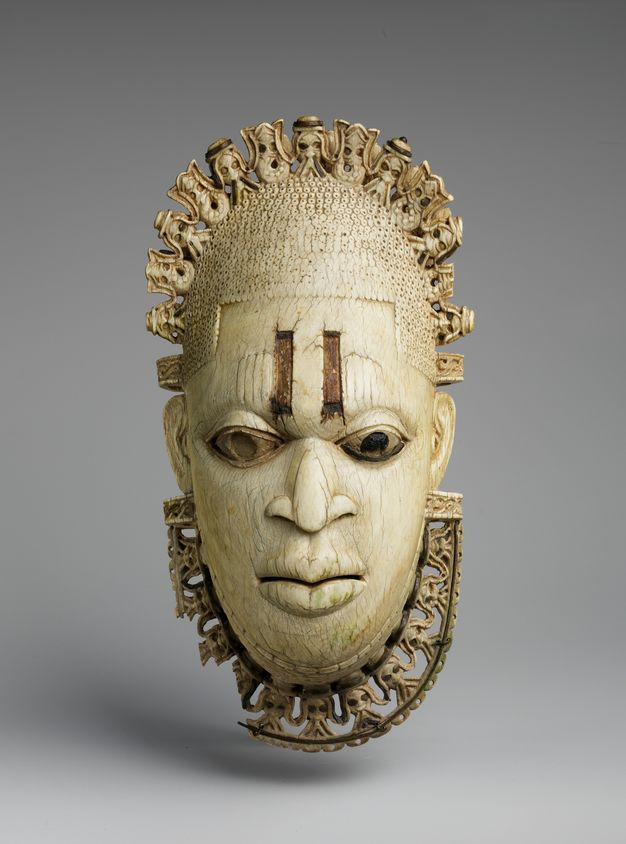 Figure 50
Queen Mother Pendant Mask: Iyoba, 16th century;
artist: Unknown Ebo;
Ivory, iron, and possibly copper, H. 9 3/8 x W. 5 x D. 2 1/2 in. (23.8 x 12.7 x 6.4 cm);
The Metropolitan Museum of Art (New York, New York), The Michael C. Rockefeller Memorial Collection, Gift of Nelson A. Rockefeller, 1972, 1978.412.323 © The Metropolitan Museum of Art. All Rights Reserved.] - Cities and Sites Cartes-de-visite; collection; Eugenio Courret, Burton Brothers, Charles Leinack, and others; 1854-ca. 1905; Special Collections, Research Library, Getty Research Institute (Los Angeles, California, United States); no.ZCDV 2
- Ruskin Hours; prayer book; unknown French; ca. 1300; J. Paul Getty Museum (Los Angeles, California, United States); MS. LUDWIG IX 3
DISCUSSION and GUIDELINES
Optional: Record a label identifying the work as it was recorded in the exhibition. This subcategory is important if the title or other information in the label that was used in the context of the exhibition differed from information used for the same object when it is on permanent display or in other exhibitions.
Form and syntax
Use consistent syntax and punctuation for the label, as described in the subcategory. Follow the “Examples” section above, concatenating the following subcategories: Title; semi-colon; Object/Work Type; semi-colon; Creator Description; semi-colon; Creation Date; semi-colon; Current Location Description; semi-colon; Repository Number (or Exhibition/Loan History- Exhibition Object Number).
Alternatively, devise another scheme for syntax and punctuation, provided it is used consistently in local practice.
TERMINOLOGY/FORMAT
System generated: Ideally, this should be generated from various fields in the object/work record.
Free-text: This is not a controlled field. If retrieval is required on this information, index the information in the pertinent controlled subcategories elsewhere in the record.
RELATED CATEGORIES and ACCESS
Record titles used for the work in the exhibition as alternate titles in the subcategories. Any other information in the label should be repeated in other pertinent categories.
24.10 Remarks
DEFINITION
Additional notes or comments pertinent to information in this category.
DISCUSSION and GUIDELINES
Optional: Record a note containing additional information or comments on this category. Use consistent syntax and format. For rules regarding writing notes, see the category.
FORMAT/TERMINOLOGY
Free-text: This is not a controlled field. Use consistent syntax and format.
24.11 Citations
DEFINITION
A reference to a bibliographic source, unpublished document, or individual opinion that provides the basis for the information recorded in this category.
DISCUSSION and GUIDELINES
Optional: Record the source used for information in this category. For a full set of rules for citations, see .
TERMINOLOGY/FORMAT
Authority: Ideally, this information is controlled by citations in the citations authority; see .
24.11.1 Page
DEFINITION
Page number, volume, date accessed for Web sites, and any other information indicating where in the source the information was found.
DISCUSSION and GUIDELINES
Optional: For a full set of rules for pages, see .
FORMAT/TERMINOLOGY
Free-text This is not a controlled field. Use consistent syntax and format.
Examples
Example of an exhibition in several venues
-
Exhibition Title or Name: Ancient Art
of the American Woodland Indians
Type: exhibition
Curator: Penney, David W.
Organizer: Detroit Institute of Arts (Detroit, Michigan, USA)
Sponsors: National Endowment for the Arts
Stroh Foundation
Founders Society Detroit Institute of Arts
Venue: National Gallery of Art, 17 March-4 August 1985; Detroit Institute of Arts, 2 September-11 November 1985; Houston Museum of Fine Arts, 16 December 1985-2 March 1986.
Name/Place: National Gallery of Art (Washington, DC, USA)
Date: 17 March-4 August 1985
Earliest Date: 1985-03-17
Latest Date: 1985-08-04
Name/Place: Detroit Institute of Arts (Detroit, Michigan, USA)
Date: 2 September-11 November 1985
Earliest Date: 1985-09-02
Latest Date: 1985-11-11
Name/Place: Houston Museum of Fine Arts (Houston, Texas, USA)
Date: 16 December 1985-2 March 1986
Earliest Date: 1985-12-16
Latest Date: 1986-03-02
Object Number: no.58
Number Type: catalog number
Object Label: Raven-Effigy Pipe; pipe; unknown Jersey Bluff Culture; 900/400 CE; Thomas Gilcrease Institute of American History and Art (Tulsa, Oklahoma, USA); 5125.1201.
Citations: Brose, David S., James A. Brown, and David W. Penney. Ancient Art of the American Woodland Indians. National Gallery of Art, Washington, DC, Detroit Institute of Arts, and the Houston Museum of Fine Arts. New York: H.N. Abrams, in association with the Detroit Institute of Arts, 1985. Page: 83
Example of an exhibition that was in a gallery and also online:
-
Exhibition Title or Name: Mexico: From
Empire to Revolution
Type: exhibition
online exhibition
Curator: Merewether, Charles
Organizer: Getty Research Institute (Los Angeles, California, USA)
Sponsor: Getty Research Institute (Los Angeles, California, USA)
Venue: Getty Center, Research Institute Exhibition Gallery, 24 February-20 May 2001; online exhibition at https://www.getty.edu/art/exhibitions/art_mexico2/#:~:text=The first section focuses on,his execution and its aftermath, (25 May 2006), ongoing.
Name/Place: Getty Center, Research Institute Exhibition Gallery (Los Angeles, California, USA)
Date: 24 February-20 May 2001
Earliest Date: 2001-02-24
Latest Date: 2001-05-20
Name/Place: Getty Research Institute (Los Angeles, California, USA)
Date: 24 February 2001-ongoing
Earliest Date: 2001-02-24
Latest Date: 2050-01-01
Object Label: Paseo and Bucareli Ave., Mexico City: Corner of Paseo de la Reforma and Bucareli Avenue, with statue of Charles IV_; gelatin silver print; Charles Burlingame Waite (American, active ca. 1890-ca. 1910); ca. 1900; Getty Research Institute, Research Library, Special Collections (Los Angeles, California, USA); 96.R.143.
Citations: Mexico: From Empire to Revolution [online exhibition]. Los Angeles: Getty Research Institute, 2001-. https://www.getty.edu/art/exhibitions/art_mexico2/#:~:text=The first section focuses on,his execution and its aftermath (12 June 2003). Page: accessed 25 May 2006
Revised 27 February 2024
by Emily Benoff
Notes
-
See Mario-Andreas von Lüttichau, “Entartete Kunst, Munich 1937- A Reconstruction,” in Stephanie Barron et al., “Degenerate Art”: The Fate of the Avant-Garde in Nazi Germany. Los Angeles: Los Angeles County Museum of Art, 1991, 45-103. ↩︎
-
The Age of Correggio and the Carracci: Emilian Painting in the Sixteenth and Seventeenth Centuries. Translated by Robert Erich Wolf et al. exhibition held at the Pinacoteca Nazionale di Bologna, 10 September-9 November 1986; National Gallery of Art, Washington, DC, 19 December 1986-16 February 1987; Metropolitan Museum of Art, New York, 26 March-24 May 1987. Washington, DC: National Gallery of Art, 1986. ↩︎