This essay describes the origins and contours of Ed Ruscha’s Streets of Los Angeles (SoLA) project, from Ruscha’s earliest forays into photography and the ambitious publication project of Every Building on the Sunset Strip to the contemporary excursions Ruscha and his team still take to photograph streets, parklands, and deserts using similar methods to those they employed in the 1960s. It is not clear exactly when the pithy six-word phrase “every building on the Sunset Strip” first occurred to Ruscha—probably in late 1964 or early 1965. Whatever the case, it eventually led to the SoLA photographic project, which has now spanned six decades, far superseding the original scope of the notorious 1.6-mile commercial strip on Sunset Boulevard.
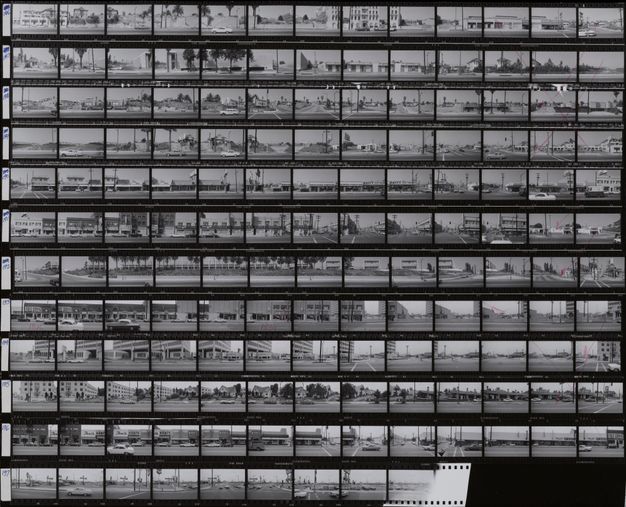
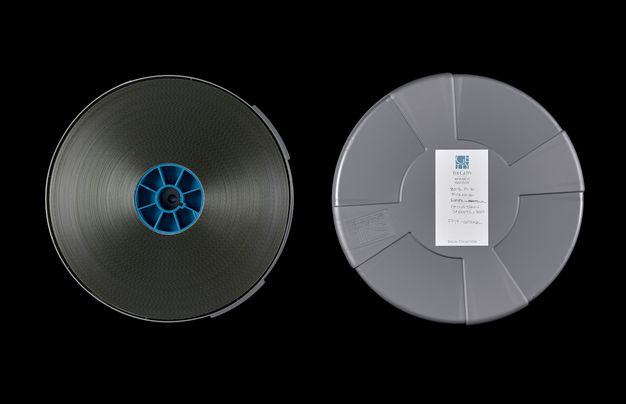
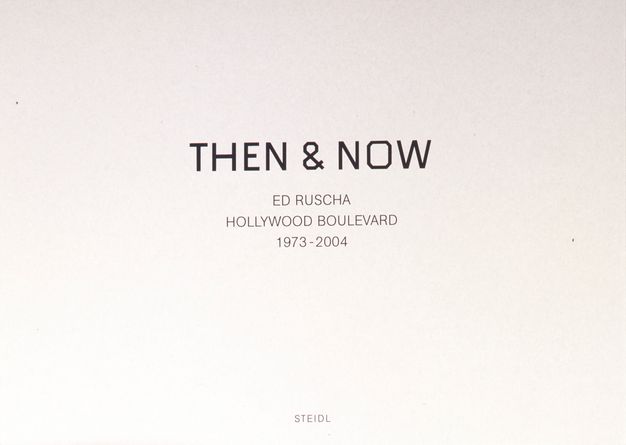
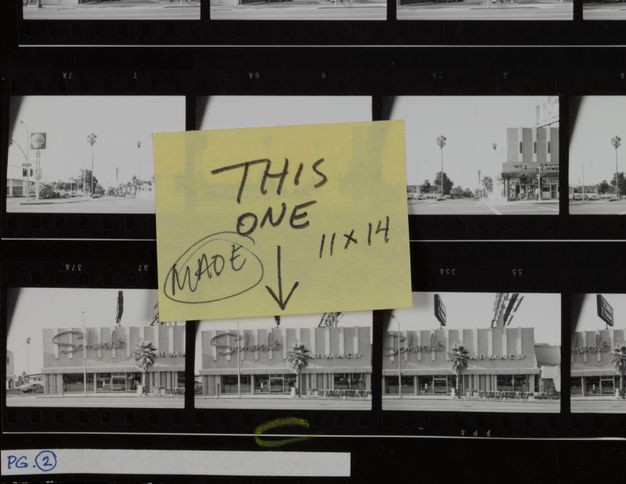
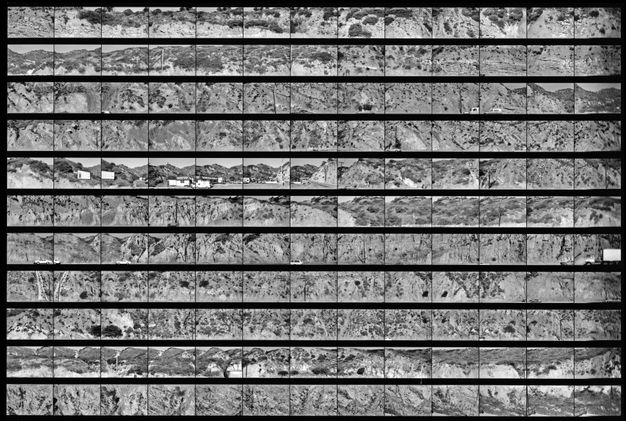
This is a project of unwieldy statistics and information: there have been over one hundred photographic shoots in Los Angeles County to date.1 Each shoot has generated around 4,000 to 8,000 images, resulting in upward of 900,000 images.2 From this total, about 740,000 are housed in Ed Ruscha’s SoLA Archive at the Getty Research Institute (GRI),3 which contains documentation of major Los Angeles streets, from 1965 until 2010. The archive is mostly constituted by contact prints, negatives stored on film reels (figs. 2.1, 2.2), and the production archives for Every Building on the Sunset Strip (1966) and the Steidl publication THEN & NOW: Hollywood Boulevard, 1973–2004 (2005). In the 1990s, Ruscha’s images were used to create a portfolio of images published by Patrick Painter (fig. 2.3) and the above-mentioned THEN & NOW (fig. 2.4). But aside from Every Building and THEN & NOW, the photos were mostly gathered with no specific project in mind. Ruscha himself refers to it as a kind of “study” or “program.”4 In what follows, we detail the emergence of the project in the mid-1960s and its development over the next six decades to the present day. We describe the early innovative setup of what Ruscha called his “motorized photographs” (fig. 2.5), the different projects that drew upon the photographic archive, and the ways in which the scope of the project changed over time (see “You Are Here: Locating the SoLA Archive,” this volume).
Before Sunset: Photographing Urban Landscapes
Ruscha had been photographing cityscapes since at least 1961, when he took a trip to Europe with his brother, Paul, and mother, Dorothy. These cityscapes had previously seemed quite different from the images published in Ruscha’s photography books, but the SoLA Archive has shed new light on Ruscha’s lengthy engagement with photography as more than a medium to fill his books with images. After his family returned to the US, Ruscha remained in Paris for about a month and then stopped in New York on his way home to Los Angeles. With his twin-reflex Yashica camera, Ruscha took more than three hundred photographs during his trip (see figs. 7.7, 7.8, 7.9, 7.10).5 The black-and-white images, featuring subjects such as store windows, rooftops, roads, and street signs, read like a mini history of twentieth-century photography, full as they are of the subjects that fascinated many photographers of that time, including Henri Cartier-Bresson, Aleksandr Rodchenko, Eugène Atget, Walker Evans, and Robert Frank. Many of Ruscha’s encounters with these photographers happened within the pages of printed materials. Ruscha first saw Frank’s The Americans in 1959, in a bookstore where his friend Joe Goode worked.6 “It was like opening a book laced with dynamite. No one ever told the story of America that way,” Ruscha recalled.7
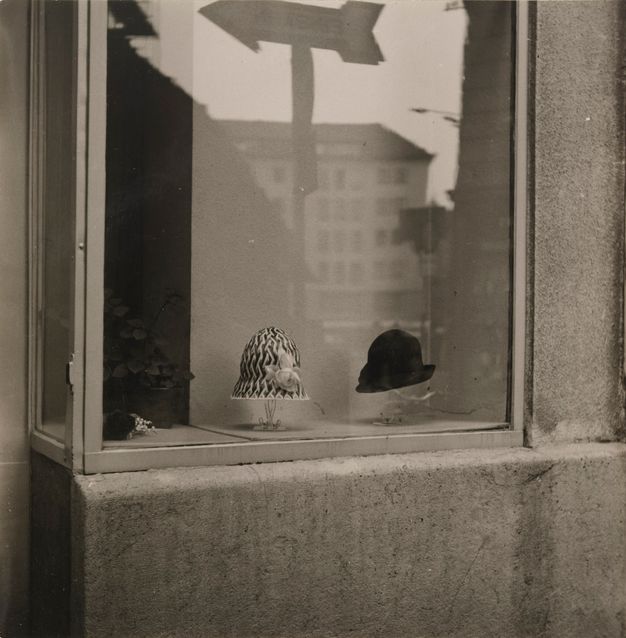
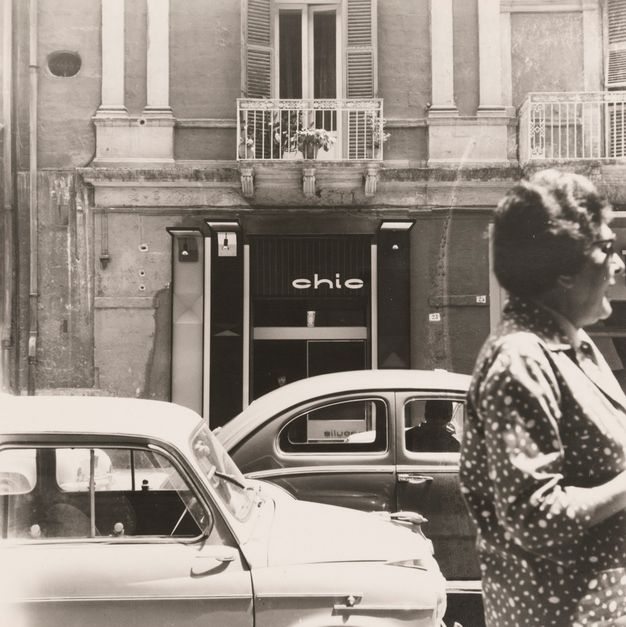
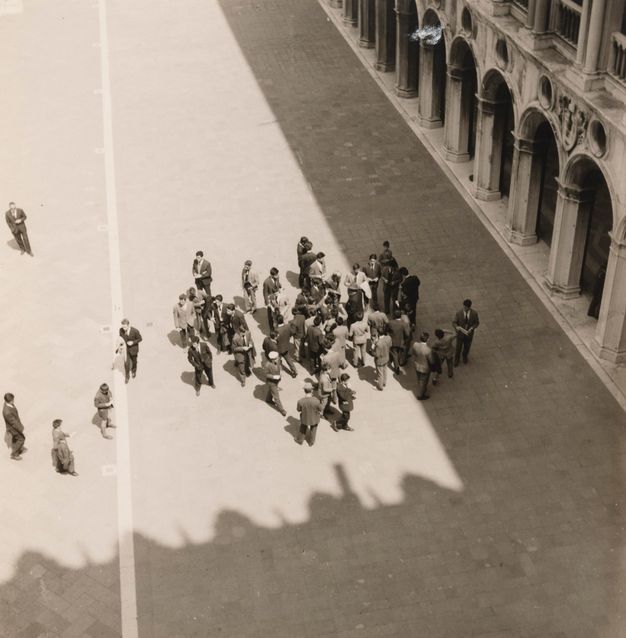
Ruscha has characterized his early pictures as “naive” and has insisted that he had “no real strategy” when taking them, a statement that elides the degree to which he did in fact have an understanding of modernist photography, broadly defined.8 His photographs, both in subject matter and style, exhibit at least a general knowledge of various twentieth-century photographic modernisms. One can imagine Ruscha, freshly graduated from L.A.’s Chouinard Art Institute, wandering the streets of Europe, snapping shots of a gas-station sign on a building, a group of women strolling through a town square, and the awning of an optician’s shop. Ruscha’s photograph of a shop window in Vienna, with the reflection of a street sign at the top (fig. 2.6), recalls Atget’s many photographs of Parisian shop windows. A shot of a woman walking down a city street in Rome recalls Frank’s photographs from The Americans, especially in Ruscha’s use of cropping (fig. 2.7). The woman’s body exceeds the frame at the right while the car is cut off at the left. In another photograph, Ruscha captures a view from above of a crowd gathering outside a building in Venice (fig. 2.8), evoking Rodchenko’s notion of casting off photographs taken “from the belly button.”9 The photographs, as a whole, suggest that Ruscha was experimenting with different modes of modernist photography. His European journey offered an opportunity to experiment freely with the medium outside the classroom, rather than in the context of creating advertisements, as he did at Chouinard.
After Ruscha returned to Los Angeles, he continued to use the Yashica to photograph the urban landscape. He took a job with Carson/Roberts advertising agency as a layout artist. During his lunch breaks, Ruscha brought his Yashica to the building’s rooftop and photographed the neighborhood around it, the Melrose/Beverly Grove area of the city. In these photographs, Ruscha began to focus more on the built environment and less on the human interactions with that environment. (This contrasts with the Europe photographs, where people appear frequently.) By dint of his position on the building, Ruscha captured aerial views that show billboards (including the agency’s own), rooftops, and vehicles (fig. 2.9).
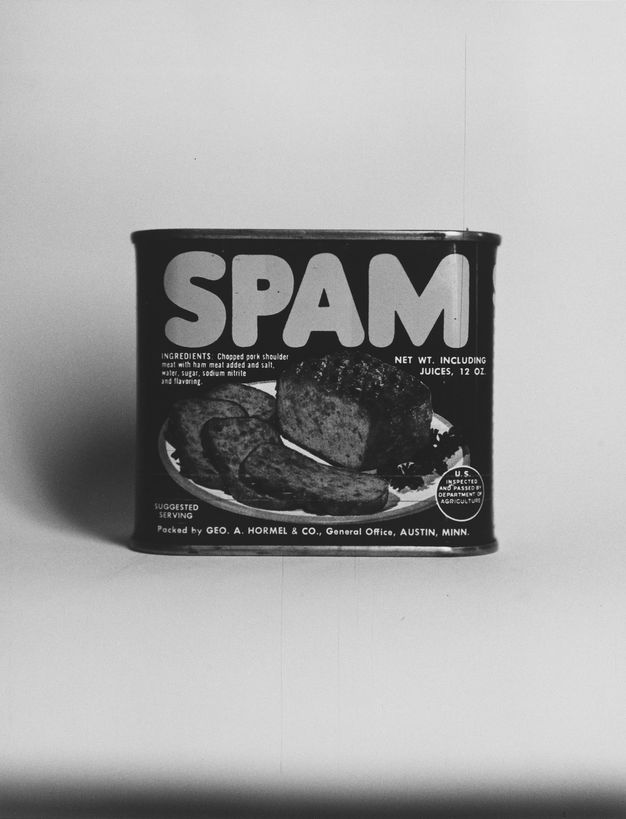
While Ruscha used the Carson/Roberts building as a platform for photographing Los Angeles, he also began to take photographs that mirrored the kind of advertising work occurring inside the walls of his agency. For example, in his Product Still Lifes series, from 1961, ordinary commodities such as Oxydol detergent and Spam appear brightly lit against a stark white background (fig. 2.10). With their high-contrast aesthetic, these images evoke a visual language of advertising photography, which Ruscha would have become acquainted with through not only his work at Carson/Roberts but also in his photography courses at Chouinard.
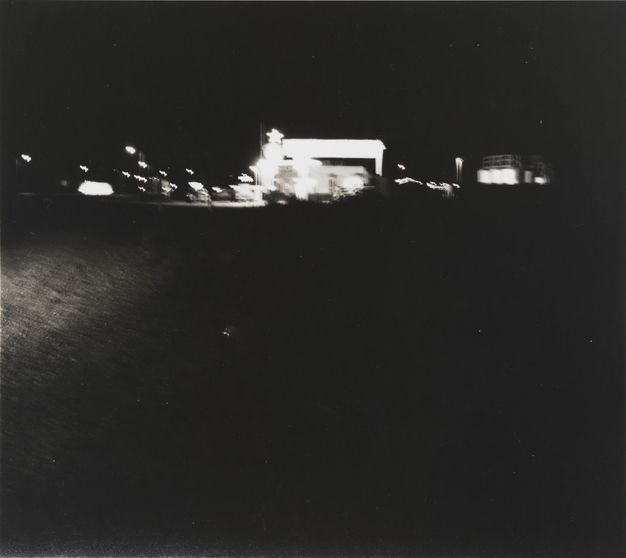
At the same time, Ruscha was turning his camera to other parts of the American landscape. He routinely made the trip between Los Angeles and Oklahoma City, where he grew up, to visit his family. Along the way, Ruscha began photographing the filling stations on Route 66 in California, Arizona, New Mexico, Texas, and Oklahoma (see fig. 7.11). Eventually, he published a number of these photographs in his first book, Twentysix Gasoline Stations (1963). For some of the pictures, Ruscha photographed the stations from across the road, leaving visible a strip of asphalt in the foreground. For others, he took a closer shot of a station’s signage and gas pumps. Three photographs show stations at night, as beacons of bright floodlights in the middle of the desert darkness (fig. 2.11). In Ruscha’s view of the United States, people leave traces (in one photograph, there is even a shadow visible), but no actual humans are pictured.
Ruscha published Twentysix Gasoline Stations under his own imprint, National Excelsior (a name found on a journal that was also featured in his Product Still Lifes series). Using commercial printing methods for the book, Ruscha chose a simple white cover with the title printed in bold and red serif letters on the front (see fig. 5.5). He would employ similar methods for the other books he published in the 1960s, including Various Small Fires and Milk (1964), Some Los Angeles Apartments (1965), and Thirtyfour Parking Lots in Los Angeles (1967) (see figs. 6.2, 13.1). Sometime during this period, Ruscha changed the name from National Excelsior to Heavy Industry Publications, playing on the idea that in his publishing practice he wanted to be the “Henry Ford of bookmaking.”10
Perhaps to engage this newly industrialized model of bookmaking, Ruscha shifted from taking his own photographs to hiring others to take them for his book Every Building on the Sunset Strip. The move from making European-style modernist photographs to informational ones could already be seen in Ruscha’s photographic books, beginning with the abovementioned Twentysix Gasoline Stations. And then, for Every Building, Ruscha began outsourcing the labor of making the images, first by contracting his friend Jerry McMillan to take the photos and later by mechanizing and semiautomating the process. The use of a collaborative model of artistic work more similar to the design methodology of an advertising agency—with Ruscha as art director—also happened to align Ruscha with conceptual art. Additionally, although the project had some resonances with the genre of street photography, Ruscha effectively shed any association with photographic tradition when he decided to automate the process.
A Blvd. Called Sunset11
In early 1965, while still in production for his book Some Los Angeles Apartments, Ruscha approached his friend Jerry McMillan about a project to photograph each and every building on the Sunset Strip.12 “He didn’t have a little drawing or any kind of plan that he showed me. He just had this idea,” McMillan recently recalled of his assignment to take test photographs for Ruscha’s book. In early 1965, McMillan made the first attempt at photographing the boulevard. “I went up and started shooting, we talked about it and how difficult it was,” said McMillan.13 His photos were shot on a Mamiya 2 1/4 camera in square format, which was, remembers Ruscha, “clumsy and the format was not suitable”; also, they “didn’t have a way of mechanizing a 2 1/4 inch camera”14 (fig. 2.12). Indeed, photographing the street on foot was incredibly time-consuming: the Mamiya only had the capacity to hold 12-exposure film, and the film was advanced by winding the film manually.
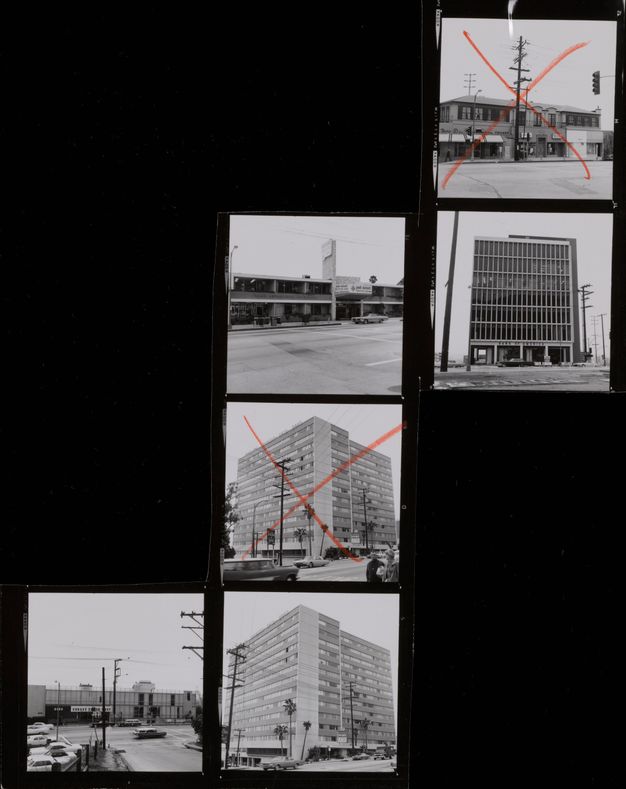
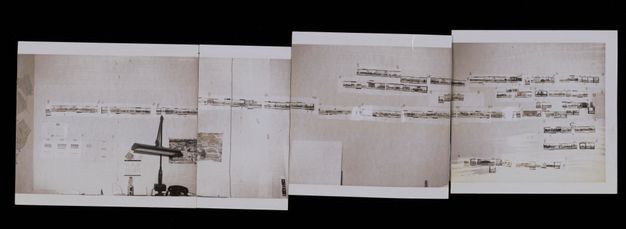
McMillan’s images were too irregular for the desired outcome: buildings were shot from varying angles and with inconsistent perspectives. In fact, as Isabel Frampton Wade observes in her essay in this volume, McMillan’s original attempt at photographing the Strip resembles the type of architectural photography employed in Some Los Angeles Apartments.15 Ruscha deemed the results of the first shoot “a fiasco.”16 McMillan’s photographs did, however, enable Ruscha to figure out the format for Every Building; the images were used to create a mock-up for the book that was later pictured on the wall of Ruscha’s studio at Vestal Avenue (fig. 2.13).17
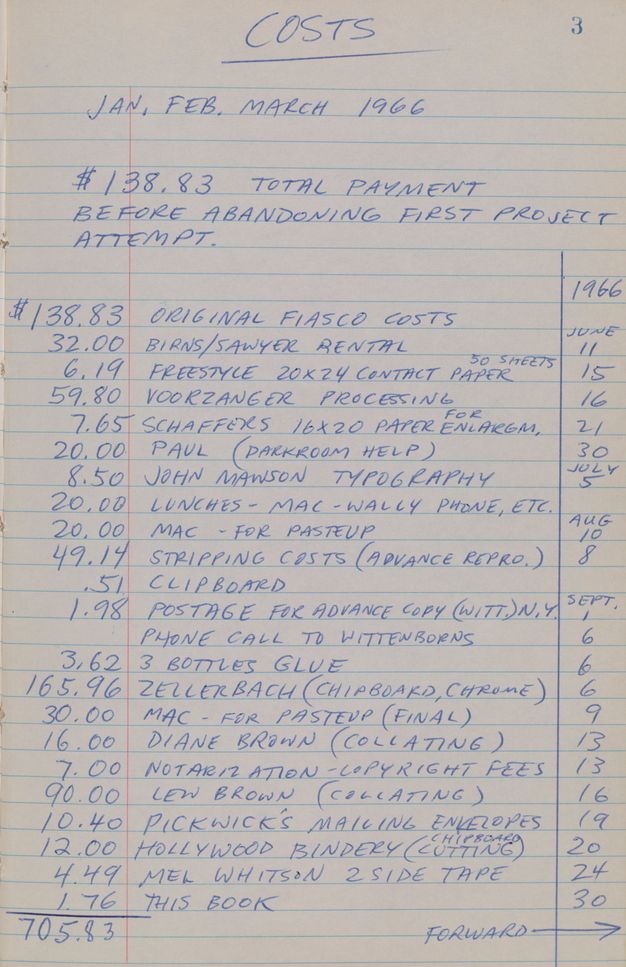
Ruscha was a meticulous notetaker: besides recording the project’s expenses in his studio journal under the heading “original fiasco costs”18 —the total was $138.83, including the cost of lunch each day for the crew (fig. 2.14)—he diagrammed the camera setup, including the height, the lens, and the f-stop, as well as the intersections and cross streets (fig. 2.15). Over the years, Ruscha’s team would tighten up the methods for keeping track of film rolls, and their corresponding cross streets would usually be noted with a numerical system. However, in the earliest days of the project, Ruscha himself wrote down landmarks and favorite haunts (see fig. 2.15, sheet 3); instead of cross streets and addresses, he recorded the icons of his own everyday experience as part of the “lifeblood” of L.A.’s urban fabric.19
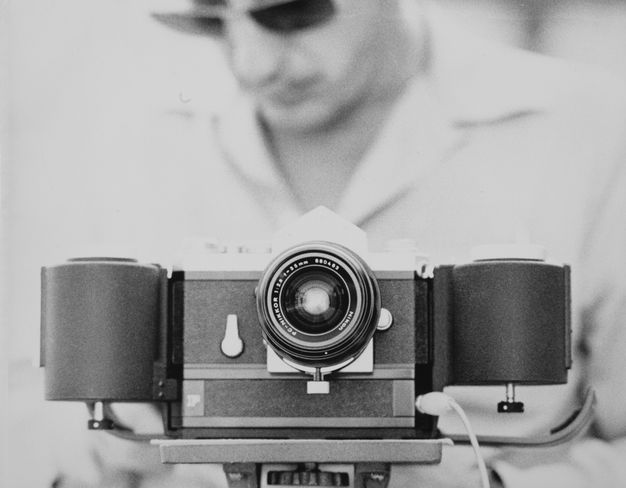
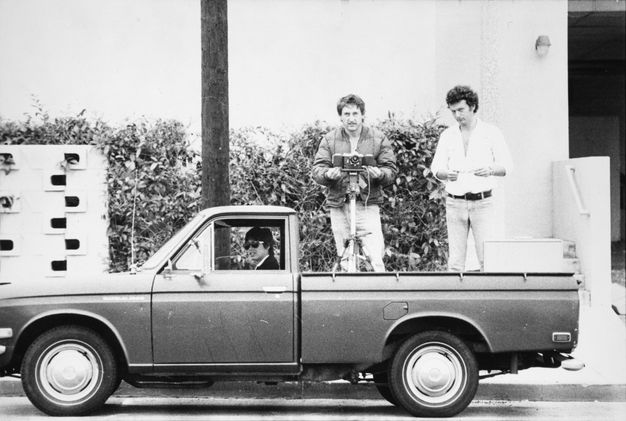
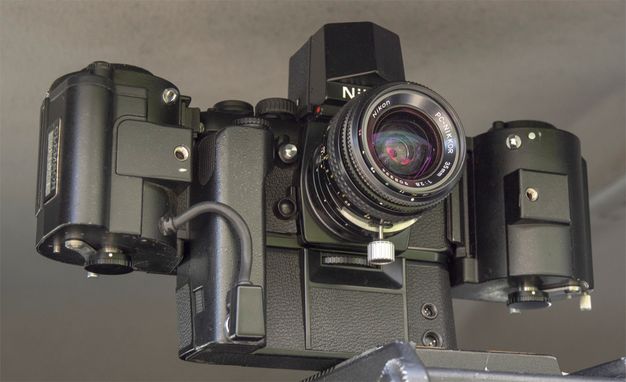
After the “fiasco” of the May 1965 shoot, Ruscha’s team devised a way to “motorize” a 35mm Nikon film camera: by driving along the street with the camera pointing out the window. According to Ruscha, “It just made complete sense to snap off pictures as you moved along rather than to move, stop, photograph, move, stop, photograph.”20 The motorized photos were also made possible by two different photographic technologies. The first was the use of a motorized drive that would automatically advance the camera film.21 This initially made the capture faster, but the process was still hampered by the use of regular film with 36 exposures, requiring the film rolls to be changed too frequently.22 The second, added in 1973, was the use of an MF-4 250-exposure bulk magazine adaption to the camera that could accommodate the extra-long, 27-foot film stock (fig. 2.16).23 This allowed the team to capture a continuous reel of images from a moving truck without the frequent and time-consuming changing of the film roll (fig. 2.17). That said, the process wasn’t flawless, as camera-changing bags were still a necessary part of the equipment. But overall, the innovation was a success. In late spring 1966, Ruscha and his team carried out a test that produced the photos that were finally deemed suitable for Every Building.24 By June 1966, he and his team were able to photograph both sides of the Strip over the course of one Sunday (fig. 2.18). Finally, the method of taking motorized photos had been perfected.
The embrace of semiautomated motorization would standardize images to achieve consistent perspective, depth of field, and framing. The photographs could then be almost seamlessly pasted together for Every Building, in which Ruscha built upon the concept of the book as a container for photographs. Instead of single pages printed with individual photographs, however, the book contains a long accordion-fold page that measures approximately twenty-seven feet when fully opened. Ruscha printed the photographs in a continuous strip, which he made from individual photographs mounted together with the techniques of pasteup layout, a process common in print advertising (and one that Ruscha had been trained to use at Chouinard). This cut-and-paste process also allowed Ruscha to selectively shape his picture of the Strip, both by choosing which photographs would be in the final image strip and, in some cases, by retouching the photographs to emphasize or deemphasize part of a building. This “pasteup picture” became a means to capture, or at least attempt to capture, every building along the section of the Strip that Ruscha had decided to photograph.25 After he completed the pasteups, Ruscha sent boards to a shop to be made into offset prints. The book’s first print run, in September 1966, numbered one thousand copies (see figs. 5.6, 8.1). In 1971, Ruscha printed an additional four thousand copies. Ruscha tracked the book’s printings and travels in his notebooks, which document its circulation in different networks and contexts, from the Sunset Strip Chamber of Commerce to the renowned Wittenborn and Company bookstore in New York.
Beyond Sunset
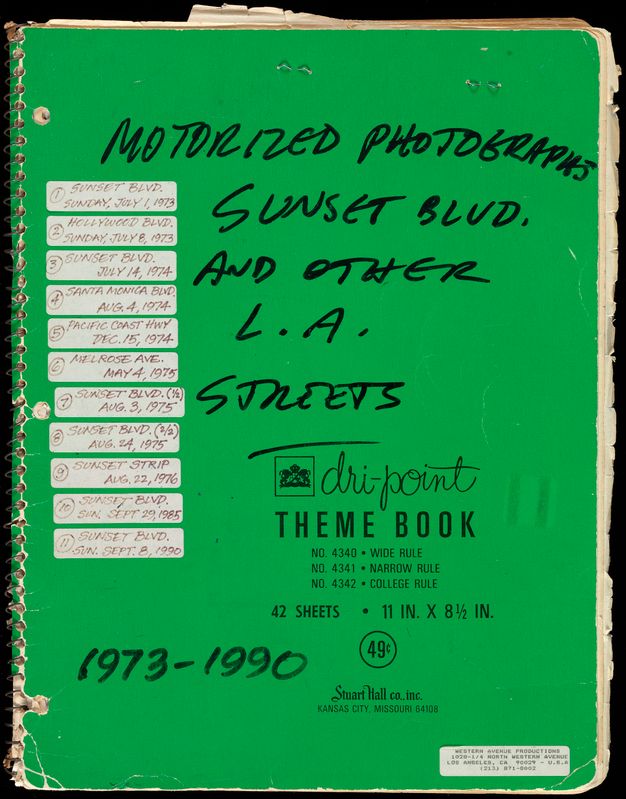
In 1973, eight years after the first shoot of Sunset Boulevard, Ruscha revisited the street once again. For this shoot, which took place on Sunday, 1 July, in Ruscha’s Datsun pickup, a definitive setup was sketched out in the project notebook: the camera lens was set at a height of 46 1/8 inches (at a slight tilt), the camera’s viewfinder height was 45 1/2 inches, and the 35mm lens was set at infinity.26 Ruscha and a team that included his brother, the photographer Paul Ruscha, set off at Sunset’s intersection with Western Avenue, close to Ruscha’s studio at 1024 3/4 North Western Avenue in Hollywood.27 A brief note records the details of both the length of time and the length of film required for the endeavor: “For all of Sunset Blvd, we shot 36 rolls of 27’ lengths. It took us from 6:30am til 5pm.” Under that note there is a quick calculation of the total length of film: 872 feet. Each shoot required three or four people to manage tasks such as driving, checking the camera, or changing the film. The 35mm Nikon camera’s focus was set to infinity to create a sharp image at a distance and to automatize the focus so that it didn’t need to be adjusted when looking through the lens on the truck. The notes also state that the car was always positioned in the furthermost right lane, shooting across the street (see fig. 2.15).28
The 1973 shoot and its fine-tuning of the system of motorized photos precipitated a burst of activity: a week after shooting Sunset, Ruscha and his team expanded beyond the iconic street for the first time to document Hollywood Boulevard (8 July 1973). Almost exactly a year later, on 14 July 1974, they photographed Sunset Boulevard again, and then a few weeks later, on 4 August 1974, they expanded to Santa Monica Boulevard. Around this time, members of the team started referring to the shoots as the “Streets” shoots: “The streets project name came into usage when Ruscha expanded to streets other than Sunset and Hollywood Blvds.”29 Later that year, on 15 December 1974, they documented the Pacific Coast Highway (fig. 2.19). On 4 May 1975, they shot Melrose Avenue, followed the next month by Sunset Boulevard (3 and 24 August 1975), which they shot again the following year on 22 August 1976. According to the archive, there were no shoots between 1976 and 1985. The project began again in 1985, with the team photographing Sunset every few years: in 1990, 1995, 1997, 1998, 2000, and 2001. The 1995 and 1997 shoots are well documented in notebooks.30 In 1995, the photographer Gary Regester became involved in the production of the Streets shoots, including doing research, organizing van and equipment rentals, and keeping digital records of the photographic campaigns, such as 4K video.
The Sunset Strip Revisited
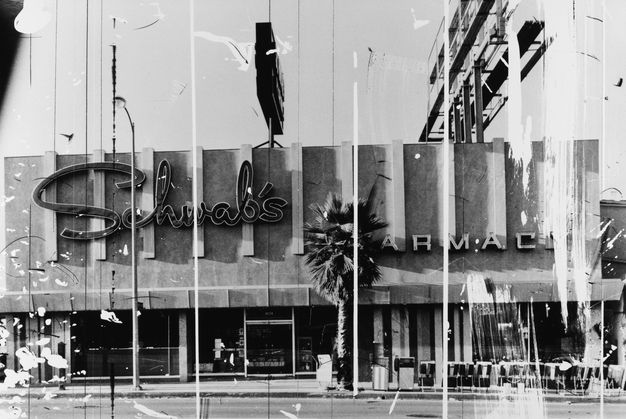
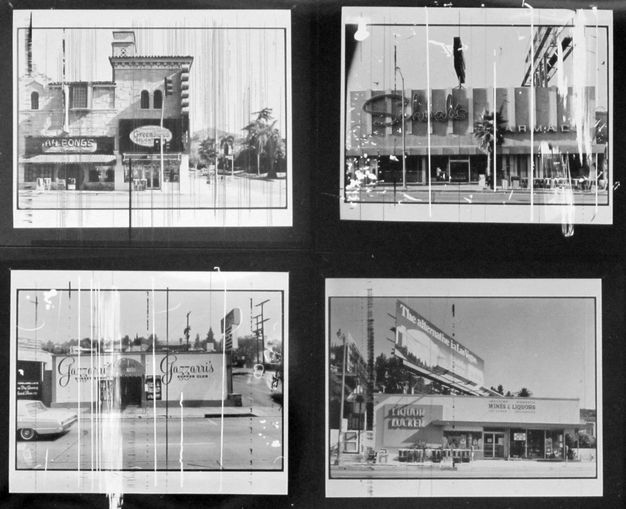
In 1995, Ruscha revisited the 1966 and 1976 Sunset shoots to create a portfolio of six photographic prints—titled Sunset Strip—that was produced with the gallerist Patrick Painter in an edition of twenty-five. Images featuring several iconic landmarks of Los Angeles’ lively nightlife, celebrity, and music scenes were selected for the portfolio: Filthy McNasty’s, Ah Fong’s Cantonese Foods, Greenblatt’s Deli, Schwab’s Pharmacy, the Whisky a Go Go, Liquor Locker, and Gazzarri’s Supper Club (fig. 2.20; see also figs. 16.13, 2.3). New negatives were produced for the images selected, and these were scratched and painted on to give the appearance of distressed film. The additions of the striations and feedback were characteristic of other works Ruscha made in the 1990s, most notably the painting The End (1991), which directly appropriates the closing credits of an old movie. This link to cinema once again connects the Sunset Strip photos to moving images.31 The images also intentionally play with the time lapse between when the images were originally shot and the portfolio production some thirty years later, as the interventions in the negatives make palpable the distance in time between the 1966/76 images and their reproduction in 1995. It was perhaps this portfolio that shifted the SoLA project from rephotography (the implicitly temporal act of photographing the street changing over time) toward before-and-after photography, a more explicit effort at comparing the same street at two different moments. This approach would be seen the following decade in the portfolio and book project THEN & NOW: Hollywood Boulevard, 1973–2004.32
THEN & NOW: The Sky Was Also a Dilemma
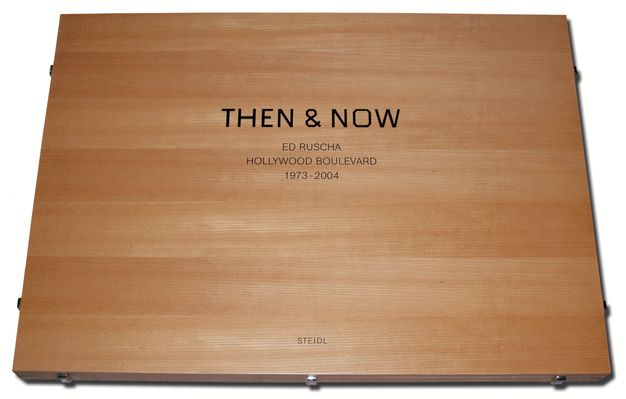
In 2005, the German publisher Gerhard Steidl released THEN & NOW as a limited-edition portfolio of 142 photographic prints (fig. 2.21) and as a trade book, both recording the changes that had taken place over three decades. Ruscha had proposed the idea to Steidl in 2002, and planning began in late 2003.33 In the portfolio, Ruscha’s 1973 images of the north and south sides of Hollywood Boulevard were printed parallel to the 2004 images (fig. 2.22). THEN & NOW relies on a formula similar to that of Every Building, with the familiar white space between the pasted-together images of the street; however, THEN & NOW has four, rather than two, strips of images. The sets of images of the boulevard’s north side run along the printed page at the top, and those of the south side run inverted along the bottom. But rather than using a single accordion-folded page, or strip, the trade book used a traditional format, while the portfolio was produced as individual large-format prints (27 1/2 x 39 3/8 inches) housed in a heavy wooden encasement. The massive size of the portfolio pages is an almost comical postscript, a self-rejoinder, to Ruscha’s earlier insistently portable and distributable books.
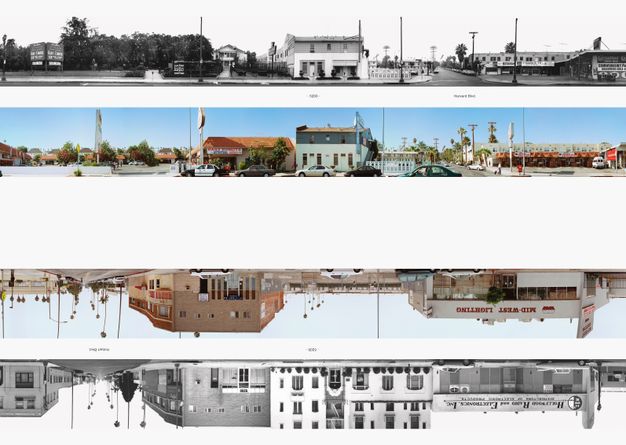
The entirety of Hollywood Boulevard was not a “strip” like Sunset but a complex topography of hilly, green embankments perhaps not quite so seamlessly transferred to the printed page. Unlike its predecessor, Every Building, where cars and pedestrians are frequently chopped off and facades unmatched as if one is moving along the street too fast to capture the wholeness of any one object, the images in THEN & NOW are seamlessly matched and retouched as needed. The archival documentation addresses the issues surrounding the difficulties of producing this image justification. The 2004 shoot, for example, took many more days than the original 1973 shoot. The production files contain an excess of information about Ruscha and the Steidl team’s conception of his project. Revisiting Hollywood Boulevard brought up the “then and now” not only of the street but also of digital technology and the newfound possibilities for image justification in Photoshop. For instance, whereas in 1966, Ruscha used pasteup to create a continuous but still jarring and jumpy record of Sunset, in 2004 his team and the Steidl team worked together to create a smoothly pasted-together paper route through Hollywood Boulevard. Indeed, in 2004, the updated photographic technology—such as the use of color photography, Photoshop, and digitization of images—was a central part of the production process.
The 2004 team’s notes reveal the difficulties in capturing the images needed due to the twists and turns of the narrow, hilly streets. Whereas the 1966 Sunset photographs had been contiguous with a long strip of paper, Hollywood Boulevard produced a pile. Ruscha’s team went to great lengths to capture the required images, perhaps due to the addition of Jonas Wettre, a member of Steidl’s company, whose approach made this shoot notably more computerized and digitized than any previous projects or shoots. Notes prepared for the shoot, which took place over six days, say to “make sure that it is always an overlap that is identical data” and mention that “we have to make adjustments and retouching to make it look natural . . . cars that appear over each other, here we have to move cars and/or trees to make it natural. So it’s not meant to look like reality, that’s impossible. It’s just meant to look good.”34 Wettre complained that the job was made difficult because the black-and-white images from the 1970s were “surfing up and down,” and then, in the recent color images, “the street is changing color all the time” and therefore “the sky was also a dilemma.”35
As well as being an ambitious photographic endeavor, the THEN & NOW project (and the SoLA photography in general) was a feat of archival organization, administration, and storage. A green spiral-bound notebook contains many details of the 1973 Hollywood shoot, such as a checklist of an astonishing array of equipment that included film-changing bags, extra batteries, a spot meter, and sandbags for weighing down the camera tripod equipment. With the slate board that was used to write roll numbers and shoot details, the list of equipment resembles a movie operation. A note from the 1973 shoot says to “scratch roll number on end of film”—just one method for keeping track of the many rolls of film. Ensuring that the photographs were standardized was important (“Always call out aperture and focus changes to each other . . . when shooting rolls #s etc.”), as was quality control (“make periodic checks of camera angle and level”).36
THEN & NOW seems to have caused a shift in Ruscha’s thinking and work about Los Angeles’ urban environment. In 2005, when Ruscha represented the United States at the Venice Biennale, the “then” and “now” frame that he had been exploring for the past several years in his photographs of L.A.’s streets was applied to the paintings in his Course of Empire series, which explored images of Los Angeles sites from the 1990s and then again in the 2000s.
Further Expansion: Streets as Landscapes
In 2007, Sunset Boulevard, Melrose Avenue, and Santa Monica Boulevard were rephotographed, but it was not until 2008 that a new phase of the SoLA project began that saw an expansion of the territory being photographed and filmed, including new streets and areas of Los Angeles, as well as the use of a variety of methods. The newly added streets in 2008 included Western Avenue and Olympic, Wilshire, Beverly, Pico, and Venice Boulevards. In 2009 the team photographed Ventura Boulevard, Third Street, Fountain Avenue, Franklin Avenue, Sepulveda Boulevard, Figueroa Street, and La Cienega Boulevard. In 2010, what the team termed suites of streets in Chinatown, Culver/Fermin, La Brea, and Silver Lake were added, along with several smaller streets. The team has continued to add new streets, such as Crenshaw Boulevard in 2017.37
While over time the team explored both digital photography and video capture, they deemed the original analog setup preferable for image quality and consistency. However, the demands of the SoLA shoots far exceed the planned use of the cameras, resulting in the Nikon F3 bodies needing constant repair and prompting their accelerated obsolescence (fig. 2.23). The team currently has fourteen cameras in rotation, which, just as in some of the earliest shoots in the 1960s, are fitted with a 250-exposure, motor-drive back. A fifteen-passenger Ford van was at the time of writing the vehicle of choice. The van is rented for each project, and the vehicle is temporarily modified by removing seats and side windows to accommodate the camera equipment. “Since the Steidl shoot in 2004,” Gary Regester notes, “the team has used Kodak 5207 color negative cine film in rolls varying from 400 to 1,000 feet. A prep day is spent in the darkroom, rolling the film into cassettes holding 33-foot lengths. A 1,000-foot reel yields 30 cassettes of film (8,000 exposures total). Each cassette covers approximately one-and-a-half miles with the van driven at 20 mph. Most shoots are horizontal format, and for these, we use a 35mm perspective-control lens.”38 On several occasions, “Ruscha himself has appeared in Streets of L.A. frames in ‘Hitchcock-style’ cameos, notably in front of his Echo Park Avenue studio in 2010, on San Fernando Road in 2011, and in front of his current studio in 2012. Gerhard Steidl also made a cameo appearance in the THEN & NOW shoot in 2004.”39
In more recent years, Ruscha and his team have expanded their focus beyond Los Angeles into the desert, which they still consider part of the SoLA project. These shoots not only record the new subject matter but also mediate some of the themes present in Ruscha’s earliest works. From 28–31 May 2013, the team photographed Las Vegas Boulevard, best known for its own quintessential strip. Photographing the desert city in turn precipitated a shift to documenting other sites in the Mojave and Colorado Deserts. (Throughout, the team also continued to document Los Angeles’ city streets.) On 14 October 2014, they took video of Bombay Beach (a former resort turned ghost town that has repopulated in recent years) from a van and in the following months produced a video that contained the footage as well as still video shots of the ecological wasteland of Salton Sea Beach. This video was overlaid in postproduction with textual information that labeled streets as well as unusual sights, such as an abandoned piano, on the debris-strewn route. Another video, made from a shoot on 15–16 August 2015 and titled Along US 66, Amboy, Needles & Cadiz California, takes the historic Route 66 (the highway from Oklahoma to California that Ruscha frequently drove as a young man). The video stops off at sites along the way, such as the Mojave Desert’s Amboy Crater, with video notations of Googie architecture and signage, motels, impromptu art installations (hundreds of shoes on a tree branch, for example, and a misplaced Asian stellae), and an abandoned building that could have been one of the twenty-six gas stations Ruscha documented in the early 1960s. Indeed, in Ruscha’s video, this once-thriving route, removed from the official US highway system in 1985, still bears the skeletal frameworks of abandoned gas-station structures that marked its heyday. The patterns created by rows of trees in satellite images recall the aerial photographs contained in the book Thirtyfour Parking Lots in Los Angeles. The camera further shows us railway crossings, an abandoned building covered in graffiti, single shots of desert trash, and a huge sign for “GAS.” In these videos, when major roads are recorded, the team shoots straight out of the front window to document the journey, without attempting to record every detail of the streets. In the expanse of the desert, a different approach is required that forgoes the need to record everything, as the cultural impact on the landscape here is intermittently recorded.
Ruscha has commented on his discomfort with fixing a subject in time through photography, apparently concerned about the nostalgia that can be created by this fixity. In 2004, he observed that “even if you go out and take a picture of a gasoline station that is freshly built today, ten years from now, it won’t look so old, but twenty and thirty years from now it will. Everything becomes nostalgia after a while. That’s sort of unfortunate because it’s as though the thing, itself, becomes a victim of history.”40 In 2008, he remarked, “That’s the one thing I regret about any photograph: that eventually it becomes historical, nostalgic, out of date. It begins to look like the age it came from.”41 Straining against this inevitable nostalgia, the Streets of Los Angeles Archive never gives in to fixity, instead opting for a living, fluid image in motion, one that is mutable and organic rather than nostalgic. The archive provides us with a portrait of an artist who has a complex and multidimensional relationship to photography. It challenges the idea of Ruscha’s photographs as deskilled or one-offs, or just something to fill the books. The Streets of Los Angeles project is ambiguous: it both stores photographic records in an “image morgue” and remains active and vital to Ruscha’s practice—a central, though previously almost invisible, visual store.
Notes
-
The Los Angeles County cities in Ruscha’s project include not only Los Angeles proper but also Malibu, West Hollywood, and Beverly Hills. For the purposes of this book, “Los Angeles” is inclusive of these cities. ↩︎
-
The numbers of images in the SoLA Archive are estimates. The estimated number of photographs taken during each shoot is based on a base ratio: length of film to miles of road. This ratio was established both by Ruscha’s team and by the efforts of the Getty digitization team. ↩︎
-
Ed Ruscha’s photographs were acquired by the GRI in 2011 and are contained in two archives: Edward Ruscha Photographs of Sunset Boulevard and Hollywood Boulevard, 1965–2010, 2012.M.1, and Edward Ruscha Photographs of Los Angeles Streets, 1974–2010, 2012.M.2. Together, these are jointly referred to as the Streets of Los Angeles (SoLA) Archive. The figure we have for the number of images in the archive is estimated. See Emily Pugh, “Some Los Angeles Streets: Ed Ruscha in the Library and Archive,” this volume. ↩︎
-
Ed Ruscha, interview by James Cuno, “Ed Ruscha’s Los Angeles,” Getty Art + Ideas podcast, 3 August 2022, https://blogs.getty.edu/iris/podcast-ed-ruschas-los-angeles. ↩︎
-
These are now in the collection of the Whitney Museum of American Art. For reproductions, see Sylvia Wolf, ed., Ed Ruscha and Photography, exh. cat. (New York: Whitney Museum of American Art, 2004). See also Alyce Mahon, “‘Almost Too Hot to Handle’: Ed Ruscha’s Every Building on the Sunset Strip,” this volume. ↩︎
-
Goode and Ruscha were Chouinard students at the time. Goode, like Ruscha, showed his work in the 1962 exhibition New Painting of Common Objects, held at the Pasadena Museum of Art. Featuring artists such as Andy Warhol and Roy Lichtenstein, the exhibition helped to launch Ruscha’s and Goode’s fine art careers. For an early review of the exhibition, see John Coplans, “The New Paintings of Common Objects,” Artforum 1, no. 6 (1962): 26–29. ↩︎
-
Ed Ruscha, quoted in Alex Greenberger, “He Rebelled against All Constraints of Society: Ed Ruscha, Danny Lyon, Dawoud Bey and More Remember Robert Frank,” Artnews, 23 September 2019, https://www.artnews.com/art-news/news/robert-frank-remembrances-13235/. ↩︎
-
Scott Rothkopf, “Ed Ruscha: Grand Tourist,” Artforum 42, no. 10 (2004): 229. ↩︎
-
Alexander Rodchenko, “Downright Ignorance or a Mean Trick?,” in Photography in the Modern Era, ed. Christopher Phillips (New York: Aperture, 1989), 246. ↩︎
-
Ed Ruscha, quoted in Douglas M. Davis, “From Common Scenes, Mr. Ruscha Evokes Art,” reprinted in Edward Ruscha, Leave Any Information at the Signal: Writings, Interviews, Bits, Pages, ed. Alexandra Schwartz (Cambridge, MA: MIT Press, 2002), 28. ↩︎
-
This is the title of a 1975 painting by Ruscha. He has commented elsewhere that he chose Sunset in part because “he always liked the name of it.” Ruscha and Cuno, “Ed Ruscha’s Los Angeles.” ↩︎
-
Ruscha’s records indicate that he paid McMillan one hundred dollars for the first attempt at the photography of the Sunset Strip; Record book, 1966–1972, box 17, folder 6, Edward Ruscha Photographs of Sunset Boulevard and Hollywood Boulevard, 1965–2010, 2012.M.1, Getty Research Institute, Los Angeles (hereafter SoLA Archive). ↩︎
-
Susan Haller, email to Zanna Gilbert, 27 July 2022. ↩︎
-
Both McMillan quotations are from Jerry McMillan, interview by Zanna Gilbert, January 2020. “He wanted to do a book on every building on the Sunset Strip, and so he asked me if I would be interested in helping him and what have you. So, I said ok. And so it’s hard to remember all this, but I went up and started shooting, and we talked about it and how difficult it was, the way I was able to do it. And then he met somebody or knew somebody, I don’t know exactly, except he told me something about doing this other thing and using a motorized 35mm camera. And Ed had a small pickup truck, and they put it in the back of the truck, and I think it was a Sunday, and they drove up and down Sunset all the way from one end of Sunset to the other, and photographed it, and by far it came out better than what I was doing, and they did it in one day. They probably did more than one day. They used my darkroom. Had it on a tripod. 3–5 days’ walk from one place to the other to find a place I could be in. I was shooting one side of the street and then planning on coming back the other way. I didn’t make it back. He didn’t have a little drawing or any kind of plan that he showed me. He just had this idea. I didn’t have a picture of what he wanted. I might have done some other things if I had a better idea.” Note: Ruscha did not start using a pickup truck until 1973; he used a car in 1966. Zanna Gilbert, in conversation with Ed Ruscha, 27 January 2025. ↩︎
-
See Isabel Frampton Wade, “‘The Tyranny of the Glossy’: Commercial Architectural Photography and Ruscha’s Streets,” this volume. ↩︎
-
Record book, 1966–1972, box 17, folder 6, 2012.M.1, SoLA Archive. ↩︎
-
The partial mock-up and a diazotype copy of this initial attempt can be found in box 14*, folder 1, 2012.M.1, SoLA Archive. The four-part, joined panorama of the mock-up displayed on Ruscha’s studio wall is in box 17, folder 3, 2012.M.1, SoLA Archive. ↩︎
-
Record book, 1966–1972. ↩︎
-
Ruscha and Cuno, “Ed Ruscha’s Los Angeles.” ↩︎
-
Deborah Vankin, “65,000 Photos of Sunset Boulevard: Take the Ultimate Road Trip with Ed Ruscha,” Los Angeles Times, 7 October 2020, https://www.latimes.com/entertainment-arts/story/2020-10-07/ed-ruscha-sunset-boulevard-getty-database. ↩︎
-
McMillan, interview. ↩︎
-
Jennifer Quick, “Pasteup Pictures: Ed Ruscha’s Every Building on the Sunset Strip,” Art Bulletin 100, no. 2 (2018): 132, https://doi.org/10.1080/00043079.2018.1393327. ↩︎
-
According to Gary Regester, the original rolls were one hundred feet in length. Haller, email. ↩︎
-
To identify the date of this shoot, Isabel Frampton Wade looked for evidence within the photographs featuring billboard advertisements, etc., and surmised that these images were taken in April or May 1966. For example, the following URLs are taken as evidence of the dates: Icecapades billboard at L.A. sports arena lists date for May (see https://www.getty.edu/research/collections/object/1036VK); and a Hollywood Palladium show identifies “Spring Promanade [sic] ’66” (see https://www.getty.edu/research/collections/object/100Z6A). ↩︎
-
Jennifer Quick uses this term in Back to the Drawing Board: Ed Ruscha, Art, and Design in the 1960s (New Haven: Yale University Press, 2022). ↩︎
-
Green spiral-bound notebook containing notes written by Ed Ruscha, Paul Ruscha, Susan Haller, Bryan Heath, and Eddie Ruscha, 1973, box 7, folder 13, 2012.M.1, SoLA Archive. ↩︎
-
Ruscha kept a studio at this address from 1965 to 1985. ↩︎
-
Notebook pages, box 39, folder 1, 2012.M.1, SoLA Archive. ↩︎
-
Haller, email. ↩︎
-
Red spiral-bound notebook, box 7, folder 8, 2012.M.1, SoLA Archive. Written on front cover: “Sunset Blvd. (and other streets) photography notebook / Sunday, Aug. 1995 and Monday, Aug. 21, 1995. Blue spiral-bound notebook. On Sept 14, 1997, a team comprised of ‘Shane Guffogg (driver), Gary Regester (photographer), Paul Ruscha (film changer), Eddie Ruscha (I.D.ographer)’ set off at 6:40am from the intersection of Sunset & Crescent Heights Blvd, heading West.” ↩︎
-
See Mark Shiel, “Ed Ruscha’s Street Photos and the Cinematic Sequence Shot,” this volume. ↩︎
-
For more on before-and-after photography, see Kate Albers and Jordan Bear, eds., Before-and-After Photography: Histories and Contexts (London: Bloomsbury, 2017). ↩︎
-
Haller, email. “In 2002, . . . Steidl was in production with the first volume of Ruscha’s first Catalog Raisonné of Paintings. He expressed an interest in working on another project with Ruscha, so later that year Ruscha proposed a re-shoot of his 1973 shoot of Hollywood Boulevard. Planning for this project eventually began in late 2003. Ruscha and Steidl assembled a team to produce the shoot, which took place between June 5–10, 2004.” ↩︎
-
“How to Handle Images in Photoshop,” document, 2004, Then + Now Production Data, box 39, folder 11, 2012.M.1, SoLA Archive. ↩︎
-
Jonas Wettre (Steidl) to Ed and Paul Ruscha about filling in gaps, 2004, Then + Now Production Data, box 39, folder 11, 2012.M.1, SoLA Archive. ↩︎
-
Green spiral-bound notebook, 1973. ↩︎
-
An inventory of “Streets” shoots from 1965 to 2023 is available at https://www.getty.edu/publications/ruscha/_assets/downloads/ruscha-work-list.pdf. ↩︎
-
Haller, email: “For the few shoots that are vertical format, we use a 28mm PC lens. Vertical format shoots include a Larchmont Blvd test, Las Vegas Blvd (Las Vegas, NV), and one Figueroa Street (Temple to Pico) shoot. Concurrent with the motor-drive stills, we began shooting video in 2004 with the Hollywood Blvd THEN & NOW Steidl shoot. The footage serves as backup and has occasionally been used to fill in for skipped or missing frames.” ↩︎
-
Haller, email. ↩︎
-
Sylvia Wolf and Ed Ruscha, “Nostalgia and New Editions,” in Wolf, Ed Ruscha and Photography, 273. ↩︎
-
Leo Benedictus, “Ed Ruscha’s Best Shot,” The Guardian, 28 May 2008, 29. ↩︎