While carefully leafing through the foldout pages of Ed Ruscha’s Every Building on the Sunset Strip (1966) with gloved hands and a scrutinizing eye, I noticed a single, monumental The fashioned in bold, italic lettering emblazoning the windowless, single-story facade of street number 8844 (fig. 12.1). Judging from the double page in front of me, the lonely definitive article seemed to be the result of the artist’s shortening of the facade in postproduction with an X-Acto knife and paste. A look at the newly visible, digitized archive of the original shoot reveals, however, that the store’s logo had not yet been attached to the wall in full when Ruscha’s image machine came driving by (see fig. 4.5). Its installation happened to coincide with the artist’s first shoot.
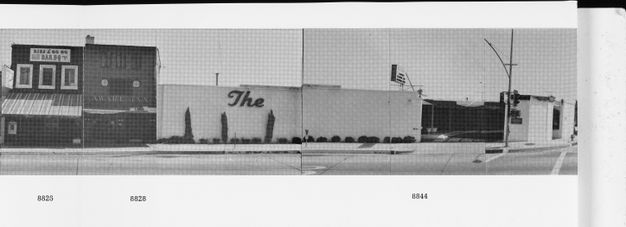
The resulting image gives pause. Breaking into the succession of tiny, unassuming storefronts running along the upper and lower edges of the foldout pages in hues of gray, the graphic presence of the black word on the bright white wall demands our attention but then falls short of delivering its message. The massive The doesn’t do its grammatical job. It stands ready to define a missing noun while an expanse of wall space reminds us of the noun’s irritating absence. It announces something that is not there. This happenstance detail illustrates the conceptual claim of the artist book Every Building on the Sunset Strip, just as the book indicates the aim of the Streets of Los Angeles (SoLA) Archive, from which its photographic raw material was sourced. In all three cases—the single photograph, the foldout book, and the digital archive—photographic documentation suggests the seamless and complete transmission of visual information but then fails to deliver its message. In what follows, I discuss Ruscha’s rejection of the functionality of images as carriers of information by situating his work in the context of 1960s information and communication theory.
Ruscha’s photographic practice relates to concepts of the image that grew out of systems theory and communication science, as well as their applications in urban planning. Initiated by the architect and theorist Kevin Lynch and his groundbreaking publication The Image of the City (1960), urban planning underwent a paradigm shift at the beginning of the 1960s.1 “Orthodox” city planning, the critique went, had superimposed a social utopia of order, simplicity, clarity, and harmony upon the physical environment of the city and thereby neglected the actual intricate, multifaceted, and often chaotic workings of cities. This “anti-city” planning, as Lynch’s contemporary, the architectural critic and activist Jane Jacobs called it, was seen to be responsible for the decline of US cities.2 In Jacobs’s view, the scattered formlessness, inaccessibility, social insularity, and absence of public space and public life was a result of abstract ideas developed on the drawing board that were put into practice without consideration of the reality of city life.3 In contrast, new planning was to be founded on the lived experience of the existing cityscape. The analysis of the inhabitants’ views and uses of their urban environment was regarded as the foundation for further planning and development. Los Angeles, the city that Ruscha began to document so excessively just a few years later, was at the heart of this paradigm shift in urban planning. Hailed by planners of the 1940s as the virtual realization of Ebenezer Howard’s Garden City ideal, Los Angeles served as the perfect punching bag for the detractors of this approach a decade later.4 It is no coincidence, then, that Los Angeles provided a regular case study for the development of novel concepts and methods of city planning. Now the greatest challenge for planners was the visual excess of the existing urban fabric. The perceived “chaos” of the contemporary city needed to be transformed into information that could be processed, interpreted, and acted upon.
In the following I first extrapolate the understanding of the image as it develops from such considerations of the contemporary urban environment—an increasingly complex system of visual communication. Contemporary theorists and planners placed great confidence in the potential for images to serve as carriers of information, which can be read if one has the right tools for the task. Even though Lynch and his contemporaries agreed that a city like Los Angeles came very close to incomprehensible chaos, they were also convinced that with the right architectural, perceptual, and technological tools, its “imageability” could be amplified and filtered in such a way as to become useful information again. The term image was of threefold significance in this context. Lynch used it to describe the mental image that an inhabitant produces of their environment through daily experience; it also represented the visual structure of the city; and it referred to the output of new imaging techniques employed to document the existing urban environment. If planners succeeded in their analysis of the existing city and, based on their findings, enhanced the visual structure of the urban environment, this would have a positive, clarifying impact on the mental image of its inhabitants and ameliorate their life in the city. From this hopeful background, I subsequently tease out Ruscha’s critical reconsideration of the way images function. In his own prolonged analysis of L.A., Ruscha documents the visual information the cityscape presents but at the same time pinpoints how this information fails to deliver its message, draws a blank, and falls silent. Ruscha’s work against the image as information is most comprehensible in the intersections between his well-known works in different media and his previously invisible, long-term photography project—that is, the Streets of Los Angeles—which he built up in parallel.
Cities as Communication Systems
Two aims overlap in the writings of architects and urbanists of the 1960s. The first task these authors set for themselves was to find methods for residents to orient themselves in an urban structure that was becoming increasingly complex, as its material layout and structure were determined by largely invisible networks of information exchange.5 For his study The Image of the City, Lynch held interviews with a group of test persons. They were asked to recount a map of the Los Angeles area based on their individual use of the urban environment. The respondents generally indicated the streets that determined their way from home to work, the places at which they shopped or spent their free time, and the landmarks they turned to for orientation. From these idiosyncratic mental images, Lynch synthesized a map that included the avenues, districts, architectures, and visual landmarks referred to by a majority of his test persons. Lynch’s method was informed by behaviorist research and system analysis, fields of inquiry that urban planners had begun to regularly turn to. In the late 1940s, the psychologist Edward C. Tolman had coined the term cognitive map for his research on the “place-learning” behavior of rats, which he had conducted by exposing the animals to complex mazes.6 Lynch accordingly describes the production of a selective mental map of the city environment as a process of “place-learning” that is driven by exposure and exploration. Applying cybernetic language to his description of the perception of the city environment, he writes: “Environmental images are the result of a two-way process between the observer and his environment. The environment suggests distinctions and relations, and the observer . . . selects, organizes, and endows with meaning what he sees. The image so developed now limits and emphasizes what is seen, while the image itself is being tested against the filtered perceptual input in a constant interacting process.”7 Similar to a computer program, the cognitive map helps the individual filter the impressions of the environment to arrive at a more refined image of the city, which in turn serves as an increasingly fine-pored filter, and so forth. Los Angeles and its environs proved to be a specifically challenging image to produce. “When asked to describe or symbolize the city as a whole,” Lynch notes, “the subjects used certain standard words: ‘spread out,’ ‘spacious,’ ‘formless,’ ‘without centers.’ Los Angeles seemed to be hard to envision or conceptualize as a whole.”8
The second task urban researchers set for themselves was the development of innovative methods to visualize the complex relations between data, goods, and persons that made up the increasingly complex and largely invisible structure of the contemporary city. Information theorists, designers, and architects experimented with a range of media to provide adequate visualizations of the urban environment and its technologically determined makeup.9 Between 1954 and 1959, Lynch cooperated with the designer and educator György Kepes to produce a preliminary study for The Image of the City. It included almost two thousand photographs that documented sequences of the Boston cityscape as it was perceived while walking along the sidewalk.10 Though the photo archive did not make it into the later publication, it illustrates the researchers’ motivation to collect data for the analysis of the perceptual form of a given city. Lynch’s approach prefigures Ruscha’s own test shoot of 1965, for which the artist commissioned the photographer Jerry McMillan to walk along Sunset Boulevard and document the buildings he passed. Lynch also cooperated with the architects Donald Appleyard and John R. Myer on the picture-heavy publication The View from the Road (1964), which promoted the examination of the contemporary city from street level, in imitation of the lived experience of its inhabitants.11 The authors put their innovative ideas into practice in a corresponding video documentation of a car ride through the cityscape of Chicago (fig. 12.2). Filmed with a static camera aimed at the front windshield, the recording captures the driver’s limited perceptual access to the city’s structural layout. It underscores the importance of colorful, large-scale markers or signs installed along the road, which can be processed from a distance and at high speed. The visual overload of the contemporary urban environment is reinforced by the time-lapse recording, which is sped up over the course of two minutes and fifty-nine seconds. Ruscha’s photographic documentation of Sunset Boulevard is in close correspondence to these efforts. Not only does he visualize a specific, street-level perspective—neither from the sidewalk nor through the windshield but rather imitating the view from a passenger seat, looking out of the side window of a moving car—he also experiments with a combination of car and camera to produce an “image” of the city.
Initially, little effort was made to connect the challenge of visualization to the concurrent social and economic upheavals in the contemporary urban environment and their racial implications.12 Lynch, for his part, acknowledges that his group of interviewees, consisting of white professionals who worked in downtown Los Angeles, produced a shared cognitive map that blocked out segregated neighborhoods, such as those in South Los Angeles, which was a predominantly Black community, and East Los Angeles, which was home to mostly Mexican, Mexican American, and Latin American residents.13 But he is not concerned with the discriminating impact of the formation of group identity on the basis of a shared visual memory. Lynch’s focus is squarely on ways planning can help enable inhabitants to perceptually produce a “visual form” of the city. Ruscha’s focus is on subverting this dream of clarity and control.
Visual Design: Learning Perception, Enabling Communication
Ruscha became an active participant in the discourse on visual communication during his studies in advertising design at the Chouinard Art Institute from 1956 to 1960.14 Since the beginning of the 1950s, design instruction had broadened from the teaching of industrial design toward an instruction in perception. This change in emphasis was to a large degree informed by the newly developed information theory, which had grown out of research in telecommunications that Claude Shannon and Warren Weaver conducted at Bell Telephone Laboratories and the Massachusetts Institute of Technology (MIT). Formulating their theory in the context of telecommunication, the mathematician Shannon and electrical engineer Weaver defined information as a transmission of a message from sender to receiver. They focused on the conditions for the successful transfer of the signal as well as on its possible disruptions and malfunctions, which might cause a loss of information. Aiming to solve what they understood to be first and foremost an “engineering problem,” they explicitly excluded “meaning” from their conceptualization of information.15 Shannon and Weaver’s information theory quickly diffused into other contexts. It was used to describe not only data transmitted on wireless and fiber-optic networks or broadcast on media but also biological, chemical, physical, and social processes of address and response. Their rather narrow understanding of information was conferred on these diverse contexts as well.
Kepes was a colleague of Shannon’s at MIT. In close correspondence with the latter’s model of communication, Kepes understood design as a means to support and stabilize the transmission of signals. His pedagogical program was aimed at an “education of vision,” which would enable an unobstructed flow of information.16 In his publication and exhibition The New Landscape of Art and Science (1956), Kepes presents visual analogies between organic and inorganic, micro and macro, and natural and human-made structures to alert his audience to their formal similarities. He argues that learning to recognize such patterns provides the perceptual basis to find visual order in the vast and complex networks of contemporary society. Design accordingly needs to be based on a “dynamic iconography,” which considers “perception’s dependence on pattern seeing and latent visual knowledge, and its experiential nature.”17 Kepes was convinced that this new “language of vision” could ameliorate contemporary society’s difficulty with developing adequate channels of communication among highly diverse areas and agents. As an environment in which this communication crisis played out, the contemporary city was a crucial area of application for this work, as Lynch’s research for The Image of the City, codirected by Kepes, evinces. In 1959, as a student, Ruscha visited the International Design Conference in Aspen, (titled “Communication: The Image Speaks”); though Kepes did not attend, his paper was printed in the conference reader.18
Kepes and Lynch were invested in the importance of perception as a teachable skill that can ameliorate the disparate and opaque status quo of the contemporary world. In Language of Vision (1944), Kepes diagnoses a “formless age of transition, of chaos, incomparable to anything man has ever experienced before,” and Lynch specifically applies the term “formless” to Los Angeles.19 But information theory had taught them that formlessness is merely a result of insufficient information.20 Consequently, both authors introduce concepts, methods, and technological instruments that enhance information in order to adequately visualize the perceptual chaos of the contemporary urban environment. They believe that these efforts will ultimately make manifest new patterns and structures that can be used to organize one’s life and scientifically analyze it for further improvement.
Despite his professional training, Ruscha’s own take on images does not comply with the idealistic notions of “wholeness” and “visibility” that resonate in both Kepes’s and Lynch’s conceptualizations of image-making. Ruscha, I argue, bows out of these hopeful claims. For him, Los Angeles is not a complex system of communication. Its users do not need to be trained in perception and its researchers do not need to be provided with better visualizing tools to process the visual information at hand. For Ruscha, L.A. is rather the perfect example of an image that fails to act as a carrier of information. My following discussion of Ruscha’s artworks against the background of his continued photographic documentation of Los Angeles clarifies that he seeks out and produces images that cannot be reduced to information. Their material makeup, their weight and body, continuously gets in the way of their message. The The on the facade of 8844 is a case in point. Because the heavy, black letters of the store’s name have not yet been drilled into the pristine white wall, the lettering’s meaning is announced, but not delivered. The materiality of information, and its adverse impact on information’s functionality, moves to the foreground.21 Ruscha’s handling of two visual qualities that Lynch ascribed to Los Angeles in order to pinpoint its challenging formlessness makes the artist’s image critique manifest: L.A.’s low “imageability” and the necessarily procedural perception of its horizontal expanse.22 In the following, I will trace these qualities in Ruscha’s own image-making. While Ruscha documents them quite literally in the SoLA Archive, they are also of fundamental importance for his artistic work in other media, which developed parallel to his continued engagement with a limited number of L.A. boulevards.
Low Imageability
Lynch defines the imageability of a topographical place as its quality to be perceived as a coherent pattern or entity—in other words, as an image. To be perceived as an image, the environment needs to possess a recognizable form and a spatial structure, which clarifies the position of the observer as well as that of the perceived objects. L.A. lacks this kind of form.23 All efforts of visualization must be geared to the enhancement of its imageability.
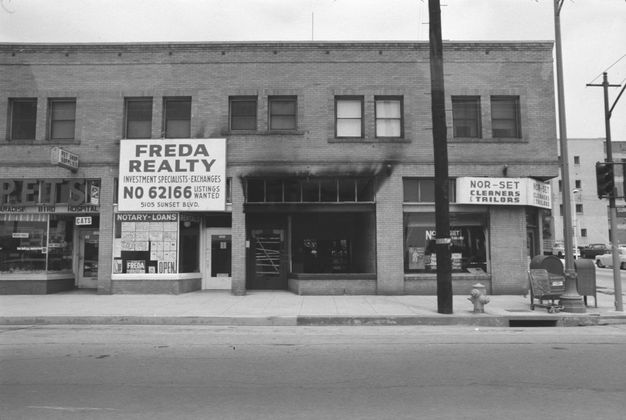
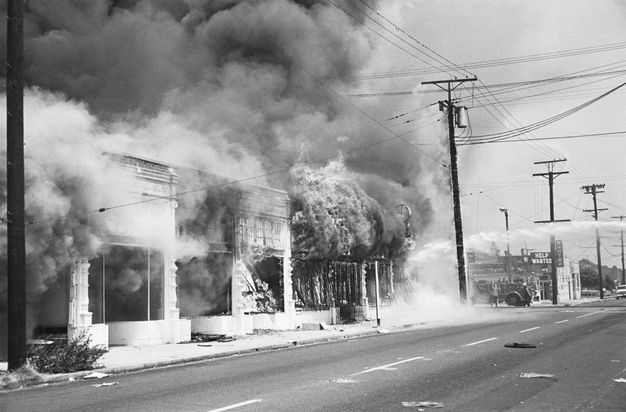
Ruscha, on the other hand, embraces the low imageability of Los Angeles. Arguably, it becomes the most prominent motif within the SoLA Archive. Based on the conventional understanding of photography as a documentation of the real, Ruscha apparently captures everything that is visible on Sunset Boulevard. But despite the medium’s claim of completeness and transparency, the informational value of the enormous resource of visual data that his camera-pickup-imaging machine has produced is questionable. Due to the ninety-degree angle of the camera installed on the vehicle, the resulting images lack spatial localization. They double the storefronts in front of the camera, while the social landscape behind these facades remains invisible. An image from Ruscha’s test run from 1966, for example, shows a clinker-brick facade with storefronts of a pet shop, a real estate agency, and a dry-cleaning business (fig. 12.3). The road and sidewalk are deserted, no customers are visible, and the second-story windows are covered with screens. An alarming detail breaks into the eerie silence of the photograph: the storefront at the center is burned out. Its window is missing, and the door is barred haphazardly with narrow planks. Black soot traces the route the flames took, indexical evidence of the violent fire that blasted through the glass panels above, ready to consume the entire building. This was the year after the Watts uprising. In other neighborhoods of Los Angeles, burned-out storefronts were a familiar picture, signaling the brutal destruction of a city’s social and economic fabric as a consequence of systemic racism (fig. 12.4).24 Contemporary Angelenos and media consumers could not ignore this visual parallel; perception, as Kepes maintained, is based on latent visual knowledge. But the artist’s commissioned camera just documents and moves on. Ruscha’s photographic documentation of L.A. announces information but fails to deliver it.
Ruscha’s interest in images as agglomerations of informational data—which seem to lend themselves easily to configuration and processing while having a meaning that remains frustratingly opaque—is also the driving force of his artist book Various Small Fires and Milk (1964), realized a year before he began his documentation of Sunset Boulevard. The book contains fifteen photographs of various fire sources and, as the subtitle indicates, an image of a glass of milk. Significantly, the last five pages of the slim publication are left empty. In an interview with John Coplans for Artforum, Ruscha describes the photographs assembled in the book as “technical” or “informational” data. This prompts Coplans to ask Ruscha whether he is familiar with the publication Nonverbal Communication (1956) by the psychiatrist Jurgen Ruesch and the artist Weldon Kees. In his answer, Ruscha emphasizes the difference between Ruesch and Kees’s use of images and his own. Pointing out that the authors use image captions to designate the different use values of signs and images, he states that “[Nonverbal Communication] is for people who want to know about the psychology of images,” but “[Various Small Fires] IS the psychology of pictures. . . . Nonverbal Communication has a functional purpose, it is a book to learn things from. You don’t necessarily learn anything from my books.”25 This clarification is crucial in two ways: First, Ruscha is interested in the experiential field of images, in how they “behave” differently in various contexts. Second, he does not aim to break down this experiential field by explaining it or making sense of it. On the pages of his artist book, the “psychology” of images is not analyzed but rather acted out.
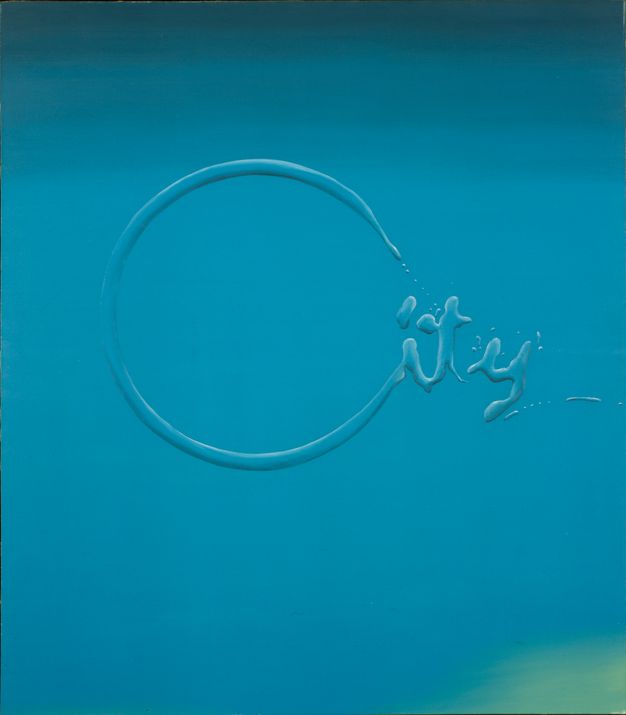
Let me substantiate this claim by taking a closer look at Various Small Fires and Milk (fig. 12.5). The medium of black-and-white photography arrests the lively flames in their movement. Their brightness overexposes the photographic film. Visually abstracted from their different sources—the matches, the lighter, the candle, or the stovetop—they become flattened, amorphous white blobs. In contrast, the glass of milk is perfectly reproducible in a black-and-white photograph. The opacity and stillness of the white liquid, enclosed in the translucent glass cylinder, assist its visualization. The juxtaposition of two elements—fire and liquid—and their divergent “imageability” in the medium of photography pinpoints Ruscha’s interest in the materiality of media and the consequences of their material makeup for their functionality as carriers of information. This is also at play in the painting City (1968) (fig. 12.6). In imitation of a splash of water, the word city sits on a blue surface. The word’s form is contained and “imageable” only due to the horizontal orientation of the depicted tableau, as its liquid materiality suggests. If the material base the lettering seems to sit on were tipped to a vertical position—the orientation of the actual painting on the wall—the word would lose its precarious form. Ruscha presents in his painting a city’s form that is contingent on a volatile moment, when matter and medium come together in a very specific way. Just as the city of Los Angeles threatens to escape its permanent visualization, Ruscha’s City is prone to dissolving into meaningless streaks of water, getting soaked up by its support or evaporating into thin air.
The majority of Ruscha’s other artist books of the 1960s and 1970s feature elements of the city documented continuously in his SoLA Archive that point to the emptiness and illegibility of this assembled “image of the city”—for example, the nondescript and repetitive architecture of gas stations, the barren wasteland, or the empty parking lots. These elements contribute to the structural makeup of the networked city, which is based on the movement of persons, goods, capital, and information. They “image” increasingly invisible networks and in turn contribute to the city’s overall formlessness, its low imageability.
Ruscha is thus more interested in the structure and process of information than in its content. This seems to align with both Lynch’s and Shannon and Weaver’s aims. Accordingly, the digitization process of the SoLA Archive nurtured a latent hope among researchers and archivists: that by digitizing this massive visual resource, it would finally become accessible as information, and that it could be analyzed, read, and productively combined with other data. But Ruscha does not seek to perfect the image’s “identity and structure,” to have it function smoothly as a transmitter of information. Instead, he demonstrates how the materiality of information determines, changes, or obstructs its processing, and how it gets in the way of a city’s imageability.26
Procedural Perception
In The Image of the City, Lynch discusses the mental image that the inhabitant of a city can produce based on the necessarily partial, fragmentary, and processual visual experience of the urban environment. The “observer” plays an active and creative role in this exercise of perception. Lynch describes the process of arriving at one’s own image of the city as a feedback system. Like a computer program, the mental image helps filter the impressions of the environment to arrive at a more refined image of the city, which in turn serves to focus one’s impressions and to see patterns more clearly.27
Urban theorists regularly described the contemporary city as an agglomeration of visual data in need of processing by its users.28 In turn, the city stands ready to explain electronic data processing to a broader audience. In the catalog for the exhibition Software—Information Technology: Its New Meaning for Art, held at the Jewish Museum in 1970, Theodor H. Nelson, the technological advisor for the show, discusses the relationship between hardware and software with reference to a city’s infrastructure. Nelson describes software as “plans and procedures for actions, as distinct from the equipment that carries the action out. Thus in a transportation system the hardware consists of cars, highways, traffic lights and policemen, while the software consists of rules, such as drive on the right, stop at a red light, etc. . . . In computer-based systems we must distinguish between the hardware (computer and reading screen), software (computer and display program) and content (what is read).”29
Ruscha’s camera-pickup-imaging machine seems to be a veritable example of such a system. It photographs the “hardware” and simultaneously visualizes the “software” of the city. This can be seen in L.A.’s traffic-light system; it is mapped onto the archive by means of doubles, which the camera generates at a red light, or by gaps produced in the line-up of the facades when the truck speeds along the boulevard. The availability and use of public transportation is on display: on an early Sunday morning, bus stops are one of the few places where people are outside and immobile, ready to be documented by Ruscha’s machine driving by. At the same time, this neat analog with a computer program is constantly undermined. The two datasets that Ruscha’s analog machine produces of the city’s “hardware” and “software” do not lead to any plausible content. Only by means of a laborious, analog editing process is the “raw data” produced by his machine assembled into a visual entity, which remains difficult to interpret.
What is more, in the interview with Coplans, Ruscha suggests an equally process-based manner of perception for the finished book, inviting viewers to start at any page and flip to any other. You can “edit them in your own mind as you move through the pages,” says Ruscha.30 Compare this to Lynch’s description of the process to produce a mental image of the city: “On different occasions and for different people, the sequences are reversed, interrupted, abandoned, cut across. . . . At every instant, there is more than the eye can see. . . . Nothing is experienced by itself, but always in relation to its surroundings.”31 Both the perception of the city and Ruscha’s artworks involve an active process of visual editing in the attempt to produce content from a mass of visual data.
Already by the late 1960s, the task to adequately visualize the contemporary city came to be regarded as a highly charged political activity. Increasingly, the social implications of the city’s physical makeup came into the focus of city planners. And by the early 1970s, urban planners faced broad criticism for their apparent ignorance regarding the social fractures and injustices that were integral to the city’s structural layout—for example, the racial division of neighborhoods, the economically driven fight for highway accessibility, or the excessive lateral expansion and lack of public transportation.32 Ruscha, however, made clear that he did not choose Los Angeles as a subject because he wanted to make a social or political statement. To the contrary, in a survey conducted for Artforum in 1970, he argued against artists becoming involved in any political agenda: “I have excluded all political science from my program. . . . An objective attitude is one which makes all world events neither good nor bad but only so much data to play with. I isolate myself and my work continues smoothly with no involvement in any issue. . . . I don’t think an artist can do much for any cause by using his art as a weapon.”33
Though Ruscha’s project begins in 1966, the year after the Watts uprising, his SoLA Archive does not lend itself easily to the examination of the social dynamics of the city. His choice of streets stays clear of the underresourced neighborhoods in South and East Los Angeles, which were and still are mainly inhabited by Black and Latino populations and have, since the 1960s, been the site of notable, tumultuous protest against the structural injustices of urban living and police oppression.34 He presents neither a dystopian view of the lamentable status quo of Los Angeles nor a utopian vision of its imagined future. No matter what issues the city has faced over time—the non- or misrepresentation of people of color, gentrification, rising rents, homelessness, and gun violence—Ruscha’s machine continues smoothly, producing a vast amount of visual data without providing the definitive tools or programs to interpret them. But the refusal to interpret receives its own expressive power through the informed intermedial confrontation with media and images of the present (e.g., the newsreel and the newspaper illustrations of the mid-1960s, or Google Maps in 2024), as well as the messages of objectivity and transparency they are conventionally understood to convey.
The loud announcement of visual information and the simultaneous and equally loud refusal to communicate is, as I have argued, at the heart of Ruscha’s image critique. The image with a lonely The is a case in point, but the entire archive functions in a similar way. We are provided with an excess of visual data, which upon closer scrutiny turn out to undermine their functionality as carriers of information. Getty’s own efforts to make Ruscha’s archive workable as a visual resource needs to be addressed in this context as well. Enormous amounts of financial and technological effort and labor have been allocated to the task of processing and editing the mass of visual data that Ruscha has collected over the past sixty years to make it accessible to a growing user community as a source of information about both the artist and the city of Los Angeles. This effort is similar to the task that urban planners like Lynch set for themselves in the mid-1960s: to develop new methods for the visualization of the contemporary city.
As I have argued, Ruscha’s project was a critical riposte to these efforts, which were based on an understanding of the image as a functional carrier of information. Now, his archive’s extremely low imageability is itself approached with innovative technological tools, again with the underlying assumption that its content might turn into functional information.
The The at 8844 Sunset Boulevard is an illustrative example of how the archive refuses this functionalization and acts out Ruscha’s underlying image critique. To learn more about the fate of the lettering, I entered the term The into the search engine of the digital archive. The documentation of the shoot from 1973 solves the mystery of the noun that the lonely article had announced so vehemently: the address houses The Classic Cat, a restaurant and bar established in 1965 (see fig. 4.6). However, by 1976 the lettering does not show up in the result list anymore (fig. 12.7). The The has become invisible to the search engine for the simple reason that foliage has grown over the lettering. The dense ivy cropping up from the left makes impossible any clear differentiation of the black word from the white background. Its form, which would enable its being processed by the word-recognition software, is lost due to the material intervention of natural growth. In the 0-1-world of digital data processing, word merges with plant to become a meaningless blob, a nonfunctional image.
Notes
I would like to thank the Streets of Los Angeles project team at the Getty Research Institute as well as my fellow collaborators for the opportunity to work on Ruscha’s archive in an unprecedented interdisciplinary and collaborative manner. A specific thank-you to Eric Rodenbeck, Stamen Design, for his enthusiastic help in tracing the fate of the The.
-
Andrew M. Shanken, “The Visual Culture of Planning,” Journal of Planning History 17, no. 4 (2018): 300–319. For a contextualization of Lynch’s work in the history of city planning and his role in the reframing of urban planning in the early 1960s, see Tridib Banerjee and Michael Southworth, eds., City Sense and City Design: Writings and Projects of Kevin Lynch (Cambridge, MA: MIT Press, 1990), 1–29. ↩︎
-
Jane Jacobs, The Death and Life of Great American Cities (New York: Vintage, 1992), 21. ↩︎
-
Jacobs, Death and Life, 21. ↩︎
-
Jacobs, Death and Life, 16–25. On Lynch’s prolonged interest in L.A., see Tridib Banerjee and Meredith Drake Reitan, “Kevin Lynch in Los Angeles: Reflections on Planning, Politics, and Participation,” Journal of the American Planning Association 84, no. 3–4 (2018): 217–29. ↩︎
-
Lloyd Rodwin and Robert M. Hollister, Cities of the Mind: Images and Themes of the City in the Social Sciences (New York: Plenum, 1984); Melvin M. Webber, “The Roles of Intelligence Systems in Urban-Systems Planning,” AIP Journal 31, no. 4 (1965): 289–96; and Melvin M. Webber, “Urbanization and Communication,” in Communications Technology and Social Policy: Understanding the New “Cultural Revolution,” ed. George Gerbner (New York: Wiley, 1973), 293–304. ↩︎
-
With the term, Tolman describes a selective mental map, a “broad” picture of the environment, which develops by environmental exploration. Edward C. Tolman, “Cognitive Maps in Rats and Men,” Psychological Review 55, no. 4 (1948): 189–208. Since the late 1940s, the concept of the mental map plays a role in different fields, such as architecture, urban planning, psychology, anthropology, and sociology. ↩︎
-
Kevin Lynch, The Image of the City (Cambridge, MA: MIT Press, 1960), 6. For analogies between the work of city planners and that of systems analysts, see Jennifer S. Light, From Warfare to Welfare: Defense Intellectuals and Urban Problems in Cold War America (Baltimore: Johns Hopkins University Press, 2003), 47. ↩︎
-
Lynch, Image of the City, 40. ↩︎
-
See, for example, Richard Meier, Communications Theory of Urban Growth (Cambridge, MA: MIT Press, 1962); Donald Foley, “An Approach to Metropolitan Spatial Structure,” in Explorations into Urban Structure, ed. Melvin M. Webber (Philadelphia: University of Pennsylvania Press, 1964), 21–78; Thomas Paine, “The City as an Information Network,” IEEE International Convention Record (New York: IEEE, March 1966); and Robert Venturi, Denise Scott Brown, and Steven Izenour, Learning from Las Vegas (Cambridge, MA: MIT Press, 1972), 8. ↩︎
-
Perceptual Form of the City, 1951–1960, 1, Kevin Lynch Papers, MC-0208, Massachusetts Institute of Technology, Department of Distinctive Collections, Cambridge, MA. This is partially digitally accessible: https://dome.mit.edu/handle/1721.3/33656. ↩︎
-
Donald Appleyard, Kevin Lynch, and John R. Myer, View from the Road (Cambridge, MA: MIT Press, 1964). ↩︎
-
This apparent lack of a political dimension was criticized early on. See, for example, Michael Southworth and Susan Southworth, “Environmental Quality in Cities and Regions,” Town Planning Review 44, no. 3 (1973): 231–53. ↩︎
-
Lynch points out that Broadway was regarded by his test persons as a clear spatial marker, which delimited “their” Los Angeles from that of “ethnic minorities and lower-income groups.” Lynch, Image of the City, 37–38. ↩︎
-
See Jennifer Eileen Quick, “Back to the Drawing Board: Ed Ruscha 1956–68” (PhD diss., Harvard University, 2015); and Jennifer Quick, “Pasteup Pictures: Ed Ruscha’s Every Building on the Sunset Strip,” Art Bulletin 100, no. 2 (2018): 125–52. Lisa Pasquariello discusses how Ruscha’s use of language relates to his training in commercial design. Lisa Pasquariello, “Ed Ruscha and the Language That He Used,” October 111 (January 2005): 81–106. ↩︎
-
Claude E. Shannon and Warren Weaver, The Mathematical Theory of Communication (Urbana: University of Illinois Press, 1949), 31. See also Mark C. Taylor, The Moment of Complexity: Emerging Network Culture (Chicago: University of Chicago Press, 2001), 108–10. ↩︎
-
At MIT, Kepes founded the art-and-science think tank Center for Advanced Visual Studies (CAVS) for this purpose. John R. Blakinger, Gyorgy Kepes: Undreaming the Bauhaus (Cambridge: MIT Press, 2019), 95. ↩︎
-
This conceptualization of perception is informed by behaviorist research as well. Gyorgy Kepes, Language of Vision (Chicago: P. Theobald, 1944), 200. See also Blakinger, Gyorgy Kepes. ↩︎
-
In the reader, Kepes focused on the consequences that excessive growth and complexity had for systems (such as cities) and their functionality. See the conference reader for “Communication: The Image Speaks,” 1959, International Design Conference in Aspen records, 1949–2006, box 5, folder 2, 2007.M.7, Getty Research Institute, Los Angeles. Ruscha had visited the International Design Conference in Aspen for the first time in 1958 and attended again in 1960. ↩︎
-
Kepes, Language of Vision, 202; and Lynch, Image of the City, 40. ↩︎
-
Taylor, Moment of Complexity, 24. ↩︎
-
On the materiality of information, see Taylor, Moment of Complexity, 106. For Ruscha’s foregrounding of the physicality of words in his work, see Pasquariello, “Ed Ruscha.” ↩︎
-
Lynch, Image of the City, 1–13. ↩︎
-
Lynch, Image of the City, 9–12. He refers directly to Kepes in this passage. ↩︎
-
See David Ludwig, “Abseits des Sunset Strip,” (Not Nearly) Every Picture—Annäherungen an Ed Ruschas Streets of Los Angeles-Archiv, https://noteverypicture.de/abseits-des-sunset-strip. ↩︎
-
John Coplans, “An Interview with Ed Ruscha,” Artforum 3, no. 5 (1965): 25. Ruesch and Kees reference Shannon and Weaver as well as Norbert Wiener’s Cybernetics; or, Control and Communication in the Animal and the Machine (New York: J. Wiley, 1949). See also Norbert Wiener, The Human Use of Human Beings: Cybernetics and Society (Boston: Houghton Mifflin, 1950). ↩︎
-
Jack Burnham, “Alice’s Head: Reflections on Conceptual Art,” Artforum 8, no. 6 (1970): 37–43. ↩︎
-
Lynch, Image of the City, 6. ↩︎
-
John W. Cook and Heinrich Klotz, eds., Conversations with Architects (London: Lund Humphries, 1973), 247–66. ↩︎
-
Theodor H. Nelson, quoted in Jack Burnham, “Notes on Art and Information Processing,” in Software—Information Technology: Its New Meaning for Art, ed. Jack Burnham, exh. cat. (New York: Jewish Museum, 1970), 12. The analog between built architecture and computer networks is continued in the literature. See, for example, Taylor, Moment of Complexity. ↩︎
-
Coplans, “Interview with Ed Ruscha,” 25. ↩︎
-
Lynch, The Image of the City, 1. ↩︎
-
Following the Watts uprising in 1965, city planners were themselves embarrassed to admit that they did not have any data on South and East L.A., which would have helped them understand the causes of social unrest. They had, in a sense, collected the wrong data sets. This shift in interest is also palpable in the programming of the International Design Conference in Aspen. In 1972, the effects of building abandonment in disadvantaged neighborhoods were addressed under the conference’s title “The Invisible City.” Two years later, and under the impression of sustained social unrest, Melvin M. Webber demanded a critical readjustment of city planning. Melvin M. Webber, “The Post-City Age,” in Suburbanization Dynamics and the Future of the City, ed. James W. Hughes (New Brunswick, NJ: Center for Urban Policy Research, 1974), 245–64. ↩︎
-
Ruscha, “The Artist and Politics: A Symposium,” Artforum 9, no. 1 (1970): 38. ↩︎
-
See Mike Davis and Jon Wiener, Set the Night on Fire: L.A. in the Sixties (London: Verso, 2021). ↩︎