My books were very hot items—it was hot art to me, almost too hot to handle. I liked the idea that my books would disorient . . . like a wolf in sheep’s clothing. I felt they were very powerful statements, maybe the most powerful things I’ve done. . . . My books were art objects to me, but a lot of people chose not to even accept them, and for this reason they have always been underground—and still are.
—Ed Ruscha
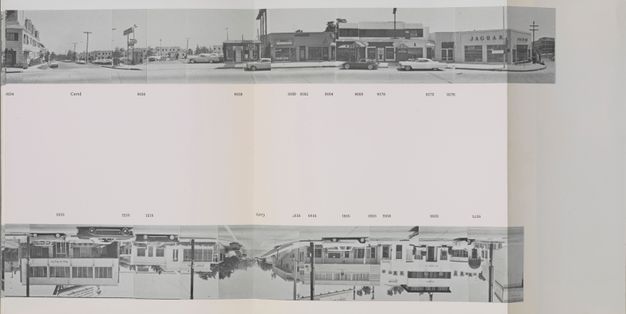
Ed Ruscha’s Every Building on the Sunset Strip (1966) presents the everyday city space of Sunset Boulevard in West Hollywood in an art book that traces a panorama between Crescent Heights Boulevard and Doheny Drive. Produced at a time when the artist’s book was only just gaining ground as an art object proper, the endeavor spawned an exhaustive, if not obsessive, archival project of photographing Sunset and Hollywood Boulevards in Los Angeles, always at low traffic moments and with no stated purpose. The vast majority of these photographs remain as negatives, but they allowed Ruscha to then design his “pasteup” portraits of the Sunset Strip, fusing his commercial training with artistic innovation, as Jennifer Quick has documented.1 As a work of art, Every Building sheds light on the history of and raises critical questions about photography in the 1960s, when the distinction between the photograph as document (objective/indexical object) and the photograph as art (iconic/expressive object) was undergoing a vigorous reimagining by conceptual and pop artists. The artist’s book offered the perfect vehicle for this reimagining of the medium. In Every Building, Ruscha relies on the work of seriality and repetition to undermine the expectation that the photograph represent the world; instead, his work dialogues with what Roland Barthes would later term the “already made” image.2 As a published photographic series selected and orchestrated from an archive of images, Every Building maps a particular locale with dingbat-style apartments, restaurants, and drugstores, along with well-known businesses such as Tower Records, interspersed with billboards, shop displays, signage, vehicles, and minute details that speak to the mid-1960s visual culture of California. As a performance, Every Building offers the trace of an orchestrated, motorized street view. As an art object, the three-dimensional book unfolds into a concertina of pasted-together pages that allows the viewer two continuous photographs of an iconic section of Sunset Boulevard. Ruscha’s art collaging of a selection of photographs from a larger archival work to craft an art book must be appreciated through a series of intertextual interlockings. He turns to photography as a medium for both mass reproduction and avant-garde disruption, seizing the “underground” potential of the tension between both roles.
Every Building is immersive in form and aesthetic (fig. 7.1). It incorporates both an act and the photographic trace of an act in an accordion book of photographs that is twenty-seven-feet long when folded out to its full length. That is to say, it unfolds, literally, in the hands of the spectator-reader, and an urban panorama is reduced to an intimate handheld object. At the same time, given the book’s elastic form and epic subject matter, it is impossible to grasp or read that panorama in one view. In this way, Every Building mimics the very act of driving or cruising along the Strip and snapping details of the street with the mind’s eye, albeit on a much smaller scale. One moves across photographs through to the last, arriving at a white strip that seems to entice the imagination to continue cruising off the page. Ruscha identifies street numbers and the names of cross streets in the book, but he insisted on this design detail at the end, this “leap” into the white strip. When the first print run had an extra 2 7/8-inch flap of paper folded over behind the last page, he elected to retain this “error” rather than eliminate it.3
In this essay, I consider how Ruscha’s Streets of Los Angeles Archive and Every Building reveal a debt to the avant-garde—notably, the art of Eugène Atget and the surrealists—as well as an extension of their fascination with photography’s unique ability to expose the surreal within the real into the postmodern age. Drawing on Walter Benjamin’s concept of “the optical unconscious,” as articulated in his 1928 essay “Little History of Photography,” I argue that Ruscha’s obsessive use of the medium of photography needs to be appreciated as a process of opening the “optical unconscious” in the real.4 Ostensibly, Every Building is a dispassionate document of built structures in a particular geographic location in Los Angeles, and yet it disorientates. It is often described as “cool” in its aesthetic, in keeping with Ruscha’s role in the so-called Cool School around the Ferus Gallery from 1957 to 1966, and yet the artist insisted it was “hot.”5 Marshall McLuhan defines the “cool” media (speech, cartoons, the telephone, and television) as participatory, needing to be completed or “filled in” by the viewer/listener, and “hot” media (print, photographs, radio, and movies) as passive and a “high definition” media that is “well filled with data.”6 Ruscha turns to the art book to explore the interdependence of the cool and the hot, or the photograph as both artwork and document. In Every Building, we find high-definition photographs arranged in a handheld book that appeals to the viewer’s somatic register. It is for the viewer to enter the fiction of a mechanical document and then to discover the work’s sensorial interplay and complete it—to open up to what the camera records.
The Optical Unconscious
The interpretation of any photograph is never fixed. Each viewer sees differently depending on their historical point in time. In his “Little History of Photography,” Benjamin states:
No matter how artful the photographer, no matter how carefully posed his subject, the beholder feels an irresistible urge to search such a picture for the tiny spark of contingency, of the here and now, with which reality has (so to speak) seared the subject, to find the inconspicuous spot where in the immediacy of that long-forgotten moment the future nests so eloquently that we, looking back, may rediscover it. For it is another nature which speaks to the camera rather than to the eye: “other” above all in the sense that a space informed by human consciousness gives way to a space informed by the unconscious.7
Benjamin’s understanding of the photograph also speaks to motion, noting that the camera has the potential to capture, literally, what happens when a person moves or takes a step. This allows it to reveal “the existence of this optical unconscious,” capturing the image before one consciously sees it.8
Every Building makes the familiar street view strange by slowing down the temporal experience of the visible and encouraging invisible imaginings. Ruscha positions the spectator before every building on the Sunset Strip from the perspective of the mechanized camera lens, rather than his naked eye, and from a set position on the back of a pickup truck. In his focus on the street (rather than its inhabitants), mechanized indifference (rather than emotive details), and a horizontal, nomadic perspective (rather than a vertical, cartographic one), Ruscha demands the viewer’s completion of the artwork. Indeed, he hopes it has the subversive potential to be “too hot to handle.”9
It is in hovering on the horizontal line that he ensures this “hot” quality, through the process of installing a camera in the vehicle, and the steady feeding through of 35mm film with a motorized cassette, and then in cutting and pasting images to form two continuous strips facing each other, as the opposite sides of the street. Together this ensured that Ruscha’s own view of Los Angeles as “a landscape line that is actually horizontal” was mirrored.10 By resolutely sticking to the horizontal line, Ruscha reveals the diverse buildings on the Strip—the Body Shop Burlesque (at 8250 Sunset Boulevard); the Sea Witch nightclub (8514 Sunset), with its sign stating “Age Limit 18–80” (fig. 7.2); the rental car business Travelers Rent a Car (8371 Sunset); and Cars from Europe (8373 Sunset).
Ruscha’s careful editing process ensured this horizontality was maintained—the eye could not move into the background, as evidenced by the next photograph showing part of the building beside the Sea Witch, Dino’s Lodge (8524), which he elected to cut from his final presentation of the Strip (see fig. 7.2). The laneway between the two buildings in the rejected photograph would have encouraged the eye to impose a horizon line on the Strip and view it from a vertical perspective, rather than pan across the radically different buildings, one looking like a tiki hut, the other a jazz club and diner owned by Dean Martin (and his business partner, Maury Samuels), as advertised by the huge neon sign of Martin’s face at the right of the composition.
As Eva Respini has observed, the road trip and car-bound view mainly emerges in American photography of this period as framed from the windshield or rearview mirror. This is witnessed in the contemporary photographs of Robert Frank, Lee Friedlander, Andrew J. Russell, and Stephen Shore—such as Shore’s color photograph Beverly Boulevard, Los Angeles (21 July 1975).11 Ruscha’s Every Building is also car-bound in perspective, but he does not frame the Strip from the perspective of a car window or car mirror. Instead, he keeps the street-level facades on a horizontal grid and the perspective of a car passenger, not a driver. This perspective might be compared to that of the flaneur, the “stroller” or observer, and the flaneur’s potential to offer a critical gaze on modern life, as defined by Charles Baudelaire’s model of the “painter of modern life.”12 By employing the view from a car rather than a pathway, Ruscha takes flânerie in a new Beat direction. In this way, Every Building bridges European and American generational approaches to the urban environment, appreciating their common concern with the street, which was not to map territory as a form of conquest or control but to approach space as a means of self-knowledge.
In Ruscha’s terms, this meant mapping “hot” familiar details as a means of generating “cool” strange dynamics—enjoying how the distance between the passive and active makes space for chance, fear, or fantasy. Sigmund Freud’s explanation of the uncanny acknowledged the tension between the built environment, as homely and visible, and the psychic, as the unhomely and what is kept from sight.13 Avant-garde circles in Paris and New York enacted a form of defamiliarization in their art and writing that drew on this Freudian idea of the uncanny as a means to create a mesh of possibilities for the street, facade, or consumer object. The Situationist International group, formed in 1957 in Paris, expanded the subversive potential of flânerie in their concept of dérive (drifting), a term that denotes a shift in speed and spatial frame during aimless wandering. As Guy Debord explains, dérive was a “technique of rapid passage through varied ambiances” that involved “playful-constructive behavior and awareness of psychogeographical effects.”14 To challenge the spectacle of the modern city with its advertisements, traffic, store windows, metros, and general one-directional speed of consumer communication, the group proposed a system of détournement in the city (the literal translation of détournement is “derailing,” but it denotes the sense of navigating the city space without any preconceived plan). Ruscha’s employment of technology—the camera, tripod, vehicle—to enact a form of poetic disorder, rather than order, on the streets of Los Angeles continued this praxis in again allowing the machine to record but not interfere with, or manipulate, the experience of the city as place. Further, the sheer excess of his photographic documentation of those same streets, as evidenced in his archive, embodies an act of deflection or disobedience: it ensures the authentic photographic record metamorphoses into an excessive, installation-like artwork. Ruscha employs the mechanical language of photography to disrupt expectations and to explore the medium’s irrational potential, perfectly advancing the aesthetics of the interwar avant-garde into the 1960s.
The Secret Life of the City
The European avant-garde—notably, the Dada and surrealist movements—turned to the street as a subject and platform for their art. They adapted Baudelaire’s concept of flânerie for a more interactive engagement whereby the artist was encouraged to seek out a person, object, building, or street that might spark a creative idea or act. Aimless wandering was an improvisation process because it took “only a street-turning or a shop-window to inspire a fresh outpouring” and reveal “a kind of hidden life of the city,” as André Breton once described walking the streets of the city in the company of fellow surrealist Louis Aragon.15 Benjamin’s understanding of the optical unconscious was also indebted to an appreciation of the transgressive potential of the familiar to open up new creative outpourings and imaginings. He lauded the surrealists for astutely perceiving how “destitution—not only social but architectonic, the poverty of interiors, enslaved and enslaving objects—can suddenly be transformed into revolutionary nihilism.”16 Both Breton and Benjamin admired the work of the commercial photographer Eugène Atget, who documented Paris and its environs; they saw much greater illuminating potential in Atget’s work than his own modest description of it as “landscapes, animals, flowers and monuments for the use of artists.”17 The fact that some five thousand vintage prints and over one thousand glass-plate negatives were found in his studio after his death suggests he also hoped they might be considered as high art, or at least that his efforts went beyond the commercial commission.18 Atget’s oeuvre reminds us that photography is a deductive art wherein the photographer works from a given image rather than a blank canvas. While he never intended his archive to be institutionally housed or displayed, it has come to frame his individual projects, such that the filing system and the negative are inseparable.
We might also see Ruscha’s intertextual relations with Atget as extending those of American avant-garde photographers—notably, Berenice Abbott. She was instrumental in the promotion of Atget in practical terms as well as formal citation and to the publication of Atget: Photographe de Paris (1930), ensuring that his work was appreciated in the United States, and it was she who purchased the five thousand prints and negatives in his studio after his death, thus preserving his archive (as did MoMA, after acquiring the collection from Abbott). Put simply, Abbott played an important role in Atget becoming a canonical figure for European and American photography, or “canon fodder,” as Abigail Solomon-Godeau describes it. More importantly for this essay, Abbott also ensured that Atget’s seemingly informational photography became newly appreciated as having something more profound, psychological, and poetic to it.19
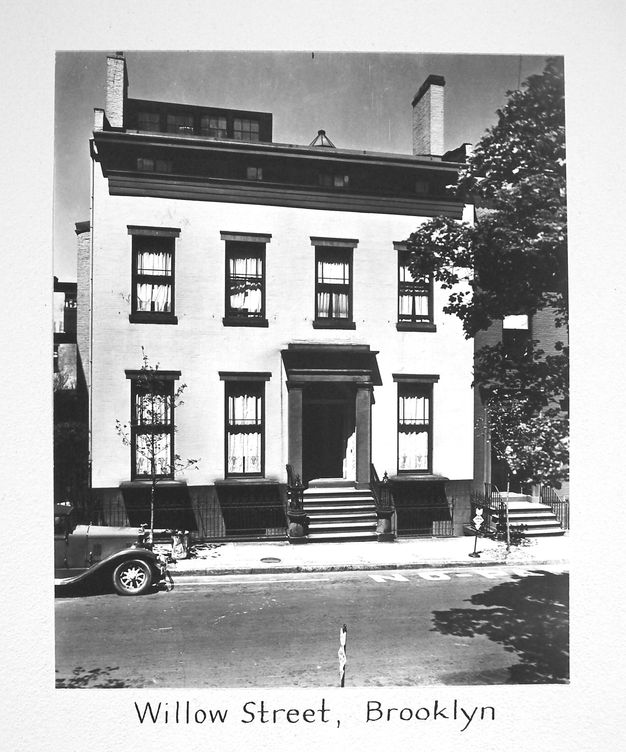
Abbott wrote of Atget’s work as harboring “a sudden flash of recognition—the shock of realism unadorned. The subjects were not sensational but were nevertheless shocking in their very familiarity. The real world, seen with wonderment and surprise, was mirrored in each print. Whatever means Atget used to project the image did not intrude between subject and observer.”20 In her project Changing New York, supported by the Federal Art Project and shot between 1935 and 1939, Abbott’s understanding of such “realism” is made visible.21 We find a clear homage to Atget in her formalist intrigue with the architecture and archaeology of the urban environment as cultural text, whether the photographer is in front of a commercial or privately owned building. She takes photography beyond camera work and yet eschews sentimentality. Abbott’s Changing New York speaks to a Benjaminian understanding of the history of the city and photography’s ability to archive it. She endows the medium with “a legitimating objective and a subversive energy,” as Sarah M. Miller has documented in her appraisal of the project (fig. 7.3).22
It is this pursuit of an oneiric quality within the photograph as informational object that resonates with Every Building and Ruscha’s archival turn. Atget shot multiples of a theme, such as the trades and professions documented in his petits métiers series (1898–1900), and photographs of vehicles, shop fronts, and interiors. Like Ruscha, Atget typically took his photographs in the early morning light, before shops opened to the public or boulevards were busy. Tasked with framing or embellishing reality for the spectator-consumer, he refused the romance of the artist as the master of the worldview. Through the camera of Atget, we discover the character, or “miseries and treasures,” of the city, as Abbott rightly noted, but always from what is unsaid or unseen.23 His photographs of shop fronts—with their factual titles, such as Boulevard de Strasbourg, Corsets (1912) or Brocanteur, rue des Anglais (1926)—dialogue with the world of advertising and consumer culture, but they still unveil the lure of the unknown, or the facade, or the object of desire, as well as what the French call faire du lèche-vitrines, which literally means “to lick the windows” but translates as “window shopping.”
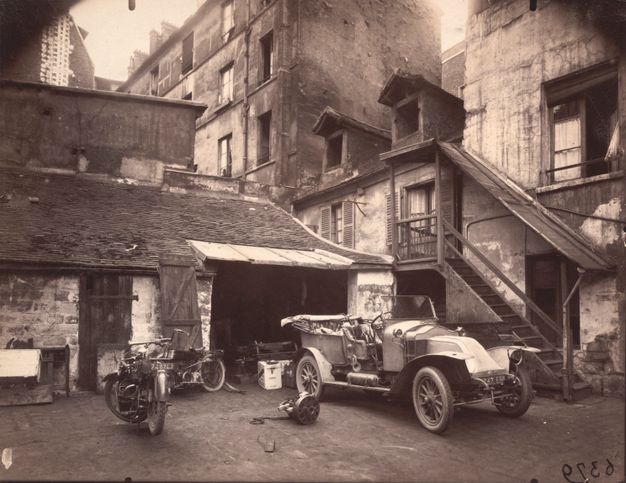
This sense of intimacy is augmented, somewhat paradoxically, by the fact that Atget’s photos were resolutely devoid of the deliveryperson, shopkeeper, pedestrian, or consumer. Thus, while Atget wrote of his photographs in emphatically clinical terms—as documents of a city—they are documents that might be read in a more subversive, corporeal way as the viewer is effectively encouraged to inhabit the scene presented. This, in turn, might be seen to reject the divide between Paris’s boulevards and splendor and its back streets, illuminating sociohistorical moments and demanding we look at the overlooked. For example, in a photograph dated 1922 and titled Cour, 7 rue de Valence, we find a scene from the fifth arrondissement in Paris taken with a wooden camera and a glass negative on a heavy tripod (fig. 7.4). Atget frames a slice of everyday working life without its workers; it is the architecture (a courtyard) and automobile (a Renault car) that lend the image its invisible face and voice. His work was “immensely sensitive, stubbornly popular culture, alien and at the same time half-familiar, strange and desirable, pensé and impensé,” as Molly Nesbit has observed.24 It is this dialectic between the familiar and strange, or between the thought of and unthought of, that finds a legacy in Ruscha’s art.
The Familiar and the Strange
Every Building demands that the spectator engage in the familiar and search out the secrets the overlooked might hold. Ruscha’s titles for his serialized works—Twentysix Gasoline Stations (1963), Some Los Angeles Apartments (1965), Every Building on the Sunset Strip (1966), and Thirtyfour Parking Lots in Los Angeles (1967)—echo those of Atget in their documentary-like practicality. Atget’s influence can also be seen in Ruscha’s formal use of long exposures, which flatten or bleach the sky. At the same time, Ruscha brings the aesthetic of the avant-garde into the postmodern era. Benjamin’s reading of Atget’s photographs of empty Parisian streets might be applied to Ruscha’s deliberate focus on the Strip as facade: it stands before us “not lonely, merely without mood; the city in these pictures looks cleared out, like a lodging that has not yet found a new tenant.”25 With Every Building, the spectator’s eye searches the anonymous physiognomy of the Strip looking for clues, footprints, and meaning across an accordion of sewn-together photographs in which time, space, sound, and narrative are all curiously frozen. Cécile Whiting notes, “Ruscha’s imagery repudiated both the booster’s vision of Los Angeles as a modern city with a center and the doomsayer’s outrage about untrammeled growth.”26
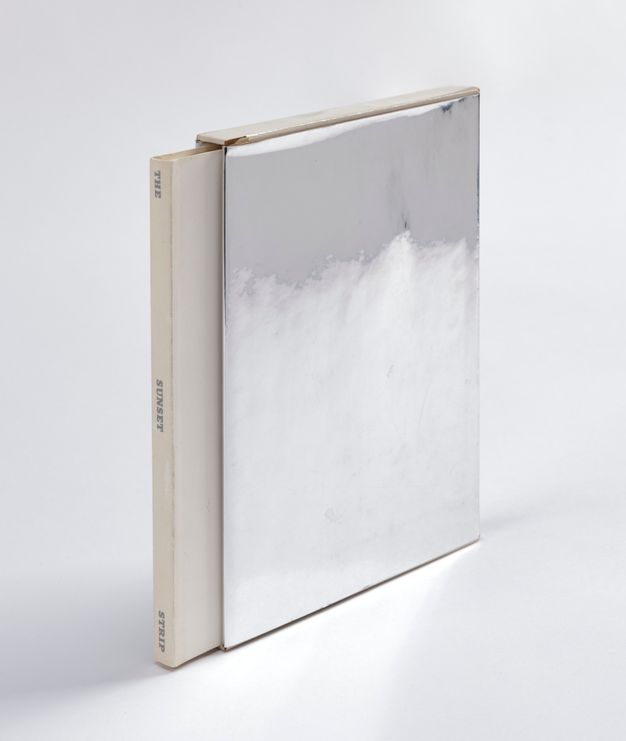
Ruscha’s decision to move to California was linked to its Hollywood image; he explained, “I seemed to be drawn by the most stereotyped concepts of Los Angeles, such as cars, suntans, palm trees, swimming pools, strips of celluloid with perforations; even the word sunset had glamor.”27 However, he then disrupts those visual clichés by stripping the Strip of its sunset (his camera shoots north and south, not east or west); there is no ocean view as finale. The familiar book object becomes uncannily strange: one must turn the book upside down to view the opposite street. It is an interactive, kinetic, and playful artwork contained in the leaves of a book. The subversive potential of the black-and-white photo reproductions folded into an accordion is reinforced by the silver Mylar–covered slipcase (fig. 7.5). While this case might at first suggest the pop aesthetics of the L.A. “Cool School,” its mirrored surface reflects the hands and face of the spectator, signaling that they must complete the work of art they hold.
In this way, Ruscha offers a peculiarly Californian variation on an avant-garde approach to the book or luxury catalog as art object. The cover Marcel Duchamp designed for a 1947 surrealist exhibition catalog offers the perfect example: for Prière de toucher (Please touch), a New York-made “falsie,” or foam-rubber breast, was set against a piece of black velvet (fig. 7.6). Duchamp’s design ensured the reader touched art and “flesh” in holding the book, thus contradicting the typical instruction in society to not touch either.28
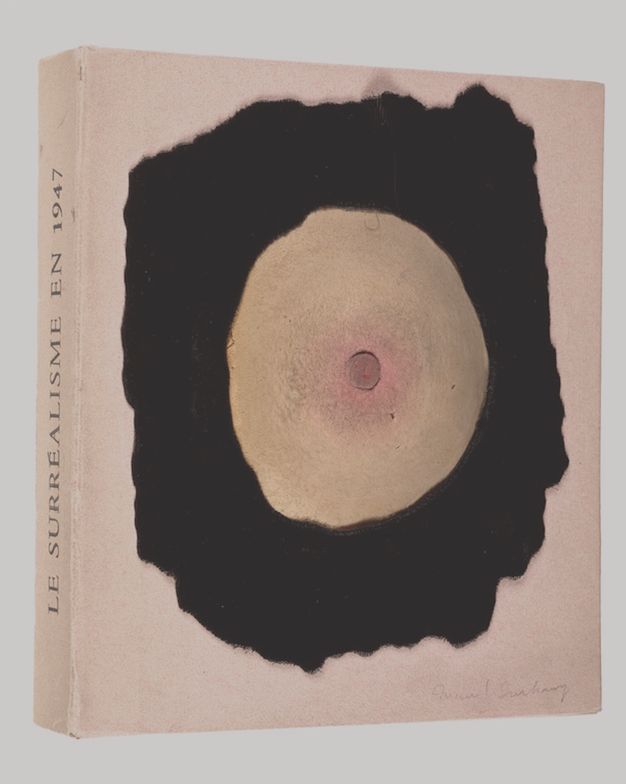
In 1969 the architect Denise Scott Brown described Ruscha’s art book as “deadpan.”29 In a recent essay, Aron Vinegar also argues that Ruscha’s art book wallows in the “deadpan . . . defined as a flat or emotionless face, the word ‘pan’ being slang for face in nineteenth-century America. . . . It also suggests a kind of ‘artless art’ in its dry and direct mode of delivery.”30 A focus on the deadpan may comfortably situate Ruscha’s work within a 1960s American art-historical frame, but it seems at odds with Ruscha’s own description of the art book as “a wolf in sheep’s clothing.”31 With Duchamp’s book aesthetic in mind, we might instead see Every Building’s silver Mylar slipcover as enacting a sort of striptease that alludes to the Sunset Strip—seeing and being seen amid clubs such as the Whisky a Go Go—and a world that promised the glamour of fashion, music, mirrors, and lights. In Eve’s Hollywood (2015), Eve Babitz writes of sitting with her friend Sally at “Pupi’s, a place devoted to cake, overlooking the Strip” and how “just watching the fashionable traffic go back and forth on the Strip for a while . . . felt fantastic.”32 In this way the mirror-like surface of Every Building’s slipcover immediately signals its “hot” performative ambitions, both nodding to its clubs and burlesque bars, such as the topless club The Classic Cat at 8844 Sunset Boulevard, and the broader culture of the consumer-voyeur who frequented such places and enjoyed “just watching.”
We must look to Duchamp again to further appreciate the tension between the indifferent and the critical, the cool and the hot, that exists between the orchestration of the photographs in Every Building. Ruscha frequently mentions in interviews how his teachers at the Chouinard Art Institute had introduced him to Duchamp before he became part of the Ferus group in L.A., and how he felt “the spirit of [Duchamp’s] work is stronger in my books than anything else.”33 Duchamp wreaked havoc on the art world in the first decades of the twentieth-century with his ready-made objects and his insistence that the modern artist had to remove aesthetic quality from art and reject “painting [that] is addressed to the retina.”34 As a young man and emerging artist, Ruscha came across Duchamp in the media and his art circles: Duchamp appeared in Life magazine on 28 April 1952; Grove Press published the English edition of Robert Lebel’s book-length study of Duchamp in 1959; and the Ferus Gallery (founded by the curator Walter Hopps and the artist Edward Kienholz in 1957) actively encouraged interest in Duchamp thanks to Hopps’s particular fascination with the French artist. By the time Ruscha was producing the canvases Honk (1962) and OOF (1962, reworked 1963) and drawing Corn-Popped Ruscha (1963), which played with text as sound and image alike, he was very aware of Duchamp’s challenge to younger artists to “approach something with an indifference, as if you had no aesthetic emotion.”35 Indifference underpins Twentysix Gasoline Stations, Some Los Angeles Apartments, and Thirtyfour Parking Lots in Los Angeles, as Ruscha turned to the city as a readymade.
Europe as a Wonderland
Ruscha’s appreciation of Duchampian indifference was also fortified by his seven-month tour of Europe in 1961. Traveling with his mother, Dorothy, and brother, Paul, and carrying his 2 1/4-inch, square-format Yashica camera, he toured some seventeen countries. He saw Europe as “a wonderland of things that you don’t see in America that made me want to take pictures . . . an odd mixture of architecture and angles and diminishing perspectives and nostalgia and foreign objects.”36
The 342 black-and-white photographs that record that voyage, now housed at the Whitney Museum of American Art, are united by one key theme: the juxtaposition of architecture and sign, or image and text, at the expense of people and location, even when he stood in the most glamorous, iconic locations (figs. 7.7, 7.8, 7.9, 7.10). His eye sought out angles, nostalgia, and the unusual, but not tourist monuments. This is evident in a series of photographs simply titled France, for which his lens was trained on ads for consumer goods or gas (though they are always captured at odd angles to their architectural supports) and on three unnamed students in Paris, whose grouping forms an irregular, soft composition at odds with the linearity of the posters that are pasted to the wall directly behind them. Signage invariably dominates the compositions: for example, in a photograph titled Cannes, we note that pedestrians, cars, the beach and a palm tree are secondary to the juxtaposition of signage—movie posters and a flag. Photographing on the celebrated boulevard de la Croisette in Cannes, Ruscha succeeds in referencing the city’s association with the movie industry through an apparent indifference; the viewer is asked to look at the overlooked detail rather than gaze at the beaches and crowds of this popular Côte d’Azur location.
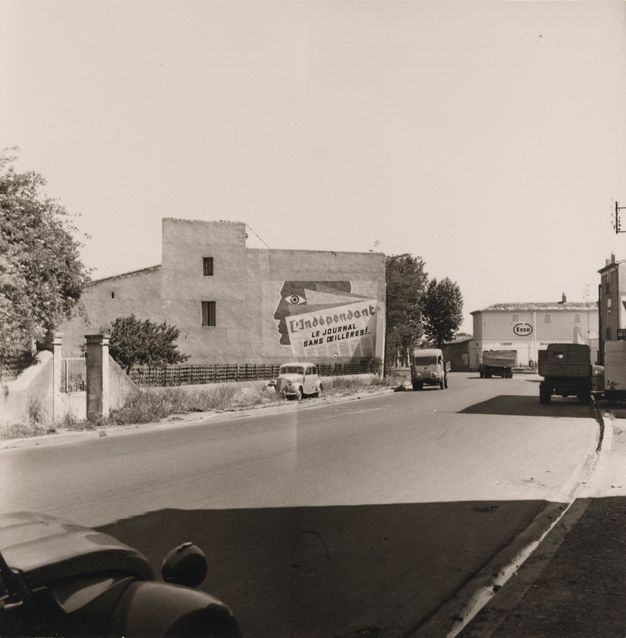
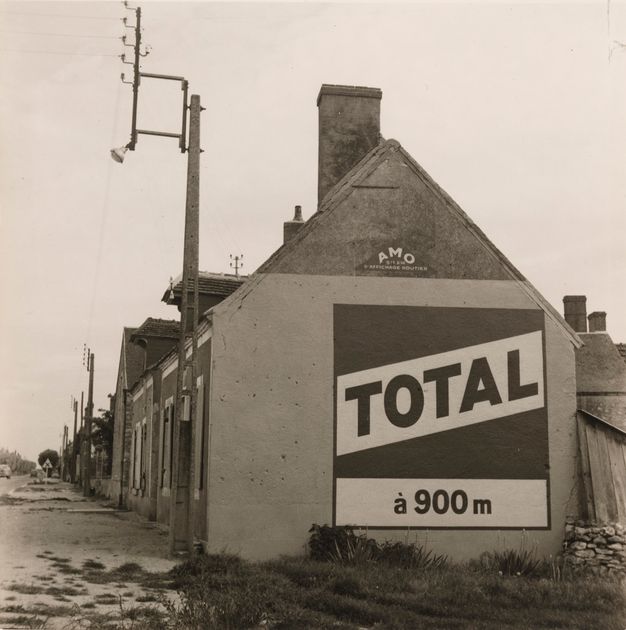
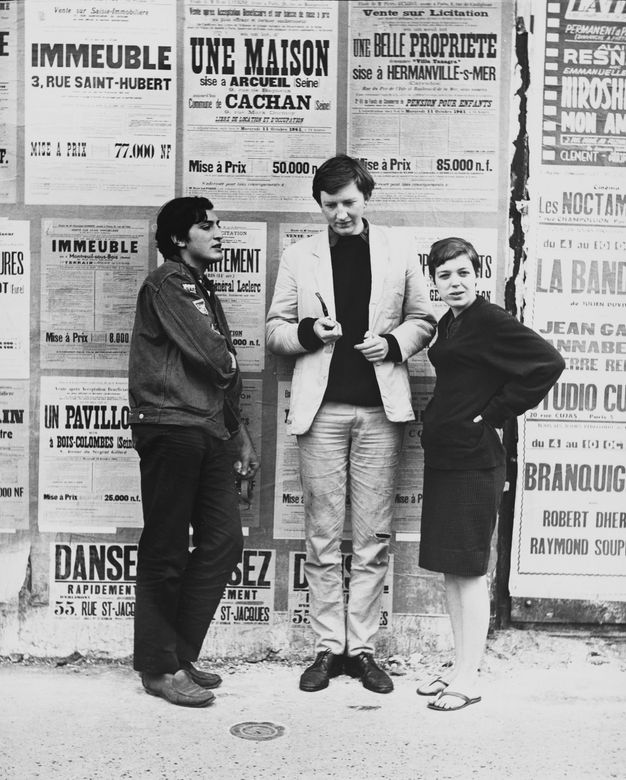
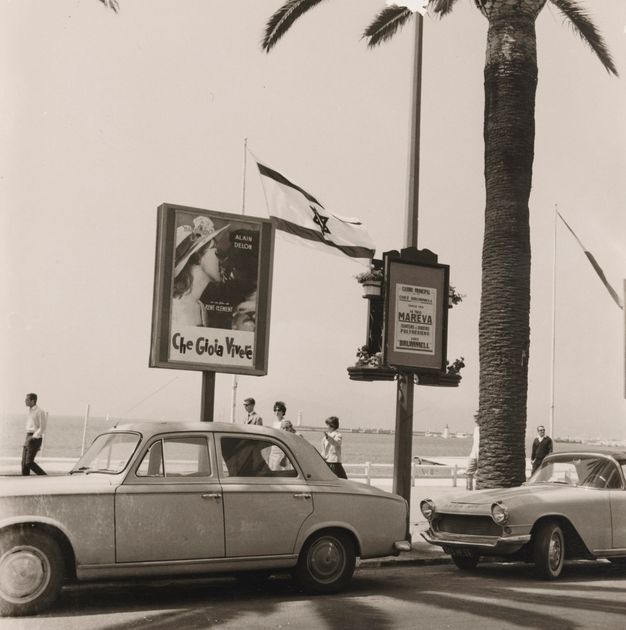
Ruscha once explained his focus on gas stations and roads in his photographs of the California landscape, stating, “I don’t have any Seine River like Monet. I just have U.S. 66 between Oklahoma and Los Angeles,” but even when journeying through a European “wonderland,” his camera aimed to reveal the uncanny, unfamiliar potential of the touristic, familiar location.37
On returning to California, he continued to seek out the angle or everyday detail over the whole. For example, the photographs in Twentysix Gasoline Stations were taken while the artist was driving on Route 66 between Los Angeles and his hometown of Oklahoma City (fig. 7.11). The gas stations are documented as if they are pins on a map, from Bob’s Service, Los Angeles, California through to Fina, Groom, Texas.
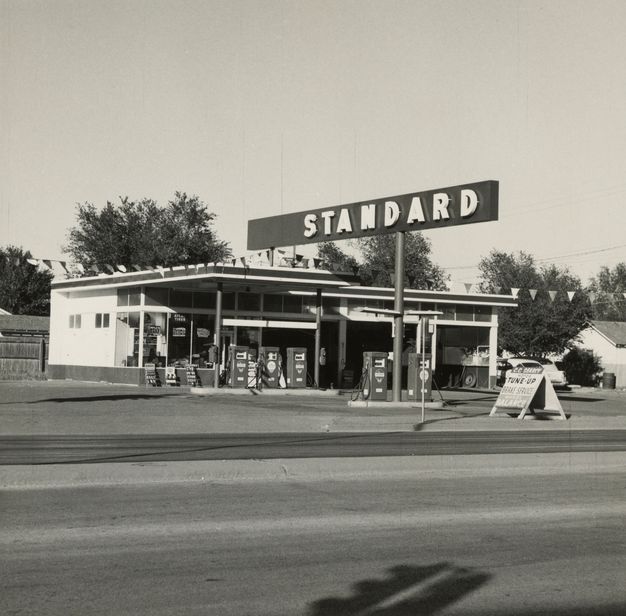
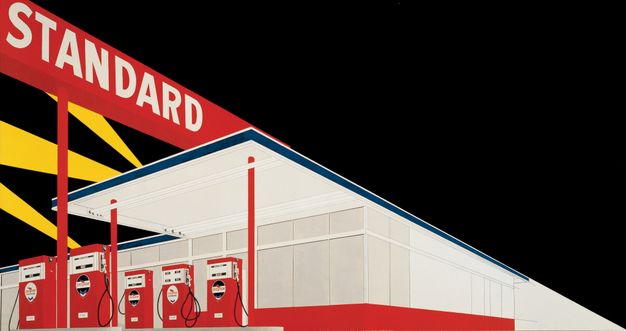
Ruscha adapted one photograph from the series for the screen print titled Standard Station, Amarillo, Texas (1963) (fig. 7.12). His use of flat blocks of solid color and his emphatically geometrical composition with a shallow diagonal line reinforce a mechanical perspective in keeping with “low” commercial signage. The viewer is again denied any emotional engagement with the subject matter due to the absence of people, vegetation, or picturesque details. As with the photograph that begets the painting, the bizarre angle of the composition and black skyline disorientate the eye, despite the banality of the subject matter. It is the text—“Standard”—that dominates and becomes the image.
The Duchamp Effect
Duchamp’s ready-made artworks and text-as-image play were promoted by the Ferus Gallery circle through Hopps, who described himself as a “Duchamp addict” ever since he first met the French artist in Los Angeles in 1949.38 Hopps curated a Duchamp show at the Ferus Gallery in 1962 (the same year he curated a show of Ruscha there), and then, when he moved and was appointed curator at the Pasadena Art Museum in 1963, he organized a major retrospective of Duchamp, the first in the United States, with a catalog titled By or of Marcel Duchamp or Rrose Sélavy. Ruscha, Larry Bell, Dennis Hopper, Andy Warhol, and others from his circle all attended the stylish black-tie opening of the exhibition on 2 October 1963 and met the seventy-three-year-old Duchamp (fig. 7.13).
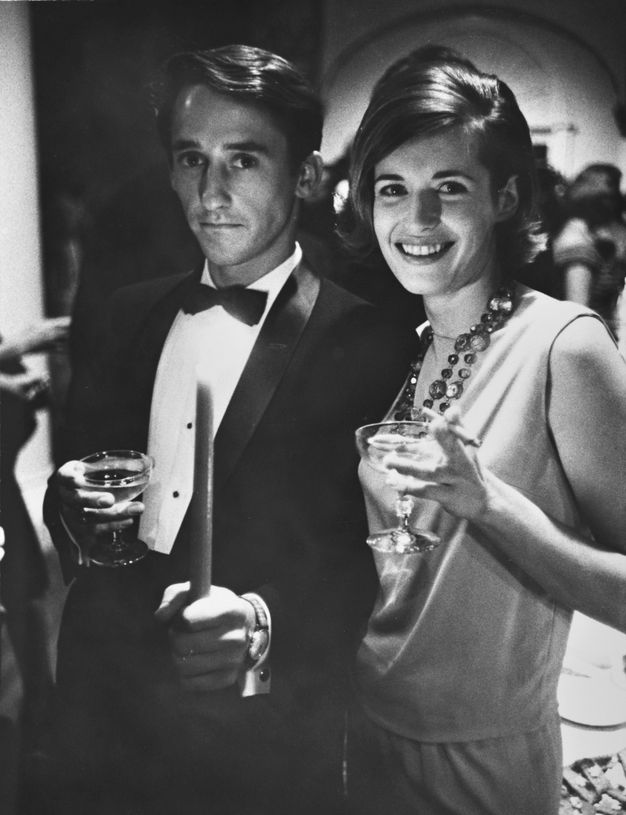
The retrospective demonstrated how avant-garde activity was burgeoning in Los Angeles; young local artists had the opportunity to view Duchamp’s work “at first hand and in its diversity,” as Dickran Tashjian has noted.39 It also ensured that Ruscha and his Ferus Gallery circle cemented their interest in “Duchamp’s readymade model.”40 In 2016 Ruscha recalled of Duchamp: “He proved to be a real guiding light. All of his works, they kind of went counter to what we learned in school. The fact that all of these works finally got together in this very unlikely little museum in Pasadena was a surprise and also a real jewel.”41
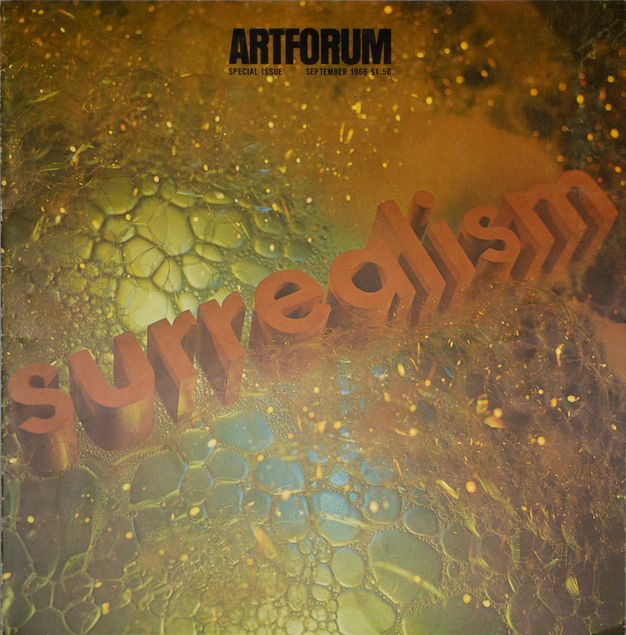
Ruscha’s cover design for the September 1966 edition of Artforum, titled Surrealism Soaped and Scrubbed, brought these avant-garde influences into play. With this cover, surrealism—which began as a literary movement in Paris in 1924 and spread from there to New York, thanks to central figures in its circle such as Duchamp—became a logo, or brand, standing in relief, to recall the Hollywood Sign that proudly overlooks the Los Angeles Basin. It complements Man Ray’s oft-cited analysis of Hollywood after his time living there between 1940 and 1951: “There was more Surrealism rampant in Hollywood than all the Surrealists could invent in a lifetime.”42 In 1965 Ruscha moved to a new studio at 1024 3/4 North Western Avenue in Hollywood, from where he could see the sign and where, he claimed, he could predict the day’s weather based on its visibility from his windows. On the cover of Artforum, his surrealist signage is set against a golden, mirrored surface that gleams as if in the California sun, further “Hollywoodizing” it, to borrow his own terminology (fig. 7.14).43 For Benjamin, the surrealists’ power as an avant-garde lay in the strategy of “profane illumination”—that is, looking at the overlooked and outdated through an anthropological or dreamlike openness to the strange.44 Ruscha’s title for the cover artwork and inclusion of the detail of steamy bubbles at the top right-hand side of the image translates this idea to the United States: text and image evoke the soaping and scrubbing of an automobile so that it gleams in the sun. In that issue of Artforum, Kurt von Meier’s essay, “Surrealism and Architecture,” reminds us of the transformation of surrealism in California as he explains the impact of the avant-garde movement on the geopolitics of the city:
One of the greatest contributions of Surrealism to the history of architecture involves discovery, or rediscovery, rather than original creative efforts within the medium. . . . Simon Rodia’s Watts Towers afford a more recent example of visionary structure-sculpture in the Los Angeles area. . . . A more everyday example of Surrealist disorientation, although no less disquieting perhaps, is the freeway or turnpike experience. Who has not been confronted by the ambiguity of wanting to turn left, knowing he must go left, and yet following the signs and turning to the right?45
As Von Meier astutely observed, surrealism offers a means and a worldview to challenge the very experience of the city in all its “space-time architectural perceptions.”46
On the Strip
In Jack Kerouac’s Beat novel On the Road (1957), which the author once claimed to have manically written across twenty days of road trips in 1951, Los Angeles is presented as the “one and only golden town where all is said and done.”47 Kerouac harnessed the city’s combination of glamour and despair as he documented the road trip of Sal Paradise (Kerouac), Dean Moriarty (Neal Cassady), and a Mexican woman he befriends named Terry on a continuous, 120-foot-long scroll of paper. The Sunset Strip is described in the novel as follows:
LA is the loneliest and most brutal of American cities. . . . LA is a jungle.
South Main Street, where Terry and I took strolls with hot dogs, was a fantastic carnival of lights and wildness. Booted cops frisked people on practically every corner. . . .
We went to Hollywood to try to work in the drugstore at Sunset and Vine. Now there was a corner! Great families off jalopies from the hinterlands stood around the sidewalk gaping for sight of some movie star, and the movie star never showed up. When a limousine passed, they rushed eagerly to the curb and ducked to look: some character in dark glasses sat inside with a bejewelled blonde. “Don Ameche! Don Ameche!” “No, George Murphy! George Murphy!” They milled around, looking at one another. Handsome queer boys who had come to Hollywood to be cowboys walked around, wetting their eyebrows with hincty fingertip. The most beautiful little gone gals in the world cut by in slacks; they came to be starlets; they ended up in drive-ins.48
Kerouac also sought out the unconscious through the artistic process, echoing the surrealists’ understanding of automatism in “Essentials of Spontaneous Prose,” where he advises to “write ‘without consciousness’ in semi-trance . . . allowing subconscious to admit in its own interesting necessary and so ‘modern’ language what conscious art would censor.”49
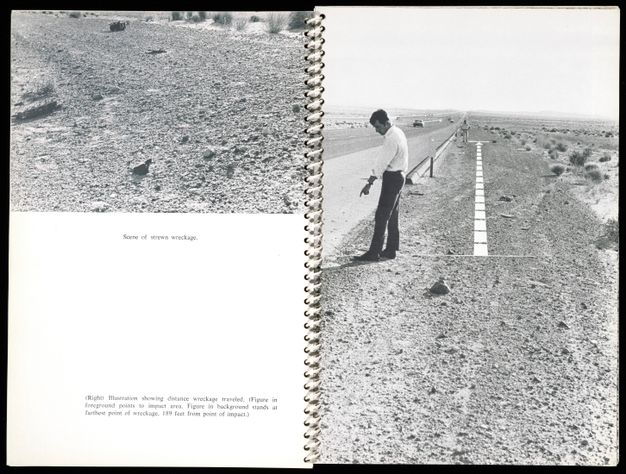
Ruscha paid homage to Kerouac’s Beat aesthetic of free association with Royal Road Test in 1967, carried out on Sunday, 21 August 1966, at 5:07 p.m., on Route 91, with the help of Mason Williams (the “thrower”) and Patrick Blackwell (the “driver”). Moving at speed, Williams dropped a vintage typewriter, of the sort Kerouac used, from a speeding Buick and Ruscha then documented the broken, dirt-encrusted machine and the wreckage in a series of photographs subsequently published as an artist’s book (fig. 7.15). The photographs are titled factually, but the book opens with the typed sentence, “It was too directly bound to its own anguish to be anything other than a cry of negation; carrying within itself, the seeds of its own destruction.”
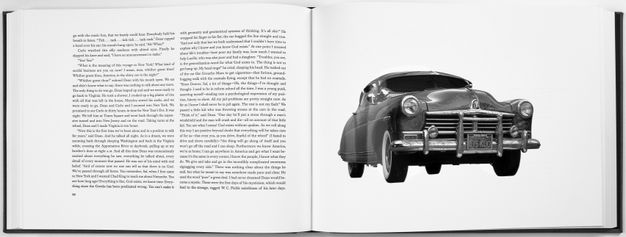
In 2009 Ruscha produced a leather-bound artist’s book of 228 pages in which he again dialogued with On the Road through a selection of black-and-white photographs, cut-up details from photographs, and ink drawings that he arranged alongside the original text, echoing the scat rhythm of Beat art and writing in the seemingly improvisational conversation between text and image (fig. 7.16).
Ruscha emphasized the role of the car for the Beat aesthetic: “Sometimes they hitchhike and sometimes they drive cars. They steal cars and just want to be on the road the whole time. I’ve always liked that notion.”50 With Kerouac’s text in hand, Every Building seems to lure us to open up to that mood of being on the move. It gives form to Sal’s Beat position: “California is white like wash lines and empty headed. . . . I had my own thoughts and held the car to the white line in the holy road.”51
Ruscha once described streets as “like ribbons. They’re like ribbons and they’re dotted with facts. Fact ribbons I guess.”52 Ribbon might suggest the idea of ribbon development in cities. Or “the long ribbon slips with itemized prices” that Sal writes about as he struggles to pay food bills. Or the ribbon of a typewriter. Or the ribbon of negatives that end up filed in an archive. For Ruscha, the medium of photography served as the perfect means to tease out the optical unconscious from the road—or, in this case, the Sunset Strip, and beyond it. Ruscha stated that “books are a medium for people in the street to enjoy”; they are democratic, accessible, and mass produced.53 But he also stated that his art books reflect “the dark side of what I was up against and what I stood for—the toughest, meanest art I was making”; herein lay their potential to derail.54 Every Building on the Sunset Strip revels in the tension between enjoyment and darkness, the familiar and the strange, the cool exterior of Los Angeles and its hot interior. The focus is on neither the beginning nor the end of the journey but on opening up to new experiences as one advances.
Notes
Epigraph: Ed Ruscha in Bernard Blistène, “Conversation with Ed Ruscha,” in Edward Ruscha: Paintings = Schilderijen, exh. cat. (Rotterdam: Museum Boymans-van Beuningen, 1990), 126–140 (134); reprinted in Edward Ruscha, Leave Any Information at the Signal: Writings, Interviews, Bits, Pages, ed. Alexandra Schwartz (Cambridge, MA: MIT Press, 2002), 300–308 (303).
-
See Jennifer Quick, “Pasteup Layout: Photographs and Books,” in Quick, Back to the Drawing Board: Ed Ruscha, Art, and Design in the 1960s (New Haven: Yale University Press, 2022), 85–121. ↩︎
-
Roland Barthes explains the “déjà-lu” (already made/already read) in Barthes, S/Z: An Essay, trans. Richard Miller (New York: Hill & Wang, 1974). ↩︎
-
Ruscha also insisted that the second printing retain not only this error, or flap, but the words first edition at the front. See Willoughby Sharp, “‘A Kind of a Huh’—An Interview with Edward Ruscha,” Avalanche (Winter–Spring 1973): 30–39; reprinted in Ruscha, Leave Any Information, 69. ↩︎
-
Walter Benjamin, “Little History of Photography,” in Walter Benjamin: Selected Writings, vol. 2, pt. 2, 1931–1934, trans. Rodney Livingstone et al., ed. Michael W. Jennings, Howard Eiland, and Gary Smith (Cambridge, MA: Belknap, 1999), 507–30 (512). ↩︎
-
Ruscha, Leave Any Information, 303. ↩︎
-
Marshall McLuhan, Understanding Media: The Extensions of Man (Berkeley: Ginko, 2013), 24. ↩︎
-
Benjamin, “Little History,” 510. ↩︎
-
Benjamin, “Little History,” 510. ↩︎
-
Ruscha in Blistène, “Conversation with Ed Ruscha,” 134; reprinted in Ruscha, Leave Any Information, 303. ↩︎
-
Paul Karlstrom, “Oral History Interview with Edward Ruscha, 1980 October 29–1981 October 2,” Archives of American Art, Smithsonian Institution, Washington, DC, https://www.aaa.si.edu/collections/interviews/oral-history-interview-edward-ruscha-12887. ↩︎
-
Eva Respini, Into the Sunset: Photography’s Image of the American West, exh. cat. (New York: MoMA, 2009), 15. ↩︎
-
Charles Baudelaire, “The Painter of Modern Life,” in The Painter of Modern Life and Other Essays, trans. and ed. Jonathan Mayne (London: Phaidon, 1995). ↩︎
-
See Sigmund Freud, The Uncanny, trans. David Mclintock (London: Penguin, 2013). ↩︎
-
Guy Debord “Theory of the Dérive,” in Situationist International Anthology, ed. Ken Knabb (Berkeley: Bureau of Public Secrets, 2006), 62–66 (62). ↩︎
-
André Breton with André Parinaud, Conversations: The Autobiography of Surrealism, trans. Mark Polizzotti (New York: Paragon, 1993), 27. ↩︎
-
Walter Benjamin, One Way Street and Other Writings, trans. Edmund Jephcott and Kingsley Shorter (London: Verso, 1979), 229. ↩︎
-
Atget’s ad is in the February 1882 edition of the Revue des Beaux-Arts; cited in Suzanne Tise-Isoré, ed. Atget: Paris in Detail, trans. David Radzinowicz (Paris: Flammarion, 2002), 11. ↩︎
-
This body of work was acquired by MoMA, New York, courtesy of the Abbott-Levy Collection, in 1968. See MoMA, Advance fact sheet for The Work of Atget: Modern Times, https://www.moma.org/momaorg/shared/pdfs/docs/press_archives/6211/releases/MOMA_1985_0065_63.pdf. ↩︎
-
See Abigail Solomon-Godeau, “Canon Fodder: Authoring Eugène Atget,” in Solomon-Godeau, Photography at the Dock: Essays on Photographic History, Institutions, and Practices (Minneapolis: University of Minnesota Press, 1991), 28–51. ↩︎
-
Berenice Abbott, The World of Atget (New York: Horizon, 1964), viii. ↩︎
-
Between 1935 and 1938, the Federal Art Project (FAP) provided her a $145 monthly salary, a field assistant, research assistants, a secretary, and a car. When the funding was cut, she completed her project by creating two sets of 305 exhibition prints for the Museum of the City of New York and a partial set for the New York State Museum. These FAP works are documented for the first time in Bonnie Yochelson, Berenice Abbott: Changing New York; The Museum of the City of New York (New York: New Press, 1999). ↩︎
-
See Sarah M. Miller, Documentary in Dispute: The Original Manuscript of Changing New York by Berenice Abbott and Elizabeth McCausland (Cambridge, MA: MIT Press, 2020), 221. ↩︎
-
Abbott, World of Atget, xi. ↩︎
-
Molly Nesbit, Atget’s Seven Albums (New Haven: Yale University Press, 1992), 5. ↩︎
-
Benjamin, “Little History,” 519. ↩︎
-
Cécile Whiting, Pop L.A.: Art and the City in the 1960s (Berkeley: University California Press, 2006), 63. ↩︎
-
Robert Landau and John Pashdag, “A Conversation with Edward Ruscha,” in Outrageous L.A. (San Francisco: Chronicle, 1984); reprinted in Ruscha, Leave Any Information, 242. ↩︎
-
See the detailed analysis of the 1947 surrealist catalog and exhibition in Paris in Alyce Mahon, Surrealism and the Politics of Eros, 1938–1968 (London: Thames & Hudson, 2005), 107–41. ↩︎
-
Denise Scott Brown, “On Pop Art, Permissiveness, and Planning,” Journal of the American Institute of Planners 35, no. 3 (May 1969): 185. ↩︎
-
Aron Vinegar, “Ed Ruscha, Heidegger, and Deadpan Photography,” in Photography after Conceptual Art, ed. Diarmuid Costello and Margaret Iverson (London: Wiley-Blackwell, 2010), 29–49 (31). ↩︎
-
Ruscha in Blistène, “Conversation with Ed Ruscha,” 134; reprinted in Ruscha, Leave Any Information, 303. ↩︎
-
Eve Babitz, Eve’s Hollywood (New York: New York Review of Books, 2015), 157. ↩︎
-
Elizabeth Armstrong, “Interviews with Ed Ruscha and Bruce Conner,” in “The Duchamp Effect,” October 70 (Fall 1994): 55–59 (55). ↩︎
-
Pierre Cabanne, Dialogues with Marcel Duchamp (New York: Viking, 1971), 43. ↩︎
-
Cabanne, Dialogues, 48. ↩︎
-
Sylvia Wolf, Ed Ruscha and Photography (New York: Whitney Museum of American Art, 2004), 260–61. ↩︎
-
Edward Ruscha, “A Conversation between Walter Hopps and Ed Ruscha, September 1992,” in Romance with Liquids: Paintings 1966–1969, exh. cat. (New York: Gagosian Gallery, 1993), 100. ↩︎
-
Hopps met Duchamp through Walter and Louise Arensberg, Duchamp’s friends and patrons. See Dickran Tashjian, “Nothing Left to Chance: Duchamp’s First Retrospective,” in West Coast Duchamp, ed. Bonnie Clearwater (Miami Beach: Grassfield, 1991), 83, 61. ↩︎
-
Tashjian, “Nothing Left,” 77, 80, respectively. ↩︎
-
Benjamin H. D. Buchloh, “Conceptual Art 1962–1969: From the Aesthetic of Administration to the Critique of Institutions,” October 55 (Winter 1990): 105–143 (138). ↩︎
-
Jordan Riefe, “Ed Ruscha on Marcel Duchamp: ‘He was a guiding light,’” The Guardian, 14 March 2016, https://www.theguardian.com/artanddesign/2016/mar/14/ed-ruscha-marcel-duchamp-retrospective-los-angeles. ↩︎
-
Janus, “Interview with Man Ray,” reproduced in Jean-Hubert Martin, ed., Man Ray: Photographs (1982; repr., New York: Thames and Hudson, 1991), 35. ↩︎
-
In the Mystic Fire video, directed by Gary Conklin, 1981, Ruscha stated: “‘Hollywood’ is like a verb to me. It’s something to any subject or any thing. You can take something in Grand Rapids and Hollywoodize it.” Transcript reprinted as “L.A. Suggested by the Art of Ed Ruscha,” in Ruscha, Leave Any Information, 220–224 (221). ↩︎
-
Walter Benjamin, “Surrealism: The Last Snapshot of the European Intelligentsia,” in Walter Benjamin: Selected Writings, vol. 2, part 1, 1927–1930, trans. Rodney Livingstone et al., ed. Michael W. Jennings, Howard Eiland, and Gary Smith (Cambridge, MA: Belknap, 1999), 507–30 (512). ↩︎
-
Kurt von Meier, “Surrealism and Architecture,” Artforum 5, no. 1 (1966), https://www.artforum.com/print/196607/surrealism-andarchitecture-37743 . ↩︎
-
Von Meier, “Surrealism.” ↩︎
-
Jack Kerouac, On the Road (New York: Viking, 1957), 81. For more on how he wrote it, see Andrea Shea, “Jack Kerouac’s Famous Scroll, ‘On the Road’ Again,” All Things Considered, National Public Radio, 5 July 2007, https://www.npr.org/2007/07/05/11709924/jack-kerouacs-famous-scroll-on-the-road-again. ↩︎
-
Kerouac, On the Road, 86. ↩︎
-
Jack Kerouac, “Essentials of Spontaneous Prose,” Evergreen Review (1958); quoted in John Tytell, Naked Angels: Kerouac, Ginsberg, Burroughs (New York: Grove, 1986), 142. ↩︎
-
Gagosian Gallery London, “Ed Ruscha: On the Road: An Artist Book of the Classic Novel by Jack Kerouac,” press release, 22 September 2009, https://gagosian.com/media/exhibitions/2009/ed-ruscha-on-the-road-an-artist-book-of-the-classic-novel-by-jack-kerouac/Gagosian_Ed_Ruscha_On_The_Road_An_Artist_Book_Of_The_Classic_Novel_By_Jack_Kerouac_2009_Press_Releas.pdf. ↩︎
-
Kerouac, On the Road, 79, 131–32, respectively. ↩︎
-
Ruscha, Leave Any Information, 224. ↩︎
-
Ruscha, in Diane Spodarek, “Feature Interview: Ed Ruscha,” Detroit Artists Monthly 2, no. 4 (1977): 1–5; reprinted in Ruscha, Leave Any Information, 73–81 (74). ↩︎
-
Fred Fehlau, “Ed Ruscha,” Flash Art, no. 138 (January–February 1988): 70; reprinted in Ruscha, Leave Any Information, 262–68. ↩︎