When Ed Ruscha left Oklahoma for Los Angeles in 1956, the city’s music scene was in a noisy state of flux. DJ Dick “Huggy Boy” Hugg was still pumping R&B hits over the KRKD airwaves from the front window of Dolphin’s of Hollywood, the legendary South Central record store, but the heyday of Central Avenue as L.A.’s beating heart of jazz and R&B was no more. The Black music scene had dispersed across the city. The Hollywood Bowl hosted its first recorded jazz concert with established names familiar to local club crowds, such as Ella Fitzgerald and Art Tatum, while L.A.-groomed upstarts like Ornette Coleman, Chico Hamilton, and Eric Dolphy were woodshedding a new language of jazz—what the title of Coleman’s debut album described as Something Else!!! (1958). (Coleman developed the album while working as a freight-elevator operator in a downtown L.A. department store.) Stan Kenton was busy leading a parallel march toward orchestrated jazz coolness: he released Cuban Fire! in 1956 on Capitol Records, which had just moved into its iconic circular digs on Hollywood Boulevard.
In the same period, Little Richard played the Wrigley Field ballpark in South Central; the Platters brought the L.A. vocal group movement (which included artists like the Coasters, the Jaguars, and the Penguins) to the number-one slot on the pop charts with “The Great Pretender” (1955); and new independent labels like Crown Records and Challenge Records were prepping for launch.1 On the Eastside, Mexican American artists like Don Tosti and Eddie Cano were under the heavy influence of Black music, fusing Latin American styles with new R&B and jazz hybrids that packed steak houses and bars up and down Atlantic Boulevard and all over downtown. Farther east, the radio trailblazer Art Laboe was hosting R&B and rock ’n’ roll concerts at the El Monte Legion Stadium.2 If, as Kenneth Marcus has argued, the dominant forces that made L.A. into a “musical metropolis” between 1880 and 1940 were “diversity and decentralization,” the same could certainly be said of L.A. in 1956: it was a city flush with diverse music scenes and experiments that stretched from the ocean to the canyons to the Eastside to the valleys, reaching any avenue and boulevard with enough creative guts, and enough real estate, to host a new sound.3
What’s That Sound? Ruscha on Sunset
While the musical Los Angeles Ruscha encountered was decentralized, it had reliable main arteries, none more iconic than the one Ruscha would spend over five decades photographing: Sunset Boulevard. Of all the musical streets in Los Angeles, and there are many, Sunset is the most musical.4 As the former Los Angeles Times music critic Randall Roberts put it, Sunset is “a kind of metaphorical artery pumping rhythms across the city and around the world.”5 Across various decades, the boulevard has consistently shaped the city’s sonic identities in many ways. No other street has been the site of as many live recordings—from Eddie Cano and Jack Costanzo’s Dancing on the Sunset Strip (1960) to Otis Redding’s In Person at the Whisky a Go Go (1968)—or as many tribute songs, whether Wes Montgomery’s “Bumpin’ on Sunset” (1966), Love’s “Maybe the People Would Be the Times or Between Clark and Hilldale” (1967), Donna Summer’s “Sunset People” (1979), Don Henley’s “Sunset Grill” (1984), or 2Pac’s “To Live & Die in L.A.” (1996), to name just a few.
The Sunset Strip, the iconic 1.6 miles that stretch across West Hollywood, undoubtedly has helped cement Sunset Boulevard’s world-famous reputation, but it’s only one part of the story. Ever since Sunset’s future was laid on Tongva land by chain-gang laborers in the early 1900s, it has been home to various musical cultures and industries, aided by the presence of instrument shops, sheet-music and record stores, recording and TV studios, theaters, nightclubs, and record labels.6 Sunset may be most synonymous with the Strip’s golden age of psychedelic rock and hair metal of the late 1960s and 1980s—scenes and lifestyles typically associated with white youth—but the street also tells key musical histories of trailblazing racial integration; the expanded influence of Latin American and Chicano music; the West Coast outposts of Motown; the boom of disco; the cross-cultural evolution of L.A. punk; and the long revolutionary arc of underground queer culture. It’s been a street where musical capitalism runs amok—with subcultural rebels ending up in the boardrooms of major labels—and where policed and oppressed communities demand justice.
Sunset Boulevard’s nightlife began as a release valve after the end of Prohibition. By the 1940s, clubs on the Strip—like Ciro’s (later known as Ciro’s Le Disc), the Mocambo, and Preston Sturges’s Players Club—made the boulevard into a minted leather booth Hollywood playground. By the 1950s, though, the Strip’s Hollywood sheen had worn off and the boulevard was in transition, leaving room for venues like Club Renaissance, the Sea Witch, the Crescendo, and Pandora’s Box to become reliable jazz destinations. Off the Strip, Sunset was birthing new scenes altogether. After midnight, teenagers cruising down Sunset would end up at Scrivner’s Drive-In (at Cahuenga Boulevard) for burgers and see Laboe broadcast his KPOP radio show. Nearby, the Hollywood Palladium had started throwing “Latin Holidays,” which included mambo and cha-cha dance parties curated and hosted by Chico Sesma, another influential local radio DJ. And even farther east on Sunset, at Club Havana—co-owned by the respected bandleader, saxophonist, and regular Sunset headliner René Bloch—there were thrilling mambo dance-offs and packed battle-of-the-bands nights that pitted Bloch’s elite house orchestra against visiting stars like Tito Puente.7
But by the time Ruscha began photographing Sunset in 1966, the street had transformed into a whole other world: the national capital of teenage rock rebellion and hippie dissent. In the words of the Los Angeles Free Press journalist Paul Jay Robbins, Sunset had become synonymous with “the total collective consciousness of a new breed of people. The Strip, so long a tinsel turkey, had become a flaming phoenix and its light was seen around the world.”8 During the 1960s, the clubs Whisky a Go Go, Hullabaloo, and Ciro’s Le Disc hosted bands at the center of the rock revolution, including the Byrds, the Doors, and the Mothers of Invention. Newspapers and magazines, such as the Los Angeles Free Press and West, documented the rise of L.A. counterculture, and teen music and dance shows inspired by Sunset, like Shindig! and Where the Action Is, gave it a national media platform.
It was this nighttime (and daytime) world that Ruscha had come to know well. A regular at jazz clubs in the 1950s, Ruscha lived in Hollywood in the 1960s and saw the Byrds play at Ciro’s Le Disc. He had a front-row seat for the Strip’s countercultural metamorphosis; he called it “an abruptness, a cultural jump.” As Ruscha told the journalist David Kamp, “Suddenly there was this changeover to the hippie thing. What I remember most is you could stand anywhere on the Sunset Strip and see cars going down very slowly, always with someone in the backseat tapping on a tambourine—going tap, tap, tap.”9 In fact, it was Sunset’s music scene that helped inspire Ruscha to photograph the street. Standing outside the Whisky a Go Go after seeing the Doors play, Ruscha marveled at Sunset’s visual signage and decided then and there to photograph the entire boulevard. “It just had a wavy, windy sort of look to it that I like,” he recalled. “And I just said, ‘Well, I’ll start here.’”10
Ruscha’s connection to the visual-art changeovers of Ferus Gallery—located close to the Strip, down La Cienega Boulevard—also linked his emerging solo art practice with Sunset’s transformations. He once compared the gallery to a jazz catalog that has “a lot of different voices under the same record label”;11 however, the vibe of Ferus Gallery was more rock adjacent. In 1966, artist Billy Al Bengston was photographed for West in front of the Whisky a Go Go, and that same year Ruscha published Every Building on the Sunset Strip. Many of Sunset’s key music venues ended up in Ruscha’s contact sheets from 1966. He photographed the Sea Witch (fig. 20.1)—the first club on the Strip to feature self-identified rock bands—during a two-night run by the local blues group Canned Heat. The club proudly declared its solidarity with older teens, as evidenced by its door banner that proclaimed, “Age Limit 18 to 80.” Ruscha also captured one day in the two-year tenure of the “teener” rock club It’s Boss (fig. 20.2), which operated in the former space of Ciro’s, the posh celebrity haunt of the 1940s and 1950s (the club’s original logo could still be seen on its street-side wall). An early ad for It’s Boss declared, “For the first time in L.A., a night club for young adults 15 years of age & over! Continuous dancing to LIVE music seven nights a week from 7pm.”12 Ruscha also photographed Pandora’s Box (fig. 20.3), another haven of teenage nightlife, right when it was the epicenter of the Sunset Strip riots (1966) in which teens from across L.A. repeatedly clashed with police enforcing restrictive club curfews (the night of Ruscha’s photograph, “two continuous bands,” World War III and Everybody’s Children, played). The riots gave Sunset’s musical rebellions a ground-level reality and positioned the boulevard’s nightclubs as part of a larger “struggle of teenagers of all colors during the 1960s and 1970s to create their own realm of freedom and carnivalesque sociality within the Southern California night.”13
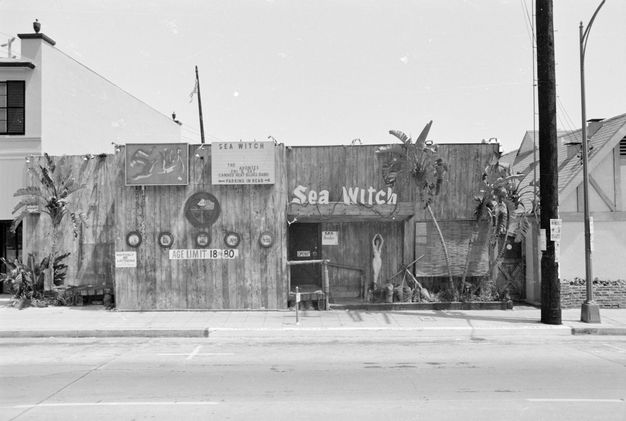
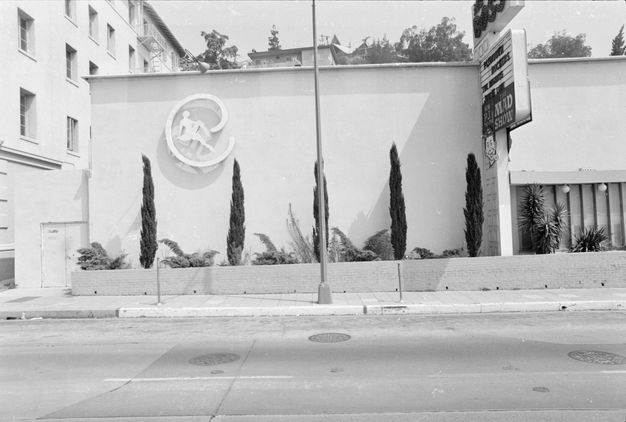
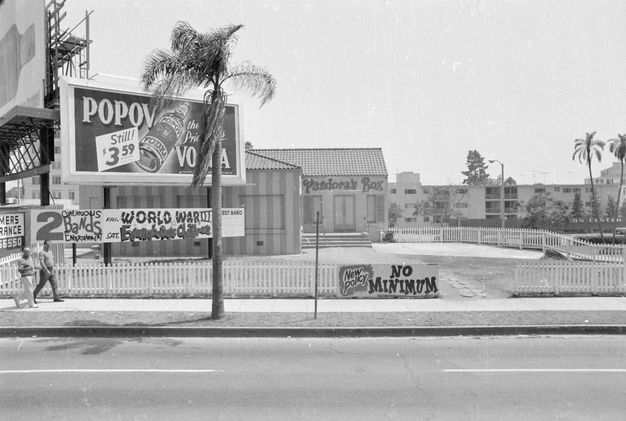
Jennifer Quick has argued that Every Building is a book-length “pasteup picture” that extends the pasteup layout techniques Ruscha knew from his work in commercial advertising.14 In their own way, the music worlds of Sunset were also a series of pasteup sounds, a collection of different songs and musical experiments strung together down the spine of an urban boulevard. Thus, Ruscha’s visual treatment of Sunset—a pasteup, a series of fragments in a layout—is also how the boulevard was, and still is, heard: not through a single sound or even a single cord of seamless transitions but an auditory pasteup of musical fragments. Like Ruscha’s project, the boulevard jumps from space to space, club to club, sound to sound, and song to song.
Ruscha’s Streets of Los Angeles Archive is without a doubt an extraordinary visual resource. It provides a new archive of Los Angeles’ visual history, allowing a rare opportunity to see how the streets of L.A. changed over time and to analyze urban transformation through a larger set of aesthetic, social, political, and economic inquiries. According to Getty, the collection contributes to a wider understanding of “modern art, architecture, and the changing physical, social, and cultural landscapes of Los Angeles.”15
This is all true; however, these hundreds of thousands of images not only add to our visual knowledge of the city; they add to our auditory knowledge of it as well. They help us hear Los Angeles differently. When Ruscha photographed Sunset, it was usually on Sundays or early in the morning when the boulevard was quiet.16 But when you look at his photographs, it’s impossible not to hear the streets come alive in sound: the music of its cultural jumps. After all, Ruscha is a visual artist with deep connections to live and recorded music, and his word paintings often draw from sonic vocabularies. The words radio and music are featured in his paintings as early as 1963, two years before he began photographing Sunset; music even makes frequent appearances in the titles of his works, including Music (1969), Hawaiian Music (1974), Music (1975), Music from the Balconies (1984), Music (2009), and Music (2014), the last example a commission to celebrate the fiftieth anniversary of the Los Angeles Music Center. In 1969, Ruscha also used “music” as the textual centerpiece in an album cover he designed for his longtime friend, the musician Mason Williams. Numerous album covers followed, including the art for 12-inch albums by Van Dyke Parks, Soon, Marc Matter and Stefan Römer, Nels Cline, Talking Heads, and Paul McCartney. Five years after publishing Every Building, Ruscha made Records (1971), a book that compiled gray-scale offset photographs of thirty record albums from his personal collection (now estimated to contain almost two thousand jazz, country, and R&B records, mostly from the 1930s, ’40s, and ’50s). Most recently, he created his first work connected to hip-hop culture, 2Pac–All Eyez on Me, a giclée-printed album cover fixed to a linen-wrapped vinyl jacket that was part of the Los Angeles County Museum of Art’s exhibition Artists Inspired by Music: Interscope Reimagined (2021) to celebrate the thirtieth anniversary of Interscope Records.
“For me, jazz is the music of Los Angeles,” Ruscha said in an interview from 1988 about his musical tastes. “Perhaps because that’s the music I was into when I first came here. Of the music that’s associated with this city—the Byrds, the Doors, the Eagles—the Byrds are the only ones that do it for me. I used to go see them at Ciro’s on the Strip in the ’60s, but I wasn’t into most of that music. I guess I was sort of square.”17 In an appearance as a guest DJ on the Santa Monica public radio station KCRW in 2011, Ruscha opened his set with Jesse Belvin’s slow-burning “Goodnight My Love” (1956):
[The song] represents everything I felt about California when I first came out here. . . . There was a rich kind of thing happening right in central L.A. which is Hollywood and Los Angeles proper, not so much the suburbs. Also Central Avenue, I mean all the great musicians were playing there. And seeing that and just kind of building this structure of thoughts about music and how it jived with art. I was studying art at that time at Chouinard Art Institute and this kind of represented that romantic aspect of coming to California.18
Phonographic Returns and Photographic Listenings
Ruscha’s history as a listener, and his continued proximity to music throughout his career, only increase the demand that his images make to be heard. They force us to ask larger questions about the relationship between image and sound, between photography (from the Greek photo, “light” plus graph, “something written”) and phonography (from the Greek phono, “voice, sound” plus graph, “something written”). Where does phono reside in photo? Where is the sound within the light? In looking at Ruscha’s photographs of Sunset Boulevard, how can we not also listen to them?
In her recent work on photography of the Black diaspora, Tina Campt has suggested “listening to images” as a method of hearing what is unsaid, unspoken, and silenced in photographs.19 For Campt, vernacular photographs of Black subjects register what she calls felt sound, or “sound that, like a hum, resonates in and as a vibration.” She listens for “the sonic frequencies of photographs.” Ruscha’s images of L.A. streets have their own version of sonic frequencies and felt sounds that resonate as vibrations within and beyond their status as photographs. As Nicolas Poussin once said of paintings, photographs are not “mute things”;20 they resonate and vibrate with worlds shaped by sound and music. Photographs hold music. They contain the sound of the scene being photographed. When a photographic image is produced, its acoustic life is not erased. There is sound in the light that is written.
“Is there a way to portray Los Angeles that hasn’t already been seen?” Ruscha recently asked. “There is always another view.”21 He’s right, but maybe that other view is not always visual. There is always another sound as well, another musical portrayal that hasn’t already been heard, another way of listening to the city seen through the lens of a camera mounted to the back of a pickup truck.
Arguably the most famous urban ecological take on Los Angeles as a built environment belongs to Reyner Banham’s landmark Los Angeles: The Architecture of Four Ecologies (1971).22 These four ecologies—surfurbia, foothills, plains of ID, and autopia—which have become part of local critical parlance, were missing music entirely. They, too, were mute things. Banham drove through the city with his eyes glued to the windshield and rearview mirror, focusing on L.A. urbanism as a purely visual language. But his ecologies all have their own musical alter egos. Their soundscapes shape and define them as much as any building code, design aesthetic, or parade of architectural quirks. Ruscha’s images offer inroads into the music of these urban ecologies.23 They are indispensable additions to the archive of sonic Los Angeles, and indispensable tools for developing an “L.A. acoustemology,” an acoustic way of knowing Los Angeles.24
In the decades since Ruscha began photographing L.A. streets, scholars and sound artists have continued to develop theories of musical urbanism and sonic ecologies, whereby cities are analyzed through their relationship to auditory experience, design, and history. For instance, Michael Bull has studied the “auditory nature of everyday experience in urban and cultural studies,”25 while Rowland Atkinson has theorized the “ambient envelope of urban life,” in which sound and music shape and define understandings of place and space.26 Ruscha’s photographs allow an engagement with this ever-changing sonic ecology of L.A.: “a permeable, modulating, fleeting and occasionally persistent soundscape within and across different social and physical sectors of the city.”27 They help us study L.A. not only as a neoliberal “music city” (in which music scenes are resources for privatized capitalist expansion and urban development) but also as a “musical city,” a city shaped by the music that is made on and off its streets.28 The musician Vijay Iyer argues that this is, in fact, one way to define a city, as a musical organism:
Cities are music. Cities exist because we—that is, “humankind”—are able to build things together, and music was among the first things we ever built together. The capacities to coordinate and synchronize our actions, to incorporate each other’s rhythms, to make choices together in real time—to groove and to improvise—these are human skills, not merely musical skills. . . . This thing we call “music” is essentially the sound of ourselves—the joyful noise of people doing things together, the art of unsilent interaction.29
The musical city of Los Angeles—with all its soundscapes, musical ecologies, and acoustic territories—is of course defined by the same imbalances of power and rigid social and racial inequities that characterize the city’s broader history. As a result, music has played a key role in waging what Gaye Theresa Johnson has called spatial entitlements, cultural claims to and reimaginations of urban space by communities of color marginalized from the public sphere and rendered precarious by urban development campaigns.30 When we listen to Ruscha’s photographs, then, we can hear the histories of not only the city’s sonic ecologies and musical territories but also of how sound and music have been instrumental in waging battles for visibility, recognition, and sustainability among minoritized populations. Listening to images of L.A. streets and buildings can foster an attunement to histories of loss, displacement, and erasure. Like the houses in J. G. Ballard’s short story “The Sound-Sweep” (1960) that have sounds from the past living within their walls, all built environments are sonic haunted houses.31 They contain the ghosts of music past. By listening for the musical ghosts in Ruscha’s photographed buildings—residing in walls and floorboards, hanging out on street corners and parking lots—we can hear the sound of neighborhoods change, sonic traces of erased and displaced communities, the sound of what is no longer there. In her examination of how the past is made present in photographs, Shawn Michelle Smith argues that intrusions of the past are intrinsic to the photograph itself. She writes, “The photograph is emblematic of the way a past continues to inhabit and punctuate the present, and also one of the central vehicles through which that temporal collision takes place.”32 She names these collisions photographic returns: fragments of the past that create ruptures in the present, all captured in a photographic image. If photographs can be listened to, then photographic returns are also simultaneously phonographic returns; the past inhabits the present through returning sounds, interrupting the temporal fixity of the image through a musical refrain. They provide opportunities for what we might call, in a light remix of Campt, photographic listenings.
The Trip and El Club Continental
Co-owned by Elmer Valentine, who also opened the Whisky a Go Go, the Trip (8572 Sunset Boulevard) is typically remembered as a cutting-edge rock venue where Barry McGuire, the Byrds, the Velvet Underground and Nico, and Andy Warhol’s Expanding Plastic Inevitable show all held court. When Ruscha photographed the Trip in June 1966 (fig. 20.4), the New Jersey garage band the Knickerbockers and Ted Neeley (the psychedelic folk-rocker and future lead of Jesus Christ Superstar) were on the marquee.
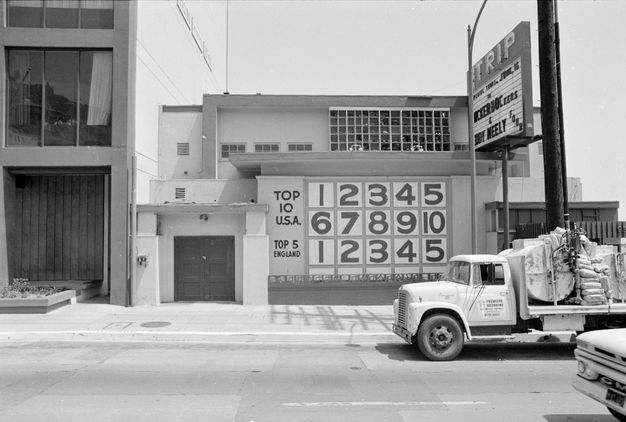
Yet the Trip’s story is more complex. The club opened just weeks after the Watts rebellion in August 1965 when Black Angelenos protested chronic racial profiling, racist violence, and discriminatory policing by the Los Angeles Police Department. The uprisings in Watts reverberated throughout the city. And Sunset’s nightclubs, which for decades were ruled by racial segregation, soon had their own racial awakenings. (When Duke Ellington performed at Ciro’s in 1945, Billboard announced it as “the first time that any of the swank strip spots have gone in for a high-priced, big-name Negro band” and the club’s management still warned Ellington: “We don’t allow the help to socialize with the guests.”)33 At first, the Trip might have been a natural home for the white hippie set, but it, too, heard Watts’s call to “Burn, baby, burn!” and soon featured some of the biggest names in Black popular music: Billy Stewart, Marvin Gaye, Stevie Wonder, the Temptations, Wilson Pickett, Billy Preston, and the Soul Brothers. Jackie Wilson also played a legendary ten-night run to an audience that included both Elvis Presley and James Brown.34
Only three months after Watts went up in flames, Preston, sharing a bill with the Miracles, had a show at the Trip (they were the first Black artists to play the venue). The recording of Preston’s set was released two years later on LP as Club Meeting, which included organ-blasted makeovers of Willie Dixon and George Gershwin compositions. That night he also played “This Little Light of Mine,” the African American spiritual and gospel classic that by then was best known as a civil rights anthem—a defiant call for hope, struggle, and resilience in the face of state violence and systemic racism. At the Trip, Preston played it with big-band go-go energy: the horns vigorously punctuating his keyboard playing, the crowd clapping along with fever, shouting enough hallelujahs to turn the room into a church. And you can really hear the room, hot from the music, the drinks, and the dancing, but also hot from the Southern California night outside, the insurrectionist heat of a city still very much on fire.
Before it was the Trip, it was the Crescendo, the legendary jazz club opened in 1954 by the influential DJ and concert promoter Gene Norman. It’s there in Ruscha’s photograph as well: the club-before-the-club lingering like a ghost, invisible but still present in the frame. Norman recorded dozens of live albums at the Crescendo for his own label GNP Crescendo, showcasing a variety of artists and styles that cemented the venue’s reputation for openness and its embrace of Black and Latino musicians. Artists who cut records there included jazz greats like Louis Armstrong, Count Basie, and Art Tatum, as well as the Cuban bandleader Machito, the exotica pioneer Arthur Lyman, and the cabaret provocateur Frances Faye. Ella Fitzgerald’s performances there in 1961 and 1962 were also captured live, but they were recorded by her manager Norman Granz and released—first as Ella in Hollywood (1961) and later as Twelve Nights in Hollywood (2009)—on his label Verve Records (an affiliation she makes sure to mention before her rendition of “Witchcraft”).
Fitzgerald first played the Strip in 1955 at the Mocambo, right down the block from the Crescendo. As legend has it, the Mocambo’s owner was reluctant to book a serious jazz singer like Fitzgerald, so her friend Marilyn Monroe intervened to help her get the gig. Fitzgerald had told her press agent in the early 1950s: “I know I make a lot of money at the jazz clubs I play, but I sure wish I could play at one of those fancy places.”35 When she did play the Crescendo, one of the songs she sang was “Take the ‘A’ Train.” Granz’s recording of it is an opportunity for photographic listening. Listen to her performance while trying to listen around it and through it. Listen to the song as it begins—Lou Levy’s piano warming up through the applause—and listen to the final seconds after it finishes, the band in brief repose, the audience enraptured. We can hear the temperature in the room, the warmth of two hundred bodies. We can hear those bodies shuffle and move, tap a loafer or a heel, reach for a glass, light a cigarette, adjust a wristwatch. We can hear light and shadows, the density of air and smoke. We can hear the distance from the bandstand to the first row of bistro tables. We can hear the parquet of the dance floor. There is the song and then there is the room of the song; there is Ella and Levy and Herb Ellis on guitar, Wilfred Middlebrooks on double bass, and Gus Johnson on drums, and then there is the Crescendo, the building, the address, the block, the boulevard.
Ruscha only photographed the Crescendo from the exterior, but the image contains sonic frequencies and felt sound; the building still vibrates with sounds from Fitzgerald’s and Preston’s shows. By looking at the photograph, we can hear the room’s tone, the sonic identity unique to its physical space. In an essay on Rhona Bitner’s photographs of empty nightclubs and recording studios, the musician Iggy Pop describes the depicted locations as “ghost ships of American music.”36 The clubs in Ruscha’s photographs are ghost ships of L.A. music, full of phantom musical, social, and cultural histories that continue to haunt his images, even after the buildings within the frame became parking lots and strip malls or were burned down in fires (fig. 20.5).
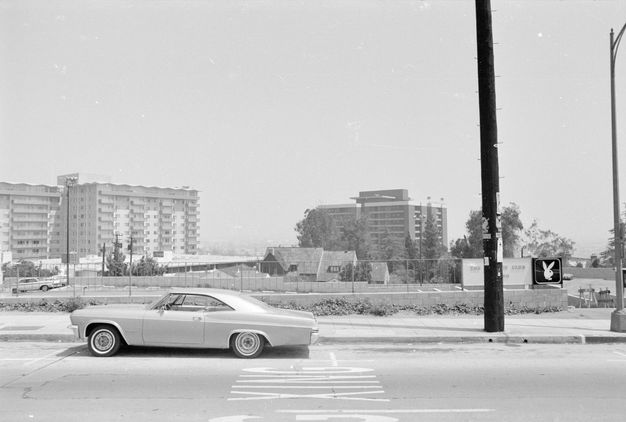
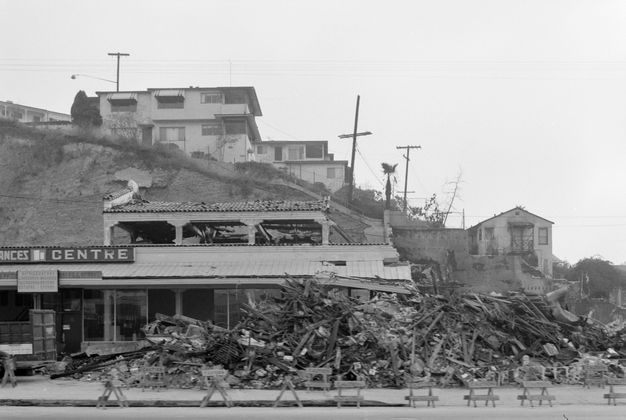
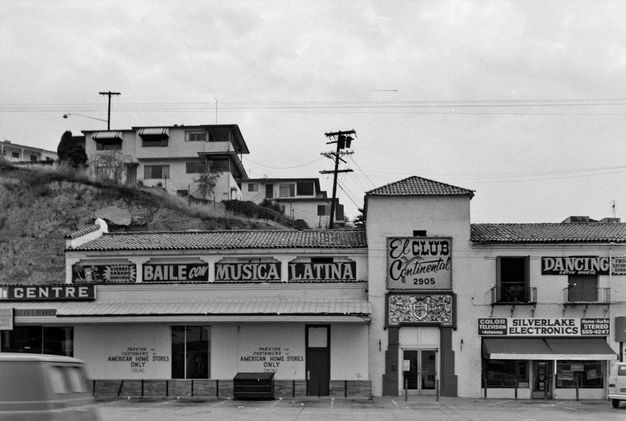
Which is what happened to El Club Continental (2905 Sunset Boulevard) in 1975 when a blaze ripped through its ballroom and restaurant, causing the building to be demolished. That year Ruscha photographed the remains: a single mound of charred wood, blasted cement, and crumbled drywall (fig. 20.6). Over the previous two years, though, he had caught the club in its prime as the nightlife capital of Latino Silver Lake (fig. 20.7). Located next to a Mexican appliance store advertising estufas and secadoras on its windows, the club was a music-driven “urban anchor,” to borrow Natalia Molina’s formulation, a community hub and reliable neighborhood stop for local Mexican and Central American residents who dressed up and sought after-work refuge in classic cumbias and salsa montunos.37 Still a predominantly working- and middle-class Latino neighborhood, Silver Lake in the 1970s was also home to a growing gay and lesbian community, and, by the end of the decade, leather bars shared sidewalks with Mexican restaurants.
El Club Continental had a ton of real estate and solid bones. The music steeped in its walls—its phantom sounds, its ghost-ship scores, its phonographic returns—helps unravel the club’s illustrious backstory. In the 1940s, it was Club Zarape, a legendary, upscale dancehall that featured top Cuban and Puerto Rican bands, billing itself as “California’s most popular Latin American rendezvous.” Zarape promised an “original Spanish atmosphere” and delivered a menu that offered both a “Special Mexican Dinner” and a “Special American Dinner.”38
Among its acclaimed house bands was Esy Morales and His Latin-American Orchestra. Morales, a flautist and horn player from Puerto Rico who played in Xavier Cugat’s band, became an L.A. favorite when he and his glossy rumba “Jungle Fantasy” (1948) were featured in the Hollywood film Criss Cross (1949). Other Zarape residents included the esteemed likes of the Chicano music pioneer Lalo Guerrero, the Cuban singer Miguelito Valdés, and the Cuban pianist Nilo Menendez. Menendez was best known as the composer of the classic bolero “Aquellos ojos verdes” (1929), whose English translation, “Those Green Eyes,” became a hit for Jimmy Dorsey some ten years later. All these musicians did their time on studio back lots—Valdés shared the screen with Humphrey Bogart and Rita Hayworth in You Were Never Lovelier (1942)—which helped make Club Zarape into a certified haunt for Hollywood celebrities. “The place was full of stars and beautiful people,” the percussionist Puente recalled of a night at the club. “Everyone looked like a star to me.”39
When Club Zarape later morphed into Club Havana—the hot spot of the 1960s—the address’ reputation for top-shelf Latin music skyrocketed. But by the end of the 1960s, Latin music was catering less and less to Hollywood tastes. Unlike previous eras when Sunset clubs were more segregated, and venues like the Mocambo and Café Trocadero allowed more Latinos on stage than on the dance floor, Club Havana’s patrons were more diverse than ever before. By the time El Club Continental took over the space in the early 1970s, the El in its title and the phrase “baile con música latina” (dance to Latin music) on its signage were direct messages to the local Latino neighborhood that it belonged to them as much as anyone else (see fig. 20.7).
After the fire, the building was eventually replaced by a strip mall that included a dental office, pawn shop, immigration tax office, mom-and-pop mariscos restaurant, and Silversun Liquor. By 1990, the Mexican restaurant had become a Salvadoran pupuseria and the tax office was taken over by a bridal and tuxedo shop. As gentrification accelerated in the late 1990s, many Latinos were gradually pushed out of the neighborhood. When Ruscha photographed the location again in 2007, the plaza was home to a dental office and teeth-whitening center, a nail salon, and a restaurant serving steak, seafood, and pasta (fig. 20.8). Silversun Liquor was still there and it gave the strip mall its new moniker: the Silversun Plaza. More importantly, when Ruscha photographed the plaza in 2007, Silversun had become a key word of music in L.A. thanks to the indie band the Silversun Pickups, who named themselves after the liquor store and were leading the charge of Silver Lake’s new alt-rock scene.
By looking at Ruscha’s photographs of a single block over the course of decades and tuning into their many phonographic returns, not only can we see changes in neighborhoods over time but we can also hear them. In the case of 2905 Sunset, mambos, cha cha chas, and salsa montunos fade out, slick and fuzzy indie rock fades in—one more address caught in Ruscha’s lens, haunted by sound and shaped by music.
Notes
Portions of this essay were previously published in my online essay series 10 Songs for 12 Sunsets, Getty Iris, 2020, https://blogs.getty.edu/iris/series/10-songs-for-12-sunsets/, specifically “What Does Sunset Blvd. Sound Like?,” 12 November 2020, https://www.getty.edu/news/what-does-sunset-blvd-sound-like/; and “Listen to the Room Where Ella Fitzgerald Sang,” 3 December 2020, https://www.getty.edu/news/listen-to-the-room-where-ella-fitzgerald-sang/.
-
Crown Records was the budget spin-off of Modern Records, and its first release was A Rock ’n’ Roll Dance Party (1957); meanwhile Challenge Records was founded by the singing cowboy Gene Autry, and its first release was Christmastime with Gene Autry (1957). ↩︎
-
The summary of L.A.’s music life in the 1950s was culled from the following sources: Barney Hoskyns, Waiting for the Sun: Strange Days, Weird Scenes, and the Sound of Los Angeles (New York: St. Martin’s, 1996); Domenic Priore, Riot on Sunset Strip: Rock ’n’ Roll’s Last Stand in Hollywood (London: Jawbone, 2007); Anthony Macias, Mexican American Mojo: Popular Music, Dance, and Urban Culture in Los Angeles, 1935–1968 (Durham, NC: Duke University Press, 2008); Clora Bryant, ed., Central Avenue Sounds: Jazz in Los Angeles (Berkeley: University of California Press, 1998); and Ted Gioia, West Coast Jazz: Modern Jazz in California, 1945–1960 (New York: Oxford University Press, 1992). ↩︎
-
Kenneth H. Marcus, Musical Metropolis: Los Angeles and the Creation of a Music Culture, 1880–1940 (New York: Palgrave, 2004), 1–3. ↩︎
-
Randall Roberts, “Mapping Sunset Boulevard’s Musical History,” Los Angeles Times, 28 August 2017. ↩︎
-
Randall Roberts, “The Hollywood Palladium Stage Opens Up to Its Citizens: An L.A. Story,” Los Angeles Times, 25 August 2017. See all of Roberts’s Los Angeles Times series on the music of Sunset Boulevard in Mapping Sunset Boulevard’s Musical History: https://www.latimes.com/entertainment/music/la-et-ms-sunset-blvd-updates-20170825-htmlstory.html. ↩︎
-
On the chain-gang history of Sunset, see Kelly Lytle Hernández, City of Inmates: Conquest, Rebellion, and the Rise of Human Caging in Los Angeles, 1771–1965 (Chapel Hill: University of North Carolina Press, 2017), 59. ↩︎
-
Macias, Mexican American Mojo, 278. Club Havana also makes a brief appearance in Natalia Molina’s important work on Mexican and Mexican American “place-makers” and “urban anchors” in the Echo Park and Silver Lake neighborhoods of Los Angeles. See Natalia Molina, “The Importance of Place and Place-Makers in the Life of a Los Angeles Community: What Gentrification Erases from Echo Park,” Southern California Quarterly 97, no. 1 (Spring 2015): 69–111; and Natalia Molina, A Place at the Nayarit: How a Mexican Restaurant Nourished a Community (Oakland: University of California Press, 2022). ↩︎
-
Priore, Riot on Sunset Strip, 21. ↩︎
-
David Kamp, “Live at the Whisky,” Vanity Fair, 10 November 2000, https://archive.vanityfair.com/article/2000/11/live-at-the-whisky. ↩︎
-
Karen Breuer, ed., Ed Ruscha and the Great American West, exh. cat. (San Francisco: Fine Arts Museums of San Francisco, 2016), 201. ↩︎
-
Barabara Isenberg, “An L.A. Art Story,” Los Angeles Times, 22 September 2002. ↩︎
-
From the blog Showbiz Imagery and Forgotten History, https://oldshowbiz.tumblr.com/post/182747897624/its-boss-was-a-sunset-strip-venue-that-lasted-two. ↩︎
-
Mike Davis, “Riot Nights on Sunset Strip,” Labour / Le Travail 59 (2007): 202. ↩︎
-
Jennifer Quick, “Pasteup Pictures: Ed Ruscha’s Every Building on the Sunset Strip,” Art Bulletin 100, no. 2 (2018): 2. ↩︎
-
“Ed Ruscha’s Streets of Los Angeles: Making Ed Ruscha’s Photo Archive Accessible for the First Time,” Getty Projects and Initiatives, Getty, https://www.getty.edu/projects/ed-ruschas-streets-los-angeles/. ↩︎
-
Quick, “Pasteup Pictures,” 130. ↩︎
-
Kristine McKenna, “The Sentimental Musical Tastes of Ed Ruscha,” Los Angeles Times, 19 June 1988. ↩︎
-
Liza Richardson, “Guest DJ Project: Ed Ruscha,” KCRW, 5 January 2011, https://www.kcrw.com/music/shows/guest-dj-project/ed-ruscha. ↩︎
-
Tina Campt, Listening to Images (Durham, NC: Duke University Press, 2017), 7. ↩︎
-
Nicolas Poussin, quoted in David Toop, Sinister Resonance: The Mediumship of the Listener (London: Continuum, 2011), xi. ↩︎
-
Ed Ruscha, foreword to Both Sides of Sunset: Photographing Los Angeles, ed. Jane Brown and Marla Hamburg Kennedy (New York: Metropolis, 2015), 9. ↩︎
-
Reyner Banham, Los Angeles: The Architecture of Four Ecologies (New York: Harper & Row, 1971). ↩︎
-
For more on the application of musical ecologies to Los Angeles, see Josh Kun, “Los Angeles Is Singing,” in Latitudes: An Angeleno’s Atlas, ed. Patricia Wakida (Berkeley: Heyday, 2015), 180–91. ↩︎
-
Steven Feld, “Acoustemology,” in Keywords in Sound, ed. David Novak and Matt Sakakeeny (Durham, NC: Duke University Press, 2015), 12–21. ↩︎
-
Michael Bull, Sounding Out the City: Personal Stereos and the Management of Everyday Life (Oxford: Berg, 2000), 2. ↩︎
-
Rowland Atkinson, “Ecology of Sound: The Sonic Order of Urban Space,” Urban Studies 44, no. 10 (2007): 1905. ↩︎
-
Atkinson, “Ecology of Sound,” 1913. I also explore musical ecologies occurring at the US-Mexico border in “The Tijuana Sound: Brass, Blues, and the Border of the 1960s,” in Transnational Encounters: Music and Performance at the US-Mexico Border, ed. Alejandro Madrid (New York: Oxford University Press, 2011), 231–51. ↩︎
-
Atkinson, “Ecology of Sound,” 1913. See also Peter A. Coates, “The Strange Stillness of the Past: Toward an Environmental History of Sound and Noise,” Environmental History 10, no. 4 (2005): 636–65; and Brandon LaBelle, Acoustic Territories: Sound Culture and Everyday Life (New York: Continuum, 2010). ↩︎
-
Vijay Iyer, “New York Stories: Viljay Iyer,” Red Bull Music Academy Daily, 15 May 2013, https://daily.redbullmusicacademy.com/2013/05/new-york-stories-vijay-iyer. ↩︎
-
Gaye Theresa Johnson, Spaces of Conflict, Sounds of Solidarity: Music, Race, and Spatial Entitlement in Los Angeles (Berkeley: University of California Press, 2013). ↩︎
-
J. G. Ballard, “The Sound-Sweep,” Science Fantasy 13, no. 39 (1960): 2–39. ↩︎
-
Shawn Michelle Smith, Photographic Returns: Racial Justice and the Time of Photography (Durham, NC: Duke University Press, 2020), 4. ↩︎
-
“Ciro’s, Hollyw’d, Books Ellington,” Billboard, 3 February 1945. See also Terry Teachout, Duke: A Life of Duke Ellington (New York: Gotham, 2013), 249. ↩︎
-
“Burn, baby, burn!” began as the signature on-air slogan of Los Angeles R&B radio personality Magnificent Montague. During his music programs on KGFJ, he shouted the phrase during his favorite records, and it soon caught on as an off-air, street-level expression by Black youth across the city. Most famously, it was heard on the street during the Watts uprising of 1965, soon becoming the unofficial tagline of the rebellions. ↩︎
-
Tad Hershorn, Norman Granz: The Man Who Used Jazz for Justice (Berkeley: University of California Press, 2011), 214. ↩︎
-
Rhona Bitner, Listen: The Stages and Studios That Shaped American Music (New York: Rizzoli, 2022), 7. Natalie Bell references Ruscha’s Sunset photographs as operating differently than Bitner’s because they do not make the viewer listen to the sites in the image. My contention is the opposite, that Bitner and Ruscha—one photographing interiors, the other photographing exteriors—share a photographic demand for phonographic listening. See Natalie Bell, “Unlimited Frequencies,” in Bitner, Listen, 253–58. ↩︎
-
Molina, A Place at the Nayarit, 10. ↩︎
-
The use of Spanish to describe Mexican and Latin American cuisine and culture was part of a larger civic history of appealing to romantic myths of a colonial Spanish legacy in Southern California (and in turn erasing the Mexican present), what Carey McWilliams famously described as a “fantasy heritage.” See Carey McWilliams, North from Mexico: The Spanish-Speaking People of the United States (Philadelphia: J. B. Lippincott, 1949), 15–26. References to the Zarape club are drawn from the venue’s menus and other ephemera. ↩︎
-
Tito Puente, quoted in Josephine Powell, Tito Puente: When the Drums Are Dreaming (Bloomington: AuthorHouse, 2007), 109. ↩︎