I am not a photographer.
—Denise Scott Brown, 2018
I’m not a photographer at all.
—Ed Ruscha, 1972
Jackson was not a photographer per se.
—Jordi Ballesta and Camille Fallet, 2017
This essay considers the photographic archives of the cultural landscape theorist J. B. Jackson and the architect and urban theorist Denise Scott Brown alongside Ed Ruscha’s Streets of Los Angeles Archive at the Getty Research Institute (GRI). None of them is a self-described photographer, but each recognized the camera’s value as a tool for picturing and thinking. Their ways of seeing came to the fore in significant publications during the period 1956–77, establishing visual vocabularies for the built environment and automotive spectatorship that reverberate to this day. By attending to their biographical and professional positions and considering iconographic and formal affinities in their photographic archives, I suggest that their legacies encompass not only the work itself (depictions of everyday architecture) but also their way of working (cumulatively, archivally) and their way of looking (“deadpan”).
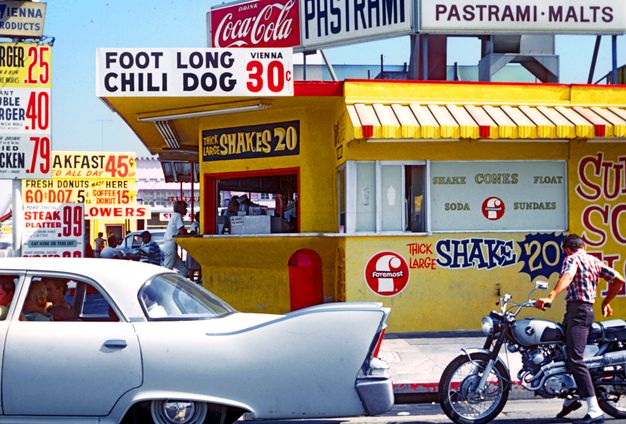
Jackson, Ruscha, and Scott Brown shared some meaningful commonalities despite their different origins: Jackson was an American born in Dinard, France, and raised in a patrician manner; Ruscha was born in Omaha, Nebraska, and raised in Oklahoma City; and Scott Brown, a daughter of European Jewish immigrants, was born in Nkana, Zambia, and grew up in Johannesburg, South Africa.1 All three had formative experiences as young adults traveling in Europe, where they noticed the specificities of urban life, design, and signage. In the United States, each took to the road and witnessed the 1956 Federal-Aid Highway Act’s transformative effects on the landscape. With the automobile’s ascendancy came such amenities as the commercial “strip,” eye-catching signage and billboards, and parking lots (figs. 9.1, 9.2). These subjects were commonly considered ugly, but they attracted Jackson, Ruscha, and Scott Brown, impelling their image production over many years as well as key publications: Jackson’s “Other-Directed Houses” (Landscape, 1956–57) and other articles on the American scene; Ruscha’s Every Building on the Sunset Strip (1966); and Scott Brown’s Learning from Las Vegas (1972), coauthored with Robert Venturi and Steven Izenour. If Jackson first articulated a new perspective on the built environment in the 1950s, and Ruscha created a photographic/graphic means of representing it beginning in the mid-1960s, then Scott Brown put it all together in the early 1970s in one of the twentieth century’s most compelling and generative manifestos.
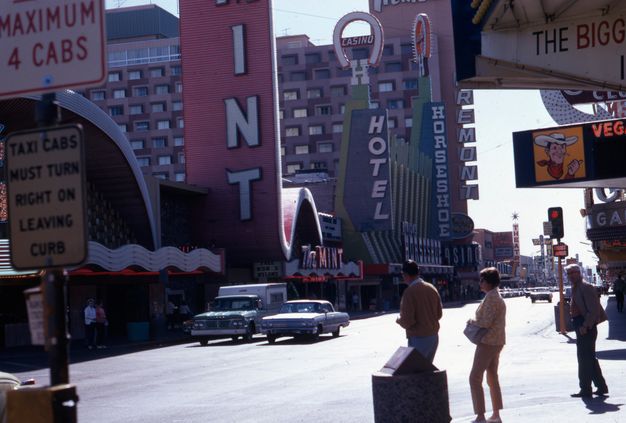
Jackson, Ruscha, and Scott Brown were not invested in midcentury modes of fine art and architectural photography. By the late 1960s, the virtuosic landscapes of Ansel Adams and the meticulous architectural studies of Ezra Stoller, to name just two prominent figures in these respective categories, seemed overdetermined and out of step with Cold War anxiety, Vietnam War protests, the civil rights movement, and a general shattering of post–World War II optimism. Walker Evans, a photographer for the Resettlement Administration in the 1930s and at Fortune from 1945 to 1965, provided a precedent sanctioned by the Museum of Modern Art for looking at ordinary structures in a direct, unemotional manner he referred to as “documentary style.”2 Anonymous technical and commercial photographs—the kind seen in advertisements, manuals, and annual reports—were another resource for a new attitude of detachment.
Whereas pop art tended to stylize, isolate, and monumentalize mundane products (soup cans, for example), the camera encompassed the commercial present as it was: messy, precarious, and inescapable. In the photographic archives of Jackson, Ruscha, and Scott Brown, we can see a tendency to address the same kinds of subjects repeatedly in search of recurring features and symbolic content. This demonstrates their knowing use of typology (an analytic tool for categorization already prevalent in human geography, urban studies, and conceptual art) as a point of departure. What they added—and what challenged the orthodoxies of their respective fields—was an antinostalgic, antiestablishment attitude and a willingness to be provocative or perplexing. In their photographic typologies, categories never fully subsume individual specimens.
Although photographs by all three can look very similar, they ultimately functioned within different kinds of arguments. Take the idea of the commercial strip: for Jackson, the strip was a phenomenon encountered everywhere, a site for community activity and the expression of popular taste. He used color slides made in various locations to illustrate the story of its evolution and functions. Ruscha focused on West Hollywood’s Sunset Strip in particular, attracted by its flatness, ready-made aspect, and synecdochic relationship to the Los Angeles area.3 His black-and-white photographic montages reinforce those ideas without offering any narrative or didactic message. For Scott Brown, the strip was both generic and specific to Los Angeles or Las Vegas. She used color slides in the classroom (like Jackson) and in publications (like Ruscha), alongside a welter of data and infographics, to mount a polemic in defense of “the ugly and ordinary.”4 Comparing the role of place for these figures, we can see Los Angeles serving as a laboratory for testing methodologies that could be applied elsewhere. Perhaps Ruscha spoke for all of them when he said, “There was something beyond the simple pictures of capturing Sunset Boulevard. It was more like I was some professor studying what this is all about.”5 Looking more closely at these three individuals, where their paths crossed, and the role of photography in their thinking, we get a better sense of how their ideas about the built environment—visualized in a certain type of “deadpan” photography—gained traction across their disciplines and beyond. In its slang etymology, deadpan originated to describe acting styles that emerged in early narrative cinema (circa 1915–25) and came to generally connote an impassive facial expression, often assumed for comic effect. Jackson, Ruscha, and Scott Brown, alike in their love of language, effectively appropriated it as a term of art. Luring in viewers and readers with their amusingly deadpan pictures, they end up persuading us to adopt their nonjudgmental perspective.
Self-styled amateur geographer John Brinckerhoff Jackson (1909–96) was a founding figure of cultural landscape studies, a field that emerged in the mid-twentieth century and combined elements of human geography, architectural history, urban planning, and sociology. Jackson based his work on the firsthand observations he made on many road trips, during which he made drawings, notes, and (after about 1956) color slides. He first began to publish his thoughts on American vernacular architecture in Landscape, a journal he founded in 1951. In his role as editor, Jackson incorporated his own drawings as well as diagrams and photographs made by others, alongside articles and reviews.6 As a contributing author, he published such influential essays as “Other-Directed Houses” (1956–57), “The Stranger’s Path” (1957), and “The Abstract World of the Hot-Rodder” (1958–59), expressing his love of the view from the road and his early perception that the automobile was irreversibly altering landscapes and lives. Ultimately, for Jackson, landscape was not an idealized, pure state of nature; it was houses, utilitarian buildings, roads, and signage, among other things, in a geographical context. This vernacular landscape could be considered a quintessentially American work of art that Jackson spent his life interpreting.
After stepping down from Landscape in 1968, Jackson began a storied ten-year teaching career, alternating between the University of California, Berkeley, and Harvard University. Regular drives between these two universities, his home in New Mexico, and various speaking destinations served as field work. Jackson’s photographic activity accelerated from this point onward.7 “Slide shows are popular in the classroom,” Jackson later observed, “and though my slides were poor in quality, they were of familiar, everyday objects and places, and that, I suspect, was the principal reason for the success of the course.”8 Typically, Jackson would speak for about forty-five minutes, activating the imaginations of his listeners, and then conclude with a selection of four to ten slides shown singly rather than in pairs.9
Gradually, Jackson became habituated to using slides as “visual notes, as sets of ideas that he stored away as he studied new landscape elements and prepared essays about them.”10 The macro purpose of Jackson’s slides was, according to Jordi Ballesta, “to structure his geographic experience” and facilitate its articulation in essays.11 Ballesta further explains: “Because [the slide] can receive written annotations, I think it enabled the transition from image to text. It can easily be sorted, moved, arranged, removed and brought back, and so it is able to closely follow a developing typological thought, the phrasing of a question and the setting up of a narrative path.”12 Unlike typical academics in his field, Jackson didn’t build arguments on the basis of maps, planning documents, demographic data, and so on.13 Whereas Landscape is amply illustrated, few images appear in Jackson’s many essay collections. His method consisted, quite simply, of looking, thinking, and writing. Photography served these primary activities without ever becoming an end in itself.
Jackson made some 5,500 color slides in total. Rather than filing them in lecture order, he stored them in binders according to more than ninety subject categories and subcategories that he also used for bibliography cards.14 For example, the binder he titled “The Strip” contains subcategories—such as travel, motels, gas stations, ships, harbors, airports, garages, hotels, vehicles, and bridges—that make it clear he considered transportation and commercial architecture to be wholly interconnected. Other large categories include roads and highways, domestic architecture, and churches and schools. Jackson usually annotated individual slide mounts with place names and their category; dates were less important, although sometimes stamped on the mounts automatically when processed. He changed some slides’ categories over time, moving them from the specific to the generic, in keeping with the wide-ranging nature of his lectures and later writings, which are seldom close studies of a single site. In figure 9.3, two handwritten notes indicate the subject is a “used car lot/Mission Blvd/Hayward,” enough information to locate the same enterprise (Bridges Auto Center, 25711 Dollar Street, Hayward, California) today. At some later stage, he added the titles Strip II and Street Decorations.
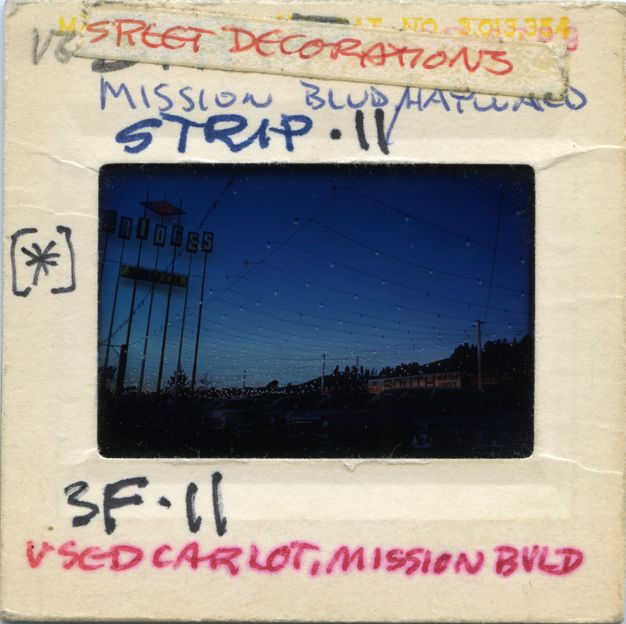
Jackson’s slides gradually made their way to what is now their primary archive, the University of New Mexico’s Center for Southwest Research & Special Collections.15 Among many copy slides from picture libraries and books is a page from Ruscha’s Thirtyfour Parking Lots in Los Angeles (1967). Jackson’s own slides—all 35mm color, not cropped or masked, in plastic or cardboard mounts, some with glass—bear signs of fading and handling; many are out of focus, taken on the move, and not intended for publication. He called them “poor,” and some commentators concurred that they are “artless” or “competent yet prosaic,” while others described them as “excellent” and “often arresting . . . riveting views.”16 His evident position, often within or beside the car (see fig. 9.1), was not simply expedient but also illustrated how the automotive landscape was experienced in everyday life. It should be noted that many of Jackson’s photographs include people, reinforcing the human aspect of cultural landscape studies and distinguishing them from Ruscha’s depopulated architectural imagery. Out of the car and strolling around, Jackson used the camera as a means of engaging with residents to inquire about how they perceived and navigated their environments.17
Denise Scott Brown (b. 1931) was already using photography in connection with her research and teaching. She was well versed in the burgeoning literature around cultural landscape studies when she met Jackson in the mid-1960s, probably at the University of Pennsylvania (Penn). Their teaching posts overlapped at UC Berkeley’s College of Environmental Design in 1965, and the two became friendly.18 In a recollection published in 2003, Scott Brown referred to the academic and social upheaval that affected her, Venturi, and Jackson at the time of their meeting. “Its relevance, for us as for Brinck, had to do with the physical environment, urban and rural, and how it could be understood as a work of art and technology of a multicultural community and society. These lines of thought led us to a critique of the latter-day Modern architecture and urbanism of the 1950s and 1960s and to a search for socially concerned, culturally tuned approaches to design.”19 She quickly realized that western cities such as Los Angeles and Las Vegas were suitable testing grounds for her ideas. While the latter was the titular subject of her best-known book, her approach to it was determined by her time in Los Angeles.20
Scott Brown took four trips to Las Vegas in 1965–66 before inviting Venturi to accompany her in November 1966. She had the training to analyze the city as an urban phenomenon and a contrarian’s openness to nontraditional forms. Photography played a role in processing her ambivalence, and she continued a habit she had cultivated with her first husband, Robert Scott Brown (d. 1959), while they traveled in Africa and Europe. Together they became interested in “cultures not Culture—pop culture, counter-cultures, pop art, commercial architecture and signs—and photography itself as an art.”21 She admired the French photographer Henri Cartier-Bresson, and she once traveled through Spain with a group that included the photojournalist Leonard Freed. But she would later say of her own photographs, echoing Jackson and Ruscha, “If there’s art here it’s a byproduct.”22 Her subject matter always correlated with her research interests. Traveling with Venturi starting in the mid-1960s, she began looking even more carefully at “communication, streets, and the way store signs behave. So we began taking those photographs too.”23
In Los Angeles and Las Vegas, Scott Brown turned her attention to the much-disparaged sprawl, commercial strips, everyday buildings, signage, parking lots, and so on. In the process, she began to discern specificities and patterns, and she modified her photographic perspectives accordingly. In Las Vegas, she “documented the ‘view from the road’ on foot and by car, and shot The Strip from a raised eye level through the front window of the early morning bus that took workers to the casinos.”24 While getting to know Las Vegas, she was concurrently teaching urban planning in a newly established department at the University of California, Los Angeles (UCLA)—notably, an ambitious studio course titled “Form, Forces and Function in Santa Monica.” Based on a structure she developed at Penn, the Santa Monica Studio addressed the city’s historical, cartographic, and sociological aspects through lectures, readings, guest speakers (Jackson among them), research, and production assignments. The syllabus of this 132-session course evolved into a book-length report comprising Scott Brown’s preparatory research, student projects, contributions from invited participants, and everyone’s critical dialogue with everyone else. The Santa Monica Studio likewise asked students to “experiment with techniques and methods of drawing and photography which give some feeling of the multiplicity and complexity of patterns of activities and structures” in Santa Monica and the broader scope of Los Angeles.25
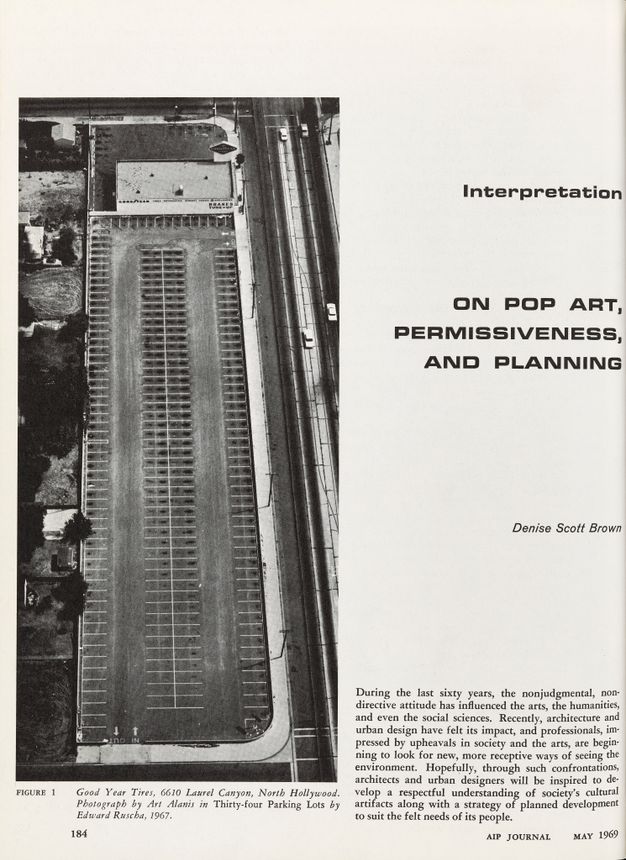
In addition to her impressive scholarly productivity, Scott Brown was “shooting like crazy” in L.A.26 To understand Pico Boulevard, “a kind of everyday strip,” she walked with a camera, “building up my data by photographing what I loved” (see fig. 9.2).27 She discovered Ruscha’s books in a bookstore on Santa Monica Boulevard in 1965 and was immediately “intrigued that he was doing what I was doing.”28 Three of Ruscha’s photographs (one each from Thirtyfour Parking Lots, Twentysix Gasoline Stations [1963], and Some Los Angeles Apartments [1965]) illustrate her May 1969 article “On Pop Art, Permissiveness and Planning” (fig. 9.4), which opens with a reflection on the attitude of nonjudgment across various realms of cultural production and Scott Brown’s conviction that architects and urban designers ought to follow suit. Every Building on the Sunset Strip (1966)—“Deadpan, it could be on the piazzas of Florence, but it suggests a new vision of the very imminent world around it”—exemplifies her call for a neutral but curious gaze on contemporary, nonmonumental reality.29 From the vantage point of Ruscha’s Los Angeles, Scott Brown glances backward at Renaissance Italy and forward to a generic, postindustrial urban formation.
Ruscha’s unusual format further reminded her of a mass-culture prototype: “Seeing his photo-composite of the Sunset Strip, I felt he had perhaps learned, as I had, from the traditional accordion-folded photo guides for tourists travelling down the Rhine. In 1952 I bought one of those for my Rhine trip and perhaps he did too.”30 Both artist book and travel guide portray the built environment as seen by a mobilized gaze. How to present information to just such a gaze was the top priority of “Learning from Las Vegas, or Form Analysis as Design Research,” a third-year studio course taught by Scott Brown, Venturi, and Steven Izenour in fall 1968 at the Yale School of Architecture that used the Santa Monica Studio as a template.
Part road trip, part boot camp, and part think tank, the Las Vegas Studio took up the challenge of “evolving . . . a new graphics for urbanism” according to the provocative insights and propositions Scott Brown and Venturi had recently put forth in an Architectural Forum article, “A Significance for A&P Parking Lots, or Learning from Las Vegas.”31 Thirteen students—nine in architecture, two in urban planning, and two in graphic design—spent the first three weeks of the course preparing at Yale University and then stayed four days in Los Angeles before launching into ten days in Las Vegas.32 From the outset, Scott Brown, Venturi, and Izenour emphasized that conventional rendering techniques would not suffice. The students would have to augment the urban theorist’s typical array of maps, charts, and schedules with the media of popular culture and temporal flow—that is, photography and film. In this regard, Ruscha’s Every Building on the Sunset Strip, Some Los Angeles Apartments, and Thirtyfour Parking Lots would be crucial.
Following the initial research phase at Yale, the group headed to Los Angeles in October 1968. They went to Disneyland to observe the architecture and signage and to UCLA to meet with the architectural critic Esther McCoy and others whom Scott Brown had invited to her course. She also arranged a studio visit with Ruscha at 1024 3/4 North Western Avenue.33 What we know about that encounter comes from Scott Brown and the students; Ruscha is laconic on the subject. “I seem to remember studio visits from them [Venturi and Scott Brown] and not having exactly that much to exchange with one another except that we were just curious about each other,” he remarked in an interview with Hans Ulrich Obrist.34
At the time, Ruscha had completed four of his five books about the Los Angeles built environment and no doubt had materials related to their production ready to hand. (Already, perhaps, the Streets of Los Angeles project was serving as a research archive.) However, it is unlikely that he conducted a demonstration in any formal sense. “He and they [the students] got on well together,” Scott Brown recalled. “Back then he was hesitant to explain what he was doing, so they ended up drinking beer together.”35 The group may have swapped impressions about Las Vegas, where Ruscha had been spending a fair amount of time, and discussed, at least in general terms, Ruscha’s Every Building on the Sunset Strip, given their preoccupation with automobile-seeing and their assignment to produce a Ruscha-style elevation of the Las Vegas Strip. In essence, Ruscha’s L.A. books “provide an analysis of what is visible from the road—what there is to actually look at in moving through the city,”36 which was the studio’s goal as well. (They also planned to capture aerial views of Las Vegas from a helicopter, so Ruscha’s experience hiring the aerial photographer Art Alanis for Thirtyfour Parking Lots could also have been of interest.)
The students worked in pairs and small teams on specific representational assignments, compiling slides and film footage of Las Vegas signs, particular building types, pedestrian activity, traffic patterns, and the Strip’s signage and architecture from all perspectives. In all, the students generated some five thousand color slides, three thousand meters (9,842 feet) of film, and myriad documents and sketches.37 The field work was intense and round-the-clock. In addition to the time they spent on and around the Strip with cameras and notepads in hand, students talked with tourists, participated in meetings with local authorities, were interviewed by print and television journalists, visited the Young Electric Sign Company (YESCO), and attended the grand opening of the Circus Circus casino.
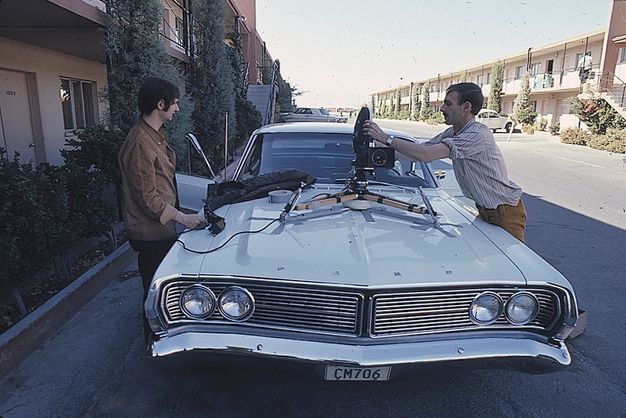
The studio’s prevailing tone, encouraged by the instructors, was a Ruscha-like “deadpan” stance devoid of judgment, whether critical or celebratory. It was, as Scott Brown put it, “a way to avoid being upstaged by our own subject matter,” to remember that patterns and commercial-cultural imperatives underpin the city’s flamboyantly embellished facades.38 In this spirit, they gave the title Las Vegas Deadpan (or Three-Camera Deadpan) to a film that ended up generating several illustrations in the book, the Ruscha elevation among them.39 To produce this record of the Las Vegas Strip between Tropicana Avenue and the Sahara hotel, the students mounted a motor-equipped movie camera, loaded with color film, to the hood of a car (fig. 9.5), with two additional movie cameras, loaded with black-and-white film, in the side windows. Martino Stierli summarizes: “During the subsequent journey, the camera documented both sides of the street without interruption and without any human intervention. It was thus an attempt to obtain a ‘desubjectivized’ version of the cityscape.”40 The total duration of Las Vegas Deadpan is around twenty-one minutes.
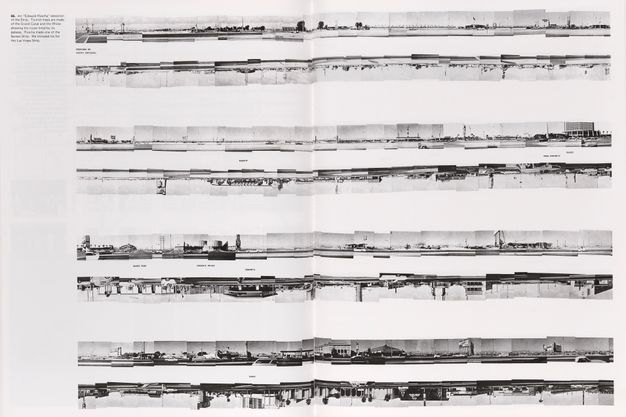
Douglas Southworth was the student who volunteered to make the Ruscha elevations, which in the final project report pertain to “pattern and order in the environment,” a rubric calling to mind both Jackson’s and Ruscha’s insights about the strip having a logic based on communication and movement.41 In the first edition of Learning from Las Vegas, the panorama took the form of eight paired bands across four pages (fig. 9.6), an amplitude in keeping with Ruscha’s long accordion fold. The debt to Every Building is explicitly stated in an accompanying caption, although in Southworth’s assembly, the facades are not continuous; nor are individual frames cropped to even out the upper and lower edges.42 Frames of unbuilt space indicate the distances between casinos and draw attention to the punctuating role of billboards and signage. Captions, very like Ruscha’s in appearance and often redundant given the casinos’ massive signage, identify cross streets and important sites. Overall, facades are less legible here than in the Ruscha original, in part because the buildings along the Las Vegas Strip vary more in height and distance from the road than those along the Sunset Strip. In the composited photographs, as in a moving car, signage and text, not architecture or people, command attention.
While Southworth reassembled frames from the Las Vegas Deadpan footage for the Ruscha elevation, fellow student Ronald Filson scrutinized it for the “entire strip in words” diagram (see “Description as Data: What the Tags See in the SoLA Archive,” this volume).43 “I can’t believe the number of hours that I spent slumped over a film-editing machine extracting from the documentary filming of the ‘Ed Ruscha’ strips. This was done with an old-fashioned lettering template, a relic even then. I tried to assemble the words in a way that revealed their importance.”44
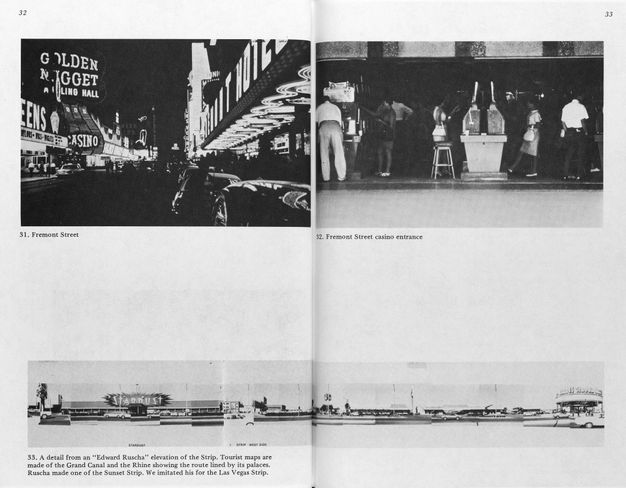
The reception of Learning from Las Vegas, starting with a final presentation at Yale on 10 January 1969 and accelerated by the 1972 release of the book by MIT Press, is too complex to be recapitulated here. Ruscha and Jackson are implicated only to a limited degree. Ruscha was possibly invited to the final presentation but did not attend, and Jackson wrote a now-obscure review of the book, published in the Harvard Independent on 30 November 1972.45 Scott Brown was disappointed with Muriel Cooper’s design of the book’s first edition: a hardcover she considered too large (14 x 10 1/2 inches), lavish, full of white space and color illustrations, and modernist.46 The 1977 edition has a much smaller trim size (9 x 6 inches) and black-and-white reproductions, feeling more like a handbook and akin to Ruscha’s small publications. In the later edition’s dense layout, the Ruscha elevation is reduced to a single segment (pages 32–33): the west side of Fremont Street from the Stardust to Circus Circus, placed along the lower edge of a spread, below a photograph looking down the street at night and a sidewalk view of tourists using slot machines (fig. 9.7). The three images collectively illustrate the point that “on Fremont Street the casinos are part of the sidewalk.”47 Especially in this minimized version, the Ruscha elevation can only serve the project’s larger contention that mobile vision requires experimentation with different representational techniques; its value as an analytical tool for urban design is not assessed in the text.
In 1967 Scott Brown had become a principal in the firm eventually named Venturi, Scott Brown, and Associates; as her focus shifted to planning and design, her photographic activity diminished. She boxed up her slides—a total of eleven thousand made between 1956 and 1975—and stored them in a closet, where they remained untouched for some forty years, until exhibition opportunities brought them to light again.48 Hilar Stadler and Martino Stierli’s exhibition Las Vegas Studio: Images de l’archive de Robert Venturi et Denise Scott Brown originated at the Museum im Bellpark, Kriens, Switzerland, in 2008 and toured to venues in Europe, the United States, and Australia. In 2016, Scott Brown showed her photography in the Venice Biennale and designed the installation herself—including a reprint of the Ruscha elevation of the Las Vegas Strip. Since then, her photographs have appeared in numerous galleries under the title Wayward Eye.49
Jackson, Ruscha, and Scott Brown shared a conviction that the ordinary world and its elements deserve attention. They honed their own attentive capacities—and, ultimately, those of wider audiences—through photographic activity. Often, archives are formed and then remain within disciplinary and institutional boundaries. This is not the case with Jackson’s, Ruscha’s, and Scott Brown’s. They knew each other (or each other’s work), and their archives document biographical cross-connections. Moreover, photographs by all three now share space in the art world and, perhaps more importantly, in the digital realm.
Mining their archives, one can assemble many appealing triplets that are linked through iconography and attitude: commercial and handmade signage, parking lots and cars, highways, strips, houses, gas stations, or main streets. A term used at the time, deadpan, still works to describe the nonjudgmental curiosity, resistance to nostalgia, attention to communication, and willingness to learn evinced by all three archives. To observe that some of these images are effectively interchangeable isn’t to deny Jackson, Ruscha, and Scott Brown their distinct creative positions as essayist, artist, and architect/urban theorist. J. B. Jackson’s photography was solitary and idiosyncratic, akin to snap shooting. His slides were aide-mémoire, illustrations supplementary to storytelling in the form of essays and lectures. Ruscha, an artist with experience in graphic design, generated the photographic material now in the Streets of Los Angeles Archive at the GRI with the goal of making a visual statement in the form of an artist’s book. Denise Scott Brown’s slides, which combine aspects of Jackson’s note-taking and Ruscha’s conceptual self-awareness with her own flair for provocation, appeared variously in her manifesto-like lectures, publications, and exhibitions.
What can be learned by comparing these photographic archives? For all three, photography was a legible, minimally expressive means of discerning formal patterns and communicative intent within the apparent randomness of the commercial vernacular. But it is also more than that. If we personify the archives, Scott Brown plays the part of gracious host, introducing Ruscha and Jackson to each other by pointing out some common interests. Others join the conversation, which goes deeper and gets louder. Connections are made; perspectives change.
Notes
Epigraphs: Anna Fixsen, “View-Master: The World, as Seen by Denise Scott Brown,” Architectural Record, 22 July 2016, https://www.architecturalrecord.com/articles/11824-view-master-the-world-as-seen-by-denise-scott-brown; A. D. Coleman, “Photography: ‘I’m Not Really a Photographer,’” New York Times, 10 September 1972; and Jordi Ballesta and Camille Fallet, “Vers une autre photographie documentaire: Quelques échanges autour de Notes sur l’asphalte = Towards Another Documentary Photography: Discussion about Notes on Asphalt,” in Notes sur l’asphalte: Une Amérique mobile et précaire, 1950–1990 = Notes on Asphalt: A Mobile and Precarious America, 1950–1990, by Ballesta and Fallet, exh. cat. (Vanves, France: Hazan, 2017), 9.
-
Numerous biographical accounts exist for all three. Particularly useful in drafting this essay were the following: Helen Lefkowitz Horowitz, Traces of J. B. Jackson: The Man Who Taught Us to See Everyday America (Charlottesville: University of Virginia Press, 2020); Paul Groth and Chris Wilson, “The Polyphony of Cultural Landscape Study,” in Everyday America: Cultural Landscape Studies after J. B. Jackson, ed. Chris Wilson and Paul Groth (Berkeley: University of California Press, 2003), 1–22; Sylvia Lavin, “Positioning Denise Scott Brown: Los Angeles, 1965–1966,” e-flux (March 2022); Jeremy Eric Tenenbaum et al., Your Guide to Downtown Denise Scott Brown (Zurich: Park, 2019); Paul Karlstrom, “Oral History Interview with Edward Ruscha, 1980 October 29–1981 October 2,” Archives of American Art, Smithsonian Institution, Washington, DC, https://www.aaa.si.edu/collections/interviews/oral-history-interview-edward-ruscha-12887; and Alexandra Schwartz, Ed Ruscha’s Los Angeles (Cambridge, MA: MIT Press, 2010). See also Isabel Frampton Wade, “‘The Tyranny of the Glossy’: Commercial Architectural Photography and Ruscha’s Streets,” this volume. ↩︎
-
On Walker Evans’s relevance in the 1960s and 1970s, including his impact on Ruscha, see Britt Salvesen, New Topographics (Tucson: Center for Creative Photography, 2009), 14–18. Chris Wilson discusses Jackson’s relative disinterest in Evans as an artist (although Jackson did make copy slides from Evans’s books) in “J. B. Jackson, Photography and the Quickening of Cultural Landscape Studies,” in Photoscapes: The Nexus between Photography and Landscape Design, ed. Frédéric Pousin (Basel, Switzerland: Birkhäuser, 2019), 57–58, 66. ↩︎
-
On flat facades as indicators of superficiality, see Cécile Whiting, Pop LA: Art and the City in the 1960s (Berkeley: University of California Press, 2006), 113; and Jesús Vassallo, “Inclusive Surfaces: Ed Ruscha and Venturi & Scott Brown,” in Epics in the Everyday: Photography, Architecture, and the Problem of Realism (Zurich: Park, 2019), 159–60. ↩︎
-
Robert Venturi and Denise Scott Brown, “Ugly and Ordinary Architecture, or the Decorated Shed,” part 1, Architectural Forum, November 1971, 64–67. ↩︎
-
Ed Ruscha, interviewed by James Cuno, “Ed Ruscha’s Los Angeles,” 3 August 2022, in Art + Ideas, produced by Getty, podcast, 34:48, https://blogs.getty.edu/iris/podcast-ed-ruschas-los-angeles/. I am grateful to Isabel Frampton Wade for bringing this to my attention. ↩︎
-
Bruno Notteboom, “Order and Ambiguity: The Urban Landscape in J. B. Jackson’s Magazine Landscape,” in Pousin, Photoscapes, 72–87. ↩︎
-
Jordi Ballesta, “John Brinckerhoff Jackson, within Ordinary Landscapes: Field Research and Amateur Photographic Practices,” L’espace géographique 45, no. 3 (2016): 211–44; and Peter Barberie, “Denise Scott Brown, Signs and Symbols for Living,” Aperture, no. 238 (Spring 2020): 129. See Robert S. Nelson, “The Slide Lecture, or The Work of Art History in the Age of Mechanical Reproduction,” Critical Inquiry 26 (Spring 2000): 414–34; and Jennifer F. Eisenhauer, “Next Slide Please: The Magical, Scientific, and Corporate Discourses of Visual Projection Technologies,” Studies in Art Education 47, no. 3 (2006): 198–214. ↩︎
-
J. B. Jackson, The Necessity for Ruins, and Other Topics (Amherst: University of Massachusetts Press, 1980), 113. See also Wilson, “J. B. Jackson,” 52–71. ↩︎
-
Wilson, “J. B. Jackson,” 60. Other accounts of Jackson’s teaching include the following: Paul Groth, in J. B. Jackson and the Love of Everyday Places, directed by Robert Calo (Chicago: Encyclopedia Britannica Educational Corp., 1988); Janet Mendelsohn and Bob Calo, “Shop Talk: A Conversation with the Filmmakers,” in Drawn to Landscape: The Pioneering Work of J. B. Jackson, ed. Janet Mendelsohn and Chris Wilson (Staunton, VA: George F. Thompson, 2015), 170; and Marc Treib, “The Measure of Wisdom: John Brinckerhoff Jackson (1909–1996),” Journal of the Society of Architectural Historians 55, no. 4 (1996): 490. ↩︎
-
Paul Groth, “J. B. Jackson’s Slides,” in Mendelsohn and Wilson, Drawn, 121. ↩︎
-
Jordi Ballesta, “J. B. Jackson, Field Research and Amateur Photographic Practices,” PhotoPaysage/Landscape Representation conference, University of New Mexico, Albuquerque, 16 October 2015, https://www.youtube.com/watch?v=bS2HaJFaIOc&list=PLprNspBRvTtgkgGKntvfy79Lee6QXKYIg&index=3, at 34 min., 30 sec. ↩︎
-
Ballesta and Fallet, “Vers une autre photographie,” 14. ↩︎
-
Ballesta, L’espace géographique, 4; and Groth, “J. B. Jackson’s Slides,” 121. ↩︎
-
Groth, “J. B. Jackson’s Slides,” 126. See also Paul Groth, “Appendix B: Organization of J. B. Jackson’s Teaching Slides,” in Mendelsohn and Wilson, Drawn, 227–32. ↩︎
-
The collection’s finding aid is online: https://nmarchives.unm.edu/repositories/22/resources/2580. Photographs can be searched here: https://econtent.unm.edu/digital/collection/Groth. See Audra Bellmore, Claire-Lise Bénaud, and Sever Bordeianu, “J. B. Jackson, Cultural Geographer: Evolution of an Archive,” Collection Building 31, no. 3 (2012): 115–19. ↩︎
-
For “poor,” see Jackson, Necessity for Ruins, 113; for “artless,” see Kenneth J. Helphand, review of Figure in a Landscape: Conversations with J. B. Jackson, directed by Claire Marino and Janet Mendelsohn, Landscape 9, no. 2 (1990): 146; for “competent,” see Jonathan Crisman, review of Drawn to Landscape: The Pioneering Work of J. B. Jackson, by Janet Mendelsohn and Chris Wilson, Architect’s Newspaper, 27 April 2016, https://www.archpaper.com/2016/04/review-drawn-landscape-book-jb-jackson/; for “excellent,” see Laurie Olin, “J. B. Jackson and Landscape Architects,” Sitelines 15, no. 11 (2020): 8; and for “arresting,” see Groth, “J. B. Jackson’s Slides,” 123. ↩︎
-
Jackson is seen doing this in two documentaries from the 1980s: Calo, J. B. Jackson; and Figure in a Landscape: Conversations with J. B. Jackson, directed by Claire Marino and Janet Mendelsohn (Cambridge, MA: Conservation Foundation and the Film Study Center, Harvard University, 1987). The two documentaries were released together under the title J. B. Jackson and the American Landscape (Watertown, MA: Documentary Educational Resources, 2015). ↩︎
-
Denise Scott Brown, “Learning from Brinck,” in Wilson and Groth, Everyday America, 49. Scott Brown published two book reviews in Landscape during Jackson’s editorship: “Art or People: Which Do the Architects Serve?,” review of The People’s Architects, ed. Harry S. Ransom, Landscape 16, no. 1 (Spring 1967): 38; and “Mapping the City: Symbols and Systems,” review of Urban Atlas by Joseph R. Passonneau and Richard S. Wurman, Landscape 17, no. 1 (1968): 22–25. ↩︎
-
Scott Brown, “Learning from Brinck,” 50–51. ↩︎
-
Lavin, “Positioning Denise Scott Brown.” ↩︎
-
Luise Rellensmann, “Framed Views: Denise Scott Brown on Ed Ruscha, the Desert, and Bitter Old Men,” Uncube, 25 July 2013, 12. ↩︎
-
Barberie, “Denise Scott Brown,” 130. For art as a “byproduct,” see Andrés F. Ramirez, ed., Denise Scott Brown, Wayward Eye (Berlin: Plane—Site, 2018), 6. ↩︎
-
Barberie, “Denise Scott Brown,” 129. Venturi took the “serious” black-and-white photos; Scott Brown took the “fun” color ones. In a commentary about Scott Brown’s photographs, Elizabeth Greenspan notes that “real designers sketched”: Greenspan, “Denise Scott Brown’s Wayward Eye,” Architect, 7 September 2018, https://www.architectmagazine.com/design/denise-scott-browns-wayward-eye_o. ↩︎
-
Stephanie Salomon and Steve Kroeter, “Interviews: Still Learning from Denise Scott Brown,” Designers and Books, 7 January 2014, https://www.designersandbooks.com/blog/still-learning-from-denise-scott-brown. ↩︎
-
Lavin, “Positioning Denise Scott Brown.” Scott Brown explained the pedagogical logic of the studio structure in “Studio: Architecture’s Offering to Academe,” keynote address, Para-theses: Current Trajectories in Architectural Research symposium, Columbia University Graduate School of Architecture, Preservation and Planning, 4 February 2006; edited version available at https://mascontext.com/observations/studio-architectures-offering-to-academe/. ↩︎
-
Fixsen, “View-Master.” ↩︎
-
Ramirez, Denise Scott Brown, 39–40. Venice Beach was also a strip of sorts. See Barberie, “Denise Scott Brown,” 126. ↩︎
-
Rellensmann, “Framed Views,” 11. ↩︎
-
Denise Scott Brown, “On Pop Art, Permissiveness and Urban Planning,” Journal of the American Institute of Planners 35, no. 3 (May 1969): 186. ↩︎
-
Rellensmann, “Framed Views,” 11. ↩︎
-
Robert Venturi and Denise Scott Brown, “A Significance for A&P Parking Lots, or Learning from Las Vegas,” Architectural Forum (March 1968): 37–43. ↩︎
-
For the syllabus, see Stephanie Salomon and Steve Kroeter, “The 1968 Learning from Las Vegas Studio Revisited,” Designers and Books, 19 December 2013, https://www.designersandbooks.com/blog/1968-learning-las-vegas-studio-revisited. ↩︎
-
Adam Marcus, “Interview: Denise Scott Brown and Robert Venturi,” Museo 2010, http://www.museomagazine.com/SCOTT-BROWN-VENTURI. ↩︎
-
Peter Fischli, Rem Koolhaas, and Hans Ulrich Obrist, “Flâneurs in Automobiles,” in Las Vegas Studio: Images from the Archive of Robert Venturi and Denise Scott Brown, ed. Hilar Stadler and Martino Stierli (Zurich: Scheidegger & Spiess, 2015), 162. ↩︎
-
Rellensmann, “Framed Views,” 11. See also Vassallo, “Inclusive Surfaces,” 138: “Commenting on this visit, [Scott Brown] recounts feeling disappointed by the lack of explanation provided by Ruscha regarding his work, as the artist refused to engage her in serious conversation and in turn threw an impromptu party for the students.” ↩︎
-
Mariana Moglievich, “Monuments and Mediocrity: Landmarking Los Angeles,” Future Anterior 11, no. 1 (Summer 2014): 50. ↩︎
-
These statistics come from the summary-report excerpts reproduced by Salomon and Kroeter, “Interviews.” ↩︎
-
Denise Scott Brown, “Remedial Housing for Architects Studio,” in Venturi, Scott Brown & Associates: On Houses and Housing (London: Academy, 1992), 56; cited in Aron Vinegar, “The Melodrama of Expression and Inexpression in the Duck and Decorated Shed,” in Relearning from Las Vegas, ed. Aron Vinegar and Michael J. Golec (Minneapolis: University of Minnesota Press, 2009), 181. ↩︎
-
Katherine Smith, “Mobilizing Vision: Representing the American Landscape,” in Vinegar and Golec, Relearning, 111. ↩︎
-
Martino Stierli, “Las Vegas Studio,” in Stadler and Stierli, Las Vegas Studio, 27. ↩︎
-
Robert Venturi, Denise Scott Brown, and Steven Izenour, Learning from Las Vegas: The Forgotten Symbolism of Architectural Form, rev. ed. (Cambridge, MA: MIT Press, 1977), 76; and Smith, “Mobilizing Vision,” 125–26n41. ↩︎
-
Similar discontinuities occurred in Ruscha’s attempt to paste together Jerry McMillan’s initial photographs of the Sunset Strip. ↩︎
-
Venturi, Scott Brown, and Izenour, Learning, 30–31. ↩︎
-
Salomon and Kroeter, “1968 Learning from Las Vegas.” ↩︎
-
It is certain that Ruscha did not attend the critique, although several secondary sources, including my own (New Topographics, 26), erroneously mention that he did. Stierli, “Las Vegas Studio,” 15, states that he was invited, whereas Vassallo, “Inclusive Surfaces,” 142n34, says Scott Brown told him in May 2013 that they “never contacted [Ruscha] again after their brief visit to his studio in Los Angeles.” ↩︎
-
On the Cooper design, see Salomon and Kroeter, “Interviews”; Michael Golec, “‘Doing It Deadpan’: Venturi, Scott Brown and Izenour’s Learning from Las Vegas,” Visible Language 37, no. 3 (2003): 266–87; Michael J. Golec, “Format and Layout in Learning from Las Vegas,” in Vinegar and Golec, Relearning, 31–47; and Stierli, “Las Vegas Studio,” 17. ↩︎
-
Venturi, Scott Brown, and Izenour, Learning, 77. ↩︎
-
Greenspan, “Denise Scott Brown’s Wayward Eye.” Scott Brown refers to twenty thousand slides in Salomon and Kroeter, “Interviews.” In 1965, she gave duplicate teaching slides to the UC Berkeley Department of City & Regional Planning; see the online collection guide here: https://oac.cdlib.org/findaid/ark:/13030/c81g0rth/admin/. ↩︎
-
Ramirez, Denise Scott Brown. Betts Project, London, published a limited-edition portfolio of twelve prints. See Elizabeth Greenspan, “Star System,” Believer 18, no. 4 (October/November 2021): 60–61. Once Scott Brown is no longer using her slides, they will join the Venturi, Scott Brown, and Associates (VSBA) Archive, established in 2006 at the University of Pennsylvania Architectural Archives. ↩︎