The Information Man is someone who comes up to you and begins telling you stories and related facts about a particular subject in your life. He came up to me and said, “Of all the books of yours that are out in the public, only 171 are placed face up with nothing covering them; 2,026 are in vertical positions in libraries, and 2,715 are under books in stacks. The most weight on a single book is 68 pounds, and that is in the city of Cologne, Germany, in a bookstore. Fifty-eight have been lost; 14 have been totally destroyed by water or fire; 216 books could be considered badly worn. Three hundred and nineteen books are in positions between 40 and 50 degrees. Eighteen of the books have been deliberately thrown away or destroyed.”
Now wouldn’t it be nice to know these things?
—Ed Ruscha
Despite the fact that a significant part of Ed Ruscha’s artistic practice included cataloging streets, swimming pools, and parking lots; using language as one of his primary media; and making paintings of the gridded structure of Los Angeles, the relationship between Ruscha and information theory has not received adequate attention. This is, after all, an artist who decided to title his collected writings Leave Any Information at the Signal (2002) and whose most well-known literary contribution is titled “The Information Man" (1971). From one perspective, the Information Man is the purveyor of factoids, in this case pertaining to Ruscha’s books: their spatial orientation, relation to other objects, physical condition, extraliterary functionality and use value, olfactory presence, states of stasis or mobility, and so on. However, the facts provided by the Information Man, while a thought-provoking compendium of data, do not directly address the objects as works of art or as books to be viewed or read. Instead, the Information Man delights in seemingly needless knowledge and an abundance of largely useless facts, in information for information’s sake. Ruscha ends his passage about the Information Man with a question: “Now wouldn’t it be nice to know these things?” The question, from the perspective of a reader who understands that the entire story is presented as a dream, can be rephrased to ask: What is the information quotient of the nonrational? Of datasets beyond human comprehension? Of things that are not and, perhaps, cannot be made instrumental? These are questions Ruscha was grappling with at the precise moment the United States and many other countries were moving from an industrial to an information-based society.
This essay analyzes the information dynamics at play in Ruscha’s early paintings and photobooks, the apotheosis of which is the Streets of Los Angeles (SoLA) Archive. This archive, constructed as if the Information Man was asked to describe an urban landscape, documents many of the major streets and boulevards west of the Los Angeles River and north of Venice Boulevard in photographs taken between 1965 and today. Ruscha’s SoLA project has been, and in many ways continues to be, a difficult body of work to comprehend. For most of its existence, it has functioned as a largely latent archive. Now numbering almost one million images (with 740,000 currently at the Getty Research Institute), the archive remained largely untouched for decades, with over 90 percent of the negatives never printed but spooled around dozens of film reels and tucked away in the artist’s studio.1
Nevertheless, the artist has recently said of the archive, “It’s all part of the big picture,” indicating that it informs his Los Angeles-based artwork.2 The archive is the source material for three Ruscha works: Every Building on the Sunset Strip (1966), the Patrick Painter photo suite Sunset Strip (printed 1995), and the book THEN & NOW: Hollywood Boulevard, 1973–2004 (2005). Despite Ruscha’s comment, the SoLA project is more than just material for an artwork; at its core, it is a collection of urban data—one that, perhaps, could be described as a fever dream of documentary completeness, like a Borgesian map. Even now that digital technology (which Ruscha is deeply suspicious of) has caught up with him and a portion of the archive has been digitized and made accessible to the public, the informational quotient is overwhelming. In the following, the SoLA Archive will be seen to be many things: a visual palimpsest, a loop (both literal and figurative), and a core part of the artist’s practice for over five decades—each of them connected to Ruscha’s career-long interest in information.
“I’m a child of communications”3
Ruscha’s engagement with information theory dates to his student days. As several of the authors in this publication discuss (most extensively, Jennifer Quick), Ruscha’s art-school training was not in painting.4 Rather, in 1956 he enrolled in the advertising design program at the Chouinard Art Institute, and he soon joined its Society of Graphic Designers. Bill Moore, a major figure in postwar design, was the lead instructor for this program, and his sensibility was clearly derived from the New Bauhaus in Chicago, where he had studied. In keeping with this background, Moore’s dictum was “design is the logical arrangement of visual elements for order.”5 Order, for Moore, was not simply a positive abstraction. Rather, the logical pattern of image, text, and color was intended to convey information clearly and concisely.
In the mid-twentieth century, graphic design and advertising were allied with the nascent fields of communication and information theory that would have such a radical impact on postwar life. One definition of advertising is, of course, a process of persuasive communication between a company and its intended audience; the language the field was using in the 1950s to describe its methods and goals was at times identical to that of the information sciences. Both fields relied heavily on behavioral psychology, and advertising—with its goal of stimulating desire, including by visual means—looked particularly at subfields concerned with perception. Gestalt psychology’s emphasis on studies of mental filtering and clear, immediately perceptible shapes and concepts seemed to offer some especially pertinent lessons for the advertising professional. Advertisers believed that if they could get consumers to foreground their product and company logo and experience the rest of the visual field as background, the effectiveness of campaigns could be greatly improved. A well-designed advertisement was often said to possess a “good Gestalt,” which was what Moore was after.6
Ruscha was both a strong student at Chouinard and something of a rebel. He frustrated Moore—in one instance, he created a Dadaist collage that the instructor tried to burn—and systematically turned away from establishment advertising teaching in the student journal he cofounded, Orb (fig. 6.1).7 This journal was inspired by the permeability of commercial and fine art that not only characterized the work of Jasper Johns, Robert Rauschenberg, and the Independent Group but also fundamentally changed the advertising business. Orb arguably went even further than other important student magazines of the era, such as the Royal College of Art’s protopop Ark (edited by David Hockney and friends), in integrating the advertisements and the editorial, to the point that the two are often indistinguishable. The journal programmatically demonstrated that graphic design could be used in many ways that did not constitute “the logical arrangement of visual elements for order.” Orb was particularly notable for its typography, which was set upside down and sideways in addition to in a conventional orientation. For issue 2, a giant orange finger was superimposed over the entire text of the main page, causing large sections to be nearly illegible, and the text itself was set in three directions, making it impossible for any element to have a good Gestalt, or for that matter any Gestalt at all (see fig. 5.8). Orb’s exciting combination of disparate elements—references to Marcel Duchamp and to comics, poetic and corporate language, and a matter-of-fact irrationality—introduced parameters that Ruscha continues to employ.
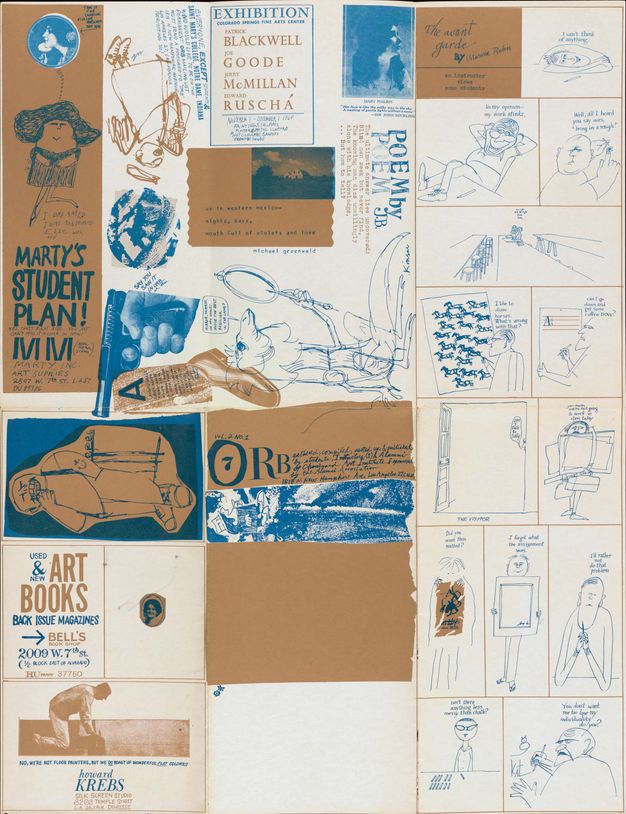
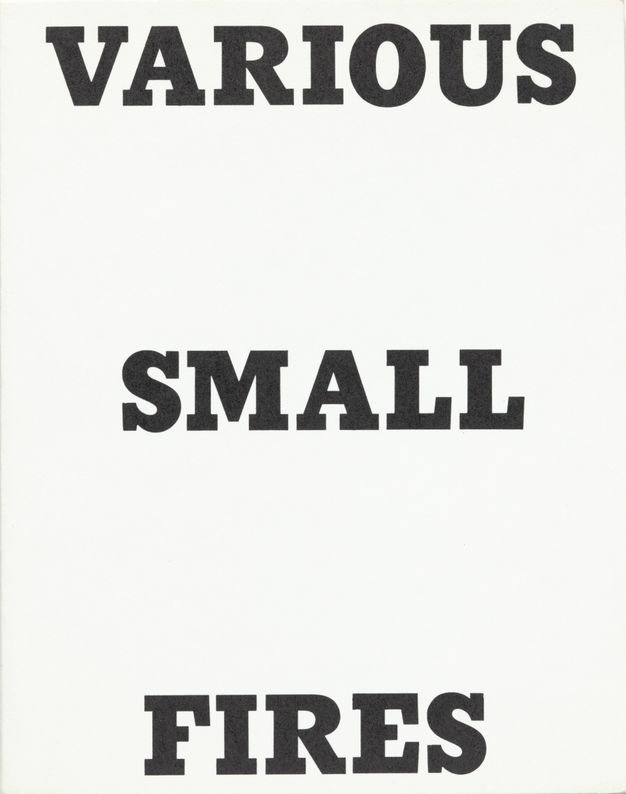
This brief discussion of Orb foregrounds what would become a central element of Ruscha’s art practice: the translation of aesthetic or formal problems into information or communication issues. Indeed, in Ruscha’s first published interview—printed in Artforum on the occasion of his second artist’s book, Various Small Fires and Milk (1964) (fig. 6.2)—John Coplans, who was most likely aware of Ruscha’s training in commercial art and experience in advertising, asks Ruscha if he knows the book Nonverbal Communication (1956) by Juergen Ruesch and Weldon Kees. This book sought to elicit people’s reactions to visual material and train them to read the nonverbal clues that evidence individuals’ inner states. It also contained an epigraph from Bell Telephone Laboratories’ Warren Weaver, one of the inventors of mid-twentieth-century information theory. Ruscha’s response demonstrates an awareness of both the book’s intellectual context and the types of arguments it puts forth. However, he immediately distances his own artist’s books from Ruesch and Kees’s publication: “Yes, it is a good book, but it has a text that explains the pictures. It has something to say on a rational level that my books evade. The material is not collated with the same intent at all.”8
What separates Ruscha from Ruesch and Kees is the artist’s interest in the nonrational—the elements of communication that are neither logical nor quantifiable—and in one aspect of information theory—the phenomenon of noise, which Ruscha claims originates at the beginning of his career: “I guess the idea of noise, of visual noise, somehow meant something to me, and still means something to me.”9 The concept of noise within communications theory has a very specific referent: it is everything in a communication that is not part of the message. Noise frustrates communication: in Ruscha’s day, it was the static that one heard over a telephone line, or, today, the ads that clutter one’s search returns. The illegible typography in Orb and the failure to distinguish between advertisements and editorial promote communicative confusion, just as the undifferentiated enormity of the SoLA Archive never coheres into a clear project with measurable intent and outcomes.
Ruscha is explicit that his engagement with noise is rooted in his commercial-arts background: “My inspiration comes from mass communication rather than cerebral or historical things.”10 The concept of noise was first articulated by Weaver and his colleague Claude Shannon, and it had a definite pedigree within mid-twentieth-century advertising and commercial arts, but its broadest and most profound expression was developed in the 1950s by Norbert Wiener, a mathematics professor at the Massachusetts Institute of Technology. Wiener called his theory cybernetics, and its goal was to maximize information and eliminate noise, steering or controlling messages and keeping entropy at bay through feedback, a now-common term coined by Wiener to describe the cybernetic process of machine learning: the “control of a machine on the basis of its actual performance rather than its expected performance is known as feedback.”11 In other words, a guided missile that corrects its course based on the changed position of its target is using feedback to achieve a desired result. That human beings could be controlled in a similar manner through cybernetic feedback was something that Wiener was acutely aware of, and when it was pointed out to him that there are numerous differences between a person and something like a guided missile, he chillingly replied that for cybernetics the differences do not matter.12
“A given space in which to make noise”13
To understand Ruscha’s emphasis on noise and the nonrational, it is crucial to remember his deep appreciation for surrealism, the movement that put the unconscious, the irrational, and the psychosexual at the center of Western art. Utilizing his commercial art training, Ruscha made his most significant contribution to Artforum, the magazine he art directed for several years, when he produced the cover for the surrealism issue in September 1966. Surrealism Soaped and Scrubbed is a three-dimensional rendering of the word surrealism cut out of balsa wood and floating in a bath of soap bubbles, which was then photographed and reproduced for the magazine (see fig. 7.14). Ruscha’s use of an entirely commercial art process foregrounds his acknowledgment that surrealism had been thoroughly integrated into commercial culture by the early 1960s. For Ruscha, the liberatory potential of the unconscious and the psychosexual is no longer available—there are no melting clocks in Ruscha—and the irrational—things that look or read as manifestly off—can only be achieved materially and matter-of-factly.
Surrealism Soaped and Scrubbed combines humor—Is surrealism naughty and in need of scrubbing because of its sexual charge or commercial capitulation?—with the irrational—What does it mean to make a word a three-dimensional object and then clean it? Humor, the nonrational, and noise are also central to Ruscha’s most specific engagement with information theory in what he has called his best painting: Noise, Pencil, Broken Pencil, Cheap Western (1963) (fig. 6.3).14 Ruscha has dispersed the oversized word NOISE and three objects to the four edges of the large, dark blue field, leaving the center of the canvas entirely blank. The deep-red sans-serif capitals of NOISE are rendered in perspective, receding from left to right, with white shading creating the look of a billboard thrust into the viewer’s space. The two pencils and the pulp western are depicted veristically and at actual size, with the trompe l’oeil break in one pencil depicted as accurately as possible. If one were to draw a line between the four objects, it would form a circular loop. This figure is crucial because the feedback relationship, as conceived by Wiener, is not a simple unilateral relay but rather a circuit of input and output that feed into each other. Relationships between servo-mechanisms—humans and “intelligent" machines who both send and receive messages in a process of continuous feedback and control—are not ones of cause and effect; rather, they are circular.
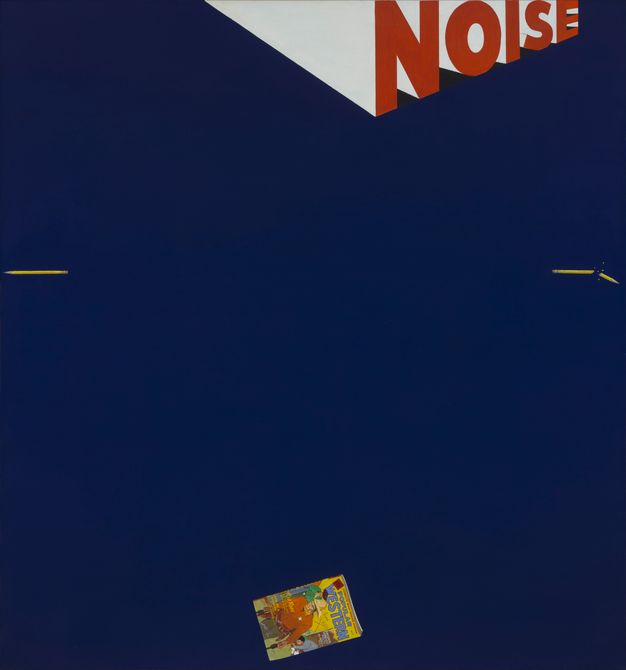
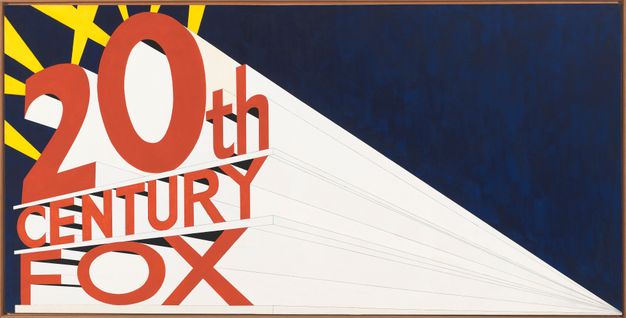
The cybernetic feedback loop controls noise, but in Noise, Pencil, Broken Pencil, Cheap Western, noise suffuses the painting—literally, linguistically, visually, and, even by inference, auditorily. The letters in NOISE are similar in form, color, and structure to the 20th Century Fox logo as it appears in Ruscha’s Large Trademark with Eight Spotlights (1962) (fig. 6.4). The adaptation of this immediately recognizable trademarked form for the word NOISE evokes the constant onslaught of signs and symbols by which the entertainment industry promotes itself and its wares—employing the tropes of commercial art to maximize noise. In this sense, Ruscha reveals another crucial concept in communications theory: noise is not only the product of a lack of information or of an unclear or fragmented message but also sometimes the result of an excess of information, of too many competing messages vying for attention, even if each features its own, clear, well-designed Gestalt. In this sense, the SoLA Archive can be seen to contain a great deal of noise.
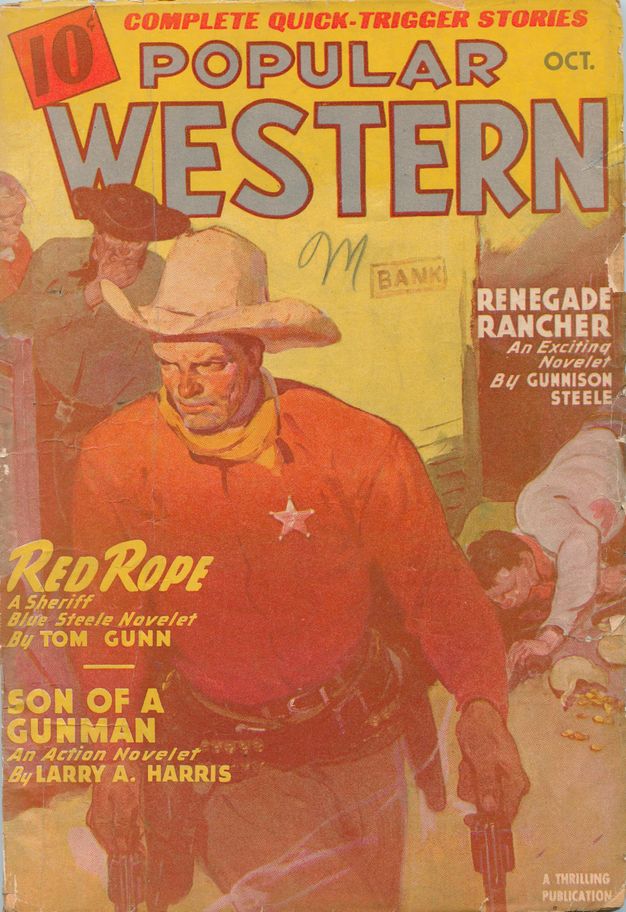
The pencil is the designer’s initial tool; it is in many ways the ur-writing instrument, the first one given to schoolchildren in their initiation to the practice, and it represents the baseline of writing’s ability to construct and store information or produce noise. The pencil snapped in half, now useless, evokes the noise of its demise. Ruscha’s cheap western is another artifact whose time has passed, through obsolescence, for the pulp western had completely died out as a genre during the mid-1950s, killed off by television. The magazine emits the faint, dated noise of the outmoded in popular culture. The specific issue Ruscha remakes is from October 1946 (fig. 6.5), and the seventeen years of distance challenges the view that pop art is concerned with the topical and that it buys into the capitalist myth of progress.15
On another level, the painting is a parody, a wry comment on the obsession of color-field painting in the 1960s, with the literal, rather than depicted, edges of the canvas as the site of artistic innovation. This corresponds to Ruscha’s inversion of surrealism into a form of irrationality that is literal and material. What does it mean to paint something actual size, countering the logic of representation? Or to depict the cybernetic loop as an actual loop? The Ruschaean logic of Noise, Pencil, Broken Pencil, Cheap Western seems to be arguing that neither desire nor the unconscious—which surrealism tried—can subvert control, but perhaps matter-of-factness and a lack of affect can. Information theory controls noise to foreground the message, but the message of Noise, Pencil, Broken Pencil, Cheap Western is NOISE. This illogical logic (would steering or controlling noise make it even noisier?) is set against the consequences of a world managed successfully, as Wiener feared, by the feedback loop of cybernetics. In such a world, human beings are reconceived as patterns of information, studied by market research and seduced by advertisements to have their consent manipulated, not by steering them against their will but by holding out the promise that through feedback their deepest needs and desires can be fulfilled. Those of us living in an era defined by Amazon, Google, and Instagram know how effective control through algorithmic feedback has become.
“Dead serious about being nonsensical”16
Wiener was, of course, well aware that there is an inverse definition of feedback. The normative scientific meaning refers to the mode employed by cybernetics, in which output directed toward a goal is reintrojected as input to control the object. Known more precisely as negative feedback, this is a restrictive loop, one that narrows the possible range of activity and focuses an object toward its goal. The other type of feedback is positive. It occurs when the output energy that reenters as input has the same sign as the original input, as in the case of an electric amplifier in which feedback distorts rather than controls.17 While growing up in Oklahoma, Ruscha had admired jazz and blues and, later, became enamored with the progressive rock of the 1960s; drawing on these musical forms, he employed their modes of feedback, dissonance, and static to challenge the normative process.18
Cybernetics, or any information system that seeks to control or persuade, needs vast amounts of data to function properly, but Ruscha’s work proposes that certain kinds of excess data are disruptive. This positive feedback is not difficult to spot in Ruscha’s photobooks and the SoLA Archive; it is, in fact, rooted in their production. Every Building on the Sunset Strip, the book at the core of the SoLA Archive, contains a surfeit of extraneous information—or noise—that is literally and materially fed back into the system. Not only does the titular mandate of “every” building along the 1.6-mile Sunset Strip amount to around three hundred buildings photographed, but the book includes all manner of nonarchitectural information: parked cars, billboards, trees, bus benches, and passersby, among many other things. Even in his similarly L.A.-centric and deliberately enumerated Thirtyfour Parking Lots in Los Angeles (1967), outlying lots and innumerable buildings creep into the frame to belie the specificity of the title. The first edition of the accordion-folded Every Building on the Sunset Strip has a 2 7/8-inch flap glued into the book that extends the Strip at 9176 and 9171 Sunset Boulevard (see fig. 7.1), while the final photograph in the codex format of Thirtyfour Parking Lots, captioned “Santa Monica Boulevard from Roxbury to Wilshire Blvd.,” is cropped so that the image is four times as wide as it is high (fig. 6.6). Ruscha runs the image across the spread, but rather than reduce it to fit the dimensions of the book, he continues the image onto a small flap glued to the right-hand page. These flaps had to be added to each copy by hand, and Ruscha admits that it required considerable effort and extra cost.19 When told that the part of the image on the flap of Thirtyfour Parking Lots was nothing special, Ruscha replied, “I know! That’s why I like it.”20 For Ruscha, the flap image is important and even desirable because it contains no worthwhile information and does not add to a comprehension of the city.
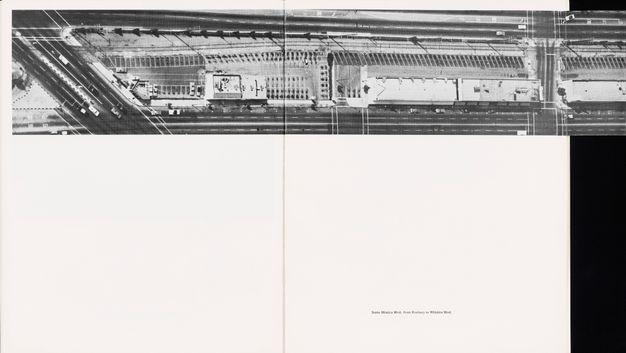
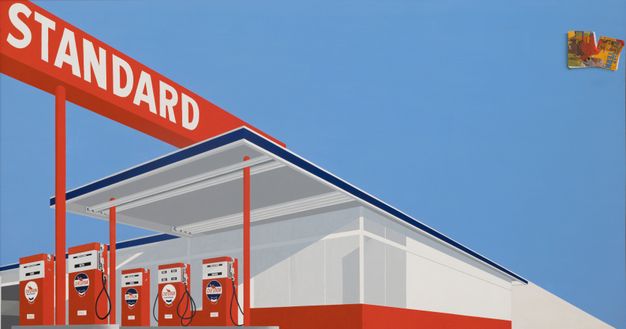
These flaps literally feed information, or data, of the same sign back into the system (book) in a manner that is not goal oriented and does not add to or improve the message. Much of Ruscha’s work exploits this antithesis to cybernetic control. In noisy, seemingly illogical and nonrational moves that no machine could make, Ruscha uses positive feedback and noise to create a communicative distortion that challenges the hypothesis that sees human beings as readable patterns, information as quantifiable, and all human output as transmissible in binary code. Ruscha has explained the type of relationship that he looks for in his art: “A yapping puppy running through a church full of people listening to a sermon is one thought—or it could be a priest walking quietly into a kennel of barking dogs. Unlike thoughts or objects inserted at the end or out-of-the-way from a main dominant theme. Often, when an idea is so overwhelming I use a small unlike item to ‘nag’ the theme.”21 There are no intentional “unlike items” in the SoLA Archive, in contrast to the pulp western in Noise, Pencil, Broken Pencil, Cheap Western, which makes a second appearance in Standard Station, Ten Cent Western Being Torn in Half (1964). Here it floats on a blue field at the extreme right edge of the canvas, unconnected to the majestic spread of the gas station along a diagonal from lower right to upper left (fig. 6.7). Yet by including everything in the camera’s range, the SoLA Archive has all manner of unlike items no matter what theme the viewer is exploring. Most importantly, it contains no message about Los Angeles to be steered or controlled. Ruscha has said of himself, “I’m a real pessimist, especially about business and maybe the computer aspect of life.”22 By constantly producing varieties of visual noise, Ruscha acts as a fly in the ointment of a system that believes it can manage the taste of its consumers and the consent of its citizens through ever greater information processing.
“I’ll never leave Los Angeles”23
While this approach might seem to place Ruscha’s project in the avant-garde tradition of critical negativity, his deep appreciation and respect for things that information theory would filter out demonstrates another valence for his work. It is particularly in his L.A. books and the SoLA project that this positive strategy emerges, often through the documentation of things easily overlooked, such as street signs, dingbat-style apartments, dollar stores, and palm trees. Far from random exemplars of urban noise, his photographic subjects are tied to a specific place: Los Angeles. Ruscha’s decision to focus in and around Los Angeles was crucial; its empty lots, gas stations, and cheap construction optimistically clamoring for differentiation in a sea of sameness typified the East Coast’s view of L.A. as the proverbial sound and fury.
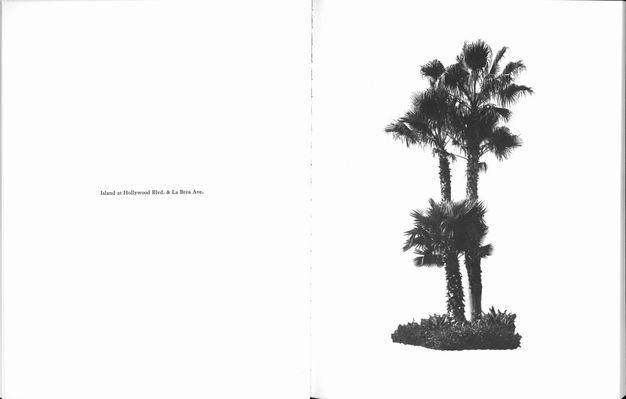
The photographic mode Ruscha adopted for the photobooks centered on Los Angeles is very different from the way Los Angeles boosters like David Hockney and Reyner Banham, and even most architectural historians, depict the city. Nowhere to be found are the pioneering architects and era-defining buildings of midcentury Los Angeles, or the strong topographical features—hills, beaches, and freeways—that for Hockney and Banham define the city and to which they tried to give cohesive and compelling identities. Instead, Ruscha defines certain typologies of urbanistic elements present throughout the Los Angeles region, and each of his Los Angeles photobooks is a serial presentation of a named object. However, seriality in Ruscha’s work is quite complex, and the artist distinguishes different modes from the outset. The most common mode is a numerical limit to the series: Twentysix Gasoline Stations (1963), Thirtyfour Parking Lots, and Nine Swimming Pools and a Broken Glass (1968). At the same time, there are delimited but unenumerated groupings: Some Los Angeles Apartments (1965) and A Few Palm Trees (1971); undelimited groups: Streets of Los Angeles, Real Estate Opportunities (1970), and Records (1971); and even comprehensive cataloging: Every Building on the Sunset Strip. Ruscha’s practice suggests that with the impossibility (and perhaps undesirability) of a totalizing description of Los Angeles, the city could only be approached in a serial manner that emphasizes difference within sameness and sameness within difference—seeing with noise, rather than seeing through noise. A Few Palm Trees, a typological study of Southern California’s most iconic flora, is far from a simple litany of likenesses. Flipping through the book, the viewer is presented with a panoply of palm trees, each photographed, cropped, and pasted into a startlingly blank pictorial field (fig. 6.8). Their isolation from any contextual information (save the attendant captions) forces focus on each tree’s peculiarity: some are short and squat, another impossibly attenuated; some grow in little groupings, while others appear as a solitary silhouette.
If seriality and seeing with noise are crucial to Ruscha’s L.A. photobooks, the SoLA Archive is in many ways both Ruscha’s magnum opus and the summa of his information dynamics. The structure for photographing Los Angeles-area streets is an endless loop—Ruscha and his collaborators driving down one side of a street until it ends and then driving down the other side until they reach the beginning. Crucially, there is no selection or filtering in the process—everything along the drive is recorded—not only every building, architecturally significant or not, but also every object in the mechanized camera’s field of view. Ruscha continuously returns to the same streets—he has photographed Sunset Boulevard more than twelve times, for example—creating a temporal as well as a geographic loop and a palimpsest of surplus information without hierarchy. In the “deadpan” documentary style for which he has been both celebrated and criticized, there is no sense of things getting better or worse. Instead, there is both stubborn sameness and continuous flux, all presented without any commentary on preservation or progress. Ruscha seems to be arguing that the process of selection and refinement that both Los Angeles’ boosters and its detractors engage in must be avoided; seeing without selection—that is, apprehending the city in all its jumbled noisiness—is the alternative mode proposed by the SoLA project.
This surfeit of information extends to the production of the SoLA Archive itself. A third of every photograph duplicates the information in the previous photograph in the series, as if the streets were being photographed to be animated or for a movie that will probably never be made. This potential is in constrast to Ruscha’s reluctance to make art out of the archive. Other than in Every Building on the Sunset Strip, Ruscha has had to be convinced by others to turn the photographs into art: first by gallerist Patrick Painter to create the small portfolio of still photographs and next by Gerhard Steidl to make the book THEN & NOW. For Ruscha, it seems crucial that the archive remain in an unfinished (he has hinted it will continue until his death) and mostly unused state, one of potential. Ruscha’s information dynamics is ultimately an argument that any message can be controlled, repurposed, or used to feed the cybernetic system and its command structure. Therefore, the SoLA Archive is information without a message—information in a perpetual state of being written and rewritten.
The fact that Getty has made portions of the SoLA Archive accessible is not unproblematic. The employment of computer vision, algorithms, digital mapping—the twenty-first-century inheritors of cybernetics and twentieth-century information theory—will almost inevitably insert meaning into Ruscha’s messageless information. Who controls that meaning and to what end the message is put will determine whether the archive should have been shared and used or whether it would have been wiser to leave it in a state of perpetual possibility.
Notes
Epigraph: “The Information Man” is dated 2 October 1971; part of it was first published in A. D. Coleman, “My Books End Up in the Trash,” New York Times, 27 August 1972, D21. For the full text, see Ed Ruscha, “The Information Man,” Los Angeles Institute of Contemporary Art Journal, no. 6 (June–July 1975): 21.
-
See the Streets of Los Angeles Archive, which includes two collections: Edward Ruscha Photographs of Sunset Boulevard and Hollywood Boulevard, 1965–2010, 2012.M.1, https://www.getty.edu/research/collections/collection/100001; and Edward Ruscha Photographs of Los Angeles Streets, 1974–2010, 2012.M.2, Getty Research Institute, Los Angeles, https://www.getty.edu/research/collections/collection/100071. ↩︎
-
Ed Ruscha, interviewed by Zanna Gilbert, 6 September 2022. ↩︎
-
Ed Ruscha, quoted in Edward Ruscha, Leave Any Information at the Signal: Writings, Interviews, Bits, Pages, ed. Alexandra Schwartz (Cambridge, MA: MIT Press, 2002), 150. The quotation was taken from an interview by Paul Karlstrom, “Oral History Interview with Edward Ruscha, 1980 October 29–1981 October 2,” California Oral History Project (COHP), Archives of American Art, Smithsonian Institution, Washington, DC, https://www.aaa.si.edu/collections/interviews/oral-history-interview-edward-ruscha-12887 (hereafter cited as “Karlstrom interview, COHP transcript”). This interview, conducted in several sessions over the course of a year, is the most extensive interview Ruscha has given. The interview was edited and first published in Ruscha, Leave Any Information, 92–209 (hereafter cited as “Karlstrom interview, Leave Any Information”). ↩︎
-
See Jennifer Quick, Back to the Drawing Board: Ed Ruscha, Art, and Design in the 1960s (New Haven: Yale University Press, 2022). See also Jennifer Quick, “No Design: The Streets of Los Angeles Photographs and Ruscha’s Books,” this volume. ↩︎
-
Bill Moore, quoted in Robert Perine, Chouinard: An Art Vision Betrayed; The Story of the Chouinard Art Institute, 1921–1972 (Encinitas, CA: Artra, 1985), 181. Perine’s book is an odd document: a very partisan history of Chouinard up until the Disney takeover and merger in 1972. Nevertheless, it provides by far the fullest account of Ruscha’s student days (its narrative is told largely through interviews with former Chouinard students and teachers). ↩︎
-
Regarding the use of Gestalt psychology in advertising, see Franco M. Nicosia, “Advertising Management and Its Search for Useful Images of Consumers,” Advertising and Consumer Psychology, ed. Larry Percy and Arch G. Woodside (Lexington, MA: D. C. Heath, 1983), 25–56, esp. 35. Regarding the use of Gestalt psychology in techniques of advertising layouts, see Stephen Baker, Visual Persuasion (New York: McGraw-Hill, 1961), esp. chap. 3, “For the Subconscious Only.” ↩︎
-
Jerry McMillan, quoted in Perine, Chouinard, 180. Moore lit one end of Ruscha’s collage of cigarette butts on fire, causing deep division among students and faculty at the school. ↩︎
-
Ed Ruscha, quoted in John Coplans, “Concerning ‘Various Small Fires’: Edward Ruscha Discusses His Perplexing Publications,” Artforum 3, no. 5 (1965): 24. At the time of this interview, Artforum had recently relocated from San Francisco to Los Angeles in an office above Ferus Gallery, where Ruscha exhibited. Ruscha was the chief designer of Artforum during its Los Angeles years, so Coplans was undoubtedly aware of Ruscha’s industrial-art pedigree. ↩︎
-
Ed Ruscha, quoted in Bernard Blistène, “Conversation with Ed Ruscha,” in Edward Ruscha: Paintings = Schilderijn, exh. cat. (Rotterdam: Museum Boymans-van Beuningen, 1990), 128. The centrality of the concept of visual noise to Ruscha’s work was first elaborated in Yve-Alain Bois’s remarkable essay “Thermometers Should Last Forever,” in Bois, Edward Ruscha: Romance with Liquids, Paintings 1966–1969 (New York: Gagosian Gallery, 1993), 8–38. Bois makes numerous insightful comments on Ruscha’s treatment of “noise” and also connects Ruscha’s interest in the subject with the communication theory of Claude Shannon, Warren Weaver, and Norbert Wiener. However, he quickly abandons US communication theory for an extended discussion based in linguistics and semiotics. ↩︎
-
Ed Ruscha, quoted in Blistène, “Conversation with Ed Ruscha,” 126. ↩︎
-
Norbert Wiener, The Human Use of Human Beings: Cybernetics and Society (Garden City, NY: Doubleday, 1954), 24. Wiener’s blend of terminology from the fields of biology and engineering—sensory and motor as well as telltales and monitors—is quite common in his writing and is, of course, fitting for a theory that treats human beings and certain machines under the same classification. A crucial distinction between older and more modern feedback mechanisms is that modern ones are able to correct behavior in process through continuous real-time measurement. ↩︎
-
Wiener does not insist that there are no differences between human beings and machines; rather he asserts that cybernetic questions can only be answered through observable, quantifiable behavior. In a paper he coauthored with the physiologist Arturo Rosenblueth, they explain that the consequences of only basing one’s findings on strictly behaviorist grounds is that any differences between humans and machines are rendered inconsequential:
The question of whether machines are or can be like men or the higher animals does not guide our choice. This question is on the main irrelevant for scientific objectives. We believe that men and other animals are like machines from the scientific standpoint because we believe that the only fruitful methods for the study of human and animal behavior are the methods applicable to the behavior of mechanical objects as well. Thus, our main reason for selecting the terms in question was to emphasize that, as objects of scientific enquiry, humans do not differ from machines.
See Arturo Rosenblueth and Norbert Wiener, “Purposeful and Non-Purposeful Behavior,” Philosophy of Science 17, no. 4 (1950): 326. ↩︎
-
Ed Ruscha, quoted in Blistène, “Conversation with Ed Ruscha,” 126. ↩︎
-
Ed Ruscha, quoted in Karlstrom interview, Leave Any Information, 207. ↩︎
-
The cover, which is of course remade at actual size, is of Popular Western, October 1946. ↩︎
-
Ed Ruscha, quoted in Patricia Failing, “Ed Ruscha, Young Artist: Dead Serious about Being Nonsensical,” ARTnews 81, no. 4 (1982): 74–81; reprinted in Ruscha, Leave Any Information, 227. ↩︎
-
Arturo Rosenblueth, Norbert Wiener, and Julian Bigelow, “Behavior, Purpose and Teleology,” Philosophy of Science 10, no. 1 (1943): 19. ↩︎
-
Ed Ruscha, quoted in Karlstrom interview, Leave Any Information, 167, 208. In the unedited typescript, Ruscha discusses the musicians—Spike Jones, Count Basie, and Billy Eckstine—who informed his thinking during his early years in Oklahoma. See Ed Ruscha, quoted in Karlstrom interview, COHP transcript, 11. ↩︎
-
Ed Ruscha, quoted in David Bourdon, “Ruscha as Publisher (or All Booked Up),” ARTnews 71, no. 2 (1972): 32–36, 68–39; reprinted in Ruscha, Leave Any Information, 43. ↩︎
-
Ed Ruscha, quoted in Clive Phillpot, “Sixteen Books and Then Some,” in Edward Ruscha: Editions, 1959–1999, Catalogue Raisonné, ed. Siri Engberg and Clive Phillpot, vol. 2 (Minneapolis: Walker Art Center, 1999), 68. ↩︎
-
Ed Ruscha, quoted in Barbara Radice, “Interview with Ed Ruscha,” Flash Art, no. 54–55 (May 1975): 49. ↩︎
-
Ed Ruscha, quoted in Karlstrom interview, COHP transcript, 6. ↩︎
-
Ed Ruscha, quoted in Henri Man Barendse, “Ed Ruscha: An Interview,” Afterimage 8, no. 7 (February 1981): 8–10; reprinted in Ruscha, Leave Any Information, 213. ↩︎