Ed Ruscha’s street photos of Los Angeles demonstrate the rich artistic and technical capabilities of photography when it engages with specific places and their evolution over time. Since the late 1960s, his photos have helped shape Los Angeles’ civic imaginary and metropolitan heritage while representing the nth degree of a sociocultural and engineering phenomenon—automobile-led urbanization—that formed and deformed cities and towns around the world in the twentieth century. In this essay, I compare Ruscha’s photographic techniques with cinema to shed new light on the heightened spatiality of his work and its meaning in the early twenty-first century when, we now know, the kind of strip development Ruscha photographed became unsustainable.1
Beginning with the photographic field work from which he selected images for his legendary book Every Building on the Sunset Strip (1966), and in dozens of subsequent shoots through the 2010s, Ruscha took hundreds of thousands of pictures of Sunset Boulevard, Hollywood Boulevard, and other Los Angeles streets. In each shoot the artist worked for several hours or a whole day with one or two assistants, producing anywhere from 2,500 to 8,000 images with a semiautomated photographic system.2 This consisted of a 35mm film still camera mounted on a tripod on a slow-moving vehicle and pointed at the opposite side of the street perpendicular to the direction of travel of the vehicle. To minimize the disruption caused by changing the film in the camera on each shoot, Ruscha used multiple large rolls of film, each containing about 200 to 250 exposures and fed through the camera from an external motorized cassette (once, in 2001, he used a digital still camera but did not like the results).
While a lot of attention has been given to Ruscha’s painting and the distinctive “Cool School” of L.A. pop art associated with the legendary Ferus Gallery in the early 1960s, his photos have usually been interpreted as a kind of serial photography of the built environment instrumental in the subsequent emergence of conceptual art.3 Accounts that relate Ruscha to conceptualism typically consider his photos alongside the work of contemporaries such as Eleanor Antin, Dan Graham, Martha Rosler, and Robert Smithson. In these interpretations, the studied repetitiveness of Ruscha’s photography was part of a radical break with authenticity and uniqueness in representation even greater than that of pop art and akin to the first recognition of photography as art in Dada and surrealism in the 1920s.
However, the sheer number of photographs Ruscha has produced, and their insistently suburban typology (apartment buildings, swimming pools, parking lots, gas stations, and street fronts), has led some commentators to relate them to the emergence of conceptions of postmodern urbanism and visual culture.4 Ruscha’s serial photography of urban sprawl is a kind of encoded data that can be interpreted through systems theory, communications theory, and cognitive psychology, which were rapidly growing fields after World War II. This growth was evident in innovative urban-planning studies such as Donald Appleyard, Kevin Lynch, and John R. Myer’s The View from the Road (1964) and Robert Venturi, Denise Scott Brown, and Steven Izenour’s Learning from Las Vegas (1972).5 Both of these presented carefully designed photo sequences of streets, highways, and buildings, many of them taken from behind the windshield of a vehicle moving forward.
A reformist urban agenda was also evident in Leonard Nadel’s photographs of Los Angeles housing and “slum” conditions published in official reports by the Housing Authority of the City of Los Angeles in the late 1940s and 1950s.6 However, in contrast to Ruscha’s work, maps, diagrams, and prose arguments in favor of practical improvements to cities accompanied Nadel’s photos of streets and buildings in urban-planning publications. Ruscha’s photos do not propose anything; nor do they aim to foreground beauty or excellence, unlike some of the iconic photos of modern architectural masterpieces by Julius Shulman, in which Los Angeles was a place of pleasing functionality, harmony, and comfort.7
Comparing other kinds of photography with Ruscha’s in this manner highlights the tension that exists between singular and serial photos, qualitative and quantitative representations, and artistic and social-scientific approaches to visualizing the built environment. In the rest of this essay, however, I compare Ruscha’s photos with contemporaneous innovations in cinema to shed new light on his work. Not only does cinema generally manifest seriality in extreme form (twenty-four frames per second), but the 1960s was an exceptionally experimentative era in which filmmakers often used cinematography and editing to accelerate or decelerate the viewing experience of the street.8
Alexandra Schwartz has remarked on the “numerous affinities and connections between Ruscha’s art and filmmaking.”9 Several of Ruscha’s most well-known works foreground Hollywood iconography—for example, his oil painting Large Trademark with Eight Spotlights (1962) (see fig. 6.4) and color screen print Hollywood (1968). These works seem simultaneously nostalgic for and ironically distant from the golden era of the Hollywood studios then coming to an end. Even their exceptional width—what Ruscha has called their “panoramic” or “widescreen format”—echoed Hollywood’s grandeur.10 Ruscha trained in graphic design at the Chouinard Art Institute, which was financially supported by Walt Disney, and his photographic practice and book publishing often mimicked the commercial-art principles of his training. In 1961 he attended the Cannes Film Festival while touring Europe.11 His studio was in Hollywood, and he was connected to the countercultural social scene of the so-called New Hollywood, especially through his friend Dennis Hopper, the accomplished actor, director, and photographer. When Ruscha was promoting Every Building by distributing it to friends and colleagues free of charge, he sent copies to Andy Warhol and the Italian director Michelangelo Antonioni.12 He also made two short films of his own—Premium (1971) and Miracle (1975)—which were vignettes on the theme of metamorphosis filmed on interior sets. Interviews suggest that his taste lay in experimental film and independent features. He has called Warhol’s films “profound” and admired Nicolas Roeg’s The Man Who Fell to Earth (1976) and Robert Altman’s 3 Women (1977).13 He has explained that if he were ever to make his own feature film, it would also be about the desert, but he has admitted frustration with “the vulgarity of Hollywood and the cinema industry,” and with the relatively complicated processes of film production and distribution.14 Hence, he has remained at one remove from the medium: “There is no doubt that my paintings, to a degree, feed on movies, and yet I have stayed a painter. I guess you could say I am interested in the possibilities that remain in a time which tends to favor the moving image.”15
Schwartz has noted the cinematic qualities of Ruscha’s street photography while David James has called Every Building “one of the best movies made in LA,” comparing it to the work of contemporaneous artist-filmmakers such as John Baldessari, Wallace Berman, and Bruce Nauman.16 Matt Reynolds has analyzed what he calls the “paracinematic” aspects of Ruscha’s photobooks—highly selective sequences of still images printed on paper that resemble films and reflect not only Ruscha’s long preoccupation with motion and stasis but also a wider tradition of urban panoramas that require the viewer to perform a kind of editing.17
Less well-known but striking are parallels between Ruscha’s street photos and feature films around the same time. This was an era of intense technical and stylistic innovation in cinematography and editing in both European art cinema and the so-called New Hollywood. While handheld cameras, rapid zooming, and jump-cutting abounded, the visualization of automobility was also a consistent feature, especially in vehicle-mounted tracking shots. Crime films such as Point Blank (John Boorman, 1967), Bullitt (Peter Yates, 1968), and The French Connection (William Friedkin, 1971) rapidly intercut streetscapes with violent action to express urban crisis or psychosis, or both. Images of the street and the road were linked with hippie dissent and calls for social justice in Easy Rider (Dennis Hopper, 1969), Medium Cool (Haskell Wexler, 1969), and Zabriskie Point (Michelangelo Antonioni, 1970). Many art films were set in L.A., including the relatively subdued and abstract Smog (Franco Rossi, 1962), Model Shop (Jacques Demy, 1969), and Lions Love (And Lies . . . ) (Agnès Varda, 1969).18 All of these were indebted to the groundbreaking driving sequences of Jean-Luc Godard’s À bout de souffle (1960; Breathless), Pierrot le fou (1965; Pierrot the fool), and Week-end (1967), which exaggeratedly sped up or slowed down the quotidian experience of the automobile with jump-cutting and long takes. They were also facilitated by technological trends toward more lightweight cameras and sound equipment that facilitated the representation of continuous movement.19
To appreciate the significance of these trends and Ruscha’s relationship to them, consider this authoritative definition of the cinematic sequence: “Sequence. A series of related shots and scenes in a film, analogous to a book chapter, which constitutes a significant phase of action or a move in the plot. . . . Where an entire sequence is rendered in a single shot, this is known as a sequence shot. A sequence is at once autonomous—with its own beginning, middle, and end, and often concluding with a dramatic climax of some sort—and also a link in a causal narrative chain.”20
In Every Building on the Sunset Strip, Ruscha pushed the principle of serial photography so that it took on some of the characteristics of the sequence shot in expressing a continuous, mobile point of view. The need to photograph in long sequences required him to improvise technically in a way that paralleled recent cinematic innovations. In their shoots of the 1970s, the bulk rolls of film that he and his assistants used were 55-foot (17-meter) lengths of Ilford FP3 or FP4 35mm still film, cut in half to fit their specially adapted camera.21 Godard and his cinematographer, Raoul Coutard, used an analogous technique to film À bout de souffle, joining together numerous 17-meter rolls of Ilford HPS 35mm still film for use in their Éclair Caméflex motion-picture camera.22
In contrast to those films, however, Ruscha’s images are strikingly lacking in affect because the camera aims for a rigorously lateral point of view, without authorial signatures, as if the result of an automated process (an approach Denise Scott Brown influentially called “deadpan”).23 Scanning the built environment and its facades, they rarely contain human bodies or faces, eschewing expression in favor of recording. The effect of this abstraction is enhanced by a 35mm or 28mm wide-angle “perspective control” lens: the short focal length of the lens makes any human figure accidentally photographed appear tiny in the streetscape, while the lens’s engineering reduces or eliminates the distortion of perspective (or exaggerated convergence of vertical lines) that often occurs when the facade of a building is photographed from street level.
The homogenizing effect of the resulting photo sequences is compounded in Every Building by Ruscha’s presentation of the north and south sides of Sunset Boulevard in two parallel strips separated by white space in the middle of the page, although he did not photograph both sides of the street simultaneously, but one after the other, proceeding from east to west or west to east before turning the vehicle around halfway through each shoot and driving back in the opposite direction. The relation of each photo to the next is characterized by a tension between cutting and continuity. Very few photos are seamlessly joined but the seams are often slight. Sometimes a short stretch of street is repeated from slightly different angles. Sometimes part of a car, lamppost, or billboard is missing because Ruscha combines two shots of the same location taken at different times. Often a whole frame is presented adjacent to one that has been cropped, and so on. That Ruscha prepared his book by manually compositing his photos on paper, on a wall and table in his studio, using knives, rulers, and glue, bears out Jennifer Quick’s contention that he was deeply indebted to the practices of the commercial art studio.24 However, given the large, horizontal and elongated form of this project, his approach also resembled the cutting and splicing of film reels on a flatbed editor, and it anticipated today’s digital, nonlinear editing of video timelines.
Ken D. Allan notes that Ruscha’s sequences of street photographs may be perused slowly or rapidly depending on the viewer, who may also choose to scan them from left to right or vice versa to look closely at a detail on a given page, or to hold the book at arm’s length for a wider view of several pages at once. This encourages an interactive spectatorship, which Ruscha has compared to that of the Happening or performance art.25 On the other hand, Allan correctly observes that the editing and interactivity of Every Building are outweighed by its continuity, because the Strip is so uniform that the visual effect or meaning of the images changes little, no matter how they are viewed. Examination of the contact sheets and transparencies of the original, unedited photos in the Getty Research Institute archive backs this up: they show greater variations of weather and light during each shoot and between shoots, suggesting that such contingencies were evened out in Ruscha’s selection and cutting of shots for publication. His rigorous management of his camera’s position and angle also minimized topographical information in each image—although the Sunset Strip undulates considerably, the curbside is nearly always parallel to the bottom edge of the frame. This contrasts with the disjointed jump-cutting during driving sequences in Easy Rider and Zabriskie Point, where the editing makes rapid and striking adjustments in point of view and real time to express countercultural disgust with racism, war, or urban-industrial landscapes. Ruscha’s street photography has more in common with the longer and more-continuous sequence shots of Model Shop and Lions Love (And Lies . . . ), which were also overshadowed by those problems but presented multiple points of view from inside a vehicle looking out to convey melancholic beauty in the city (figs. 11.1, 11.2).
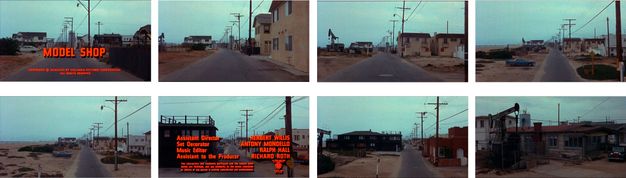
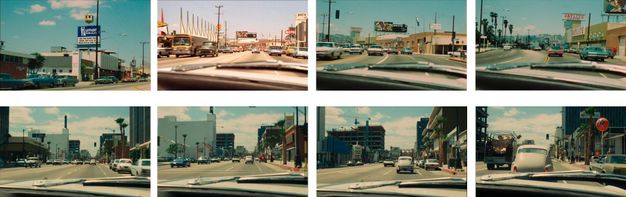
It is revealing here to relate Ruscha’s street photography to André Bazin’s analysis of “The Evolution of the Language of Cinema” (1960).26 According to Dudley Andrew, that essay “can be said to anchor . . . the entire aesthetic of [French] New Wave criticism and filmmaking” that became so influential internationally.27 Bazin describes the history of cinema in terms of “two broad and opposing trends: those directors who put their faith in the image and those who put their faith in reality.”28 By “the image,” he meant mise-en-scène and montage, where montage was defined as “the creation of a sense or meaning not objectively contained in the images themselves but derived exclusively from their juxtaposition.”29 For example, he pointed to the epic dramas of the Soviet filmmakers Sergei Eisenstein and Lev Kuleshov, the latter having demonstrated in the experiment known as the “Kuleshov effect” that the audience of a film will interpret the meaning of an actor’s facial expression differently depending on what the actor is shown, by montage, to be looking at—whether a dead child, a bowl of soup, or an attractive woman. But Bazin distrusted such contrivance. He also counterpointed it to the relatively “neutral” form of montage that accompanied the coming of sound and the institutionalization of “classical” cinemas in France and Hollywood in the 1930s.30 Their editing rendered montage “invisible” by subordinating it to narrative, action, characterization, and dialogue—for example, in the films of John Ford—but still without “faith in reality.”31 Apart from a few early examples, it was really only in the French poetic realism of Jean Renoir’s La règle du jeu (1939; The Rules of the Game) and the Italian neorealism of Luchino Visconti’s La terra trema (1948; The Earth Trembles) that cinema began to show proper “respect for the continuity of dramatic space and, of course, for its duration.”32 Such films downplayed montage in favor of “depth of field” or “deep focus” cinematography, which Bazin called a “dialectical step forward in the history of film language.”33 They more closely approximated human perception of the real world, requiring an active and engaged spectator and leaving more room for ambiguity, and they relied on technological innovation—specifically, the development of faster “panchromatic” film stocks, which were more sensitive to light and therefore allowed cinematographers to use camera lenses with smaller apertures to achieve more depth of field.34 This encouraged them to move the camera more freely left and right, forward and back, in studio or on location, handheld, on a dolly or a crane, whether representing pedestrian or automobile movement or other action.
Ruscha moves the camera quite freely, and, in a sense, he respects the continuity of dramatic space and duration, especially in his geographical accuracy. The numerous captions accompanying the photos in Every Building record the street address where each image was taken, while the original unedited photos and Ruscha’s production notes contain detailed handwritten information about location, distance, time, speed, and direction of travel. This echoes Bazin’s interest in mobile cinematography and continuous space and time, which Ludovic Cortade has convincingly related to Bazin’s training in geography in the 1930s and early 1940s, before he turned to film criticism, especially his interest in “the intersection of maps and cinema, since both offer an accurate and objective record of reality.”35
However, contrary to Bazin, Ruscha’s dramatic space is almost entirely two-dimensional, showing depth only in the occasional side street that runs to a distant horizon. This contrasts with the frequent use of “rear projection” in Hollywood films of the studio era. As Vivian Sobchack has explained, it was standard practice to project second-unit or stock footage of landscapes or city streets—often in Los Angeles—on a screen behind the actors in the studio when representing vehicular movement, even though the technique was visually unconvincing.36 In a film noir like Edgar Ulmer’s Detour (1945), the disjuncture between the protagonists’ forward motion and the constantly receding landscape, signifying the past, enhanced the fatalistic theme of murder and guilt. By contrast, a more exhilarating effect was achieved in sequence shots on location—for example, in Gun Crazy (Joseph H. Lewis, 1950), where a bank robbery was filmed in one three-and-a-half-minute take by a camera pointing forward, while panning left and right, from the back seat of the getaway car.
Bazin wrote an entire book on Orson Welles, whom he admired for the sequence shots in Citizen Kane (1941), The Magnificent Ambersons (1942), The Lady from Shanghai (1947), and Touch of Evil (1958).37 In the last of these, in which the Los Angeles district of Venice posed as a Mexican border town, Welles devised two long sequence shots that exemplify different tendencies of the technique (fig. 11.3). In the famous opening sequence, which was three minutes and eighteen seconds long, Welles provides the spectator with an almost omniscient point of view by means of a virtuoso crane shot that tracks and floats above the protagonists, played by Charlton Heston and Janet Leigh, as they walk through the night just moments before the explosion of a time bomb in a nearby car. Unlike Ruscha, Welles gives his sequence temporal urgency because he lets the spectator see the ticking bomb, using the sequence shot to create suspense (something Alfred Hitchcock did as well).38 In a second sequence later in the film, however, Welles more closely anticipates Ruscha by presenting Heston, the investigating detective, driving down a straight and narrow street at high speed, with the camera on the hood of the car pointing back at him and buildings whizzing by.
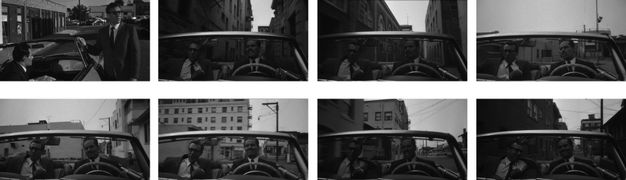
Welles emphasized the difficulty of making a sequence shot in a film industry where crews were not trained or equipped for it and producers disliked the extra expense it entailed. Working artisanally, Ruscha achieves his sequence shot with considerable skill and a minimum of resources, but there is almost no narrative, action, or suspense; very few people; and no sound. Therefore, his photo series invite comparison to experimental films such as Andy Warhol’s Empire (1964) or Michael Snow’s Wavelength (1967), although those filmed changes over time in architectural environments from stationary cameras—an eight-hour shot of the Empire State Building and a forty-five-minute, slow zoom shot of the interior of an apartment, respectively. Justin Remes has persuasively argued that these and other films challenge the long-established prejudice that cinema is defined by movement. Instead, he documents “the rich and variegated tradition that [he calls] the cinema of stasis”: “Static films offer radical challenges to conventional conceptions of cinema since they are ostensibly motion pictures without motion. In most films an impression of movement is provided either by the motion of the camera or the motion of elements within the mise-en-scène—usually both. In contrast, static films generally feature no camera movement and little or no movement within the frame. Instead, these films foreground stasis and consequently blur the lines between traditional visual art and motion pictures.”39
Remes casts the history of film theory as a debate between those who see motion as cinema’s essence (e.g., Siegfried Kracauer and Rudolf Arnheim) and those who emphasize its capacity for stillness (e.g., Noël Carroll and Laura Mulvey). As Remes points out, the earliest films by Auguste and Louis Lumière were projected as still images that suddenly moved, much to the excitement of spectators. Dynamic action subsequently became the medium’s most prominent feature and a target of avant-garde critique. In this respect, Remes highlights Warhol’s Empire, projected on the walls of The Factory as a kind of two-dimensional “furniture” to facilitate spontaneous interaction among audience members rather than passive entertainment.40 Conversely, Ernie Gehr’s Serene Velocity (1970) presented a twenty-three-minute sequence of rapidly alternating shots of an empty corridor taken from a fixed camera with lenses of different focal lengths. Remes’s explanation of Gehr might equally apply to Ruscha: “In many ways, in fact, Serene Velocity feels more like a succession of still photographs than a film. Of course, in a sense cinema really is nothing more than a succession of photographs. . . . But while this fact is carefully concealed in traditional motion pictures, static films often foreground this dimension of cinema’s ontology.”41 Gehr’s experimental shorts, which sometimes feature streets and automobiles—for example, in Transparency (1969) and Shift (1974)—are often described as “meditative” or “hallucinatory.”42 They rely on montage, but sequence shots are often described in similar terms. For Bazin, a long, studio-bound sequence shot of domestic activity in Welles’s The Magnificent Ambersons created a “heavy spell which forces us to participate intimately in the action.”43 For Jean Rouch, making the ethnographic documentary Tourou et Bitti: Les tambours d’avant (1971; Tourou and Bitti: Drums of the past) on location in Niger, a ten-minute sequence shot of a ceremonial dance by village elders, filmed close-up with a handheld camera, sent him into an immersive “film-trance” analogous to the elders’ possession by spirits.44 The duration of the “trance” was dictated by the standard ten-minute running time of a reel of 16mm film.45
In their content, form, and technique, however, Ruscha’s street photos emphasize the urban-industrial too relentlessly to encourage metaphysical readings. At the end of the 1960s, when much film theory took a Marxist turn, Brian Henderson influentially argued that both Soviet montage and the Bazinian sequence shot had become “classical” and therefore redundant.46 Henderson did not discuss photography or Los Angeles but called for a new “non-bourgeois camera style” that would emulate the slow, lateral tracking shots of Godard in La Chinoise (1967), Week-end (1967), One Plus One (1968), and British Sounds (1969). His description of these could encompass Ruscha’s as well:
Godard’s tracking shot moves neither forward nor backward in space, nor in any diagonal or arc, nor at any angle but 90° to the scene it is shooting. That is, Godard’s track lies exactly along the 0°/180° line. The scenes or subjects which these shots address lie also along a 0°/180° line, which, furthermore, is exactly parallel to the camera line. This extreme stylization, wherein a plane or planes of subject are paralleled exactly by the plane of art, is unusual in cinema and gives the shot very much the form of a planimetric painting.47
Henderson differentiates Godard’s lateral tracking shots from earlier examples by F. W. Murnau, Max Ophuls, and Federico Fellini because Godard does not move the camera in depth, follow characters in the frame, or arrange people or objects in the foreground, middle ground, or background. Henderson uses metaphors of flatness and elongation to evoke this: “A camera moves slowly, sideways to the scene it is filming. It tracks. But what is the result when its contents are projected on a screen? It is a band or ribbon of reality that slowly unfolds itself. It is a mural or scroll that unrolls before the viewer and rolls up after him.”48
This use of the tracking shot, avoiding depth of field, makes Godard’s sequence shots different from those praised by Bazin. Godard is not a realist; he seeks to engage the viewer intellectually rather than emotionally, and he is not interested in ambiguity but rather meaningful two-dimensionality. This is especially clear in Week-end: “The entire film aspires to the condition of this [tracking] shot” filmed in long shot. That film’s exceptional “flatness” is the key to its “non-bourgeois style.” Both montage and composition in depth join multiple places (one by editing, the other by moving the camera in three dimensions), but Godard only shows one continuous plane.49
Reading Henderson, the approaches of Godard and Ruscha seem remarkably similar until we recall that Godard was more politically engaged and further to the left. Ruscha occasionally expressed concern about social problems but generally declined to engage with them directly in his art, participating in the 1970 Venice Biennale when many other American artists boycotted the event in protest of the Vietnam War. Other pop artists, and even conceptual artists, became more politically engaged, and it is notable that Ruscha does not figure prominently in studies of art and politics in the 1960s.50 Meanwhile, his photos were admired by analysts of architecture who visited L.A. briefly and assumed his so-called deadpan approach was a muted endorsement. Venturi, Scott Brown, and Izenour appreciated Ruscha’s recognition of “the validity of the commercial vernacular,” while the architectural historian Reyner Banham praised Ruscha for providing “a view of the typical Angeleno building and environment ‘like it is.’”51 However, because none of their publications reflected on Ruscha’s work in detail, Mariana Mogilevich is probably right to propose that they “learned from Ruscha but misread him.”52
Situating Every Building and Ruscha’s Streets of Los Angeles project in relation to the sequence shot is a useful counterpoint to their interpretation in the light of conceptual art and postmodern architecture, relating his work instead to a progressive international trend in cinema. In 1970, while telling Artforum that his art had “an objective attitude” with “no involvement in any [political] issue,” Ruscha continued: “As an American citizen though, I have no trouble seeing how bad things are. And I don’t think the American public necessarily needs to be alerted to how serious it is.”53 On the other hand, despite their number, his photos of the Sunset Strip circa 1966 include no images of the turbulent scenes that surrounded the Peace Tower built by the Artists Protest Committee or the large-scale confrontations between demonstrators and police that disrupted traffic on the Strip that year.
Today—at a time of increased anxiety and contestation of the city and calls for equality, diversity, and inclusion—such absences might be read as a sign that Ruscha lacked interest in social issues. Like much Hollywood cinema set in Los Angeles, his photos are geographically selective, emphasizing its relatively comfortable and photogenic Westside and thereby demonstrating the de facto segregation of much of the city. Ruscha is not responsible for that segregation, though a skeptic might ask if his photos do enough to comment on or condemn it. Ruscha commissioned the artist Jerry McMillan to take the first test photos of Sunset Boulevard, in 1965, the year of the traumatic Watts uprising; the busiest period of his street photography extended into the mid-1970s. This was one of the most violent eras of urban unrest in US history, and it led to very different tracking shots of the streets of South L.A.—for example, in TV news reporting such as “Watts: Riot or Revolt?” (CBS News, 1965) and in subsequent feature films on racism and poverty in Watts, such as Bush Mama (Haile Gerima, 1975).54
Whether Ruscha’s photobooks empower or disempower the viewer vis à vis urban space must therefore be partly a matter of opinion, though their prescience must be considered alongside their lacunae. With the benefit of hindsight, and comparison with cinema, we can see Every Building as an anticipation of digital, nonlinear editing and playback, their increased flexibility compared to earlier technologies allowing us to appreciate Ruscha’s photos for imagining a future scopic regime. By extension, the relation between Ruscha’s photos and the streaming services of Amazon, Netflix, and Apple is similar to that posited by Beatriz Colomina between Charles and Ray Eames’s Cold War, multiscreen, informational film Glimpses of the U.S.A. (1959) and the graphical user interface of computers today, with their multiple “windows.”55 Some recent scholarship has noted Every Building as an artistic forerunner of Google Street View, foreshadowing the smart city and its putative data-rich responsiveness.56 That Google Street View can trace its lineage to the pioneering project known as the Aspen Movie Map, developed at the Massachusetts Institute of Technology in the late 1970s, only strengthens the connection, as does the fact that the first public demonstration of that computerized navigation system took place at the influential International Design Conference in Aspen—a conference Ruscha attended earlier, while studying at Chouinard.57 Such a technological interpretation implies that Ruscha’s street photos constituted one of the most enthralling urban-visualization projects in history long before that term was widely used. Each of his photos and series contain extensive data on the dimensions of streets, buildings, lots, and city blocks as well as on land use, construction materials and methods, architectural styles, automobiles, signage, and even foliage, including their distribution—all of which has evolved over time in Ruscha’s shoots.
Ruscha’s preference for buildings over human figures might seem antithetical to humanist readings of his work. He has explained that he has never wanted to focus on people, seeing them as “extraneous elements,” and his street photos are certainly less anthropocentric than feature films, whether Hollywood, neorealist, or Godardian.58 Nonetheless, just as Remes has observed that static films “can offer a vast array of temporal experiences,” so too can Ruscha’s photos prompt us to reflect on the contingency of the passage of time and the finitude of human lives.59 They recall the surrealistic ghostliness of earlier street photography by Eugène Atget and Brassaï, and they share in what Steven Jacobs calls postwar cinema’s “oscillation between movement and stillness . . . as a metaphor for the tension between life and death.”60 This most humanistic of themes formed the core of Bazin’s famous essay, “Ontology of the Photographic Image,” in which he traces the deep human need for resemblance—the making of human likenesses—from the embalming of the dead in the ancient world to sculpture, painting, photography, and cinema: “Viewed in this perspective, the cinema is objectivity in time. The film is no longer content to preserve the object, enshrouded as it were in an instant, as the bodies of insects are preserved intact, out of the distant past, in amber. The film delivers baroque art from its convulsive catalepsy. Now, for the first time, the image of things is likewise the image of their duration, change mummified as it were.”61
In Ruscha’s photos, the city is preserved and mummified while the relative absence of humans suggests their transience by comparison with buildings and streets. In 1966 and 1973, respectively, the local television shows Ralph Story’s Los Angeles and Citywatchers dedicated special episodes to Sunset Boulevard that recounted its foundational role with nostalgia and civic pride.62 Preservationism has grown in the city since, but in his reference to amber, Bazin is hinting at ecological deep time, not just human lifespans. Ruscha’s close engagement with movement, temporality, and the city raises environmental questions by encouraging the viewer to slow or stop the automobile.63 It draws attention to the “creative destruction” of the urban landscape under capitalism and anticipates the recent tide of eco-cinema and its preference for “slow” temporality.64 Most of his photos show buildings, but nature is there too—trees, lawns, palm trees, empty lots, and hillsides filled with scrub—especially in the original photos, which record increasing construction on green space over time. Ruscha has sometimes made light of L.A.’s transportation problems. He once mused that Banham did not drive when he visited from London but did bring a “little tiny bicycle with little wheels.”65 On the other hand, he has also insisted, “I’m very aware of the desert. I go out there a lot. I have a house in the desert; it’s a special place for me.”66 While his photos have been applauded for their urban-industrial modernity, they arguably contain alternative lessons today, in a time of greening and rewilding the city, combatting wildfires and homelessness, achieving densification and high-speed rail construction, and expanding the Los Angeles Metro. Considering these problems and opportunities, Ruscha’s street photos, while beautiful, offer an ecological warning, a premonition of the emptied-out public space of pandemics, a flashback to the Anthropocene, or a counterpoint to energy crises. Moving and still, their relevance continues to endure.
Notes
-
See Benjamin Ross, Dead End: Suburban Sprawl and the Rebirth of American Urbanism (Oxford: Oxford University Press, 2014); and Robert Gottlieb, Reinventing Los Angeles: Nature and Community in the Global City (Cambridge, MA: MIT Press, 2007). ↩︎
-
The lower number, 2,500, approximates to the total number of exposures (2,561) in Ruscha’s shoot on the Sunset Strip in 1966. The higher number, 7,000, reflects detailed handwritten notes kept by Ed and Paul Ruscha regarding their shoot on Sunset Boulevard on 1 July 1973. All the original photos and notebooks are preserved in box 2*, box 26*, and box 7, 2012.M.1, Edward Ruscha Photographs of Sunset Boulevard and Hollywood Boulevard, 1965–2010, Getty Research Institute, Los Angeles (hereafter SoLA Archive). ↩︎
-
Nancy Foote, “The Anti-Photographers,” Artforum 15, no. 1 (1976): 46–54; Rosalind Krauss, “Reinventing the Medium,” Critical Inquiry 25, no. 2 (1999): 289–305; and Benjamin H. D. Buchloh, “Conceptual Art 1962–1969: From the Aesthetic of Administration to the Critique of Institutions,” October 55 (Winter 1990): 105–43. ↩︎
-
See, for example, Buchloh, “Conceptual Art,” 119; Mike Davis, City of Quartz: Excavating the Future in Los Angeles, rev. ed. (1990; London: Verso, 2006), 69; and Cecile Whiting, Pop L.A.: Art and the City in the 1960s (Berkeley: University of California Press, 2006), 14. ↩︎
-
Donald Appleyard, Kevin Lynch, and John R. Myer, The View from the Road (Cambridge, MA: MIT Press, 1964); and Robert Venturi, Denise Scott Brown, and Steven Izenour, Learning from Las Vegas (Cambridge, MA: MIT Press, 1972). Martino Stierli has explained that in 1968, Venturi, Scott Brown, and Izenour took their Yale University architecture students to visit Ruscha’s studio in L.A., where they learned about his “continuous motorized photos.” This directly influenced their subsequent fieldwork in Las Vegas, including the making of short films with vehicle-mounted cameras, such as Las Vegas Deadpan (or Three-Camera Deadpan) (1968). See Martino Stierli, Las Vegas in the Rearview Mirror: The City in Theory, Photography, and Film (Los Angeles: Getty Research Institute, 2013), 149–89. See also Britt Salveson, “Seeing the Strip: The Photographic Archives of J. B. Jackson, Ed Ruscha, and Denise Scott Brown,” this volume. ↩︎
-
See Nicole Krup Oest, Photography and Modern Public Housing in Los Angeles (Heidelberg: arthistoricum.net, 2022); and Sophie Spalding, “The Myth of the Classic Slum: Contradictory Perceptions of Boyle Heights Flats, 1900–1991,” Journal of Architectural Education 45, no. 2 (1992): 107–19. ↩︎
-
See Mariana Mogilevich’s comparison of Ruscha and Shulman in Mariana Mogilevich, “Monuments and Mediocrity: Landmarking Los Angeles,” Future Anterior: Journal of Historic Preservation, History, Theory, and Criticism 11, no. 1 (2014): 35–52. ↩︎
-
In examining temporality, narrative, and perception, some of the most progressive films of the era focused on the relation between cinema and photography in distinctive urban settings—for example, La jetée (Chris Marker, 1963), Columbia Revolt (Newsreel, 1968), and Memories of Underdevelopment (Tomás Gutiérrez Alea, 1968). ↩︎
-
Alexandra Schwartz, Ed Ruscha’s Los Angeles (Cambridge, MA: MIT Press, 2010), 68. ↩︎
-
Ed Ruscha, interview by Bonnie Clearwater, “An Interview with Ed Ruscha,” 1989, reprinted in Edward Ruscha, Leave Any Information at the Signal: Writings, Interviews, Bits, Pages, ed. Alexandra Schwartz (Cambridge, MA: MIT Press, 2002), 288–95 (291). ↩︎
-
Paul Karlstrom, “Oral History Interview with Edward Ruscha, 1980 October 29–1981 October 2,” California Oral History Project (COHP), Archives of American Art, Smithsonian Institution, Washington, DC, https://www.aaa.si.edu/collections/interviews/oral-history-interview-edward-ruscha-12887. ↩︎
-
Record Book, 1966–1972, box 17, folder 6, 2012.M.1, SoLA Archive. ↩︎
-
Christopher Bollen, “An Interview with Ed Ruscha,” Believer, March 2006, 47–54 (50); and Diane Spodarek, “Feature Interview: Ed Ruscha (1977),” in Ruscha, Leave Any Information, 73–82. ↩︎
-
Spodarek, “Feature Interview,” 81. ↩︎
-
Bernard Blistène, “Conversation with Ed Ruscha (1990),” in Ruscha, Leave Any Information, 300–308 (307). ↩︎
-
David James, “Artists as Filmmakers in Los Angeles,” October 112 (Spring 2005): 111–27 (119). ↩︎
-
Matt Reynolds, “Ed Ruscha’s Moving Pictures,” in Alternative Projections: Experimental Film in Los Angeles, 1945–1980, ed. David E. James and Adam Hyman (New Barnet: John Libbey, 2015), 187–202. ↩︎
-
See Mark Shiel, “‘It’s a Big Garage: Cinematic Images of Los Angeles circa 1968,” in Architectures of Revolt: The Cinematic City circa 1968, ed. Mark Shiel (Philadelphia: Temple University Press, 2018), 164–88; and Mark Shiel, “Los Angeles and Hollywood in Film and French Theory: Agnès Varda’s Lions Love (1969) and Edgar Morin’s California Journal (1970),” in Cinematic Urban Geographies, ed. François Penz (New York: Palgrave Macmillan, 2017), 245–68. ↩︎
-
Joshua Gleich and Lawrence Webb, eds., Hollywood on Location: An Industry History (New Brunswick, NJ: Rutgers University Press, 2019). ↩︎
-
Annette Kuhn and Guy Westwell, A Dictionary of Film Studies (Oxford: Oxford University Press, 2012), s.v. “sequence.” ↩︎
-
These films were known for producing especially sharp images with rich tonality, even in low light. See “Ilford HP2 Plates and Films,” Photographic Memorabilia, last updated 21 March 2023, https://www.photomemorabilia.co.uk/Ilford/HP3_Films_Plates.html; and Robert J. Hercock and George A. Jones, Silver by the Ton: The History of Ilford Limited, 1879–1979 (London: McGraw-Hill, 1979). ↩︎
-
See Michel Marie, The French New Wave: An Artistic School, trans. Richard Neupert (Malden: Blackwell, 2003), 90. Roberto Rossellini had done something similar when shooting scenes of wartime street life for Rome, città aperta (1945; Rome, Open City). See Mark Shiel, Italian Neorealism: Rebuilding the Cinematic City (New York: Columbia University Press, 2005), 47. ↩︎
-
See Stierli, Las Vegas, 156–57; and Aaron Vinegar, “Ed Ruscha, Heidegger, and Deadpan Photography,” Art History 32, no. 5 (2009): 852–74. ↩︎
-
Jennifer Quick, Back to the Drawing Board: Ed Ruscha, Art, and Design in the 1960s (New Haven: Yale University Press, 2022), 95. ↩︎
-
Ed Ruscha and Sylvia Wolf, “Nostalgia and New Editions: A Conversation with Ed Ruscha,” in Ed Ruscha and Photography, ed. Sylvia Wolf, exh. cat. (New York: Whitney Museum of American Art, 2004), 275. Quoted in Ken D. Allan, “Ed Ruscha, Pop Art, and Spectatorship in 1960s Los Angeles,” Art Bulletin 92, no. 3 (2010): 231–49 (242). ↩︎
-
André Bazin, “The Evolution of the Language of Cinema,” in What Is Cinema?, ed. and trans. Hugh Gray (Berkeley: University of California Press, 1967), 23–40. ↩︎
-
Dudley Andrew, André Bazin (Oxford: Oxford University Press, 2013), 162. ↩︎
-
Bazin, “Evolution,” 24. ↩︎
-
Bazin, “Evolution,” 25. ↩︎
-
Bazin, “Evolution,” 29. ↩︎
-
Bazin, “Evolution,” 24. ↩︎
-
Bazin, “Evolution,” 34. ↩︎
-
Bazin, “Evolution,” 35. ↩︎
-
Bazin, “Evolution,” 30. ↩︎
-
Ludovic Cortade, “Cinema across Fault Lines: Bazin and the French School of Geography,” in Opening Bazin: Postwar Film Theory and Its Afterlife, ed. Dudley Andrew and Hérve Joubert-Laurencin (Oxford: Oxford University Press, 2011), 13–31 (17). ↩︎
-
Vivian Sobchack, “Detour: Driving in a Back Projection, or Forestalled by Film Noir,” in Kiss the Blood Off My Hands: On Classic Film Noir, ed. Robert Miklitsch (Urbana: University of Illinois Press, 2014), 113–29. ↩︎
-
André Bazin, Orson Welles: A Critical View (New York: Harper & Row, 1978). ↩︎
-
John Belton, “The Space of Rear Window,” Comparative Literature 103, no. 5 (1988): 1121–38 (1134). ↩︎
-
Justin Remes, Motionless Pictures: The Cinema of Stasis (New York: Columbia University Press, 2015), 3. ↩︎
-
Remes, Motionless Pictures, 36–45. ↩︎
-
Remes, Motionless Pictures, 18. ↩︎
-
See, for example, Scott MacDonald, “Ernie Gehr: Camera Obscura/Lens/Filmstrip,” Film Quarterly 43, no. 4 (1990): 10–16; and Manohla Dargis, “No Blockbusters Here, Just Mind Expanders,” New York Times, 11 November 2010, 11. ↩︎
-
Bazin, Orson Welles, 73. ↩︎
-
Jean Rouch, “On the Vicissitudes of the Self: The Possessed Dancer, the Magician, the Sorcerer, the Filmmaker, and the Ethnographer,” in Ciné-Ethnography, ed. and trans. Steven Feld (Minneapolis: University of Minnesota Press, 2003), 87–101 (99). ↩︎
-
A similar limit was set by the standard 1,000-foot reel of 35mm motion-picture film. ↩︎
-
Brian Henderson, “Two Types of Film Theory,” Film Quarterly 24, no. 3 (1971): 33–42 (33). ↩︎
-
Brian Henderson, “Toward a Non-Bourgeois Camera Style,” Film Quarterly 24, no. 2 (1970–71): 2–14 (2). ↩︎
-
Henderson, “Toward a Non-Bourgeois Camera Style,” 4. ↩︎
-
Henderson, “Toward a Non-Bourgeois Camera Style,” 13–14. ↩︎
-
More politically engaged artists included Carl Andre, Dan Flavin, and Donald Judd in conceptualism, and Roy Lichtenstein, James Rosenquist, and Claes Oldenburg in pop art. See Matthew Israel, Kill for Peace: American Artists against the Vietnam War (Austin: University of Texas Press, 2013), 37–67; Peter Selz, Art of Engagement: Visual Politics in California and Beyond (Berkeley: University of California Press, 2006); and Blake Stimson, “Conceptual Work and Conceptual Waste,” Discourse 24, no. 2 (2002): 121–51. ↩︎
-
Reyner Banham, Los Angeles: The Architecture of the Four Ecologies (London: Allen Lane, 1971), 251; and Venturi, Scott Brown, and Izenour, Learning from Las Vegas, 6. ↩︎
-
Mariana Mogilevich, “Monuments and Mediocrity: Landmarking Los Angeles,” Future Anterior: Journal of Historic Preservation, History, Theory, and Criticism 11, no. 1 (2014): 35–52. ↩︎
-
Ed Ruscha in “The Artist and Politics: A Symposium,” Artforum 9, no. 1 (1970): 35–39 (38). Jennifer Quick aptly describes Ruscha’s art as “a space of subtle resistance” that is nonetheless “realistic about design’s role in a capitalist economy.” Quick, Back to the Drawing Board, 20. ↩︎
-
See CBS News, “Watts: Riot or Revolt?,” CBS Reports series, 6 December 1965, https://www.c-span.org/video/?327579-1/reel-america-watts-riot-revolt-1965. On Bush Mama, see Allyson Field, Jan-Christoph Horak, and Jacqueline Najuma Stewart, eds., LA Rebellion: Creating a New Black Cinema (Berkeley: University of California Press, 2015), 119–55, 196–224. See also Eric Avila, “Streets of Another Los Angeles: Geographies of Exclusion and Difference,” this volume. ↩︎
-
Beatriz Colomina, “Enclosed by Images: The Eameses’ Multimedia Architecture,” Grey Room, no. 2 (Winter 2001): 5–29. ↩︎
-
Andrew Higgott and Timothy Wray, eds., Camera Constructs: Photography, Architecture and the Modern City (London: Routledge, 2016). ↩︎
-
See Martin Beck, The Aspen Complex, trans. Nicholas Grindell (Berlin: Sternberg, 2012). ↩︎
-
Thomas Bellen, “Ed Ruscha,” interview, Splash, February 1989, n.p., reprinted in Ruscha, Leave Any Information, 284. ↩︎
-
Remes, Motionless Pictures, 143. ↩︎
-
Steven Jacobs, Framing Pictures: Film and the Visual Arts (Edinburgh: Edinburgh University Press, 2011), 96. ↩︎
-
André Bazin, “The Ontology of the Photographic Image,” trans. Hugh Gray, Film Quarterly 13, no. 4 (1960): 4–9 (8); translated from “Ontologie de l’image photographique” in Bazin, Qu’est-ce que le cinema (Paris: Éditions du Cerf, 1958). Bazin’s essay was first published in Gaston Diehl, Les problèmes de la peinture (Lyon: Confluences, 1945). ↩︎
-
Los Angeles, episode 205, “A Drive Down the Entire 25-Mile Length of Sunset Boulevard,” directed by Ralph Story, aired on 22 September 1968, on KNXT; and Citywatchers, episode 211, “Sunset Boulevard as Seen by Art and Chuck from the Blimp,” aired on 13 April 1975, on KCET/PBS. ↩︎
-
A similar encouragement is also achieved, in a different way, by the interactive website recently developed to display Ruscha’s street photos by the Getty Research Institute and the data visualization firm Stamen. See “12 Sunsets: Exploring Ed Ruscha’s Archive,” Getty, https://12sunsets.getty.edu/. Always intended to be a limited-term application, the website for “12 Sunsets” will not be maintained. A video capturing some of its capabilities can be found here: https://vimeo.com/946364401/ba0b654c0d. ↩︎
-
On “creative destruction,” see Sharon Zukin, Landscapes of Power: From Detroit to Disney World (Berkeley: University of California Press, 1991), 5. On slow cinema and ecology, see Scott MacDonald, “Toward an Eco-Cinema,” Interdisciplinary Studies in Literature and Environment 11, no. 2 (2004): 107–32. ↩︎
-
Ed Ruscha and Ludovico Centis, “Where the City Meets the Desert,” interview, AA Files, no. 77 (2020): 78–86 (80). ↩︎
-
Ruscha and Centis, “Where the City Meets the Desert,” 80. ↩︎