Within your skull you’ll haunt Mnemopolis, a lonesome and obscure city. No streets no canals no paving being done in the area (the circumvolutions of your brain), but only traces that you’ll try to catch hold of: these will be shreds of memories (or hallucinations) and sonorous debris that somehow reach you from without and most of the time evoke absolutely nothing; so many objects or fragments that patiently—and not without hesitation—you’ll want to string together, give them meaning by connecting them.
—Maurice Roche, Compact
In 1966, within a year of the day Ed Ruscha first drove down Sunset Boulevard to produce the photographs that would become Every Building on the Sunset Strip, Maurice Roche published his experimental novel Compact, an oddly structured narrative in which an unnamed protagonist, blinded and immobilized by illness, forsakes his body and, remanding all experience to memory, imagines that the convolutions of his brain take the image of a city he calls Mnemopolis, whose labyrinthine paths through the past are imprinted with images of things no longer accessible in the present. The stakes of this Mnemopolis are the preservation of knowledge itself: “I picked my brains,” reports Roche’s antihero, “THERE WAS ALMOST NOTHING LEFT. I was a sort of archaeologist, a pocket speleologist. . . . The canning . . . of this preserved world being a question of taking a detailed inventory of its memory, before losing it forever.”1 Given that the speaker is blind, it is the worn tracks on a wall map, traceable with his finger, that are the prompts driving memory through Roche’s streetscape, not photography’s handy visual directory. But the insistent diachrony of Ruscha’s Streets of Los Angeles (SoLA) Archive has the same propulsive force, the same serialized unspooling of recorded images, and the same evocation of repetition as inseparable from memory. Like the SoLA photographs, which repeatedly traverse a handful of streets, Roche’s Mnemopolis rises from steps retraced obsessively in an attempt to render memory indelible. “I feel the tape unwind and rewind within me,” claims the protagonist, “[the] voice of an old gramophone tirelessly turning in the same groove, repeating its same old song.”2 It is difficult not to hear there the pace of the reels and reels of photographic negatives that have come to light since the inception of the SoLA project at the Getty Research Institute (GRI), and, considering their quantity and the long duration of their production, to understand them as having given form to Ruscha’s own version of a mnemopolis. Like the memory banks of Compact’s protagonist, Ruscha’s SoLA apparatus is stuck in a groove—it’s an obsolescent recording system set into perpetual motion, designed to trundle forward absurdly on Los Angeles–area streets for another fifty years without updates to the system of production.
Both of these projects, located at the nexus of memory technology and the cityscape, demonstrate a will to retrieve that which seems to be constantly slipping away, and to do so through a certain distancing of the body not only from the space of lived experience but also from memory—a condition that was becoming acute by midcentury in Euro-American culture as it hovered on the brink of the information age.3 Yet they are instructive as well in their differences: Roche’s protagonist floats free of his immobilized body as he roams Mnemopolis—he addresses himself in the third person, as if he had shed the physiological limits of experience—but his memories are deeply personal, made ephemeral by his imminent death. Ruscha’s project, conversely, shows the artist’s conscious effort to depersonalize the mnemopolis, exploiting technology to render memory as a set of disembodied facts, first through the camera, and then, as if to underscore the effort, through the vehicle that bears it, clicking, through the streets of Los Angeles, “laying down the facts of what’s out there.”4 For Diana Taylor, a scholar whose work examines the hegemony of recorded knowledge, the difference between these two attitudes toward memory marks the difference between memory and archives, with memory defined as a “repertoire of embodied knowledge . . . acts usually thought of as ephemeral, nonreproducible knowledge transferred from body to body,” and archive as amassments of “supposedly lasting, stable objects such as books, documents, bones, photographs, and so on that theoretically resist change over time.”5 The repertoire, she writes, “lives under the sign of erasure,” whereas “the archive [has] constructed and safeguarded a ‘knowable’ past that could be accessed over time.”6
Another way of describing this difference, in terms that acknowledge the spatial coordinates of the mnemopolis, is to draw on the historian Pierre Nora’s work on lieux de mémoire, the name he has given to the sites modern society developed in response to anxiety over memory loss in the face of a rising tide of alienation from the past.7 In fact, there are many indications that the SoLA collection was already functioning as one of these sites—a private archive of sorts—before it left Ruscha’s studio: Ruscha claimed to choose “facts” over expression, as reflected in the impersonal “inventory style” he adopted for the photographs; the project is steered by an ethos of inclusion, both in its accumulation of images over time and in the unedited, “warts and all” form the photographs take; and Ruscha has given the impression that the photographs were preserved for their usefulness, providing a pool of imagery from which to draw future projects.8
Furthermore, photography itself could be understood in Nora’s terms as one of these sites. Nora claims that the dissolution of “living memory” is a modern phenomenon, along with urban development, arriving with the rise of three new cultural phenomena: trace, mediation, and distance—terms that map directly onto the process and effects of Ruscha’s project, reinforcing the sense that the SoLA Archive enacts a certain anxiety over the ever-accelerating slippage of the present into the past that initially brought the archive into being.9 Nevertheless, removing Ruscha’s archive from the artist’s studio to the GRI’s institutional context brings about notable changes to the project—most prominently, the categorical shift from memory motivated by individual will to what Nora describes as “the fundamentally historical sensibility” by which “our hopelessly forgetful modern societies, propelled by change, organize the past.”10 In that sense, with the move to the GRI, the photographs are no longer Ruscha’s mnemopolis but rather the mnemopolis-of-record, the authoritative Streets of Los Angeles Archive.
Complicating this change is a broad shift in technological substrate as our “sites of memory” take electronic form within the system of information management we call the digital archive. Taking into consideration the extraordinary scale of the project (nearly one million images, and growing), Ruscha’s SoLA photographs can be understood as a critical project that metastasizes the archive to the point of it being unusable; it tests the very limits of the archive as a construct, the GRI as its vessel, the digital means of storage and retrieval, and, by extension, the contemporary fixation with pursuing knowledge through the sheer amassment of information. Recast by the institutional context rising around it, the SoLA project (and the GRI’s willingness to take it on) effectively demonstrates the overarching implications of archivization, and particularly digital preservation, as it enters our current configurations of sociocultural memory.
A great deal of attention has been paid to the archive as a construct in recent years, much of it stemming from two poststructuralist texts that both position and critique archival authority in its relation to memory, power, and knowledge.11 The first, Michel Foucault’s The Archaeology of Knowledge (1969), theorizes the archive as the very condition of knowledge in modernity, at once establishing its authority and destroying its innocence as a mere repository of accumulated material traces.12 The second, Jacques Derrida’s Archive Fever (1995), distills Foucault’s argument to a focus on the alignment of power and knowledge within the archive: “There is no political power without control of the archive,” Derrida asserts flatly, “let alone memory.”13 But Derrida (who first began thinking through the complex of memory, archive, and computational systems in 1966) deepened the analysis by positing archival structure as analogous to a specifically Freudian model of the mind: a set of memory traces stored subconsciously (which is to say, chaotically) and only retrievable through a consciously organized system of language-based association.14 Sigmund Freud’s evocative visual metaphor for the mechanism of memory was the Wunderblock, a wax writing tablet covered with translucent layers of paper and celluloid on which one could write with a stylus.15 Once lifted from the wax block, the paper surface was erased, but its erstwhile marks were preserved in an undifferentiated tangle of impressions on the wax below, hidden from sight. What intrigued Derrida about the Wunderblock model was that the very material that makes writing visible in the system is the material that preserves it, and then, through sheer accumulation, ultimately disables it by rendering it illegible. The writing surface, in effect, “forgets” its contents even as it grows, relegating language to quasi-inoperability in the cluttered archive of oblivion. Here Archive Fever reaches beyond Foucault’s description of the archive as collective memory distorted by power to recall Freud’s late articulation of the “death drive”: the compulsive malaise always already contained in the psychic apparatus that actively seeks to forget, rendering memory redundant.16
Several alignments with Ruscha’s SoLA photographs make the Derrida/Freud/Foucault triad a powerful lens through which to examine the successive conversions the Ruscha images undergo with their move from artist’s studio to institutional vault to digitized image.17 First, there is the evocation of memory trace in the operations of the mystic writing pad, and the association of photography with the same. Photographic archives invoke the old problematic of Oliver Wendell Holmes’s “mirror with a memory” as well as photography’s utopian promise, which for Holmes took the form of a vast archive that would displace the need for unmediated apprehension of the material world.18 Holmes’s conflation of photography and archive, with its promise of photographic futures is, in part, the GRI’s motivation for scanning Ruscha’s SoLA Archive: the hope that, in keeping with Ruscha’s own attitude toward the collection as raw material, it might be useful as sheer information to a wide range of cross-disciplinary artists and researchers.
But of course, photographs are not factual; they offer a subjective view in myriad ways, and following Foucault and Derrida, we recognize the archive in this dimension of photographs as well. Like the individual photographs of Ruscha’s mnemopolis, the SoLA Archive offers so strong an impression of inclusion that we tend to overlook its exclusions. In part, this is due to certain systemic qualities of photography—for example, “forgetting” the highly mediated processing step between negative inscription and positive development (decisive in the case of the SoLA images, which came to the GRI for the most part as negatives, all but forcing their direct conversion to digital scans without an intermediary print stage), or ignoring the spatial possibilities that lie beyond the single-point perspective of the camera lens. The photographic fictions of transparency Ruscha attempted, quite elaborately, to guarantee through his process of inscription deepen as the SoLA images move further away from the artist’s stewardship; with the transition from studio to institutional archive comes an elision of the art context from which the collection emerged.19
In fact, the idea of Ruscha’s Every Building on the Sunset Strip as a cleverly edited collection of fragments that give the impression of completeness only became obvious when the full extent of the archive Ruscha had amassed was revealed to those of us the GRI gathered to witness its processing. Just as the SoLA Archive’s very existence changes the nature of Every Building on the Sunset Strip, digital conversion changes the nature of the negatives, scanned or unscanned, inventing them as a new form: the material archive—much in the way the advent of digital photography “invented” analog photography and its historical obsolescence. The implications of this move go beyond the mere designation of a new category for the representation of physical archives. As Emily Pugh points out in her essay in this volume, the digital archive functions as a separate entity, “shap[ing] the nature and meaning of both the physical and digital versions of archives.”20 This is to say that where once there was only “the archive,” we now have “the physical or material archive,” a new category of the extra-electronic “real” opened for photographic archives in general, with important consequences for research. Indeed, the physical SoLA Archive—long, spliced strips of negative film wound onto reels, cinema-style—will enter a hierarchy of visibility in relation to its “other,” the electronic archive, which, labeled and rearranged within the SoLA database, will begin to narrow the rhetorical possibilities afforded to the images, even as they offer the appearance of having opened up those very possibilities through the sheer process of becoming visible to researchers from outside the institution. For example, designating the digital scans as the publicly accessible archive and maintaining the negative film strips as private (which is to say protected and preserved), privileges purely visual, formal, and iconographic interpretation of the photographs, rather than forcing analysis of the material conditions of Ruscha’s process: the tiny scale of the images and the difficulty of viewing them, the type of film Ruscha used and the quality of the original exposure, the tactility of film, and its scent of decay—all of these are meaning-bearing “content” in the same way that the subject matter and pictorial effects of the images are. The anachronistic, analog nature of the project and the subjugated role of the negative that long governed the history of photography both step back into the shadows, shielded from public perusal.21 Only a relative few of the GRI staff will be authorized to view and handle the original material, as witnessed by the fact that over the long months that the advanced research team accessed an extraordinary array of GRI resources circulating around the SoLA Archive, we never saw the negative reels themselves. The omission constitutes a gaping hole at the center of the enterprise where its object should be, and it renders our project illustrative of the physical “real” gradually disappearing behind screen experience at large. Mnemopolis, Ruscha seems to claim, is no longer traceable on a wall map, as it was for Roche’s protagonist. Memory in the information age will have to limit itself to other sensory prompts.
In fact, the transformation of the SoLA’s archived artifacts into electronic data proves an excellent case study for conversions to digital “social frameworks of memory,” the structures of distribution that regulate shared knowledge and unify behaviors and attitudes.22 The gains are clear: preservation (the algorithm is forever, and the films are protected), use, and, importantly, the potential for wide and inclusive dissemination through open access—contributing to what Andreas Huyssen has called “public media memory.”23 Since whatever is published online has the potential for global exposure, “public” is exponentially more public now than it ever was, and with this newly expanded audience come shifts in anticipated viewers, an effect felt both by the GRI and by Ruscha himself, who promises to have his team continue shooting the streets of Los Angeles and its environs, but now for posterity rather than personal use (he plans to eventually turn the remaining photos over to the GRI for archiving and scanning). With digitization in the offing, that means Ruscha and his team will be photographing for the “instantly everywhere” of the vast electronic archive. This could lead to greater possibilities for creative engagement, afforded by the dynamic network of media ecology, a relatively uncontrollable site of dispersal in which time shifts away from the static and historical to the active and atemporal.24 This network, at scale, is an encompassing environment, and presence within its immersive milieu will have the effect of affirming the credibility of Ruscha’s archive, in part because the internet presents itself as a universal archive, thereby cultivating, in its immensity, the impression that there is nothing outside its boundaries. To be scanned, these days, is to exist; to remain unscanned is to be consigned to oblivion. For the SoLA Archive, this simple fact has compelling implications, since making its daunting quantity of material visible depends almost exclusively on scanning, which proceeds at a relatively slow pace. Yet the edited selection of searchable SoLA photographs, accessed through finding aids, is designed to give the impression of completeness: once live, the viewer will enter a search word, and all of the thematically related images will appear to come up, when actually only a small fraction of the whole has been searched. The vast majority of the SoLA images are currently invisible and will remain so for an indefinite period of time.
The unscanned archive haunting public media memory is perhaps the most readily quantifiable exclusion from the SoLA Archive, but it is by no means the only way, in Derrida’s formulation, that the technical structure of the digital archive shapes the structure of archivable content.25 In fact, the SoLA Archive’s entry into this electronic nonsite (to be everywhere, like atmosphere, is to be nowhere in particular) poses a set of complex problems for communicating the historical and material conditions of its production. One issue emerges from the “multi-sited” aspect of the web, and its networked, rather than linear, structure.26 As Taylor has pointed out, while the position of the conventional archive is locatable, online ecology is temporally discrete, comprising fragments of information that make interchange and creative memory possible. That is to say, the photographs become not only materially digital (if that makes sense) but also conceptually digital: digital in the affordances of their creative intellectual manipulation. A “teleporting” browse of the SoLA photographs becomes possible through thematically driven searches, conveying the impression that any given theme blankets all of Los Angeles, rather than the topography of a handful of streets. History itself is the tradeoff in this shift from the sequentially bounded material space of the film-wound reel to the atemporal fragmentation of the digital past-in-present.27 The time-based structure of the original project, linear and repetitive, disappears, and with it, Ruscha’s peculiar mode of facture—the truck, the camera, the slow crawl. This in turn suppresses a whole set of historically tied interpretive possibilities—for example, the uncanny effects of repetition, readable as the logic of the palimpsest, or the listlike, one-after-the-other form so evocative of bureaucratic writing, a tongue-in-cheek exploration of “business art” that connects the archive to pop art. Context, site-specificity, and the structure of the street—which affirm the performative, temporally based dimension of the process—are shunted to the margins of analytic possibility in favor of associations based in quantified affinities that may or may not have historical significance. Paradoxically, the sheer compass of immersive, networked scale afforded by the internet tends to obscure important synoptic perspectives on Ruscha’s intellectual project, pushing them down into the “unconscious” of the archive.
Abstraction is another structural change that conditions the path from artifact to data, given that remediation requires the conversion of the photographs to a set of calculable symbols, restricting formal and material possibilities to what is transmissible via quantifiable data.28 The resulting knowledge is malleable: available to reconfiguration and infinite exchangeability. The model for this kind of calculability of value is the mature money system, theorized by Georg Simmel as early as 1900, and in our time extended to encompassing status.29 Capitalism is the motivating force behind this kind of exchange, and the dematerialization of the SoLA material into data readies the archive for instrumentalizing whatever insights the GRI might be able to glean from the usage metrics made available by the software. Effectively, these are the structures of commerce reordering the structures of knowledge: Once abstracted, archival material is subjected to second-order calculation, also by machine. Interest in the images and, by democratic measure, their value can be calculated by quantity, according to how many views they’ve garnered, as opposed to the quality of knowledge that has been generated by the views. As archives are “pruned” to make room on servers for other images/information, it’s important to remember that a machine will be advising—or even making—the decisions.30 Abstraction of this kind participates in the economic determination of the social and the cultural automatically, whether or not the GRI elects to capitalize on the archive remediated as information, but it looms particularly large for the SoLA photographs, which are virtually inaccessible in their original negative forms.
Ironically, while at the processing level the SoLA images are rendered abstract as calculable information at the level of human access, once on the screen they are likely to be read only for their iconographic content. This is because archiving the SoLA negatives reduces the open-ended pictorial to a lexical form for ease of retrieval—that is, determining the metadata necessarily will entail selecting terms in anticipation of viewers’ needs, obscuring certain elements of the photographs (e.g., composition, lighting, or depth) in favor of readily described iconography. This remediation to language would not necessarily be uninteresting to Ruscha, whose work has notoriously mined the instability of language, especially in its relation to the pictorial as Kate Albers explores in her essay in this volume. In fact, the entire project of assigning descriptors to the massive number of images he has delivered to the GRI feels commensurate with a certain poetics of banality that has been one of the most interesting aspects of Ruscha’s intellectual project. Again, Mnemopolis comes to mind, and its invocation of “debris that somehow reaches you from without and most of the time evokes absolutely nothing; so many objects or fragments that patiently—and not without hesitation—you’ll want to string together, give them meaning by connecting them.”31 But a thematic organizational structure will always prioritize looking “through” photographs to what they represent, rather than the absurdity of the repeatedly boring image; indeed, it will limit the very definition of content itself, refracting the ways the images can be grasped by the viewer. Ultimately, despite the metadata’s intimacy with language, the remediation of the photographs entails the breakdown of rhetoric into data.32
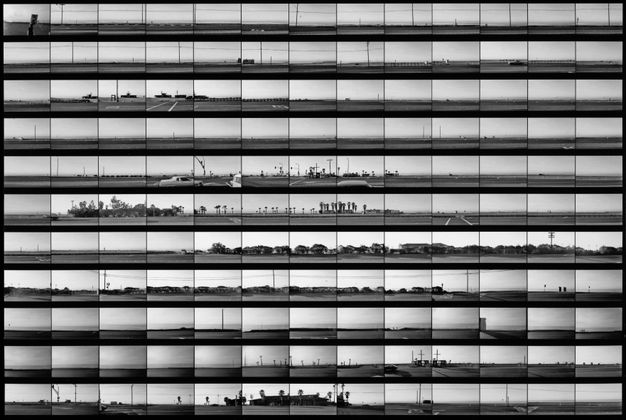
It is in this construction of identity for the images that the politics of metadata will be found and the ideology of the digital archive (if locatable) will be read. The “law of what can be said,” to speak in Foucault’s terms, has shifted from the artist’s to the institution’s purview, and it will ultimately be the GRI that has the right to determine what will be deemed legitimate and what will not.33 Retrieval will always be partial and therefore biased: the rare or unusual will be labeled, but the common will be less likely to be, and some images may actively resist identification. How, for example, does one assign a search term for subjective categories like “unspectacular,” “flat,” or “redundant” (fig. 14.1)? Subjected to a kind of banality cull, the exhaustive account promised by the archive’s name, the Streets of Los Angeles, is likely to fall short, carrying forward Ruscha’s blind spots (which mark it as Ruscha’s mnemopolis, and not, for example, one generated from the streets of South or East L.A.) and adding the GRI’s own.34 To return to the metaphor of the Wunderblock and the ways the digital archive reshapes social memory, the tangled disorder of the archival unconscious will be preserved in the physical “wax tablet” but will only ever be accessible through the terms written on the translucent surface sheet. Confined to the digital interface, we will rarely be able to lift the cellophane and examine the chaotic traces below.
Failures of language and quantification join other sociocultural gaps that are incapable of being thought of by institutions aligned with dominant power structures, resulting in histories that have remained in the shadows and that demand major reconstructions of the foundations and constitution of knowledge to understand them. The scholars Tina Campt, Saidya Hartman, Marianne Hirsch, Jean Howard, and Laura Wexler have drawn attention to them from within the Engendering the Archive project at Columbia University, where they have led a group of thirty participants in an effort to expose the silences in archives that police the borders of social difference.35 In light of their work, Ruscha’s SoLA Archive was already an oppressive “patriarchive” before it entered the GRI’s custodianship—we would be challenged, for example, to locate there the repercussions of the Watts uprising of 1965 (the year Ruscha commissioned Jerry McMillan to do a test shoot of the Sunset Strip), or evidence of the 1966 curfew riots on Sunset itself.36 These invisible histories of the streets of Los Angeles, accessed only through an encompassing overview of what Ruscha did and didn’t photograph, form an immaterial counterarchive of absence that is also lost to view within the rhizomatic clickbait atmosphere of cultural memory’s new digital apparatus. Once identified, these gaps undermine the authority of the SoLA images, even when gathered under the GRI’s aegis. Electronic remediation can be understood literally in this context as remedial when the very uniformity and bureaucratic structures that subtend the SoLA Archive are understood as outgrowths of disciplinary culture that are exploded when one of their avatars is fragmented and dispersed into the immersive electronic interface. Yet again, history is sacrificed—this time, the history of the repressive context of the images’ production. In such an amassment, the perspective necessary to find these social voids becomes daunting, both realistically and psychologically, and the possibility of encountering the previously unseen and unanticipated drops precipitously. The further the archive moves toward morcellation and diffusion the less likely we are to link the routes traced to the individual photographs accessed: searchability, which claims to be giving us access to the whole, comes at the expense of the broad view.
But ideological impairment in the SoLA Archive, already present when the images resided in the artist’s studio, is further supported by the way the massive scale of the collection conditions its visibility.37 In such a situation, the sheer size of the archive becomes the very force that inhibits its function, even in the interests of the power structures that have put it in place. Availability is so increased that the rhizomatic structure, full of creative promise, now functions as a string of distractions in support of the attention economy. Thus, even as the credibility of the archive increases with the number of records in it (truth through quantity of evidence), so may its slide toward triviality. Another way of saying this is that as the archive increases in size, it weirdly becomes more limited, effectively estranging itself from itself.
These contradictions are the terms by which Derrida’s “archive fever” is defined: the destabilizing force, implicated in the genesis of the archive itself, that resists and opposes the archival (the “conservation drive”) is always threatening to displace knowledge and power from their positions of authority. For Derrida, the archive defines itself against oblivion: “There would indeed be no archive desire,” he writes, “without the possibility of a forgetfulness.”38 Ironically, as we approach the point at which technological memory will map directly onto the world’s vast stores of preserved knowledge, attempting to eliminate the possibility of forgetting as we might eliminate a virus, it is important to remember that in doing so, we threaten to eliminate the need for the archive itself. Massification, by this logic, becomes the agent of the archive’s undoing in the age of its digitization, through the technical, structural, social, and cognitive limitations that sweeping scale introduces.
The biggest issue lies not with the technology per se—while the GRI has had to increase server capacity to accommodate the collection, and parts of the collection have resisted automatic processing, the technology to manage large-scale image collections is available and customizable. But the conversion doesn’t come cheap. Only an institution like the GRI can support the material and intellectual labor that now attends the SoLA Archive; developing the archive in Ruscha’s studio was already a collaborative effort, but the institutional digitization has multiplied the labor pool and the cost many times over. Consider the numbers: scanning began in 2017 and ended in 2019, and in that period approximately 130,000 images were digitized and tagged—about 17 percent of the SoLA collection. Even if the GRI could scan continuously, it would be another six years before the remaining images in the archive could be searchable. More realistically, this number would at least double, since, five years after the start of digitization, the collection has yet to be made searchable by subject. During all that time, Ruscha’s team would be out generating more images to add to the archive. In fact, given the projected scale of the collection of SoLA photographs, the challenge to archival preservation in general, and digitization in particular, are built into the project itself. The SoLA Archive was designed to increase in size—its horizon is always moving; the project is never complete. The immensity and open-endedness of the archive approaches the digital sublime, particularly if one takes into consideration the limits of human consciousness to grasp the project as a whole or isolate a group for interpretation. As such, the SoLA Archive’s move to the GRI completes the project as an allegory of the futility of the kind of plenary knowledge sought by the information age through sheer scale—through “being counted” in every sense of the word. Ruscha, it could be said, is using quantification to resist itself.
With this in mind, we might consider the possibility that the Streets of Los Angeles project—launched, like Roche’s Mnemopolis and Derrida’s first thoughts about mechanisms of memory, at the start of the information age—was conceived as a wry commentary on postwar expansion in the pursuit of accumulation and supersizing, a visual argument whose stakes for knowledge and experience (now ratcheted up to extreme proportions) invoke exhaustion and death. “You’ll travel without moving,” Roche’s antihero observes, “in the endless city in your head that is filled with every fatigue—just one more step, and another.”39 And from Derrida: “The machine—and consequently representation—is death and finitude within the psyche.”40 By metastasizing a photographic archive to its breaking point and consigning it to the GRI’s stewardship, Ruscha the trickster effectively parodies the institutional mission to preserve and produce knowledge, generating a meta-archive that shapes the Streets of Los Angeles project as a folly and, paradoxically, renders Ruscha’s mnemopolis the conceptual work of art it never was while in his studio.
Notes
Epigraph: Maurice Roche, Compact, trans. Mark Polizzotti (Elmwood Park, IL: Dalkey Archive, 1988), 4. For the French edition, see Maurice Roche, Compact: Roman (Paris: Éd. du Seuil, 1966).
-
Roche, Compact, 59. The capitalized letters are in the original text, which experiments with typography and color, offering a fragmented and networked reading experience suggestively similar to web-based browsing. ↩︎
-
Roche, Compact, 55, 70. ↩︎
-
See Andreas Huyssen, Present Pasts: Urban Palimpsests and the Politics of Memory (Stanford: Stanford University Press, 2009), 1–10. For the idea of photography and archives as forms of “artificial memory,” see Richard Terdiman, Present Past: Modernity and the Memory Crisis (Ithaca: Cornell University Press, 1993), 30. ↩︎
-
Edward Ruscha, Leave Any Information at the Signal: Writings, Interviews, Bits, Pages, ed. Alexandra Schwartz (Cambridge, MA: MIT Press, 2002), 41. See also Joshua Shannon, The Recording Machine: Art and Fact during the Cold War (New Haven, CT: Yale University Press, 2017), 1. Shannon links this “factualism” to a period tendency in US art: Shannon, Recording Machine, 5. ↩︎
-
Diana Taylor, “Save As,” in “On the Subject of Archives,” ed. Marianne Hirsch and Diana Taylor, special issue, Emisférica 9, no. 1 (2012), https://hemisphericinstitute.org/en/emisferica-91/9-1-essays/e91-essay-save-as.html. See also her influential book, Diana Taylor, The Archive and the Repertoire: Performing Cultural Memory in the Americas (Durham: Duke University Press, 2003). ↩︎
-
Taylor, “Save As,” 2. ↩︎
-
Pierre Nora, ed., Realms of Memory: Rethinking the French Past (New York: Columbia University Press, 1998), 1–3. ↩︎
-
For the practical imperatives of Ruscha’s style, see Jennifer Quick, “Pasteup Pictures: Ed Ruscha’s Every Building on the Sunset Strip,” Art Bulletin 100, no. 2 (2018): 125–52. “Directory style,” may be the most appropriate characterization, given Every Building on the Sunset Strip’s formal similarity to Japanese real estate directories. See, for example, the leporello examples in the GRI and Huntington Library collections. ↩︎
-
Nora, Realms of Memory, 2. ↩︎
-
Nora, Realms of Memory, 2. ↩︎
-
The scholarship on the archive is vast. For a recent overview, see Marlene Manoff, “Archive and Library,” in The Oxford Encyclopedia of Literary Theory, ed. John Frow (New York: Oxford University Press, 2022), https://doi.org/10.1093/acrefore/9780190201098.013.1017. Important art historical accounts include Benjamin Buchloh, “Gerhard Richter’s ‘Atlas’: The Anomic Archive,” October 88 (Spring 1999): 117–45; Hal Foster, “An Archival Impulse,” October 110 (Autumn 2004): 3–22; Sven Spieker, The Big Archive: Art from Bureaucracy (Cambridge, MA: MIT Press, 2008); and Markus Miessen and Yann Chateigné, eds., The Archive as a Productive Space of Conflict (Berlin: Sternberg, 2016). For the materiality of photo archives, see the conference website hosted by the Kunsthistorisches Institut in Florence, https://www.khi.fi.it/en/forschung/photothek/photo-archives.php. A valuable resource on archival exclusions is the project Engendering the Archive, Columbia University, Center for the Study of Social Difference, https://www.socialdifference.columbia.edu/projects-/engendering-the-archive. ↩︎
-
Michel Foucault, The Archaeology of Knowledge and the Discourse on Language, trans. Alan Sheridan (New York: Pantheon, 1972). ↩︎
-
Jacques Derrida, Archive Fever: A Freudian Impression, trans. Eric Prenowitz (Chicago: University of Chicago Press, 1998), 4n1. ↩︎
-
See Jacques Derrida, “Freud and the Scene of Writing,” in Writing and Difference, trans. Alan Bass (Chicago: University of Chicago Press, 1978), 227–28. See also Derrida, Archive Fever, 14. ↩︎
-
Sigmund Freud, “A Note upon the ‘Mystic Writing-Pad,’” in The Standard Edition of the Complete Psychological Works of Sigmund Freud, ed. and trans. James Strachey, vol. 19 (London: Hogarth, 1961), 227–32. ↩︎
-
The translation of the title Archive Fever from its original French, Mal d’archive, is slightly misleading, as it deemphasizes the destructive dimension so important to Derrida, but it has the advantage of foregrounding, through the double connotations of the word fever in English, the compulsive aspect of the death drive. ↩︎
-
For important changes in reception and oversight of archives in general under the new electronic regime, see David M. Berry, “The Post-Archival Constellation: The Archive under the Technical Conditions of Computational Media,” in Memory in Motion: Archives, Technology, and the Social, ed. Ina Blom, Eivind Røssaak, and Trond Lundemo (Amsterdam: Amsterdam University Press, 2017), 103–25. ↩︎
-
Oliver Wendell Holmes. “The Stereoscope and the Stereograph,” Atlantic Monthly 3, no. 20 (1859): 748. ↩︎
-
Since it was the art context of the SoLA photographs that brought the project to the GRI’s attention, the very phenomenon, in Derridean terms, that generated the institutional archive destroyed its “origins,” its arche. Interesting as well is that the move from art to information is opposite to the aggrandizement museums usually perform on archival photographs—for example, the Museum of Modern Art’s treatment of Eugène Atget’s archive of Paris. See Abigail Solomon-Godeau, “Canon Fodder: Authoring Eugène Atget,” Print Collector’s Newsletter 16, no. 6 (1986): 221–27. ↩︎
-
Emily Pugh, “Some Los Angeles Streets: Ed Ruscha in the Library and Archive,” this volume. ↩︎
-
See Geoffrey Batchen, Negative/Positive: A History of Photography (New York: Routledge, 2021). ↩︎
-
Ina Blom, “Rethinking Social Memory: Archives, Technology, and the Social,” in Blom, Røssaak, and Lundemo, Memory in Motion, 17. ↩︎
-
Huyssen, Present Pasts, 17. Even if the GRI reserves a portion of the digitized archive for authorized users, once scanned and posted the images will be impossible to keep out of broad circulation online. ↩︎
-
Blom, “Rethinking Social Memory,” 17, 29. ↩︎
-
Derrida, Archive Fever, 17. For an account that emphasizes that “the computer is the quintessential information system precisely because it can process, store, retrieve, and exchange virtually any type of information (e.g., aural, textual, and visual),” see Pugh, “Some Los Angeles Streets.” I think it is important to acknowledge that the structural differences between organizational systems can be significant. Printed books shape their readers differently than electronic interfaces. ↩︎
-
Taylor, “Save As.” ↩︎
-
As one scholar has pointed out, history (and art history) cedes to the priorities of media archaeology—namely, the performative effects of technology on knowledge—as soon as the work has been digitized. Wolfgang Ernst, Digital Memory and the Archive (Minneapolis: University of Minnesota Press, 2013), 55–59. ↩︎
-
“To make something computable requires that it be abstracted twice over: it must be encoded in a symbolic system of digital abstractions and captured in a grammar of actions that can be prescribed back onto physical activity. Abstraction is thus a feature of functionality.” Berry, “Post-Archival Constellation,” 104. ↩︎
-
Georg Simmel, The Philosophy of Money (New York: Routledge, 2011). ↩︎
-
For Berry, the stakes for machine-only readability are ultimately human intelligibility, as witnessed, for example, by the apparently chaotic organizational system of the Amazon warehouse, comprehensible only to the computer that masters it. Berry, “Post-Archival Constellation,” 110. ↩︎
-
Roche, Compact, 14. ↩︎
-
Certainly, the reduction of images and objects to lexical identifiers is a standard archival practice that predates electronic databases. But most metadata, unlike keyword descriptors, are hidden as a condition of use. See Amelia Acker, “Metadata,” in Uncertain Archives: Critical Keywords for Big Data, ed. Nanna Bonde Thylstrup et al. (Cambridge, MA: MIT Press, 2021), 321–29. ↩︎
-
Foucault, Archaeology of Knowledge, 129. ↩︎
-
The research group Metadata Culture has published extensively on the care and consequences of data tagging for cultural heritage. See http://metadataculture.se/. ↩︎
-
See Engendering the Archive; and the resultant double issue of Emisférica: Hirsch and Taylor, “On the Subject of Archives,” https://hemisphericinstitute.org/en/emisferica-91.html. ↩︎
-
Derrida uses the term patriarchive to characterize the elision of women’s presence in the archive as described by Sonia Combe in her book Archives interdites (Paris: A. Michel, 1994). See Derrida, Archive Fever, 4n1. ↩︎
-
Ruscha himself has never laid eyes on most of the images, not even through the viewfinder; shortly after editing Every Building on the Sunset Strip, he remanded his street-photo apparatus to a team of assistants, who have been tasked with sustaining the project. ↩︎
-
Derrida, Archive Fever, 19. ↩︎
-
Roche, Compact, 13, 125. ↩︎
-
Derrida, “Freud,” 228. ↩︎