Ed Ruscha’s newly accessible Streets of Los Angeles (SoLA) Archive presents an opportunity to reconsider all aspects of his long history of photographically documenting the city. We now know, for example, that his famous artist’s book, Every Building on the Sunset Strip (1966), constitutes a tiny fraction of the numerous other streets, and the multiple iterations of the same street, that he documented over the course of his long career. As a long-term resident and acute observer of his adopted home, Ruscha has seen Los Angeles and its environs undergo significant changes, and not all for the better. One question raised by the SoLA Archive concerns the artist’s attitude to the changes he witnessed. Does his project of repeatedly documenting the same streets imply a watchful, critical stance? The literature on Ruscha often comments on the artist’s pose of indifference and the tonality of deadpan, especially evident in his series of books. Yet, since the late 1980s, this characterization has seemed inappropriate. Increasingly, observers have noticed a more critical posture and a more pessimistic tone. Hal Foster, for instance, observed a change in mood or “weather” in Ruscha’s work.1 Mention is made in this context of the Course of Empire series (2005), the noirish, air-brushed silhouette paintings he began in the late 1980s, and Our Flag (2017), his stunning depiction of a tattered American flag against a black sky. Recent decades have undoubtedly witnessed the emergence of a darker Ruscha.
The critical posture evident in the later work should perhaps prompt us to reconsider the stance of neutrality or impersonal objectivity attributed to his early books and the cool detachment so often ascribed to the man. This essay identifies two types of criticality in Ruscha’s work. The first, disruption, is mainly associated with his books, including Every Building. I argue that by adopting and playing against what the pioneering media theorist Vilém Flusser would later call the apparatus and program of graphic design,2 Ruscha was able to demonstrate his resistance to its mechanistic and instrumental character. A portion of his work, including his photodocumentation of the streets of Los Angeles and adjacent cities, is, I think, a response to what he saw as the steady deterioration of the urban fabric of L.A. and the surrounding environment. His growing dismay demanded a different model of criticality: recursion, which involves time-lapsed, repeated documentation of the same site. I will consider each critical strategy in turn.
Disruption, or A Spanner in the Works
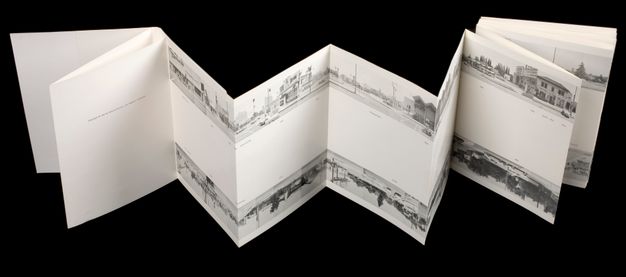
In her recent book, Back to the Drawing Board: Ed Ruscha, Art, and Design in the 1960s, Jennifer Quick situates the artist’s work in the context of his training in graphic and advertising design. In a chapter presenting painstaking and original research into the making of Every Building, Quick persuasively argues that Ruscha “tested the representational capacities, perceptual apparatuses, and communicative potential of pasteup layout, sometimes adhering to its rules and at other times breaking them.”3 The whole process—involving the systematic photographic documentation of the Strip, pasteup techniques, and commercial printing processes—effectively compressed both sides of the 1.6-mile-long boulevard onto a 27-foot foldout (fig. 8.1). The work on Every Building coincided with Ruscha’s freelance job as layout designer for Artforum (1965–69). Given his training and professional experience, including working briefly for an advertising agency, it makes sense to consider how Every Building and Ruscha’s other books both deploy and disrupt standard commercial applications of graphic design.4
Quick’s research demonstrates the extent to which Ruscha’s process is governed by the apparatus and program of graphic design—terms I borrow from Flusser’s Towards a Philosophy of Photography (2000). Flusser’s influential book is about the apparatus and program of the analog camera, but he makes it clear that the camera is one apparatus among many involved in the production and dissemination of information and, as such, it provides a useful model for reflecting on the production of Ruscha’s books. For Flusser, photographers are restricted to mining the “possibilities contained within the program of the camera,” and so their images are largely predetermined by the camera.5 He declares that the effect of the camera and other apparatuses on lived experience leaves “no place for human freedom within the area of automated, programmed, and programming apparatuses.”6 However, Flusser thought that artists and experimental photographers have a role to play in resisting the program: “They know they are playing against the camera.” They bend or alter the program and attempt to “outwit the camera’s rigidity.” They “force the camera to produce the unpredictable, the improbable, the informative.”7 In short, they endeavor to produce something that is not anticipated by the program and, in doing so, help to reverse the incremental domination by programmed and programming apparatuses.
What Quick refers to as “the total system of pasteup” seems analogous to Flusser’s apparatus and program, and, indeed, many of Ruscha’s statements encourage this comparison.8 He said, for instance, that after he had established the format of his first book, Twentysix Gasoline Stations (1963), the subsequent books came easily because “each one could be plugged into the system I had.”9 In other words, the photographs served the book design, not the other way around. Similarly, in an interview with Christophe Cherix, Ruscha states that he wanted to make a book, and the series of swimming pool photographs “just kind of fell into my program.”10 His interest in the books was mainly focused on the production logic of the total system of pasteup, rather than on the content of the photographs. By adhering to this impersonal, methodical system, he distanced himself from the ethos of abstract expressionism, but, at the same time, he risked uncritically embracing the procedures of commercial media. This is exactly what Benjamin Buchloh claims in his influential essay “Conceptual Art 1962–1969: From the Aesthetics of Administration to the Critique of Institutions” (1990). He argues that Ruscha’s books were part of a project of negating the transcendental aspirations of traditional art by miming “with bureaucratic rigor” the positivist and instrumentalist logic of late capitalism.11 As a result, Ruscha and other artists succeeded in evading the self-deluded pursuit of a free, corporeal, expressive gesture, but they did so at the cost of submitting to capitalism’s coercive, techno-scientific systems of administration and control. My argument suggests that Buchloh failed to appreciate Ruscha’s critical strategy of both appropriating and undermining such systems.
Quick makes it clear that what Ruscha called his “consciousness of layout” does not imply that his work was wholly determined or limited by the program.12 To avoid this implication, she draws attention to his use of “strategies of reversal or inversion that often countered design’s functionalism and communicative capacities” and notes how Ruscha “reveled in moments of mistranslation, ambiguity, and even failure, delighting in the comedy and confusion that resulted.”13 She cites moments of resistance in Every Building, such as its unconventional design, with its broad, blank band down the middle of the page and the nearly indecipherable small scale of the images; she also observes the unwieldiness of its extended foldout. While I agree with Quick’s thesis that Ruscha’s deployment of the techniques of graphic design is key to understanding his practice, I think it is equally important to emphasize the extent to which he also resisted succumbing to its logic. His response to a query about his early experience working as a printer’s apprentice is telling: “My eyes would light up when I saw mistakes.”14 For Ruscha, methodical, technical procedures must be countered by the accidental or the unexpected. How, then, do his artist’s books subvert the techniques and protocols of graphic design?
In my view, Ruscha’s series of little books, including Every Building, were aimed at putting the program of graphic design under extreme pressure to produce something unanticipated by the program. The very project for a 27-foot-long, jack-in-the-box, foldout book is patently absurd, especially as it is housed in such a small volume (7 × 5 5/8 inches).15 The motorized automaticity of Ruscha’s photographic process is in stark contrast to the earlier examples using a similar layout. Every Building is a protoconceptual work in which the boulevard is treated as an architectural readymade just like the buildings in Twentysix Gasoline Stations. Quick’s research in the Getty Research Institute archive demonstrates that Every Building is a complex assemblage of images, yet the end product shrugs off its labor-intensive pasteup process. This disparity between process and appearance sets it apart from much conceptual art, which is a record of its own production. Every Building’s look of impersonal automaticity is central to its impact and significance as a work of art. Crucially, it was presented in an art context that came to appreciate its doubly motorized photographic technique, its vacant streets, and its deadpan neutrality and humor. These factors are what constitute its enduring art historical importance.
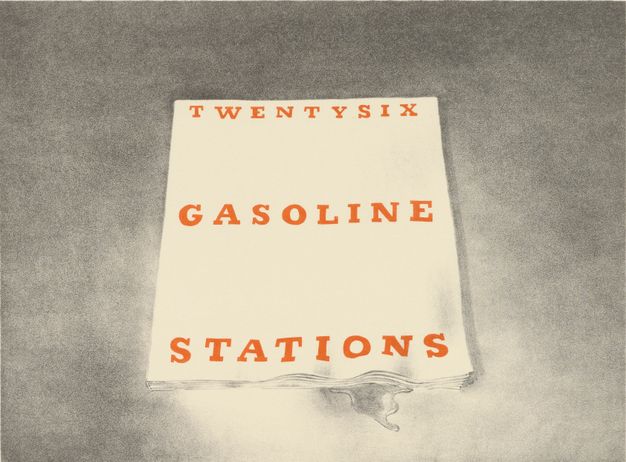
The instructions for display and some of the photographs that Ruscha had taken for Every Building accentuate its absurdity. In one photograph, the book poses as a freestanding, crinkle-crankle sculpture that turns a sharp corner to fit the confines of the frame. On this evidence, the accordion fold can hardly be regarded as a functional solution to the design problem of making the work portable and manageable. The design of Every Building was aimed at subverting and stretching the techniques of graphic art. In this respect, Ruscha follows Marcel Duchamp’s example. Molly Nesbit has proposed that Duchamp aimed to subvert the authoritarian and utilitarian “common sense” of the new Third Republic in France. The republic’s “common sense” was inculcated by mandatory training in technical drawing in primary and secondary schools, where “line and body were pitted against each other as if they were savagely opposite poles.”16 The aim was to discipline vision and channel drawing to serve the interests of industry and commerce instead of art. Many of Duchamp’s paintings and readymades appropriate the utilitarian objects illustrated in the drawing manuals, including coffee grinders and snow shovels. Yet he also contaminated the culture of dry mechanical drawing with eroticism, chance, blossoming, and splashing.17 By appropriating and subverting the techniques of technical drawing, he managed to evade both the prevailing conventions of fine art and the strictures of a rationalizing and utilitarian educational culture. If, as Nesbit argues, Duchamp interrogated the industrial common sense of his time, then I suggest that Ruscha did the same for graphic design’s common sense by both miming and undermining it. Ruscha’s books and paintings lightly discredit the techniques of graphic design and perspective construction with bubbles, fire, various fluids, stains, clouds, vivid colors, and signs of deterioration—all things, in other words, unassimilable to the ruler and the perspectival grid.18 For Every Building, he motorized the camera in emulation of a kind of machinelike vision. In the pasteup process, he ironed out the topographical irregularities of the actual Strip into two literal strips, which he then proceeded to fold and collapse.19 His Book Covers series (1970) includes a lithographic still life of Twentysix Gasoline Stations (fig. 8.2), which shows the book’s bottom edge as a wet, wavy contour not unlike the curvaceous rulers Duchamp made in 1913–14 for 3 stoppages étalon (3 Standard Stoppages). In both artists’ work, premeditated logic and technical procedures encounter the unexpected, the accidental, the bodily. Something formless or unruly disrupts the clear-cut design. The dry is contaminated by the wet.20
This strategy of disruption extends to the other aspects of the design of Ruscha’s books. Several commentators have pointed out how their consistent serial structure is undercut by a head-scratching coda. The artist himself noted, for instance, that the journey implied in Twentysix Gasoline Stations reaches its assumed destination in Oklahoma, only to backtrack and end in Texas.21 Thirtyfour Parking Lots in Los Angeles (1967) contains what the artist described as a “strange foldout” tab at the end of the book where a tipped-in, 1 1/2-inch extension added a few more parking spaces to a long and narrow two-page photographic spread of them.22 Nine Swimming Pools and a Broken Glass (1968) features only ten color photographs and fifty-four blank pages. The tenth photograph is of a broken glass, which is as unexpected as the glass of milk at the end of Various Small Fires and Milk (1964). To my mind, this tension between the methodical and the unexpected is what animates Ruscha’s work.23 He himself tends to stress the methodical character of his process, only rarely mentioning how this aspect is tied to the books’ subversive humor. Yet Ruscha is aware of their close connection: in conversation with Willoughby Sharp, he observes that “to have something come across as humor you have to be methodical about it.”24 I suggest that the famous “deadpan” character of Ruscha’s books may have something to do with this methodical, repetitive, automatic, and mechanistic ground of humor.
It is generally agreed that Ruscha’s early work, including the series of books, was motivated by his antipathy to the fantasy of artistic authenticity, autonomy, and spontaneous gestural originality associated with abstract expressionism. Accordingly, much critical commentary, including my own earlier effort, has tended to accentuate Ruscha’s impersonal technique, his adherence to a self-assigned brief, and his attraction to what he once called the “inhuman aspect” of photography.25 However, this emphasis has resulted in an underappreciation of the extent to which he also aimed to sabotage the determining power of the apparatus and program of graphic design, which was closely associated with the burgeoning industries of commercial print advertising and product and package design. Although Ruscha certainly admired the books’ “clear-cut machine finish,”26 he cannot have been untouched by contemporary critiques of commercial art and advertising. As the Rolling Stones declared in 1965, advertising purveys information useless for the purpose of gaining satisfaction. In my view, Ruscha’s books are finely balanced between, on the one hand, an astute acknowledgment of the actual conditions of art practice in a commercial and highly technical environment and, on the other, a provocative, playful, witty, critical, and disruptive resistance to those conditions.27
Recursion, or That Was Then, This Is Now
If Ruscha’s books play against the apparatus and program of graphic design, the same cannot be said of his periodically repeated photodocumentation of L.A. streets. This major project clearly demands a very different model of analysis bearing on the subject matter of the photographs. We must inquire into why he returns again and again to rephotograph the Sunset Strip, Hollywood Boulevard, Santa Monica Boulevard, the Pacific Coast Highway, and La Cienega Boulevard. This project of recursive observation and documentation is in keeping with his “waste-retrieval method”—that is, his general practice of recycling and reworking motifs, like the Standard gas station and Hollywood Sign.28 Yet his periodic inventory of L.A. streets has a specific motivation tied to the changing fabric of the city over the course of time.
THEN & NOW: Hollywood Boulevard, 1973–2004 is a large-format book published in 2005. It is a photodocumentation of both sides of Hollywood Boulevard that was first carried out in black and white in 1973 and then in color thirty years later.29 The book has the same layout as Every Building, with continuous strips of photographs showing one side of the street at the top and the other, inverted, at the bottom of the page (see fig. 2.22). However, THEN & NOW is a conventionally bound book rather than a concertina foldout, and both upper and lower registers are doubled. What fundamentally distinguishes Every Building from THEN & NOW, apart from their vastly different dimensions, is that the latter demands a detailed comparative study of the monochrome and color registers. Viewing is focused not on formal aspects of the layout but rather on the actual architecture and signage of the boulevard. Ruscha has said that his archive of photodocumentation of city streets is primarily of interest for its record of the changing face of the city over the course of several decades. As Amy Murphy put it in her contribution to this volume, while Ruscha’s initial focus seemed to be on the horizontal or spatial dimension of the street, it clearly shifts to a vertical or temporal dimension.30 He explicitly invites viewers to study the differences between the monochrome and color registers: “You can go back and compare: ‘Oh, there’s that tree or Mexican fan palm and look what size it is today.’”31 That THEN & NOW and the Streets of Los Angeles Archive provide the opportunity for such banal observations cannot explain the magnitude of the project, which has yielded about 900,000 photographs to date. In my view, Ruscha’s ongoing documentation of L.A. streets is motivated by a deep concern about the city’s continual process of decay, demolition, and development. During an interview in January 2020, he explained that he started his photodocumentation of L.A. because he “began to see the city decaying in negative ways. . . . Anything that was worth looking at seemed to be erased and something came along to replace it that was repulsive. That continues to be true today, too.”32 His practice amounts to a time-lapse documentation that makes visible the optical unconscious of that gradual change.
Ruscha’s worry about the changing character of the city and his critical strategy of recursive documentation and comparative viewing were unveiled in his celebrated series of paintings exhibited in the American Pavilion at the 51st Venice Biennale in 2005. In the Biennale catalog, Ruscha associates Course of Empire with a concurrent project, “a book of buildings on Hollywood Boulevard,” so it is instructive to view THEN & NOW alongside the series of paintings.33 For Course of Empire, Ruscha returned to the quasi-imaginary industrial buildings he painted in monochrome for the Blue Collar series (1992); he depicted them again, in color, just over a decade later.34 In his review of the installation’s inaugural exhibition in Venice, Buchloh revisits his critical assessment of Ruscha’s books and entire body of work. Upon viewing Course of Empire, he declares that Ruscha’s dual series of five canvases depict “his country’s culture at a moment of incessant deterioration of its liberal-democratic public sphere”—exemplified, for example, by the boarded-up windows and chain link fence in The Old Trade School Building (2005). He concludes that this had been “the focus of his artistic projects of the last forty years.” The “corporate ordering of space” in Ruscha’s paintings “was not the triumph of a technological culture over an obsolete artisanal one, but rather a melancholic and allegorical act of resistance within the totality of industrial sign systems.”35
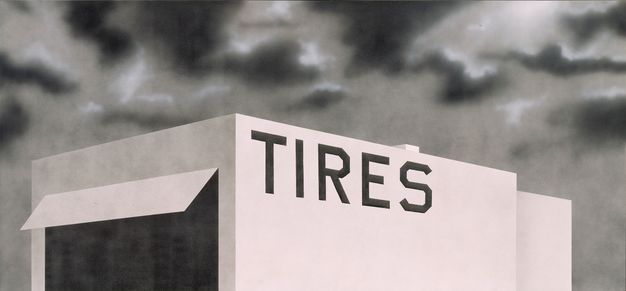
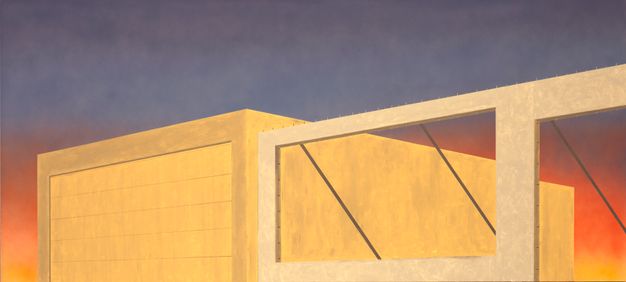
Juxtaposed to the color series, the monochrome paintings acquire the connotation of a “that-has-been” industrial moment on the cusp of a postindustrial one. But the prospect of imminent change was already clearly marked in the Blue Collar series. Monochrome paint has an inherent bleakness and, in the early 1990s, it also alluded to the near obsolescence of black-and-white photography and film. In an interview, Ruscha revealed that Blue Collar Tires (1992) (fig. 8.3) was based on a building he often passed on his way to his retreat in the Mojave Desert. “It was so lonely and it seemed forgotten. . . . It didn’t look like it was in business.” As such, it assumed for him an “iconic” status. Expansion of the Old Tires Building (2005) appears to show a stalled redevelopment project (fig. 8.4).36 The sense that the buildings in the Blue Collar series are abandoned, or nearly so, is particularly marked in the case of Telephone: in 1992, public telephones were already nearing redundancy, and this must be what motivated its inclusion in the series (apart from starting, like the other signage, with the letter T). In a conversation that same year with Walter Hopps, Ruscha described the Blue Collar series as “futuristic,” by which I think he meant that it anticipated the transformations he was to depict in the second series.37 In any case, Course of Empire does not describe a simple opposition. Rather, the Blue Collar paintings anticipate changes represented in the second set, which in turn prompt the viewer to cast a retrospective glance back at what has been lost.
The temporality of Course of Empire is further complicated by its relation to Thomas Cole’s The Course of Empire (1834–36), a cycle of five paintings envisaging the rise and fall of a great imperial city of classical antiquity but also prefiguring what Cole imagined was the possible destiny of the United States. Cole’s paintings show millennia of historical transformations taking place in the same location. The last painting in the series, Desolation (1836), depicts a landscape at dusk with the ruins of classical buildings being reclaimed by wildlife. The landscape represents the desolate remains of a bloated and decadent empire, but it also indicates the possibility of renewal of the natural world. The calm and delicate pastel blue of the sky in Cole’s painting resembles the tonality of Ruscha’s penultimate painting—Site of a Former Telephone Booth (2005) (fig. 8.5). Here, too, a tree has sprung up—a species of tree native to California, the Western Sycamore—with one leaf just visible at the top right of the canvas. The only other feature, a cast concrete roadside sign or lamppost, corresponds to Cole’s single standing classical column in the left foreground of Desolation. Ruscha’s painting—with its delicacy of color, pale light, stillness, and perfect geometry—suggests a glimmer of hope for future renewal.
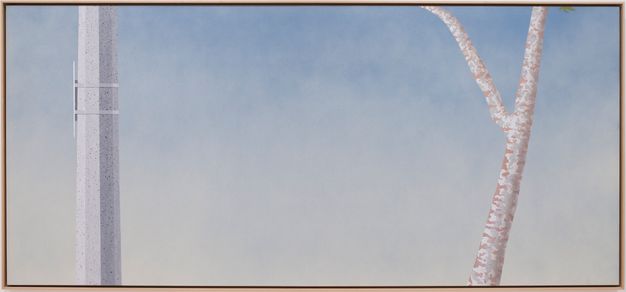
Course of Empire is evidence of Ruscha’s growing interest in capturing complex temporalities and marking social and environmental change. Several statements confirm it: “I’ve been doing a lot of jumping in time. I’m not sure I learned anything from it, but the man that started this thinking was Thomas Cole. Somehow, I’ve picked up on this, repeated or extended it in different ways, tried to lasso it in or to have some discourse that emphasizes the passage of time.”38 Discussing his work following Course of Empire, Ruscha says he was still working from “a sense of LA as decay,” yet, as we have seen, his project is more nuanced than that comment implies.39 Of interest in this context are his Metro Plots, a series of monochrome paintings dating from the late 1990s showing bare Los Angeles street patterns and names in a manner midway between an oblique aerial view and a map. Ruscha remarks, “They almost look like what these streets might look like in the year 5000 or something.”40 In conversation with Margit Rowell, he describes the Metro Plots as an “archaeological vision” of L.A. and a “catastrophic, future vision.” They are “patterns of streets that once existed.”41 Ruscha compares the series to aerial photographs of Hiroshima and Nagasaki after they were bombed, “where the streets were all clearly seen with no buildings.”42 The Metro Plots envisage future traces of an extinct civilization.
In a statement published in 1988, Ruscha laments the condition of L.A.’s urban sprawl and dwindling natural environment. He observes that “it’s all just rape of the land for profit these days. It’s fairly sick. Southern California is all just one big city now.”43 Yet, in 1967, he was already photographically documenting that destruction from the vantage point of a helicopter. Thirtyfour Parking Lots reveals a vast acreage of land tarmacked and painted with grid patterns. The photograph of the Universal Studios lot is particularly telling in this respect: the site looks fresh and raw, having been recently bulldozed, steamrolled, paved, painted, and planted with spindly trees. It is perhaps only now that we can see these photographs as evidence of the despoliation of the natural environment, and perhaps also as traces of the displacement of local communities by developers. In a 2016 interview, Ruscha refers to the forced displacement in the 1950s of Mexican American residents of Chavez Ravine to clear the land where Dodger Stadium was to be built.44 He doesn’t mention his 1967 aerial view of the stadium in Thirtyfour Parking Lots, but his reference to these circumstances retroactively alters its significance.
Surveying THEN & NOW, one notices numerous changes that have occurred over the course of three decades. One critic remarked that "Hollywood Boulevard’s sedate, old-style glamour of 1973 has a new facade of uniformity and tourist amnesia.”45 Studying the time-lapsed registers, one sees, for example, the disappearance of one of Ruscha’s favorite “modernist” canopied gas stations; former vacant lots and real estate opportunities filled with large, bland office buildings; property developments block former vistas; and touches of humor, such as a monstrously overgrown hedge. Demolition and overdevelopment are documented without comment. Speaking in 1999, Ruscha continues to defend his practice of making art without imposing “value judgements.”46 Yet his insistence on the “nonjudgmental” documentation of the city should not be interpreted as indifference on the artist’s part. Rather, it indicates his aversion to making art that carries an overt message. His practice of recursive documentation invites comparison and reflection. Ruscha is quoted in a 2008 Gagosian press release as saying, “If you give the viewer something to compare, you don’t have to interpret.”47
In a 2015 interview with Jonathan Griffin, Ruscha remarks that every time he sees a single-story bungalow demolished, he feels sad because he knows it will be replaced by a three-story apartment building. He saw population growth and demand for accommodation putting pressure on the fabric of the city.48 He also says that when he first started driving to Joshua Tree, in the 1960s, much of the route—which is now developed—passed through countryside: “Believe it or not, there was actually scenery out there. There were horse farms and meadows and beautiful white picket fences and palm trees. Now all of that, every bit of it, is gone. . . . Now we have concrete loading docks and logistics centers.”49 The spread of banal office blocks, residential buildings, and faceless distribution hubs is part of what constitutes, for him, “LA as decay.” Ruscha mourns the California he has personally lost, but we should also acknowledge losses of longer duration and much greater severity suffered by the area’s Indigenous population.50 In a Tate interview about Twentysix Gasoline Stations, Ruscha indicated his awareness that the land crossed by Route 66 is occupied land: “What used to belong to the Navajo and Apache Indians now belongs to the white man and he’s got gas stations out there. So, I started seeing [them] as cultural curiosities.”51 The phrase “cultural curiosities” has the effect of defamiliarizing the gas stations and turning them into poor roadside monuments of the white man’s civilization.
Discussing Course of Empire, Donna DeSalvo and Linda Norden remark, “It’s hard not to read a certain nostalgia, a sense of personal loss . . . lurking just below the surface of Ruscha’s cool remove.”52 There are also undercurrents of anger and frustration; these emotions surfaced in an episode of The Art Angle podcast recorded ahead of the US presidential election in 2020. Ruscha was in conversation with Jimmy Iovine, the music impresario who had commissioned Our Flag three years earlier. Ruscha explains that he had accepted the commission on condition that he could paint the flag in tatters. With unusual bluntness, he says that the painting represented his view that the Trump administration had brought “unrest and discord” to the nation and threatened it with “tyranny.”53 With Our Flag, Ruscha extends his sense of L.A.’s decay to cover the state of the nation under its forty-fifth president. His sense of the dangerous fragmentation of the social fabric led him to abandon his strict avoidance of explicit messages in his work or statements.
We have seen how two types of criticality inform Ruscha’s work. The first, based on a Duchampian model, is mainly associated with the books and his early career. By adopting and playing against or disrupting the apparatus and program of graphic design, Ruscha was able to demonstrate his resistance, not only to abstract expressionism but also to the professional automatisms of commercial art. In this way, he challenged what I believe he saw as a cultural shift leading to increasing commodification, standardization, and automatization of life and work. A large portion of his work is concerned with the impact of this cultural shift on the built environment and lived experience. Drawing attention to this impact demanded a different model of criticality. Although Ruscha began his practice of recursive documentation of the streets of L.A. in the early 1960s, the method was consolidated when he adopted the approach of Cole’s The Course of Empire. He then deployed a strategy of time-lapsed documentation of the same site and offered the viewer the opportunity to track changes by comparing then and now. With his ongoing project, Ruscha continues to document the changes that have affected the city and landscape and asks us to judge for ourselves.
Notes
-
Throughout this essay, I will be citing various volumes of Edward Ruscha: Catalogue Raisonné of the Paintings, 7 vols. (New York: Gagosian Gallery, 2003–16). For Foster’s observation of the change in “weather” in Ruscha’s work, see Hal Foster, “Evening in America,” in Edward Ruscha, vol. 5, 1993–1997, 8. See also Hal Foster, The First Pop Age: Painting and Subjectivity in the Art of Hamilton, Lichtenstein, Warhol, Richter, and Ruscha (Cambridge, MA: MIT Press, 2011), 239; and Briony Fer, “Moth-Man: Ruscha’s Light and Dark,” in Edward Ruscha, vol. 4, 1988–1992, 5–12. ↩︎
-
Vilém Flusser, Towards a Philosophy of Photography (London: Reaktion, 2000), 26–27. ↩︎
-
Jennifer Quick, Back to the Drawing Board: Ed Ruscha, Art, and Design in the 1960s (New Haven: Yale University Press, 2022), 88. See also Quick, “Pasteup Pictures: Ed Ruscha’s Every Building on the Sunset Strip,” Art Bulletin 100, no. 2 (2018): 125–52. ↩︎
-
In 1960, Ruscha was employed as assistant layout artist at the Carson/Roberts advertising agency—an experience he described as “sheer hell.” Edward Ruscha, Leave Any Information at the Signal: Writings, Interviews, Bits, Pages, ed. Alexandra Schwartz (Cambridge, MA: MIT Press, 2002), 230. ↩︎
-
Flusser, Towards a Philosophy, 26–27. ↩︎
-
Flusser, Towards a Philosophy, 81–82. ↩︎
-
Flusser, Towards a Philosophy, 81, 80. ↩︎
-
Quick, Back to the Drawing Board, 93. The expression comes from the chapter titled “Pasteup—A Total System,” in Walter B. Graham, A Complete Guide to Pasteup (Philadelphia: North American, 1975). ↩︎
-
Ruscha, Leave Any Information, 212. ↩︎
-
Ed Ruscha, interview by Christophe Cherix, 12 January 2012, audio transcript, p. 12, Museum of Modern Art Oral History Program, New York, https://www.moma.org/momaorg/shared/pdfs/docs/learn/archives/transcript_ruscha.pdf. ↩︎
-
Benjamin Buchloh, “Conceptual Art 1962–1969: From the Aesthetics of Administration to the Critique of Institutions,” October 55 (1990): 141. ↩︎
-
Ruscha, Leave Any Information, 24. ↩︎
-
Quick, Back to the Drawing Board, 117, 5. ↩︎
-
Ruscha, Leave Any Information, 363. ↩︎
-
Every Building was not altogether unprecedented. In fact, a very similar book was published in Japan in 1954 by Yoshikazu Suzuki and Shohachi Kimura: Ginza Kaiwai / Ginza Haccho is a two-volume boxed publication; the second volume is a 14-foot accordion foldout with a continuous panorama of both sides of Tokyo’s Ginza Street. However, Every Building and Ginza Haccho are conceptually very different. While Suzuki and Kimura’s book documented for posterity the architecture and street life of the Tokyo neighborhood circa 1954, the photographs in Ruscha’s books are to be understood, in his own words, as “an extension of the readymade in photographic form.” Ruscha, Leave Any Information, 215. ↩︎
-
Molly Nesbit, “The Language of Industry,” in The Definitively Unfinished Marcel Duchamp (Cambridge, MA: MIT Press, 1991), 353. ↩︎
-
Molly Nesbit, Their Common Sense (London: Black Dog, 2000), 26, 121, 186. ↩︎
-
On the topic of the grid and what it excludes, see Rosalind Krauss, “The /Cloud/,” in Agnes Martin, by Barbara Haskell et al., exh. cat. (New York: Whitney Museum of American Art, 1992), 159. ↩︎
-
Studying the raw photographs on the Getty Research Institute’s website reveals that Ruscha had to eliminate numerous redundant frames, particularly those showing oblique rather that en face views of buildings, to achieve what he called the simple “store-front plane.” Ruscha, Leave Any Information, 43; and Edward Ruscha Photographs of Sunset Boulevard and Hollywood Boulevard, 1965–2010, 2012.M.1, Getty Research Institute, Los Angeles, http://hdl.handle.net/10020/cifa2012m1. ↩︎
-
Yve-Alain Bois makes a related case arguing that the series of paintings often referred to as “liquid words,” made in the late 1960s, is a way of “signaling the repressed materiality of an idealized code.” Yve-Alain Bois, “Liquid Words,” in Formless: A Users Guide, by Bois and Rosalind Krauss (New York: Zone, 1997), 127. ↩︎
-
Ruscha, in conversation with Clive Phillpot, “Sixteen Books and Then Some,” in Edward Ruscha: Editions, 1959–1999; Catalogue Raisonné, ed. Siri Engberg and Clive Phillpot, vol. 2 (Minneapolis: Walker Art Center, 1999), 63. ↩︎
-
Ruscha, Leave Any Information, 43. ↩︎
-
Ruscha supported this view when he said that he added a floating stuffed olive to the painting Cheese Mold Standard with Olive (1969) as “a way of antagonizing or disrupting the central idea.” Ruscha, interview by Cherix, 47. ↩︎
-
Ruscha, Leave Any Information, 65. ↩︎
-
See Margaret Iversen, “Auto-maticity: Ruscha and Performative Photography,” Art History 32, no. 5 (2009): 836–51; and Ruscha, Leave Any Information, 170. ↩︎
-
Ruscha, Leave Any Information, 27. ↩︎
-
Gabriel Orozco is another prominent contemporary artist whose work both mimics and subverts graphic design. See Margaret Iversen, “Desire and the Diagrammatic,” Oxford Art Journal 39, no. 1 (2016): 1–17. ↩︎
-
Ruscha, Leave Any Information, 251. ↩︎
-
Edward Ruscha, THEN & NOW: Hollywood Boulevard, 1973–2004 (Göttingen, Germany: Steidl, 2005). ↩︎
-
Amy Murphy, “Now Before Then: Ed Ruscha’s Streets of Los Angeles Project and the Anticipation of an Archive," this volume. The vertical axis of Sunset Boulevard can be digitally accessed using Getty’s interactive website “12 Sunsets: Exploring Ed Ruscha’s Archive,” https://12sunsets.getty.edu. Soon this website will no longer be supported; for a video capture, see http://hdl.handle.net/10020/12sunsets_archive. ↩︎
-
Ruscha, interview by Deborah Vankin, “65,000 Photos of Sunset Boulevard: Take the Ultimate Road Trip with Ed Ruscha,” Los Angeles Times, 7 October 2020, https://www.latimes.com/entertainment-arts/story/2020-10-07/ed-ruscha-sunset-boulevard-getty-database. ↩︎
-
M. H. Miller, “Ed Ruscha: He Up and Went Home,” New York Times, 15 January 2020, https://www.nytimes.com/2020/01/15/arts/design/ed-ruscha.html. ↩︎
-
Ed Ruscha, quoted in Donna DeSalvo et al., Course of Empire: Paintings by Ed Ruscha (Ostfildern-Ruit, Germany: Hatje Cantz, 2005), n.p. ↩︎
-
Edward Ruscha, vol. 4, 1988–1992, 382–93. ↩︎
-
Benjamin H. D. Buchloh, “The Curse of Empire,” Artforum 44, no. 1 (2005): 254–58, 324. ↩︎
-
Ruscha, “Course of Empire,” interview with Tom McCarthy and Elizabeth Kornhauser, Gagosian Quarterly (Fall 2018), https://gagosian.com/quarterly/2019/02/11/interview-ed-ruscha-course-of-empire/. ↩︎
-
Ruscha, Leave Any Information, 327. ↩︎
-
Ruscha, “Course of Empire.” ↩︎
-
Linda Norden, “Ed Ruscha’s Course of Empire,” Edward Ruscha, vol. 7, 2004–2011, 31, n1. Ruscha commented that Cole’s series is “philosophically on the money as far as the way civilization is going.” “In Conversation: Ed Ruscha and Joanne Northrup,” Gagosian Quarterly, 4 December 2017, https://gagosian.com/quarterly/2017/12/04/ed-ruscha-and-joanne-northrup/. ↩︎
-
Ruscha, Leave Any Information, 375. ↩︎
-
Margit Rowell, Cotton Puffs, Q-tips®, Smoke and Mirrors: The Drawing of Ed Ruscha, exh. cat. (New York: Whitney Museum of American Art at Philip Morris, 2004), 23. ↩︎
-
Kerry Brougher, “Living in Hollywood Backwards: An Interview with Ed Ruscha,” in Ed Ruscha and the Great American West, ed. Karin Breuer (Berkeley: University of California Press, 2016), 42. ↩︎
-
Ruscha, Leave Any Information, 18. ↩︎
-
Brougher, “Living,” 41. ↩︎
-
Karen Marta, “Then and Now,” Domus 884 (September 2005): 1. ↩︎
-
Ruscha, Leave Any Information, 375. ↩︎
-
Ed Ruscha: Paintings, Gagosian, Britainnia Street, London, February–March 2008, https://gagosian.com/exhibitions/2008/ed-ruscha-paintings/. ↩︎
-
Amy Murphy argues that Ruscha preserves a largely imaginary “first” L.A. derived from his visits to the city as a teenager. As soon as he moved there in 1956, he experienced large-scale demolition and redevelopment projects, including the construction of the freeways. In any case, it’s hardly an originary landscape to which he appeals. Murphy, “Now Before Then." ↩︎
-
Ed Ruscha, quoted in Jonathan Griffin, “Ed Ruscha: L.A.'s Artist,” Financial Times, 30 October 2015. ↩︎
-
This point was highlighted by the Alaska-based Tlingit/Unangax artist Nicholas Galanin. His Never Forget was a giant, site-specific sign reading “INDIAN LAND” erected in the Coachella Valley of Southern California during the Desert X biannual in 2021. It mimicked the famous Hollywood Sign, much painted by Ruscha, which originally advertised the new, segregated housing development of Hollywoodland. ↩︎
-
Ruscha, transcript of “Ed Ruscha’s Photography Books, Artist Interview,” Tate Shots, 12 September 2012, https://youtu.be/0xboX5cvIzw?feature=shared. ↩︎
-
DeSalvo et al., Course of Empire, n.p. See also Norden, “Ed Ruscha’s Course of Empire,” 27–31. ↩︎
-
Ruscha, “The Art Angle Podcast: Ed Ruscha and Jimmy Iovine on How Art Can Help End the Trump Era,” Artnet News, 29 October 2020, https://news.artnet.com/multimedia/art-angle-podcast-jimmy-iovine-ed-ruscha-1919128. ↩︎