Two photographs of the Lytton Savings bank on Sunset Boulevard appear similar. Both are shot from across the street and to the west of the building from oblique angles that highlight the building’s three dimensionality and signature zigzag roofline. The first photograph (fig. 10.1) has perfected certain formal deficiencies of the second (fig. 10.2): less road in the foreground places more focus on the architecture, a corrected exposure gives richer contrasts, and the roofline is made parallel to the photographic frame. Yet their similarities in representing Lytton Savings outweigh their differences.
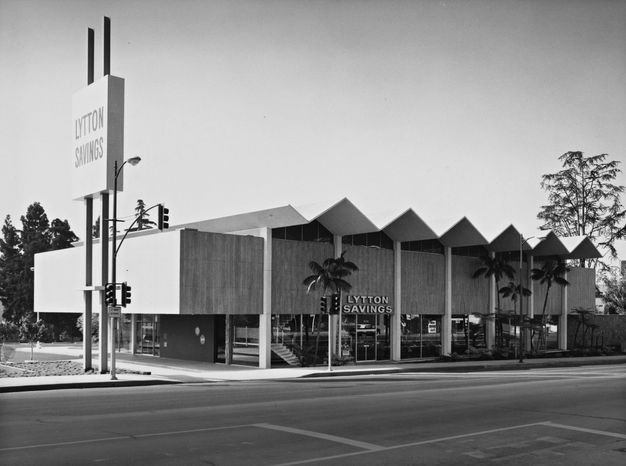
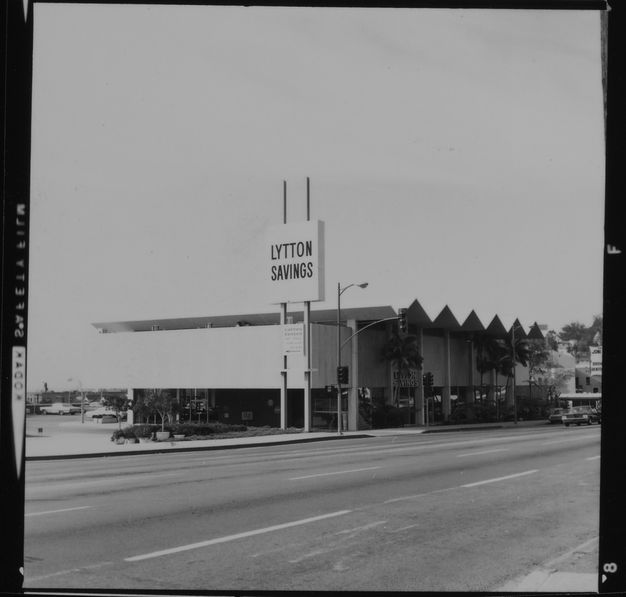
The photographs were shot five years apart for two entirely different projects. Architectural photographer Julius Shulman shot the first in 1960, artist Jerry McMillan the second. McMillan was commissioned by his friend Ed Ruscha to complete a test shoot of Sunset Boulevard in 1965, marking the beginning of Ruscha’s methodical photography of every building on the Sunset Strip (and many other streets throughout the subsequent decades). His Streets of Los Angeles (SoLA) project proposed new ways of documenting and looking at the city and its environs. Though Ruscha has experimented with how photography can visualize the breadth and scope of Los Angeles–area streets, the artist has nonetheless resisted the notion that the medium of photography may have contributed to the city’s depiction. “I don’t even look at it as photography; they’re just images to fill a book,” he remarked about his artist books, all illustrated with photography.1 This essay, by contrast, asks what we learn about Ruscha’s SoLA project if we insist upon looking at it not only as photography but also as a practice embedded in adjacent discourses surrounding the photographic representation of architecture and Los Angeles.
It is unsurprising that Ruscha’s motorized photographs2 (his term) have been associated with the movement, mobility, and fluidity of travel by car, and even as filmic montage.3 McMillan’s test shoot of Sunset Boulevard, however, was done on foot, unveiling a slower, less motorized history behind Ruscha’s multiheaded project. Revisiting McMillan’s test shoot gives insight into the various iterations of Ruscha’s project, including the photography done for Every Building on the Sunset Strip (1966), the subsequent shoots of Los Angeles streets, the digitized negatives, and their presentation online. Most importantly, however, the McMillan test shoot reveals the ways that Ruscha and his team contended with the mechanism of photography, the medium’s limitations, and its effectiveness in representing the buildings and stories of Sunset Boulevard.
McMillan’s shoot, I argue, shares similarities in process, formal conventions, and theoretical approaches to contemporaneous commercial architectural photography—such as Shulman’s shot of the Lytton Savings bank. Like Ruscha’s venture into photography, which is often understood only as “deadpan” and informational, commercial architectural photography has likewise suffered from myopic analyses of its purpose and its photographers’ approaches to their subjects. Frequently misunderstood as divergent from or antithetical to the aims of contemporaneous artists who used photography to explore the limits of representation, image, and subjectivity, commercial architectural photography was decried even by some architects, who complained it was a poor substitute for the experience of a building itself, leading one architect to bemoan the “tyranny” that so-called glossy, glamorous photographs published in architectural magazines held over the public.4
Commercial architectural photographers, however, found themselves at the center of pressing debates around the role of urban representation in growing, changing cities. Los Angeles was transforming on both large and small scales through urban renewal, community displacement, and increased sprawl. Photographers used the city as an ongoing experiment, shooting individual architectures and situating their work within the contexts of L.A.’s continual evolution.
I consider contemporaneous writings about architectural photography by photographers and those in related fields to delineate how its practitioners established new paradigms for the genre that implicated urban architecture. If a preoccupation of photographers and theorists in the 1960s concerned questioning the modernist notion that photography could transparently convey truth about its subjects, commercial architectural photography did not resist such scrutiny; rather, it was a key site of its interrogation.5 This chapter helps to illuminate how Los Angeles became a testing ground for photographers of all backgrounds in the 1960s—and how, across professional fields, artists, architects, and urbanists used photography to assess how urban change affected visuality.
Commercial Architectural Photography: The Profession
Commercial architectural photography carries two general associations about its use. On the one hand, it connotes technical photographs commissioned by architecture or construction firms, whose primary purpose is to document, not to showcase photographic mastery. On the other hand, it brings to mind beautiful photographs featured in architecture, design, and shelter magazines, those which convey aspirational lifestyles over particular architectural or spatial features. Like many commercial practices, architectural photography has also been siloed in scholarship from consideration alongside artists who photograph architecture. Andrew Higgott and Timothy Wray’s estimation is an exemplar: commercial architectural photography, they argue, positions architecture as its “largely autonomous primary source,” whereas art practices that represent architecture consider it in wider social and cultural contexts and take on “wide-ranging” subjects.6 Implicit in this split is the belief that artist-photographers adopt a creative approach toward architectural representation, whereas commercial practices have little room for experimentation and are instead bound, as Higgott and Wray put it, to a “defined discourse” because of the nature of their commissions and clients.
Commercial architectural photography, however, encompasses a more diverse field of photographs than most scholars consider, including representations of residences, commercial buildings, urban streetscapes, interior design, art objects, and exhibitions. Coinciding with new avenues of professionalization for architects in the United States, architectural photography grew in the 1940s as a distinct field within commercial photography. Established in 1947, the Architectural Photographers Association, for which Shulman was a vice president in the 1950s, aimed to make the profession known in various industries and to help settle payment disputes that often arose with architects and magazine editors who refused to pay appropriate wages to photographers, seeing the latter as replaceable labor. As the association’s president Lionel Freedman remarked in 1956, “The idea that architectural photography has no appreciable intrinsic value except as a steppingstone to other more lucrative (and generally quite nebulous) fields is essentially ridiculous.”7 In effect, Freedman and others argued that photographing architecture, design, and interior spaces required skills separate from those of other commercial photographic fields.
Joining a growing body of books at midcentury aimed at teaching the public about taking photos, the Los Angeles–based photographer Robert Cleveland published the manual Architectural Photography of Houses: How to Take Good Pictures of Exteriors and Interiors (1953), promoted as the first book of its kind.8 Geared toward both amateurs and aspiring professionals, the book included detailed information about camera selection, angles, lens tilts, and requirements for particular rooms and exteriors. The book was heavily illustrated with photographs, often showing two photos of the same room side by side to demonstrate successful and unsuccessful approaches. Cleveland distinguished the pictures he took as “house portraiture,” those which captured the mood and the character of architecture.9
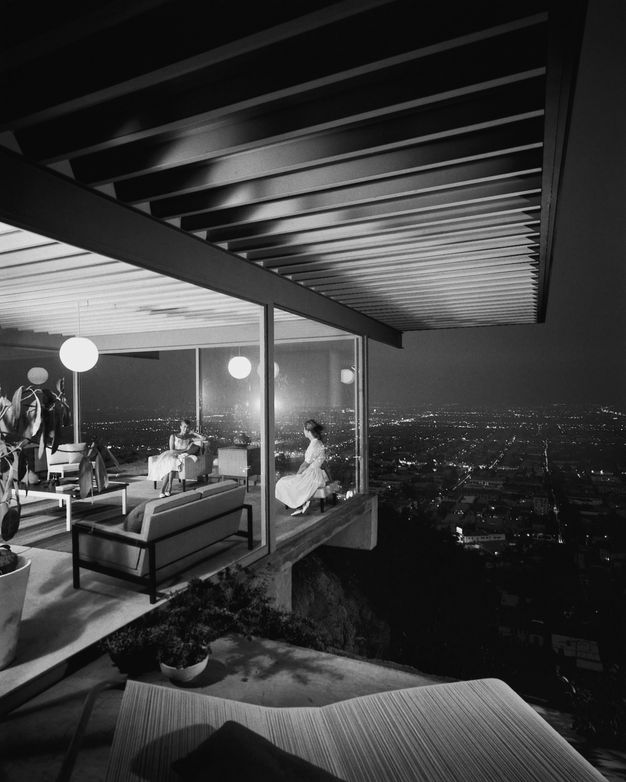
While Cleveland’s book created a bedrock of images that young architectural photographers could refer to while honing their skills, it wasn’t until the publication of Shulman’s Photographing Architecture and Interiors (1962) that a photographer deeply imbedded in the growing modern-architecture culture in the United States established the theoretical and ideological tenets of the profession. Part how-to manual and part treatise, Shulman’s book begins by rehearsing the oft-repeated dual purposes of photography as both a fine art and a medium of communication. He cites architectural photography as primarily concerned with the latter purpose: “A photographer must remember that he is not doing a class exercise in artistic photography,” Shulman advises, urging young photographers not to stray into the “siren regions of art photography.”10 His words resonate with Ruscha’s oft-remarked commentary on photography: “I think photography is dead as a fine art; its only place is in the commercial world, for technical or information purposes.”11 Diverging from Ruscha, however, Shulman proposes that, while its primary purpose is to “convey information about the design,” architectural photography can “transcend mere physical recording,” becoming a “work of art in its own right.”12 Shulman thus viewed the superior architectural photograph as that which could fuse the dual purposes of photography. Not all of the architectural photographs produced and circulated by figures like Shulman conveyed such artistry or, alternatively, what Alice Friedman has termed the “distinctive American glamour” cultivated through visual media of midcentury modernist buildings (fig. 10.3).13 While at least one distinctly glamorous shot would usually be included in a magazine spread, it would be supplemented by conventional photos that served to convey key information about a building, its site, and its surrounds. The genre’s meaning and use, in other words, was far less determined or codified than subsequent histories have conveyed.
Architectural Photography’s Critics
The profession did not go without critique. In 1948, Esther McCoy wrote a satirical short story about a client, a photographer, and a house. First published in the New Yorker, “The Important House” tells the story of a Mr. and Mrs. Blakeley who live in a recently completed modern home, presumably in Los Angeles, designed by an acclaimed fictitious architect named Mr. Aidan.14 The architect brings a photographer to shoot the house, an event highly anticipated by Mrs. Blakeley, who is lured with the promise of her “important” house being featured in a competition for a fictitious shelter magazine—House and Garden. An increasingly absurd performance unfolds through the act of staging a house for architectural photographs. Over the course of the afternoon, Mrs. Blakeley becomes progressively demoralized as the architect and photographer take over the house. She begins questioning her own taste and ownership of the house as the photographer transforms it into a comical assortment of plantings stolen from the neighbor’s property, magazines taped to tables, and old outdoor furniture hauled into the house.
We are dragged, alongside Mrs. Blakeley, through the ordeal of being involved in a photography shoot, seeing another side to the innocuous objects in finished prints—McCoy intended to reveal more than the photograph ever would. As Mrs. Blakeley becomes overwhelmed by the men’s appropriation of her house, she asks why the photograph should not capture the house as it is in real life. Condescendingly, the architect responds, “I’m sorry I’m not able to explain to you the function of a photograph.”15 The story further cultivated the paradox between the unrelenting bravado in the production of a photograph and the inscrutability of the final product. McCoy’s piece implies that knowing the photograph is not the same as knowing the house, that there is no authentic way to “understand” the architecture through the photograph. While there is confidence in the ability of the architect and photographer to craft the perfect image of the house, a complete breakdown in communication occurs simultaneously, particularly with the one woman in the story. The final product, the photograph, exceeds the explanations by architects and photographers. Architectural photography, according to McCoy, had become a master at performing its own innocence, exceeding the need for explanation.
McCoy’s haughty but fictional photographer satirized larger concerns about architectural photography’s glamorization of its subjects, a glamour often regarded as far removed from reality. Shulman conceded that “a complaint occasionally heard about architectural photography is that it glamorizes the building; this need not be true.”16 On a similar note, Eric de Maré, in his Photography and Architecture (1961), included an extended quote by the architect Sir William Holford, who complained of architectural photography’s superficiality: “Ordinary folk have to look at these buildings through the lens and the filter, instead of moving in and through them, and becoming conscious of them, as it were, by absorption and use. The tyrrany [sic] of the drawing-board, with its emphasis on two dimensions at a time, is superseded by the tyrrany of the glossy photograph with its emphasis on pose.”17 De Maré, via Holford, traced the lineage of architectural photography to the drawing board, characterizing both mediums as detrimental to the profession of architecture. To gain respect from the field of architecture and design as true professionals, figures such as Shulman and de Maré were thus often working against the so-called tyranny of the glossy, the glamorous, and what they both implied about the superficiality of the medium.
Ruscha developed his art practice while involved in related commercial spheres. Jennifer Quick positions Ruscha’s connections to commercial advertising not merely as crucial contextual information—he worked as an assistant layout artist for the Carson/Roberts advertising agency in the early 1960s—but also as the key to understanding how the artist, through his books, interrogated larger representational paradigms, such as the “relation of content to form.”18 Building on Quick’s arguments, I regard the SoLA project as exemplary of the continuities in representational problems between commercial photography, on the one hand, and artists who took photographs, on the other. Architectural photographers and Ruscha were both questioning paradigms of representation in ways that would prove relevant to a wide range of subsequent photographers. On a fundamental level, such questions concerned to what degree photography, in general, held control over its subject in determining photographic meaning.
The Test Shoot
In 1965, as Ruscha and Jerry McMillan began shooting the Sunset Strip, architectural photography was at the height of its professional dominance in circles of modern architecture around Los Angeles. In the same period, urbanists, artists, and architects were scrutinizing L.A.’s relationship to its visual representation, frequently identifying its “image” as a major problem. The urban theorist Kevin Lynch assessed that residents carried a mental image of the city as disorienting and weary; the historian Robert Fogelson described it as fragmented.19 The watershed Watts uprising of August 1965 catalyzed a flood of aerial and street-level photographs of burning buildings and destroyed streets, provoking the simplistic analysis that the city had become “formless.”20 This critical juncture in Los Angeles’ representation concerned not just the city’s visual appearance or its generically termed “image” but also the particular media—namely, photography—used to represent it. In his acclaimed Los Angeles: The Architecture of Four Ecologies (1971), the British architectural historian Reyner Banham blames photography, in part, for newcomers’ shock at the realities of Los Angeles: “The distant view, processed through morality and photography, erudition and ignorance, prepares us . . . for almost anything except what Los Angeles looks like in fact.”21
Every Building on the Sunset Strip was the culmination of two previous attempts on the part of Ruscha and his team to make sense photographically of the Sunset Strip. In March 1965, McMillan began photographing the Strip on foot with a Mamiya camera and 2 1/4-inch-square negatives. Ruscha had told McMillan to shoot the buildings straight on and to include curbs, some street, and portions of the sky, but the images did not always conform to these directions.22 McMillan’s photographs were ultimately scrapped and deemed a “total fiasco” by Ruscha.23 McMillan took approximately ninety-two photographs of the Sunset Strip, generally considered the 1.6 miles of West Hollywood that ends at Beverly Hills. In the archive, the photographs exist as contact sheets as well as book mock-ups pasted together on a board, where Ruscha and the team first tried to visualize the photos as a continuous strip.
Each frame of McMillan’s shoot contains a single building as the main subject, framed either head-on or at an oblique angle. Especially instructive are McMillan’s experimentations in photographing the few multistory buildings on Sunset. Tall buildings were outliers on Sunset, which was known, like the rest of Los Angeles, for its low-lying horizontal sprawl. Unsurprisingly, they proved challenging for McMillan’s approach. At 9000 Sunset Boulevard, McMillan captured the tallest building on the Strip, then occupied by the First Security Bank (fig. 10.4). Built in 1963, the building rose sixteen stories. McMillan photographed it four times, taking a different approach in each frame. In the first, McMillan shot at a low angle, so that the building and the outlines of its thin white windows seem to tower above the photograph’s viewer, perspectival lines converging toward each other dramatically to create a keystone effect when the image is not perpendicular to the camera lens. In the second frame, the building occupies the entire frame. McMillan shot head-on, so the building’s vertical lines are not distorted as in the first, but we have no sense of the building’s true height. In the third, McMillan moved farther away, shooting catty-corner to the building. The result is an oblique shot, giving a sense of the building’s spatiality as well as its length and its width, but its top is still truncated. Finally, in the fourth shot, the building no longer appears to be the primary object of focus, as it instead acts as a dark background to the diminutive two-story buildings next door. What seemed to be in question in taking these four shots was what part of the building needed to be visible to convey its identity and its relationship to the street. McMillan tried to fit the entirety of the building in the frame. But as Every Building on the Sunset Strip makes clear, Ruscha ultimately sacrificed this in favor of the mechanized shoot and the horizontality it afforded, which gave a truncated view of the bank. In the book, the first three stories become an expanse of gridded black and white, the building’s true height not visible.
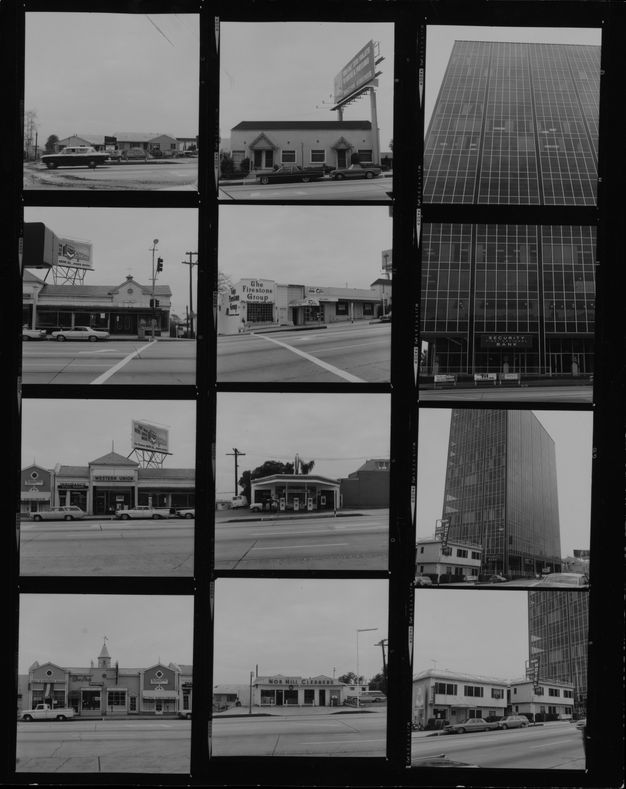
Another pair of photographs features a twelve-story building, which McMillan managed to fit in the frame (fig. 10.5). The bottom photograph, taken at a somewhat low angle, shows little of the street below, and the building’s front vertical angle is slightly exaggerated in length, making the rest of the diagonals appear distorted in another keystone effect. By contrast, in the top photograph, the lens has been raised a bit, which reduces the building distortion. The street is visible, with blurred cars passing and framing the view. An orange X is placed over the shot, presumably indicating Ruscha’s or his team’s preference for it.
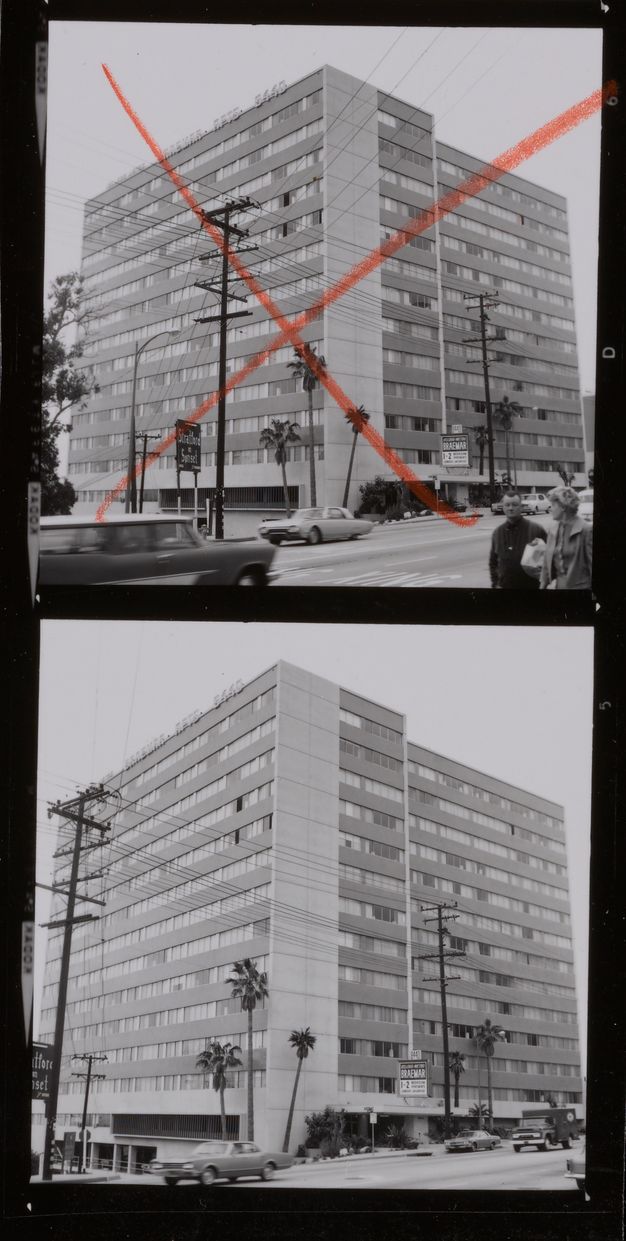
This extended comparison that draws out the minute differences between these shots might seem a fastidious exercise in formal analysis. But it was this precision in composition that characterized the job of an architectural photographer. Practitioners such as Shulman ascribed meaning to architectural photographs through small changes in technical details. On page 54 (fig. 10.6) of Photographing Architecture and Interiors, Shulman argues that the top photograph is “sharp and formal, but leaves the viewer with a need for more information.” By contrast, the preferred bottom photograph adds dimensions, allowing the rectangular form of the building to be retained while making the roof “understandable”—conveying the information the top photo hadn’t. Subtle shifts in photographic composition thus became loaded with meaning.
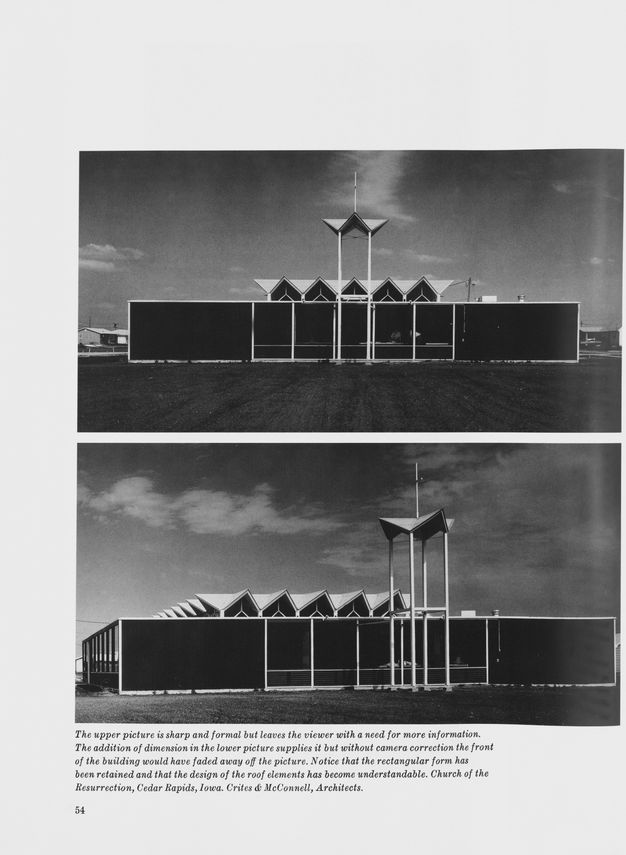
For photographs of the Long Beach Water Department building, however, the more frontal and less oblique angle is preferred, according to Shulman, because it avoids an awkwardly large foreground (fig. 10.7). These two pages dramatize how Shulman and other architectural photographers publicized the way small changes to photographic framing significantly can alter how a building appears to viewers.
Some Los Angeles Apartments
From one perspective, it is clear why McMillan’s shoot may have been unsatisfactory for Ruscha. McMillan’s test photographs were far from standardized: there are clear differences in angles, camera heights, and distances from the buildings. This would have made the process of pasting everything together challenging, as evidenced by the mock-up of the contact sheets in the archive. McMillan’s approach, moreover, seems at odds conceptually with Ruscha’s ultimate vision for Every Building on the Sunset Strip. “He didn’t have a little drawing or any kind of plan that he showed me,” McMillan remarked retrospectively about the lack of directives for the initial shoot, conceding that if Ruscha had given him more than an idea, McMillan might have “done some other things.”24 The test shoot even resembles a different Ruscha project: the artist book Some Los Angeles Apartments, published the same year, in 1965. At first glance, Some Los Angeles Apartments seems to resonate with the field of commercial architectural photography: each page contains a photograph of a different apartment building and a caption with its address. The photographs vary in size and composition: some are shot head-on, others at oblique angles, and a number from extreme low angles, with only portions of the building visible. Scholars have homed in on this book as evidence of Ruscha’s de-skilling of the craft of photography (he got the film developed at a drug store, as the apocryphal story goes).25 Virginia Heckert has argued that Ruscha’s decision to include significant portions of the roads in front of the buildings indicates his predilection for mimicking the observations of a “dispassionate” observer rather than, for instance, a trained professional photographer.26 Instead, I consider it an important precedent to the SoLA project and in particular to Every Building on the Sunset Strip because it shows Ruscha’s experimentation with representing the urban landscape.
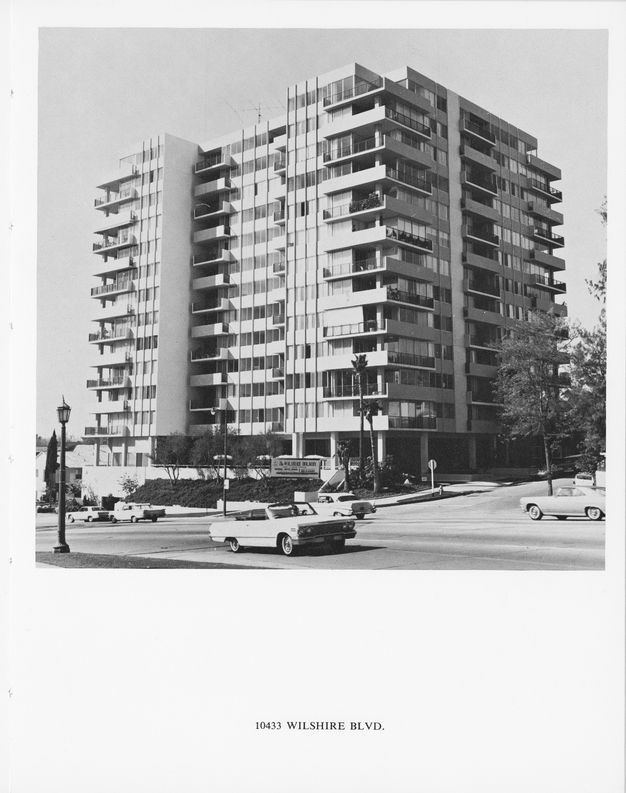
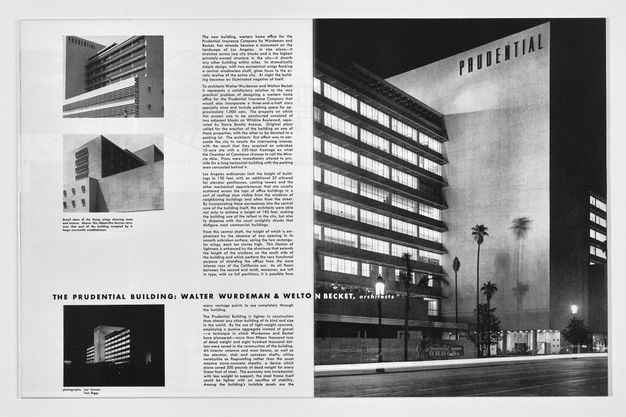
An apartment building shot by Ruscha and shown in Some Los Angeles Apartments draws out the congruences with McMillan’s test shoot, especially his photographs of high-rise buildings on Sunset Boulevard (fig. 10.8). The photograph, showing 10433 Wilshire Boulevard, is taken from across the street, in the context of the busy streetscape below. Shot from an oblique angle, the photograph appears neither distorted nor out of proportion, as often happens when photographing architectural structures, something Shulman often warned against. It especially resembles the twelve-story building in angle and position (see fig. 10.5). Both shots also recall published architectural photographs by Shulman. Arts & Architecture magazine featured a spread of photographs by Jay Connor and Tom Riggs of the Prudential Building, designed by the acclaimed modernist architect firm Wurdeman and Becket in May 1949 (fig. 10.9). While the drama and sharp precision of the night scene and the effervescence of the palm tree shadows sets the photograph apart, the oblique angle is quite similar, forging a resemblance between the three shots because they all show the building in the context of its street scene. The smaller images in the Prudential spread also bear striking resemblance to a shot of the Park La Brea apartment complex featured in Some Los Angeles Apartments (fig. 10.10). Considered together, these photographs suggest an attempt to experiment with compositions that showcase their architecture as well as their relationships to the fabric of the urban landscape surrounding them. The variation in technique suggests a genuine attempt to consider how buildings change in appearance through different formal decisions, not just an attempt to produce casual snapshots. In a later book of 1977, Shulman wrote more expansively on the purpose of commercial architectural photography, arguing that there are infinite ways to view a building, and that “there are absolutely no rules of composition other than to make each photograph a strong graphic as well as architectural statement.”27 He went further, relaxing his former rules of camera choice, for instance, opining that some of the best remembered architectural photography had been shot with less-than-ideal equipment, even handmade cameras.28 Across his writing and practice, Shulman established the importance of shooting as many photographs as possible, testing and experimenting with one’s subject, and establishing transparency of one’s process as key to working with photography.
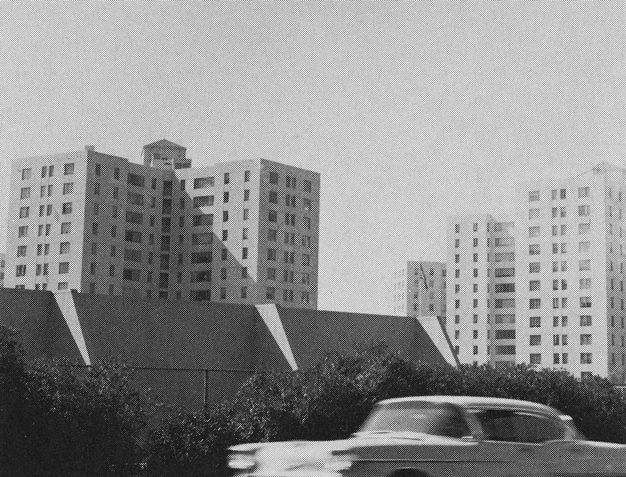
McMillan’s photographs were also not desirable to Ruscha, I suggest, for similar reasons they wouldn’t be to a photographer such as Shulman. If we return to McMillan’s attempt to photograph the First Security Bank, for instance, the vertiginous building posed several formal problems: its lines start to converge toward the top of the frame, and it was distorted by the lens, which lacked the tilt and wide angle necessary to capture its height (see fig. 10.4). Ruscha’s settled-upon, motorized, and fixed-frame approach provides views of partial buildings; architectural photographers are candid in advocating that this, too, is ultimately all you get with architectural photography. As the architectural photographer Ezra Stoller remarked in 1963: “The building that can be shown completely in one picture is not worth bothering about.”29 If commercial architectural photography has suffered from too narrow a scholarly treatment and the SoLA project has remained relatively unstudied, subsumed by the much better known Every Building on the Sunset Strip, the McMillan photographs illuminate that both can be better understood by looking at their processes, experiments, and test shoots.
Digitization and Multiplicity
In 2013, Ruscha remarked on the origins of his SoLA project: he wanted to make something that he “could study like an architect standing over a table and plotting a city.”30 Ironically, this retrospective consideration is the closest Ruscha ever got to conceding a certain use value of his photographs to architectural and urban fields. While it might seem as though he intended the comparison to evoke drawings rather than photographs—the image of an architect standing over a table suggests the study of blueprints or elevation drawings—it nonetheless positions the medium of photography as a conduit to the profession of architecture. The digitization of the archive by the Getty Research Institute (GRI), which began in 2013, indelibly changed the photographic stakes of Ruscha’s venture, bringing its utility closer to that of commercial architectural photography than in analog form.
The Getty websites for “12 Sunsets: Exploring Ed Ruscha’s Archive” and the SoLA Archive display Ruscha’s digitized negatives, allowing users to navigate the archive more accessibly: they are searchable thanks to optical character recognition, geolocation, and tagging, and one can easily compare different years of production.31 Additionally, more contextual information is available about the buildings’ locations, the surrounding structures, the photographic shoot, and the photographs’ locations in the finding aid. Ruscha’s digitized negatives, as they exist in the Getty’s virtual space, are both visual and extravisual, with textual data presented alongside the digitized negatives. The dissemination of Ruscha’s photographs as such actively welcomes excavation of buildings, signage, and streetscapes, making each stage of the project’s process as visible to viewers as Shulman did with his process and profession in his publications. The transparency of the digital archive is how, then, it becomes easier to isolate Ruscha’s depictions of the Lytton Savings bank and compare them to Shulman’s.
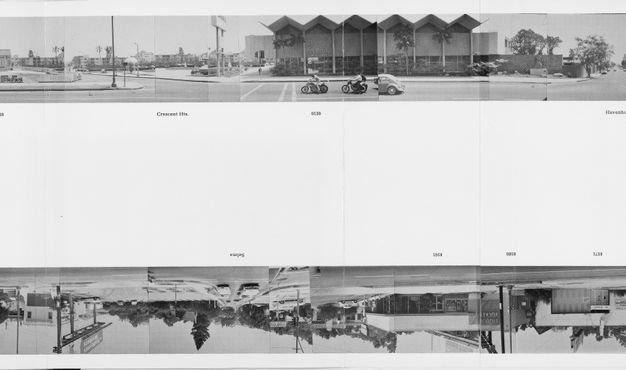
While the digitization initiative shows how Ruscha’s negatives can be excavated for information in a way similar to traditional uses of architectural photography, the question remains as to how the later motorized shots, Ruscha’s primary approach to photographing the streets, relate to the genre. Unlike McMillan’s test shoots, they appear quite different from a commercial architectural photograph. When selecting individual digitized negatives from the SoLA digital archive (fig. 10.11), closely cropped views of the building and street tend to crowd the frame, which in the case of the Lytton Savings bank truncates its sign and leaves little room for the horizon to balance the composition. The motorized photographs lack the dynamic oblique angles and careful framing reminiscent of Shulman’s and McMillan’s shots (fig. 10.12); instead, they are subject to the fixed framing of the mounted tripod camera, which led to building distortions that many architectural photographers would avoid through lens choice.
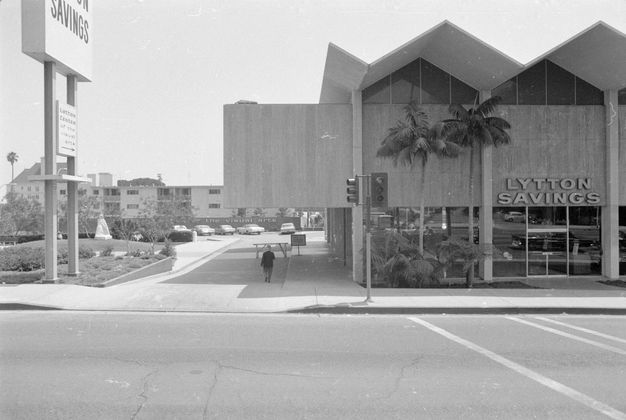
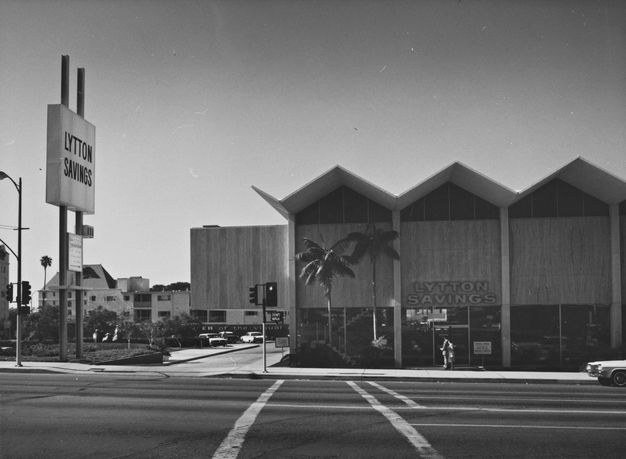
Every Building on the Sunset Strip likewise challenges comparisons to commercial architectural photography practices. It is difficult to isolate individual frames enough to discern concrete information about the building structures or the conventions of the photographs themselves. Yet there is one shared quality between the two that the digital archival presentation makes clear. While Ruscha’s motorized approach meant that every building would appear at the same angle and general orientation, each building was also photographed three to four times.32 This multiplicity was not erased but preserved, both through the visible suture marks in Every Building on the Sunset Strip and, most importantly, in the digital archive presentation. This exemplifies the paradox of the book as contained in its title: Ruscha sought to represent each individual building as well as the totality of the Strip.33 Instead of using individual photographs to convey information about the architecture, the sutured-together photographs provoke a reflection on the necessity of multiple photographs and multiple failed attempts to capture a building (fig. 10.13). If in Every Building on the Sunset Strip Ruscha presents a multi-image, extended view of how buildings span the street, in the digital archival presentations we see the photographic labor that went into such a construction, a process inherent to commercial architectural photography. The archive shows every photograph taken of a particular building, including all the shots that were rejected for the final book and have since existed only in negative form. We see where framing led to lens flares, where the composition cut components off, and where the negatives have been marked for editing and selection; all are made visible on the website alongside the technically perfect and untouched negatives.34
Bringing the multiple representations of the Lytton Savings bank—the test shoot, Every Building on the Sunset Strip, and the digitized negatives—into conversation with Shulman’s photographs of the bank shows what seemingly dissimilar photographic practices have in common, and how photographers achieve these similarities. All interrogate the purpose of photographs of urban architecture, albeit through different formal means. Ruscha and architectural photographers were working through the capacity and limitations of photography to convey details of the changing urban landscape, despite differences in composition and formal approach. Commercial architectural photography’s influence on photographing Los Angeles was not only, then, its popularization of the single glossy shot. Instead, its legacy concerned the way photographers encouraged transparency of the photographic process and the need to experiment when representing a city as confounding as Los Angeles. Cleveland’s and Shulman’s books exemplify this, but so does Ruscha’s overall approach to photographing the city.
The digitized negatives of Ruscha’s archive have provoked an excitement about photographs reminiscent of urbanists’ obsession with cities’ imageability and the visuality of the 1960s. As Robert Venturi, Denise Scott-Brown, and Steven Izenour included “movie sequence” shots taken from the car in a direct inspiration from Ruscha, so too has the architect Charles Waldheim’s urban-design studio at Harvard University used Ruscha’s archive to build models that imagine new ways of providing shade to the increasingly sunbaked city streets.35 But embracing the potentials of this new digital format must require an equally rigorous interrogation of its exclusions: it shows a narrow portion of the vast, unruly city of Los Angeles, and it mostly excludes residents—ironically, two complaints also frequently waged at commercial architectural photography. Thinking comprehensively across photographic formats reveals the burdens that commercial and art practices shared in Los Angeles at the time: how to metabolize the particular, individual units of a city that was increasingly spread out and generic.
If we consider both practices—Ruscha’s SoLA project and commercial architectural photography—as far from resolute in their approaches to representation and, instead, as mutually invested in experimenting with ways to represent architecture in the city, then it becomes clear how Ruscha’s project extended specific formal and conceptual concerns affecting commercial architectural photography. Through photography, both Ruscha and architectural photographers proposed different solutions to common problems.
Notes
-
A. D. Coleman, “I’m Not Really a Photographer,” in Edward Ruscha, Leave Any Information at the Signal: Writings, Interviews, Bits, Pages, ed. Alexandra Schwartz (Cambridge, MA: MIT Press, 2002), 8. ↩︎
-
Matthew Miller, “Ed Ruscha—Motorized Photographs of Sunset Blvd. and Other L.A. Streets,” 10 December 2019, video, 2:26, https://vimeo.com/378662791. ↩︎
-
Katherine Smith, “Mobilizing Visions: Representing the American Landscape,” in Relearning from Las Vegas, ed. Aron Vinegar and Michael J. Golec (Minneapolis: University of Minnesota Press, 2009), 122; and Jaleh Mansoor, “Ed Ruscha’s ‘One-Way Street,’” October 111 (Winter 2005): 131. ↩︎
-
By “glossy,” the architect refers to the particular method of printing on high quality, glossy art paper, a choice that goes back to nineteenth-century British magazines. The term glossy often serves as a metonym for a magazine’s cultural status as serving wealthy, elite audiences. Quotation by Sir William Holford, excerpted in Eric de Maré, Photography and Architecture (London: Architectural Press, 1961), 18. ↩︎
-
Benjamin H. D. Buchloh, “Conceptual Art 1962–1969: From the Aesthetic of Administration to the Critique of Institutions,” October 55 (Winter 1990): 105–43. ↩︎
-
Andrew Higgot and Timothy Wray, introduction to Camera Constructs: Photography, Architecture, and the Modern City, ed. Andrew Higgott and Timothy Wray (London: Routledge, 2012), 12. ↩︎
-
Lionel Freedman, “Minutes of the April 3, 1956 Meeting,” Architectural Photographers Association Bulletin 9, no. 5 (May 1956), 2, box 203, Office Records; Correspondence A–R, Maynard Parker Negatives, Photographs, and Other Material, Huntington Library, San Marino, California. ↩︎
-
Dust jacket description, Robert Cleveland, Architectural Photography of Houses: How to Take Good Pictures of Exteriors and Interiors (New York: F. W. Dodge, 1953). European precedents to Cleveland’s book exist. See Claire Zimmerman, Photographic Architecture in the Twentieth Century (Minneapolis: University of Minnesota Press, 2014). ↩︎
-
Cleveland, Architectural Photography of Houses, 8. ↩︎
-
Julius Shulman, Photographing Architecture and Interiors (New York: Whitney Library of Design, 1962), 2. ↩︎
-
John Coplans, “Concerning Various Small Fires: Edward Ruscha Discusses His Perplexing Publications,” Artforum 5 (February 1965): 24; reprinted in Ruscha, Leave Any Information, 46. ↩︎
-
Shulman, Photographing Architecture and Interiors, 2. ↩︎
-
Alice Friedman, American Glamour and the Evolution of Modern Architecture (New Haven: Yale University Press, 2010), 5. ↩︎
-
Esther McCoy, “The Important House,” New Yorker, 17 April 1948, 50. ↩︎
-
This line is from a draft of the story but was cut from the published version. See folder 15, box 10, Esther McCoy Papers, Archives of American Art, Smithsonian Institution, Washington, DC. ↩︎
-
Shulman, Photographing Architecture, 47. ↩︎
-
De Maré, Photography and Architecture, 18. ↩︎
-
Jennifer Quick, “Pasteup Pictures: Ed Ruscha’s Every Building on the Sunset Strip,” Art Bulletin 100, no. 2 (2018): 149. ↩︎
-
Kevin Lynch, The Image of the City (Cambridge, MA: MIT Press, 1960); and Robert Fogelson, The Fragmented Metropolis: Los Angeles, 1850–1930 (Berkeley: University of California Press, 1967). ↩︎
-
California Governor’s Commission on the Los Angeles Riots, Violence in the City—An End or a Beginning? A Report (Los Angeles: The Commission, 1965). ↩︎
-
Reyner Banham, Los Angeles: The Architecture of Four Ecologies (London: Allen Lane, 1971), 242. ↩︎
-
Ed Ruscha via his studio manager, Susan Haller, email, 27 July 2022. ↩︎
-
Copy of Ruscha studio notebook, n.d., box 7, folder 5, 2012.M.1, Edward Ruscha Photographs of Sunset Boulevard and Hollywood Boulevard, 1965–2010, Getty Research Institute, Los Angeles. ↩︎
-
Jerry McMillan, interview by Zanna Gilbert, January 2020. ↩︎
-
David Bourdon, “Ruscha as Publisher (or All Booked Up),” ARTnews 71, no. 2 (1972): 32–36; and Kevin Hatch, “‘Something Else’: Ed Ruscha’s Photographic Books,” October 111 (Winter 2005): 107–26. McMillan, however, said they used his darkroom to develop the photographs. McMillan, interview. ↩︎
-
Virginia Heckert, Ed Ruscha and “Some Los Angeles Apartments” (Los Angeles: J. Paul Getty Museum, 2013), 10. ↩︎
-
Julius Shulman, The Photography of Architecture and Design: Photographing Buildings, Interiors, and the Visual Arts (New York: Whitney Library of Design, 1977), 14. ↩︎
-
Shulman, The Photography of Architecture and Design, 14. ↩︎
-
Ezra Stoller, “Photography and the Language of Architecture,” Perspecta 8 (1963): 44. ↩︎
-
Calvin Tomkins, “Ed Ruscha’s L.A.,” New Yorker, 24 June 2013, https://www.newyorker.com/magazine/2013/07/01/ed-ruschas-l-a. ↩︎
-
“12 Sunsets: Exploring Ed Ruscha’s Archive,” Getty, https://12sunsets.getty.edu. Always intended to be a limited-term application, the website for “12 Sunsets” will not be maintained. A video capturing some of its capabilities can be found here: https://vimeo.com/946364401/ba0b654c0d. See also Edward Ruscha Photographs of Sunset Boulevard and Hollywood Boulevard, 1965–2010, 2012.M.1, http://hdl.handle.net/10020/cifa2012m1; and Edward Ruscha Photographs of Los Angeles Streets, 1974–2010, 2012.M.2, http://hdl.handle.net/10020/cifa2012m2. ↩︎
-
Ruscha devised a system whereby the camera was attached to a motor system with a button; someone riding inside the truck would press the button, and the film would advance automatically, allowing for multiple shots of a facade to be taken in quick succession. ↩︎
-
The book’s title was settled upon before the photographic approach; hence, the title acts as a problem to be solved. ↩︎
-
Likewise, Julius Shulman’s archive, also held at the GRI, contains several dozen photographs for each assignment, revealing the accumulative nature of commercial work that has resulted in an archive containing over 260,000 prints and negatives. Julius Shulman Photography Archive, 1935–2009, 2004.R.10, Getty Research Institute, Los Angeles, http://hdl.handle.net/10020/cifa2004r10. ↩︎
-
Robert Venturi, Denise Scott Brown, and Steven Izenour, Learning from Las Vegas: The Forgotten Symbolism of Architectural Form (Cambridge, MA: MIT Press, 1972); and Charles Shafaeih, “Shading Sunset: Charles Waldheim on Reimagining the Streets of Los Angeles for a Warmer Future,” News, Harvard University Graduate School of Design, 19 April 2021, https://www.gsd.harvard.edu/2021/04/shading-sunset-charles-waldheim-on-reimagining-the-streets-of-los-angeles-for-a-warmer-future/. ↩︎