In 1954, art collectors John and Dominique de Menil established the Menil Foundation, a nonprofit charitable foundation in Houston, Texas, dedicated to the promotion of understanding and culture through the arts. The collecting habits of the de Menils were somewhat idiosyncratic; their collection was not encyclopedic but instead had particular strengths in antiquities and art from the Byzantine era, Africa, Oceania, the Pacific Northwest, and the twentieth century. These collecting areas correspond to art that the de Menils personally liked or to specific educational or social projects in which they engaged.1 In 1987, the Menil Collection, a museum managed by the Menil Foundation, opened as the permanent home for their artworks. Its mission is to foster direct, personal encounters with works of art. Reflecting the ideals of the de Menils, admission is free, and the museum is dedicated to pursuing new and challenging ideas and disseminating original scholarly research.
A recent trend in the teaching of art history is object-based learning, in which students actively engage in the examination of objects and interpret and contextualize their findings to understand the means of manufacture, use, meaning, and/or history of objects.2 The Collection Analysis Collaborative, a recent partnership between the Menil Collection, Rice University, and the University of Houston–Clear Lake, uses object-based learning to enhance education, provide research opportunities, and improve understanding of the collection.3 The success of the initiative has stimulated a more holistic approach to utilizing the collection, including objects known or suspected to be forgeries.4
Among the antiquities in the Menil Collection are five Romano-Egyptian mummy portraits. Such portraits, which were originally integrated into the deceased individual’s burial wrappings, exemplify cross-cultural exchange and integration of Greco-Roman artistic practices into ancient Egyptian funerary traditions.5 The period in which these objects were manufactured was relatively brief, beginning around the first century CE and ending with Emperor Theodosius’s ban on the embalming of bodies in 392 CE.6 The limited period of manufacture, the relatively elevated socioeconomic status of individuals able to afford portraits,7 and the vagaries of preservation mean that only about a thousand mummy portraits are held in museum collections today.
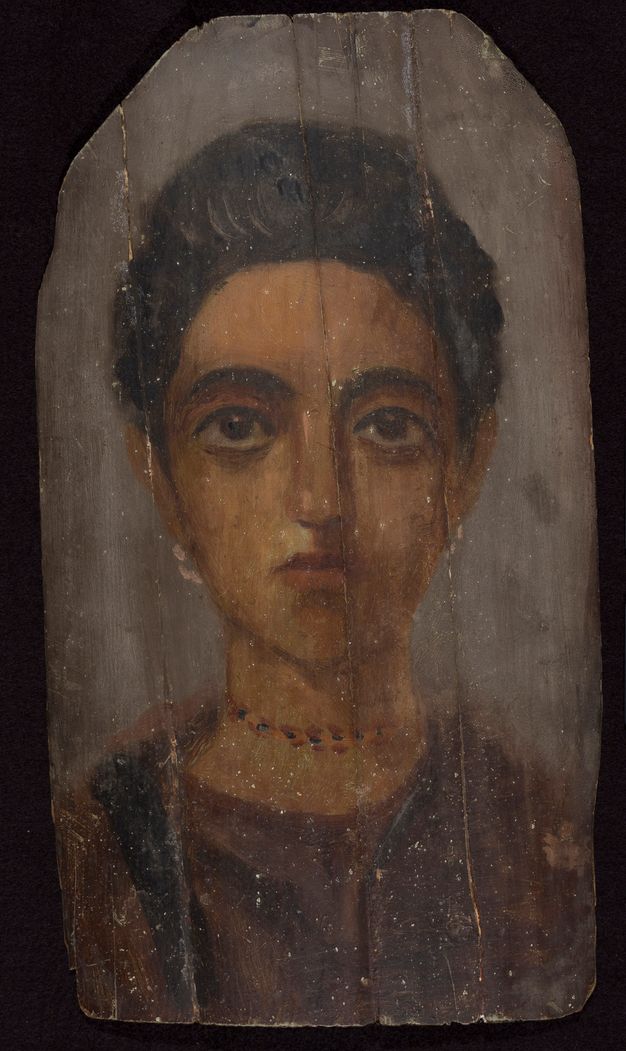
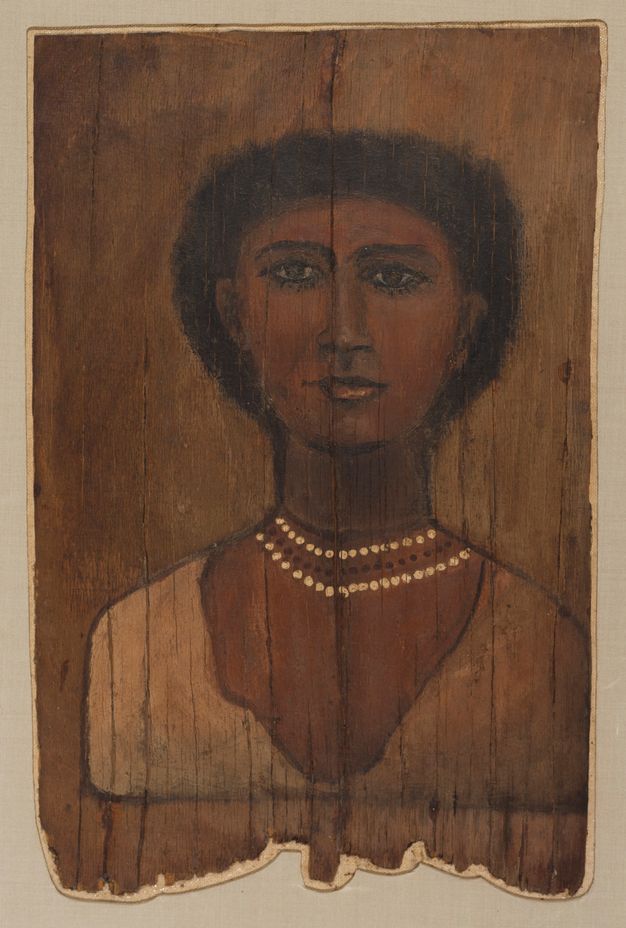
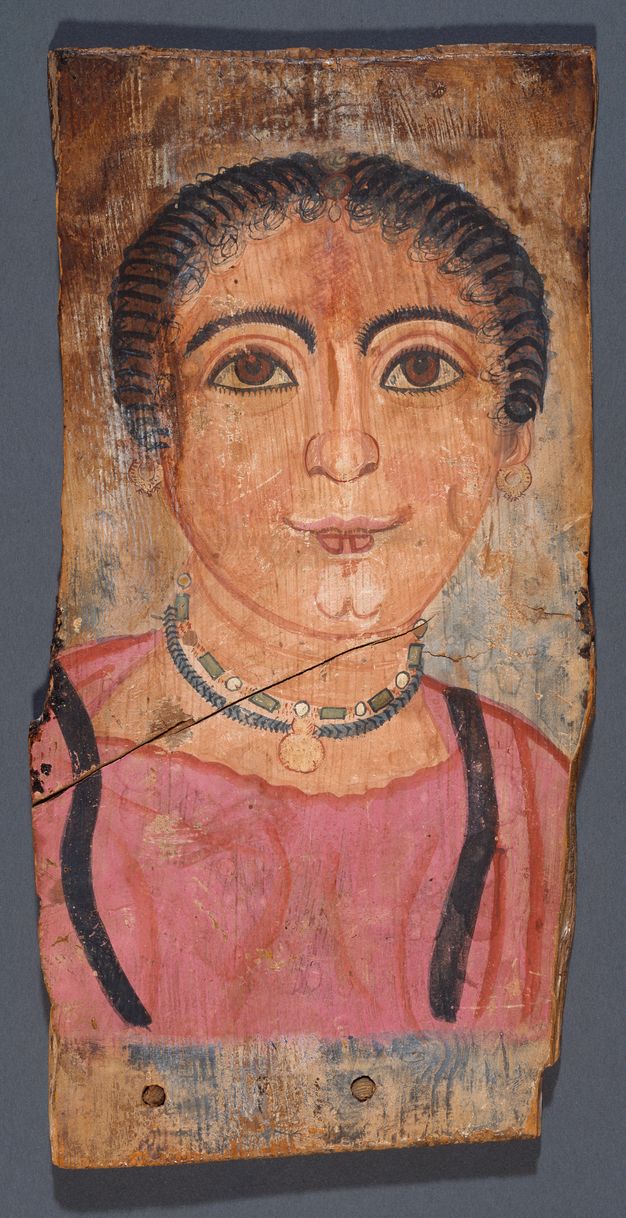
In 2013, the J. Paul Getty Museum, recognizing a lack of scientific and technical information on mummy portraits, launched a collaborative project, Ancient Panel Paintings: Examination, Analysis, and Research (APPEAR). The Menil Collection joined this endeavor and conducted technical analyses on the five mummy portraits, which had never been carefully studied. The analysis of two of the portraits, 1970-001 DJ (ST) and CA 5878 (ST) (figs. 6.1 and 6.2, respectively), described herein, reveals a nineteenth-century terminus post quem manufacture date, confirming them to be modern forgeries. These portraits, although not authentic, can facilitate a deeper understanding of the history of collecting and of the Menil Collection. They also make excellent case studies for discussing analytical approaches, sampling ethics, and the relationship between technical analysis and connoisseurship. We hope that illustrating how we utilize these forgeries will encourage other institutions to reevaluate the roles of such objects in their collections.
Results: Technical Analysis of the Mummy Portraits
Mummy Portrait of a Woman, 1970-001 DJ (ST)
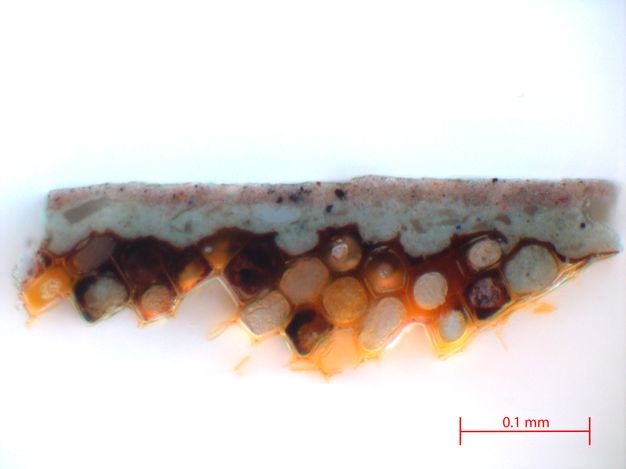
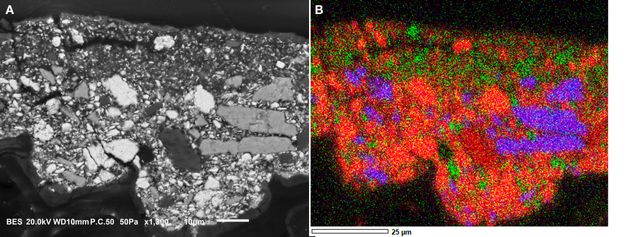
An unknown craftsperson painted 1970-001 DJ (ST) (see fig. 6.1) on a Pinus sp. (pine) panel, a type of wood not hitherto found in authentic mummy portraits.8 A cross-sectional sample taken from the background (figs. 6.3–6.4) revealed that the artist applied a greenish-gray ground layer containing Prussian blue, barium sulfate, and zinc white onto the panel (fig. 6.5). These pigments are anachronistic; they were not introduced into artists’ palettes until the early eighteenth century or later.9
| Pigment | Mummy Portrait of a Woman, 1970-001 DJ (ST) | Mummy Portrait of a Woman, CA 5878 (ST) | Analytical methods |
|---|---|---|---|
| Ground | Barium sulfate, lead white, Prussian blue, calcium carbonate, gypsum | Not present | Raman, FTIR, XRF, SEM-EDX |
| White | Not present | Barium sulfate, zinc white and/or lithopone, calcium carbonate | Raman, FTIR, XRF |
| Black | Not analyzed | Magnetite | XRF |
| Gray | Lead white, carbonaceous black, silicates | Not present | Raman, FTIR |
| Red | Vermilion, iron earth pigments, lead chromate | Not present | XRF |
| Pink | Vermilion, zinc white | Not present | XRF |
| Orange-yellow | Lead chromate, iron earth pigments, vermilion | Not present | |
| Blue | Cobalt blue | Not present | XRF |
| Skin | Iron earth pigments, lead white, zinc white, barium sulfate and/or lithopone | Iron earth pigments, calcium carbonate, barium sulfate, zinc white and/or lithopone | XRF |
The red and yellow necklace beads may contain lead chromate species, first manufactured in the nineteenth century.10 The blue beads are high in cobalt, suggesting the use of cobalt blue, a species that came into widespread use in the early 1800s; however, cobalt blue has been found on painted ceramic vessels from ancient Egypt dating from 1400–1200 BCE, so it is not necessarily anachronistic—although no cobalt pigments have been found on authentic mummy portraits to date.11
The binding media of the paints is a drying oil,12 a material not used on authentic portraits, and all paints were applied with a brush. Visual inspection and Fourier-transform infrared spectroscopy (FTIR) analysis of a surface scraping reveals that a coating of wax was brushed over the finished work in an attempt to simulate the appearance of true encaustic portraits. The use of inappropriate wood and anachronistic pigments in the ground conclusively shows that this is not a pastiche or heavily restored object but a de novo, modern creation.
Mummy Portrait of a Woman, CA 5878 (ST)
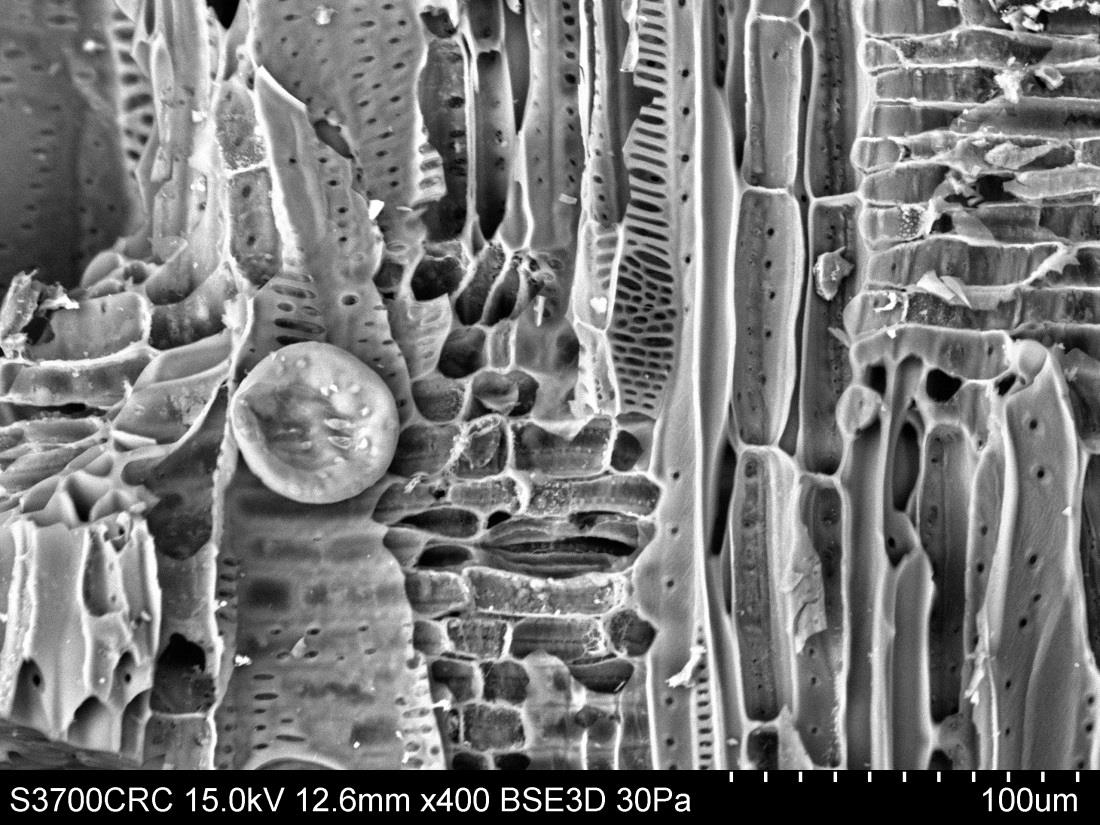
The second forgery, CA 5878 (ST) (see fig. 6.2) is more simply manufactured. The wood support is Fagus sylvatica (European beech) (fig. 6.6); this wood has not been identified to date in the more than 190 portraits analyzed and published by one of the authors (Caroline R. Cartwright), although other European species, such as Tilia europaea (lime), are common.13 The creator applied paint directly to the bare wood using a brush. X‑ray fluorescence (XRF) analysis indicates that the white paint contains either a mixture of zinc white and barium sulfate or lithopone (a mixture of zinc sulfide and barium sulfate), all components of which were introduced in the nineteenth century and so are inconsistent with the purported date.14 The red of the flesh tones is made from a mixture of earth pigments, calcium carbonate, barium sulfate, zinc white and/or lithopone. The black of the individual’s hair contains high iron levels and is thus likely magnetite, a pigment not used in ancient Egypt.15 The binding medium of the paints is a drying oil.16
Discussion
After the analytical results confirmed that these two objects are forgeries, the question then became what value they held to the Menil Collection. Many institutions deaccession such objects or consign them to storage, never to be shown or discussed again. However, a few exhibitions have chosen to highlight the presence of forgeries in collections and explain the role technical analysis plays in their unveiling.17 These are popular with museum visitors, but exhibiting these forgeries and explaining their stories would require more didactics than is permitted at the Menil Collection.
While these portraits do not have ancient lives, their modern ones are instructive. Forgeries inform us about supply and demand, about appeal and desire—and often the style of a forgery reflects contemporary fashions.18 Although not authentic objects from ancient Egypt, these portraits tell a story of the de Menils, their philosophies, collecting habits, and favored gallerists, expanding the research begun by the Collection Analysis Collaborative.19 The forgeries are also excellent pedagogical materials and can be used with almost any audience level to initiate discussions on a variety of topics, including the interplay of connoisseurship and technical investigations, the ethics of destructive sampling, and low-tech versus high-tech analytical approaches.
Fashions, Fads, and Forgeries
The French campaign in Egypt (1798–1801), the publication of Description de l’Égypte (1809–1829), and the deciphering of hieroglyphs by Jean-François Champollion in 1822 began a period of Egyptomania. Archaeological sites were plundered and artifacts, whether acquired legally or illegally, were exported for sale, and the popularization of antiquities inevitably led to the production of forgeries. An early collector lamented, “What, for Christ’s sakes, was to be done in order to supply antiquities to so many amateurs, interested, and curious parties? How does one find divinities, statuettes, and scarabs? How does one find them when they are not to hand? Either by looking for or by making them—the latter being the faster option.”20
Forgers reacted quickly to new archaeological finds and demands of the market. As early as 1826, forgeries began to enter collections. In 1912, Dr. T. G. Wakeling published a book on forgeries of ancient Egyptian materials, interviewing forgers, discussing different “schools” of forgers, and documenting the types of objects commonly forged. He provided photographs of the forgeries in his collection and information on the types of materials and pigments to be expected in authentic objects.21 In 1930, Ludwig Borchardt published a paper with accompanying photographs of “ancient Egyptian” objects in collections that he believed to be inauthentic.22 Since that time, museums—including the British Museum, Metropolitan Museum of Art, Brooklyn Museum, the Louvre, the Ägyptisches Museum und Papyrussammlung, and the Staatliches Museum Ägyptischer Kunst—have discovered forgeries in their collections.23 The creation and unmasking of forgeries of ancient Egyptian materials continue to this day, with the Bolton Museum’s Amarna Princess being an infamous example.24
Mummy portraits first came to the attention of Europeans in 1615, when Pietro della Valle, an early Italian explorer, visited an excavation at Saqqara.25 Della Valle fell in love with the portraits, describing them as the “most delicate sight in the world,”26 and acquired two, both of which are now in the Staatliche Kunstsammlungen Dresden collection (inv. nos. Aeg 777 and Aeg 778). The acquisition and export of mummy portraits continued when Egypt was under British administration. One of the primary responsibilities of Sir Henry Salt, the consul general of Egypt from 1816 to 1827, was to acquire antiquities for the British Museum. He also collected mummy portraits for himself, including one now in the Louvre collection (N 2733.3).27 It was the Viennese antiquities dealer Theodor Graf, however, who truly popularized mummy portraits. In 1887 he began acquiring them, ultimately amassing a collection of almost three hundred, which he exhibited and sold in Europe and North America.28 Ironically enough, the emergence of such a large number of portraits with little provenance raised suspicions that they might all be forgeries, but Sir Flinders Petrie’s excavations at Hawara (1888–89 and 1910–11) conclusively demonstrated that mummy portraits had been made in antiquity.29
The relative scarcity and appealing nature of the mummy portraits made them attractive targets for forgers, and many forgeries date from the late 1800s to early 1900s, when they were novel and in demand. Four portraits in the Brooklyn Museum (inv. nos. 51.253.1–4) were collected in the Fayum region of Egypt around 191130 and document the quick response of forgers to Petrie’s excavations. The two Menil portraits may also date to the early 1900s, as both lack titanium white, a pigment that became ubiquitous by the mid-1900s,31 suggesting that it may not have been accessible to the forgers. Although absence of a material can never provide definitive proof, it is suggestive and would slot the creation of these forgeries nicely into the time frame when mummy portraits were becoming desired objects.
In addition to mimicking objects of desire and demand, forgeries may inadvertently reflect the aesthetic standards of their time of creation. Subconsciously, forgers may integrate ideals of beauty and contemporary tastes into their works. Kenneth Clark, director of the National Gallery from 1934 to 1945, first became suspicious of a “Botticelli” painting when he noticed that, as depicted, the Madonna resembled contemporaneous cinema stars.32 In figure 6.1, the portrait’s strong half-moon eyebrows, large eyes, and rosebud lips are evocative of the Edwardian beauty ideal—as is the hairstyle resembling a low pompadour—suggesting an early 1900s creation date.
Reflections of a Collection
A small number of art historians and dealers were extremely influential to the de Menils; among them was Alexander Iolas (1907–1987).33 He was a friend of artists, including Giorgio de Chirico, Georges Braque, Max Ernst, René Magritte, Man Ray, and Pablo Picasso, and traded upon these personal associations when he became head of the Hugo Gallery in New York in 1946. This gallery was founded by Maria Hugo, a fellow émigré and one of the first friends the de Menils made in the United States. Their personal friendship with Hugo led the de Menils to invest in the gallery, beginning a forty-year relationship with Iolas. Over that period, the de Menils purchased a large number of works from Iolas, 450 paintings alone, including the majority of their Surrealist collection. Dominique trusted his judgments on contemporary art, saying, “He always kept paintings for us, and since he had a very good eye, they were the best.”34 Financial support commingled with friendship; the reason that paintings were “kept” by Iolas for the de Menils was thanks to their financial underwriting: they advanced money to support collecting trips to Paris, which was repaid by their keeping “this and that” when he came back.35
The “this and that” kept by the de Menils may have included CA 5878 (ST) (see fig. 6.2). Neither the Hugo Gallery nor Iolas’s later galleries specialized in antiquities, but Iolas himself collected and sold them. The de Menils acquired a variety of antiquities from Iolas, including some that were later found to be suspected or outright forgeries, and by 1963 or 1964 they had become skeptical of his trustworthiness when it came to antiquities.36 The de Menils did not leave any indication of why they purchased the mummy portrait, but the unconvincing style of the portrait makes it hard to believe they thought it authentic, so perhaps by purchasing it they effectively donated funds to support Iolas’s gallery. This supposition is supported by the de Menils’ accounting records, which show no other purchases made at the same time, suggesting that the transaction could have been a one-off donation to a friend. The world-class Surrealism collection created by the de Menils and Iolas, which hangs in a dedicated gallery space in the museum, is a testament to their productive relationship—but so, in its own way, is this portrait.
Dominique de Menil purchased 1970-001 DJ (ST) in 1962, but left no information on why she chose to acquire it. The portrait was obtained from Michel Abemayor, a New York City dealer and scion of a family of well-established antiquities dealers; his grandfather founded a shop opposite Shepheard’s Hotel in Cairo in 1888.37 After World War II, Abemayor relocated to the United States and established his Ancient Works of Art gallery. Objects that passed through the Abemayor family ended up in a variety of different museums, and the Archaeological Institute of America has an annual Abemayor Lecture “in recognition of Mr. and Mrs. Abemayor’s lifelong interest and enjoyment in the study of ancient cultures.” The respect paid to Michel Abemayor implies he did not have a reputation for dealing in forgeries, although the large number of forgeries in the antiquities market inevitably resulted in some passing through his gallery. The de Menils paid for two different conservation treatments of the mummy portrait, suggesting that they did not initially suspect it to be a forgery. However, by 1970 it was considered suspect on stylistic grounds, as mentioned above.
One unifying theme of the de Menils’ collection was humanism. They were strongly influenced by Father Marie-Alain Couturier, who advised and advocated for purchases of non-naturalistic modern and “primitive” art because the materials shared a purity of spirit.38 Pamela Smart summarized the philosophy shared by Couturier and the de Menils, writing, “The aesthetic qualities of artworks lie not in the character of the objects themselves but are predicated on the human virtues of those who craft these objects. The art object is a trace of humanity, just as it is a means by which that very humanity might be fostered.”39 The eyes of a modern viewer are drawn directly to the eyes of the individuals in mummy portraits, and a connection across time is created. This automatic recognition of humanity in mummy portraits exemplifies the type of relationship the de Menils were trying to foster between viewers, objects, and their creators. A more personal connection may have existed between the de Menils and the more stylistically convincing of our two forgeries, 1970-001 DJ (ST): a family friend noted that the portrait subject resembled Christophe de Menil, one of John and Dominique’s daughters.40
Pedagogical Value of Forgeries
John de Menil was sanguine about the possibility of purchasing forgeries; he saw it as a learning opportunity: “So there are the fakes and the lemons and the total involvement and the engulfing passion. There is all of that but it’s worth it. . . . You learn a lot in the process of researching and cataloguing. A lot about civilizations, about men—and their yearnings and their fears.”41 The ability to learn from art, to use their collection as a means to teach, was an important part of the collecting philosophy of the de Menils. They felt that students at Rice University and the University of St. Thomas lacked access to art, and that to understand and appreciate objects they needed the opportunity to look at and handle works of art—not just to experience them through slides or images in a book. Although the term had not yet been coined, the de Menils wanted students to engage in object-based learning. Many of the purchases made by the de Menils were intended to help establish a teaching collection. The mummy portrait forgeries make excellent case studies for illustrating critical thinking and the importance of technical studies in art history.
High-Tech versus Low-Tech Analysis
“Bigger, better, faster” is one mantra of the modern era, and it leads to the perception that high-tech approaches are most effective. When discussing with audiences how to determine whether the Menil mummy portraits are forgeries, radiocarbon dating is almost always suggested as the first approach. We have found that using this suggestion as a pivot to discuss the ethics of sampling, limitations of the method, the cost of analysis, and the value of low-tech approaches is highly effective and engaging. Until the advent of accelerator mass spectrometry, radiocarbon dating required large samples. Modern instrumentation has reduced the sample size required, but other techniques can be undertaken non-destructively or with still less material. Members of the American Institute of Conservation, including conservators and conservation scientists, abide by a code of ethics and guidelines for practice.42 These mandate that non-invasive methods of analysis are to be preferred, and “the choice of testing techniques, the amount of sample required, and the expected value of the information gained, must be weighed against the effect of removal of the sample upon the cultural property.”43 We could have radiocarbon dated the mummy portrait panels, but many forgers utilize age-appropriate supports, and the results would not have revealed the age of the pictorial layers. Given the sample size, the cost of radiocarbon dating (often over $400 per sample), and the incomplete information that would have been obtained, we decided to employ other approaches.
Our first approach to analysis in a museum laboratory is often X‑ray fluorescence spectroscopy (XRF), a non-destructive form of elemental analysis. Although not able to conclusively identify materials, this method can provide strong suggestions for the pigments present based upon elemental signatures. In both of our forged mummy portraits, XRF clearly revealed the presence of anachronistic materials, while scanning electron microscopy (SEM) was used to detect anachronistic wood species in the two forgeries. However, many institutions do not have access to scientific equipment, or a scientist.
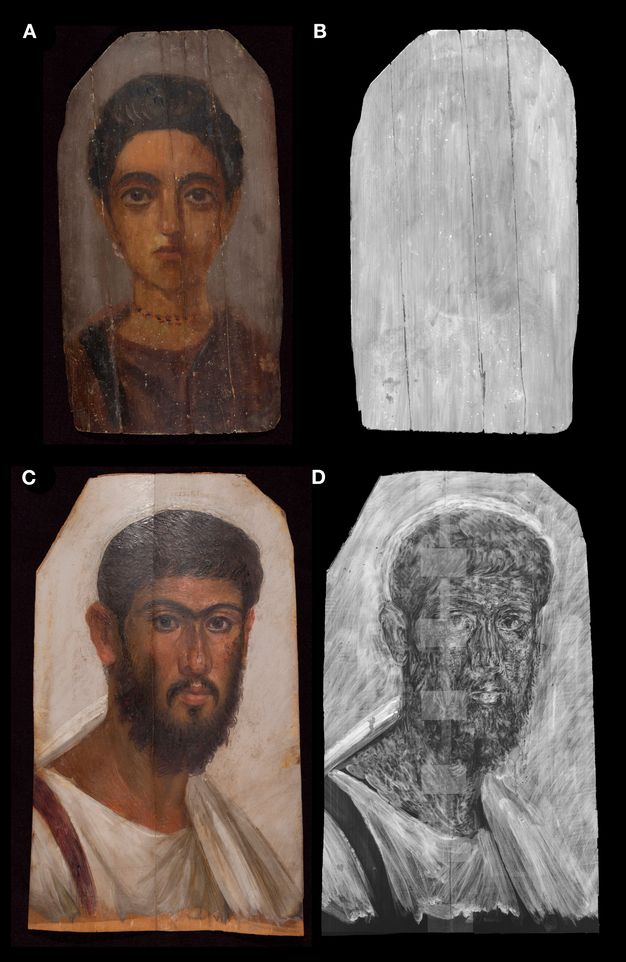
In the case of mummy portraits, more accessible imaging techniques, including X‑radiography and visible-induced infrared luminescence (VIL), may provide the same answer. Many museums own X-radiography systems or can negotiate access to medical or veterinary units or contract with commercial companies. Comparison of the X-radiograph of 1970‑001 DJ (ST) with that of an authentic mummy portrait from the Menil Collection, Mummy Portrait of a Man (CA 7013), is quite revealing (fig. 6.7). The X‑radiograph of the man’s portrait (fig. 6.7D) shows the individual strokes of paint quite clearly, due to the use of the radiopaque lead white pigment. In contrast, the X-radiograph (fig. 6.7B) of Mummy Portrait of a Woman shows almost no detail, because of the method of paint application and the use of an anachronistic barium sulfate–rich ground layer that is X‑ray opaque. The absence of clearly defined strokes of paint in this portrait supports its identification as a modern forgery.
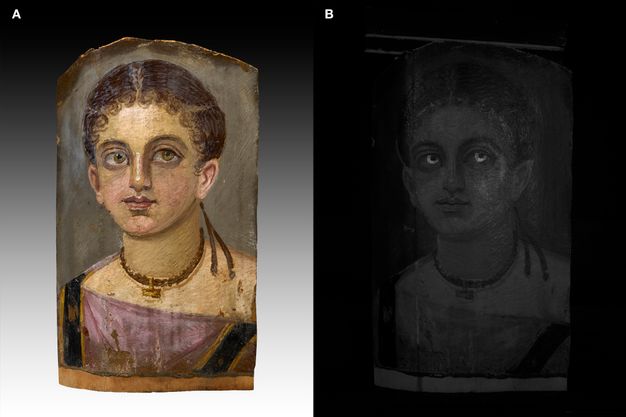
Egyptian blue, one of the first manufactured pigments, has the relatively unique property of emitting light in the infrared range when illuminated with visible light.44 Cameras modified by removal of the manufacturer-installed infrared filter placed over the image sensor can document this luminescence.45 Figure 6.8A shows a mummy portrait of a girl; in the VIL image (fig. 6.8B) the hazel eyes of the girl appear white, due to the luminescence of Egyptian blue. The camera modification and filter sets needed to do this type of imaging are inexpensive, and this sensitive, non-destructive technique can be used to identify Egyptian blue in museums and at archaeological sites.
The identification of Egyptian blue is of key importance because, while it was the most common blue pigment in ancient Egypt, its use gradually declined until the process for making it was lost sometime after the ninth century CE, although sporadic instances of use, or perhaps reuse, continued until the sixteenth century.46 In 1815, Egyptian blue was reintroduced to the world through Sir Humphry Davy’s analysis of samples excavated at Rome and Pompeii, and by 1889 the chemical formula of the material had been determined.47 However, it was not produced on a commercial scale until around 1893 and then was available only through a single French manufacturer.48 It was seen as an historic curiosity rather than a useful pigment since it is coarse grained and difficult to use. Because it was not widely available during the nineteenth century, it is unlikely that many forgers at the time or in the early twentieth century would have had access to it. For this reason, a mummy portrait with Egyptian blue on it that entered a collection in the early 1900s has a good probability of being authentic. Still, not all authentic mummy portraits use Egyptian blue, and its absence cannot be taken as proof of inauthenticity.
No techniques discussed in this section—radiocarbon dating, XRF, X-radiography, or VIL—are definitive, but the last three are non-destructive, and so, preferable. Realities of and limitations to scientific investigations are often glossed over in forensic television shows or academic papers. We want students to appreciate these factors and engage in critical thinking about why a technique was used and whether it was appropriate. Using our mummy portraits as examples, we ask students to define what the expected outcomes for each analytical test would be for authentic or inauthentic objects, to select what analytical techniques they would use, and to justify that choice. The discussion can then be broadened to include other analytical techniques or other types of artworks, if desired.
Connoisseurship and Technical Analysis in Dialogue
Traditional connoisseurship involves the gathering of visual cues from the close examination of an artwork that are then compared against a corpus of work accepted as authentic. One of the best descriptions of connoisseurship is that it “requires a wide range of intellectual qualifications; something of the astuteness of a lawyer, the diagnosis of a physician, and the research of the antiquary and historian, all combined in an art which most of us are practicing every day, more or less consciously, the art of comparison.”49 Like provenance research or technical analysis, it is not an infallible means of establishing authenticity, but when used in conjunction these complementary methods constitute a highly effective approach.
A letter in the Menil Collection Archives dated August 31, 1970, from John de Menil to Dr. Klaus Parlasca of the Archäologisches Institut Goethe Universität Frankfurt am Main expresses concern about the authenticity of 1970-001 DJ (ST). De Menil described four main issues:
-
There was no base paint (ground) under the subject of the painting.
-
The wood has “coarse veins.”
-
It was painted with a brush instead of a spatula.
-
The ears and earrings are painted impressionistically.
Based upon these points, when the de Menils donated the painting to the Menil Foundation it was as a suspected forgery. The letter can initiate excellent discussion among students, especially since none of the issues raised by de Menil in his letter are entirely confirmed by technical analysis. For example:
-
John de Menil incorrectly describes both this object and authentic objects: there is a ground layer underlying the portrait, and the use of ground layers on authentic mummy portraits is inconsistent.50
-
The statement that the wood has “coarse veins” is ambiguous; woods do not have veins. It is likely that de Menil meant that the wood was coarse grained, and as the majority of authentic mummy portraits on panel utilize Tilia europaea, a fine-grained wood, a coarse-grained wood could seem suspicious.51 However, the coarse-grained genus Quercus was used occasionally in antiquity for mummy portraits.52 The actual wood was identified as Pinus sp., a species not encountered thus far by Cartwright in authentic portraits, which is suspicious.
-
The ancient painters used both brushes and spatulas, and often used both on a given painting, so brushstrokes are not necessarily anachronistic. A close examination of the portrait under raking light does show a stylistic anachronism, however: some of the brushstrokes do not correspond to the underlying paint application and instead arise from the surface application of wax, a coating technique not used on authentic portraits.
-
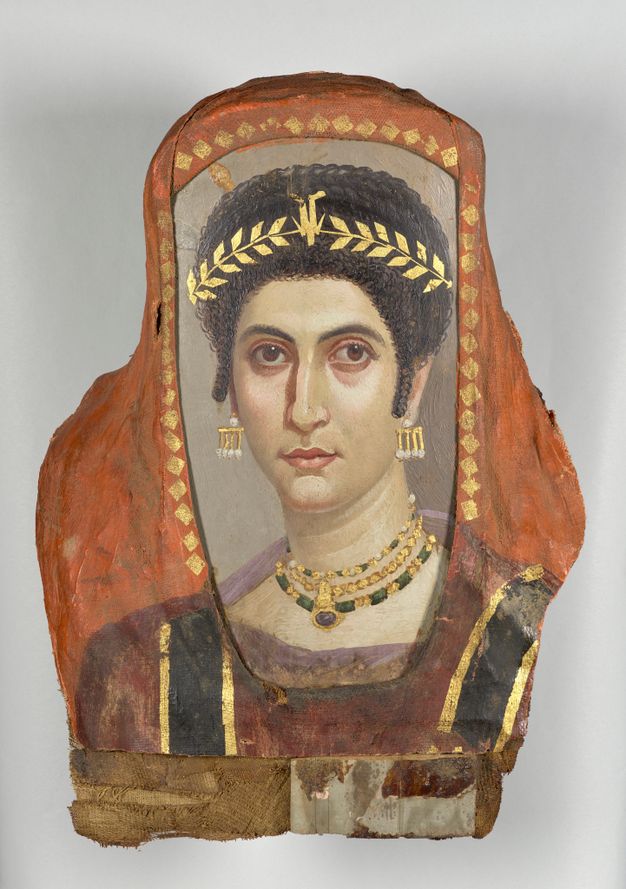
The final point of concern, the impressionistic treatment of the earrings, is a particularly engaging topic. The artist simply used three quick dashes of paint to indicate the earrings, rather than very carefully depicting the jewelry, as seen in some authentic portraits, such as the portrait of Isidora in the J. Paul Getty Museum (fig. 6.9). For ancient Egyptians, expensive accessories signaled social status, and finely executed mummy portraits tend to depict jewelry as realistically as they do the sitter, whereas the earrings and necklace of 1970-001 DJ (ST) lack such realism. That said, not all artists creating mummy portraits were highly skilled. Another example from the J. Paul Getty Museum, shown in figure 6.10, is less realistic than either the forged Menil portrait or that of Isidora. Introducing this contrast to the discussion reinforces the ideas that “crudeness” does not necessarily denote inauthenticity and that royal workshops and village craftsmen will create objects with a wide skill gamut. (At this point, we found it very effective to ask the audience to reevaluate the other Menil forgery, CA 5878 [ST], in light of diverse artistic abilities.)
In an educational environment, this dialogue between connoisseurship and technical analysis can be turned into a Socratic lesson. Students can be asked to compare 1970-001 DJ (ST) with images of authentic mummy portraits and generate their own lists of characteristics for supporting or refuting authenticity. Their lists can then be compared with the issues voiced by John de Menil and the differences discussed. The technical analyses can be introduced into the discussion and used to address the students’ concerns as well as those of de Menil. This type of discursive dialogue between the students and the object, facilitated by the instructor, is indispensable for training rigorous scholars in almost any field.
Conclusions
Thomas Hoving, a past director of The Metropolitan Museum of Art, claimed that 40 percent of all objects he looked at over a fifteen-year period were either fakes or so heavily restored as to be nonrepresentative.53 Careful preacquisition screening may reduce the number of fakes and forgeries in a collection, but it is almost inevitable that some will be acquired, and to avoid falsification of history and distortion of scholarship they must be identified. Such revealed forgeries can be used to enhance scholarship by training the eyes of the public and young scholars and by serving as tools in object-based learning methods to teach critical thinking and analytical approaches. Museums should include them in collection databases and publish their characteristics so that other institutions and collectors can make comparisons with their own objects; we have contributed the technical results from the Menil Collection’s mummy portrait forgeries to the Getty Museum’s APPEAR database. We advocate that these objects, which John de Menil recognized as “lemons,” be put to use, figuratively, to make lemonade. By illustrating the pedagogical approaches we have taken to integrate these objects into our object-based learning praxis, we hope to encourage other institutions to reevaluate the possibilities inherent in the lemons of their own collections.
Appendix: Scientific Methodology
Sampling and Cross Section Preparation
Samples of the portraits were taken under magnification using a 0.5 mm Ted Pella micro-chisel. For cross sectioning, samples were embedded in Bio-Plastic resin and polished using Micro Mesh sheets (120–12000 grit). Sample images were taken with a Zeiss AxioCam MRc 5 camera mounted onto a Nikon Labophot POL microscope and controlled by Zeiss AxioVision AC software (v. 4.5). Samples were taken from the portraits for analysis of the binding media by scientists at the Getty Conservation Institute.54
X‑ray Fluorescence Spectroscopy (XRF)
XRF spectra were collected using either a Bruker Artax 400 or Bruker Tracer III SD energy dispersive X‑ray spectrometer. The Artax has a rhodium (Rh) target X‑ray tube with a 0.2 mm–thick beryllium (Be) window and was operated at 40 kV and 400 mA current. The X‑ray beam was directed at the artifact through a polycapillary tube. X‑ray signals were detected using a Peltier-cooled XFlash silicon drift detector (SDD) with a resolution of 146.4 eV. Helium purging was used to enhance sensitivity to light elements. Spectra were collected over 180 seconds (live time). The Bruker Tracer III SD spectrometer is equipped with a Peltier-cooled XFlash SDD with a resolution of 145 eV. The excitation source was a rhodium-target X‑ray tube, operated at 40 kV and 10 μA current. Spectra were collected over 180 seconds (live time).
Fourier Transform Infrared Spectroscopy (FTIR)
Attenuated total reflectance (ATR) and transmission spectra were collected using a Bruker Lumos FTIR microscope equipped with a MCT‑A detector and a motorized germanium ATR crystal with a 100 μm tip. Transmission spectra were obtained by flattening samples in a diamond compression cell, removing the top diamond window, and analyzing the thin film on the bottom diamond window. ATR spectra were taken on cross-section samples embedded in Bio-Plastic. All spectra are an average of 64 or 128 scans at 4 cm−1 spectral resolution.
Dispersive Raman Microspectroscopy
Dispersive Raman spectra were collected on a Renishaw inVia Raman microscope using a 785 nm excitation laser operating at powers between 75.4 μW and 7.41 mW at the sample, as measured using a Thorlabs PM100D laser power meter equipped with a S120C photodiode power sensor. A 50x objective was used to focus the excitation beam on the sample. Each scan was of 10 seconds duration, and the spectral resolution was 3–5 cm−1 across the spectral range analyzed.
Scanning Electron Microscopy–Energy Dispersive Spectrometry (SEM-EDX)
Backscatter electron images of cross-sectional samples were taken with a JEOL JSM-IT100 scanning electron microscope operating at pressures of 50–55 Pa, an accelerating voltage of 20 kV, and a probe current of 40–50 (unitless value from SEM operating software). Energy dispersive X‑ray spectrometry using the integrated detector was performed under the same pressure conditions but with higher probe currents (65–75).
Wood Identification
Small samples were manually fractured to expose transverse, radial-longitudinal, and tangential-longitudinal sections and analyzed as reported by Cartwright.55
Acknowledgments
We thank Paul R. Davis, curator of collections at the Menil Collection, and David Aylsworth, collections registrar at the Menil Collection, for critical reading of the manuscript and sharing their knowledge of the de Menils and the collection; Yekatarina Barbash, associate curator of Egyptian art, and Lisa Bruno, the Carol Lee Shen chief conservator, both of the Brooklyn Museum, for kindly sharing information about the forged mummy portraits in their collection; and the Andrew W. Mellon Foundation for supporting conservation science at the Museum of Fine Arts Houston and the Menil Collection.
Notes
-
van Dyke, Kristina. 2010. “Losing One’s Head: John and Dominique de Menil as Collectors.” In Art and Activism: Projects of John and Dominique de Menil, edited by Josef Helfenstein and Laureen Schipsi. Yale University Press.. ↩︎
-
Chatterjee, Helen J., and Leonie Hannan. 2016. Engaging the Senses: Object-Based Learning in Higher Education. Routledge.. ↩︎
-
Hopkins, John N., Sarah K. Costello, and Paul R. Davis, eds. 2021. Object Biographies: Collaborative Approaches to Ancient Mediterranean Art. Yale University Press.. ↩︎
-
Definitions of the term forgery vary; here we use it to mean an object deliberately made to deceive others as to its origin and age. ↩︎
-
Thompson, David L. 1982. Mummy Portraits in the J. Paul Getty Museum. J. Paul Getty Museum.; Doxiadis, Euphrosyne. 1995. The Mysterious Fayum Portraits: Faces from Ancient Egypt. Thames & Hudson.; Picton, Janet, Stephen Quirke, and Paul C. Roberts. 2018. Living Images: Egyptian Funerary Portraits in the Petrie Museum. Routledge.; Walker, Susan. 2000. “A Note on Dating Mummy Portraits.” In Walker 2000A.; Svoboda, Marie, and Caroline R. Cartwright, eds. 2020. Mummy Portraits of Roman Egypt: Emerging Research from the APPEAR Project. J. Paul Getty Museum.. ↩︎
-
Thompson, David L. 1982. Mummy Portraits in the J. Paul Getty Museum. J. Paul Getty Museum.. ↩︎
-
Borg, Barbara E., and Glenn W. Most. 2000. “The Face of the Elite.” Arion: A Journal of Humanities and the Classics, 3rd ser., 8 (1): 63–96. http://www.jstor.org/stable/20163786.. ↩︎
-
Cartwright, Caroline R. 2020. “Understanding Wood Choices for Ancient Panel Painting and Mummy Portraits in the APPEAR Project through Scanning Electron Microscopy.” In Svoboda and Cartwright 2020. https://www.getty.edu/publications/mummyportraits/part-one/2.. ↩︎
-
Feller, Robert. 1986. “Barium Sulfate.” In vol. 1 of Artists’ Pigments: A Handbook of Their History and Characteristics, edited by Robert Feller. National Gallery of Art.; Berrie, Barbara. “Prussian Blue.” 1997. In vol. 3 of Artists’ Pigments: A Handbook of Their History and Characteristics, edited by Elizabeth FitzHugh. National Gallery of Art.; Kühn, Hermann. 1986. “Zinc White.” In vol. 1 of Artists’ Pigments: A Handbook of Their History and Characteristics, edited by Robert Feller. National Gallery of Art.. ↩︎
-
Kühn, Hermann. 1986. “Zinc White.” In vol. 1 of Artists’ Pigments: A Handbook of Their History and Characteristics, edited by Robert Feller. National Gallery of Art.. ↩︎
-
Roy, Ashok. 2007. “Cobalt Blue.” In vol. 4 of Artists’ Pigments: A Handbook of Their History and Characteristics, edited by Barbara H. Berrie. National Gallery of Art.; Shortland, Andrew J., Colin Appleby Hope, and M. S. Tite. 2006. “Cobalt Blue Painted Pottery from 18th Dynasty Egypt.” Geological Society, London, Special Publications 257 (1): 91–99. https://doi.org/10.1144/GSL.SP.2006.257.01.07.. ↩︎
-
Mazurek, Joy, Marie Svoboda, and Michael Schilling. 2019. “GC/MS Characterization of Beeswax, Protein, Gum, Resin, and Oil in Romano-Egyptian Paintings.” Heritage 2 (3): 1960–85. https://doi.org/10.3390/heritage2030119.. ↩︎
-
Cartwright, Caroline R. 2020. “Understanding Wood Choices for Ancient Panel Painting and Mummy Portraits in the APPEAR Project through Scanning Electron Microscopy.” In Svoboda and Cartwright 2020. https://www.getty.edu/publications/mummyportraits/part-one/2.. ↩︎
-
Kühn, Hermann. 1986. “Zinc White.” In vol. 1 of Artists’ Pigments: A Handbook of Their History and Characteristics, edited by Robert Feller. National Gallery of Art.; Eastaugh, Nicholas, Valentine Walsh, Tracey Chaplin, and Ruth Siddall. 2004. Pigment Compendium: A Dictionary and Optical Microscopy of Historical Pigments. Butterworth-Heinemann.. ↩︎
-
Lee, Lorna, and Stephen Quirke. 2000. “Painting Materials.” In Nicholson and Shaw 2000.. ↩︎
-
Mazurek, Joy, Marie Svoboda, and Michael Schilling. 2019. “GC/MS Characterization of Beeswax, Protein, Gum, Resin, and Oil in Romano-Egyptian Paintings.” Heritage 2 (3): 1960–85. https://doi.org/10.3390/heritage2030119.. ↩︎
-
Examples include Fakes and Forgeries, Minneapolis Institute of Arts (1973); Falsche Faraonen. Zeitung zur Sonderaustellung 400 Jahre Fälschungsgeschichte, Staatliche Sammlung Ägyptischer Kunst (1983); Fake? The Art of Deception, British Museum (1990); GeaECHTet. Fälschungen und Originale aus dem Kestner-Museum, Kestner Museum (2001); Unearthing the Truth: Egypt’s Pagan and Coptic Sculpture, Brooklyn Museum (2009); The Metropolitan Police Service’s Investigation of Fakes and Forgeries, Victoria & Albert Museum (2010); Fakes, Forgeries and Mysteries, Detroit Institute of Arts (2019); Russian Avant-Garde at the Museum Ludwig: Original and Fake, Museum Ludwig (2020). ↩︎
-
Jones, Mark, Paul T. Craddock, and Nicolas Barker. 1990. Fake? The Art of Deception. University of California Press.; Briefel, Aviva. 2006. The Deceivers: Art Forgery and Identity in the Nineteenth Century. Cornell University Press.; Lenain, Thierry. 2011. Art Forgery: The History of a Modern Obsession. Reaktion.. ↩︎
-
Hopkins, John N., Sarah K. Costello, and Paul R. Davis, eds. 2021. Object Biographies: Collaborative Approaches to Ancient Mediterranean Art. Yale University Press.. ↩︎
-
Clerc, Alfred. 1847. “Lettre à M. De Saulcy sur Quelques Antiquités Égyptiennes et sur le Boeuf Apis.” Revue Archéologique 3 (2): 649–67. Translated in Fiechter 2009. Flammarion.. ↩︎
-
Wakeling, T. G. 1912. Forged Egyptian Antiquities. Adam & Charles Black.. ↩︎
-
Borchardt, Ludwig. 1930. “Ägyptische ‘Altertümer’, die ich für neuzeitlich halte.” Zeitschrift für Ägyptische Sprache und Altertumskunde 65 (1): unnumbered appendix.. ↩︎
-
Cooney, John D. 1950. “A Reexamination of Some Egyptian Antiquities.” Brooklyn Museum Bulletin 11 (3): 11–26. http://www.jstor.org/stable/26458610.; Schoske, Sylvia, and Dietrich Wildung. 1983. Falsche Pharaonen: Zeitung zur Sonderausstellung, 400 Jahre Fälschungsgeschichte. Staatliches Museum Ägyptischer Kunst.; Davies, W. Vivian. 1984. The Statuette of Queen Tetisheri: A Reconsideration. The British Museum.; de Cenival, Jean-Louis. 1991. “La fin de la tête de harpe.” La Revue du Louvre et des musées de France 1: 6–7.; Arnold, Maurice, and Héléne Valladas. 1991. “Datation carbone 14 de la tête de harpe en bois.” La Revue du Louvre et des musées de France 1: 7. https://agorha.inha.fr/ark:/54721/b06e9134-528f-4f27-836d-8ff2190104fa.; Lilyquist, Christine, James E. Hoch, and A. J. Peden. 2003. The Tomb of Three Foreign Wives of Tuthmosis III. The Metropolitan Museum of Art.; Biron, Isabelle, and Geneviève Pierrat-Bonnefois. 2007. “La tête égyptienne en verre bleu du musée du Louvre.” L’actualité chimique, nos. 312–313 (October–November): 47–52.; Fiechter, Jean-Jacques. 2009. Egyptian Fakes: Masterpieces That Duped the Art World and the Experts Who Uncovered Them. Flammarion.. ↩︎
-
Hardwick, Tom. 2010. “A Group of Art Works in the Amarna Style.” In Offerings to the Discerning Eye: An Egyptological Medley in Honor of Jack A. Josephson, edited by Sue D’Auria. Brill.. ↩︎
-
Borg, Barbara E., and Glenn W. Most. 2000. “The Face of the Elite.” Arion: A Journal of Humanities and the Classics, 3rd ser., 8 (1): 63–96. http://www.jstor.org/stable/20163786.. ↩︎
-
Bietenholz, Peter G. 1962. “Pietro Della Valle 1586–1652.” Studien zur Geschichte der Orientkenntnis und des Orientbildes im Abendlande 85: 205–8.. ↩︎
-
Manley, Deborah, and Peta Rée. 2001. Henry Salt: Artist, Traveller, Diplomat, Egyptologist. Libri.; Thompson, David L. 1982. Mummy Portraits in the J. Paul Getty Museum. J. Paul Getty Museum.. ↩︎
-
Thompson, David L. 1982. Mummy Portraits in the J. Paul Getty Museum. J. Paul Getty Museum.. ↩︎
-
Picton, Janet, Stephen Quirke, and Paul C. Roberts. 2018. Living Images: Egyptian Funerary Portraits in the Petrie Museum. Routledge.. ↩︎
-
Brooklyn Museum object files, kindly communicated by Dr. Yekatarina Barbash, associate curator of Egyptian art at the Brooklyn Museum. ↩︎
-
Laver, Marilyn. 1997. “Titanium White.” In vol. 3 of Artists’ Pigments: A Handbook of Their History and Characteristics, edited by Elisabeth FitzHugh. National Gallery of Art.. ↩︎
-
Jones, Mark, Paul T. Craddock, and Nicolas Barker. 1990. Fake? The Art of Deception. University of California Press.. ↩︎
-
Middleton, William. 2018. Double Vision: The Unerring Eye of Art World Avatars Dominique and John de Menil. Knopf.. ↩︎
-
Biographical interview of Dominique de Menil by Paul Winkler and Carol Mancusi-Ungaro, September 25 and 27, 1995, Menil Archives. ↩︎
-
Dominique de Menil interview. ↩︎
-
Davis, Paul R. 2021. “The Twentieth-Century Life of a ‘Hellenistic’ or ‘Imperial Roman’ Statue of a Bull.” In Hopkins, Costello, and Davis 2021.. ↩︎
-
Bierbrier, Morris L. 2012. Who Was Who in Egyptology. 4th ed. Egyptian Exploration Society.. ↩︎
-
Smart, Pamela G. 2010. Sacred Modern: Faith, Activism, and Aesthetics in the Menil Collection. University of Texas Press.; Middleton, William. 2018. Double Vision: The Unerring Eye of Art World Avatars Dominique and John de Menil. Knopf.. ↩︎
-
Smart, Pamela G. 2010. Sacred Modern: Faith, Activism, and Aesthetics in the Menil Collection. University of Texas Press.. ↩︎
-
Bettie Cartwright, personal conversation, October 24, 2016. ↩︎
-
Typed notes held in the Menil Archives for a talk by John and Dominique de Menil entitled “The Delight and the Dilemma of Collecting,” given at the University of St. Thomas, Houston, April 9, 1964. ↩︎
-
American Institute for Conservation. 1994. “Code of Ethics and Guidelines for Practice; Commentaries.” https://www.culturalheritage.org/docs/default-source/administration/governance/code-of-ethics-and-guidelines-for-practice.pdf.; American Institute for Conservation. 2015. “Commentaries to the Guidelines for Practice of the American Institute for Conservation of Historic & Artistic Works.” https://www.culturalheritage.org/docs/default-source/administration/governance/commentaries-to-the-guidelines.pdf.. ↩︎
-
American Institute for Conservation. 2015. “Commentaries to the Guidelines for Practice of the American Institute for Conservation of Historic & Artistic Works.” https://www.culturalheritage.org/docs/default-source/administration/governance/commentaries-to-the-guidelines.pdf.. ↩︎
-
Pozza, Giorgio, David Ajò, Giacomo Chiari, Franco De Zuane, and Marialuisa Favaro. 2000. “Photoluminescence of the Inorganic Pigments Egyptian Blue, Han Blue and Han Purple.” Journal of Cultural Heritage 1 (4): 393–98.; Accorsi, Gianluca, Giovanni Verri, Margherita Bolognesi, Nicola Armaroli, Catia Clementi, Costanza Miliani, and Aldo Romani. 2009. “The Exceptional Near-Infrared Luminescence Properties of Cuprorivaite (Egyptian Blue).” Chemical Communications, no. 23, 3392–94. https://doi.org/10.1039/B902563D.. ↩︎
-
Warda, Jeffrey. 2011. The AIC Guide to Digital Photography and Conservation Documentation. 2nd ed. American Institute for Conservation of Historic and Artistic Works.. ↩︎
-
Lee, Lorna, and Stephen Quirke. 2000. “Painting Materials.” In Nicholson and Shaw 2000.; Lazzarini, Lorenzo. 1982. “The Discovery of Egyptian Blue in a Roman Fresco of the Mediaeval Period (Ninth Century AD).” Studies in Conservation 27 (2): 84–86. https://doi.org/10.1179/sic.1982.27.2.84.; Lluveras, Anna, Anna Torrents, Pilar Giráldez, and Marius Vendrell-Saz. 2010. “Evidence for the Use of Egyptian Blue in an 11th-Century Mural Altarpiece by SEM–EDS, FTIR and SR XRD (Church of Sant Pere, Terrassa, Spain).” Archaeometry 52 (2): 308–19.; Bredal-Jørgensen, Jørn, Jana Sanyova, Vibeke Rask, Maria Louise Sargent, and Rikke Hoberg Therkildsen. 2011. “Striking Presence of Egyptian Blue Identified in a Painting by Giovanni Battista Benvenuto from 1524.” Analytical and Bioanalytical Chemistry 401: 1433–39. https://doi.org/10.1007/s00216-011-5140-y.. ↩︎
-
Davy, Humphry. 1815. “Some Experiments and Observations on the Colours Used in Painting by the Ancients.” Philosophical Transactions of the Royal Society of London 105: 97–124. https://www.jstor.org/stable/107361.; Fouqué, Ferdinand. 1889. “Sur le bleu égyptien ou vestorien.” Comptes-rendus hebdomadaires des séances de l’Académie des sciences 108: 325–27.. ↩︎
-
Adrian, Louis Alphonse. 1893. Exposition internationale de Chicago, 1893, compte rendu des groupes 87 et 88, Comité 19: Produits chimiques et pharmaceutiques, matériel de la peinture, parfumerie. A. Hennuyer.. ↩︎
-
Eastlake, Elizabeth. 1891. “Giovanni Morelli: Patriot and Critic.” Quarterly Review 173: 235.. ↩︎
-
Ramer, Brian. 1979. “The Technology, Examination and Conservation of the Fayum Portraits in the Petrie Museum.” Studies in Conservation 24 (1): 1–13.; Salvant, Johanna, Jane Williams, Monica Ganio, Francesca Casidio, Céline Daher, Ken Sutherland, Letizia Monico, Frederik Vanmeert, Steven de Meyer, Koen Janssens, Caroline R. Cartwright, and Marc Walton. 2018. “A Roman Egyptian Painting Workshop: Technical Investigation of the Portraits from Tebtunis, Egypt.” Archaeometry 60 (4): 815–33. https://doi.org/10.1111/arcm.12351.; Svoboda, Marie, and Caroline R. Cartwright, eds. 2020. Mummy Portraits of Roman Egypt: Emerging Research from the APPEAR Project. J. Paul Getty Museum.. ↩︎
-
Cartwright, Caroline R. 2020. “Understanding Wood Choices for Ancient Panel Painting and Mummy Portraits in the APPEAR Project through Scanning Electron Microscopy.” In Svoboda and Cartwright 2020. https://www.getty.edu/publications/mummyportraits/part-one/2.. ↩︎
-
Cartwright, Caroline R. 1997. “Egyptian Mummy Portraits: Examining the Woodworkers’ Craft.” In Portraits and Masks: Burial Customs in Roman Egypt, edited by Morris Bierbrier. The British Museum.. ↩︎
-
Hoving, Thomas. 1997. False Impressions: The Hunt for Big-Time Art Fakes. Touchstone.. ↩︎
-
Mazurek, Joy, Marie Svoboda, and Michael Schilling. 2019. “GC/MS Characterization of Beeswax, Protein, Gum, Resin, and Oil in Romano-Egyptian Paintings.” Heritage 2 (3): 1960–85. https://doi.org/10.3390/heritage2030119.. ↩︎
-
Cartwright, Caroline R. 2015. “The Principles, Procedures and Pitfalls in Identifying Archaeological and Historical Wood Samples.” Annals of Botany 116 (1): 1–13. https://doi.org/10.1093/aob/mcv056.; Cartwright, Caroline R. 2020. “Understanding Wood Choices for Ancient Panel Painting and Mummy Portraits in the APPEAR Project through Scanning Electron Microscopy.” In Svoboda and Cartwright 2020. https://www.getty.edu/publications/mummyportraits/part-one/2.. ↩︎