Roman-Egyptian mummy portraits, which were probably used in a domestic context before the death of the person depicted,1 were fixed over the face of mummies from the first to the fourth centuries CE. Created at the crossroads between Pharaonic funerary tradition and Greco-Roman memorial portraiture, these works constitute one of the rare surviving testimonies of the origins of what is now known as Western panel painting. Simultaneously, mainly in the Fayum region, another type of production expressed a complementary aspect of the religious practices of Roman Egypt’s mixed population: framed painted panels representing gods. Found mainly in disturbed archaeological contexts in chapels and temples, these panels were objects of worship for the syncretic cults characteristic of the period. The cultural and historical significance of mummy portraits has been studied in depth,2 whereas the panels of gods have only recently received extensive attention.3
Until quite recently, few studies have been dedicated to the materials and technical practices used in the production of these artifacts.4 Although the number of studies and publications has increased, it remains difficult to link material results to archaeological information, as provenience and contexts are sparsely documented in many cases. The study of workshops (artisans and organization) and the understanding of technical practices remain elusive despite the increasing amount of research.5
The Louvre collection is no exception; most of its portraits have no precise archaeological context offering secure data to cross reference with the results of material studies. The collection is composed of thirty-one mummy panel portraits and two panels of gods. Only five portraits have a secure archaeological provenience; the hypotheses for the remaining works in the collection are based on iconography, style, shape, and information about the collectors’ whereabouts.
Three portraits were found by Albert Gayet in Antinoöpolis,6 which is a likely provenience for eight others.7 Seven portraits purchased from the Salt collection in 1826 are probably from Thebes.8 The Fayum region9 provides up to seven examples, only one of which is securely attached to the area,10 while six others are very plausibly from that region (five portraits acquired from Daninos Pacha in 1893 probably come from Philadephia/er-Rubayat,11 whereas Dioscorous’s mummy-case, E 13044, is likely to have come from Hawara). Portrait N 2733 1 was brought from Egypt by Léon de Laborde in 1827, after being found in the Memphis necropolis. Five others are too fragmentary or damaged to even suggest a hypothetical provenience.12 As for the panels of gods, both are said to be from the Fayum region dating back to the second century CE.13 The fragment representing a Dioscure14 (MND 193 - E 10815) was acquired by Georges Bénédite in 1899 in Cairo, whereas the Heron and Lycurgus panel is a 2020 acquisition from the Thierry Collection in Étampes, France (RFML.AE.2020.8.1).
Despite the relative scarcity of archaeological information, the opportunity to launch a material study on such an important corpus has been viewed as a unique occasion to deepen and refine the knowledge of this collection and of the production of these objects in general. Part of the collection had already been studied during the 1990s and 2000s, which resulted in the catalogue raisonné15 published in 2008. The APPEAR project prompted the Louvre to assess which possibilities could be offered by scientific equipment not available more than twenty years ago. Therefore, a two-year program of research was undertaken (FAYOUM Project, 2020–22),16 carried out by the Louvre and the Centre de Recherche et de Restauration des Musées de France (C2RMF) in collaboration with the Centre de Recherche sur la Conservation (CRC). The study was performed by Lucile Brunel-Duverger, physicochemist, and codirected by Caroline Thomas, curator of Egyptian art at the Louvre, and Michel Menu and Anne-Solenn Le Hô, scientists at the C2RMF. The aim was to undertake a material study on the whole collection,17 on the widest range of questions and issues, in order to share results with the APPEAR community and to prompt discussion. The present paper aims to sum up the main results of this campaign, hoping the connection between historical and cultural information and scientific data can benefit from the comparison offered by similar studies.
Manufacturing Steps
Since the latest research campaign in the early 2000s, several technical and technological advances have been made, offering new insights into the production of ancient painting. One of the main evolutions is the development of two-dimensional (2D) equipment that gives information on the entire surface of the object and provides distribution of materials (the methods and technology used are described in further detail in the Scientific Methodology section). Here we summarize the order of manufacturing steps, from the wooden support to the surface, describing the wood species, ground layers and backgrounds, underdrawings, binders, polychromy, and gilding (see the Results section for greater detail).
Wood
An exhaustive wood anatomy study of the corpus had already been carried out mainly by Maria Victoria Asensi Amorós (from Xylodata) and Pierre Détienne (CIRAD).18 Results are consistent with what has been found by Caroline R. Cartwright in the APPEAR project.19 Most mummy portraits from the Louvre are made with imported timber, with indigenous wood accounting for a third. A large majority are made of linden (Tilia sp., Malvaceae, nineteen examples), followed by sycomore fig (Ficus sycomorus L., Moraceae, seven). More rarely we encounter beech (Fagus sp., Fagaceae, two), cedar (Cedrus sp., Pinaceae, two), and tamarisk (Tamarix cf. aphylla, Tamaricaceae, one). Both panels of gods are made of willow (Salix sp. and Salix cf. subserrata Willd., Salicaceae).20
Ground Layers, Underdrawings, and Backgrounds
Different types of ground layers have been identified. Light ground layers are calcium-based; most of them have been identified as gypsum-based (both panels of gods and five of the portraits),21 while the composition of two could not be clarified.22 Beige layers are made of calcium-based material (sulfate or carbonate) mixed with iron yellow. The largest number of portraits (twelve)23 have a dark ground layer composed of a mixture of calcium-based materials and carbon black and/or iron-based pigments. Finally, three appear to have no ground layer, polychromy being directly applied on bare wood.24 Doubts persist for the remaining seven.25
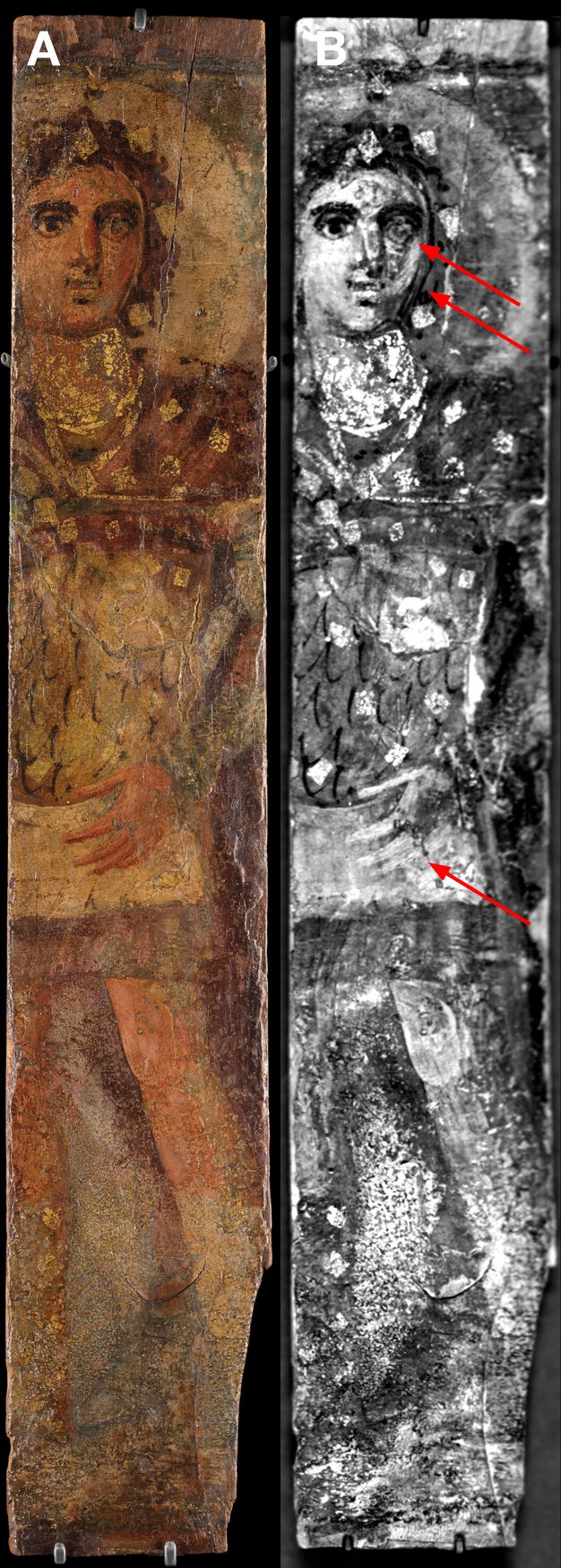
Underdrawings have rarely been discussed in publications to date; this is mostly related to the technical difficulties faced when trying to detect them, rather than to their supposed rarity. Recent studies using modern technology have detected a variety of colors used to produce underdrawings, such as black,26 white,27 blue,28 and mixtures of colors, possibly using madder lake–based pigments, to create preparatory sketches and add volume to faces and hair.29 For dark underdrawings on light ground layers, infrared reflectography (IRR) is an efficient imaging method for revealing carbon black on white substrate. This common technique was unfortunately not carried out during the 2000s campaign. Using hyperspectral imaging (HSI) in the near-infrared range (NIR) we were able to reveal dark underdrawings on two portraits30 with light ground layers and on both panels of gods. However, their composition could not be identified, as the technique reveals only the presence of carbon black and does not indicate if it is used pure or mixed. Modifications between first sketches and final result can be noted, whether it is a slight shifting of the jaw and nose outlines31 or the reworking of an eye (fig. 2.1).32
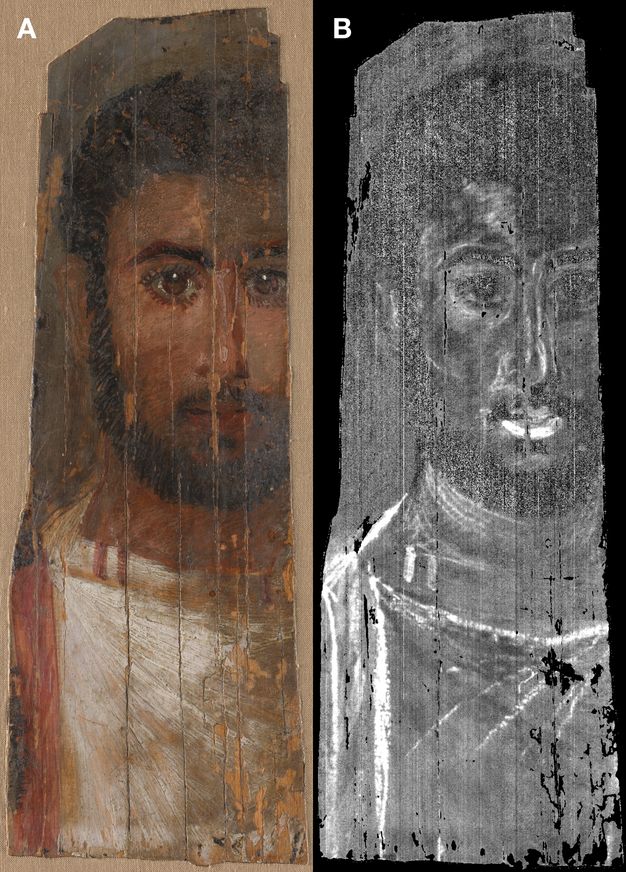
The most surprising result was the uncovering of white sketches on a dark ground layer that refuted earlier claims that there were none. The energy range of HSI-SWIR (short-wavelength infrared) produces signals for materials deep into the stratigraphy due to their characteristic vibrational features. Indeed, we were able to identify the main vibrational patterns of water from gypsum (νa + δ OH [H2O])33 with specific positions at 1941 nm and a 1973 nm shoulder, sometimes associated with a lower band at 1445 nm, also attributable to the water in gypsum (ν3 + 2ν2 H2O). The identification of gypsum (CaSO4 · 2H2O) for white underdrawings is consistent with what was found in other studies.34 Those white drawings were revealed on at least seven portraits,35 some of them showing changes in composition, notably redesigning the hairline or direction of garment folds (fig. 2.2).36 It should be noted that the whole series that is probably from Thebes (Salt collection) exhibits this feature, pointing toward a possible criterion for a Theban workshop.37
The color of portrait backgrounds ranges from light beige to dark gray, passing through a multitude of shades. Background application does not seem to follow a consistent pattern: nineteen were applied after the portrait was painted,38 two may have been applied on the whole surface of the ground layer before the portrait was painted,39 one shows a background applied in anticipation of the shape of the not-yet-painted portrait (E 12570), and the application steps remain unclear for seven.40
Binders
Mummy portraits’ binders have prompted a lot of research, especially on the complex question of wax-based portraits and Punic wax.41 On the Louvre corpus, we identified two specific patterns characteristic of encaustic (fig. 2.3) and tempera (fig. 2.4) using HSI-SWIR and macro X-ray fluorescence (MA-XRF) data. Most portraits are wax-based (twenty-four),42 whereas a smaller number (seven),43 as well as both panels of gods, are water-based.44 Because of the spectral resolution (~7 nm) we were not able to discern the nature of the protein.45 By resizing the initial data cube (1000–2500 nm) within the area of interest (2100–2500 nm) we could map the distribution of both types of binders.
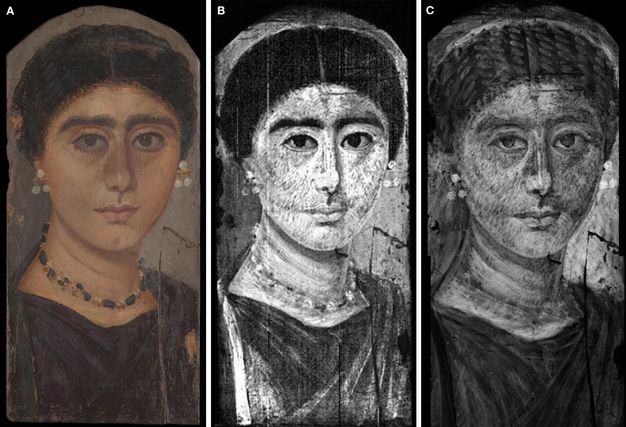
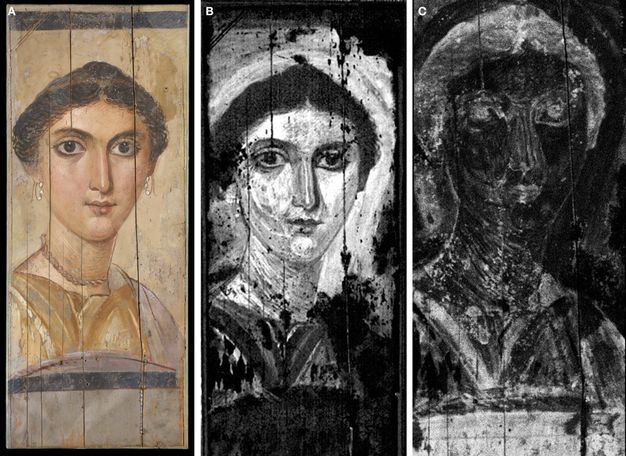
An interesting connection was revealed between the nature of the binder and the addition of a filler. It seems that in most cases a white filler was added to the pictorial matter, thus contributing to the large range of hues characteristic of Roman-Egyptian polychromy. This filler has been identified as calcium-based for protein-based binders on the one hand (see fig. 2.4C) and as lead white for wax-based binders on the other (see fig. 2.3C). In the latter case, the addition of lead white was perhaps intended to create a saponification reaction (as in Punic wax), which would impact the texture and properties of the wax, rendering it easier to apply cold.
Two portraits seem to be exceptions among the corpus: Salt collection portraits N 2732 2 and N 2733 2, long said to be encaustic, are in fact water-based but show a coating of wax on the whole surface. Their style is indeed more characteristic of tempera-based paintings, and the shine of their surfaces was misleading for a long time. We do not know when the wax was applied.46 Moreover, the white filler used for this tempera-based binder is lead white, adding another peculiarity to these complex portraits.
Another portrait (MNC 1695) stands out as an unusual combination of all examples: it is protein-based but shows traces of wax on the surface of certain areas, maybe to emphasize the outlines of the face and jewels. The white filler is predominantly calcium-based; however, lead white found on the face and jewels does not perfectly match the distribution of the wax. The understanding of those peculiarities could greatly benefit from comparisons outside of the Louvre collection to see if they could be clues toward workshop practices.
Polychromy
Subsequent to Pharaonic Egypt, new pigments and techniques became available, thus material choices may provide evidence for the identification of workshops. Some materials seem to be more commonly used than others; for example, earth pigments are found on the whole collection.47 Brown pigments were used for the hair,48 while red and yellow are always found mixed together with a white material to depict flesh tones. Iron red is consistently found in contours and details: it corresponds to the main red pigment, mostly characterized as hematite, which in few cases is titanium-rich,49 possibly indicating the presence of ilmenite, a natural compound frequently found in Egyptian red ochres.50 We identified cinnabar on two male portraits, to highlight the upper lip in one case51 and possibly for the complexion in the second.52
Yellow appears on female portraits to render golden jewels or hues of tinted textiles. Besides iron earth, which in some cases we were able to characterize as jarosite,53 we also found arsenic-based pigment—presumably orpiment—on three protein-based portraits54 as well as on the Dioscure panel (also protein-based).55
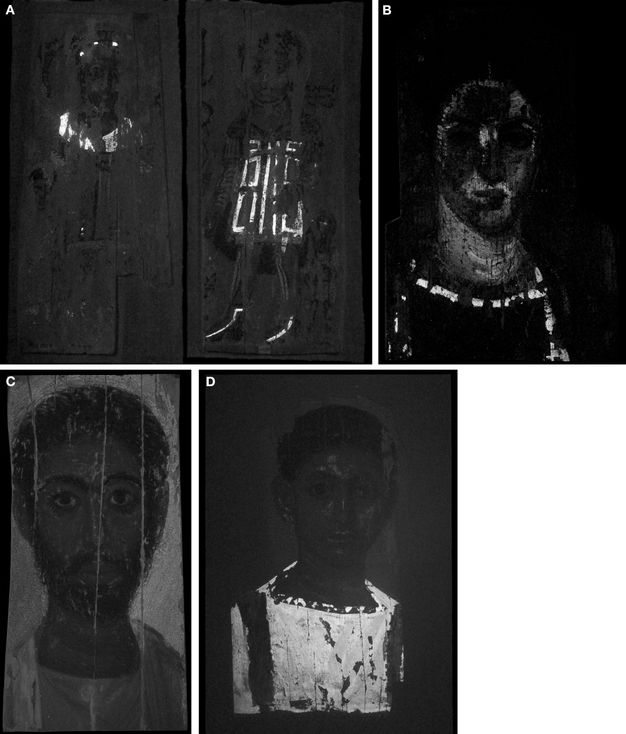
Blue hues are not often found on mummy portraits, except occasionally in tunics, mantles, jewels, and eyes, although Egyptian blue and indigo are well attested to as components of the pictorial layers by the APPEAR project.56 Among the Louvre collection, blue is not widely used. On the Heron and Lycurgus panel, Egyptian blue is used to render the clothing57 (fig. 2.5A), while on mummy portraits, indigo is employed to depict a light blue stone in a necklace on MNC 1695 and three dark clavi.58 In the corpus, Egyptian blue is mainly employed to render complexion (fig. 2.5B) and backgrounds (fig. 2.5C), and more rarely to create details such as white sclera.59 Those blue pigments are also used to obtain purple shades for the tunics (fig. 2.5D), mantles, and clavi characteristic of Roman-Egyptian portraiture.
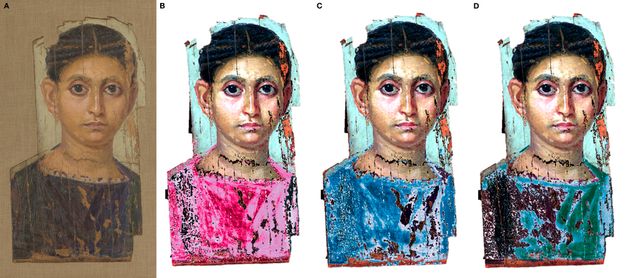
Purple was rarely depicted in Pharaonic Egypt60 but became more popular during the Ptolemaic period, under the influence of Hellenistic Greece, where pink and mauve denoted sophistication, preciosity, and power. During the Roman period, a wide variety of hues appeared, ranging from light pink to dark purple, and were used to render both complexion61 and clothing. Despite the absence of Tyrian purple on any portrait, these shades are most probably connected to the rare and prestigious colorant/dye derived from Muricidae gastropods, reserved for emperors and circles of power.62 On mummy portraits, madder lake has often been used with other colored materials (indigo, Egyptian blue, or minium63), mixed together or applied in overlapping layers, to add subtlety to its hue.64 In this way, artisans were able to create a large range of shades for representing textiles, from bright red to bluish purple. The several shades of purple on the Louvre portraits were identified using hyperspectral imaging data in the visible and near infrared range (HSI-VNIR).65 In portraits’ purple clothes we found two types of mixtures: madder lake and Egyptian blue,66 and madder lake and indigo.67 A particular example (AF 6884; fig. 2.6A) shows a combination of both blue pigments (Egyptian blue and indigo) in conjunction with madder lake. While the main part of the tunic is rendered in a mixture of Egyptian blue and madder lake (figs. 2.6B and 2.6C), specific areas of the clothing are painted with indigo used in association with madder lake (figs. 2.6B and 2.6D), possibly to render the volume of the folds using different shades. A single portrait shows the use of orchil, a violet dye extracted from lichen (Roccella) to render the purple clavus.68 Pigment mixtures used to produce purple hues could be clues toward workshop practices and might well be addressed by the sharing of results prompted by the APPEAR project.
Green is not the most widespread color observed on mummy portraits, even though several mixtures are purported to render this hue in the Roman period.69 Indeed, green shades found on the Louvre portraits only depicted stones (probably emeralds) or clavi. Green stones are consistently painted with copper green materials,70 whereas clavi can be rendered with an iron-based green called green earth.71 On the panel of gods RFML.AE.2020.8.1, green earth is mixed with Egyptian blue to depict the blades of the ax or the cnemids (shin guards).72
Gilding was quite frequently used on mummy portraits to represent elements such as wreaths, hair ornaments, and jewels (e.g., MNC 1695). The so-called Européenne mummy portrait (MND 2047) shows gold on the neck and torso up to the ears; the former study concluded that the gold leaves, composed of two-thirds gold and one-third silver, were randomly applied, thus confirming the assumption of a ritualistic action rather than the depiction of a specific object.73 Gilding is rare on panels of gods, but the Dioscure (see fig. 2.1) provides one example. Tiny rectangular pieces of gold cover the god’s throat and mouth as well as other shining areas: nimbus, hair, cuirass, cnemids.74 Leaf-thickness measurements have been attempted on the MA-XRF datasets; however, the values obtained from the altered leaves were less than 1 µm, which cannot be considered as representative of gold-leaf production.
A Word about Workshops
In addition to iconographic and stylistic traits, choice of materials and techniques place Roman-Egyptian painting at the crossroads between Pharaonic tradition and Greco-Roman practices. The many recent studies on this topic continuously shed light on the connection between technological characteristics and workshops. The extensive research carried out on Louvre mummy panel portraits and panels of gods provided a wide range of data that deepened our knowledge of the collection. However, the lack of precise information on provenience hampers cross referencing material data with firmly secured archaeological contexts, which would enable workshop practices to be distinguished. A wider scope is necessary to make data speak and shed light on the context of the production of mummy portraits and panels of gods. Therefore, it is through sharing information within the APPEAR community that this data is best able to provide reliable clues regarding workshops, provenience, and dating.
Let us complete this affirmation with a cautionary tale likely to trigger discussion. Material and technical characteristics can say a lot about production, which continues to be studied from an art history point of view. Indeed, research on corpora with an attested provenience has shown without doubt the potential of intersecting material data and archaeological information. This supports the widespread hope that possible proveniences could be secured by the recognition of common material characteristics. However, some cases call for caution, and therefore we considered this otherwise useful assumption with care.
The set of seven portraits from the Salt collection, presumably from Thebes, showed some material similarities, in particular newly discovered white underdrawings. We were hoping to go further, expecting meaningful material results (potential clues of a local workshop!) for the four male portraits within the group that showed close iconographic and stylistic affinities. It turned out that their material composition presents important disparities (type of wood, use of Egyptian blue or madder lake; see the Results section). That came as a surprise, when perhaps it should not have.75 This example testifies to the fact that technical similarities can provide important clues about mummy portraits but also suggests that disparities can coexist among an apparently cohesive group with comparable dating and provenience—another confirmation of the complexity of this remarkable production, which is still promising for research.
Scientific Methodology
The material study included two steps, starting with the assessment of previous analysis carried out between 1967 and 2011, mostly on microsampling. From the cross sections and related scanning electron microscopy (SEM) analyses previously done on 150 samples, we obtained a significant amount of information on the stratigraphy. Starting from there, the FAYOUM Project conceived a non-invasive, non-destructive analytical protocol that aimed to get information on the entire surface of the object. This 2D methodology comprised a technical imaging campaign (ultraviolet [UV], infrared [IR], infrared-reflected false color [IRFC], visible-induced visible luminescence [VIVL], and visible-induced infrared luminescence [VIL]) associated with scientific imaging methods able to collect, on the UV–SWIR range, chemical and optical information highlighting the Egyptian painters’ palette.
The MA-XRF/RIS/PL is an instrument developed in-house.76 It delivers in a single pass five spectral data cubes containing all spectra at each pixel:
-
X-ray fluorescence spectrometry (XRF)
-
Photoluminescence (PL) at 250, 365, and 655 nm
-
Reflectance imaging spectroscopy (RIS) at 400–1000 nm
The instrument head is scanned in front of the panel over an area measuring up to 300 mm (X) × 300 mm (Y) × 120 mm (Z) with a standard 0.5 mm step size and 80 ms dwell time per point.
For hyperspectral imaging (HSI), two different imaging devices were used for the two spectral ranges under study. The visible and near infrared (VNIR) imager was a Specim HS camera, operating at 400–1000 nm, equipped with an ImSpector V10E 2/300 spectrograph combined with an Imperx IPX-2M30 CCD detector (1600 [spatial] × 1200 [spectral] pixels).
The short-wave infrared (SWIR) system consisted of an ImSpector N25E 2/300 spectrograph coupled with a cooled, temperature-stabilized MCT detector (9.6 mm detector with 320 [spatial] × 256 [spectral] pixels), operating at 970–2500 nm. The objective lenses used were, respectively, OLES23 (23 mm f1.4) and OLES56 (56 mm f1.4) for the VNIR and SWIR cameras. Spectral samplings for the VNIR and SWIR detectors are, respectively, 3 nm and 7 nm. Spatial resolutions were fixed at 0.5 mm, to match the spatial resolution of MA-XRF/RIS/PL acquisitions.
In this way, elemental cartography by XRF can be compared to the distribution of other materials, such as madder lake, thanks to its characteristic emission under UV, or Egyptian blue under red excitation (VIL).77 Indeed, elementary maps obtained by XRF were also correlated to the distribution of colored materials such as pigments and dyes using RIS and HSI-VNIR,78 while HSI-SWIR allowed us to characterize white materials and binders.79 Because of the spectral domain covered by HSI (400–2500 nm) we were also able to mimic infrared reflectance (IRR) by selecting specific wavelengths of the SWIR data cube (980 nm, 1300 nm, and 1650 nm).80 IRR is an imaging technique that uses wavelengths in the infrared range to penetrate opaque paint layers and reveal invisible elements of the composition. It is based on the fact that infrared light is absorbed by carbon-rich materials and reflected back from light-colored elements such as a white ground.81
Results
Figures 2.7, 2.8, and 2.9 detail the mummy portraits and panels of gods from the Louvre collection studied in the course of this research.
| Inventory number | Gender | Estimated date based on style (CE) | Provenience | Wood | Binder | Charge | Ground layer | Underdrawing | Background (Egyptian blue) |
|---|---|---|---|---|---|---|---|---|---|
| AF 6723 | M | 250 | Thebes (?) | Fagus sp. | Wax | Lead white | Dark gray | White | |
| Iron oxidea | Gypsum | ||||||||
| AF 6724 | F | 0–100 | Antinoöpolis (?) | Tilia sp. | Wax | Lead white | None(?) | NH | |
| AF 6882 | F | 130–150 | Antinoöpolis (?) | Tilia sp. | Wax | NA | NA | NA | |
| AF 6883 | M | 190–230 | Antinoöpolis (?) | Tilia sp. | Wax | Lead white | Dark gray | NH | |
| Ochres + iron oxidea | |||||||||
| AF 6884 | F | 130–150 | Antinoöpolis (?) | Tilia sp. | Wax | Lead white | None | NH | |
| AF 6885 | M | 250 | Thebes (?) | Fagus sp. | Wax | Lead white | None | White | |
| Gypsum | |||||||||
| AF 6886 | F | 100–180 | Antinoöpolis (?) | Cedrus sp. | Wax | Lead white | Beige | NH | |
| CaSO4 + jarosite + Sia | |||||||||
| AF 6887 | M | 150–225 | Antinoöpolis (?) | Ficus sycomorus L. | Wax | Lead white | Light gray; CaSO4 + carbon blacka | NH | |
| AF 6888 | F | 150 | Antinoöpolis (?) | Tilia sp. | Wax | Lead white | Dark gray | NH | |
| NI | |||||||||
| AF 6889 | F | 100–200 | Antinoöpolis | Tilia sp. | Wax | Lead white | Dark gray | White (?) Gypsum (?) | X |
| NI | |||||||||
| AF 6890 | M | 0–400 | Unknown | Tilia sp. | Wax | Lead white | Dark gray | NH | |
| CaSO4 + carbon blacka | |||||||||
| AF 6891 | M | 200–300 | Unknown | Tilia sp. | Protein | Calcium-based | White | Red (?) | |
| Calcium-based | Fe-based (?) | ||||||||
| AF 6892 | (?) | 0–400 | Unknown | Tilia sp. | Wax | Lead white | NH | NH | X |
| AF 6893 | M (?) | 0–400 | Unknown | Ficus sycomorus L. | Wax | Lead white | Black | NH | X |
| CaSO4 + C black + ochresa | |||||||||
| E 12569 | F | 150 | Antinoöpolis | Ficus sycomorus L. | Wax | Lead white | Dark red | NH | |
| Ochres + iron oxide + Sia | |||||||||
| E 12570 | M | 175–225 | Antinoöpolis | Ficus sycomorus L. | Wax | Lead white | Dark gray | Blue (?) | |
| CaSO4 + ?a | Egyptian blue (?) | ||||||||
| E 13044 | F | 250–300 | Hawara (?) | Tilia cf. europaea | Wax | NA | NA | NA | |
| E 33650 | M | 0–400 | unknown | Tamarix cf. aphylla | Wax | Lead white | NH | NH | X |
| MNC 1693 | F | 150–350 | Er-Rubayat (?) | Ficus sycomorus L. | Wax | Lead white | Black | NH | |
| CaSO4 + carbon blacka | |||||||||
| MNC 1694 | F | 150 | Er-Rubayat (?) | Tilia sp. | Wax | Lead white | Black | NH | |
| NI | |||||||||
| MNC 1695 | F | 175–225 | Er-Rubayat (?) | Tilia sp. | Protein | Calcium-based | White | White | |
| Traces of wax | Traces of lead white | Gypsum | Gypsum | ||||||
| MNC 1696 | F | 150–200 | Er-Rubayat (?) | Tilia sp. | Wax | Lead white | NH | NH | X |
| MNC 1697 | F | 275–325 | Er-Rubayat (?) | Ficus sycomorus L. | Protein | Calcium-based | White-beige | Red (?) | |
| Calcium-based | Fe-based | ||||||||
| MND 2029 | F | 350 | Er-Rubayat | Ficus sycomorus L. | Protein | Calcium-based | White | Gray | |
| CaSO4a | Carbon black | ||||||||
| MND 2047 | F | 100–150 | Antinoöpolis (?) | Cedrus sp. | Wax | Lead white | Black | NH | |
| CaSO4 + carbon blacka (soot) | |||||||||
| N 2732 1 | M | 250 | Thebes (?) | Tilia sp. | Wax | Lead white | Brown | White | X |
| NI | Gypsum | ||||||||
| N 2732 2 | M | 250 | Thebes (?) | Tilia sp. | Gum (?) | Lead white | NH | White | X |
| Gypsum | |||||||||
| N 2732 3 | M | 250 | Thebes (?) | Tilia sp. | Wax | Lead white | None | White | X |
| Gypsum | |||||||||
| N 2733 1 | F | 150 | Memphis necropolis | Tilia sp. | Protein | Gypsum | Light gray | Black | |
| CaSO4a | Carbon black | ||||||||
| N 2733 2 | F | 200–250 | Thebes (?) | Tilia sp. | Gum (?) | Lead white | White (?) | White (?) | |
| Gypsum (?) | |||||||||
| N 2733 3 | F | 150–200 | Thebes (?) | Tilia sp. | Wax | Lead white | Black or none (?) | White | |
| Gypsum |
Note:
NI = unidentified (relating to material identification: analysis conducted but without relevant results), NH = not highlighted (relating to manufacturing step: observations and analysis conducted but without relevant results), NA: not analyzed.
a Results obtained by MEB-EDS on cross section.
| Inventory number | Clavi | Clothing | Flesh tones | Noteworthy pigments | Gilding | |||
|---|---|---|---|---|---|---|---|---|
| Color | Composition | Color | Composition | EB | ML | |||
| AF 6723 | Red | Madder lake + Egyptian blue | White | Lead white | X | X | Vermilion (upper lip) | |
| AF 6724 | Gray | Lead white + carbon black Detail: copper |
Pink | Madder lake | X | Copper green (stone), Cu-based materials (hair) | ||
| AF 6883 | Purple | Madder lake + Egyptian blue | White | Lead white | X | |||
| AF 6884 | Green | Green earth (K rich) + carbon black | Purple | Madder lake + Egyptian blue + indigo | X | |||
| AF 6885 | Red | Madder lake + Egyptian blue | White | Lead white | X | |||
| AF 6886 | Pink | Madder lake + Egyptian blue | Yellow | Iron-based material | X | X | Copper green (stone) | |
| AF 6887 | Purple | Madder lake + indigo | White | Lead white | Ti-rich hematite | |||
| AF 6888 | Pink | Madder lake Folds: indigo |
White | Lead white | Copper green (stone) | |||
| AF 6889 | Black | Carbon black | Red | Madder lake + minium Folds: hematite |
X | Vermilion (complexion) | ||
| AF 6890 | NO | White | Lead white | |||||
| AF 6891 | NO | NO | Ti-rich hematite | |||||
| AF 6892 | NO | NO | ||||||
| AF 6893 | NO | NO | X | |||||
| E 12569 | Green | Green earth + Egyptian blue | Purple |
Iron-based material + carbon black Folds: madder lake |
Jarosite, copper green (stone) | |||
| E 12570 | Purple | Madder lake + indigo | White | Lead white | X | |||
| E 33650 | NO | NO | ||||||
| MNC 1693 | Dark blue | Indigo | Purple | Madder lake on gray background | Jarosite | |||
| MNC 1694 | Dark purple | Orchil | Yellow | Iron-based material | X | Ti-rich hematite, copper green (stone) | ||
| MNC 1695 | Blue | Indigo + carbon black | Pink | Madder lake Folds: hematite and indigo |
Orpiment (necklaces), Ti-rich hematite | X | ||
| MNC 1696 | NO | Pink | Madder lake | Copper green (stone) | ||||
| MNC 1697 | Black | Carbon black | Pink | Madder lake | X | Orpiment (jewelry) | ||
| MND 2029 | Dark blue | Indigo | Pink | Madder lake | X | |||
| MND 2047 | NO | Yellow | Iron-based material | Jarosite, copper green (stone) | X | |||
| N 2732 1 | Pink | Madder lake on Egyptian blue | White | Lead white | ||||
| N 2732 2 | Pink | Madder lake | White | Lead white | X | |||
| N 2732 3 | Pink | Madder lake | White | Lead white | X | |||
| N 2733 1 | White | Aluminum sulfate | Yellow | Iron-based material + orpiment | X | Orpiment (cloth, necklace) | ||
| N 2733 2 | Purple | Madder lake + indigo | White | Lead white | x | Jarosite, Ti-rich hematite, white As‑based material (necklace) | ||
| N 2733 3 | Black | Carbon black | Purple |
Madder lake + Egyptian blue Folds: iron-based material |
x | Jarosite, Ti-rich hematite | ||
Note:
EB = Egyptian blue, ML = Madder lake, NO = not observable (e.g., fragmentary portraits).
| Characteristics | Inventory Number | |
|---|---|---|
| MND 193 - E 10815 | RFML.AE.2020.8.1 | |
| Date | 100–200 CE | 100–200 CE |
| Provenience | Fayum(?) | Fayum(?) |
| Wood | Salix sp. | Salix cf. subserrata Willd. |
| Binder | Protein | Protein |
| Charge | Gypsum | Gypsum |
| Ground layer | White Gypsum |
White Gypsum |
| Underdrawing | NI Carbon black |
Gray Carbon black |
| Egyptian blue background | X | — |
| Pigments | Orpiment, madder lake | Madder lake, Egyptian blue, green earth, yellow lake |
| Gilding | X | — |
Note:
NI = unidentified
Notes
-
Borg, Barbara. 1997. “The Dead as a Guest at Table: Continuity and Change in the Egyptian Cult of the Dead.” In Portraits and Masks: Burial Customs in Roman Egypt, edited by Morris L. Bierbrier. The British Museum.. ↩︎
-
See, for example, Parlasca, Klaus. 1969–2003. Repertorio d’arte dell’Egitto: Greco-Romano serie B; Ritratti di mummie. 4 vols. Officine Tipo-Litografiche I.R.E.S.; Corcoran, Lorelei H. 1995. Portrait Mummies from Roman Egypt (I–IV Centuries AD): With a Catalog of Portrait Mummies in Egyptian Museums. Oriental Institute of the University of Chicago.; Borg, Barbara. 1996. Mumienporträts: Chronologie und kulturelle Kontext. Philipp von Zabern.; Walker, Susan, and Morris Bierbrier, with Paul Roberts and John Taylor. 1997. Ancient Faces: Mummy Portraits from Roman Egypt. A Catalogue of Roman Portraits in the British Museum 4. The British Museum.. ↩︎
-
Rondot, Vincent. 2013. Derniers visages des dieux d’Égypte: Iconographies, panthéons et cultes dans le Fayoum héllenisé des II–III siècles de notre ère. Éditions du Louvre.; Mathews, Thomas F., and Norman E. Müller. 2016. The Dawn of Christian Art in Panel Paintings and Icons. J. Paul Getty Museum.. ↩︎
-
The greatest step made has been thanks to the APPEAR project, as the publication of the first conference testifies (Svoboda, Marie, and Caroline R. Cartwright, eds. 2020. Mummy Portraits of Roman Egypt: Emerging Research from the APPEAR Project. J. Paul Getty Museum.). ↩︎
-
Some studies of corpora with an attested provenience show the potential of intersecting material data and archaeological information, such as the eleven Tebtunis portraits published by Salvant, Johanna, Jane Williams, Monica Ganio, Francesca Casidio, Céline Daher, Ken Sutherland, Letizia Monico, Frederik Vanmeert, Steven de Meyer, Koen Janssens, Caroline R. Cartwright, and Marc Walton. 2018. “A Roman Egyptian Painting Workshop: Technical Investigation of the Portraits from Tebtunis, Egypt.” Archaeometry 60 (4): 815–33. https://doi.org/10.1111/arcm.12351.. ↩︎
-
E 12569 and E 12570 (1904–1905 excavations); AF 6889 (1909 excavations). ↩︎
-
AF 6724, AF 6882, AF 6883, AF 6884, AF 6886, AF 6887, AF 6888, MND 2047. ↩︎
-
N 2732 1, N 2732 2, N 2732 3, N 2733 2, N 2733 3, and AF 6885; AF 6723 is most probably the seventh portrait acquired from the Salt collection. ↩︎
-
As we know, the so-called Fayum portraits got their name from the first important discoveries made in the Fayum region; however, their production is attested to be from Marina el-Alamein to Aswan. ↩︎
-
MND 2029, which is also the only portrait from the Theodor Graf collection kept in the Louvre, comes from Philadelphia (Er-Rubayat). ↩︎
-
MNC 1693, MNC 1694, MNC 1695, MNC 1696, MNC 1697. ↩︎
-
E 33650, AF 6890, AF 6891, AF 6892, AF 6893. ↩︎
-
Thomas, Caroline, and Lucile Brunel-Duverger. 2023. “Les tableaux culturels d’Egypte romaine: Étude matérielle des deux panneaux du musée du Louvre (Dioscure MND 193 – E 10815; Hèrôn et Lycurgue RFML.AE.2020.8.1).” Technè 55: 118–27. https://doi.org/10.4000/techne.17881.. ↩︎
-
The Dioscuri are divine brothers from Greco-Roman mythology, often depicted in Roman Egypt as powerful armed gods. ↩︎
-
Aubert, Marie-France, and Roberta Cortopassi. 2008. Portraits funéraires de l’Égypte romaine. Volume 2. Réunion des musées nationaux and Éditions Kheops.. ↩︎
-
The FAYOUM Project was supported by the Paris Seine Graduate School of Humanities, Creation, Heritage, Investissement d’Avenir ANR-17-EURE-0021 – Foundation for Cultural Heritage Science. ↩︎
-
For practical reasons we had to omit two portraits still placed on their mummies (AF 6882 and E 13044). The remainder of the collection was included in the study: twenty-nine mummy panel portraits and two panels of gods. ↩︎
-
Asensi Amorós, Victoria, Sylvie Colinart, Madeleine Fabre, Catherine Gras, Hélène Guichard, Daniel Jaunard, and Sylvie Watelet. 2001. “Survivre au-delà de la mort: Les portraits funéraires égyptiens du musée des Beaux-Arts de Dijon.” Technè, nos. 13–14, 119–30.; Asensi Amorós, Victoria, and Pierre Détienne. 2008. “Les bois utilisés pour les portraits peints en Egypte à l’époque romaine.” In Aubert and Cortopassi 2008.. Additional analysis was carried out by Asensi Amorós in 2021 and 2022 on portraits AF 6893, E 33650, and E 13044 and on panel RFML.AE.2020.8.1. CIRAD is the Centre de coopération internationale en recherche agronomique pour le développement. ↩︎
-
Cartwright, Caroline R. 2020. “Understanding Wood Choices for Ancient Panel Painting and Mummy Portraits in the APPEAR Project through Scanning Electron Microscopy.” In Svoboda and Cartwright 2020. https://www.getty.edu/publications/mummyportraits/part-one/2.. https://www.getty.edu/publications/mummyportraits/part-one/2/. ↩︎
-
We have not come across other panels of gods painted on willow, but scientific data is still scarce on that production compared to mummy portraits. Providence RISD Heron panel (59.030) is made of sidr wood (Ziziphus spina-christi), as identified by Caroline R. Cartwright and published by Borromeo, Georgina E., Ingrid A. Neuman, Scott Collins, Catherine Cooper, Derek Merck, and David Murray. 2020. “Framing the Heron Panel: Iconographic and Technical Comparanda.” In Svoboda and Cartwright 2020.. In her talk at the second APPEAR Conference (“Three Romano-Egyptian Panel Paintings in the Ny Carlsberg Glyptotek”), Cecilie Brøns mentioned sidr wood (Ziziphus spina-christi) and tamarisk (Tamarix sp.) for panels of gods. That study seems to show a variety of wood species—in most cases native to Egypt—which is different from the observations made on mummy portraits. See Thomas, Caroline, and Lucile Brunel-Duverger. 2023. “Les tableaux culturels d’Egypte romaine: Étude matérielle des deux panneaux du musée du Louvre (Dioscure MND 193 – E 10815; Hèrôn et Lycurgue RFML.AE.2020.8.1).” Technè 55: 118–27. https://doi.org/10.4000/techne.17881.. ↩︎
-
AF 6886, AF 6887, MNC 1695, MND 2029, N 2733 1. ↩︎
-
AF 6891 and MNC 1697. Only macro X-ray fluorescence (MA-XRF) was performed. ↩︎
-
AF 6723, AF 6883, AF 6888, AF 6889, AF 6890, AF 6893, E 12659, E 12570, MNC 1693, MNC 1694, MND 2047, N 2732 1. ↩︎
-
AF 6884, AF 6885, N 2732 3. ↩︎
-
Because there were no existing samples nor paint losses for non-invasive analysis, we were not able to get information regarding the nature of the background. These portraits are AF 6724, AF 6892, E 33650, MNC 1696, N 2732 2, N 2733 2, N 2733 3. ↩︎
-
Knudsen, Sandra. 2017. “Cats. 155–156: Two Mummy Portraits.” In Roman Art at the Art Institute of Chicago, edited by Katharine A. Raff. Art Institute of Chicago. https://publications.artic.edu/roman/reader/romanart/section/1965/1965., in particular paragraph 9, footnote 9, and further developments. ↩︎
-
Williams, Jane. 2010. “The Conservation Treatment of the Roman Egyptian Paintings in the Hearst Museum of Anthropology, University of California, Berkeley.” In Decorated Surfaces on Ancient Egyptian Objects: Technology, Deterioration, and Conservation; Proceedings of a Conference Held in Cambridge, UK, on 7–8 September 2007, edited by Julie Dawson, Christina Rozeik, and Margot M. Wright. Archetype.; Salvant, Johanna, Jane Williams, Monica Ganio, Francesca Casidio, Céline Daher, Ken Sutherland, Letizia Monico, Frederik Vanmeert, Steven de Meyer, Koen Janssens, Caroline R. Cartwright, and Marc Walton. 2018. “A Roman Egyptian Painting Workshop: Technical Investigation of the Portraits from Tebtunis, Egypt.” Archaeometry 60 (4): 815–33. https://doi.org/10.1111/arcm.12351.. ↩︎
-
Ganio, Monica, Johanna Salvant, Jane Williams, Lynn Lee, Oliver Cossairt, and Marc Walton. 2015. “Investigating the Use of Egyptian Blue in Roman Egyptian Portraits and Panels from Tebtunis, Egypt.” Applied Physics A 121 (3): 813–21. https://doi.org/10.1007/s00339-015-9424-5.. ↩︎
-
Mayberger, Evelyn (Eve), Jessica Arista, Marie Svoboda, and Molly Gleeson. 2020. “Invisible Brushstrokes Revealed: Technical Imaging and Research of Romano-Egyptian Mummy Portraits.” In Svoboda and Cartwright 2020.. ↩︎
-
MND 2029, N 2733 1. ↩︎
-
N 2733 1. ↩︎
-
Dioscure panel: MND 193 - E 10815. ↩︎
-
Longoni, Margherita, Beatrice Genova, Alessia Marzanni, Daniela Melfi, Carlotta Beccaria, and Silvia Bruni. 2022. “FT-NIR Spectroscopy for the Non-Invasive Study of Binders and Multi-Layered Structures in Ancient Paintings: Artworks of the Lombard Renaissance as Case Studies.” Sensors 22 (5): 2052.. ↩︎
-
Salvant, Johanna, Jane Williams, Monica Ganio, Francesca Casidio, Céline Daher, Ken Sutherland, Letizia Monico, Frederik Vanmeert, Steven de Meyer, Koen Janssens, Caroline R. Cartwright, and Marc Walton. 2018. “A Roman Egyptian Painting Workshop: Technical Investigation of the Portraits from Tebtunis, Egypt.” Archaeometry 60 (4): 815–33. https://doi.org/10.1111/arcm.12351.. ↩︎
-
AF 6723, AF 6885, MNC 1695, N 2732 1, N 2732 2, N 2732 3, N 2733 3; strongly suggested on AF 6889 and N 2733 2. ↩︎
-
N 2732 3 and AF 6885. ↩︎
-
The fact that we found it on the seven portraits presumably from Thebes is worth noting. However, white underdrawings have been found on other corpora, such as the group of portraits from Tebtunis (Fayum), published by Salvant, Johanna, Jane Williams, Monica Ganio, Francesca Casidio, Céline Daher, Ken Sutherland, Letizia Monico, Frederik Vanmeert, Steven de Meyer, Koen Janssens, Caroline R. Cartwright, and Marc Walton. 2018. “A Roman Egyptian Painting Workshop: Technical Investigation of the Portraits from Tebtunis, Egypt.” Archaeometry 60 (4): 815–33. https://doi.org/10.1111/arcm.12351.. Therefore it is attested to at least on one other site. It could well be a criterion for specific workshops on both sites. ↩︎
-
AF 6723, AF 6883, AF 6884, AF 6885, AF 6886, AF 6887, AF 6888, AF 6890, AF 6891, AF 6892, AF 6893, E 33650, MNC 1697, MND 2047, N 2732 1, N 2732 2, N 2732 3, N 2733 1, N 2733 3. ↩︎
-
AF 6724, MNC 1695; in both cases, the portrait is painted on a gray layer that serves as background. Underdrawing was noticed only on MNC 1695. ↩︎
-
AF 6889, E 12569, MNC 1693, MNC 1694, MNC 1696, MND 2047, N 2733 2. ↩︎
-
From the earlier studies of H. Kühn to research performed by S. Colinart in particular on the Louvre corpus; Kühn, Hermann. 1960. “Detection and Identification of Waxes, Including Punic Wax by Infrared Spectrography.” Studies in Conservation 5 (2): 71–81. https://doi.org/10.2307/1504955.; Colinart, Sylvie, and Sibille Grappin-Wsevolojsky. 1999. “La cire punique: Étude critique des recettes antiques et de leur interprétation; Application aux portraits du Fayoum.” In ICOM-CC 12th Triennial Meeting, Lyon, vol. 1, edited by Janet Bridgland and Jessica Brown. James & James.. More recently, see Cuní, Jorge, Pedro Cuní, Brielle Eisen, Rubén Savizkyc, and John Bové. 2012. “Characterization of the Binding Medium Used in Roman Encaustic Paintings on Wall and Wood.” Analytical Methods 4 (3): 659–69. https://doi.org/10.1039/C2AY05635F.; and Mazurek, Joy, Marie Svoboda, and Michael Schilling. 2019. “GC/MS Characterization of Beeswax, Protein, Gum, Resin, and Oil in Romano-Egyptian Paintings.” Heritage 2 (3): 1960–85. https://doi.org/10.3390/heritage2030119.. ↩︎
-
AF 6723, AF 6724, AF 6882, AF 6883, AF 6884, AF 6885, AF 6886, AF 6887, AF 6888, AF 6889, AF 6890, AF 6892, AF 6893, E 12569, E 12570, E 13044, E 33650, MNC 1693, MNC 1694, MNC 1696, MND 2047, N 2732 1, N 2732 3, N 2733 3. ↩︎
-
Protein-based: AF 6891, MNC 1695, MNC 1697, MND 2029, N 2733 1; probably sugar-based: N 2732 2, N 2733 2. ↩︎
-
It should be noted that all panels of gods analyzed thus far have water-based binders (gum, glue, or egg); see the Annex B chart in Mathews, Thomas F., and Norman E. Müller. 2016. The Dawn of Christian Art in Panel Paintings and Icons. J. Paul Getty Museum.; also see Borromeo, Georgina E., Ingrid A. Neuman, Scott Collins, Catherine Cooper, Derek Merck, and David Murray. 2020. “Framing the Heron Panel: Iconographic and Technical Comparanda.” In Svoboda and Cartwright 2020.; Thomas, Caroline, and Lucile Brunel-Duverger. 2023. “Les tableaux culturels d’Egypte romaine: Étude matérielle des deux panneaux du musée du Louvre (Dioscure MND 193 – E 10815; Hèrôn et Lycurgue RFML.AE.2020.8.1).” Technè 55: 118–27. https://doi.org/10.4000/techne.17881.. ↩︎
-
Vagnini, Manuela, Costanza Miliani, Laura Cartechini, P. Rocchi, Bruno Brunetti, and A. Sgamellotti. 2009. “FT-NIR Spectroscopy for Non-Invasive Identification of Natural Polymers and Resins in Easel Paintings.” Analytical and Bioanalytical Chemistry 395 (7): 2107–18. proposes characteristic bands for several protein binders, particularly for the (1ν C=O amide I + amide II) vibrational band positioned at 2173 nm for casein, 2176 nm for whole egg, 2176 nm for skin glue, and 2178 nm for egg white. ↩︎
-
We are hoping to carry out carbon-14 dating to get more data. Evidence suggests a modern date because one of the wax drops covers a paint loss. ↩︎
-
These are iron-based materials easily characterized by MA-XRF. ↩︎
-
In one case (MNC 1694), observations made under binocular magnification show bright orange particles, identified with hyperspectral imaging in the visible and near infrared range (HSI-VNIR) as minium, associated with brown earth. While we detected traces of copper (without being able to be more precise) on AF 6724 to render the hair outline, eyebrows, and chin, these resemble the cursory brushstrokes outlining the figure highlighted with visible-induced visible luminescence (VIVL) imaging technique in Mayberger, Evelyn (Eve), Jessica Arista, Marie Svoboda, and Molly Gleeson. 2020. “Invisible Brushstrokes Revealed: Technical Imaging and Research of Romano-Egyptian Mummy Portraits.” In Svoboda and Cartwright 2020.. ↩︎
-
AF 6887, AF 6891, MNC 1694, MNC 1695, N 2733 2, N 2733 3. ↩︎
-
Additional in-depth structural analyses would have been necessary to be conclusive. Dandrau, Alain. 1999. “La peinture murale minoenne, I. La palette du peintre égéen et égyptien à l’Âge du Bronze: Nouvelles données analytiques.” Bulletin de Correspondance Hellénique 123 (1): 1–41. https://www.persee.fr/doc/bch_0007-4217_1999_num_123_1_7209.. ↩︎
-
AF 6723. For another example of use on lips, see Salvant, Johanna, Jane Williams, Monica Ganio, Francesca Casidio, Céline Daher, Ken Sutherland, Letizia Monico, Frederik Vanmeert, Steven de Meyer, Koen Janssens, Caroline R. Cartwright, and Marc Walton. 2018. “A Roman Egyptian Painting Workshop: Technical Investigation of the Portraits from Tebtunis, Egypt.” Archaeometry 60 (4): 815–33. https://doi.org/10.1111/arcm.12351.. ↩︎
-
AF 6893; unfortunately, the portrait is too damaged to confirm this. ↩︎
-
KFe3(SO4)2(OH)6, on AF 6882, E 12569, MNC 1693, MND 2047, N 2733 2, N 2733 3. ↩︎
-
MNC 1695, MNC 1697, N 2733 1. ↩︎
-
MND 193 - E 10815. All details have been revealed by MA-XRF. Arsenic-based pigment is used here for some outlines and details and to depict glittering elements, such as the cuirass and spear, and the brooch and head jewel hidden under gold leaves. See Thomas, Caroline, and Lucile Brunel-Duverger. 2023. “Les tableaux culturels d’Egypte romaine: Étude matérielle des deux panneaux du musée du Louvre (Dioscure MND 193 – E 10815; Hèrôn et Lycurgue RFML.AE.2020.8.1).” Technè 55: 118–27. https://doi.org/10.4000/techne.17881.. ↩︎
-
Thiboutot, Gabrielle. 2020. “Egyptian Blue in Romano-Egyptian Mummy Portraits.” In Svoboda and Cartwright 2020.. We observed the same correlation between the use of Egyptian blue and wax binders for mummy portraits; however, both panels of gods show Egyptian blue despite a protein-based polychromy. ↩︎
-
On some areas, hyperspectral imaging in visible and near infrared range (HSI-VNIR) shows Egyptian blue mixed with green earth. See Thomas, Caroline, and Lucile Brunel-Duverger. 2023. “Les tableaux culturels d’Egypte romaine: Étude matérielle des deux panneaux du musée du Louvre (Dioscure MND 193 – E 10815; Hèrôn et Lycurgue RFML.AE.2020.8.1).” Technè 55: 118–27. https://doi.org/10.4000/techne.17881.. ↩︎
-
All identified as indigo by infrared false color imaging (IRFC), confirmed with HSI-VNIR. Clavi on MNC 1693, MNC 1695, and MND 2029 appear more black than blue. ↩︎
-
M. Ganio found that Egyptian blue was used imperceptibly for underdrawings and highlights, and that it was mixed with white pigment to enhance specific details, such as eyes and tunics (Ganio, Monica, Johanna Salvant, Jane Williams, Lynn Lee, Oliver Cossairt, and Marc Walton. 2015. “Investigating the Use of Egyptian Blue in Roman Egyptian Portraits and Panels from Tebtunis, Egypt.” Applied Physics A 121 (3): 813–21. https://doi.org/10.1007/s00339-015-9424-5.); similar observations are made in Salvant, Johanna, Jane Williams, Monica Ganio, Francesca Casidio, Céline Daher, Ken Sutherland, Letizia Monico, Frederik Vanmeert, Steven de Meyer, Koen Janssens, Caroline R. Cartwright, and Marc Walton. 2018. “A Roman Egyptian Painting Workshop: Technical Investigation of the Portraits from Tebtunis, Egypt.” Archaeometry 60 (4): 815–33. https://doi.org/10.1111/arcm.12351.. On portrait E 12570 we noticed a peculiar distribution of Egyptian blue, which could be used as underdrawing or mixed with other materials for outlining contours. ↩︎
-
Scott, David A. 2016. “A Review of Ancient Egyptian Pigments and Cosmetics.” Studies in Conservation 61 (4): 185–202. https://doi.org/10.1179/2047058414Y.0000000162.. ↩︎
-
We found madder lake frequently used for complexion and pink accents such as lips or cheeks, on AF 6723, AF 6885, AF 6886, MND 193 - E 10815, MNC 1697, MND 2029, N 2732 2, N 2733 1, N 2733 2, RFML.AE.2020.8.1. The first three are encaustic, while others are tempera. ↩︎
-
See Cardon, Dominique, Witold Nowik, Adam Bülow-Jacobsen, Renata Marcinowska, Katarzyna Kusyk, and Marek Trojanowicz. 2018. “La pourpre en Egypte romaine: Récentes découvertes, implications techniques, économiques et sociales.” In Les arts de la couleur en Grèce ancienne… et ailleurs, edited by Philippe Jockey. École française d’Athènes. for perspective regarding the use of this dye in Greco-Roman Egyptian society, particularly in the making of cosmetics and dyed textiles. ↩︎
-
Minium added to madder lake has been identified using HSI-VNIR on one case: AF 6889. ↩︎
-
Mixture of madder lake and indigo for bright purple clavi: Salvant, Johanna, Jane Williams, Monica Ganio, Francesca Casidio, Céline Daher, Ken Sutherland, Letizia Monico, Frederik Vanmeert, Steven de Meyer, Koen Janssens, Caroline R. Cartwright, and Marc Walton. 2018. “A Roman Egyptian Painting Workshop: Technical Investigation of the Portraits from Tebtunis, Egypt.” Archaeometry 60 (4): 815–33. https://doi.org/10.1111/arcm.12351.. Mixture of madder lake and Egyptian blue: Cartwright, Caroline R., and Andrew P. Middleton. 2008. “Scientific Aspects of Ancient Faces: Mummy Portraits from Egypt.” The British Museum Technical Research Bulletin 2: 59–66.; Sand, Luise, Elisabeth Fugmann, Ina Reiche, Agnes Schwarzmaier, Stefan Rohrs, Sabine Schwerdtfeger, Heike Stege, and Andrea Obermeier. 2017. “Tabellarischer Überblick zu den Farbmitteln der Mumienporträts und des Severertondos.” In Inkarnat und Signifikanz: Das menschliche Abbild in der Tafelmalerei von 200 bis 1250 im Mittelmeerraum. Veröffentlichungen des Zentralinstituts für Kunstgeschichte.. ↩︎
-
The discrimination between Egyptian blue and indigo can be challenging due to the absorbance maxima peak of their reflectance spectrum being in close range. Therefore, the Kubelka-Munk approximation was applied to every data cube containing purple to better discriminate the localization of both blue pigments, which was made possible by the linear unmixing algorithm of the Envie software. The Envie software Linear Spectral Unmixing tool is used to determine the relative abundance of materials that are depicted in hyperspectral data cubes based on the materials’ spectral characteristics. Here it was applied on a data cube transformed with the Kubelka-Munk approximation on the 450–750 nm range, after application of a continuum removal. To increase the signal-noise ratio, pixels were aggregated 5×5. Each false color map is superposed to the RGB image (R=700 nm, G=546 nm, B=469 nm) from the entire VNIR data cube (400–1000 nm). ↩︎
-
Four portraits: AF 6723, AF 6883, AF 6886, N 2733 3. ↩︎
-
Five portraits: AF 6887, AF 6888, E 12570, MNC 1695, N 2733 2. ↩︎
-
Orchil was identified by HSI-VNIR on MNC 1694 by its characteristic spectral pattern (Aceto, Maurizio, Angelo Agostino, Gaia Fenoglio, Ambra Idone, Monica Gulmini, Marcello Picollo, Paola Ricciardi, and John K. Delaney. 2014. “Characterisation of Colourants on Illuminated Manuscripts by Portable Fibre Optic UV-Visible-NIR Reflectance Spectrophotometry.” Analytical Methods 6 (5): 1488–1500. https://doi.org/10.1039/c3ay41904e.). ↩︎
-
Mainly green earth, copper green, Egyptian blue and yellow, and mixtures of indigo and yellow ochre or indigo and orpiment (Roberts, Caroline. 2020. “Green Pigments: Exploring Changes in the Egyptian Color Palette through the Technical Study of Roman-Period Mummy Shrouds.” In Svoboda and Cartwright 2020.). ↩︎
-
AF 6724, AF 6886, AF 6888, MNC 1694, MNC 1696, MND 2047. We join J. Dyer and N. Newman (Dyer, Joanne, and Nicola Newman. 2020. “Multispectral Imaging Techniques Applied to the Study of Romano‑Egyptian Funerary Portraits at the British Museum.” In Svoboda and Cartwright 2020.) in observing that copper-based organometallic greens are used only in encaustic portraits. ↩︎
-
AF 6884 and E 12569. On AF 6884, MA-XRF shows the presence of K associated with Fe-rich green, suggesting the possible use of glauconite ((K,Na)(Fe3+AlMg)2(Si,Al)4O10(OH)2). This is not obvious for E 12569, where green earth appears to be mixed with Egyptian blue. Note that E 12569 combines copper-green for rendering emeralds with green earth for the clavus. ↩︎
-
See Thomas, Caroline, and Lucile Brunel-Duverger. 2023. “Les tableaux culturels d’Egypte romaine: Étude matérielle des deux panneaux du musée du Louvre (Dioscure MND 193 – E 10815; Hèrôn et Lycurgue RFML.AE.2020.8.1).” Technè 55: 118–27. https://doi.org/10.4000/techne.17881.. ↩︎
-
Colinart, Sylvie, et al. 2001. “Masques funéraires égyptiens de l’époque romaine.” In Le plâtre: L’art et la matière, edited by Georges Barthe. Créaphis.. The gold leaf covers and hides the pearl necklace. ↩︎
-
See Thomas, Caroline, and Lucile Brunel-Duverger. 2023. “Les tableaux culturels d’Egypte romaine: Étude matérielle des deux panneaux du musée du Louvre (Dioscure MND 193 – E 10815; Hèrôn et Lycurgue RFML.AE.2020.8.1).” Technè 55: 118–27. https://doi.org/10.4000/techne.17881.. ↩︎
-
N 2732 1, N 2732 3, AF 6885, AF 6723. All are wax-based, but the choice of materials differs more than one might guess from comparing similar-looking images with similar dates and provenience (in terms of wood, use of Egyptian blue, and rendering of flesh tones). N 2732 3 is painted on linden, Egyptian blue in the background and flesh tones, madder lake for clothing. N 2732 1 is also painted on linden but with no Egyptian blue, iron-based materials for flesh tones, and madder lake for clothing. AF 6885 is on beechwood with Egyptian blue for the clavus and madder lake for flesh tones and clothing. AF 6723 is also on beechwood, and a combination of madder lake and Egyptian blue is used for flesh tones and clothing and cinnabar for the upper lip. ↩︎
-
Moreau, Raphaël, Lucile Brunel-Duverger, Laurent Pichon, Brice Moignard, Didier Gourier, and Thomas Calligaro. 2023. “Application of a MA-XRF/RIS/PL Scanner to Paintwork Studies.” European Physical Journal Plus 138: 16.; Moreau, Raphaël, Thomas Calligaro, Laurent Pichon, Brice Moignard, Sorin Hermon, and Ina Reiche. “A Multimodal Scanner Coupling XRF, UV–Vis–NIR Photoluminescence and Vis–NIR–SWIR Reflectance Imaging Spectroscopy for Cultural Heritage Studies.” X-Ray Spectrometry 53 (2): 271–81. https://doi.org/10.1002/xrs.3364.. ↩︎
-
According to Clementi, Catia, Brenda Doherty, Pier Luigi Gentili, Costanza Miliani, Aldo Romani, Bruno G. Brunetti, and Antonio Sgamellotti. 2008. “Vibrational and Electronic Properties of Painting Lakes.” Applied Physics A 92 (1): 25–33. https://doi.org/10.1007/s00339-008-4474-6., madder lake has a maxima emission band between ~ 590 nm < λem,max < ~ 605 nm, while Verri, Giovanni, David Saunders, Janet Ambers, and Tracey Sweek. 2010. “Digital Mapping of Egyptian Blue: Conservation Implications.” In Conservation and the Eastern Mediterranean: Contributions to the 2010 IIC Congress, Istanbul, edited by Christina Rozeik, Ashok Roy, and David Saunders, 220–24. Archetype. identified for Egyptian blue λem,max = 910 nm. ↩︎
-
Delaney, John K., Kathryn A. Dooley, Roxanne Radpour, and Ioanna Kakoulli. 2017. “Macroscale Multimodal Imaging Reveals Ancient Painting Production Technology and the Vogue in Greco-Roman Egypt.” Scientific Reports 7 (1): 15509. https://doi.org/10.1038/s41598-017-15743-5.. ↩︎
-
Vagnini, Manuela, Costanza Miliani, Laura Cartechini, P. Rocchi, Bruno Brunetti, and A. Sgamellotti. 2009. “FT-NIR Spectroscopy for Non-Invasive Identification of Natural Polymers and Resins in Easel Paintings.” Analytical and Bioanalytical Chemistry 395 (7): 2107–18.. ↩︎
-
Cucci, Costanza, E. Keats Webb, Andrea Casini, Marina Ginanni, Elena Prandi, Lorenzo Stefani, Tatiana Vitorino, and Marcello Picollo. 2019. “Short-Wave Infrared Reflectance Hyperspectral Imaging for Painting Investigations: A Methodological Study.” Journal of the American Institute for Conservation 58 (1–2): 16–36. https://doi.org/10.1080/01971360.2018.1543102.. ↩︎
-
van Asperen de Boer, J. R. 1968. “Infrared Reflectography: A Method for the Examination of Paintings.” Applied Optics 7 (9): 1711–14.. ↩︎