Attribution to the Saint Louis Painter
In his publications on the Romano-Egyptian funerary portraits in the collection of the J. Paul Getty Museum, David L. Thompson attributed three female portraits to the same artist, whom he named the Saint Louis Painter on the basis of the portrait of an elderly woman in the collection of the Saint Louis Art Museum (appendix [hereafter app.] no. 1; fig. 11.1).1 “The most striking feature of the style of the St. Louis Painter,” in Thompson’s words, “is his distinctive use of lines of hatching.”2 The likely provenience of these panel portraits can be traced back to the cemetery of ancient Philadelphia (conventionally referred to as er-Rubayat).3 Thompson dated the works to about 290–310 CE. He acknowledged that “a number of other portraits are related to those by the St. Louis Painter and some to each other,” thus “suggesting a school of portrait artists active at er-Rubayat around A.D. 300.”4 He did not specify any of these other portraits nor their possible number.
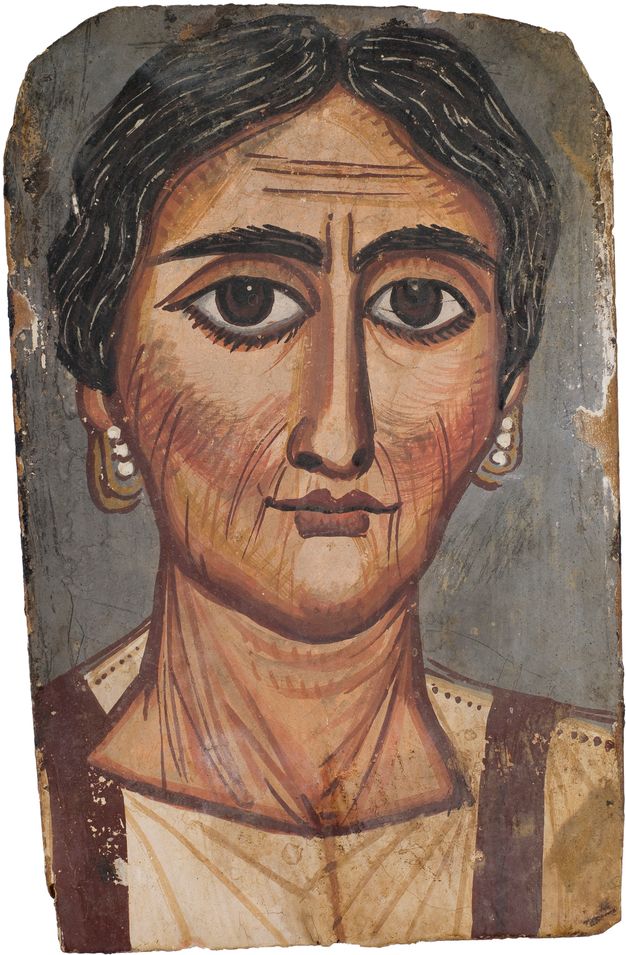
Klaus Parlasca associated the work of the Saint Louis Painter with portraits that had been attributed to the so-called Würzburg Painter based on the portrait of the mature bearded man now at the Martin von Wagner Museum, Würzburg (app. no. 13; fig. 11.2).5 Parlasca also noted the artist’s flat pictorial style that tends toward a definite schematism and dates some of the examples to about 300 CE, yet others to about 325–350 CE.6
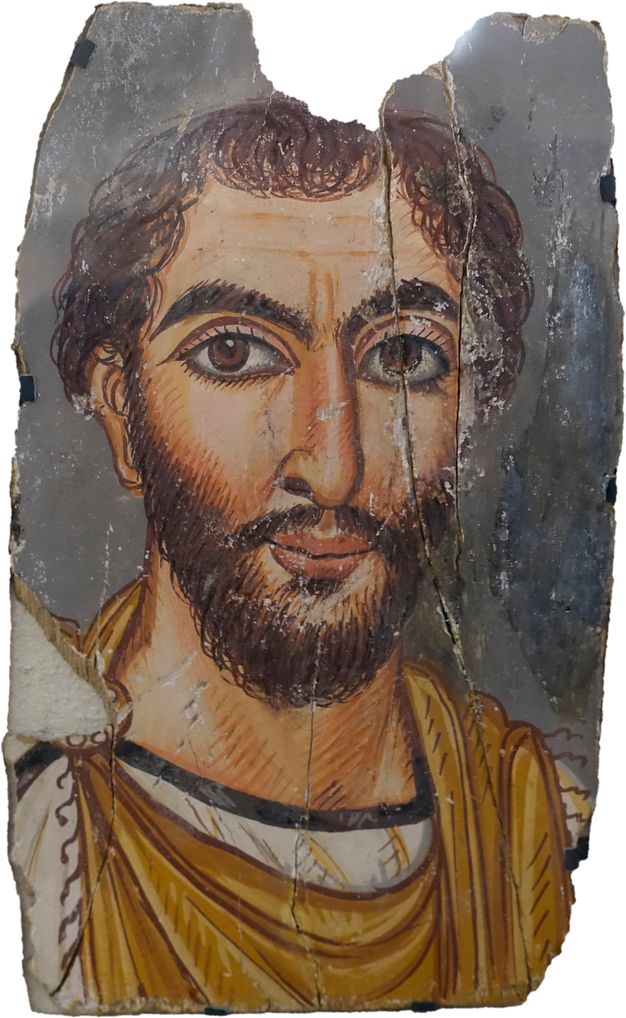
The attribution of over a dozen portraits to the Würzburg Painter, though not by that name, may be traced to Heinrich Drerup in his 1933 dissertation on the dating of the funerary portraits.7 Drerup was one of the first experts to recognize that the subjects’ hairstyles could offer clues for the purpose of dating the portraits.8 He was able to assign all specimens to the Roman Imperial age rather than the Ptolemaic period, as had been argued earlier by Georg Ebers.9 Drerup dated the portraits attributed to the Würzburg or Saint Louis Painter to the early Constantinian period (324–337 CE).10 Although he explicitly mentioned portraits of the woman now at the Harvard Art Museums (app. no. 3; fig. 11.3B) and of the elderly man at the Kunsthistorisches Museum Wien (app. no. 16; fig. 11.4C), in addition to the Würzburg painting, he did not specify which other examples he had in mind.11
Barbara Borg dates the Würzburg portrait significantly earlier, to about 190–210 CE, and relates its style to that of the famous tondo of the imperial family of Septimius Severus (r. 193–211 CE).12 Borg discusses the portraits at the Pushkin State Museum of Fine Arts (app. no. 2; fig. 11.3A) and in Saint Louis among a group of female portraits with a chignon coiffure, which she dates to about 165–190 CE on account of similarities with the hairstyles of the empresses Faustina Minor, Lucilla, and Crispina.13 Without mentioning the Saint Louis Painter or the site of the workshop, she implicitly attributes at least nine “impressively expressive” portraits to this artist, considering them among “the last of the more naturalistic tempera portraits.”14 Borg does not address the relationship between the Saint Louis Painter and the Würzburg Painter and, to reiterate, dates the relevant works to a time span of nearly half a century, from about 165 to 210 CE.
The present study is based on twenty-five portrait paintings that may be considered closely related based on stylistic features (see app.; eighteen are illustrated in this paper, figs. 11.1–11.4).15 These artistic characteristics and techniques are addressed first. The discussion will clarify the stylistic features attributed to the same workshop, if not the same painter. It will also illustrate the relative variance of identifiable characteristics. Next, an analysis is provided of the portrait features, such as basic outlines and the subjects’ positions. This analysis will allow me to delve further into aspects of the paintings, particularly the subjects’ physiognomy and proportions. Hairstyles, generally considered a potential dating method, as well as jewelry and clothes, will not produce firm chronological indicators. Questions about the possibility of attributing the selection of twenty-five portraits to the same artist or workshop are then addressed. The last section brings together some of the scientific examinations performed on the paintings, mostly as a result of the Getty’s APPEAR project. Such analytical data is sourced to identify similarities in the materials chosen for the creation of the portraits as a means of corroborating possible attribution to an artist or workshop.16
Artistic Characteristics and Techniques
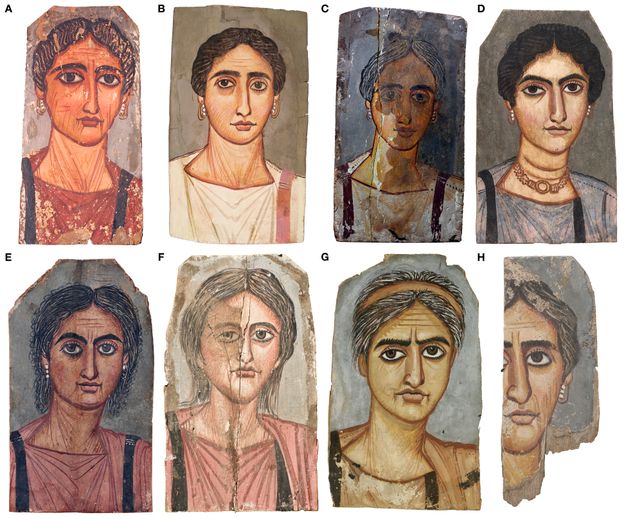
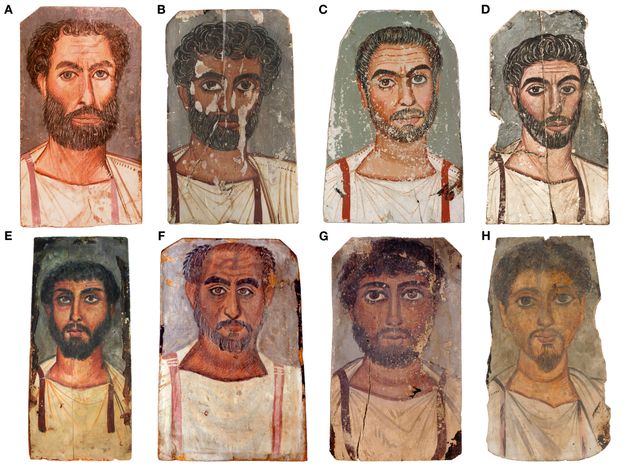
As Thompson recognized, one of the most characteristic features of the Romano-Egyptian portraits associated with the Saint Louis Painter that immediately catches the viewer’s attention is a distinctively graphic hatching technique.17 While this may be more or less the case for about half of the examples here suggested to belong to the same workshop, in other examples the technique is admittedly less apparent or simply absent. For example, the technique is much less evident on the female portraits at the Yale University Art Gallery, Universität Zürich, Antiken Sammlung (the Ancient Collection of the University of Zurich), and the British Museum (app. nos. 8, 9, and 12; figs. 11.3E, G, and H), as well as the male portraits at the Stockholm National Museum and the Los Angeles County Museum of Art (app. nos. 17 and 22; figs. 11.4D and H). This feature is difficult to discern on the examples sold on the art market (app. nos. 11 and 25; not illustrated). It is entirely absent on the female portrait at the Rosicrucian Egyptian Museum in San Jose, the two male portraits at the British Museum, and the paintings in Rhode Island and Vienna (app. nos. 3, 20, 21, and 23; figs. 11.3C and 11.4H). This absence might be taken as evidence that the relevant paintings were not the work of the same artist as the others. Conversely, it might indicate that the painter, his workshop, or the wider artistic circle was prone to some variation. The intermediary cases where the lines of hatching are less easily distinguished might actually represent a sliding scale of artistic variation.
The portraits exhibit little sense of perspective apart from a slight turn away from the viewer, generally indicated by a foreshortening of the proper left side of the face, and often by transverse, twisting lines in the neck. About half of the male portraits, nevertheless, are shown in full or almost frontal view. The style may best be described as expressionistic. Individualizing facial features are painted with usually fairly thin, vivid brushstrokes. These features are applied over an initial outline drawn with broader strokes in simple contours, generally in the same dark tone as the vertical stripes of the tunic. A simplified representation of this outlining for six of the female portraits illustrates how similar these contours really are (fig. 11.5).
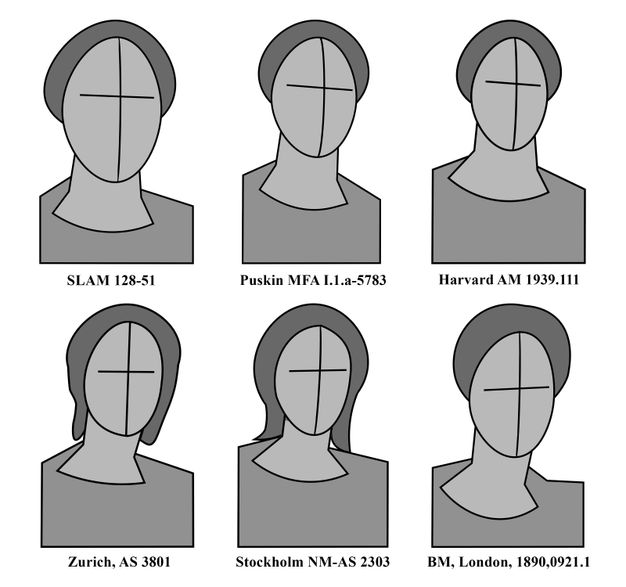
The parallel or crosshatched lines (often at angles of 30°, 45°, or 60°), which are applied to suggest shade and/or volume, are often found along the hairline and the side of the face, as well as on the neck, but less often elsewhere—for instance around the eyes. Occasionally, however, shades and volume have been painted in broad (gradient) tones. On two female portraits, curving lines appear to indicate shadows thrown by the locks or curls of the hair (viz. on the Yale and Zurich paintings, app. nos. 8–9; figs. 11.3E and H). On the portrait of the elderly woman in the British Museum (app. no. 12; fig. 11.3G), the painter has attempted to indicate highlights on the face—over the brows, across the nose, under the eyes, and on the chin. On the portrait of a young man sold on the art market (app. no. 25), unusual yellowish-pink highlights are drawn under the eyes, along the rim of the nose, in the nasal-labial area, and along the outline of the mouth, while the philtrum is shaded in dull brown.
Features and Position
Of the twenty-five panel paintings under examination, twelve portray women. Of these female portraits, half appear to depict elderly women (over sixty years old), another one shows a middle-aged woman (ca. forty-five to sixty years old), four more portray mature women (ca. thirty to forty-five years old), and just one shows a younger woman (ca. fifteen to thirty); none of them portray children (fig. 11.6). This age distribution is significant foremost because the average life expectancy at birth for women in Roman Egypt was typically low, about twenty years of age, though members of the wealthier classes may be expected to have lived longer.18 Additionally, the apparent age distribution contradicts the assumption that portraits of mummified persons represent an idealized, youthful beauty standard. In connection with this notion of beauty ideals, it should furthermore be emphasized that the portrayed women exhibit a similar complexion to their male counterparts—ranging from a soft yellowish-tan to a warm copper tone, at times with an added pinkish blush on the cheeks—rather than the pale white skin expected for women of the Graeco-Roman upper class.19 (Compare, for instance, the difference between the skin colors of Terentius and his wife, fig. 11.10.)
| Category | Age | Male | Female | Total |
|---|---|---|---|---|
| child | 0–15 | – | – | 0 |
| young | 15–30 | 8 | 1 | 9 |
| mature | 30–45 | 2 | 4 | 6 |
| middle-aged | 45–60 | 1 | 1 | 2 |
| elderly | 60+ | 2 | 6 | 8 |
| Total | 13 | 12 | 25 |
In light of their represented ages, it is no surprise that the foreheads of most women are furrowed with wrinkles and/or frowns; only the younger but still mature ladies on the Harvard and San Jose portraits have smooth foreheads (figs. 11.3B and C).20 They all have bushy black or brownish black eyebrows that typically curve unevenly so as to emphasize the asymmetry of the face. The eyes are, without exception, expressively stark and disproportionally large, with long eyelashes. They may occasionally be unevenly set, asymmetrically sized, and/or drooping. The eyes have large, usually brown irises with black pupils and small white dots of reflected light, all with limbal rings. In most portraits, the insides of the eyes are outlined in the same shade of gray as the background of the panel; ocular sockets are marked with semicircular folds over the eyes. The upper lids tend to pass over the lower lids at the outer corners. In only two examples is a single tear duct indicated (figs. 11.3C and G). Sagging flesh is generally drawn underneath the eyes with curved lines or darker shades of color. The ears are mostly covered by hair; what remains visible of the ear is usually no more than a curved line. If an attempt was made to draw the earlobes, they seem to be attached.
A common feature is the anatomically awkward and elongated nose. The nostrils are typically indicated with dark dots, and often the proper left nostril is barely visible due to foreshortening. Although Thompson recognized this feature as one of the hallmarks of the group of portraits in question, occasionally the nostrils are rendered more successfully (e.g., on the Harvard and Zurich portraits, figs. 11.3B and E).21 Cheeks may be round and full, flat, or bony and hollow. The lower face is often creased with wrinkles and has folds from the nostrils and/or the corners of the mouth. Without exception, the mouth is full, with a Cupid-bowed upper lip and a fleshy lower lip. Occasionally the lips are pursed or puckered, and in one example (fig. 11.3C), both lips are outlined. A dimpled philtrum is indicated on three female portraits (figs. 11.3B, F, and H). The corners of the mouth are mostly rendered with short, rounded strokes, but in one example (fig. 11.3G) the proper left corner has a little dimple. The women invariably have full, round chins; their jawlines may be slanting, jutting, long, or round. Their necks suggest wrinkles or sagging flesh, while one example (fig. 11.3D) has Venus rings and in another example (fig. 11.3C) the neck is smooth.
The thirteen male portraits display a somewhat wider range of age distribution than the women (figs. 11.4 and 11.6). Only two depict elderly men (over sixty years old), and just one can be said to be middle-aged (ca. forty-five to sixty years old). Two more portray mature men (ca. thirty to forty-five years old). The remaining eight represent young men (ca. fifteen to thirty years old), of whom three seem to be adult (ca. twenty to thirty), while the remaining five may be younger (ca. fifteen to twenty) and, significantly, seem to be more distantly related to the Saint Louis and Würzburg portraits (or is that the consequence of the portrayal of their younger age?). The average male life expectancy at birth, about forty years, was higher than it was for women in Roman Egypt.22 Still, it remains notable that there are fewer middle-aged and elderly men represented than middle-aged and elderly women. The complexions of the men display a similar range to those of the women. Skin tones range from a pale yellowish to a warmer copper tan. Occasionally the complexion may shade into a darker sienna tan. In the case of the young man in the Kunsthistorisches Museum (app. no. 24), the skin tone is exceptionally pink.
The shape of the male heads is generally elongated (and occasionally more angular), at times even more so than the women’s. Their foreheads are either smooth or furrowed with wrinkles and/or frowns. Like the women’s brows, the men’s black or brownish black eyebrows are usually thick and bushy and tend to curve or arch. Sometimes there are a few hairs on the bridge of the nose. Also much like the portraits of the women, the stark eyes are typically expressively large. Sometimes they are broadly outlined in black. If they have lashes, they are either thin and short or thick and long. The eyes have mostly large brown irises, fairly often with dark limbal ring outlines, black pupils, and normally some white dots of reflecting light. The sclera may be outlined in the same grayish tone as the background of the painting. Tear ducts are often indicated (sometimes only in the proper right eye). In two examples, the inside corners of the eyes show red blood vessels (app. nos. 20 and 22; fig. 11.4H). Ocular sockets are invariably marked above the eyes with semicircular folds. The upper eyelids tend to pass over the lower lids at the outer corners. Below the eyes, dark shades of sagging bags may be indicated to suggest aging, fatigue, or both. At times, though, the eyes appear slightly closed, almond-shaped (app. nos. 18 and 20; fig. 11.4E), or of comparatively smaller size (app. no. 23). The irises of the portrait of the young man in the British Museum (app. no. 20) are green, and on the Rijksmuseum van Oudheden portrait (app. no. 14; fig. 11.4A) gray (not blue).
While on some male portraits the outer ears are simply depicted as curved lines, on over half an attempt has been made to depict the ear more naturalistically. In two cases, this even includes unattached earlobes (app. nos. 22 and 25; fig. 11.4H). Noses are typically elongated and usually straight, but occasionally broad or crooked. Nostrils are mostly rendered anatomically awkwardly, with dark dots for the openings, even if the proper left nostril is barely visible due to foreshortening. Some portraits do display an attempt to draw the nose in a more naturalistic manner. In nearly half the cases, a philtrum is indicated. The mouth is generally fleshy, with a Cupid-bowed upper lip and a (sometimes smaller but still) full lower lip. The mouth is occasionally pursed, puckered, or curved in a gentle smile. Corners of the mouth may be indicated with short strokes or as shadows. Because of their facial hair, many of the lower faces, cheeks, jaws, and chins remain difficult to determine. The general outline of the lower face, however, appears to range from squarish to elongated or pointed. The cheeks vary from flat or bony to round. Occasionally the face is aged with wrinkled creases, while on the younger men the skin may be described as soft and smooth.
An aspect that has little to do with artistic techniques or portrait features is the pose. The portraits are typically depicted nearly frontally, slightly turning toward the viewer’s right, and with a slight foreshortening effect in the proper left side of the face, occasionally making the proper right ear nearly or fully invisible. The angles of the necks and the twisting lines on their skin further emphasize the slight turn away from the viewer. Seven subjects are portrayed even more frontally, their shoulders sloping approximately symmetrically. In the other cases, where the person is turned slightly to the viewer’s right, their shoulders are generally at different levels and angles—with the proper right, near shoulder somewhat higher and the left shoulder at a more oblique angle. A notable exception is the mature bearded man at Staatliche Museen zu Berlin, Antikensammlung (app. no. 18; fig. 11.4E), whose head is slightly turned to the viewer’s left and whose shoulders are slanting as if seen frontally. The subjects’ heads are nearly always upright. Only two men’s heads are slightly tilted to the viewer’s left (app. nos. 16–17; figs. 11.4C–D). These major similarities in the basic positioning of the portraits form yet another confirmation that this group of paintings likely derive from the same workshop.
Physiognomic Proportions
Since the paintings only feature disembodied heads, the general physiognomic proportion cannot be expressed in relation to the rest of the body (fig. 11.7). If we take the Pushkin portrait as a starting point (figs. 11.3A and 11.7, top left), it appears that the facial proportions follow a grid of 10 x 12 units, as proposed by Thistlewood for the Romano-Egyptian funerary portraits in general (fig. 11.8).23 The dimensions of the general ellipse describing the face are 2:3 for width-to-height. However, the painter has adjusted the grid to achieve perspectival effects. The vertical lines are slanted at an angle of 4°—most notably at the eyes and mouth but also the brows. We find the root of the hair at the first tenth from the top of the head. The eyes are on the middle horizontal line, with the brows one-tenth above the eyes. The earlobes are in the middle of the seventh unit. The middle of the nose is at the crossing of the seventh horizontal and the central vertical. The mouth is placed on the eighth grid line, and the middle of the chin is about one-tenth from the bottom of the face.
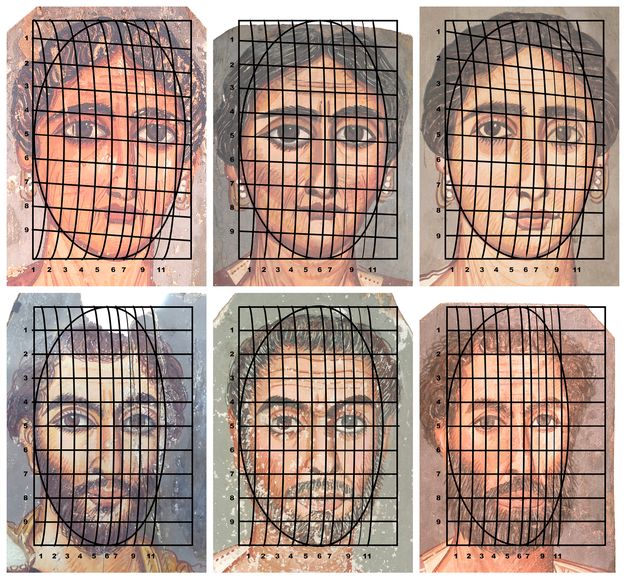
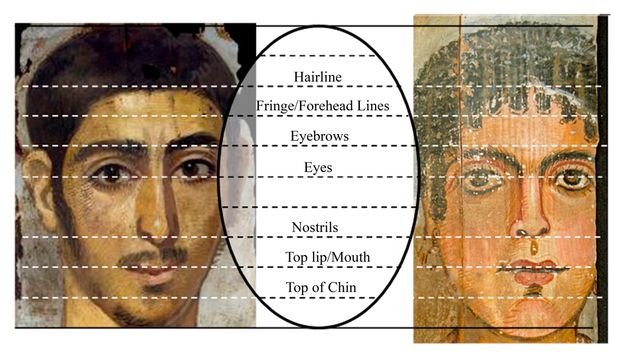
The grid is further adjusted by using semi-elliptical curves instead of straight lines for the verticals, to suggest volume. The central vertical passes between the eyes at a shift of one unit to the (viewer’s) right. The vertical lines to the (viewer’s) left of the center have been shifted accordingly. We find the inner corner of the proper right eye, as well as the nostril, one unit from the center. The outer corner of the mouth is at the second grid line. The middle of the pupil, however, is drawn about a quarter unit from the third line toward the center (to better fit the iris in the eye). The outer corner of the proper right eye is on the second vertical from the outside of the face, and the end of the brow is on the first line. To indicate the effect of foreshortening due to the turning of the head, the proper left side of the face has been reduced by half a grid unit. Here we find the inner corner of the eye, as well as the nostril, on the first line from the center, and the outer corner on the first line from the outside of the face. The pupil is perfectly centered between the inner and outer corners of the eye; the iris falls neatly between the eighth and tenth verticals.
Comparing the Pushkin portrait with the Saint Louis painting (fig. 11.7, top center), it is obvious that the artist employed the same basic grid of 10 x 12 units to divide the general ellipse that describes the face, and at the same dimension of 2:3. However, there are some minor deviations because the Saint Louis portrait is more frontal than the Pushkin portrait. The vertical lines are slanted at 2.5° (instead of 4°), and consequently the vertical lines are less curved. The central vertical is shifted to the (viewer’s) right by about one-third unit, while the outside of the face is shifted a unit to the (viewer’s) left. The inner corners of both eyes and the nostrils, as well as the corners of the lower lip, all fall on the first vertical from the center. Both irises are spaced on the inner side of the eyes on the second grid line from the center, and the corners of the upper lip are drawn on the same vertical. However, while the proper left pupil is positioned nearly on the third vertical, the right pupil is centered in the middle of the third unit from the center. Notice, furthermore, that the proper left earlobe is drawn in the middle of the seventh unit, while the right earlobe is placed on the seventh grid line.
The Harvard portrait (fig. 11.7, top right) exhibits a surprising feature in the grid system of 10 x 12, for the horizontals are best understood to approximate a vanishing point of perspective to the viewer’s far right of the face, in which the ninth line is perfectly horizontal while each line above is slanted at increasing increments of 1°, so that the first line below the top is at an oblique angle of 8°. The right eyebrow is drawn just above the fourth horizontal line, while the left brow curves over that line. The corners of the right eye are placed about a quarter above the fifth line, but the proper left eye is slanting inward, so that the inner corner lies neatly on the fifth line. The mouth (that is, the bottom of the upper lip) is found about a quarter below the eighth line. Also notice that the proper right earlobe is almost half a unit lower than the other. Vertically, the proper right side of the face has shifted two-thirds of a unit beyond the central line (to the viewer’s right), while the outside line of the other side of the face has shifted inward by another two-thirds. On the proper right side, most features are placed where they would be expected, except that the inner corner of the eye is in the middle of the second unit from the center and the pupil is neatly centered on the third line. On the other side, the outer corner of the left eye is in the middle of the second unit from the outside rather than on the penultimate line.
If we turn to the Würzburg portrait (fig. 11.7, bottom left), it is immediately apparent that the grid of 10 x 12 has been significantly adjusted, both horizontally and, to a lesser extent, vertically. First of all, the general oval describing the face is much more elongated, at a dimension of 11:13 (instead of 2:3), and the top line of the oval falls a whole unit above the top of the head. If we follow the horizontal lines down the grid, we do find the hairline on the first horizontal, the brows on the fourth, the tip of the nose on the seventh, the mouth on the eighth, and the middle of the chin on the ninth. The eyes, however, are aligned on the central horizontal (rather than about a quarter unit above), in such a way that the proper left eye is neatly horizontal on the fifth line, and the inner corner of the proper right eye lies also on that line, but its outer corner lies above it at an angle of 4°. Looking closer, we notice that the left brow is actually placed a little higher than the right, thus exaggerating the asymmetry. The mouth is even more slanted than the right eye, namely at an angle of 5°. Vertically, the six curved lines of the proper right side of the face (the viewer’s left) are evenly spaced, without too much deviation from the expected placements, apart from the eye, which is placed just to the (viewer’s) left of the third vertical (thus centered in the middle of that side of the face). The proper left side, conversely, is reduced in width—to suggest foreshortening—by a third (two whole units). The placement of the facial features nonetheless follows the established pattern.
A second male portrait, the Leiden painting (fig. 11.7, bottom right), compares very well with the Würzburg portrait. Notice, however, that the face is even more elongated. For while the central vertical has shifted just a third to the (viewer’s) right, the outside of the face has shifted two whole units to the (viewer’s) left, thus much reducing the width of the proper left side. Other than that, the (flattened) top of the head is again one grid line below the top of the oval describing the face, and all other vertical alignments are similar to the Würzburg painting. The eyes are slanted curiously, though, as they both droop to the (viewer’s) left.
Finally, the Vienna painting (fig. 11.7, bottom center) aligns fairly well with the previous two male portraits. Starting with a clockwise rotation of 6°, the main difference from the preceding two examples is that the width of the face in this example corresponds more with that of the female portraits discussed above. The width of the proper right side has increased by a shift of half a unit, while the outside of the (viewer’s) right of the face has shifted inward by one and a third unit. The top of the head is closer to the tip of the oval, but the hairline remains on the second horizontal. As on the male portraits, the eyes are drawn in the middle, on the fifth lines. On the vertical grid, the inner corner of the proper right eye falls in the middle of the second unit from the center (rather than on the first vertical from the center), while the outer corner of the left eye falls on the tenth grid line (rather than on the eleventh, as on most other paintings).
This is not the place to go into further detail about the proportions of the other specimens possibly attributable to the Saint Louis Painter’s workshop or its wider circle. Nor is it the place to compare the preceding observations with the so-called Egyptian Canon of Proportions.24 Suffice to say that few conventional ancient Egyptian paintings have survived, and that on comparable two-dimensional imagery, Egyptian tradition dictated that heads were portrayed in profile, and rarely frontal, but certainly never in three-quarters view (fig. 11.9).25 Moreover, no comprehensive examination of facial proportions in ancient Egyptian art exists, even for sculpture. A quick comparison with the portraits of Terentius Neo and his wife on a wall painting from Pompeii demonstrates that their proportions follow the same basic division in 10 x 12 units (fig. 11.10).26 (Note, however, that the adjusted vertical lines accommodate facial features slightly differently.) Finally, it bears emphasizing that these subdivisions diverge both from the ideals expressed by Vitruvius and from actual human anatomy—neither of which prescribes such expressively large eyes or elongated heads.
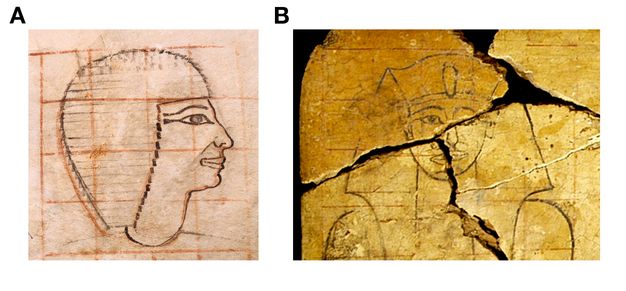
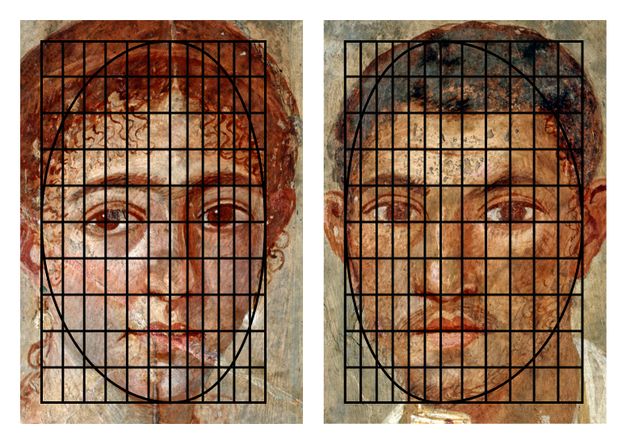
Returning to the portraits under examination, it can be safely concluded that the artist(s) creating these paintings did not employ the grid system in any hard-and-fast manner by drawing it out on the panel with a ruler. From the slight deviations and variations, it can be deduced that the grid was applied intuitively. This is significant to bear in mind for the following two reasons. In the application of the grid system of 10 x 12 units and employing a general ellipse of approximately 2:3, the portraits under question can be shown to belong to the wider Romano-Egyptian corpus of portrait paintings. Conversely, slight deviations and variations from the basic grid cannot be taken as proof that the portraits do not belong to the corpus—either of the Romano-Egyptian funerary portraits in general or of the Saint Louis Painter in particular. Such deviations are therefore no indications of suspected inauthenticity. The conventions and traditions of portrait-painting left room for individual intuition and invention.
Hairstyles, Jewelry, and Clothes
The women’s hair is nearly always graying brown, black, or brown-black (fig. 11.3). It is usually wavy but occasionally straight, mostly parted in the middle, and pulled to the back or bound in loose locks to the sides, often partially covering the ears. The hair falls down in loose frizzy locks or in untidy long strands to the shoulders. The hair on the portrait of the elderly woman in the British Museum (fig. 11.3G) is bound by a headband. Although female coiffures generally tend to offer significant clues for the dating of Roman portraits, the hairstyles as described above are too generic to be chronologically useful. In the two cases where the hair falls down in frizzy or untidy locks, we may consider Parlasca’s suggestion that the coiffure signifies mourning.27 Nonetheless, we may wonder why the deceased would be portrayed in mourning.
The men’s fairly simple hairstyles are mostly short and occasionally full, usually with wavy, curly, or frizzy locks of gray or graying brown, black, or brown-black hair (fig. 11.4). It may be combed neatly forward or fall down over the forehead. Sometimes the hairline recedes above the temples. The hair may either partially conceal the ears or expose them. One of the paintings in the Freud Museum (fig. 11.4F) portrays a balding and wreathed man. One of the male subjects in the British Museum (fig. 11.4G) seems to wear a thin headband in his short wavy hair. The young man at RISD (app. no. 23) has a golden wreath over his frizzy curls. As in other respects, the Würzburg portrait (fig. 11.2) stands apart in the hairstyle it shows, as the man is coiffed with curly dark brown hair combed in bangs, with a receding hairline over the temples and thinning to the sides. These simple hairstyles do not provide any firm chronological clues.
All of the male portraits additionally show various types of facial hair, adding distinct features to the faces. The men are shown with short and thin—or long and full—dark or graying brown, black, or brown-black, occasionally neatly groomed beards; and slanting, drooping (or handlebar), occasionally trimmed moustaches. The portrait once at Puhze (app. no. 25) has full side-whiskers. The young man at RISD (app. no. 23, RISD portrait not illustrated) has a beard but no moustache.
The only piece of jewelry worn by a man is the round brooch with pearls that fastens the mantle in the Würzburg portrait. As mentioned above, the young man at RISD (app. no. 23) wears a golden wreath with diamond-shaped leaves. His head is also crowned with a large wreath, perhaps of rose petals. The balding man in the Freud Museum (fig. 11.4F) seems to wear a kind of wreath, too.
Nearly all of the women have the very same looped ear pendants, each with three white pearls on a small vertical bar. They are mostly drawn in the same style, with ochre indicating the gold of the loops, and dark lines indicating shadow and outlining the contours. The elderly woman in the British Museum (fig. 11.3G) wears a faded terracotta-colored headband in her gray hair. Three portraits show women wearing another piece of jewelry, namely an intricately torqued golden necklace with a central medallion—perhaps decorated with a Medusa’s head (app. nos. 5, 6, 11; fig. 11.3D). It is important to draw attention to the general absence of rich jewelry, as well as of fashionable coiffures; even the clothes are rather plain—often no more than a simple striped tunic. The portrayed individuals must have been among the wealthier citizens of Philadelphia for their family to afford the expense of commissioning a portrait for the deceased’s mummified remains. Apart from examples such as the Würzburg portrait and the painting once offered at Christie’s (app. no. 11), most individuals appear rather “middle class” instead of exhibiting the affluence of their elite status.
With the exception of the Würzburg portrait and the Yale portrait fragment (figs. 11.2 and 11.3h), the catalogued portraits depict nearly identical dress: a basic draped tunic with one or two stripes, often with dots representing seams along one or both shoulders (sometimes only on the stripes, sometimes over the mantle, where seams would not be expected), and an accentuated, hemmed neckline, occasionally with threads in one or both corners of the neckline. About a dozen wear a mantle draped over their left shoulder. It bears emphasizing that the way in which the neck and neckline are outlined on all the portraits exhibits very little variation: on either side of the vertical outline of the neck, two diagonal lines widen toward the neckline of the tunic, which is drawn in a curve, two straight oblique lines, or a kind of downward-pointing accolade. The pleats of the tunic are generally drawn in oblique lines that follow a wide V-shape. Only a few cases have curved folds, and a single example has squiggly pleats.
Five of the portrayed women wear clothes in some shade of red, ranging from rose-taupe (light purple) and sienna (dark, moderate reddish-brown) to pale terracotta (faded orange-brown). The color is probably meant to represent the common red lake dye, madder, rather than the costly Tyrian purple dye. In all five cases the stripes on the tunics are black. All other subjects, irrespective of gender, wear clothes in shades of beige and white. The stripes on the clothes show more variation: from pale to dark, mostly desaturated, grayish or brownish shades between purple and orange. Only the Würzburg portrait (fig. 11.2) deviates from this basic costume, as the subject is here dressed in a draped white tunic with a broad black hem at the neckline and wears a fringed and draped ochre cloak, which is fastened on his right shoulder with a brooch.
Workshop, Master, and Apprentices
The possibility presents itself that the portraits themselves were painted in different stages. For instance, the stylistic differences between the often rather schematic outlines (drawn in broad, dark strokes) and the expressionistic details (painted in thinner, vivid brushstrokes) may well indicate not only two different stages of production but two different hands—an apprentice’s and the master’s, respectively. That might lead to the conclusion that the more schematic outlining that distinguishes most, if not all, of these portraits might belong to a workshop, a wider artistic circle, or even a school of portrait-painting, while the expressionistic portrait features that characterize many, though not all, could be the work of the same artist.
While there is little to no evidence to reveal where or how Romano-Egyptian portraits were created, one tantalizing clue is famously provided by a sketch drawn on the back of a portrait from Tebtynis, now in the Phoebe A. Hearst Museum of Anthropology, University of California, Berkeley (fig. 11.11).28 For on the back of the panel are written instructions in Greek, such as σιτόχρωμος (lit., “wheat-colored” [of the hair?], perhaps “fair-colored” [of the skin]); and ἡδυτέρου[ς] ὀφθαλμούς (lit., “more pleasant eyes,” probably “[paint] the eyes softer”).29 Perhaps these notes should be understood as instructions from the master to a pupil or apprentice.
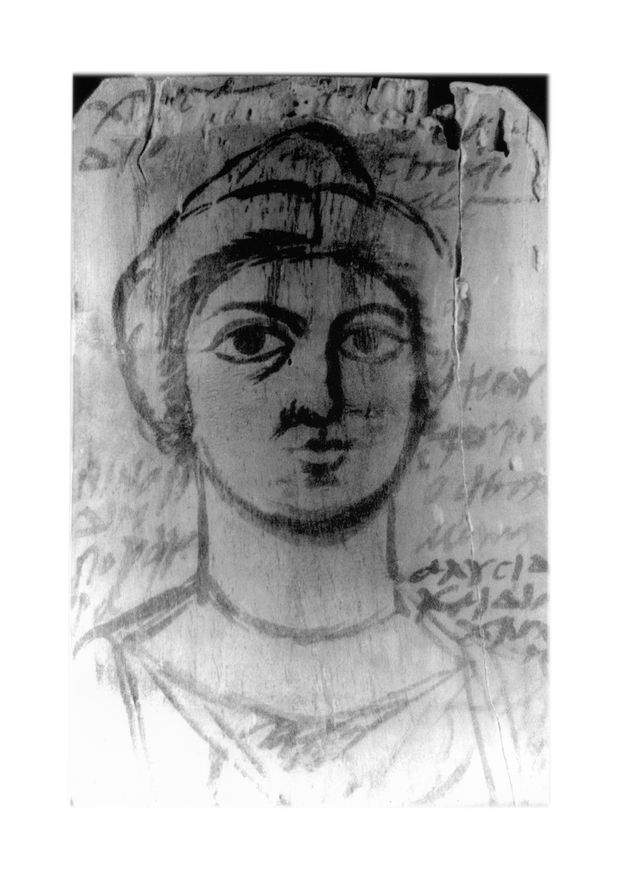
If we accept the hypothesis that the portraits attributed to the same artistic circle were produced in two stages and perhaps reveal the hands of more than one individual—a master and apprentice(s)—a further suggestion presents itself, namely that the outlines without individualizing portrait features were drawn in a kind of assembly-line process. This might imply that the workshop had a great variety of generic panels at the ready when the customer arrived to commission a portrait of their deceased family member. This would explain how nearly all twenty-five examples show nearly identical clothes, which are either white with reddish stripes or reddish with black stripes. A little under half wear a mantle (not always properly understood). The only significant exception in this respect is the Würzburg portrait (fig. 11.2), on which the bearded man wears a fringed ochre cloak, fastened with a brooch, over a white tunic with a black-hemmed neckline. Perhaps, then, this portrait was entirely or largely painted by the master—and/or was a more expensive option at the workshop. Additionally, the color of the dress (beige-white or red lake) was apparently not—or at least not only—determined by the gender of the deceased and may have therefore been decided on the basis of considerations such as availability or expense.
Materials, Shapes, and Sizes
The wood on which the Romano-Egyptian funerary portrait panels were painted is mostly hardwood, such as linden (lime tree). Some 75 percent of the sampled panels are proven to be a species of Tilia.30 To the best of my knowledge, fewer than half of the panels discussed here have been examined for their wood type. The specimen in Saint Louis was made of willow (Salix sp.).31 At least four were made of fig wood (Ficus sycomorus), three are oak (Quercus sp.), another two are made of tamarisk (Tamarix sp.), and none of the 25 panels have thus far proven to be of linden. That is to say that if the attributed paintings are all accepted to derive from the same workshop, the artist(s) used different kinds of wood for the portraits’ panels—and therefore the type of wood cannot be taken as an indication of workshop or provenience. Most of the panels measure between 27 and 37 cm in height and 15 to 22 cm in width. The mature bearded man in Berlin is exceptionally tall at 41.5 cm, while the fragmentary Yale panel measures 24.5 x 9.5 cm. The panels that have been measured are less than 1 cm in thickness.
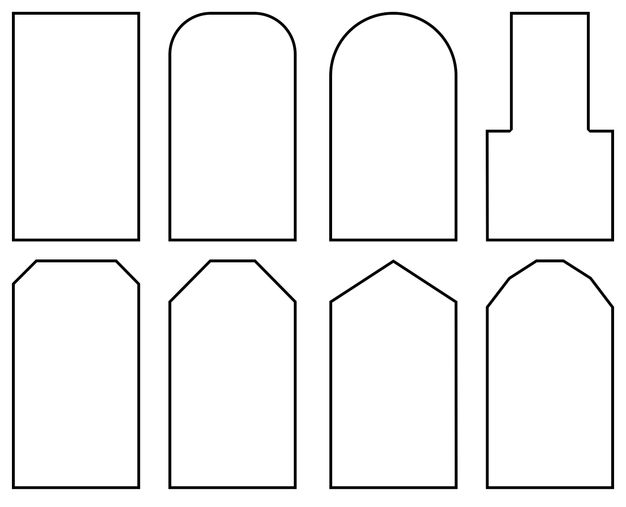
Few panels are fully rectangular in shape. The basic panel shapes of the portraits in general can be described as rounded, angled, or stepped (fig. 11.12)—all indicating the manner in which the top edges have been cut to facilitate the portraits’ eventual placement within the wrappings of the mummified person. Most of the paintings catalogued here display variations of the angled type, in which the upper edges are cut at a slanting or oblique angle. Their lower edges are straight. Eight of the examples are slightly tapered to the top. Four are unevenly or irregularly shaped. The Harvard panel (fig. 11.3B) was originally rounded at the top. The LACMA panel (fig. 11.4H), conversely, is rounded at the bottom. This variation in the panel shapes would seem to indicate that a workshop did not necessarily keep to one single type, even if the majority here are of the angled-edge type.
The plain backgrounds of the paintings display little variation among light, medium, or dark bluish- or greenish-gray. The artist used a color palette consisting of shades of red and pink; only occasionally blue, green, and orange; and additionally yellow, ochre, brown, black, gray, and white.32 For white pigments, not only calcite (e.g., calcium carbonate) or gypsum (calcium sulfate) but occasionally alum or lead white are attested. Black was mostly derived from charcoal (carbon), but also from bone char. Red could be sourced from madder or minium as well as realgar. Iron oxides such as ochre provided yellow, red, and brown pigments. Egyptian blue (calcium copper silicate) was not identified through imaging or analysis during material examinations of these portraits. Insufficient analyses have been performed to confirm if the tempera binder in the relevant examples is animal- or plant-based. The information currently provided about Romano-Egyptian painting technique—as being (hot or cold) encaustic or (wax) tempera—is confusing, misleading, and occasionally contradictory.33
Conclusion
The twenty-five Romano-Egyptian portrait panels from ancient Philadelphia in the Fayum Oasis exhibit artistic characteristics that may allow their attribution to the same painter or group of painters working together. These features, foremost, include a similar expressionistic style, in addition to nearly identical portrait outlines and physiognomic proportions, as well as similar brushstrokes in just two or three different sizes, and a fairly basic palette of pigments. More individualizing portrait aspects are found in hairstyles and, in the case of the male portraits, facial hair. While the clothes are generally similar, attributes such as jewelry (in some cases) add variety to the paintings too. In terms of panel shapes, wood types, and pigments, the group of paintings exhibit more variety than they provide indicators for attributing the portraits to the same artist or workshop.
Finally, while the attribution to either the Saint Louis Painter or the Würzburg Painter has become convention in specialized circles, it may be more appropriate to reattribute the portraits to an ancient Philadelphia painters’ workshop.34 Maybe there were more painters’ workshops active at the same time in the area. There were certainly different painters producing portrait panels in ancient Philadelphia over time, such as the so-called Brooklyn Painter. A look at how these different painters or workshops were related would further contribute to and expand such focused studies.
Abbreviations
BM British Museum, London, U.K.
EMC Egyptian Museum, Cairo, Egypt
FREM Freud Museum, London, U.K.
HAM Harvard Art Museums, Cambridge, MA
KHM-AS Kunsthistorisches Museum Wien, Antikensammlung (Art Historical Museum, Ancient Collection), Vienna, Austria
LACMA Los Angeles County Museum of Art, Los Angeles, CA
MANN Museo Archeologico Nazionale di Napoli (National Archaeological Museum of Naples), Naples, Italy
MvWM Martin van Wagner Museum, Würzburg, Germany
PHMA Phoebe A. Hearst Museum of Anthropology, Berkeley, CA
PMFA Pushkin State Museum of Fine Arts, Moscow, Russia
REM Rosicrucian Egyptian Museum, San Jose, CA
RISD Rhode Island School of Design, Providence, RI
RMO Rijksmuseum van Oudheden (National Museum of Antiquities), Leiden, the Netherlands
SCMA Smith College Museum of Art, Northampton, MA
SLAM Saint Louis Art Museum, St. Louis, MS
SMB-AS Staatliche Museen zu Berlin, Antikensammlung (State Museums at Berlin, Ancient Collection), Berlin, Germany
SMME Medelhavsmuseet (The Museum of Mediterranean and Near Eastern Antiquities), Stockholm, Sweden
SNM Ant. Nationalmuseum, Stockholm, Antikviteter (Swedish National Museum, Antiquities), Stockholm, Sweden
UZH-AS Universität Zürich, Antikensammlung (University of Zurich, Ancient Collection), Zürich, Switzerland
WAMA Wadsworth Atheneum Museum of Art, Hartford, CT
YUAG Yale University Art Gallery, New Haven, CT
Appendix
No. 1
Saint Louis Portrait (fig. 11.1)
Title: Elderly Woman with Graying Hair
Institution: SLAM 128:51
Collection: Graf (II)
Provenience: Rubayat
Parlasca 1969–2003, III: no. 520
Dimensions: 25.7 x 14.9 x 0.8 cm (10 1/8 x 5 7/8 x 5/16
in.)
Wood: willow
Pigments: carbon, gypsum, iron oxides, lead white, madder
Binder: “tempera”
Age: 60+
No. 2
Pushkin Portrait (fig. 11.3a)
Title: Elderly Lady in Red
Institution: PMFA I.1a 5783
Collection: Golenishchev, no. 4291
Provenience: Rubayat (?)
Parlasca 1969–2003, III: no. 519
Dimensions: 33.2 x 17.2 x 0.7 cm (13 1/16 x 6 3/4 x 1/4
in.)
Wood: fig
Pigments: carbon, gypsum, ochre
Binder: “tempera”
Age: 60+
No. 3
Harvard Portrait (fig. 11.3b)
Title: Woman with Black Hair
Institution: HAM 1939.111
Collection: Graf (II)
Provenience: Rubayat
Parlasca 1969–2003, III: no. 516
Dimensions: 32 x 19 x 0.5 cm (12 5/8 x 7 1/2 x 3/16 in.)
Wood: fig
Pigments: bone char, carbon, gypsum [bassanite and anhydrite],
red and yellow ochres, minium, madder, alum
Binder: animal glue
Age: 30–45
No. 4
San Jose Portrait (fig. 11.3c)
Title: Lady in White Tunic
Institution: REM RC-1759
Collection: Graf (II)
Provenience: Rubayat
Parlasca 1969–2003: n/a
Dimensions: 37 x 20.5 x 0.9 cm (14 9/16 x 8 1/16 x 3/8 in.)
Wood: n/a
Pigments: n/a
Binder: “tempera”
Age: 30–45
No. 5
Smith College Portrait (fig. 11.3d)
Title: Woman in Blue Tunic with Necklace
Institution: Smith College MA SC 1932.9.1
Collection: Graf (II)
Provenience: Rubayat
Parlasca 1969–2003, III: 556
Dimensions: 33 x 20.3 cm (13 x 8 in.)
Wood: n/a
Pigments: n/a
Binder: “tempera”
Age: 30–45
No. 6
Hearst Portrait
Title: Woman in Red Tunic with Necklace
Institution: PHMA 5-2327
Collection: Graf (II), no. 46
Provenience: “Kerke”
Parlasca 1969–2003, II: no. 494
Dimensions: 34.5 x 19 x 0.3 cm (13 9/16 x 7 1/2 x 1/8 in.)
Wood: fig
Pigments: gypsum, iron oxides (NB: no black?)
Binder: “tempera”
Age: 30-45
No. 7
Cairo Portrait
Title: Young Woman in Crimson
Institution: EMC CG 33.248
Collection: n/a
Provenience: Rubayat
Parlasca 1969–2003, III: no. 515
Dimensions: 35 x 19.5 cm (13 3/4 x 7 11/16 in.)
Wood: n/a
Pigments: n/a
Binder: “tempera”
Age: 15–30
No. 8
Yale Portrait (fig. 11.3h)
Title: Elderly Woman with Gray Hair
Institution: YUAG 2011.102.1
Collection: Pitt-Rivers via Chester (from Graf?)
Provenience: Rubayat?
Parlasca 1969–2003, IV: no. 856
Dimensions: 24.5 x 9.5 x 0.48 cm (9 5/8 x 3 3/4 x 3/16 in.)
Wood: oak
Pigments: n/a
Binder: “tempera”
Age: 60+
No. 9
Zürich Portrait (fig. 11.3e)
Title: Elderly Woman with Graying Hair
Institution: UZH-AS 3801
Collection: Graf (II)
Provenience: Rubayat
Parlasca 1969–2003, III: no. 518
Dimensions: 31 x 17 cm (12 3/16 x 6 11/16 in.)
Wood: n/a
Pigments: n/a
Binder: “tempera”
Age: 60+
No. 10
Stockholm Female Portrait (fig. 11.3f)
Title: Elderly Woman with Gray Hair
Institution: SNM Ant. 2303
Collection: Graf (II)
Provenience: Rubayat
Parlasca 1969–2003, III: no. 525
Dimensions: 32.5 x 19.5 cm (12 13/16 x 7 11/16 in.)
Wood: n/a
Pigments: n/a
Binder: “tempera”
Age: 60+
No. 11
Christie’s Portrait
Title: Middle-Aged Woman with Graying Hair
Institution: Christie’s, 9 December 2005, lot 85
[present whereabouts unknown]
Collection: Graf (II)
Provenience: Rubayat
Parlasca 1969–2003, III: no. 521
Dimensions: 35.2 x 18 x 0.3 cm (13 7/8 x 7 1/16 x 1/8 in.)
Wood: n/a
Pigments: n/a
Binder: “tempera”
Age: 45–60
No. 12
British Museum Portrait (fig. 11.3g)
Title: Elderly Woman with Grey Hair
Institution: BM 1890,0921.1
Collection: Chester (via Graf?)
Provenience: Faiyum District (?)
Parlasca 1969–2003, III: no. 517
Dimensions: 31.2 x 18.5 x 0.6 cm (12 1/4 x 7 1/4 x 1/4 in.)
Wood: fig (?)
Pigments: n/a
Binder: “tempera”
Age: 60+
No. 13
Würzburg Portrait (fig. 11.2)
Title: Mature Man with Beard
Institution: MvWM H2196
Collection: Graf (I), no. 44
Provenience: Rubayat
Parlasca 1969–2003, III: no. 497
Dimensions: 32.7 x 19.9 cm (12 7/8 x 7 13/16 in.)
Wood: n/a
Pigments: n/a
Binder: “tempera”
Age: 15–30
No. 14
Leiden Portrait (fig. 11.4a)
Title: Middle-Aged Man with Beard
Institution: RMO F 1932 /3.1
Collection: Graf (II)
Provenience: Rubayat
Parlasca 1969–2003, III: no. 514
Dimensions: 35.3 x 19.8 x 0.8 cm (13 7/8 x 7 13/16 x 5/16
in.)
Wood: fig (?)
Pigments: n/a
Binder: “tempera”
Age: 45–60
No. 15
Freud Portrait (fig. 11.4b)
Title: Bearded Man in White Tunic
Institution: FREM 4947
Collection: Graf (II)
Provenience: Rubayat
Parlasca 1969–2003, III: no. 500
Dimensions: 35.6 x 19.1 cm (14 x 7 1/2 in.)
Wood: n/a
Pigments: n/a
Binder: “beeswax”
Age: 30–45
No. 16
Vienna Portrait (fig. 11.4c)
Title: Elderly Man in White Tunic
Institution: KHM-AS X-300
Collection: Graf (II)
Provenience: Rubayat
Parlasca 1969–2003, III: no. 499
Dimensions: 33.2 x 22 x 0.5 cm (13 1/16 x 8 11/16 x 3/16
in.)
Wood: fig
Pigments: gypsum, iron oxides (NB: no black?)
Binder: “tempera”
Age: 60+
No. 17
Stockholm Male Portrait (fig. 11.4d)
Title: Bearded Man in White Tunic
Institution: SNM Ant. 2309
Collection: Graf (II)
Provenience: Rubayat
Parlasca 1969–2003, III: no. 513
Dimensions: 34.5 x 19.5 cm (13 9/16 x 7 11/16 in.)
Wood: n/a
Pigments: n/a
Binder: “tempera”
Age: 30–45
No. 18
Berlin Portrait (fig. 11.4e)
Title: Mature Man with Beard
Institution: SMB-AS 31.161/38
Collection: Graf (I), no. 72
Provenience: Rubayat
Parlasca 1969–2003, II: no. 447
Dimensions: 41.5 x 19 cm (16 5/16 x 7 1/2 in.)
Wood: n/a
Pigments: n/a
Binder: “tempera”
Age: 15–30
No. 19
Freud Portrait (fig. 11.4f)
Title: Balding Man with Graying Beard
Institution: FREM 4946
Collection: Graf (I), no. 53
Provenience: Rubayat
Parlasca 1969–2003, II: no. 482
Dimensions: 36 x 24 cm (14 3/16 x 9 7/16 in.)
Wood: n/a
Pigments: n/a
Binder: “beeswax”
Age: 60+
No. 20
British Museum Portrait
Title: Young Man with Chin Beard
Institution: BM 1931,0711.4 (EA 63397)
Collection: Graf (II)
Provenience: Rubayat
Parlasca 1969–2003, III: no. 506
Dimensions: 30.3 x 18.3 x 0.5 cm (11 15/16 x 7 3/16 x 3/16
in.)
Wood: oak
Pigments: n/a
Binder: “tempera”
Age: 15–30
No. 21
British Museum Portrait (fig. 11.4g)
Title: Mature Man with Beard
Institution: BM 1931,0711.3 (EA 63396)
Collection: Graf (II)
Provenience: Rubayat
Parlasca 1969–2003, II: no. 453
Dimensions: 31.8 x 18.5 x 0.5 cm (12 1/2 x 7 1/4 x 3/16
in.)
Wood: oak
Pigments: n/a
Binder: “tempera”
Age: 30–45
No. 22
LACMA Portrait (fig. 11.4h)
Title: Young Man with Chin Beard
Institution: LACMA M.71.73.62
Collection: Graf (II), no. 13 (?)
Provenience: Rubayat
Parlasca 1969–2003, IV: no. 915
Dimensions: 30.5 x 15.2 x 0.6 cm (12 x 6 x 1/4 in.)
Wood: Tamarisk
Pigments: n/a
Binder: “tempera”
Age: 15–30
No. 23
RISD Portrait
Title: Young Man with Golden Wreath
Institution: RISD 39.025
Collection: Graf (II)
Provenience: Rubayat
Parlasca 1969–2003, IV: no. 921
Dimensions: 34.3 x 19.7 cm (13 1/2 x 7 3/4 in.)
Wood: Tamarisk
Pigments: n/a
Binder: “tempera”
Age: 15–30
No. 24
Vienna Young Male Portrait
Title: Young Man with Chin Beard
Institution: KHM-AS X-303
Collection: Graf (II)
Provenience: Rubayat
Parlasca 1969–2003, III: no. 612
Dimensions: 35.5 x 19.3 cm (14 x 7 5/8 in.)
Wood: fig
Pigments: calcite, iron oxides, lead white, realgar
Binder: “tempera”
Age: 15–30
No. 25
Puhze Portrait
Title: Young Man with Short Beard
Institution: Galerie Puhze, Kunst der Antike 22
(2008), no. 213; Sotheby’s, NY sale 8560, 4 June 2009, lot 103
(unsold); remained at Puhze, n.d.; private German collection,
n.d.–ca. 2022/23; present whereabouts unknown
Collection: Graf (II)
Provenience: Rubayat
Parlasca 1969-2003, III: no. 607
Dimensions: 28.5 x 17 cm (11 1/4 x 6 11/16 in.)
Wood: n/a
Pigments: n/a
Binder: “tempera”
Age: 15–30
Acknowledgments
As my research on the Romano-Egyptian mummy portraits began during a fellowship at the J. Paul Getty Museum in Los Angeles (spring 2017), I foremost wish to thank Mary Louise Hart and Marie Svoboda for their wholehearted encouragement, and the latter especially for all her unwavering support, advice, and genuine friendship—and for introducing me to the many colleagues at relevant institutions that hold associated mummy portraits in their collections. Furthermore, I am very grateful to Olga Vassilieva (Pushkin State Museum of Fine Arts, Moscow) for initiating the present study by our collaboration on the Pushkin portrait of the Elderly Lady in Red. For additional discussions on related Egyptological, art historical, and provenance issues, I am greatly indebted to Robert S. Bianchi (Ancient Egyptian Museum Shibuya, Tokyo), John Pollini (University of Southern California Dornsife), Kate Smith (Harvard Art Museums), Jan M. van Daal (Utrecht University), and Judith Barr (Getty Villa, Malibu). Further thanks for inspiration, background information, and/or photographs are due to (alphabetically) Ben van den Bercken (Allard Pierson), Martin Bürge (Universität Zürich), Susanne Ebbinghaus (Harvard University), Jochen Griesbach (Universität Würzburg), Laura Maccarelli (LACMA), Susan Matheson (Yale University), Irma Passeri (Yale University), Julii Piteria (Pushkin State Museum of Fine Arts, Moscow), Bjarne Purup (Museum Sydøstdanmark), Maarten Raven (formerly at the Rijksmuseum van Oudheden), Georgina Rayner (Harvard Art Museums), Yvonne Schmuhl (Staatliches Museum für Archäologie Chemnitz), Julie Scott (Rosicrucian Egyptian Museum), Jevon Thistlewood (Ashmolean Museum), Nancy Thomas (LACMA), Bettina Vak (Kunsthistorisches Museum Wien), Susan Walker (University of Oxford), Lara Weiss (formerly Rijksmuseum van Oudheden), Eman H. Zidan (formerly Ministry of Tourism and Antiquities, Cairo), as well as the speakers and attendees of both the Getty APPEAR symposia, held at the Getty Villa, Malibu, in 2018 and at the Allard Pierson, Amsterdam, in 2022.
Notes
-
SLAM 128:1951; Thompson, David L. 1976. The Artists of the Mummy Portraits. J. Paul Getty Museum.; Thompson, David L. 1982. Mummy Portraits in the J. Paul Getty Museum. J. Paul Getty Museum., figs. 35–37. ↩︎
-
Thompson, David L. 1982. Mummy Portraits in the J. Paul Getty Museum. J. Paul Getty Museum.. ↩︎
-
Twenty-two of the twenty-five portraits under discussion derive from the Graf collection and were unearthed “near er-Rubayat.” For ancient Philadelphia in the Fayum Oasis as the site conventionally identified as er-Rubayat (variously spelled), see Walker, Susan, and Morris Bierbrier, with Paul Roberts and John Taylor. 1997. Ancient Faces: Mummy Portraits from Roman Egypt. A Catalogue of Roman Portraits in the British Museum 4. The British Museum.; Gehad, Basem, Lorelai H. Corcoran, Mahmoud Ibrahim, Ahmed Hammad, Mohamed Samah, Abd Allah Abdo, and Omar Fekry. 2022. “Newly Discovered Mummy Portraits from the Necropolis of Ancient Philadelphia–Fayum.” BIFAO 122, 245–64. https://journals.openedition.org/bifao/11727.. ↩︎
-
Thompson, David L. 1982. Mummy Portraits in the J. Paul Getty Museum. J. Paul Getty Museum., fig. 37. ↩︎
-
MvWM H 2196; Parlasca, Klaus. 1969–2003. Repertorio d’arte dell’Egitto: Greco-Romano serie B; Ritratti di mummie. 4 vols. Officine Tipo-Litografiche I.R.E.S., III: no. 497, and VI: no. 856. ↩︎
-
Parlasca, Klaus. 1969–2003. Repertorio d’arte dell’Egitto: Greco-Romano serie B; Ritratti di mummie. 4 vols. Officine Tipo-Litografiche I.R.E.S., III: p. 23 (no. 497). ↩︎
-
Drerup, Heinrich. 1933. Die Datierung der Mumienporträts. Ferdinand Schönigh., 62–63, pls. 16–17, nos. 26–28. ↩︎
-
Cf. Edgar 1905, xiv (making the same point but not explored systematically). ↩︎
-
Ebers, Georg. 1893. Antike Portraits: Die hellenistischen Bildnisse aus dem Fajjûm. Leipzig.. ↩︎
-
Drerup, Heinrich. 1933. Die Datierung der Mumienporträts. Ferdinand Schönigh. (“der Meister [muß] seine Bilder hauptsächlich in frühconstantinischer Zeit gemalt haben”). ↩︎
-
Drerup, Heinrich. 1933. Die Datierung der Mumienporträts. Ferdinand Schönigh. (“die drei Porträts . . . wurden augenscheinlich von derselbe Hand gemalt, der mindestens noch 10 weitere Porträts zuzuweisen sind”). ↩︎
-
SMB-AS 31.329; Borg, Barbara. 1996. Mumienporträts: Chronologie und kulturelle Kontext. Philipp von Zabern., 83 (“spätantoninisch-frühseverisch”), 84 (“letzte Jahrzehnt des 2. und das erste Jahrzehnt des 3. Jhs.”); cf. Parlasca, Klaus. 1969–2003. Repertorio d’arte dell’Egitto: Greco-Romano serie B; Ritratti di mummie. 4 vols. Officine Tipo-Litografiche I.R.E.S., II: no. 390; Borg, Barbara. 1996. Mumienporträts: Chronologie und kulturelle Kontext. Philipp von Zabern., further associates this work to a male portrait formerly in a Swedish private collection (Parlasca, Klaus. 1969–2003. Repertorio d’arte dell’Egitto: Greco-Romano serie B; Ritratti di mummie. 4 vols. Officine Tipo-Litografiche I.R.E.S., no. 498). ↩︎
-
Borg, Barbara. 1996. Mumienporträts: Chronologie und kulturelle Kontext. Philipp von Zabern. (“mittel- bis spätantoninisch”); cf. Parlasca, Klaus. 1969–2003. Repertorio d’arte dell’Egitto: Greco-Romano serie B; Ritratti di mummie. 4 vols. Officine Tipo-Litografiche I.R.E.S., nos. 519–520. ↩︎
-
Borg, Barbara. 1996. Mumienporträts: Chronologie und kulturelle Kontext. Philipp von Zabern., note 47. ↩︎
-
Other examples not included in this study may perhaps be attributed to the same workshop, e.g., SMME 1977:005 (Parlasca, Klaus. 1977. Vol. 2 of Repertorio d’arte dell’Egitto: Greco-Romano serie B; Ritratti di mummie. L’Erma di Bretschneider., II: no. 493) and WAMA 1971.52.119 (Parlasca, Klaus. 1969–2003. Repertorio d’arte dell’Egitto: Greco-Romano serie B; Ritratti di mummie. 4 vols. Officine Tipo-Litografiche I.R.E.S., III: no. 656), though more likely are attributable to the so-called Brooklyn Painter’s workshop, also from ancient Philadelphia. ↩︎
-
In this study I refrain from the conventional term mummy portrait to avoid objectifying the painted subjects and to show some consideration to their wish to be eternally associated with their embalmed physical remains and thus receive immortality in the hereafter. ↩︎
-
Thompson, David L. 1982. Mummy Portraits in the J. Paul Getty Museum. J. Paul Getty Museum.. ↩︎
-
Parkin, Tim G. 1992. Demography and Roman Society. Johns Hopkins University Press.; cf. B. W. Frier in BMCR 1992/03.05.13 (for a critique of skepticism about the evidence’s credibility); Bagnall, Roger S., and Bruce Frier. 1994. The Demography of Roman Egypt. Cambridge University Press., 75–110; Parkin in BMCR 1995/03.20 (for doubts about the accuracy of male life-expectancy statistics). For the representation of age and gender in Romano-Egyptian portraiture, see Purup, Bjarne B. 2019. “A Social Approach to the Sex and Age Distribution in the Mummy Portraits.” In Family Lives: Aspects of Life and Death in Ancient Families, edited by Kristine Bøggild Johannsen and Jane Hjarl Petersen. Acta Hyperborea 15. Museum Tusculanum Press.. ↩︎
-
For Classical beauty ideals, see Dean-Jones, Lesley. 1991. “The Cultural Construct of the Female Body in Classical Greek Science.” In Women’s History and Ancient History, edited by Sarah B. Pomeroy. University of North Carolina Press.; Konstan, David. 2014. Beauty: The Fortunes of an Ancient Greek Idea. Oxford University Press.; Jenkins, Ian, ed. 2015. Defining Beauty: The Body in Ancient Greek Art. The British Museum.; King, Helen. 2016. The One-Sex Body on Trial: The Classical and Early Modern Evidence. Routledge.. ↩︎
-
An example in Cairo (not illustrated here) similarly portrays a young woman: EMC CG 33.248 (Parlasca, Klaus. 1969–2003. Repertorio d’arte dell’Egitto: Greco-Romano serie B; Ritratti di mummie. 4 vols. Officine Tipo-Litografiche I.R.E.S., III: no. 515). ↩︎
-
Thompson, David L. 1982. Mummy Portraits in the J. Paul Getty Museum. J. Paul Getty Museum.. ↩︎
-
Supra note 18. ↩︎
-
Thistlewood, Jevon. 2017. “Drawing the Face of a Mummy Portrait.” Unpublished Research Seminar Paper. Ashmolean Museum of Art and Archaeology.; Thistlewood, Jevon, Olivia Dill, Marc S. Walton, and Andrew Shortland. 2020. “A Study of the Relative Locations of Facial Features within Mummy Portraits.” In Svoboda and Cartwright 2020.; Thistlewood in this volume. ↩︎
-
For the Egyptian Canon of Proportions, see especially Iversen, Erik. 1955. Canon and Proportion in Egyptian Art. Sidgwick and Jackson.; Kielland, Else Christie. 1955. Geometry in Egyptian Art. Tiranti.; Hanke, Rainer. 1961. Untersuchungen zur Komposition des ägyptischen Flachbildes. PhD diss. Kramer.; Davis, Whitney M. 1989. The Canonical Tradition in Ancient Egyptian Art. Cambridge University Press.; Robins, Gay. 1993. Proportion and Style in Ancient Egypt. University of Texas Press.. ↩︎
-
For the apprentice’s board from Dra Abu El-Naga, see Galán, José M. 2007. “An Apprentice’s Board from Dra Abu el-Naga.” JEA (Journal of Egyptian Archaeology) 93 (2007): 95–116.. ↩︎
-
MANN 9058; Gschwantler, Kurt. 2000. “Graeco-Roman Portraiture.” In Walker 2000A., fig. 5; Roberts, Paul. 2013. Life and Death in Pompeii and Herculaneum. The British Museum., fig. 112; Jones, Nathaniel B. 2019. Painting, Ethics, and Aesthetics in Rome. Cambridge University Press., fig. 2.14. ↩︎
-
Parlasca, Klaus. 1969–2003. Repertorio d’arte dell’Egitto: Greco-Romano serie B; Ritratti di mummie. 4 vols. Officine Tipo-Litografiche I.R.E.S., nos. 521 and 525. ↩︎
-
PHMA 6-21378a verso; Parlasca, Klaus. 1969–2003. Repertorio d’arte dell’Egitto: Greco-Romano serie B; Ritratti di mummie. 4 vols. Officine Tipo-Litografiche I.R.E.S., II: 76–77, no. 432; Thompson, David L. 1976. The Artists of the Mummy Portraits. J. Paul Getty Museum., fig. 29; Walker, Susan, and Morris Bierbrier, with Paul Roberts and John Taylor. 1997. Ancient Faces: Mummy Portraits from Roman Egypt. A Catalogue of Roman Portraits in the British Museum 4. The British Museum.. ↩︎
-
Fournet, Jean-Luc. 2004. “Deux textes relatifs à des couleurs: 1. Liste mentionnant des teintures (P. Société Fouad inv. 99); 2. Un portrait avec des indications destinées au peintre (Phoebe Hearst Museum [Berkeley] inv. 6/21378b).” In Gedenkschrift Ulrike Horak (P. Horak), edited by Hermann Harrauer and Rosario Pintaudi. Papyrologica Florentina 34. Gonnelli.. ↩︎
-
Cartwright, Caroline R. 1997. “Egyptian Mummy Portraits: Examining the Woodworkers’ Craft.” In Portraits and Masks: Burial Customs in Roman Egypt, edited by Morris Bierbrier. The British Museum.; Cartwright, Caroline R., and Andrew P. Middleton. 2008. “Scientific Aspects of Ancient Faces: Mummy Portraits from Egypt.” The British Museum Technical Research Bulletin 2: 59–66.; Cartwright, Caroline R. 2015. “The Principles, Procedures and Pitfalls in Identifying Archaeological and Historical Wood Samples.” Annals of Botany 116 (1): 1–13. https://doi.org/10.1093/aob/mcv056.; Cartwright, Caroline R. 2020. “Understanding Wood Choices for Ancient Panel Painting and Mummy Portraits in the APPEAR Project through Scanning Electron Microscopy.” In Svoboda and Cartwright 2020. https://www.getty.edu/publications/mummyportraits/part-one/2.; Cartwright in this volume. ↩︎
-
Smith et al. in this volume. ↩︎
-
Pigments attested on the portrait panels under discussion are sourced from Vassilieva et al. 2021; results presented at the Harvard Art Museums’ exhibition Facing Forward (available online at https://harvardartmuseums.org/exhibitions/6194/funerary-portraits-from-roman-egypt-facing-forward); and the J. Paul Getty Museum’s APPEAR project (https://www.getty.edu/projects/appear-project/). For ancient painters’ pigments in general, see e.g. BM 1888,0920.23–28; Pliny the Elder (Gaius Plinius Secundus). 77–79 CE. Naturalis Historia. https://la.wikisource.org/wiki/Naturalis_Historia., 35.29–49; Petrie, William Matthew Flinders. 1889. Hawara, Biahmu, and Arsinoe, with Thirty Plates. Field & Tuer., 17; Doxiadis, Euphrosyne. 1995. The Mysterious Fayum Portraits: Faces from Ancient Egypt. Thames & Hudson.; Lee, Lorna, and Stephen Quirke. 2000. “Painting Materials.” In Nicholson and Shaw 2000.; Vogelsang-Eastwood, Gillian. 2000. “Textiles.” In Nicholson and Shaw 2000.; Cartwright, Caroline R., and Andrew P. Middleton. 2008. “Scientific Aspects of Ancient Faces: Mummy Portraits from Egypt.” The British Museum Technical Research Bulletin 2: 59–66., table 5; Miliani, Costanza, Alessia Daveri, Lin R. Spaabæk, Aldo Romani, Valentina Manuali, Antonio Sgamellotti, and Brunetto G. Brunetti. 2010. “Bleaching of Red Lake Pigments in Encaustic Mummy Portraits.” Applied Physics A 100 (3): 703–11. https://doi.org/10.1007/s00339-010-5748-3.; Delaney, John K., Kathryn A. Dooley, Roxanne Radpour, and Ioanna Kakoulli. 2017. “Macroscale Multimodal Imaging Reveals Ancient Painting Production Technology and the Vogue in Greco-Roman Egypt.” Scientific Reports 7 (1): 15509. https://doi.org/10.1038/s41598-017-15743-5.; Salvant, Johanna, Jane Williams, Monica Ganio, Francesca Casidio, Céline Daher, Ken Sutherland, Letizia Monico, Frederik Vanmeert, Steven de Meyer, Koen Janssens, Caroline R. Cartwright, and Marc Walton. 2018. “A Roman Egyptian Painting Workshop: Technical Investigation of the Portraits from Tebtunis, Egypt.” Archaeometry 60 (4): 815–33. https://doi.org/10.1111/arcm.12351.. ↩︎
-
Tempera is sometimes still taken to imply egg yolk as a binding medium, but yolk has not been identified in scientific analyses performed on ancient paintings. ↩︎
-
A suggestion made by Egyptologist Olaf Kaper (Leiden University) at the Getty’s APPEAR conference at the Allard Pierson in 2022. ↩︎