Component Details
Sauceboat (71.DG.76.a)
H: 6.6 × W: 19.8 × D: 14.5 cm, 336.7 g (2 5/8 × 7 13/16 × 5 11/16 in., 10 ozt., 16.503 dwt.)
Marks
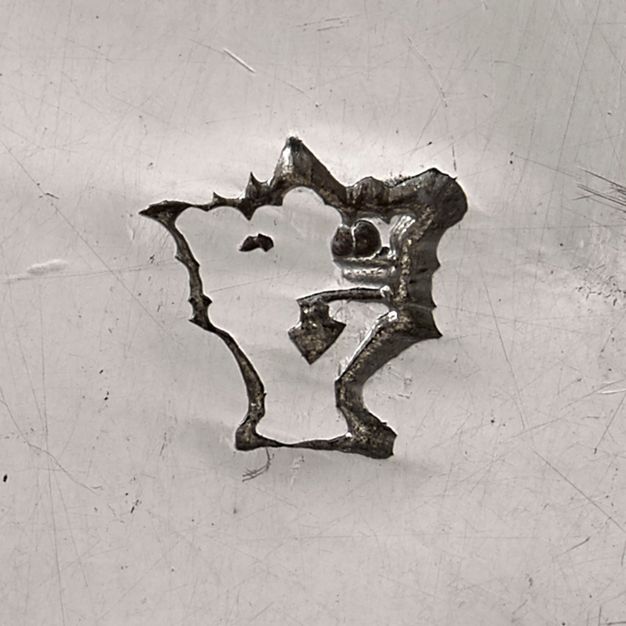
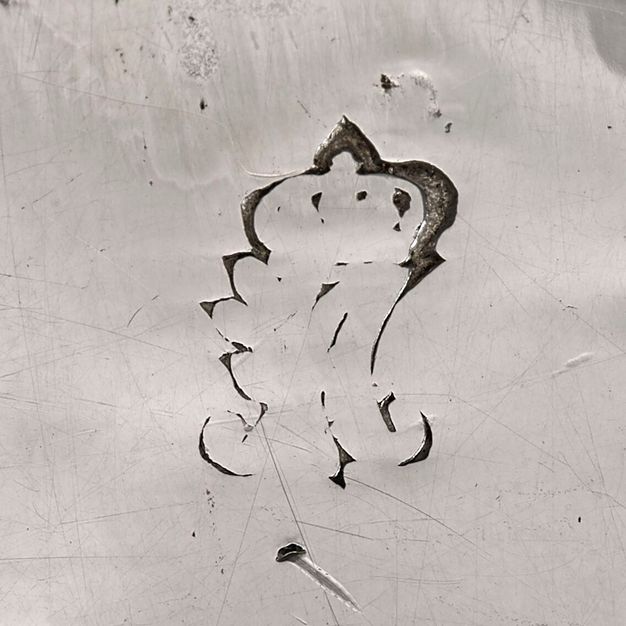
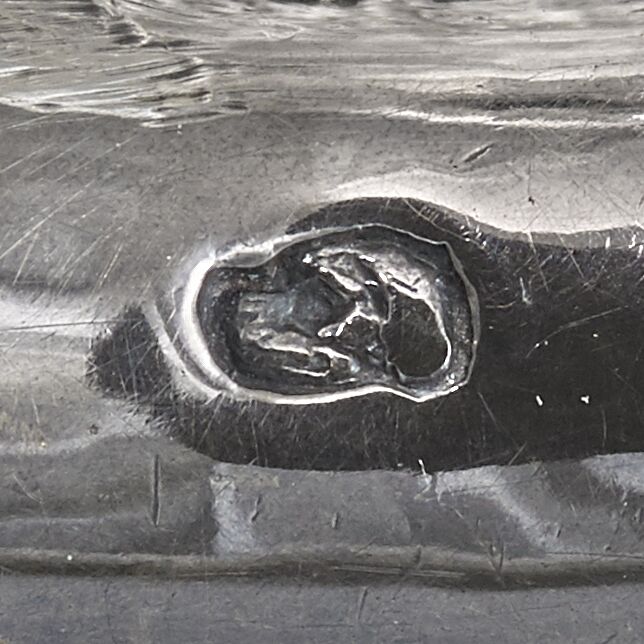
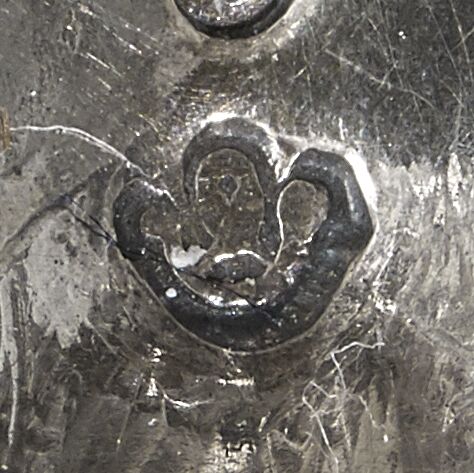
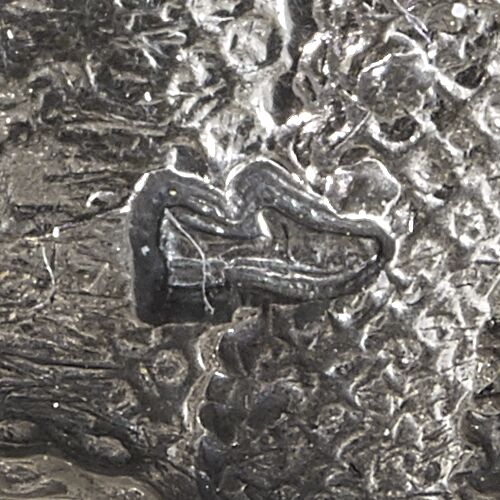
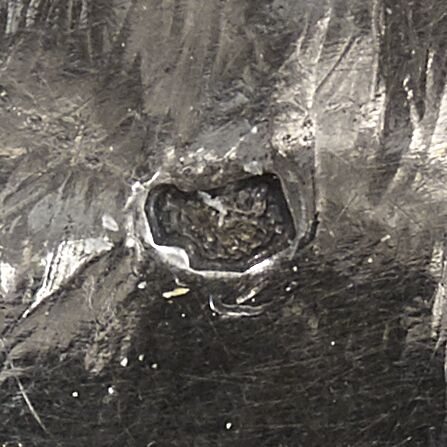
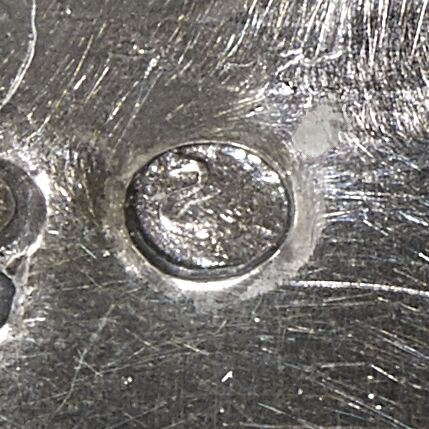
Struck, underneath, with the following stamps: the partially struck maker’s mark consisting of the initials “J.B.C.,” a key, and two grains below a crowned fleur-de-lys; a crowned Y (the Paris warden’s mark used between July 21, 1762, and July 13, 1763) (mark 9.1); and a crowned A with a laurel branch (the Paris charge mark for large works of silver used between October 1, 1762, and October 1, 1768, under the fermier Jean-Jacques Prévost) (mark 9.2). Struck, in the locations given below, with the following stamps: a pointer head (the Paris discharge mark for gold and small works of silver used between October 1, 1762, and October 1, 1768, under the fermier Jean-Jacques Prévost) on the proper left pouring lip (mark 9.3); a hunting horn (the Paris countermark used between October 1, 1768, and November 18, 1774, under the fermier Julien Alaterre) on the proper right pouring lip; a man’s slipper (the Paris countermark used between November 18, 1774, and July 13, 1780, under the fermier Jean-Baptiste Fouache) underneath; twice with a boar head (the “restricted warranty” of 800 parts per thousand, or 80 percent, minimum silver standard used in Paris exclusively from May 10, 1838) on the exterior, underneath the proper left pouring lip, and on the exterior of the rim, near the handle; and a swan in an oval (the standard mark for silver of unknown origin that is sold at auction as used by contracting countries between July 1, 1893, and 1970) on the proper right pouring lip.
Armorial
A coat of arms has been burnished off the cartouche on the face of the sauceboat.
Stand (71.DG.76.b)
H: 10.8 × W: 18.5 × D: 12.6 cm, 566.69 g (4 1/4 × 7 5/16 × 4 15/16 in., 18 ozt., 4.390 dwt.)
Marks
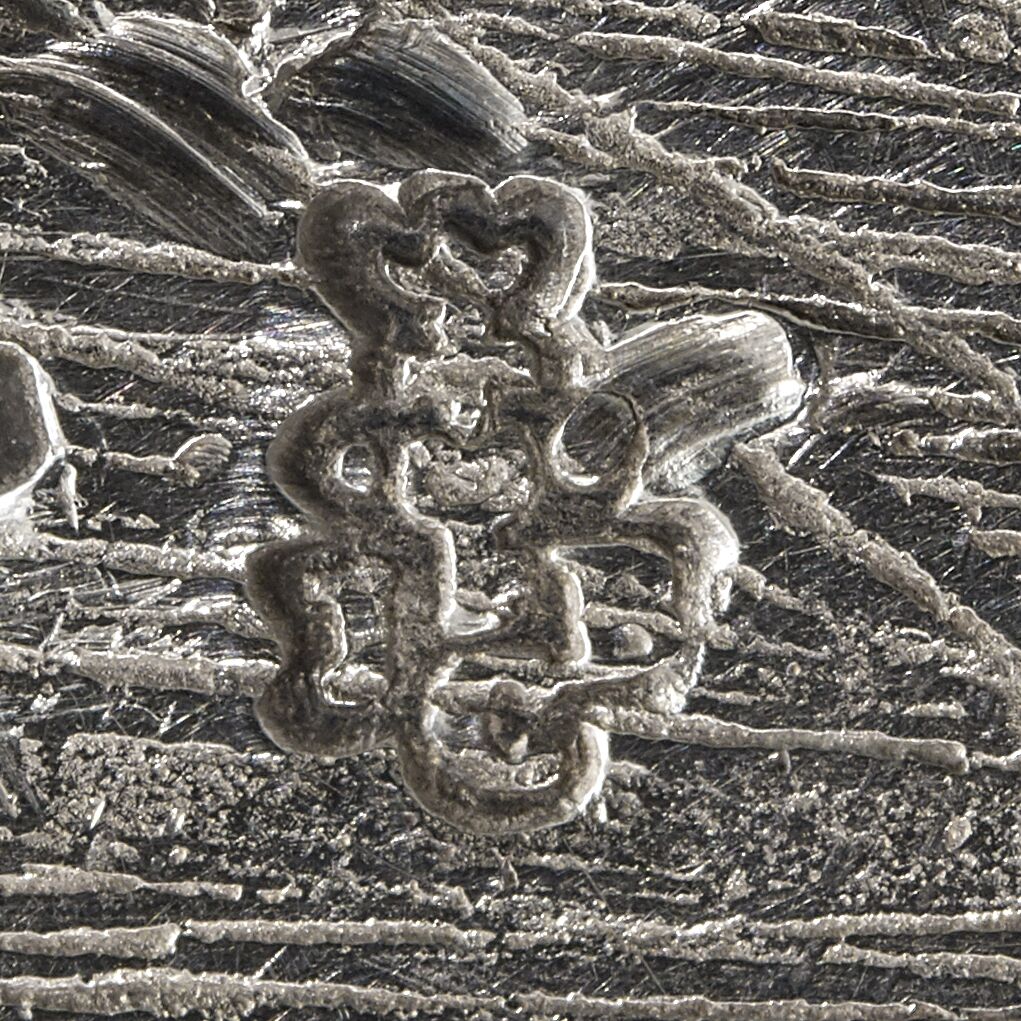
The stand consists of two parts, secured together by a threaded rod and nut: an upper part, called a “cradle” (berceau), and a lower part, the base. Each is individually marked as follows. The stand’s “cradle” (berceau) is struck, on the exterior of the rim, with the following stamps: a pointer head (the Paris discharge mark for gold and small works of silver used between October 1, 1762, and October 1, 1768, under the fermier Jean-Jacques Prévost); a hunting horn (the Paris countermark used between October 1, 1768, and November 18, 1774, under the fermier Julien Alaterre); a man’s slipper (the Paris countermark used between November 18, 1774, and July 13, 1780, under the fermier Jean-Baptiste Fouache); and a boar head (the “restricted warranty” of 800 parts per thousand, or 80 percent, minimum silver standard used in Paris exclusively from May 10, 1838). The stand’s base is struck, underneath, with the following stamps: the maker’s mark consisting of the initials “J.B.C.,” a key, and two grains below a crowned fleur-de-lys (mark 9.4); a crowned Y (the Paris warden’s mark used between July 21, 1762, and July 13, 1763); and crossed laurel branches (the Paris charge mark for small works of silver used between October 1, 1762, and October 1, 1768, under the fermier Jean-Jacques Prévost); a pointer head (the Paris discharge mark for gold and small works of silver used between October 1, 1762, and October 1, 1768, under the fermier Jean-Jacques Prévost). The stand’s base is struck, on the surface, with the following stamps: a hunting horn (the Paris countermark used between October 1, 1768, and November 18, 1774, under the fermier Julien Alaterre) (mark 9.5); a man’s slipper (the Paris countermark used between November 18, 1774, and July 13, 1780, under the fermier Jean-Baptiste Fouache) (mark 9.6); a boar head (the “restricted warranty” of 800 parts per thousand, or 80 percent, minimum silver standard used in Paris exclusively from May 10, 1838) (mark 9.7); and a swan in an oval (the standard mark for silver of unknown origin that is sold at auction as used by contracting countries between July 1, 1893, and 1970) (mark 9.8).
Inscriptions
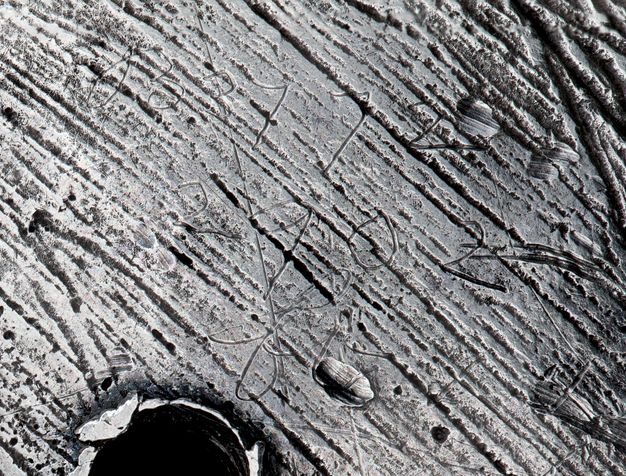
The stand is scratched, underneath, with the weight “2902” [for the weight of 29 ozt., 2 dwt.] and “fr”(?), below the alphanumeric string “B3772” (inscription 9.1).1
Description
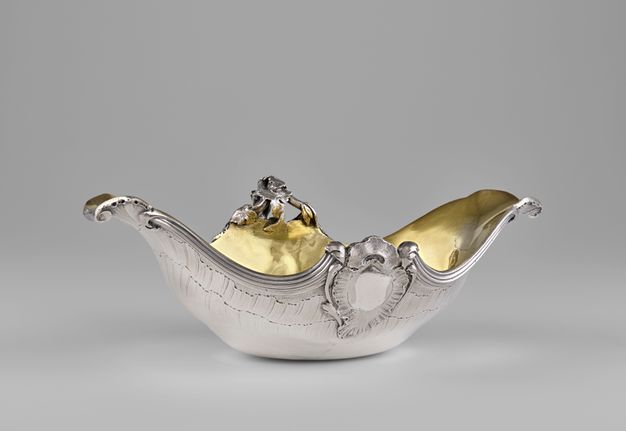
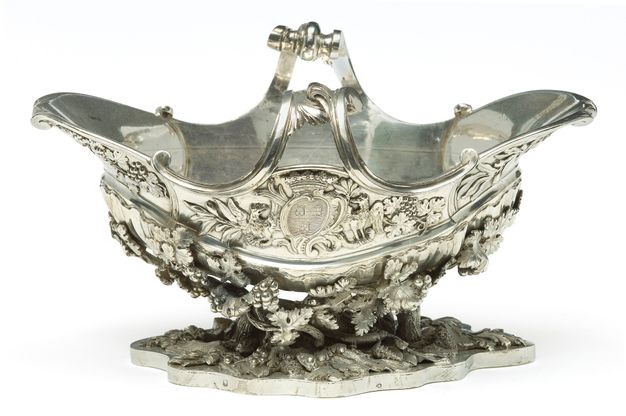
This double-lipped sauceboat on stand (saucière avec son berceau) consists of two main parts—the oval-shaped boat in the traditional form of a nef (a ceremonial ship-shaped condiment vessel for salt or spices) and its independent stand (called berceau, or “cradle”).2 The boat has a high prow and stern, whose lip rims curl downward to control the pour of the vessel’s semiliquid content (cat. 9.1). Segments of banded moldings line the undulating rim to the midpoints, where an asymmetrical cartouche, within a shell border, centers one side and a handle of braided olive branches and grape vines centers the other.3 The armorial that was engraved on the cartouche has been effaced; faint traces of the armorial’s outermost supporting branches and heraldic coronet are just visible. The exterior walls of the vessel bear an irregular wave pattern suggestive of shallow ripples of water on a shore. The rounded lower wall and bottom of the vessel are polished silver. The interior is gilded.4
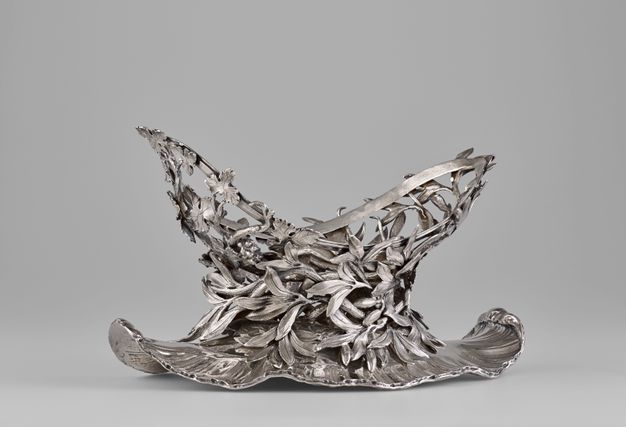
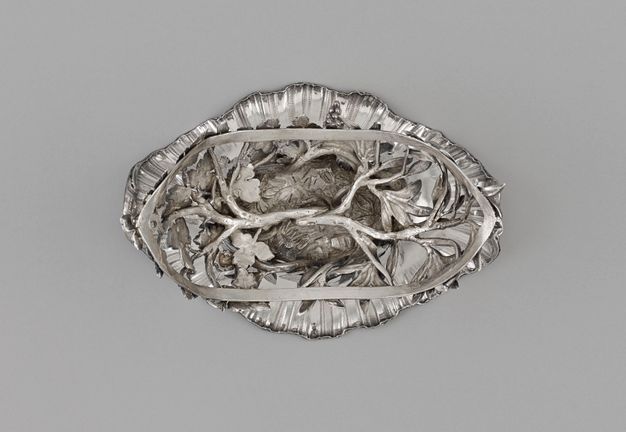
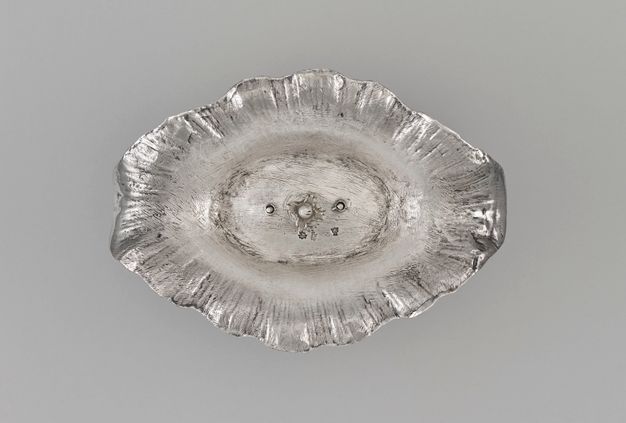
The stand is a complex form. Its upper part, called a “cradle” (berceau), takes the form of a thicket of leafy olive branches, with slender fruit on one side, and leafy grape vines, also with clusters of fruit, on the other side. In two locations, the plants meet and their branches intertwine (cat. 9.2). Their principal stems rise from anchor points in a thin oval sheet, hammered and chased in the repoussé technique to evoke the earthen floor of an oil grove or a vineyard (cat. 9.3).5 These assembled elements are bolted to a sturdy base—an undulating oval form chased with stylized wavelets reminiscent of a sea snail in motion, such as the so-called bubble snail (Hydatina physis) (cat. 9.4).6
Commentary
French cookery of the late seventeenth and eighteenth centuries efficiently utilized every dripping of fat, meat juice, or vegetable broth generated during the process of food preparation.7 These liquids became ingredients themselves for a miscellany of sauces, coulis, jus, condiments, and dressings that complemented a meal’s main dishes of stews, ragouts, roasts, game, fish, and vegetables. The savory flavorings were brought to the table in an array of specially designed vessels such as sauceboats, small lidded vessels fitted with a handle, and pots à jus (small lidded cups for mixtures, reductions, or extracts of cooked meat and vegetable juices).8 This type of consumable and the vessels that held them were known as hors d’oeuvre (literally “outside the work”), meaning they were placed toward the edge of table, outside the central arrangement of larger tureens and platters, so that they were conveniently within arm’s reach, to be used at the discretion of each diner.
The author and poet Voltaire attested to the popularity of these savory condiments in his poem of 1736 titled Le mondain (The Worlding):
The cheerful supper next invites
To luxury’s less refined delights.
How exquisite those sauces flavor!
Of those ragouts I like the savor.
The man who can in cookery shine,
May well be deemed a man divine.9
Elsewhere in the poem, he praised the renowned chef whose recipes pleased his own palate, François Massialot. Massialot was a chef to princes and the author of the enduring cookbook Le cuisinier royal et bourgeois (The Royal and Bourgeois Cook), first printed in 1691.10 This two-volume publication had several editions into the eighteenth century and included multiple recipes for coulis, jus, and sauces. In the 1729 edition, there were instructions for making no fewer than fourteen different sauces, each named after a chief ingredient or characteristic flavor: ham, green, duck, snipe, sheep, anchovy, capers, truffle, onion, scallion, (black) pepper, fennel, and green currants, plus two others prosaically named the “poor man’s sauce.”11 Of these last two, the “poor man’s sauce, with oil” was a simple recipe calling for little more than oil and vinegar, akin to our modern-day vinaigrette:
Poor Man’s Sauce, with Oil
Chop a little spring onion & parsley, & put it in a sauceboat, With oil, pepper, & salt; You can put a little vinegar in it, And serve it cold.12
The ingredients of “poor man’s sauce, with oil” were given physical form by Jean-Baptiste François Chéret when he designed and executed the Getty sauceboat, with its olive branches and grape vines alluding to their derivative products of oil and vinegar. It does not follow that this sauceboat was used exclusively for serving a vinaigrette, though. It surely contained over time a variety of meat-, fish-, or vegetable-based sauces. Indeed, the vessel’s evocation of water, aquatic life, and shells suggests its ornament would have been equally appropriate for fish-based sauces.13 The gilded interior of the Getty sauceboat, moreover, would have mitigated against silver oxidation (tarnishing) and corrosion caused by common ingredients such as lemon, vinegar, egg, onion, garlic, and salt.
The cookbook author Menon offered ten rich (grasse) and ten light (maigre) sauce recipes in his La nouvelle cuisine avec de nouveaux menus pour chaque saison de l’année of 1742. The ingredients of his more complex sauce à la Provençale are also well matched to the motifs of Chéret’s design:
Sauce à la Provençale
Put in a saucepan, parsley, spring onions, mushrooms, truffles, garlic, all very finely chopped; rub it with oil; wet with broth, a little reduction, two glasses of wine from Champagne; cook this sauce until reduced to one glass, season with salt, coarse pepper, degrease the sauce & serve.14
In 1767 the English edition of another Menon cookbook gave this advice to his readers concerning sauces:
This is where true Taste shows itself, and must meet with Approbation or Condemnation; as all boiled meats stewed or brazed are to be made relishing, with the Addition of a well-timed Sauce, and as it is absolutely impossible to direct Quantities so minutely as to agree with different Palates, I shall strongly recommend to all Cooks of either Sex, to keep their Stomach free from strong Liquors, and Noses from Stuffs.15
The historian of food and dining culture Meredith Chilton noted that, in the mid-eighteenth century, a well-balanced sauce required fresh ingredients and skillful preparation. The growing abundance and variety of sauce recipes caused a proliferation of sauceboats to appear on the table as specific sauces were deemed necessary complements to certain meat, fish, and vegetable dishes served through the meal.16
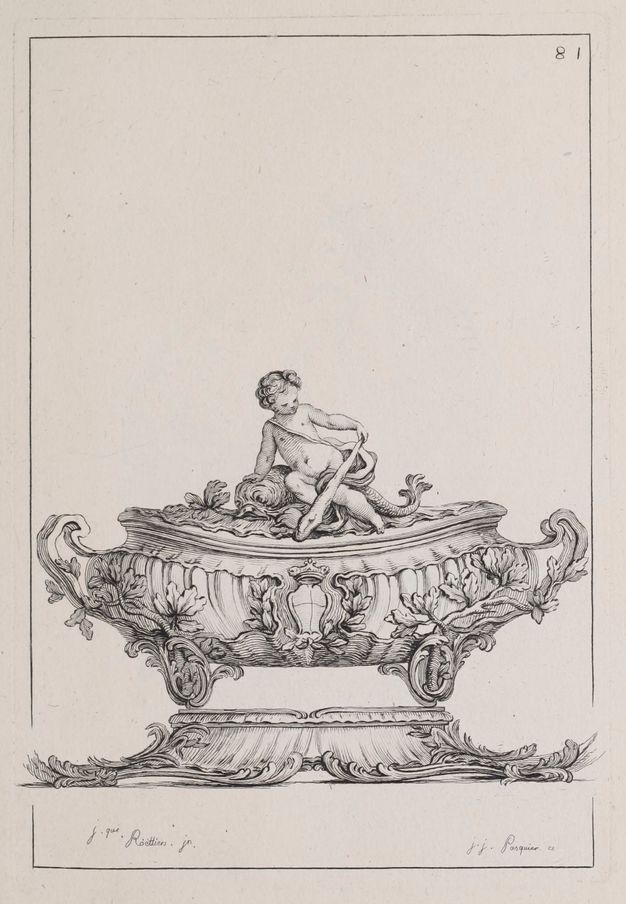
Chéret made at least one other version of this sauceboat model, but whether the two together were an independent pair or part of a larger service of tableware or complementary condiment vessels such as an oil and vinegar cruet set remains unknown, for no obvious companion pieces have been located (fig. 9.1).17 The two sauceboats are not precisely identical, and there are subtle differences, notably in the quantity, arrangement, and chasing of foliage and fruit on the supporting “cradles” (berceaux) (fig. 9.2). The two are extraordinarily sculptural pieces, combining elements inspired by nature’s bounty on land and in water that allude to some common ingredients of contemporary cookery.18 The form of their bases and the wave-like treatment of the boats’ exterior surfaces echo aspects of a design for an oval silver tureen on stand by the goldsmith Jacques III Roëttiers that was published in 1748 by another goldsmith, Pierre Germain (fig. 9.3).19
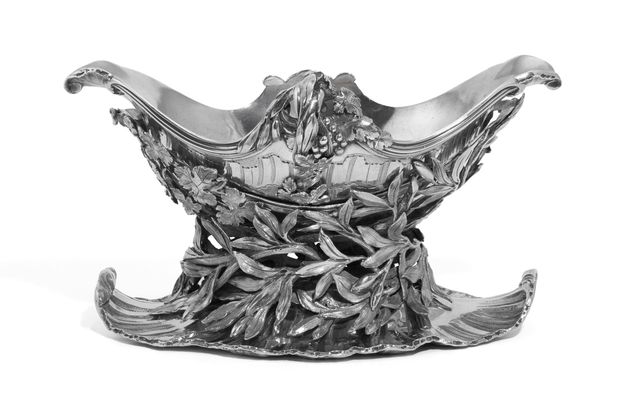
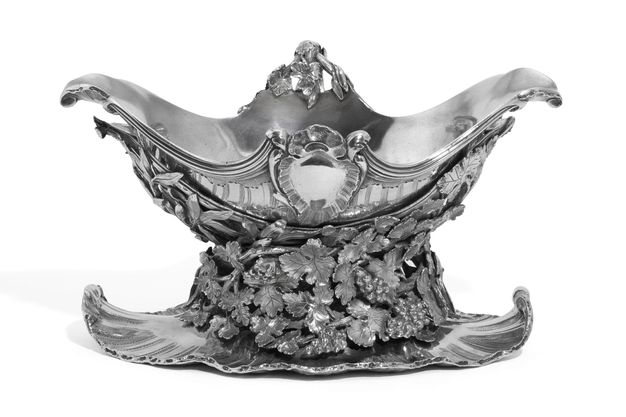
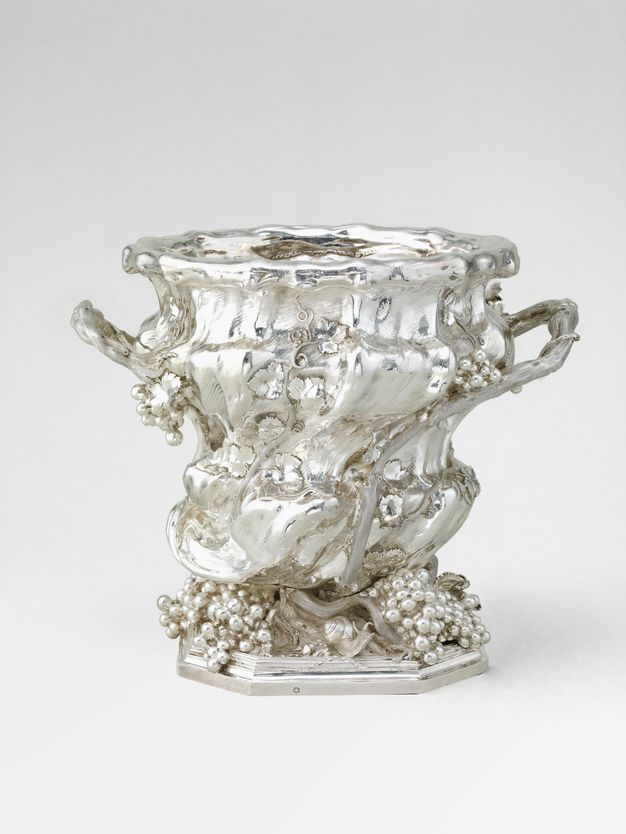
The closest precedent to Chéret’s creations was the pair of sauceboats on stands of 1754–55 by the Parisian goldsmith François Joubert. Their bases are composed of rooted grape vines that stretch upward to support the boats, whose bodies have olive branches and grape vines applied in low relief. They are bulky, more solid in form, and heavier than the Chéret example (weighing 1,035 and 1,048 grams, respectively, while the Getty’s piece weighs 903 grams) (fig. 9.4).20 Aesthetically, aspects of Chéret’s form and motifs have an affinity with an earlier pair of, admittedly more exuberant, wine-bottle coolers made by the goldsmith Thomas Germain in 1726–28 for Louis-Alexandre de Bourbon, the legitimized son of Louis XIV. Those vessels were exceptionally fluid in form, commencing with fruiting grape vines that branched upward from an earthen floor, past gliding snails and empty shells, into swells of splashing water suggestive of the swirling chilly water that would have cooled the wine bottles within. Higher up, loops of the same fruiting grape vines transform into the vessels’ handles (fig. 9.5).21
Provenance
Before 1903: “Duke of Buckingham, London, 1903,” possibly referring to William Stephen Temple-Gore Langton, fourth earl Temple of Stowe, British, 1847–1902, and, by special remainder, heir to his uncle Richard Temple-Grenville, third duke of Buckingham and Chandos, British, 1823–1889;22 –1913: Joseph Henry Fitzhenry, British, 1836–1913, (12 Thurloe Place, London) [sold, Christie’s, London, November 20, 1913, lot 214];23 1913?–1926?: “Bensimon,” referring to either Gaston Bensimon, French, active 1920s–70s (Paris), or to his art firm, Bensimon Antiquaire et Bijoutier (20 rue Royale, Paris);24 by 1926–52: David David-Weill, French/American, 1871–1952 (Paris), by inheritance to his wife, Flora David-Weill; 1952–70: Flora David-Weill, French, 1878–1970 (Paris) [sold after her death, Palais Galliéra, Paris, November 24, 1971, lot 14, to the J. Paul Getty Museum].25
Exhibition History
Exposition d’orfèvrerie française civile du XVIe siècle au début du XIXe, Musée des arts décoratifs (Paris), April 12–May 12, 1926 (no. 108, lent by M[onsieur] David-Weill); The J. Paul Getty Collection of French Decorative Arts, Detroit Institute of Fine Arts, October 3, 1972–August 31, 1973 (lent by the J. Paul Getty Museum); Exquisite Everyday: 18th-Century Decorative Arts Objects from the J. Paul Getty Museum, Pulitzer Arts Foundation (Saint Louis), July 29–October 15, 2016.
Bibliography
Catalogue of the Choice Collection of English and Foreign Silver formed by J. H. Fitzhenry, Esq, Deceased, Late of 12 Thurloe Place. S.W., sale cat., Christie, Mason & Woods, London, November 17 and 20, 1913: 28, lot 214, “A boat-shaped sauce-tureen”; Exposition d’orfèvrerie française civile du XVIe siècle au début du XIXe. Exh. cat. Paris: Le Musée, 1926., 19, no. 108 (lent by M[onsieur] David-Weill); Collection D. David-Weill (deuxième vente d’orfèvrerie)—Orfèvrerie France XVe au XVIIIe siècle, sale cat., Palais Galliéra, Paris, November 24, 1971: lot 14, “Saucière ovale et son berceau”; Sassoon, Adrian, and Gillian Wilson. Decorative Arts: A Handbook of the Collections of the J. Paul Getty Museum. Malibu, CA: J. Paul Getty Museum, 1986., 68, no. 151; Barr, Elaine. “Il Rococò.” In Storia degli Argenti, edited by Kirsten Aschengreen Piacenti, 125–40. Novara, Italy: Istituto Geografico de Agostini, 1987., 128; French Silver in the J. Paul Getty Museum, exh. brochure (Malibu, CA: J. Paul Getty Museum, 1988), 2–3, 6; Whitehead, John. The French Interior in the Eighteenth Century. London: Laurence King, 1992., 234, ill.; Bremer-David, Charissa, with Peggy Fogelman, Peter Fusco, and Catherine Hess. Decorative Arts: An Illustrated Summary Catalogue of the Collections of the J. Paul Getty Museum. Malibu, CA: J. Paul Getty Museum, 1993. http://www.getty.edu/publications/virtuallibrary/0892362219.html., 115–16, no. 192; Wilson, Gillian, and Catherine Hess. Summary Catalogue of European Decorative Arts in the J. Paul Getty Museum. Los Angeles: J. Paul Getty Museum, 2001. http://www.getty.edu/publications/virtuallibrary/089236632X.html., 98, no. 198; Schenkenberg, Tamara H. Exquisite Everyday: 18th-Century Decorative Arts Objects from the J. Paul Getty Museum. Exh. cat. Saint Louis: Pulitzer Arts Foundation, 2016., 2, 3, ill.
Notes
-
This is the weight given in the sale catalogue description in Catalogue of the Choice Collection of English and Foreign Silver formed by J. H. Fitzhenry, Esq, Deceased, Late of 12 Thurloe Place. S.W., sale cat., Christie, Mason & Woods, London, November 17 and 20, 1913: 28, lot 214, “A boat-shaped sauce-tureen.” ↩︎
-
For a comparison, see the 1728–29 design for a nef for Louis XV by Juste-Aurèle Messionnier, now in the Cooper-Hewitt, National Museum of Design, Smithsonian Institution, New York, inv. 1921-6-212-25-b, https://collection.cooperhewitt.org/objects/18707145/. It was published in 1748 as an etching by Gabriel Huquier. ↩︎
-
The boat appears to have been raised from sheet. The handle, the rim’s banded moldings, and the cartouche were separately cast and soldered to the vessel. Technical Report, December 9, 2021, by Julie Wolfe, Decorative Arts and Sculpture Conservation, J. Paul Getty Museum. X-radiographs were captured at 400 kV, 1.8 mA, 500 mSec, and 60 inches, with a GE X-radiography system with digital detector array. ↩︎
-
X-ray fluorescence spectroscopy conducted on November 15, 2021, by Julie Wolfe, Decorative Arts and Sculpture Conservation, J. Paul Getty Museum, registered the presence of mercury in the vessel’s gilded interior, which is generally indicative of the amalgamation fire-gilding technique used during the eighteenth century. See Appendix: Table 2. Further analysis by Arlen Heginbotham, Decorative Arts and Sculpture Conservation, J. Paul Getty Museum, determined that while the area was originally mercury-amalgam gilded in the eighteenth century, it was later regilded electrolytically sometime after the mid-nineteenth century. The localized electrolytic gilding was achieved by applying a coating on the object’s exterior to prevent the reaction on that surface. Technical Report, December 9, 2021, by Julie Wolfe, Decorative Arts and Sculpture Conservation, J. Paul Getty Museum.
Electroplating is a process, developed in the first half of the nineteenth century, that submerges the object to be plated into a bath of conductive electrolyte solution containing a piece of chosen plating metal (for example, gold). When the bath is electrified, plating metal ions transfer to the surface of the object. In general, the process has good adhesion and is able to consistently produce a very thin, continuous plating layer. Consequently, it has become the most commercially used technique for plating from the mid-nineteenth century until today. Susan La Niece et al., “Gilding and Plating,” a definition from the CAST:ING Project’s Guidelines for the Technical Study of Cast Bronze Sculpture. See CAST:ING (website), accessed April 4, 2022, http://www.cast-ing.org/. ↩︎
-
The boat’s support (berceau), in the form of a leafy thicket, is composed of a cast framework of branches to which some additional, individually cast leaves have been soldered. To the topmost of these branches, two narrow strips of hammered sheet were soldered in order to properly hold and balance the boat in its resting place. The earthen floor of the thicket was separately formed from sheet metal by the repoussé technique and chased; it was soldered to the base of the branches. Technical Report, December 9, 2021, by Julie Wolfe, Decorative Arts and Sculpture Conservation, J. Paul Getty Museum. ↩︎
-
The base appears to have been raised from sheet. Its undulating perimeter may have been made separately and soldered in place. A silver threaded rod, soldered to the underside to the earthen floor of the support, anchors to the base and is secured with a silver nut underneath. Two additional pins from the earthy floor fit into the base to keep it from twisting out of alignment. Technical Report, December 9, 2021, by Julie Wolfe, Decorative Arts and Sculpture Conservation, J. Paul Getty Museum. ↩︎
-
Wheaton, Barbara Ketchem. Savoring the Past: The French Kitchen and Table from 1300 to 1789. New York: Scribner, 1996., xxi, 95, 114; Civitello, Linda. Cuisine and Culture: A History of Food and People. Hoboken, NJ: John Wiley, 2004., 162. ↩︎
-
Chilton, Meredith. “The Pleasures of Life, Ceramics in Seventeenth- and Eighteenth-Century France.” In Daily Pleasures: French Ceramics from the MaryLou Boone Collection, edited by Elizabeth A. Williams, 23–65. Los Angeles: Los Angeles County Museum of Art, 2012., 37–38. Two little silver pots for mustard or milk, measuring 10.6 and 12.1 centimeters (4 3/16 and 4 3/4 inches) in height, survive from the hand of Jean-Baptiste Chéret; they each have a hinged lid, a pouring spout, and one handle. The earlier one, dated 1759–60, is in the Musée des arts décoratifs, Paris, inv. 30077. See Mabille, Gérard. Orfèvrerie française des XVIe XVIIe XVIIIe siècles: Catalogue raisonné des collections du Musée des arts décoratifs et du Musée Nissim de Camondo. Paris: Flammarion/Musée des arts décoratfis, 1984., 48, no. 62. The other dates from 1763–64 and is in the Metropolitan Museum of Art, New York, inv. 48.187.410, https://www.metmuseum.org/art/collection/search/200371. ↩︎
-
Excerpted from “The Worlding,” in Voltaire (born François-Marie Arouet). “The Worlding.” 1736. The Works of Voltaire: A Contemporary Version, edited by Tobias Smollett, John Morley, and Oliver Herbrand Gordon Leigh; translated by William F. Fleming, vol. 36, 84–88. New York: St. Hubert Guild, ca. 1901.. The original French had slightly different wording: “Allons souper. Que ces brillants services, Que ces ragoûts ont pour moi de délices! Qu’un cuisinier est un mortel divin!” (Voltaire (born François-Marie Arouet). “Le Mondain.” 1736. In La Henriade, divers autres poèmes et toutes les pièces relatives à l’épopée, vol. 12, 64–68. Geneva: Cramer et Bardin, 1775.). ↩︎
-
Bremer-David, Charissa. “Of Cauliflower and Crayfish: Serving Vessels to Awaken the Palate.” In The Edible Monument: The Art of Food for Festivals, edited by Marcia Reed, 124–47. Exh. cat. Los Angeles: Getty Research Institute, 2015., 134–38. ↩︎
-
Massialot, François (probable author). Le nouveau cuisinier royal et bourgeois. 2 vols. Paris: Chez Claude Prudhomme, 1729., vol. 2, 322–29. ↩︎
-
“Sausse au pauvre-homme à l’huile. Hachez un peu de ciboule & de persil, & le mettez dans une saussiere, avec de l’huile, du poivre & du sel; on peut y mettre un peu de vinaigre, & la servez froide” (Massialot, François (probable author). Le nouveau cuisinier royal et bourgeois. 2 vols. Paris: Chez Claude Prudhomme, 1729., vol. 2, 327, author’s translation). ↩︎
-
On the relationship between the form and ornament of serving vessels and their contents, see Bremer-David, Charissa. “Of Cauliflower and Crayfish: Serving Vessels to Awaken the Palate.” In The Edible Monument: The Art of Food for Festivals, edited by Marcia Reed, 124–47. Exh. cat. Los Angeles: Getty Research Institute, 2015.. ↩︎
-
“Sauce à la Provençale. Mettez dans une casserole persil, ciboules, champignons, truffles, ail, le tout haché très fine; passes-le avec de l’huile; mouillez avec bouillon, un peu de reduction, deux verres de vin de Champagne; faites cuire cette sauce jusqu’à la reduction d’un verre, assaisonnez de sel, gros poivre, degraissez la sauce & servez” (Menon, Joseph. La nouvelle cuisine avec de nouveaux menus pour chaque saison de l’année […]. Vol. 3. Paris: Chez la veuve Prudhomme, chez Joseph Saugrain, 1742., 237, author’s translation). ↩︎
-
Clermont, Bernard. The Art of Modern Cookery Displayed: Consisting of the Most Approved Methods of Cookery, Pastry, and Confectionary of the Present Time: Translated from [Menon] Les Soupers de la Cour, ou, La Cuisine Reformée, the Last and Most Complete Practice of Cookery Published in French. Vol. 1. London: Printed for the Translator; sold by R. David, 1767., vol. 1, 30. Quoted by Chilton, Meredith. The King’s Peas: Delectable Recipes and Their Stories from the Age of the Enlightenment. Toronto: Gardiner Museum; Stuttgart: Arnoldsche Art Publishers, 2019., 106–7, 139n42. ↩︎
-
Chilton, Meredith. The King’s Peas: Delectable Recipes and Their Stories from the Age of the Enlightenment. Toronto: Gardiner Museum; Stuttgart: Arnoldsche Art Publishers, 2019., 105–10, 139nn42–46. ↩︎
-
The second sauceboat sold in Royal and Noble, sale cat., Sotheby’s, London, January 20, 2022: lot 56, “A French silver sauceboat on stand, Jean Baptiste François Chéret, Paris, 1762.” Previously, it was in the collection of the Pinto Basto family, Casa das Gaeiras, Óbidos, Portugal. It and the Getty example are similarly constructed and bear nearly identical marks. The former apparently does not have a boar head “restricted warranty” mark of 800 parts per thousand, or 80 percent, minimum silver standard, used in Paris exclusively from May 10, 1838, nor the standard mark of a swan in an oval, applied to silver of unknown origin sold at auction as used by contracting countries between July 1, 1893, and 1970, thereby implying the two sauceboats were separated before the end of the nineteenth century or subsequently. Furthermore, only traces remain of that boat’s formerly gilded-silver interior surface. The coat of arms has been abraded from its armorial shield. Information about, and images of, this piece are courtesy of João Magalhães, Director/Senior Specialist, French and Continental Furniture, Sotheby’s, London. ↩︎
-
A pair of gilded-silver and glass salts of 1768–69 by Chéret offers an interesting comparison, for two miniature, but highly natural, lobsters adorn each stem. See L’exceptionelle collection Bernard de Leye, sale cat., Kunsthaus Lempertz, Cologne, July 15, 2021: lot 180, “A pair of Parisian silver gilt salt bowl supported by two lobsters.” ↩︎
-
The etching by Jacques Jean Pasquier after Jacques III Roëttiers was published in Germain, Pierre. Elements d’orfèvrerie divisés en deux parties de cinquante feuilles chacune compose par Pierre Germain, Marchand Orfevre Joaillier. 2 parts. Paris: Chez l’auteur, place du Carousel a l’Orfèvrerie du roy, 1748., vol. 2, pl. 81–82. ↩︎
-
Both sauceboats are in the Musée des arts décoratifs, Paris, inv. 26908 A–B, http://collections.lesartsdecoratifs.fr/sauciere-0 and http://collections.lesartsdecoratifs.fr/sauciere. The coats of arms presently engraved in their cartouches were added in 1900 at the request of their owner at the time, Madame Burat. The arms are those of the marquise de Pompadour, who, according to unsubstantiated legend, originally commissioned them (Salmon, Xavier, ed. Madame de Pompadour et les arts. Exh. cat. Paris: Réunion des musées nationaux, 2002., 524–25, no. 227, entry by Gérard Mabille). ↩︎
-
Musée du Louvre, Paris, inv. OA 9431–OA 9432, https://collections.louvre.fr/en/ark:/53355/cl010104561. Babelon, Jean-Pierre, Zeev Gouranier, Catherine Arminjon, Béatrix Saule, et al., eds. Versailles et les tables royales en Europe XVIIème–XIXème siècles. Exh. cat. Paris: Réunion des musées nationaux, 1993., 138, ill., 276, no. 59, “Paire de sceaux à bouteilles” (entry by Gérard Mabille); Bimbenet-Privat, Michèle, Florian Doux, Catherine Gougeon, and Philippe Palasi. Orfèvrerie française et européenne de la Renaissance et des temps modernes, XVIe, XVIIIe, XVIIIe siècle: La collection du musée du Louvre. Paris: Musée du Louvre, 2022.. ↩︎
-
“Coll. Duc de Buckingham, Londres, 1903,” as given in Collection D. David-Weill (deuxième vente d’orfèvrerie)—Orfèvrerie France XVe au XVIIIe siècle, sale cat., Palais Galliéra, Paris, November 24, 1971: lot 14, “Saucière ovale et son berceau.” See also Royal and Noble, sale cat., Sotheby’s, London, January 20, 2022: lot 56, “A French silver sauceboat on stand, Jean Baptiste François Chéret, Paris, 1762.” ↩︎
-
On Joseph Henry Fitzhenry as a collector, see Baudis, Macushla. “Tea Parties at the Museum: The Collector J H Fitzhenry and His Relationship with the V&A.” V&A Online Journal 2 (Autumn 2009). http://www.vam.ac.uk/content/journals/research-journal/issue-02/tea-parties-at-the-museum/.. ↩︎
-
“Bensimon,” as given in Collection D. David-Weill, lot 14, “Saucière ovale et son berceau.” Bensimon referred to Gaston Bensimon as an individual or the same person acting in his role as an art dealer whose firm, Bensimon Antiquaire et Bijoutier, was located at 20 rue Royale, Paris. The firm was active from the 1920s through at least 1970. He was portrayed in a lithograph caricature by Charles Martin in Pan: Annuaire du luxe à Paris; An 1928. Paris: Paul Poiret Fondateur, 1928., unpaginated. Another advertisement for Bensimon Bijoutier, likewise located at 20 rue Royale, Paris, appeared on an unpaginated page in the same publication. See also the advertisement in Burlington Magazine 112, no. 810 (September 1970): liii, and Collection Bensimon, sale cat., Hôtel Drouot, Paris, November 18, 1981. ↩︎
-
Collection D. David-Weill, 28, lot 14, “Saucière ovale et son berceau.” ↩︎