Component Details
Lid and Vessel (84.DG.744.1.a–b)
Lid (84.DG.744.1.a)
H: 10.5 × Diam: 6.4 cm, 175.20 g (4 3/16 × 2 1/2 in., 5 ozt., 12.656 dwt.)
Marks
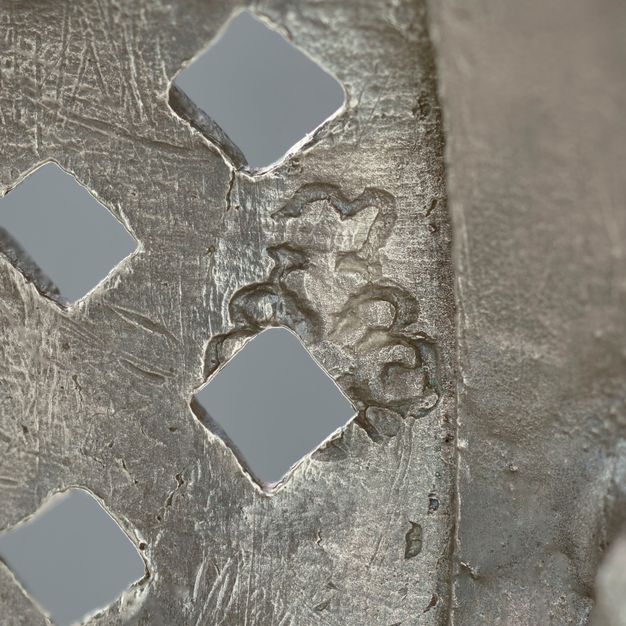
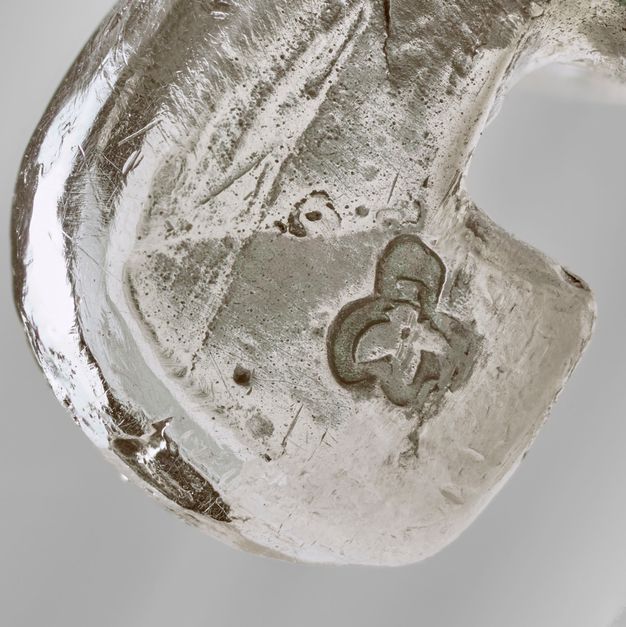
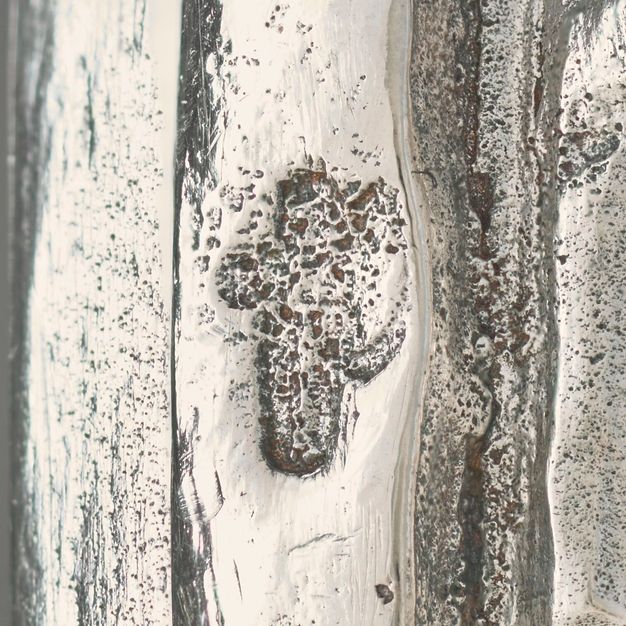
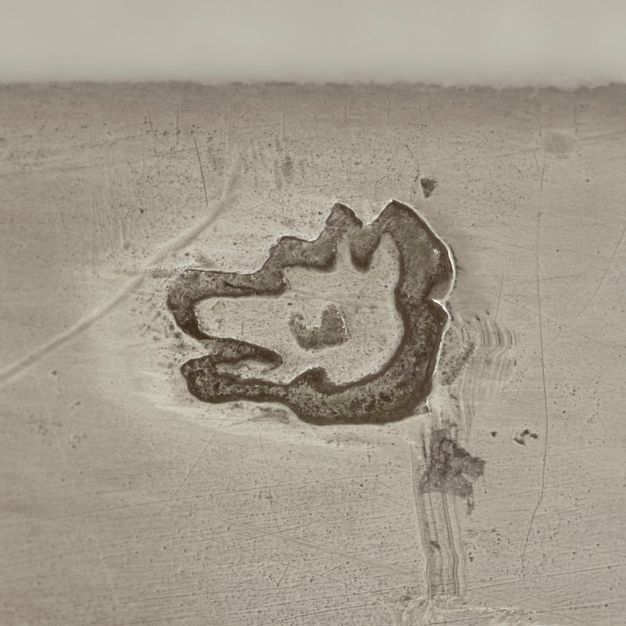
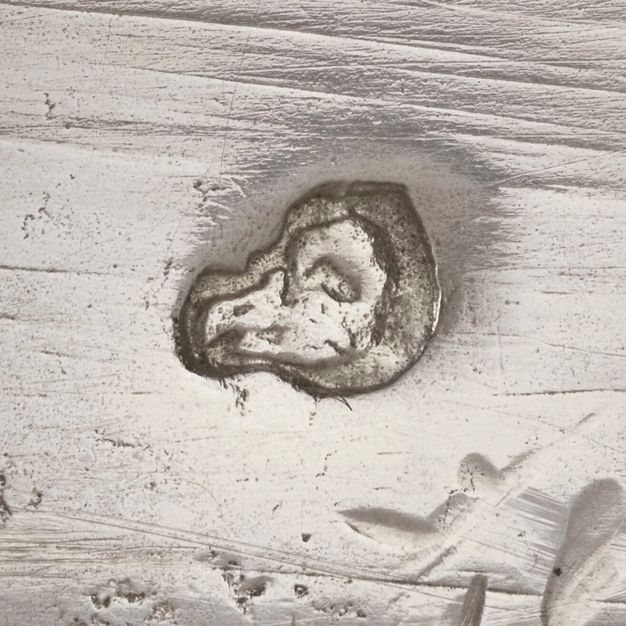
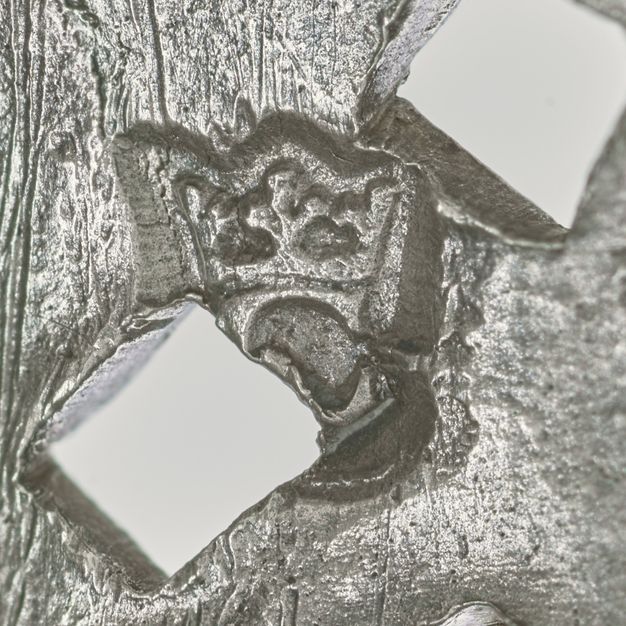
Struck, on the interior, with the following stamps: the maker’s stamp consisting of the initials “S.G.,” a sun, and two grains below a crowned fleur-de-lys (mark 5.1); a crowned C (the Paris warden’s mark used between May 30, 1743, and July 6, 1744); and a human foot (the Paris charge mark used between October 4, 1738, and October 1, 1744, under the fermier Louis Robin). Struck, on the catch-latches (see Description), with the following stamps: a fly (the Paris countermark for works of gold and silver used between October 1, 1744, and October 1, 1750, under the fermier Antoine Leschaudel) (mark 5.2); and possibly a salmon head (the Paris countermark for small works of gold and silver used between October 1, 1744, and October 1, 1750, under the fermier Antoine Leschaudel) or a duck head (the Paris countermark for small works of gold and silver used between October 1, 1750, and October 1, 1756, under the fermier Julien Berthe). Struck, on the exterior of the rim, with the following stamp: an ax (a Dutch standard mark used since 1852 for old silver objects returned to circulation) (mark 5.3).
Vessel (84.DG.744.1.b)
H: 18.2 × Diam: 11.4 cm, 867.25 g (7 1/4 × 4 1/2 in., 27 ozt., 17.654 dwt.)
Marks
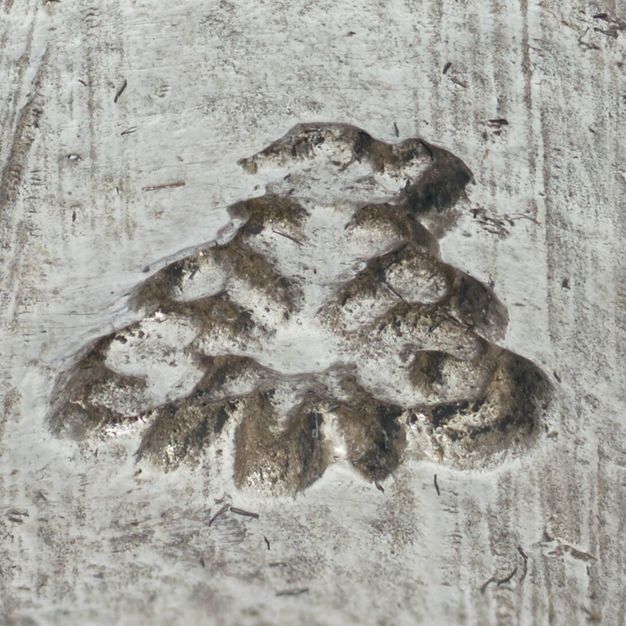
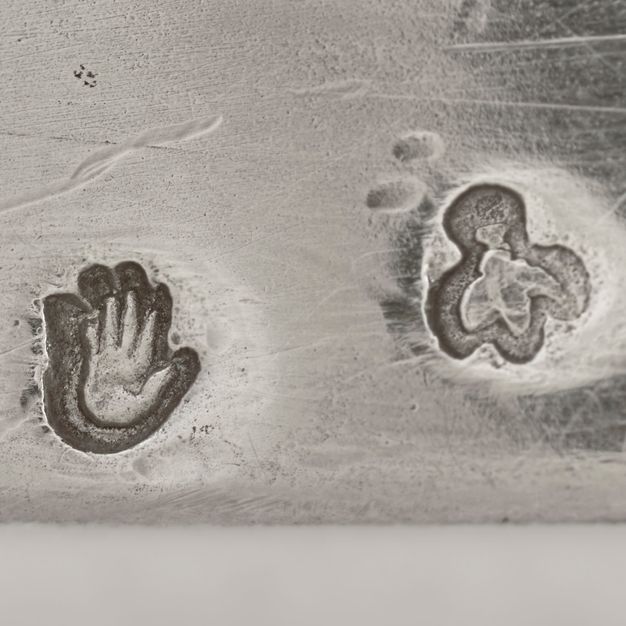
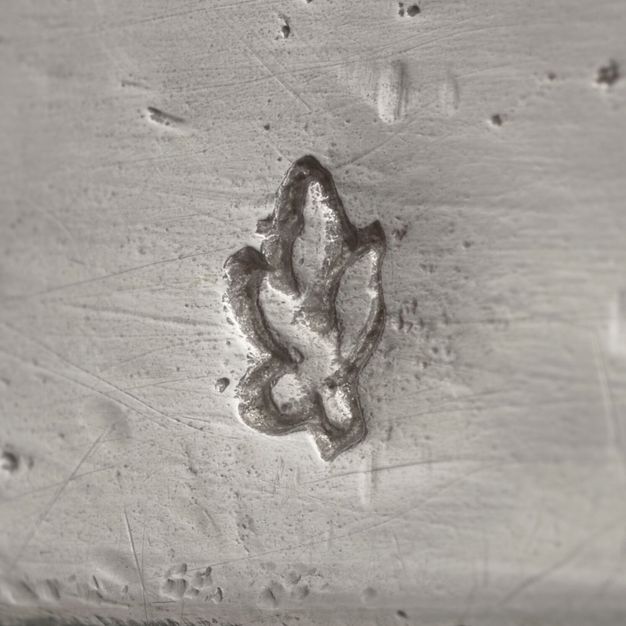
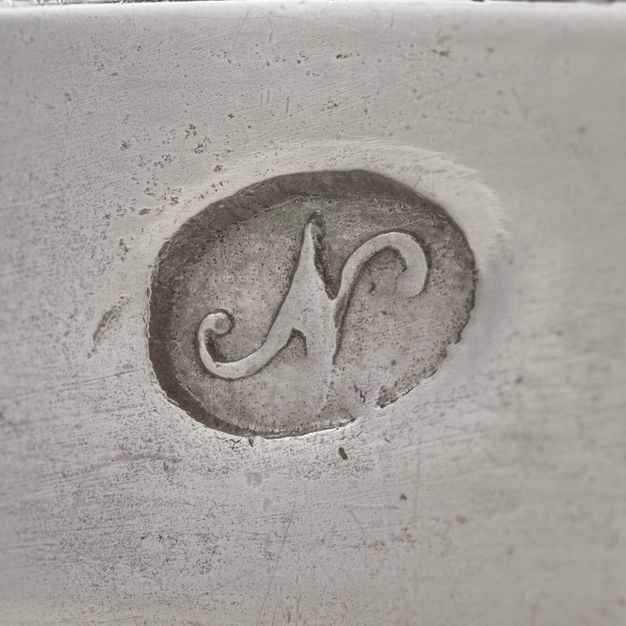
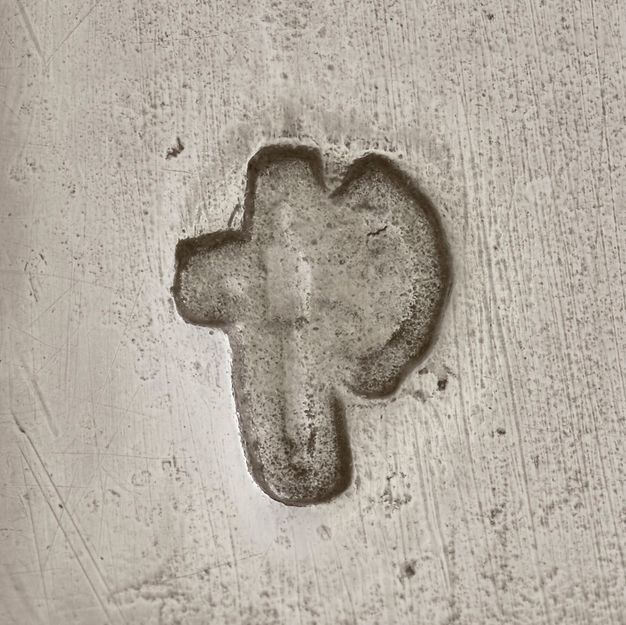
Struck, on the interior, with the following stamps: the maker’s stamp consisting of the initials “S.G.,” a sun, and two grains below a crowned fleur-de-lys (mark 5.4); a crowned C (the Paris warden’s mark used between May 30, 1743, and July 6, 1744); and a crowned A with two entwined palm branches (the Paris charge mark used between October 4, 1738, and October 1, 1744, under the fermier Louis Robin). Struck, on the exterior rim of the foot, with the following stamps: a fox head (the Paris discharge mark for small works of gold and silver used between October 1, 1738, and October 1, 1744, under the fermier Louis Robin) (mark 5.5); a fly (the Paris countermark for works of gold and silver used between October 1, 1744, and October 1, 1750, under the fermier Antoine Leschaudel) (mark 5.6); possibly a salmon head (the Paris countermark for small works of gold and silver used between October 1, 1744, and October 1, 1750, under the fermier Antoine Leschaudel) or a duck head (the Paris countermark for small works of gold and silver used between October 1, 1750, and October 1, 1756, under the fermier Julien Berthe) (mark 5.7); laurel leaves and stem (the Paris countermark for all works of gold and silver used between October 1, 1756, and October 1, 1762, under the fermiers Éloy Brichard and Étienne Somfoye) (mark 5.8); an open right hand (the Paris countermark for all works of gold and silver used between October 1, 1762, and October 1, 1768, under the fermier Jean-Jacques Prévost) (see mark 5.6); an N inscribed in an oval (the Dutch date letter for 1822 for works in precious metals) (mark 5.9); and an ax (a Dutch standard mark used since 1852 for old silver objects returned to circulation) (mark 5.10).
Inscriptions
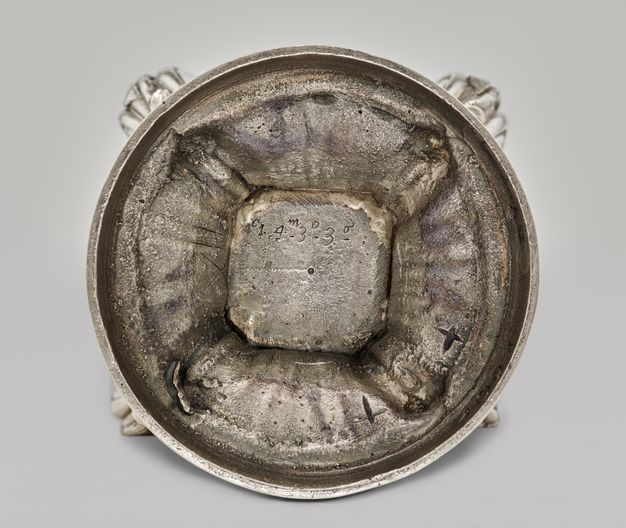
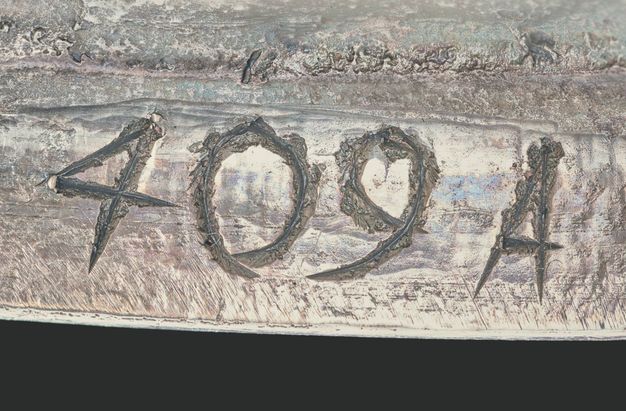
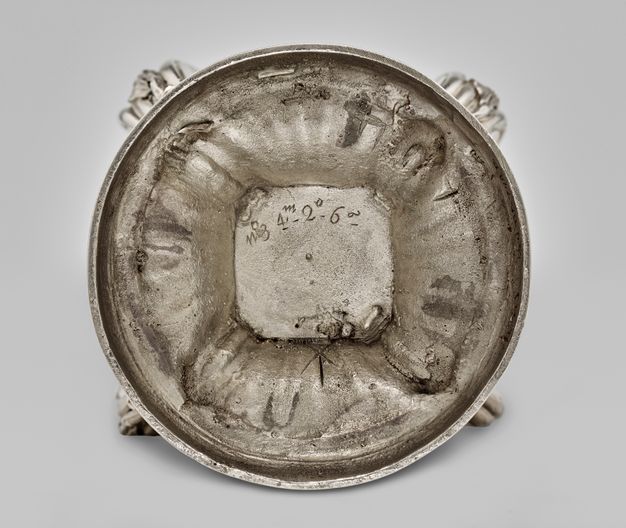
The vessel is scratched underneath with the Roman numeral “XII” and incised with the numeral and weight “no. 1 4m - 3o - 3g” (inscription 5.1).1 The interior of the foot rim is scratched “409A” (inscription 5.2).
Lid and Vessel (84.DG.744.2.a–b)
Lid (84.DG.744.2.a)
H: 10.8 × Diam: 6.3 cm, 169.06 g (4 1/4 × 2 1/2 in., 5 ozt., 8.708 dwt.)
Marks
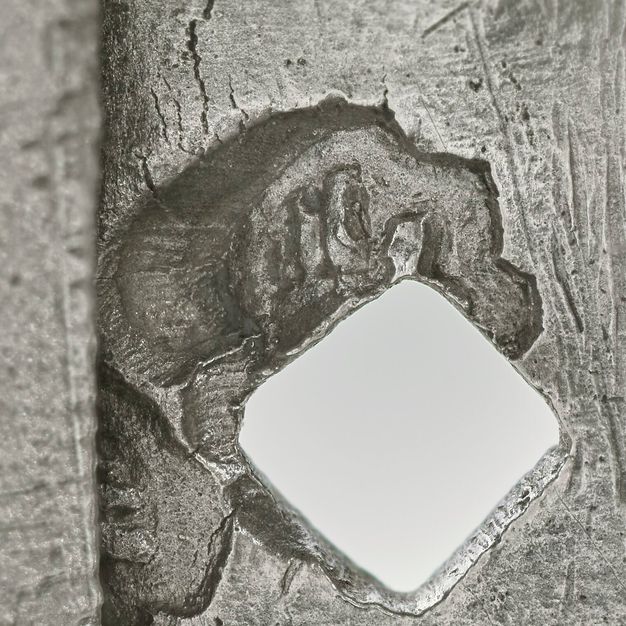
Struck, on the interior, with the following stamps: a crowned C (the Paris warden’s mark used between May 30, 1743, and July 6, 1744) (mark 5.11); and twice with a human foot (the Paris charge mark used between October 4, 1738, and October 1, 1744, under the fermier Louis Robin) (mark 5.12). Struck, on the catch-latches, with the following stamps: a fox head (the Paris discharge mark for small works of gold and silver used between October 1, 1738, and October 1, 1744, under the fermier Louis Robin); laurel leaves and stem (the Paris countermark for all works of gold and silver used between October 1, 1756, and October 1, 1762, under the fermiers Éloy Brichard and Étienne Somfoye); and an open right hand (the Paris countermark for all works of gold and silver used between October 1, 1762, and October 1, 1768, under the fermier Jean-Jacques Prévost). Struck, on the exterior of the rim, with the following stamp: an ax (a Dutch standard mark used since 1852 for old silver objects returned to circulation).
Vessel (84.DG.744.2.b)
H: 18 × Diam: 11.7 cm, 849.06 g (7 1/8 × 4 5/8 in., 27 ozt., 5.958 dwt.)
Marks
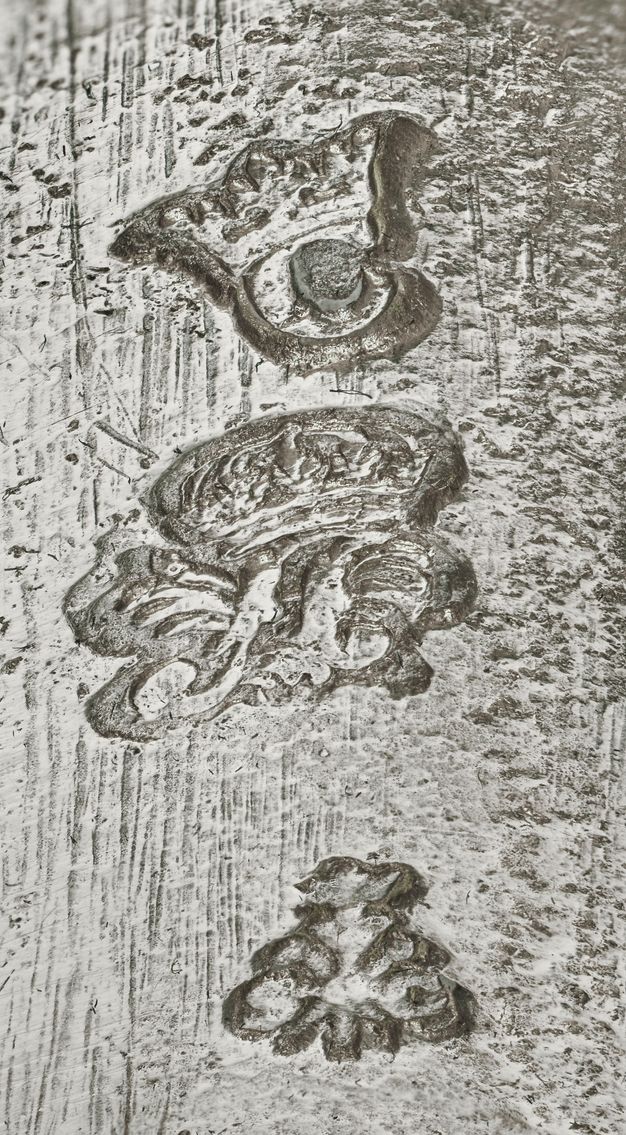
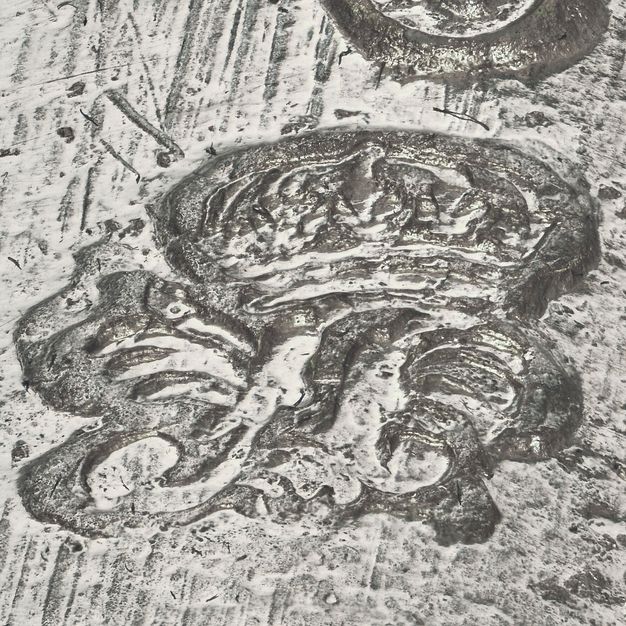
Struck, on the interior, with the following stamps: the maker’s stamp consisting of the initials “S.G.,” a sun, and two grains below a crowned fleur-de-lys (mark 5.13); a crowned C (the Paris warden’s mark used between May 30, 1743, and July 6, 1744) (mark 5.13); and a crowned A with two entwined palm branches (the Paris charge mark used between October 4, 1738, and October 1, 1744, under the fermier Louis Robin) (mark 5.14). Struck, on the exterior rim of the foot, with the following stamps: a fox head (the Paris discharge mark for small works of gold and silver used between October 1, 1738, and October 1, 1744, under the fermier Louis Robin); a fly (the Paris countermark for works of gold and silver used between October 1, 1744, and October 1, 1750, under the fermier Antoine Leschaudel); possibly a salmon head (the Paris countermark for small works of gold and silver used between October 1, 1744, and October 1, 1750, under the fermier Antoine Leschaudel) or a duck head (the Paris countermark for small works of gold and silver used between October 1, 1750, and October 1, 1756, under the fermier Julien Berthe); laurel leaves and stem (the Paris countermark for all works of gold and silver used between October 1, 1756, and October 1, 1762, under the fermiers Éloy Brichard and Étienne Somfoye); an open right hand (the Paris countermark for all works of gold and silver used between October 1, 1762, and October 1, 1768, under the fermier Jean-Jacques Prévost); an N inscribed in an oval (the Dutch date letter for 1822 for works in precious metals); and an ax (a Dutch standard mark used since 1852 for old silver objects returned to circulation).
Inscriptions
The vessel is scratched underneath with the Roman numeral XI and incised with the numeral and weight “no 3 4m - 2o - 6g -” (inscription 5.3).2 The interior of the foot rim is scratched “409.”
Description
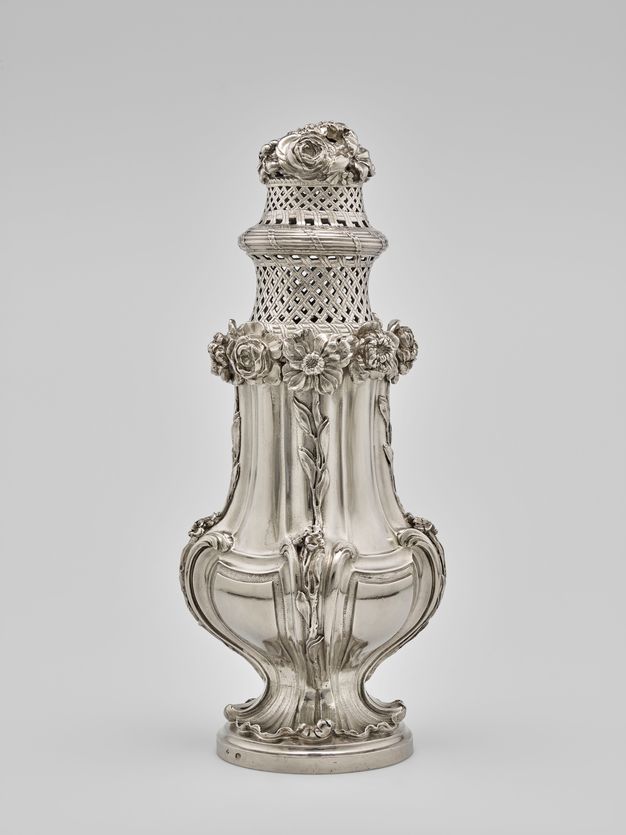
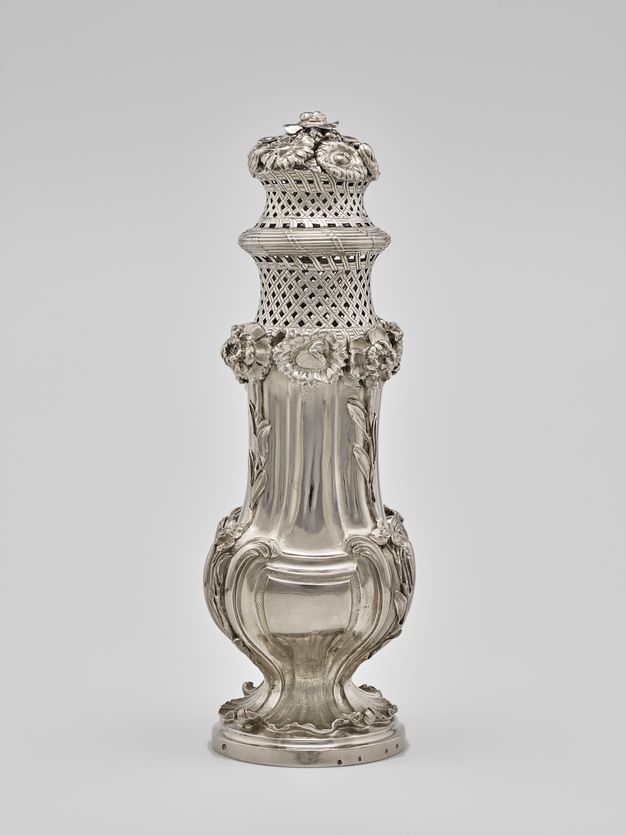
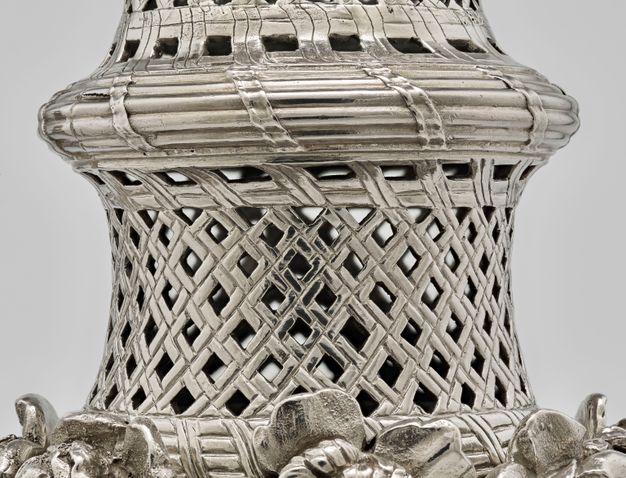
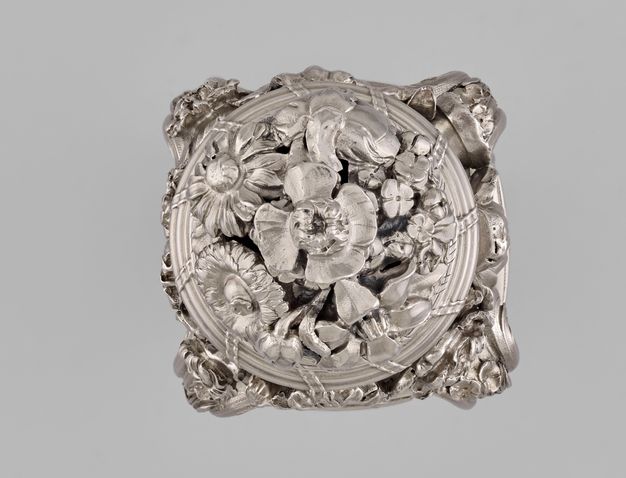
These two sugar casters (sucriers à poudre) are of identical form, though their floral ornament differs. They are of baluster shape with a burnished circular foot ring. The body rises up from a base that evokes the underside of a corolla of flower petals, to narrow and then swell into a bulb shape before continuing upward as a slightly lobed cylinder. Four vertical scrolls spaced equidistant around the bulb accentuate its profile.3 A single plant stem grows along the face of each scroll and upward, adhering to the cylindrical body, to culminate in a full-blown flower head, in high relief, at the rim of the vessel. These stems also serve to disguise the solder seams that join the four separately cast parts of the body. Four additional single flower heads are soldered to the rim so that, all together, there is a wreath of eight blooms of differing varieties: rose, peony, ranunculus, dahlia, chrysanthemum, daffodil, daisy, and sunflower. True to nature, each blossom is unique and none repeats from one caster to the other (cats. 5.1, 5.2). The cylindrical lid continues the verticality of the baluster; its joint to the body is hidden by the floral wreath. The lid takes the form of two stacked wicker baskets—the upper one slightly smaller in diameter. Apertures in the wickerwork allow the sugar to be sprinkled (saupoudroir) or “cast” (cat. 5.3). The lower edge of each basket has a banded reed molding. At the crown of each upper basket is a sculptural arrangement of larger and smaller flower heads from among the list above, with the addition of poppy and a diminutive four-petal variety, perhaps aubrieta (cat. 5.4). Each lid secures to the body by two catch-latches that engage and disengage, through a twisting motion, with openings cut into the vessel rim (see mark 5.2).4
Commentary
The consumption of sugar in Europe grew as the demand, cultivation, processing, and importation of the commodity increased throughout the eighteenth century.5 By mid-century, French West Indies colonial plantations, particularly on the islands of the Antilles, Saint Domingue (modern-day Haiti), and Guadeloupe, were major sources of raw cane and its processed products of crystallized sugar, molasses (mélasse, or treacle), and brandy (l’eau-de-vie des cannes).6 Seven enlightening engravings designed by Louis-Jacques Goussier for the famed Encyclopédie, edited by Denis Diderot and Jean Le Rond d’Alembert, visualized a sugarcane plantation in the Antilles in the early 1760s as well as the refining processes that took place in its mill, boiling house, curing house, distillery, and storage.7
Sugar was enjoyed across the French socioeconomic spectrum, from elite to modest households. It sweetened the naturally bitter beverages made from coffee, tea, and cacao; complemented some savory dishes; flavored fruit and desserts; and, when made into a paste and molded, formed sculptural table decorations. Quantities used by the royal kitchens at the Château de Versailles offer an accurate measure of consumption for a representative year. The kitchens ordered a total 8,539 pounds of sugar in 1785 (a year for which such documentation survives for the king’s household, or la Maison du roi).8 The combined tally reflected the available grades of the product: 3,748 pounds of “ordinary” crystalline, imperfectly refined sugar (“cassonnade blanche”); 3,103 pounds of partially cleaned and crystallized brown sugar (“cassonnade”); 996 pounds of “ordinary” sugar of the first grade (“cassonnade blanche, première sorte”); and 692 pounds of “royal” (“roial surfin”) or confectionary sugar.9 Specialty cookery books provided details about the grades of sugar, their preparation, and uses.10 By 1788, annual consumption in France averaged about two pounds per person, at a cost ranging between eleven and twenty-five sous a pound in Paris.11
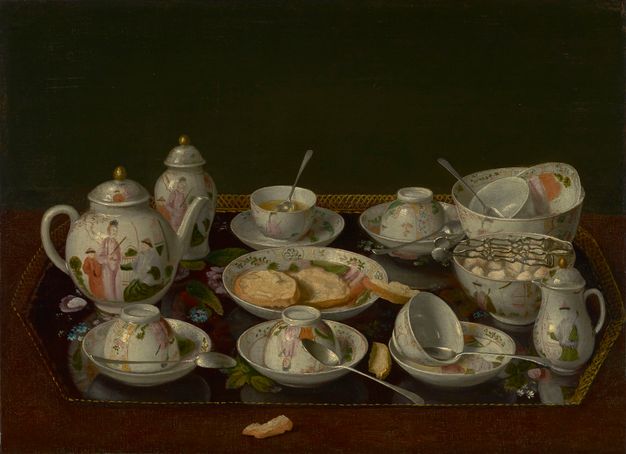
Refined crystallized sugar was shipped across the Atlantic packed in paper-wrapped, semihard cone shapes, known as sugar loaves (pains de sucre).12 Once brought into the domestic kitchen, the cone had to be broken down with a diminutive hammer or cut into small lumps with nippers. These smaller pieces generally accompanied the serving of coffee or tea, whose hot liquid readily dissolved them. Precious-metal tongs facilitated the handling of these lumps from open bowls of commensurately expensive silver or porcelain, as portrayed in the still life of a tea tray by Jean Étienne Liotard (fig. 5.1).13
Alternatively, shipments of semihard crystallized sugar arrived in France to be crushed into very small fine grains or powder at specialized refineries, notably those around the port city of Bordeaux, for use as a condiment during a meal.14 Two types of vessels served sugar in these forms: a caster with a pierced lid for sprinkling (sucrier à poudre) and a lidded bowl (the smaller pot à sucre or the larger sucrier à poudre) with an accompanying slotted or pierced spoon for dusting (cuillère à saupoudrer). Casters, as tablewares, were already in use by the mid-1600s for salt, ground pepper, spices, and dry mustard. With the broadening of sugar consumption in domestic settings, sugar casters were added to those commonly present on the table, and all of them usually stayed in placed for the entire repast, from the first course to the dessert course. During this last course, a dusting of fine grain or powdered sugar especially enhanced the flavor of fresh fruit. When a distinctly separate table setting of precious metal was laid for the dessert service, the wares, including the sugar casters, were often of gilded silver, perhaps to better show off the snowy whiteness of the refined sugar.
The most prevalent caster shape in use by the 1650s was a cylinder canister with a hinged or clasped pierced dome-shaped lid (saupoudreuse à dôme).15 This form was easy to grasp by hand, while the number, size, and shape of the piercings controlled the flow of its dry contents.16 In more prosperous households, all the condiment containers were grouped on a table centerpiece (surtout de table). An engraving in the 1729 edition of the cookbook Le nouveau cuisinier royal et bourgeois by François Massialot illustrated this custom. The foldout image shows a table centerpiece designed as a low stand supporting assorted condiment vessels and a tureen (from which candle branches projected). The caption reads “Machine, autrement dit Surtout, pour server au milieu d’une grande Table, qu’on laisse pendant tous les Services” (“Machine, in other words a centerpiece, to serve in the middle of a large table, which is left there during all the courses of the meal”).17 The two cylindrical casters are the tallest of the condiment vessel forms (see fig. 8.1).
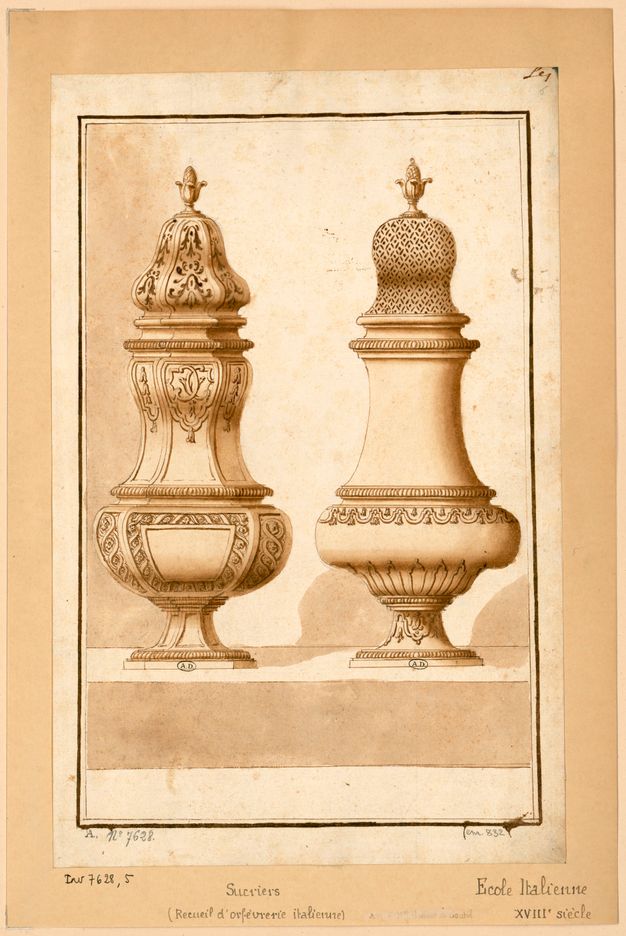
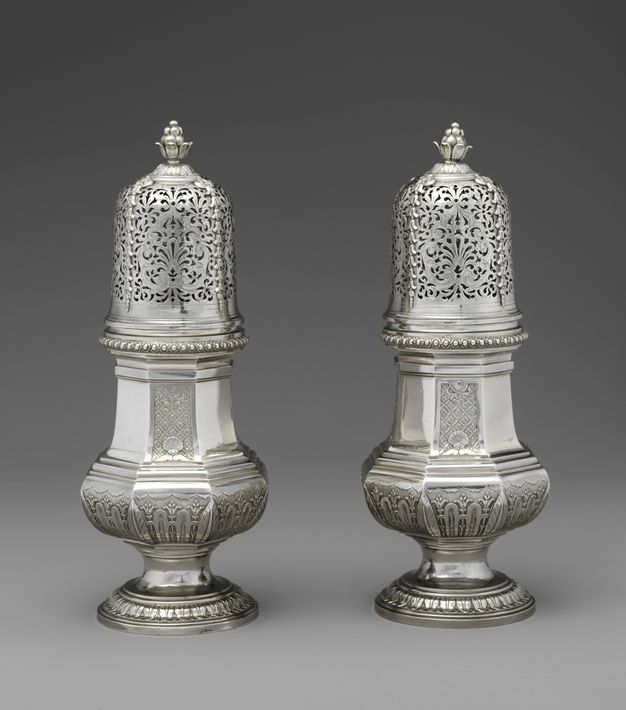
Casters were generally purchased in pairs, multiples, or sets, so that all diners could find one within reach on the table. The Massialot engraving clearly shows this multiplicity in a symmetrical arrangement. Eventually, differing shapes and heights among a group of casters gave visual clues to the content of each. Casters for sugar became taller than those for spices. Evolving fashion prompted variations in design, away from the utilitarian cylindrical canister type to a pear or baluster body shape (fig. 5.2).18 The pear shape emerged in the last decades of the 1600s, the baluster in the 1710s. A pair of casters from 1728–29 by Nicolas Besnier, the Parisian goldsmith to the king (orfèvre du roi), exemplify the baluster shape that prevailed at the beginning of independent rule by Louis XV. Aspects of its design and ornament (waterleaf and bead moldings, laurel leaves and flutes, and delicate piercing patterns) persisted into the 1740s (fig. 5.3).
Stylistically, in shape and in ornament, the Getty casters by Parisian goldsmith Simon Gallien embody natural forms, in keeping with the principles of the alternative rocaille aesthetic. Each silver blossom is botanically identifiable and uniquely singular. The variety and individuality of each speaks of Gallien’s respect for the organic character of nature. In some crevices, among the flower petals, there is a granular surface quality that was not consistently chased or burnished away.19 This inconsistency may have been deliberate, perhaps to imbue a naturalism in defiance of the inorganic materiality of the precious metal. Simon’s younger relative Jean Edme Gallien, the sculptor and merchant goldsmith (marchand orfèvre) who lived with him in the rue de Bussy, may have assisted in creating these flowers.20 Cleverly, Simon Gallien also employed these natural motifs to disguise the technical assembly of the vessels. The four vertical floral stems that travel upward along the baluster-shaped body actually hide the solder seams that join its four separately cast parts, while the wreath of floral blossoms at the vessel’s rim hides the joint of the body and lid. The casters are numbered underneath one and three, respectively, indicating they were once part of a set of three or more pieces. It is also possible that they were originally part of a multipiece table centerpiece, but no comparable companion pieces have been identified.
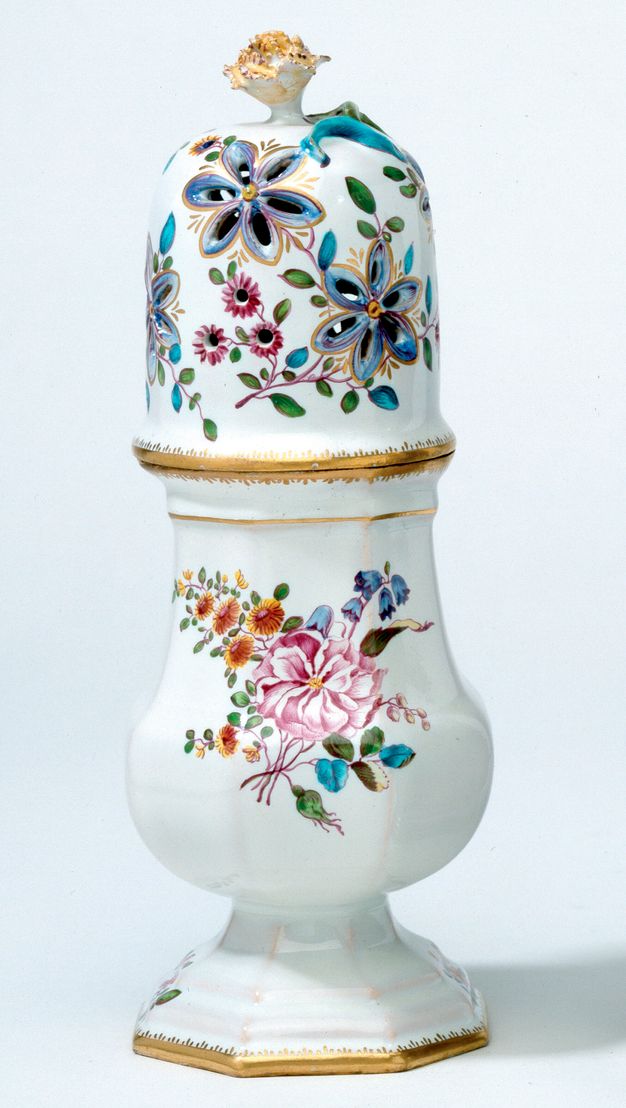
In contrast to the more common design for sugar bowls that took the form of sweet fruit, such as melons, Gallien’s casters effectively brought the flower garden indoors to remain ever fresh on the table.21 In this, he rivaled contemporary faience sugar casters with their opaque white tin glaze grounds and two-dimensional lush floral decoration painted in colorful enamels, by rendering his naturalistic blossoms in high relief, albeit of monochromatic silver. Like the faience sugar casters of the Paul Hannong manufactory in Strasbourg, whose white grounds mimicked refined white sugar and whose painted blooms evoked sweet fragrances, Gallien’s flowers added a tactical sweetness to match that of the palate (fig. 5.4).22
Provenance
Before 1929: F. J. E. Horstmann (Oud Clingendaal, the Netherlands) [sold, Frederik Müller & Cie, Amsterdam, November 19–21, 1929, lot 178];23 before 1976: Jean-Louis Bonnefoy, French, active 1950s (Paris), possibly in association with Bonnefoy et Cie and the antiquaire Au Vieux Paris (4 rue de la Paix, Paris);24 –1976: Robert Henry Edward Abdy, fifth baronet of Albyns, British, 1896–1976 (Newton Ferrers, Saint Mellion, Cornwall, England), by inheritance to his son, Valentine Robert Duff Abdy; 1976: Valentine Robert Duff Abdy, sixth baronet of Albyns, British, 1937–2012 (Paris); –1984: possibly Elizabeth Parke Firestone (Mrs. Harvey S. Firestone, Jr.), American, 1897–1990 (Newport, Rhode Island);25 1984: S. J. Phillips, Ltd., British, active 1869–present (then located at 139 New Bond Street, London), sold to the J. Paul Getty Museum.26
Exhibition History
Paris: Life and Luxury, J. Paul Getty Museum at the Getty Center (Los Angeles), April 26–August 7, 2011, and Museum of Fine Arts, Houston, September 18, 2011–January 2, 2012 (no. 195); The Edible Monument: The Art of Food for Festivals, Getty Research Institute at the Getty Center (Los Angeles), October 13, 2015–March 16, 2016.
Bibliography
Collection F. J. E. Horstmann à Oud Clingendaal: Tableaux, meubles, tapisseries, porcelaines, pendules, bronzes, estampes en couleurs, etc., sale cat., Frederik Müller & Cie, Amsterdam, November 19–21, 1929: unpaginated, lot 178, “Une paire de magnifiques saupoudroirs en argent”; “Acquisitions/1984,” with an introduction by John Walsh. The J. Paul Getty Museum Journal 13 (1985): 157–258., 178, no. 53; Bremer-David, Charissa, with Peggy Fogelman, Peter Fusco, and Catherine Hess. Decorative Arts: An Illustrated Summary Catalogue of the Collections of the J. Paul Getty Museum. Malibu, CA: J. Paul Getty Museum, 1993. http://www.getty.edu/publications/virtuallibrary/0892362219.html., 113, no. 189; Wilson, Gillian, and Catherine Hess. Summary Catalogue of European Decorative Arts in the J. Paul Getty Museum. Los Angeles: J. Paul Getty Museum, 2001. http://www.getty.edu/publications/virtuallibrary/089236632X.html., 96–97, no. 195; Bremer-David, Charissa, ed. Paris: Life and Luxury in the Eighteenth Century. Exh. cat. Los Angeles: J. Paul Getty Museum, 2011., 122, no. 35.
Notes
-
These notations record the weight for sugar caster “no. 1” in the old French units of marc, once, gros. The amount is equivalent to about 1,082.262 grams, which is about 39.826 grams (or 1 ozt., 5.60 dwt.) more than the actual overall weight for this caster and lid. ↩︎
-
These notations record the weight for caster “no. 3” in the old French units of marc, once, gros. The amount is equivalent to about 1,063.071 grams, which is about 44.961 grams (or 1 ozt., 8.90 dwt.) more than the actual overall weight for this caster and lid. ↩︎
-
Both sugar casters have very similar construction, though their surface texture varies slightly (see note 19 below). The vessels, especially, appear quite porous in the X-radiographs taken by Julie Wolfe, Decorative Arts and Sculpture Conservation, J. Paul Getty Museum. Each vessel is composed of five main parts that were soldered together: the open body (whose cylindrical form was assembled from four cast sections), a bottom plate disc of sheet metal, and a cast circular foot. Additionally, the rim of each vessel was made from hammered and cut sheet metal. Cast leafy stems were soldered over the four vertical joins of each vessel body. The array of naturalistic flowers, covering the vessel rim, were made with the repoussé technique and soldered in place. When the open back of a flower would be exposed above the rim, it was fitted with a covering of hammered and rounded sheet metal. Technical Report, November 23, 2021, by Julie Wolfe, Decorative Arts and Sculpture Conservation, J. Paul Getty Museum. X-radiographs were captured at 450 kV, 2 mA, 1000 mSec, and 60 inches, with a GE X-radiography system with digital detector array. For further analytical information, see Appendix: Table 1. ↩︎
-
The lids appear to have been made from sections of sheet metal that were worked and then soldered together. The woven basket effect was created by chasing and piercing. The arrangement of flowers at the top was achieved with the repoussé technique. The sections were struck with the maker’s, warden’s, and discharge marks prior to piercing (see mark 5.1). Technical Report, November 23, 2021, by Julie Wolfe, Decorative Arts and Sculpture Conservation, J. Paul Getty Museum. ↩︎
-
The sugar economy of French and English slave-based plantations reached its apogee in the eighteenth century as production and consumption crescendoed. See Mintz, Sidney W. Sweetness and Power: The Place of Sugar in Modern History. New York: Penguin Books, 1985., 52–53. ↩︎
-
Cultivating cane and processing sugar was an arduous, labor-intensive, and dangerous operation. The true cost of the commodity cannot be factored on a financial basis alone, for sugar production in the West Indies was inexorably dependent on slave and indentured laborers. See Ponting, Clive. World History: A New Perspective. London: Chatto & Windus, 2000., 510–13. The systemic use of black slave labor was already entrenched in the French Antilles colonial economy by the 1660s, when the engraver Sébastian Le Clerc published illustrations of slaves working the sugar plantations there. See Tertre, Jean-Baptiste. Histoire générale des Antilles habitées par les François. 4 parts. Paris: Thomas Jolly, 1667–71., vol. 2, 122–25. To understand the contemporary colonialist sense of racial supremacy, see the entry on sugar plantations, Sucrerie (Habitation), by Le Romain (Jean-Baptiste-Pierre Romain) in Diderot, Denis, and Jean Le Rond d’Alembert, eds. Encyclopédie, ou dictionnaire raisonné des sciences, des arts et des métiers. 17 vols. Paris: Briasson et al., 1751–65., vol. 15, 618–19. The economic, political, and social complexities of the French colonial island culture on Saint Domingue came to a head with the rejection of the 1789 Proclamation of the Rights of Man, the white civil war, and the slave revolt of 1791. See Curtin, Philip D. “The Declaration of the Rights of Man in Saint-Domingue, 1788–1791.” The Hispanic American Historical Review 30, no. 2 (May 1950): 157–75.. ↩︎
-
The engravings of Agriculture et économie rustique—Sucrerie et affinage des sucres, printed in 1762, corresponded to the text entry by “D.J.” (le chevalier Louis de Jucourt), Sucre (Hist. nat. art.), published three years later in volume 15 of the Encyclopédie. See Diderot, Denis, and Jean Le Rond d’Alembert, eds. Recueil des planches sur les sciences, des arts libéraux et les arts méchaniques, avec leurs explications. 11 vols. Paris: Briasson et al., 1762–72., vol. 1, plates 1–7, and Diderot, Denis, and Jean Le Rond d’Alembert, eds. Encyclopédie, ou dictionnaire raisonné des sciences, des arts et des métiers. 17 vols. Paris: Briasson et al., 1751–65., vol. 15, 608–14. ↩︎
-
Paris, Archives nationales de France, O1 838 pièce 182, as quoted by Noël-Waldteufel, Marie-France. “Manger à la cour: Alimentation et gastronomie aux XVIIe et XVIIIe siècles.” In Versailles et les tables royales en Europe XVIIème–XIXème siècles, edited by Jean-Pierre Babelon, Zeev Gouranier, Catherine Arminjin, Béatrix Saule et al., 69–84. Exh. cat. Paris: Réunion des musées nationaux, 1993., 71, 81–82n42. ↩︎
-
Mintz, Sidney W. Sweetness and Power: The Place of Sugar in Modern History. New York: Penguin Books, 1985., 83; Williams, Elizabeth A. Daily Pleasures: French Ceramics from the MaryLou Boone Collection. Los Angeles: Los Angeles County Museum of Art, 2012., 322–23, no. 104 (entry by Meredith Chilton). ↩︎
-
The prime example being Massialot, François. Nouvelle instruction pour les confitures, les liqueurs et les fruits […]. Paris: Chez Charles de Sercy, 1692.. It was reprinted seventeen times by 1751. ↩︎
-
Braudel, Fernand. The Structures of Everyday Life: Civilization and Capitalism 15th–18th Century, vol. 1. Translated by Siân Reynolds. New York: Harper & Row, 1981., vol. 1, 226, 583n146. On the price of sugar and its inflation in Paris in the years 1792–95, see Hibbert, Christopher. The Days of the French Revolution. New York: William Morrow, 1999., 147, 282. For comparison, John Quincy Adams noted in his diary that the average price for one pound of butter in Paris in 1785 was thirty sous, though in the contemporary period of drought it reached 2 livres. Washington, D.C., National Archives, “[May 1785],” Founders Online, accessed July 4, 2020, https://founders.archives.gov/documents/Adams/03-01-02-0007-0007, originally in The Adams Papers: Diary of John Quincy Adams, vol. 1, November 1779 – March 1786, ed. Robert J. Taylor and Marc Friedlaender (Cambridge, MA: Harvard University Press, 1981), 259–77. ↩︎
-
For a near contemporary three-dimensional representation that shows the relative scale and appearance of such a paper-wrapped sugar loaf, see the sculptural rendering of a woman, seated at a table, who reckons the accounts for a delivery of comestibles including a sugar loaf in its pink paper covering, made around 1760 at the Frankenthal Porcelain Factory after the model of Johann Friedrich Lück. The State Hermitage Museum, Saint Petersburg, inv. 3Փ-13912, https://www.hermitagemuseum.org/wps/portal/hermitage/digital-collection/10.+porcelain%2C+faience%2C+ceramics/329478. ↩︎
-
J. Paul Getty Museum, inv. 84.PA.57, https://www.getty.edu/art/collection/object/103RG0. ↩︎
-
On the purification process of cassonade sugar, specifically utilized by island planters, versus the exclusive processes employed in the powerful domestic French refineries, see Yvon, Tristan. “The Provenance of Refining Pottery in Guadeloupe: Indispensable Utensils for the Sugar Industry from the Seventeenth to the Nineteenth Century.” Journal of Caribbean Archaeology 11 (2011): 1–23.. ↩︎
-
Micio, Paul. “Les merveilles du repercé français.” L’estampille/L’objet d’art 391 (May 2004): 45–53., 48–49. ↩︎
-
The flow of the cast sugar could even be subtly controlled for the sake of economy. In his entry “Sucrier” in the Encyclopédie, Le Romain cited the seventeenth-century poet and author Paul Scarron, who reproached his sister for having modified the holes of his sugar caster for this reason. See Diderot, Denis, and Jean Le Rond d’Alembert, eds. Encyclopédie, ou dictionnaire raisonné des sciences, des arts et des métiers. 17 vols. Paris: Briasson et al., 1751–65., vol. 15, 619. ↩︎
-
Massialot, François (probable author). Le nouveau cuisinier royal et bourgeois. 2 vols. Paris: Chez Claude Prudhomme, 1729., vol. 1, 1 bis. ↩︎
-
Deux modèles de sucriers à poudre (Two Models for Sugar Casters), from Recueil d’orfèvrerie italienne (Collection of Italian Silver), early 1700s, Musée des arts décoratifs, Paris, Département des arts graphiques, inv. 7628-5, http://collections.lesartsdecoratifs.fr/deux-modeles-de-sucriers-a-poudre-0. ↩︎
-
This granular quality, also known by the descriptive term “orange peel,” is an unusual surface to be found on worked, chased, and engraved silver. It was likely caused when the molten silver-copper alloy was overheated and oxygen was absorbed. As the molten alloy cooled, oxygen reacted with the copper to make cuprite, which expanded in volume, creating a bubbly surface. Overheated silver-copper alloys can also develop pinhole porosity when solidifying. See Scott, David. “Technological, Analytical, and Microstructural Studies of a Renaissance Silver Basin.” Archeomaterials 5, no. 1 (1991): 21–45., especially 31–32. Reference courtesy of Julie Wolfe, Decorative Arts and Sculpture Conservation, J. Paul Getty Museum. ↩︎
-
In 1747 Jean Edme Gallien (1720–1797) was identified as a sculptor working in association with Louis Paffe, master bronze founder and chaser (maître fondeur et ciseleur). In the same year, he was identified also as a merchant goldsmith (marchand orfèvre). Paris, Archives nationales de France, Minutier central, XXVII, 241, July 1, 1747 (the historical document was not consulted; the citation draws upon the descriptive notary catalogue by Mireille Rambaud and Catherine Grodecki, Artisans XVIIIe siècle, 1956–1977, originally compiled as a paper resource, since adapted and now searchable online at https://francearchives.fr/). Seven years later, he collaborated on the massive gilt-bronze mantel clock executed in 1754 for Louis XV’s bedroom at the Château de Fontainebleau. The clock is now in the Château de Versailles, inv. VMB 8706, http://collections.chateauversailles.fr/?permid=permobj_e5589ad5-6cbb-44f7-a43c-f3f7f6a42b0a. See Ottomeyer, Hans, and Peter Pröschel. Vergoldete Bronzen. Die Bronzearbeiten des Spätbarock und Klassizismus. 2 vols. Munich: Klinkhardt & Bierman Verlagsbuchhandlung, 1986., vol. 1, 130, fig. 2.8.21; and Augarde, Jean-Dominique. Les ouvriers du temps: La pendule à Paris de Louis XIV à Napoléon Ier. Geneva: Antiquorum Editions, 1996., 131, 137, 167n37, 167n51, 235, fig. 186. ↩︎
-
See, for instance, the silver sugar bowl in the naturalistic form of a melon (sucrier en forme de melon) of 1777 by Ignace Colombier of Marseille. Musée du Louvre, Paris, inv. OA 12177, https://collections.louvre.fr/en/ark:/53355/cl010110062. ↩︎
-
Sugar caster (sucrier à poudre), Paul Hannong manufactory, Strasbourg, ca. 1750, Historisches Museum Basel, inv. 1988.211, https://www.hmb.ch/fr/musees/objets-de-la-collection/vue-simple/s/deux-sucriers-saupoudreurs/. There is a collection of Paul Hannong sugar casters in the Château-Musée de Saumur. See Lahaussois, Christine, and Antoinette Faÿ-Halle. Les céramiques du Château-Musée de Saumur. Dijon: Éditions Faton, 2017.. ↩︎
-
Collection F. J. E. Horstmann à Oud Clingendaal: Tableaux, meubles, tapisseries, porcelaines, pendules, bronzes, estampes en couleurs, etc., sale cat., Frederik Müller & Cie, Amsterdam, November 19–21, 1929: unpaginated, lot 178, “Une paire de magnifiques saupoudroirs en argent.” The identity of F. J. E. Horstmann needs further investigation. The individual may have been “F. Horstmann,” the managing director of the Dutch oil company Nederlandsche Koloniale Petroleum Maatschappij (NKPM), who died after April 11, 1929, and before June 19, 1929. Richard M. Tobin, “Report from the Minister in the Netherlands to the Secretary of State, June 19, 1929, the Hague,” reprinted by the Department of State, Papers Relating to the Foreign Relations of the United States, 1929 (Washington, DC: Government Printing Office, 1944), vol. 3, 544, available at https://www.google.com/books/edition/Papers_Relating_to_the_Foreign_Relations/yU06AQAAIAAJ. See also Agus Setiawan, “The Political and Economic Relationship of American-Dutch Colonial Administration of Southeast Asia: A Case Study (1907–1928)” (Ph.D. diss., Jacobs University, Bremen, Germany, 2014), 159. ↩︎
-
Sir Valentine Abdy, letters to Gillian Wilson, January–February 1985, on file in the Sculpture and Decorative Arts Department, J. Paul Getty Museum. ↩︎
-
S. J. Phillips, Ltd., London, invoice sent to the J. Paul Getty Museum, November 20, 1984, a copy of which is on file in the Sculpture and Decorative Arts Department, J. Paul Getty Museum. ↩︎
-
Purchased with funds raised through the deaccession of an ewer and basin of 1736–37 by Paul de Lamerie (which had been subsequently gilded and altered, probably in the 1870s), formerly in the personal collection of J. Paul Getty and distributed by his estate to the J. Paul Getty Museum in 1978 (78.DG.177.1–2). Proposed Disposal Information Sheet, April 16, 1984, on file in the Sculpture and Decorative Arts Department, J. Paul Getty Museum. ↩︎