Component Details
Marks
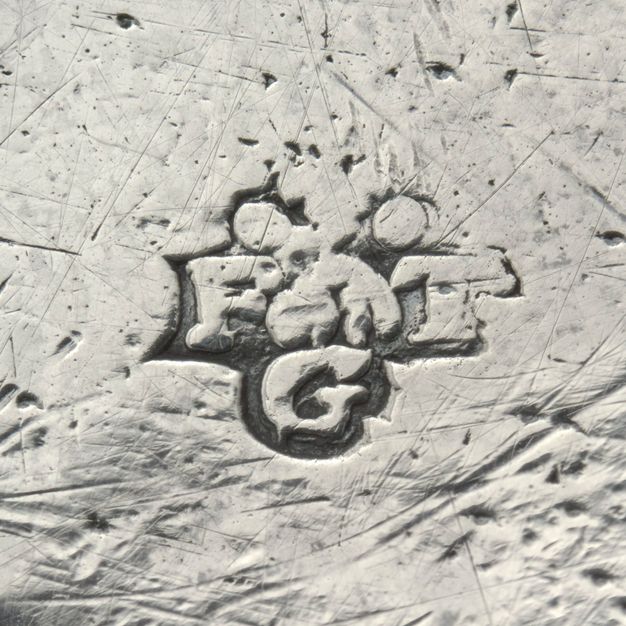
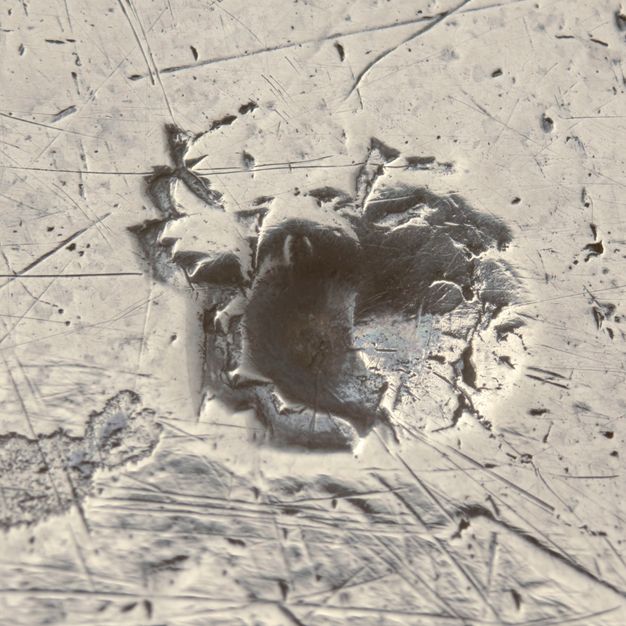
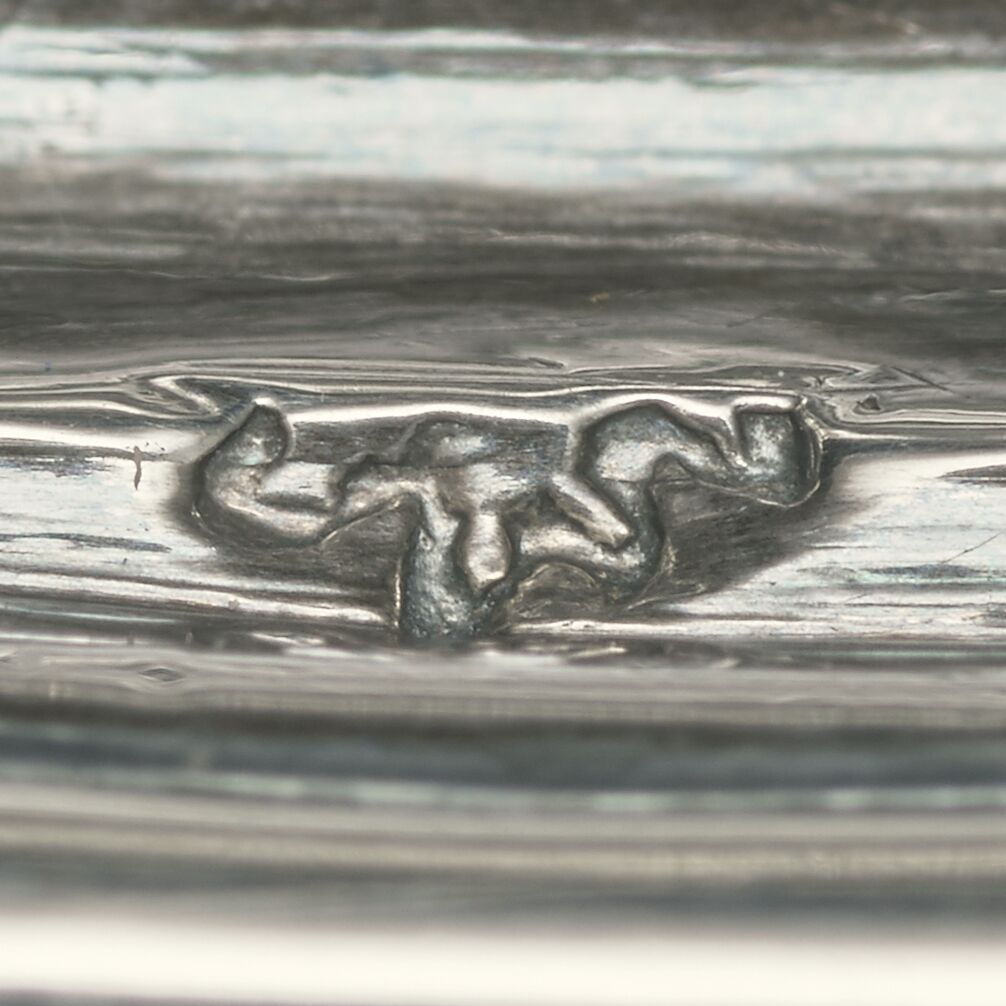
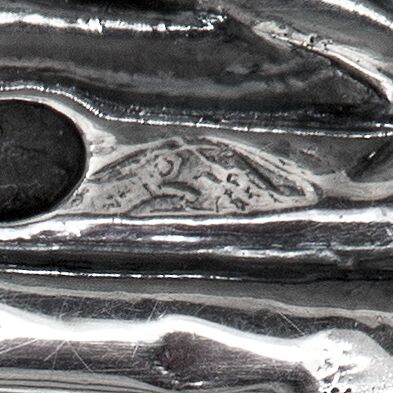
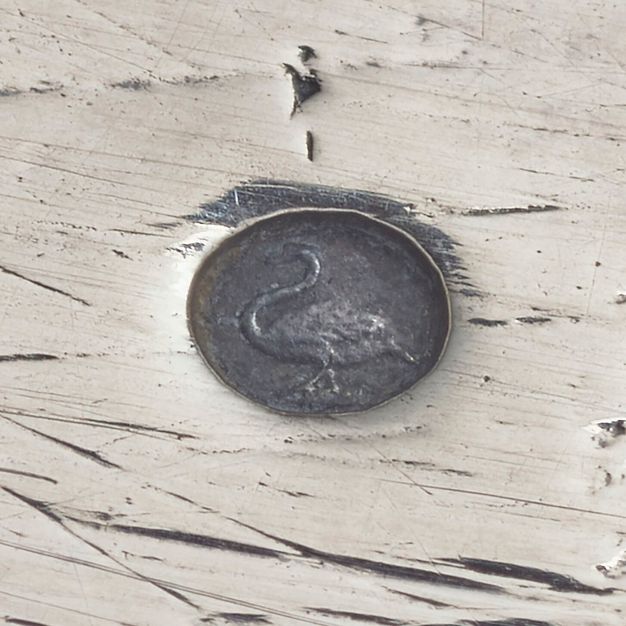
Struck, underneath, with the following stamps: the maker’s mark consisting of the initials “F.T.G.,” a lamb’s fleece, and two grains below a crowned fleur-de-lys (mark 7.1); a crowned K (the Paris warden’s mark used between July 15, 1750, and January 22, 1752) (mark 7.2); and a crowned A with palm and laurel branches (the Paris charge mark for large works of silver used between October 1, 1750, and October 1, 1756, under the fermier Julien Berthe) (mark 7.3). Struck, on the exterior of the rim, with the following stamps: a cow (the Paris discharge mark for large works of silver intended for export used from before October 1, 1762, to November 18, 1774, under successive fermiers, Jean-Jacques Prévost, then Julien Alaterre) (partially struck) (mark 7.4);1 an indistinct mark, possibly a boar head (the “restricted warranty” of 800 parts per thousand, or 80 percent, minimum silver standard used in Paris exclusively from May 10, 1838); a small charançon, or weevil (for small works of gold or silver imported into France, used in Paris exclusively between May 10, 1838, and May 31, 1864) (mark 7.5); and a swan in an oval (the standard mark for silver of unknown origin that is sold at auction as used by contracting countries between July 1, 1893, and 1970). Struck, underneath, near the rim, with the following stamp: a swan in an oval (the standard mark for silver of unknown origin that is sold at auction as used by contracting countries between July 1, 1893, and 1970) (mark 7.6).

Armorials
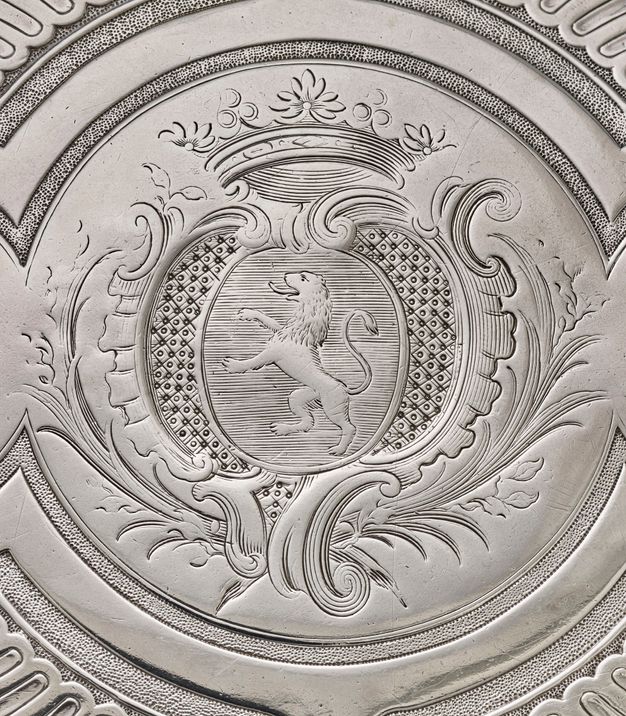
The surface of the tray is engraved with the coat of arms of, possibly, a member of the de Ménard de la Menardière family, surmounted by a marquis’s coronet (armorial 7.1).
Description
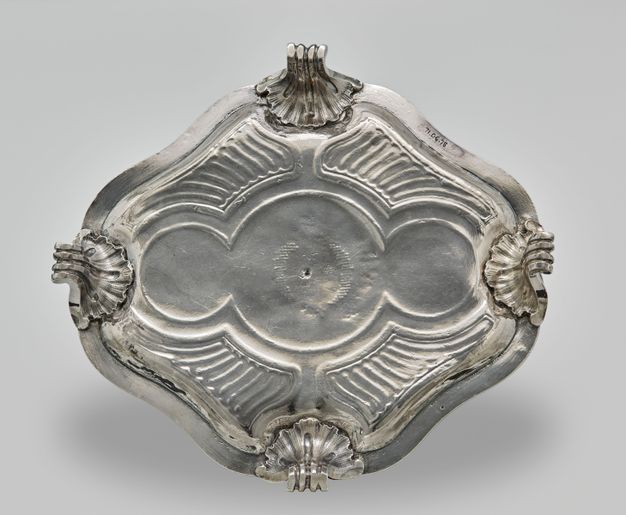
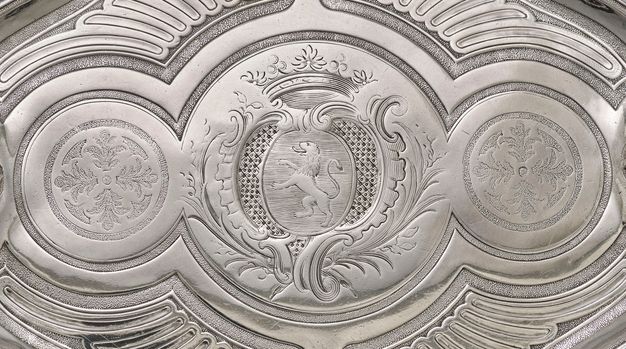
This lozenge-shaped tray is supported by four low legs (cat. 7.1). The volutes at the base of each leg rise into a fan of paired leaves flanking a central budding stalk that stretches above the rim of the tray and over its banded reed molding.2 Ribbons bind the reeds, giving the illusion of tying them in place along the serpentine contours of the rim. The surface of the tray is divided into compartments: a large central circle is flanked by a pair of smaller circles and four irregularly shaped fields of waving flutes (cat. 7.2). The central circle contains a coat of arms tentatively identified as that of the de Ménard de la Menardière family, surmounted by a marquis’s coronet, set against a diaper pattern within an asymmetrical shield above crossed palm fronds and twigs of laurel. Each flanking circle is engraved with a geometric arrangement of four flattened acanthus leaves set around a central dot and encircled by a narrow ring.
Commentary
This type of tray was intended to support a pair of lidded beakers, or gobelets couverts. Such trays were standard fixtures in the eighteenth-century French toilette set (service de toilette), which was an ensemble of implements used during the morning act of cleansing and grooming. As a ritualized process, it was known as la levee.3 Toilette sets served both men and women, though those for men featured a shaving basin. In prosperous high-ranking families, it was customary for a bride to receive a silver toilette service upon her marriage, for use and for display. Typically, a set comprised a mirror, candlesticks, a tray with a candlesnuffer and wick trimmer, an ewer and basin, a tray with lidded beakers, brushes, a vessel for dental paste, pots for creams and cosmetics, and boxes of differing sizes for powder, accessories, jewelry, and pins. More extensive sets could include additional items such a water jug, scent bottles, a bell, a small spittoon, and even a warming pan.
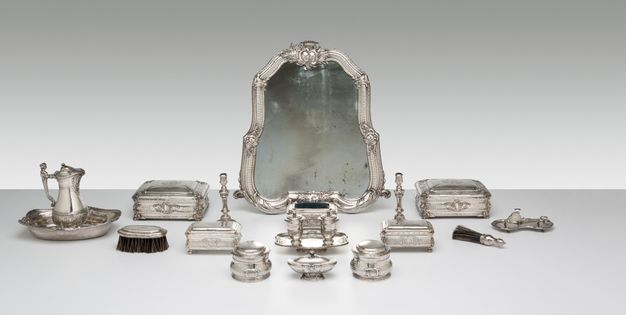
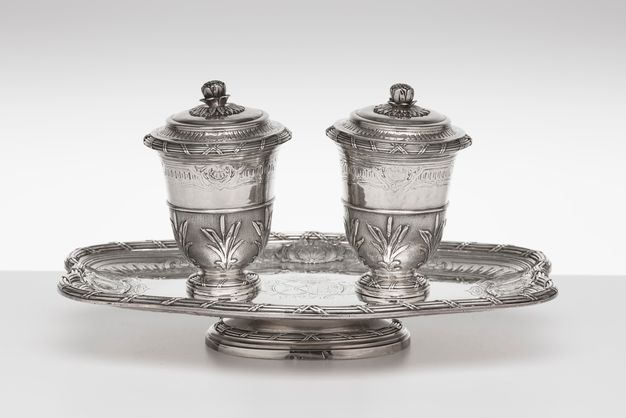
Two extant Parisian silver toilette sets from the period exemplify the role of this type of tray and show the form of lidded beakers it supported. Contrary to previous scholarly interpretation, these vessels were not intended to contain face creams or cosmetics. The first toilette set contains nineteen pieces made in 1738–39 by Étienne Pollet, and four other silversmiths under his direction, for Henriette Julie Gabrielle de Lorraine, duchesse de Cadaval (fig. 7.1).4 It was not uncommon for a goldsmith to efficiently and quickly fill a commission by subcontracting components of a large toilette set among several craftsmen, all working toward a unified design. For the Cadaval toilette set, the tray and pair of lidded beakers were made by Antoine LeBrun (fig. 7.2).5 In archival documents concerning the commission, the tray was called a “saucer or glove tray” (soucoupe ou gantière) and the lidded beakers were called “covered goblets” (gobelets avec leurs couvercles).6 Though the old-fashioned etiquette of having a tray to pass or to receive les honneurs, or gloves, was less commonly observed by midcentury, new commissions by aristocratic households still included the item.7 The function of the Getty tray, however, aligned more closely with the role of a saucer, as it was intended to carry a pair of little drinking cups for cold beverages.8 The oblong shape of the tray and the narrow form of the beakers endured for decades. It was the tray’s single oval foot that evolved, as demonstrated by the second comparative toilette set.
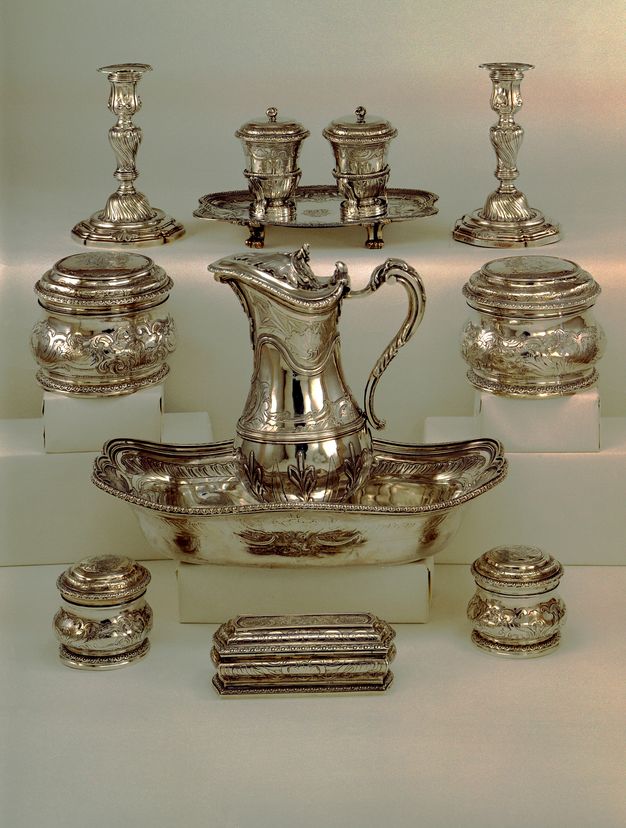
The second comparable toilette set dates from ten years later, and while now incomplete, all ten surviving pieces were made by the Parisian goldsmith Jean Charles Fauché (fig. 7.3).9 Its tray is quite similar in shape to the Cadaval one, except that it has four volute-shaped feet rather than a singular foot ring, and in this detail, it reflects a new development in design. It follows the precedent of the tray in the gilded-silver toilette set delivered in 1746 by Thomas Germain for the French dauphine Marie Thérèse Raphaëlle d’Espagne. That tray was of lozenge shape, supported by four volute-shaped feet (albeit, positioned at the cardinal points). The dauphine’s service does not survive, but seven related drawings, done to scale, are preserved, including one for the gantière with two gobelets couverts.10 Given the prestige of the dauphine’s set, no doubt its design features became common knowledge among the tight community of Parisian goldsmiths eager to keep up with fashion (fig. 7.4).
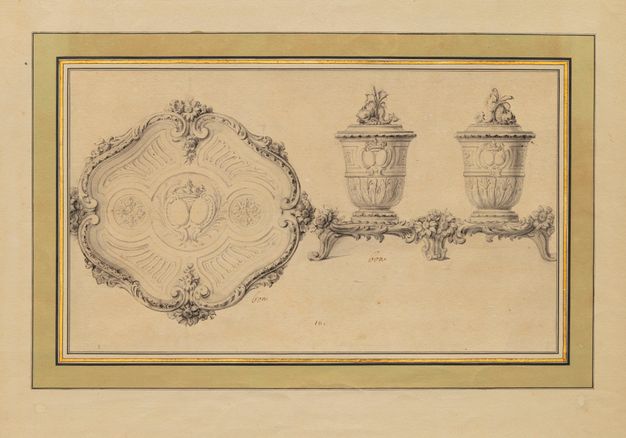
The Getty tray, made by the son of Thomas Germain some four to five years after the dauphine’s tray, corresponds in several key features to the latter’s drawn rendering, namely in size, shape, and design.11 First of all, the tray’s actual dimensions match almost precisely those of the two-dimensional views, which measure from guilloche border to guilloche border (excluding the maximum bulk of the flowers) 3.6 × 21 × 18.7 centimeters. Secondly, the volute-shaped feet and their positions align, in relation to the orientation of the lozenge-shaped tray. Thirdly, the compartmentalization of the trays’ surfaces and flat-chased ornament are comparable. It is clear that François Thomas Germain had access to the drawing (and perhaps to molds for the volute-shaped feet), which was preserved after his father’s death. For the 1750 commission, however, he simplified the overall appearance of its tray, eliminating the profusion of flowers and substituting a banded reed molding for the tray rim.
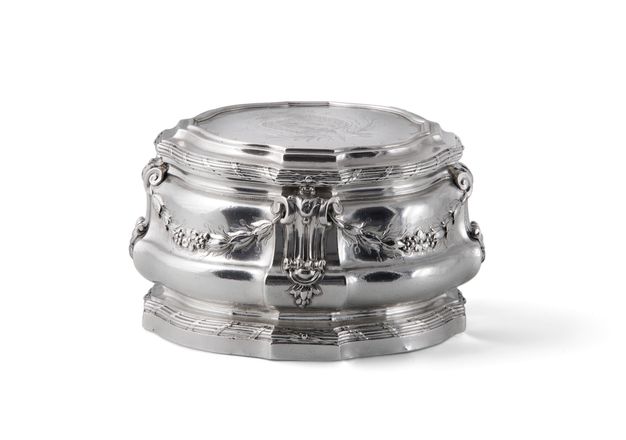
The center of the Getty tray is engraved with the coat of arms of, possibly, the de Ménard de la Menardière family.12 Thanks to the presence of this armorial engraved on related pieces, it is possible to identify four lidded boxes, or boîtes de toilette rondes, from this dispersed toilette set. The largest box (H: 8.3 × Diam: 13.8 cm) is in the in the Musée des arts décoratifs, Paris (fig. 7.5).13 A smaller pair (5.5 × 8.5 cm) of the same form, called boîtes à mouche (which were containers for fashionable, small black patches usually applied to the face), passed through the French art market in 1996.14 These three still bear the family’s arms, while the fourth (6 × 9 cm) has a heavily overengraved sunflower obliterating the arms.15 All four are stamped with the Paris warden’s mark “K” (used under Julien Berthe between July 15, 1750, and January 22, 1752), meaning that they were produced as a group simultaneously with the tray in the workshop of François Thomas Germain.16 The boxes are of rounded octagonal shape, with four vertical console-bracketed segments spaced equidistant around each vessel. Chased floral swags link one console to the next. The base of each vessel and its lid follow the same rounded octagonal contour. Their banded reed moldings echo that of the tray.
If the lidded beakers (gobelets couverts) survive for the Getty tray, perhaps they would also follow the model in Thomas Germain’s drawing for the 1746 dauphine’s service, but simplified and updated with a banded reed molding. That was the design solution François Thomas German chose just a few years later in 1755 for the lidded beakers he delivered with another gilded-silver toilette set.17 Curiously, he took a different approach with that tray, reverting back to the traditional oblong shape that prevailed in the 1730s–40s. He modernized its appearance, though, by chasing large palmettes at either end.
In summary, five pieces from the original toilette set are known: the Getty’s tray and four lidded boxes. The other elements of the set have not been identified, so their number and appearance can only be surmised (as above). Certainly, as a creation of the king’s famous goldsmith-sculptor (orfèvre-sculpteur du roi) François Thomas Germain, the set was an expensive and prestigious commission but possibly not executed originally for the de Ménard de la Menardière family. This hypothesis is based on an engraved design for a tray, published by Pierre Germain in 1748, that offers alternative decorative treatments for two quadrants, one of which is closely similar the Getty tray. The armorial in the design incorporates a pair of shields, above palm fronds and below a crown.18 Did aesthetic merits preserve the original toilette set from the crown’s 1759 order to melt silver in order to defray the cost of the Seven Years’ War?19 Marks on the extant tray and four boxes indicate they were exported from France between 1762 (if not before) and 1774 and imported back into France between 1838 and 1864.20 Some scholars conclude, therefore, the French armorials for the de Ménard de la Menardière family were added between 1838 and 1887.21
Provenance
By 1887: possibly a member of the de Ménard de la Menardière family (originally from Berry and from Normandy), as part of a service de toilette; before 1926: possibly Junius Spencer Morgan, American, 1867–1932 (New York);22 possibly ca. 1926: Louis-Victor Tabouret Puiforcat, French, died 1955 (Paris), father of Jean Puiforcat;23 by 1926–45: Jean Puiforcat, French, 1897–1945 (Paris; then Urrugne, Saint-Jean-de-Luz, France, until 1940; then Mexico until October 1945);24 1946–50: Jacques Helft, French, 1891–1980 (Paris until 1940 and again from 1946; active in New York 1940–48);25 1950–52: David David-Weill, French American, 1871–1952 (Paris), by inheritance to his wife, Flora David-Weill; 1952–70: Flora David-Weill, French, 1878–1970 (Paris) [sold after her death, Palais Galliéra, Paris, November 24, 1971, lot 24, to the J. Paul Getty Museum].26
Exhibition History
Exposition d’orfèvrerie française civile du XVIe siècle au début du XIXe, Musée des arts décoratifs (Paris), April 12–May 12, 1926 (no. 91, lent by M[onsieur] Puiforcat); Three French Reigns (Louis XIV, XV & XVI): Exhibition in Aid of the Royal Northern Hospital, 25 Park Lane (London), February 21–April 5, 1933 (no. 388, lent by Monsieur Puiforcat); Three Centuries of French Domestic Silver, Metropolitan Museum of Art (New York), May 18–September 18, 1938 (no. 85, lent by Puiforcat); The J. Paul Getty Collection of French Decorative Arts, Detroit Institute of Fine Arts (Detroit), October 3, 1972–August 31, 1973 (lent by the J. Paul Getty Museum).
Bibliography
Exposition d’orfèvrerie française civile du XVIe siècle au début du XIXe. Exh. cat. Paris: Le Musée, 1926., 17, no. 91 (lent by M[onsieur] Puiforcat); Three French Reigns (Louis XIV, XV, and XVI): Loan Exhibition in Aid of the Royal Northern Hospital at 25 Park Lane, February 21st to April 5th (Inclusive) 1933. 2 vols. Exh. cat. London: Battley Bros., Queensgate Press, 1933., vol. 1, 53, no. 388 (lent by Monsieur Puiforcat); Three Centuries of French Domestic Silver: An Exhibition Held May 18 through September 18, New York, 1938, the Metropolitan Museum of Art. Exh. cat. New York: The Museum, 1938., no. 85, fig. 85 (lent by Puiforcat); Brault, Solange, and Yves Bottineau. L’orfèvrerie française du XVIIIe siècle. Paris: Presses Universitaires de France, 1959., 186, pl. 17; Dennis, Faith. Three Centuries of French Domestic Silver: Its Makers and Its Marks. 2 vols. New York: Metropolitan Museum of Art, 1960., vol. 1, 19–21, 116–17, fig. 149; Nocq, Henry. Le poinçon de Paris: Répertoire des maîtres-orfèvres de la juridiction de Paris depuis le Moyen-âge jusqu’à la fin du XVIIIe siècle. 5 vols. Paris: Léonce Laget, 1968., vol. 2, 243, ill.; Collection D. David-Weill (deuxième vente d’orfèvrerie)—Orfèvrerie France XVe au XVIIIe siècle, sale cat., Palais Galliéra, Paris, November 24, 1971: lot 24, “Plateau”; Sassoon, Adrian, and Gillian Wilson. Decorative Arts: A Handbook of the Collections of the J. Paul Getty Museum. Malibu, CA: J. Paul Getty Museum, 1986., 69, no. 153; Whitehead, John. The French Interior in the Eighteenth Century. London: Laurence King, 1992., 229, ill.; Bremer-David, Charissa, with Peggy Fogelman, Peter Fusco, and Catherine Hess. Decorative Arts: An Illustrated Summary Catalogue of the Collections of the J. Paul Getty Museum. Malibu, CA: J. Paul Getty Museum, 1993. http://www.getty.edu/publications/virtuallibrary/0892362219.html., 115, no. 191; Perrin, Christiane. François Thomas Germain: Orfèvre des rois. Saint-Rémy-en-l’Eau: Éditions d’art Monelle Hayot, 1993., 53, 110–12, 276n115, ill.; Wilson, Gillian, and Catherine Hess. Summary Catalogue of European Decorative Arts in the J. Paul Getty Museum. Los Angeles: J. Paul Getty Museum, 2001. http://www.getty.edu/publications/virtuallibrary/089236632X.html., 98, no. 197; Fuhring, Peter. Designing the Décor: French Drawings from the Eighteenth Century. Exh. cat. Lisbon: Calouste Gulbenkian Foundation, 2005., 158–59, no. 53, 328, no. 53n1.
Notes
-
The research of Michèle Bimbenet-Privat has revealed that the discharge mark of the cow actually came into use long before 1762, probably as early as 1733. Michèle Bimbenet-Privat, comments to author, August 2021. ↩︎
-
A technical analysis by Julie Wolfe and her interpretation of X-radiographs taken at 450 kV, 2 mA, 500 mSec, and 60 inches, with a GE x-radiography system, improve our understanding of how this object was made. It appears the flat tray itself was cast and not hammered from sheet metal. Its upward curving edge was, apparently, raised by hand from the perimeter of the cast tray. This edge, in turn, was hidden under a cast lozenge-shaped ring that encompasses the banded reed molding and the four budding stalks, which was soldered into place. Each leg, from its volute-shaped base upward to its scroll and cartouche-shaped top, was hollow cast and soldered to the underside of the tray (see cat. 7.1). The thickness of the cast tray thins at the center of the lozenge, in the area of the engraved armorial. This suggests a prior alteration to that surface ornament. Technical Report, November 19, 2021, by Julie Wolfe, Decorative Arts and Sculpture Conservation Department, J. Paul Getty Museum. See also Appendix: Table 1. ↩︎
-
The levee, as practiced among elite levels of ancien régime court and society, is a vast topic. Two especially relevant articles are Albainy, Tracey. “Eighteenth-Century French Silver in the Elizabeth Parke Firestone Collection.” Bulletin of the Detroit Institute of Arts 73, no. 1/2 (1999): 8–29. and Chrisman-Campbell, Kimberly. “Dressing to Impress: The Morning Toilette and the Fabrication of Femininity.” In Paris: Life and Luxury in the Eighteenth Century, edited by Charissa Bremer-David, 56–59. Exh. cat. Los Angeles: J. Paul Getty Museum, 2011.. ↩︎
-
Detroit Institute of Arts, inv. V2014.6 and 53.177–192, https://www.dia.org/art/collection/object/toilet-service-duchesse-de-cadaval-102681. See Carlier, Yves. “Details of the Toilet Service of the Duchesse de Cadaval.” Bulletin of the Detroit Institute of Arts 78, nos. 1–2 (2004): 4–17.. ↩︎
-
Detroit Institute of Arts, inv. 53.186.3, https://www.dia.org/art/collection/object/stand-108467. The tray, also called a stand, measures 3.8 × 24.1 × 17.1 cm (1 1/2 × 9 1/2 × 6 3/4 in.). It bears the Paris warden’s mark for 1738–39. ↩︎
-
Further evidence of this nomenclature and purpose is found in designs for gantières (glove trays), such as that published in 1748 by the goldsmith Pierre Germain (Germain, Pierre. Elements d’orfèvrerie divisés en deux parties de cinquante feuilles chacune compose par Pierre Germain, Marchand Orfevre Joaillier. 2 parts. Paris: Chez l’auteur, place du Carousel a l’Orfèvrerie du roy, 1748., part 2, plate 90). It was etched by Jean Jacques Pasquier after Germain. ↩︎
-
For instance, “2 gantier et 2 sucoupe [sic]” were part of the gilded-silver toilette service of Louis, duc d’Orléans, located in his bedroom at his Paris residence, the Palais Royal, as listed in a document of 1741–42. Bibliothèque Historique de la Ville de Paris C.P. 4574, chemise 1741. Peter Fuhring reproduced and translated the document in Fuhring, Peter. “The Silver Inventory from 1741 of Louis, duc d’Orléans.” Cleveland Studies in the History of Art 8 (2003): 130–45., 138–39, 144n7. ↩︎
-
Carlier, Yves. “Details of the Toilet Service of the Duchesse de Cadaval.” Bulletin of the Detroit Institute of Arts 78, nos. 1–2 (2004): 4–17., 15, 17n25. ↩︎
-
Musée des arts décoratifs et du design, Bordeaux, inv. 55.4.1–55.4.8. The tray, catalogued as a présentoir, measures H: 23.5 × W: 16.5 cm (9 1/4 × 6 1/2 in.) and weighs, together with its pair of lidded beakers, 975 grams (31 ozt., 6.939 dwt.). It bears the Paris warden’s mark for 1749–50. Though a mirror is the principal item missing from this set, a pair of candlesticks was later added. Information kindly provided by Antonin Macé de Lépinay and Olivier Hurstel. See Orfèvrerie: Catalogue des collections des XVIIIe et XIXe siècles, réalisé dans le cadre de l’exposition “Permanence de l’orfèvrerie française—argenterie bordelaise.” Bordeaux: Musée des arts décoratifs, 1987., 47–51, nos. 20–24. See also Musée des arts décoratifs et du design de Bordeaux, Objet du mois #25: La toilette d’argent du comte de Marcellus, deuxième quart du XVIIIe siècle (Inv. 55.4.1 à 55.4.8), June 2014, https://madd-bordeaux.fr/objet-du-mois/toilette-dite-du-comte-de-marcellus. This set is contemporary with the designs for silver published in 1748 by the goldsmith Pierre Germain. Fauché’s tray with two lidded beakers corresponded to the etching by Jean Jacques Pasquier after Germain in Germain, Pierre. Elements d’orfèvrerie divisés en deux parties de cinquante feuilles chacune compose par Pierre Germain, Marchand Orfevre Joaillier. 2 parts. Paris: Chez l’auteur, place du Carousel a l’Orfèvrerie du roy, 1748., part 2, plate 88, for a Toilette simple that included a tray carrying two lidded beakers. ↩︎
-
After the untimely death of the first dauphine, this set was adapted and expanded by Thomas Germain for the second dauphine, Marie-Josèphe de Saxe, who married Louis, dauphin de France, in 1747. The descriptive title “gantière avec deux gobelets couverts” derives from the list made by the goldsmith Roëttiers in December 1768, when he was tasked with restoring the service after the death of Dauphine Marie-Josèphe de Saxe. Paris, Archives nationales de France, O1 3622, cited by Perrin, Christiane. François Thomas Germain: Orfèvre des rois. Saint-Rémy-en-l’Eau: Éditions d’art Monelle Hayot, 1993., 52–55, 267n129, ill., and Fuhring, Peter. Designing the Décor: French Drawings from the Eighteenth Century. Exh. cat. Lisbon: Calouste Gulbenkian Foundation, 2005., 156–65, nos. 51–56, and 328, nos. 51–56nn1–14. ↩︎
-
The drawing by Thomas Germain (pen and black ink, gray wash, and black chalk, 26 × 45 cm) is in a private collection in Paris and is illustrated in Fuhring, Peter. Designing the Décor: French Drawings from the Eighteenth Century. Exh. cat. Lisbon: Calouste Gulbenkian Foundation, 2005., 158–59, no. 53 (titled as “cosmetic tumblers and tray”), and 328, no. 53n1. Access to the drawing was kindly facilitated by the private collector and Peter Fuhring. ↩︎
-
This identification is not certain, as the field of the de Ménard de la Menardière family’s coat of arms should be silver (represented in heraldic tincture as a white, or plain, field without hatching), whereas the engraved armorial shows it as blue (with horizontal hatching). Likewise, the engraved armorial does not correctly indicate the red color of the heraldic lion. Did the engraver accurately render his patron’s arms, make an error, or take artistic liberty? See Rietstap, J[ohannes] B[aptista]. Armorial général: Précédé d’un dictionnaire des termes du blazon. 2 vols. 1887. Reprint edition, New York: Barnes & Noble, 1965., vol. 2, 197; Rolland, V[ictor], and H[enri] V. Rolland. Illustrations to the Armorial Général by J.-B. Rietstap. 6 vols. London: Heraldry Today, 1967., vol. 3, plate CLXXXIV; Jougla de Morénas, Henri. Grand armorial de France: Nouvelle édition. 7 vols. Paris: Frankelve; Paris-Nancy: Berger-Levrault, 1975., vol. 5, Mar–Ric, 37. ↩︎
-
Musée des arts décoratifs, Paris, inv. 26910. See Mabille, Gérard. Orfèvrerie française des XVIe XVIIe XVIIIe siècles: Catalogue raisonné des collections du Musée des arts décoratifs et du Musée Nissim de Camondo. Paris: Flammarion/Musée des arts décoratfis, 1984., 76, no. 107. Mabille tentatively identified this box as the one published in Bapst, Germain. Études sur l’orfèvrerie française au XVIIIe siècle: Les Germain, orfèvres-sculpteurs du roy. Paris: J. Rouam et cie, 1887., 111, ill. Perhaps it was the same box that sold after the death of M[onsieur] H. Sennegon at Hôtel Drouot, Paris, May 9–11, 1887, 35, lot 160, ill., “Jolie Boîte à poudre” (measuring 8.5 × 15 cm). François Thomas Germain would repeat this form of box in 1756–57 for the famous gilded-silver toilette service he delivered in March 1759 to José I, King of Portugal (and now in the Museu Nacional de Arte Antiga, Lisbon). Perrin, Christiane. François Thomas Germain: Orfèvre des rois. Saint-Rémy-en-l’Eau: Éditions d’art Monelle Hayot, 1993., 158, ill., 284n69. ↩︎
-
They sold at Galerie des ventes, G. Boscher and Ch. Oriot, SCP Commissaires-Priseurs, Morlaix, August 12, 1996, lot 396, ill. on cover. It is thought that one of the pair was formerly in the collection of Henri Chasles, sold in Orfèvrerie française du XVIII siècle, anciennes porcelains tendres françaises, objets d’art et d’ameublement du XVIII siècle, sale cat., Hôtel Drouot, December 9, 1907: 4, lot 13, “Boîte à pâtes” (no measurements), ill.; then Marius Paulme, Catalogue des objets d’orfèvrerie ancienne, principalement de “Vieux Paris” du XVIIIe siècle … composant la collection de M. M. P. […], sale cat., Galerie Georges Petit, Paris, April 18–19, 1923: 47, lot 169, “Boîte à pâte” (measuring 5.5 × 9 cm), ill.; and David David-Weill, Collection D. David-Weill (deuxième vente d’orfèvrerie)—Orfèvrerie France XVe au XVIIIe siècle, sale cat., Palais Galliéra, Paris, November 24, 1971: lot 25, “Boîte de toilette et son couvercle” (measuring 5.5 × 8.8 cm), ill. Present location unknown. ↩︎
-
Despite the heavy-handed overengraving, traces of the previous armorial’s crossed palm fronds and marquise’s coronet are still recognizable. See Perrin, Christiane. François Thomas Germain: Orfèvre des rois. Saint-Rémy-en-l’Eau: Éditions d’art Monelle Hayot, 1993., 110, 113, 276n118, ill. It sold in European Silver, sale cat., Sotheby’s, Geneva, May 15, 1984: 68, lot 207, “Toilet box.” The present location is unknown. The box was lent by the baron de Mesnard to the Exposition rétrospective de l’art français au Trocadéro, Paris, in 1889. See Darcel, Emile, and Alfred Darcel. Exposition rétrospective de l’art français au Trocadéro. Exh. cat. Lille: Impr. L. Danel, 1889., 221, no. 1398. The baron de Mesnard is not to be confused with Ménard family and their respective coats of arms are different. For the former, see Rietstap, J[ohannes] B[aptista]. Armorial général: Précédé d’un dictionnaire des termes du blazon. 2 vols. 1887. Reprint edition, New York: Barnes & Noble, 1965., vol. 2, 208. ↩︎
-
The pieces have been variously catalogued, however, and dated to within a narrower range of years. See notes 13 and 14 above. Concerning the warden’s span of activity, see Bimbenet-Privat, Michèle, and Gabriel de Fontaines. La datation de l’orfèvrerie parisienne sous l’ancien régime: Poinçons de jurande et poinçons de la Marque 1507–1792. Paris: Éditions de la ville de Paris, 1995., 130–33. ↩︎
-
The tray, its pair of lidded beakers, and an assortment of five boxes remain together in a private collection, London. Their engraved armorials are a later addition. See Perrin, Christiane. François Thomas Germain: Orfèvre des rois. Saint-Rémy-en-l’Eau: Éditions d’art Monelle Hayot, 1993., 110, 112, 276n119, ill. This partial set sold in Importante argenterie européenne: Succession de Monsieur Claude Cartier, sale cat., Sotheby Parke Bernet Monaco S.A., Monte Carlo, November 27, 1979: lot 731, “Toilette.” ↩︎
-
Germain, Pierre. Elements d’orfèvrerie divisés en deux parties de cinquante feuilles chacune compose par Pierre Germain, Marchand Orfevre Joaillier. 2 parts. Paris: Chez l’auteur, place du Carousel a l’Orfèvrerie du roy, 1748., part 2, plate 90. See note 6 above. ↩︎
-
Bimbenet-Privat, Michèle. “The Royal Silversmiths.” In Royal Treasures from the Louvre: Louis XIV to Marie Antoinette, by Marc Bascou, Michèle Bimbenet-Privat, and Martin Chapman, 82–89. Exh. cat. San Francisco: Fine Arts Museums of San Francisco, 2012., 83, 89n1. For the melt’s effect on the activity of François Thomas Germain, see Perrin, Christiane. François Thomas Germain: Orfèvre des rois. Saint-Rémy-en-l’Eau: Éditions d’art Monelle Hayot, 1993., 81. ↩︎
-
This span of years is suggested by the tray’s mark for importation into France and by the publication and exhibition history for two of the set’s boxes, which are identifiable by the armorials they bear. The coat of arms was on the largest round box when it was published in Bapst, Germain. Études sur l’orfèvrerie française au XVIIIe siècle: Les Germain, orfèvres-sculpteurs du roy. Paris: J. Rouam et cie, 1887., 111, ill. See notes 2 and 13 above, as well as Mabille, Gérard. Orfèvrerie française des XVIe XVIIe XVIIIe siècles: Catalogue raisonné des collections du Musée des arts décoratifs et du Musée Nissim de Camondo. Paris: Flammarion/Musée des arts décoratfis, 1984., 76, no. 107; and Perrin, Christiane. François Thomas Germain: Orfèvre des rois. Saint-Rémy-en-l’Eau: Éditions d’art Monelle Hayot, 1993., 110, 276n116. In any event, the toilette set was dispersed by 1889, for the box with the defaced coat of arms was lent in that year by the baron de Mesnard (not to be confused with the Ménard family) to the Exposition rétrospective de l’art français au Trocadéro, Paris. See note 15 above. ↩︎
-
Clare Le Corbeiller, former curator at the Metropolitan Museum of Art, New York, letter to Gillian Wilson, June 2, 1980, on file in the Sculpture and Decorative Arts Department, J. Paul Getty Museum. ↩︎
-
Ibid. ↩︎
-
Monsieur Puiforcat is listed as the lender of this object to three exhibitions between 1926 and 1938. See the Exhibition History above. ↩︎
-
The tray appears in the stock photo and is catalogued in a stock inventory card for the dealer Jacques Helft. They are part of the dealer’s records preserved in the Département des Objets d’art, Musée du Louvre, Paris. ↩︎
-
Collection D. David-Weill (deuxième vente d’orfèvrerie)—Orfèvrerie France XVe au XVIIIe siècle, sale cat., Palais Galliéra, Paris, November 24, 1971: lot 24, “Plateau.” Prior to the second sale of the David David-Weill collection, there was a special presentation viewing of the more important objects. This viewing was held at Maison de la Chimie, 28 bis rue Saint-Dominique, Paris, on November 19, 1971, and this tray is visible in photographs documenting that display. Catherine Gougeon kindly provided access to these images in the Jacques Helft documentation file in the Département des Objets d’art, Musée du Louvre, Paris. ↩︎