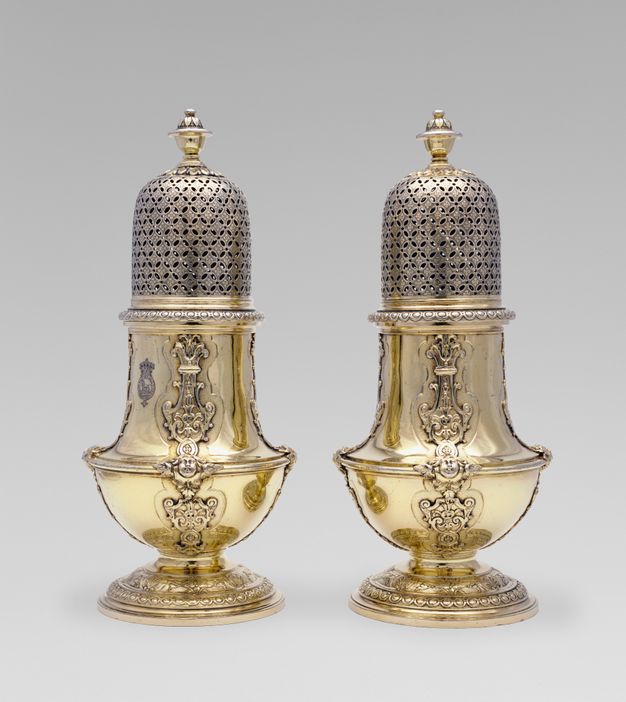
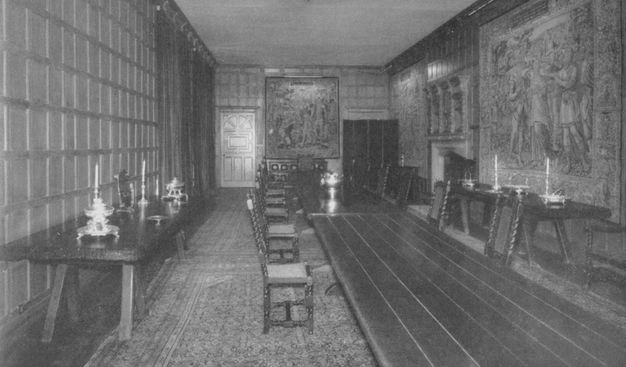
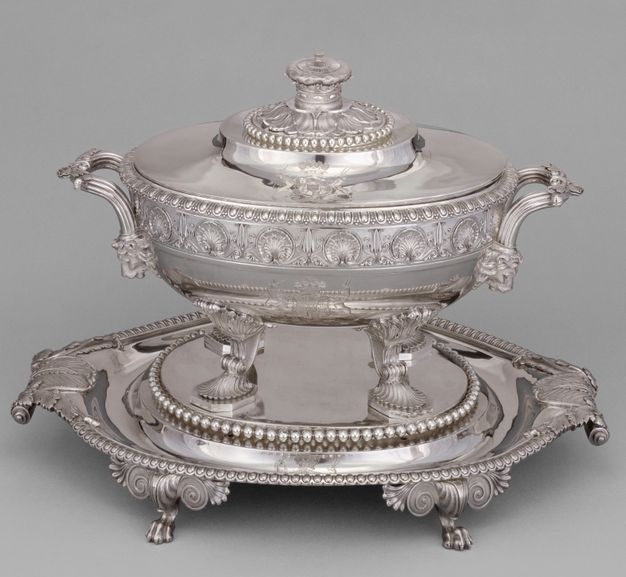
The collection of French silver at the J. Paul Getty Museum reflects the tastes and choices of chiefly two individuals, J. Paul Getty (1892–1976), the institution’s founder and director from 1959 to his death, and Gillian Wilson (1941–2019), the institution’s curator of decorative arts from December 1971 to 2003. While alive, Getty identified himself as a collector of British silver, and his few purchases of French silver, made just five years before his death, were selected specifically and directly for the Museum.1 His appreciation of the medium in general and his own penchant for silver plate and cutlery intended for the dining table continued to shape the collection even after his death in June 1976.2 As early as 1941, he plainly stated the parameters of his personal focus: “I have one of the outstanding collections of Georgian silverware. I am a particular admirer of the 18th Century London silversmith Paul [de] Lamerie, and have several many fine pieces by other noted 18th Century English silversmiths” (fig. 0.1).3 By 1954 some of these pieces were displayed in the dining room of his California ranch–style residence in Malibu, which became the first venue of the J. Paul Getty Museum.4 And by 1961 most had joined him in his English home, the Tudor manor house of Sutton Place, in Surrey (fig. 0.2).5 In 1978, following his death, the greater share of his silver collection was distributed from his estate to the Museum, then housed at its second venue, the Villa, which had opened on the Malibu site in January 1974.6 Few pieces of the British silver went on public view there, however, for the decorative arts collection featured predominantly French works. Eventually, the bulk of British silver was deaccessioned, so that now only four pieces remain in the Museum’s current silver installation at the Getty Center, in Los Angeles (figs. 0.1, 0.3).7
Getty’s decision to bid on three inaugural pieces of French silver at auction in Paris on November 24, 1971, coincided with his vision of expanding the fledgling Museum’s collection of French decorative arts and its display in its future venue, the Villa, then under construction. His primary advisors on French decorative arts at that time—the New York–based dealer Martin Zimet (1931–2020) of French & Company and the specialist Theodore (Ted) Dell (1939–2020)—probably recommended the opportunity to him when they visited Sutton Place on November 18.8 The auction was the second of three that dispersed the acclaimed silver collection of the distinguished collector and philanthropist David David-Weill (1871–1952).9 The prestige of the provenance would not have been lost upon Getty, but, as he did not travel to the sale preview himself, no doubt Zimet and Dell lobbied his approval by showing him the illustrated sale catalogue. Zimet spoke with Getty on November 26, when they may have reviewed the successful bids on three lots.10 The items were serving vessels spanning the mid-eighteenth century: a lidded broth bowl (cat. no. 2 in this catalogue); a small tray used to serve beverage beakers during the morning ritual of dressing (cat. no. 7), by the esteemed goldsmith François Thomas Germain (1726–1791); and a sauceboat on stand (cat. no. 9).11
Then followed a ten-year suspension of French silver acquisitions while larger seventeenth- and eighteenth-century objects (such as wall paneling, furniture, clocks, lighting fixtures, porcelain, and textiles) were purchased to fill out the Villa’s ten galleries of decorative arts. This interval lasted until the settlement of Getty’s financial bequest to the Museum in 1982. In the meanwhile, Gillian Wilson displayed the three French pieces in a showcase with Sèvres porcelain, situated in the so-called Neoclassical Vestibule, gallery 219, on the Villa’s second floor.12
The hiatus was broken in a spectacular and transformative step at the close of 1981 when, thanks to Wilson’s network with dealers, auctioneers, colleagues, and collectors, the Museum was privately offered a major piece of French Baroque seventeenth-century silver, a rarity given the periodic and destructive melt-downs of silver during Louis XIV’s reign. This object, a large silver water vessel (later transformed into a fountain), survived because of its export to London before 1698 and its subsequent adaptation for a British aristocratic family (cat. no. 1). The purchase was a true game changer, as it signaled that the Museum might consider other extraordinary pieces of comparable significance and beauty should they became available. Thus, within days of the fountain’s approval by the Acquisitions Committee, two stupendous pairs of mid-eighteenth-century Parisian tureens with stands were offered simultaneously from different sources to the Museum. Made by the preeminent goldsmiths of the era, Thomas Germain (1673–1748) and his son, the aforementioned François Thomas Germain, they too had escaped the historic melt-downs of the ancien régime on account of their early export to Portugal. Strategically, Wilson displayed both pairs in the Museum’s board room on the spring day in March 1982 when the Acquisitions Committee next convened. The tureens’ inventive yet complementary design and virtuoso execution overcame any possible reticence the committee may have had concerning perceived redundancy, and contrary to Wilson’s expectations but much to her delight, both pairs were approved (cat. nos. 3 and 6). These superlative examples established the Museum’s burgeoning collection of French silver as world class. As press announcements and publications celebrating the new additions reached dealers, specialists, and the public, further fine French silver came on offer—pieces that otherwise might well have remained in private hands.13
More opportunities followed shortly. The first arrived when, once again, a private party offered a pair of three-branch girandoles by Robert Joseph Auguste (1723–1805), the prominent Parisian goldsmith working in the Neoclassical style (cat. no. 10). The elegantly balanced forms were originally part of an extensive silver table service commissioned in the 1770s for the Hanoverian court in the Holy Roman Empire by Prince-Elector George III (1738–1820), Duke of Brunswick-Lüneburg. By now, the Museum’s collection of French silver had developed a nearly exclusive concentration in tablewares and serving vessels that exemplified the eighteenth-century art of dining and entertaining.
The next two acquisitions, of the mid-1980s, were the only silver objects bought directly from art dealers. The first was a pair of mid-eighteenth-century sugar casters by Simon Gallien (died 1757) in the Rococo style, which enlarged the Museum’s array of serving vessel types (cat. no. 5). They came from S. J. Phillips, the same London art firm frequented by Getty since the 1930s.14 The next purchase, and the last silver piece proposed by Wilson, comprised another pair of sugar casters, yet very unusual in conception and material: its artisan makers, working in their disparate craft traditions, collaborated to create figurative sculptures of varnished bronze with casters of silver (cat. no. 4). Illustrious provenance was a constant consideration in Wilson’s acquisitions, exactly as it had been for Getty, and she maintained his same demanding criteria in this regard throughout her professional career. Indeed, these casters likely once belonged to the celebrated marquise de Pompadour, the ultimate trendsetter and arbiter of taste at the court of Louis XV.
By 1988 the number of French silver pieces, as well as their range of type and form, was sufficient to require a dedicated gallery in the Villa. A didactic booklet, French Silver in the J. Paul Getty Museum, was produced and available gratis to gallery visitors: it explained stylistic evolutions of the long century from 1661 to 1782, traditional craft techniques of the era, and the systematic use of marks—or stamps—employed by the regulating Parisian guild that guaranteed the requisite purity of silver alloy and that governed the practices of member goldsmiths (see Note to the Reader I: Stamps and Marks).15 Some pieces of Getty’s British silver were included in this installation.16 That focused installation of silver moved to the Museum’s third venue at the Getty Center in Los Angeles in 1997, where its display was enhanced by the natural light of the enclosed South Hall.
After the retirement of Gillian Wilson, a newly combined curatorial department of Sculpture and Decorative Arts was formed in November 2004, headed by Antonia Boström. A singularly fitting acquisition in silver soon followed: the highly sculptural centerpiece for a table, known as La Machine d’Argent, of 1754 by François Thomas Germain (cat. no. 8). It was a privilege for me to examine and research the piece as soon as it first appeared on the New York art market in 2004. This unique object, a still life with game, was commissioned by Christian Ludwig II (1683–1756), Duke of Mecklenburg-Schwerin, for his castle in the eponymous duchy in the northern domains of the Holy Roman Empire. The commission reflected the fame and prestige of the Germain family of goldsmiths far beyond their Paris-based workshop. The magnificent object, with its prestigious provenance, built upon the collection’s strength of works by the father and son who held, successively, the title of “goldsmith-sculptor to the king” (orfèvre-sculpteur du roi) under Louis XV. The Museum now contained six of their works in silver, in addition to two pairs of massive wall lights in gilt bronze.17 In August 2016, under the direction of Anne-Lise Desmas, the Sculpture and Decorative Arts Department designed a fresh display for the art of European goldsmiths in an adjacent area of the South Hall. It brought together works from a broader spectrum, spanning the late sixteenth to early nineteenth centuries, with the French objects as its core.
Thus far, the French silver at the J. Paul Getty Museum features works by Parisian masters exclusively; it is a small but exceptionally superlative assemblage. Most pieces exhibit an extraordinary virtuosity and inventiveness of design and form, a high quality of execution and finishing, a distinguished provenance, and an excellent state of preservation. Among public collections of North America, the Museum’s holdings most closely parallel those of the Detroit Institute of Arts, which were built up by the notable collectors Elizabeth Parke Firestone (1897–1990) and Harvey S. Firestone, Jr. (1898–1973), near contemporaries of Getty.18 In terms of the world’s great collections of eighteenth-century French silver, the Museum’s pieces would fit well within those of the Musée du Louvre in Paris, the Museu Nacional de Arte Antiga and the Museu Calouste Gulbenkian in Lisbon, and the State Hermitage in Saint Petersburg, all of which are rich with works by the Germain family of goldsmiths.19
Notes
-
J. Paul Getty’s preference for British silver, to the near exclusion of other national schools, dated back to the 1930s. Early anecdotal indicators of his preferences appear in his diary entry for October 10, 1938, when he visited the highly regarded Parisian dealer of French silver Jacques Helft, and another entry for November 4, 1938, when he visited the London art firm S. J. Phillips. The former entry mentioned only French furniture and no silver, while the latter recorded in detail the cleaning and repair of some of Getty’s British silver. Getty Research Institute, Institutional Records and Archives, IA40009, J. Paul Getty Diaries, August 27–November 13, 1938: 30, October 13, 1938, and 10, November 4, 1938, http://hdl.handle.net/10020/2010ia16v1. Four works in this catalogue passed through the dealer Jacques Helft (cat. nos. 1, 6, and 7), while four passed through S. J. Phillips (cat. nos. 5 and 6). ↩︎
-
A 1942 inventory of Getty’s silver collection in his New York City residence listed more than forty-one silver serving vessels and two sets of cutlery, each comprising more than one hundred pieces. Getty Research Institute, Institutional Records and Archives, IA20009, Inventory, 1942, J. Paul Getty Family Collected Papers, Box 1986.IA.48-05, Folder 27. ↩︎
-
Getty, J. Paul. History of the Oil Business of George F. and J. Paul Getty 1903–1939. [Los Angeles?]: J. P. Getty, 1941. http://archives.getty.edu:30008/getty_images/digitalresources/gri_2833470.pdf., 392. ↩︎
-
Le Vane, Ethel, and J. Paul Getty. Collector’s Choice: The Chronicle of an Artistic Odyssey through Europe. London: W. H. Allen, 1955., 68–69. ↩︎
-
“Sutton Place: The 16th Century Residence in Surrey of Mr. J. Paul Getty.” The Antique Collector 32, no. 2 (April 1961): 43–52., 47, 49. Once settled at Sutton Place, Getty also acquired twentieth-century tablewares of gold. Frederick Wight, “The Romans, the Regency and J. Paul Getty,” ARTnews 73, no. 2 (February 1974): 52–55 and cover. ↩︎
-
“Inventory of Sutton Place Gold and Silver [compiled at the J. Paul Getty Museum, Malibu], January 20, 1981,” on file in the Sculpture and Decorative Arts Department, the J. Paul Getty Museum. ↩︎
-
The sole published survey of Getty’s most important British pieces was compiled by Adrian Sassoon. See Sassoon, Adrian, and Gillian Wilson. Decorative Arts: A Handbook of the Collections of the J. Paul Getty Museum. Malibu, CA: J. Paul Getty Museum, 1986., 127–36, nos. 267–301. The bulk of the deaccessioned British gold and silver sold over three sales at auction: Important English and Continental Silver and Objects of Vertu, Christie’s, New York, April 19, 1990, lots 43–50; Important English and Continental Silver, Sotheby’s, New York, April 19, 1991, lots 184–215; Important English and Continental Silver, Sotheby’s, New York, October 16, 1996, lot 323. ↩︎
-
Getty Research Institute, Institutional Records and Archives, IA40009, J. Paul Getty Diaries, April 18, 1971–July 28, 1972: 40, November 18, 1972, http://hdl.handle.net/10020/2010ia16v25. ↩︎
-
The sales that dispersed the silver collection of David David-Weill took place after the death of his widow, Flora David-Weill, in 1970. ↩︎
-
Getty Research Institute, Institutional Records and Archives, IA40009, J. Paul Getty Diaries, April 18, 1971–July 28, 1972: 42, November 26, 1972, http://hdl.handle.net/10020/2010ia16v25. ↩︎
-
Collection D. David-Weill (deuxième vente d’orfèvrerie)—Orfèvrerie France XVe au XVIIIe siècle, sale cat., Palais Galliéra, Paris, November 24, 1971: lots 14, 17, and 24. There is no written indication that Getty consulted Gillian Wilson concerning these purchases at auction, as she had not yet taken up her curatorial appointment. ↩︎
-
The silver is mentioned but not described in Frel, Jiří, Burton Fredericksen, and Gillian Wilson. Guidebook: The J. Paul Getty Museum. [Malibu, CA]: The Museum, 1978., 117. ↩︎
-
To have a sense of the range of publications announcing the water fountain’s acquisition, see the broad outreach to specialists, “Some Acquisitions (1981–82) in the Department of Decorative Arts, the J. Paul Getty Museum.” Burlington Magazine 125, no. 962 (May 1983): 322–26., 324, no. 114, and the seminal scholarly article by Wilson (Wilson, Gillian. “The Kedleston Fountain, Its Development from a Seventeenth-Century Vase.” The J. Paul Getty Museum Journal 11 (1983): 1–12.). ↩︎
-
The purchase of the Gallien sugar casters was financed, in part, through a negotiated exchange of a gilded-silver ewer and basin by Paul de Lamerie, of 1736–37, that had been distributed from the estate of J. Paul Getty to the Museum (78.DG.177.1–2). ↩︎
-
French Silver in the J. Paul Getty Museum, exh. brochure (Malibu, CA: J. Paul Getty Museum, 1988). ↩︎
-
Gillian Wilson, letter to Beth Carver Wees, Associate Curator of Decorative Arts, Sterling and Francine Clark Art Institute, Williamstown, Massachusetts, February 9, 1988, in the object file for 78.DG.130.1–2, Sculpture and Decorative Arts Department, J. Paul Getty Museum. This gallery (number 224) was located in the second-floor corridor of the Villa. ↩︎
-
J. Paul Getty Museum, inv. 81.DF.96.1–4, https://www.getty.edu/art/collection/object/103SGV. ↩︎
-
Albainy, Tracey. “Eighteenth-Century French Silver in the Elizabeth Parke Firestone Collection.” Bulletin of the Detroit Institute of Arts 73, no. 1/2 (1999): 8–29.. ↩︎
-
At the end of 2022, the Musée du Louvre and the Museu Calouste Gulbenkian each published catalogues of their respective French silver collections. With the addition of this catalogue of French silver in the J. Paul Getty Museum, the field is flourishing anew. See Bimbenet-Privat, Michèle, Florian Doux, Catherine Gougeon, and Philippe Palasi. Orfèvrerie française et européenne de la Renaissance et des temps modernes, XVIe, XVIIIe, XVIIIe siècle: La collection du musée du Louvre. Paris: Musée du Louvre, 2022.; Fuhring, Peter, The French Silverware in the Calouste Gulbenkian Collection. Lisbon: Calouste Gulbenkian Foundation, Calouste Gulbenkian Museum, 2022. ↩︎