Component Details
Marks
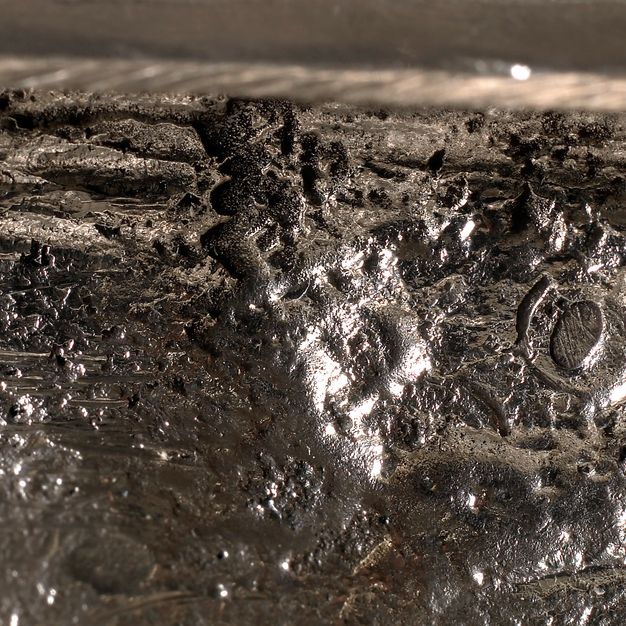
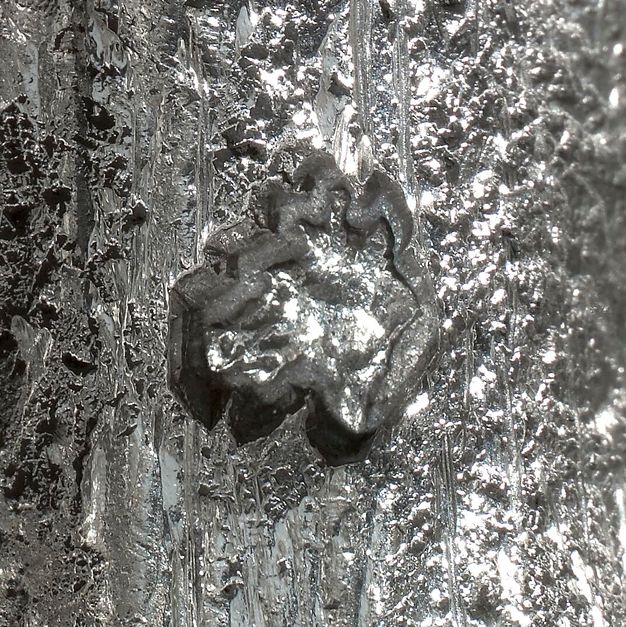
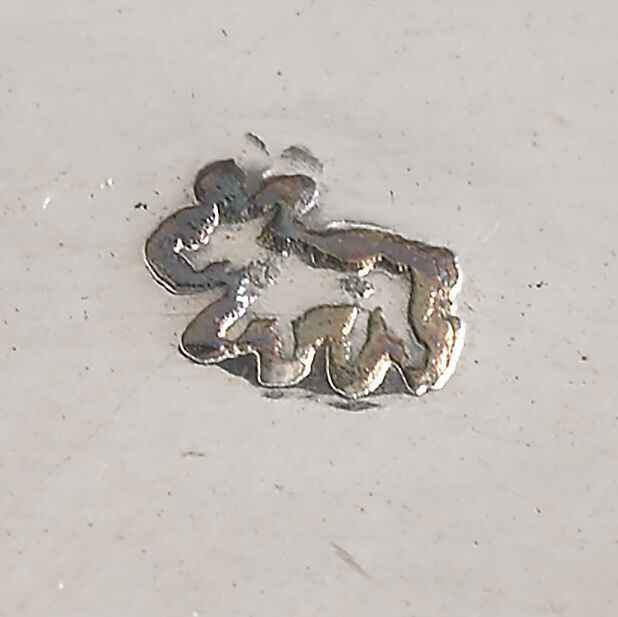
Struck, underneath, at the front edge, with the following stamps: the partially struck maker’s mark consisting of the initials “F.T.G.,” a lamb’s fleece, and two grains below a crowned fleur-de-lys (mark 8.1); a crowned “O” (the Paris warden’s mark used between July 20, 1754, and July 12, 1755) (see mark 8.1); and an ox head (the Paris charge mark for works in gold used between October 1, 1750, and October 1, 1756, under the fermier Julien Berthe) or, less likely, a horse head (the Paris discharge mark for large works of old silver used between October 1, 1750, and October 1, 1756, under the fermier Julien Berthe) (mark 8.2). Struck, on the face of the plinth, with the following stamp: a cow (the Paris discharge mark for large works of silver intended for export used between October 1, 1762, and November 18, 1774, under successive fermiers, Jean-Jacques Prévost, then Julien Alaterre) (mark 8.3).1
Inscriptions
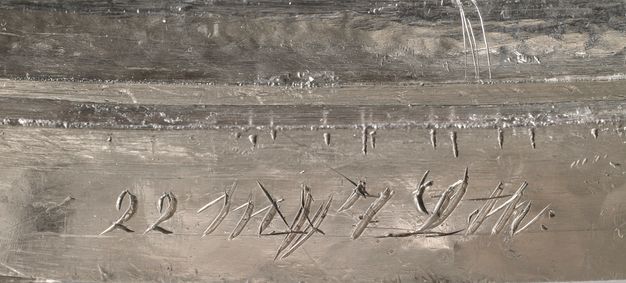
The base is incised, on its interior, at the back, with “F.T. GERMAIN . SCULPTEUR ORFEVRE DUROY FECIT . 1754 A PARIS” (F.T. GERMAIN . SCULPTOR GOLDSMITH OF THE KING MADE . 1754 IN PARIS). The base is scratched, on its interior, at the front, with the historic weight units of Mecklenburg-Schwerin: “22 m[arks] // 7 L[o]th:” (inscriptions 8.1, 8.2).2

Description
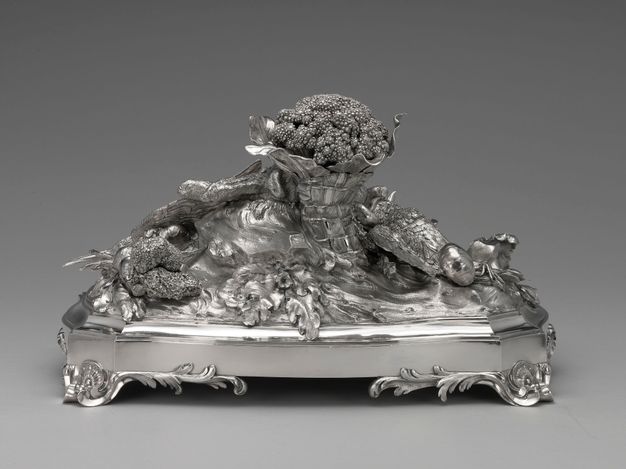
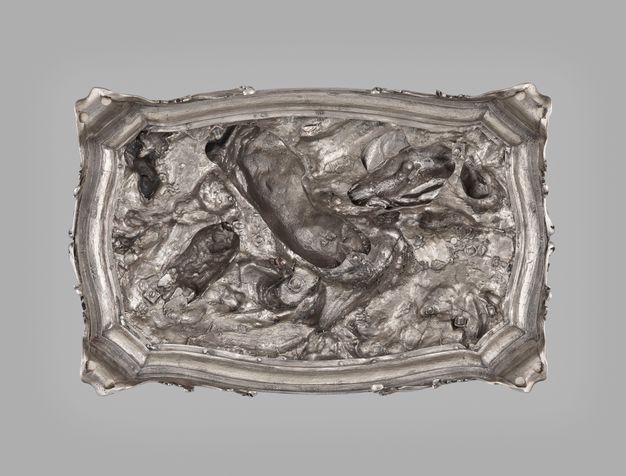
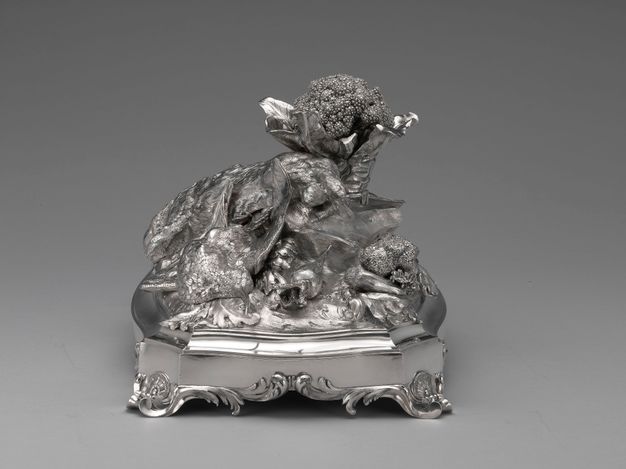
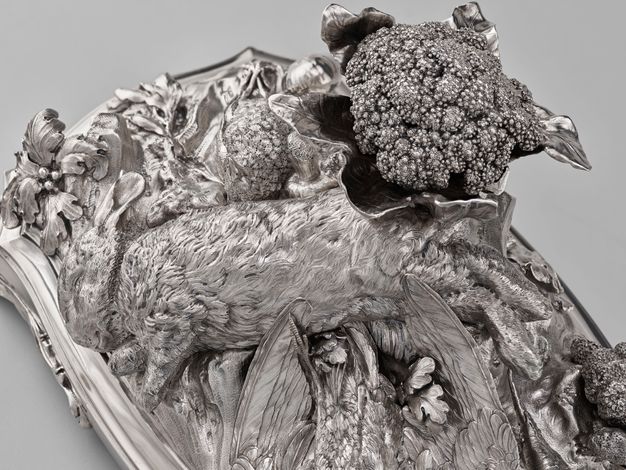
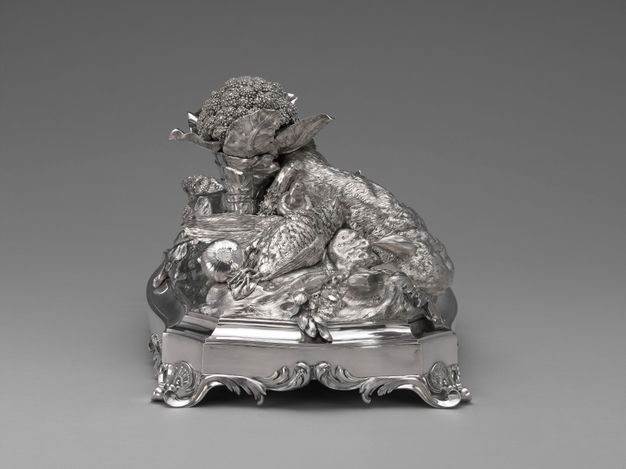
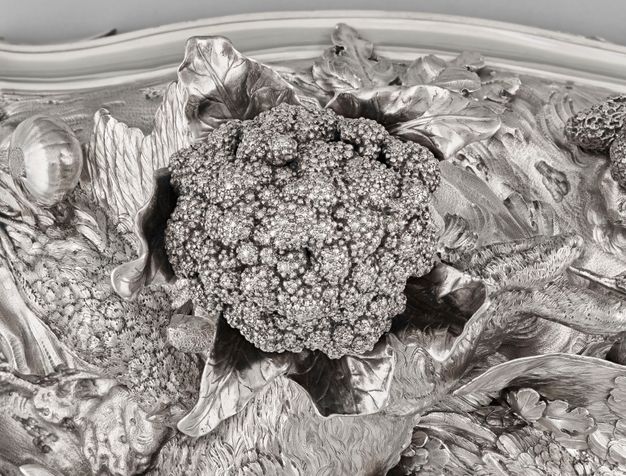
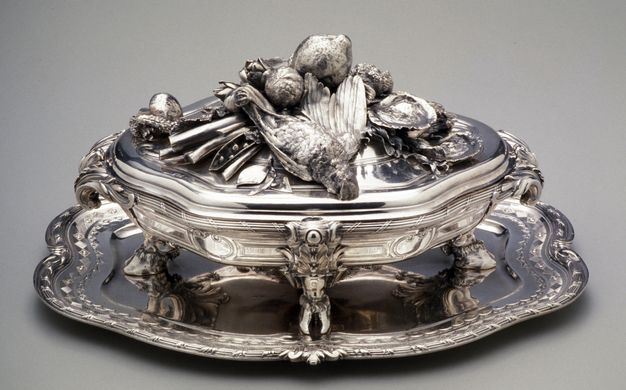
This rectangular centerpiece rises from four shell-and-scroll supports positioned below the canted corners of the polished plinth. Each support is flanked by a pair of spreading acanthus leaves. Above the concave polished rim of the plinth is an uneven forest floor, cast and chased to resemble earthy soil with six low-lying broadleaf plants.3 Resting upon the ground are dead game, mushrooms, root vegetables, and a gherkin, all piled toward the apex of a stalk of cauliflower standing not at center, but at the middle point of the back side of the centerpiece (cat. 8.1). This highly sculptural and naturalistically chased still life consists of thirteen elements separately cast, some in the round. A system of threaded silver rods, soldered to each element, and silver nuts secure them to the earthy floor (cat. 8.2). The elements include a rabbit lying on its side, a snipe on its back with its long beak extending beyond the plinth’s perimeter, an ortolan on its back, a turnip, an onion, a mushroom and a mushroom stalk, a morel, a truffle, a gherkin, and a cauliflower head nestled within its leafy stem (cat. 8.3).4
Commentary
This centerpiece, called the Machine d’Argent, is a unique work in the oeuvre of François Thomas Germain. As a centerpiece for a dining table (surtout de table), it serves none of the form’s traditional functions of tray, condiment stand, or candelabra. It is, purely, a work of sculpture whose still-life subject, that of the hunt, appealed to the patron who commissioned it, Christian Ludwig II, Duke of Mecklenburg-Schwerin. It referenced not only a catch of game (that, in turn, visualized the ingredients of a meal) but also the vast forests of his domain of Schloss Schwerin in the duchy of Mecklenburg-Schwerin (situated between the northern city of Hamburg and the north-central city of Berlin). These forests were renowned for their game, especially boar and stag. Though unique, the Machine d’Argent was constructed from elements whose design dated back twenty years or more when first modeled by Thomas Germain, father of François Thomas Germain, and its creation in 1754 represents the son’s masterful and inventive reuse of preexisting models to fashion entirely new and original work.
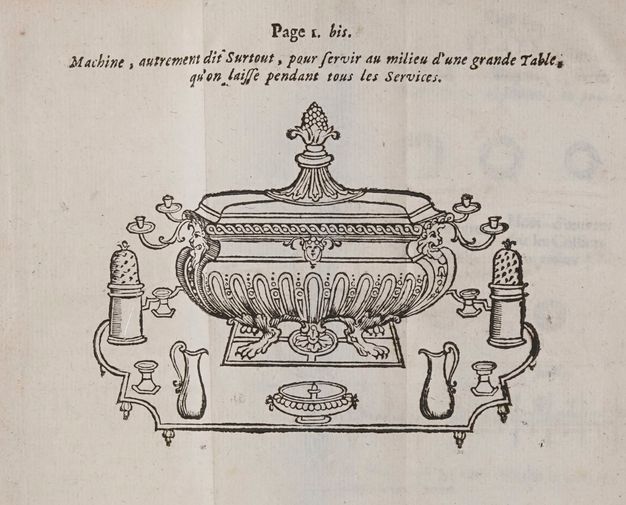
From the time of its creation in 1754, this specific object was called La Machine d’Argent (literally, “the silver machine”) in contemporary correspondence, though all the parties involved in the commission understood the phrase to signify a centerpiece for a table (surtout de table). In the seventeenth and eighteenth centuries, the phrase machine d’argent distinguished a work as an exceptionally creative and novel invention of astonishing artistic design. The phrase had been applied to table centerpieces as early as 1672.5 An engraving in the illustrated 1729 edition of the cookbook Le nouveau cuisinier royal et bourgeois by François Massialot gives visual confirmation of this custom. The foldout illustration of a table centerpiece, designed as a low stand supporting assorted condiment vessels and a tureen (from which project candelabra), was captioned as “Machine, autrement dit Surtout, pour servir au milieu d’une grande Table, qu’on laisse pendant tous les Services” (“Machine, in other words a centerpiece, to serve in the middle of a large table, which is left there during all the courses of the meal”) (fig. 8.1).6
A wealth of period correspondence documents the commission and gives insight into the international patron-artist relationship and into the fruitful exchange among the network of artists housed in the Galeries du Louvre, under the auspices of Louis XV and the crown’s administration. The correspondence is also a primary source for understanding the widespread esteem in which top Parisian artists and artisans were held locally and abroad. The novelty and quality of their works brought visitors and orders from near and far. The Machine d’Argent makes an excellent case study of the commission process as well as the factors and forces that directed the creative collaboration.
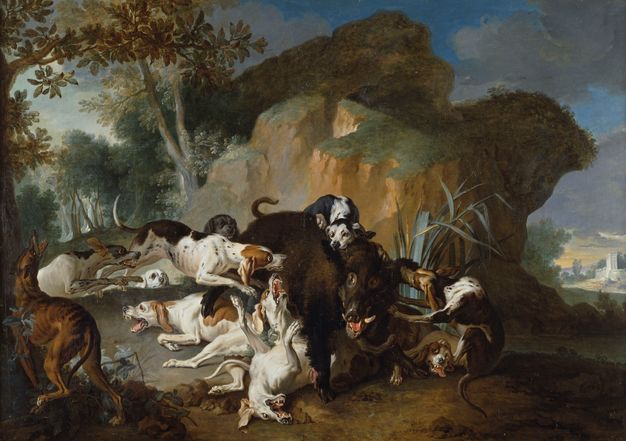
Christian Ludwig II’s commission of the Machine d’Argent was just one consequence of a twenty-year correspondence with the Paris-based artist Jean-Baptiste Oudry, who, as painter of the French king’s kennels (peintre ordinaire de la vénerie royale), specialized in scenes of the hunt, animal portraiture, and still lifes with game.7 The earliest surviving letter, dated December 21, 1733, is one in an ongoing string of communications between Oudry and the duke’s chamberlain, Herr Hafften. Oudry reports on the progress of four paintings he will deliver to Schwerin the following year. The compositions, two woodland animal scenes and two hunting scenes, reveal much about this patron’s personal passion for hunting and his taste in contemporary art (fig. 8.2).8 Oudry astutely likens the duke’s interests to those of the French king, for whom he was designing at that moment a major tapestry cycle portraying Louis XV’s hunts.9 The patron-artist epistolary record later expands to include letters from the duke’s son, Prince Friedrich, written after his own numerous visits to the artist’s Paris studio in October 1737, May 1738–May 1739, and July–September 1750.10 The relationship finally concludes with the death of Oudry and the posthumous sale, on July 7, 1755, of items from the artist’s studio and lodgings. The court of Mecklenburg-Schwerin acquired no fewer than sixteen paintings on that occasion, bringing the total number of the artist’s canvasses in the duke’s collection to forty-four.11
As concerns the commission of the silver machine d’argent, there are four principal correspondents: patron Christian Ludwig II (represented by his secretary T. J. Caspar), influencer Prince Friedrich, agent Jean-Baptiste Oudry, and François Thomas Germain, goldsmith-sculptor to the king (orfèvre-sculpteur du roi).12 Thanks to the research of Alexander von Solodkoff, the narrative of the commission is known in detail. The first extant letter in this matter was sent from Oudry to Schwerin on December 15, 1751. The letter is in reply to an earlier query about tureens in silver and models in plaster that they had seen during the prince’s visit to Germain’s workshop in late summer 1750. Apparently, the duke now wished Oudry to act as his agent in soliciting a price quote from Germain for silver tureens of similar appearance.
Oudry lost no time in conferring with his neighbor, Germain, whose lodgings in the Galeries du Louvre and whose workshop in the rue des Orties were conveniently close to his own lodgings in the Louvre and studio in the Cour des princes of the nearby Palais des Tuileries. Oudry’s letter describes which silver tureens were presently available and the plaster models that could be used for a new commission:
Those of silver have a simple molding but the profile is quite pretty. They have neither animals nor plants above, [while] the plaster model, on the contrary, has an extremely well composed cover of animals, plants or vegetables which would likely finish nicely. Between us, this model is by the father of Germain, who was the greatest man of this genre. Its profile is a beautiful oval.
He then gives his opinion on the plaster model that the prince recalled seeing on a shelf:
This model is much larger than the ones I just mentioned. It is almost round, there are two children grouped together on the cover holding a pomegranate. The profile is quite good: the stand is ornamented with some dead animals such as partridge and snipe etc., but the general taste of the latter is inferior to those above. I believe we must [be] careful not [to] make human figures in silver. Those workers who make them are never good sculptors so the difference is great. 13
Oudry enclosed an estimate from Germain for making tureens such as the prince had seen. A pair of smaller, simpler tureens as first described by Oudry would weigh 160 French marcs of silver. This weight would include the tureens (presumably with lids), their liners, stands, and ladles. At the price of 52 livres per marc, the costs were itemized as:
Material 8,320 [livres] Stamps for export abroad 200 Fashioning the pair 7,000 (3,500 each) Case 200 Total 15,720
A pair like the other “richly formed” tureens, with lids of children and a pomegranate, liners, and stands decorated with game and vegetables, would weigh 200 marcs of silver:
Material 10,400 Stamps for export abroad 250 Fashioning the pair 8,000 (4,000 each) Case 200 Total 18,850 14
An apparent pause in the proceedings follows Oudry’s letter of December 15, 1751, which scholars attribute to financial considerations within the court of Mecklenburg-Schwerin. When the discussion resumes in February 1753, the duke has in mind just one tureen—“the silver tureen”—rather than the customary pair.15 In general, the purchase of high-end silver table vessels was always a significant expenditure, and the expense increased exponentially when the patron desired to have sculptural ornament that was intensively laborious to achieve. As a point of comparison, the duke paid Oudry 800 livres for the life-size portrait of a famous adult Indian rhinoceros, painted in 1749–50.16 The cost of materials alone, meaning the silver bullion, for two tureens by Germain, as itemized above, was more than ten times the cost of this large canvas. And the goldsmith’s “fashioning,” or the casting and chasing work, was an additional 3,500 to 4,000 livres for a single tureen.
By March 1754, the duke refined the plan, and the parties agreed to a centerpiece accompanied by a pair of canine sculptures, secured by an advance partial payment of 600 livres. No further description was given in Oudry’s letter of March 22, 1754, though the parties had surely also agreed on its unstated general appearance:
The [model for the] silver centerpiece for which the two dogs that the prince wishes has been made and completed. He [Germain] promised two dogs of very pleasing [appearance] that he hasn’t yet made. He is currently working on our business. It will be well made.17
Based on following letters, one understands that the preliminary model, or arrangement of the sculptural and ornamental motifs, was “made and completed” at this stage, not the actual silver centerpiece itself. That required seven months to complete. On September 29, 1754, Oudry wrote:
La machine d’argent is finished by Sieur Germain. It is very well made. I asked him for the memorandum attached here for which I was quite surprised to see was four hundred livres more than what you ordered me to spend. That’s because it became heavier during casting than M. Germain had imagined, as it wasn’t possible to be exact. I found the piece so precious that I have decided to have a case made for its conservation.
I believe that despite the expense, Monseigneur the prince will be charmed by it. I am very mortified by this excess but I could not have foreseen it. There are 1,123 livres worth of silver in this piece, [and it] has 700 livres worth of work. You see, Sir, that the weight of silver exceeds your expectation and for that, there is no remedy.
M. Germain presents his S.A.S [Son Altesse Sérénissime, or His Serene Highness] two dogs that are perfectly beautiful.
Memorandum of la machine d’argent
The group weighs 21 marcs, 3 onces, 1 gros18
Price of the silver19 1,123 L[ivres] [1 livres 5 [sous] per marc] for export stamps 28 15 Agreed price for fashioning 700 1 case 36 Lead packaging 19 10 Total 1907 L[ivres] 5 [sous]20
Germain compensated for the centerpiece’s tardy completion and unexpectedly high price by making a token gift of the two dogs. In a subsequent letter of October 13, 1754, Oudry explained the dogs were made of bronze.21 Oudry proceeded to ship the machine d’argent over land via Strasbourg and Hamburg to Schwerin, which was deemed the safer route, while the two dogs joined a later shipment of works of art going by land and sea.22 When the centerpiece arrived at its destination some date after November 11, 1754, its cost was converted into Reichstaler, the local currency.23
There is no mention in the correspondence revealing Christian Ludwig’s or Prince Friedrich’s satisfaction in the commission. Nor has documentation come to light recording when and how the centerpiece and the bronze dogs were displayed at court. It would be interesting to understand how the object was positioned if it was ever placed on a dining table, given the explicit frontal orientation of the composition. A much later inventory of the silver at the Mecklenburg court, from around 1900, finally described the centerpiece in a manner that definitively identifies it as the work of art now in the J. Paul Getty Museum:
Inventory of the Grand Ducal Silver Chamber. Silver, Centerpieces, Small Centerpieces, No. 8 One small centerpiece, low, group on plinth, depicting vegetables and a rabbit. (French hunting centerpiece)24
Oudry’s candid statement in his letter to Schwerin dated December 15, 1751 (referenced above and in note 13), testified to François Thomas Germain’s use of his father’s models: “The plaster model, on the contrary, has an extremely well composed cover of animals, plants or vegetables which would likely finish nicely. Between us, this model is by the father of Germain, who was the greatest man of this genre” (cat. 8.4). One must trust this assessment, as Oudry was on close terms with the father, Thomas Germain, his neighbor at the Louvre since around 1730, if not earlier, and surely he recognized his colleague’s bronze, copper, lead, plaster, terracotta, and wax models. Notwithstanding his praise for the father, Oudry would have redirected the Schwerin commission to another goldsmith had he not also esteemed the work of the son.
While François Thomas’s continued use of preexisting models reflected standard workshop practices, his inventive reconfiguring of the forms was anything but standard. The novel, superbly chased compositions created under his supervision were greatly admired. At the peak of operations in the 1750s, he directed a busy workshop with six forges and an estimated forty employees, who specialized in modeling, mold-making, casting, raising, chasing, and engraving.25 But according to François Thomas, he himself was solely responsible for the quality and reputation of all production: “my workers have varied, but never my works.”26 The value of the models François Thomas inherited in 1748 was 1,500 livres, but their intrinsic value was priceless.27 An inventory of 1765 revealed the number and diversity of his model collection, which had grown but surely still contained a core group from the era of his father, as they were made in durable lead, copper, and silver.28 These more durable models yielded generations of molds for wax casts.29 The wax casts could be individually manipulated, adjusted, or modified into new compositions through the process of marcottage (or “layering”) (cat. 8.5).30
The inventory of François Thomas Germain’s premises taken in May–June 1765 listed categories of lead forms from which the Machine d’Argent was probably created: 2 rabbits, 2 snipes, 4 ortolans, 24 cauliflowers (cat. 8.6), 6 shells [hulls] of onion bulbs, 10 shells [hulls] of turnips, 8 shells [hulls] of truffles, 44 shells [hulls] of mushrooms and stalks, 24 shells [hulls] of morels, and 18 shells [hulls] of gherkins. There were also 5 copper cauliflower leaves.31 The naturalistically chased still life of the Machine d’Argent was set above a simple polished plinth with slightly bowed sides, canted corners, shell and scroll feet, and spreading acanthus leaves. Even it derived from an earlier design for a lidded box in the gilded-silver toilette set Thomas Germain delivered in 1746 for the dauphine Marie Thérèse Raphaëlle d’Espagne. The dauphine’s service does not survive, but the workshop retained seven drawings for the commission. These still survive, including one for the box that shows it in two views.32
Versions of nearly all the animals, vegetables, and mushrooms on the machine d’argent appeared on a series of earlier tureens made by Thomas Germain during the childhood and youth of François Thomas. The first extant examples were commissioned as a pair by Samuel Jacques Bernard in 1726 for his Paris residence and eventually returned to the Germain workshop decades later, at some point after Bernard’s death in 1753 (see cat. no. 3).33 By 1764 François Thomas resold them to a Portuguese client, having modified the armorials accordingly. Mid- and late eighteenth-century inventories described their lids as bearing animals, birds, and a cauliflower.34 Another tureen of similar type, dating from 1729–30, had a lid with the same model of ortolan and morel (fig. 8.3).35 Yet another pair of 1733–34 had lids decorated with a rabbit and mushrooms on one (see fig. 3.3) and a snipe, cauliflower, and onion on the other.36
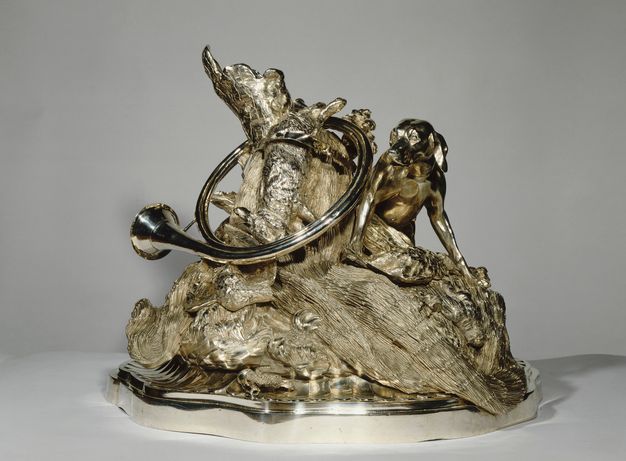
While fabricating the machine d’argent in 1754, François Thomas Germain was simultaneously finishing a massive and impressive centerpiece begun by his father in 1729–31 for Samuel Bernard, comte de Coubert.37 That ambitious piece had a tiered tray set with two greyhounds, furling foliage, a hunting horn, and a very similar, if not the same, rabbit (see fig. 3.1).38 And just a few years later, in 1757, the workshop commenced a famous tour de force—the large sculptural dish cover for the service of King José I of Portugal. Its hunt theme with game and hounds monumentally expanded upon the machine d’argent and included casts of nearly the same rabbit, snipe, turnip, and onion (fig. 8.4).39
Provenance
1754–56: Christian Ludwig II, Duke of Mecklenburg-Schwerin, German, 1683–1756 (Schloss Schwerin, Mecklenburg-Schwerin), commissioned from François Thomas Germain through the agent Jean-Baptiste Oudry and delivered to Schloss Schwerin, in the duchy of Mecklenburg-Schwerin, in the Holy Roman Empire, after November 11, 1754, by inheritance to his son, Friedrich; 1756–85: Friedrich, Duke of Mecklenburg-Schwerin, German, 1717–1785 (Schloss Schwerin, Mecklenburg-Schwerin), by inheritance to his nephew, Friedrich Franz I; 1785–1837: Friedrich Franz I, Duke of Mecklenburg-Schwerin and later Grand Duke of Mecklenburg-Schwerin, German, 1756–1837 (Schloss Schwerin, Mecklenburg-Schwerin), by inheritance to his grandson, Paul Friedrich; 1837–42: Paul Friedrich, Grand Duke of Mecklenburg-Schwerin, German, 1800–1842 (Schloss Schwerin, Mecklenburg-Schwerin), by inheritance to his son, Friedrich Franz II; 1842–83: Friedrich Franz II, Grand Duke of Mecklenburg-Schwerin, German, 1823–1883 (Schloss Schwerin, Mecklenburg-Schwerin), by inheritance to his son, Friedrich Franz III; 1883–97: Friedrich Franz III, Grand Duke of Mecklenburg-Schwerin, German, 1851–1897 (Schloss Schwerin, Mecklenburg-Schwerin), by inheritance to his son, Friedrich Franz IV; 1897–1945: Friedrich Franz IV, Grand Duke of Mecklenburg-Schwerin, German, 1882–1945, until his deposition in 1918, by inheritance within the family; 1945–2005: private collection (heirs of Friedrich Franz IV) [unsold, Sotheby’s, New York, May 20, 2004, single lot], and sold privately to the J. Paul Getty Museum, through Sotheby’s, New York, 2005.40
Exhibition History
Casting Nature: François-Thomas Germain’s Machine d’Argent, J. Paul Getty Museum at the Getty Center (Los Angeles), July 11, 2006–March 25, 2007; Oudry’s Painted Menagerie, J. Paul Getty Museum at the Getty Center (Los Angeles), May 1–September 2, 2007, and Museum of Fine Arts, Houston, October 7, 2007–February 24, 2008; Oudrys Gemalte Menagerie: Porträts von exotischen Tieren im Europa des 18. Jahrhunderts, Staatliches Museum Schwerin Kunstsammlungen, Schlösser und Gärten (Schwerin, Germany), April 12–August 31, 2008; Paris: Life and Luxury, J. Paul Getty Museum at the Getty Center (Los Angeles), April 26–August 7, 2011, and Museum of Fine Arts, Houston, September 18, 2011–January 2, 2012 (no. 37); The Edible Monument: The Art of Food for Festivals, Getty Research Institute at the Getty Center (Los Angeles), October 13, 2015–March 16, 2016.
Bibliography
Solodkoff, Alexander von. “A Lost ‘Machine d’Argent’ of 1754 by François-Thomas Germain for the Duke of Mecklenburg.” Studies in the Decorative Arts 7, no. 2 (Spring–Summer 2000): 122–35.; La Machine d’argent by François-Thomas Germain. Sale cat. Sotheby’s, New York. May 20, 2004.; Burstyn, Dorothea. “All These Numbers….” Silver Society of Canada Journal 8 (2005): 23–29., 24–25, 29n8, fig. 9; Solodkoff, Alexander von. “The Rediscovery of a 1754 ‘Machine d’Argent’ by François-Thomas Germain.” Studies in the Decorative Arts 13, no. 2 (Spring–Summer 2006): 93–103., figs. 1–4, 7; Frank, Christoph. “Pictorial Relations: New Evidence on Jean-Baptiste Oudry and the Court of Mecklenburg-Schwerin.” In Oudry’s Painted Menagerie: Portraits of Exotic Animals in Eighteenth-Century Europe, edited by Mary Morton, 31–59. Exh. cat. Los Angeles: J. Paul Getty Museum, 2007., fig. 9; Fuhring, Peter. “Dessins d’orfèvres-sculpteurs au XVIIIe siècle.” In Dessins de sculpteurs. Vol. 1, Troisièmes rencontres internationales du Salon du dessin, Paris, 9 et 10 Avril 2008, edited by Guilhem Scherf and Cordélia Hattori, 49–61. Paris: Société du Salon du dessin, 2008., 49–60, 157, fig. 7; Sheriff, Mary. “Seeing Metamorphosis in Sculpture and the Decorative Arts.” In Taking Shape: Finding Sculpture in the Decorative Arts, edited by Martina Droth and Penelope Curtis, 158–65. Exh. cat. Leeds: Henry Moore Foundation; Los Angeles: J. Paul Getty Museum, 2009., 160–61, fig. 3; Seelig, Lorenz. “Das Silberservice Friedrich Karl von Hardenbergs: Zur Adeligen Tafelkultur des Rokoko.” In Im Auftrag der Krone: Friedrich Karl von Hardenberg und das Leben in Hannover um 1750, edited by Wilken von Bothmer and Marcus Köhler, 54–61. Rostock, Germany: Hinstorff, 2011.; Bremer-David, Charissa, ed. Paris: Life and Luxury in the Eighteenth Century. Exh. cat. Los Angeles: J. Paul Getty Museum, 2011., 122, no. 37; Bremer-David, Charissa. “Of Cauliflower and Crayfish: Serving Vessels to Awaken the Palate.” In The Edible Monument: The Art of Food for Festivals, edited by Marcia Reed, 124–47. Exh. cat. Los Angeles: Getty Research Institute, 2015. 130, 132, 145–46n23, figs. 4, 12, 15.
Notes
-
The research of Michèle Bimbenet-Privat has revealed that the discharge mark of the cow actually came into use long before 1762, probably as early as 1733. Michèle Bimbenet-Privat, comments to author, August 2021. See note 22 below. ↩︎
-
This scratched notation recorded the weight of the centerpiece in the customary units of the Holy Roman Empire, Marks and Loth. The Mark in the northern duchy of Mecklenburg-Schwerin aligned with the Cologne standard. The inscription indicated that the scratch weight calculated one Mark to the metric equivalent of 233.537 grams, which was within an acceptable deviation of the Cologne Mark of 233.856 grams. See “Notes to Reader II: Historic Units of Measure and Currency” and note 18 below. ↩︎
-
Jane Bassett determined that the “organic” forest floor was formed using the lost-wax casting technique (rather than being hammer raised or achieved through the repoussé technique). The “geometric” plinth was composed of several sections soldered together. The forest floor was joined to the plinth with pins and solder. Examination Report, 2005, updated April 19, 2021, by Jane Bassett, Decorative Arts and Sculpture Conservation, J. Paul Getty Museum. ↩︎
-
The bodies of the birds, the rabbit, and the vegetables were hollow cast; as evidenced by the waxy brush marks on the hollow interior of the rabbit made during formation of the wax inter-model, the rabbit is a lost wax cast. A few separately cast elements such as the gherkin and mushroom were soldered together before being joined to the forest floor by the system of threaded rods and nuts. Some very thin details such as bird wings and cauliflower leaves were solid cast and soldered, respectively, to the bird bodies and to the cauliflower. Examination Report, 2005, updated April 19, 2021, by Jane Bassett, Decorative Arts and Sculpture Conservation, J. Paul Getty Museum. X-radiographs were taken with a Phillips 450 kV tube using Kodak Industrex M film in cassette holders with lead sheet measuring 0.01 inch in front of and 0.005 inch behind the film. The most descriptive radiographs were then digitized (grayscale at 304.8 DPI, file size approx. 50 MB). ↩︎
-
“La machine servant sur la table, garnye de trois petites salières, deux sucriers, un poivrier, un vinaigrier” (“The machine serving the table, comprising three small salt cellars, two sugar casters, a pepper pot, and a vinegar cruet,” author’s translation). Paris, Archives nationales de France, Minutier central, XLV, 232, March 26, 1672, Inventaire après le décès de Pierre Séguier chanceller de France à la requête de Magdeleine Fabry demeurant dans son hôtel rue de Grenelle paroisse Saint Eustache. Michèle Bimbenet-Privat noted that the goldsmith Claude I. Ballin made this machine (Bimbenet-Privat, Michèle. Les orfèvres et l’orfèvrerie de Paris au XVIIe siècle. Vol. 1, Les hommes. Vol. 2, Les oeuvres. Paris: Éditions des Musées de la ville de Paris, 2002., vol. 2, 175). See also Micio, Paul. “Early French Surtouts, Unpublished Drawings and Documents.” Silver Studies: The Journal of the Silver Society 19 (2005): 79–96., 81–82 and 83n22.
Another instance of the term machine appeared in a court circular of 1692: “La table estoit de forme ovale. Il y avoit au milieu une grande machine de vermeil doré de nouvelle invention, appellée Sur tout de table” (“The table was of oval shape. It had in the middle a large gilded-silver machine of new invention, called a table centerpiece,” author’s translation). Mercure galant (1692). ↩︎
-
Massialot, François (probable author). Le nouveau cuisinier royal et bourgeois. 2 vols. Paris: Chez Claude Prudhomme, 1729., vol. 1, 1 bis (author’s translation). ↩︎
-
The principal monograph on this artist is Opperman, Hal N. Jean-Baptiste Oudry. 2 vols. New York: Garland Publications, 1977.. On his relationship with the dukes of Mecklenburg-Schwerin, see Droguet, Vincent, Xavier Salmon, and Danièle Véron-Denise. Animaux d’Oudry: Collection des ducs de Mecklenbourg-Schwerin. Exh. cat. Paris: Réunion des musées nationaux, 2003. and Morton, Mary, ed. Oudry’s Painted Menagerie: Portraits of Exotic Animals in Eighteenth-Century Europe. Exh. cat. Los Angeles: J. Paul Getty Museum, 2007.. Surviving correspondence between the dukes of Mecklenburg and Oudry is preserved in Schwerin, Landeshauptarchiv, Älteres Aktenarchiv, Mecklenburg-Vorpommern, inv. 2.12-1/7, 2.12-1/22, and 2.12-1/26. A partial transcription was first published by Seidel, Paul. “Beiträge zur Lebensgeschichte Jean Baptiste Oudry (1686–1755) mit besonderer Berücksichtigung seiner Gemälde in Schwerin und seiner Verbindungen mit dem Meklenburgischen Hofe.” Repertorium für Kunstwissenschaft 13 (1890): 80–110.. Several art historians have translated and interpreted other select letters, notably in Solodkoff, Alexander von. “A Lost ‘Machine d’Argent’ of 1754 by François-Thomas Germain for the Duke of Mecklenburg.” Studies in the Decorative Arts 7, no. 2 (Spring–Summer 2000): 122–35.; Solodkoff, Alexander von. “The Rediscovery of a 1754 ‘Machine d’Argent’ by François-Thomas Germain.” Studies in the Decorative Arts 13, no. 2 (Spring–Summer 2006): 93–103.; Altes, Everhard Korthals. “The Art Tour of Friedrich of Mecklenburg-Schwerin.” Simiolus: Netherlands Quarterly for the History of Art 31, no. 3 (2004–5): 216–50.; and Frank, Christoph. “Pictorial Relations: New Evidence on Jean-Baptiste Oudry and the Court of Mecklenburg-Schwerin.” In Oudry’s Painted Menagerie: Portraits of Exotic Animals in Eighteenth-Century Europe, edited by Mary Morton, 31–59. Exh. cat. Los Angeles: J. Paul Getty Museum, 2007.. The selected documents cited in this entry draw principally from the research of Alexander von Solodkoff. ↩︎
-
Opperman, Hal N. Jean-Baptiste Oudry. 2 vols. New York: Garland Publications, 1977., vol. 1, 424–25, nos. P 188–P 189, and 483–84, nos. P 338–P 339; Berswordt-Wallrabe, Kornelia von, ed. Jean-Baptiste Oudry Jean-Antoine Houdon: Vermächtnis der Aufklärung. Exh. cat. Schwerin, Germany: Sammlung Staatliches Museum Schwerin, 2000., 68, nos. 18–19, 102, no. 39, 202; Bailey, Colin B. “‘A Long Working Life, Considerable Research and Much Thought’: An Introduction to the Art and Career of Jean-Baptiste Oudry (1686–1755).” In Oudry’s Painted Menagerie: Portraits of Exotic Animals in Eighteenth-Century Europe, edited by Mary Morton, 1–29. Exh. cat. Los Angeles: J. Paul Getty Museum, 2007., 14–15. ↩︎
-
For a transcription of the December 21, 1733, letter, see Seidel, Paul. “Beiträge zur Lebensgeschichte Jean Baptiste Oudry (1686–1755) mit besonderer Berücksichtigung seiner Gemälde in Schwerin und seiner Verbindungen mit dem Meklenburgischen Hofe.” Repertorium für Kunstwissenschaft 13 (1890): 80–110., 93. On Oudry’s most famous hunting cycle, Les chasses du roi Louis XV, see Vittet, Jean. “Tenture des chasses de Louis XV d’après Jean-Baptiste Oudry (1735–1746).” In Les Gobelins au siècle des Lumièries: Un âge d’or de la manufacture royale, 136–47. Paris: Swan, 2014.. ↩︎
-
During the studio visit to Paris in the summer of 1750, perhaps Prince Friedrich saw Oudry’s current work in progress, a still-life painting of dead game including a hare, a partridge, and two snipes. The splay of the painted snipe wings would be replicated a few years later in cast silver for the Machine d’argent. The painting is now in the Worcester Art Museum, Massachusetts, inv. 1960.8, https://worcester.emuseum.com/objects/30941/still-life-a-dead-hare-a-dead-redlegged-partridge-and-two. ↩︎
-
Bailey, Colin B. “‘A Long Working Life, Considerable Research and Much Thought’: An Introduction to the Art and Career of Jean-Baptiste Oudry (1686–1755).” In Oudry’s Painted Menagerie: Portraits of Exotic Animals in Eighteenth-Century Europe, edited by Mary Morton, 1–29. Exh. cat. Los Angeles: J. Paul Getty Museum, 2007., 29. ↩︎
-
Per a warrant signed by Louis XV on February 13, 1748, François Thomas Germain would succeed his father as goldsmith-sculptor to the king (orfèvre-sculpteur de … Maison [du roi]) upon the father’s demise, which occurred in August 1748. François Thomas routinely signed his works as sculpteur orfèvre du roy to emphasize his identity as a sculptor and to distinguish himself from other goldsmiths who produced simpler, less sculptural forms such as dishes, trays, and salvers. ↩︎
-
“Celles d’argent sont à simple moulure mais le profil assez joli. Point d’animaux ni plantes dessus, au contraire le modèle en plâtre a sur le couvercle des animaux, des plantes ou légumes extrêmement bien composés et susceptibles d’un beau fini. Entre nous ce modèle est de Germain le père qui a été le plus grand homme dans ce genre. Le profil est d’un bel oval…. Ce modèle est bien plus grande que celles dont je viens de parler, Elle est presque ronde, il y a sur le couvercle deux enfants groupés qui tiennent une grenade. Le profile est assez bon: le plat est orné de quelques animaux morts comme perdrix ou bécasse etc., mais pour le goût général ce dernier est inférieur aux premiers ci-dessus. Je crois qu’il faut (se) garder de faire faire des figures humaines en argent. Ce ne sont jamais de bons sculpteurs qui les font mais les ouvriers, ainsi la différence est grande,” as transcribed by Solodkoff, Alexander von. “A Lost ‘Machine d’Argent’ of 1754 by François-Thomas Germain for the Duke of Mecklenburg.” Studies in the Decorative Arts 7, no. 2 (Spring–Summer 2000): 122–35., 130–31, Appendix, excerpt no. 1, December 15, 1751 (all English excerpts author’s translation). ↩︎
-
“Les deux terrines que son Excellence a vu chez le S. Germain et dont on a envoyé la description à Mr. Oudry devait peser avec leurs doubles fonds, plats et cuillers 160 M[arcs] monteront pour la matière à 52 L[ivres] le marc…. Le Sr. Germain propose deux autres terrines dont les couvercles seront ornés de deux enfants qui badinent avec une grenade. Ces terrines sont d’une forme très riche, les plats sont décorés de gibier et de légumes. Elles doivent pese 200 M montant pour les matières à 52 L le marc,” as transcribed by Solodkoff, Alexander von. “A Lost ‘Machine d’Argent’ of 1754 by François-Thomas Germain for the Duke of Mecklenburg.” Studies in the Decorative Arts 7, no. 2 (Spring–Summer 2000): 122–35., 131–32, Appendix, excerpt no. 2, December 15, 1751. ↩︎
-
“Je ne peux encore vous faire repose sur l’article de la terrine d’argent,” as transcribed by Solodkoff, Alexander von. “A Lost ‘Machine d’Argent’ of 1754 by François-Thomas Germain for the Duke of Mecklenburg.” Studies in the Decorative Arts 7, no. 2 (Spring–Summer 2000): 122–35., 125, 132, Appendix, excerpt no. 3, February 5, 1753, and 135nn8–9. ↩︎
-
Seidel, Paul. “Beiträge zur Lebensgeschichte Jean Baptiste Oudry (1686–1755) mit besonderer Berücksichtigung seiner Gemälde in Schwerin und seiner Verbindungen mit dem Meklenburgischen Hofe.” Repertorium für Kunstwissenschaft 13 (1890): 80–110., 99–101; Frank, Christoph. “Pictorial Relations: New Evidence on Jean-Baptiste Oudry and the Court of Mecklenburg-Schwerin.” In Oudry’s Painted Menagerie: Portraits of Exotic Animals in Eighteenth-Century Europe, edited by Mary Morton, 31–59. Exh. cat. Los Angeles: J. Paul Getty Museum, 2007., 54–55. ↩︎
-
“Le surtout d’argent pour lequel les deux chiens que le prince désire avoir avait été fait et achevé. Il m’a promit des deux chiens à grand plaisir ce qu’il n’avait pas encore fait. Il travaille actuellement à notre affaire. Cela sera bien fini,” as transcribed by Solodkoff, Alexander von. “A Lost ‘Machine d’Argent’ of 1754 by François-Thomas Germain for the Duke of Mecklenburg.” Studies in the Decorative Arts 7, no. 2 (Spring–Summer 2000): 122–35., 132, Appendix, excerpt no. 4, March 22, 1754. ↩︎
-
This weight in old French units of measure, that von Solodkoff equated to 5,235.419 grams, is somewhat less than the scratch weight given in Mecklenburg-Schwerin units that equate to 5,240 grams. See note 2 above and Solodkoff, Alexander von. “A Lost ‘Machine d’Argent’ of 1754 by François-Thomas Germain for the Duke of Mecklenburg.” Studies in the Decorative Arts 7, no. 2 (Spring–Summer 2000): 122–35., 127, 135n17. ↩︎
-
Though this document did not state the price for one marc of silver as 52 livres (the amount agreed upon in 1751 and recorded when Germain’s invoice was received in Schwerin), the amount billed in September 1754 of 1123 livres for 21 marcs, 3 onces, 1 gros worth of silver seems to suggest a higher rate was actually charged, around 52 livres, 10 sous per marc—or, that the stated weight of the bullion was imprecise. See notes 20 and 23 below.
According to a latter inventory of the Germain workshop of May 1765, the rate for one marc of silver then was 52 livres, 10 sous. Paris, Archives nationales de France, Minutier central, LXXXIII, 511, May 22, 1765, Délivrance de mobilier par François Thomas Germain, sculpteur orfèvre du roi, under the subsection titled “Prem.er avril 1765.No.7. Bordereau et résultat des matières d’orphèvreries remises par Mr. Germain le p.er avril 1765 à la commandite avec le prix des matières et l’apréciation des façons à payer aud.t Sr. Germain.” Images of the document were kindly shared by Peter Fuhring. ↩︎
-
“La machine d’argent est finie par le Sieur Germain. Elle est très bien. Je lui ai demandé le mémoire qui est ci-joint dont j’ai été bien surpris de voir plus de quatre cents livres de plus que vous ne n’aviez donné ordre de dépenser. Cela est devenu plus lourd à la fonte que M. Germain ne s’était imagine et qu’il n’était pas possible d’être juste. J’ai trouvé le morceau si précieux que j’ai pris la partie de faire faire un étui pour sa conservation. / Je crois que malgré la dépense que Monseigneur le prince en sera charmé. Je suis bien mortifié de cet excédent mais je n’ai pu m’en garantir. Il y a dans ce morceau pour 1123 L[ivres] d’argent, j’avais fait marcher à 700 L[ivres] de façon. Vous voyez, Monsieur, que c’est le poids de la matière qui excède vos prétentions et contre lequel poids il n’y a point de remède. / M. Germain fait present à S.A.S des deux chiens qui sont parfaitement beaux. / Mémoire de la machine d’argent - Le groupe pèse 21 marcs, 3 onces, 1 gros - Montant du prix de l’argent 1123 L[ivres] - Le contrôle à 1 L[ivre] 5 en faveur de l’étranger 28 15 - La façon prix convenu 700 - 1 étui 36 - Frais d’emballages à plomb 19 10 - Total 1907 L[ivres] 5,” as transcribed by Solodkoff, Alexander von. “A Lost ‘Machine d’Argent’ of 1754 by François-Thomas Germain for the Duke of Mecklenburg.” Studies in the Decorative Arts 7, no. 2 (Spring–Summer 2000): 122–35., 133, Appendix, excerpt no. 10, September 29, 1754. ↩︎
-
Solodkoff, Alexander von. “A Lost ‘Machine d’Argent’ of 1754 by François-Thomas Germain for the Duke of Mecklenburg.” Studies in the Decorative Arts 7, no. 2 (Spring–Summer 2000): 122–35., 133–34 (Oudry’s letter of October 13, 1754). Michèle Bimbenet-Privat theorizes whether Germain’s gilt-bronze dogs could be the pair of greyhounds now in the Musée du Louvre, Paris, inv. OA 10534, Our. https://collections.louvre.fr/en/ark:/53355/cl010118098. They are very much like the silver versions incorporated into a massive table centerpiece commenced by Thomas Germain and finished by his son in 1757. That object is now in the Museu Nacional de Arte Antiga, Lisbon, inv. 1827 Our, http://www.museudearteantiga.pt/colecoes/ourivesaria/centro-de-mesa. See cat. no. 3, fig. 3.1, and note 38 below. See also D’Orey, Léonor. The Silver Service of the Portuguese Crown. Lisbon: Edições Inapa, [1991]., 68–81, 194, no. 2; and D’Orey, Léonor. “Le service en argent et vermeil de D. José 1er, Roi du Portugal.” In Versailles et les tables royales en Europe XVIIème–XIXème siècles, edited by Jean-Pierre Babelon, Zeev Gouranier, Catherine Arminjin, Béatrix Saule et al., 303–10. Exh. cat. Paris: Réunion des musées nationaux, 1993., 303–5, no. 145. ↩︎
-
The machine d’argent is stamped on the exterior face of its burnished plinth with the Paris discharge mark for large works of silver intended for export, previously stated to have been in use from October 1, 1762, and November 18, 1774 (Bimbenet-Privat, Michèle, and Gabriel de Fontaines. La datation de l’orfèvrerie parisienne sous l’ancien régime: Poinçons de jurande et poinçons de la Marque 1507–1792. Paris: Éditions de la ville de Paris, 1995., 119n234, 138–39, 140, no. 453). Subsequent research by Michèle Bimbenet-Privat, however, has revealed that this discharge mark actually came into use long before 1762, probably as early as 1733. Michèle Bimbenet-Privat, comments to author, August 2021. When the machine d’ argent was offered for sale at Sotheby’s, New York, on May 20, 2004, the discharge mark for export was stated then to have been valid from 1733 to 1775. La Machine d’argent by François-Thomas Germain. Sale cat. Sotheby’s, New York. May 20, 2004., 36. ↩︎
-
“Das Silber wigt 21 Marcs, 3 onces, 1 gros - A 52 L[ivres] is ./. 1123 L[ivres] 280 R[eichs]t[aler] 36./. - Façon 200 [sic] L[ivres] 175 R[eichs]t[aler] - Contrôle, à 1 L[ivre] 5 ./. 26 L[ivres] is ./. 6 R[eichs]t[aler] 33./. - Etui 32 L[ivres] 9 R[eichs]t[aler] - Plombier und Emballage 19 L[ivres] is 4 R[eichs]t[aler] 42./. - [total] 476 R[eichs]t[aler] 15./. [./. is a notational abbreviation for the word Schilling (ß)]” (“The silver weights 21 marcs, 3 onces, 1 gros - At 52 L[ivres] is ./. 1123 L[ivres] 280 R[eichs]t[aler] 36./. - Fashioning 200 [sic] L[ivres] 175 R[eichs]t[aler] - Stamps, at 1 L[ivre] 5./. 26 L[ivres] ./. 6 R[eichs]t[aler] 33./. - 1 case 32 L[ivres] 9 R[eichs]t[aler] - Lead packaging and shipping 19 L[ivres] is 4 R[eichs]t[aler] 42./. - [total] 476 R[eichs]t[aler] 15./.”), as transcribed by Solodkoff, Alexander von. “A Lost ‘Machine d’Argent’ of 1754 by François-Thomas Germain for the Duke of Mecklenburg.” Studies in the Decorative Arts 7, no. 2 (Spring–Summer 2000): 122–35., 134 (n.d. [1754]). The document converted the French charges into the local currency used by the court of Mecklenburg-Schwerin. See “Notes to the Reader II: Historic Units of Measure and Currency,” in this volume. A likely error should be noted in this transcription: von Solodkoff’s line “Façon 200 L 175 Rt” presents a mathematically incorrect conversion rate of livre to Reichstaler. It would be consistent, rather, to read that itemization as “Façon 700 L 175 Rt.” Alexander von Solodkoff and Torsten Fried, in a communication of September 14, 2021, kindly explained the notation “./.” used in the Reichstaler conversions above was an abbreviation for ß (Schilling). ↩︎
-
“Inventarium der Grossherzoglichen Silberkammer. Silber, Tafelaufsätze – Kleiner Tafelaufsätz, No. 8 1 niedrig, Kleiner Tafelaufsätz, Gruppe auf Sockel, Gemüse mit einem Hasen vorstellend, (fr. Jagdaufstaz).” Mecklenburg, Germany, private archive, author’s translation. Reproduced in La Machine d’argent by François-Thomas Germain. Sale cat. Sotheby’s, New York. May 20, 2004., 12, 16n11. Alexander von Solodkoff stated that earlier Mecklenburg inventories of 1758 and 1770 listed silver plate but no centerpieces. See also Solodkoff, Alexander von. “A Lost ‘Machine d’Argent’ of 1754 by François-Thomas Germain for the Duke of Mecklenburg.” Studies in the Decorative Arts 7, no. 2 (Spring–Summer 2000): 122–35., 126, 135n15. ↩︎
-
Perrin, Christiane. François Thomas Germain: Orfèvre des rois. Saint-Rémy-en-l’Eau: Éditions d’art Monelle Hayot, 1993., 40–42. ↩︎
-
“C’est à mes Ouvriers, avez-vous dit, que je dois ma reputation; mes Ouvriers ont varié, mais jamais mes Ouvrages.” Germain, François-Thomas. Offres de concours à messieurs les orfèvres de Paris, par le Sr. François-Thomas Germain … où l’on traite de l’orfèvrerie. Paris: Dufour, n.d., 12. Images of the printed booklet were kindly shared by Peter Fuhring. ↩︎
-
Paris, Archives nationales de France, Minutier central, XXXVI, 460, August 27, 1748. See also Perrin, Christiane. François Thomas Germain: Orfèvre des rois. Saint-Rémy-en-l’Eau: Éditions d’art Monelle Hayot, 1993., 20, 263n14. ↩︎
-
Paris, Archives nationales de France, Minutier central, LXXXIII, 511, May 22, 1765, Délivrance de mobilier par François Thomas Germain, sculpteur orfèvre du roi. Images of the document were kindly shared by Peter Fuhring. ↩︎
-
Information courtesy of Tonny Beentjes, Professor of Metal Conservation and Restoration, Universiteit van Amsterdam, and Jane Bassett, Decorative Arts and Sculpture Conservation, J. Paul Getty Museum. Memorandum, August 26, 2013, on file in the Sculpture and Decorative Arts Department, J. Paul Getty Museum. ↩︎
-
Bremer-David, Charissa. “Of Cauliflower and Crayfish: Serving Vessels to Awaken the Palate.” In The Edible Monument: The Art of Food for Festivals, edited by Marcia Reed, 124–47. Exh. cat. Los Angeles: Getty Research Institute, 2015., 132–33. ↩︎
-
“N.9 Etat générale des modeles en cuivre et étain concernent l’Orfèvrerie: [boîte] 23: no. 1, 24 plombs chouxfleurs; no. 2, 5 cuivres feuilles de chouxfleurs. [boîte] 25: no. 4, 6 coquilles d’oignons plombs; no. 7, 10 coquilles de navets plombs; no. 8, 8 coquilles de truffles plombs; no. 9, 44 coquilles et pieds des champignons plombs; no. 10, 24 coquilles de morilles plombs; no. 11, 18 coquilles de cornichons plombs. [boîte] 29: différen gibiers: no. 1, 2 laperaux plombs; no. 2, 2 becasses plombs; no. 4, 4 ortolans plombes.” The inventory also counted 52 sheets of drawings for centerpieces (surtouts). Paris, Archives nationales de France, Minutier central, LXXXIII, 511, May 22, 1765, Délivrance de mobilier par François Thomas Germain, sculpteur orfèvre du roi. Images of the document were kindly shared by Peter Fuhring. ↩︎
-
The drawing by Thomas Germain (pen and black ink, gray wash, and black chalk) is in a private collection in Paris. Access to the drawing was kindly facilitated by the private collector and Peter Fuhring. Fuhring, Peter. “Dessins d’orfèvres-sculpteurs au XVIIIe siècle.” In Dessins de sculpteurs. Vol. 1, Troisièmes rencontres internationales du Salon du dessin, Paris, 9 et 10 Avril 2008, edited by Guilhem Scherf and Cordélia Hattori, 49–61. Paris: Société du Salon du dessin, 2008., 53, 58n15, 157, figs. 7–8; and Fuhring, Peter. Designing the Décor: French Drawings from the Eighteenth Century. Exh. cat. Lisbon: Calouste Gulbenkian Foundation, 2005., 156–57, no. 51, 165. See also Perrin, Christiane. François Thomas Germain: Orfèvre des rois. Saint-Rémy-en-l’Eau: Éditions d’art Monelle Hayot, 1993., 52–55, 267n129. ↩︎
-
Per Christiane Perrin, the boar head tureens were sold in 1753, after the death of Samuel Jacques Bernard (Perrin, Christiane. François Thomas Germain: Orfèvre des rois. Saint-Rémy-en-l’Eau: Éditions d’art Monelle Hayot, 1993., 268n146). The widow of Thomas Germain was involved in the settlement of the silver holdings of the estate of Samuel Jacques Bernard, as the goldsmith was one of the creditors due unpaid sums (Boiron, Stéphane. “Jacques-Samuel Bernard et l’argenterie Melo e Castro.” In Tureen “Aux Ecrevisses” by Thomas Germain. Sale cat. Sotheby’s, New York, October 25, 2019: 44–60., 53, 57–58). ↩︎
-
The tureens were described in the posthumous inventory of Samuel Jacques Bernard as “Vaisselle d’argent. No 802: Deux grandes terrines portées par des sangliers. Sur les couvercles sont différents animaux et fruits. Deux grands plats ovales à contours cizelés servant aux terrines. Deux grands cuillers pour icelles.” (“Silver Plate. No 802: Two large tureens supported by wild boars. On the covers are different animals and fruits. Two large oval dishes with chased contours serve [as stands] for the tureens. Two large spoons for these.”) Paris, Archives nationales de France, Minutier central, LXXXVIII, 629, August 13, 1753, author’s translation. Reproduced in Boiron, Stéphane. “Jacques-Samuel Bernard et l’argenterie Melo e Castro.” In Tureen “Aux Ecrevisses” by Thomas Germain. Sale cat. Sotheby’s, New York, October 25, 2019: 44–60., 54–55, and transcribed by Perrin, Christiane. François Thomas Germain: Orfèvre des rois. Saint-Rémy-en-l’Eau: Éditions d’art Monelle Hayot, 1993., 268n146. They were later described in the posthumous inventory of Martinho de Melo e Castro of September 14, 1796, paraphrased by Luis Keil, as “as tampas tinham como remate, una alcachofra emu ma delas, e na outra uma couve flor, e todas eram ornamentadas com aves, mariscos e camarões” (“the lids were topped with an artichoke on one of them, and on the other a cauliflower, and all were decorated with birds, seafood and shrimp [sic, meaning crayfish]”). See Exposição de Arte Francesa, Especialmente de Ourivesaria do Século XVIII. Exh. cat. Lisbon: Museu Nacional de Arte Antiga, 1934., 64–65, 80–83, nos. 230–31, “Duas Terrinas” (entry by Luis Keil). See also cat. no. 3 in this catalogue. ↩︎
-
Detroit Institute of Arts, inv. 55.183, https://www.dia.org/art/collection/object/tureen-lid-and-stand-45770. See Perrin, Christiane. François Thomas Germain: Orfèvre des rois. Saint-Rémy-en-l’Eau: Éditions d’art Monelle Hayot, 1993., 136–39, and Bremer-David, Charissa. “Of Cauliflower and Crayfish: Serving Vessels to Awaken the Palate.” In The Edible Monument: The Art of Food for Festivals, edited by Marcia Reed, 124–47. Exh. cat. Los Angeles: Getty Research Institute, 2015., 126, 132–33. ↩︎
-
One of the pair is in the Detroit Institute of Arts, inv. 59.18, https://www.dia.org/art/collection/object/tureen-lid-liner-and-stand-45774. See Perrin, Christiane. François Thomas Germain: Orfèvre des rois. Saint-Rémy-en-l’Eau: Éditions d’art Monelle Hayot, 1993., 58–59. The other is in a private collection. See French Royal Silver: The Property of George Ortiz, sale cat., Sotheby’s, New York, November 13, 1996: 58–65, lot 13, “Penthièvre-Orléans Service: A Louis XV Royal Silver Tureen, Cover, Liner and Stand, Thomas Germain, Paris, 1733–34.” The provenance of this pair is still under investigation, as succinctly summarized in Treasures, sale cat., Sotheby’s, London, July 6, 2016: 132–41, lot 25, “A French Royal Silver Tureen and Cover from the Penthièvre-Orléans Service, The Cover, Antoine Sebastien Durant, Paris 1752–1753, The Tureen, Jean-Baptiste Claude Odiot, Paris, Circa 1821.” Its original owner is thought to have been Henry Janssen, who from 1738 co-rented the Hôtel de Lassay, located at 140 rue du Bac, with his brother Robert Janssen. Either this pair, or another pair of boar head tureens, then passed to François Joly de Fleury, a fermier général, and possibly on to the Saxon minister Count Brühl. See Cassidy-Geiger, Maureen. “Ein neues silbern Französisches Tafel Service: Linking the Penthièvre-Orléans Service to Dresden.” Silver Studies: The Journal of the Silver Society 22 (2007): 123–52.. ↩︎
-
Pons, Bruno. “Hôtel Jacques-Samuel Bernard.” In Le Faubourg Saint-Germain: La Rue du Bac, edited by Bruno Pons and Anne Forray-Carlier, 126–53. Paris: Délégation à l’action artistique de la ville de Paris, 1990., 132, 136, 152n24. ↩︎
-
In 1757 Francois Thomas Germain sold this centerpiece to a Portuguese client, the eighth duque d’Aveiro, who was forced to relinquish it to King José I. The object is now in the Museu Nacional de Arte Antiga, Lisbon, inv. 1827 Our. See note 21 above and D’Orey, Léonor. The Silver Service of the Portuguese Crown. Lisbon: Edições Inapa, [1991]., 68–81, 194 no. 2; D’Orey, Léonor. “Le service en argent et vermeil de D. José 1er, Roi du Portugal.” In Versailles et les tables royales en Europe XVIIème–XIXème siècles, edited by Jean-Pierre Babelon, Zeev Gouranier, Catherine Arminjin, Béatrix Saule et al., 303–10. Exh. cat. Paris: Réunion des musées nationaux, 1993., 303–5, no. 145; Perrin, Christiane. François Thomas Germain: Orfèvre des rois. Saint-Rémy-en-l’Eau: Éditions d’art Monelle Hayot, 1993., 56, 82, 85, 268n142; Boiron, Stéphane. “Jacques-Samuel Bernard et l’argenterie Melo e Castro.” In Tureen “Aux Ecrevisses” by Thomas Germain. Sale cat. Sotheby’s, New York, October 25, 2019: 44–60., 53, 57–58, 60nn33–44. ↩︎
-
Musée du Louvre, inv. OA 10923, https://collections.louvre.fr/en/ark:/53355/cl010104931. Alcouffe, Daniel. “Surtout.” In Musée du Louvre: Nouvelles acquisitions du département des Objets d’art 1980–1984, 90–91, no. 37. Paris: Réunion des musées nationaux, 1985., 90–91, no. 37 (entry by Daniel Alcouffe); D’Orey, Léonor. “Le service en argent et vermeil de D. José 1er, Roi du Portugal.” In Versailles et les tables royales en Europe XVIIème–XIXème siècles, edited by Jean-Pierre Babelon, Zeev Gouranier, Catherine Arminjin, Béatrix Saule et al., 303–10. Exh. cat. Paris: Réunion des musées nationaux, 1993., 306, no. 152; Perrin, Christiane. François Thomas Germain: Orfèvre des rois. Saint-Rémy-en-l’Eau: Éditions d’art Monelle Hayot, 1993., frontispiece, 134–35, 156–57, 283n60; Bimbenet-Privat, Michèle, Florian Doux, Catherine Gougeon, and Philippe Palasi. Orfèvrerie française et européenne de la Renaissance et des temps modernes, XVIe, XVIIIe, XVIIIe siècle: La collection du musée du Louvre. Paris: Musée du Louvre, 2022.. ↩︎
-
La Machine d’argent by François-Thomas Germain. Sale cat. Sotheby’s, New York. May 20, 2004.. ↩︎