Robert Joseph Auguste
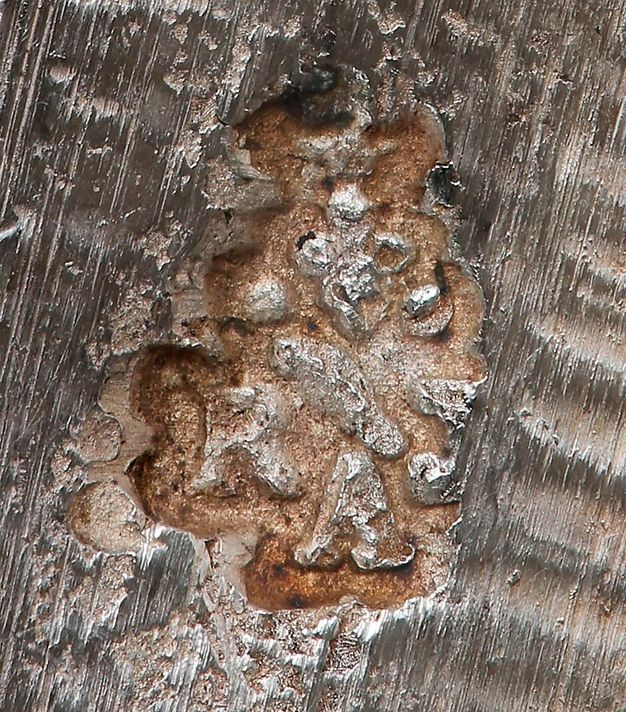
French, born in Mons in 1723, son of Christophe Auguste and Anne-Philippe Baldit; worked as a journeyman (compagnon) for ten years with different goldsmiths in Paris, including future goldsmith “ordinaire” to the king (orfèvre ordinaire du roi) Jacques III Roëttiers, in 1746–56; became a master on January 19, 1757; resided in the cul de sac Saint-Thomas-du-Louvre in 1758–59; married Louise-Élisabeth Barge (died 1773) on April 5, 1758, and had a son, Henry Auguste (born March 8, 1759); resided in the rue des Cordeliers in 1766; working as a sculptor-goldsmith (sculpteur-orfèvre), resided in the rue de la Monnaie in 1773–76; delivered the coronation regalia for Louis XVI to the Crown’s furniture warehouse (Garde-meuble de la Couronne) in 1774–75; appointed goldsmith to the king (orfèvre du roi) on March 23, 1775; purchased the Roëttiers family business and premises in the Place du Carrousel from Jacques Nicolas Roëttiers in 1777; named goldsmith “ordinaire” to the king (orfèvre ordinaire du roi) in 1777; granted lodgings in the Galeries du Louvre in 1784; ceded his workshop to his son Henry Auguste (master April 13, 1785) on January 30, 1788; resided in rue des Orties in 1795; died in 1805.1
Production
From the 1770s, Auguste provided items of precious metal to the Garde-meuble de la Couronne: the coronation crown of Louis XVI in 1775, a table service for Louis XVI in 1783, and serving vessels (pots à oille or terrines) for the queen’s use at the Château de Saint-Cloud in 1788.2 Notable private clients patronized him, including the marquise de Pompadour (salts, in 1755), Jean de Jullienne (a square box with pilasters, in 1767), and Augustin Blondel de Gagny (gilded-bronze wall lights with female herms, in 1776). He delivered tableware to international patrons, including Christian VII, King of Denmark, in 1769; the comte de Creutz, Swedish ambassador to France, in 1775–76; George III, as Duke of Brunswick-Lüneburg and Prince-Elector of Hanover, in 1777–86; the duque de Cadaval, Portugal, in 1778–80; and Catherine II, Empress of Russia, in 1778–85. He also produced a large gilded-silver toilette service for Queen Maria of Portugal, in 1784. He subcontracted lesser components of these large services to Claude Auguste Aubry, Nicolas Martin, and Jean Etienne Langlois. At the height of his career, in the month of April 1778, his workshop brought a total of 4,000 marcs of silver (a weight equivalent to 979.2 kilograms, or more than one ton) to the Crown’s tax bureau (bureau des fermiers) in order to pay the requisite levy.
Jean-Baptiste François Chéret
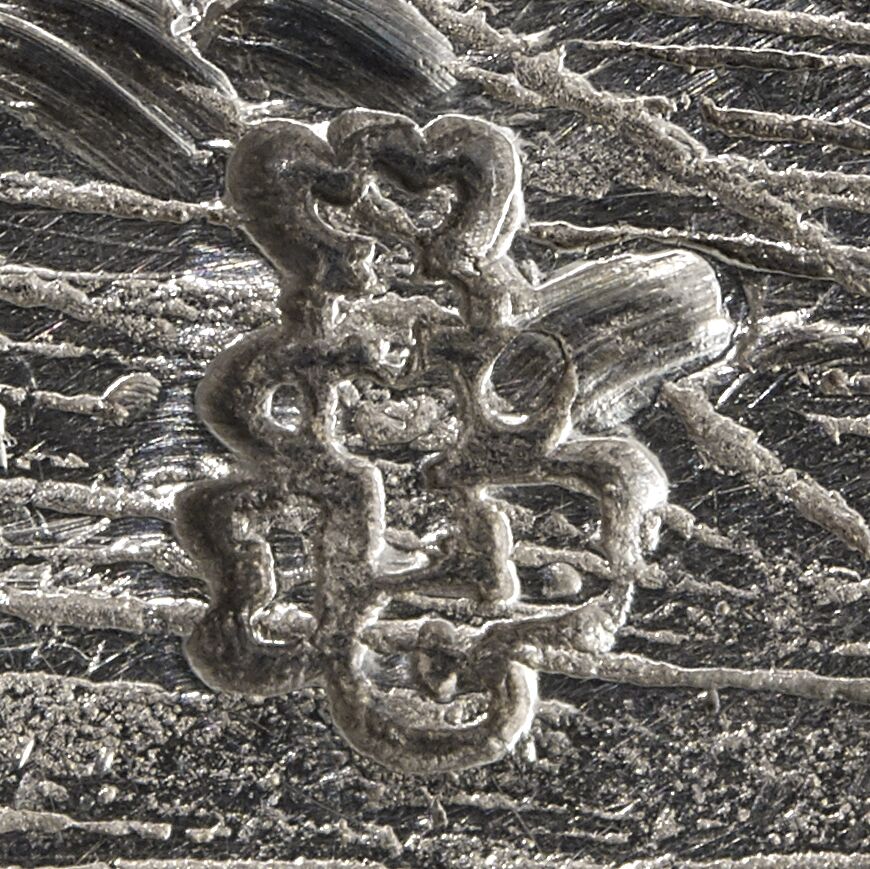
French, baptized in Paris on October 10, 1728, son of master goldsmith Pierre Charles Chéret and Geneviève Cain; brother of goldsmiths Antoine Chéret (died 1787) and, possibly, Jean-Jacques Chéret; became a master on July 13, 1759; resided in the rue de Harley in December 1759; then in the rue de la Fromagerie in 1766; then, under the sign of the Golden Chariot (Chariot d’or), on the quai des Orfèvres from 1773 to 1787; then in the rue Saint-Louis in 1788; and in the rue de Clery in 1789–91; advertised a complete gilded-silver toilette service in the Affiches de Paris in 1773; ranked as having the tenth highest income among the guild of master merchants of goldsmiths-jewelers (maîtres marchands orfèvres-joailliers-bijoutiers) in 1774; served as warden of the guild from July 15, 1755, and again from July 13, 1776; succeeded goldsmith Jacques Nicolas Roëttiers as a city councilor on August 12, 1777; served as fourth-level warden (quatrième grand garde) from July 11, 1787, and second-level warden (deuxième grand garde) from November 12, 1788;3 died on November 30, 1809.4
Production
Documents and extant works testify to the creative productivity of the Chéret workshop from 1759 to the Revolution, spanning the Rococo to Neoclassical styles. Rarely, though, are the names of his clients revealed. Three names only are known: Louis XV, who presented a gilded-silver ewer and basin by Chéret in 1770 to his mistress, Marguerite Catherin Hinault, and her husband, the marquis Blaise Arod de Montmelas; Prince Cardito, who rejected the vessel he commissioned from Chéret in 1789; and the city of Marseilles, which commissioned in 1789 an allegorical vase for their mayor, Jean-Pierre d’Isnard.5 That vase does not seem to have survived. Two tureens exhibit Chéret’s evolving exploration of Neoclassical forms. The earlier example of 1772, bearing the arms of comte Branicki, is in the transitional style with thick oak leaf and acorn garlands, while the other, of 1789, has a band of scrolling acanthus leaves in low relief, characteristic of the later arabesque style.6 Other extant works tend to be rather modest in size. The Metropolitan Museum of Art has a concentration of six of his pieces ranging from tableware to items from toilette services and dating from 1763 to 1784.7 The Musée des arts décoratifs, Paris, has three pieces of tableware of 1759–60, 1762–63, and 1786–87.8
Louis Cordier
French, born in Paris, son of the Parisian goldsmith Claude Cordier; residing on the pont Saint-Michel, registered his mark on April 28, 1692; worked on the quai de la Mégisserie in 1737; trained two successive apprentices at that address: Philippe Roland, from 1737, and François Leclerc, from 1746; retired on February 20, 1748.9
Production
Few pieces survive bearing the mark of Louis Cordier. A pair of small beakers (timbales) dated 1717–22 was in the collection of David David-Weill.10 A pair of candlesticks dated 1722–23 passed through the French art market within the last ten years.11 The largest piece, and the most distinctive, is a baluster-shaped ewer of 1729–30, with a hinged lid, a spout with an applied human mask, and a handle whose thumb rest takes the form of a female head cast in the round.12
Simon Gallien
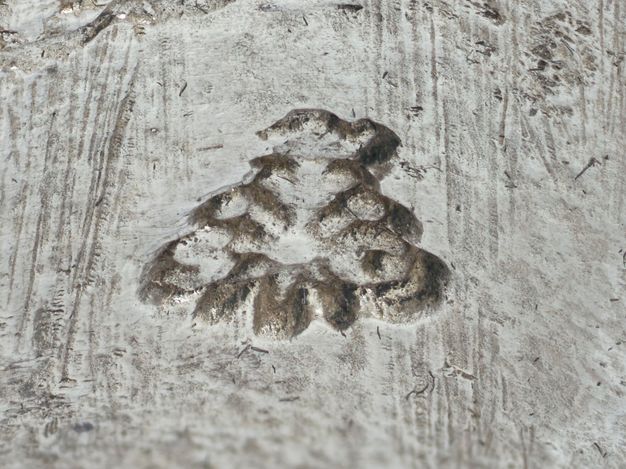
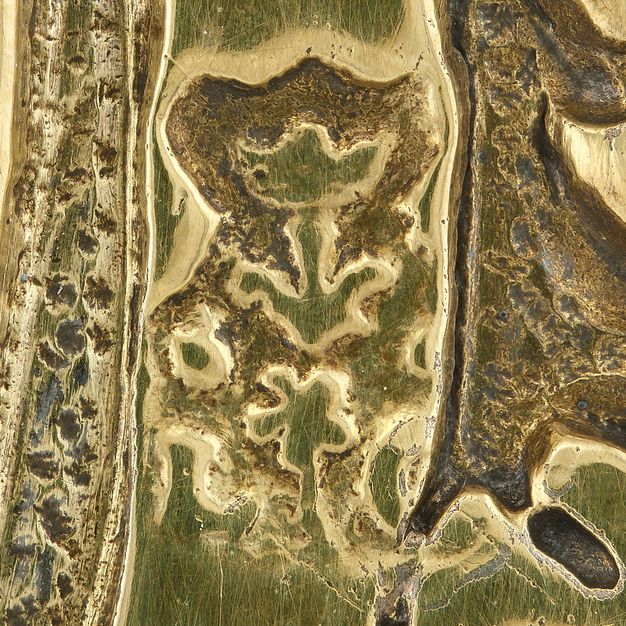
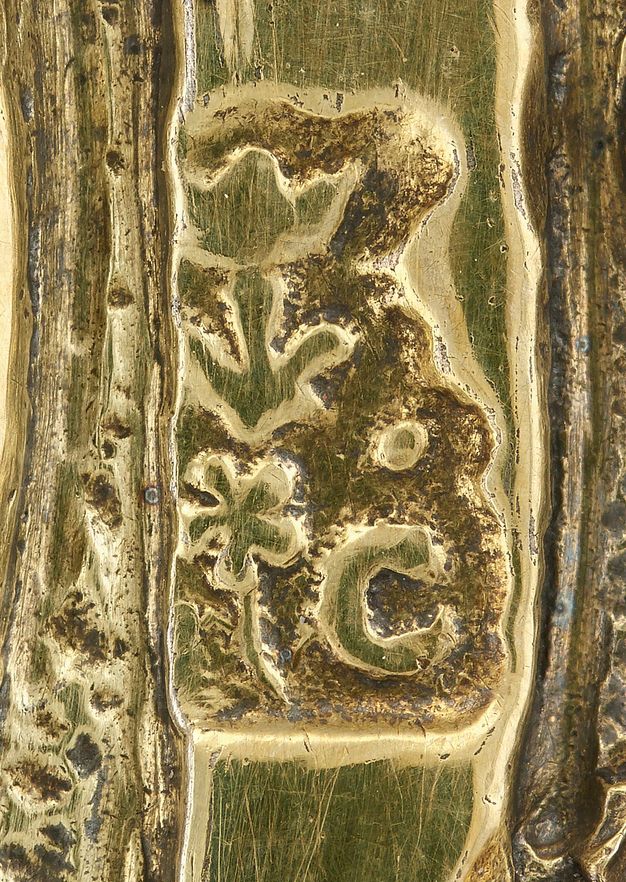
French, possibly the goldsmith (orfèvre) living in the enclosure of the Abbey of Saint-Germain-des-Prés, Paris, in 1710;13 resided as a merchant goldsmith (marchand orfèvre) in the rue de Bussy (alternatively spelled Buci and Boucheries) from 1710 to 1757; became a master on February 3, 1714; married in 1710,14 and had a son, Simon Gallien, baptized on October 17, 1719; was identified as a goldsmith jeweler (orfèvre joaillier) in 1727 and in 1744;15 took Jean-Louis Morel as an apprentice on November 26, 1748; madame Gallien (née Marie-Antoinette Cupre) was buried on December 13, 1748; paid the security for the mastership (maîtrise) of his son, Jean Simon, on July 20, 1756; resigned as a master on May 12, 1757; died and was buried on November 3, 1757.
Production
Though Simon Gallien’s career spanned more than forty years, few works by his hand are in public collections. The most important, and most unusual, is the ceremonial gilded-silver sword and harness (baudrier) he provided in 1729 to Marc de Beauvau, prince de Craon, at the price of 2,312 livres, on the occasion of the state funeral of duc Leopold of Lorraine, in Nancy. In 2015 the object was classified as a national treasure, and in 2017 it was acquired by the Musée de Lorraine de Nancy, Palais des ducs de Lorraine.16 Gallien’s other surviving pieces are domestic wares, including a pair of candlesticks of 1735–36 in the Musée des arts décoratifs, Paris,17 cutlery of 1734–35, and a mustard pot of 1739–40.18
Phillips Garden
British, orphaned son of John Garden, who had been a London citizen and a draper; was apprentice to the London plateworker Gawen Nash from 1730 to 1738; “made free,” meaning he was elected freeman of the Worshipful Company of Goldsmiths of the City of London, on October 3, 1738; registered multiple versions of his marks (1) as a smallworker, on June 12, 1738, (2) as a largeworker, on June 23, 1739, (3) on March 12, 1744, (4) on October 29, 1748, and (5) on April 18, 1751; worked as a goldsmith and jeweler in Gutter Lane in 1739, then as a goldsmith, jeweler, and retailer at the Golden Lion in Saint Paul’s Churchyard from 1744 to 1762; went bankrupt in 1762; resigned from the Livery division of the Goldsmith’s Company in 1763.19
Production
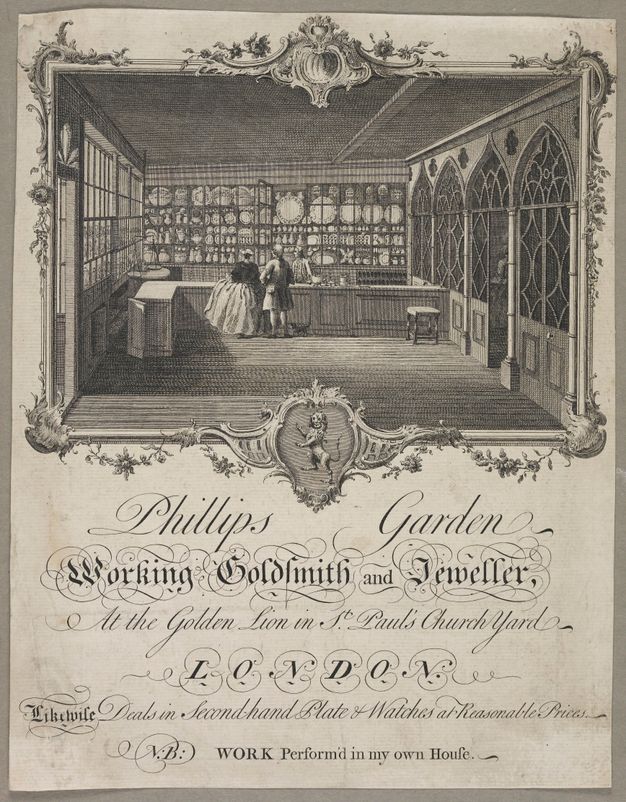
A trade card for Phillips Garden, working goldsmith and jeweler at the Golden Lion in Saint Paul’s Church Yard, London, includes an interior view of his shop, replete with glazed showcases of silver plate, including monteiths, cisterns, bowls, trays, salvers, plates, flagons, pitchers, ewers, coffee pots, teapots, sauceboats, candlesticks, etc. The etched and engraved print is attributed to Francis Garden and dates from the 1750s, when Phillips Garden lived and worked at the Golden Lion.20 Interestingly, the trade card further states that Garden “Likewise Deals in Second-hand Plate & Watches at Reasonable Prices.”
François Thomas Germain
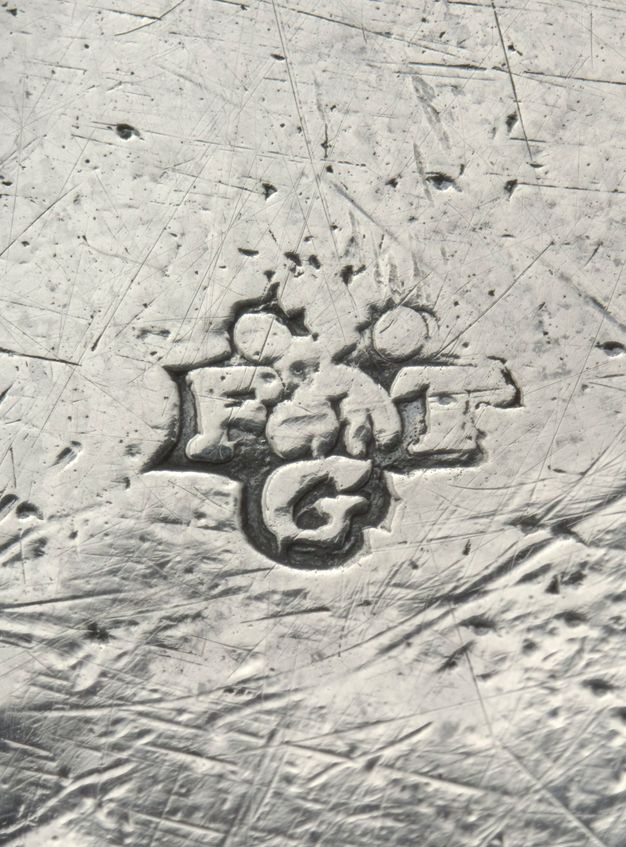
French, born in Paris on April 17, 1726, son of the Parisian goldsmith Thomas Germain and Anne-Denise Gauchelet, a goldsmith’s daughter, residing in the Galeries du Louvre; was apprentice to his father; upon the death of his father, on August 14, 1748, operated the family’s workshop in the rue des Orties, together with his mother until December 1750 and on his own thereafter; succeeded his father as goldsmith-sculptor to the king (orfèvre-sculpteur de la Maison [du roi]), per an earlier warrant signed by Louis XV on February 13, 1748, effective November 18, 1748; registered his mark on November 27, 1748; routinely signed his works as “sculptor-goldsmith to the king” (sculpteur-orfèvre du roi) to emphasize his identity and skill as a sculptor; took successive apprentices, including Louis Tourteau in 1749, Henri Bodson in 1753, Charles Douze in 1756, and Jean Rameau in 1763; married Marguerite Lesieur Desbrières on May 3, 1759, and had three daughters and a fourth child; faced insolvency and, in contravention of guild rules, entered into partnership with financiers on March 31, 1765; went bankrupt on June 27, 1765; moved from the Galeries du Louvre into the workshop in the rue des Orties in December 1765, and retained the title goldsmith-sculptor to the king (orfèvre-sculpteur du roi); resided in England in 1768–72; bankruptcy settled in 1774; died in Paris on February 20, 1791.21
Production
The production of the Germain workshop under François Thomas was prolific in the years following the death of his father. As one of three goldsmiths to the king (serving with Claude II Ballin, Jacques III Roëttiers, and then Jacques Ballin), he fulfilled royal commissions throughout the 1750s, supplying altar fixtures, table and toilette services, candelabra, and writing sets of astounding virtuosity to the extended royal family as well as diplomatic gifts to the department of foreign affairs. Activity peaked in 1752, when the workshop delivered some 2,000 marcs of finished works to the Crown’s furniture warehouse (Garde-meuble de la Couronne) alone (a weight equivalent to 489 kilograms, or 1,078.5 pounds).22 The renowned workshop also served princely, aristocratic, and private clients in France and abroad, from Lisbon to Saint Petersburg. Orders gradually declined, however, as the financial toll of the Seven Years’ War (1756–63) increased. Having enlarged the workshop to meet demand, this downturn proved ruinous for Germain, whose career never recovered from the ensuing bankruptcy of 1765.
Thomas Germain
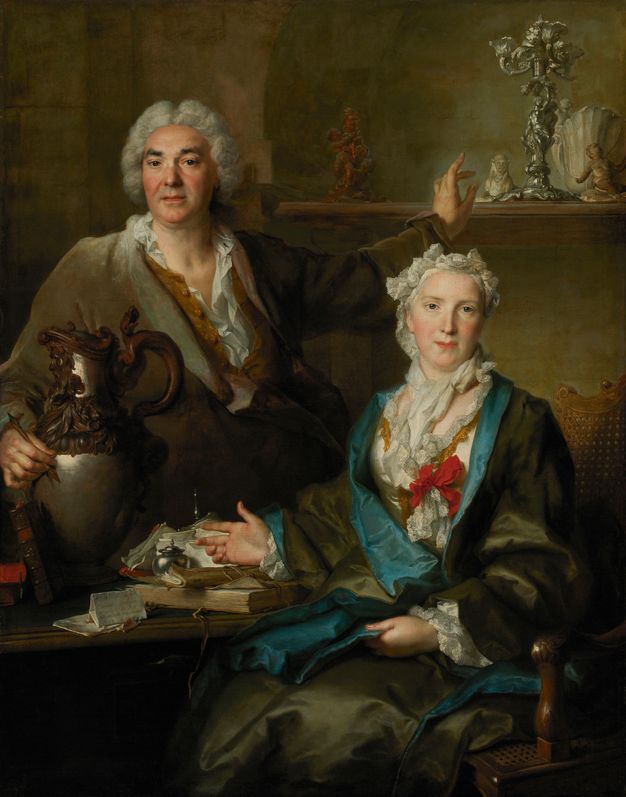
French, born in Paris on August 15, 1673, son of the Parisian goldsmith to the king (orfèvre du roi) Pierre I Germain, residing in the Galeries du Louvre; studied painting under Louis de Boullonge; received a medal in sculpture from the Académie royale de peinture et de sculpture and, while under patronage of the marquis de Louvois, superintendent of the king’s buildings, gardens, art, and manufactories (surintendant des bâtiments du roi, jardins, arts, et manufactures du roi), moved to Rome in 1688; worked under the silversmith, bronze caster, and ornamentalist Giovanni Giardini; worked with Pierre II Legros and Johann Friedrich Ludwig on the sculptural decoration of the Saint Ignatius chapel in the Church of the Gesù in 1698; returned to Paris in 1706; resided on the quai des Orfèvres until 1715, then in the rue de la Monnaie until 1726; married Anne-Denise Gauchelet, a goldsmith’s daughter, on January 7, 1720, and had six children, including the future goldsmith François Thomas Germain; registered his mark on January 30, 1720; was awarded lodgings in the Galeries du Louvre and was appointed goldsmith-sculptor to the king (orfèvre-sculpteur du roi) in September 1723; Nicolas de Largillière painted his portrait with his wife in 1736; acquired the workshop in the rue des Orties in 1743; employed Pierre Germain (called le Romain) in 1726–29; took apprentices, including his son François Thomas and future silversmith to the court of Savoy Andrea Boucheron, in 1737; was elected alderman (échevin) for the city of Paris in 1738 and in 1741; designed the Église de Saint-Louis-du-Louvre in 1739–44 (demolished 1810); died in Paris on August 14, 1748.23
Production
Upon Thomas Germain’s return to Paris from Italy in 1706, he fulfilled ecclesiastical commissions in silver and in bronze, including a silver monstrance, bronze candlesticks, and a bronze crucifix for the Cathédrale Notre-Dame de Paris in 1716–18. Following his appointment as goldsmith-sculptor to the king (orfèvre-sculpteur du roi) in 1723, his work was in high demand and his production was prodigious. As one of three goldsmiths to the king (serving with Nicolas Besnier and Claude II Ballin), he delivered a variety of wares to the Crown’s furniture warehouse (Garde-meuble de la Couronne) until his death in August 1748, notably: a large gold toilette service of thirty-five pieces for Marie Leczinska, Queen of France, in 1726; rattles for each royal child, beginning with the first, born in 1726; a silver necessaire for Louis XV, in 1727; a gold, gilded-silver, and silver toilette service for Marie Thérèse Raphaëlle d’Espagne, the dauphine, in 1746; and two large girandoles in gold for the king’s formal table setting, known as le grand couvert, in 1747. He delivered wares to the courts of Portugal, from 1725 to 1748; Vienna, in 1725 and in 1733; Spain, in 1727–28; Naples, in 1732–33 and 1738; and Denmark, in 1738–42. He also catered to many private patrons, such as Samuel Jacques Bernard, comte de Coubert.
Ralph Leake
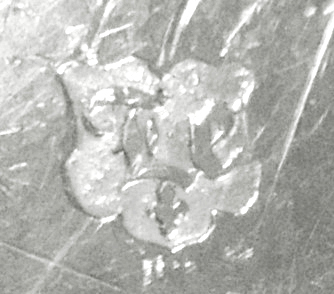
English, son of yeoman Thomas Leake of Osbaston, Shropshire; was apprentice to the London plateworker Thomas Littleton from 1664 to 1671; “made free,” meaning he was elected freeman of the Worshipful Company of Goldsmiths of the City of London, on September 20, 1671; conducted some retail trade around 1677; resided in Bridges Street/Bridges Street West, Covent Garden, from 1677 to 1694; registered two marks on the guild’s new Mark Plate in 1682; signed the Declaration of Loyalty to William III and entered a largeworker’s mark for Britannia standard in 1697; his will was accepted in court on June 8, 1716.24
Production
Ralph Leake made a gilded-silver alms basin, with a central scene of the Last Supper in relief, as part of an altar service for Saint James’s Church, Piccadilly, London, in its inaugural year of 1683. Concerning this service, John Evelyn wrote in November 1684, “There was no altar anywhere in England, nor has there been any abroad, more handsomely adorned.”25 Besides the two cisterns that survive from the pair of fountains and cisterns from Kedleston Hall, Derbyshire, England (see cat. no. 1 in this catalogue), there is the standing dish of 1685–86 in the collection of the Goldsmiths’ Company, engraved with the arms of the Duke of Grafton and bearing his maker’s mark.26
Jean Leroy
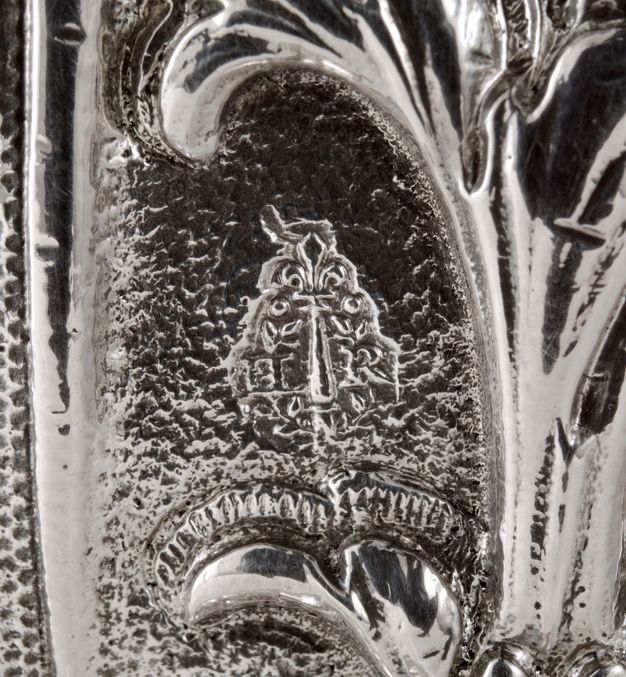
French, born in Saumur; was a journeyman in Paris; residing in the rue d’Avignon, registered his mark as a specialist in silver, not gold, on November 28, 1625;27 married Denise Barbotte (died 1637), and had one son, Jean (born 1632); married Jeanne Barbier on October 18, 1638, at the Église Saint-Sulpice, Paris, and had four sons: Jean-Baptiste, André, Honoré (all three baptized at Saint-Sulpice between 1642 and 1649), and Pierre (born ca. 1647);28 working on the quai de Gesvres, apprenticed his thirteen-year-old son, Jean-Baptiste, with the Parisian goldsmith Claude Gaucher for four years, from around 1655;29 presumably converted from Catholicism to Calvinism at an unknown date, likely after 1649, and emigrated to England after June 7, 1655; as John Le Roy, residing in the London borough of Westminster by June 28, 1655, received a letter of denization as a jeweler;30 as John Le Roy, “born at Saumur in France, son of Phillip Le Roy,” was naturalized in England on July 24, 1663;31 active in Paris and in London in the 1660s;32 maintained business relationships and cross-Channel family networks with merchant goldsmiths jewelers (marchands orfèvres-joailliers), such as Thomas Verbecq (who was “born at Paris in France” and was naturalized in England on the same date as John Le Roy, July 24, 1663);33 apprenticed his fifteen-year-old son, Pierre, with Jean Frère, the Paris-based Huguenot goldsmith from Metz who had a workshop in the passage of Saint-Germain des Prés, on January 22, 1662;34 jeweler Jean Leroy (father or son?), was in Paris in 1669 and obtained the right from the French authorities to reside in London as a merchant on March 15, 1670;35 was possibly the same person known as John Le Roy of London, working with jewels, on January 9, 1667, and as a merchant in association with the London goldsmith Edward Backwell, on March 16, 1670;36 and was possibly associated with the female Parisian goldsmith Geneviève Cabarin (who, in 1671–72, incorporated a gilded-silver sheet with Jean Leroy’s mark in her work).37
Production
Apparently, only three works survive bearing the mark of Jean Leroy. The earliest piece is a small octagonal toilette box, with the Paris warden’s date letter for 1627–28, in a private collection.38 Its segmented surfaces are embossed and finely chased with naturalistic flowers, leaves, and a bird in relief against matted grounds. His mark is also found on the base of one of a pair of small gilded-silver perfume flasks in the Victoria and Albert Museum, London. The flasks otherwise bear the marks of Geneviève Carabin and an indistinct Paris date letter, possibly for 1671–72.39 One surmises that a considerable portion of Leroy’s Paris-based oeuvre was lost due to the French sumptuary edicts of 1689 and 1709 and that any London-based work by him remains unrecognized due to the absence of an identifying mark. If he did indeed make silver plate in England, it would have been subsumed into the production of a freeman of the Worshipful Company of Goldsmiths of the City of London, who used his own registered mark.
The Martin Family
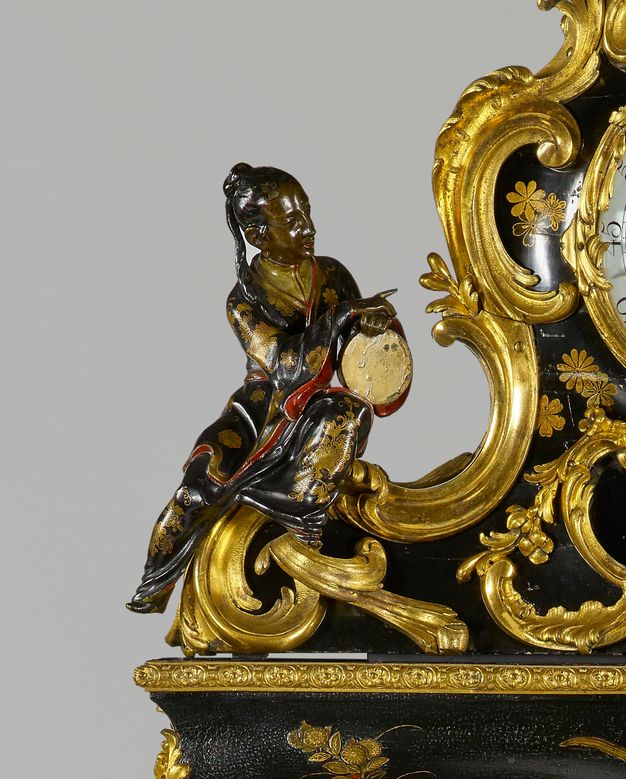
Four brothers in the Paris-based Martin family worked as varnish painters (vernisseurs): Guillaume (1689–1749), Julien (died 1765), Étienne Simon (1703–1770), and Robert (1706–1765); all were members of the Académie de Saint-Luc, specializing in a type of varnish finish (vernis) imitating Chinese and Japanese lacquer; Guillaume was active as a vernisseur in 1711; Guillaume obtained the privileged title of “varnisher of the king” (vernisseur du roy) on June 23, 1725, a title his brothers also used, so he identified himself as “first varnisher of the king” (premier vernisseur du roy); Guillaume worked in the grande rue du Faubourg-Saint-Denis from 1727 to 1749; Guillaume earned—but failed to register—a twenty-year monopoly by letters patent for making “all sorts of works in relief … in the manner of Japan or of China” (“toutes sortes d’ouvrages en relief … dans le goût du Japon ou de la Chine”), dated November 27, 1730; Julien worked in the grande rue du Faubourg-Saint-Martin from 1730 to 1765; Étienne Simon established a workshop large enough to accommodate carriages in the grande rue du Faubourg-Saint-Martin in 1731, and formalized an agreement with Guillaume to share in the privileged title of vernisseurs du roy on February 10, 1731; Étienne Simon took ownership of Guillaume’s workshop and operated independently from 1736; Guillaume and Jean entered a ten-year partnership, from 1736 to 1746; Robert worked in the grande rue du Faubourg-Saint-Denis in 1741; Robert moved to Prussia at some point between 1747 and 1753 and worked at the palace of Sanssouci, in Potsdam; at the time of his death in 1765, Robert carried the title “painter, varnisher of the king of Prussia”(peintre, vernisseur du roy de Prusse); sons Guillaume Jean (son of Guillaume, born 1713) and Étienne François (son of Étienne Simon, died 1771) joined the Paris endeavor; Guillaume Jean moved to Parma in 1749, and worked for Philippe, infant d’Espagne, duc de Parme, and son-in-law of Louis XV; Guillaume Jean then relocated to Naples in 1756; and Jean Alexandre (son of Robert, born 1738) worked in Prussia with his father. 40
Production
The Martin family of vernisseurs had a long and prosperous production spanning some forty years from the 1720s to around 1770. Applications of their house-branded vernis de Martin were applied to boxes, toilette services, objects, scientific instruments, furniture, harpsicords, wall paneling (boiserie), and carriages. They collaborated routinely with merchants of luxury goods (marchands merciers) Thomas Joachin Hébert, Simon Phillipe Poirier, and Lazare Duvaux. Duvaux’s day books itemize extensive work by Étienne Simon Martin from 1755 to 1759. The family was patronized by the Crown’s office of royal buildings (bâtiments du roi), the French royal family, the abbé Jean-Antoine Nollet, the marquise de Pompadour, the Prince of Liechtenstein, and Frederick the Great of Prussia. Notable commissions included: paneling for madame de Châtelet at the Château de Cirey, in 1738; the cabinet of the dauphine Marie Josèphe de Saxe at Versailles, in 1748–49; a cabinet for the marquise de Pompadour at Versailles, in 1750; a two-wheeled gig (chaise de poste) for monsieur de Tournehem, in 1751; Madame Victoire’s cabinet at Versailles, in 1756; and paneling for Frederick the Great at Sanssouci, Potsdam, in 1760. Similar varnishing techniques were legitimately utilized by other practitioners, whose works are described as being in the manner of vernis de Martin or, if specifically localized, vernis de Paris.
Notes
-
This brief biography draws from Forray-Carlier, Anne, with Yves Carlier, Chantal Bouchon, and Sylvie Legrand-Rossi. Dessins d’orfèvrerie de l’atelier de Robert-Joseph Auguste (1723–1805). Online exh. Paris: Musée des arts décoratifs and Musée Nissim de Camondo, 2011. https://madparis.fr/dessins-d-orfevrerie-de-l-atelier.; H.C., “Roëttiers, Jacques (dit Jacques III),” Le Poinçon de Paris et autres (blog), June 16, 2019, https://orfevrerie.wordpress.com/2019/06/16/les-roettiers/; and Nocq, Henry. Le poinçon de Paris: Répertoire des maîtres-orfèvres de la juridiction de Paris depuis le Moyen-âge jusqu’à la fin du XVIIIe siècle. 5 vols. Paris: Léonce Laget, 1968., vol. 1, 31–33, “Auguste (Robert-Joseph).” ↩︎
-
For a fuller account of Auguste’s deliveries of tablewares to the Crown in the 1780s, see Carlier, Yves. “L’orfèvrerie de table de Louis XVI.” In Versailles et les tables royales en Europe XVIIème–XIXème siècles, edited by Jean-Pierre Babelon, Zeev Gouranier, Catherine Arminjin, Béatrix Saule et al., 106–9. Exh. cat. Paris: Réunion des musées nationaux, 1993.. ↩︎
-
This brief biography derives from Nocq, Henry. Le poinçon de Paris: Répertoire des maîtres-orfèvres de la juridiction de Paris depuis le Moyen-âge jusqu’à la fin du XVIIIe siècle. 5 vols. Paris: Léonce Laget, 1968., vol. 1, 259–60, and Dennis, Faith. Three Centuries of French Domestic Silver: Its Makers and Its Marks. 2 vols. New York: Metropolitan Museum of Art, 1960., vol. 2, 51–52, nos. 96–98. ↩︎
-
Michèle Bimbenet-Privat, email to author, April 18, 2018, on file in the Sculpture and Decorative Arts Department, J. Paul Getty Museum. ↩︎
-
The gilded-silver ewer and basin sold from the collection of Belgian art dealer Bernard de Leye in The Exceptional Collection of Bernard de Leye, sale cat., Kunsthaus Lempertz, Cologne, July 15, 2021: lot 181. For the names of the two clients of 1789, see Brault, Solange, and Yves Bottineau. L’orfèvrerie française du XVIIIe siècle. Paris: Presses Universitaires de France, 1959., 7. ↩︎
-
Their locations have not been tracked since the mid-1960s when they were in private collections (Frégnac, Claude. Les grands orfèvres de Louis XIII à Charles X: Collection connaissance des arts “Grands artisans d’autrefois.” Paris: Hachette, 1965., 216–19). ↩︎
-
Five pieces were bequeathed to the Metropolitan Museum of Art by Catherine D. Wentworth in 1948: a mustard or milk pot of 1763–64 (inv. 48.187.410); a pair of candlesticks of 1767–68, engraved with a double-shield armorial (inv. 48.187.25a, b, .26a, b); and a pair of candelabra of 1768–69 (inv. 48.187.393a, b, .394a, b). A sixth piece was given by Jayne Wrightsman in 1980: an ewer of 1784–85 with a handle formed as the upper torso and head of Narcissus, probably from a toilette set (inv. 1980.79, https://www.metmuseum.org/art/collection/search/206816). ↩︎
-
Musée des arts décoratifs, Paris: a cream pot (pot à crème) of 1759–60 (inv. 30077); a gilded-silver double salt (salière double) of 1762–63, with the armorial of Baron Jérôme Pichon (inv. 26866 A–B); and a chocolate pot (chocolatière) of 1786–87 (inv. 30008). See Mabille, Gérard. Orfèvrerie française des XVIe XVIIe XVIIIe siècles: Catalogue raisonné des collections du Musée des arts décoratifs et du Musée Nissim de Camondo. Paris: Flammarion/Musée des arts décoratfis, 1984., 48, no. 62 (pot à crème), and no. 63 (salière double). ↩︎
-
Nocq, Henry. Le poinçon de Paris: Répertoire des maîtres-orfèvres de la juridiction de Paris depuis le Moyen-âge jusqu’à la fin du XVIIIe siècle. 5 vols. Paris: Léonce Laget, 1968., vol. 1, 296–97. Images of Louis Cordier’s mark were kindly confirmed by Michèle Bimbenet-Privat, as they were not reproduced by Nocq. ↩︎
-
Collection D. David-Weill (Troisième vente d’orfèvrerie)—Orfèvrerie XIIe au XIXe siècle, sale cat., Hôtel Drouot, Paris, May 4–5, 1972: lot 25. ↩︎
-
They were advertised by the consortium of French antique dealers known as Proantic, founded in 2009. ↩︎
-
Dennis, Faith. Three Centuries of French Domestic Silver: Its Makers and Its Marks. 2 vols. New York: Metropolitan Museum of Art, 1960., vol. 1, 93, no. 103 (formerly in the collection of Jean Block); Fuhring, Peter, Michèle Bimbenet-Privat, and Alexis Kugel. Orfèvrerie française: La collection Jourdan-Barry. 2 vols. Paris: J. Kugel, 2005., vol. 2, 57–58, no. 137. ↩︎
-
Paris, Archives nationales de France, Minutier central, I, 240, October 13, 1710 (the historical document was not consulted; the citation draws upon the descriptive notary catalogue by Mireille Rambaud and Catherine Grodecki, Artisans XVIIIe siècle, 1956–1977, originally compiled as a paper resource, since adapted and now searchable online at http://francearchives.fr/). Paris, Archives nationales de France, online catalogue, Minutes de Nicolas Charles Le Prévost (MC/ET/I/239–MC/ET/I/287), Minutes. 1710, octobre–décembre (MC/ET/I/240). This brief biography also draws upon Nocq, Henry. Le poinçon de Paris: Répertoire des maîtres-orfèvres de la juridiction de Paris depuis le Moyen-âge jusqu’à la fin du XVIIIe siècle. 5 vols. Paris: Léonce Laget, 1968., vol. 2, 208–9. ↩︎
-
Paris, Archives nationales de France, Minutier central, XCI, 580, March 1, 1710. See also Paris, Archives nationales de France, online catalogue, Minutes de Jean Carnot (MC/ET/XCI/356–MC/ET/XCI/591), Minutes, janvier–1710, octobre, mars (MC/ET/XCI/580). See note 13. ↩︎
-
Paris, Archives nationales de France, Minutier central, XXVII, 165, May 13, 1727, and XXVII, 228, July 8, 1744. See also Paris, Archives nationales de France, online catalogue, Minutes de Nicolas Duport (MC/ET/XXVII/1–MC/ET/XXVII/165), Minutes, 1727, janvier–20 mai, (MC/ET/XXVII/165); and Minutes de Jérôme Duport (MC/ET/XXVII/166–MC/ET/XXVII/859), Minutes, 1744, juillet–15 octobre (MC/ET/XXVII/228). See note 13. ↩︎
-
The ceremonial sword sold in Chosen pieces: Provenant de la collection de la princesse Minnie de Beauvau-Craon du Château de Haroué, sale cat., AuctionArt, Rémy le Fur et Associés, Hôtel Richelieu, Paris, June 15, 2015: 29–39, lot 6, “Importante et unique épée de grand écuyer de Lorraine.” The entry reproduced Gallien’s signed invoice and description of the work. Musée de Lorraine de Nancy, Palais des ducs de Lorraine, inv. 2017.1.1, https://www.musee-lorrain.nancy.fr/fr/collections/les-oeuvres-majeures/epee-de-grand-ecuyer-du-duc-de-lorraine-184. See Martin, Philippe. “La ‘mort’ d’un duc de Lorraine.” In Les cérémonies extraordinaires du catholicisme baroque. Histoires croisées, edited by Bernard Dompnier, 293–312. Clermont-Ferrand: Presses Universitaires Blaise-Pascal, 2009., 306n60. ↩︎
-
Musée des arts décoratifs, Paris, inv. 26896 A,B, http://collections.lesartsdecoratifs.fr/flambeau-55. See Mabille, Gérard. Orfèvrerie française des XVIe XVIIe XVIIIe siècles: Catalogue raisonné des collections du Musée des arts décoratifs et du Musée Nissim de Camondo. Paris: Flammarion/Musée des arts décoratfis, 1984., 73–78, no. 105, “Paire de flambeaux.” Additionally, a pair of two-branch candelabra of 1740 sold in Magnificient Silver / Magnifique orfèvrerie, sale cat., Christie’s, Geneva, April 27, 1976: 119, lot 436, “A Pair of Fine Louis XV Two-Light Candelabra.” ↩︎
-
Two place settings of cutlery and a serving spoon of 1734–35 sold in Livres anciens, dessins et tableaux anciens, céramique, orfèvrerie allemande, objets d’art, meubles, tapis et tapisseries, sale cat., Brissonneu et Daguerre, Hôtel Drouot, Paris, May 17, 2013: 51, lot 141, “Ensemble de deux couverts, une cuiller.” The mustard pot of 1739–40, from the collection of J. L. Bonnefoy, was on public view in 1974. See Louis XV: Un moment de perfection de l’art français. Exh. cat. Paris: Imprimerie Nationale, 1974., 352, no. 475. ↩︎
-
Heal, Sir Ambrose. The London Goldsmiths, 1200–1800: A Record of the Names and Addresses of the Craftsmen, Their Shop-Signs and Trade-Cards. Newton Abbott, U.K.: David & Charles Reprints, 1972., 30, 157; Grimwade, Arthur G. London Goldsmiths, 1697–1837: Their Marks and Lives from the Original Registers at Goldsmiths’ Hall and Other Sources. London: Faber and Faber, 1990., 158–59, 518–19. ↩︎
-
It is preserved in the British Museum, London, Prints and Drawings, Trade Cards, inv. Heal,67.156, https://www.britishmuseum.org/collection/object/P_Heal-67-156. The opportunity to study the trade card was kindly facilitated by Hugo Chapman, Head of the Prints and Drawings Department, British Museum, and by Sheila O’Connell. See also O’Connell, Sheila. London 1753. Exh. cat. London: British Museum Press, 2003., 99, no. I.86. ↩︎
-
This brief summary draws principally from Bapst, Germain. Études sur l’orfèvrerie française au XVIIIe siècle: Les Germain, orfèvres-sculpteurs du roy. Paris: J. Rouam et cie, 1887., 108; Perrin, Christiane. François Thomas Germain: Orfèvre des rois. Saint-Rémy-en-l’Eau: Éditions d’art Monelle Hayot, 1993., 16–33; and Fuhring, Peter, Michèle Bimbenet-Privat, and Alexis Kugel. Orfèvrerie française: La collection Jourdan-Barry. 2 vols. Paris: J. Kugel, 2005., vol. 2, 95, no. 245. ↩︎
-
Perrin, Christiane. François Thomas Germain: Orfèvre des rois. Saint-Rémy-en-l’Eau: Éditions d’art Monelle Hayot, 1993., 81. ↩︎
-
This brief summary draws principally from Bapst, Germain. Études sur l’orfèvrerie française au XVIIIe siècle: Les Germain, orfèvres-sculpteurs du roy. Paris: J. Rouam et cie, 1887., 38–39, 91–98; Perrin, Christiane. François Thomas Germain: Orfèvre des rois. Saint-Rémy-en-l’Eau: Éditions d’art Monelle Hayot, 1993., 19–20, 34–38, 88–89; Fuhring, Peter, Michèle Bimbenet-Privat, and Alexis Kugel. Orfèvrerie française: La collection Jourdan-Barry. 2 vols. Paris: J. Kugel, 2005., vol. 2, 61–62, no. 148; Fuhring, Peter. Designing the Décor: French Drawings from the Eighteenth Century. Exh. cat. Lisbon: Calouste Gulbenkian Foundation, 2005., 338–39; and Thompson, Eleanor. “I. Thomas Germain: A Biographical Sketch.” In Tureen “Aux Ecrevisses” by Thomas Germain. Sale cat. Sotheby’s, New York, October 25, 2019: 10–17.. Nicolas de Largillière’s portrait of Thomas Germain and his wife, Anne-Denise Gauchelet, is in the Museu Calouste Gulbenkian, Lisbon, inv. 431, https://gulbenkian.pt/museu/en/works_museu/portrait-of-thomas-germain-and-his-wife/. ↩︎
-
Grimwade, Arthur G. London Goldsmiths, 1697–1837: Their Marks and Lives from the Original Registers at Goldsmiths’ Hall and Other Sources. London: Faber and Faber, 1990., 140–41, 264, 579; Mitchell, David M. Silversmiths in Elizabethan and Stuart London: Their Lives and Their Marks. Woodbridge, U.K.: Boydell Press in association with the Goldsmiths’ Company, 2017., 457–58. ↩︎
-
Bray, William, ed. Diary and Correspondence of John Evelyn. 4 vols. London: Henry Colburn, 1852., vol. 2, 201; Oman, Charles. “Restoration Silver at the Royal Academy.” Burlington Magazine 103, no. 695 (February 1961): 44–47., 44–47, fig. 8. One gilded-silver chalice and standing paten from a set of four from the service are on loan from the Rector and Churchwardens of Saint James’s, Piccadilly, to the Victoria and Albert Museum, London, http://collections.vam.ac.uk/item/O109443/chalice-leake-ralph/. ↩︎
-
The dish is visible in a showcase in the Exhibition Room, Goldsmiths’ Hall Virtual Tour, Goldsmiths’ Company, accessed April 9, 2022, https://www.pan3sixty.co.uk/virtual_tours/goldsmiths-company/#exhibition-room. ↩︎
-
Bimbenet-Privat, Michèle. Les orfèvres et l’orfèvrerie de Paris au XVIIe siècle. Vol. 1, Les hommes. Vol. 2, Les oeuvres. Paris: Éditions des Musées de la ville de Paris, 2002., vol. 1, 206, 410–11, and vol. 2, 210–11, no. 66. This brief biography draws upon the work of Michèle Bimbenet-Privat and David M. Mitchell. ↩︎
-
Bimbenet-Privat, Michèle. Les orfèvres et l’orfèvrerie de Paris au XVIIe siècle. Vol. 1, Les hommes. Vol. 2, Les oeuvres. Paris: Éditions des Musées de la ville de Paris, 2002., vol. 1, 410. ↩︎
-
Ibid. ↩︎
-
Shaw, William Arthur, ed. The Publications of the Huguenot Society of London 18 (1911)., 68. ↩︎
-
Shaw, William Arthur, ed. The Publications of the Huguenot Society of London 18 (1911)., 91. ↩︎
-
David M. Mitchell noted the apparent presence of two Jean Le Roys, one active in Paris and the other in London in the 1660s. David M. Mitchell, email to author, November 8, 2018, on file in the Sculpture and Decorative Arts Department, J. Paul Getty Museum. The situation is succinctly summarized in Pijzel-Dommisse, Jet. “Huguenot Goldsmiths and French Influence in the Hague in the Late 17th Century.” In Beyond the Border: Huguenot Goldsmiths in Northern Europe and North America, edited by Tessa Murdoch, 20–44. Brighton, U.K.: Sussex Academic Press, 2008., 43n31. ↩︎
-
Naturalization lists, apprenticeship contracts, merchant ledgers, and extant marks testify to Jean Leroy’s business and family networks. Mitchell, David. “‘To Alderman Backwells for the Candlesticks for Mr. Coventry’: The Manufacture and Sale of Plate at the Unicorn, Lombard Street, 1663–72.” The Silver Society Journal 12 (Autumn 2000): 111–24., 123 and 123n139. ↩︎
-
The Parisian goldsmith Jean Catillon signed the apprenticeship contract for Leroy’s fifteen-year-old son, Pierre, with Jean Frère on January 22, 1662. Pointedly, Jean Catillon had an English journeyman in his atelier in 1680. The journeyman’s work on a bracelet was substandard. Bimbenet-Privat cites this document in Bimbenet-Privat, Michèle. Les orfèvres et l’orfèvrerie de Paris au XVIIe siècle. Vol. 1, Les hommes. Vol. 2, Les oeuvres. Paris: Éditions des Musées de la ville de Paris, 2002., vol. 1, 406, 410. On the activities of the marchand joaillier Jean Catillon (died 1702), who counted the French royal family among his clients, see Castelluccio, Stéphane. Le prince et le marchand: Le commerce de luxe chez les marchands merciers parisiens pendant le règne de Louis XIV. Kronos 73. Paris: SPM, 2014., 111, 186, 201, 369, 385, 391. ↩︎
-
Bimbenet-Privat, Michèle. Les orfèvres et l’orfèvrerie de Paris au XVIIe siècle. Vol. 1, Les hommes. Vol. 2, Les oeuvres. Paris: Éditions des Musées de la ville de Paris, 2002., vol. 1, 410. ↩︎
-
Edinburgh, Royal Bank of Scotland, Backwell’s Ledgers, vol. P, fol. 649, and vol. R, fol. 593. Citation courtesy of David M. Mitchell. ↩︎
-
Bimbenet-Privat, Michèle. Les orfèvres et l’orfèvrerie de Paris au XVIIe siècle. Vol. 1, Les hommes. Vol. 2, Les oeuvres. Paris: Éditions des Musées de la ville de Paris, 2002., vol. 2, 94–95, no. 24. Cabarin’s perfume flask, with the mark of Jean Leroy on its base, is in the Victoria and Albert Museum, London, inv. 806&B-1892, http://collections.vam.ac.uk/item/O91709/perfume-flask-cabarin-genevieve/. ↩︎
-
Bimbenet-Privat, Michèle. Les orfèvres et l’orfèvrerie de Paris au XVIIe siècle. Vol. 1, Les hommes. Vol. 2, Les oeuvres. Paris: Éditions des Musées de la ville de Paris, 2002., vol. 2, 52–53, no. 2; Mitchell, David M. Silversmiths in Elizabethan and Stuart London: Their Lives and Their Marks. Woodbridge, U.K.: Boydell Press in association with the Goldsmiths’ Company, 2017., 109. ↩︎
-
Information drawn from Courajod, Louis, ed. Livre-Journal de Lazare Duvaux, marchand-bijoutier ordinaire du roy 1748–1758, précedé d’une étude sur le goût et sur le commerce des objets d’art au milieu du XVIIIe siècle. 2 vols. Paris: Société des bibliophiles françois, 1873., vol. 1, cxxiii–ccxxx; Sonenscher, Michael. Work and Wages: Natural Law, Politics, and the Eighteenth-Century French Trades. Cambridge: Cambridge University Press, 1989., 225–27; Czarnocka, Anna. “Vernis Martin: The Lacquerwork of the Martin Family in Eighteenth-Century France.” Translated by Laura Lindgren and Renata Stein. Studies in the Decorative Arts 2, no. 1 (Fall 1994): 56–74.; Wolvesperges, Thibaut. “A propos d’une pendule aux magots en vernis Martin du Musée du Louvre provenant de la collection Grog-Carven.” Revue du Louvre: La revue des musées de France 4 (October 2001): 66–78.; Forray-Carlier, Anne. “Les débuts des Martin.” In Les secrets de la laque française: Le vernis Martin, edited by Anne Forray-Carlier and Monika Kopplin, 50–57. Exh. cat. Paris: Les arts décoratifs; Münster: Museum für Lackkunst, 2014.; and Forray-Carlier, Anne. “‘L’engouement pour le vernis Martin: Décor intérieur et ameublement.” In Les secrets de la laque française: Le vernis Martin, edited by Anne Forray-Carlier and Monika Kopplin, 71–77. Exh. cat. Paris: Les arts décoratifs; Münster: Museum für Lackkunst, 2014.. ↩︎