Component Details
84.DG.42.1
1781–82
Marks
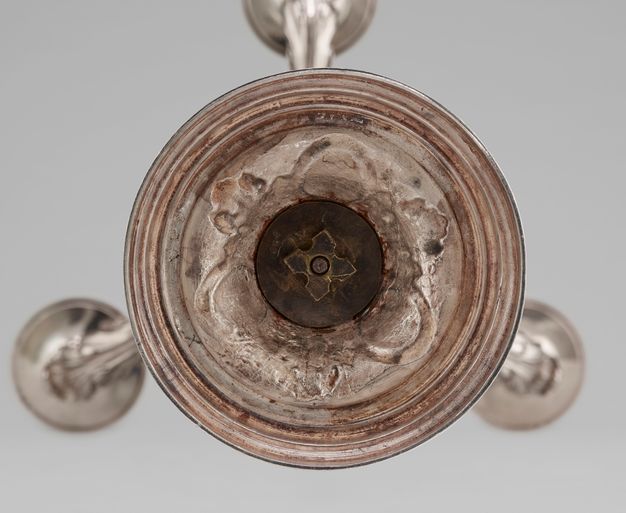
This girandole consists of fourteen individually made parts joined together by one long threaded iron rod, secured with a brass disc and nut, and by a system of shorter threaded silver rods (cat. 10.1, see cat. 10.3).
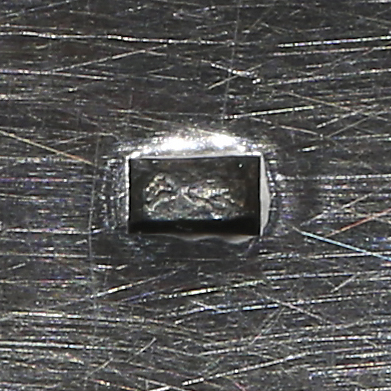
The girandole’s stand, consisting of the foot and central shaft, is struck twice, once on the interior of the foot ring and once underneath the base, with the following stamps: the maker’s mark consisting of the initials “R.J.A.,” a palm branch, and two grains, below a crowned fleur-de-lys (mark 10.1); a crowned S (the Paris warden’s mark used between August 1, 1781, and July 13, 1782) (mark 10.2); and the cipher of two Ls, facing and interlaced (the Paris charge mark used between April 7, 1781, and June 4, 1783, under the fermier Henry Clavel) (mark 10.3). The stand is struck, on the exterior of the foot ring, with the following stamp: an ewer (the Paris discharge mark used on works destined for export between April 7, 1781, and June 4, 1783). The stand is also struck twice, once on the exterior of the foot ring and once on a herm head, in its coiffure, with the following stamp: a charançon (weevil) in a rectangle (the mark of 800 parts per thousand, or 80 percent, minimum standard for works imported into France from contracting countries as used since July 1, 1893).
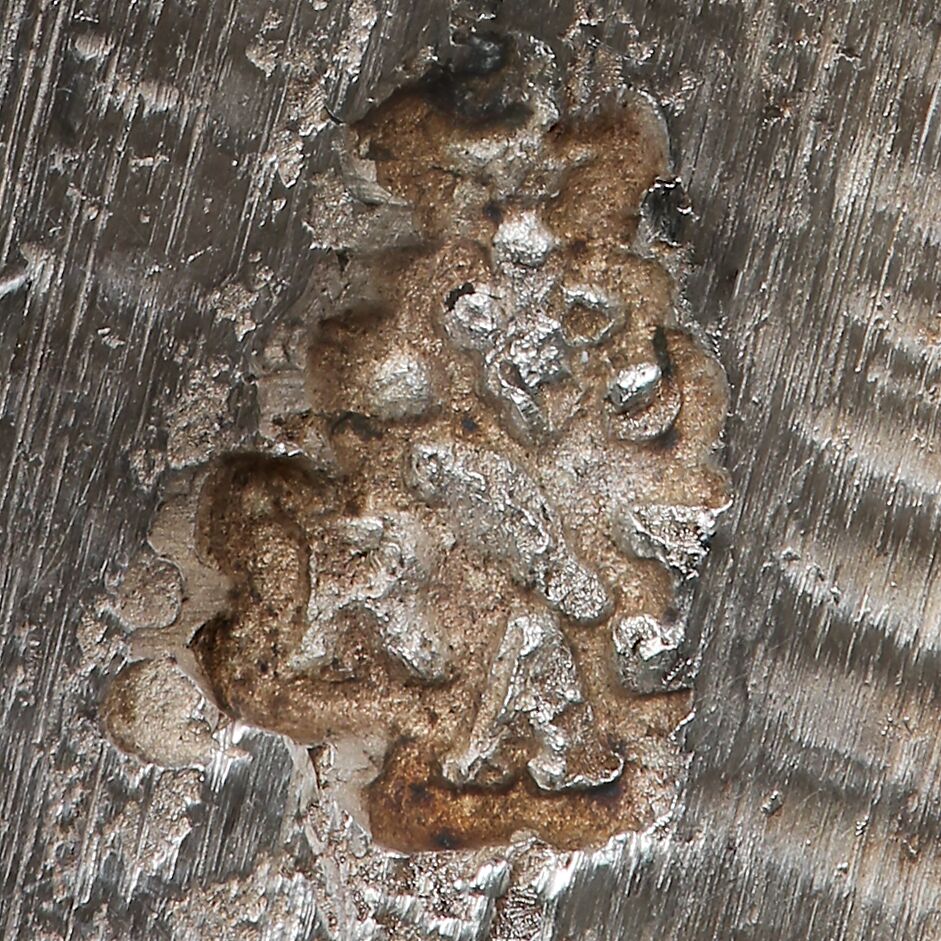
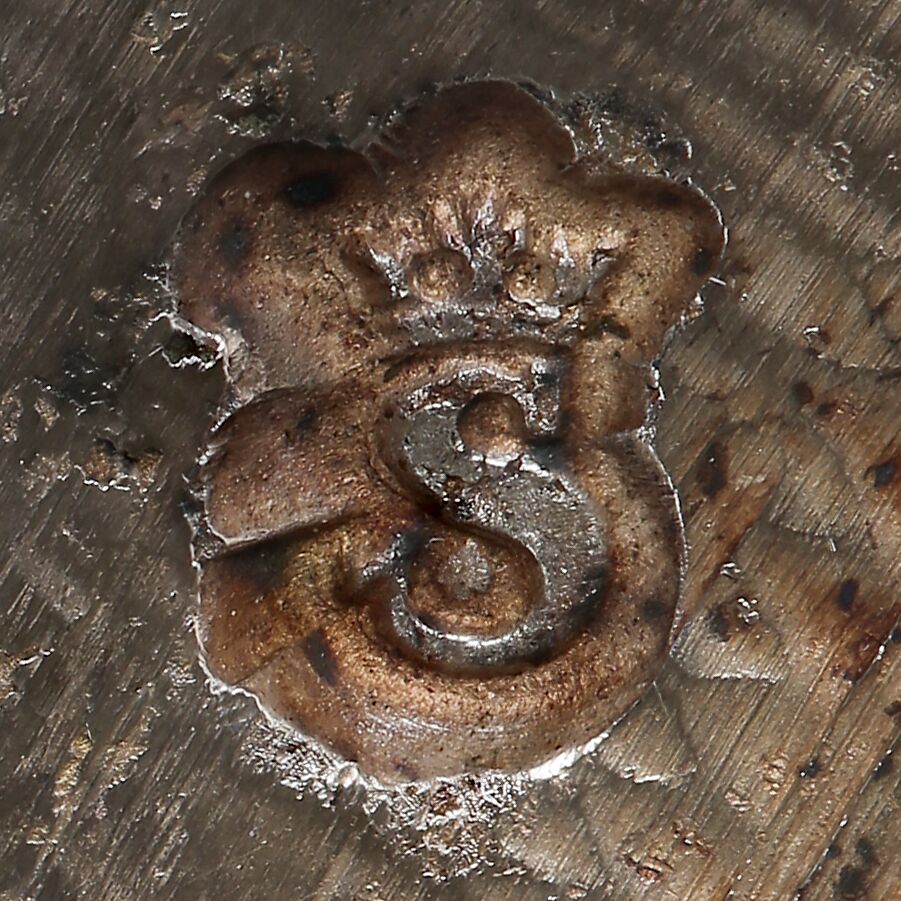
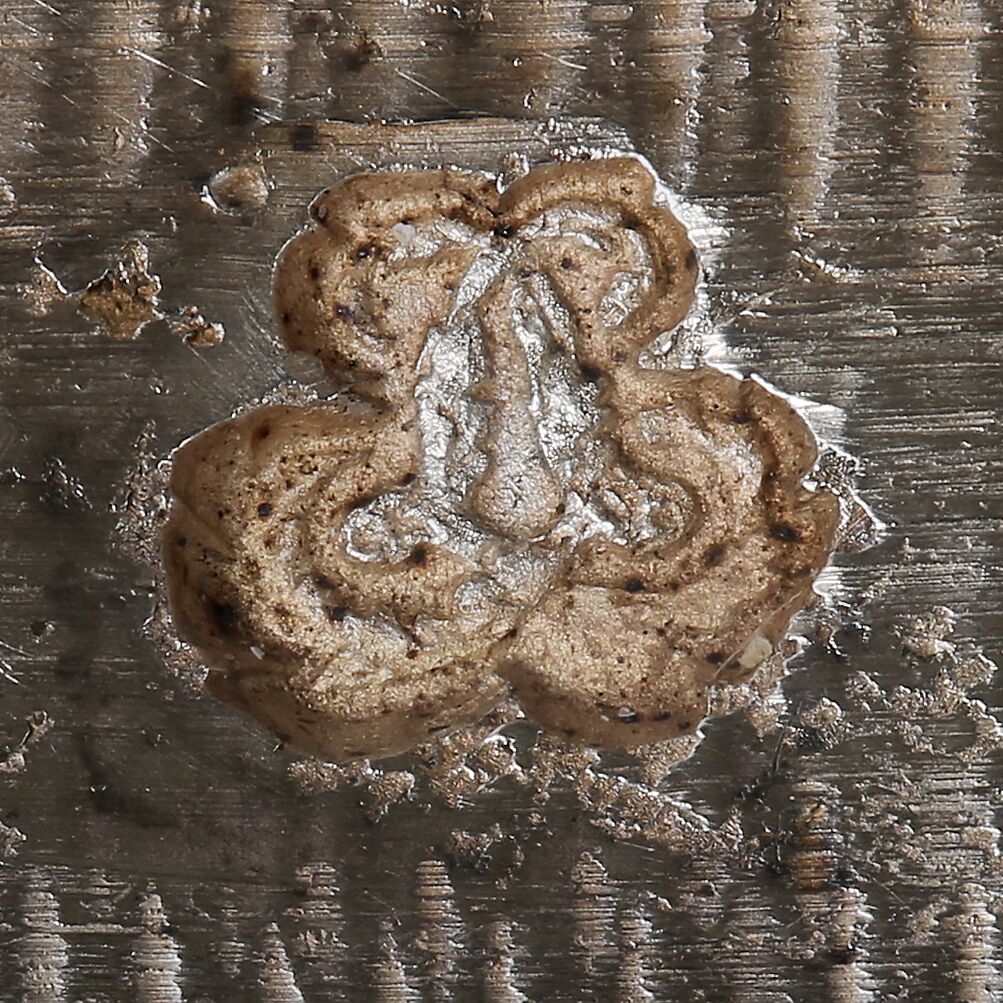
The girandole’s fluted column, from which branch three arms, is struck, underneath, with the following stamps: the maker’s mark consisting of the initials “R.J.A.,” a palm branch, and two grains, below a crowned fleur-de-lys (partially struck); a crowned S (the Paris warden’s mark used between August 1, 1781, and July 13, 1782); the cipher of two Ls, facing and interlaced (the Paris charge mark used between April 7, 1781, and June 4, 1783, under the fermier Henry Clavel). With the putto’s torso as the front of the object, the fluted column is struck, on the exterior, with the following stamp: an ewer (the Paris discharge mark used on works destined for export between April 7, 1781, and June 4, 1783). The fluted column is also struck twice, once on top of the back arm and once on top of the proper right arm, with the following stamp: a charançon (weevil) in a rectangle (the mark of 800 parts per thousand, or 80 percent, minimum standard for works imported into France from contracting countries as used since July 1, 1893).
The girandole’s finial, consisting of a column capital and a putto figure, holding the central candle branch, is struck, on the exterior of the capital, with the following stamp: a charançon (weevil) in a rectangle (the mark of 800 parts per thousand, or 80 percent, minimum standard for works imported into France from contracting countries as used since July 1, 1893).
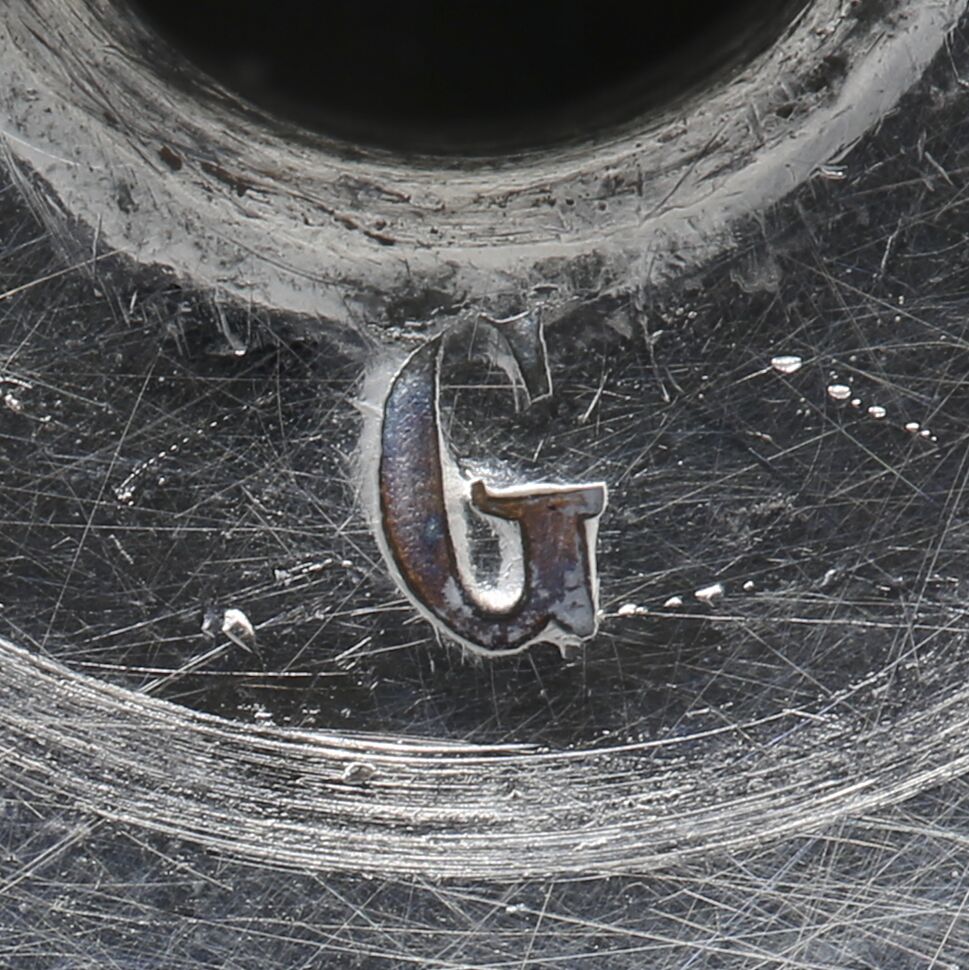
The girandole’s four drip pans are each struck, underneath, with the following stamps: the maker’s mark consisting of the initials “R.J.A.,” a palm branch, and two grains, below a crowned fleur-de-lys (partially struck); a crowned S (the Paris warden’s mark used between August 1, 1781, and July 13, 1782) (partially struck); and the cipher of two Ls, facing and interlaced (the Paris charge mark used between April 7, 1781, and June 4, 1783, under the fermier Henry Clavel) (partially struck). The central drip is also struck, on the interior of the rim, with an ewer (the Paris discharge mark used on works destined for export between April 7, 1781, and June 4, 1783); and twice, underneath and on the surface, with the letter G (referring to a Hanoverian inventory of 1800) (mark 10.4).1 With the putto’s torso as the front of the object, the girandole’s proper right and rear drip pans are each struck, underneath, with the letters “G G” (referring to a Hanoverian inventory of 1800). The four drip pans are struck, underneath the central drip pan on the interior rim of each lateral drip pan, with a charançon (weevil) in a rectangle (the mark of 800 parts per thousand, or 80 percent, minimum standard for works imported into France from contracting countries as used since July 1, 1893).
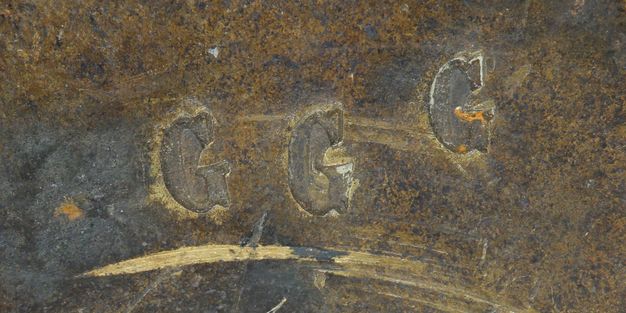
The central candle cup is struck, on its interior, with the following stamps: the maker’s mark consisting of the initials “R.J.A.,” a palm branch, and two grains, below a crowned fleur-de-lys; a crowned S (the Paris warden’s mark used between August 1, 1781, and July 13, 1782); and the cipher of two Ls, facing and interlaced (the Paris charge mark used between April 7, 1781, and June 4, 1783, under the fermier Henry Clavel) (partially struck). The proper right candle cup is struck, underneath, with the letters “G G G” (referring to a Hanoverian inventory of 1800). The four candle cups are each struck, on the exterior of the rim, with a charançon (weevil) in a rectangle (the mark of 800 parts per thousand, or 80 percent, minimum standard for works imported into France from contracting countries as used since July 1, 1893) (mark 10.5).
The brass disc is struck with the letters “G G G” (mark 10.6) and the brass nut with the letters “G G G G G G” (referring to a Hanoverian inventory of 1800).
Inscriptions
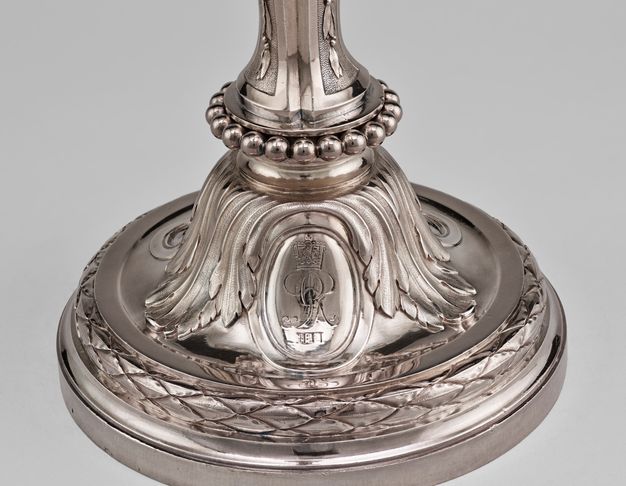
The surface of the base is engraved with the interlaced cipher of “GR III” for George Rex III (King George III), below a stylized British monarch’s crown (inscription 10.1). The threaded iron rod is scratched with the Roman numeral “IV.”
84.DG.42.2
1778–79 and 1781–82
Marks
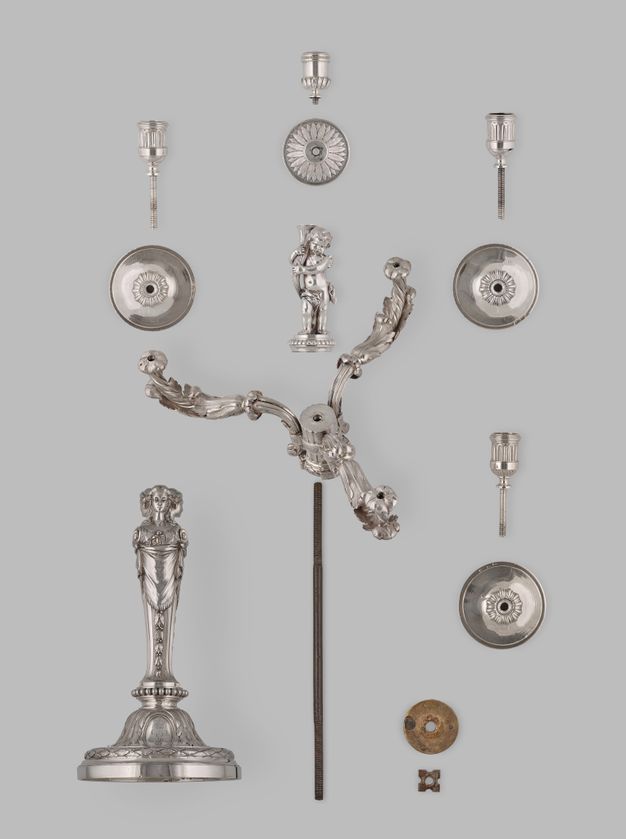
This girandole consists of fourteen individually made parts joined together by one long threaded iron rod, secured with a brass disc and an iron nut, and by a system of shorter threaded silver rods (cats. 10.2 and 10.3).
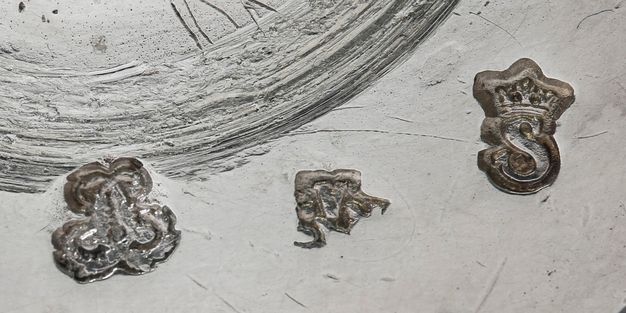
The girandole’s stand, consisting of the foot and central shaft, is struck twice, once on the interior of the foot ring and once underneath the base, with the following stamps: the maker’s mark consisting of the initials “R.J.A.,” a palm branch, and two grains, below a crowned fleur-de-lys; a crowned P (partially struck) (the Paris warden’s mark used between July 18, 1778, and July 21, 1779) (mark 10.7); and the monogram for the city of Paris, “P A R I S” (the Paris charge mark used between September 1, 1775, and April 7, 1781, under the fermier Jean-Baptiste Fouache) (mark 10.8). The stand is struck, on the exterior of the foot ring, with the following stamp: an ewer (the discharge mark used on works destined for export between April 7, 1781, and June 4, 1783) (mark 10.9). The stand is also struck twice, once on the interior foot ring and once on top of a herm head, with the letters “G G” (referring to a Hanoverian inventory of 1800); and twice, once on the exterior of the foot ring and once on a herm head, in its coiffure, with a charançon (weevil) in a rectangle (the mark of 800 parts per thousand, or 80 percent, minimum standard for works imported into France from contracting countries as used since July 1, 1893).
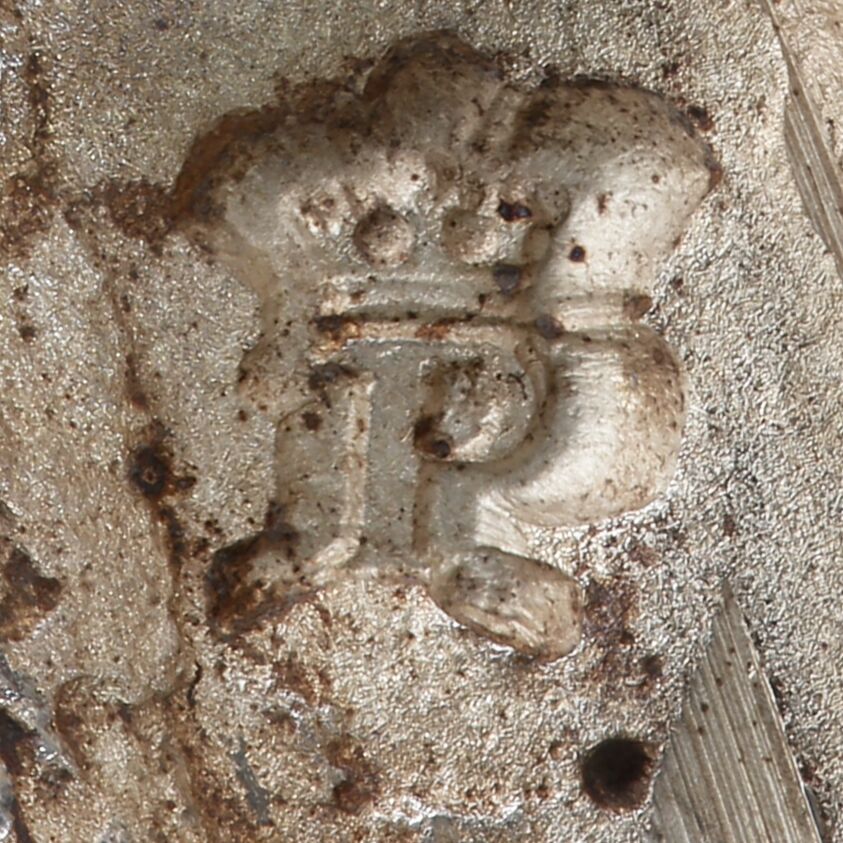
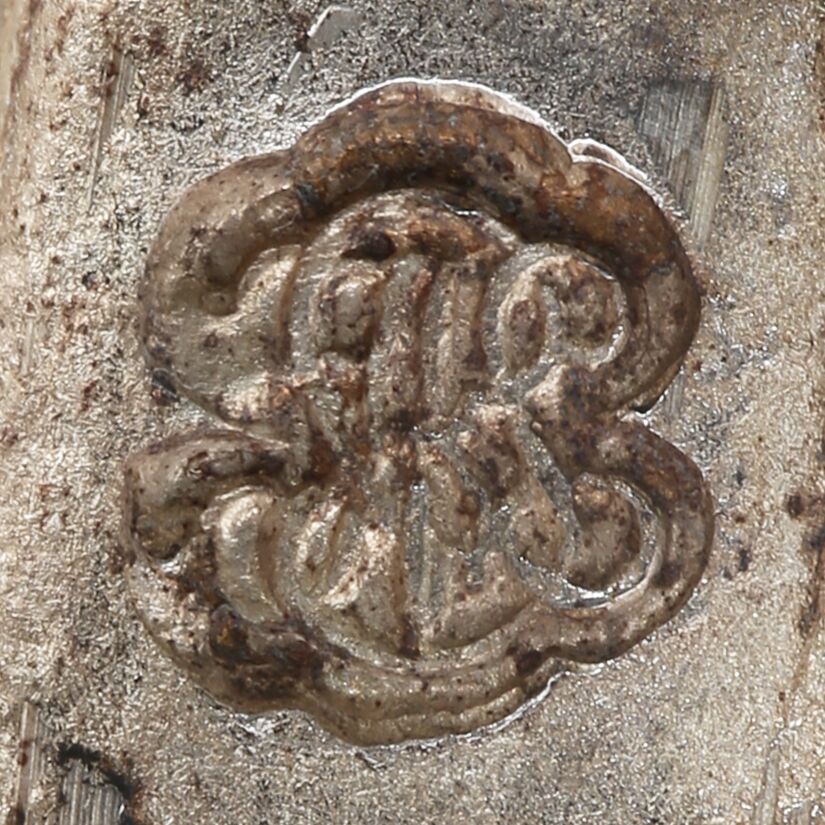
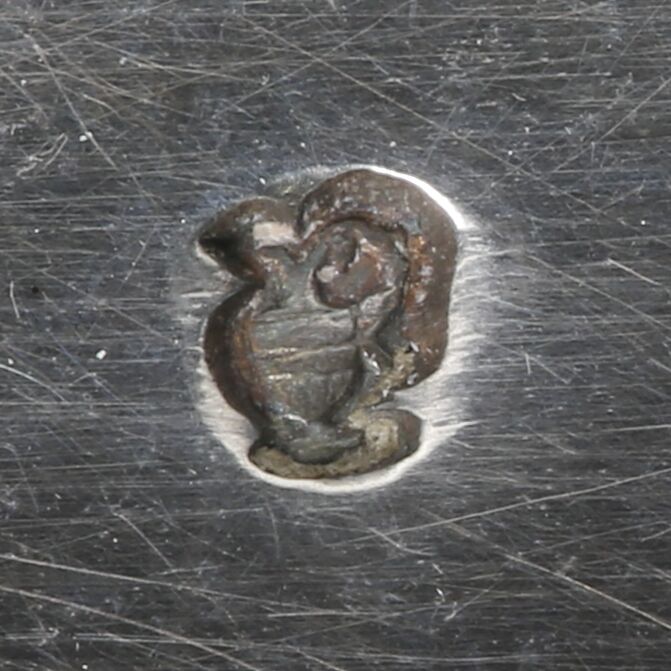
The girandole’s fluted column, from which branch three arms, is struck, underneath, with the following stamps: the maker’s mark consisting of the initials “R.J.A.,” a palm branch, and two grains, below a crowned fleur-de-lys (partially struck) (mark 10.10); a crowned S (the Paris warden’s mark used between August 1, 1781, and July 13, 1782) (mark 10.10); and the cipher of two Ls, facing and interlaced (the Paris charge mark used between April 7, 1781, and June 4, 1783, under the fermier Henry Clavel) (mark 10.10). The fluted column is struck, on the exterior, with the following stamps: an ewer (the Paris discharge mark used on works destined for export between April 7, 1781, and June 4, 1783); and a charançon (weevil) in a rectangle (the mark of 800 parts per thousand, or 80 percent, minimum standard for works imported into France from contracting countries as used since July 1, 1893).
The girandole’s finial, consisting of a column capital and the putto figure holding the central candle branch, is struck twice, once underneath the capital and once on top of the central branch, with the following stamps: the letter G (referring to a Hanoverian inventory of 1800); and a charançon (weevil) in a rectangle (the mark of 800 parts per thousand, or 80 percent, minimum standard for works imported into France from contracting countries as used since July 1, 1893).
The girandole’s four drip pans are each struck, underneath, with the following stamps: the maker’s mark consisting of the initials “R.J.A.,” a palm branch, and two grains, below a crowned fleur-de-lys (partially struck); a crowned S (the Paris warden’s mark used between August 1, 1781, and July 13, 1782) (partially struck); and the cipher of two Ls, facing and interlaced (the Paris charge mark used between April 7, 1781, and June 4, 1783, under the fermier Henry Clavel) (partially struck). The central drip pan is also struck, on the interior of the rim, with the following stamp: an ewer (the Paris discharge mark used on works destined for export between April 7, 1781, and June 4, 1783). The four drip pans are each struck, underneath the central drip pan and on the interior rim of each lateral drip pan, with the following stamp: a charançon (weevil) in a rectangle (the mark of 800 parts per thousand, or 80 percent, minimum standard for works imported into France from contracting countries as used since July 1, 1893).
The central candle cup is also struck, on the interior, with the following stamps: the maker’s mark consisting of the initials “R.J.A.,” a palm branch, and two grains, below a crowned fleur-de-lys (partially struck); a crowned S (the Paris warden’s mark used between August 1, 1781, and July 13, 1782); and the cipher of two Ls, facing and interlaced (the Paris charge mark used between April 7, 1781, and June 4, 1783, under the fermier Henry Clavel) (partially struck). With the putto’s torso as the front of the object, the central candle cup is struck, on the terminus of its threaded rod, with the letter G; and the rear candle cup is partially struck, underneath, with at least four letters “G G G G” (referring to a Hanoverian inventory of 1800). The four candle cups are each struck, underneath the central drip pan and on the interior rim of each lateral drip pan, with a charançon (weevil) in a rectangle (the mark of 800 parts per thousand, or 80 percent, minimum standard for works imported into France from contracting countries as used since July 1, 1893).
Inscriptions
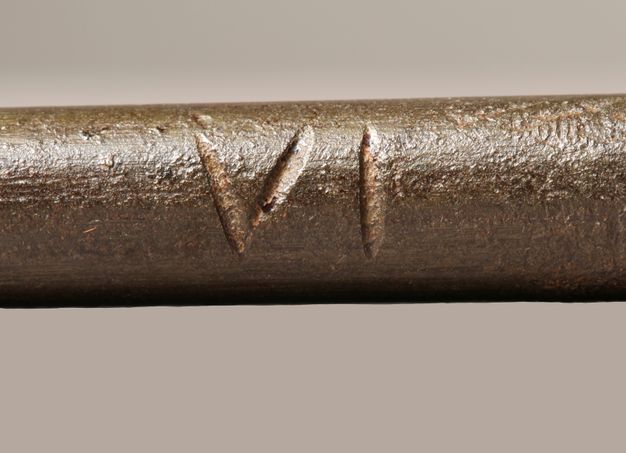
The surface of the base is engraved with the interlaced cipher of “GR III” for George Rex III (King George III), below a stylized British monarch’s crown. The threaded iron rod is scratched with the Roman numeral “VI” (inscription 10.2).
Description
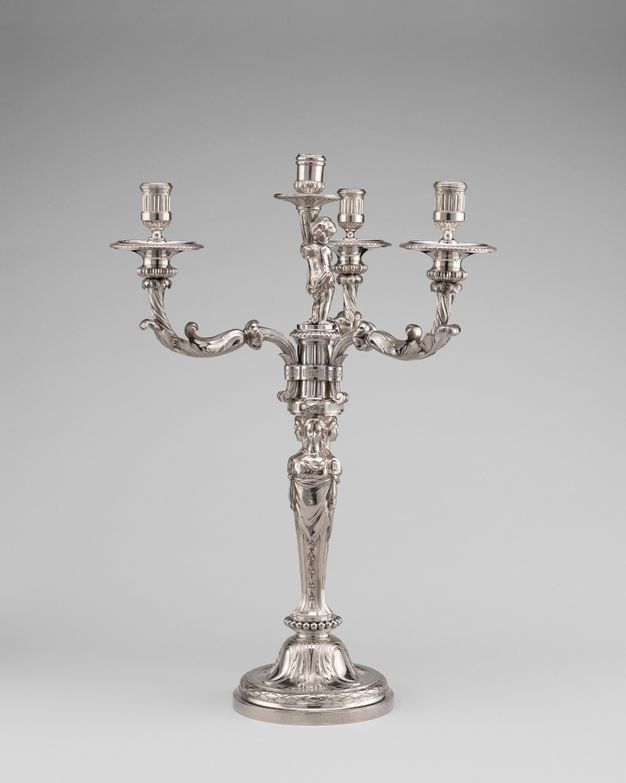
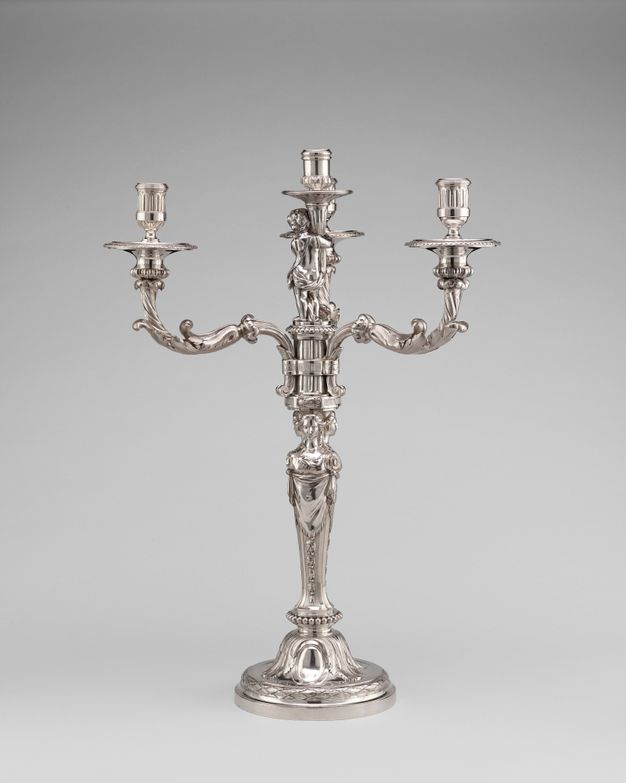
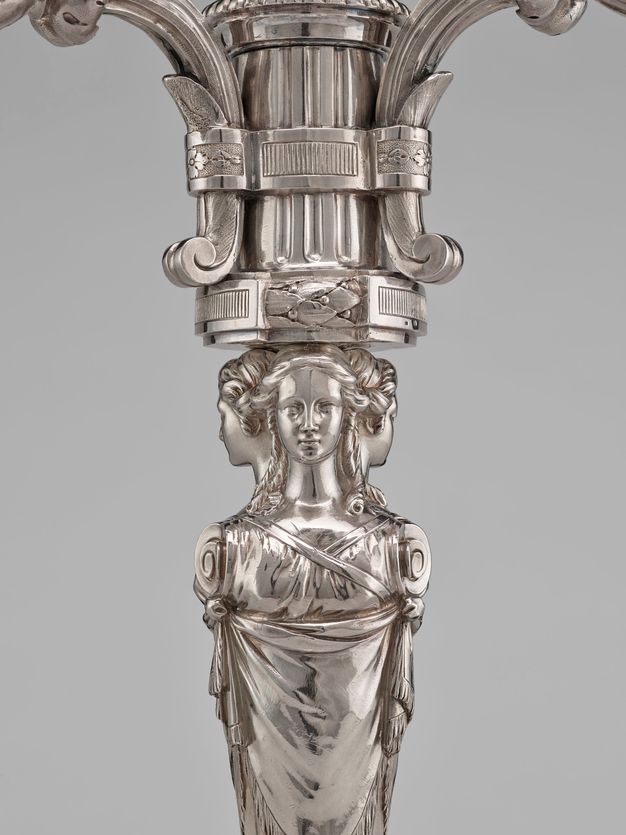
These two three-branch girandoles, in the Neoclassical style, are nearly identical. Each circular base, with a plain burnished foot ring and a quarter-round laurel-wreath molded edge, dips and then swells upward. The bell-shaped swelling is set with three plain burnished ovals, positioned equidistant around the perimeter and separated by finely chased flat acanthus leaves. One oval on each girandole is engraved with the cipher “GR III,” surmounted by a closed crown for George III, king of the United Kingdom of Great Britain and Ireland and king of Hanover (see inscription 10.1).2 The triangular shaft rises from a short baluster encircled by a string of round beads. Each face of the triangular shaft presents an antique herm, whose lower portion is adorned with a vertical festoon of berried laurel before rising up to transform, under the covering of a tasseled shawl, into the chest and head of a sculpted female. The bodice styles of their simple shifts and their facial demeanors are individualized (cat. 10.4). Each idealized face is delicately cast and finished, with downcast or open eyes and long curling locks. Where the shoulders of the three herms touch, short, abbreviated scrolls abut like the scrolls of an Ionic capital. The three herm heads support the suprastructure consisting of a fluted column, from whose encircling bracket branch three arms of scrolling acanthus leaves and twisted fluting. Each arm terminates in a baluster-shaped drip pan, with water-leaf molding along the edge, surmounted by one of two candle cup types: one fluted, banded, and burnished, the other fluted, banded, and ringed with overlapping laurel leaves (cat. 10.5). A putto, possibly representing Zephyr with his butterfly-shaped wings, stands atop each central column and holds the fluted cornucopia-shaped stem of the fourth drip pan surmounted by a banded and fluted candle cup adorned with laurel leaves (cat. 10.6). This cup has a ring of laurel leaves below its plain burnished surface. The overall design of each girandole balances alternating geometric forms upward from the circular base, triangular shaft, central column, three spreading candle arms, to the elevated central drip pan held aloft by the putto.
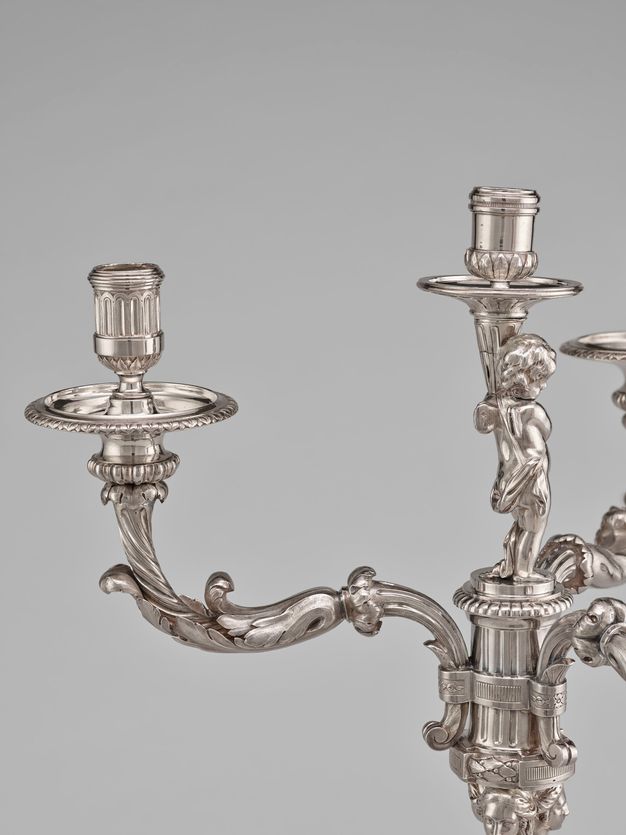
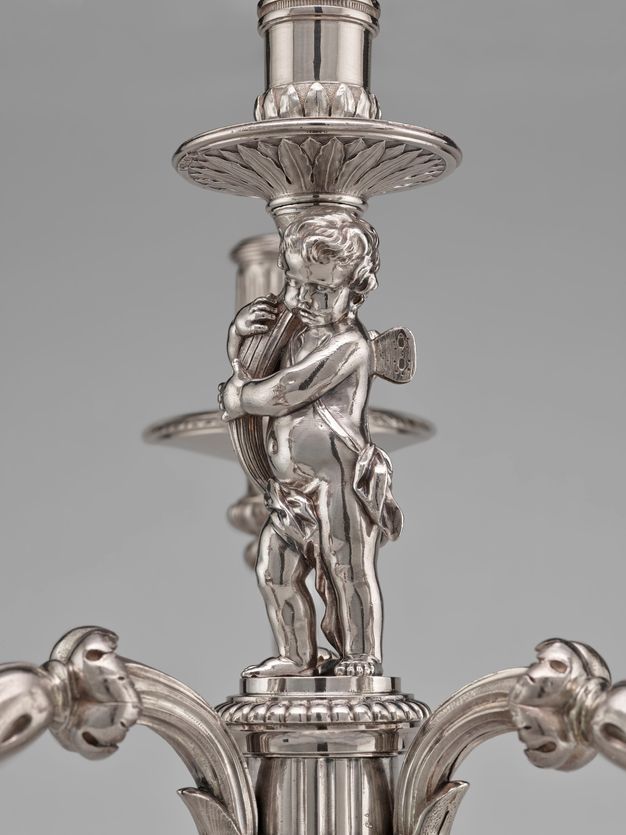
These are sculptural works in the round. Each girandole is an assembly of fourteen separate parts made from cast or sheet silver, with each part individually finished using a combination of techniques: repoussé, chasing, and/or engraving. On top of this count, X-radiography indicates each finial putto is itself composed of nine different hollow or solid cast components soldered together. The circular base and triangular shaft are connected using a collar joint, and then, the remaining parts of the stand are assembled all together by means of a central threaded iron rod, secured with a brass disc and either a brass or iron nut (cat. 10.7). A system of shorter threaded silver rods anchors each candle cup and each drip pan to its corresponding candle branch.3
Commentary
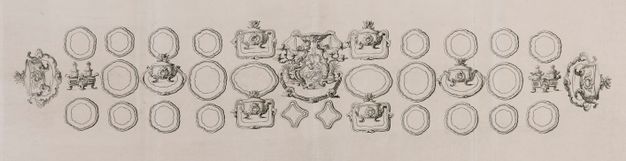
A variety of lighting fixtures illuminated the seventeenth- and eighteenth-century dining room or hall for nocturnal meals and entertainments. Depending on prevailing court or local etiquette, the ceremony or occasion, the size of the room, the dimensions of the table(s), the number of guests, as well as the layout of vessels and place settings, different types of lighting fixtures could grace the dining table itself: centerpieces (surtouts) with multiple candle cups; candlesticks with single or multiple candle cups (flambeaux or chandeliers); smaller tiered, multibranched girandoles; and taller candelabra and girandoles, with multiple candle cups (candélabres and girandoles). Period images and table plans provide visual evidence of these practices.4 Centerpieces, candelabra, and girandoles were centrally or symmetrically positioned (fig. 10.1).5 Candlesticks, with one or two candle cups, however, were typically placed at measured distances along the dining table, to shed light for seated guests and to allow servants to easily exchange vessels and plates throughout the courses of the meal.6 Taller and larger, multibranched candelabra sometimes took their place on the dining table during grander festivities, but generally they stood on buffets or sideboards, where their sculptural forms could be admired (to the esteem of their owner), while their greater illumination aided staff.7
The present girandoles were two of six made by the Parisian goldsmith Robert Joseph Auguste as part of an extensive table service (un service à la française) for George III, Duke of Brunswick-Lüneburg and Prince-Elector of Hanover. The large service was intended for use at the elector’s principal seat of Leineschloss, in Hanover, or at Herrenhausen, the electoral summer residence located north of the city. At the time of their delivery in July 1782, George III ruled the electorate as a principality of the Holy Roman Empire from his seat in Britain, where he lived and simultaneously reigned as king of Great Britain and king of Ireland.8 From this perspective, the silver commission was meant to reflect the status, prestige, and taste of the Hanoverian court and the Brunswick-Lüneburg dynasty of dukes, prince-electors, and kings. In ordering this service, George III chose to follow the prevailing princely fashion for court dining à la française (in the French manner). This manner of dining dictated that all the serving vessels for a course be placed on the table at the same time, from which the seated diners would help themselves. As customs of the day required a bountiful variety of dishes and condiments for each course, multiples of many types of vessels were needed (see fig. 10.1). As described below, the complete table service was impressive. Indeed, guests were dazzled by its magnificence when displayed during a large housewarming festivity, hosted by King George and Queen Charlotte not at Leineschloss or Herrenhausen, but at Windsor Castle in February 1805 (when French troops occupied the Hanoverian territories).
The history of the commission, creation, staggered delivery, and subsequent use of this service was masterfully documented by Lorenz Seelig, and the present summary draws upon his research.9 In 1771 George III, as duke of Brunswick-Lüneburg and prince-elector of Hanover, determined to order a complete silver table service, with lighting fixtures, serving vessels, and seventy-two place settings, for use in the elector’s Hanoverian residences.10 The commission was a matter entirely separate and apart from British affairs of state, so it was not managed by, nor financed through, the British Crown.11 Rather, the Hanoverian lord chamberlain’s office orchestrated the entire process, in concert with the lord chamberlain Heinrich Julius, imperial Baron von Lichtenstein, who was then residing in Vienna. The office reviewed the Hanoverian household silver reserves; assessed the collection and sent old pieces of inferior alloy to be melted down to raise eighty thousand Reichstaler to finance—and liquidate bullion for—the project; and later received the staggered shipments from Paris over a nine-year period as the pieces were completed in 1777–86.12 The lord chamberlain was involved in the call for design proposals, price negotiations, the pace of cash advances, and payments.
At first, design proposals were solicited from the respected local Hanoverian goldsmith Frantz Peter Bundsen and then from an array of reputable international artisans: an unnamed Parisian smith submitted twenty-one drawings that integrated Rococo and antique elements in 1772, the Viennese Würth brothers submitted four or more in the Neoclassical style in 1773, and thirteen drawings came from the Roman Luigi Valadier around the same time.13 Eventually, in 1776, the commission was awarded to the Parisian goldsmith Robert Joseph Auguste, whose creations in the refined Neoclassical style and whose exceptional skills were gaining recognition within France and abroad.14 The decade of 1775–85 would showcase his extraordinary talents and entrepreneurship.
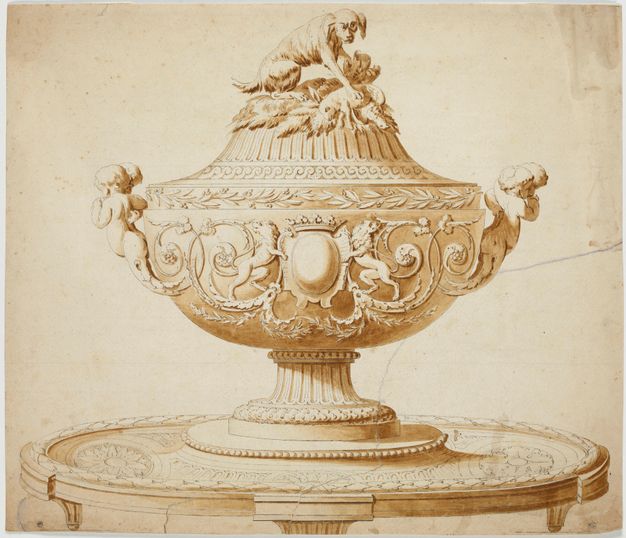
While moving between London and Windsor, George III personally stayed abreast of the design phase of the commission, receiving and commenting upon drawings for the principal vessel shapes and their ornament before granting his approval. Two extant drawings from the Auguste workshop suggest the type of designs that could have been submitted to him. The first was for a round tureen (pot à oille) on an oval stand. The body of its vessel was adorned with a central oval cartouche flanked by rinceaux of thin acanthus leaves, while its handles took the form of entwined putti, whose lower torsos emerged from heavier acanthus leaves (fig. 10.2).15 These distinctive features, as well other geometric details from the stand and the lid (but not its finial), corresponded to a pair of tureens delivered to Hanover in 1782.16 Another drawing attributed to the Auguste workshop showed the design for the service’s sauceboat and stand (saucière).17
After some time settling matters of style with his elite patron, Auguste began production in 1776 and made his first delivery of wine-bottle coolers, glass coolers, and cruets for oil and vinegar in 1777. Following a down payment of 20,000 livres, he received 10,000 livres each year to purchase bullion. And, in turn, he made four more staggered deliveries through 1786. As his workshop was simultaneously producing four other large table services from 1776 to 1783 destined for Russian imperial governors serving under Catherine II, Auguste subcontracted some of the Hanoverian pieces from fellow Parisian goldsmiths: Antoine Boullier made eight double salts (salières), Claude Auguste Aubrey provided cutlery (couverts de table), and Martin Langlois crafted ladles (louches) for tureens.18
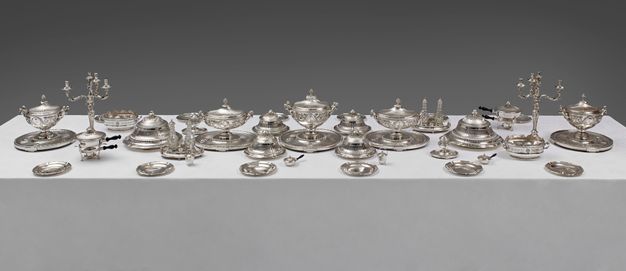
The service for George III comprised girandoles (girandoles), candlesticks (flambeaux), wine-bottle coolers (rafraîchissors), glass coolers (verrières), ice pails (seaux à glace), lidded tureens with liners, on stands (pots à oille and soupiers couverts, doublures et présentoirs), covered meat dishes (cloches or couvre-plats), sauceboats (saucières), oil and vinegar cruets (huiliers-vinaigriers), salts and peppers (salières and poivriers), mustard pots (moutardiers), dishes (plats), plates (assiettes), cutlery (couverts de table), and serving utensils such as ladles (louches). When inventoried in Hanover in 1789, the service had more than 336 Parisian pieces, weighing a total of 1,754 marcs (428 kilograms) at the cost of 131,804 livres (91,226 livres for the bullion, plus 40,578 livres for the labor), excluding export tax and shipping costs.19 The service remained in the possession of the Brunswick-Lüneburg dynasty until sold in 1923 and dispersed in 1924. A subset of seventy-six pieces purchased at that time by Louis Cartier later passed onto the art market in 1979.20 Another large subset has also been divided. Twenty-three pieces from a private French collection entered the Musée du Louvre in 1975, followed by two more in 2011 and twenty more since (fig. 10.3).21 Additionally, at least thirty-three pieces are on view at Waddesdon Manor, Buckinghamshire, an English country house and estate belonging now to the National Trust of England, Wales, and Northern Ireland and managed by the Rothschild Foundation.22
Seelig transcribed the bilingual Hanoverian inventory of 1800 itemizing the Auguste service, where it was identified as “Service A” to distinguish it from supplemental additions delivered by other goldsmiths from within the Holy Roman Empire.23 The group of six Auguste girandoles reached Hanover in two deliveries—two girandoles in about 1778 and four in July 1782.24 Included in the latter were the two Getty examples.25 The entry described the six as:
A: 6 girandoles of which two have 4 and four have 3 candles [meaning three candle branches] … 2 examples: second delivery, combined weight of 37 marcs 7 onces, material cost 519 Reichs Taler 26 Groschen 2 Pfennige, fashioning cost [labor] 1800 l[ivres] or 475 Reichs Taler; 4 examples: third delivery, combined weight of 74 marcs 5 onces 1 gros, material cost 1024 Reichs Taler 8 Groschen 3 3/4 Pfennige, fashioning cost [labor] 3600 l[ivres] or 925 Reichs Taler.26
It seems the inventory identified the Getty girandole model by the number of its three candle branches, rather than the actual number of candle cups. The wording of the inventory is ambiguous, but, assuming the four girandoles with three candle branches each were those tallied as the “4 examples” of the third delivery, then the combined weight of these four, recorded in French units of marc, once, and gros, equated to 18,268.516 grams, or about 4,567.129 grams each, on average, at the cost of 900 livres each for labor.27
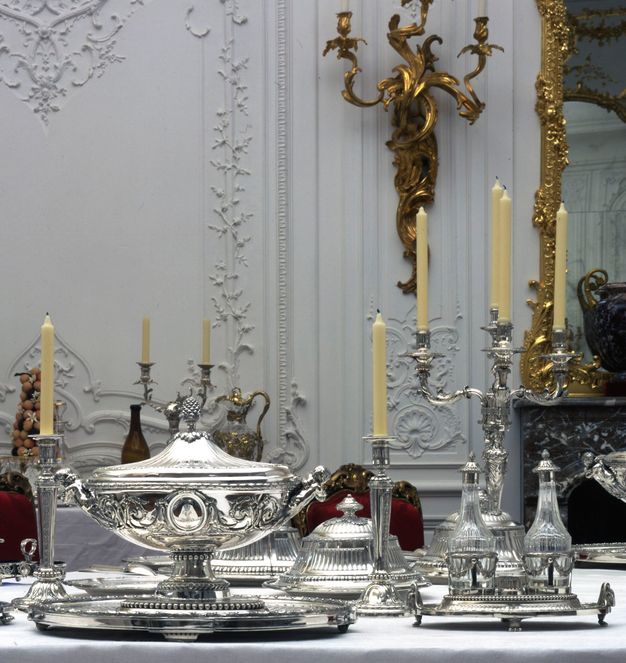
Once Auguste’s shipments reached Hanover, the palace governor commissioned the local goldsmith Frantz Peter Bundsen to make duplicates using a standard of bullion equivalent to the French (958.1 parts per thousand pure silver, or 95.8 percent—a percentage that was higher than the prevailing Hanoverian standard of 750 parts per thousand). In all, Bundsen augmented the service with some 260 pieces through 1790. More than ten dozen are at Waddesdon Manor, many displayed in a room with a dining table and side tables set with the Auguste companion wares (fig. 10.4).28 In regard to the four replica girandoles Bundsen produced in 1781–82 after the Auguste model, they were faithfully rendered but subtly different. Their finishing is not as soft nor as finely chased, most notably in the female herms, whose faces are narrower and their features stiffer.29 Other Bundsen pieces from this service have passed through the art market.30
While the service remained in Hanover, its presence came to represent George III in absentia, as he never visited the Hanoverian territories. But for the invasion and occupation of the electorate by Napoleonic forces from 1803 to 1813, he may never have seen the service in person. As recounted by Gordon and Philippa Glanville, that interlude caused the service to be brought temporarily into the United Kingdom.31 In direct contravention of the Treaty of Sulingen, signed June 3, 1803, the elector’s prize studs, carriages, and valuables were evacuated rather than surrendered as stipulated. Fifty-three horses and thirty grooms reached London on naval transports on September 23. The silver and other valuables took a longer route, via the Baltic Sea to Saint Petersburg, where they were received by the Hanoverian ambassador extraordinary to the court of Czar Alexander I. From there, seventy cases of plate and linen and five casks of coins were brought to London on board a British frigate and then dispatched up the Thames River, reaching Windsor on December 5, 1803.32
Some fourteen months later, a lady-in-waiting to Queen Charlotte mentioned the Hanoverian plate in regard to its display during an upcoming housewarming fete at Windsor Castle, planned for February 25, 1805: “There is also the magnificent plate which was brought over from Hanover, consisting of … 30 tureens, 50 dozen of plate, silver drums and many other articles.”33 The Gentleman’s Magazine reported on the event:
This evening their Majesties gave a most magnificent entertainment at Windsor-castle. It has been in contemplation since they first went to reside in the Castle: when his Majesty was determined to have what is generally termed, among good old English customs, a house-warming; and, to give it in the grandeur of a King, we attest, that the expenditure cannot cost less than 50,000 £.… During the time Mr [James] Wyatt was fitting up the rooms, his Majesty had the entertainment in mind, and he gave directions accordingly; and, for months past, Mr. Gilbert, the silversmith, has been preparing [cleaning] a new service of plate, valued, we understand, at between 20,000 and 30,000 £.; the whole service of plate displayed this night, was supposed to be the most magnificent in Europe.34
The service returned to Hanover around 1814, when the territory was restored to the dukes of Brunswick-Lüneburg and elevated to a kingdom. In advance of King George IV’s state visit in 1821, the service was extended according to the new mode of dining à la russe (in the Russian manner), in which servants brought at each course, in synchronized choreography, a plate filled with an individual serving of food to each seated diner. Local goldsmiths Franz Anton Hans Nübell and Johann Christian Peter Neuthard created more dishes, plates, and cutlery for this purpose, consistent in form and ornament to the Auguste table wares.35 Subsequently, in 1841, at the instruction of Ernest Augustus, Duke of Brunswick-Lüneburg and King of Hanover, every piece of the service was engraved with the cipher of his father, “GRIII,” surmounted by a king’s crown.36 The service descended through the family, even after the dissolution of the kingdom in 1866 and its annexation to Prussia. Eventually, his grandson Ernest Augustus, Duke of Brunswick-Lüneburg and Crown Prince of Hanover, sold it before his death in 1923.
Stylistically, the earlier repertoire of Robert Joseph Auguste’s oeuvre informed the design possibilities he offered George III and influenced the final appearance of the Hanoverian service. This is evidenced by the service he delivered in 1776 to Gustav Philip, comte de Creutz, Swedish ambassador to France 1766–83.37 In keeping with an ambassador’s Parisian table, it was a smaller service, composed of two tureens and two pots à oille, each with its own stand, twelve candlesticks, two sauceboats, and twelve salts (subcontracted to Antoine Boullier), plates, and cutlery. King Gustav III purchased the set, considered exceptionally refined yet sumptuous, from the comte de Creutz in 1781 for 34,400 livres for his own use in Stockholm. It survives today divided between the Swedish Royal Collection and the Swedish Ministry of Foreign Affairs.38 Its shapes, motifs, and ornament were quoted and repurposed in the service of George III. The Creutz candlestick shafts, for instance, have busts of three females, whose shoulders are joined to one another as scrolls, heralding their bolder evolution in the later three-branch girandoles of George III.39 In this latter iteration for George III, the subtle chasing of fine details is extraordinary.
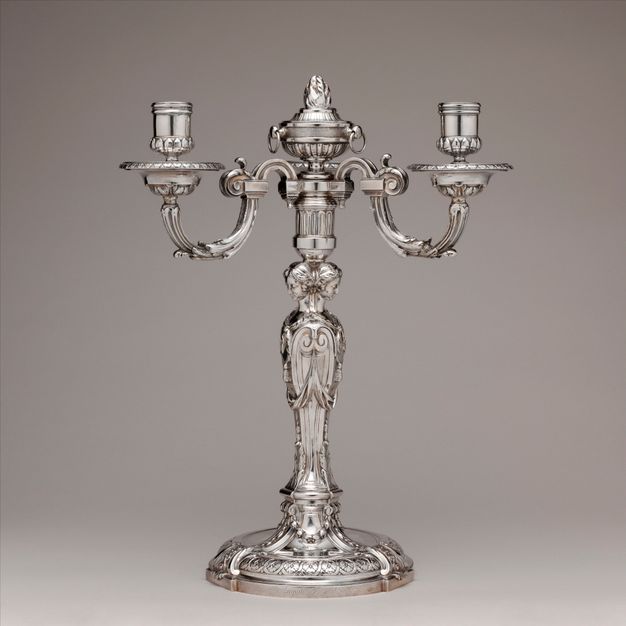
The de Creutz candlesticks were not the first commission for which Auguste incorporated the idealized heads of three female herms into the design of his lighting fixtures. In fact, they were a recurring feature in his works since at least 1767–68, when he fashioned a three-branch candelabrum that he signed “Auguste F. à Paris” on its foot and “Auguste” on one branch (fig. 10.5).40 Yves Carlier has reasoned that when a goldsmith signed his work as “F[ecit],” it signaled his role as designer-creator (with copyright) rather than simply maker.41 Indeed, one could say the female herms were an identifiable “signature” of Auguste, even across mediums, as an entry in the 1776 posthumous sale catalogue of Augustin Blondel de Gagny described a pair of three-branch wall lights, of gilt bronze, as “very well executed, & of the composition of M. Auguste, the body of each represents a female herm.”42 A later drawing attributed to the Auguste workshop showed a further evolution, wherein the shaft of that three-branch girandole was composed of three full-length female figures in the round. They support a short fluted column, on which stand two winged putti, one of them grasping the stem of the central drip pan and candle socket.43
Given that the threaded iron rods joining together the component parts of the Getty’s two girandoles are numbered “IV” and “VI,” respectively, it seems Auguste’s six girandoles were conceived as a set, even though their production and delivery spanned five years (see inscription 10.2). This could explain why the stand of one girandole (84.DG.42.2) bears the Paris warden’s mark of 1778–79, while its associated components bear the Paris warden’s mark of 1781–82. Alternatively, the component parts of all six girandoles could have been interchanged during their long history of use and changes of venue.44 A comprehensive survey and analysis of all the girandoles in this service would help to clarify the presence of those component parts without maker’s or warden’s marks in the Getty’s pieces, including both finial putto figures and all six lateral candle cups. One finial and two lateral candle cups, though, do have marks corresponding to the Hanoverian inventory of 1800, signifying that they had been made by that date.45 And X-ray fluorescence indicates the silver alloy of both putto finials is consistent, suggesting they were made within the same workshop, even if only one (84.DG.42.2) bears the inventory mark of 1800 (see Appendix: Table 1).
Provenance
By 1782–1820: George III, King of Great Britain and Ireland, Duke of Brunswick-Lüneburg and Prince-Elector, then King, of Hanover, British/German, 1738–1820 (as part of a large table service for use at Leineschloss or Herrenhausen Palace, Hanover, though the service was in London and Windsor from December 1803 to about 1814), by inheritance to his son, George IV; 1820–30: George IV, King of the United Kingdom of Great Britain and Ireland, and of Hanover, British/German, 1762–1830 (Leineschloss or Herrenhausen Palace, Hanover), by inheritance to his brother, William IV; 1830–37: William IV, King of the United Kingdom of Great Britain and Ireland, and of Hanover, British/German, 1765–1837 (Leineschloss or Herrenhausen Palace, Hanover), by inheritance to his brother, Ernest Augustus, first Duke of Cumberland and Teviotdale; 1837–51: Ernest Augustus, first Duke of Cumberland and Teviotdale, Duke of Brunswick-Lüneburg, and King of Hanover, British/German, 1771–1851 (Leineschloss or Herrenhausen Palace, Hanover), by inheritance to his son, George V, second Duke of Cumberland and Teviotdale; 1851–78: George V, second Duke of Cumberland and Teviotdale, Duke of Brunswick-Lüneburg, and King of Hanover, British/German, 1819–1878 (Leineschloss or Herrenhausen Palace, Hanover, then moved to Gmunden, Austria, in 1866, when George V was deposed, and to London in 1876), by inheritance to his son, Ernest Augustus, third Duke of Cumberland and Teviotdale;46 1878–1923: Ernest Augustus, third Duke of Cumberland and Teviotdale, Duke of Brunswick-Lüneburg, Prince of the United Kingdom of Great Britain and Ireland, and Crown Prince of Hanover, British/German, 1845–1923, sold to the Viennese dealer J. Glückselig und Sohn, 1923; 1923–24: J. Glückselig und Sohn, Austrian, 1911–38 (Stallburggasse 2, Vienna), sold to Crichton Brothers, London, 1924; 1924: Crichton Brothers, British, ca. 1890–ca. 1954 (22 Old Bond Street, London); 1924–42: Louis Cartier, French, 1875–1942 (London), by inheritance to his son, Claude Cartier (ca. 1940–47 in the possession of an unidentified thief and recovered by Claude Cartier);47 1942–75: Claude Cartier, French, 1925–1975 (London and Paris) [sold after his death, Sotheby Parke Bernet Monaco S.A., Monte Carlo, November 27, 1979, lot 824, with another pair of matching girandoles, to his daughter Véronique Cartier];48 1979–84: Véronique Cartier, French, 1936–2014 (Paris), sold to the J. Paul Getty Museum through her cousin Riccardo Salmona, 1984.
Exhibition History
Exposition d’orfèvrerie française civile du XVIe siècle au début du XIXe, Musée des arts décoratifs (Paris), April 12–May 12, 1926 (possibly no. 144, lent by Cartier Ltd., London).49
Bibliography
Exposition d’orfèvrerie française civile du XVIe siècle au début du XIXe. Exh. cat. Paris: Le Musée, 1926., 24, possibly no. 144 (lent by Cartier Ltd., London); “Stolen! Information Wanted.” The Connoisseur CXVII, no. 500 (June 1946): xxxiv–xxxv., xxxiv–xxxv; Frégnac, Claude. Les grands orfèvres de Louis XIII à Charles X: Collection connaissance des arts “Grands artisans d’autrefois.” Paris: Hachette, 1965., 240–41; Très bel ensemble de meubles, tableaux et dessins anciens principalement du XVIIIe siècle, importante argenterie européenne, porcelains de Saxe et de la Chine, succession de Monsieur Claude Cartier, provenant de la collection de ses parents Monsieur at Madame Louis Cartier, sale cat., Sotheby Parke Bernet Monaco S.A., Monte Carlo, November 25–27, 1979: 159, lot 824, “Magnifique ensemble de quatre candélabres” (two of four); “Acquisitions/1984,” with an introduction by John Walsh. The J. Paul Getty Museum Journal 13 (1985): 157–258., 182, no. 63; French Silver in the J. Paul Getty Museum, exh. brochure (Malibu, CA: J. Paul Getty Museum, 1988), 3–4, fig. 3; Bremer-David, Charissa, with Peggy Fogelman, Peter Fusco, and Catherine Hess. Decorative Arts: An Illustrated Summary Catalogue of the Collections of the J. Paul Getty Museum. Malibu, CA: J. Paul Getty Museum, 1993. http://www.getty.edu/publications/virtuallibrary/0892362219.html., 116, no. 193; Arminjon, Catherine. “Les services royaux conservés.” In Versailles et les tables royales en Europe XVIIème–XIXème siècles, edited by Jean-Pierre Babelon, Zeev Gouranier, Catherine Arminjin, Béatrix Saule et al., 232–39. Exh. cat. Paris: Réunion des musées nationaux, 1993., 238–39nn46–47; Carlier, Yves. “Angleterre: Le service d’orfèvrerie de George III d’Angleterre.” In Versailles et les tables royales en Europe XVIIème–XIXème siècles, edited by Jean-Pierre Babelon, Zeev Gouranier, Catherine Arminjin, Béatrix Saule et al., 330–33. Exh. cat. Paris: Réunion des musées nationaux, 1993., 330–31; Wilson, Gillian, and Catherine Hess. Summary Catalogue of European Decorative Arts in the J. Paul Getty Museum. Los Angeles: J. Paul Getty Museum, 2001. http://www.getty.edu/publications/virtuallibrary/089236632X.html., 99, no. 199; Seelig, Lorenz. “Das Silberservice König Georgs III. von Robert-Joseph Auguste und Frantz-Peter Bundsen: Zur Goldschmiedekunst des frühen Klassizismus in Paris, London und Hannover.” Münchner Jahrbuch der bildenden Kunst, 3rd series, LVIII (2007): 141–207., 141–207, 177, no. 18bis, 193n329, and 199–200, no. 28; Seelig, Lorenz. “The Dinner Service Made for George III by Robert-Joseph Auguste and Frantz-Peter Bundsen: Neo-Classical Goldsmith’s Work in Paris, London, and Hanover.” Translated by Dorothea Burstyn and William P. Hood, Jr. Silver Society of Canada Journal 13 (2010): 44–91.; Glanville, Philippa. “‘Curiously Enchased’: Goldsmiths and Diplomats in Baroque Europe.” In The International Fine Art and Antique Dealers Show, the Park Avenue Armory, New York 2010, 17–29. London: Houghton International, 2010., 28–29; Seelig, Lorenz. “The Dinner Service Made for George III by Robert-Joseph Auguste and Frantz-Peter Bundsen: Neo-Classical Goldsmith’s Work in Paris, London, and Hanover.” Translated by Dorothea Burstyn and William P. Hood, Jr. Silver Studies: The Journal of the Silver Society 28 (2012): 76–100..
Notes
-
Seelig, Lorenz. “Das Silberservice König Georgs III. von Robert-Joseph Auguste und Frantz-Peter Bundsen: Zur Goldschmiedekunst des frühen Klassizismus in Paris, London und Hannover.” Münchner Jahrbuch der bildenden Kunst, 3rd series, LVIII (2007): 141–207., 200, no. 44; Seelig, Lorenz. “The Dinner Service Made for George III by Robert-Joseph Auguste and Frantz-Peter Bundsen: Neo-Classical Goldsmith’s Work in Paris, London, and Hanover.” Translated by Dorothea Burstyn and William P. Hood, Jr. Silver Society of Canada Journal 13 (2010): 44–91., 68. ↩︎
-
The engraved ciphers were added in 1841 by Johann Carl Matthias, during the rule of George III’s son, Ernest Augustus, Duke of Brunswick-Lüneburg and King of Hanover (Seelig, Lorenz. “Das Silberservice König Georgs III. von Robert-Joseph Auguste und Frantz-Peter Bundsen: Zur Goldschmiedekunst des frühen Klassizismus in Paris, London und Hannover.” Münchner Jahrbuch der bildenden Kunst, 3rd series, LVIII (2007): 141–207., 174, 192–93nn315–17). ↩︎
-
This summary derives from the analysis in Technical Report, September 6, 2021, updated October 4, 2021, by Julie Wolfe, Decorative Arts and Sculpture Conservation, J. Paul Getty Museum. ↩︎
-
For surveys of contemporary paintings, prints, and table plans, see Babelon, Jean-Pierre, Zeev Gouranier, Catherine Arminjon, Béatrix Saule, et al., eds. Versailles et les tables royales en Europe XVIIème–XIXème siècles. Exh. cat. Paris: Réunion des musées nationaux, 1993.; Ottomeyer, Hans, and Michaela Völkel, eds. Die Öffentliche Tafel: Tafelzeremoniell in Europa 1300–1990. Exh. cat. Berlin: Deutsches Historisches Museum; Wolfratshausen, Germany: Edition Minerva Hermann Farnung, 2002.; and Koeppe, Wolfram. Vienna Circa 1780: An Imperial Silver Service Rediscovered. Exh. cat. New York: Metropolitan Museum of Art; New Haven, CT: Yale University Press, 2010.. ↩︎
-
For a mid-eighteenth-century Augsburg table, set with a centerpiece with candle cups, see the Table Plan for a First Course Setting, Augsburg, Städtische Kunstsammlungen, Graphische Sammlung, inv. Gr. 24934, (see fig. 10.1); Seelig, Lorenz. “Der schöne Schatz: Tafelsilber als Staatsvermögen. Bestellung, Lieferung und Einschmelzung süddeutscher Tafelservice des 18. Jahrhunderts.” In Die Öffentliche Tafel: Tafelzeremoniell in Europa 1300–1990, edited by Hans Ottomeyer and Michaela Völkel, 102–9. Exh. cat. Berlin: Deutsches Historisches Museum; Wolfratshausen, Germany: Edition Minerva Hermann Farnung, 2002., 103. On the positioning of the smaller girandoles, see the engraving Repas présenté au roi et aux princes de sa cour à l’Hôtel de Ville, from the Almanach pour l’année 1730, Musée Carnavalet, Histoire de Paris, inv. G. 13992, https://www.parismuseescollections.paris.fr/fr/musee-carnavalet/oeuvres/almanach-pour-l-annee-1730-repas-presente-au-roi-et-aux-princes-de-sa-cour. Luxurious versions of these smaller girandoles were strung with pendant drops of glass, crystal, or hardstone, such as the pair in the J. Paul Getty Museum, inv. 85.DF.382.1–2, https://www.getty.edu/art/collection/object/103SKB. ↩︎
-
A notable example of a nocturnal intimate court meal, with candlesticks only, shows the Swedish King Gustav III and his family at supper. Pehr Hilleström, Repas public: Le jour de l’an 1779, Stockholm Nationalmuseum Drottningholm, inv. NMD 499, reproduced in Babelon, Jean-Pierre, Zeev Gouranier, Catherine Arminjon, Béatrix Saule, et al., eds. Versailles et les tables royales en Europe XVIIème–XIXème siècles. Exh. cat. Paris: Réunion des musées nationaux, 1993., 181, 301, no. 142 (entry by Bo Vahlne). This painting is contemporary with the girandoles of this entry, which were part of the 1776 commission of George III, Duke of Brunswick-Lüneburg and Prince-Elector of Hanover, from Robert Joseph Auguste. ↩︎
-
For an image of candelabra on the dining tables during the March 8, 1742, coronation banquet of Empress Maria Amalia in Frankfurt City Hall, see the colored engraving by Johannes Georg Funck and Michael Rößler in the Historical Museum, Frankfurt am Main, inv. C 1149. For girandoles on buffets, see the display in the Hôtel de Ville, Paris, of February 23 and 28, 1745, celebrating the first marriage of the dauphin, as drawn by François Blondel, Buffet de la salle de bal à l’Hôtel de Ville à l’occasion de premier marriage du dauphin, Musée Carnavalet, Histoire de Paris, inv. D5925, https://www.parismuseescollections.paris.fr/fr/musee-carnavalet/oeuvres/buffet-de-la-salle-de-bal-a-l-hotel-de-ville-a-l-occasion-du-premier. ↩︎
-
The Hanoverian branch of the Brunswick-Lüneburg dynasty ruled the electorate of Hanover and, from 1714, also ruled the Kingdom of Great Britain and the Kingdom of Ireland in personal union under George I and his heirs. When the kingdoms of Great Britain and Ireland were united in 1801, George III became king of the United Kingdom of Great Britain and Ireland. Following the 1814 Congress of Vienna, the Kingdom of Hanover succeeded the former electorate. The personal union of Hanover with the United Kingdom ended in 1837, when Victoria ascended the British throne and her uncle Ernest Augustus ascended the Hanoverian throne. ↩︎
-
Seelig, Lorenz. “Das Silberservice König Georgs III. von Robert-Joseph Auguste und Frantz-Peter Bundsen: Zur Goldschmiedekunst des frühen Klassizismus in Paris, London und Hannover.” Münchner Jahrbuch der bildenden Kunst, 3rd series, LVIII (2007): 141–207.; Seelig, Lorenz. “The Dinner Service Made for George III by Robert-Joseph Auguste and Frantz-Peter Bundsen: Neo-Classical Goldsmith’s Work in Paris, London, and Hanover.” Translated by Dorothea Burstyn and William P. Hood, Jr. Silver Society of Canada Journal 13 (2010): 44–91.; Seelig, Lorenz. “The Dinner Service Made for George III by Robert-Joseph Auguste and Frantz-Peter Bundsen: Neo-Classical Goldsmith’s Work in Paris, London, and Hanover.” Translated by Dorothea Burstyn and William P. Hood, Jr. Silver Studies: The Journal of the Silver Society 28 (2012): 76–100.. ↩︎
-
Regarding earlier Hanoverian court commissions of silver, see the precedents set by the Brunswick dynasty of dukes, prince-electors, and kings, George I and George II, great-grandfather and grandfather, respectively, of George III, as described in Alcorn, Ellenor M. “‘A Chandelier for the King’: William Kent, George II, and Hanover.” Burlington Magazine 139, no. 1126 (January 1997): 40–43.; Alcorn, Ellenor M., with contributions from Thomas Sinsteden. English Silver in the Museum of Fine Arts, Boston. Vol. 2, Silver from 1697, Including Irish and Scottish Silver. Boston: MFA Publications, a division of the Museum of Fine Arts, Boston, 2000., 72–75; and Koeppe, Wolfram. “Setting the Standard: Forging a Culture of Magnificence. Marvels, Wonders, and Their Offspring.” In Making Marvels: Science and Splendor at the Courts of Europe, 15–31. Exh. cat. New York: Metropolitan Museum of Art, 2019., 30–31, nos. 6–7 (especially the grand pair of fountains and basins on loan to the Metropolitan Museum of Art, New York, inv. L.2016.38.1–4, https://www.metmuseum.org/art/collection/search?q=L.2016.38). Silver also entered the collection through tributes and gifts. For instance, the city of Celle presented the Hanoverian court with a pair of large, five-branch girandoles as tribute. Seelig surmised they may have been intended for the dining table (Seelig, Lorenz. “Der schöne Schatz: Tafelsilber als Staatsvermögen. Bestellung, Lieferung und Einschmelzung süddeutscher Tafelservice des 18. Jahrhunderts.” In Die Öffentliche Tafel: Tafelzeremoniell in Europa 1300–1990, edited by Hans Ottomeyer and Michaela Völkel, 102–9. Exh. cat. Berlin: Deutsches Historisches Museum; Wolfratshausen, Germany: Edition Minerva Hermann Farnung, 2002., 109n72). See Hanover, Niedersäschsisches Landesarchiv-Hauptstaatsarchiv Hannover NLA-HstAH, Dep. 103, IV, fols. 174–75. ↩︎
-
As prince-elector of Hanover from 1760 to 1814, George III’s rule of the local electoral privy council was coordinated through the Hanoverian chancery in London, which operated from two rooms in Saint James’s Palace, London. In 1814, after the Congress of Vienna, George III ruled as king of Hanover. ↩︎
-
Hanover, Niedersäschsisches Landesarchiv-Hauptstaatsarchiv Hannover NLA-HstAH, Dep. 103, IV, fol. 196. A letter of January 22, 1773, from George III¸ as Duke of Brunswick-Luneberg, explained the funding plan:
We have decided to make a change regarding our Hanoverian court silver and to give old and unusable silver of about 80,000 Reichs Taler to Our “Rent-Cammer” to be partly minted/coined partly melted into ingots and sold … in order to acquire a complete “neu faconiertes” [new fashion] dinner service made out of further old silver while the costs for making should be payed from the interest.
This translation is quoted from Works of Art from the Royal House of Hanover / Kunstwerke des Königlichen Hauses Hannover, 3 vols., sale cat., Sotheby’s Deutschland, Hanover, Schloss Marienburg, October 5–15, 2005: vol. 2, lot 1191, “A set of four German 15 Lot standard silver shaped circular serving dishes with the cypher of George III king of Great Britain, Ireland and later king of Hanover.” Lorenz Seelig cited the document but did not transcribe it. He did, however, discuss an even earlier decision of July 1768, when George III authorized the melt-down of 540 Cologne Marks of old 12 Lot silver from the Hanoverian Silberkammer. On the value and weight of the Cologne Mark, see “Notes to the Reader II: Historic Units of Measure and Currency,” in this volume. See also Seelig, Lorenz. “Das Silberservice König Georgs III. von Robert-Joseph Auguste und Frantz-Peter Bundsen: Zur Goldschmiedekunst des frühen Klassizismus in Paris, London und Hannover.” Münchner Jahrbuch der bildenden Kunst, 3rd series, LVIII (2007): 141–207., 143, 179n25, and Seelig, Lorenz. “The Dinner Service Made for George III by Robert-Joseph Auguste and Frantz-Peter Bundsen: Neo-Classical Goldsmith’s Work in Paris, London, and Hanover.” Translated by Dorothea Burstyn and William P. Hood, Jr. Silver Studies: The Journal of the Silver Society 28 (2012): 76–100., 76n3, 77. ↩︎
-
The general consensus among scholars is that François Thomas Germain may have been the unidentified Parisian goldsmith who submitted drawings with a combination of Rococo and antique motifs (Seelig, Lorenz. “The Dinner Service Made for George III by Robert-Joseph Auguste and Frantz-Peter Bundsen: Neo-Classical Goldsmith’s Work in Paris, London, and Hanover.” Translated by Dorothea Burstyn and William P. Hood, Jr. Silver Society of Canada Journal 13 (2010): 44–91., 56–58, 66nn7–8). On drawings from the brothers Ignaz Joseph and Ignaz Sebastian Würth as well as Luigi Valadier, see Koeppe, Wolfram. Vienna Circa 1780: An Imperial Silver Service Rediscovered. Exh. cat. New York: Metropolitan Museum of Art; New Haven, CT: Yale University Press, 2010., 16–17, 20, 38, 84nn74–76, 78–82. On Valadier, see González-Palacios, Alvar. Luigi Valadier. New York: Frick Collection; London: D. Giles Limited, 2018., 37–38, 39nn20–21, 71–93, 120nn30–40. ↩︎
-
It is surmised that George III may have been introduced to the work of Auguste while visiting Stanton Harcourt, home of his tutor and friend Simon, first Earl Harcourt. Simon Harcourt owned a pair of wine-bottle coolers made by Auguste in 1766–67, bearing the incised signature “Auguste F. A Paris” (“Auguste Made in Paris”). Lord Harcourt served as the British ambassador to Paris from 1768 to 1772, during which time he continued to patronize Auguste. Information kindly provided by Gordon Glanville and Philippa Glanville. See The Harcourt Collection, sale cat., Sotheby’s, London, June 10, 1993: lot 104; and Fine Silver and Vertu, sale cat., Sotheby’s, London, November 20, 2003: lot 196, “An Highly Important Pair of French Silver Wine Coolers, Robert-Joseph Auguste, Paris, 1766/67.” ↩︎
-
The drawing is in the École nationale supérieure des beaux-arts, Paris, inv. O 1273. See Carlier, Yves. “Angleterre: Le service d’orfèvrerie de George III d’Angleterre.” In Versailles et les tables royales en Europe XVIIème–XIXème siècles, edited by Jean-Pierre Babelon, Zeev Gouranier, Catherine Arminjin, Béatrix Saule et al., 330–33. Exh. cat. Paris: Réunion des musées nationaux, 1993., 330–31. ↩︎
-
The tureens are now in the Musée du Louvre, Paris, inv. OA 12381–12382, https://collections.louvre.fr/en/ark:/53355/cl010116331. See Bascou, Marc, and Michèle Bimbenet-Privat. “Paris. Musée du Louvre. Deux terrines du service de George III.” La revue des musées de France: Revue du Louvre 62, no. 3 (June 2012): 15–18.; Durand, Jannic, Michèle Bimbenet-Privat, and Frédéric Dassas, eds. Décors, mobilier et objets d’art du Musée du Louvre, de Louis XIV à Marie-Antoinette. Paris: Louvre éditions; Somogy éditions d’art, 2014., 497–99, no. 217; and Bimbenet-Privat, Michèle, Florian Doux, Catherine Gougeon, and Philippe Palasi. Orfèvrerie française et européenne de la Renaissance et des temps modernes, XVIe, XVIIIe, XVIIIe siècle: La collection du musée du Louvre. Paris: Musée du Louvre, 2022.. ↩︎
-
The ink and wash drawing is in a private collection. See Carlier, Yves. “Dessins d’orfèvrerie de l’atelier de Robert-Joseph Auguste (1723–1805).” In Dessins d’orfèvrerie de l’atelier de Robert-Joseph Auguste (1723–1805). Online exh. Paris: Musée des arts décoratifs and Musée Nissim de Camondo, 2011. https://madparis.fr/dessins-d-orfevrerie-de-l-atelier-2948., no. 15 and note 13. This drawing for a sauceboat corresponds to the examples executed by Auguste and later copied in 1794 by Frantz Peter Bundsen in Hanover. Sauceboats by Auguste of this design are at Waddesdon Manor, Buckinghamshire, England, inv. 8.2003.10–11, on loan from a Rothschild Charitable Trust, https://waddesdon.org.uk/the-collection/item/?id=11376. Sauceboats by Frantz Peter Bundsen after Auguste’s model sold in Très bel ensemble de meubles, tableaux et dessins anciens principalement du XVIIIe siècle, importante argenterie européenne, porcelains de Saxe et de la Chine, succession de Monsieur Claude Cartier, provenant de la collection de ses parents Monsieur el Madame Louis Cartier, sale cat., Sotheby Parke Bernet Monaco S. A., Monte Carlo, November 25–27, 1979: 165, lot 830, “Belle suite de quatre saucières.” ↩︎
-
Of the 336 pieces made for this service in Paris, at least 121 bear the maker’s mark of Robert-Joseph Auguste and some 124 bear the marks of his subcontractors Claude Auguste Aubry and Antoine Boullier. The maker’s marks on more than 50 pieces are not listed. See Seelig, Lorenz. “Das Silberservice König Georgs III. von Robert-Joseph Auguste und Frantz-Peter Bundsen: Zur Goldschmiedekunst des frühen Klassizismus in Paris, London und Hannover.” Münchner Jahrbuch der bildenden Kunst, 3rd series, LVIII (2007): 141–207., 196–201, nos. 1–35; and Seelig, Lorenz. “The Dinner Service Made for George III by Robert-Joseph Auguste and Frantz-Peter Bundsen: Neo-Classical Goldsmith’s Work in Paris, London, and Hanover.” Translated by Dorothea Burstyn and William P. Hood, Jr. Silver Society of Canada Journal 13 (2010): 44–91., 60. On the Russian services, see Foelkersam, A. E. [Fel’kerzam, A. E (Arminiĭ Evgenʹevich)]. Opisi Serebra Dvora Ego Imperatorskago Velitsestva: Inventaire de l’argenterie conservée dans les garde-meubles des palais impériaux. 2 vols. Saint Petersburg: R. Golicke & A. Wilborg, 1907.; Frégnac, Claude. Les grands orfèvres de Louis XIII à Charles X: Collection connaissance des arts “Grands artisans d’autrefois.” Paris: Hachette, 1965., 242–43; and Babelon, Jean-Pierre, Zeev Gouranier, Catherine Arminjon, Béatrix Saule, et al., eds. Versailles et les tables royales en Europe XVIIème–XIXème siècles. Exh. cat. Paris: Réunion des musées nationaux, 1993., 315, nos. 205–6, 328. ↩︎
-
Seelig, Lorenz. “The Dinner Service Made for George III by Robert-Joseph Auguste and Frantz-Peter Bundsen: Neo-Classical Goldsmith’s Work in Paris, London, and Hanover.” Translated by Dorothea Burstyn and William P. Hood, Jr. Silver Society of Canada Journal 13 (2010): 44–91., 74–75. ↩︎
-
Très bel ensemble de meubles, tableaux et dessins anciens…, 154–56, lots 821–22; 158–59, lot 824; 163, lots 826–27; 167, lot 831; 169, lots 833–35; and 169–71, lots 837–40, comprising seventy-six pieces by Auguste or his subcontractors: four salts of 1781 by Antoine Boullier (lot 821), three gilded-silver salt spoons of 1781 (lot 822), four girandoles of 1778–82 (lot 824), twelve place settings of spoons, forks, and knives of 1783 by Claude-Auguste Aubry (lot 826), one ladle of 1782 by Martin Langlois (lot 827), two soup tureens of 1778–80 (lot 831), three dozen dishes of 1783 (lots 833–35), four oval plates of 1783 (lot 837), eight large plates of 1783 (lots 838–39), and two wine coolers of 1777 (lot 840). ↩︎
-
Bimbenet-Privat, Michèle. “Un grand service pour une petite cour: Le service de George III d’Angleterre et de Hanovre.” In Les tables du pouvoir: Une histoire des repas de prestige, edited by Zeev Gourarier, Michèle Bimbenet-Privat, Hélène Bouillon, Alexandre Estaquet-Legrand, Christine Germain-Donnat, and Marie Lavandier, 292–303. Exh. cat. Lens: Musée du Louvre-Lens; Paris: Réunion des musées nationaux, 2021., 292–97, especially 297n13 and 299, cat. 192. Musée du Louvre, Paris, inv. OA 10602–OA 10625 and OA 12381–OA 12382. This group by Auguste consists of two oil and vinegar cruets (huiliers-vinaigriers) of 1776–77 (OA 10602–OA 10603), two wine-glass coolers (seaux à verre or verrières) of 1776–77 and 1777–78 (OA 10604–OA 10605), two round tureens on stands (pots à oille avec leur plateau) of 1778–79 (OA 10606–OA 10607), one large round tureen on stand (un grand pot à oille avec son plateau) of 1780–82 (OA 10608), two girandoles (girandoles) of 1778–79 and 1781–82 (OA 10609–OA 10610), two mustard pots (moutardiers) of 1780–81 and 1781–82 (OA 10611–OA 10612), two large dishes (grands plats) of 1783–84 (OA 10613–OA 10614), four smaller dishes (plats) of 1783–84 (OA 10615–OA 10618), four smaller dish covers (cloches) of 1784–85 (OA 10619–OA 10622) and two larger dish covers (cloches) of 1784–85 (0A 10623–OA 10624), and two large tureens on stands (terrines avec leur plateau) of 1778–82 (OA 12381–12382). See Carlier, Yves. “Angleterre: Le service d’orfèvrerie de George III d’Angleterre.” In Versailles et les tables royales en Europe XVIIème–XIXème siècles, edited by Jean-Pierre Babelon, Zeev Gouranier, Catherine Arminjin, Béatrix Saule et al., 330–33. Exh. cat. Paris: Réunion des musées nationaux, 1993.; Bascou, Marc, Michèle Bimbenet-Privat, and Martin Chapman. Royal Treasures from the Louvre: Louis XIV to Marie Antoinette. Exh. cat. San Francisco: Fine Arts Museums of San Francisco, 2012.; Durand, Jannic, Michèle Bimbenet-Privat, and Frédéric Dassas, eds. Décors, mobilier et objets d’art du Musée du Louvre, de Louis XIV à Marie-Antoinette. Paris: Louvre éditions; Somogy éditions d’art, 2014., 497–99, no. 217; and Bimbenet-Privat, Michèle, Florian Doux, Catherine Gougeon, and Philippe Palasi. Orfèvrerie française et européenne de la Renaissance et des temps modernes, XVIe, XVIIIe, XVIIIe siècle: La collection du musée du Louvre. Paris: Musée du Louvre, 2022. for the more recent acquisitions by the Musée du Louvre, OA 12878–OA 12885. ↩︎
-
National Trust of England, Wales, and Northern Ireland, Waddesdon Manor, Buckinghamshire, England, inv. 8.2003.1–82, on loan from a Rothschild Charitable Trust, https://waddesdon.org.uk/the-collection/item/?id=11376. The following were provided by Auguste: a round tureen (pot à oille) on stand and ladle of 1780–82 (8.2003.5); two sauceboats of 1781–82 (8.2003.10–11); eight double salts with spoons of 1781–82 supplied by the subcontractor Antoine Boullier (8.2003.52–59); twelve round plates of 1783–84 (8.2003.30–41); six small round plates of 1783–84 (8.2003.16–22); four small bread plates of 1783–84 (8.2003.12–15); and eight dish covers of 1784–85 (8.2003.42–47). See Seelig, Lorenz. “Das Silberservice König Georgs III. von Robert-Joseph Auguste und Frantz-Peter Bundsen: Zur Goldschmiedekunst des frühen Klassizismus in Paris, London und Hannover.” Münchner Jahrbuch der bildenden Kunst, 3rd series, LVIII (2007): 141–207., 196, no. 3; 197, nos. 6–7; 198, no. 16; 199, no. 20; and 200, nos. 29–30. Access to the object file at Waddesdon Manor was kindly facilitated by Pippa Shirley and Mia Jackson. ↩︎
-
Hanover, Niedersäschsisches Landesarchiv-Hauptstaatsarchiv Hannover NLA-HstAH, Dep. 103, IV, no. 175, fols. 252–55. See Seelig, Lorenz. “Das Silberservice König Georgs III. von Robert-Joseph Auguste und Frantz-Peter Bundsen: Zur Goldschmiedekunst des frühen Klassizismus in Paris, London und Hannover.” Münchner Jahrbuch der bildenden Kunst, 3rd series, LVIII (2007): 141–207., 195–201. ↩︎
-
Seelig, Lorenz. “Das Silberservice König Georgs III. von Robert-Joseph Auguste und Frantz-Peter Bundsen: Zur Goldschmiedekunst des frühen Klassizismus in Paris, London und Hannover.” Münchner Jahrbuch der bildenden Kunst, 3rd series, LVIII (2007): 141–207., 154–55, 184nn132–33. Michèle Bimbenet-Privat dates the first delivery of girandoles to the end of 1780 (Bimbenet-Privat, Michèle. “Un grand service pour une petite cour: Le service de George III d’Angleterre et de Hanovre.” In Les tables du pouvoir: Une histoire des repas de prestige, edited by Zeev Gourarier, Michèle Bimbenet-Privat, Hélène Bouillon, Alexandre Estaquet-Legrand, Christine Germain-Donnat, and Marie Lavandier, 292–303. Exh. cat. Lens: Musée du Louvre-Lens; Paris: Réunion des musées nationaux, 2021., 294). ↩︎
-
Two of the three-branch model are in the Musée du Louvre (see note 21 above), and two others are in a private collection. ↩︎
-
“A: 6 girandoles dont deux à 4 et quatre à 3 bougies [sic] … 2 Exemplare: 2. Lieferung, Gr. 37 m 7 o, Materialkosten 519 Rtlr. 26 Gr. 2 Pf., Façonkosten 1800 l. oder 475 Rtlr.; 4 Exemplare: 3. Lieferung, Gr. 74 m 5 o 1 g, Materialkosten 1024 Rtlr. 8 Gr. 3 3/4 Pf., Façonkosten 3600 l. oder 925 Rtlr,” transcribed in Seelig, Lorenz. “Das Silberservice König Georgs III. von Robert-Joseph Auguste und Frantz-Peter Bundsen: Zur Goldschmiedekunst des frühen Klassizismus in Paris, London und Hannover.” Münchner Jahrbuch der bildenden Kunst, 3rd series, LVIII (2007): 141–207., 199–200, no. 28, author’s translation. ↩︎
-
The precise weight of each individual Getty girandole, including the internal iron rod and brass parts, is 4,750 grams (84DG.42.1) and 4,680 grams (84DG.42.2). ↩︎
-
National Trust of England, Wales, and Northern Ireland, Waddesdon Manor, Buckinghamshire, England, inv. 8.2003.1–82, on loan from a Rothschild Charitable Trust, https://waddesdon.org.uk/the-collection/item/?id=11376. The following were provided by Bundsen: two glass coolers of 1778 (8.2003.70–71); a cruet for oil and vinegar of 1778–79 (87.2003); four girandoles of 1781–82 (8.2003.66-69); two oval tureens with stands and ladles of 1783–83 (8.2003.8–9); two sauceboats with stands of 1783 (20.2003.1–2); two round tureens (pots à oille) with stands and ladles of 1783–84 (8.2003.6–7); forty-eight plates of 1784–86 (52.2005.1–48); twelve settings of cutlery consisting of knives, forks, and spoons of 1784–86 (84.2003.1–12, 13–24, 25–36) and dessert spoons of 1790 (84.2003.37–48); four oval dish covers of 1787 (8.2003.48–51); and six candlesticks of 1790 and 1796–97 (8.2003.60–66). See Seelig, Lorenz. “Das Silberservice König Georgs III. von Robert-Joseph Auguste und Frantz-Peter Bundsen: Zur Goldschmiedekunst des frühen Klassizismus in Paris, London und Hannover.” Münchner Jahrbuch der bildenden Kunst, 3rd series, LVIII (2007): 141–207., 201, no. 36; 202, nos. 37, 40–41; 203, nos. 42–45; 204, nos. 48–49, 51; and 205, nos. 58–59. Access to the object file at Waddesdon Manor was kindly facilitated by Pippa Shirley and Mia Jackson. ↩︎
-
National Trust of England, Wales, and Northern Ireland, Waddesdon Manor, Buckinghamshire, England, inv. 8.2003.66–69, on loan from a Rothschild Charitable Trust. Opportunities to examine the service at Waddesdon Manor, and the Frantz Peter Bundsen girandoles in particular, were kindly facilitated by Mia Jackson and Ulrich Leben. ↩︎
-
Très bel ensemble de meubles, tableaux et dessins anciens…, 157, lots 823; 160–161, lot 825; 163, lot 828; 164, lot 829; and 165, lot 830, comprising 281 pieces made by the Hanoverian goldsmith Bundsen and his subcontractors by 1790: one oil and vinegar cruet (lot 823), six candlesticks (lot 825), one ladle (lot 828), 269 pieces of gilded-silver cutlery (by Frantz Peter Bundsen and Johann Christian Peter Neuthard) (lot 829), and four sauceboats (lot 830). Later additions to the service that remained in the family of the dukes of Brunswick-Lüneburg sold in Works of Art from the Royal House of Hanover, vol. 2, lots 1185–89 and lots 1192–94. ↩︎
-
Information kindly provided by Gordon Glanville and Philippa Glanville. ↩︎
-
Glanville, Philippa. “Le service de George III: Un somptueux ensemble néoclassique.” L’estampille/L’objet d’art, hors-série 14 (October 2004): 40–45.. ↩︎
-
Windsor, British Royal Collection, Royal Library Windsor, RCIN 1100579, Mrs Kennedy’s Diary 1793–1816 [manuscript], as quoted in Hedley, Olwen. Queen Charlotte. London: John Murray, 1975., 221–22. ↩︎
-
Sylvanus Urban (pen name), The Gentleman’s Magazine and Historical Chronicle, for the Year MDCCCV (London: J. Nichols and Son, 1805), vol. 75, pt. 1, 262–63. ↩︎
-
Such as the dishes sold in Works of Art from the Royal House of Hanover, vol. 2, lot 1190, “A set of six German 15 lot[hig] standard silver shaped circular serving dishes with the cipher of George III king of Great Britain, Ireland and later king of Hanover,” https://www.sothebys.com/en/auctions/ecatalogue/2005/property-from-the-royal-house-of-hanover-mm0986/lot.1190.html. See also Très bel ensemble de meubles, tableaux et dessins anciens…, 169, lot 832, “Beau plat à poisson,” and lot 836 “Suite de quatre plats.” For cutlery, see Masterpieces from a Rothschild Collection, sale cat., Christie’s, London, July 4, 2019, lot 32, “A Louis XVI Silver and Silver-Gilt Table Service,” https://www.christies.com/en/lot/lot-6217652. ↩︎
-
The Creutz service is divided between the Swedish Ministry of Foreign Affairs, Stockholm, and the Swedish Royal Collection, inv. HGK SK 2–3, 93–94 (girandoles), 105, 162, 163, 169–170, and 177. See Tyden-Jordan, Astrid. “Le repas public.” In Le soleil et l’étoile du nord: La France et la Suède au XVIIIe siècle, 232–39. Exh. cat. Paris: Association française d’action artistique and Réunion des musées nationaux, 1994., 309–31, 314, and 315–19, nos. 464–75 and 477–84; and 327, no. 496; Arminjon, Catherine. “Les services royaux conservés.” In Versailles et les tables royales en Europe XVIIème–XIXème siècles, edited by Jean-Pierre Babelon, Zeev Gouranier, Catherine Arminjin, Béatrix Saule et al., 232–39. Exh. cat. Paris: Réunion des musées nationaux, 1993., 234, 238n234. ↩︎
-
Vahlne, Bo. “La table au Palais Royal de Stockholm.” In Versailles et les tables royales en Europe XVIIème–XIXème siècles, edited by Jean-Pierre Babelon, Zeev Gouranier, Catherine Arminjin, Béatrix Saule et al., 180–83. Exh. cat. Paris: Réunion des musées nationaux, 1993., 181, 183. ↩︎
-
Frégnac, Claude. Les grands orfèvres de Louis XIII à Charles X: Collection connaissance des arts “Grands artisans d’autrefois.” Paris: Hachette, 1965., 232–33. The candlesticks measure 32 centimeters in height. ↩︎
-
Metropolitan Museum of Art, New York, inv. 48.187.389a,b, https://www.metmuseum.org/art/collection/search/200356. Koeppe, Wolfram. Vienna Circa 1780: An Imperial Silver Service Rediscovered. Exh. cat. New York: Metropolitan Museum of Art; New Haven, CT: Yale University Press, 2010., 7 and 90, no. 1. ↩︎
-
Carlier, Yves. “Sculpture et orfèvrerie à Paris au XVIIIe siècle: Jacques et Jacques-Nicolas Roëttiers.” Revue de l’Art 105 (1994): 61–69., 61. ↩︎
-
“No. 1033 Une paire de bras à trois branches de bronze doré, très bien exécutée, & de la composition de M. Auguste; le corps de chaque bras représente un therme de femme,” in Remy, Pierre. Catalogue de tableaux précieux, miniatures et gouaches, figures, bustes … qui composent le cabinet de feu M. Blondel de Gagny. Paris: Chez Musier, père, December 10–24, 1776, and January 8–22, 1777., 210–11. Nocq, Henry. Le poinçon de Paris: Répertoire des maîtres-orfèvres de la juridiction de Paris depuis le Moyen-âge jusqu’à la fin du XVIIIe siècle. 5 vols. Paris: Léonce Laget, 1968., vol. 1, 32. ↩︎
-
The ink and wash drawing is in a private collection. It is reproduced in Carlier, Yves. “Dessins d’orfèvrerie de l’atelier de Robert-Joseph Auguste (1723–1805).” In Dessins d’orfèvrerie de l’atelier de Robert-Joseph Auguste (1723–1805). Online exh. Paris: Musée des arts décoratifs and Musée Nissim de Camondo, 2011. https://madparis.fr/dessins-d-orfevrerie-de-l-atelier-2948., no. 16. ↩︎
-
The marks on each of the two girandoles in the Musée du Louvre likewise correspond to the same span of years, from 1778 to 1782 (Bimbenet-Privat, Michèle, Florian Doux, Catherine Gougeon, and Philippe Palasi. Orfèvrerie française et européenne de la Renaissance et des temps modernes, XVIe, XVIIIe, XVIIIe siècle: La collection du musée du Louvre. Paris: Musée du Louvre, 2022.). Information kindly shared in advance of publication by Michèle Bimbenet-Privat. ↩︎
-
One candle cup from girandole 84.DG.42.1 bears the letters “G G G.” On girandole 84.DG.42.2, the threaded rod of the central finial candle cup bears one “G” and one lateral candle cup bears “G G G G.” Concerning significance of the letters “G” as Hanoverian inventory marks of 1800, see both Marks sections in this entry and note 1 above. ↩︎
-
Schroder, Timothy. British and Continental Gold and Silver in the Ashmolean Museum. 3 vols. Oxford: Ashmolean Museum of Art and Archaeology, 2009., vol 1., 339–41, no. 129, “Pair of Casters,” and 240n1. ↩︎
-
“Stolen! Information Wanted.” The Connoisseur CXVII, no. 500 (June 1946): xxxiv–xxxv., xxxiv–xxxv. ↩︎
-
Très bel ensemble de meubles, tableaux et dessins anciens…, 159, lot 824, “Magnifique ensemble de quatre candélabres” (two of four). ↩︎
-
The Cartier/Getty girandoles may be the ones visible in a photograph of the showcase displaying pieces from Auguste’s service for George III during the 1926 Exposition d’orfèvrerie française civile held at the Musée des arts décoratifs, Paris. The photograph is in Paris, Bibliothèque des arts décoratifs, album Maciet, no. 309 bis/2, p. 20. The image is reproduced as fig. 9 in the online exhibition-related page, Diaporama. ↩︎