Component Details
Lid (82.DG.17.a)
H: 14.7 × Diam: 13.1 cm, 706.1 g (5 13/16 × 5 3/16 in., 22 ozt., 14.032 dwt.)
Inscriptions
Rim inscribed “No. 2.”
Vessel (82.DG.17.b)
H: 59.8 × W: 35.9 × D: 36.2 cm, 10,540 g (23 9/16 × 14 1/8 × 14 1/4 in., 338 ozt., 17.377 dwt.)
Marks
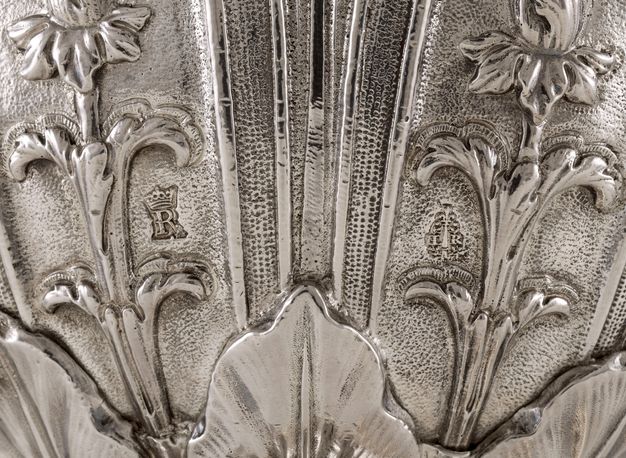
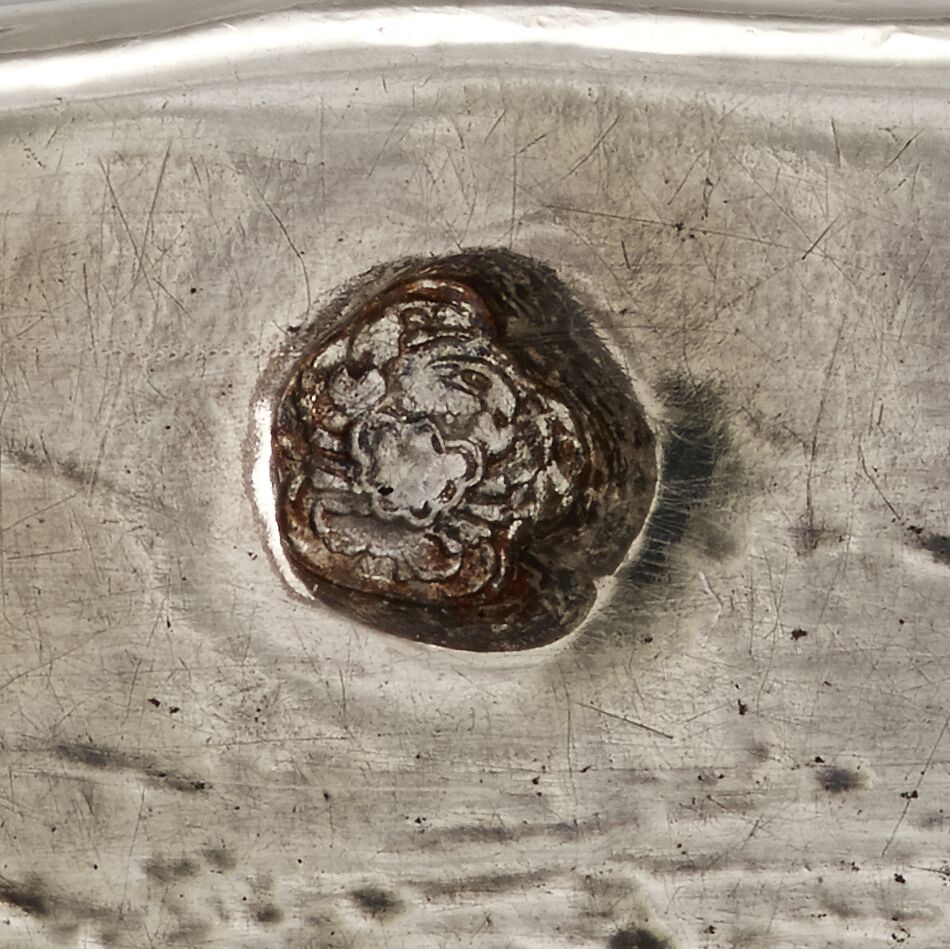
Struck, twice, once on the collar and once on the skirt (see Description), with the following stamps: the maker’s mark consisting of the initials “I.L.R.,” a baton or a scepter, and two grains, enclosed within two laurel branches, below a fleur-de-lys; and a crowned R (the Paris warden’s mark used between December 30, 1661, and June 26, 1663) (cat. 1.1). Struck twice, once on the vessel body and once on the vessel rim, with the following stamp: a small crab (the “restricted warranty” of 800 parts per thousand, or 80 percent, minimum silver standard used in French provinces from May 10, 1838) (mark 1.1).
Inscriptions
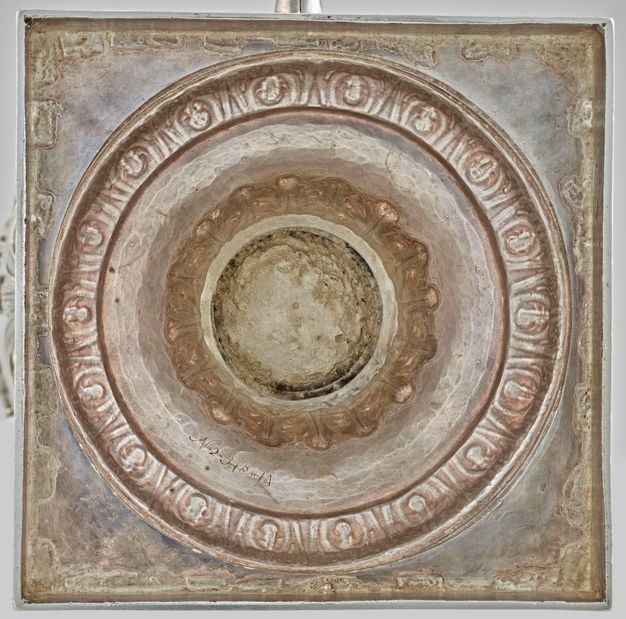
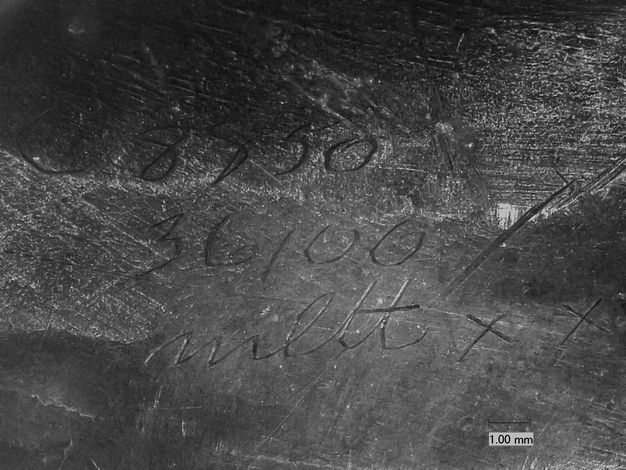
Under the foot, the vessel is incised “No. 2” and scratched with the weight “348 14” [crossed-out] and lightly scratched with “C8850 / 36100 / melt xx” (see fig. 1.16). Under the base, the vessel is incised “No. 2” and scratched with the weight “362 13” (see cat. 1.9).1
Armorial
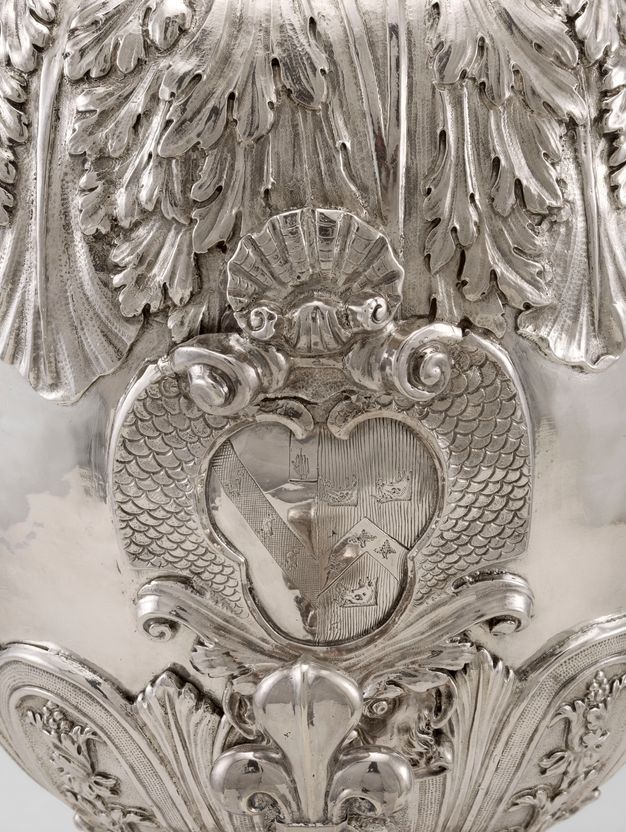
The vessel bears the engraved coat of arms of Curzon impaling Colyear, for Sir Nathaniel Curzon and Caroline Colyear, who were married in 1750 (armorial 1.1 and figs. 1.12 and 1.13).
Description
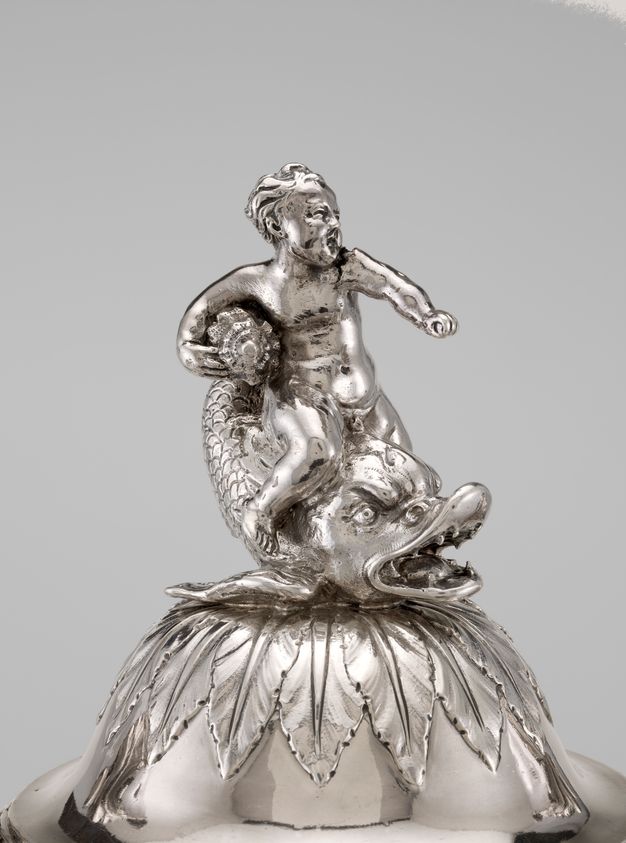
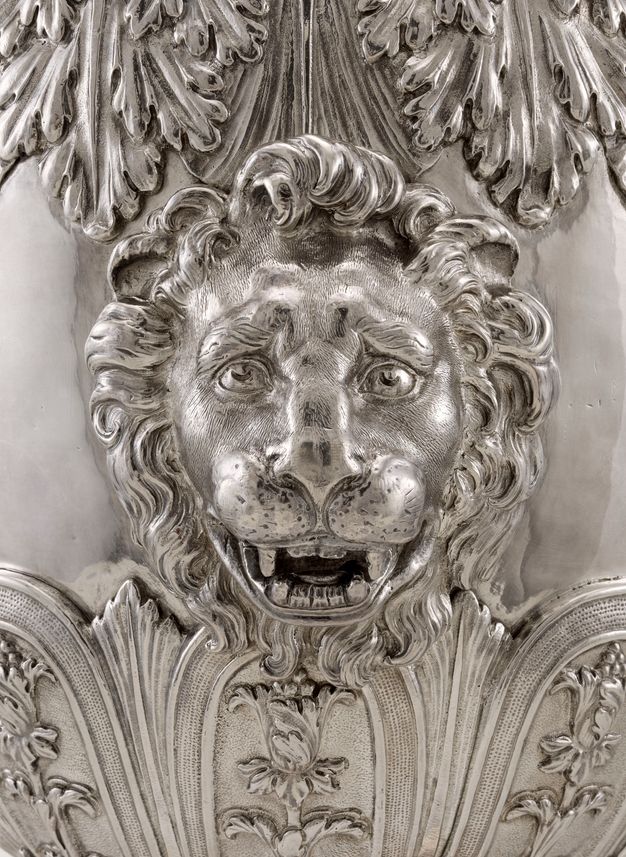
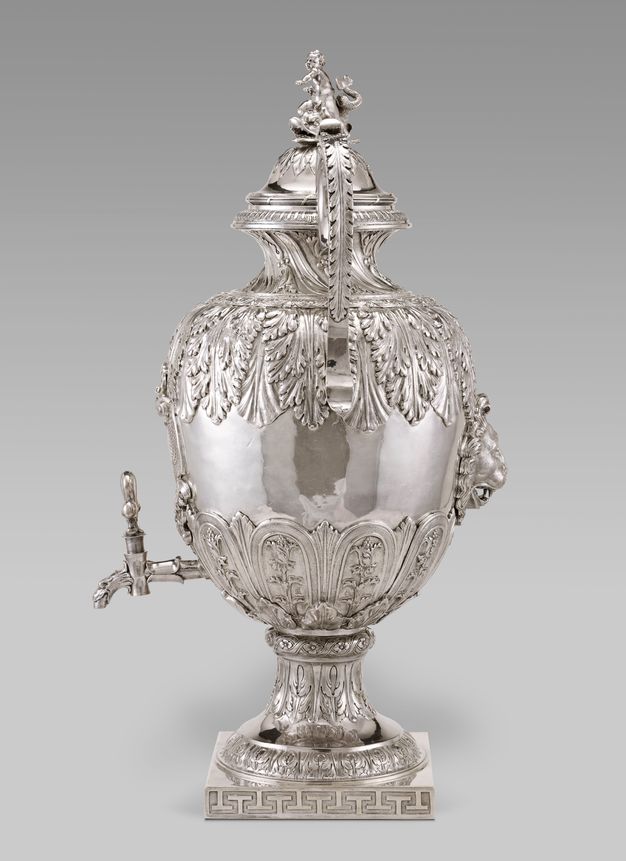
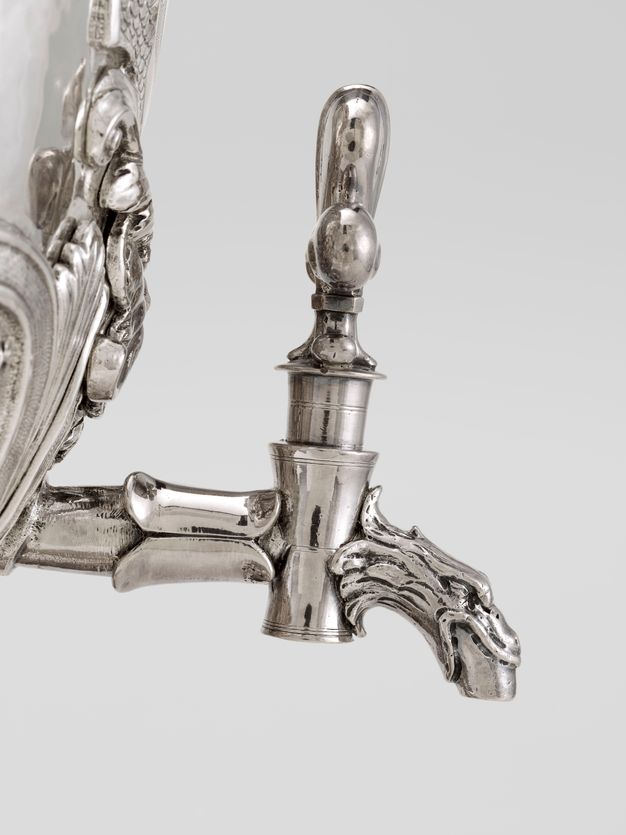
This two-handled water fountain has an ovoid body, with a spool-shaped fluted neck and a flared foot fixed to a square base. The dome-shaped lid has a finial in the form of a putto riding a dolphin. The ovoid body, of polished silver, has an applied collar of alternating flattened acanthus and water leaves. The lobes of its applied skirt are separated by narrow, veined leaves; each lobe contains a vertical leafy stalk of budding acanthus. A secondary applied ring of water leaves encircles the base of the body. The central front of the vessel has a shell-mounted cartouche enclosing the tri-lobed armorial shield, with an auricular mustached mask below. The tap below the armorial cartouche is in the shape of a waterfowl’s head and bill; its spigot takes the form of a fleur-de-lys. The reverse side of the body has an applied lion mask centrally placed (cat. 1.2). Where the body joins the neck, there is an applied circle chased with flattened palmettes within molded arcs. The burnished diagonal flutes of the neck alternate with abutted acanthus leaves, twisting and curling upon themselves. The rim of the neck is soldered and secured with pins. Its quarter-round edge has a pattern of irregularly spaced gadroons. Two opposing C-scroll handles project from the collar, stretch upward, and curve back to anchor at the rim of the neck. Strips of narrow acanthus leaves have been applied to the handles’ exterior surface; a coil of leaf projects, as a thumb rest, from each handle near its apex. The handles are soldered and pinned to the vessel. The body is soldered to the flared foot. The top of the foot stem has a half-round ring of interlaced bands enclosing quatrefoils; its polished stem is shallowly chased with alternating flattened acanthus and water leaves; its circular and stepped base is also shallowly chased with the same leafy pattern. The flat surface of the square base is of polished sheet while each of its four vertical sides are cast with a T-shaped geometric pattern.
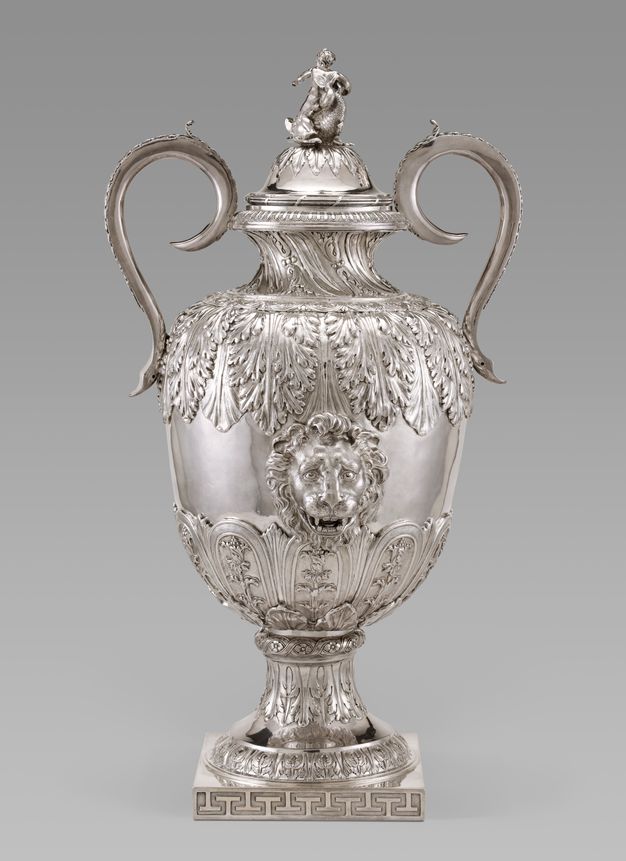
The polished lid has, above, a shallowly chased ring of pointed and veined leaves and, below, a half-round molding of banded reeds. The finial is shaped in the form of a putto straddling a coiled dolphin. The boy cradles a large conch shell in his right arm and stretches out his left, as if holding invisible reins to control his mount (cat. 1.3).
Commentary
From the seventeenth century into the nineteenth century, etiquette during formal meals served in the French manner (à la française) dictated that wine glasses did not rest on the table. Rather glasses were filled at the buffet or sideboard and delivered on salvers to guests upon request. A guest drank the contents while a servant waited in attendance to carry away the empty glass for rinsing.2 Water fountains (fontaines) on the dining room buffet provided rinse water for this purpose, while cisterns, or “washers” in old English inventories, caught the rinse water and the drips from the rinsed glasses. Servants drew water from the fountain through the tap and controlled its flow by means of a spigot. In the grandest of households, yet another, larger cistern contained chilled water to cool bottles of wine. The trio of vessels anchored the arrangement of the buffet in a tiered fashion, with the fountain topmost.3 The present water fountain served this function from at least 1698 until 1947.
The history of the creation and alteration of this vessel is complex, and there are gaps in our knowledge that warrant continuing investigation. Originally, it was not created as a water fountain. The main body and neck of the vessel were made in Paris between December 30, 1661, and June 26, 1663, by the goldsmith Jean Leroy.4 It is the largest and most ambitious of his extant production, and there is much still to understand about his life and work. Other than two small gilded-silver items from dispersed toilette services, no other wares by his hand have been identified.5
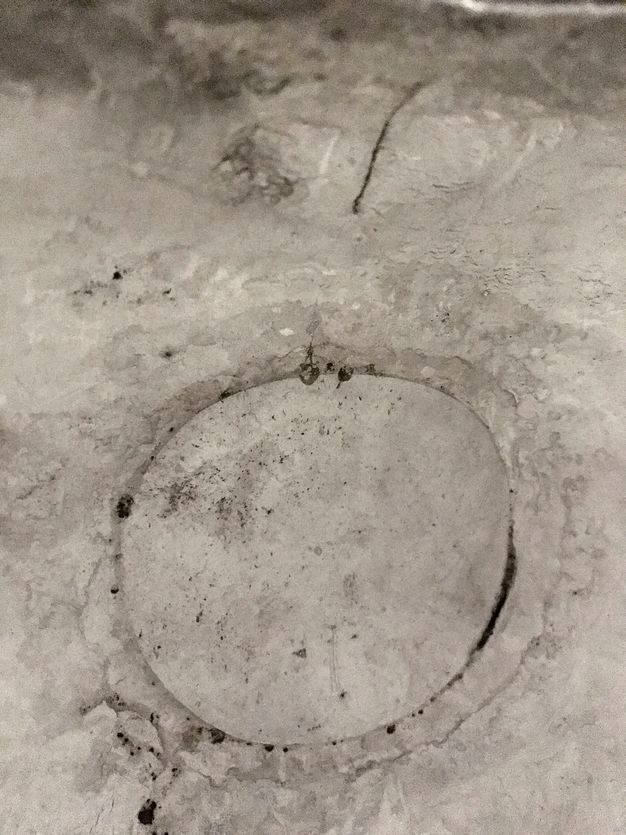
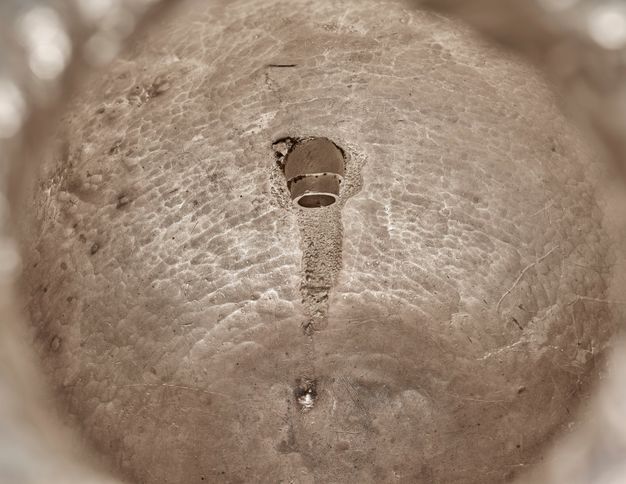
Physical evidence indicates there were alterations to this object in the seventeenth and eighteenth centuries. Some aspects of the vessel’s creation can be deduced from the maker’s mark and the Paris warden’s mark with the date letter and from X-ray fluorescence (XRF) analysis of its metal alloy. The alloy of this vessel’s body and neck exceeds the prevailing silver purity standard in Paris of 958 parts per thousand (95.8 percent). Presumably, the form of the original vessel was a water flagon (buire) with a spout for pouring water positioned in the collar above the armorial cartouche. This supposition is based on an acanthus leaf patch located above and slightly to the right of the armorial cartouche and on the appearance of two similar flagons surviving now in the Portland Collection, the Harley Gallery, at Welbeck Abbey, Nottinghamshire, England (as explained below). To facilitate tilting and pouring from this spout, a ring handle once hung from the reinforced jaw of the lion mask on the back of the vessel (cat. 1.4). The profile view of the present lion’s jaw clearly shows the circular indentation in the teeth that once accommodated the tubular shape of the handle (now missing) (cat. 1.5). Subsequently, the spout was removed and the gap patched with a new acanthus leaf in the collar on the exterior and with a disc on the interior (see armorial 1.1 and figs 1.12 and 1.13) (cat. 1.6). The vessel was then transformed into a water fountain (fontaine), with the insertion of a tap below the armorial cartouche (cats. 1.7 and 1.8). Other parts of the vessel were altered over time, particularly the dome-shaped lid, flared foot, and square base (cat. 1.9).
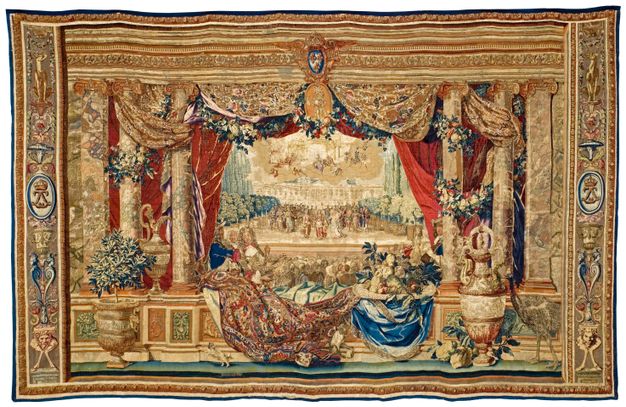
In proportion, form, and ornament, the original vessel reflected, no doubt, the contemporary silver works made for the court of Louis XIV. Though relatively little court silver survived the sumptuary edict of 1689 and the melt-downs of 1689–90, extant tapestries from the period reliably convey their appearance. The unaltered vessel probably looked much like the flagon portrayed in the tapestry titled L’opéra dans le Louvre / Le mois de janvier (The Opera at the Louvre / The Month of January) from the cycle known as Les maisons royales / Les mois de l’année (The Royal Residences / The Months of the Year), woven at the Manufacture Royale de Tapisseries des Gobelins (Royal Tapestry Manufactory at the Gobelins) in the 1670s after the conceptual design of Charles Le Brun of the mid-1660s (fig. 1.1).6 The flagon in the tapestry suggests the original form of the present vessel, with a trilobed handle, a spout in the upper collar, a fluted neck, and an acanthus leaf skirt.
The vessel reached England by 1698, when it was seen by, or passed through the hands of, the London-based goldsmith Ralph Leake. Leake himself may have been responsible for its transformation from flagon to fountain, though this has yet to be proven. The object bears no English marks.7 Leake produced a copy of the altered vessel and created two cisterns as well. Together, the four pieces—two fountains and two cisterns—became matching pairs (hence the presence of the historic numeral “No. 2” inscribed on the lid and on the vessel of the Getty’s water fountain, which distinguished them from the Leake copy; see Inscriptions above). The cisterns, whose present locations are known, both bear the maker’s mark for Ralph Leake, the mark for the City of London, the guild warden’s date letter for 1698–99, and the Britannia standard mark for a silver purity of 958 parts per thousand (95.8 percent).8 One cistern is in the Victoria and Albert Museum, London (fig. 1.2), and the other is in the collection of the Worshipful Company of Goldsmiths of the City of London. Since 1947 the location of Leake’s fountain remains a mystery.9
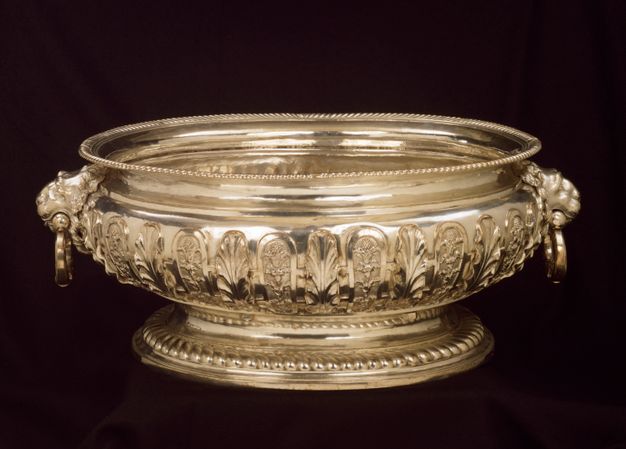
Precisely how and when the original vessel left Paris and reached London before 1698 can only be surmised. Jean Leroy was part of a cross-Channel network of marchand joailliers (merchant jewelers who, at this time, also dealt in an assortment of precious wares, including silver and gems). One of his associates, the marchand joaillier Jean Catillon, followed the seasonal progress of the French court from Saint-Germain to Saint-Cloud and, in 1679, had outstanding debts due him from court nobles, members of the royal family, and even the sovereigns themselves.10 Another associate, Thomas Verbeck, marchand mercier grossier joaillier privilégié suivant la cour (which translates roughly as “grand jewelry merchant, by appointment to the Court”), not only delivered plate to the Garde-Meuble de la Couronne (the Crown’s Furniture Warehouse) but pursued commercial activities in London from about the mid-1660s.11 It is noteworthy to recall that Charles II, son of Charles I and cousin of Louis XIV, lived in exile in Paris from October 1651 to April 1654, absorbing the French Baroque style before eventually returning to Britain when the monarchy was restored in May 1660. And later, his brother James II fled, after being deposed, to France, where Louis hosted him in exile at the Château de Saint-Germain-en-Laye from 1690 until James’s death in 1701. Beginning in the 1660s, thanks to cross-Channel trade and Stuart-Bourbon dynastic ties, the English market developed a taste for plate in the French Baroque fashion, which could contrast markedly from the austere style of the preceding Protectorate years.12 It cannot be ruled out, either, that the vessel could have crossed the Channel in a diplomatic pouch, a method that avoided import duty tax.13
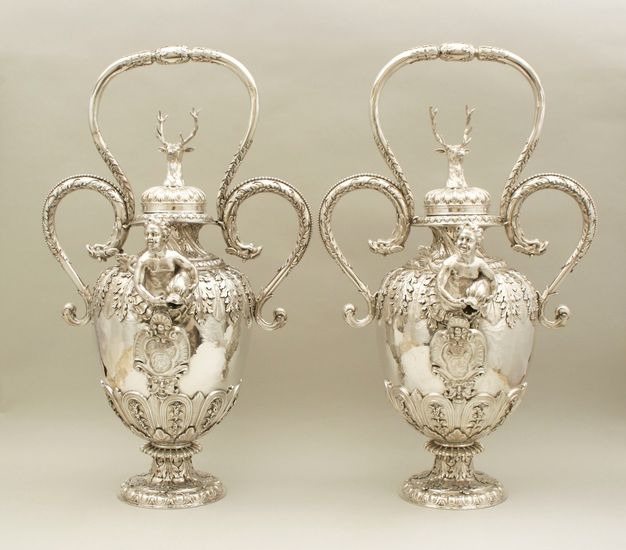
A closely related pair of flagons, unmarked but thought to date from 1681, is in the Portland Collection, the Harley Gallery, at Welbeck Abbey, Nottinghamshire, England (fig. 1.3).14 Their bodies and necks replicate the present vessel, though each still has a spout, situated above the armorial cartouche, that takes the form of the head and upper torso of an adolescent holding a dolphin whose mouth is the conduit for water. A trilobed handle spans each flagon, the central lobe arcing high above the later lids. These flagons reflect the presumed original appearance of the present vessel; indeed, it has been argued that these flagons were actually inspired by, if not directly copied from, the Getty vessel. Interestingly, the design of the flagons’ feet may suggest the form of the original foot on the Getty version. The flagons are attributed to Adam Loofs, a Dutch Protestant, who is thought to have apprenticed in the mid-1660s, together with Jean Leroy’s son Pierre, in Paris under Jean Frère, a Huguenot goldsmith who came from Metz.15 These flagons are thought to have been created in the Hague after June 29, 1680, when Loofs became “ordinary gold- and silversmith and keeper of plate” to William of Orange, future joint sovereign with Mary Stuart of England, Scotland, and Ireland. Indeed, they may be the two hooge watterkrucken (tall water flagons) he delivered to William in 1681.16 Whether copied directly or indirectly, the flagons at Welbeck Abbey are larger and heavier (weighing 435 troy ounces each) than the present vessel, and their method of casting, assembly, and chasing are all relatively stiffer.17 Their lids, with the heraldic stag heads of the Cavendish family, are later, perhaps early nineteenth century.
The early provenance of the Getty vessel is not known until November 1759. At that time, it was one of four pieces comprising two pairs of water fountains and cisterns that were with the goldsmith Phillips Garden at his shop the Golden Lion in Saint Paul’s Church Yard in the City of London. An invoice survives, charging Sir Nathaniel Curzon, fifth baronet, for their “new doing up” and for the replacement of their engraved heraldic arms. The work, completed on November 22, 1759, billed only for fashioning and engraving, not for new bullion (fig. 1.4).18 This indicates that the four pieces were already the property of Sir Nathaniel. In 1761 the pieces were still in London, located in one of the Curzon townhouses.19 The new armorial engraved in Garden’s workshop is still present on the vessel; there is no trace of the former heraldry. The arms are Curzon impaling Colyear, for Sir Nathaniel’s wife, Caroline Colyear, whom he had married in 1750. Since the armorial lacks a baron’s coronet, it dates between November 18, 1758, and June 4, 1761, the period in which he succeeded to the baronetcy but had not yet been elevated to the peerage as the first baron of Scarsdale.
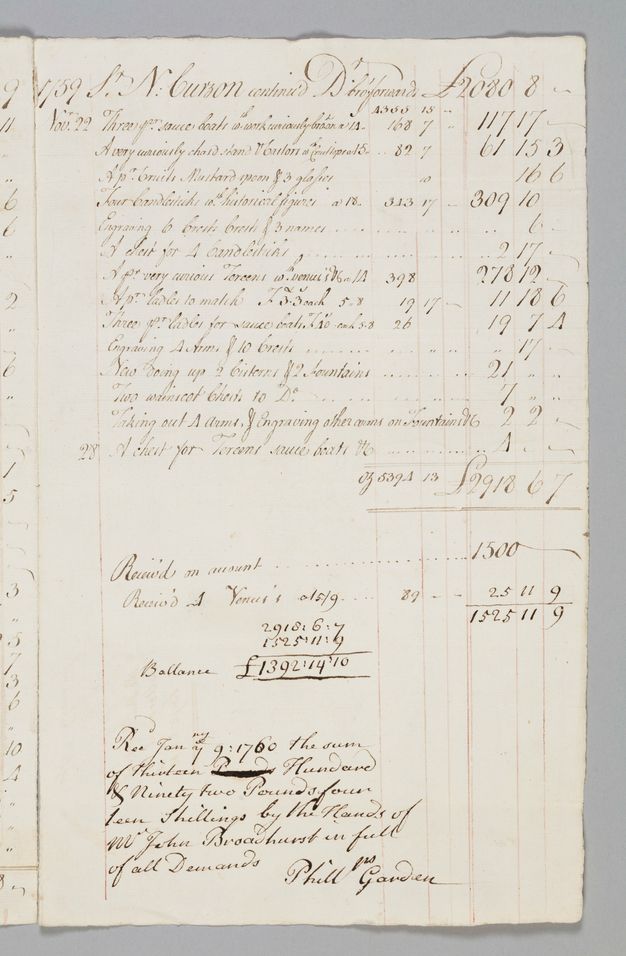
New doing up 2 cisterns & 2 fountains 21 [pounds] Two wainscot Chests to Do. 20 7 Taking out 4 arms & Engravings other arms on Fountains 2 2 [shillings]
There are at least two possible explanations for the lack of bullion charges. The first is that Sir Nathaniel Curzon could have previously purchased the four pieces from Phillips Garden, who dealt in “second-hand plate,” according to one of his trade cards (see bio 5.1),21 or from an unidentified dealer, though no such invoice or receipt has been found in the archives at Kedleston Hall.22 The second is that Sir Nathaniel might have inherited the four pieces. Thus far, no Curzon inventories have surfaced to document the four pieces in the family’s possession prior to 1759.
Nonetheless, the status of the family and its collection of church plate strengthens the supposition that the four pieces might have been in the family’s possession prior to 1759. Earlier recorded Curzon family gifts of silver shed light on the type of plate then deemed appropriate as charitable gifts. For instance, Sir Nathaniel’s grandmother, Lady Sarah Curzon (1655–1727), wife of the second baronet, gifted old gilded-silver plate to the Kedleston parish church of All Saints in 1715. The gift consisted of two communion patens dating from 1527 and a chalice of 1601.23 Moreover, by bequest, she commissioned new work to be presented after her death to Saint George’s Hospital, near Hyde Park, Westminster, in its inaugural year of 1733. London goldsmith Edward Feline created a gilded-silver communion cup and paten cover for the use of the sick there.24
The research of Leslie Harris, former archivist at Kedleston Hall, outlines the patronage of Nathaniel Curzon and the role of architects James “Athenian” Stuart and Robert Adam in rebuilding his ancestral seat in Derbyshire. Beginning in 1757, Stuart supplied Neoclassical designs for items intended for the Curzon dining room buffet, including a plate warmer and tripod perfume burners, executed by Diederich Nicolaus Anderson in 1760, and an enormous jasper cooler, supplied by the sculptor Richard Hayward (all items still preserved in the dining room at Kedleston Hall).25 Given that Stuart designed so many buffet pieces, Harris suggested he was also involved in the alterations carried out on the water fountain by Phillips Garden in November 1759.
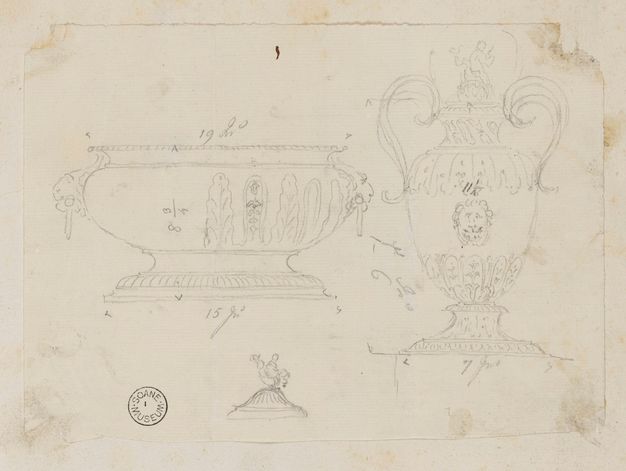
One working drawing in pencil by Robert Adam’s hand, however, shows an older version of the fountain. Does it record the appearance of the fountain before or after the 1759 “new doing up” by Garden? The sketch presents, on the left, one of Ralph Leake’s cisterns in elevation with the lion masks in profile and, on the right, one of the fountains in elevation with the lion mask full frontal.26 Dimensional measurements are carefully recorded (fig. 1.5). The fountain’s neck has diagonal fluting and acanthus leaves. Interestingly, the lid on the vessel is quite different from the present dome-shaped version. The drawing outlines, rather, a lid fashioned as an orb, with cascading droplets of water, upon which sits the putto and dolphin. Moreover, the vessel’s handle is trilobed, with a high arc above the lid finial. Over this, Adam superimposed another concept for a pair of similar C-curved handles whose apexes stretch taller in height. The foot is proportionally shorter and broader at its base than its present form. There is no square base (though one vertical short stroke intimates that it may have been in the mind of Adam).27 A separate design for an alternate lid, lower down on the same sheet, shows a fluted shallow dome with the putto-dolphin finial.
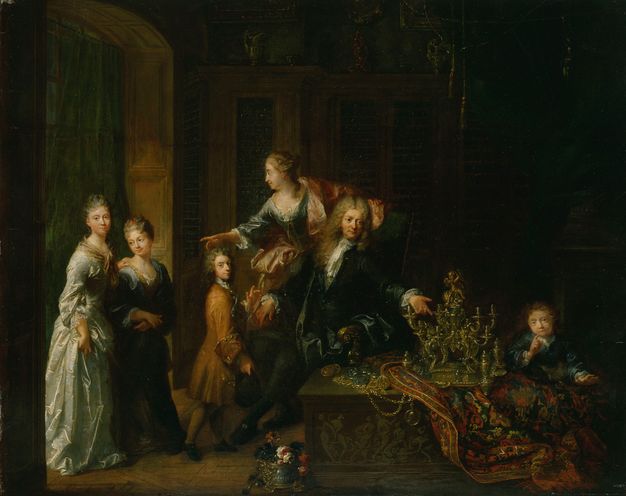
The fountain’s putto finial figure derives ultimately from antique models of Cupid riding a dolphin, via an intermediary statuette by the Italian sculptor Francesco Fanelli, who was active at the court of King Charles I in the 1630s before moving to Paris in 1642. In his first iteration, winged Cupid stands upright and takes aim with his bow and arrow.28 A variant model also circulated as an engraved proposal for a central sculptural monument intended, appropriately, for an outdoor fountain. Here, a youth—rather than Cupid with his bow—sits astride a trio of dolphins. Fanelli published the engraving in his Varie architetvre, di Francesco Fanelli fiorentino, scultore del Re della Gran Bretagne (Paris, 1661).29 Drawing inspiration from this design, craftsmen on both sides of the Channel adapted and incorporated the model into their work. An interesting painted example is the finial of a silver epergne portrayed in the Portrait of Goldsmith Nicolas Delaunay and His Family by Robert Le Vrac Tournières of 1704 (fig. 1.6).30 Was Jean Leroy or Ralph Leake responsible for the finial on the Getty fountain? The alloy of the putto nearly matches the prevailing silver purity standard for Paris and, from 1698, the Britannia standard for London of 958 parts per thousand (95.8 percent) (see the Appendix: Table 1).
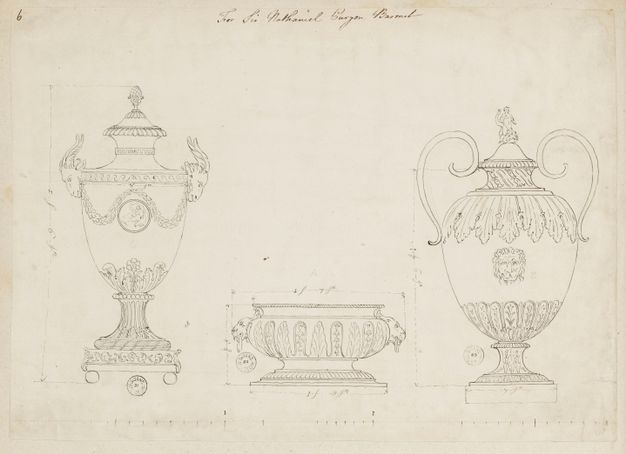
A second drawing in ink was prepared by professional draftsmen in the Adam office for “Sir Nathaniel Curzon Baronet,” so it dates prior to June 1761, when he became Lord Scarsdale. It shows three vessels, from left to right: a vase with ram heads (possibly designed by Stuart), one cistern with lion masks in profile (as made by Leake), and one water fountain with the lion mask full frontal (fig. 1.7).31 No doubt, this presentation drawing was intended to show the patron the relative proportions of the new and older vessels and how they would compare when assembled together in the buffet alcove of the dining room in Kedleston Hall. In this rendering, the body of the fountain is egg shaped, the lion mask is slightly smaller in scale, the lid is dome shaped, and the pair of C-curved handles accords with the second iteration in the pencil drawing. The profile of the foot is narrower and slightly elongated; the square base appears as polished sheet.32 In fact, the fountain has been reconceived as a Neoclassical object.
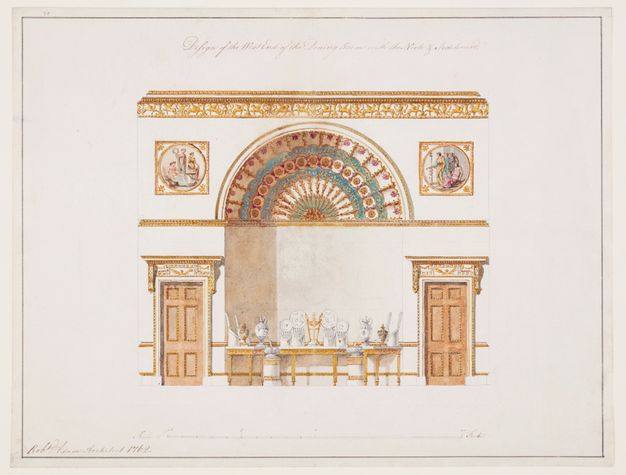
In 1765 the new dining room of Kedleston Hall was completed, with its west wall following the 1762 design of Robert Adam.33 The 1762 presentation watercolor of the harmonious buffet arrangement in the west wall alcove shows the fountains spilling water from the lion masks into the cisterns positioned below on lower pedestals (fig. 1.8).34 That aspect of the 1762 proposal was not realized, for water can actually only flow from this fountain through the tap below the armorial cartouche. There is no piercing (or patching) of the Getty’s vessel wall at the level of the lion masks. Presumably, Lord Scarsdale decided his coat of arms—not the lion masks—should face the viewer when the fountains were displayed in this setting. Nonetheless, the image reveals the intended formal function of such a fountain that, when paired with its cistern, served as a reservoir of water, whose controlled flow rinsed wine glasses during the course of a meal, while the cistern served as a catch basin for the rinse water.
Art historian James Lomax has described how silver fountains and cisterns were the most ambitious and esteemed vessels of any “cupboard of plate” in the Baroque era, for these objects visually conveyed identity, dynastic connections, status, wealth, and taste.35 Dozens of elite British families owned and prominently displayed these heirlooms in their city townhouses and country houses as the objects had the dual function of being ornamental and useful. Lord Scarsdale’s display of plate demonstrates how the custom continued well beyond the Baroque period. Indeed, today many British country houses still preserve this practice, presenting fountains and cisterns in their historic settings.36 The pairs of fountains and cisterns remained at Kedleston Hall until 1947, when they were sold by the Kedleston Settled Estates to the London firm of S. H. Harris & Son Jewelry in Hatton Garden. Since 1996, electroformed copies of the fountains and cisterns adorn the National Trust of England, Wales, and Northern Ireland’s re-creation of the buffet alcove at Kedleston Hall.37
Technical Summary
- Jessica Chasen
The documented history of the fountain and physical evidence of alteration merited a close technical examination to support and challenge ideas surrounding its creation and subsequent modification. The investigation relied on improvements in technical imaging (cat. 1.10)38 and newly acquired data on silver alloys to complement recent curatorial research. By utilizing the aforementioned tools to examine components of the original structure and to consider alterations, the history of the object can be understood more clearly and interpreted more fully.
The fountain originally took the form of a flagon (buire), as supported by the art historical context and material evidence presented in the curatorial essay. This form was subtracted from and added to over the seventeenth and eighteenth centuries. An original spout and handles were removed, leaving the hollow vessel body and separately raised neck with their applied ornament as the extant original components. The round foot and square base were added, as were the two C-scroll handles. The vessel is completed by a domed lid with a putto and dolphin finial. To better comprehend the alterations to the vessel, the examination required a close evaluation of the materials and techniques used in the original and added components.
What is believed to remain of the original flagon by Jean Leroy, mentioned above, are the large, hollow-bodied forms of the vessel body and the neck, each raised separately from individual pieces of silver plate and joined together with solder (fig. 1.9). Looking into the body of the vessel, the oblong, overlapping marks on the interior reveal the impression of the iron stake against which the silver plate was struck with the goldsmith’s raising hammer. On the exterior of the vessel, these impressions are less noticeable due to the finishing of the surface by planishing and polishing. However, on the underside of the body, a round, confident center point is visible. This tool mark, likely the impression of a pointed iron stake, facilitated the use of a compass to guide and control the shape and wall thickness while raising the vessel.39 The spool-shaped form of the neck was likely raised in a similar manner and then decorated with chasing and repoussé work40 to create the shallow relief of swirling acanthus leaves and diagonal flutes.
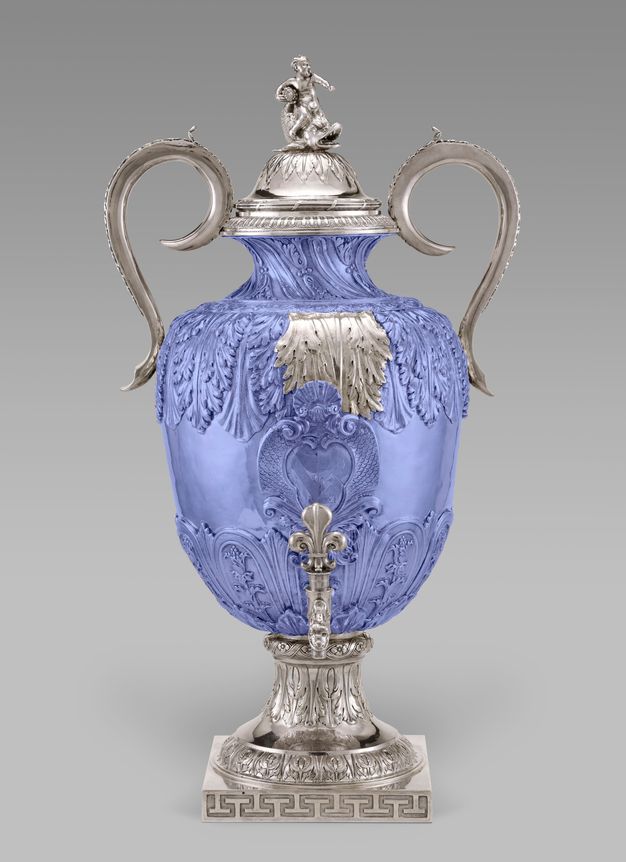
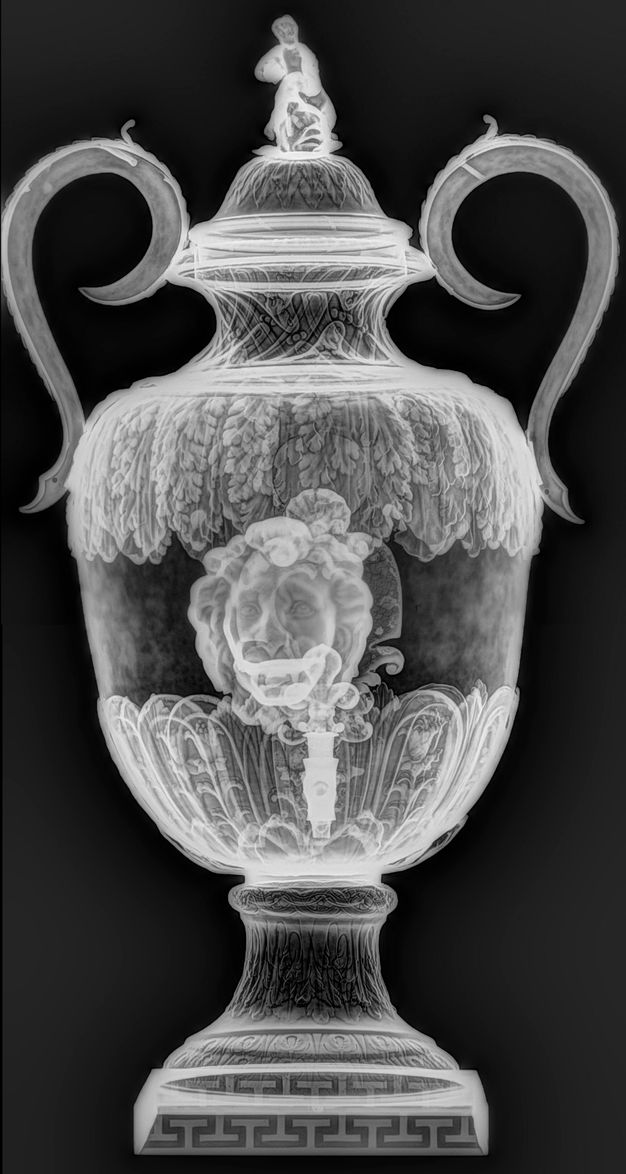
The applied repeat ornament on the body is also thought to be part of the original workings by Leroy. The collar of acanthus and water leaves and skirt with acanthus spring lobes were cast in small sections, and it is on one of each of these sections that the maker’s mark and Paris warden’s marks are located. Each of the collar and skirt sections consists of two repeats; five sections complete each design around the circumference. The sections of ornament within the collar and the skirt were cast, likely utilizing the same mold, as evidenced by the X-radiographs (figs. 1.10, 1.11). In the latter of these two images, the transfer of casting flaws—small defects caused when the inside of the mold is damaged—are visible. The cast elements were soldered to the vessel, and the joining of repeats was carefully concealed with fine chasing.41 The repeat water-leaf ornament, found just above the foot, is also thought to be cast and applied. However, the circular band of palmettes that conceals the solder seam between the neck and body was created with chasing and repoussé.
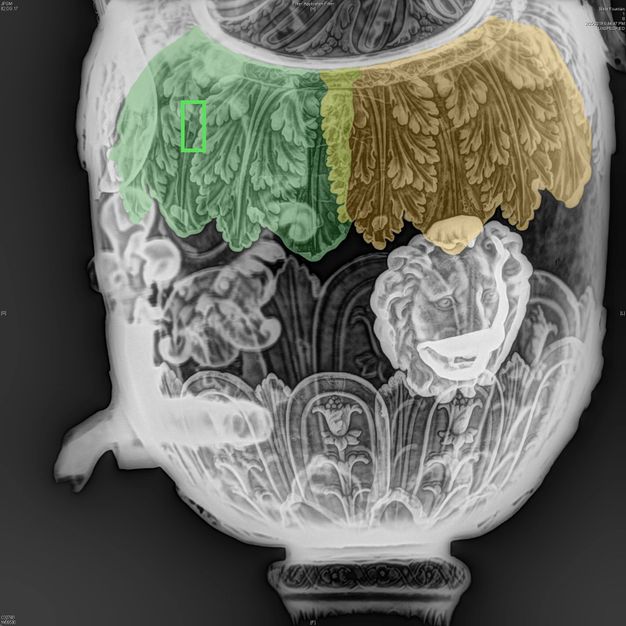
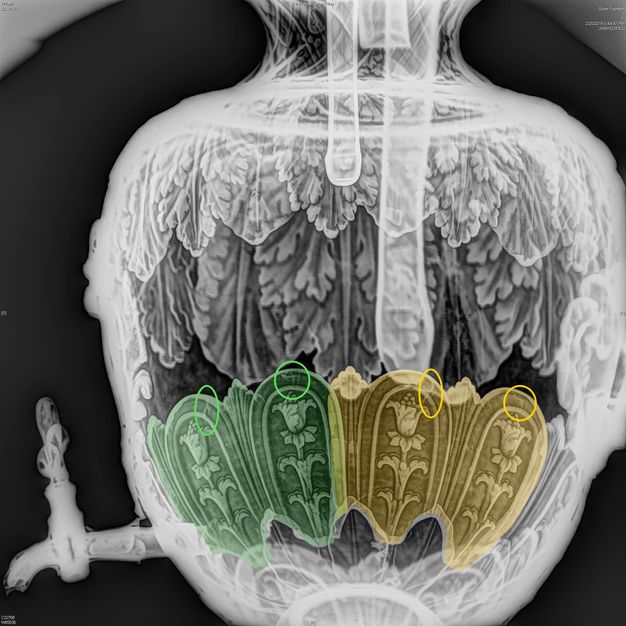
The additional ornament of the lion mask, cartouche, and auricular mask are also likely part of Leroy’s work and original design, based on the appearance of the Portland Collection example in the Harley Gallery at Welbeck Abbey (see fig. 1.3). These elements were cast and soldered to the large body. Each component shows evidence of casting porosity, or small bubbles of gases trapped in the solidifying silver alloy as it cooled in the mold, visible with X-radiography.42
By considering what is likely original to the flagon, the components related to its initial transformation into a fountain become more readily apparent. While at first glance the collar appears as a continuous repeat of acanthus and water leaves, as described above, closer examination reveals the partial lobes of a previous leaf visible just beyond the edge of a full acanthus. The form of this latter leaf is notably broader than the others in the collar, with less dynamic relief and less refinement in the chased details (fig. 1.12). On the corresponding area of the interior, a large circular patch is visible (see cat. 1.6). The outer irregular acanthus patch and inner circular patch directly echo the just off-center position of the spouts on the Welbeck Abbey examples. When the area is examined with X-radiography (fig. 1.13), the full extent of the modification becomes apparent, including secondary solder seams and separations in the ornament, confirming the connection to the Welbeck vessels.
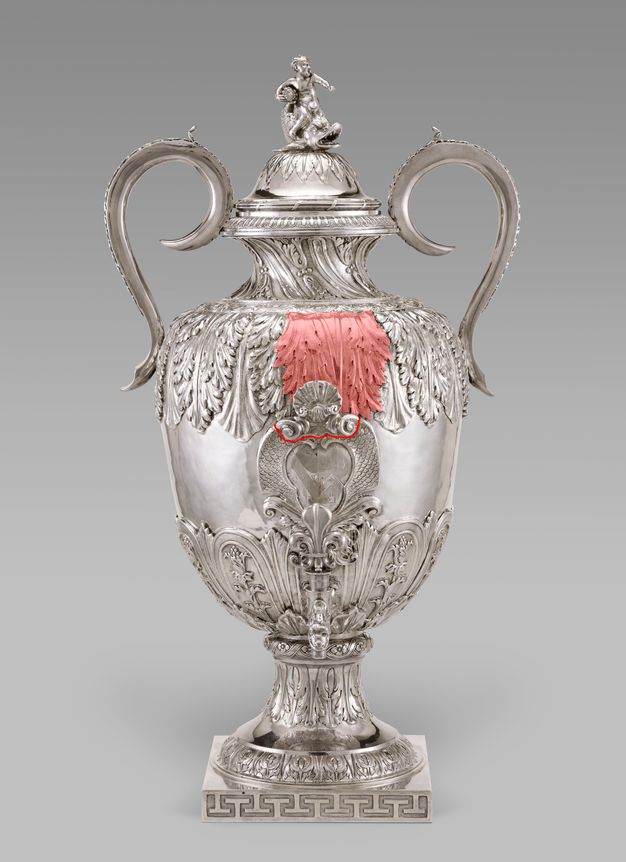
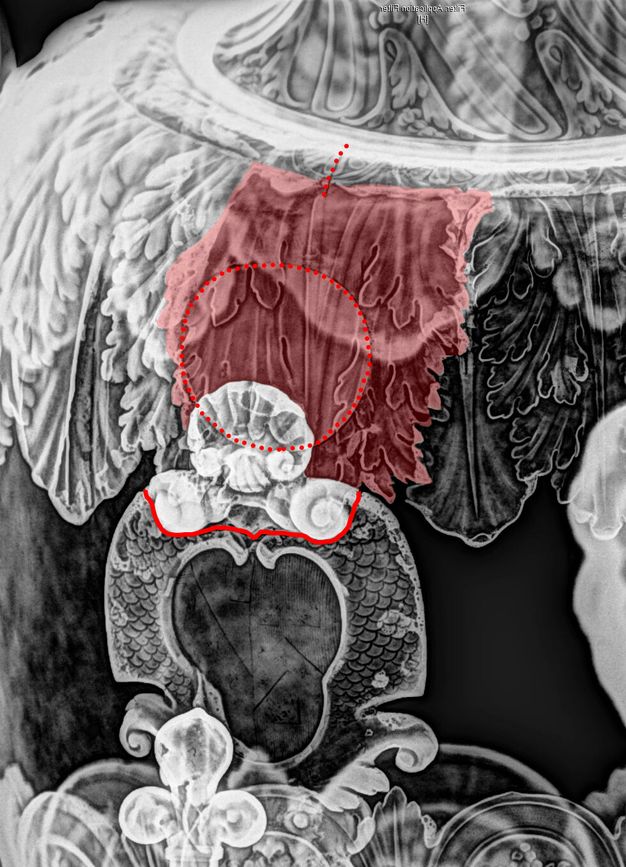
Based on the presumed similarity in design, the removal of the spout on the Getty example likely also required removal of a portion of the shell-mounted cartouche, an area that in the Welbeck flagons projects out significantly on the underside of the spout. As noted in the figures above, a fine separation is visible underneath the shell through the upper portion of the cartouche. While the shell could have been newly cast and fitted, this does not seem to be the case as the trace metals in the silver alloy very closely match those of the remaining lower portion, as presented in the analytical data (see Appendix: Table 1).43
The change in function was completed with the insertion of a tap through the lower ornament. The tap is visible on the interior along with a large drip of silver solder (see cat. 1.8). A ring, thought to have once rested in the curved mouth of the lion, as echoed in the Leake cisterns (see fig. 1.2), may also have been removed at this time, as it would no longer have been needed to support pouring from the now-removed vessel spout.
While these observations detail the transformation from flagon to fountain and its similarities to the Welbeck vessels, it remains uncertain if these modifications were carried out by Ralph Leake in 1698, or if they occurred earlier in the life of the object. Many additional components of the fountain, including the coat of arms, lid, handles, foot, and base, are documented, albeit with some ambiguity, in the mid-eighteenth-century records related to Kedleston Hall. While these documents are far from clear in regard to alterations, the examination of what material evidence exists better situates each component within the overarching context of the vessel.
In 1759 Phillips Garden was responsible for “taking out 4 arms and engraving other arms” and “new doing up 2 cisterns & 2 fountains” for Sir Nathaniel Curzon.44 The Curzon-Colyear arms are engraved within the reserve of the cast cartouche. With visual examination under magnification with raking light, and by X-radiography, there is no indication of an earlier arms beneath those visible (see armorial 1.1).
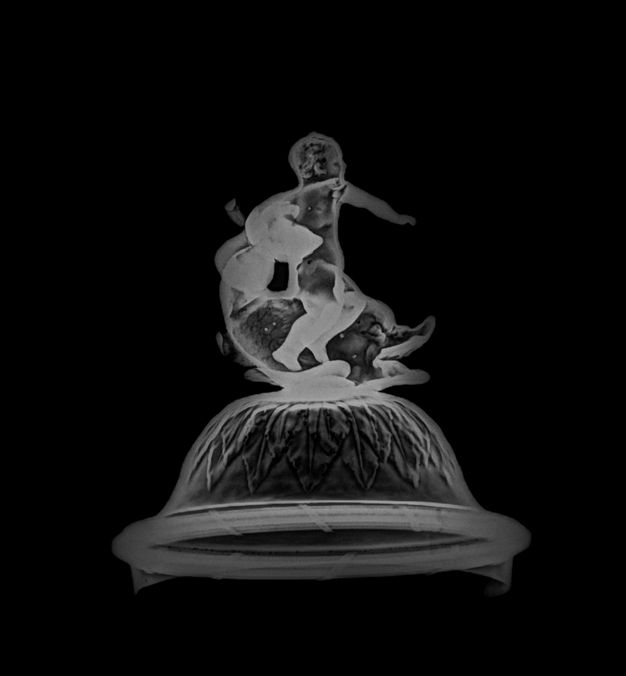
Between around 1760 and 1762, three drawings by Robert Adam and the Adam office clearly indicate changes to the vessel, which may well be the “doing up” referred to in Garden’s invoice (see figs. 1.5, 1.7, and 1.8). The earliest pencil study hints at a possible shift of the lid from orb to dome, a move from trilobed handle to C-scrolls, and possible additions to the foot, but it remains unclear if this was a reference to Garden’s work or a note for future modification. Close examination of these components offers little additional clarity at this time. The dome of the lid is raised, with the addition of a separate ring of banded reeds along the lower edge. The putto and dolphin were cast as a single element with the lost-wax casting method using a slush mold (fig. 1.14; see cat. 1.3). The arms, lower legs, and dolphin’s tail are solid silver alloy.45 The putto and dolphin are mechanically joined to the lid by a small hollow tube with the addition of solder.46 The rim of the main vessel appears to have been modified with an added thin silver sheet in order to accept the lower edge of the lid.
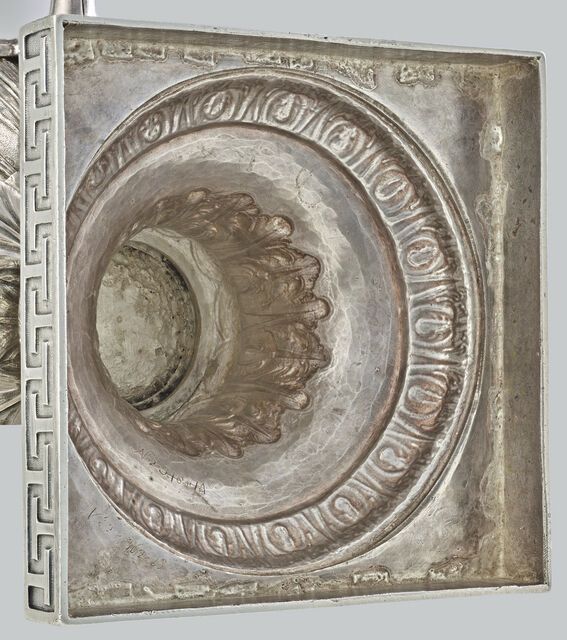
While differences in the proportions of the foot as rendered in the Adam pencil and presentation drawings are significant, the forms and decoration remain essentially unchanged. Examining the flared foot reveals a form that has been raised from a single sheet with no visible seams, including the profiles of the half-round ring, polished stem, and circular and stepped base. The decoration is rendered with chased and repoussé work, albeit flatter and more simplified than the leaves on the neck. The foot has been attached to a piece of polished silver sheet that serves as the upper surface of the square base. It is the addition of this base that likely accounts for the change in the weight from “348 14” to “362 13,” inscribed on the inner surface (see cat. 1.9).
The vertical edges of the base are unadorned in all versions of the Adam drawings, while the present iteration has a T-shaped geometric pattern. Was this an intentional simplification of the drawing? Or does it provide evidence for an additional set of later modifications? The quality of the casting and soldering on these components is significantly less refined and inconsistent with that seen elsewhere on the vessel (fig. 1.15). The cast sides of the base have large areas of porosity left unrepaired even on the readily visible front exterior face. The solder seams on the underside contain large tabs of silver, or partially melted pallions of solder. The lightly scribed notation of “C8850 / 36100 / melt xx” (fig. 1.16) may hint at the work of another silversmith or restorer yet to be connected to the history of the object.47
Once visual and X-radiography analysis had provided a clearer understanding of the original fabrication and later alteration, it was hoped that alloy data could confirm the observations. Quantitative X-ray fluorescence spectroscopy (XRF) was used to nondestructively collect data from the surface of the vessel.48 XRF has been found to be a particularly powerful tool when significant differences in alloy composition can be detected and when these align with the documented silver standards of the period. In theory, the differences in the prevailing silver standards should allow for the separation of silver vessels made in Britain and France before 1697 and, in some instances, those made in Britain and France after May 1720 based on their relative proportions of silver content.49 However, the quality of the silver used for all components of the fountain is well in excess of 92.5 percent sterling standard, and frequently more than the 95.8 percent Britannia and French standards. This requires a more nuanced approach to data interpretation and, in many cases, an evaluation of trace element content.
As explained in the introduction to the Appendix, processing alloy compositions with fundamental parameters software and calibrations based on silver reference standards improves the accuracy in this data; nonetheless, the interpretation may be affected by the complex microstructure of silver alloys, the surface geometry of curved and decorated forms, and the limited number of available reference standards based on historic silver alloys.50 Fundamentally, XRF is a surface-analysis technique, and the composition of the alloy is only gauged to a depth of a few microns, which does not capture the microstructural character of the bulk metal.51 Quite often, a fine silver surface could be a thin layer, depleted of copper and trace elements, due to their preferential removal during the “pickling” process.52 This in turn increases the perceived silver value of the bulk. In contrast, raising a form from silver sheet, particularly with multiple rounds of annealing, can also cause localized copper oxides beneath the surface, increasing the perceived copper values.53 Furthermore, the geometry of objects restricts access for the instrument, and for this very reason, not all components of the fountain could be measured equally. Nonetheless, the alloy analysis has allowed for interesting comparisons of seventeen different components on the Getty’s fountain as seen in the Appendix: Table 1.54
The quality of the silver used to create the main forms of the body, neck, and applied repeat ornament on the vessel body is among the highest found anywhere on the fountain, with average values between 96.5 and 98.7 percent silver. These values are consistent with the Paris warden’s marks (1661–63) on the collar and skirt and supports the assertion that the main body and neck were also likely created in France in the same period. The use of an alloy far above the prevailing standard is surprising, and this likely relates to the repeated annealing and subsequent pickling required to raise such a large vessel. A finer alloy may also have been intentionally selected, as lower copper content in the silver alloy causes a decrease in the annealed hardness, in turn making it slightly easier to raise a labor-intensive form.55
While the date of the early transformation from flagon to fountain remains unknown, XRF analysis of the silver composition adds another layer of information. The exterior acanthus repair patch, the waterfowl tap, and the proper left handle have an average silver content of 95.8–96.0 percent, 97.1 percent, and 96.1 percent, respectively—values close to or greater than Britannia standard yet significantly different from the higher silver content in the body, neck, and applied ornament. Had the alterations been carried out in England before they were in Ralph Leake’s shop in 1698, it may have been expected that a lower quality of silver, representative of sterling standard, would have been used. This is only an assumption, as it also must be considered that the alteration may have been carried out in Britain using remelted silver from the removed spout. Alternatively, a higher quality of silver may have been selected to better match that of the original portions of the vessel.
The foot and square base are quantified at average values ranging from 93.8 to 94.0 percent silver, which is lower than all other measured components on the fountain. While this is yet again in excess of 92.5 percent—the standard for British sterling before 1697—the measurements are closer to that of sterling than Britannia and are significantly lower than the 97.0–98.0 percent silver found in the vessel body. Considered in light of the archival drawings by Robert Adam, this data supports the theory that the foot and base were added post-1720. It is hoped that continued evaluation of the trace elements found in different components may further group sets of alterations, clarify the remelting and reuse of silver, and potentially connect silver alloys to geographically specific ores.56
Study of the techniques and materials, supported by X-radiography and digital microscopy, allows the original construction and early alterations to the fountain to be more clearly understood. These observations, when supported by quantitative alloy data and bolstered by detailed curatorial research, provide an understanding of how, and perhaps when, these modifications were carried out. While many questions remain, it is hoped that future developments in trace-alloy analysis, supplemented by yet undiscovered archival documentation, may continue to inform the complex history of the Getty’s fountain.
Provenance
By 1698: unidentified collection, England, probably adapted from a water flagon in 1698, when a matching fountain and two basins were made by Ralph Leake; ca. 1758–1804: Nathaniel Curzon, fifth baronet and first baron Scarsdale, British, 1726–1804 (Curzon London house, documented around 1761, and Kedleston Hall, Derbyshire, England, from 1765), by inheritance to Nathaniel Curzon;57 1804–37: Nathaniel Curzon, second baron Scarsdale, British, 1751–1837 (Kedleston Hall, Derbyshire, England), by inheritance to Nathaniel Curzon; 1837–56: Nathaniel Curzon, third baron Scarsdale, British, 1781–1856 (Kedleston Hall, Derbyshire, England), by inheritance to Alfred Nathaniel Holden Curzon; 1856–1916: Alfred Nathaniel Holden Curzon, fourth baron Scarsdale, British, 1831–1916 (Kedleston Hall, Derbyshire, England), by inheritance to George Nathaniel Curzon; 1916–25: George Nathaniel Curzon, fifth baron and first viscount Scarsdale, British, 1859–1925 (Kedleston Hall, Derbyshire, England), by inheritance to Richard Nathaniel Curzon; 1925–45: Richard Nathaniel Curzon, second viscount Scarsdale, British, 1898–1977 (Kedleston Hall, Derbyshire, England) [unsold, together with an English version of the fountain and a pair of matching cisterns all made by Ralph Leake in 1698, Christie’s, London, July 16, 1930, lot 72];58 [unsold, same pairs as in 1930, Christie’s, London, November 7, 1945, lot 114],59 and transferred to Kedleston Settled Estates; 1945–47: Kedleston Settled Estates (35 Saint Mary’s Gate, Kedleston, Derby, England), sold privately to James Harris of S. H. Harris & Son Jewelry, London;60 1947: S. H. Harris & Son Jewelry (5 Hatton Garden, London); after 1947: Jacques Helft, French, 1891–1980 (Paris, until 1940 and again from 1946; New York, active 1940–48); before 1948–62: Arturo López-Willshaw, Chilean, 1901–1962 (14 rue du Centre, Neuilly sur Seine, France), displayed on the buffet in the dining room of his residence in Neuilly sur Seine, by inheritance to his wife, Patricia López-Willshaw;61 1962–82: Patricia López-Willshaw, Chilean, 1912–2010 (Paris) [unsold, Sotheby Parke Bernet Monaco S.A., Monte Carlo, June 23, 1976, lot 48, and sold privately to the J. Paul Getty Museum through Sotheby’s, Monaco, 1982].62
Exhibition History
5ème salon des arts de la table, musée des Arts décoratifs (Paris), June 3–September 15, 1950 (lent by Arturo López-Willshaw); Louis XIV: Faste et décors, musée des Arts décoratifs, Palais du Louvre, Pavillon de Marsan (Paris), May–October 1960 (no. 378, lent by M[onsieur] A. López-Willshaw); The Life of Art: Context, Collecting, and Display, J. Paul Getty Museum at the Getty Center (Los Angeles), February 7, 2012–December 3, 2017.
Bibliography
Catalogue of Old English Silver Plate: The Property of the Late Rt. Hon. the Earl of Balfour, K.G., O.M., also Part of the Scarsdale Heirlooms, sale cat., Christie’s, London, July 16, 1930: 12–13, lot 72, “A Pair of Wine-Cisterns and Urns”; Catalogue of Old English Silver Plate: The Property of Mrs. C. L. Masterson, A Pair of William III Wine Cisterns, The Property of the Rt. Hon. Viscount Scarsdale (sold with the consent of the Court), sale cat., Christie’s, London, November 7, 1945: 11, lot 114, “A Pair of Wine Cisterns and Urns”; Penzer, Norman Mosley. “The Great Wine-Coolers II.” Apollo 66, no. 391 (September 1, 1957): 39–46., 43; Louis XIV: Faste et décors. Exh. cat. Paris: Tournon et Cie, 1960., 69, no. 378 (lent by M[onsieur] A. López-Willshaw), pl. LVII; Jullian, Philippe. 14, rue du Centre, Neuilly sur Seine. Monaco: Jaspard, Polus et Cie, 1961., 33, 35, ill.; Verlet, Pierre. “Paris: Arturo Lopez-Willshaw, Argenterie des XVIIe et XVIIIe siècles français.” In Les grandes collections privées, edited by Douglas Cooper, with an introduction by Kenneth Clark, 126–37. Paris: Editions du Pont Royal, 1963., 127, 128, 130; Reitlinger, Gerald. The Economics of Taste. Vol. 2, The Rise and Fall of the Objets d’Art Market since 1750. New York: Barrie and Rockliff, 1963., vol. 2, 648; Frégnac, Claude. Les grands orfèvres de Louis XIII à Charles X: Collection connaissance des arts “Grands artisans d’autrefois.” Paris: Hachette, 1965., 60–61, fig. 3 (“collection de Mme A. López-Willshaw”); Orfèvrerie: Objets d’art et bel ameublement, sale cat., Sotheby Parke Bernet Monaco S.A., Monte Carlo, June 23, 1976: 50–51, lot 48, “Grande fontaine en argent”; Hardy, John, and Helena Hayward. “Kedleston Hall, Derbyshire—III, The Seat of Viscount Scarsdale.” Country Life CLXIII, no. 4205 (February 9, 1978): 322–25., 325; Hardy, John. “Robert Adam and the Furnishing of Kedleston Hall.” The Connoisseur 198, no. 797 (July 1978): 198–207., 203, 207n13; Wilson, Gillian. “The Kedleston Fountain, Its Development from a Seventeenth-Century Vase.” The J. Paul Getty Museum Journal 11 (1983): 1–12., 1–12; “Some Acquisitions (1981–82) in the Department of Decorative Arts, the J. Paul Getty Museum.” Burlington Magazine 125, no. 962 (May 1983): 322–26., 324, no. 114; Glanville, Philippa. Silver in England. London: Unwin Hyman, 1987., 91, 101n28; Harris, Leslie. Robert Adam and Kedleston: The Making of a Neo-Classical Masterpiece. London: The National Trust, 1987., 31; French Silver in the J. Paul Getty Museum, exh. brochure (Malibu, CA: J. Paul Getty Museum, 1988), 10, fig. 6; Lomax, James. “Silver for the English Dining Room, 1700–1820.” In A King’s Feast: The Goldsmith’s Art and Royal Banqueting in the 18th Century, edited by Ole Villumsen Krog, 118–33. Exh. cat. London: Kensington Palace, 1991., 129–31, 133n16; Bremer-David, Charissa, with Peggy Fogelman, Peter Fusco, and Catherine Hess. Decorative Arts: An Illustrated Summary Catalogue of the Collections of the J. Paul Getty Museum. Malibu, CA: J. Paul Getty Museum, 1993. http://www.getty.edu/publications/virtuallibrary/0892362219.html., 110–11, no. 185; Cornforth, John. “A Splendid Unity of Arts.” Country Life CXC, no. 24 (June 13, 1996): 128–31., 128–31; “Living National Treasure: Silversmith,” Country Life CXC, no. 5 (February 15, 1996): 24–25; Snodin, Michael. “Adam Silver Reassessed.” Burlington Magazine 139, no. 1126 (January 1997): 17–25.; Wilson, Gillian, and Catherine Hess. Summary Catalogue of European Decorative Arts in the J. Paul Getty Museum. Los Angeles: J. Paul Getty Museum, 2001. http://www.getty.edu/publications/virtuallibrary/089236632X.html., 94, no. 191; Bimbenet-Privat, Michèle. Les orfèvres et l’orfèvrerie de Paris au XVIIe siècle. Vol. 1, Les hommes. Vol. 2, Les oeuvres. Paris: Éditions des Musées de la ville de Paris, 2002., vol. 1, 206, 410–11, vol. 2, 211, no. 66, 210–11; Pijzel-Dommisse, Jet. “De goud en zilver productie in de Hofstad.” In Haags goud en zilver, Edelsmeedkunst uit de Hofstad, 25–27. Exh. cat. The Hague: Gemeentemuseum with Waanders Uitgeverij, 2005., 27; Pijzel-Dommisse, Jet. “Buires, gueridons en cassoletten: ‘Frans’ zilver in het interieur van stadhouder Willem III.” Het Nederlandse binnenhuis gaat zich te buiten, Internationale invloeden op de Nederlandse wooncultuur Leids kunsthistorisch jaarboek 14 (2007): 91–115., figs. 17–18; Wilson, Gillian, with Charissa Bremer-David, Jeffrey Weaver, Brian Considine, Arlen Heginbotham, Katrina Posner, and Julie Wolfe. French Furniture and Gilt Bronzes: Baroque and Régence; Catalogue of the J. Paul Getty Museum Collection. Los Angeles: J. Paul Getty Museum, 2008., 373, fig. 17; Pijzel-Dommisse, Jet. “Huguenot Goldsmiths and French Influence in the Hague in the Late 17th Century.” In Beyond the Border: Huguenot Goldsmiths in Northern Europe and North America, edited by Tessa Murdoch, 20–44. Brighton, U.K.: Sussex Academic Press, 2008., 38–40, 44n49, figs. 24, 26; Glanville, Philippa. “‘Curiously Enchased’: Goldsmiths and Diplomats in Baroque Europe.” In The International Fine Art and Antique Dealers Show, the Park Avenue Armory, New York 2010, 17–29. London: Houghton International, 2010., 24–26; Lomax, James. “Baroque Silver Fountains, Cisterns, and Coolers in England.” In Diplomats, Goldsmiths, and Baroque Court Culture: Lord Raby in Berlin, the Hague, and Wentworth Castle; The Proceedings of the 2012 Wentworth Castle Conference, edited by Patrick Eyres and James Lomax, 141–58. Stainborough, U.K.: Wentworth Castle Heritage Trust in association with Northern Heritage Publications, 2014., 142–45, 156n6, fig. 3; Rothwell, James. Silver for Entertaining: The Ickworth Collection. London: Philip Wilson Publishers, 2017., 66n5.
Notes
-
The historic scratch weight in troy ounces of “362 13” nearly matches the current measurement of 361 ozt., 13.918 dwt. The scratched alphanumeric string “C8850 / 36100 / melt xx” is consistent with similar alphanumeric strings scratched on two stands for tureens (82.DG.13.1.d and 82.DG.13.2.d), which likewise passed through the dealer Jacques Helft in the mid-twentieth century (cat. no. 6). See the Technical Summary, fig. 1.16, for further comments. ↩︎
-
This practice originated at the French court, in the public dining ceremony known by the words called out by the gentleman attending the king’s table, “A boire pour le Roi” (“… drink for the king”). A precise account published in 1739 described the table set apart for the service of bread and wine as well as the presentation to the monarch of wine and water and a goblet or glass on a salver. See Saule, Béatrix. “Tables Royales à Versailles, 1682–1789.” In Versailles et les tables royales en Europe XVIIème–XIXème siècles, edited by Jean-Pierre Babelon, Zeev Gouranier, Catherine Arminjin, Béatrix Saule et al., 41–68. Exh. cat. Paris: Réunion des musées nationaux, 1993. (49, 51–52, 66n66), who quotes Jean Rousset de Missy, Le cérémonial diplomatique des cours de l’Europe … : Supplément au Corps universel diplomatique du droit des gens, 5 vols. (Amsterdam: Chez les Janssons à Waesberge, Wetstein & Smith, & Z. Chatelain, 1739). ↩︎
-
Lomax, James. “Baroque Silver Fountains, Cisterns, and Coolers in England.” In Diplomats, Goldsmiths, and Baroque Court Culture: Lord Raby in Berlin, the Hague, and Wentworth Castle; The Proceedings of the 2012 Wentworth Castle Conference, edited by Patrick Eyres and James Lomax, 141–58. Stainborough, U.K.: Wentworth Castle Heritage Trust in association with Northern Heritage Publications, 2014., 141–44. ↩︎
-
In May 2018 Michèle Bimbenet-Privat examined the fountain and reconsidered her opinion published in 2002. On the basis of the 2018 examination, Bimbenet-Privat concluded that the vessel, including the body and the neck, were created in Paris around 1661–63 and that the maker’s marks are authentic. Notes of this examination are on file in the Sculpture and Decorative Arts Department, the J. Paul Getty Museum. See also Bimbenet-Privat, Michèle. Les orfèvres et l’orfèvrerie de Paris au XVIIe siècle. Vol. 1, Les hommes. Vol. 2, Les oeuvres. Paris: Éditions des Musées de la ville de Paris, 2002., vol. 2, 210–11, no. 66. ↩︎
-
One item is a perfume flask, possibly dating to 1671–72, in the Victoria and Albert Museum, London, inv. 806&B-1892, http://collections.vam.ac.uk/item/O91709/perfume-flask-cabarin-genevieve/. The opportunity to examine the perfume flask was kindly facilitated by Kirstin Kennedy, Curator of Silver, Metalwork Section, Victoria and Albert Museum. The other item is a small lidded box, with the Paris warden’s date letter for 1627–28, in a private collection; see Bimbenet-Privat, Michèle. Les orfèvres et l’orfèvrerie de Paris au XVIIe siècle. Vol. 1, Les hommes. Vol. 2, Les oeuvres. Paris: Éditions des Musées de la ville de Paris, 2002., vol. 2, 52–53, no. 2, and Mitchell, David M. Silversmiths in Elizabethan and Stuart London: Their Lives and Their Marks. Woodbridge, U.K.: Boydell Press in association with the Goldsmiths’ Company, 2017., 109. ↩︎
-
An example of the tapestry is in Paris, Mobilier national, inv. GMTT-1-08-001, https://collection.mobiliernational.culture.gouv.fr/objet/GMTT-108-001. An ewer in the tapestry has a circle of flattened palmettes, joining the ewer’s body to its neck, that is similar to the comparable ring on the present vessel. See also Buckland, Frances. “Gobelins Tapestries and Paintings as a Source of Information about the Silver Furniture of Louis XIV.” Burlington Magazine 125, no. 962 (May 1983): 271–79, 283., 271–79, 283. ↩︎
-
The absence of English marks on this piece may be explained by the regulations and practices in Britain during the seventeenth century: (1) until 1696 it was only legally necessary to mark plate intended for retail sale; (2) marks were not required on pieces made to order, when the patron supplied old silver to be melted down and refashioned; (3) a large percentage of plate made during the reign of Charles II bears only a maker’s mark; and (4) works of foreign origin had to be marked at the London Goldsmiths’ Hall prior to sale, though this regulation was oftentimes dodged. See Oman, Charles. Caroline Silver, 1625–1688. London: Faber and Faber, 1970., 5n1, 7. Moreover, Dora Thornton, Curator of Antique and Contemporary Silver, Modern Jewellery, and Art Medals at the Goldsmiths’ Company, clarified that in Britain royal gifts of silver plate did not have to be assayed or hallmarked. See “British Silver: An Introductory Course” (online course), “Part 2: The Seventeenth Century,” The Silver Society, The Goldsmiths’ Company and the Goldsmiths’ Centre, London, October 27, 2021, at 25:05. ↩︎
-
Both cisterns were consigned for sale at auction by an unnamed “Gentleman.” See Highly Important English and Continental Silver, sale cat., Sotheby & Co., London, July 9, 1964: 29, lot 104, and frontispiece. One cistern then entered the Victoria and Albert Museum in 1965: Victoria and Albert Museum, London, inv. M.30-1965, http://collections.vam.ac.uk/item/O7767/cistern-leake-ralph/. The opportunity to examine this cistern was kindly facilitated by Kirstin Kennedy, Curator of Silver, Metalwork Section, Victoria and Albert Museum.
The other cistern entered the collection of the Worshipful Company of Goldsmiths of the City of London in 1968. The opportunity to examine that cistern was kindly facilitated by Dora Thornton and Charlie Spurrier, Silver Steward, at the Goldsmiths’ Company. In a recorded video of November 3, 2021, Dora Thornton theorized that the cistern at the Goldsmiths’ Company was probably made by an unidentified Huguenot journeyman employed in the workshop of Ralph Leake. She based this attribution on the use of Huguenot goldsmithing techniques such as the cast and applied leaf and stalk ornament as well as the very heavy cast and applied lion heads with their very functional handles. “British Silver: An Introductory Course,” “Part 3: Huguenot and Rococo,” November 3, 2021, at 12:03. ↩︎
-
The best photograph documenting the twentieth-century appearance of the Leake fountain may be that in Catalogue of Old English Silver Plate: The Property of the Late Rt. Hon. the Earl of Balfour, K.G., O.M., also Part of the Scarsdale Heirlooms, sale cat., Christie’s, London, July 16, 1930: 12–13, lot 72, “A Pair of Wine-Cisterns and Urns” (one of the four pieces), and Catalogue of Old English Silver Plate: The Property of Mrs. C. L. Masterson, A Pair of William III Wine Cisterns, The Property of the Rt. Hon. Viscount Scarsdale (sold with the consent of the Court), sale cat., Christie’s, London, November 7, 1945: 11, lot 114, “A Pair of Wine Cisterns and Urns” (one of the four pieces). ↩︎
-
Castelluccio, Stéphane. Le prince et le marchand: Le commerce de luxe chez les marchands merciers parisiens pendant le règne de Louis XIV. Kronos 73. Paris: SPM, 2014., 369, 385. ↩︎
-
Bimbenet-Privat, Michèle. Les orfèvres et l’orfèvrerie de Paris au XVIIe siècle. Vol. 1, Les hommes. Vol. 2, Les oeuvres. Paris: Éditions des Musées de la ville de Paris, 2002., vol. 1, 192–93, 205. ↩︎
-
Mitchell, David M. Silversmiths in Elizabethan and Stuart London: Their Lives and Their Marks. Woodbridge, U.K.: Boydell Press in association with the Goldsmiths’ Company, 2017., 99–107. ↩︎
-
In 1681, for instance, the French Huguenot goldsmith Pierre Harache (also known as Peter Harrack) reached England on October 20, with “113 ounces of new white plate and 125 ounces of old plate.” The plate was exempted from customs duty, calculated at 50 shillings 3 pence, due to his status as a diplomatic missionary on behalf of an important English patron. See Shaw, William Arthur, ed. The Calendar of Treasury Books, 1681–1685. Vol. 7. London: His Majesty’s Stationery Office, 1916., vol. 7, part 1, 279, citing “Out Letters (Customs)” VIII, p. 11; and Cousins, Julian. “Pierre Harache I and II: A Challenge to Current Attributions.” Silver Studies: The Journal of the Silver Society 19 (2005): 71–77., 71–77. Information courtesy of Alice Minter, Curator, the Rosalinde and Arthur Gilbert Collection, Victoria and Albert Museum, London. ↩︎
-
The flagons bear armorials for Robert Harley, first earl of Oxford and earl of Mortimer (1661–1724). See Garrard, James. A Catalogue of Gold and Silver Plate: The Property of His Grace the Duke of Portland. London: Chiswick Press, 1893., 15, nos. 90–91 and pl. XII, no. 4; Jones, E. Alfred. Catalogue of Plate Belonging to the Duke of Portland, K.G., G.C.V.O., at Welbeck Abbey. London: Saint Catherine Press, 1935., 46 and pl. XV, no. 3; and Hall, Michael. Treasures of the Portland Collection. Welbeck Abbey, Nottinghamshire, U.K.: Harley Gallery, 2016., 14–15. ↩︎
-
Pijzel-Dommisse, Jet. “De goud en zilver productie in de Hofstad.” In Haags goud en zilver, Edelsmeedkunst uit de Hofstad, 25–27. Exh. cat. The Hague: Gemeentemuseum with Waanders Uitgeverij, 2005., 26–27; Pijzel-Dommisse, Jet. “Buires, gueridons en cassoletten: ‘Frans’ zilver in het interieur van stadhouder Willem III.” Het Nederlandse binnenhuis gaat zich te buiten, Internationale invloeden op de Nederlandse wooncultuur Leids kunsthistorisch jaarboek 14 (2007): 91–115.; Pijzel-Dommisse, Jet. “Huguenot Goldsmiths and French Influence in the Hague in the Late 17th Century.” In Beyond the Border: Huguenot Goldsmiths in Northern Europe and North America, edited by Tessa Murdoch, 20–44. Brighton, U.K.: Sussex Academic Press, 2008.. ↩︎
-
Pijzel-Dommisse, Jet. “Huguenot Goldsmiths and French Influence in the Hague in the Late 17th Century.” In Beyond the Border: Huguenot Goldsmiths in Northern Europe and North America, edited by Tessa Murdoch, 20–44. Brighton, U.K.: Sussex Academic Press, 2008., 36. ↩︎
-
The opportunity to examine the Welbeck Abbey flagons was kindly facilitated by Lisa Gee, Director of The Harley Gallery and Foundation, and Gareth Hughes. ↩︎
-
Derbyshire, England, Muniment Room, Kedleston Hall, “R1-37/6 Silver.” Access to the document was kindly facilitated by National Trust of England, Wales, and Northern Ireland staff, Lead Curator Jane Gallagher and Assistant Curator Richard Swinscoe. The invoice is from Phillips Garden to “Sr. N. Curzon, Bar.t” and covers the period from January 4, 1759, to January 9, 1760. The document identifies Garden as a “Working Goldsmith and Jeweller” located “at the Golden Lion the North Side of St. Paul’s Church Yard.” According to the invoice, Garden charged the patron both for the precious metal (at a rate varying from 5 shillings and 8 pence to 6 shillings and 9 pence per ounce sterling standard) and for the fashioning when he created a different, entirely new work. Information regarding the silver bullion rates courtesy of Philippa Glanville. ↩︎
-
According to Leslie Harris, former archivist at Kedleston Hall, the pairs of fountains and cisterns were in the Curzon London house in Audley Square, Mayfair, in 1761 and not yet installed at Kedleston Hall (Harris, Leslie. Robert Adam and Kedleston: The Making of a Neo-Classical Masterpiece. London: The National Trust, 1987., 14, 40). See the entry “Lord Scarsdale,” in Kimber, Edward. The Peerage of England. London: Printed for W. Woodfall, J. Fuller, G. Woodpale […], 1766., 217. Other London residences of the Curzon family included the principal property in Queen Square, Bloomsbury, from 1700 to 1779. Nathaniel Curzon, future fifth baronet, was born there in 1726 and was baptized in the adjoining church of Saint George the Martyr in 1727. He did not inhabit 15 Mansfield Street, Marylebone, designed by Robert and James Adam, until 1773–1801. See Shorvon, Simon, and Alastair Compston. Queen Square: A History of the National Hospital and Its Institute of Neurology. Cambridge: Cambridge University Press, 2019., 51, 52n6, 53–54n7; Howard, Joseph Jackson, and Frederick Arthur Crisp, eds. Visitation of England and Wales, Notes. 12 vols. London: privately printed, 1903., vol. 5, 97; and Temple, Philip, Colin Thom, and Andrew Saint, eds. South-East Marylebone Part 1. Vol. 51, Survey of London. New Haven, CT, and London: The Bartlett School of Architecture (UCL) and The Paul Mellon Centre for Studies in British Art in association with Yale University Press, 2017., chapter 11, “Mansfield Street,” 299–319, especially 300, 302, 315-16, 476n47. ↩︎
-
The line description of “Two wainscot Chests to Do” refers to the wooden chests made to store the vessels. ↩︎
-
The trade card is preserved in the British Museum, London, Prints and Drawings, Trade Cards, Heal,67.156. See also O’Connell, Sheila. London 1753. Exh. cat. London: British Museum Press, 2003., 99, no. I.86. Access to the trade card was kindly facilitated by Hugo Chapman, Keeper of Prints and Drawings at the British Museum, and Sheila O’Connell. ↩︎
-
Even before coming into his inheritance, Nathaniel Curzon bought important silver tableware, notably the large epergne and stand from Thomas Harrache in 1755. Its purchase, costing more than £525, was paid from prize money won by his race horses. See Cornforth, John. “A Splendid Unity of Arts.” Country Life CXC, no. 24 (June 13, 1996): 128–31.. The epergne is displayed in the dining room at Kedleston Hall, Derbyshire, England, inv. NT 108946, http://www.nationaltrustcollections.org.uk/object/108946. ↩︎
-
Kelly’s Directory of the Counties of Derby, Nottingham, Leicester and Rutland (London: Kelly’s Directories, 1891), 242–43. ↩︎
-
The object is presently on loan from Saint George’s Hospital to the Victoria and Albert Museum, London. Information courtesy of Tessa Murdoch. Both the cup and paten are inscribed “The Communion Plate for the Use of the Hospital near Hyde Park; given by the late Lady Curzon of Kedleston in Derbyshire A.D. 1733.” Victoria and Albert Museum, London, loan, http://collections.vam.ac.uk/item/O109516/communion-cup-and-feline-edward/. ↩︎
-
Harris, Leslie. Robert Adam and Kedleston: The Making of a Neo-Classical Masterpiece. London: The National Trust, 1987., 13, 30–31, 34. ↩︎
-
The drawing is with the Robert Adam materials housed in London, Sir John Soane’s Museum, SM Adam Volume 54 Series III/1, http://collections.soane.org/THES92585. Access was kindly facilitated by Anna McAlaney, Adam drawings cataloguer, Sir John Soane’s Museum. ↩︎
-
That the base was a later addition is proven by the weight “348 14” scratched into the underside of the foot. This inscription was struck out when the increased weight “362 13” was scratched into the underside of the new square base. See the detail images under Inscriptions above. ↩︎
-
Fanelli’s gilt-bronze statuette, of ca. 1625, is in the Victoria and Albert Museum, London, inv. A.103-1910, http://collections.vam.ac.uk/item/O88524/cupid-on-a-dolphin-statuette-fanelli-francesco/. The bow and arrow are missing from this statuette. One of Fanelli’s sons continued to manage the English workshop at least until 1663, contributing toward the persistence of the model. See, for instance, the cast finial on a mantel clock made in London around 1685. Victoria and Albert Museum, London, inv. W.35-1976, http://collections.vam.ac.uk/item/O60649/clock-gregory-jeremie/. ↩︎
-
Fontaines et iets d’eau, dessinés d’après les plus beaux lieux d’Italie par Fr. Fanelli sculpteur du Roi d’Angleterre, Victoria and Albert Museum, London, inv. E86:13-1991, http://collections.vam.ac.uk/item/O1257366/fontaines-et-iets-deau-dessines-print-fanelli-francesco/. ↩︎
-
Portrait of Goldsmith Nicolas Delaunay and His Family, Musée des Beaux-Arts, Caen, inv. 78.2.1. A gilt-bronze surtout was created in Paris, closely following the model seen in the family portrait. This surtout is thought to have replaced a silver version, made by Delaunay, that had been melted down in the sumptuary edict of 1709. It is now in the Toledo Museum of Art, Ohio, inv. 1971.178A-1, http://emuseum.toledomuseum.org/objects/55455/table-centerpiece. See Micio, Paul. “Early French Surtouts, Unpublished Drawings and Documents.” Silver Studies: The Journal of the Silver Society 19 (2005): 79–96.. ↩︎
-
The drawing is with the Robert Adam materials housed in London, Sir John Soane’s Museum, SM Adam Volume 25/81, 82, 83, http://collections.soane.org/THES89145. Access was kindly facilitated by Anna McAlaney, Adam drawings cataloguer, Sir John Soane’s Museum. See Wilson, Gillian. “The Kedleston Fountain, Its Development from a Seventeenth-Century Vase.” The J. Paul Getty Museum Journal 11 (1983): 1–12., 6, 10–11. ↩︎
-
Due to repairs to the fountain’s handles and upper rim, as well as the “torn” shoulder of the putto, it seems the vessel was unstable—a condition compounded when filled with water. Evidently, the new square base was a modification to address this imbalance. ↩︎
-
For the significance of the Kedleston Hall dining room within the broader context of English Neoclassical dining rooms, see Lomax, James. “Silver for the English Dining Room, 1700–1820.” In A King’s Feast: The Goldsmith’s Art and Royal Banqueting in the 18th Century, edited by Ole Villumsen Krog, 118–33. Exh. cat. London: Kensington Palace, 1991., 129, 131, 133n16. ↩︎
-
Robert Adam [and Office], Design of the West End of the Dining Room, Kedleston Hall, Derbyshire, National Trust of England, Wales, and Northern Ireland, inv. NT 109448, https://www.nationaltrustcollections.org.uk/object/109448. Study of the original drawing was kindly facilitated by Richard Swinscoe, assistant curator at the National Trust. See also Harris, Leslie. Robert Adam and Kedleston: The Making of a Neo-Classical Masterpiece. London: The National Trust, 1987., 30–31. ↩︎
-
Lomax, James. “Baroque Silver Fountains, Cisterns, and Coolers in England.” In Diplomats, Goldsmiths, and Baroque Court Culture: Lord Raby in Berlin, the Hague, and Wentworth Castle; The Proceedings of the 2012 Wentworth Castle Conference, edited by Patrick Eyres and James Lomax, 141–58. Stainborough, U.K.: Wentworth Castle Heritage Trust in association with Northern Heritage Publications, 2014.. ↩︎
-
Penzer, Norman Mosley. “The Great Wine-Coolers I.” Apollo 66, no. 390 (August 1, 1957): 3–8.; Penzer, Norman Mosley. “The Great Wine-Coolers II.” Apollo 66, no. 391 (September 1, 1957): 39–46.. ↩︎
-
The electroforming process was achieved with the cooperation of the J. Paul Getty Museum. See “Living National Treasure: Silversmith,” Country Life CXC, no. 5 (February 15, 1996): 24–25; and Cornforth, John. “A Splendid Unity of Arts.” Country Life CXC, no. 24 (June 13, 1996): 128–31.. ↩︎
-
Composite X-radiograph captured at 350 kV, 10 mA, 1000 mSec, and 96 inches with a GE X-radiography system with digital detector array. ↩︎
-
For additional information on the marking of a center point with a stake and the use of a compass for raising a vessel, see Cellini, Benvenuto, and Charles R. Ashbee. The Treatises of Benvenuto Cellini on Goldsmithing and Sculpture. London: E. Arnold, 1898., 85–86. ↩︎
-
Repoussé is the technique by which metal is worked from the verso to create relief on the front face, often done against a pitch-filled surface. ↩︎
-
Silver solder was selected for its lower melting point than that of the vessel and cast ornament, a particularly important consideration for a large and complicated vessel. Several manuscripts available in the period describe the technique of soldering. See Biringuccio, Vannoccio, Cyril Stanley Smith, and Martha Teach Gnudi. The Pirotechnia of Vannoccio Biringuccio: The Classic Sixteenth-Century Treatise on Metals and Metallurgy. New York: Dover, 1990., 365. ↩︎
-
X-radiographs were captured at 400 kV, 7 mA, and 1 second exposure using a 4.7-mm copper source filter, 5.5-mm focal spot, 96-inch focal distance, and a GE ISOVOLT 450kV tube. Rhythm RT capture software recorded the image with an 8-frame average and 200-micron resolution. ↩︎
-
While these two components have slightly different copper and silver contents, possibly due to polishing away of the enriched silver surface on the upper portion (Mass, Jennifer, and Catherine Matsen. “Quantitative Non-Destructive Analysis of Historic Silver Alloys: X-Ray Fluorescence Approaches and Challenges.” In Handheld XRF for Art and Archaeology, edited by Aaron N. Shugar and Jennifer L. Mass, 215–48. Studies in Archaeological Sciences 3. Leuven, Belgium: Leuven University Press, 2012.), their trace component values mirror one another. See Appendix: Table 1 for data. ↩︎
-
Based on interpretation of X-radiographs by Jane Bassett, Senior Conservator, Decorative Arts and Sculpture Conservation, J. Paul Getty Museum, on February 25, 2019. ↩︎
-
It remains unclear based on casting technique and alloy analysis if the putto is consistent with the 1661–63 body or later lid. ↩︎
-
Analyses done in July 2018 and December 2018 by Jessica Chasen and Arlen Heginbotham with a Bruker Tracer III-SD ED-XRF instrument with a rhodium source and silicon drift detector. The real acquisition time for each spectrum was 60 seconds, voltage 40 KeV, amperage 15 mA, beam filtrations with a 0.027-mm Al and 0.0026-mm Ti. This configuration resulted in count rates of approximately 65,000 cps and a dead time of approximately 20 percent. Spectra were fitted and quantified using PyMca fundamental parameters software, version 5.3.1, and the results were calibrated against silver reference standards from the Patricia H. and Richard E. Carman Art Conservation Department at Buffalo State College, New York. Results and sample locations are in the (unpublished) technical reports in the object file, Decorative Arts and Sculpture Conservation, J. Paul Getty Museum. Many thanks to Aaron Shugar for loaning the reference samples for analysis. See Appendix: Table 1. ↩︎
-
In France, between 1549 and 1797, wrought silver plate measured at 95.8 percent silver. In Britain, until 1697, sterling was the standard at the notably lower 92.5 percent silver. From March 1697 through May 1720, Britannia was the prescribed alloy in Britain at 95.8 percent silver. After May 1720, sterling came back into effect; however, Britannia remained optional. See Jackson, Charles James, and Ian Pickford. Jackson’s Silver and Gold Marks of England, Scotland, and Ireland. Woodbridge, U.K.: Antique Collectors’ Club, 1989., 23–29, and Dennis, Faith. Three Centuries of French Domestic Silver: Its Makers and Its Marks. 2 vols. New York: Metropolitan Museum of Art, 1960., vol. 2, 9–23. ↩︎
-
Advanced quantification work has been carried out on copper alloys and informed the creation of the silver calibration used to generate this data. A significant debt is owed to Arlen Heginbotham for his work in creating these frameworks and applying them to silver in order to enrich the study of this piece (Heginbotham, Arlen, Jane Bassett, David Bourgarit, Chris Eveleigh, L. Glinsman, Duncan Hook, Dylan Smith, Robert J. Speakman, Aaron N. Shugar, and Robert Van Langh. “The Copper CHARM Set: A New Set of Certified Reference Materials for the Standardization of Quantitative X-Ray Fluorescence Analysis of Heritage Copper Alloys.” Archaeometry 57, no. 5 (2014): 856–68.). See the introduction by Arlen Heginbotham, Julie Wolfe and Jessica Chasen in the Appendix. ↩︎
-
Mass, Jennifer, and Catherine Matsen. “Understanding Silver Hollow Wares of the Eighteenth and Nineteenth Centuries: Is There a Role for X-Ray Fluorescence?” Studies in Conservation 57, no S1 (January 2012): 191–98.. ↩︎
-
Pickling is the process of dipping or submerging the object in an acid bath to dissolve copper oxides known as firescale. ↩︎
-
Mass, Jennifer, and Catherine Matsen. “Quantitative Non-Destructive Analysis of Historic Silver Alloys: X-Ray Fluorescence Approaches and Challenges.” In Handheld XRF for Art and Archaeology, edited by Aaron N. Shugar and Jennifer L. Mass, 215–48. Studies in Archaeological Sciences 3. Leuven, Belgium: Leuven University Press, 2012.; Smith, Cyril Stanley. A Search for Structure: Selected Essays on Science, Art, and History. Cambridge, MA: MIT Press, 1981., 91. ↩︎
-
As part of an earlier technical examination of this object in 1984, destructive analysis was carried out on 1–2 mg samples via potentiometric titration in Stuttgart. These analyses quantified silver and copper content, but not trace elements. The results differ from the XRF analysis most notably for the acanthus patch, putto, lid, and proper left handle. Unpublished report by Dr. E. L. Richter, April 7, 1984, in the object file, Decorative Arts and Sculpture Conservation, J. Paul Getty Museum. ↩︎
-
See the chart in Butts, Allison, Charles D. Coxe, and Handy & Harman. Silver: Economics, Metallurgy, and Use. Princeton, NJ: D. Van Nostrand, 1967., 251. The decreasing hardness only aids in raising as long as the vessel can retain its form. ↩︎
-
Limited research has been done on trace elemental analysis of historic silver, but it holds promise. For example, see Van Bennekom, Joosje. “Wenzel Jamnitzer’s Centrepiece and the Goldsmith’s Secret.” Rijksmuseum Bulletin 66 no. 1 (2018): 44–67., in which the presence of elevated levels of bismuth is thought to have been tied to the addition of the element in order to increase the flow of silver into intricate molds. Borges et al. (Borges, Rui, Rui Jorge Cordeiro Silva, Luís C. Alves, M. F. Araújo, António Candeias, Victoria Corregidor, and João Vieira. “European Silver Sources from the 15th to the 17th Century: The Influx of ‘New World’ Silver in Portuguese Currency.” Heritage 1, no. 2 (2018): 453–67.) have researched trace elements in Portuguese silver coins in an attempt to link coins and production periods to specific ore sources in the fifteenth through seventeenth centuries. ↩︎
-
Nathaniel Curzon married Caroline Colyear (1733–1812) in 1750. The armorial of the Curzon arms impaling Colyear was engraved between 1758, when he succeeded to the baronetcy, and 1761, when he was elevated to the peerage (Harris, Leslie. Robert Adam and Kedleston: The Making of a Neo-Classical Masterpiece. London: The National Trust, 1987., 14). ↩︎
-
Catalogue of Old English Silver Plate: The Property of the Late Rt. Hon. the Earl of Balfour, 12–13, lot 72, “A Pair of Wine-Cisterns and Urns” (one of the four pieces), ill. ↩︎
-
Catalogue of Old English Silver Plate: The Property of Mrs. C. L. Masterson, 11, lot 114, “A Pair of Wine Cisterns and Urns” (one of the four pieces). ↩︎
-
Sale documented with receipt preserved in Derbyshire, England, National Trust of England, Wales, and Northern Ireland, Kedleston Hall Archives, “R1-37/6 Silver - Kedleston Fountain, 1947.” ↩︎
-
Jullian, Philippe. 14, rue du Centre, Neuilly sur Seine. Monaco: Jaspard, Polus et Cie, 1961., 33, 35. ↩︎
-
Orfèvrerie: Objets d’art et bel ameublement, sale cat., Sotheby Parke Bernet Monaco S. A., Monte Carlo, June 23, 1976: 50–51, lot 48, “Grande Fontaine en Argent,” ill. ↩︎