An enduring principle in the practice of cultural heritage management is that, to be effective in protecting and managing heritage, knowing what heritage you have is essential to safeguarding it. This principle holds for any organization or individual professional. The more thoroughly the heritage is understood, the better it can be managed. This makes inventories and related surveys, as well as other data collection activities, fundamental to effective heritage management.
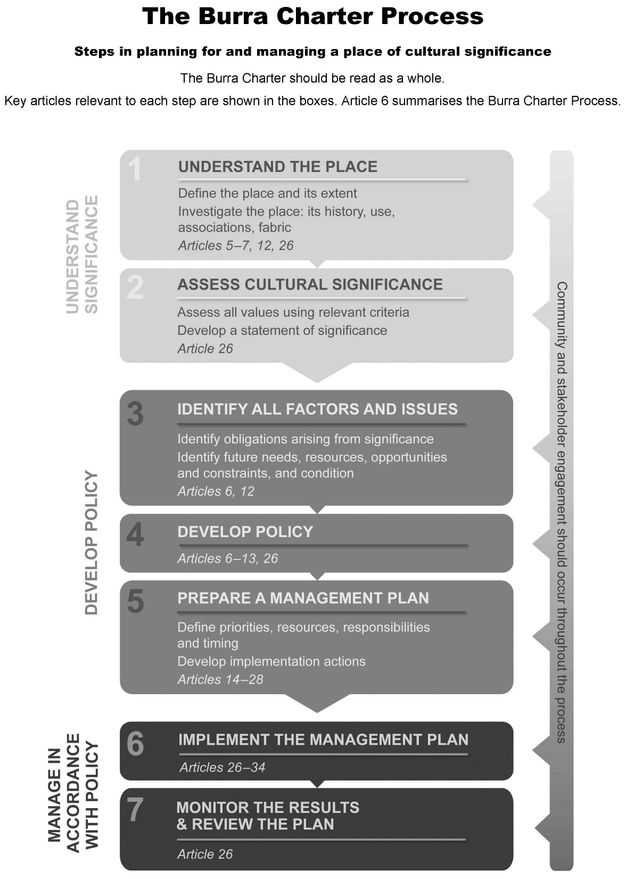
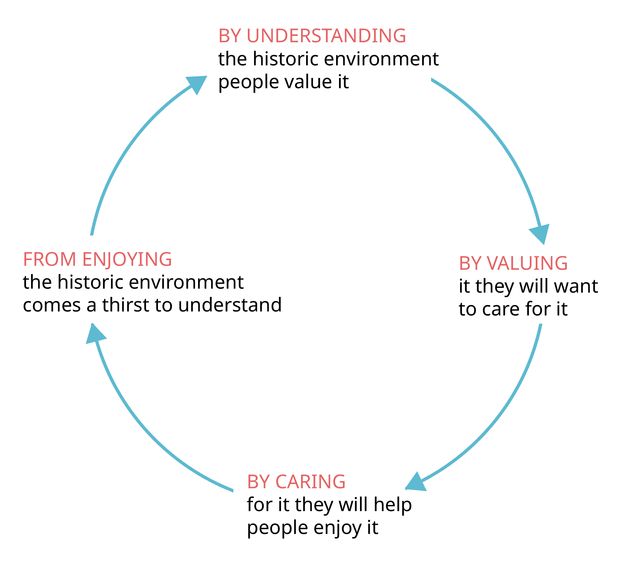
This principle is embedded in the heritage management processes of many nations. For example, the Australia ICOMOS Burra Charter, which establishes national principles for the management and conservation of cultural sites in Australia, provides that the first step of its process (fig. i.1) is to “understand the place” (Australia ICOMOS. 2013a. The Burra Charter: The Australia ICOMOS Charter for Places of Cultural Significance. Burwood, Australia: Australia ICOMOS. https://australia.icomos.org/wp-content/uploads/The-Burra-Charter-2013-Adopted-31.10.2013.pdf). Likewise, in the “virtuous circle” developed by English Heritage as part of its 2005 strategy “to create a cycle of understanding, valuing, caring and enjoying” England’s historic environment (fig. i.2), which continues to influence heritage practice there, the first tenet is that “by understanding the historic environment, people value it” (English Heritage. 2005. English Heritage Strategy 2005–2010: Making the Past Part of Our Future. Swindon, UK: English Heritage. https://historicengland.org.uk/images-books/publications/eh-strategy-2005-2010/making-past-part-of-our-future/). Similarly, guidance for local surveys developed by the U.S. National Park Service states that “to plan for the preservation and enhancement of the historic environment, it is necessary to determine what properties make up that environment” (Derry, Anne, H. Ward Jandl, Carol D. Shull, and Jan Thorman. 1985. National Register Bulletin 24: Guidelines for Local Surveys: A Basis for Preservation Planning. Revised by Patricia L. Parker. Washington, DC: National Register of Historic Places. https://www.nps.gov/subjects/nationalregister/upload/NRB24-Complete_Part1t.pdf; https://www.nps.gov/subjects/nationalregister/upload/NRB24-Complete_Part2.pdf).
Although inventories and related surveys may not provide a comprehensive understanding of heritage, they provide a valuable foundation to gain such understanding, particularly when dealing with large numbers of heritage places at site, regional, national, or international scales. As shown in the Burra Charter flowchart (see fig. i.1), such understanding provides a basis for all of the heritage management and protection activities that follow.
Across the globe, heritage-related legislation at national, regional, and local levels usually mandates the establishment and use of inventories for heritage management and for keeping inventory information current through surveys. The UNESCO Recommendation Concerning the Protection, at National Level, of the Cultural and Natural Heritage (UNESCO. 1972b. Recommendation Concerning the Protection, at National Level, of the Cultural and Natural Heritage. Paris: UNESCO. http://portal.unesco.org/en/ev.php-URL_ID=13087&URL_DO=DO_TOPIC&URL_SECTION=201.html) urges national heritage authorities as a matter of urgency to establish heritage inventories and keep them up to date. For organizations tasked with safeguarding heritage resources, inventories, surveys, and their linkage to legal regimes for heritage protection are the most fundamental means at their disposal for managing change to the built environment.
At an international level, in addition to the above-mentioned UNESCO Recommendation, the importance and role of inventories and of activities keeping them current is recognized in numerous other international heritage charters, conventions, and recommendations developed over the course of modern conservation practice.1 Inventories are further recognized in regional heritage norms (Council of Europe. 1985. Convention for the Protection of the Architectural Heritage of Europe. http://www.coe.int/en/web/conventions/full-list/-/conventions/treaty/121, Council of Europe. 1992. European Convention on the Protection of the Archaeological Heritage (Revised). http://www.coe.int/en/web/conventions/full-list/-/conventions/treaty/143). In 2017 the United Nations Security Council also adopted Resolution 2347, which urged the creation and improvement of national and local heritage inventories to counter illegal attacks against and looting and trafficking of cultural property in relation to armed conflicts (UN Security Council. 2017. S/RES/2347 (on destruction and trafficking of cultural heritage by terrorist groups and in situations of armed conflict). https://www.un.org/securitycouncil/s/res/2347-(2017)). This resolution relates to both immovable and movable heritage.
Widespread Need for Current and Comprehensive Guidance
In recent years, an increasing number of heritage agencies—from both North America and beyond—have been looking to the survey- and inventory-related experiences of the City of Los Angeles in implementing SurveyLA and establishing HistoricPlacesLA (see chapter 5). Over the past two decades the Getty Conservation Institute (GCI) has gathered experience from and exposure to a wide range of international practices, as well as to challenges relating to inventories and surveys of heritage places. This has come about through the GCI’s involvement in laying the groundwork for SurveyLA and the related implementation of HistoricPlacesLA; developing and implementing the Kingdom of Jordan’s national archaeological information system (Myers, David, and Alison Dalgity. 2012. “The Middle Eastern Geodatabase for Antiquities (MEGA): An Open Source GIS-Based Heritage Site Inventory and Management System.” Change Over Time 2, no. 1: 32–57. https://www.getty.edu/conservation/our_projects/field_projects/jordan/mega_jordan_cot_article.pdf); and since 2012 in the development and support for the Arches Heritage Data Management Platform and its growing international open-source community (see chapter 4).
Through these initiatives, the GCI has been involved with establishing new inventory systems in the United States, United Kingdom, Middle East, and China, and has engaged with professionals from across the world involved in heritage inventories and related standards and information technologies. These experiences have revealed renewed and growing interest in heritage inventories and surveys that employ contemporary approaches and effective practices in the field of heritage place management. Perhaps more importantly, these interactions have underscored the urgent need for new and updated guidance on inventories and surveys reflecting technological advancements in data collection and management and shifting mindsets in the heritage field that broaden the types of heritage resources and the reasons they should be identified and recorded, while also providing for greater public input and engagement.
Despite the foundational role of inventories and surveys in heritage management, related guidance that exists on how they should be created, implemented, and maintained is inconsistent and in many instances outdated. The two primary international standards relating to heritage inventories—both of which aim to identify core items of information that should form a part of any cultural heritage inventory—date from the mid-1990s, a relatively early point in the development of digital information systems and before the widespread adoption of geographic information systems.2 In the United States, national professional standards and guidelines for heritage surveys date from the mid-1980s, reflecting a predigital era.3 Today, the body of literature in the United States on survey and inventory methods and practice is scant, other than these arguably outdated technical publications, which still serve as go-to resources for conducting heritage surveys.
Although some jurisdictions do have more current guidance, in our experience interacting with colleagues from a broad range of heritage agencies around the world, more often than not, available guidance on inventories is not only dated but also limited. The impetus for this publication, therefore, is to draw on the authors’ and others’ experiences to fill information gaps by providing practical technical advice, guidance, and lessons learned for creating functional, usable inventories and conducting modern surveys based on current practices in heritage management.
How to Use This Book
This book is organized as follows:
-
This introduction offers a foundational overview of modern inventories and surveys, defining essential concepts and their relation to each other, providing a conceptual framework for their application, and overviewing the range of ways they are used.
-
The main body of the book is divided into four parts: Part I discusses in detail the processes and considerations for developing and implementing inventories, while part II does the same for surveys. Part III describes a range of important uses of heritage inventory and survey information. And part IV contains two case studies on heritage inventories: one of archaeological heritage in Lincoln, England, and a second of intangible heritage in Singapore.
-
A conclusion presents key considerations, common challenges, and potential remedies, as well as forward-looking recommendations relating to initiating, implementing, and sustaining heritage inventories and surveys.
-
In several chapters, sidebars like this one address a variety of relevant topics to both expand upon and augment the authors’ experiences.
-
Figures throughout the book illustrate a variety of structures, tools, and materials used in creating and implementing inventories and planning and conducting surveys. Some chapters in part II also include links to downloadable materials from SurveyLA that can serve as examples.
-
A glossary at the back defines key terms used throughout this text.
-
In addition, for online readers, author-date citations throughout the book provide easy access to related content with just a couple of clicks.
Although the information provided applies to inventories and surveys in a variety of contexts, lessons drawn from SurveyLA are particularly relevant to practice relating to aboveground heritage resources in urban built environments—that is, extant resources that represent important aspects of the architectural, social, cultural, and ethnic history and development of urban areas. More generally, the contents of this book focus primarily on the application of inventories and surveys to the management of heritage places.
Inventories versus Surveys
We have quite frequently encountered a lack of clarity in the heritage field in how inventories and surveys are discussed, with the two terms sometimes used synonymously. Inventories and surveys each serve distinct but complementary roles in heritage practice. It is therefore important to first define what we mean with respect to these two concepts, the relationship between them, and their differences.
The contents of this volume have been prepared under the assumption that the vast majority of inventories and surveys utilize digital technologies, rather than relying on paper-based records, and that survey data should be integrated into a digital inventory.
For the purposes of this volume, we define a heritage inventory as an ongoing record identifying and describing significant, as well as potentially significant, cultural resources. We define a heritage survey as an activity carried out over a specific timeframe to identify, describe, and/or assess the significance of potential cultural resources within a defined geographic area. Surveys may also determine through evaluation which places or properties are not significant.
Heritage Inventories
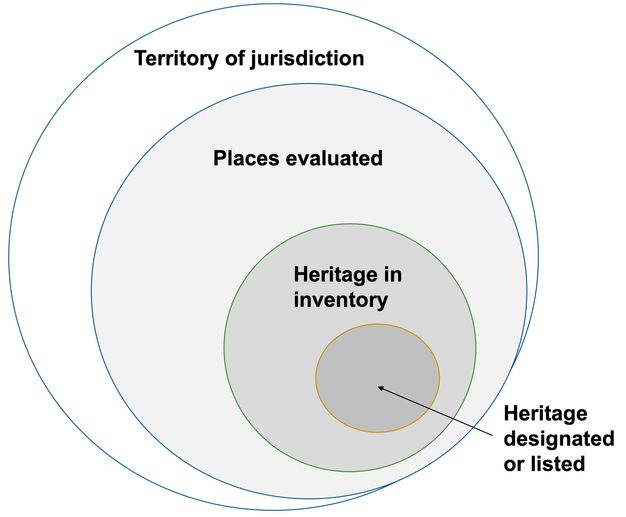
Official heritage inventories maintained by public agencies typically include records of heritage resources designated or listed through statutory lists or registers, as well as properties determined through evaluation to meet a minimum threshold of significance (fig. i.3). While the latter are not formally listed or designated, they may nevertheless need to be considered in planning decisions. Some inventories also include properties determined through assessments to not meet a minimum threshold of significance—another important factor to inform decision-making.4 In addition, inventories may hold records about heritage that no longer exists for purposes of posterity and research. They are established to serve as tools for a range of purposes, including heritage management and protection and public appreciation, as discussed in the Roles of Inventories and Surveys section here and the case studies in part IV.
Official inventories are typically established through legal mandate, in which case they are often known as statutory inventories. Inventories are also often created by nongovernmental organizations (NGOs), professional or voluntary organizations, or researchers with interests relating to geographical areas or topical concerns.5 In many cases, inventories first created by NGOs or researchers have formed the basis for creating or supplementing official or statutory inventories. Inventories are produced at a variety of geographic scales, including international, national, regional, local (e.g., city), and site levels. In some cases, topical or thematic inventories are produced, such as of modern or industrial heritage, shipwrecks, or intangible heritage.
Ideally, information within an inventory evolves as more is learned about heritage places, as additional heritage places are identified, and as the state of those heritage places changes. The physical environment is in a continual state of change, whether due to human or natural forces. Cultural traditions, as well as conceptions of what is culturally significant, also are in an ongoing state of flux. New information periodically emerges about the significance of heritage places, whether through public input or new research. Heritage places are newly revealed from time to time, whether through active investigation or through coincidence, such as in the discovery of subterranean ruins during construction projects.
Heritage Surveys
A heritage survey is one among several types of heritage data collection activities with similar purposes, including historical map regression;6 analysis of remote sensing data such as satellite imagery, aerial photography, or airborne laser scanning (known as lidar); cultural mapping; and archaeological excavations. Ideally, surveys and other data collection activities are designed (before implementation) to collect information in such a way that it can be incorporated efficiently within an ongoing inventory (fig. i.4). Put another way, information within inventories is best kept current as well as improved through surveys and other data collection activities with similar purposes.
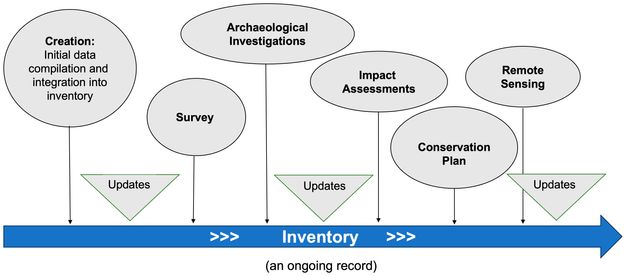
Surveys may be undertaken to create or update an inventory and may have a geographic, thematic, or temporal focus. Some surveys cover entire geographic areas that have never been surveyed or formally investigated or focus on subareas that have not been included in previous surveys of a geographic area. Others focus on heritage typologies that are underrepresented in existing inventories or are from certain time periods that have never been recorded. Surveys may also be geared toward updating existing information on heritage places, for example, after a substantial amount of time has elapsed since a prior survey, in advance of planned development in an area, or in direct response to changes in the built environment, such as in the wake of natural disasters or conflicts.
Survey information provides a snapshot from a specific point in time. Potentially, a heritage resource could be demolished or substantially altered within weeks or months after it has been recorded through a survey. This is just one example of how, over time, much of the information gathered through a survey will inevitably become increasingly outdated. Thus, there is a need for long-term planning to carry out ongoing surveys over time to feed into a collective inventory record.
Roles of Inventories and Surveys in Heritage Management
Inventories and surveys in tandem play a variety of important roles in heritage management. As shown in figure i.5, these functions can be divided broadly between those that aid in understanding heritage and those aimed at using that understanding to make decisions and take actions with respect to heritage. Regarding the “understanding” function, the primary purpose of inventories and surveys is to identify, describe, and collect assessments of heritage resources deemed to be significant or potentially significant—or those not deemed significant. Crucially, they can provide a basis for monitoring and understanding changes to significant heritage resources over time. Inventories and surveys can also be valuable tools for progressing knowledge and understanding of the collective historic environment over broad areas, to whatever geographic extent they pertain. Such a knowledge base can be progressively added to over time through successive surveys and other data collection activities.
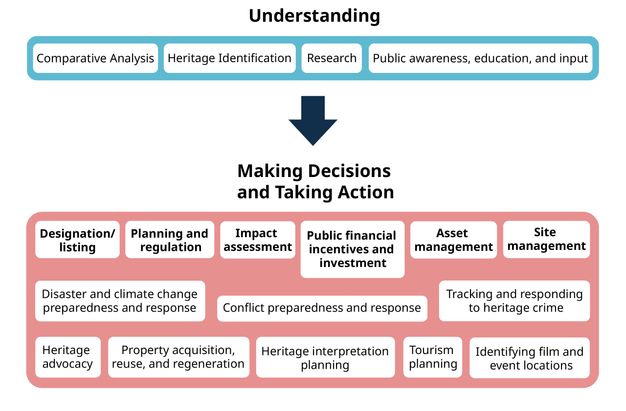
Making inventories publicly accessible and seeking public participation in reference to both inventories and related surveys can be highly beneficial. This effort can serve as a means to elicit from stakeholders information about heritage resources not included in inventories and can allow them to contribute additional information to existing records to supplement or improve those records. This input can be particularly useful in the identification of heritage resources that are significant for their historical, ethnic, and cultural associations in ways that may not be readily apparent through visual inspection. Inventories and surveys can, in this way, provide mechanisms to generate and foster public engagement in heritage identification, understanding, and management.
In certain cases, inventory and survey information should be made confidential and access to it restricted to only those with a legitimate need or right to access. The need for limited access often arises with places held sacred by indigenous peoples, as well as with archaeological sites deemed to be at risk from looting. In many jurisdictions, laws or policies dictate confidentiality and restrict access to information concerning these types of heritage places. Detailed information on places held sacred by indigenous peoples and certain archaeological sites should be made accessible only to those who have been identified as authorized users and secured from all others.
Well-structured inventory and related survey data can aid in the classification of heritage resources. This can, in turn, enable the recognition of broad historical and cultural patterns, taking into account geographic and temporal dimensions. Inventories and surveys can thus serve as valuable bases for both answering research questions and identifying underexamined areas in need of new investigation. They can enable comparative analysis of specific resource types, including with respect to resource integrity (further discussed in part II), to better understand their commonality or rarity and assess their relative significance. For example, such analysis could show that a theater may be the only surviving example retaining the character-defining features of its typology and architectural style. In a sense, an inventory and the surveys that feed into it can provide a broad overview of the historic environment—thus allowing us to see the forest at macro scale, and the patterns within it, including interconnections and gaps, rather than only the individual trees.
By providing this basis of understanding, or evidence base, as it is referred to in the U.K., inventories and related surveys are poised to serve the more active functions of making decisions and taking actions that serve public agencies’ mandates of heritage conservation, protection, management, and valorization. When connected to legal and policy regimes, they serve to identify which heritage resources are officially designated or listed; which merit protection, regulation, or incentives; and which should receive formal consideration within regulatory processes. In this respect, inventories and surveys aid in providing for sensitive development, for example by supplying the information needed to impact assessment processes and to help determine priorities in targeting heritage utilization and regeneration.
In addition, by serving as a basis for monitoring change, surveys and inventories can help heritage organizations recognize the need for interventions for heritage conservation and protection. This can include providing a basis for recording, analyzing, and responding to illegal activities affecting heritage resources, such as looting and illicit demolitions. They also serve as essential sources for public agencies to use in formulating and implementing informed planning programs, policies, and strategies that take into account the significance of heritage resources. The recognition of significant heritage resources through publicly accessible inventories also promotes broader public understanding, appreciation, and engagement with those places, which is often an important factor in heritage stewardship. This fact makes accessible inventories, as well as public involvement in both inventories and surveys, instrumental features in stimulating the “virtuous circle” developed by English Heritage (see fig. i.2).
As discussed in chapter 12, in formulating a response to heritage being caught in the midst of disaster situations—earthquake, fire, flood, or tsunami—one of the first needs is to consult an inventory. Such data can provide an essential basis for understanding the significance of damaged and at-risk heritage and determining intervention priorities. Given the urgency of emergent disaster situations and the competing demands they create, to prepare for future disasters, it is recommended that inventory information be both comprehensive and kept current through ongoing survey activities (Stovel, Herb. 1998. Risk Preparedness: A Management Manual for World Cultural Heritage. Rome: ICCROM. https://www.iccrom.org/publication/risk-preparedness-management-manual-world-cultural-heritage). The need for these tools is becoming increasingly apparent due to climate change, whether in coastal areas that urgently need to prepare for and respond to rising sea level, or severe storm events that seemingly may now occur anywhere.
Inventories and related surveys are also critical to heritage protection with respect to armed conflicts. This is the case from both legal and practical standpoints. Inventories are a key feature of the Second Protocol to the Hague Convention of 1954 for the Protection of Cultural Property in the Event of Armed Conflict (UNESCO. 1999. Second Protocol to the Hague Convention of 1954 for the Protection of Cultural Property in the Event of Armed Conflict. Paris: UNESCO. http://portal.unesco.org/en/ev.php-URL_ID=15207&URL_DO=DO_TOPIC&URL_SECTION=201.html), which calls for their compilation as a peacetime preparatory measure. Armed forces are obliged to identify important cultural sites to be avoided in military operations, whether aerial bombing, missile strikes or artillery fire, or on-ground operations. As part of the process, consultation and cooperation between militaries and heritage organizations and practitioners, such as through Blue Shield national committees, are essential to heritage protection (Stone, Peter. 2013. “War and Heritage: Using Inventories to Protect Cultural Property.” Conservation Perspectives: The GCI Newsletter 28, no. 2 (Fall): 13–15. https://www.getty.edu/conservation/publications_resources/newsletters/pdf/v28n2.pdf). For postconflict situations, inventories and related condition surveys are crucial to systematically determining intervention priorities. Inventories and postconflict assessments have also contributed to the legal prosecution—and in some cases conviction—of individuals involved in intentional destruction of cultural heritage within conflicts.
In pursuing the multifaceted aims of sustainable development, inventories and surveys employed deftly through modern information technologies have the potential to be among heritage organizations’ most essential tools. They can provide for proactively responding to transformational forces with the aim of enabling the continued existence and use of significant heritage to be the patrimony of future generations. Without robust inventories and surveys, the effectiveness of government agencies tasked with protecting heritage would be substantially weakened, leaving heritage at risk due to a lack of essential information.
Current Trends and Approaches Relating to Inventories and Surveys
In recent decades, public agencies responsible for heritage stewardship have shown growing interest in heritage inventories and surveys. We believe this interest has arisen as a result of a few different factors, in combination with the fundamental and wide-ranging utility of information provided through inventories and surveys to heritage management.
Perhaps most noteworthy is the global need for up-to-date information to manage heritage assets in an era of rapidly increasing urbanization and development. Urban centers are experiencing fast-paced growth, resulting in pressure to improve and expand infrastructure, create more housing, revitalize neighborhoods and urban centers, develop transit-oriented communities, and embrace diversity, while also dealing with issues including gentrification, displacement, and economic inequality. Cities experiencing growth need current, usable information to plan for redevelopment, reutilization, and regeneration of heritage resources in existing urban areas, as well as new development in geographically expanding cities, including planning for large-scale transportation projects: highways and above- and belowground rail lines, for example.
Many older inventories tend to focus on pre–Second World War heritage. In recent years the imperative to have current information has led to an emerging priority to record the “recent past” and themes such as modern architecture and design and suburbanization, the latter of which covers vast geographic areas of development.
Cities experiencing dramatic population decreases, such as those in the United States’ Rust Belt that have lost manufacturing industries through technological obsolescence or globalization, also need up-to-date information to decide how to deal with vacant historic properties and public spaces and facilities increasingly falling into disrepair. This situation has entailed at times a need to decide which buildings or structures should be demolished and which merit public protection and support or conversion to new uses.
Usable information on heritage resources is critical to meeting planning objectives for growth and change. Many heritage agencies are faced with the challenge of working with data in various formats, many of which are largely unusable or inaccessible, including decades-old paper-based records. Others have in the past made substantial investments in creating rudimentary databases to serve as inventory systems—which have since increasingly become antiquated and in need of replacement and modernization. Technological advancements have created new possibilities for more easily collecting digital data and making it accessible and searchable online.
Another factor encouraging recent interest in inventories and surveys has been the progressively expanding definition of what constitutes cultural heritage. This expansion has resulted, in many instances, in the need to identify and take account of heritage not previously receiving comprehensive official recognition by public heritage agencies. The past focus within heritage practice on aesthetics, monumental architecture, and individual buildings has broadened to be more inclusive of places and their diverse histories and community narratives and the variety of resource types they represent. This wider focus includes recognition of cultural landscapes, historic urban landscapes, and the heritage of underrecognized groups such as ethnic and LGBTQ populations, as well as intangible heritage: folklore, customs, beliefs, traditions, knowledge, and language—and the relationships among them (explored further in chapter 14, on intangible heritage in Singapore).
From a practical standpoint, the identification of heritage resources in line with the expanding notion of what is culturally significant has been facilitated in some countries by an increasing reliance on thematic frameworks, theme studies, and historic contexts (explored in detail in chapter 2). These tools have also served as mechanisms for recognizing places of ethnic, social, and cultural significance that were largely underrepresented in earlier inventories and surveys. The identification of these places and traditions of social significance necessitates that modern survey methods engage all segments of the public as expert sources of information on places they value and as stakeholders in developing planning initiatives to enhance and celebrate them.
Recent trends in planning and heritage management to identify and preserve community, neighborhood, and landscape character have spurred interest in developing new survey methods that focus on collecting information at the area scale rather than by individual property or heritage resource. This trend has played out in international practice with the development and application of methods relating to cultural landscapes—and more recently urban heritage—such as the Historic Urban Landscape approach adopted in 2011 by UNESCO’s General Conference (UNESCO. 2011b. “UNESCO Recommendation on the Historic Urban Landscape.” UNESCO World Heritage Convention. https://whc.unesco.org/en/hul/).
Undoubtedly, the rapid advancement and proliferation of mobile and web-based information technologies, including the ease of digital photography and video and social media, have vastly increased the ability to capture and share information about heritage resources. These technological advances have further enabled public input and comment on what is identified as heritage, as well as public reporting on adverse impacts to such resources, and have helped increase public participation in the heritage identification process through crowdsourcing efforts. At the same time, a widespread, long-term trend of decreasing public funding for heritage agencies mandated to identify and protect heritage resources has often meant that such agencies have struggled to keep up with advancing information technologies, the need to keep information on heritage resources current and accessible, and the work of further engaging with increased public participation. These trends have also, together, at times raised questions about when the involvement of trained heritage professionals is warranted, as opposed to volunteer or crowdsourcing efforts.
We will attempt to address these and other emerging trends and challenges in the chapters that follow.
Notes
-
See Congress Internationaux d’Architecture Moderne (CIAM). 1946. La Charte d’Athenes or The Athens Charter, 1933. Translated by J. Tyrwhitt. Paris: Library of the Graduate School of Design, Harvard University. https://web.archive.org/web/20230206153753/http://www.getty.edu/conservation/publications_resources/research_resources/charters/charter04.html; UNESCO. 1968. Recommendation Concerning the Preservation of Cultural Property Endangered by Public or Private Works. Paris: UNESCO. http://portal.unesco.org/en/ev.php-URL_ID=13085&URL_DO=DO_TOPIC&URL_SECTION=201.html, UNESCO. 1970. Convention on the Means of Prohibiting and Preventing the Illicit Import, Export and Transfer of Ownership of Cultural Property. http://portal.unesco.org/en/ev.php-URL_ID=13039&URL_DO=DO_TOPIC&URL_SECTION=201.html, UNESCO. 1972a. Convention Concerning the Protection of the World Cultural and Natural Heritage. Paris: UNESCO. http://whc.unesco.org/en/conventiontext/, UNESCO. 1976. Recommendation Concerning the Safeguarding and Contemporary Role of Historic Areas. Paris: UNESCO. http://portal.unesco.org/en/ev.php-URL_ID=13133&URL_DO=DO_TOPIC&URL_SECTION=201.html; ICOMOS, International Committee on Archaeological Heritage Management (ICAHM). 1990. ICOMOS Charter for the Protection and Management of the Archaeological Heritage. https://www.icomos.org/images/DOCUMENTS/Charters/arch_e.pdf; ICOMOS. 1996. Principles for the Recording of Monuments, Groups of Buildings and Sites. Paris: ICOMOS. https://www.icomos.org/en/charters-and-texts/179-articles-en-francais/ressources/charters-and-standards/387-principles-for-the-recording-of-monuments-groups-of-buildings-and-sites-1996; UNESCO. 1999. Second Protocol to the Hague Convention of 1954 for the Protection of Cultural Property in the Event of Armed Conflict. Paris: UNESCO. http://portal.unesco.org/en/ev.php-URL_ID=15207&URL_DO=DO_TOPIC&URL_SECTION=201.html, UNESCO. 2001. Convention on the Protection of Underwater Cultural Heritage. Paris: UNESCO. http://unesdoc.unesco.org/images/0012/001260/126065e.pdf, UNESCO. 2003. Convention for the Safeguarding of the Intangible Cultural Heritage. Paris: UNESCO. https://ich.unesco.org/en/convention; ICOMOS, International Scientific Committee on Cultural Routes (CIIC). 2008. The ICOMOS Charter on Cultural Routes. Paris: ICOMOS. https://www.icomos.org/images/DOCUMENTS/Charters/culturalroutes_e.pdf; ICOMOS. 2011b. The Valletta Principles for the Safeguarding and Management of Historic Cities, Towns and Urban Areas. Paris: ICOMOS. https://civvih.icomos.org/wp-content/uploads/2022/03/Valletta-Principles-GA-_EN_FR_28_11_2011.pdf; ICOMOS and The International Committee for the Conservation of Industrial Heritage (TICCIH). 2011. Joint ICOMOS-TICCIH Principles for the Conservation of Industrial Heritage Sites, Structures, Areas and Landscapes. Paris: ICOMOS. https://www.icomos.org/images/DOCUMENTS/Charters/GA2011_ICOMOS_TICCIH_joint_principles_EN_FR_final_20120110.pdf; ICOMOS. 2017. Salalah Guidelines for the Management of Public Archaeological Sites. Paris: ICOMOS. https://www.icomos.org/images/DOCUMENTS/Charters/GA2017_6-3-3_SalalahGuidelines_EN_adopted-15122017.pdf; ICOMOS, International Committee on Twentieth Century Heritage (ISC20C). 2017. Madrid-New Delhi Document (Approaches to the Conservation of Twentieth-Century Cultural Heritage). Paris: ICOMOS. https://isc20c.icomos.org/resources/mndd/mndd-full-document-translations/; and ICOMOS and International Federation of Landscape Architects (IFLA). 2017. ICOMOS-IFLA Principles Concerning Rural Landscapes as Heritage. Paris: ICOMOS. https://www.icomos.org/images/DOCUMENTS/Charters/GA2017_6-3-1_RuralLandscapesPrinciples_EN_adopted-15122017.pdf. ↩︎
-
Those two international standards, both adopted in 1995, are the Core Data Index to Historic Buildings and Monuments of the Architectural Heritage (Council of Europe. 1995. Core Data Index to Historic Buildings and Monuments of the Architectural Heritage. Reproduced in Documenting the Cultural Heritage, edited by Robin Thornes and John Bold (1998), Los Angeles: J. Paul Getty Trust.), and the International Core Data Standard for Archaeological Sites and Monuments, adopted by the International Committee for Documentation (CIDOC) of the International Council of Museums (ICOM) and the Council of Europe (Council of Europe, Council for Cultural Co-operation. 1999. International Core Data Standard for Archaeological Sites and Monuments. Strasbourg: Council of Europe.; see also Thornes, Robin, and John Bold. 1998. Documenting the Cultural Heritage, Los Angeles: J. Paul Getty Trust. https://www.getty.edu/publications/virtuallibrary/9780892365432.html). ↩︎
-
These include National Register Bulletin 24: Guidelines for Local Surveys: A Basis for Preservation Planning (Derry, Anne, H. Ward Jandl, Carol D. Shull, and Jan Thorman. 1985. National Register Bulletin 24: Guidelines for Local Surveys: A Basis for Preservation Planning. Revised by Patricia L. Parker. Washington, DC: National Register of Historic Places. https://www.nps.gov/subjects/nationalregister/upload/NRB24-Complete_Part1t.pdf; https://www.nps.gov/subjects/nationalregister/upload/NRB24-Complete_Part2.pdf) and the Secretary of the Interior’s Standards and Guidelines for Archaeology and Historic Preservation (National Park Service. 1983. Archaeology and Historic Preservation: Secretary of the Interior’s Standards and Guidelines. Washington, DC: U.S. Department of the Interior. https://www.nps.gov/subjects/historicpreservation/upload/standards-guidelines-archeology-historic-preservation.pdf). ↩︎
-
Inclusion of properties that have been surveyed and determined to not meet significance thresholds provides essential information for planning and ensures they are not unintentionally resurveyed over time. ↩︎
-
For example, Docomomo International, as well as many national chapters of Docomomo, have created registers identifying and documenting significant buildings, sites, and neighborhoods of the modern movement, and these are added to on an ongoing basis. One of the specialist committees of Docomomo International is also devoted to such registers. Further information is available at https://docomomo.com/iscs/. ↩︎
-
See further explanation of historical map regression in the glossary. ↩︎