The publication of survey results marks the final step in the heritage survey process. While digital survey data are published in an associated inventory, survey results can also be published in the form of a written report or reports. This chapter discusses both of these publishing formats.
Data Integration
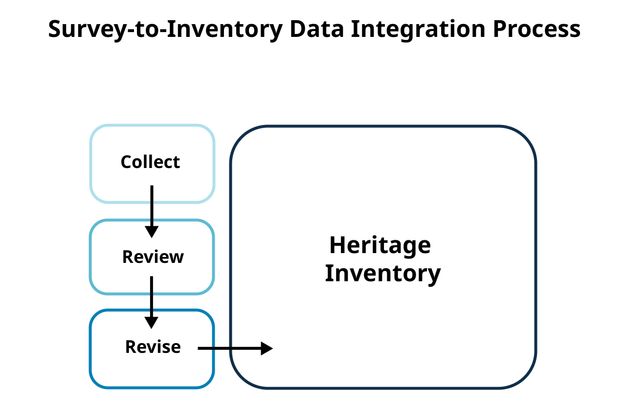
Data integration, as it relates to heritage inventories, is the process of adding or merging data from multiple sources into an inventory to publish it and provide users with a unified view of the data. When the same software, data structure and content (e.g., terminology), and methodological approaches are used to both collect and publish survey data, the integration process is ongoing as data is collected. If these factors differ from those used to publish the data, data migration is necessary. Data migration is a process through which data is verified and changes are made to ensure the data content and format are compatible, readable, and/or interoperable for successful integration into the software that will be used to publish it.
The procedures to achieve data integration can vary in complexity and time required, depending on the amount of data and the degree of compatibility between the survey and inventory systems. For this reason it is strongly urged that survey planning give due attention to ensuring compatibility between field data collection and associated inventory information systems regarding software, methodologies, and terminologies to be used before survey work begins (see chapters 7 and 8).
While quality control review and data validation take time regardless of the data collection system, it is far more complex and time consuming to introduce to an inventory data that was recorded through a separate system not associated with the inventory. SurveyLA data, for example, was collected through a separate application not associated with HistoricPlacesLA, the city’s heritage inventory system, which was in development at the time of SurveyLA (see chapter 5), consequently, SurveyLA data included different terminology than that used in the inventory. To integrate and publish the survey data in HistoricPlacesLA, the terminology needed to be reconciled as part of the data migration process. This process included conversion of existing data and the limited creation of supplemental data to match the underlying methodologies of the inventory system. For reasons such as this, it is a less troublesome path to record data through a system directly associated with or built into the inventory.
The ongoing experiences of the authors provide thoughts and recommendations for others charged with data integration and management:
-
Data integration will take considerable time, particularly if the data collection system has not been designed with inventory data upload or integration in mind. However, a data collection system independent of the inventory system can be designed or configured to facilitate easier data integration. Be sure to allow sufficient time and resources for either approach.
-
For quality control reasons, limit the number of people involved with data integration. Ideally, one person—a data manager—will perform and oversee data integration.
-
Additional support personnel for data review and editing will help to facilitate faster data processing and formatting. For example, detail-oriented interns with relevant experience can help prepare records for integration under the direction of the data manager.
-
For new inventories, the initial process of adding data can help establish a workflow and specific protocols for data entry, review, validation, and editing during the survey process (see chapter 8), as well as processes for data entry and editing within the inventory after survey data is published.
-
For established inventories, the overall process of data integration to the inventory serves as an opportunity to examine the content compatibility and uniformity of the data that is being migrated into the inventory. While time-consuming, this step ultimately helps refine existing procedures and protocols to best serve data quality and the growth of the inventory. It can also help define what data is necessary to constitute a complete record in the inventory and, conversely, what data may not be pertinent within the inventory.
-
Preparing survey data for inventory integration requires a detailed and cautious review by the data manager, who must identify any commonalities and differences between the inventory system data structure and that of the survey. Most often these can be found in the controlled vocabularies used for the organization of data. For example, the survey data in review for integration may include the use of different, yet parallel, terminology than that established for the inventory. Alternatively, the survey data in review for integration may include terminology for which an equivalent term is lacking in the inventory. It is critical to reconcile discrepancies such as these before survey data is integrated into the inventory. In cases when it is not possible to import or merge records simply, it may be necessary to edit the existing inventory, the survey data structure, or the controlled vocabularies to support the data being integrated.
Figure 11.1 illustrates the steps necessary to integrate survey data that is not recorded directly into an inventory system.
Final Survey Reports
The jurisdictional survey standards and guidelines adopted for a survey may include detailed final reporting requirements to follow once a survey is complete. Final reports may also be required by an agency or organization that partnered in the survey or that provided funding for the survey. In addition to any technical requirements, it is important that survey reports be understandable and accessible to the public.
Public reports are an important source of information describing and explaining the survey project and summarizing findings. For smaller surveys, a single report may be completed; for larger-scale surveys, a series of reports may be needed, perhaps to coordinate with a survey phasing plan. Where multiple reports are prepared over time, it is recommended that a report template be developed so that each report is consistent in format and content and can be easily recognized as part of the survey.
It is also recommended that reports describe aspects of a survey project with respect to:
-
Who commissioned, carried out, and supported the survey
-
What types of heritage resources were surveyed
-
When survey activities were carried out—the overall timeframe
-
Where survey activities occurred—the geographic extent
-
How the survey was done—the methodology and standards followed
For SurveyLA, thirty-five separate reports were prepared by survey consultant teams, corresponding with the thirty-five community plan areas surveyed (Los Angeles City Planning Department. n.d.b. “Historic Resources Surveys: SurveyLA Findings by Community Plan Area” (interactive map). Accessed August 3, 2023. https://planning.lacity.gov/preservation-design/historic-resources-survey). The report for each area included appendices summarizing survey findings by resource category used for SurveyLA (e.g., individual properties, historic districts, etc.), and they were published sequentially as the surveys were completed. The Field Survey Results Master Report was also developed to function as a cover document for the plan area reports (Los Angeles City Planning Department. 2016b. SurveyLA Field Survey Results Master Report. Los Angeles: City of Los Angeles, Department of City Planning. https://planning.lacity.gov/odocument/c118f301-cc39-4ede-af5a-3e5ec901e7be/SurveyLA_Master_Report.pdf). It explains the survey data collection tools and methods, introduces the citywide historic context statement, and outlines the resource evaluation and documentation process.
The report formats developed for SurveyLA may serve as useful references or templates. A sample report is shown in resource 11.1.
Resource 11.1 SurveyLA Historic Resources Survey Report: Northeast Los Angeles Community Plan Area
Download Report Download the PDF
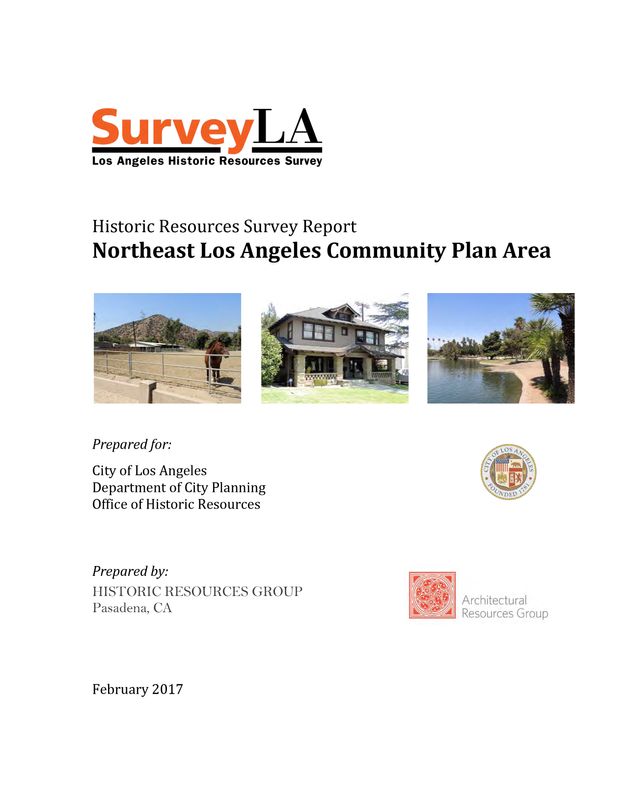
Table of Contents
-
Project Overview
- SurveyLA Methodology Summary
- Project Team
- Survey Area
- Designated Resources
- Community Plan Area Survey Methodology
-
Summary of Findings
- Summary of Property Types
- Summary of Contexts and Themes
- For Further Reading
-
Appendices
- Appendix A: Individual Resources
- Appendix B: Non-Parcel Resources
- Appendix C: Historic Districts & Planning Districts
Publishing Survey Reports
Survey reports can be published to serve a range of users and uses. Public websites are a primary venue for publication as they are widely accessible. SurveyLA reports, for example, are published on Los Angeles City Planning’s Historic Preservation, Historic Resources Surveys webpage, where they are accessible via an interactive map featuring all of the city’s community plan areas (Los Angeles City Planning Department. n.d.b. “Historic Resources Surveys: SurveyLA Findings by Community Plan Area” (interactive map). Accessed August 3, 2023. https://planning.lacity.gov/preservation-design/historic-resources-survey). Selecting and clicking on any one area on the map navigates to a list of hyperlinks corresponding to the survey report and appendices for that area. SurveyLA reports are also accessible through the online inventory, HistoricPlacesLA (City of Los Angeles, Office of Historic Resources. n.d. HistoricPlacesLA. Accessed June 20, 2023. https://hpla.lacity.org/), where the profile for each SurveyLA-recorded resource includes a hyperlink to the corresponding report.
Ultimately, published survey findings, both in the inventory and in report format, provide information to support preservation programs and initiatives by public agencies, heritage organizations, and community members, as explored further in chapter 12.