Part II of this book aims to provide a framework and practical guidance for planning, designing, and carrying out modern heritage surveys. Modern in this context is meant to refer to survey practices that use the latest methods, technologies (particularly digital), tools, and concepts in heritage conservation.
This narrative includes recommendations, considerations, and pointers for surveys drawn largely from my (Janet Hansen’s) hands-on experiences and lessons learned in my role as lead author and manager of SurveyLA, the citywide survey of Los Angeles. City staff, consultants, and others directly involved in the project also contributed to the content.
As described in chapter 5, SurveyLA is the outgrowth of earlier research and study by the Getty Conservation Institute (GCI) to establish the need for and benefits of a survey of Los Angeles and to provide a blueprint for how it could be completed. This information served as an indispensable starting point for the city in undertaking a survey of unprecedented size and scope and implementing innovative methodologies. Various strategies were tried, tested, and revised over the course of the multiyear survey. While in the end SurveyLA proved successful for Los Angeles, it has also gained ongoing international interest as a demonstration project for completing surveys.
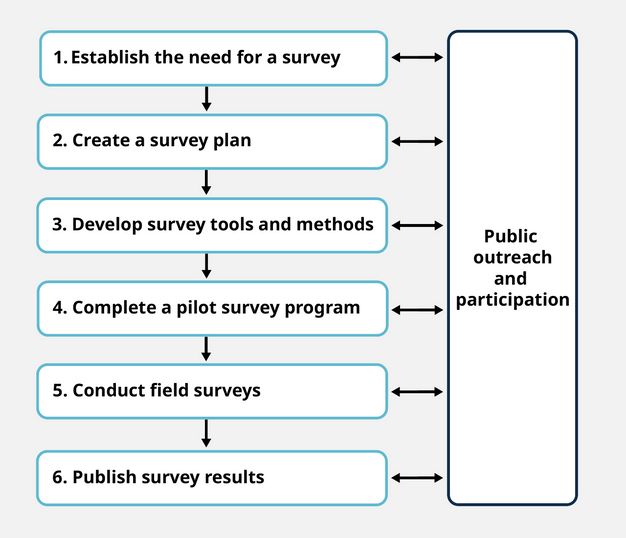
Using the experience of SurveyLA, part II presents the heritage survey process as a series of steps (fig. II.1) that are summarized below and detailed in the chapters that follow.
-
Establish the need for a survey to assess the scope and type of information to be collected and to formulate survey goals and objectives, including the proposed uses of the resulting data and inventory to inform heritage management (see chapter 6).
-
Create a survey plan to determine the elements of the survey and to provide a framework for how it will be carried out and administered (see chapter 7).
-
Develop survey tools and methods to guide data collection and recording processes and procedures (see chapter 8).
-
Complete a pilot survey program to test, refine, and finalize survey tools and methods (see chapter 9).
-
Conduct field surveys to identify, evaluate, and document heritage resources that reflect the goals, objectives, and scope of the survey (see chapter 10).
-
Publish survey results through an associated heritage inventory system and other means (e.g., reports) that are accessible to a range of users (see chapter 11).
While the Los Angeles survey focused on a large-scale urban environment, those of us authoring this section have sought to generalize the guidance to be applicable to surveys in varying environments, cover a range of heritage typologies, and to encompass geographic areas of differing sizes and complexities.1
Defining Characteristics of Modern Surveys
Surveys are essential to identifying and understanding an area’s heritage and have long been a key element of effective heritage planning and management. While modern surveys are generally grounded in established standards and guidelines, they have several distinguishing characteristics that set them apart from those of the past; these characteristics are introduced below and discussed in chapters throughout part II.
Perhaps the most important characteristic of a modern survey is the use of digital technologies, which have fundamentally changed the way field surveys are completed. The practice of surveying with paper, pencil, and film photography has been supplanted by the use of portable computer devices loaded with survey software, interactive digital maps, land use information, and other data. Surveyors can record precise geographic locations and document resource history, description, and significance using controlled vocabularies and drop-down menus. Digital technology also facilitates associated research activities as more and more sources become readily available on mobile and desktop computers. But while digital surveys may be more accurate and efficient than past surveys, they also require substantial upfront time to prepare data collection tools and methods and post-field time for data integration and management.
Surveys today also go beyond the traditional focus on monumental buildings and architecture to cover a wide range of heritage themes and typologies that represent a more holistic and inclusive view of the history and development of an area. In countries including the United States, Canada, and Australia, thematic frameworks, theme studies, and historic context statements are being used to systematically guide resource identification and evaluation as part of survey work (see the sidebar on this subject and related information in chapter 2). These mechanisms help ensure that surveys incorporate expanding definitions of heritage and heritage value and represent diverse populations and multiple narratives. They also provide a means to identify and consistently categorize and evaluate resources. Importantly, they can be designed for use in digital format and applied directly in the field.
Finally, an increasingly central feature of modern surveys is public outreach and the associated participation programs. When effective, these efforts are far-reaching, diverse, and integral to all steps of the survey process (see fig. II.1). Such programs may incorporate a range of strategies to directly involve communities in documenting their stories, foster partnerships and collaborations, and incite interest in a survey generally (Hansen, Janet, and Sara Delgadillo Cruz. 2019. “Big City, Big Data: Los Angeles’s Historic Resources.” In Preservation and the New Data Landscape, edited by Erica Avrami. New York: Columbia University Press, 21–36. https://www.arch.columbia.edu/books/reader/370-preservation-and-the-new-data-landscape#reader-anchor-2). Today, developing and implementing thoughtful and innovative approaches to survey outreach can be a substantial, time-intensive effort that requires specialized expertise in community engagement.
Undertaking Heritage Surveys
A heritage survey can be initiated by governmental agencies, NGOs, or partnerships between the two. Surveys are generally most impactful for heritage management when they are officially endorsed and managed by agencies charged with enforcing heritage legislation, such as local, regional, and national governments (Derry, Anne, H. Ward Jandl, Carol D. Shull, and Jan Thorman. 1985. National Register Bulletin 24: Guidelines for Local Surveys: A Basis for Preservation Planning. Revised by Patricia L. Parker. Washington, DC: National Register of Historic Places. https://www.nps.gov/subjects/nationalregister/upload/NRB24-Complete_Part1t.pdf; https://www.nps.gov/subjects/nationalregister/upload/NRB24-Complete_Part2.pdf). In some cases, heritage surveys may originate from programs and activities led by local universities, museums, heritage organizations, or community groups, often working toward collaborations with governmental agencies. The concept for a citywide survey of Los Angeles, for example, started as a research project of the GCI; SurveyLA subsequently became a public-private partnership between the city and the Getty.
The commitment to undertake a survey is generally secured at the beginning or upon completion of step 1 or 2 of the survey process, and it may come in phases. For example, early interest in a survey may result in funding a needs assessment, the findings of which may then provide the basis for securing a commitment to move forward with survey planning. The plan, in turn, can provide information to support allocating resources needed to complete a survey, often over a protracted period of time. The needs assessment and survey plan discussed further in the following chapters are foundational to organizational buy-in for a survey.
Notes
-
SurveyLA did not include archaeological resources or resources associated with indigenous peoples. Though these topics, as well as intangible heritage, are not explored in detail in part II, they are touched on throughout this publication. Archaeological resources are specifically addressed in chapter 13, and an intangible heritage inventory is described in chapter 14. ↩︎