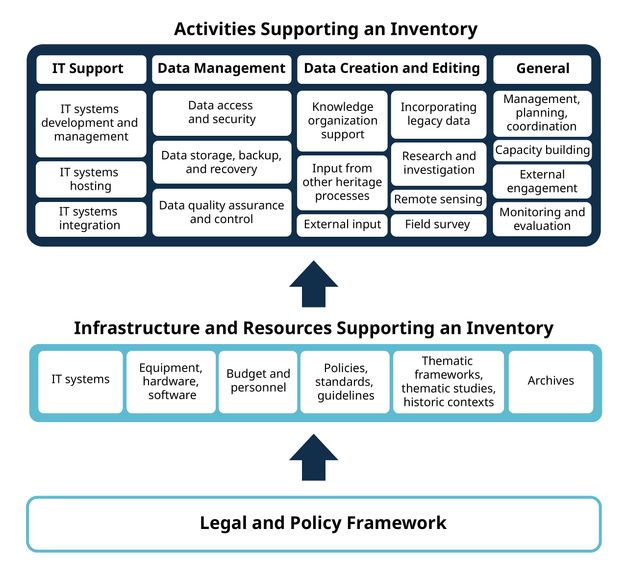
As discussed in the introduction, heritage inventories are considered to be ongoing records to be added to, improved, and updated over time. The introduction also covered a broad range of ways that inventories are typically utilized in heritage conservation and management. The assumptions that inventories need to be regularly improved and are in ongoing use in turn assume that an inventory program will be in a state of constant evolution. Therefore, to be effective, a heritage inventory program will require continuing support through an assortment of infrastructure, resources, and activities. Figure 2.1 lists the types of infrastructure, resources, and activities that an inventory program may require. While some of those support elements are critical to any inventory program, the necessity of others will depend on the size and nature of any given heritage organization, its mandate, and its particular inventory. This chapter discusses the elements of figure 2.1 and how each of them can support an inventory’s effectiveness.
Support through a Legal and Policy Framework
Perhaps the most important measure for making an inventory an effective mechanism for heritage management is providing that it is authorized and supported by a legal and policy framework. A statutory inventory is recognized by law as the authoritative information source upon which governmental decision-making regarding heritage is to be based. Such legal and policy frameworks typically specify all of the official mandates of public agencies relating to heritage protection and valorization, such as listing or designation, regulation, asset management, and providing financial incentives. A legal and policy framework can ensure that an inventory is officially sanctioned as the authoritative information record for the day-to-day application of heritage-related laws and policies, and can secure a government obligation to support it.
The following are examples of specific ways that legal and policy frameworks may provide support to heritage inventories and associated data collection activities.
-
Providing for the establishment of an inventory, and recognizing it as an official, authoritative record (i.e., statutory inventory)
-
Recognizing necessary sources of support for an inventory and its programmatic requirements, which may be through funding or revenue generation
-
Identifying roles and responsibilities of specific organizations with respect to an inventory, including obligations of specific organizations to regularly contribute information
-
Defining baseline information content of an inventory
-
Providing that heritage agencies keep an inventory up to date, adhere to related standards, and maintain defined levels of service
-
Identifying the official language(s) of an inventory
-
Mandating uses of an inventory, such as to serve as the basis for development planning and impact assessment; to inform heritage regeneration, conservation, and management projects, and governmental strategic policies and plans; and to ensure that heritage agencies provide advice based on the inventory
-
Requiring community and public consultation and input with respect to an inventory
-
Providing for public access to an inventory, establishing an information access policy, and defining confidentiality of certain types of inventory information, such as that relating to sensitive archaeological sites and sites held sacred by indigenous groups
In some cases, laws or their associated regulations identify criteria and thresholds for the assessment of heritage places to determine whether their level of cultural significance merits inclusion within a statutory inventory. Very often, administrative jurisdictions have separate laws from different points in time that recognize differing inventories. Sometimes, each law specifies different heritage agencies to support these inventories. For instance, some jurisdictions have separate laws relating to archaeological, architectural, or indigenous heritage, with corresponding agencies and inventories separately devoted to archaeological and architectural heritage. Addressing challenges posed by fragmented legal and policy frameworks is discussed in chapter 3 and in the conclusion at the end of this book.
Support through Resources
The following section describes the need for dedicated resources—budget and personnel—that are indispensable for both securing infrastructure and carrying out activities supporting inventory programs.
Budget
An effective heritage inventory program will require an annual budget to cover regular, ongoing core costs of essential infrastructure, personnel, and activities. The sources of an inventory program’s budget will vary depending on whether it is part of a public agency or an NGO. Sources may include direct public agency funding, fees charged for more robust access to inventory information systems, and service fees for time spent by inventory staff on responding to research requests. Some inventories are supported through public-private partnerships or consortia of multiple organizations, enabling pooling of resources. In certain cases, external funding such as grants might be sought to enhance the infrastructure and services of the inventory program, although grants typically have a fixed timeframe and are not a reliable source of support for ongoing operations.
Personnel
As mentioned, an effective heritage inventory program will also require dedicated personnel supporting it on an ongoing basis. The following are inventory program roles that may be required, depending on the size and nature of the inventory program.
-
Inventory program manager. There will be a need for a lead role to provide for overall management, planning, and coordination of the inventory program, including its personnel, infrastructure, and activities. A person in this role should also serve as an advocate for the inventory program and work to help secure needed resources.
-
Heritage subject matter specialists. An inventory program will need to have expertise on the types of heritage recorded through its inventory. For example, an archaeological heritage inventory will need expertise in archaeology of the particular jurisdiction covered by the inventory. An inventory recording all types of heritage places will need expertise regarding all those types of heritage represented in the jurisdiction of the inventory. Depending on the circumstances of the inventory program and the prevalence of specific types of heritage for a given jurisdiction, that expertise may exist within the inventory program’s own personnel or be available through external consultants, advisors, or volunteers.
Overview of Thematic Frameworks, Thematic Studies, and
Historic Contexts
Thematic frameworks and accompanying thematic studies and historic contexts can serve a number of useful roles within an inventory program and in related data collection activities such as surveys. All three devices were originally created to support heritage designation and listing, although internationally the meaning of these concepts is neither clear-cut nor consistent, and this author is not aware of a single source that defines all three concepts and explains their relation to each other. (See the glossary for the definitions used in this book.) Later chapters will explain and illustrate more specifically how these concepts may be applied to heritage inventories and surveys.
Thematic Frameworks
For purposes of this book, the thematic framework is considered the overarching concept of the three. A thematic framework is an organizing structure that broadly identifies themes relating to important trends, topics, and patterns in prehistory and history that are represented through a diverse range of heritage places. Thematic frameworks help ensure that heritage identification, designation or listing, and interpretation represent a full range of deliberately articulated themes. Thematic frameworks have been applied in U.S. heritage practice since the 1930s. For example, the U.S. National Park Service thematic framework (National Park Service. 2000. History in the National Park Service: Themes and Concepts. Washington, DC: Park History Program, National Park Service, U.S. Department of the Interior. http://npshistory.com/publications/history-themes-concepts.pdf; National Park Service. 2018. National Historic Landmark Thematic Framework. https://home.nps.gov/subjects/nationalhistoriclandmarks/nhl-thematic-framework.htm) for prehistory and history identifies the following eight themes at a national level for the United States:
Peopling Places
Creating Social Institutions and Movements
Expressing Cultural Values
Shaping the Political Landscape
Developing the American Economy
Expanding Science and Technology
Transforming the Environment
-
Changing Role of the United States in the World Community
This framework is designed to guide the identification and evaluation of significance of resources for listing in the U.S. National Register of Historic Places, for designation as National Historic Landmarks, and for potential addition of sites of cultural significance to the National Park System.
In addition to their application in the United States, thematic frameworks are formally utilized and applied in heritage inventory and survey work as well as designation or listing in Canada (Parks Canada. 2000. “Thematic Framework.” In National Historic Sites of Canada: System Plan, 9–26. Gatineau, Quebec: Parks Canada. https://publications.gc.ca/collections/collection_2016/pc/R64-234-2000-eng.pdf; Parks Canada. 2019. Framework for History and Commemoration: National Historic Sites System Plan 2019. Gatineau, Québec: Parks Canada. https://www.pc.gc.ca/en/lhn-nhs/plan/cadre-framework) and Australia (Australian Heritage Commission. 2001. Australian Historic Themes: A Framework for Use in Heritage Assessment and Management. Canberra: Australian Heritage Commission. https://repository.up.ac.za/bitstream/handle/2263/27059/Appendix 16.pdf?sequence=25; Heritage Council of Victoria. 2010. Victoria’s Framework of Historical Themes. Melbourne: Heritage Council of Victoria. https://www.heritage.vic.gov.au/__data/assets/pdf_file/0022/512275/Victorias-framework-of-historical-themes-Heritage-Council-of-Victoria,-Victorian-Aboriginal-Heritage-Council-2009.pdf). They have also been applied within world heritage listing processes by UNESCO, ICOMOS, and others involved in world heritage deliberations (UNESCO. 2005. Thematic Framework for World Cultural Heritage in the Pacific, 5–8 September 2005, Port Vila, Vanuatu. Paris: UNESCO. https://whc.unesco.org/document/101752), as well as to international heritage practice more generally (Marsden, Susan, and Peter Spearritt. 2021. The Twentieth-Century Historic Thematic Framework: A Tool for Assessing Heritage Places. Los Angeles: Getty Conservation Institute. https://www.getty.edu/conservation/publications_resources/pdf_publications/pdf/twentieth_century_historic_thematic_framework_CORRECTED.pdf).*
Thematic Studies
Thematic frameworks are sometimes elaborated through thematic studies or historic context statements. The latter two concepts are quite similar, and in some cases, they are difficult to distinguish. A thematic study (sometimes in the United States referred to as a theme study) is a narrative document that presents in-depth research and/or a synthesis of existing research on one or more themes, often those identified through a thematic framework. The studies help justify the significance of themes and associated heritage types and may include evaluation standards to help assess heritage significance.
Thematic studies are employed in combination with thematic frameworks in the heritage management systems of the United States (National Park Service. 2021. “Full List of Theme Studies.” National Historic Landmarks. https://www.nps.gov/subjects/nationalhistoriclandmarks/full-list-of-theme-studies.htm), Canada (Parks Canada. 2023. “Appendix: List of Thematic Studies and Workshops.” https://parks.canada.ca/culture/designation/proposer-nominate/criteres-criteria#section-9), and Australia (McDonald, Jo, and Lucia Clayton. 2016. Rock Art Thematic Study: Report to the Department of the Environment and the Australian Heritage Council. Centre for Rock Art Research and Management, University of Western Australia. https://www.dcceew.gov.au/sites/default/files/documents/rock-art-thematic-study.pdf). Heritage organizations in the United Kingdom (Franklin, Geraint, Simon Taylor, Matthew Whitfield, and Elain Harwood. 2012. “England’s Schools 1962–88: A Thematic Study.” Research Report 33/2012. UK: Historic England. https://historicengland.org.uk/research/results/reports/33-2012) and New Zealand have employed thematic studies without reference to thematic frameworks (Wellington City Council. 2013. Thematic Heritage Study of Wellington. Wellington: Wellington City Council. https://wellington.govt.nz/-/media/arts-and-culture/heritage/files/thematic-heritage-study.pdf). World heritage practice also utilizes thematic studies, most commonly without reference to thematic frameworks (ICOMOS. 2011a. “Thematic Studies for the World Heritage Convention / Etudes Thématiques Pour La Convention Du Patrimoine Mondial.” ICOMOS Documentation Centre. https://www.icomos.org/en/about-the-centre/publicationsdoc/monographic-series-3/198-thematic-studies-for-the-world-heritage-convention; International Committee for the Conservation of the Industrial Heritage (TICCIH). n.d. “Thematic Studies and Published Reports.” Accessed September 16, 2021. https://ticcih.org/ticcih-thematic-studies-and-published-reports/). As noted in the World Heritage Operational Guidelines, “As requested by the World Heritage Committee or as necessary, ICOMOS and IUCN will carry out thematic studies to evaluate proposed World Heritage Properties in their regional, global, or thematic context” (UNESCO World Heritage Committee. 2021. Operational Guidelines for the Implementation of the World Heritage Convention. Paris: UNESCO. https://whc.unesco.org/en/guidelines/).
Historic Contexts
Historic contexts are used to organize information about related heritage resources based on theme, geographical area, and chronological period. Associated historic context statements—devices with similarities to thematic studies—are increasingly being designed in the United States (National Park Service. 1983. Archaeology and Historic Preservation: Secretary of the Interior’s Standards and Guidelines. Washington, DC: U.S. Department of the Interior. https://www.nps.gov/subjects/historicpreservation/upload/standards-guidelines-archeology-historic-preservation.pdf) and in Canada to inform inventory and survey work and to support designation or listing. Such context statements contain a narrative discussion of a theme or themes, identify and describe important associated heritage resource types, and more recently provide standards and guidelines for evaluations of significance. In some cases, such as SurveyLA (see chapter 5), historic context statements have been specifically designed to establish the physical characteristics, associative qualities, and aspects of integrity or authenticity a resource must have to be an important example of its type. Importantly, they can help provide consistency in the identification, description, and assessment of a range of heritage types.
Thematic frameworks, as well as theme or thematic studies and historic context statements, periodically need to be expanded and revised. Interpretations of history change over time—sometimes through new research, new survey findings, and public engagement—and through new methods of information analysis. Inevitably, at times new priorities or topics emerge that are deemed to be significant but that in the past had gone unrecognized.
-
Research and investigation support. Research and investigation activities may be conducted by personnel employed by the heritage organization responsible for the inventory, as well as by consultants, researchers affiliated with external academic or research institutions, interns, or volunteers. Research activities will require expertise in a range of disciplines relevant to the types of heritage resources included in the inventory, such as history, architectural history, archaeology, or anthropology. Some personnel conducting research may need experience in conducting oral history interviews. Personnel with research expertise might also help develop thematic frameworks, thematic studies, and historic context statements (see the related Overview sidebar in this chapter).
-
Recording and documentation support. An inventory program typically needs recording and documentation support, such as expertise in field photography and image processing, mapping (perhaps including use of global positioning system [GPS] devices), geographic information system (GIS) applications, and videography. Support may also be needed in remote sensing (analysis of satellite and aerial imagery) and geophysical prospection (e.g., ground-penetrating radar), both of which also relate to investigation (see Research and Investigation, under Activities, below).
-
Knowledge organization support. Some inventory programs may wish to have staff provide what is known as knowledge organization support. Most commonly this includes responsibility for managing and updating the inventory’s controlled vocabularies and giving advice on their use (see the Controlled Vocabularies sidebar later in this chapter). This role might also provide input on data modeling for the design of the data structure of inventory databases. In certain cases, larger inventory programs may have the need and ability for knowledge organization support on an ongoing basis. Smaller inventory programs may have only occasional need for knowledge organization support.
-
Public outreach support. As discussed in chapter 3, public outreach is often an important activity for inventory programs for the purposes of soliciting input on inventory information and the recognition of significant heritage resources. In some cases, such public consultation is legally mandated. An inventory program may wish to have public outreach support within its team, in which case members might have training and expertise in conducting oral history interviews, carrying out cultural mapping, identifying stakeholders, running public meetings, recruiting and managing volunteer contributors, and publicly sharing information about the work of the inventory program, such as through social media.
-
Data editor. This role helps ensure inventory data quality by using defined standards to review data additions or changes captured through survey activities or submitted by users (the latter might be deemed to be provisional until reviewed). The data editor would also be responsible for merging inventory records and eliminating duplicates. A data editor should be detail oriented and have a thorough knowledge of the information contained across the inventory—or at least of the portion of the inventory they are responsible for—and of the relevant inventory standards.
-
Database administrator. A database administrator (DBA) will be needed to oversee an inventory program’s database or information system. This role often includes responsibilities relating to system setup and hosting, data import, data validation, managing system users’ access, software upgrades, monitoring and optimizing system performance, system security, and migrating data to newer systems when deemed necessary. In addition to responsibilities relating to information access and security, a DBA will also need to monitor system performance, provide for optimization, and deal with database troubleshooting. The DBA or other information technology (IT) support also will be responsible for ensuring compatibility with other relevant information systems, and planning for future system capacity needs.
-
Administrative support. Support for the inventory program will be required for various aspects of administration, such as budgeting, grant management, consultant contracting, and report preparation.
Some roles might be carried out by external consultants, interns, or volunteers rather than internal staff. Having personnel and support in the various required areas will require recruitment, supervision, and training, as discussed later in the Capacity Building section. In cases where roles and responsibilities are spread across an organization or multiple organizations, coordination will also be required.
Support through Infrastructure
The following sections describe various types of organizational infrastructure that commonly support heritage inventory programs.1 This infrastructure should not be confused with another type common to heritage inventories: information repositories, which include archives holding physical collections of information records.
Information Policies, Standards, and Guidance
Information policies, standards, and other guidance are key elements of any inventory program. Many heritage inventory programs, or their parent organization, create an information access policy as a mechanism for ensuring that information access is both provided and controlled in accordance with relevant laws for a jurisdiction, such as those covering freedom of information, information privacy, copyright laws, and the restriction of certain sensitive information relating to archaeological sites and places held sacred by indigenous peoples. Information standards and guidance also are essential to ensuring that information is created and enhanced in a consistent and valid way over time, even when many individuals with varying expertise and experience are contributing to the effort and various means of data creation are used. Digital data standards are also necessary to promote data readability over time, to integrate information seamlessly into inventory databases, and to support information comparison and retrieval.
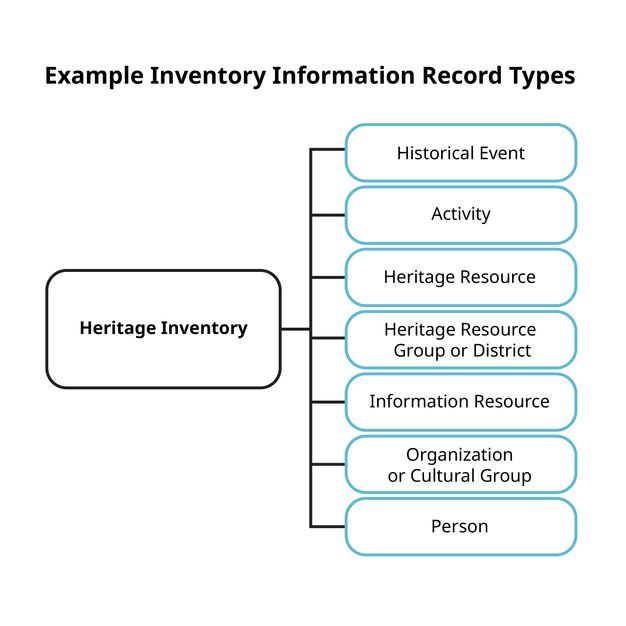
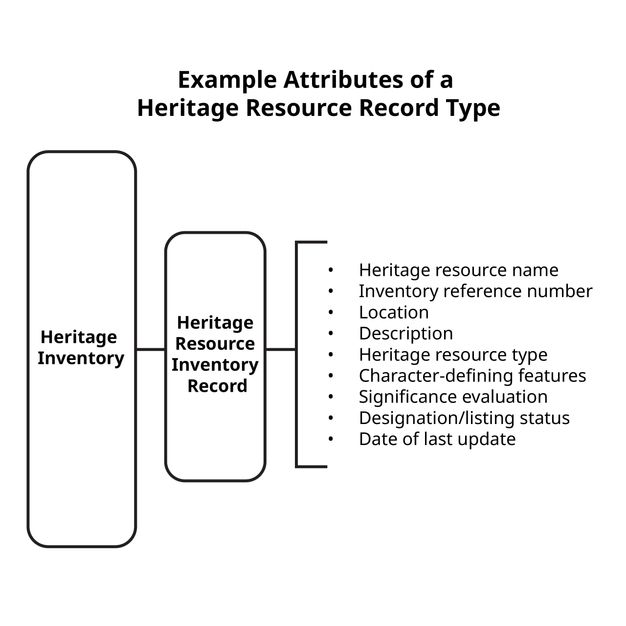
Standards relating to what information should be recorded can be referred to as content standards. In specifying what information should be recorded, this can be defined at two different levels of detail, as shown in figures 2.2a and 2.2b.
-
Record types. As shown in figure 2.2a, a single inventory typically contains many types of information records, for example, immovable heritage resources (e.g., buildings, landscapes, archaeological sites, underwater heritage), intangible heritage (e.g., spiritual practices, oral traditions), collections of movable cultural materials associated with places, activities (e.g., surveys, conservation interventions), persons (e.g., architects, historical figures), organizations, or information resources (e.g., images, reports).
-
Attributes for each information record type. As shown in figure 2.2b, a heritage resource record type might include the following attributes: heritage resource name, inventory reference number, location (expressed through geographic coordinates, address, etc.), description, heritage resource type, character-defining features, significance evaluation, designation or listing status, and date of last record update.
Controlled Vocabularies
One key type of data standard is controlled vocabularies, which have been defined as “an information tool that contains standardized words and phrases to refer to ideas, physical characteristics, people, places, events, subject matter, and many other subjects” (Harpring, Patricia. 2010. Introduction to Controlled Vocabularies: Terminology for Art, Architecture, and Other Cultural Works. Los Angeles: Getty Research Institute. http://www.getty.edu/research/publications/electronic_publications/intro_controlled_vocab/). Controlled vocabularies range in form and complexity from simple word lists to hierarchical, multilingual thesauri. They are essential to help ensure that data creation is consistent and valid, and thus are frequently used in defining drop-down values in an inventory database.
The application of controlled vocabularies in data creation can be extremely powerful in the retrieval of inventory information within modern information systems through the indexing of records. For any particular inventory, controlled vocabularies are often created through agreement among subject-matter experts. Those controlled vocabularies should be closely managed over time, as the need for new or variant terms may emerge.
In some cases, it is useful to give thought to sharing controlled vocabularies, or even parts of them, across multiple inventories, such as when a regional inventory needs to provide data to a national inventory, or when searching across multiple inventory information systems is desired. For example, in England one official set of controlled vocabularies is used by all local, regional, and national inventories through the UK Forum on Information Standards in Heritage (FISH; see https://www.heritage-standards.org.uk/), which includes a terminologies working group. This collection facilitates cross searching more than sixty separate information records (Forum on Information Standards in Heritage (FISH). n.d. “FISH Vocabularies.” Accessed July 27, 2023. https://www.heritage-standards.org.uk/fish-vocabularies/) through an online information system known as Heritage Gateway that offers local and national information relating to England’s heritage; see https://www.heritagegateway.org.uk/gateway/.
Defining how information should be recorded is likely to be more complex and specific. For example, for the location attribute of a heritage building within a city inventory, the how part of the data standard might specify that location can be recorded through street addresses derived from an official street address database and property parcel numbers derived from an official cadastral database. It may also specify which fields within a database are mandatory and which are optional, which fields should have a single value and which may have multiple values recorded, which fields have restricted drop-down values (see the Controlled Vocabularies sidebar in this chapter), which have free-text fields with a specified range of text characters, which should have geospatial coordinate or street address values, and so forth.
Heritage inventory programs very often create recording guidelines that provide an overall explanation of standards and practices to be followed in creating inventory information. Such guidelines may explain how to compile information for each record type, provide guidance for field recording, and include definitions of relevant terminology. Recording guidance might include visual glossaries of controlled vocabulary terms, including graphics and images of heritage typologies or their features. Recording guidelines may also address photography of heritage resources.
In addition, inventory guidance may address standards, criteria, and sources for assessing the significance and integrity of heritage resources, and it may direct how to assess the condition and vulnerability of heritage resources.
Because modern heritage inventories are typically digital, another essential type of standard or guideline relates to digital data and inventory databases. In some cases, organizations may wish to prescribe that specific information systems or other digital applications be used to create data. This may minimize both the effort required to incorporate data into a central inventory database and the risk of data incompatibility. An organization managing a digital inventory may otherwise wish to prescribe the data structure, formats, and other technical characteristics (e.g., minimum image resolution) of data created or provided for that inventory. Particular details will often depend on the database, or databases, used.
Standards and guidelines are also commonly created for specifying the creation of digital geospatial information about the location of heritage resources or activities. Examples include geospatial metadata standards for heritage data and guidelines for recording spatial polygons describing the location and extent of heritage resources, including for defining boundaries of archaeological sites. Such guidance may also need to address how the location of heritage resources should be linked to or otherwise related to associated property parcel records. If the location of parcels does not match with heritage resources exactly, or numerous heritage resources are located on a single parcel, or a heritage resource spans multiple parcels, then there should be a clear method for aligning the location of heritage resources with associated property parcels. There may need to be similar guidance for recording street addresses of heritage resources, including what to do when street names or numbers change. In some instances a heritage resource may have multiple addresses.
It is typically expected that information standards will be refined and otherwise improved over time through accumulated experience in their use. Some aspects of standards will require updating, such as when the areas of responsibility of a heritage agency are modified or when new information technologies are adopted.
Certain staff may need to be responsible for preparing, expanding, or improving inventory standards and guidelines. This might include knowledge organization personnel and other heritage specialists being responsible for controlled vocabularies (see the sidebar on this topic), heritage specialists who are experienced field surveyors being responsible for field recording guidance, recording and documentation specialists being responsible for certain types of technical recording guidance, and an inventory data editor, DBA, and possibly experienced users being responsible for inventory database user guidance.
Thematic Frameworks, Thematic Studies, and Historic Contexts
A heritage organization may find it useful to implement a combination of a thematic framework and accompanying thematic studies and/or historic contexts as mechanisms serving multiple purposes within an inventory program, as well as related data collection activities such as surveys. (See the Overview of Thematic Frameworks, Thematic Studies, and Historic Contexts sidebar.) These tools define important prehistoric and historic themes and subthemes to be represented among heritage resources that are formally listed or designated, which in turn will help provide that a full range of significant heritage resources are protected, taken into consideration within heritage impact assessments and other planning decisions, and potentially qualify for public financial incentives. Once created, they can be applied to:
-
Identify gaps in themes underrepresented within an inventory (in addition to gaps in listed or designated heritage resources), helping to guide activities seeking to fill gaps and achieve inclusiveness and representativeness. This can include directing or stimulating research to address themes that need further study, the synthesis of research to convey broad patterns, and seeking stakeholder or public input on neglected or poorly understood themes.
-
Help to perceive broad patterns and how individual resources fit within them (i.e., to see the forest, not just the trees) when seeking to classify and evaluate heritage resources within their broader contexts. By providing a framework, these tools aid in interpreting how people, events, and places fit within historic contexts and in explaining interconnections. In addition, through aiding in heritage resource classification, these mechanisms can help provide a structure for indexing heritage resources within an inventory database, which in turn facilitates database search and discovery.
-
Provide a framework for assessment of cultural significance, including carrying out comparative evaluations of the significance of heritage resources within local, regional, national, and international contexts, including assessing the rarity or commonality of particular heritage resources.
-
Enable the recognition, interpretation, and presentation of heritage resources from a full range of significant themes (including underrepresented themes such as those relating to minority cultural groups); help tie heritage interpretation and presentation more broadly to regional, national, or international stories or events; and aid in identifying the most representative examples according to particular themes. These applications can also support tourism planning.
Chapter 8 discusses in more detail the use of these mechanisms in heritage survey work.
Information Repositories
Inventory programs often rely on information repositories, such as archives holding physical collections of historical documents, including maps, photographs, and construction records, to support research and investigation activities. Such repositories may be maintained by the heritage organization responsible for the inventory, other public agencies, universities, NGOs, or private researchers.
IT Systems, Hardware, and Software
As mentioned earlier, for heritage inventories today, one of the most crucial types of infrastructure for data creation, editing, and publishing is an information system or database that is used to manage and provide for searching of inventory information. Ideally, such an information system is available online to enable direct access to intended users. Given the rapid pace of advances in information technologies, it should be assumed that after a certain period of time one information system will need to be upgraded or replaced by another, which will occasionally entail migrating inventory data to a newer system. Such data migration efforts are notorious for taking more time and effort than originally expected. An enterprise- or organization-level information system will need to be hosted either on a server or through cloud-based server services. Inventory systems may also need to ingest data from other sources, such as an authoritative street address database or data from a national mapping agency, or they may need to integrate with other information systems, perhaps for planning casework or building permits.
An inventory program may also need other types of hardware and software, such as mobile data collection devices like tablet computers, cameras for field photography, imaging software for photo editing, GPS units for accurately recording the locations of heritage places, and GIS software for creating and managing geospatial data recording the locations of heritage places or activities such as surveys. Inventory programs also typically need specialized support related to geospatial data collection, management, and use to help ensure that mapping and other location information is dealt with according to professional standards. Hardware will need to be maintained and replaced over time, and software installed, upgraded, and at times replaced.
Support through Activities
The following are potential activities to support an inventory as a tool for effective heritage management. They are grouped by the general categories shown in figure 2.1: data collection, creation, and editing; data management; and general, program-wide activities.
Information Collection, Creation, and Editing
For any inventory program, a fundamental set of activities that typically occurs on an ongoing basis is the collection, creation, review, and editing (including updating) of inventory information. The following sections describe the most common related activities.
Compiling Legacy Data
When a digital inventory is created or a substantial effort is made to enhance its content, a common activity is to identify relevant sets of existing legacy data or other existing information to incorporate within the inventory. Such information could come from information maintained about designated or listed heritage resources, from past surveys of the jurisdictional area, or from other forms of relevant research about the area. This type of information may already reside within the heritage organization where the inventory program exists; may be held by other public agencies, NGOs, or academic or research institutions; or may be in the hands of private researchers. See Assessing Existing Heritage Information in chapter 6 for considerations involved in dealing with legacy data.
Remote Sensing
In some cases, particularly with respect to archaeological and landscape-scale investigation and recording, specialists in remote sensing may need to acquire and analyze aerial and satellite imagery or lidar data (a product of aerial laser scanning). Historic aerial or satellite images, which have particular value in showing past conditions and change over time, may be held in archives and would need to be digitized and georeferenced. As noted earlier, GIS skills are typically required to process data and record the spatial location and attributes of items of interest. Skills in satellite- and aerial-photo manipulation, analysis, and interpretation are also needed.
Surveys
Surveys can be a vital method of collecting, enhancing, and updating existing inventory information. Part II of this publication covers surveys in detail, including personnel and infrastructure requirements, as well as methods used to elicit public participation and input.
Input from Other Heritage-Related Processes
It is recommended that those working with public agencies require that relevant information collected through other heritage-related processes be input into the heritage inventory as those activities occur. Such processes include heritage designations or listings, heritage financial incentive programs, impact assessments and other development-related activities, and disaster response efforts. Some heritage agencies that issue permits for academic archaeological surveys or other investigations require as a condition of those permits that researchers submit information resulting from fieldwork for addition to the heritage inventory according to specified standards, as mentioned above.
Research and Investigation
For any heritage inventory program, research and investigation are essential activities required for fulfilling many of the program’s mandates and ensuring its effectiveness. Research fundamentally informs what is known and understood about heritage, including supporting heritage identification and recognition of significance; these in turn bolster the credibility of decision-making. Research relating to an inventory can be approached at a strategic level and also as specific research questions arise. At a strategic level, some heritage organizations create formal research frameworks that define an overall research agenda, identifying priority topics and research questions to be addressed (Nixon, Taryn, Ellen McAdam, Roberta Tomber, and Hedley Swain, eds. 2002. A Research Framework for London Archaeology 2002. London: Museum of London Archaeology Service. https://archaeologyinlondon.files.wordpress.com/2016/04/research-framework-for-london-archaeology-mola-2002.pdf).2
For organizations that have thematic frameworks (which are oriented toward heritage resource assessment, identification, and designation or listing), the thematic framework may be mirrored in a corresponding research framework (which may outline a research agenda for the thematic framework). Priorities might focus on gaps in knowledge, understanding of the historic environment that needs updating, or heritage typologies or historical periods or events that have been newly recognized as significant. A research framework can prioritize specific research themes, time periods, geographic areas, typologies, or a combination of these topics.
Some organizations also create research strategies (Rowsome, Peter, and David Baker, eds. 2015. A Strategy for Researching the Historic Environment of Greater London. London: Museum of London. https://archaeologyinlondon.files.wordpress.com/2016/04/research-strategy-pdf-final-november-2015.pdf) that identify research activities, sources, and timeframes to implement a research framework. Having a formal research framework and strategy can help focus and coordinate heritage-related research for a particular jurisdiction, and perhaps lead to research partnerships. Such a big-picture approach can also provide that research work is more efficient than research only carried out at the level of individual heritage resources.
Research frameworks and strategies can also relate directly to the development of thematic studies and historic context statements. The organization maintaining a heritage inventory might address some of the prioritized research topics. The research framework and strategy might also be shared with academic or research institutions operating within the same jurisdiction to encourage them to address certain topics. Such research by external institutions might be incentivized through grants or solicited under contract.
On a day-to-day basis, contributors to a heritage inventory often need to carry out a broad variety of research. This might include any or all of the following:
-
Reviewing historic building permits or maps to determine the construction date of a structure
-
On-site investigation for dating purposes
-
Consulting historic newspapers or other documents to confirm the association of a person or event with a particular building
-
Consulting unpublished archaeological survey or excavation reports or, alternatively, carrying out a site investigation to help determine the presence or dates of archaeological features within a specific geographic area
-
Carrying out oral history interviews
One useful related method is historical map regression—a process used in research on the history of places in which maps of an area compiled in different time periods are compared to help determine the state of and changes to the natural or built environment (Mapping History. n.d. “Step by Step Map Analysis: Learn about Map Regression.” Accessed August 3, 2023. https://digital.nls.uk/mapping-history/learn-about-maps/step-by-step/). In archaeology, map regression can help locate features appearing only on earlier maps and assign building phases. It is frequently part of desk-based assessments before field work. Relevant historical maps may be held in research collections. They may need to be digitized and georeferenced, which requires GIS skills. However, in many cases historical maps have already been digitized and are available on the web.
It is also important that those conducting research for an inventory have access to relevant information sources, which may include both published and unpublished literature, maps, drawings, photographs, and reference publications. Some items may be analog and others digital. Those creating or managing an inventory program are advised to consider what information sources should be held and perhaps catalogued within their own organization, what arrangements might need to be made with external institutions to access their research collections, and whether subscriptions need to be secured to online research databases or online publications.
Stakeholder Input
An often important way for inventory programs to obtain information about significant heritage resources is through stakeholder input. Information from stakeholders can be particularly valuable in recognizing the significance of heritage resources that is not apparent through visual inspection by heritage specialists. Such resources might include those significant to local, ethnic, or cultural communities; ones related to cultural traditions or that have other traditional uses; and those associated with historical events or significant organizations or persons.
Some legal and policy frameworks require public heritage agencies to obtain public input, including to their inventories. Stakeholder input can be obtained through a variety of means, such as:
-
Providing for submission of information through a heritage organization’s website
-
Including stakeholder representatives within a heritage organization’s advisory body
-
Stakeholder outreach consultations
-
Stakeholder and oral history interviews
Sometimes stakeholder participation activities can be led by community groups, or they can be collaborations between public agencies and community organizations.
Related to stakeholder input, cultural mapping is a methodology focused on involving communities in identifying and recording the location and attributes of local tangible and intangible cultural assets. Often such mapping is used to inform government interventions or community initiatives (Duxbury, Nancy, W. F. Garrett-Petts, and David MacLennan. 2015. “Cultural Mapping as Cultural Inquiry: Introduction to an Emerging Field of Practice.” In Cultural Mapping as Cultural Inquiry, edited by Nancy Duxbury, W. F. Garrett-Petts, and David MacLennan, 1–42. New York: Routledge.). This approach can be particularly useful for involving communities in determining which resources are identified in a heritage inventory—specifically those deemed important due to social significance—or in identifying socially significant attributes of places. Cultural mapping, the utility of which has been recognized prominently by UNESCO, has been applied extensively to engaging indigenous communities to identify cultural resources. It has also been especially useful for engaging communities in identifying their intangible heritage (Crawhall, Roger. 2009. “The Role of Participatory Cultural Mapping in Promoting Intercultural Dialogue: ‘We Are Not Hyenas’: A Reflection Paper.” Paris: UNESCO. http://www.iapad.org/wp-content/uploads/2015/07/nigel.crawhall.190753e.pdf).
Heritage agencies may also wish to forge partnerships with certain stakeholders, which might be public agencies or NGOs, to support the ongoing improvement of inventory information. For instance, collaborations with universities, historical societies, or advocacy groups can help address identified research needs, carry out field surveys or investigations, and carry out other data collection activities.
The means of promoting stakeholder input might include a combination of public meetings (in-person or virtual/online), social media campaigns, mechanisms for soliciting online information contributions (including photographs), and interviews to record oral histories. Some heritage agencies outsource stakeholder engagement activities to consultants or NGOs; others work to enlist and train volunteers and interns for crowdsourcing inventory information. (Public-engagement aspects of heritage surveys are discussed in detail in chapter 8.)
As with any means of data collection, mechanisms should be put in place to validate new information before it is incorporated within the inventory. In some cases, this may require research by inventory program personnel.
Stakeholder outreach and engagement require investment of time, staffing, and other resources. Interns or volunteers may be recruited to contribute to inventory activities. In some contexts, external engagement may involve outreach in multiple languages. It may also require training of staff, interns, or volunteers in public engagement activities.
Such investments in stakeholder engagement efforts can return multiple benefits. Firstly, they can help the inventory more accurately reflect the heritage resources that are truly valued by citizens. This will in turn support the informed consideration of those heritage resources in public agency planning processes, heritage impact assessments, disaster planning and response activities, and heritage financial incentive programs. Investments in meaningful stakeholder engagement can also convey that their views on the significance of heritage resources are appreciated. Stakeholder involvement in heritage inventories may help stimulate the “virtuous circle” developed by English Heritage and discussed in the introduction to this publication (see fig. i.2), which has the potential to promote stakeholders’ sense of appreciation for their heritage and thereby encourage them to support its stewardship.
These various activities supporting information collection, creation, and editing require a combination of resources, including budget and personnel with required expertise, and activities, such as planning, management, and coordination.
Information Management
The overarching task of information management is a key requirement of any inventory program. It requires personnel as well as a range of activities, policies, standards, procedures, and infrastructure. The topic of information management has many facets, and an entire field of study is devoted to it. The sections that follow highlight three core types of information management activities that are relevant to heritage inventories: data validation; storage, backup, and recovery; and access and security.
Data Validation
For an inventory information system, a DBA will commonly be responsible for implementing data validation measures. This frequently entails creating and running database scripts to confirm that newly imported, created, or edited data meets defined data standards or other validation rules. It could include identifying duplicate records or errors in geospatial locations of newly created or edited records, such as a location erroneously recorded outside the relevant governmental jurisdiction. All such issues normally need to be resolved.
The DBA or other information technology (IT) support will at certain points in time need to migrate inventory data from one software platform to a newer and/or more capable one, which typically involves extensive checks to ensure that migrated data meets the validation requirements of the new platform.
Storage, Backup, and Recovery
The DBA or other IT support typically needs to ensure on an ongoing basis that adequate data storage is provided for the inventory program, including its primary information system. Data storage might be implemented through a physical server or servers, cloud-based server services, or a combination of these arrangements. Ongoing data integrity is normally also made possible by implementing a strategy for regular data backups to allow data recovery in case of unintended data loss or corruption. In accordance with IT standard practices, backups typically occur on a server located separately from the primary data storage location, in part to mitigate the risk of destruction of data due to natural disasters or armed conflict. Stored data is also typically checked on a regular basis to confirm that no inadvertent loss or corruption has occurred.
Access and Security
Intertwined with information management is managing information access and security. As previously mentioned, public heritage agencies sometimes create and implement an information access policy that applies to their heritage inventory. A DBA is also typically responsible for managing user accounts and maintaining related information access levels.
Another crucial part of information management is providing information security, which is often also a responsibility of a DBA. Potential security measures include passwords, firewalls, systems to detect network intrusions, and data encryption.
Program-Wide Activities
The activity types that follow support work across the entire inventory program.
Planning, Management, and Coordination
An inventory program will require planning as well as management of activities and investments over the annual, medium, and longer terms. Some inventory programs prepare a written plan for a specific time period. The following are elements that might be included in such a plan:
-
An inventory mission statement with explicit goals
-
A strategy for achieving specified goals
-
Areas requiring improvement, changes, and increased resources (including staffing), or training
-
A work program to realize the established goals and related objectives
-
A realistic timetable and specific proposed annual budgets identifying methods, infrastructure and equipment, and personnel needed
-
Performance indicators to regularly monitor how effectively the plan is being realized (see Monitoring and Evaluation)
In addition, an effective inventory program will require coordination both internally and with external public agencies and nongovernmental actors (see External Engagement).
Capacity Building
Inventory programs also require ongoing training or capacity building for personnel carrying out programmatic activities. Capacity building is essential for the onboarding of new staff, interns, or volunteers; for maintaining the skills of existing personnel; and for keeping up with developments in the heritage field, in IT, and in data management practices. Activities may include orientation to the meaning and application of data standards, as well as training in field recording and in the assessment of heritage places.
In some cases, capacity building on techniques for public engagement may be beneficial. Very often IT-oriented capacity building is needed, such as in the use of applicable information systems, in digital data management, and perhaps in satellite or aerial image analysis. Heritage organizations may wish to develop a training plan to outline the frequency, topics, and methods of capacity building activities. They may also need a related plan for ongoing professional development of individual team members.
IT Support
Information technology support encompasses another set of activities that is typically essential for an inventory program, particularly as it relates to supporting information collection, creation, editing, and management. IT support normally helps provide for information system procurement, hosting and setup, software upgrades, and monitoring and optimizing system performance. IT support also typically deals with hardware procurement, maintenance, and repair, as well as replacement. Ensuring compatibility and integration with other relevant information systems and planning for future IT system capacity needs are typically also the responsibility of IT.
External Engagement
In addition to the frequent need to solicit information from external stakeholders as input to inventory information, heritage inventory programs typically need ongoing engagement with a range of external entities and stakeholders for a range of other purposes. For public agencies, this typically includes interacting with different parts of one’s own organization, as well as separate government agencies, which may or may not be at differing levels of governmental jurisdiction. For example, the inventory program of a city agency may need to interact with other city agencies and with regional, state or provincial, and national agencies to carry out its mandate. These necessary interactions may be about obtaining or exchanging information, providing advice, or interpreting and using data.
External engagement may also relate to the creation or enhancement of thematic studies or historic context statements. This outreach might be augmented through targeted engagement with specific ethnic or cultural groups, including indigenous communities or historical societies. External engagement can also include providing advice, as well as responding to queries, remarks, or criticisms regarding inventory information or how it is accessed. Many public agencies are required by law to share information about their activities with the public to ensure transparency. For data to be readily integrated between a heritage inventory and other information system, multiple organizations may need to implement measures to provide data interoperability, such as shared data standards and data formats. An inventory program might also have an advisory committee that includes members from stakeholder groups and the general public to provide guidance on certain inventory functions.
Heritage organizations also often carry out activities and create resources to promote awareness of and understanding of how to utilize their inventory, such as through social media or presentations orienting others to inventory information and how to use an online inventory database. Some agencies create online videos to demonstrate such use. These efforts might include demonstrating the utility of the inventory to local heritage advocacy groups, historical and genealogical societies, and museums, and can also include engagement with schools and universities to discuss with educators how they and their students can use a heritage inventory in teaching and research activities.
The usefulness of the inventory might also be presented to investors and realtors who are interested in historic properties, to organizations that promote tourism, and to those involved in identifying potential filming locations. In some situations, it is important for the public to understand how the inventory data will or will not be used for regulatory purposes, particularly when private property is involved.
Monitoring and Evaluation
Some inventory programs establish systems for monitoring and periodically assessing performance and the extent to which defined outcomes are being achieved. Such monitoring and evaluation systems can help identify areas in need of attention and improvement. In the United Kingdom, for example, the English and Welsh governments have each developed a series of benchmarks or specifications against which historic environment records (HERs)—regional and local government inventories—are assessed every five years (Historic England. 2023b. Historic Environment Records (HER) Audit Programme: HER Audit Specification based on HER Service Areas, Outcomes and Indicators, version 2.7. UK: Historic England. https://historicengland.org.uk/content/docs/her/audit-specification-pdf/; Cadw. 2017c. Historic Environment Records in Wales: Standards and Benchmarks. Cardiff: Welsh Government, Historic Environment Service (Cadw). https://cadw.gov.wales/advice-support/placemaking/historic-environment-records). Although the English and Welsh systems are somewhat different, their benchmarks both apply to four inventory-related service areas:
-
Content and coverage: the degree to which inventory information has been maintained, updated, and extended, including for newly discovered or recorded heritage resources. Assessments can identify specific areas of deficiency in need of updating or where inventory information needs to be extended through new data collection activities, such as surveys.
-
Data standards and security: the level of compliance with data standards and relevant laws and policies, as well as regular data backup and security procedures.
-
Access and engagement: the degree to which public queries have been responded to within defined timeframes and how well the inventory program has facilitated access to and helped interpret inventory information.
-
Service delivery and infrastructure: the extent to which the inventory program has delivered services according to specified or defined levels of service. For example, this may include determining maximum response times of HER staff to queries from different categories of users based on the priority of their use, and assessing related performance. This benchmark is also used to determine the appropriateness of management and resourcing of the inventory.
Audits of HERs in England and Wales are generally carried out on a five-year cycle to assess performance according to the outcomes and related indicators for each service area. After each audit, five-year plans are produced to identify priorities for enhancement work, including responding to inventory user feedback.
Some heritage organizations evaluate access to and use of inventory information through surveying the opinions of inventory users. This can also be done through data analytics of online inventory information systems and other websites. Periodically assessing inventory-related data analytics can provide useful insights (fig. 2.3).
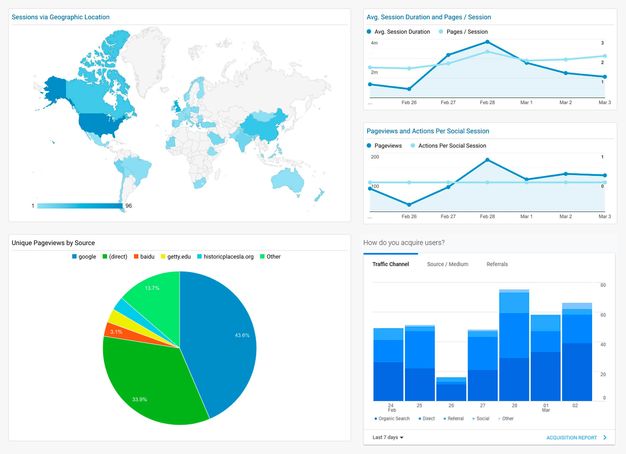
Such analytics can convey trends in the overall number of unique online visitors to an inventory over time, how users tend to come upon the inventory (e.g., search engines, social media), the types of digital devices and web browsers they use to access the inventory, trends in the geographic locations of users, and insights regarding particular interests of online users. This information can help in understanding how further efforts might be made to disseminate information about the inventory (such as through social media), and whether inventory system webpages should be further optimized to be read by search engines. Statistics on user engagement are also useful to providing decision-makers information about the extent to which an inventory is being used by the public, and thereby justify ongoing support.
Notes
-
Organizational infrastructure has been defined as “underlying systems, structures, and processes that support the operation and management of an organization. It includes both tangible elements, such as facilities and equipment, as well as intangible elements, such as policies and procedures, systems and technology, and culture and values” (CIO Wiki. n.d. “Organizational Infrastructure.” Accessed August 12, 2023. https://cio-wiki.org/wiki/Organizational_Infrastructure). ↩︎
-
It should be noted that a research framework is different from a thematic framework. A research framework is aimed at identifying research questions to be answered; a thematic framework identifies prehistoric or historic themes to guide the identification and evaluate the significance of heritage resources, often ultimately contributing to designations or listings. ↩︎