Lapatin et al. / The Getty Peacock FrescoGetty Research Journal, No. 21 (2026)
Copied page section link to clipboard
Abstract
Acquired by J. Paul Getty himself in 1968, the Getty
Museum’s fragment of a fresco depicting a peacock
(68.AG.13) has long been a favorite among visitors.
Hitherto considered to be an ancient Roman work produced
in Campania circa 70 CE, it has been reproduced as museum
merchandise, textbook illustrations, and gift-shop decor.
Recent technical examination and analyses combined with
historical research, however, reveal that the popular
peacock is not in fact ancient; nor does it seem to be a
forgery. Rather, it appears to be a reproduction of a
now-lost fresco from a Pompeian house that was fashioned
to decorate an early twentieth-century “free Greek-style”
bungalow designed by architect Robert Alexander Briggs in
the English countryside.
Keywords
Roman wall painting, Getty Peacock, fresco, Pompeii, House
of Siricus, Robert Alexander Briggs, MA-XRF, pigment
identification, technical study
Copied page section link to clipboard
Peer Review
Single anonymous, external
Copied page section link to clipboard
Cite
Chicago
Kenneth Lapatin, Marie Svoboda, Sierra Schiano, Monica
Ganio, and Karen Trentelman, “The Getty Peacock Fresco:
Unraveling Its History Through Technical and Historical
Investigations,” Getty Research Journal, no. 21
(2026),
https://doi.org/10.59491/BTBV8023.
MLA
Lapatin, Kenneth, et al. “The Getty Peacock Fresco:
Unraveling Its History Through Technical and Historical
Investigations.” Getty Research Journal, no. 21,
2026,
https://doi.org/10.59491/BTBV8023.
On 30 October 1968, at an extraordinary meeting presided over
by J. Paul Getty himself, the Trustees of the J. Paul Getty
Museum voted unanimously to acquire a mosaic representing the
taking of Briseis from Achilles (an episode from the Trojan
War described in Homer’s Iliad) and a “Roman fresco
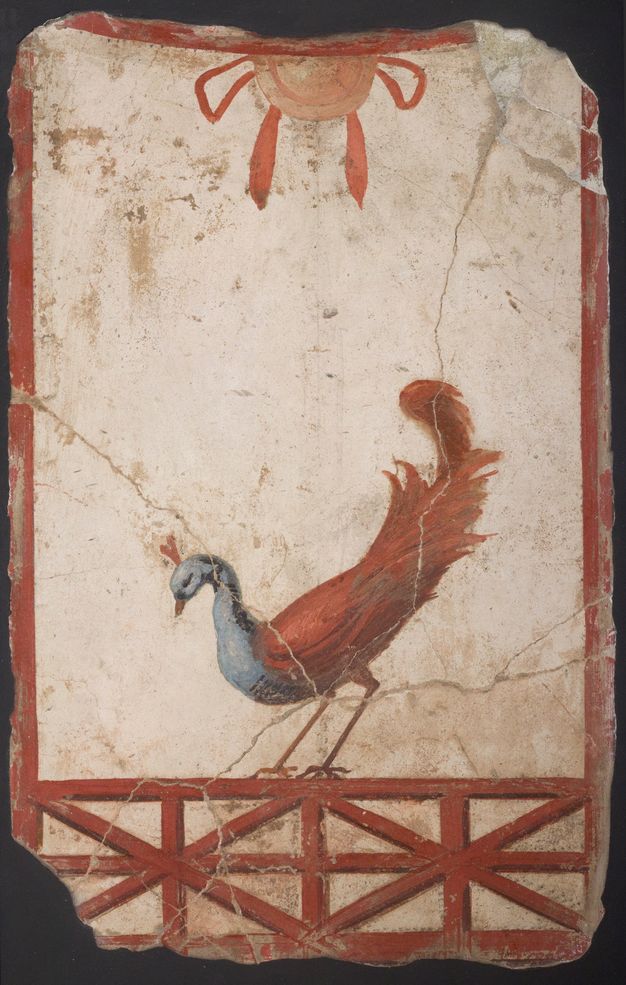
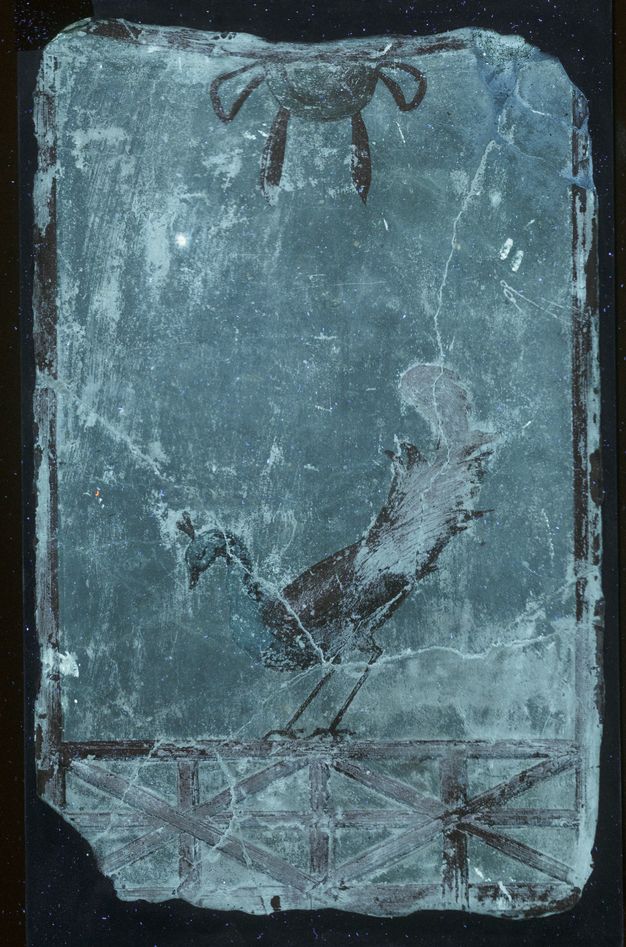
from Pompei depicting a peacock standing on a fence” (fig. 1).1
The meeting was notable for two reasons: first, it was held
via telephone, rather than in person; second, the acquisition
of these objects represented Getty’s first purchase of
antiquities from the London-based dealer Spink & Son, Ltd,
after a hiatus of more than a decade.
ExpandFig. 1. —Wall fragment with a peacock, pigment and plaster, 40 ×
24.8 × 3.2 cm.
Los Angeles, J. Paul Getty Museum, Villa collection,
68.AG.13.
J. Paul Getty had a long relationship with the seller. He
bought many antiquities (and pseudo-antiquities) from them in
the late 1940s and early to middle 1950s. Spink & Son also
served as the go-between in Getty’s purchase of the Lansdowne
Herakles in 1951, which he subsequently donated to his
museum.2
We do not know when Mr. Getty, who had resided at Sutton Place
in Surrey since 1960, first saw the fresco, nor what
representations about its origin Spink may have made to him.
Also unknown is when precisely the fresco arrived in Southern
California, and it does not appear to have been displayed
publicly until the opening of the Getty Villa on 16 January
1974, when it was likely installed with other frescoed panels
in one of the cubicula off the atrium (today designated
Galleries 101C–F).3
In preparation for the opening of the new museum (now called
the Getty Villa Museum), the fresco was published in the
catalog authored by architectural historian Norman Neuerburg
and curator of classical art at the Museum of Fine Arts,
Boston, Cornelius Vermeule,
Catalogue of the Ancient Art in the J. Paul Getty Museum:
The Larger Statuary, Wall Paintings and Mosaics
(1973).4
There it is described as follows:
108. Fragment of a Wall Painting with a Peacock
About 70 A.D.
40 × 24.8 cm (15 3/4 × 9 3/4 in.)
Provenance: Purchased by the Museum in 1968 (68AG13)
An architectural frame of dark red contains a peacock
standing on a dark red “union jack” fence. The bird is blue
and black on the breast and neck, while the body and
top-knot are red; the beak and legs are brown. A pink shield
with red ribbons hangs above from behind the drooping
lintel. The piece is composed of several fragments and is
set in cement, but there are no areas of repaint. It closely
resembles a detail from the upper register of a room in the
House of Siricus in Pompeii,i the only difference
being that the fence is in three sections rather than two.
In fact, the similarity is close enough to suggest the same
painter. The rather odd tonality of the colors, which seem
chemically changed, resembles a circumstance occurring in
Pompeii and Herculaneum; this also suggests a provenance
from the same zone. At any rate the fragment belongs to the
so-called fourth style and should date around 70 A.D.
R. A. Briggs, Pompeian Decorations, London, 1911,
unnumbered plate. No trace of this painting now remains.
As will be seen, the reference to Briggs’s publication is a
significant clue in the story of the peacock fresco. Robert
Alexander Briggs (1858–1916) was a British architect who
traveled to the Continent in the 1880s but did not publish his
observations of paintings preserved at Pompeii until 1911:
“Owing to the absence of any process that could faithfully
reproduce the drawings, no book has hitherto been published,
which shows with fidelity the beautiful and gorgeous colouring
of the Mural Decorations at Pompeii.”5
The aim of his publication was “to illustrate, at a moderate
cost, what the Pompeian Decorations are really like.”6
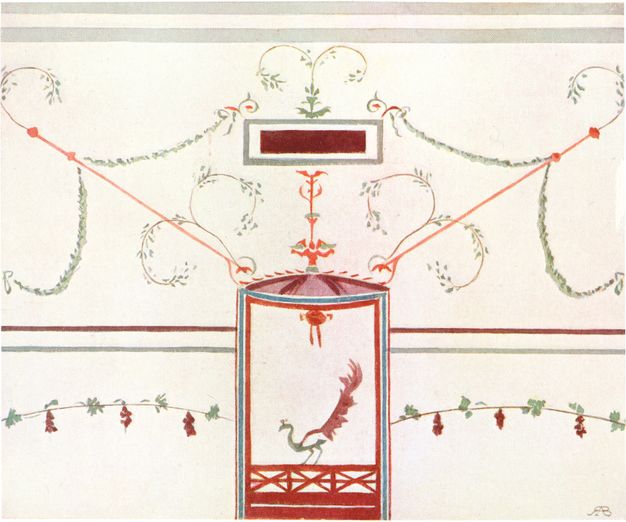
His color rendering of the peacock fresco is one of two
illustrations in his book of his own watercolor reproductions
of wall paintings from the House of Siricus (VII.1.47), which
was excavated between 1851 and 1872 (fig. 2). By the time of his publication in 1911, Briggs notes, “The
friezes have become very faint in color, having been exposed
so long to the air.”7
Earlier, nineteenth-century archaeologists had noted, but did
not illustrate, frescoes with birds, including a peacock, in
two rooms near one of the entrances to the house on the Vicolo
del Lupanare.8
Autopsy in November 2022 by Kenneth Lapatin confirmed Briggs’s
observation that nothing remains of the peacock wall painting
at Pompeii.
ExpandFig. 2. —Robert Alexander Briggs (British, 1858–1916).
Reproduction of a watercolor of a lost ancient Roman
fresco from the House of Siricus, Pompeii, from Robert
Alexander Briggs, Pompeian Decorations (London:
B. T. Batsford, 1911), unnumbered plate. Los Angeles,
Getty Research Institute, 84-B30541.
Peacocks are frequently depicted in ancient Roman art in
various guises.9
Similarly, Roman lattice (“Union Jack”) balustrades, shields,
and suspended fillets are also common in ancient Roman art.
However, there are no published parallels for a peacock
standing on a Union Jack balustrade other than the now-lost
fresco from the House of Siricus.10
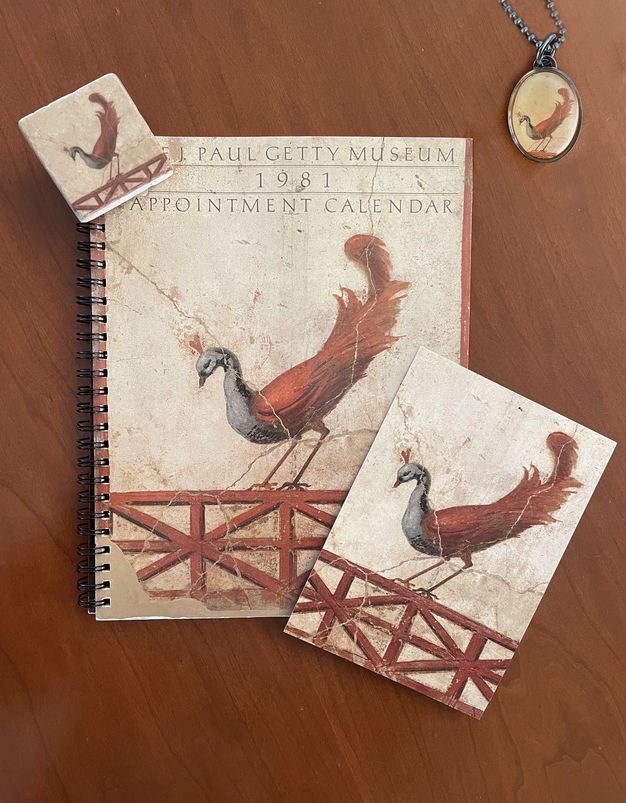
In any case, for more than half a century, the Getty Peacock
has gone largely unremarked upon by scholars but has been a
perennial favorite of visitors. It has appeared on the cover
of a blank, spiral-bound yearly planner retailed at the Museum
store in 1981 titled the
J. Paul Getty Museum Appointment Calendar, on the
cover and front jacket flap of Matthew Kneale’s book
Rome: A History in Seven Sackings (2017), in the
L.A. Zoo Review (1985/1986) and a Latin textbook
(2020), and in a few other publications intended for the
general public.11
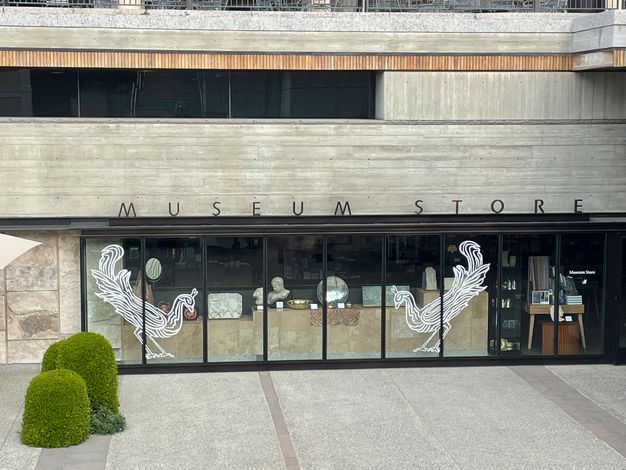
It has also featured prominently on postcards, shopping bags,
coasters, refrigerator magnets, pendants, and scarves sold in
the Getty Museum Store over many years, and even as a graphic
on the exterior of the shop during the course of our research
(figs. 3a,
3b).
ExpandFig. 3A. —Merchandise featuring the Getty Peacock (magnet,
postcard, appointment calendar, and necklace) for sale
at the Getty Museum Store, 1981–2022.ExpandFig. 3B. —The Getty Museum Store at the Villa featuring window
graphics of the Getty Peacock, May 2022.
The closure of the Getty Villa during the pandemic provided an
opportunity to survey the collection of frescoes and catalog
the use of Egyptian Blue, a synthetically produced pigment
commonly found in Roman wall paintings. Egyptian Blue can be
easily detected using visible-induced infrared luminescence
(VIL) imaging, a method in which the diagnostic response of
certain pigments is captured using an infrared camera.12
Eleven of the twelve wall paintings on display exhibited the
characteristic luminescence of Egyptian Blue, but the peacock,
with its blue head, neck, and breast, did not. This surprising
result inspired a technical study into the peacock fresco by a
multidisciplinary team to characterize the pigments and
materials used in the creation of the painting and identify
the source of the blue color. This study, employing
nondestructive and minimally invasive technical imaging and
scientific analyses, coupled with an in-depth historical
investigation, has led to a new interpretation and a better
understanding of the Getty Peacock.
The Fresco: Pigments and Other Material Considerations
The Getty Peacock is composed of eleven joined fresco
fragments set in concrete (see
fig. 1). Prior
to its acquisition, the perimeter was filled with a commercial
spackling compound that was painted black in the 1990s. Today
the fresco is enclosed within a rectangular aluminum frame
that normalizes its irregular shape. The painting has a very
thin, smooth, off-white painted calcitic intonaco layer.13
Thus, it is not a true fresco, which would consist of paint
applied directly on a smooth, wet lime-plaster surface where
the pigments are bound into the wet or setting plaster.
The peacock itself (painted in red, blue, green, and black) as
well as the balustrade, shield, ribbons, and border that
enclose the scene (painted in shades of red), are
superficially applied, indicating a fresco-secco technique in
which the pigments are mixed with an organic binder or
limewater painted on top of a dried lime-plaster surface.
However, for simplicity, throughout this paper, the Getty
Peacock will be referred to as either a fresco or wall
painting. The execution of the work is very painterly, with
visible, deliberate brush strokes, unlike many other Roman
frescoes characterized by a sketchier application of paint.
Gray surface accretions are visible, mostly along the breaks
and at the edges, and the entire front surface is glossy with
visible brush strokes suggesting that it has received a modern
coating.
The Painted Surface
To identify the materials in the peacock wall painting and
help elucidate how and when it was created, a suite of
analytical methods was employed. Noninvasive imaging
techniques—ultraviolet-induced visible fluorescence (UVF),
infrared reflectography (IRR), X-radiography, and macro X-ray
fluorescence (MA-XRF) scanning—provided information about the
distribution of materials and guided the choice of sampling
sites. Analyses of small amounts of removed material—by Raman
spectroscopy, gas chromatography–mass spectrometry (GC–MS),
Fourier transform-infrared (FT-IR) spectroscopy, X-ray
diffraction (XRD), and scanning electron microscopy with
energy dispersive X-ray spectroscopic (SEM-EDS)
analysis—provided more specific identifications of the
pigments and the other materials present.
Under UV radiation, the object displayed an overall pale-blue
fluorescence with additional intensity in areas with
accretions and within break joins, possibly indicating the
presence of synthetic materials such as an adhesive and/or a
coating (fig. 4).14
Analysis of a sample from one of the highly fluorescing areas
identified the presence of pentaerythritol and phthalic
anhydride, suggesting the use of a drying oil alkyd resin.15
Invented in the 1950s, this synthetic resin was commonly used
in the production of paints and water-resistant materials.16
It was also used in the second half of the twentieth century
to consolidate, saturate, and protect the surfaces of wall
paintings.17
ExpandFig. 4. —Ultraviolet-induced visible fluorescence (UVF) image of
the Getty Peacock.
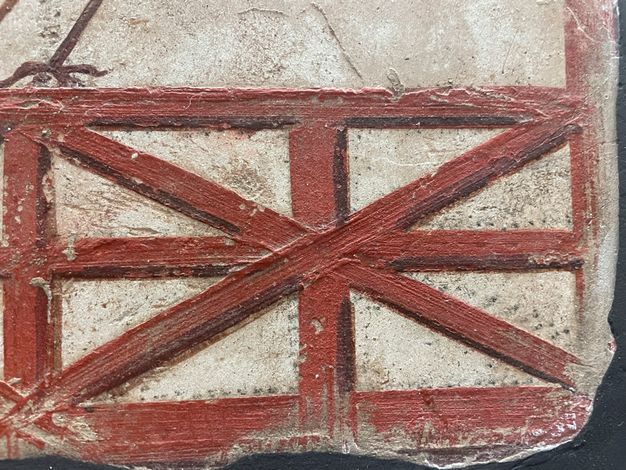
IRR revealed the use of sketch lines and, more puzzling,
highlighted the presence of pounce marks, which are also
visible to the naked eye throughout the composition,
particularly along the edges of the red border and the ribbons
hanging from the shield at the top, the beams of the Roman
lattice balustrade (fig. 5), and the peacock itself.18
Such pounce marks are evidence of
spolvero, a technique in which
a preparatory drawing on paper (or similar substrate) is
transferred onto the final surface by dusting
(spolverare) chalk or carbon
black through the pounce holes in a preparatory drawing that
are punched along the contours of its features. This technique
was documented as early as the tenth century in China and
first described in Europe around 1390.19
During the Renaissance, it was a common method for
transferring sketches to frescoes perfected by artists such as
Michelangelo Buonarroti, Cennino Cennini, and Raffaello
Sanzio.20
The presence of pounce marks, a technique otherwise unattested
in ancient Roman painting, on an artifact thought to date to
circa 70 CE challenged our understanding of the fresco.
ExpandFig. 5. —Detail of the Roman lattice balustrade of the Getty
Peacock showing pounce marks and pronounced, superficial
brushwork.
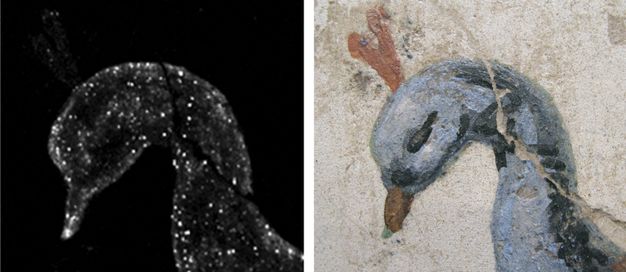
Spatially resolved MA-XRF scanning produced distribution maps
of individual chemical elements across the surface of the
object.21
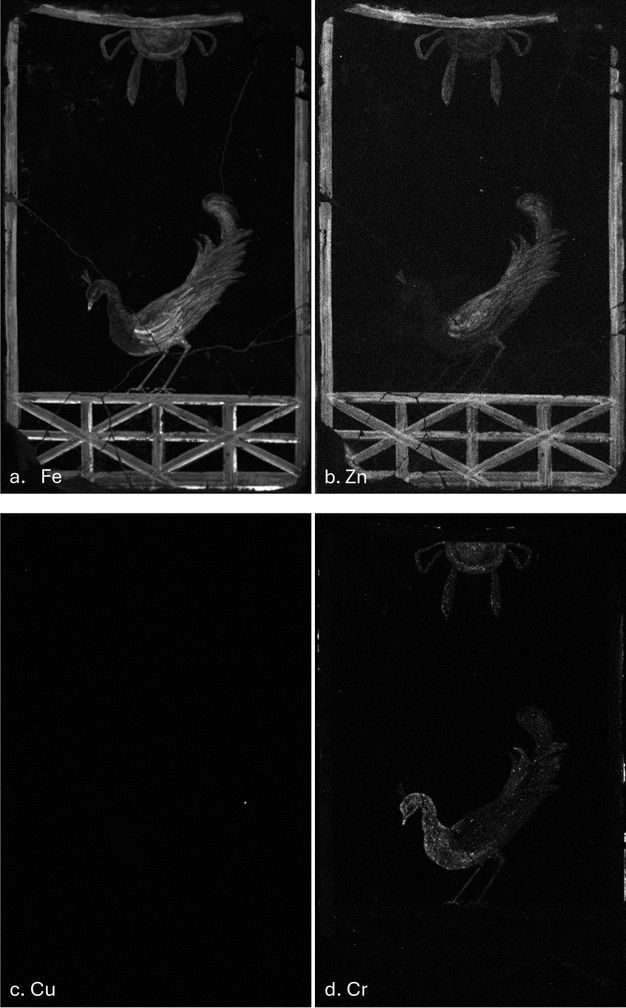
Most significant for the understanding of the palette used to
paint the work were the maps of iron (Fe), zinc (Zn), copper
(Cu), and chromium (Cr) (figs. 6a–d). The iron map shows a strong correlation to the many shades
of red observed on the surface, suggesting the use of
iron-earth pigments (see
fig. 6a). These
red areas also were found to contain variable amounts of
impurities, most notably zinc (see
fig. 6b). A
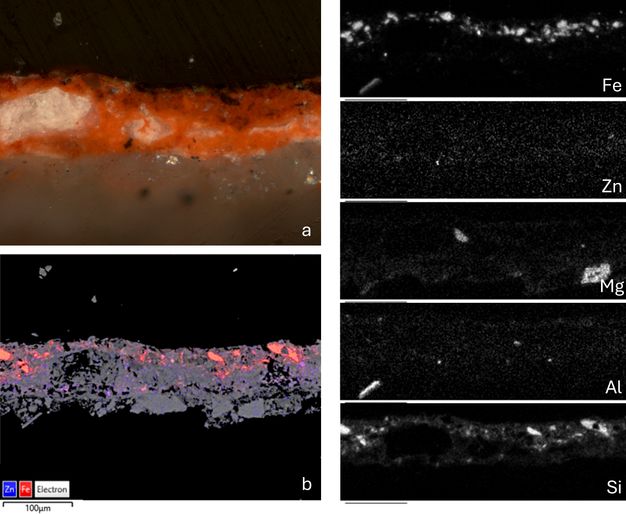
cross section of a sample from the balustrade shows the
painting’s stratigraphy: a superficial (organic) coating,
under which is a dark-red pigment layer, then a light-red
pigment layer, followed by the intonaco (figs. 7a, 7b). SEM-EDS analysis confirmed that both the dark- and
light-red layers contain iron, and Raman analysis identified
the presence of hematite (Fe2O3) in both
layers.22
The dark-red layer did not show the presence of zinc. By
contrast, the light-red layer contained grains rich in zinc
along with iron, sodium, and oxygen (as shown by SEM-EDS).
This suggests the use of two different iron-earth pigments,
one with zinc impurities and one without. Zinc oxide, employed
in the nineteenth-century pigment zinc white, if present,
would have been detected by Raman spectroscopy or SEM-EDS. No
indication of zinc white—in other words, grains containing
only zinc and oxygen with no impurities—was found.
ExpandFigs. 6A–D. —MA-XRF element-distribution maps of the Getty Peacock
indicating the presence of (a) iron (Fe), (b) zinc (Zn),
(c) copper (Cu), and (d) chromium (Cr).ExpandFigs. 7A, 7B. —Images of a cross-sectioned sample from the balustrade
of the Getty Peacock under (a) visible light and (b)
backscattered electron (BSE) imaging overlaid with
energy dispersive X-ray spectroscopy (SEM-EDS)
element-distribution maps of iron (Fe, in red) and zinc
(Zn, in blue); at right are shown the individual SEM-EDS
element-distribution maps of iron, zinc, magnesium (Mg),
aluminum (Al), and silicon (Si).
Egyptian Blue and azurite, both copper based, are the two most
common blue pigments found in antiquity and are likely the
only ones used in ancient Roman wall paintings.23
Initial VIL imaging indicated that Egyptian Blue was not used
in the peacock, and the absence of copper in these areas as
evidenced by MA-XRF scans (see
fig. 6c)
suggests that azurite was also not the source of the blue.
Surprisingly, the blue in the peacock’s body was found to
contain chromium, which was also found in the red feathers,
with a higher concentration in the tail (see
fig. 6d). The
distribution of chromium is not homogenous (see, for
comparison, the iron map,
fig. 6a) but is
present in sparse globular aggregates, or dots (figs. 8a, 8b).
ExpandFigs. 8A, 8B. —Detail of the Getty Peacock showing (a) MA-XRF
element-distribution map of chromium (Cr) showing sparse
globular aggregates of a chromium-containing material
throughout the peacock’s head and neck, and (b) visible
image in which green pigment can be seen extending
beyond the tip of the peacock’s beak, corresponding to a
bright spot in the Cr map.
Examination of the surface under magnification revealed that
the areas painted blue contained a mixture of blue and green
particles. The use of a pure green pigment was also observed
as a discrete underlayer in areas such as the peacock’s beak
(see
fig. 8b).
Traces of chromium have been identified in natural green earth
minerals (celadonite or glauconite) sourced from Italy and
identified on ancient wall paintings.24
However, Raman analysis, conducted directly on the painting
surface and on removed microsamples, identified the presence
of chrome oxide green (Cr2O3), a modern
pigment first introduced into the artist’s palette in
1862.25
Raman analysis also identified the presence of lazurite, the
mineral responsible for the blue color in lapis lazuli.26
Lapis, and the corresponding pigment ultramarine blue, is an
uncommon finding on an ancient Roman wall painting, where the
use of lapis lazuli in its ground form is not attested.27
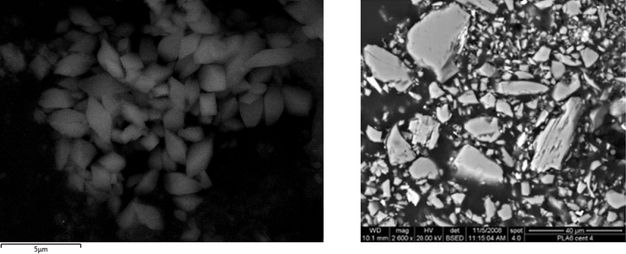
SEM imaging of a sample of blue pigment from the peacock’s
breast revealed uniformly small (approximately 1–2 micrometers
[µm] in diameter), particles with rounded edges characteristic
of a synthetically produced pigment (figs. 9a, 9b). First manufactured in 1826, synthetic ultramarine blue is
chemically identical to natural lazurite.28
The uniform shape of the blue particles found in the peacock,
together with the absence of accessory minerals typically
found in natural lapis, strongly suggests the use of synthetic
ultramarine blue. While the presence of pounce marks and the
notably refined quality of the painting cast doubt on the
ancient origin of the Getty Peacock, the identification of two
modern pigments—chrome oxide green and synthetic ultramarine
blue—provides definitive evidence that the painting, at least,
is not ancient in origin.
ExpandFigs 9A, 9B. —Backscattered electron (BSE) image of (a) a sample of
blue pigment taken from the peacock’s breast showing
uniformly small grains with rounded edges,
characteristic of synthetically produced ultramarine
pigment; and (b) BSE image of natural ultramarine
pigment extracted from lapis lazuli from Afghanistan,
showing the variety of sizes and sharp edges
characteristic of a ground, natural-mineral pigment,
from M. Favaro et al., “Characterization of Lapis Lazuli
and Corresponding Purified Pigments for a Provenance
Study of Ultramarine Pigments Used in Works of Art,”
Analytical and Bioanalytical Chemistry 402, no.
6 (2012): 2202.
The Underlying Structure
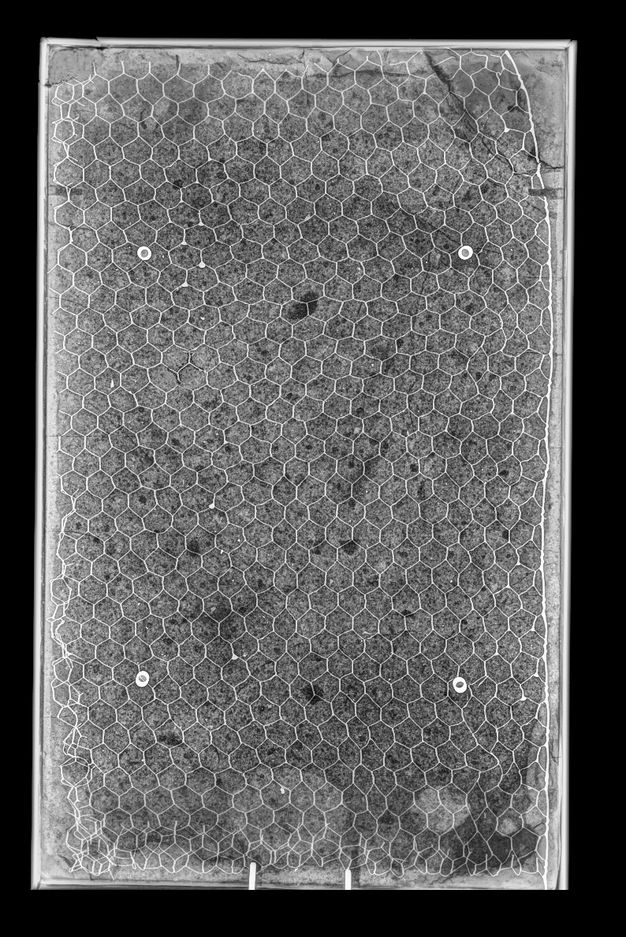
Typically, paintings removed from walls are reinforced with a
concrete backing, and the peacock fresco is no different.
X-radiographs show the presence of chicken wire with a mesh
width of approximately 1 1/4 inches embedded within the
concrete backing (fig. 10). Invented in 1844, chicken wire is commonly used not only
for containing poultry but also for providing structural
support in construction materials, such as ferro-cement, a
type of reinforced concrete. To further investigate the
concrete backing, a sample was extracted for petrographic and
compositional analysis.29
In brief, the findings indicate a composite mixture of
aggregate particles containing oxides of silicon, aluminum,
calcium, and iron in a carbonated Portland cement–based
matrix.30
Portland cement was invented and patented in 1824 in Leeds,
England, and soon became the most common ingredient in the
production of concrete.31
Composed of crystalline hydraulic calcium silicates, Portland
cement served as a strong and durable binder, making it ideal
for construction applications. By the twentieth century its
use had spread worldwide. Although not an unusual discovery,
the identification of Portland cement with embedded chicken
wire helps provide a timeline for when the fresco was backed.
ExpandFig. 10. —X-radiograph of the Getty Peacock revealing the
presence of chicken wire within.
Taken together, the visual and material investigations into
the Getty Peacock constitute a strong case for the painting
having been created no earlier than the mid-nineteenth century
as a wall painting that was subsequently removed and backed
for individual display. This sets the stage for the last phase
of our collaborative investigation, tracing the history of the
object back to its source.
If Not Ancient, What?
As stated above, no parallels to the Getty Peacock have been
found elsewhere in wall paintings from Campania apart from the
now-lost painting of a peacock in the House of Siricus
mentioned by nineteenth-century scholars and reproduced by
Briggs, whose publication of 1911,
Pompeian Decorations, was intended to provide sources
of inspiration for contemporary architects. The author,
however, was widely known not for classical forms but for his
designs of English country homes. Nicknamed “Bungalow” Briggs,
he published five editions of
Bungalows and Country Residences between 1891 and
1901 containing designs for aspirational and built structures.
While most of Briggs’s designs in these volumes follow the
Arts and Crafts style popular at the turn of the century, one
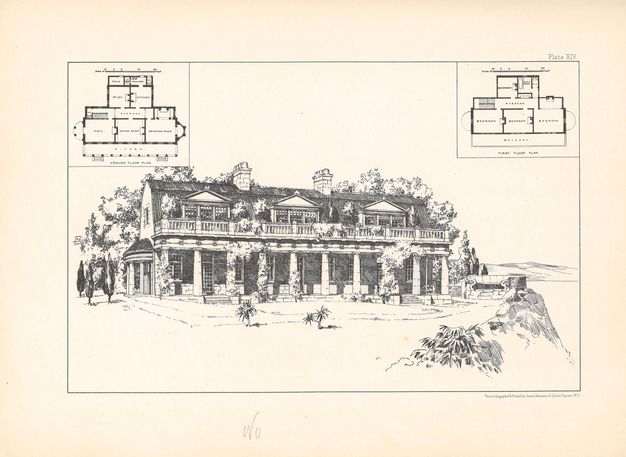
particular design for a “free Greek style” bungalow stands out
(fig. 11).
Here, it is perhaps significant that in the preface to
Pompeian Decorations, Briggs states: “The trend of
Architectural thought is now towards the Greco-Roman style,
and the archaic Greek forms, treated in a free way, are
engaging the attention of many Architects and Decorators of
the present day, to whom, it is hoped, the examples in this
volume should prove sources of inspiration.”32
With its unconventional Doric colonnade, Briggs’s bungalow
appears to be inspired by the Greco-Roman decorative motifs he
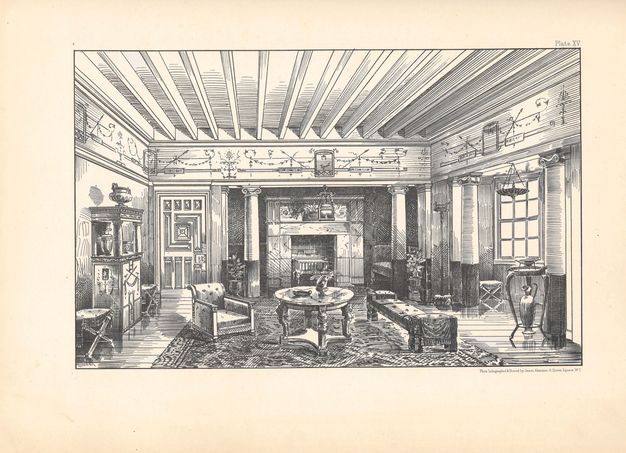
observed in Pompeii. The drawing room illustrated in plate XV
from the first edition of
Bungalows and Country Residences, moreover, includes
Ionic columns, hanging Roman lamps, and a shelf modeled after
a Pompeian lararium (fig. 12).33
Most notable in the context of our investigation, however, is
the pattern lining the top of the drawing room wall, which
features a peacock depicted within a bordered frame standing
on a Roman lattice balustrade; its composition is startlingly
similar to the lost peacock from the House of Siricus and to
the Getty wall painting itself.
ExpandFig. 11. —Robert Alexander Briggs (British, 1858–1916).
Exterior of a proposed “free Greek style” bungalow, from
R. A. Briggs,
Bungalows and Country Residences, 1st ed.
(London: B. T. Batsford, 1891), pl. XIV. Photolithograph
by James Akerman. Los Angeles, Getty Research Institute,
2625-511.ExpandFig. 12. —Robert Alexander Briggs (British 1858–1916).
Drawing room of a proposed “free Greek style” bungalow,
from R. A. Briggs,
Bungalows and Country Residences, 1st ed.
(London: B. T. Batsford, 1891), plate XV. Photolithograph
by James Akerman. Los Angeles, Getty Research Institute,
2625-511.
Briggs’s designs strongly support the hypothesis that the
peacock fresco was created by or for the English architect.
Two publications from the early twentieth century announced
the construction of a house in 1912 following Briggs’s plans
for a “free Greek style” bungalow on Furze Hill in
Banstead/Burgh Heath in Surrey, England, the same county where
J. Paul Getty would reside from 1959 until the end of his
life.34
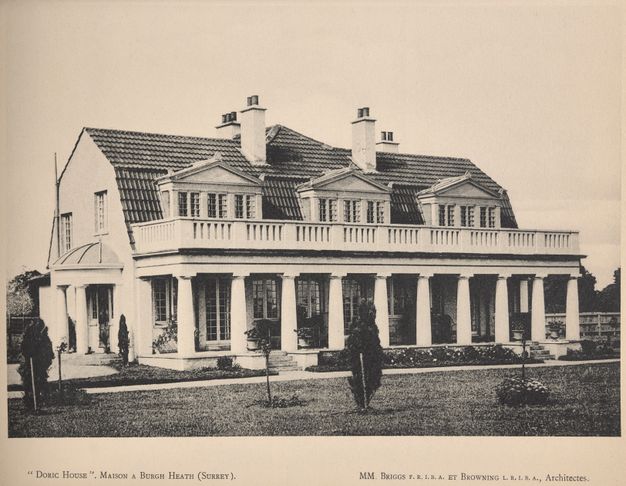
Photographs of the exterior of the structure, aptly named
“Doric House,” appear in Charles Massin’s publication
Villas Normandes & Anglaises
(Norman and English villas) of 1913, demonstrating that the
facade and floorplan of the realized building were faithful to
Briggs’s designs (fig. 13).35
Unfortunately, only one photograph of the interior of the home
has been found to date, in Massin’s book
Intérieurs Anglais (English
interiors) from 1927. It depicts an entrance hall with Ionic
columns, suggesting that the “free Greek style” decoration
likely continued in other rooms throughout the building.36
Sadly, no photographic documentation of the adornment of the
drawing room has yet to be located.
ExpandFig. 13. —“Doric House,” Furze Hill, Surrey, constructed in 1912,
from Charles Massin,
Villas Normandes & Anglaises
(Paris: s.n., 1913), pl. 2.
Ordnance Surveys of Surrey from 1911 to 1955 confirm, through
its distinctive, irregular shape, that the structure on Furze
Hill, often labeled in the documentation as Doric House,
matched Briggs’s floorplans.37
The building was also recorded in an aerial photo of Furze
Hill in 1947.38
Local land registries, district records, and electoral
registers confirm that the house was built for Lester
Bellingham, who is listed as a subscriber to Briggs’s
Pompeian Decorations.39
Bellingham likely commissioned the house from Briggs in
anticipation and celebration of his marriage to Gladys Muriel
Selby in 1912 and their honeymoon in Italy.40
Although photographic proof is lacking, Briggs’s designs in
the first four editions of
Bungalows and Country Residences suggest that the
drawing room of Doric House in Surrey was painted with a
series of peacocks standing on Roman lattices (see
fig. 12). It
seems likely that one of these peacocks was at a later date
removed and accidentally or intentionally mistaken for an
authentic Roman fresco and sold to J. Paul Getty. The presence
of pounce marks on the Getty fragment further supports the
hypothesis that it originated in Doric House, as this
technique was frequently employed to reproduce repeated images
and decorative motifs.
Perhaps the answer to how the Getty fresco could have traveled
from a country home in Surrey to Spink & Son in London
and, finally, to an art museum in California lies in the later
history of Doric House. By 1919, the original owners, the
Bellinghams, had moved out, and the house was purchased by the
nearby St. Monica’s School for Girls.41
Records suggest that Doric House was used as a residential
space for the school’s teachers, domestic staff, and visitors,
including early feminist and pacifist Vera Brittain.42
In 1939, Legal and General Assurance Society Ltd. acquired St.
Monica’s School and converted the campus buildings to rehouse
their London office.43
While this move was intended to escape the aerial bombardment
of London during World War II, an oil-based incendiary bomb
landed just north of Doric House in 1940, reportedly causing
no serious damage.44
Legal and General Assurance Society appear to have used Doric
House to accommodate its staff; local resident David Goodger,
the son of two Legal and General employees, attested to living
in the bungalow as a child from 1951 to 1965.45
Although he did not recall any peacock wall paintings, Goodger
revealed that Doric House had been stripped out and converted
into two flats, one upstairs and one downstairs. In 1973,
Legal and General conveyed the land where Doric House stood to
House Developments Ltd. By 1976, the bungalow had been
entirely demolished, and several new homes were built in its
place on the nostalgically named Doric Drive.46
If a peacock wall painting matching Briggs’s design in
Bungalows and Country Residences was part of the
original decoration of Doric House, it had to have been
removed from the building before 1968 in order to be the same
peacock fresco sold to J. Paul Getty by Spink & Son.
Renovations and redesigns resulting in the removal of the
peacock fresco could have occurred at any point in the house’s
history, perhaps owing to undocumented damage from the 1940
bombing or during Legal and General’s acquisition and the
building’s subsequent conversion into two separate flats.
Until additional evidence emerges, the precise circumstances
remain unknown.
The evidence so far compiled presents a compelling story:
Inspired by his travels in the late nineteenth century, Briggs
designed a bungalow decorated with Pompeian motifs from the
House of Siricus, which he had carefully recorded in
watercolor. In the early twentieth century, Briggs had the
opportunity to make his vision a reality for a young couple
who shared his appreciation for antiquity. As the whimsical
Doric House aged, one of its peacocks was removed and
misidentified or misrepresented as a genuine antiquity. It
eventually traveled across the Atlantic to its current home in
the Getty Villa, where its status as an ancient Roman artifact
stood unquestioned for decades.
In 2006, in conjunction with the reopening of the Getty Villa
after a major renovation, the Getty Peacock was given its own
stop on a new gallery audio guide intended for families.47
Opening with mellifluous flutes and punctuated by squawking
birds, the script describes some of the various contexts in
which peacocks appeared in ancient Roman society. Our recent
investigations, employing modern imaging technologies,
however, have demonstrated that the Getty fresco can no longer
be considered reliable evidence of ancient Roman painting. In
any case, just as the ancient Romans depicted peacocks on the
walls of their homes to invoke the high culture of ancient
Persia (as well as Juno, the Queen of the Gods), late
Victorians evidently drew upon the same imagery, invoking
ancient Roman luxury to advance their own cultural
aspirations.
Kenneth Lapatin is curator of antiquities at
the J. Paul Getty Museum.
Marie Svoboda is conservator of antiquities
at the J. Paul Getty Museum.
Sierra Schiano is an educator at the Los
Angeles County Museum of Art.
Monica Ganio is associate scientist at the
Getty Conservation Institute.
Karen Trentelman is senior scientist at the
Getty Conservation Institute.
Notes
The authors of this study are grateful to Mark Abbe, M.
Arnold, Will Austin, Judith Barr, Hilary Becker, Edward
Bottoms, Rob Briggs, Julian Brooks, Nicole Budrovich, David
Carson, Pia Chamberlain, John Clarke, James Crouch, Michelle
Da Silva, Mike Eden, Rhona Elstone, John Fidler, Susanne
Gänsicke, Regina Gee, Kiernan Graves, Arlen Heginbotham, Sarah
Lepinski, Irene Machariah, Joy Mazurek, John McInally, Fiona
Mann, Devi Ormond, Christiana Payne, Leslie Rainer, David
Saunders, Jeffrey Spier, Miranda Stead, Jeanne Marie
Teutonico, Simeon Wilkie, Lewis Wood, and Gabriel Zuchtriegel
for generously providing access, information, and insights at
various points in their investigations.
Minutes of the meeting are housed in the files of the
Department of the Registrar of the J. Paul Getty Museum.
Mosaic floor with Achilles and Briseis, Roman, possibly
Antioch, Syria (present-day Antakya, Turkey), 100–300
CE, stone mosaic and glass tesserae, J. Paul Getty
Museum, 68.AH.12,
https://www.getty.edu/art/collection/object/103SPQ; and Homer, TheIliad, 1.327–48.
↩︎
The J. Paul Getty Museum, visitor guide, 1974,
11. On the masthead, the guide states: “This is a
temporary guide for the assistance of visitors during
the period immediately after the opening of the new
Museum.” Los Angeles, Getty Research Institute,
87-B7598.
↩︎
Cornelius Vermeule and Norman Neuerburg,
Catalogue of the Ancient Art in the J. Paul Getty
Museum: The Larger Statuary, Wall Paintings and
Mosaics
(J. Paul Getty Museum, 1973), 50, no. 108.
↩︎
Robert Alexander Briggs, preface to
Pompeian Decorations (B. T. Batsford, 1911),
n.p. ↩︎
“Two Friezes,” text preceding two unnumbered plates from
the House of Siricus, in Briggs,
Pompeian Decorations, n.p.
↩︎
These rooms are alternately numbered 3, 5 and 2, 11. See
Fausto Niccolini and Felice Niccolini,
Le case ed i monumenti di Pompei, disegnati et
descritti,
vol. 1 (Naples, 1854), 2: “Sono nel mezzo taluni simboli
delle principali Deità, il pavone sacro a Giunone,
l’aquila ed il globo di Giove, la cerva con la faretra
di Diana, un grifo rimpetto alla lira d’Apollo, la
mistica cista ed il sistro d’Iside presso una sfinge,
l’uccello di Minerva, ecc.” (In the middle are some
symbols of the principal deities, the peacock sacred to
Juno, the eagle and the globe of Jupiter, the doe with
the quiver of Diana, a griffin in front of the lyre of
Apollo, the mystical cista and the sistrum of Isis near
a sphinx, the bird of Minerva, etc.) Translation of the
quotation from the Italian by the present authors; and
Johannes Overbeck,
Pompeji in seinen Gebäuden, Alterthümern und
Kunstwerken
(Leipzig, 1875), 285–86: “das auf weißben Wänden mit
leichten Ornamenten und kleinen Landschaften und mit
einer interessanten Folge von Götterattributen (Adler,
Blitz und globus für Zeus, Pfau und Wollkorb für Hera,
Greif und Kithara für Apollon u. s. w.) decorirt ist.”
(which is decorated on white walls with light ornaments
and small landscapes and with an interesting sequence of
attributes of the gods [eagle, lightning and globe for
Zeus, peacock and wool basket for Hera, griffin and
kithara for Apollo, etc.].) Translation of the quotation
from the German by the present authors. Very similar
text appears in Johannes Overbeck,
Pompeji in seinen Gebäuden, Alterthümern und
Kunstwerke, 4th ed. (Leipzig, 1884), 322–23.
↩︎
For peacocks in ancient art and thought, see, for
example, J. M. C. Toynbee,
Animals in Roman Life and Art (Cornell
University Press, 1973), esp. 250–53; John Pollard,
Birds in Greek Life and Myth (Thames &
Hudson, 1977), esp. 91–93; and W. Geoffrey Arnott,
Birds in the Ancient World from A to Z
(Routledge, 2007), 342–45, s.vv. “Tahōs, Taōs,
Taōn."
↩︎
Peacocks depicted in profile with upward curving tails
do, however, appear perched on silver basins and a thin
vegetal garland in the House of the Vettii at Pompeii
(VI.15.1).
↩︎
Ruth Siddall, “Not a Day Without a Line Drawn: Pigments
and Painting Techniques of Roman Artists,”
infocus Magazine, June 2006, 18–23, 24; and
Giovanni Verri, “The Spatial Characterization of
Egyptian Blue, Han Blue and Han Purple by Photo-Induced
Luminescence Digital Imaging,”
Analytical and Bioanalytical Chemistry 394
(2009): 1011–21.
↩︎
Calcite was identified by X-ray diffraction (XRD); no
other components were detected. XRD patterns were
collected using a Rigaku MiniFlex 600 benchtop X-ray
diffractometer equipped with a copper (Cu) tube
operating at 40 kilovolts (kV)/15 milliamps (mA), with a
0.03-millimeter (mm) nickel (Ni) filter, and a D/teX
Ultra2 silicon strip detector. Randomly oriented powder
was scanned in spin mode from 2° to 80° 2Ɵ, with a 0.01°
2Ɵ step size and counting time of 2 degrees per second
(deg/s). Data analysis was carried out using Rigaku PDXL
2 software and Profex. See Nicola Doebelin and Reinhard
Kleeberg, “Profex: A Graphical User Interface for the
Rietveld Refinement Program BGMN,”
Journal of Applied Crystallography 48, no. 5
(2015): 1573–80.
↩︎
UVF imaging captures diagnostic responses of materials
when excited by UV radiation, allowing pigments to be
characterized and ancient or modern surface
interventions to be revealed. Imaging was performed
using a modified Canon 80D 24.2-megapixel camera with
UV-VIS-IR functionality, equipped with a Zeiss Milvus 50
mm macro lens and optical filters (Max Max CCI and 918)
along with a Kodak 2E gel filter, and a Wildfire Long
Throw Series ultraviolet source (365 nanometers [nm]).
Coatings can mask the fluorescence response from the
pictorial layer, thus interfering with the observation
of any characteristic emissions associated with ancient
materials, such as madder lake or lime plaster.
↩︎
Analysis was carried out using an Agilent 7890A/5975C
GC-MS system equipped with a thermal separation probe
(TSP) and a ZebronTM ZB-5HT Inferno column (30 m × 0.25
mm × 0.10 μm) from Phenomenex. FT-IR spectroscopy was
conducted using a Bruker Hyperion 3000 FT-IR microscope.
↩︎
Kass Peter and Zeno W. Wicks, “Alkyd Resins,” US Patent
2,577,770, 11 December 1951,
https://patents.google.com/patent/US2577770A/en. Harriet A. L. Standeven,
House Paints, 1900–1960: History and Use (Getty
Conservation Institute, 2011), 4–5, 72, 76, 121–22.
↩︎
Shuya Wei et al., “Scientific Investigation of the
Materials in a Chinese Ming Dynasty Wall Painting,”
International Journal of Conservation Science
1, no. 2 (2010): 108; and Kirsten Travers et al.,
“Pemulen Case Study: Holy Innocents Mural Project,”
WAAC Newsletter 32, no. 3 (2010): 13.
↩︎
IRR imaging can reveal the presence of underdrawings
produced with infrared-absorbing materials. IRR images
were created using a modified Canon 80D 24.2-megapixel
camera with UV-VIS-IR functionality, a Zeiss Milvus 50
mm macro lens, and an 830 nm filter. See Molly Faries,
“Techniques and Applications—Analytical Capabilities of
Infrared Reflectography: An Art Historian’s
Perspective,” in National Academy of Sciences,
Scientific Examination of Art: Modern Techniques in
Conservation and Analysis
(National Academies Press, 2005), 87–88.
↩︎
Carmen Bambach Cappel, “A Substitute Cartoon for
Raphael’s Disputa,”
Master Drawings 30, no. 1 (1992): 11; Carmen
Bambach Cappel, “Michelangelo’s Cartoon for the
Crucifixion of St. Peter Reconsidered,”
Master Drawings 25, no. 2 (1987): 135; and
Cennino d’Andrea Cennini,
The Craftsman’s Handbook:
“Il Libro dell’Arte,”
trans. Daniel V. Thompson Jr., 2nd. ed. (Dover, 1954),
87. ↩︎
MA-XRF spectroscopy was performed using a Bruker M6
Jetstream spectrometer equipped with a 30 W rhodium (Rh)
tube and polycapillary focusing optics. The scans were
carried out using the following parameters: 530
micrometers (µm) spot size, 530 µm step size, and 30
milliseconds (ms) dwell time per pixel. The X-ray tube
was operated at 50 kV and 600 microamps (µA). Spectra
were collected over a 40 kiloelectron volts (keV) energy
range and 130 kilocounts per second (kcps) throughput.
The raw map data were calibrated, fit, and mosaicked
using PyMca and Datamuncher software suites. See V. A.
Solé et al., “A Multiplatform Code for the Analysis of
Energy-Dispersive X-Ray Fluorescence Spectra,”
Spectrochimica ActaPart B: Atomic Spectroscopy 62, no. 1 (2007):
62, 63–68; M. Alfeld and K. Janssens, “Strategies for
Processing Mega-Pixel X-Ray Fluorescence Hyperspectral
Data: A Case Study on a Version of Caravaggio’s Painting
Supper at Emmaus,”
Journal of Analytical Atomic Spectrometry 30,
no. 3 (2015): 30, 777–89; and T. Wolff et al., “A New
Fundamental Parameter Based Calibration Procedure for
Micro X-Ray Fluorescence Spectrometers,”
Spectrochimica ActaPart B: Atomic Spectroscopy 66, no. 2 (2011),
66, 170–78.
↩︎
Raman spectroscopy was performed using a Renishaw InVia
Raman microscope using 785 nm laser excitation and a
Leica 50× objective lens. Laser power and other
collection parameters varied between measurements to
optimize the signal while avoiding sample degradation.
↩︎
Hamdallah Bearat,
“Quelle est la gamme exacte des pigments romains?
Confrontation des resultats d’analyse et des textes de
Vitruve et de Pline,”
in
Roman Wall Painting: Materials Techniques, Analysis
and Conservation, ed. H. Bearat (Fribourg: Institute of Mineralogy and
Petrography, 1997), 24; and Jose Luise Perez-Rodriguez
et al., “Green Pigments of Roman Mural Paintings from
Seville Alcazar,” Applied Clay Science (2015):
212,
https://doi.org/10.1016/j.clay.2015.03.016. ↩︎
E. M. Molacek et al., “Re-Discovering a Roman Wall
Painting at Harvard: New Research on a Fragment from the
Villa at Boscotrecase,”
Studies in Conservation 65, no. 5 (2020): 306.
↩︎
Richard Newman, “Chromium Oxide Greens,” in
Artists Pigments: A Handbook of Their History and
Characteristics, vol. 3, ed. Elisabeth West FitzHugh (Oxford
University Press, 1997), 274.
↩︎
The elements in lazurite (sodium [Na], calcium [Ca],
aluminum [Al], silicon [Si], sulfur [S], and oxygen [O])
are not easily detectable by XRF. However, potassium (K)
can serve as a surrogate marker for the presence of
natural lapis lazuli, where it is often present as an
impurity (M. Favaro et al., “Characterization of Lapis
Lazuli and Corresponding Purified Pigments for a
Provenance Study of Ultramarine Pigments Used in Works
of Art,”
Analytical and Bioanalytical Chemistry 402, no.
6 [2012]: 2195–208). The K map for the Getty Peacock
showed weak intensity across the entire painted surface
but was insufficient to attribute it to lapis lazuli.
↩︎
Joyce Plesters, “Ultramarine Blue, Natural and
Artificial,” in
Artists Pigments: A Handbook of Their History and
Characteristics, vol. 2, ed. A. Roy (Oxford University Press, 1993),
37–61.
↩︎
Testing was performed by consulting engineers of
Sandberg LLP on 30 March 2023. Chemical analyses of the
aggregates and matrix of the concrete core were carried
out using an Oxford Instruments INCA energy dispersive
X-ray (EDX) microanalysis system calibrated with
certified mineral standards.
↩︎
The sample includes particles of just over 3 millimeters
in diameter and consists of a mixture of angular and
subrounded ash particles lacking the texture typically
associated with ash of geological origin, such as
pumice, together with siliceous sand particles. Reported
by Sandberg LLP, 30 March 2023.
↩︎
Specifically, a lararium from the House of M. Epidi
Sabini (IX.1.22). The lararium is also illustrated by
Briggs in Pompeian Decorations, n.p.
↩︎
Monochrome drawing of a “House at Furze Hill, Burgh
Heath, Surrey,” from TheAcademy Architecture and Architectural Review,
December 1912, 143; and “House, Furze Hill, Burgh
Heath,” The Architect and Contract Reporter, 18
July 1913, 52.
↩︎
Title Register for 3 Doric Drive, Tadworth (KT20 6HH)
(Freehold), title number SY453808, HM Land Registry,
https://www.gov.uk/government/organisations/land-registry. Epsom Rural District Council Building Plan
application no. 909, submitted 31 May 1911 and approved
7 June 1911, Woking, England, Surrey History Centre
Archives. All Census & Electoral Rolls, “Surrey,
England, Electoral Registers, 1832–1962,” Surrey
Electoral Register, Polling District of Banstead, 1913,
s.v. “Bellingham, Lester,” accessed on ancestry.co.uk.
↩︎
England & Wales, Civil Registration Marriage Index,
1837–1915, Marriages Registered in July, August, and
September 1912, s.v. “Bellingham, Lester,”
ancestry.co.uk; and All UK and Ireland, Outward
Passenger Lists, 1890–1960, s.v. “Gladys Bellingham,”
departure date 1 July 1913, ancestry.co.uk.
↩︎
Register of Electors, Autumn 1919, Reigate Parliamentary
Division of the County of Surrey, Polling District of
Mickleham, s.vv. “22 Bellingham, Lester” and “23
Bellingham, Gladys Muriel”; and Register of Electors,
Autumn 1919, Reigate Parliamentary Division of the
County of Surrey, Polling District of Banstead (Tadworth
Only), s.v. “511 Parker, William,” accessed on
ancestry.co.uk.
↩︎
Winifred Holtby, Letters to a Friend (Collins
Clear-Type Press, 1937), 206–59; and 1921 Census of
England, s.vv. "Florence, Bervon,” and “Surrey”;
Bervon is listed as the co-headmistress of St. Monica’s
School and as the person responsible for returning the
census form. The postal address is listed as Doric
House, Burgh Heath, Tadworth, Surrey. A teacher, a
housekeeper, and sixteen pupils are listed as residents.
London, United Kingdom National Archives, accessed on
findmypast.co.uk.
↩︎
Legal & General,
Pensioner’s Memories 1836 to 1986, vol. 1
(Legal & General, 1988), 48–49, London Archives,
CLC/B/144/MS36331A.
↩︎
Surrey World War Two Bomb Incident Map, Banstead_103, 18
October 1940, Surrey History Centre,
www.exploringsurreyspast.org.uk/bombsites/.
↩︎
David Goodger, personal e-mail interview by Lewis Wood,
Banstead History, 30 August 2022, shared with the
authors via e-mail by Wood on 16 January 2024.
↩︎