Fayet / Flaunting the UnfinishedGetty Research Journal, No. 21 (2026)
Copied page section link to clipboard
Abstract
In several completed works in the oeuvre of Swiss painter
Ferdinand Hodler (1853–1918), including some of his most
important pieces, there is an unusual phenomenon: Hodler
ostentatiously displayed lines resulting from the use of
sighting and transfer grids as well as traces of other
technical tools. Hodler’s enthusiasm for Renaissance art
is revealed by numerous sources, including previously
unpublished letters and accounts from his contemporaries.
Hodler used the traces of instruments that were
particularly prevalent in the early modern period, and the
consequent impression of
non finito, to position
himself in the tradition of the European Renaissance
canon. Through this idiosyncratic approach, Hodler’s work
can be seen anew as a modern form of classicism that frees
itself from narrative and anecdotal elements.
Keywords
Ferdinand Hodler, painting techniques,
non finito, classicism,
modernism, Swiss art
Copied page section link to clipboard
Peer Review
Double anonymous, external
Copied page section link to clipboard
Cite
Chicago
Roger Fayet, “Flaunting the Unfinished:
Non finito as a Classicist
Gesture in the Work of Ferdinand Hodler,”
Getty Research Journal, no. 21 (2026),
https://doi.org/10.59491/PZYH6543.
MLA
Fayet, Roger. “Flaunting the Unfinished:
Non finito as a Classicist
Gesture in the Work of Ferdinand Hodler.”
Getty Research Journal, no. 21, 2026,
https://doi.org/10.59491/PZYH6543.
In the oeuvre of Swiss painter Ferdinand Hodler (1853–1918)
there is an unusual phenomenon. In several of his completed
works, including some of his most important pieces, Hodler
ostentatiously displayed lines resulting from the use of
sighting and transfer grids as well as traces of other
technical tools.1
While other artists of Hodler’s time considered the use of
traditional devices such as the sighting grid or the Dürer
pane to indicate deficient artistic ability, Hodler
unashamedly admitted to using them and proudly showed them to
visitors in his studio. Even more surprising, given the
artist’s perfectionism, is that he left traces of their use
visible in some of his finished paintings. This article
attributes Hodler’s idiosyncratic flaunting of technical
processes to his enthusiasm for Renaissance art, as revealed
by numerous sources, including previously unpublished letters
and accounts from his contemporaries. The central argument
contends that Hodler used the traces of instruments that were
particularly prevalent in the early modern period and the
resulting impression of
non finito to position himself
in the tradition of the European Renaissance canon. Therefore,
Hodler’s work can be seen anew as an attempt at a modern form
of classicism that has freed itself from narrative and
anecdotal elements.
Hodler’s Use of Technical Devices
Around 1900, Hodler was the most influential figure in Swiss
painting. His art, which ranges from landscapes and portraits
to large-format figurative paintings, was initially
characterized by realism before he turned to symbolism in his
later years. At the same time as Hodler was transitioning from
realism to symbolism, he developed his concept of
“parallelism,” a specific compositional approach based on
symmetry and repetition, with which the artist sought not only
to enhance the impact of his works but also to reflect an
inherent law of nature.
Whatever genre Hodler adopted, the use of technical aids
distinguished his painting process. One common tool of the
trade was the sighting grid, which served to capture the
contours of a landscape or a sitter. Hodler himself wrote
about his approach in a notebook from 1898: “One places the
model directly behind the net, as close as possible. . . . One
must give the squares 10, 15, or 20 centimeters for whole
figures. If you make them too small, there will be too many of
them and the large number of squares will confuse the
view. . . . One places oneself at the desired distance, which
also depends on one’s eyesight.”2
Hodler used the sighting grid not only in drawing but also in
painting; thus, net-frame lines could be traced on portraits
and figure or landscape paintings.
Another device Hodler regularly used was the glass panel—the
so-called Dürer pane. He notes to his first biographer, Carl
Albert Loosli:
One has occasionally admired the depth perspective of my
pictures of Lake Geneva from Chexbres and Caux. It was in
fact no more difficult to depict them correctly than any
other distant perspective. For one thing, I got into the
habit of seeing flat; for another, I used the Dürer pane on
every occasion; it offers unmistakable, incorruptible fixed
points and bases for this purpose. With the wide surface
perspectives of large plains or steeply rising mountains, it
is no different. The draftsman and the painter do not need
more than the Dürer pane can give them.3
In addition to this, Hodler used devices such as a
straightedge, plumb line, triangle, ruler, and compass as well
as a rack made especially for him, with which he could measure
a model to the precise centimeter in height and width.4
The artist applied compasses to trace certain measurements
directly on the sitter’s face; he then transferred them to the
picture, which could lead to visible construction lines on the
painting. Hodler’s student Stéphanie Guerzoni reports that he
told her: “Use the compass to measure the length of the nose,
the width of the forehead, the distance between the eyes.”5
Particularly relevant are the lines that emerged as a result
of transfers. Hodler often applied the square grid to transmit
a preparatory drawing or study to a painting as well as to
enlarge or reduce the subject—a very common technique in the
production of large-format paintings in European art.
Making Visible the Traces of Technical Tools
There is nothing unusual about harnessing technical tools to
survey an object or to transfer a sketch onto a canvas. What
is unusual, however, is how openly Hodler talked about using
these devices and how much pride he seemed to take in their
deployment at a time when many successful artists were
celebrating more informal, loose gestures. As a student, he
had written down his “Ten Commandments,” declaring in the
eighth, “The means to achieving precision are observation,
comparison, and measurement.” In the tenth commandment, he
states: “To determine the exact measures, the human eye is not
enough, and wherever there is the opportunity, the artist is
well advised to make use of the mathematical instruments of
measurement, namely the compasses, the straightedge, the
triangle, the plumb line, and the ruler.”6
This credo, declared in 1874, corresponds to a self-portrait
from approximately the same year that shows the young painter
with a striking pageboy haircut, a reference to the hair
fashion of the sixteenth century and thus to the Renaissance
forebears.7
The student’s right hand is raised to swear; in his left, he
holds a triangle and a plumb line.
In later years, Hodler continued to insist on the importance
of measurement when talking with colleagues about his methods.
Guerzoni reports that one of his instructions was to “always
measure, never rely on your eyes!”8
Loosli remarks that the artist’s “everlasting commandment” was
the dictum “observe, measure, compare!”9
German scholar Adolf Frey claims that Hodler drew his figures
from the model “to the last square centimeter or even square
millimeter.”10
Other painters tended to regard a tool such as the sighting
grid as an aid for the beginner or amateur. Hodler, in
contrast, happily advertised his reliance on such equipment
and even posed for photographs near it.11
Even more surprising than Hodler’s verbal endorsements of
technical aids is that he sometimes left visible traces of
these techniques in his finished figure paintings and
portraits. The compositions sometimes reveal lines that were
drawn when the artist applied the sighting grid or transferred
cartoons to the canvas. Grid lines and transfer lines are
often visible on paintings that originated as studies and only
later were signed by Hodler as artworks in their own right.
Lines visible to the naked eye appear in works from around
1890 and gradually increase from around 1910 onward. In an oil
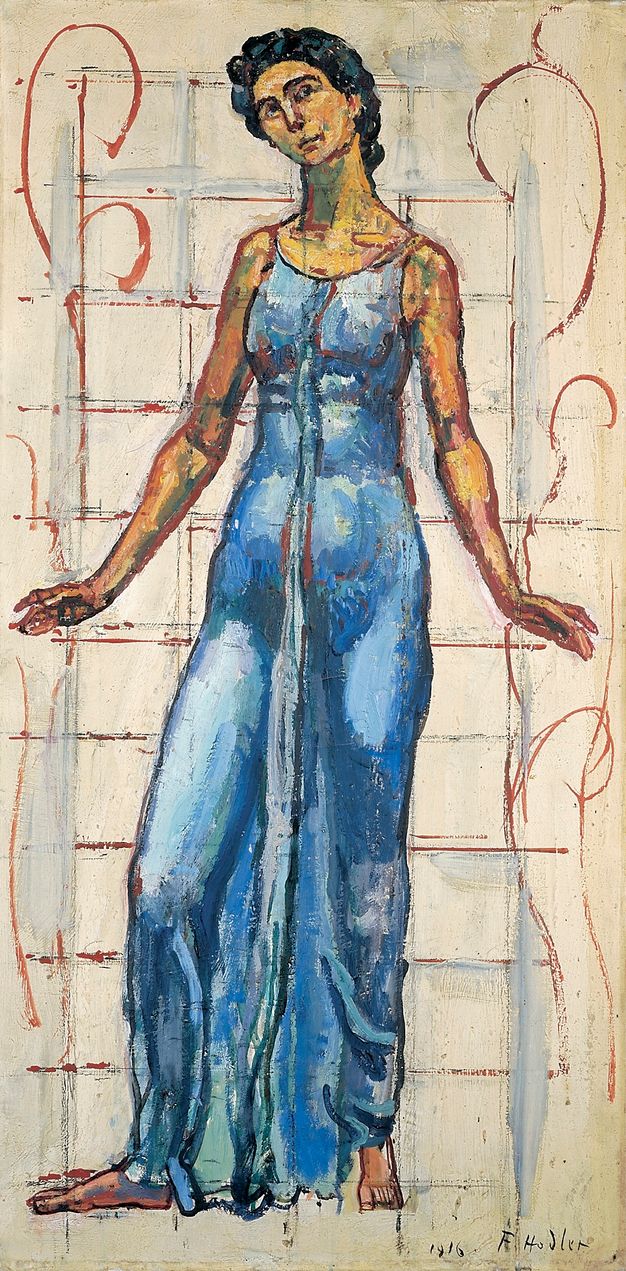
sketch for View into the Infinite, signed and dated
1916, Hodler seems to have intensified the lines at the end of
the painting process without any functional reason for the
reinforcement (fig. 1). The presence of auxiliary lines in works that originated
as studies or preliminary drawings is, of course, expected in
artistic practice of this period and can therefore hardly come
as a surprise—although it would have been easy enough for the
artist to paint over them when he allowed the painting to
become a stand-alone work.
ExpandFig. 1. —Ferdinand Hodler (Swiss, 1853–1918). Oil
study for View into the Infinite, 1916, oil on
canvas, 83 × 41.5 cm. CR no. 1649. Zurich, Kunsthaus.
Image: Kunsthaus Zürich.
By contrast, it is highly unusual for such lines to be visible
in works intended as final products from the outset. In
Hodler’s work, lines are visible to the unaided eye—for
example, in the two versions of his large-scale composition
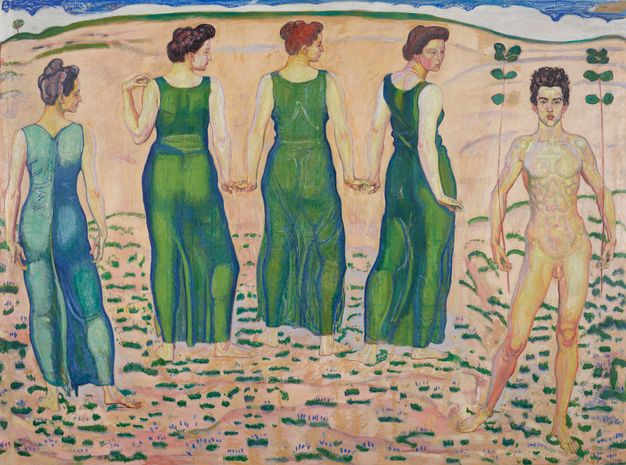
The Admired Young Man from 1903, both of which were
later revised by the artist. In the version revised in 1904,
lines are discernible mainly near the young male figure, one
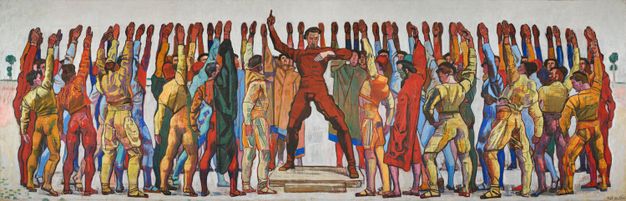
of which runs horizontally through his navel (fig. 2). Horizontal and vertical transfer lines are also present in
the monumental version of Unanimity from 1912–13,
held in the collection of the Kunsthaus Zürich, across the
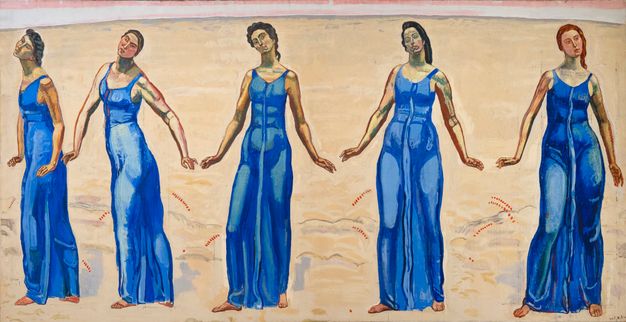
entire width of the picture (fig. 3); lines are seen in the two versions of
View into the Infinite now in the collections of the
Kunstmuseum Basel and the Kunsthaus Zürich—especially in the
latter, where they are pronounced next to the figure at the
right edge of the picture (fig. 4).12
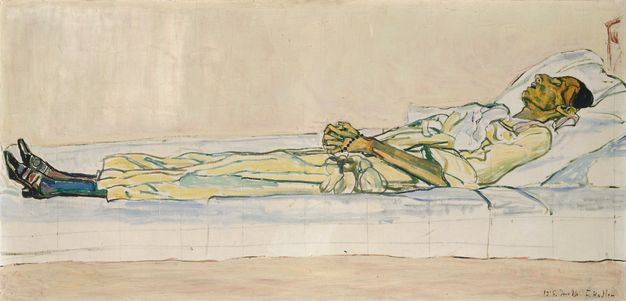
Lines have a striking presence in the depiction of Hodler’s
deceased lover, Valentine Godé-Darel, from 1915. For months,
Hodler had recorded the progression of her illness as she
suffered from cancer, and eventually, her death, in countless
drawings, oil sketches, and paintings.13
Of the three works that show Godé-Darel in overall view on her
deathbed, the one that today belongs to the Kunstmuseum
Solothurn most clearly shows a grid of lines, especially on
the side of the mattress.
ExpandFig. 2. —Ferdinand Hodler (Swiss, 1853–1918).The Admired Young Man, 1903, revised 1904, oil
and oil crayon on canvas, 213.5 × 288 cm. CR no. 1348.
Zurich, Kunsthaus. Image: Kunsthaus Zürich.ExpandFig. 3. —Ferdinand Hodler (Swiss, 1853–1918).Unanimity, 1912–13, oil on canvas, 3.3 × 10 m. CR
no. 1496. Zurich, Kunsthaus. Image: Kunsthaus
Zürich.ExpandFig. 4. —Ferdinand Hodler (Swiss, 1853–1918).View into the Infinite, 1916, oil on canvas, 343
× 723 cm. CR no. 1594. Zurich, Kunsthaus. Image: Kunsthaus
Zürich.
In some cases, auxiliary lines clear to the eye can also be
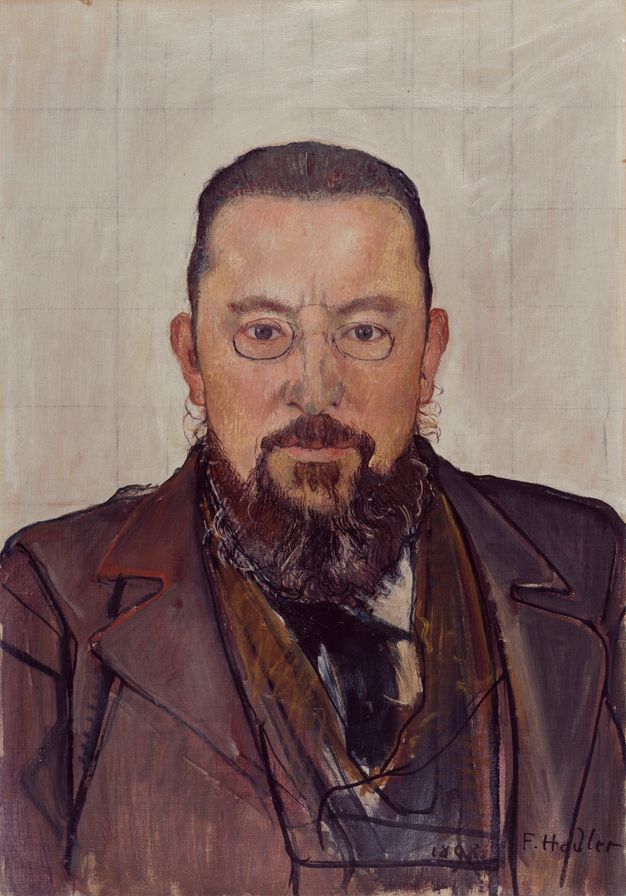
found in portraits. For example, in the portrait of literary
and art critic Josef Viktor Widmann from 1898, there are
transfer and sighting grid lines (fig. 5). The work was described by the sitter’s son, Fritz Widmann,
as “not having reached its completion,”14
but his comment did not pertain to the visible lines. Rather,
he was of the opinion that the portrait’s resemblance to the
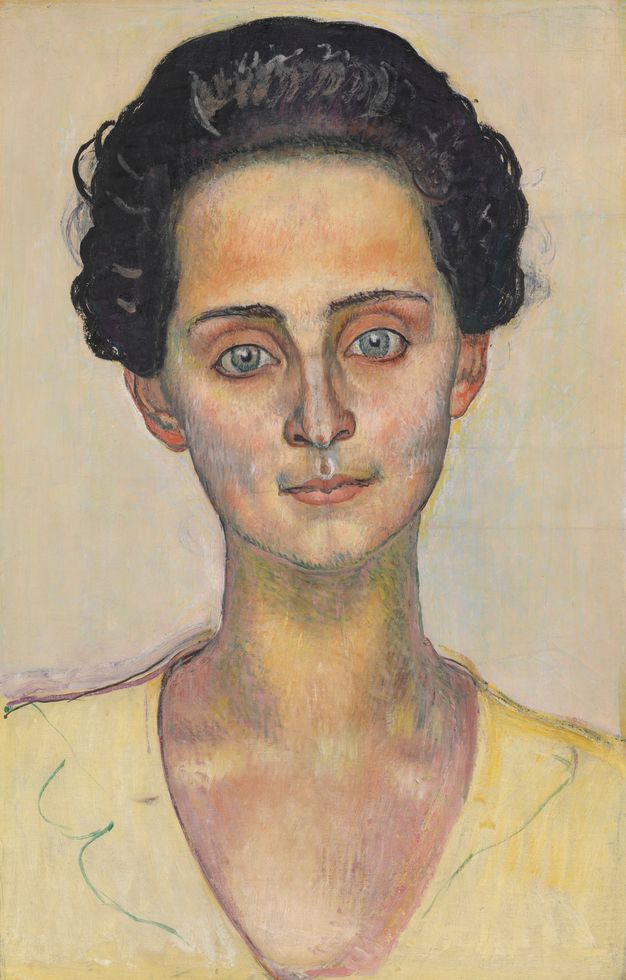
sitter was not yet completely established. In a portrait of
Hodler’s wife, Berthe Hodler-Jacques, from the same year, a
line of construction lies on the vertical central axis of the
face, while two perpendicular construction lines extend across
the eyes and mouth; faintly visible, a grid of transfer lines
marks the background (fig. 6).
ExpandFig. 5. —Ferdinand Hodler (Swiss, 1853–1918).Portrait of Josef Viktor Widmann, 1898, oil on
canvas, 55 × 38.5 cm. CR no. 798. Bern, Kunstmuseum,
bequest of Ch. Edm. von Steiger-Pinson. Image: Kunstmuseum
Bern.ExpandFig. 6. —Ferdinand Hodler (Swiss, 1853–1918).Portrait of Berthe Hodler-Jacques, 1898, oil on
canvas, 40 × 27 cm. CR no. 801. Private collection. Image:
SIK-ISEA, Zurich.
Overall, auxiliary lines are ostentatiously displayed only on
a good handful of important figure paintings, an equal number
of portraits, and several dozen oil studies that Hodler
signed, elevating them to completion; there are many more
paintings in which lines are faintly visible. In the vast
majority of his paintings, however, Hodler made the lines
disappear under new layers of paint; in his landscapes, they
are invisible throughout, even though they often played a role
in the painting process. Nevertheless, it is intriguing that
lines should have such a strong presence in some of the
artist’s most important works. And although Hodler’s auxiliary
lines only appear in a small number of finished paintings,
their presence was noticeable and unusual to Hodler’s
contemporaries. Art historian Artur Weese remarks in 1918,
“From now on, i.e., from the transition of the eighties to the
nineties, there is probably no picture by Hodler’s hand on
which the space would not be structured by an ordering of
fields, visibly or veiled, overtly or as a secret
network.”15
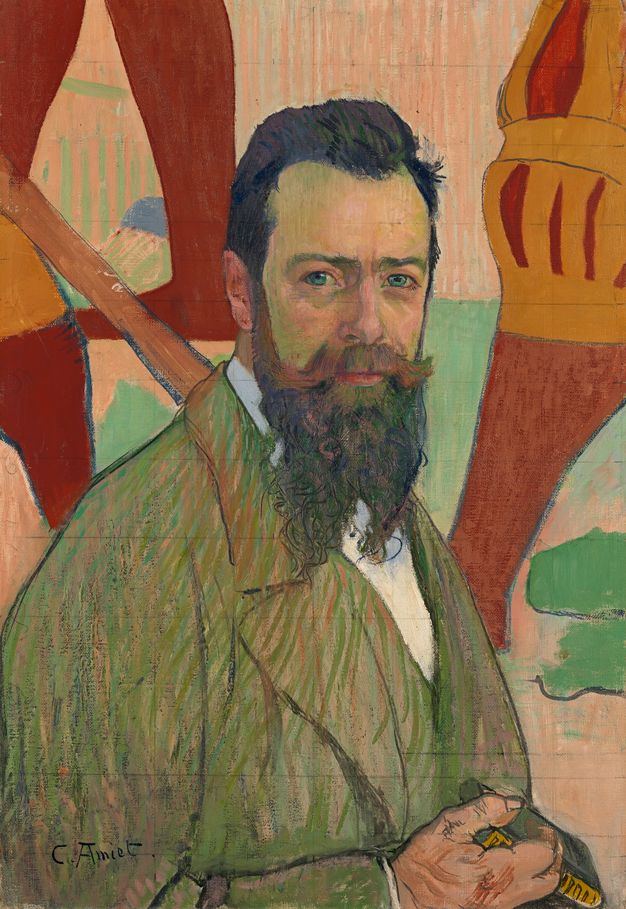
In 1898, Hodler’s friend Cuno Amiet painted a portrait of the
artist standing in front of a cartoon for the mural
commissioned to depict Swiss history in the armory hall of in
the Swiss National Museum (fig. 7). Amiet’s portrait of Hodler is the only one of Amiet’s
approximately 450 known portraits to show a visible grid of
lines. Amiet kept this work and exhibited it at the VIII
Internationale Kunstausstellung (International Art Exhibition)
in Munich and at the XII. Wiener Secession (Vienna
Secession) in 1901. In 1902, collector Oscar Miller, to whom
Amiet had sold a second version of the portrait, this time
without the grid, asked to exchange his painting for the one
with the grid.16
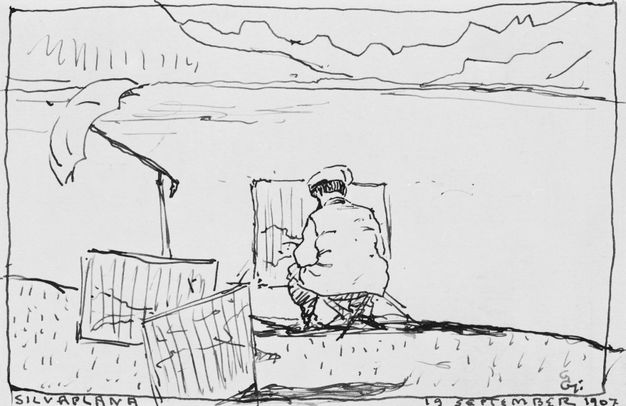
Furthermore, Swiss painter Giovanni Giacometti sent a postcard
to their mutual friend Amiet in 1907, in which a small sketch
shows Hodler painting a series of landscapes, each covered
with vertical lines (fig. 8).17
The gentle criticism that it echoes is aimed at the artist’s
large output of landscape paintings, but at the same time, it
seems to make fun of his excessive use of auxiliary lines.
It is difficult to judge whether the visibility of lines and
grids was just a remarkable element for Hodler’s
contemporaries or whether it disturbed them. Collectors
repeatedly perceived Hodler’s paintings as unfinished, but it
remains unclear whether this had anything to do with the
presence of the grids. A letter to the collector Carl
Reininghaus, for example, reveals that Reininghaus had urged
Hodler to “finish” the version of
The Admired Young Man that Reininghaus had recently
acquired (see
fig. 2). Hodler
wrote to Reininghaus on 14 February 1905: “As for the
retouching, I did what you wanted, point by point. I don’t
want to list everything I retouched. It would be impossible
for me to go beyond that without acting against the painting’s
interest. I would point out that all these retouches alter the
character of the execution, of the ductus. The better, as you
know, is often the enemy of the good. . . . For me, the
painting is very finished. . . . I already found it sufficient
in Vienna.”18
Here, as in other cases, it is obvious that the client’s idea
of what a finished painting should look like differed from the
artist’s. But there isn’t any evidence that explicitly shows
that the visibility of the grid was the reason for
dissatisfaction on the part of the clients.
The Question of Why
How do we explain the intriguing presence of the grids and
auxiliary lines in Hodler’s paintings? It is tempting to
interpret their visibility for technical reasons. Restorer and
Hodler specialist Karoline Beltinger argues that the
overpainting of dark lines in sections that show a loose or
spotted application of paint would have altered the character
of these areas.19
This explanation is undeniably convincing for many of his oil
sketches, even though in numerous cases, Hodler did not
hesitate to cover the grids. However, this argument seems
difficult to apply to artworks that were intended to be
autonomous from the outset, for the simple reason that Hodler
evidently had no trouble painting over the grids and lines in
almost all of those cases. As mentioned above, he obscured
them in all of his landscape paintings, and in the vast number
of his figure paintings and portraits. Even where they
remained visible, they only showed in certain parts, and
Hodler’s decisions as to where the lines were left had nothing
to do with the nature of the paint application in the
corresponding areas. To put it simply: If Hodler wanted to
cover the technical lines, which was usually the case, he had
no trouble doing so. Conversely, if he left them visible, it
seems that he wanted them to be seen.
Considering the significance of parallel and symmetrical
structures in Hodler’s work overall, the act of leaving the
technical lines visible could further illustrate the principle
of parallelism that the artist valued so highly. From the
beginning, the literature on Hodler has delineated the
artist’s own interest in the philosophical-aesthetic construct
of parallelism; Hodler himself did everything he could to
ensure the connection, repeatedly commenting on what he saw as
the paramount principle of his art and jealously passing
parallelism off as his own discovery.20
Hodler’s parallelism is based on the observation that
repetitions of form can be found in nature in the most diverse
ways, be it in rows or symmetrical reflections around an axis.
According to Hodler, this outward sameness of beings of all
kinds—trees, flowers, leaves, humans—manifests an inner
sameness that connects living beings and demands their
unification in a society that reflects this equality.21
Loosli quotes Hodler as follows: “The distinguishing features
that separate us from one another are thus infinitesimal
compared to the similarities that unite and unify us. The
whole of human solidarity, our generic sense of belonging
together, is nothing other than an application of parallelist
cognition.”22
The artist’s task, for Hodler, is to make visible the law of
parallelism that prevails in the cosmos, through parallel and
symmetrical structures in the composition. At the same time,
parallelist repetition also enhances the effect of a motif,
thus becoming a crucial principle of composition.23
In his lecture
“La mission de l’artiste” (“The Mission
of the Artist”) of 1897, Hodler states: “In all these cases,
it is easy to perceive the common principle and to understand
that the parallelism of these subjects from life is also a
decorative parallelism. . . . To aim for unity, a strong and
powerful unity, is to exalt something above everything else,
to express this something strongly, be it a subject
characterized by grace or by strength.”24
It may be a trivial observation that the transfer lines, or
those resulting from the application of the sighting grid,
form parallels—yet without any intrinsic reference to the
subject. It seems that in some pictures the technical
parallels take on the role of representing a parallelist
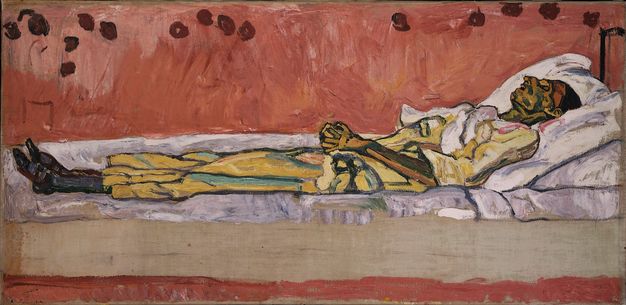
structure where other motifs do not. For example, the
depiction of Godé-Darel on her deathbed shows a network of
transfer lines on the white mattress (fig. 9). Of the three full-figure versions, only this version in
the Kunstmuseum Solothurn has transfer lines visible to the
unaided eye. The other two versions, by contrast, show other
forms of repetition: The painting in the Aargauer Kunsthaus
displays a pattern of stylized roses on the wallpaper behind
the deathbed (fig. 10), while the version in the Kunstmuseum Basel shows three
parallel horizontal stripes at the top of the composition that
mirror the three horizontal layers of the bed structure and
float above two vertical, slightly displaced parallels of the
bedposts.25
Seen in comparison with the other two versions, the Solothurn
painting gives the impression that the technically conditioned
grid of lines becomes an inherent part of the motif, a folded
structure of the sheet, not unlike the folded grid that
characterizes the tablecloth in Hodler’s much earlier
Banquet of the Gymnasts (1877/78), where the
tablecloth is structured by a square, folded pattern.26
Therefore, it may be that auxiliary lines take on the task of
representing the parallelist principles of repetition,
sequence, and symmetry where content-related motives do not.
In exceptional cases, even the reverse seems possible, in
which a thematic motif of parallelism can arise from the
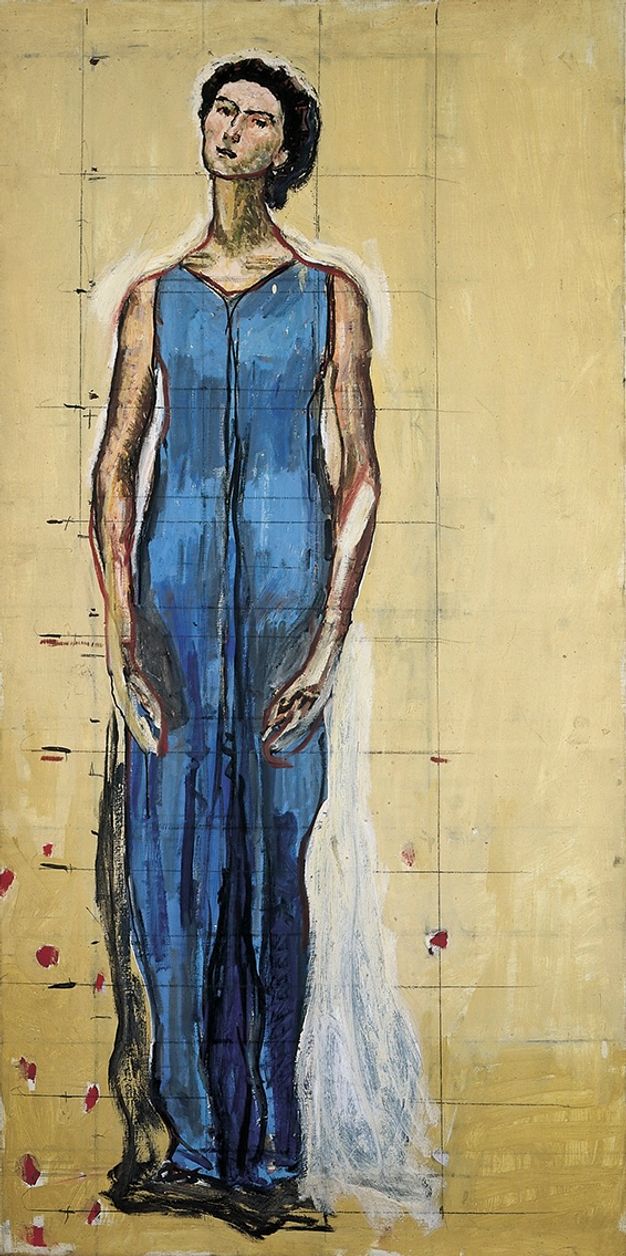
technical structure of a grid. In an oil study for
View into the Infinite, Hodler placed some of the
stylized flowers on the auxiliary lines (fig. 11).
ExpandFig. 9. —Ferdinand Hodler (Swiss, 1853–1918).The Dead Valentine Godé-Darel, 1915, oil on
canvas, 60 × 124 cm. CR no. 935. Solothurn, Kunstmuseum.
Image: SIK-ISEA, Zurich.ExpandFig. 10. —Ferdinand Hodler (Swiss, 1853–1918).The Dead Valentine Godé-Darel, 1915, oil on
canvas, 60.5 × 124.5 cm. CR no. 934. Aarau, Aargauer
Kunsthaus, Collection Werner Coninx. Image: Werner Coninx
Stiftung, Zurich.
ExpandFig. 11. —Ferdinand Hodler (Swiss, 1853–1918). Oil
study for View into the Infinite, 1913, oil on
canvas, 120.7 × 60.3 cm. CR no. 1598. Geneva, Musée d’Art
et d’Histoire. Image: Musée d’Art et d’Histoire, Ville de
Genève.
Although the visibility of the technical lines may sometimes
represent parallel principles, this alone does not offer a
sufficient explanation. Auxiliary lines can also be found in
pictures where the pictorial motifs already convey a strong
sense of parallelism, such as in the Zurich version of
Unanimity (see
fig. 3). When
the depicted figures are already organized in parallel, there
is no need to introduce additional parallel structures through
visible lines. As an explanation, the principle of
non finito appears to be, in
my mind, the most convincing possibility, an option that
Beltinger also considers in her technical study.27
This is all the more so when we take into account that
Hodler’s works show several other forms of the “unfinished,”
such as the very spontaneous, expressive execution of certain
sections, the visibility of pentimenti or, in rare cases, even
the lack of coloration in some areas.
The concept of
non finito encompasses
different forms and origins of the unfinished: The term is
used for works that remained unfinished due to external
circumstances—for example, because an artist died before
completion, the commissioner withdrew, or perhaps the artist
and commissioner experienced disagreements. Further, the
notion of non finito can also
include the idea that the artist gave up on the work after
becoming dissatisfied with the preliminary result and no
longer believed in a successful completion. Another form of
non finito emerges through the
deliberate expression of the unfinished in works that the
artist considers undoubtedly to be finished—resulting in the
peculiar paradox of the “finished unfinished” work of art.
Notions of the non finito are
not all the same, and even if the beholder may appreciate
similar aesthetic qualities in such works, different reasons
for and uses of the
non finito lead to different
viewing experiences.
The works by Hodler considered here were not left unfinished
due to external circumstances; nor did their condition result
from artistic challenges. Rather, these works show
deliberately chosen indicators of the unfinished. They are, as
Hodler told collector Reininghaus regarding
The Admired Young Man, “very finished.”28
At the time, a sketchy execution or the loose gesture were
widely accepted and sought-after techniques.29
Seen in this light, Hodler’s suggestive approach to pictorial
motifs, the sketchiness of certain areas of his compositions,
and the visibility of pentimenti, together with his
enterprising, almost excessive selling of oil studies as such,
seem to express an artistic attitude shaped by Romanticism and
impressionism that satisfied the corresponding preferences of
contemporary collectors. However, what collides with this view
is the fact that the presence of strict patterns of technical
lines seems to contradict the idea of the artist guided by
intuitive technique. Hodler’s almost pedantic fixation on
measuring, his use of the sighting grid and the Dürer pane,
and his application of transfer lines are the opposite of the
spontaneous and the intuitive.
Hodler was very aware of the artistic tendencies surrounding
him and defended Edouard Manet, for example, against critics
in his circle.30
Even so, he was far more interested in the old masters of the
Italian and German Renaissance than in his contemporaries and
immediate predecessors. If we take the primary sources,
especially his letters, as a point of reference, we see that
he felt much more fascinated by the works of artists such as
Raphael, Paolo Veronese, Titian, Albrecht Dürer, and later,
Giotto, than by the impressionists. For example, Hodler wrote
to his friend and former student Marc Odier from Madrid in
1878 about his visits to the Museo Nacional del Prado: “At the
museum, it was Raphael that I liked the best. . . . Titian,
Veronese, Ribera, and Velazquez were my next favorites. But
only Raphael’s paintings really touched me.”31
And a few days later, “One painter I always like enormously is
Veronese. His figures are well built, well placed, and richly
colored. . . . There is a small painting by Mantegna which is
magnificent, with a beautifully styled drawing and magnificent
drapery. It’s one of the things I’ve admired most. . . . I
think the painter I’d like above all others is Giotto, but
I’ll have to go to Italy to see him.”32
Five years later, in 1883, Hodler visited the Alte Pinakothek
in Munich and wrote again to Odier: “It’s from the latter
[Alte Pinakothek] that I speak enthusiastically of Dürer’s
The Four Apostles, Perugino, Raphael, in a word the
early Italian and German schools.”33
By contrast, he thought little of recent German art, as he
expressed in a letter to Bernese singer Jenny Studer: “I
prefer not to talk about the Neue Pinakothek [,] something
inferior [,] the highly praised modern German art. The art of
Kaulbach or Piloty.”34
In 1904 he noted, in a text written about his artistic
principle and the artist Gustav Klimt, “My favorite artists
are Dürer and the early Italians.”35
Daniel Baud-Bovy, then curator at the Musée Rath and later
director of the École des Beaux-Arts in Geneva, recorded in
his diary in 1905 that Hodler had told him, “Today, Giotto is
my man. I saw him recently in Italy. That’s nature!
Michelangelo is beautiful, too, his strength and curved lines.
But after him, it’s all over.”36
In his book
Erinnerungen an Ferdinand Hodler
(1918; Memories about Ferdinand Hodler), painter Fritz Widmann
recounts an incident that took place in 1898 when the artist
came to the Widmann house to paint the aforementioned portrait
of Fritz’s father, Josef Viktor Widmann (see
fig. 5):
Once, at the end of the session, I took Hodler through my
parents’ bedroom so that he could wash out his brushes in a
neighboring room. On that occasion, he unexpectedly saw an
old oil print after Raphael’s
The Miraculous Draught of Fishes. He was strongly
moved. He stood in front of it for a long time, at first
without a word; then gradually collecting himself, he told
me in an excited voice: “This is perhaps the most beautiful
composition ever created by an artist. And even in this
moderate reprint, far removed from the original, the divine
beauty so overwhelmed me at the unexpected sight of it that
I struggled with emotion.” In the conversation that followed
on the way to his workplace, he proved to be a close
connoisseur and admirer of the great Renaissance art.37
Hodler’s enthusiasm for the art of the Renaissance and his
obvious desire to see his own work in its tradition opens up a
new perspective on Hodler’s
non finito, namely, as a sign
itself of artistic reference to the Renaissance.
The Concept of non finito and Hodler’s Classicism
There is no need to elaborate too extensively on the fact that
the notion of
non finito occupied an
important place in Renaissance art. There was a high number of
unfinished works by such outstanding figures as Leonardo da
Vinci and Michelangelo.38
In Titian’s late work, a very loose style of painting, at
least close to the
non finito, comes to feature
prominently in his oeuvre.39
That which was unfinished received attention and appreciation
in art theory of the time, not least through the authority and
judgment of Pliny, who in numerous places in book thirty-five
of his Natural History praises the quality of the
unfinished and warns of the danger of too much perfection.40
Giorgio Vasari, in turn, repeatedly comments on the quality of
the spontaneous and the danger of the overly finished,
including in a comparison the two marble pulpits in the
cathedral in Florence, one by Luca della Robbia and the other
by Donatello.41
Hodler must have been aware of the appreciation of the
unfinished during the Renaissance period. From contemporaries
such as Loosli, we know that Hodler had read the treatises of
the early modern period.42
There was one aspect of
non finito that he must have
felt had much to do with his own working method: the visible
presence of the working process. The participation of the
beholder in the creative process is one of the effects of the
non finito mentioned by Pliny
when the ancient thinker states, “It is also a very unusual
and memorable fact that the last works of artists and their
unfinished pictures . . . are more admired than those which
they finished because in them are seen the preliminary
drawings left visible and the artist’s actual thoughts.”43
Furthermore, the visibility of the artist’s approach is
instructive for other artists, as it gives them a direct
insight into the methods of a virtuoso in their field.44
The unfinished as the presence of working methods, which
allows the beholder to participate in the creative process and
the apprentice painter to absorb a teaching example—this is a
concept that Hodler could certainly identify with. It
corresponds with his willingness to provide information about
his techniques and equipment, and it fits with a large number
of surviving statements and anecdotes, all of which show that
Hodler was inclined to reveal how he worked and even had a
certain missionary attitude about the techniques he used. Not
least, it fits with his self-portrayal as a craftsman, which
he maintained even in the years of his greatest success. The
visibility of traces of the working process in important
Renaissance works of art and the appreciation of the
unfinished in the art theory of the time must have confirmed
his own ideas and applied procedures. It is not a stretch to
assume that his encounters with Renaissance
non finito encouraged Hodler all the more to leave
the traces of his techniques visible. Moreover, the display of
the unfinished in this sense may also have become one of the
means by which Hodler placed himself explicitly in the
tradition.
To understand the flaunting of the unfinished as a reference
to Renaissance art is supported by the fact that it is above
all the genre of the allegorical figure painting—that is, a
classical genre of the early modern period—in which Hodler
makes use of the
non finito and in which he
shows the traces of technical tools particularly popular
during the Renaissance. In contrast, his landscape paintings,
which represent a completely modern concept, free from
allegorical and staffage figures, show no signs of
non finito, even though he
used the same tools.
More generally, these observations on the use of
non finito and its relation to
Renaissance art can reframe the understanding of Hodler’s
oeuvre as a manifestation of a modern classicism. There is no
question that his early work fits into the intellectual world
and visual language of realism, that his figure paintings from
the 1890s onward would be inconceivable without their
connection to the contemporary currents of symbolism and the
Lebensreform movement, and that his late landscapes in
particular show clear tendencies toward abstraction. Nor shall
it be denied that Hodler was the strongest innovative force in
the environment of artistic creation around 1900 in
Switzerland, which also led to his dominant position there.
But it is equally difficult to overlook the fact that,
especially in his figure paintings, he adopted aims and
procedures that can only reasonably be described as classical
or classicist. Hodler’s important works from the middle and
later periods typically depict transcendent ideas by
portraying nude or barefoot figures in an undetermined natural
setting. These figures express the represented ideas through
their postures, gestures, and positions (see
figs. 2–4). The pronounced visual hierarchy between the figures that
fill the composition, sometimes appearing statuesque, and
their rather unspecific environment can be seen as a reference
to the relationship between figure and landscape in works such
as those of Leonardo, Raphael, or Michelangelo, where humans
are presented as central, full-format motifs in an often
universal landscape.
It may be both accurate and productive to understand Hodler’s
practice as one that revolved around finding a contemporary
form of classicism—a perception that I assume was only
reluctantly made a subject of discussion until now because of
the fear that such a label as “classicist” would exclude
Hodler from the canonical lines of modern art’s development.
However, Hodler’s contribution to artistic innovation around
1900 consists precisely of a new kind of classicism, namely,
one that broke completely with the iconography of antiquity.
Unlike the classicism of French painter Pierre Henri Puvis de
Chavannes or Swiss painters Arnold Böcklin and Félix
Vallotton, Hodler’s work rejects everything narrative and
makes no use of ancient or Christian mythologies. This
explains the artist’s ambivalent attitude toward artists such
as Böcklin: “Böcklin is very great, but a little too literary
for my taste.”45
In Hodler’s oeuvre, classicism can only refer to certain
visual strategies, such as the visualization of ideas through
figures removed from any specific temporal or geographic
location, or a relationship between figure and space that
gives the former clear primacy in nearly monumental
appearance. The visibility of technical lines and grids may
have been a further way for Hodler to express a contemporary
classicism.
Hodler only left auxiliary lines in works where he expected
their presence to be accepted, those intended for collectors,
art museums, art-critic friends, and students—essentially, a
well-informed art historical public. For example, he left
lines visible on the two versions of
View into the Infinite and on the second, monumental
version of Unanimity, which Hodler had hoped to place
in the Kunstmuseum Bern and which is now in the Kunsthaus
Zürich (see
figs. 3–4).46
In contrast, the first version, which was created for the
Hannover, Germany, town hall, has no visible lines; nor do the
two studies that Hodler submitted to Hannover’s commissioners.
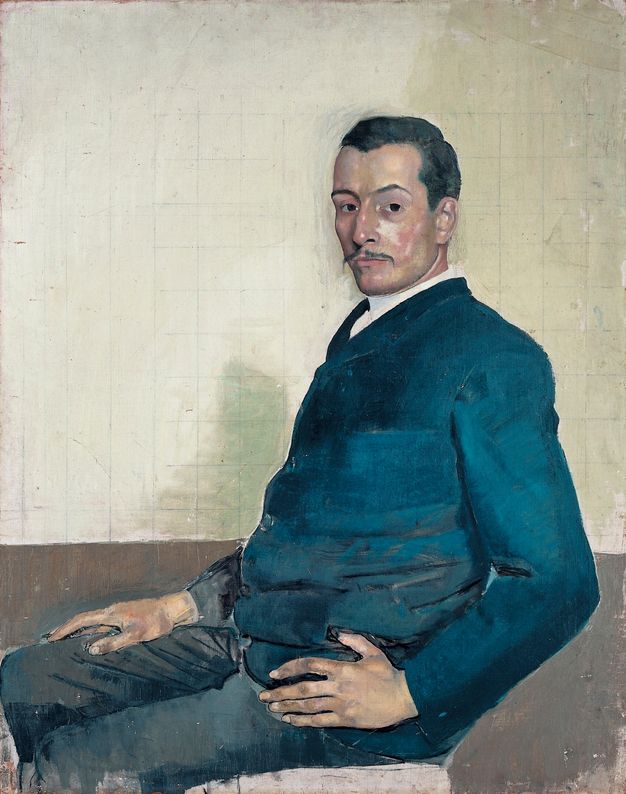
Among the portraits, those of his son Hector from 1912 (who
was probably involved in the execution of the painting),
Odier, and Widmann present a large, clearly visible grid of
lines (fig. 12,
see fig. 5).47
A faintly translucent grid, which in one place becomes a
striking motif, as a kind of ornament on the wall, is also
found on one of the two portraits of Swedish art historian
Fredrik Robert Martin, a great admirer of Hodler.48
Thus, the artist seems to have been aware that an informed
audience would appreciate or at least accept the lines as
consciously placed signs rather than purely technical
remnants.
ExpandFig. 12. —Ferdinand Hodler (Swiss, 1853–1918).Portrait of Marc Odier, 1892, oil on canvas,
100.5 × 79.5 cm. CR no. 780. Basel, Kunstmuseum, donation
by Amerbach-Stiftung. Image: Kunstmuseum Basel, Martin P.
Bühler.
The ultimate reasons for the visibility of technical lines in
Hodler’s paintings cannot be definitively determined.
Nevertheless, this issue leads to the center of Hodler’s
artistic intentions. I interpret the visible lines as
deliberate indicators of the unfinished, through which Hodler
presents himself as an artist in the tradition of the
Renaissance. There may also be cases in which the parallel
structure of the technical lines replaces parallelistic motifs
or assumes such a motif itself. Nonetheless, Hodler seems to
have left the technical lines visible only when he assumed the
public was informed enough to appreciate this somewhat
extravagant non finito.
Roger Fayet is the director of the Swiss
Institute for Art Research (SIK-ISEA) in Zurich, Switzerland,
and professor of art history at the Universität Zürich.
Notes
I would like to express my gratitude to the Getty Research
Institute in Los Angeles for providing me with the opportunity
to research the subject of this article during my scholarship
in 2023. My sincere thanks go to Niklaus Manuel Güdel at the
Institut Ferdinand Hodler in Geneva, who, together with Diana
Blome, is preparing the first edition of Hodler’s letters and
has given me access to previously unpublished material. I am
grateful to my fellow Getty scholar, Zsofi Valyi-Nagy, for her
precious help with the English readability of the manuscript.
Unless otherwise noted, translations of quoted material are by
the author.
Note on the artwork titles: Apart from a few exceptions,
Hodler did not assign titles to his works and often considered
them unimportant. Even during his lifetime, several titles
often circulated for one and the same work. For this reason,
English-language artwork titles are used in the essay and the
captions. The numbers given in the captions (“CR no.”) refer
to the catalogue raisonné: Oskar Bätschmann et al.,
Ferdinand Hodler: Catalogue raisonné der Gemälde,
vols. 2 and 3 (SIK-ISEA; Scheidegger & Spiess, 2008–2018),
https://www.ferdinand-hodler.ch/.
What follows is only possible thanks to the research
conducted by my colleagues at the Swiss Institute for
Art Research (SIK-ISEA), particularly Karoline Beltinger
and Danièle Gros in the field of technology and Oskar
Bätschmann, Paul Müller, and others who wrote the
catalogue raisonné. See Karoline Beltinger et al.,
Kunsttechnologische Forschungen zur Malerei von
Ferdinand Hodler
(SIK-ISEA, 2007); Karoline Beltinger et al.,
Hodler malt: Neue kunsttechnologische Forschungen
zu Ferdinand Hodler
(SIK-ISEA; Scheidegger & Spiess, 2019); and Oskar
Bätschmann et al.,
Ferdinand Hodler: Catalogue raisonné der
Gemälde, 4 vols. (SIK-ISEA; Scheidegger & Spiess,
2008–2018),
https://www.ferdinand-hodler.ch/. Moreover, we should not forget that our research
stands on the shoulders of a previous generation of
scholars. For example, see Carl Albert Loosli,
Aus der Werkstatt Ferdinand Hodlers
(Birkhäuser, 1938).
↩︎
Ferdinand Hodler,
Carnet 1898 b, 14,
transcribed by Jura Brüschweiler, quoted in Beltinger et
al., Hodler malt, 48.
↩︎
Loosli,
Aus der Werkstatt Ferdinand Hodlers,
101. ↩︎
See Loosli,
Aus der Werkstatt Ferdinand Hodlers,
85, 89.
↩︎
Stéphanie Guerzoni,
Ferdinand Hodler: Sa vie, son oeuvre, son
enseignement, souvenirs personnels
(Pierre Cailler, 1957), 98.
↩︎
Ferdinand Hodler,
“Les dix commandements du peintre F. Hodler,”
1874, in Ferdinand Hodler,
Écrits esthétiques, ed.
Diana Blome and Niklaus Manuel Güdel (Archives Jura
Brüschweiler; Editions Notari, 2017), 39.
↩︎
Loosli,
Aus der Werkstatt Ferdinand Hodlers, 66.
↩︎
Adolf Frey,
Ferdinand Hodler
(Haessel, 1922), 12.
↩︎
A photograph by his student and model Gertrud Müller
shows the artist in his studio, sitting next to the
Dürer pane. Gertrud Dübi-Müller,
Ferdinand Hodler, with the Dürer Pane next to Him, 1917, gelatin silver print, 30.2 × 35.7 cm,
Winterthur, Fotostiftung Schweiz,
https://fotostiftung.zetcom.net/de/collection/item/87705/. ↩︎
According to the minutes of the Zürcher
Kunstgesellschaft, which commissioned the work, and its
annual report of 1917, Hodler planned to rework the
second figure from the left and the rightmost figure in
the Zurich version after he had already handed the
painting over to the Kunsthaus—not an unusual approach
for Hodler, who often made significant revisions, even
to paintings he had already completed. It is possible
that he would have reduced the visibility of the
technical lines in the revision of the Kunsthaus’s
painting; nevertheless, the lines were not the reason
for the planned revision, which Hodler was unable to
carry out for health reasons, but rather, it was his
aforementioned dissatisfaction with the posture of the
two figures. Minutes of board meeting of the Zürcher
Kunstgesellschaft, 29 November 1917, Kunsthaus Zürich,
Archives of the Zürcher Kunstgesellschaft. In the
catalogue raisonné, Sabine Hügli-Vass comments, “At the
end of 1916, CR 1594 was completed.” Bätschmann et al.,
Ferdinand Hodler, vol.
3, pt. 1, 481, cat. no. 1594. Also in view of the fact
that the paintings The Admired Young Man and
Unanimity in the Kunsthaus Zürich have visible
lines, it seems rather unlikely that Hodler would have
removed them from View into the Infinite.
(Additionally, Hodler drew attention to the finished
state of The Admired Young Man in writing; see
this essay, note 18.) The Basel
version, originally intended for Zurich but deemed too
large by the Zürcher Kunstgesellschaft, was reworked
several times by Hodler. (Ferdinand Hodler,
View into the Infinite, 1913–17, oil on canvas,
446 × 895 cm, Kunstmuseum Basel. Bätschmann et al.,
Ferdinand Hodler, vol. 3, pt. 2, cat. no. 1593,
https://recherche.sik-isea.ch/sik:work-6007360/in/catalogues.hodler:exp/.) After a final revision, it was exhibited at the
Kunsthalle Basel and the Kunsthaus Zürich in 1917 and
acquired by the Basler Kunstverein in the same year.
There is no evidence that Hodler planned further
revisions of this version. See Mitg. (unidentified
abbreviation),
“Eröffnung der Hodler-Ausstellung in der
Kunsthalle,”
in National-Zeitung, no.
115, midday edition, 15 February 1917, 5: “The
glass-roofed room offered Hodler such an excellent
opportunity to hang his work that he came to Basel
himself and spent several days putting the finishing
touches to the painting ‘View into the Infinite.’” See
also Sabine Hügli-Vass’s comment in Bätschmann et al.,
Ferdinand Hodler, 479,
vol. 3, pt. 2, cat. no. 1593: “[Hodler] only completed
the work with the last corrections when the painting was
exhibited at the Kunsthalle Basel in February 1917.” By
contrast, the version acquired by collector Emma
Schmidt-Müller and now in the Kunstmuseum Solothurn is
definitely unfinished. See Bätschmann et al.,
Ferdinand Hodler, vol.
3, pt. 2, 484–85, cat. no. 1597.
↩︎
Visible technical lines only appear in works from this
cycle after Godé-Darel’s death.
↩︎
Fritz Widmann,
Erinnerungen an Ferdinand Hodler
(Rascher, 1918), 61.
↩︎
Artur Weese,
Aus der Welt Ferdinand Hodlers
(Francke, 1918), 24.
↩︎
See the comments by Franz Müller on the two versions of
Amiet’s portrait of Hodler in Franz Müller and Viola
Radlach,
Cuno Amiet: Die Gemälde 1883–1919
(SIK-ISEA; Scheidegger & Spiess, 2014), vol. 1,
166–69, cat. nos. 1898.04, 1898.05.
↩︎
See Oskar Bätschmann,
Ferdinand Hodler: Bilder der Alpen
(Schweizerische Akademie der Geistes- und
Sozialwissenschaften, 2006), 3–4.
↩︎
Ferdinand Hodler, letter to Carl Reininghaus, 14
February 1905, written by Berthe Hodler-Jacques on
behalf of Ferdinand Hodler, with additions by Ferdinand
Hodler, Bibliothèque de Genève, quoted in Bätschmann et
al.,
Ferdinand Hodler, vol.
3, pt. 1, 327, cat. no. 1348. The painting was exhibited
at the nineteenth Secession exhibition in Vienna in
1904.
↩︎
For example, Carl Albert Loosli,
Ferdinand Hodler: Leben, Werk und Nachlass,
vol. 1 (R. Suter, 1921), 75–87. For a more recent
discussion of Hodler’s parallelism, see Laurence
Madeleine, ed.,
Hodler // Parallelismus
(Kunstmuseum Bern; Musée d’Art et d’Histoire Genève,
2018), therein esp. Oskar Bätschmann,
“Hodler’s Parallelismen,” 155–66;
and Paul Müller, “Obsession Parallelismus,” 167–76. See
also Paul Müller,
“‘Parallelismus’: Hodler’s programmatischer
Anspruch,”
in
Ferdinand Hodler, Die Forschung, die Anfänge, die
Arbeit, der Erfolg, der Kontext,
ed. Oskar Bätschmann et al. (SIK-ISEA, 2009), 107–20.
According to Loosli, Hodler commented on his
“authorship” of parallelism as follows: “It is my merit,
which no one can rob me of, to have formulated
parallelism, to have been the first to apply it
consciously and practically. Of course, now that I have
demonstrated it, everyone is in a position to do so; now
everyone wants to have been the clever one, but it is
not true; they owe parallelism to me.” Loosli,
Ferdinand Hodler, 1:75.
↩︎
Ferdinand Hodler, “The Mission of the Artist” (1897),
trans. Henri Dorra, in
Symbolist Art Theories: A Critical Anthology,
ed. Henri Dorra (University of California Press, 1994),
251. See also Ferdinand Hodler,
“La mission de l’artiste,” in
Écrits esthétiques, 177.
↩︎
See Asher Ethan Miller, “Finish/Finished: French
Painting from Romanticism to Impressionism,” in
Unfinished: Thoughts Left Visible, ed. Andrea
Bayer et al. (Metropolitan Museum of Art; Yale
University Press, 2016), 132–39, esp. 133, 136.
↩︎
See Matthias Fischer,
Ferdinand Hodler in Karikatur und Satire
/
Ferdinand Hodler par la caricature et la satire
(Benteli, 2012), 17.
↩︎
Ferdinand Hodler, letter to Marc Odier, 16 November
1878, in Ferdinand Hodler,
Correspondance. 1874–1904,
ed. Diana Blome and Niklaus M. Güdel (Notari,
forthcoming), letter no. 15.
↩︎
Ferdinand Hodler, letter to Marc Odier, 21 November
1878, in Hodler,
Correspondance, letter
no. 17.
↩︎
Ferdinand Hodler, letter to Marc Odier, 29 July 1883, in
Hodler,
Correspondance, letter
no. 72.
↩︎
Ferdinand Hodler, letter to Jenny Studer, 3 August 1883,
in Hodler,
Correspondance, letter
no. 74.
↩︎
Ferdinand Hodler,
“Über mein Kunstprinzip und über Klimt. 1904,”
in
Écrits esthétiques, 359.
↩︎
Unpublished diary by Daniel Baud-Bovy, 30 May 1905, 31,
archives of the Institut Ferdinand Hodler, Geneva,
BB-2010-0004. On Hodler and Giotto, see Niklaus Manuel
Güdel,
“Réception moderne de Giotto: L’artiste et l’exégèse,
d’Ingres à Rothko,”Sociétés et représentations, no. 51 (2021): 27–28.
↩︎
Widmann,
Erinnerungen an Ferdinand Hodler,
62–63.
↩︎
See Carmen C. Bambach, “Leonardo, Michelangelo, and
Notions of the Unfinished in Art,” in Bayer et al.,
Unfinished, 30.
↩︎
See Andrea Bayer, “Renaissance Views of the Unfinished,”
in Bayer et al., Unfinished, 26–28.
↩︎
Pliny, the Elder, Natural History, book 35,
trans. Harris Rackham (Harvard University Press, 2014),
17, 19, 313, 321, 329, 367.
↩︎
Giorgio Vasari,
Lives of the Most Eminent Painters, Sculptors &
Architects
(1568), vol. 2, trans. Gaston du C. De Vere (The Medici
Society; Philip Lee Warner, 1912–15), 121.
↩︎
“When he [Hodler] came to Geneva and then to Menn, the
latter soon realized what Hodler was interested in and
what he was missing. He therefore played Vitruvius,
Leonardo, and Dürer into his hands. Hodler threw himself
into these books with his characteristic zeal, examined
them and rewrote them for his own use.” Loosli,
Ferdinand Hodler, 1:23.
↩︎
Hodler,
“Über mein Kunstprinzip und über Klimt,”
359. ↩︎
About the version of Unanimity which is now in
the Kunsthaus Zürich, Hodler wrote to collector Willy
Russ-Young in 1915: “I hope that one day I will be able
to place this picture in the museum in Bern.” Archives
Hodler of Carl Albert Loosli, deposit at SIK-ISEA,
Zurich, HA 22.3, fascicle no. 112. The Kunstmuseum Bern
didn’t purchase the painting; instead Hodler only
managed to sell it in 1917 to private collector Alfred
Rütschi, who made it available to the Kunsthaus Zürich
and converted the deposit into a donation in 1919. See
Bätschmann et al.,
Ferdinand Hodler, vol.
3, pt. 2, 437–39, cat. no. 1496. On
View into the Infinite, see this essay,
note 12. The archival evidence
indicates that Hodler had intended to revise the second
version, now in the Kunsthaus Zürich, but was unable to
before his death; therefore, it is uncertain whether all
the auxiliary lines would have remained in place in the
final intended product.
↩︎