Boone / Primed to SeeGetty Research Journal, No. 21 (2026)
Copied page section link to clipboard
Abstract
A manila folder opens in an archive, and its photographic
content delights its viewer and serves as a discovery that
reinforces the need to narrate the long-standing history
of Black women in photography. When photographer Jeanne
Moutoussamy-Ashe encounters a compelling body of
photographs by Eslanda Goode Robeson in the archive, the
finding galvanizes Moutoussamy-Ashe to publish her book
Viewfinders: Black Women Photographers in 1986.
Although the development of Viewfinders gains
momentum in the archive, this essay augments its origin
story by considering how the author arrives at this moment
of readiness and focus, a moment in which being grounded
in Black photographic life affords her, and her readers,
the possibility of rewriting history.
Chicago
Emilie Chesnutt Boone, “Primed to See: Jeanne
Moutoussamy-Ashe’s
Viewfinders: Black Women Photographers,”
Getty Research Journal, no. 21 (2026),
https://doi.org/10.59491/WSBP6370.
MLA
Boone, Emilie Chesnutt. “Primed to See: Jeanne
Moutoussamy-Ashe’s
Viewfinders: Black Women Photographers.”
Getty Research Journal, no. 21, 2026,
https://doi.org/10.59491/WSBP6370.
A manila folder opens in an archive, and its photographic
content delights its viewer and confirms her intuition. In the
black-and-white photograph, a Black woman holds a Leica camera
up to her face, directing her gaze toward the viewer through
its lens in a self-portrait.1
More photographs by this same individual are identified. The
archive is the Beinecke Rare Book and Manuscript Library at
Yale University, the viewer is photographer Jeanne
Moutoussamy-Ashe, and the date is February 1983, a few years
before Moutoussamy-Ashe would publish the book
Viewfinders: Black Women Photographers of 1986.2
This archival encounter between Moutoussamy-Ashe and a
compelling body of photographs by Eslanda Good Robeson, who
was an image maker previously unbeknown to Moutoussamy-Ashe,
served as a moment of discovery that reinforced the need to
narrate the long-standing history of Black women in
photography.
When Moutoussamy-Ashe found Robeson in the archive, it became
the impetus for her to urgently pursue what would become
Viewfinders.3
By the time of her visit to Yale, Moutoussamy-Ashe intuitively
knew that Black women were part and parcel of photography’s
history, but her assertions were supported by limited tangible
evidence. Happening upon Robeson in the Beinecke Library
reaffirmed the existence of other Black women photographers.
This essay augments the origin story of
Viewfinders—in which a moment in the archive spurred
personal momentum—by asking what enabled Moutoussamy-Ashe to
identify her archival encounter as one of significance in the
first place. Arguably, she was primed and poised to see
differently. I address how the author arrived at this moment
of readiness and focus, in which being grounded in Black
photographic life and its contours afforded her the
possibility of rewriting history, and in which each
encounter—with a bit of information, a newsletter, an
exhibition, a juxtaposition of images, or a publication—became
a rehearsal, building to the sort of generative discovery that
Moutoussamy-Ashe made in the archive. This essay is about what
primed Moutoussamy-Ashe to find Black women photographers in
the archive; it is about how Moutoussamy-Ashe came to see.4Viewfinders, as a result, both anticipates and
responds to other, contemporaneous efforts to normalize and
celebrate Black women behind the camera.
Born to an interior designer mother and architect father,
Moutoussamy-Ashe grew up in the segregated South Side of
Chicago in the 1950s and 1960s, and her family encouraged her
pursuit of artistic interests from the time she was a child.
Photographs fascinated her from an early age, especially those
gracing the pages of Gordon Parks’s striking photobooks.5
Moutoussamy-Ashe’s formal training in photography at the
Cooper Union, New York, where she obtained her BFA in 1975,
enabled her to learn from street photographers Garry Winogrand
and Tod Papageorge in addition to photography curator Anne
Wilkes Tucker.6
From its inception in 1859, the then-radical Cooper Union
educational model offered training in art, architecture, and
engineering to students across the color line, men and women
alike. Moutoussamy-Ashe is among several renowned Black
artists, including Roy DeCarava, Paul Gardère, Palmer Hayden,
Wangechi Mutu, Augusta Savage, and Jack Whitten, who attended
the once tuition-free institution.
Moutoussamy-Ashe is the author of five books of photography,
Viewfinders being the only publication to depart from
her own body of photographic work, which consists primarily of
landscapes, people and places, trees and nature, and
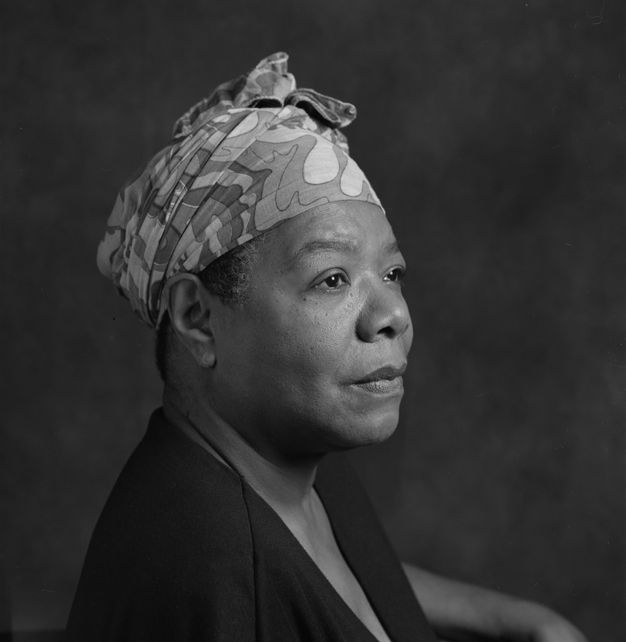
experiments with abstraction. Her wide-ranging oeuvre includes
arresting photographs such as a gelatin-silver-print portrait
of Maya Angelou from 1993 (fig. 1). The topics of her publications vary, including photographs
taken of daily life for the Gullah Geechee people on Daufuskie
Island in South Carolina (Daufuskie Island: A Photographic Essay,
1982); an anthology of photographs that she took all over the
world, including in South Africa and India, between 1973 and
2011 (An Anthology: Faces, Places, and Spaces, 2011);
and two projects that offer visual meditations on flowers (The African Flower: Singing of Angels,
2001;
A Flower is a Lovesome Thing/Notables of Note, 2011).
Another photobook offers intimate views into her own family
life and love for her daughter, Camera, and her late husband,
tennis champion Arthur Ashe, whose shared values, and, later,
his untimely death from AIDS in 1993, informed the course of
Moutoussamy-Ashe’s life. As an activist, she expressed her
commitment to “instill(ing) in young people the kindred spirit
of imagination and creativity.”7
Moutoussamy-Ashe built a successful and hard-won career as
both an artist, with exhibitions at the National Portrait
Gallery in Washington, DC, and the Museum of Modern Art (MoMA)
in New York, and as a photojournalist, contributing images on
assignment to newspapers and magazines including
Life, Smithsonian, Ebony, and
Sports Illustrated. More recent attention to
Moutoussamy-Ashe’s work includes the exhibition
Jeanne Moutoussamy-Ashe and the Last Gullah Islands
(2024–25) and related programming at the Whitney Museum of
American Art.
Moutoussamy-Ashe’s book
Viewfinders: Black Women Photographers offers a
chronologically ordered account of individual Black women’s
engagement with the medium from the time following the storied
announcements of photography’s invention in 1839 to her own
contemporary moment of the 1980s. Deborah Willis, now renowned
as a photography historian and emerging as a significant
curator at the time, served as an invaluable consultant, and a
research assistant by the name of Kali Vertamae Grosvenor
contributed tremendously to the project with visits to
numerous archives in the US. Well received by reviewers and
readers alike, the survey photobook notably went into a second
printing just a few years later, in 1993, this time with
Writers and Readers Publishing instead of the initial
publisher, Dodd, Mead & Company.8
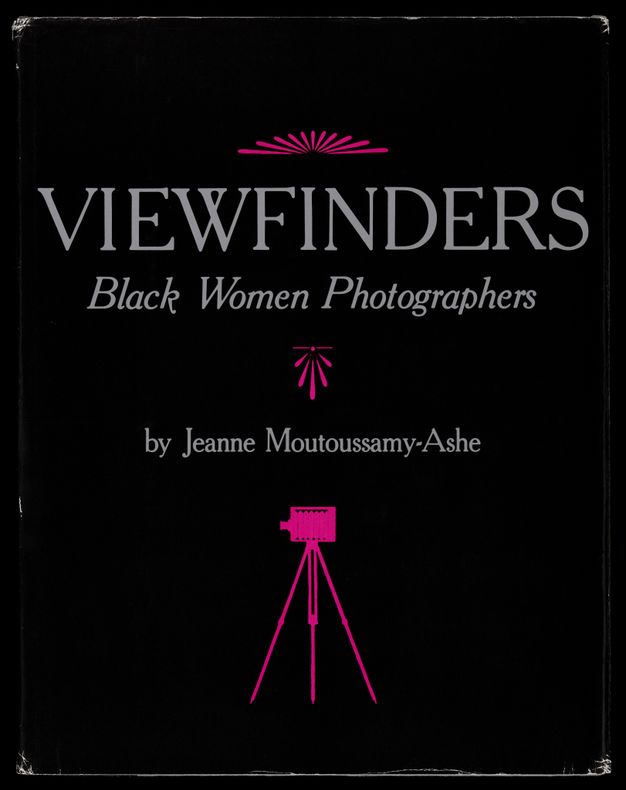
Both publishers released Viewfinders in soft- and
hardcover. While the cover of the second edition features a
still life of the author’s flea-market collection of old
photographs and cameras, an illustration of a four-by-five
tripod camera of yesteryear graces the first (fig. 2).
ExpandFig. 2. —Cover of Jeanne Moutoussamy-Ashe,
Viewfinders: Black Women Photographers (Dodd,
Mead, 1986).
Designed by Claire B. Counihan. Los Angeles, Getty
Research Institute, 86-B10153.
Although both are nearly identical in content, the first
edition deserves close consideration. With dimensions around
the size of standard printing paper, Viewfinders is a
commercially made book. The images were photographically
reproduced as offset lithograph or letterpress half-tone
prints, mostly from negatives that enabled fidelity to the
original photograph.9
Other photographs whose negatives were unavailable are not of
the same reproduction quality but can be cherished for the
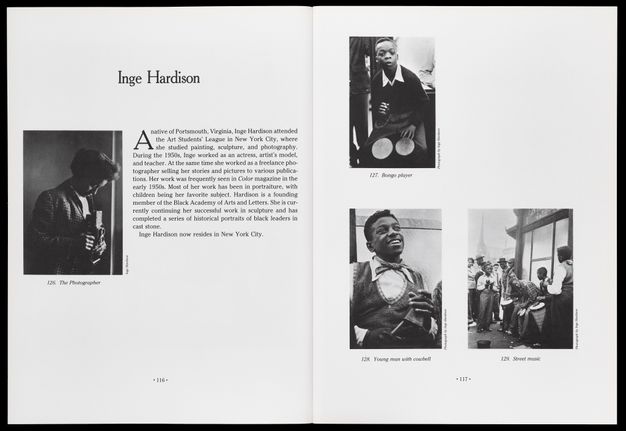
historical value of the image. As a survey book,
Viewfinders is slenderer than most, and the
individual photographs are generously arranged on the page
with space to spare (fig. 3). The credit lines repeat vertically in small print, gracing
the corner of each photograph and leaving little doubt as to
the name of each photograph’s maker. This layout is in sharp
contrast to a scrapbook or collage aesthetic, in which dense
imagery creates an effect of busyness and confluence.10
Instead, each photograph in Viewfinders is carefully
balanced on the page and distinguished from others around it.
Its “bookness” is elegant yet practically didactic.
Following a contextualizing introduction,
Viewfinders is organized into five historical
sections that span the nearly 150 years of photography from
1839 to the decade of the book’s publication. Across the
sections of the two-hundred-page book, Moutoussamy-Ashe
profiles thirty-three individual photographers through short
essays that offer biographical accounts of their engagement
with photography. Generative to each section is the inclusion
of black-and-white photographs. In some cases, a portrait
photograph of the photographer is included, while in others we
see an advertisement for their photography business or
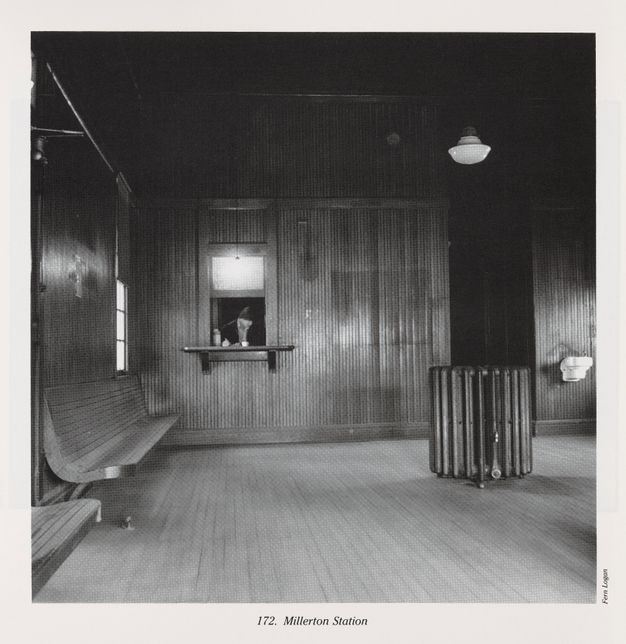
distinct examples from their bodies of work. The reader
encounters traditional studio portraiture, abstractions of
clouds and experimental work, an intimate series of a baby’s
delivery, photojournalistic views of political marches, a
modernist depiction of the built environment, and more (fig. 4). The concluding sections feature a bibliography of the
photographers featured, reminiscent of an earlier publication
by Willis, along with two general listings of names grouped by
the dates 1860–1960 and 1960–80, a geographical index, notes,
a selected bibliography, and an index, all features that
facilitate the book’s presentation as a distinct contribution
to photographic history.11
A close look at this immensely important effort to document,
collate, and narrate the longue durée of Black women
in photography and its relationship to other projects from
around the same time allows us to better understand its
genesis and impact. As this essay will demonstrate, a separate
research project by Moutoussamy-Ashe and published scholarly
work by other writers added to an emerging critical dialogue.
Elsewhere, exhibition interventions and short-lived
initiatives set an important revisionist tone. Such examples
are germane to the project of writing Black photographic
history, a process that “rarely constitutes the object of
study.”12
This essay’s object of study is Viewfinders—the book
itself—and the various antecedents, contemporaneous
interlocutors, and modes of visuality that reposition the
writing of this history of photography as pioneering. In so
doing, it acknowledges Moutoussamy-Ashe’s intrepid efforts to
set in motion a distinct kind of history for readers to reckon
with while paying tribute to the many contributions that
anticipate and add to such an expansive history of Black women
photographers.
An Opened Book
The book’s influence on Black women photographers in
particular is legendary.13
This is the book to which Black women photographers across the
African diaspora turn for evidence of trailblazers who came
before them. For South African photographer Zanele Muholi, the
book “changed my life in so many ways.”14
This is the book that authors Laylah Amatullah Barrayn and
Adama Delphine Fawundu of the independently published
anthology
MFON: Women Photographers of the African Diaspora
(2017) recognize as groundbreaking. It is one that the editors
and contributing writers Joy Gregory and Taous R. Dahmani of
Shining Lights: Black Women Photographers in 1980s–90s
Britain
identify as greatly influential to many—especially to the
women who published Polareyes, a one-off journal
issue of 1987 dedicated to the photographic portfolios of
contemporary Black British women photographers.15
For writer and director Crystal Whaley,
Viewfinders inspired the film of 2022
The Sound She Saw, on Black women photographers, one
among many examples of the book’s expansive reach. Yet
evidence of its impact remains confined largely within Black,
feminist, and specialized media outlets or through anecdotal
claims. Little recognition emerges from the various
overlapping academic fields that share interest in photography
and the project of charting its more expansive history.
A more capacious narrative begins in the pages of
Viewfinders, unfolding along an arc that starts with
Mary E. Warren, the first Black woman photographer on record
(1866), and advancing chronologically to conclude with the
work of numerous Black women photojournalists of the
mid-1980s.16
Since the early twentieth century, Black women could regularly
engage in photography as part of their professional lives.
They became studio operators, like Winifred Hall Allen,
Alberta H. Brown, and Ruth Washington; journalists, like Julia
Jones and Lenore Davis; or military personnel, like Elizabeth
“Tex” Williams. The contents of
Viewfinders demonstrate a vast and sweeping history
of Black women in photography through text and, perhaps more
subtly, through the images themselves.
Many of the photographs featured in
Viewfinders depict Black women displaying ownership
of and expertise with their photographic equipment. The first
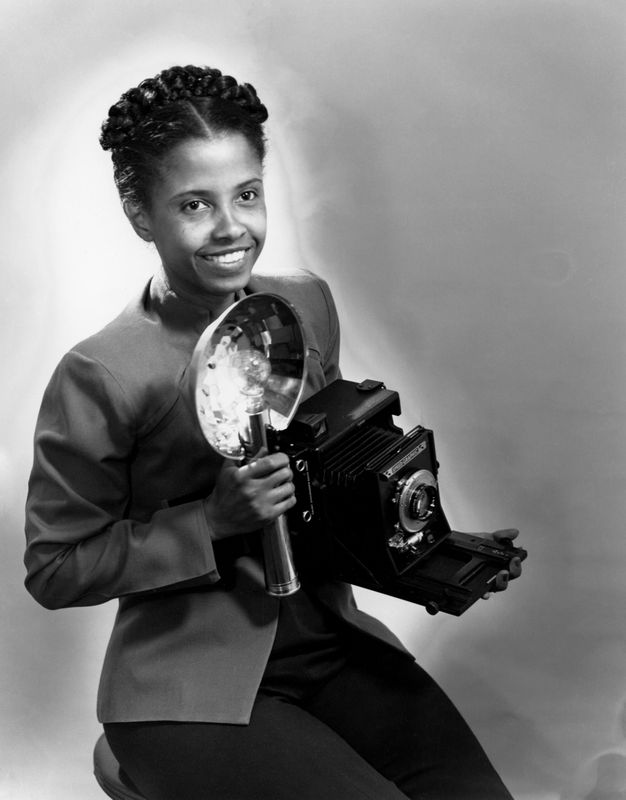
page of a six-page spread on Vera Jackson features her
portrait taken by her husband, Vernon Jackson, in which she is
confidently wielding a large four-by-five camera and a
flashbulb contained within a halo reflector (fig. 5). The etymology of the word photography means to
write with light; the portrait of Jackson conveys a sense of
professional control over when and where that light emanates.
Yet the ease with which the camera becomes a tool for
entertainment and leisure can easily place the perception of
Black women’s serious commitment to photography in the realm
of passive product consumption, seen through more mainstream
images of Black women with cameras. Such a distinction is
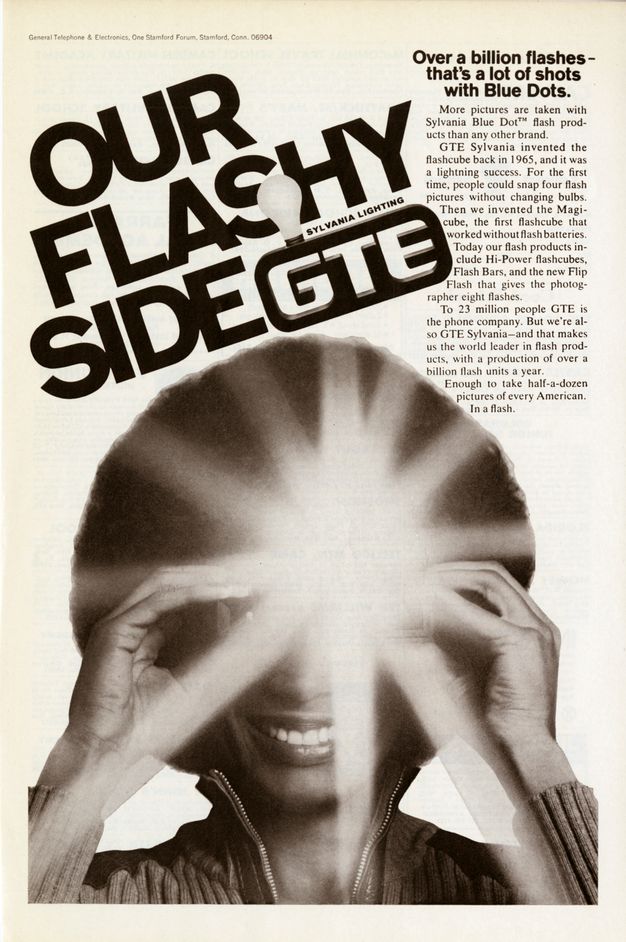
evident in a comparison between this portrait and a commercial
advertisement for the Sylvania Blue Dot Flash camera, in which
a smiling Black woman faces toward the viewer, holding a
camera up to her face with two hands. Overpowering rays of
light emanate from the camera, obscuring her eyes and the
camera itself while displacing her viewpoint (fig. 6). In the advertisement, the technology of photography is
employed to position and locate the Black woman within its
framework. By contrast, Jackson, the steady and calm
proprietor of the camera and flash-unit bulb attachment,
embodies professionalism in her fitted peacoat, a classic
design evoking the naval forces. Equipped to endure the
potential chill of taking pictures outside, even her clothing
emits a sense of readiness and command lacking in the
advertisement’s model.
ExpandFig. 5. —Vernon Jackson (US American, 1907–83).Vera Jackson Holds a Graflex Speed Graphic Camera with
a King Sol Flash,
ca. 1940, 28 × 36 cm. Image courtesy of the Tom &
Ethel Bradley Center at California State University,
Northridge.ExpandFig. 6. —“Our Flashy Side,” advertisement for the Sylvania Blue
Dot Flash camera, 1976, 20.3 × 25.4 cm.
Collection of the author.
Consistently, Moutoussamy-Ashe trains her reader’s eye to
visually engage with images that depart from those within a
more popular sphere of associations. While textual information
within the book charts key aspects of photography’s history,
the photographs themselves are the pivotal contributions. No
reproductions of works by long-acknowledged pioneers
Louis-Jacques-Mandé Daguerre, William Henry Fox Talbot, or
Alfred Stieglitz are found within the pages of
Viewfinder. Yet notably, Moutoussamy-Ashe’s telling
of history does not exclude the canonical roster of white,
male photographers, now internationally famous through the
publication of Beaumont Newhall’s
The History of Photography: From 1839 to the Present
(1964). Her introductory chapter includes the names
that have come to define the medium’s early history—Daguerre,
Talbot, Stieglitz—because these individuals are also part of
Black women’s history of photography. As cultural critic Greg
Tate reminds us, talking about artists of the postnationalist
Black aesthetic of the mid-1980s: “They feel secure enough
about black culture to claim art produced by nonblacks as part
of their inheritance. No anxiety of influence here—these folks
believe the cultural gene pool is for skinny-dipping.”17
To walk with Tate and to proclaim that Daguerre, for example,
is part of Black women photographers’ inheritance reframes the
terms of photography’s history. While not condoning Black
women’s absence from the official story, Moutoussamy-Ashe’s
gesture of positioning Daguerre as chosen kin to Black women
photographers demonstrates the nuanced and expansive nature of
artistic discourse for many Black image-makers of the
mid-1980s.
Moutoussamy-Ashe was primed to recognize a range of
photographers, including those who could not be identified by
name. While most of Viewfinders is organized around
identifiable photographers, a section titled “Camera Girls”
brings unnamed women photographers of the 1940s into history
through the recollections of Charles Williams, a Los Angeles
nightclub owner. Camera Girls was a common term used
to describe women employed to take group- and couple-clientele
portraits at nightclubs during a time when the availability of
camera equipment and merchandise in general was limited due to
the shift in production priorities in the US following World
War II.18
If people had difficulty gaining access to film, cameras, and
fully equipped darkrooms, then a nightclub like Williams’s
could offer this service while simultaneously reinforcing the
relationship between photography and Black leisure during
historical contexts when photographic material was in short
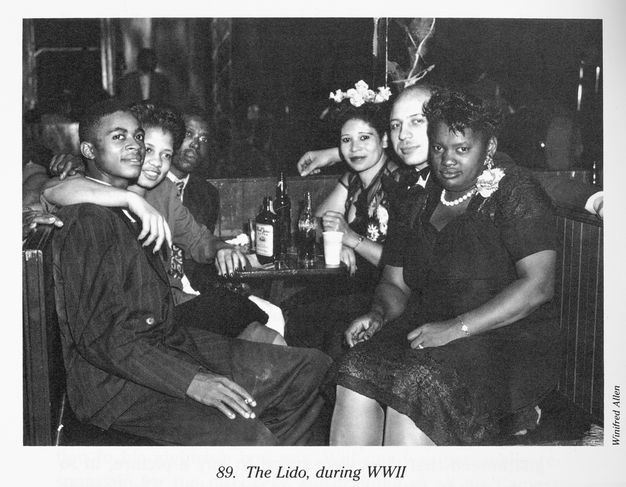
supply. The women would work the crowd, cameras in hand, and
produce photographs of groups posing and beaming for the
camera, carefully positioned to include everyone’s faces (fig. 7). The section on the Camera Girls within the publication
also stands out as the only published interview of the many
that Moutoussamy-Ashe conducted. Through this interview with
Williams, readers gain a sense of the types of questions
Moutoussamy-Ashe asked to elicit the historical narrative of
Black women photographers. The tone of these conversations and
the nature of her interviewing process can only otherwise be
experienced if one goes into the Jeanne Moutoussamy-Ashe
Manuscript and Research Collection at the Schomburg Center for
Research in Black Culture. A look in the archive illustrates
some of the choices Moutoussamy-Ashe had to make as a writer,
along with the approach she took in charting a history.
In the archive, we gain insight into the life of Jamaican-born
Winifred Hall Allen, a New Negro–era photographer whose work
preceded and expanded chronologically beyond the short run of
the Camera Girls phenomenon. She owned a studio and worked as
a portrait photographer and photojournalist in Harlem for
twenty years. Allen is mentioned in the earliest known
scholarly thesis on photography in Harlem as “the most
successful black photographer on the block.”19
While such proclamations of success characterize her
appearance in that early scholarship, the account offered
through Viewfinders and Moutoussamy-Ashe’s research
is more tempered by the challenges and precarities of life’s
duration. Allen’s ambitions did not translate into the
enduring pride and distinction one might expect. By the time
Moutoussamy-Ashe tracked down Allen and interviewed her in the
early 1980s, the once-determined Black photographer and astute
businesswoman had disposed of more than half of her
photography collection.20
Cockroaches had taken up residence in the closet shoeboxes in
which the few photographs she had kept were stored.
Moutoussamy-Ashe persuaded Allen to part with some of the
negatives; the twenty-six examples in Viewfinders are
Allen’s only published photographs. As Moutoussamy-Ashe shares
with the readers of Viewfinders, Allen did not
consider her own forays into photography earlier in life as
historically relevant or exceptional. One year following the
publication of Viewfinders, Black feminist writer
Jewelle Gomez laments that “(Allen’s) sense of the prevailing
culture’s sentiments about their lack of worth was, of course,
sadly accurate.”21
The insufficient recognition of Allen’s contributions to the
field and the disheartening conditions of her photographs
illustrate the difficulties of writing history when the sense
of collective value is absent. Reflecting on her project
An Illustrated Bio-Bibliography of Black Photographers,
1940–1988
(1989), Willis writes that many of the overlooked contemporary
Black photographers, “had their archives discarded because
they believed no one cared.”22
Considering the archive of research materials for
Viewfinder alongside the materials that made it into
the final book, it becomes evident that Moutoussamy-Ashe had
to selectively read between the lines of the narratives with
her interviewees to squeeze out a history that, for some, does
not register as History with a capital H and, more
unfortunately, is seen as “unfit for history.”23
The resistance to and the erasure of this important history is
unintentionally carried out by those whose names should be
celebrated as much as it is actively inflicted by the larger
societal systems that devalue Black women, from which,
evidently, no one is spared. It is, as theorist Christina
Sharpe might describe it, the weather.24
Sharpe uses the weather as a metaphor for the all-consuming
ubiquity of anti-Blackness through legible and illegible ways.
Because, of course, the devaluation of Black women is a
collective narrative, a story whose basic plotline we all
know—one in which the protagonist can represent a range of
subjects with varying complexities, complications, and nuances
but is nonetheless resigned to being inferior or unfit for
history. Viewfinders streamlines history to displace
the depths of anti-Blackness through legibility. A collection
of facts and ideas neatly chronicled and arranged on the page
subdue the residuals of devaluation that are yet still present
as structural norms. A range of book publications,
exhibitions, and initiatives dedicated to image makers set the
foundation for challenging such norms. Arguably, this
concatenation of emerging efforts played a part in readying
Moutoussamy Ashe and others to chart a different history.
Spanning Outward
Before Viewfinders, only two books had offered a
surveylike, historical consideration of Black photography,
serving a markedly radical departure from Newhall’s canonical
History of Photography, which, by its fifth edition
in 1982, still failed to include any Black photographers.
During the year 1983, curator Valencia Hollins Coar published
A Century of Black Photographers, 1840–1960, a
sweeping chronological survey that includes only one woman
photographer, to accompany an exhibition of the same title.
Willis released
Black Photographers, 1840–1940: A Bio-Bibliography in
1985, just a year before Moutoussamy-Ashe’s book came out.25
Significantly, in comparison, Viewfinders focused on
Black women photographers, and was the first book to do so. As
a model to build upon, Willis’s and Coar’s publications
offered important interventions into a history of photography
dominated by white, male photographers.
Moutoussamy-Ashe writes this history, when possible, by
interviewing Black women photographers, privileging the voices
of artists themselves. Previous recuperative books that
involve this strategy include artists Samella S. Lewis and
Ruth G. Waddy’s two-volume
Black Artists on Art (1969–71), and
Contextures (1978) by artists Linda Goode-Bryant and
Marcy S. Philips; each work stakes a claim at a time when the
words of Black artists were being documented and validated,
sometimes for the first time.26Viewfinders also joined the ranks of publications
that were produced by African American photographers as
meaningful efforts to visually amplify aspects of Black life.
Examples include Roy DeCarava and Langston Hughes’s
The Sweet Flypaper of Life from 1955, a
field-defining photobook surely known to Moutoussamy-Ashe.27
Part of the force of Moutoussamy-Ashe’s contribution is the
very fact that Viewfinders is a book as opposed to a
more ephemeral format. Viewfinders was originally
published by New York–based Dodd, Mead & Company, a
reputable and popular publisher, especially for Black
literature. Aligning with the years of the civil rights
movement, starting in the 1950s Dodd, Mead & Company
published several anthologies of Black poetry, essays,
folklore, and humor. The sale of Viewfinders was
mobilized through the reputation preceding its publisher, the
publisher’s efforts to advertise it, and multiple reviews of
the book’s merits and weaknesses, geared directly toward the
intended readership.28
Through its publication, Viewfinders entered the
capitalist sphere of the commodity world. As photography
historian Anne McCauley writes: “The information included in
photographic texts carries not only ideological but economic
weight.”29
A print book released by an established publisher is produced
with the intent of sale, a force less prevalent in the
production of pamphlets, journals, and exhibitions. The
commercial aspect becomes the engine behind the book’s
visibility and dissemination, which departs significantly from
noncommercial efforts to share newsletters, articles, and
exhibition materials. Yet, impact is not contingent upon the
widespread distribution channels of book publications.
Instead, as the next section will demonstrate, the grounds for
renewed thinking are often located in ephemeral or archival
materials of little circulation and attention.
Just one year before the publication of Viewfinders,
Moutoussamy-Ashe completed a twenty-page research paper on the
history of Black students at Cooper Union, a project that gave
her experience in archival research and oral interviews.30
The document, later partially published in a Black-student
directory by Cooper Union, sheds light on an extensive roster
of Black artists who attended Cooper Union from the nineteenth
century to 1994, when the register was published.31
Moutoussamy-Ashe was particularly focused on the inclusion and
matriculation of Black students in the school’s early history,
many of whom are left out of the current roll call of
significant figures. Within the document, she highlights the
“firsts”—those who were the first Black students to achieve a
specific milestone—a trailblazing designation that
traditionally dictates the importance of Black individuals in
society. Yet she does so in ways that not only reveal the
accomplishments of Cooper graduates but, importantly, the
circumstances through which they come into view, just as she
did with Allen in Viewfinders. For example, Daisy
Brown, possibly the first Black woman graduate of the
engineering school, came to the attention of an alum through a
Cooper Union bronze metal, etched with Brown’s name, found at
a flea market. For Moutoussamy-Ashe, bringing renewed
attention to Brown would allow the school to “promote dignity
by standing on the very foundation on which it was built.”32
Through the Cooper Union project, history is punctuated and
influenced by the very presence of individuals, not
necessarily by evidence of prolific contributions. Such an
outlook laid the methodological groundwork for
Viewfinders as a survey of Black women photographers,
many of whom had no extensive archive or notable accolades.
The mentorship and other impactful learning experiences that
Moutoussamy-Ashe had at Cooper Union enhanced the development
of Viewfinders. While at Cooper Union, she took
classes on African art with art historian and practicing
artist George Nelson Preston, which influenced her decision to
pursue an independent study in West Africa in 1974 along with
photographer Frank Stewart. Visiting Cape Coast Castle in
Ghana, standing at the porthole looking out at the vast
horizon of the sea, traversed for centuries by slave ships,
informed her subsequent exploration of Daufuskie Island, off
the coast of South Carolina, a place defined by the legacy of
enslavement and rich Gullah culture. Such experiences fueled
an acknowledgment of the inherent link between the African
American and African experience. This transformative trip to
Ghana and later, South Africa, where she photographed life
under apartheid (1977–78), combined with her interest in
capturing an underrecognized history of her alma mater, offer
an understated genealogy for many of her subsequent
projects.33
More broadly, these projects fueled her curiosity and desire
to visually engage with the vastness and complexity of Black
life.
The accomplishment of Viewfinders can also be framed
within the context of exhibitions, artists, and
photography-centered initiatives from the 1970s and 1980s that
demonstrate the contours of her dynamic engagement with a
range of art and visual-cultural worlds. Just Above Midtown
was an innovative, self-funded gallery space driven by an
experimental ethos and dedicated to the support and exhibition
of Black artists in Manhattan, including those making
conceptually charged work across fields, including
performance, abstraction, sculpture, and video. The exhibition
roster in 1978, the year Moutoussamy-Ashe had
South Africa: Impressions, her first solo exhibition
there from 11 April to 6 May, gestures toward a relevant
context for understanding the emergence of
Viewfinders outside of a historiography of books
alone.
The construction of history is not limited to scholarship.
Indeed, “long before average citizens read the historians who
set the standard of the day . . . they access history through
celebration, site and museum visits, movies. . . . To be sure,
the views they learn there are, in turn, sustained, modified,
or challenged by scholars involved in primary research.”34
Just Above Midtown provided this kind of sustaining force
through a chain of programs that offered Moutoussamy-Ashe a
context for and access to Black creativity in advance of her
project to survey a longer history of Black women in
photography.
In 1978, during the last year at its 57th Street location
before an eviction and relocation downtown, the intimately
small space of Just Above Midtown hosted an array of projects
within months of each other that included artist Houston
Conwill’s series of performances as part of his exhibition
Notes of a Griot, in which evocations of ancestral
chanting, whirling, and dancing were central.
Moutoussamy-Ashe’s display of photographs of everyday life in
apartheid Africa (South Africa: Impressions) followed
Conwill’s show along with a string of others, including a show
on origami-paper collages; an exhibition of earlier
twentieth-century work by African American studio photographer
James Van Der Zee, brother of Jennie L. Welcome, called
Black Has Always Been Beautiful; and solo and group
shows with eccentric titles such as
Booga Bear Paintings and Pocket Art.35
Just Above Midtown represents the kind of environment in which
Moutoussamy-Ashe developed her identity as an artist and
sharpened her awareness of the boundlessness of Black creative
endeavors, past and present. The influence of the kinds of
experiences afforded by Just Above Midtown may have buoyed
Moutoussamy-Ashe in continuing her momentum and dedication to
expanding upon the dynamism of Black creative life, this time
through a focus specifically on the remarkable breadth of
Black women photographers.
In a letter to the editor of the James Van Der Zee Institute’s
Photo Newsletter, dated 21 March 1973,
Moutoussamy-Ashe writes, “After studying the current issue
. . . I felt encouragement. I felt a vibration and wanted to
say, hey sister, I know how you feel. The important thing was
that something was said, about me, for me.”36
From 1972 to 1974, the institute, founded in 1969, produced
the Photo Newsletter about six times a year. Each
issue, of no more than eight to twelve pages, covered a range
of materials relating to photography in service of the
institute’s larger mission to promote the work of Black
photographers. The newsletter evinced an emerging moment in
which efforts to document and narrate histories of Black
photography were taking shape. Briefly housed in the
Metropolitan Museum of Art in New York before moving to the
Studio Museum in 1978, the James Van Der Zee Institute
operated through donations, a dedicated staff, and seed
funding from the Rubenstein Foundation. The stewardship of a
small collection of photographs also demonstrated the
institution’s mission.
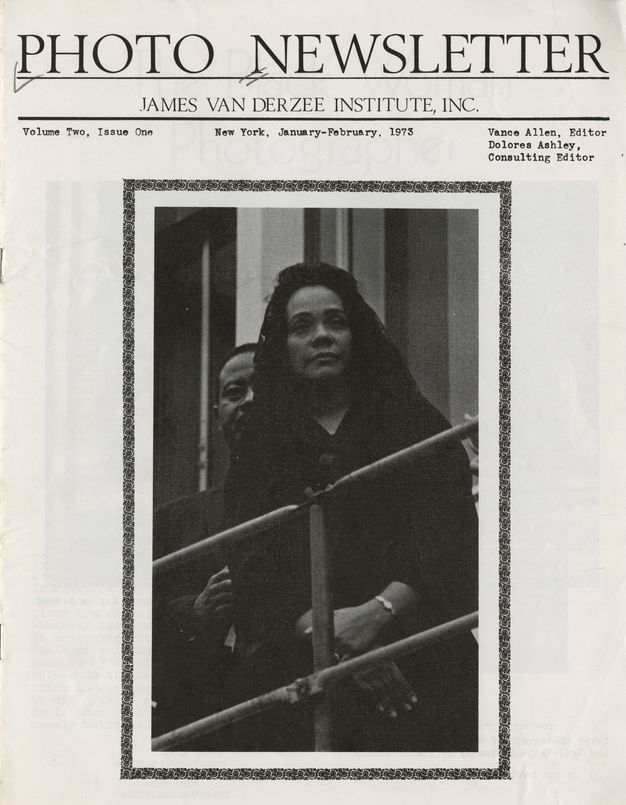
The issue that Moutoussamy-Ashe referred to in her statement
of encouragement was volume two, number one (January–February
1973), the first and last issue of the Institute’s
Photo Newsletter to focus solely on Black women
photographers (fig. 8). Her
comments may have also been made in response to the
newsletter’s announcement of a two-week exhibition on Black
women photographers to be hosted at the newly opened Community
Folk Art Gallery of Syracuse University, one of the earliest
exhibitions on record of its kind.37
It can be surmised that the women featured in the newsletter
issue were also included in the exhibition. These
photographers include Elaine Tomlin, the only Black woman
staff photographer in the 1960s for the Southern Christian
Leadership Conference; Ardina Seward, one of the first African
American women photojournalists in the news broadcast
industry; June Clark Greenberg, cofounder of the Women’s
Photography Co-op in early 1970s Toronto; Ming Smith, the
first Black woman photographer to have her work enter MoMA’s
collection, in 1979; E’Lois Kinnon, a contributor to the
Chicago Journal: The South Side’s Free Weekly Newspaper; and Mikki Ferrill, the accomplished freelance photographer
whose early assignments include covering the 1968
Olympics.38
ExpandFig. 8. —Cover of Photo Newsletter 2, no. 1
(January–February 1973), published by the James Van Der
Zee Institute.
Kansas City, MO, Spencer Art Reference Library at the
Nelson-Atkins Museum of Art.
Other efforts to document and recognize the history of Black
photography took form elsewhere—for example, in the pages of
the first
International Black Photographer’s Newsletter, a
six-page document produced in the summer of 1981.39
The newsletter, regrettably, would not continue beyond its
first couple of issues, despite the ambitions of a small cadre
of photographers who had successfully spearheaded the
Black Photographers Annual, whose four volumes, each
a substantial endeavor—for example, the second volume featured
about fifty Black photographers within more than a hundred
beautifully curated pages—ran over a seven-year period (1973,
1974, 1976, and 1980). Conceived by the visionary and
influential Kamoinge Workshop, a small collective of Black
photographers involved in the larger umbrella organization of
the International Black Photographers (IBP),
The Black Photographers Annual provided exposure to
photographers frequently left out of the photography- and
art-publishing arenas. The hopes of producing its drastically
shorter and less designed newsletter as a more frequent
quarterly publication never came to fruition. With
then–executive editor of Essence magazine, Cheryll Y.
Greene, at the helm of this later initiative, the newsletter
features short blurbs describing the organization’s founding
and its aim to honor and celebrate the more senior members of
the Black photography community, many of whom participated in
the Kamoinge Workshop.40
Of particular interest on the newsletter’s final page are a
few paragraphs describing what Greene and curator Gylbert
Coker envision for the IBP archive. In the plan for a
permanent location separate from the archive’s initial
location at the residence of a fellow IBP member, the authors
clarify the importance of such an archive, one that would
house original works, slides, portraits of photographers, oral
histories, and other kinds of materials, those “relating to
the history and development of Black photography.”41
Building this archive would depend heavily upon the “the rich
resources right at hand in our photographic history,”42
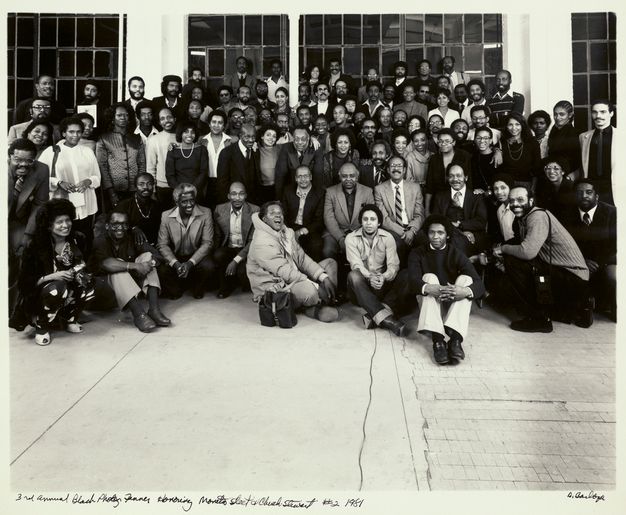
a large and active community portrayed in a group photograph
taken by Anthony Barboza and reproduced in the issue;
Moutoussamy-Ashe is identified near the right edge of the
frame, one among the scattering of women pictured (fig. 9). Also reflected in the newsletter’s pages, this community
took shape around gatherings like the IBP dinner, at which
attendees Jeanne Moutoussamy-Ashe and Arthur Ashe appear in a
photograph seated with photographers Al Fennar and John
Pinderhughes.43
ExpandFig. 9. —Anthony Barboza (US American, b. 1944).3rd Annual Black Photographers Dinner Honoring Monetta
Slate and Chuck Stewart #2,
1981, from
International Black Photographer’s Newsletter,
1981. Image courtesy Virginia Museum of Fine Arts,
Richmond, Arthur and Margaret Glasgow Endowment, 2017.40.
Across the Atlantic in Britain, another short-lived
publication further substantiates ongoing efforts to gather
and articulate a space in which Black photographers are
recognized, particularly Black women photographers.
Highlighting photographic portfolios of contemporary
photographers alongside short, critical essays, the British
magazine Polareyes had a curtailed run in 1987 that
lasted for only one issue. A burst of available funds from the
Greater London Authority and the Arts Council facilitated its
creation, while a quickly dwindling budget prevented the
publication of subsequent issues. Nonetheless, an editorial
board of women artists spearheaded the one-shot project to
center the creative commitments and voices of contemporary
Black British women photographers, which reflected an expanded
understanding of Blackness with the inclusion of contributions
by British artists of African descent along with artists of
Southeast Asian and Indigenous backgrounds. Along with
articles that center Black women photographers, the issue
includes a review of Viewfinders, a reprinted article
from volume 4 (1980) of
The Black Photographers Annual, and a mention of Van
Der Zee—all evidence of the burgeoning transatlantic momentum
toward established discourse around the production of
photography in Black life. Relevantly,
Viewfinders primed the creators of
Polareyes to see. As historian of photography Taous
R. Dahmani writes, “Viewfinders . . . became an object of
legitimization that allowed a journal like
Polareyes to fit into a historical and transatlantic
tradition.”44
Because of Viewfinders, the photographers of
Polareyes could locate their efforts not only within
a roster of British contemporary artists but along a longer
and broader trajectory of Black women in photography. Indeed,
as writer Camille Crain Drummond notes, “Using the book format
to establish dominant and authoritative narratives of the
historical and cultural record of entire peoples is as old as
the book itself.”45Viewfinders affords different options of possibility
for inclusion and redress because it charts a genealogy that
had never been expressly outlined before. It offered, and
still offers, an anchor for Black women photographers to
locate and position themselves, sometimes most impactfully
through curated modes of visual engagement.
A Model for Looking
The thoughtful inclusion of photographs within published
materials can model and generate ways of looking. For example,
in the fourth volume of the short-lived but influential
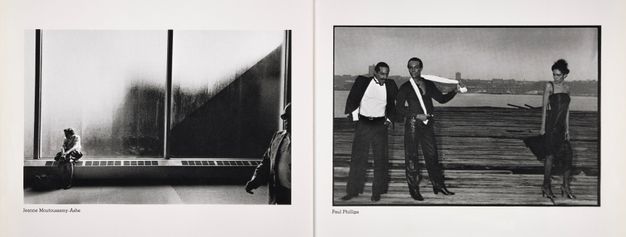
TheBlack Photographers Annual, an untitled
photograph by Moutoussamy-Ashe appears on the left-hand page
of a spread opposite an untitled photograph by Harlem-based
photographer Paul Phillips, their compositions visually in
dialogue (fig. 10). In
Moutoussamy-Ashe’s image, a woman in the middle distance sits
on what appears to be a climate-control ventilation bench that
runs under a wall-length window with a blurred view. The
expanse of space between the woman and a strolling man
partially in view at the lower edge of the other side of the
photograph mirrors the open area between a pair of two
well-dressed men and one fashionable woman standing on a windy
pier in Phillips’s image. Despite different locations and
contexts, the sophisticated spread’s paired photographs work
in tandem to advance a dynamic visual dialogue.
All too often, pairings did not work in the favor of
noteworthy photographs and their subjects. In the article
“Showing Our Faces: A Century of Black Women Photographed,”
published a year after Viewfinders, Gomez points to a
different kind of unfortunate but persistent pairing.
Describing a newspaper article, Gomez laments that “on one
page we celebrated the age of America’s first black vamp
Dorothy Dandridge, sitting backstage about to go out and work
her black magic; on another we were assaulted by the
relentlessly degrading advertisements for wigs, skin bleaching
creams and hair straighteners.”46
While a Black woman may be seen as exemplary, there
simultaneously exists a correlation to supposed imperfections
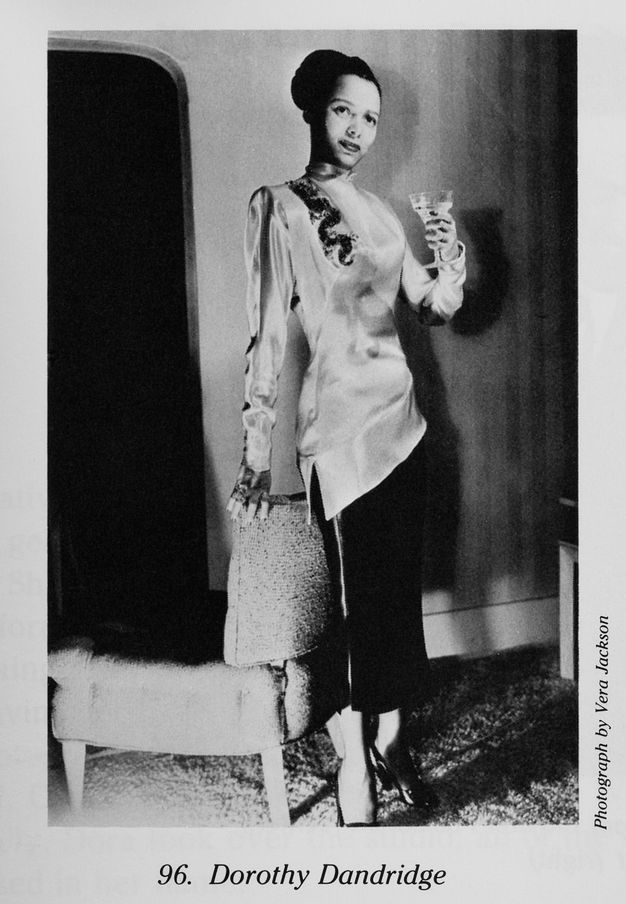
in need of correction. By contrast, in
Viewfinders, Vera Jackson’s portrait of the great
Dorothy Dandridge, cocktail in hand, spotlights the star
through directed lighting, evoking glamorous repose (fig. 11).
Through its intentional page layout,
Viewfinders celebrates the cocktail portrait in
connection with a second Dandridge portrait, along with
smiling portraits of Black female stars Phillipa Schuyler and
Hattie McDaniel and a group portrait of women celebrating the
birthday of Mary McLeod Bethune. The book’s arrangement of
photographs constellates and centers the work of Black women
image-makers—who control the viewfinder—and allows Black women
to occupy the camera viewfinder’s focal point. Like the
various efforts that primed Moutoussamy-Ashe to recognize
Robeson’s significance on that day in the Beinecke, so too
will Viewfinders continue to prime readers to disrupt
marginalizing versions of photography’s history, anchoring and
inspiring more generative narratives.
Operating within cultural and academic institutions,
historians of photography are encouraged to tell new
narratives that are often anchored by a shared set of
well-known texts on photography. Yet responses to the
important call to develop groundbreaking research tend to
overlook the methods and interventions gifted by Black women,
contributions that could significantly inform and enrich the
canon. What might it mean, for example, to disrupt the loop of
a long-standing citational practice by exchanging the
discourse around one leading text from the 1980s—say, Roland
Barthes’s canonical Camera Lucida—for another, such
as Moutoussamy-Ashe’s Viewfinders, taking into
consideration her contemporary interlocutors and the various
discursive antecedents and successors of the project? Such a
relational intervention resonates with photo theorist Ariella
Azoulay’s construction of history as a rewind as opposed to
the creation of something new. To frame the reclaiming of
history as the answer to today’s most pertinent research
questions serves as a departure from writers who commonly
place the ambitions of world-making within the possibilities
of Black futures as opposed to Black pasts. As Azoulay writes,
“To counter the imperial promise of a new beginning . . . [we
must be] tuned to a different modality: that of rehearsal,
reversal, rewinding, renewing, reacquiring, redistributing,
readjusting, reallocating, and on and on.”47
Indeed, being primed to discern Black photographic life and
all its contours affords one the possibility of rewinding and
rewriting history.
Emilie Chesnutt Boone, associate professor of
art history at New York University, writes about photography
and the African diaspora.
Notes
Many thanks to the generous peer reviewers as well as Faye
Raquel Gleisser, Eleanor Hughes, Catherine Quan Damman, and
members of the New York University (NYU) Black Diaspora
Cultural Studies Cluster Manuscript Workshop. Gratitude is
also due to Jeanne Moutoussamy-Ashe and to the countless Black
women photographers and writers who have reminded me over the
years of Viewfinders’ significance.
Pronounced “Jean-ee Ma-two-sah-me” according to the
author in Jeanne Moutoussamy-Ashe, “A History of Black
Alumni at Cooper Union,” interview by Avia Hurley and
archives librarian Mary Mann, 28 September 2021, New
York, Cooper Union Archives and Special Collections,
MG.014, box 1. Moutoussamy-Ashe visited Yale University
on the occasion of her spouse Arthur Ashe’s receipt of
the Yale Kiphuth Award bestowed to distinguished
athletes on 10 February 1983. She found Robeson’s work
in the Carl Van Vechten Papers. Jeanne Moutoussamy-Ashe,
“An Oral History with Jeanne Moutoussamy-Ashe” interview
by Kalia Brooks, BOMB, Oral History Project, 11
September 2014,
https://bombmagazine.org/articles/2014/09/11/jeanne-moutoussamy-ashe/. ↩︎
In Moutoussamy-Ashe’s own words, “My interest in writing
a book on black women photographers started in the
spring of 1982 [sic] when, on a visit to Yale
university’s Beinecke Rare Books Library, I was looking
at photographs from the Carl Van Vechten Collection. It
was in this collection that I first saw photographs of
well-known black Americans that were stamped with the
name E. G. Robeson.” Jeanne Moutoussamy-Ashe,
Viewfinders: Black Women Photographers (Dodd,
Mead, 1986), xvii.
↩︎
For a compelling contribution on how the art world came
to “see” photographers in Chicago’s Black Arts Movement
(BAM) see, Romi Crawford, “Black Arts Movement
Photography in Chicago: From Impermanent Institutions to
a Tentative ‘Arrival,’” in
Never a Lovely So Real: Photography and Film in
Chicago, 1950–1980, ed. Michal Raz-Russo with Grace Deveney and Romi
Crawford (Art Institute of Chicago, 2025),
https://doi.org/10.53269/9780865593237/06. In the essay, Crawford considers what she calls the
“tipping point, that fulcrum-like moment when art,
especially art made by minoritized persons, enters into
wider circulation and more formal institutional
contexts.” Crawford, “Black Arts Movement Photography in
Chicago,” 2.
↩︎
Moutoussamy-Ashe would later know Gordon Parks as a
friend and a work connection through NBC. See Raymond
Arsenault, Arthur Ashe: A Life (Simon &
Schuster, 2018), 413.
↩︎
For the most recent biography on the photographer, see
Candice Jansen, “Jeanne Moutoussamy-Ashe,” a biography
produced as part of the research programme The Origin of
Others: Rewriting Art History in the Americas, 19th
Century–Today in partnership with the Clark Art
Institute Archives of Women Artists, Research &
Exhibitions (AWARE), 2025,
https://awarewomenartists.com/en/artiste/jeanne-moutoussamy-ashe/. ↩︎
Moutoussamy-Ashe, “An Oral History with Jeanne
Moutoussamy-Ashe,” n.p.
↩︎
Jeanne Moutoussamy-Ashe,
Viewfinders: Black Women Photographers (repr.,
Writers & Readers, 1993.)
↩︎
Many thanks to special collections conservators Lou Di
Gennaro and Dawn Mankowski at New York University’s
Bobst Library for helping me to formulate this
descriptive language upon viewing the book on 14 May
2025. ↩︎
For example, see the collage-like layout of Toni
Morrison, The Black Book (Random House, 1974.)
↩︎
Deborah Willis,
Black Photographers 1840–1940: A Bio-Bibliography
(Garland, 1985).
↩︎
Michel-Rolph Trouillot,
Silencing the Past: Power and the Production of
History
(Beacon, 1995), 22.
↩︎
In addition, Viewfinders notably served as the
inspiration to Naomi Rosenblum,
A History of Women Photographers (Abbeville,
1994). Jeanne Moutoussamy-Ashe, interview with the
author, 22 April 2025.
↩︎
Joy Gregory and Taous R. Dahmani,
Shining Lights: Black Women Photographers in
1980s–90s Britain
(MACK & Autograph, 2024), 407. See also Taous R.
Dahmani, “Polareyes: A Magazine by and for
Black British Women Photographers as a Site of
Resistance in London, 1987” in
Resist, Organize, Build: Feminist and Queer Activism
in Britain and the United States During the Long
1980s,
ed. Sara Crook and Charles Jeffries (State University of
New York Press, 2022), 244–74.
↩︎
For more information on Mary Warren, See
Moutoussamy-Ashe, Viewfinders, 10–11.
Hereafter, short citations refer to the 1986 edition.
↩︎
Greg Tate, “Cult-Nats Meet Freaky-Deke,” in
Flyboy in the Buttermilk: Essays on Contemporary
America
(Simon & Schuster, 1992), 207.
↩︎
For a journalistic account of Camera Girls in New York
City, see Berton Roueché, “Hawkins Is Inside,”
The New Yorker, 30 November 1946.
↩︎
Myrtle Evangeline Pollard, “Harlem as Is” (master’s
thesis, College of the City of New York, 1936).
↩︎
Winifred Allen file, New York, The New York Public
Library, Schomburg Center for Research in Black Culture,
Manuscripts, Archives and Rare Books Division, Jeanne
Moutoussamy-Ashe manuscript and research collection, Sc
MG 343.
↩︎
Jewelle Gomez, “Showing Our Faces: A Century of Black
Women Photographed,” Ten.8, no. 24 (1987): 17.
↩︎
Deborah Willis, quoted in Jasmine Nichole Cobb, “Making
Space: Deborah Willis and the Archive of Black Visual
Culture,” Camera Obscura 35, no. 3 (2020): 135.
↩︎
Stephen Best, “Introduction: Unfit for History,” in
None Like Us: Blackness, Belonging, Aesthetic
Life
(Duke University Press, 2018), 1–26. Many thanks to
Emily Brady, author of the book
Let the World See What I See: Black Women
Photographers from the Harlem Renaissance to Black
Power
(University of North Carolina Press, forthcoming), for
bringing this to my attention. Emily Brady, conversation
with the author, 28 June 2023.
↩︎
Christina Sharpe, “The Weather,” chap. 4 in
In the Wake: On Blackness and Being (Duke
University Press, 2016), 102–34.
↩︎
Valencia Hollins Coar,
A Century of Black Photographers, 1840–1960
(Museum of Art, Rhode Island School of Design, 1983);
and Willis, Black Photographers 1840–1940.
↩︎
Samella S. Lewis and Ruth G. Waddy,
Black Artists on Art, 2 vols. (Contemporary
Crafts, 1969–71); and Linda Goode-Bryant and Marcy S.
Philips, Contextures (Just Above Midtown,
1978).
↩︎
Taous R. Dahmani, “Missing Photobooks: A Symptomatic
Reading on the Reasons for and Impact of the Lack of
Publications by Black British Photographers in the 1970s
and 1980s,” in
The Photobook World: Artists’ Books and Forgotten
Social Objects
(Manchester University Press, 2023), 78.
↩︎
These include G. Craven, review of
Viewfinders: Black Women Photographers, by
Jeanne Moutoussamy-Ashe, Choice 24 (1986): 110;
Marilyn Richardson, “From Negative to Positive,” review
of Viewfinders, by Moutoussamy-Ashe,
The Women’s Review of Books 3, no. 12 (1986):
7–8; David M. Johnson and Yolanda Burwell, “[Review of]
Jeanne Moutoussamy-Ashe,
Viewfinders: Black Women Photographers,”
Explorations in Sights and Sounds 7, no. 1
(1987): 55–56; and John Loughery, review of
Viewfinders, by Moutoussamy-Ashe,
Woman’s Art Journal 10, no. 2 (1989): 49.
↩︎
Anne McCauley, “Writing Photography’s History Before
Newhall,” History of Photography 21, no. 2
(1997): 87.
↩︎
Moutoussamy-Ashe, “A History of Black Alumni at Cooper
Union.”
↩︎
The Cooper Black Book, compiled/designed by
Dave Riggins “True,” 1994, New York, Cooper Union
Archives and Special Collections, Collection of
Registers and Directories, RG.010, box 5.
↩︎
Moutoussamy-Ashe, “A History of Black Alumni at Cooper
Union.”
↩︎
See Candice Jansen, “Black Colored Memory,” in
Jeanne Moutoussamy-Ashe: South Africa, 1977/1978, ed. Michal Raz-Russo (Steidl; Gordon Parks
Foundation, 2025), 200–211.
↩︎
Jeanne Moutoussamy-Ashe, letter to the editor, 21 March
1973, Photo Newsletter 2, no. 2 (March–April
1973): 5.
↩︎
Despite my efforts to find additional information on
this historic exhibition, I could only find a brief
mention in the newsletter. Dolores Ashley, “The Black
Woman Photographer,” Photo Newsletter 2, no. 1
(January–February 1973): 7–8.
↩︎
Other featured photographers include Deborah McCready,
Carole Butler, Leigh Abernathy, and Jennifer Bryan.
Ashley, “The Black Woman Photographer,” 7.
↩︎
For more information on Kamoinge, see Sarah L. Eckhardt
et al.,
Working Together: Louis Draper and the Kamoinge
Workshop
(Virginia Museum of Fine Arts, 2020.)
↩︎
Gylbert Coker and Cheryll V. Greene, “The Archive: What
We Envision,”
International Black Photographer’s Newsletter
1, no. 2 (1981): 4.
↩︎
Jeanne Moutoussamy-Ashe, interview with the author, 22
April 2025. An image was reproduced in the IBP
newsletter, and the identities of its subjects were
confirmed by Moutoussamy-Ashe during the interview. The
location of the original photograph is unknown.
↩︎
Camille Crain Drummond, “The Designer Elevating the
Present and Future of Photobooks,”
The PhotoBook Review, no. 018, in
Aperture, no. 40 (2020): 5.
↩︎