Gray / Worldwide EmotionGetty Research Journal, No. 21 (2026)
Copied page section link to clipboard
Abstract
This article reconsiders the significance of the two
riflemen in the top-right corner of David Alfaro
Siqueiros’s outdoor mural
América tropical oprimida y destrozada por los
imperialismos
of 1932 in Los Angeles. The mural was painted on the
second story of the Plaza Art Center and required a
rooftop view to be seen in totality. The artist’s
placement of these marginal figures, however, ensured
their visibility to street-level passersby. While the
mural was gradually whitewashed over the ensuing years,
the segment with the riflemen was covered first. Comparing
América tropical with
Siqueiros’s two other California commissions, I consider
how he pushed the mural’s formal and material
possibilities by incorporating a proliferation of angles
and perspectives. Using documents from the Siqueiros
Papers at the Getty Research Institute, I highlight the
interhemispheric dialogue between Siqueiros and Peruvian
Marxist José Carlos Mariátegui, and I interpret the
riflemen as figures for a transnational revolutionary
cause.
Keywords
muralism, David Alfaro Siqueiros, José Carlos Mariátegui,
Los Angeles, Mexico, Indigenismo,
Olvera Street, transnationalism, censorship, whitewash,
Marxism
Copied page section link to clipboard
Peer Review
Double anonymous, external
Copied page section link to clipboard
Cite
Chicago
Jonah Gray, “Worldwide Emotion: Interhemispheric Dialogue
in David Alfaro Siqueiros’s
América tropical oprimida y destrozada por los
imperialismos,” Getty Research Journal, no. 21 (2026),
https://doi.org/10.59491/JYNB6118.
MLA
Gray, Jonah. “Worldwide Emotion: Interhemispheric Dialogue
in David Alfaro Siqueiros’s
América tropical oprimida y destrozada por los
imperialismos.” Getty Research Journal, no. 21, 2026,
https://doi.org/10.59491/JYNB6118.
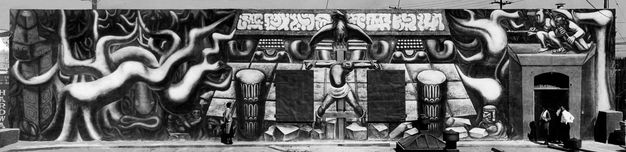
The crucified Indigenous peasant at the center of
América tropical oprimida y destrozada por los
imperialismos
(Tropical America oppressed and destroyed by imperialism), an
outdoor mural from 1932 by David Alfaro Siqueiros, has often
attracted the attention of commentators (fig. 1).1
The figure takes pride of place in the mural when it is beheld
frontally, and Siqueiros apparently added it with a dramatic
flourish at the last minute, the night before the mural’s
unveiling on the second story of what was then known as the
Plaza Art Center in Los Angeles.2
Reports of an audible gasp from the crowd gathered on the
adjacent roof at the moment of its debut neatly seals this
account of the mural’s reception, suggesting that it had
exactly the intended effect of shocking and titillating the
assembled audience, which included Siqueiros’s student
collaborators, sympathetic artists, and critics.3
Also present were the project’s patrons, who likely expected
something quite different—the artist’s official remit had been
to create a pleasant, tropically themed landscape.4
In what follows, I make a case for understanding the mural
differently, attending to influential factors in its
production process, the phases of its censorship, and the pair
of figures at the mural’s top-right corner.5
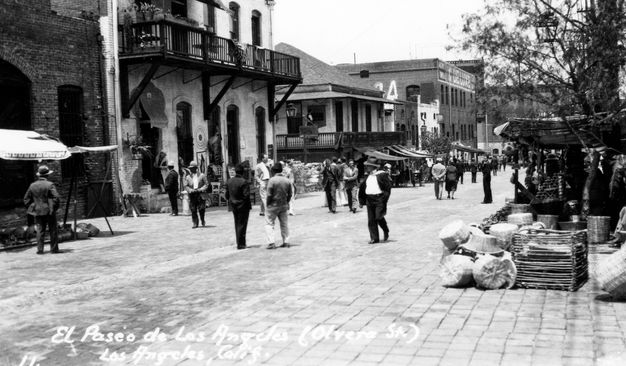
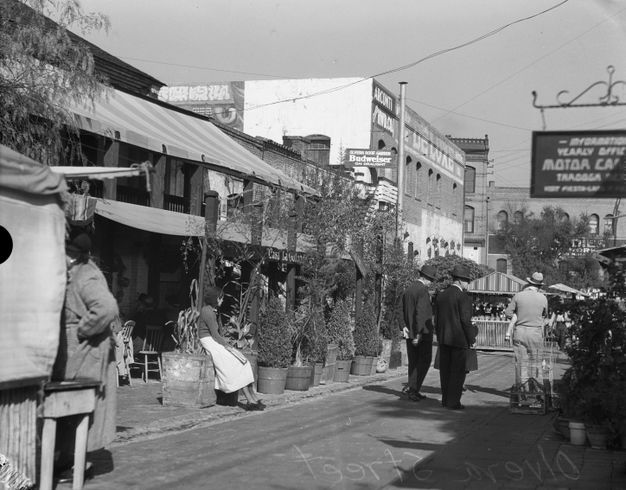
Rather than examining the mural from the ideal viewpoint
shared with the select group invited to the roof for its
debut, I argue that the perspective of the pedestrian on
Olvera Street looking up at the mural from an oblique angle
deserves more attention (fig. 2). I will build on scholarship that analyzes Siqueiros’s
intensifying experimentation with photography and perspective
in this period.6
If his manipulation of viewpoints in
América tropical hailed its
audience in an intentionally provocative way, I argue for a
closer consideration of the interhemispheric character of the
cause into which Siqueiros sought to recruit the mural’s
viewers. This approach continues the line of inquiry opened by
art historians David Craven and Tatiana Flores in their
respective scholarship on avant-gardist dialogues between
Mexico and Peru.7
Drawing on documents from the David Alfaro Siqueiros Papers at
the Getty Research Institute in which the artist critiques the
ideas of his contemporary, heterodox Peruvian Marxist José
Carlos Mariátegui (1894–1930), I interpret the two riflemen in
the mural in light of what they threatened to inspire in their
audience: agitation and solidarity toward a subversive,
transnational revolutionary cause.
Siqueiros’s commission for
América tropical came only two
years after the reinvention of Olvera Street as a landmark
meant to evoke a sanitized version of the city’s Spanish
colonial past. Styled as a restoration by its chief proponent,
socialite Christine Sterling, the establishment of El Paseo de
Los Angeles involved, according to art historian S. Janelle
Montgomery, an effort to transform the old central Plaza from
a rough-and-tumble “free speech zone” frequented by left-wing
political organizers into a quaint so-called Mexican market
lined with Anglo-operated shops and populated with
puesteros (market vendors)
mandated by Sterling to wear sombreros and serapes.8
This proposed substitution was celebrated in
Southern California Business magazine in August 1929
as “bringing back our yesterdays.”9
The whole undertaking belonged to the Mission Revival
phenomenon championed by real-estate developers and the
Chamber of Commerce that went back to the 1910s, which urban
theorist and historian Mike Davis has termed “boosterism” in
Los Angeles.10
As historian Sarah Schrank notes, the city boosters’
historical revisionism intensified during the United States
federal government’s repatriation campaign of Mexican
nationals and Mexican Americans, which had sparked protests in
the adjacent plaza.11
Sterling orchestrated the district’s redevelopment by pulling
strings among the city’s business set, including the
Los Angeles Times publisher Harry Chandler. Upon the
project’s completion, she reveled in her success: “Olvera
Street holds for me all of the charm, and beauty which I
dreamed for it, because out of the hearts of the Mexican
people is spun the gold of Romance and Contentment.”12
Constructing this imaginary, idyllic past was also a key part
of the city’s public relations campaign as host for the 1932
summer Olympics. Siqueiros’s mural would contest such
expressions of historical amnesia in the strongest possible
terms.
América tropical responded to
the civic mythologizing—and to the parallel phenomenon of
Indigenismo, which proffered competing representations of the
Americas’ Indigenous past—by pushing colonial genocide to the
foreground, countering the erasure of the mission revivalists’
nostalgia with an image of the violence they disavowed.
Documentation of the commissioning process is scarce, so it is
difficult to ascertain how much was known by the mural’s
patrons about Siqueiros’s final concept before it was
complete, or if there was any oversight during the painting
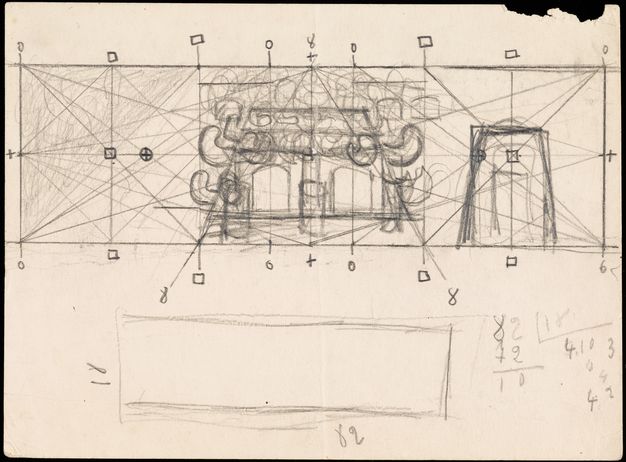
process. However, a preliminary drawing among the David Alfaro
Siqueiros Papers at the Getty Research Institute suggests that
the artist may have strategically left out the controversial
figurative elements in the planning stages (fig. 3). None of the figures featuring in the completed mural
appear in this sketch, which seems to map out the seamless
incorporation of the various doors and windows on the
supporting wall into the composition.
In the wake of the Mexican Revolution, Indigenismo—the history
of which extends back to the sixteenth century—became a locus
of intensifying ideological contestation and cultural
mediation between the emerging modern state, modernist
intellectuals, and the popular demographic constituencies of
campesinos and workers.13
The crucified peasant in
América tropical forwent the
romanticization of pre-Hispanic life that typified certain
strains of Indigenismo by focusing on a moment of suffering
under colonial attack. In the aftermath of
América tropical’s debut, however, Siqueiros expressed regret about having
employed the crucifix motif. “The only error,” he wrote of the
mural, “stems from its use of the cross because this, even
though double, lends itself to an ideological confusion.”14
This comment may refer to the fraught nature of Indigenista
appropriations of Christian symbolism.15
The specific source for Siqueiros’s use of the crucifixion
motif, however, is almost certainly not religious at all but
rather the result of an increasingly global circulation of
photographic images. Conservator Tomás Zurián and journalist
Adriana Malvido suggest that Siqueiros was quoting directly
from a photograph taken in 1865 by Felice Beato, an
Italian-born British photojournalist.16
The image in question, known as Executed Sokichi,
depicts the grisly fate of a Japanese servant involved in a
botched robbery. The resemblance to the figure in
América tropical is
unmistakable, including the tilted head and twisted torso and
how the feet are bound to the lower cross member. Siqueiros’s
use of photographs as source material and for what researcher
Laura González terms “preparatory sketches” goes back to his
early artistic education.17
Siqueiros’s exchanges with Russian filmmaker Sergei
Eisenstein—whom he had met earlier that year in Taxco, while
the muralist was living under house arrest in an abandoned
chapel—only intensified his thinking about the application of
photography as part of the mural-making process.18
Art historian Shifra Goldman argues that their dialogue
reinforced Siqueiros’s notion that “the spectator, rather than
passively receiving moving images, substitutes for the active
role of the movie camera.”19
The camera, in other words, not only aided the pictorial
design of a mural but could help conceive perspectives capable
of dynamically engaging viewers in motion through space.
As Siqueiros’s appropriation of Beato’s photograph
demonstrates, the camera also enabled contemporary viewers to
witness people, places and events they otherwise could not. In
his speech to the John Reed Club in Los Angeles, “The Vehicles
of Dialectic, Subversive Painting: Experience of the Block
Painters (Los Angeles Section)” (1932), Siqueiros might well
have been referring to the Beato image when he wrote, “Without
the photographic document [the painter] shall never know, from
a plastic standpoint, about the every-day bloody repression
directed by the exploiting classes.”20
He continues: “Without a photographic sketch, in a word, the
painter shall continue to be a mystic static, i.e., a parasite
of beauty.”21
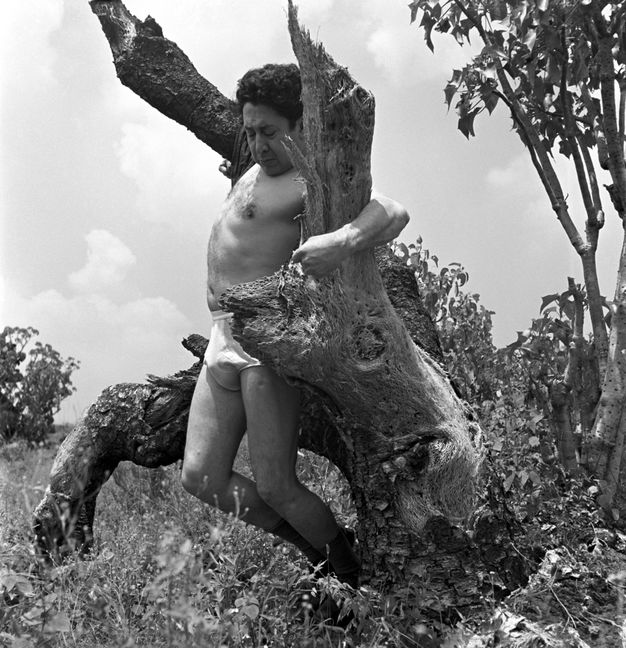
By this reckoning, photography allowed a salutary fusion of
form and content. A later example of Siqueiros’s photographic
sketching technique is demonstrated in the portraits of the
artist by Colombian photographer Leo Matiz (fig. 4), which provided the basis for the lithograph
Latin America (1945). In the same shoot, photographic
studies of the model Victor Arrevillaga naked, bound, and
hanging from a tree became source material for the background
figures in the mural
Patricios y patricidas
(Patriots and parricides; 1971). A decade after
América tropical, Siqueiros was still integrating the camera into his
artistic process even as he continued to grapple with echoing
images of crucifixion.
Siqueiros’s arrival in Los Angeles opened new technical
possibilities through the proximity to Hollywood, and he
eagerly availed himself of any and all photographic and
cinematic equipment that his Los Angeles students could
procure. The execution of his first L.A. mural at the
Chouinard School of Art, Street Meeting (1932),
incorporated acute perspectives enabled by the camera, and its
production was hastened by projecting sketches onto the wall
rather than manually drawing out the whole design at scale. To
realize Street Meeting and
América tropical, Siqueiros
assembled a crew of artists, some of whom were studying at the
Chouinard School, that he designated the “Block of Mural
Painters.”22
Although there is scant evidence as to whether Siqueiros and
his team projected the crucified figure for
América tropical like they did
for Street Meeting, he did work with a photographer
to explore the layout of the supporting wall for it.23
In addition to being compositional tools, photographic and
cinematic technologies served as time-saving devices. The
technologies allowed the artist and his collaborators to
bypass the cartoon and pouncing processes for
Street Meeting, speeding up the mural’s creation by
greatly enhancing productivity in contrast to the more
time-consuming and labor-intensive buon fresco technique. As a
result of these advancements, Siqueiros boldly claimed that it
would take only two weeks to complete
América tropical, which turned
out to be overly ambitious. While the process ultimately
continued for just over a month, considerable time was saved.
Scholars often discuss Siqueiros’s innovative use of
photography and perspective and the anticipation of mobile
viewership in his work.24
Invigorated by his exchanges with Eisenstein, which centered
on their shared ambitions for a dialectical approach to
artmaking, Siqueiros began to articulate these ideas in words
and in pictures.25
During his short tenure in Los Angeles from April to December
1932, in political exile from Mexico, he wrote of his desire
to chart a new path for muralism away from what he now deemed
its failures of the 1920s: “It is not possible to produce
revolutionary music, psychologically subversive, with the
organ from a church.”26
In other words, it was no longer enough for muralists to
depict the concerns of the proletariat in the archaic medium
of buon fresco. Production techniques had to be revolutionized
accordingly. A comparison between Street Meeting with
his contemporary Diego Rivera’s mural from 1931,
The Making of a Fresco Showing the Building of a City
at the California School of Fine Arts in San Francisco,
exemplifies how the two painters’ approaches began to diverge.
Using trompe l’oeil in the fresco, Rivera draws back the
curtain on the labor involved in the painting process, showing
the artist himself from behind with his legs dangling from a
scaffold, surrounded by assistants laying plaster and
otherwise occupied with the mural.
Street Meeting also depicts workers perched on a
scaffold illusionistically, but rather than simply
representing a collaborative artistic process while employing
the traditional buon fresco technique as Rivera did,
Siqueiros’s incorporation of nontraditional tools such as
cameras, projectors, cement guns, air brushes, and blow
torches demonstrated an interest in revolutionizing the
production of art itself—not only changing its content.
Rebecca Zamora highlights the allure of the Olvera Street
location to Siqueiros.27
Both she and Montgomery point out that aside from the adjacent
rooftop, clear sightlines to the entire mural at once were
only possible from the heights of the nearby civic buildings,
including City Hall.28
The appeal of these observations rests not only on how easy it
is to picture Siqueiros thumbing his nose at such bastions of
civic authority but also on the idea that an artist would
naturally focus on the vantage points from which viewers could
see the entire mural. Several factors suggest that Siqueiros
was more keenly attuned to how most people would actually
experience this mural, which was to be partially hidden on the
second story of the Plaza Art Center. Goldman mentions how
Siqueiros envisioned an active, mobile spectator in contrast
to the stationary, monocular perspective that emerged in the
Renaissance. By definition, this concept of viewership
dispenses with the notion of a single, correct vantage point
from which to behold the entire mural. Indeed, the artist
himself recalled how one of his collaborators on
América tropical followed
their colleagues “relentlessly with his machine [photographic
camera] . . . tracing the movement of the spectator of the
work, photographing [the] wall from every angle.”29
In “Vehicles of Dialectic, Subversive Painting,” Siqueiros
adds that preparatory sketches can be “transformed in
accordance with the requirements of the visual perspective,
which must be satisfied through the direct attack on the wall,
depending upon the different standpoints provided by the
topography of the corresponding architecture.”30
Considerations of where and how a viewer might behold
América tropical were top of mind for Siqueiros and
his team, who were moved to incorporate a proliferation of
angles and perspectives.
The importance of alternative viewpoints is also emphasized by
both formal and thematic cues within the mural itself. Despite
the defiant creative energy Siqueiros evinced, his social and
political outlook was anything but triumphant at this
juncture, as his final mural in L.A. would testify.
Portrait of Mexico Today (1932), commissioned for a
private residence in the Pacific Palisades, depicted the
country’s presiding
Jefe Máximo, Plutarco Elías
Calles, as a bandit who hoarded bags of money (fig. 5). Combined with Siqueiros’s meditations on murder and
destitution in both surviving L.A. murals, a profound sense of
a revolution on its back foot emerges. In
América tropical and
Portrait of Mexico Today, only lone soldiers—not
armies—remain to carry on the revolution’s liberatory promise.
Scholars do not exactly agree about the identity of the
rifle-toting sniper who kneels beside the campesino with the
broad-brimmed hat in the upper-right corner of
América tropical. Montgomery argues that this figure
resembles depictions of the fifteenth-century Tetzcocan ruler
Nezahualcoyotl in the Codex Ixtlilxochitl.31
Zamora and art historian Raquel Tibol, however, identify the
figure as Peruvian, and I am inclined to agree, given the
distinctive chullo hat that he shares with the revolutionary
in Portrait of Mexico Today, whose headgear is
emblazoned with a red star.32
Art historian Laurance P. Hurlburt reproduces a preparatory
drawing by Siqueiros in the book
The Mexican Muralists in the United States (1989) in
which the chullo is emphasized with polka dots, its wearer
cocking a rifle.33
As Zamora points out, these figures are particularly
interesting because they were the first to be whitewashed.34
The censorship of
América tropical was not
immediate but took place gradually, over a period of six
years. In March 1934, Arthur Millier, the art critic for the
Los Angeles Times, reported that fifteen feet of the
mural’s right side—precisely the part visible to pedestrians
walking down Olvera Street—had been whitewashed (fig. 6).35
The rest of the mural would be obscured sometime before 1938.
This suggests that the most disturbing aspect for its eventual
censors were, rather than the crucified figure, which never
would have been visible to most of the mural’s viewers, the
revolutionary gunmen.
ExpandFig. 6. —View of the partly whitewashed mural
América tropical on a
second-story exterior wall from outside Casa La
Golondrina Cafe on Olvera Street, Los Angeles, ca.
1933,
black-and-white nitrate negative. UCLA Library Digital
Collections, Los Angeles Times Photographic Collection,
uclamss_1429_2667, licensed under
CC BY 4.0.
In 1933, after Siqueiros’s deportation from the United States,
his former pupils Reuben Kadish, Harold Lehman, and Philip
Guston (then Goldstein) mailed him a photograph of a portable
cement mural that they had painted in support of the
Scottsboro Boys, nine Black teenagers falsely accused of
raping two white women in Alabama in 1931 and sentenced to
death.36
They quoted the opening lines from TheCommunist Manifesto (1848) by Karl Marx and Friedrich
Engels: “A specter is haunting Europe—the specter of
communism.”37
I would argue that the revolutionary specter summoned by
América tropical was not of
European provenance but instead emblematized a radical
pan-American political consciousness, of which Mariátegui was
a key proponent.
Zamora and Goldman allude to how the military takeover of Peru
in 1930 crushed the hopes for political change and economic
reform that had been spurred by the anti-imperialist
ideologies of Peruvian philosopher and politician Victor Raul
Haya de la Torre and the writings of Mariátegui.38
The latter, who died in 1930, ran the influential magazine
Amauta, which sold around three to four thousand
copies per issue and circulated widely in avant-garde circles
throughout Latin America.39
While Mariátegui’s relationships with Rivera and other Mexican
avant-gardists have been examined separately by Craven and
Flores, his connection with Siqueiros deserves closer
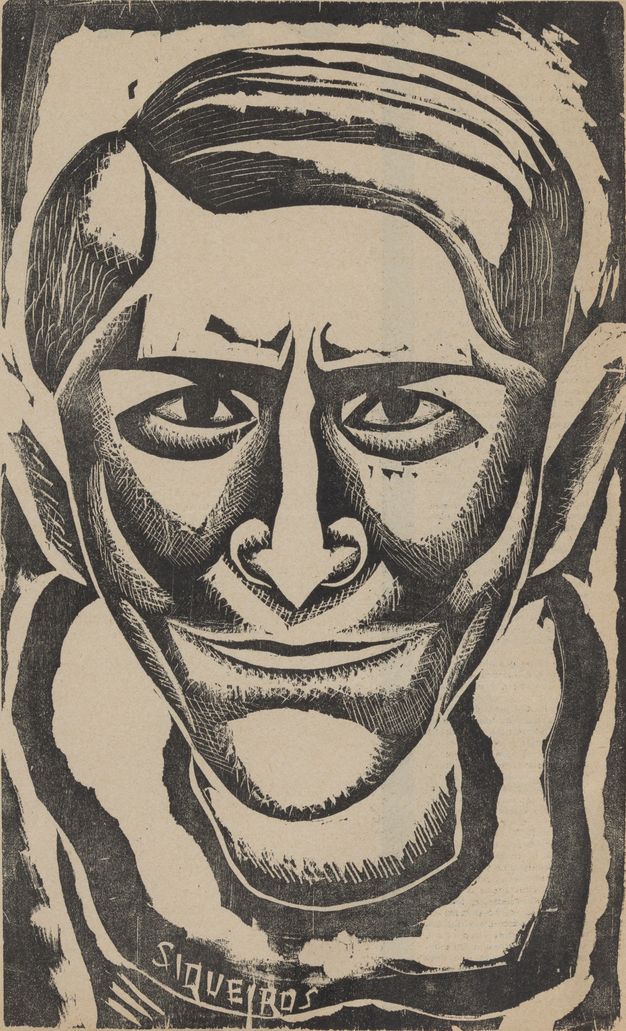
attention. In April 1932, the month he arrived in L.A.,
Siqueiros made a woodcut of Mariátegui that ran alongside a
memorial tribute to the Peruvian thinker in
Grito magazine (fig. 7). Amauta also published the
work of Uruguayan poet Blanca Luz Brum, who was married to
Siqueiros at the time of his travels to L.A. The couple
addressed Mariátegui as
“querido camarada” (dear comrade) in
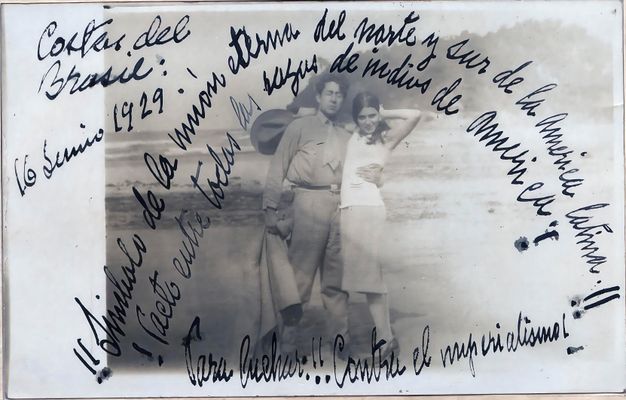
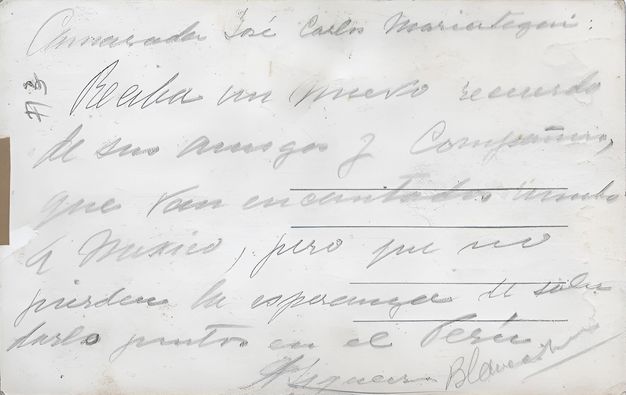
their correspondence with him. On a photograph mailed to
Mariátegui that shows Siqueiros and Brum embracing on a beach
in Brazil, dated 16 June 1929, a cheeky caption is scrawled in
Siqueiros’s distinctive hand: “Symbol of the eternal union of
the north and south of Latin America!! Pact between all races
of American Indians! To fight!! Against imperialism!” (figs. 8a, 8b). The reference
to a union between north and south surely refers to the couple
themselves, but it carries an additional significance in
relation to Mariátegui’s synthesis of Marxism and
Indigenismo.
In a handwritten document of fragmented text (composed
sometime after Mariátegui’s death in 1930) that is among the
David Alfaro Siqueiros Papers at the Getty Research Institute,
the artist rehearses, in halting prose, a critique of
Mariátegui’s thought. Siqueiros derides Mariátegui’s
“overestimation of the ethnological factor [presumably a
reference to the so-called problem of the Indian], which leads
him straight to liberal and reformist conclusions.”40
At the same time, he laments Mariátegui’s premature death.
“Had he lived to this day,” Siqueiros notes, “he would have
been the first to modify his entire premonition.”41
Multiple times, Siqueiros refers to Mariátegui’s “magnificent
accumulation of data” within his book
7 ensayos de interpretación de la realidad peruana
(1928;
Seven Interpretive Essays on Peruvian Reality, 1971),
yet criticizes the book as “seriously damaged by undoubted
residues of that literary sociology or rhetoric peculiar to
contemporary left-liberal writers.”42
This sentiment resonates with the Stalinist denunciation of
Mariátegui as a populist and a purveyor of “nationalist
romanticism” expressed by Soviet adviser to the Latin American
Bureau of the Comintern V. M. Miroshevsky in 1941.43
The muralist’s reservations about the theories of his late
Peruvian comrade are clear, although he is quick to extend a
certain generosity to Mariátegui by indicating the promise of
his social analysis. If, as Siqueiros asserts on the opening
page of his text, “Mariátegui’s native [sic] and
Americanism marks the romantic, initial stage of the emergence
of Marxist ideology in Latin America,” then Siqueiros regrets
that the Peruvian visionary’s death permanently deferred his
development of that ideology.44
This state of deferred potential echoes through Siqueiros’s
work in Los Angeles. Expelled from Mexico, where he had fought
during the revolution, Siqueiros’s defiance was tempered in
his Californian murals. Per the Plaza Art Center mural’s full
title, for all the shock the crucified laborer elicited, the
individual’s fate truly does seem to be the result of a total
“oppression and destruction.” He hangs from the cross almost
completely alone, while the ruins all around him are overrun
by the voracious roots and vines of the jungle. At this moment
of defeat, with the precarious political situation in Mexico
and Peru, it is significant that the figures that Siqueiros
chose to bear the revolutionary flame should be a Mexican and
Peruvian working together. Siqueiros looked for a way through
the current political impasse by routing the Indigenista
impulse in this painting through the hypermodern production
techniques and formal innovations afforded by the camera. In
doing so, he channeled the thinking of Mariátegui. In his 1928
essay, “El problema del indio” (“The
Problem of the Indian”), Mariátegui discusses the
pre-Columbian economic formation of “Incan communism,”
rejecting the idea that socialism is an inherently European
idea somehow alien to American realities:
Faith in the renaissance of the Indian is not pinned to the
material process of “Westernizing” the Quechua country. The
soul of the Indian is not raised by the white man’s
civilization or alphabet but by the myth, the idea, of the
socialist revolution. The hope of the Indian is absolutely
revolutionary. . . . Why should the Inca people, who
constructed the most highly developed and harmonious
communistic system, be the only ones unmoved by this
worldwide emotion? The consanguinity of the Indian movement
with world revolutionary currents is too evident to need
documentation.45
Despite Siqueiros’s disparagement of his comrade’s emphasis on
“the ethnological factor,”
América tropical demonstrates
the artist’s own drive to stoke an interhemispheric
revolutionary solidarity within which the “problem of the
Indian” is thoroughly enmeshed. While Mariátegui may have
sought a historical precedent, however, Siqueiros is careful
to distance
América tropical from any
pre-Columbian moment. Even as his mise-en-scène incorporates
ancient architecture, the jungle vines threaten to engulf and
drag its structures into the past. The plight of the
Indigenous laborer and the insurgents sitting vigil on their
perch thus exists in a suspended, anticipatory moment amid the
ruins of colonial history. If he acknowledges that the problem
of the Indian emerges historically, then Siqueiros is at pains
to highlight the urgency of action in the present. Another
typewritten document among the Siqueiros Papers, titled simply
“America Tropical,” ruminates on the
mural’s evocation of overlapping temporalities:
It is the violent symbol of the Indian peon of feudal
America doubly crucified by the native exploiting classes
and by imperialism, in turn, oppressing them.
It is the living symbol of the destruction of past American
national cultures by the invaders of yesterday and today.
It is the preparatory action of the proletarian revolution
that takes the stage and is already “cocking the trigger” to
effectively launch itself into the transformative battle and
the construction of a new social order.46
The collision of past and present depicted in the mural
directly contradicted the sanitized nostalgia that Olvera
Street’s renovation was intended to orchestrate. For the
mural’s censors, it was probably worrisome enough that the
campesino and his Peruvian comrade were armed and ready to
fight. Sterling’s Olvera Street project depended on scrubbing
the old city center of the reputation it had gained as a
gathering place and organizing site for the working class.47
If there was one thing less acceptable to the prescribed
amnesia of El Paseo de Los Angeles than a reminder of
genocide, it was the prospect of downtrodden Indigenous people
raising arms. While the image of defeat exemplified by the
crucifixion played a role in commemorating a history that some
were resolutely trying to forget, Siqueiros’s choice to
situate the snipers where he did suggests a cunning
propagandist’s understanding that images of terror and
injustice may help to agitate, but that recruitment to a cause
requires empowerment and inspiration. The decision to
whitewash this section almost immediately indicates that
Siqueiros’s strategic manipulation of perspectival
possibilities in his first completely outdoor commission, and
its urgent depiction of interhemispheric solidarity, was not
welcomed by the censors, who hastened to remove it from sight.
Jonah Gray is a faculty fellow at the New
York University Program in Museum Studies.
Notes
This research began in 2023 at the Getty Consortium Seminar
with Owen Doonan at the Getty Research Institute. I am
grateful for conversations with colleagues in that seminar,
particularly Emma Laube and Leandro Martínez Depietri in our
carpool back and forth from San Diego. Getty staff were
extremely supportive during the seminar and on successive
trips to special collections. Many thanks to the two anonymous
reviewers for their guidance, and to Lauren Gendler for her
patience and assistance with securing images, and sharp
copyediting. Thank you also to Fabiola Carranza for input on
the translations of Spanish-language material from the
Siqueiros Papers. Unless otherwise noted, translations are by
the author with assistance by Carranza.
Shifra M. Goldman emphasizes the crucified figure and
cites a similar reading by Jean Charlot in Goldman,
“Siqueiros and Three Early Murals in Los Angeles,”
Art Journal 33, no. 4 (1974): 324. S. Janelle
Montgomery also discusses the figure at length in
“‘Oppressed and Destroyed’: David Alfaro Siqueiros’s
América Tropical and
1932 Los Angeles,”
Pacific Historical Review 89, no. 4 (2020):
549. For a brief introduction to the mural’s story, see
Jaime Roque, host, Recurrent, podcast, season
1, episode 2,
“América Tropical: Art,
Activism, and Los Angeles’s Hidden Story,” produced by
Jaime Roque, Getty, 15 May 2024,
https://www.getty.edu/podcasts/recurrent/america-tropical-art-activism-and-los-angeles-hidden-story/. ↩︎
Los Angeles Times art critic Arthur Millier is
quoted in a personal letter saying, “At 1:00 A.M. that
night in a dead Olvera Street I found Siqueiros sweating
in an undershirt in the cold air, sitting on a scaffold,
painting for dear life the peon bound to a double
cross.” Millier, letter to Jack Jones, May 1970, quoted
in Goldman, “Siqueiros and Three Early Murals in Los
Angeles,” 324.
↩︎
Arthur Millier, “Power Unadorned Marks Olvera Street
Fresco,” Los Angeles Times, 16 October 1932.
↩︎
Arthur Millier, “Art Sheds ‘White Scaffold on Collar’:
Huge Fresco for El Paseo,” Los Angeles Times,
24 August 1932.
↩︎
My argument builds on an excellent observation by
Rebecca Zamora about how the mural was whitewashed in
stages, starting with the area featuring these figures,
in Rebecca Zamora, “Shifra Goldman and David Alfaro
Siqueiros’s
América Tropical,” Getty Research Journal, no. 6 (2014): 120.
↩︎
See Raquel Tibol,
Episodios fotográficos
(Libros de Proceso, 1989); Mari Carmen Ramírez,
“Las masas son la matriz: Teoría y práctica de la
plástica del movimiento en Siqueiros,”
in
Retrato de una decada: 1930–1940,
exh. cat. (Instituto Nacional de Bellas Artes, 1996),
68–95; Olivier Debroise, “The Vertical Screen,” in
Inverted Utopias: Avant-Garde Art in Latin
America, ed. Mari Carmen Ramirez and Hector Olea (Yale
University Press, 2004), 239–45; Juan Carlos Arias
Herrera, “From the Screen to the Wall: Siqueiros and
Eisenstein in Mexico,”
Mexican Studies/Estudios Mexicanos
30, no. 2 (2014): 421–45; Sergio Delgado Moya,
Delirious Consumption: Aesthetics and Consumer
Capitalism in Mexico and Brazil
(University of Texas Press, 2017); and Jennifer Jolly,
“Aesthetics of Conflict: Perspective and Anamorphosis in
Siqueiros’s Art of the 1930s,”
The Art Bulletin 103, no. 1 (2021): 111–39.
↩︎
David Craven, “Postcolonial Modernism in the Work of
Diego Rivera and José Carlos Mariátegui, or New Light on
a Neglected Relationship,” Third Text 15, no.
54 (2001): 3–16; Tatiana Flores, “Dialogues Along a
North-South Axis: Avant-Gardists in 1920s Mexico and
Peru,” Third Text 28, no. 3 (2014): 297–310;
and Tatiana Flores, “Art, Revolution, and Indigenous
Subjects,” in
The Routledge History of Latin American Culture,
ed. Carlos Manuel Salomon (Routledge, 2018).
↩︎
“Bringing Back Our Yesterdays,”
Southern California Business, August 1929, 16.
↩︎
See Mike Davis, “Sunshine or Noir?,” chap. one
in
City of Quartz: Excavating the Future in Los
Angeles
(Verso, 2006).
↩︎
Sarah Schrank, “Public Art at the Global Crossroads: The
Politics of Place in 1930s Los Angeles,”
Journal of Social History 44, no. 2 (2010):
435–57.
↩︎
Christine Sterling,
Olvera Street: Its History and Restoration
(Adobe Studios, 1933), 20, quoted in Montgomery,
“‘Oppressed and Destroyed,’” 542.
↩︎
See Flores, “Dialogues Along a North-South Axis,” on the
contexts for Indigenismo in Mexico and Peru.
↩︎
David Alfaro Siqueiros,
“America Tropical,” ca. 1932,
typewritten manuscript in Spanish, Los Angeles, Getty
Research Institute (GRI), David Alfaro Siqueiros Papers,
1920–1991, 960094, box 3, folder 20.
↩︎
On matters of religion, in particular, Indigenista
imagery in the work of Mexican muralists was not always
welcomed by their audiences. In 1936, an anticlerical
mural by the Alianza de Trabajadores de las Artes
Plásticas (Alliance of Visual Arts Workers) at a
secondary school in Portales angered working-class
parents, while teachers in Oaxaca complained about an
Indigenista rendition of a Virgen
del Perpetuo Socorro at a school in Tezoatlán. See Robin
Adèle Greeley, “Muralism and the State in
Post-Revolution Mexico, 1920–1970,” in
Mexican Muralism: A Critical History, ed.
Alejandro Anreus, Robin Adèle Greeley, and Leonard
Folgarait (University of California Press, 2012), 26.
↩︎
Tomás Zurián and Adriana Malvido,
“Siqueiros: Hallazgo Iconográfico de América
Tropical,” La Jornada,
13 September 1997, 25–26.
↩︎
Laura González, “Siqueiros and Photography: From the
Source to the Optic Device,” in
Siqueiros: Landscape Painter, by Esther Acevedo
et al. (Editorial RM, 2010), 66.
↩︎
In addition to the artist and filmmaker’s exchanges
about photography and cinema, González speculates about
the potential influence of Eisenstein’s drawings from
his time in Mexico, which include a crucifixion scene on
a similar cross with upper and lower cross members.
González, “Siqueiros and Photography,” 69.
↩︎
Goldman, “Siqueiros and Three Early Murals in Los
Angeles,” 325
↩︎
David Alfaro Siqueiros, “The Vehicles of Dialectic,
Subversive Painting: Experience of the Block Painters
(Los Angeles Section),” 12, Los Angeles, 1932,
typewritten manuscript (in English), GRI, Siqueiros
Papers, box 2, folder 32.
↩︎
Siqueiros, “The Vehicles of Dialectic, Subversive
Painting,” 12.
↩︎
Siqueiros, “The Vehicles of Dialectic, Subversive
Painting,” 1. Siqueiros’s collaborators are listed as
Maria Andrade, Luis Arenal, Jacob Assanger, Peter
Ballbusch, Dean Cornwell, Karoly Fulop, Dorothy Groton,
James Hyde, Wiard Boppo Ihnen, Harold H. Jones, John
Kehoe, Richard Kollorsz, Martin Obzina, Sanford Pollock,
Tony Revels, Frederick Schwankowsky, Jean Stewart, Ivan
Stoppe, Jeannette Summers, Wolo von Trutzschler, and
John Weiskal in Millier, “Art Sheds ‘White Scaffold on
Collar,’”15.
↩︎
This quotation, which does not appear in the English
version (see this essay, note 20),
is from a different, Spanish-language version of
Siqueiros’s typescript speech for the John Reed Club,
Los Angeles: David Alfaro Siqueiros,
“Los vehículos de la pintura
dialéctica-subversiva,”
1932,
Sala de Arte Público Siqueiros,
folio 9.1.15.272, quoted in English translation in Anna
Indych-López, “Celluloid América:
Siqueiros, Hollywood, and
Plástica Fílmica,” in
Vida Americana:Mexican Muralists Remake American Art, 1925–1945, exh. cat., ed. Barbara Haskell (Whitney Museum of
American Art, 2020), 190. Indych-López notes that
various versions of the speech for the John Reed Club by
Siqueiros are held in the Sala de Arte Público Siqueiros
(SAPS) in Mexico City, many of which are analyzed in
Delgado Moya, Delirious Consumption, 44–57.
Indych-López, “Celluloid América,” 195n4.
↩︎
Siqueiros, The Vehicles of Dialectic, Subversive
Painting,” 11. Emphasis mine.
↩︎
Montgomery, “‘Oppressed and Destroyed,’” 550. The
portrait of Nezahualcoyotl to which Montgomery refers
can be found on folio 106r in Fernando de Alva
Ixtlilxochitl, Codex Ixtlilxochitl, Paris,
Bibliothèque Nationale de France, Département des
Manuscrits, Mexicain 65–71, n.d.
↩︎
Zamora, “Shifra Goldman and David Alfaro Siqueiros’s
América Tropical,” 119;
and Raquel Tibol,
Siqueiros: Introductor de realidades
(Universidad Nacional Autónoma de México, 1961).
↩︎
David Alfaro Siqueiros, The Warriors, study for
Tropical America, n.d., pencil-and-ink drawing,
San Francisco Museum of Modern Art, from Laurance P.
Hurlburt,
The Mexican Muralists in the United States
(University of New Mexico Press, 1989), 210, fig. 203.
↩︎
Zamora, “Shifra Goldman and David Alfaro Siqueiros’s
América Tropical,” 120.
↩︎
Arthur Millier, “Brush Strokes,”
Los Angeles Times, 18 March 1934, A8. The UCLA
Library Digital Collections erroneously date the image
in this essay, figure 6, to 1930.
↩︎
Barbara Haskell, “América:
Mexican Muralism and Art in the United States,
1925–1945,” in Haskell,
Vida Americana, 25.
↩︎
Zamora, “Shifra Goldman and David Alfaro Siqueiros’s
América Tropical,” 120
↩︎
See Beverly Adams and Natalia Majluf, eds.,
The Avant-Garde Networks ofAmauta: Argentina, Mexico, and Peru in the 1920s
(Asociación Museo de Arte de Lima–MALI; Blanton Museum
of Art, 2019).
↩︎
David Alfaro Siqueiros,
“Critica a Mariátegui,” 1, Los
Angeles, n.d., GRI, Siqueiros Papers, box 5, folder 5.
↩︎
V. M. Miroshevsky,
“El ‘populismo’ en el Perú. Papel de Mariátegui en la
historia del pensamiento social
latino-americano,”
in
Mariátegui y los orígines del Marxismo
Latinoamericano, ed. José Aricó (Cuadernos de Pasado y Presente,
1978), 55–70.
↩︎
José Carlos Mariátegui, “The Problem of the Indian,” in
Seven Interpretive Essays on Peruvian Reality,
trans. Marjory Urquidi (University of Texas Press,
1971), 66.
↩︎