This essay discusses the bronze zodiac animal head
sculptures from the Yuanmingyuan (Garden of Perfect
Brightness), which was looted and burned during the Second
Opium War in 1860. Asking why these particular objects
have gained international attention in repatriation
debates, I argue that the zodiac sculptures garner their
capacity for meaning in their forms as fragmented bodies,
particularly as decapitated heads. I turn to the
afterlives of the zodiac heads as sculptural
reproductions, in which contemporary artists such as Ai
Weiwei have copied the heads and transformed them for new
audiences. Because the artistic reproductions are not
exact copies, I argue that they should be considered acts
of translation that move the conversation about cultural
heritage into site-specific contexts and give voice to
questions about heritage, identity, traditions, and global
justice. The resulting artistic translations can elevate
the originals, satirize them, challenge them, and even
take on their own lives.
Keywords
Yuanmingyuan, zodiac animals, looted Chinese art, copies,
cultural heritage, Ai Weiwei, Taiwan
Copied page section link to clipboard
Peer Review
Double anonymous, external
Copied page section link to clipboard
Cite
Chicago
Patricia J. Yu, “Fragmented Bodies, Substitute Bodies:
Zodiac Heads from the Garden of Perfect Brightness and the
Translation of Cultural Heritage,”
Getty Research Journal, no. 21 (2026),
https://doi.org/10.59491/EIWD4479.
MLA
Yu, Patricia J. “Fragmented Bodies, Substitute Bodies:
Zodiac Heads from the Garden of Perfect Brightness and the
Translation of Cultural Heritage.”
Getty Research Journal, no. 21, 2026,
https://doi.org/10.59491/EIWD4479.
On 28 December 2015, the National Palace Museum in Taiwan
celebrated the opening of its Southern Branch in Chiayi.
During the opening ceremony, Taiwan President Ma Ying-jeou and
Hong Kong superstar Jackie Chan unveiled the movie star’s
donation to the museum: bronze heads of twelve zodiac animals,
each installed atop its own rectangular concrete pillar in the
museum’s central courtyard. Two days later, a pair of
Taiwanese student activists upended cans of red paint over the
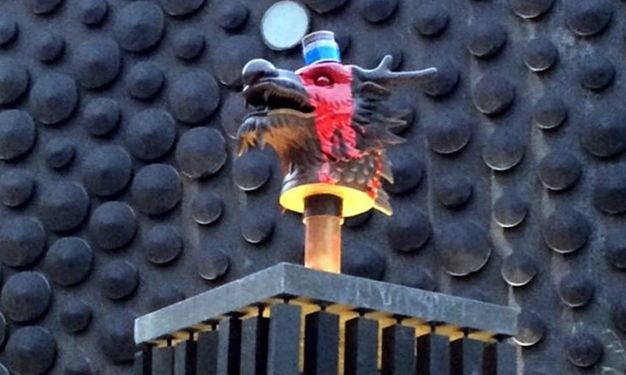
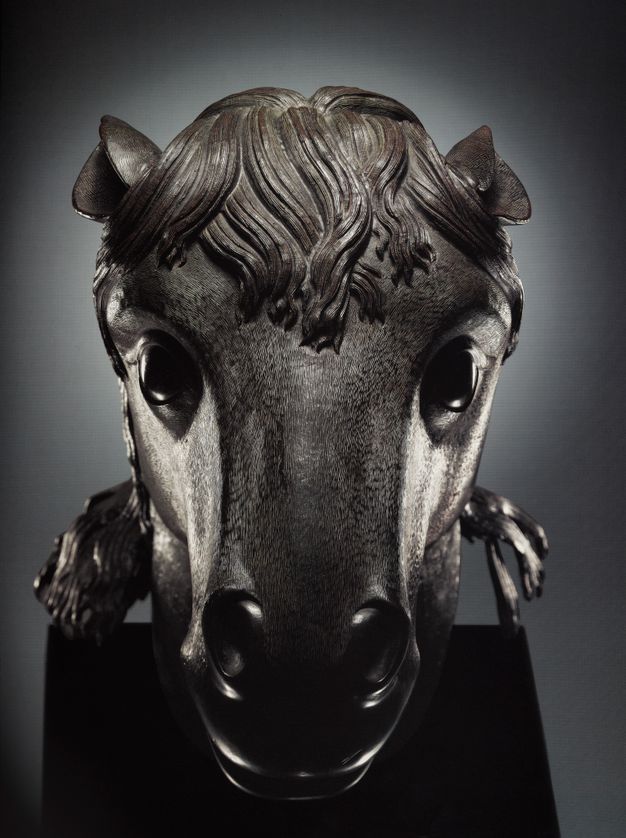
heads of the Dragon and the Horse (fig. 1). Then they spray-painted the words “cultural united front”
(wenhua tongzhan文化統戰)
over the concrete pedestals, transforming the sculptural
installation into steles of protest. They posted the
photographic evidence of their vandalism to social media; the
publicly accessible post denounced the new museum’s supposed
abandonment of its founding principles and condemned its
complicity in the marginalization and subordination of native
Taiwanese culture to the cultural imperialism of mainland
China.1
ExpandFig. 1. —Vandalized bronze head of the Dragon produced and
donated by Jackie Chan, installed in the central
courtyard of the Southern Branch of the National Palace
Museum, Chiayi, Taiwan, 2015.
Photographer unknown.
These seemingly innocuous animal sculptures may appear to be
an odd target for a protest against warming cross-strait
relations. The sculptures, however, were not simply generic
zodiac animals; they were directly based on the bronze zodiac
heads from the Yuanmingyuan
圓明園 (Garden of Perfect Clarity, or
Garden of Perfect Brightness), an imperial garden of the Qing
dynasty (1644–1912) near Beijing that was looted and burned in
1860 by British and French forces during the Second Opium War
(1856–60). The act of vandalism against its copies in the
central courtyard of the Southern Branch of the National
Palace Museum in Taiwan is but one development in the long
biography of the Yuanmingyuan zodiac heads and their
afterlives.
This essay will situate the heads within the history of the
Yuanmingyuan, trace their reappearance on the auction market,
and address the negotiation of their value as Chinese cultural
heritage in contemporary cultural heritage discourse. It will
ask the question: Of all the objects taken from the
Yuanmingyuan, why has this particular set of zodiac heads
become the most potent representative of looted Chinese
cultural heritage, inspiring fervent calls for repatriation? I
argue that it is in their sculptural forms as fragmented
bodies, specifically as decapitated heads, that they serve as
substitute bodies that continuously revive the trauma of
national humiliation in national memory. The saga of the
zodiac heads does not end with their repatriation but
continues through their multivalent sculptural reproductions,
in which contemporary makers, including Ai Weiwei have given
the heads new physical form and revived them for new
audiences. Because these reproductions are not exact copies, I
argue that these acts of artistic reproduction can be
considered acts of translation. As “translations,” the new
heads move the conversation about cultural heritage into
site-specific contexts and give voice to questions about
heritage, identity, tradition, and global justice. These acts
of translation can elevate the originals, satirize them,
challenge them, and take on their own lives.
Looting and Vandalism at the Yuanmingyuan
Located about five kilometers northwest from the Forbidden
City, the Yuanmingyuan occupies about 3.4 square kilometers
and measures a rough rectangle of about 2,415 meters by 1,890
meters.2
Most of its grounds follow Chinese principles of garden
design, featuring pavilions set alongside winding brooks and
connected by zigzagging paths and bridges. In a letter to a
friend in France, Jesuit missionary Jean-Denis Attiret
(1702–68) celebrated the garden’s grandeur and beauty and its
cultivated resemblance to nature.3
At the same time as European aristocrats delighted in what the
French termed
les jardins anglo-chinois
(Anglo-Chinese gardens), the polyglot Qianlong emperor
(1711–99, r. 1735–96) also indulged in
“Européennerie” and ordered the court
Jesuits, Giuseppe Castiglione (1688–1766) and Michel Benoist
(1715–74) to construct the European Pavilions (Xiyanglou西洋樓).4
From 1747 to 1783, a series of Sino-Baroque pavilions with
white marble facades and tiled Chinese roofs were erected on a
750-meter-long strip in the northeast corner of the
garden.5
Although the site currently lies in ruins, the architectural
facades of the European Pavilions were translated into a set
of twenty copperplate engravings by Manchu court artist
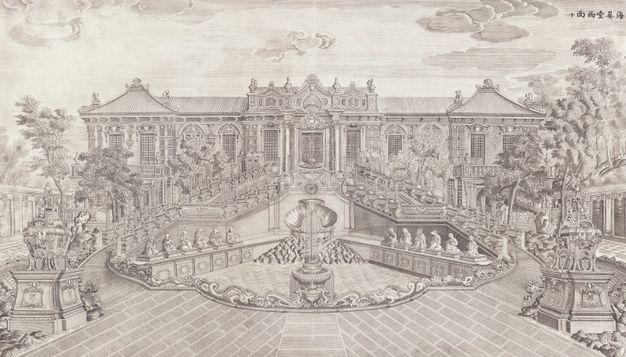
Yilantai (active 1749–86) in 1781. The bronze zodiac heads are
found in the tenth print, which depicts the western facade of
the Hall of Calm Seas (Haiyantang海晏堂) (fig. 2). Here, the animal heads still have berobed human bodies.
Arranged within a large fountain, the zoocephalic sculptures
were literally fountainheads: every two hours, a different
animal took its turn spouting a stream of water from its open
mouth; at noon, all the animals spouted together. The animals
that embodied the astronomical cycle of the years also served
to embody the cycle of the daily hours.
ExpandFig. 2. —Yilantai (Manchu, active 1749–86). West
facade of the Hall of Calm Seas, engraving, 50 × 87.5 cm.
From
The European Pavilions at the Garden of Perfect
Clarity,
portfolio of engravings, 1783–86. Los Angeles, Getty
Research Institute, 86-B26695.
In October 1860, in the closing days of the Second Opium War,
Anglo-French troops under the command of James Bruce, 8th Earl
of Elgin, occupied the Yuanmingyuan, which the Xianfeng
emperor had hastily abandoned days prior. The British and
French troops engaged in several days of looting and
destruction, culminating in Elgin’s order to set fire to the
entire complex. The destruction of a site long known as one of
artistic and cultural achievement was greeted with ambivalence
in Europe. French writer Victor Hugo, who was already invested
in the salvage of French cultural heritage and national
identity, lamented its destruction and elevated the
Yuanmingyuan into the company of the greatest monuments of
classical and medieval antiquity: “People spoke of the
Parthenon in Greece, the pyramids in Egypt, the Coliseum in
Rome, Notre-Dame in Paris, the Summer Palace in the
Orient. . . . This wonder has disappeared. One day two bandits
entered the Summer Palace. One plundered, the other
burned.”6
Hugo explicitly connected the looting of the Yuanmingyuan with
the earlier despoiling of the Parthenon by the elder Elgin:
“Mixed up in all this is the name of Elgin, which inevitably
calls to mind the Parthenon. What was done to the Parthenon
was done to the Summer Palace. . . . We Europeans are the
civilized ones, and for us, the Chinese are the barbarians.
This is what civilization has done to barbarism.”7
Although Hugo’s letter concludes with a call for repatriation,
it is likely that he also purchased Chinese silks looted from
the Yuanmingyuan for his Chinese rooms at Hauteville
House.8
In Elgin’s eyes, however, it was the Qing government that had
failed to abide by still-uncodified standards of wartime
conduct and treatment of captives. As the Anglo-French troops
neared Beijing, thirty-nine of their civilian negotiators and
soldiers had been seized after a negotiating session in
September. By the time they were returned, on 9 October, the
Anglo-French forces were already stationed at the
Yuanmingyuan. Of those captured, only eighteen came back
alive, and the living testified to the indignities of
starvation, beatings, and neglect during captivity.9
Elgin thus perceived that a “great crime” had been committed
and that the destruction of the Yuanmingyuan would be a
“solemn act of retribution.”10
General James Hope Grant justified Elgin’s decision in a
letter to their superiors: “First . . . the prisoners were
treated with such barbarity, being bound hand and foot
together for three days, with nothing to eat or drink; and
secondly, because the English nation will not be satisfied
unless more lasting marks of our sense of the barbarous manner
in which they have violated the laws of nations be inflicted
on the Chinese government.”11
To Elgin, the violations upon the bodies of his men were a
criminal act in need of retribution. In the absence of the
emperor, the Yuanmingyuan had to serve as a substitute. In a
letter to his wife on 27 October 1860, Sir Harry Parkes
explained to her that “considering that Yuen Ming Yuen was the
scene of the atrocities committed on our countrymen, I
consider that it was the proper one of the two [the other
being Beijing] to make a monumental ruin of.”12
Parkes’s biographer, Stanley Lane-Poole, offered further
commentary: “From an artistic point of view it was an act of
vandalism; from that of sound policy it was
statesmanlike.”13
In the decades that followed, the remains of the garden fell
into greater and greater disrepair. The wooden pavilions of
the garden’s Chinese side had been consumed in the flames; the
stone and brick of the European Pavilions, on the contrary,
remained partially standing. Chinese-language histories of the
Yuanmingyuan emphasize its ruins as a memorial to national
humiliation, as witness to a moment when imperialist forces
committed an act of hypocritical barbarism in the name of
civilization.14
It is within this discourse of national humiliation that the
historian Xiang Da describes the destruction of the
Yuanmingyuan as “vandalism” in his Chinese-language article in
Zhongguo yingzao xueshe huikan [Journal of the
Chinese Architecture Society] of 1931:
Destroyed by Western vandalism [xi yang fan da zhu yi西洋番達主義], this is a great loss
to Chinese culture, and it is the first of that which our
fellow countrymen must never forget. . . . Since the time of
Sino-Western encounter and exchange, Western vandalism has
brought disaster upon China [xi yang Vandalism
zhi wei huo yu Zhongguo /
西洋Vandalism之為禍於中國], of which this campaign was the first and greatest.15
Vandalism is not translated into Chinese but is
directly printed into the text in English and as a
transliteration, pointing to its origins as an imported
foreign concept. By using the English, Xiang Da constructs the
act itself as something foreign. By characterizing the
destruction of the Yuanmingyuan as vandalism, the
author implicitly harks back to the origins of the term in the
sacking of Rome by the Vandals, drawing historic parallels to
a centuries-old civilization whose decline was hastened by the
invasion of foreign barbarians.16
Where the term does appear in Chinese characters in the
article, it’s technically a transliteration, where it is put
into Chinese pronunciation: 番達fan da. But the transliteration can also be read as a
hidden play on words: the character for fan can mean
“foreigner,” and the character for da can mean “to
arrive,” and thus vandalism is defined as what
happens when foreigners arrive.
The author also calls out the international community for
inconsistent application of their own principles. He points
out, “When Germany invaded Belgium in 1914 and bombed the
Leuven Library, this act was condemned by all nations.”17
He compares the destruction of the Yuanmingyuan to the bombing
of the Leuven Library, and calls on “those adherents of
international law from Western civilized nations” to
acknowledge the parallels.18
Writing in 1931, the same year as the Athens Conference (First
International Congress of Architects and Technicians of
Historic Monuments) that called for the preservation of
historic sites, he was surely aware of the frustrating
contradiction in the rhetoric of historic preservation arising
decades too late for the Yuanmingyuan.
The interpretation of the significance of the Yuanmingyuan was
thus transformed from a private Qing imperial space to a
Chinese national site of the collective memory of national
humiliation. Proponents of its restoration argued for a new
identity as a site celebrating the genius of Chinese landscape
gardening and design.19
The revival of the Yuanmingyuan since the 1980s forms part of
a larger conversation about national memory of the past and
how that past should inform the direction of the future.
The zodiac heads are a key part of that conversation. Between
1860 and 2000, however, they have almost no history. In the
nineteenth century, the looted objects that garnered the most
attention in Europe were the items symbolic of Qing
sovereignty and military paraphernalia. An exhibition of
French loot in April 1861 at the Tuileries Palace featured the
ceremonial armor of the emperor flanked by ranks of spears and
halberds.20
The bronze animal heads, which appear neither Chinese nor
European, received no mention. Between 1860 and 1987, they
disappear. They don’t appear again until the late 1980s.
Heads on the Auction Blocks
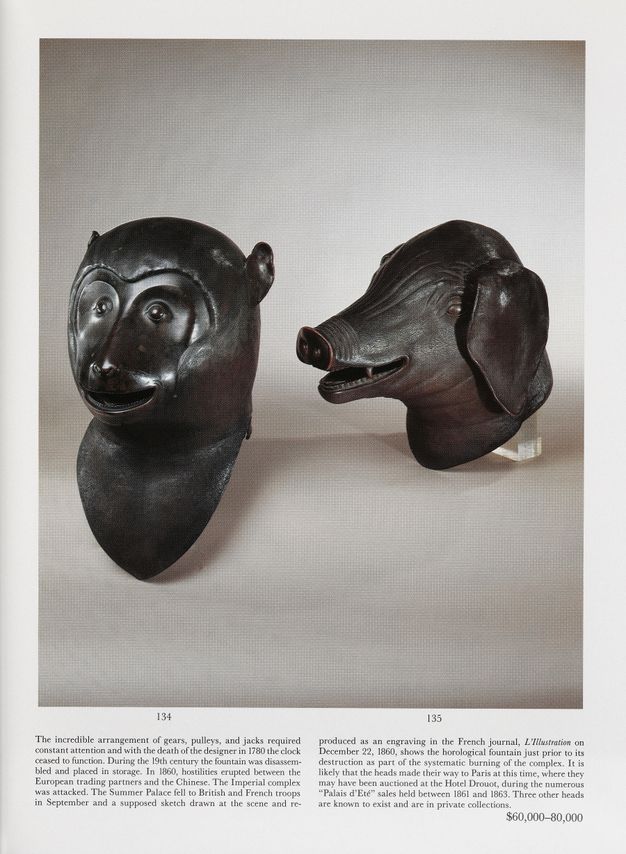
The first two heads to emerge from obscurity were the Monkey
and the Pig as lots 134 and 135 in Sotheby’s New York auction
of “Fine Chinese Decorative Works of Art” on 9 and 10 October
1987 (fig. 3). The Pig sold to a private US American collector for
US$104,500 and the Monkey sold for US$165,000 to Taiwanese
collector and dealer Cai Zhennan, the founder of the antique
dealership My Humble House (Hanshe寒舍) in Taipei, who was born in the
year of the monkey.21
ExpandFig. 3. —“Fine and Rare Bronze Head of a Monkey, circa 1750” and
“Fine and Rare Bronze Head of a Boar, circa 1750,” lots
134 and 135 in
Fine Chinese Decorative Works of Art, auction
cat., Sotheby’s New York, 9–10 October 1987.
Los Angeles, Getty Research Institute, 87-P18570.
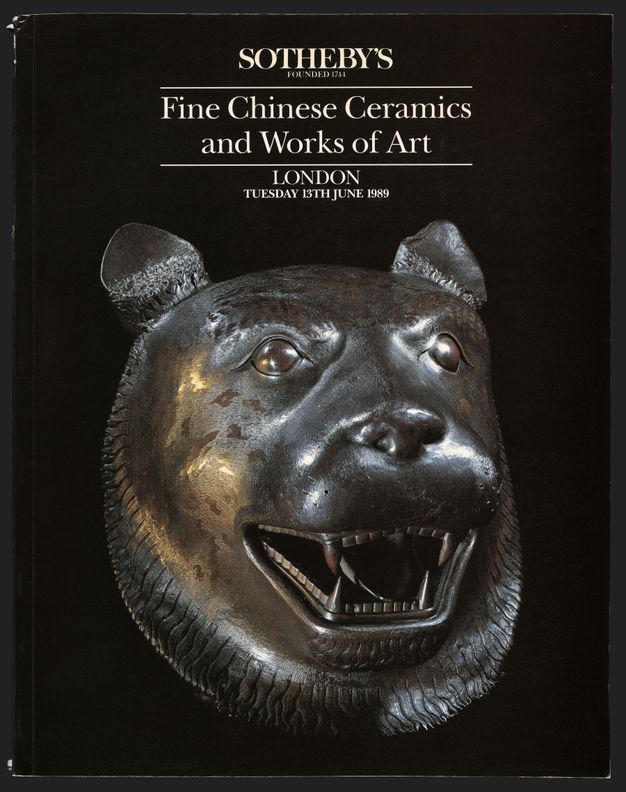
In June 1989, Sotheby’s London featured the head of the Tiger
on its catalog cover for the sale of “Fine Chinese Ceramics
and Works of Art” (fig. 4). The auction also included the heads of the Ox and Horse,
and My Humble House acquired all three: the Ox for £148,500
(US$240,570), the Tiger for £137,500 (US$222,750), and the
Horse for £181,500 (US$294,030).22
At this point, four heads were in a Taiwanese collection. My
Humble House would make one hundred full-scale replicas of the
Monkey head in bronze to sell as collectors’ items.23
It does not appear that the dealer made replicas of the other
heads in his possession, and he soon put the Tiger back up for
auction at Christie’s Swire in Hong Kong in October 1991; it
sold for US$429,000.24
ExpandFig. 4. —Cover of the auction catalog for
Fine Chinese Ceramics and Works of Art,
Sotheby’s London, 13 June 1989, featuring lot 68, “An
Important Bronze Zodiac Tiger’s Head, Qianlong.”
Los Angeles, Getty Research Institute, 89-P5233.
In the spring of 2000, the Monkey, Ox, and Tiger returned to
the auction block in back-to-back sales by Christie’s and
Sotheby’s Hong Kong.25
The sales from 1987 to 1991 had proceeded quietly, but in Hong
Kong in 2000 the Chinese government and pro-Beijing groups
lobbied to have the sales halted. Protestors stormed the
Sotheby’s salesroom at the Island Shangri-La Hotel, ironically
located by the hotel restaurant named the “Summer Palace.”26
Rather than resorting to legal action, the Chinese state
recovered the three heads (Monkey, Ox, Tiger) by delegating
the Poly Art Group—a spin-off of the People’s Liberation
Army—to win them back at auction. Exceeding all estimates, the
Poly Art Group successfully acquired the heads by spending
about one million US dollars each on the Ox and Monkey and
nearly two million on the Tiger.27
Rather than relying upon diplomatic pressure or legal
channels, the Chinese state recovered the heads by outspending
rival bidders.
At the intersection between patriotism, repatriation, and
strategic business dealing, in 2003, the “Gambling King of
Macao” Stanley Ho purchased the Pig from a private collector
in New York for US$770,000 and donated it to the Poly Art
Museum in Beijing.28
In October 2007, Sotheby’s Hong Kong featured the Horse head
as the centerpiece of its special sale, “Yuanmingyuan: The
Garden of Absolute Clarity” (fig. 5).29
To avoid public outcry, Sotheby’s ultimately facilitated the
acquisition of the Horse head by Ho as a private transaction
between him and the consigner. Ho acquired the Horse,
estimated at HK$60 million (US$7.7 million), for US$8.9
million and expressed his intention to donate the Horse head
back to the nation. The State Administration of Cultural
Heritage of the People’s Republic of China lauded Ho’s
“patriotic act.”30
Presumably, his business ventures, now that Macao itself had
been repatriated to China in 1999, also benefited from this
act of patriotism.
ExpandFig. 5. —“An Exceptionally Rare and Magnificent Bronze Horse
Head Made for the Zodiac Fountain of the Summer Palace,
Qing Dynasty, Qianlong Period,” lot 1321 in
Yuanmingyuan: The Garden of Absolute Clarity,
auction cat., Sotheby’s Hong Kong, 9 October
2007.
Los Angeles, Getty Research Institute, 2771-007.
Following Ho’s acquisition of the Horse, it was exhibited in
the Sotheby’s Hong Kong autumn sales preview so that the
public could “appreciate this national treasure.”31
Following its exhibition in Hong Kong, the Horse was
subsequently displayed in the lobby of Ho’s newest Macao
endeavor, the Hotel Grand Lisboa.32
Chinese state media celebrated the homecoming of the Horse,
but its actual location in a hotel casino within the Special
Administrative Region (SAR) of Macao raises the question of
what might be considered “home” for repatriated objects. On
the one hand, the Horse was not back at the Yuanmingyuan; nor
was it in the collection of a state museum. On Macao, it
resided just barely within the borders of the nation-state
that claims it as its cultural heritage. On the other, if
“China is not a country but an idea which was reformulated in
the twentieth century to fit with the hegemonic world
nation-state system,” where all artifacts from within its
current borders are “recast as ‘national cultural heritage,’”
then the Horse’s spatial distance from the Yuanmingyuan does
not matter.33
If anything, its presence within the Grand Lisboa also served
to anchor the peripheral SARs to the central state.
In 2009, the Rat and Rabbit head came up at a Christie’s Paris
auction from the estate of Yves Saint-Laurent.34
The Chinese government lodged a protest and demanded their
repatriation; a group of Chinese lawyers also attempted to
halt the sale, but they were refused by the French courts.
Sino-French tensions were already high due to President
Nicolas Sarkozy’s criticism of China’s human rights violations
in Tibet.35
The international drama reached a climax when Xiamen-based
businessman and collector, Cai Mingchao, won the bid at US$18
million for each head but then refused to pay, casting himself
as a patriot and claiming that the heads were illegally
removed from China and should be repatriated.36
Instead, the heads remained with Pierre Bergé, the partner of
Saint-Laurent, who then stated that he would return the heads
when China addressed human rights violations in Tibet. In
another demonstration of the intersection between cultural
heritage, global politics, and economy, French luxury-business
magnate François-Henri Pinault, who had acquired the Rat and
Rabbit from Bergé after the failed Christie’s auction in 2009,
donated the heads back to China during a diplomatic trip to
broaden trade relations between the two countries in 2013.37
In November 2019, during the seventieth anniversary year of
the founding of the People’s Republic of China (PRC), Ho
officially presented the Horse head to the National Museum of
China and the Ministry of Culture.38
In late November 2020, the Horse was transferred to the
Yuanmingyuan Ruins Park where it was displayed to mark the
160th anniversary of the burning of the Yuanmingyuan.39
Fragmented Bodies
The zodiac animal heads have served as case studies on the
repatriation of cultural relics in contemporary China.40
Scholars have argued that repatriation operates at the
intersection of art, politics, and the economy; political
scientist Richard Kraus characterized the zodiac heads as
objects that are “prized as ‘national’ treasures for
political, not aesthetic reasons.”41
On the international stage, the repatriation efforts are a
form of global competition in which China-as-nation-state
competes against other nation-states in the fields of
“civilizational antiquity” and “unbroken continuity.”42
Other scholars have argued that the zodiac heads are situated
“within a history of shifting values” that closely links them
“to the development of two intersecting discourses, national
humiliation and world cultural heritage.”43
In the post–Tiananmen Square period, the narrative of national
humiliation was revived to bolster nationalism among the youth
who had no living memory of the actual events of national
humiliation. Concurrently, the Yuanmingyuan Ruins Park was
formally established in the early 1980s and opened to the
public in 1988. In 1994, the park was designated a Patriotic
Education Base; it was also a site of celebration in 1997 with
the repatriation of Hong Kong.44
By the mid-1990s, the ruins of the European Pavilions had been
cleaned up, and they came to be metonymic with the
Yuanmingyuan as a whole—the logo of the Yuanmingyuan Ruins
Park takes the form of the ruined archway of the Grand
Fountain in the European Pavilions.
There have been many suggestions to explain the elevated
attention on the zodiac heads (versus the other looted objects
from the Yuanmingyuan) and why they suddenly mattered around
the year 2000. The heads are immediately identifiable as
objects from the Yuanmingyuan, and the bronzes are legible as
animals and relatable as personal zodiac signs, even to
audiences who know little about the Yuanmingyuan. The earlier
auction at Christie’s London on 13 June 1989 had been
overshadowed by the Tiananmen Square massacre occurring just
days earlier on June 4. Although the Yuanmingyuan Ruins Park
opened in 1988, excavation of the European Pavilions was not
completed until 1992, so the most well-known images of the
ruins were not disseminated until the late 1990s. At the time
of the Hong Kong sales in 2000, the repatriation of the former
British colony of Hong Kong in 1997 was still cause for
celebration and had turned thoughts toward the repatriation of
other ceded territories or looted objects from the Opium Wars.
And, in the wake of China’s ratification of UNESCO’s World
Heritage Convention in 1985, the rhetoric of “cultural
heritage” had been used increasingly in Yuanmingyuan-related
materials.45
To add to the above insights, I would also emphasize that
medium, size, and number matter. The zodiac heads are similar
in scale to many surviving examples of ritual bronze vessels.
As art historian Kristina Kleutghen has pointed out, the
zodiac heads are contemporary counterparts to the legendary
nine bronze tripods from Chinese antiquity that granted
political legitimacy to their possessors.46
Just as the divine tripods form a numbered set of nine, the
bronze heads form a closed set of twelve figures, each one a
part of a widely recognized zodiac sequence and possessed of
an individual identity. As a closed set, the gaps in the
sequence are all the more obvious: Until the heads of the
Dragon, Snake, Ram, Rooster, and Dog reappear, the
Yuanmingyuan zodiac set is incomplete, signaling the
incomplete project of China’s recovery from national
humiliation.
I propose addressing the heads as a fragmented set of
literally fragmented bodies in the form of decapitated heads.
Other objects looted from the Yuanmingyuan, such as porcelain
and cloisonné vessels, were originally produced in multiples
and often moved around the imperial residences. In contrast,
the zodiac heads were made specifically for the clock fountain
at the Hall of Calm Seas; as sculptural fountainheads, they
are inextricably tied to their location in the European
Pavilions.
Although no records specify how the heads were removed from
the grounds of the Yuanmingyuan, their forms create an
imagined moment of decapitation, of deliberate bodily
fragmentation. Appearing on the auction block as heads on
pedestals, they resemble trophy heads taken by enemy forces
whose mutilated forms evince the victor’s barbarity and the
victim’s humiliation.47
As heads, the zodiac sculptures also attest to the imposition
of imperialism disguised as justice. After all, Lord Elgin
ordered the destruction of the Yuanmingyuan as an act of
retributive justice against the mistreatment of English
prisoners. Before the heads appeared on the auction block, it
is easy to imagine that Elgin put them on the executioner’s
block.
In the collective memory of Chinese citizens today, the
occupation and looting of the Yuanmingyuan by the Anglo-French
in 1860 is often conflated with the invasion and looting of
the Forbidden City by the Eight Powers Expeditionary Force in
1900 when they aimed to subdue the Boxer Rebellion. The
foreign occupation of the Forbidden City was punctuated by
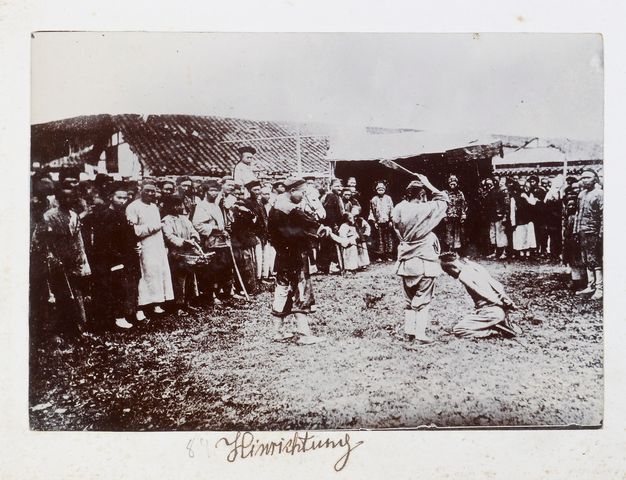
public executions of suspected Boxer rebels, whose beheaded
bodies served as silent witnesses to the imposition of foreign
justice and civilizing violence.48
Images of fallen Chinese bodies, imprisoned bodies, subjugated
bodies, and decapitated heads circulated in sensationalist
journalism and souvenir photo albums of the China campaign
that reinforced Orientalist tropes of cruelty and punishment
(fig. 6).49
In the twentieth-century Chinese imagination, decapitation
formed the “primal scene” of national and personal trauma.50
Late Qing and Republican Chinese intellectuals seized upon the
imagery of the brutalized Chinese body to call for urgently
needed reform, often couched in the terms of a strengthened
national body.51
ExpandFig. 6. —William Saunders (English, 1832–92).Hinrichtung (Execution) from
Views from the Iltis in China, album of
photographs, compiled ca. 1919. Los Angeles, Getty
Research Institute, 2003.R.2.
The narrative of national humiliation that frames the period
from the Opium Wars to World War II as a century of
humiliation continues to conflate distinct historical moments
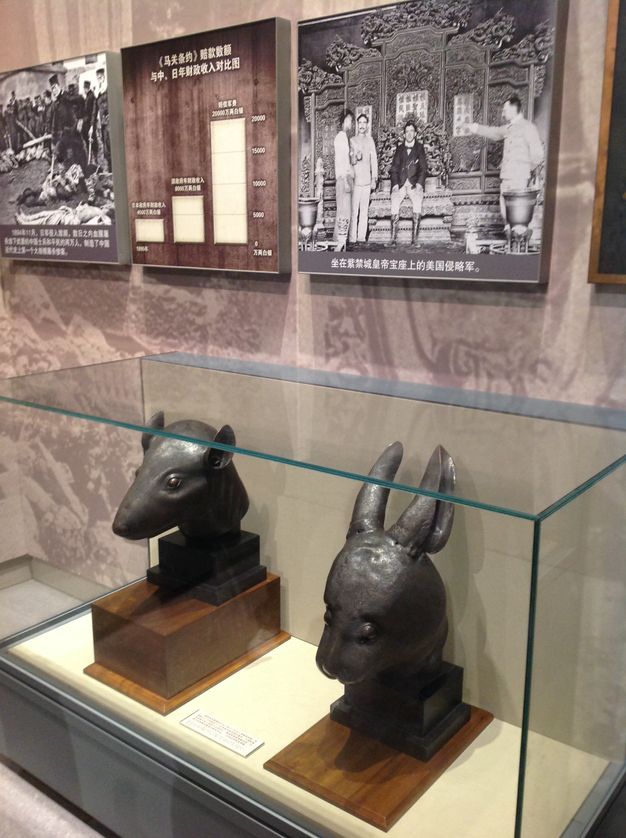
into one singular moment. The display that opens the permanent
exhibition Road of Rejuvenation in the National
Museum of China continues to draw visual equivalence between
foreign aggression, looted object bodies, and despoiled
Chinese bodies. The repatriated Rat and Rabbit heads occupy a
case positioned under photographs of Japanese soldiers
beheading Chinese soldiers during the first Sino-Japanese War
of 1894, as well as photographs of foreign soldiers of the
Eight Powers Expeditionary Force seated upon the imperial
throne after marching into Beijing (fig. 7). In their display, the zodiac heads serve as physical
manifestations of a mutilated national body, ones that must be
repatriated and made complete to heal the national wound.
ExpandFig. 7. —Bronze heads of the Rat and Rabbit, ca. 1750, displayed
in the permanent exhibition
Road of Rejuvenation in the National Museum of
China, Beijing, 2014.
Photograph by the author.
The zodiac heads remain a broken, fragmented set; therefore,
it is only in acts of reproduction that the broken set can be
made whole again. In the following section, I address two
examples of reproduction that are not exact copies or, to use
a biological metaphor, “cloned substitutes” that could be
mistaken for the originals. The original heads as a “parent”
set bore multiple “offspring” sets who share characteristics
with their progenitors but speak in their own voice. To put it
a different way, the sculptural reproductions of the zodiac
heads are acts of cultural translation; they not only fill in
the lacunae of the missing heads through acts of artistic
creation but also imbue the heads with additional layers of
meaning that address contemporary concerns about the
negotiation of cultural heritage in the twenty-first century.
Ai Weiwei’s Circle of Animals
The publicity of the Christie’s auction in 2009 sparked
near-simultaneous projects: artist-activist-provocateur Ai
Weiwei’s Circle of Animals and martial-art superstar
Jackie Chan’s movie Chinese Zodiac (2012) and
accompanying sculptural set.
The works of Ai Weiwei (b. 1957) have questioned the value of
Chinese cultural heritage; he has painted over Neolithic
pottery, dropped a Han dynasty vase, and contorted Ming
furniture into nonfunctional forms. In 2009, Ai lambasted the
Chinese media attention given to the Rat and Rabbit heads at
the Christie’s auction. He condemned corrupt Chinese officials
for expressing concern over the bronze heads when they paid no
attention to the dead children crushed under the debris of
collapsing schoolhouses. He denied the value of the heads and
called out the hypocrisy of cultural heritage in China: “The
rabbit and rat bronzes from the Old Summer Palace are not
Chinese culture, and they have no artistic value. Patriotism
is not a love of the Aisin Gioro [Qing ruling house] family
name, and twelve playthings manufactured in the West are not
the quintessence of Chinese culture. . . . Over the first few
decades of a New China, in the name of the revolution and
during the Cultural Revolution, across the entire nation and
in Tibet, you destroyed countless cultural relics.”52
When the auction occurred, Ai Weiwei was already in
discussions with Larry Warsh, the director of AW Asia, to
create a work of public sculpture.53
The controversy over the heads inspired his monumental
sculptural project Circle of Animals / Zodiac Heads,
which reproduced the Yuanmingyuan zodiac heads as monumental
bronzes.
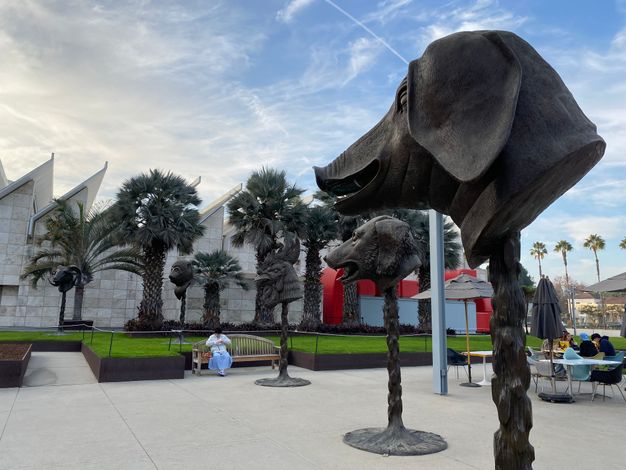
As an act of artistic translation, Ai Weiwei’s
Circle of Animals cannot truly be referred to as a
set of copies or replicas. In general, it does follow the
original forms and material of the zodiac heads. But the heads
have been enlarged to a monumental scale, measuring about four
to five feet across, each head mounted on a much thinner
column of bronze that elevated the looming heads ten feet high
over the viewer (fig. 8). To make a complete set, Ai and his team of artists
creatively devised the appearance of the five missing animals.
With the artistic freedom to break away from the established
form of the extant heads, Ai and his team imbued their
interpretation of the five missing heads with a greater degree
of liveliness and character than the other heads, taking the
liberty to completely redesign the Tiger into a fierce,
snarling beast. Ai’s version of the zodiac heads does not
quite retain their original function as fountainheads that
track time. In his sculpture, the open mouths of the animals
are not filled with streams of water, leaving them free to
“speak” on their own terms.
In the catalog for the traveling installation of
Circle of Animals, arts journalist Susan Delson
describes the thin pillars of bronze as jets of water buoying
up the heads in a “spirit of playfulness,” referencing their
original position as fountainheads.54
Roberta Smith for the New York Times spies a
suggestion of “an abstracted lotus stem and leaves,” again
drawing a connection to water and fountains.55
Seen in another light, however, the columns gain a sinister
cast. Their knobbed and gnarled striations suggest not so much
a jet of water but bloodied wooden stakes impaling the results
of a grisly hunt. Is this a condemnation of the looting of the
Yuanmingyuan, despite Ai’s vehement disavowal of their
heritage value? Or is this a skewering (pun intended) of the
supposed value of the heads as national cultural heritage?
Although the heads directly reference the Yuanmingyuan zodiac
set, they also offer a flexibility of interpretation that
moves beyond the specific context of the Yuanmingyuan. Most
prominently, the arrest and detainment of Ai Weiwei by Beijing
authorities on 3 April 2011 overshadowed the subsequent world
tour of Circle of Animals. Exhibition reviews focused
almost exclusively on the absent body of the artist and
condemned Chinese authorities for political oppression and
restricting free speech. As heads, the sculptures appeared to
speak for their silenced maker; they acted as substitute
bodies for the artist, who remained in Beijing under a travel
ban. Ai Weiwei’s passport was not returned until July 2015; he
is now working outside of China.
As Circle of Animals toured the world, each
exhibition venue opened up new interpretative possibilities.
The sheer physicality of the monumental bronzes emphasized
their occupation of any given site. In physical form,
Circle of Animals both copies and transforms the
original zodiac heads; as an edition of six sculptural sets,
Ai Weiwei’s heads also replicate each other. The six sets
moved independently of each other, resulting in concurrent and
overlapping exhibitions of Circle of Animals around
the world. Each installation location opened up different
possible interpretive frames, whose multiplicity I will
briefly explore.56
In May 2011, Circle of Animals served as the
inaugural outdoor exhibition of the courtyard of Somerset
House in London. The former parking lot for government
bureaucrats had just been renovated into a space for public
art programming. The unveiling of Ai Weiwei’s sculptures
proclaimed a new relationship between the hulking historic
building and the twenty-first century British public. The mood
was dampened, however, by the conspicuous absence of the
artist. Media discussion around the sculptural installation
focused on the arrest and detainment of Ai Weiwei and the
suppression of artistic freedom by the Chinese government.57
The presence of the monumental zodiac heads gestured toward
two injustices: the ongoing one of the artist’s absent and
traumatized body and the historical injustice of the British
empire. Somerset House is a site of layered histories. As the
seat of the British Admiralty in the nineteenth century, it
architecturally reframes Ai Weiwei’s sculptural animals as a
parodic scene of Yuanmingyuan loot on display, as if they were
trophy heads proudly displayed in a perverse celebration of
British victory in the Second Opium War.
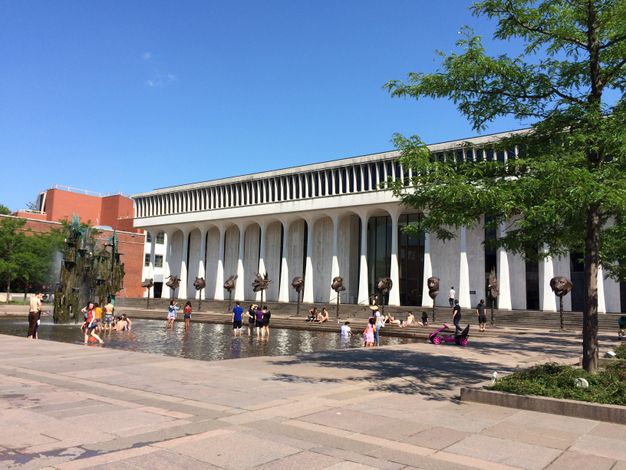
Arrayed in front of the Fountain of Freedom of Princeton
University’s Woodrow Wilson School of Public and International
Affairs from 2012 to 2017, the heads connect issues of looted
cultural heritage, human rights, and international politics.
In the summer heat, however, teenagers and school children
splash in the water, paying the heads little notice. The
heads, denied of their referent to an agonized past of
imperialist encounter and national humiliation, are relegated
to a playful backdrop for childhood innocence (fig. 9).
From 2013 to 2014, standing in the courtyards of encyclopedic
art museums such as the Cleveland Museum of Art, the heads are
pivoted toward multiple areas of museum collecting. They stand
in celebration of a famous contemporary artist’s new creation
and continue in the lineage of sculptural portrait busts in
the European galleries. Simultaneously, their bodiless heads
also echo the broken forms of fragmented Buddhist and Hindu
sculptures, whose headless bodies and disembodied heads raise
difficult questions about the provenance and acquisition
history of Asian art in US American collections.58
In 2015, at the National Museum of Wildlife Art, Wyoming, the
zoological aspect of the sculptures is emphasized, and the
conversation shifts from cultural heritage to the conservation
of the natural world. The larger-than-life sculptures hark
back to the extinct megafauna of previous geological ages,
offering a warning of the calamitous consequences of climate
change. Ai Weiwei’s own activism provides the bridge for his
sculptures to address environmental justice and human rights.
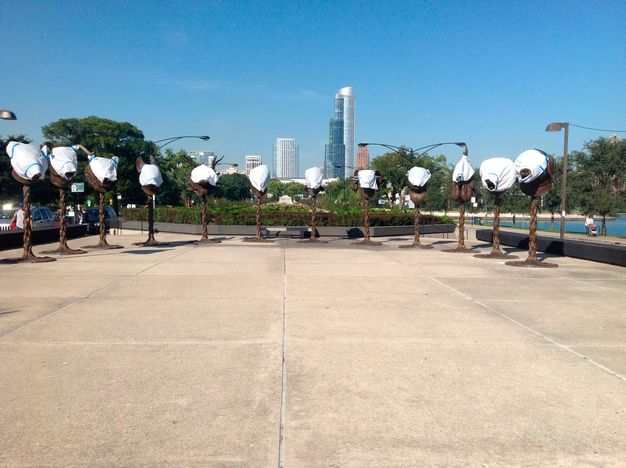
In front of Chicago’s Adler Planetarium, the heads revert to
their identity as zodiac animals keeping track of the movement
of the heavens and the cyclical passage of time. During the
installation in September 2014, the Adler covered the heads
with stark white cloths to express solidarity with Ai Weiwei,
silenced and under house arrest (fig. 10).59
The muzzled and blinded animals thus called attention to the
violation of their maker’s rights to free speech and free
movement.
After receiving his passport back in 2015, Ai was finally able
to personally unveil the zodiac heads when they were exhibited
at the National Gallery of Prague. There, he explicitly
associated the heads with his other artworks that call
attention to the Syrian refugee crisis by wrapping each head
in the same protective gold foil used by the Syrian refugees
as emergency blankets.60
In this case, the animals were no longer Ai Weiwei’s
substitute body but the substitute bodies of refugees.
Images of Ai Weiwei’s Circle of Animals continue to
appear in his more recent art, including as large mosaic
portraits made from Lego bricks, a medium that the artist
first used in portraits of political prisoners. Their images
adorn the cover of his illustrated memoir,
Zodiac: A Graphic Novel (2024), where Ai Weiwei
further removes the zodiac heads from their original referents
in the Yuanmingyuan and regrafts them onto his artistic and
autobiographical body.
Vandalizing Jackie Chan’s Zodiac Heads
Since the auctions of the zodiac heads in Hong Kong in 2009,
the martial arts movie star Jackie Chan (b. 1954) has been
vocal in his support for the repatriation of looted artifacts
from China. Playing to his own strengths, he responded to the
controversial auction of the Rat and Rabbit head at Christie’s
in 2009 by writing, directing, and starring in an action
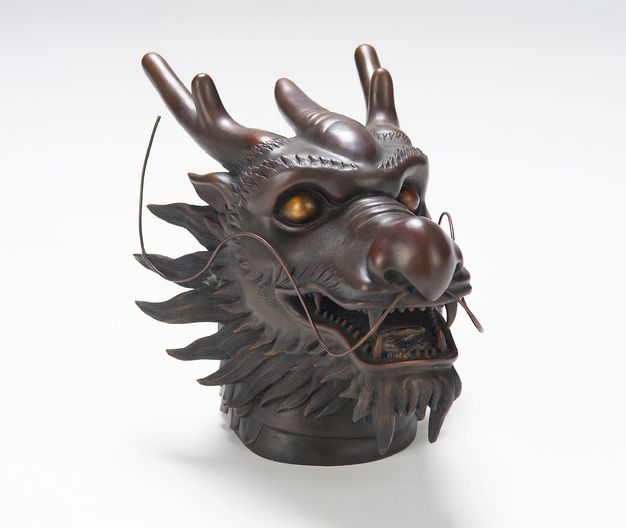
adventure movie, Chinese Zodiac (十二生肖), released in 2012. Chan plays a globe-trotting mercenary
who is hired to locate and retrieve the missing zodiac heads
by an unscrupulous French auction company. The movie positions
Chinese and French student protestors as the everyday heroes
who lobby against the sale of looted artifacts. The movie
props of the heads have also acquired a second life, as Chan’s
production company created additional sets to raise awareness
of the zodiac heads as lost cultural relics (fig. 11). Sets have been gifted to the Yuanmingyuan Ruins Park and
to the Asian Civilisations Museum in Singapore, but it was in
Taiwan—in the courtyard of the Southern Branch of the National
Palace Museum—that they inspired an act of vandalism.61
ExpandFig. 11. —12 Zodiac Sculptures (Dragon), 2012, bronze,
30.5 × 31.6 × 28 cm.
Singapore, Asian Civilisations Museum. Collection of the
Asian Civilisations Museum, Gift of Mr. Jackie Chan,
2013-00331.
Whereas Ai Weiwei criticized the original zodiac heads for
being “not Chinese,” in the context of a museum space in
central Taiwan, Chan’s reproduction heads were perceived as
“too Chinese.” The student activists saw the imposition of
these icons in the central space of the new museum as a form
of cultural imperialism. In a public post on social media,
they argued that the Southern Branch was constructed “to
connect the native people of Taiwan, to educate Taiwanese on
the cultural diversity of Asia, and to create some separation
from the National Palace Museum in Taipei.” The acceptance of
the heads, therefore, constituted a “cultural invasion and
colonization” by China that was not to be borne by Taiwanese
who refuse to be “culturally Chinese.”62
The Southern Branch was constructed as a counterbalance to the
main branch in Taipei. The initial founding of the National
Palace Museum in 1925 allocated the treasures of the Qing
imperial house to the body politic of Nationalist China. When
the Nationalist government moved to Taiwan in 1949, they moved
the collection of the National Palace Museum with them; the
museum collection serves as political legitimizer of the
Nationalist government on Taiwan as the inheritors of the
Chinese state.63
In recent years, however, more voices are advocating for
Taiwanese independence and arguing for a uniquely Taiwanese
identity set apart from ties to mainland Chinese identity.64
The Southern Branch was founded as a pan-Asian museum whose
mission is to feature the cultural exchanges across Asia as
well as highlight the Indigenous and native cultures of
Taiwan.65
In the catalog that introduces the new museum’s architecture,
grounds, and permanent exhibitions, the Southern Branch omits
the connection between the zodiac-head sculptural installation
and the Yuanmingyuan. Instead, the museum presented the twelve
animals of the zodiac as a cultural tradition shared across
Asia whose presence would help communicate the institutional
mission of “respecting cultural relics and protecting the
universal value of humanity’s cultural heritage.”66
Objects and images, however, are rarely neutral
representatives of cultural heritage. In particular, art of
the Qing imperium in relation to Taiwan often testifies to a
history of conquest from the mainland. The Qianlong emperor,
who commissioned copperplate prints to commemorate the
military victories over the Dzungars in Xinjiang and, later,
the completion of the Yuanmingyuan’s European Pavilions, also
utilized the copperplate medium to celebrate the campaign
against Taiwan to quell the Lin Shuangwen Rebellion of
1787–88.67
When military commander Fukang’an (d. 1796) led the Qing navy
across the Taiwan Strait, he was bestowed a Qing ritual
object: a rare, right-spiraling conch shell that would
guarantee the fleet’s safe passage across the sea. In late
2015, the first object seen in the Southern Branch’s inaugural
exhibition on the local history of Chiayi was the Qing
imperial conch shell.68
Immediately after the official unveiling of Chan’s sculptural
reproductions, the Taiwanese newspaper
Liberty Times (Ziyou shibao) ran an article
criticizing the zodiac-head donation on two fronts: It
questioned first that, as a world-class museum, what was the
National Palace Museum doing by accepting reproductions (and
headlined the article “Even fakes are accepted” [lian yanpin ye shou連贗品也收]). Second, and more
importantly, how could the museum not see that this was a ploy
by Mainland China to wage cultural warfare against Taiwan?69
It is likely that this article inspired the act of vandalism
by the student activists, who were previous participants in
the Sunflower Movement of 2014 protesting Ma Ying-jeou’s
policies that strengthened political and economic ties between
Taiwan and the People’s Republic of China. Vandalizing Jackie
Chan’s animal heads is a continuation of the sentiments
expressed in the Sunflower protests. The red-drenched heads
pillory the president while simultaneously evoking the
bloodied heads of protestors asserting their national identity
as Taiwanese in the face of growing rapprochement with China
(see
fig. 1).
The vandalism created a visual rebus that furthers the answer
to the question of why these heads and not other objects. In
Chinese, “animal heads” is pronounced “獸首shou shou.” Taiwanese commentators picked up on its
homophonic relationship to another phrase, also pronounced
“授首shou shou” but meaning
“to surrender, to be killed,” and most tellingly, “to be
decapitated,” used historically in reference to subduing
rebels and robbers.70
“To accept” is also “收受shou shou,” and so the form of the heads creates a
chain of homophonic equivalences wherein “to accept animal
heads” is “to accept decapitation.” The linguistic play on
words is reinforced by the physical form of the zodiac animals
as “heads” mounted for display in public space.
As the Liberty Times article speculated, President Ma
and Mr. Chan, whose Chinese names include the characters for
“horse” and “dragon,” had hoped that their combined presence
would invoke the idiom “the spirit of the dragon and the
horse,” generally used to describe a person advanced in age
who is still full of life, or in this case, an ancient nation
or a museum of ancient artifacts that still has vitality. So
when the article derided the zodiac installation by calling it
“peeling paint” (落漆luoqi),
a local colloquialism meaning a loss of face, the student
activists instantiated all the puns by literally throwing
paint over the heads of the Dragon and Horse.71
Physically, the vandalism did little damage: The paint was
easily removed.72
But the discussions that followed ultimately led the Southern
Branch to issue a statement in September 2016 saying that they
were removing the heads from the courtyard and that the space
would display local art instead.73
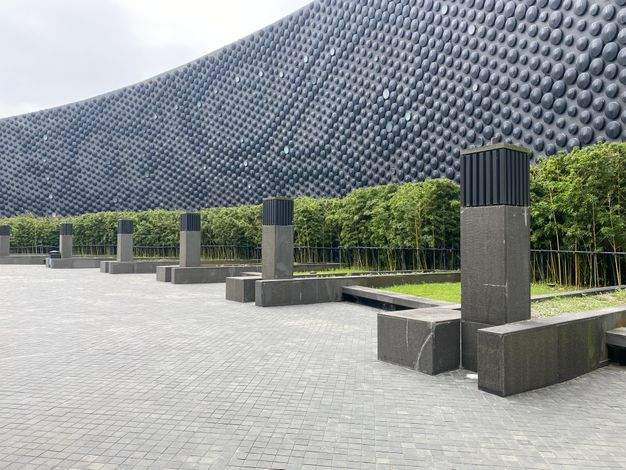
The bronze heads are now deinstalled, but the concrete
pedestals remain. The material remnants of the installation
stand like silent steles to the proxy battle over cultural
claims and national identities (fig. 12).
ExpandFig. 12. —The central courtyard of the Southern Branch of the
National Palace Museum, Chiayi, Taiwan, after the
removal of the replica zodiac animal heads donated by
Jackie Chan, 29 March 2025.
Photograph by the author.
Copies are never neutral, and neither are the spaces that they
inhabit. The copy, as an act of translation, responds to the
original referent and is also made to respond to its own
particular moment. The original Yuanmingyuan zodiac heads
became the iconic representatives of looted Chinese cultural
heritage by sharing in the visual rhetoric of decapitated
bodies; their repatriation aims to be an endpoint to the
wounds of national humiliation. In their replicated
afterlives, the zodiac heads also serve as a multitude of
substitute bodies: detained artistic bodies, looted bodies,
embattled political and national bodies. Within each
site-specific frame of display, they give new voice to
contestations over cultural heritage, identity, and global
justice.
Patricia J. Yu is assistant professor of East
Asian art history at Scripps College in Claremont, California.
Notes
An earlier version of this paper was presented as a talk at
the Getty Research Institute, where I was a predoctoral fellow
in the Getty Scholars Program in 2017–18, when its theme was
Iconoclasm and Vandalism. I thank all my mentors and
colleagues who have heard and read variations of this paper
and offered their feedback. Further thanks go to Taliesin
Thomas, director of AW Asia, for providing images and
permissions. And finally, I would like to thank this journal’s
reviewers and editors for their insightful comments and
queries.
The pinyin system for romanizing Chinese characters is used
here, except for personal names where the individual uses a
different system. Translations from the Chinese are by the
author, unless otherwise noted.
Young-tsu Wong,
A Paradise Lost: The Imperial Garden Yuanming
Yuan
(University of Hawai’i Press, 2001), 4–5.
↩︎
Jean-Denis Attiret,
A Particular Account of the Emperor of China’s Garden
Near Pekin
[. . .], trans. Sir Harry Beaumont [Joseph Spence]
(London, 1752). For the history of the letter’s
publication and translations, see George R. Loehr,
“L’artiste Jean-Denis Attiret et l’influence exercée
par sa description des jardins impériaux,”
in
La mission française de Pékin aux XVIIe et XVIIIe
siècles
(Centre de recherches interdisciplinaire de Chantilly,
1976), 69–83.
↩︎
Greg M. Thomas, “Yuanming Yuan/Versailles: Intercultural
Interactions Between Chinese and European Palace
Cultures,” Art History 32, no. 1 (February
2009): 115–43.
↩︎
For Hugo’s practice of bricolage in the ornamentation of
the Chinese rooms at his residences, see Petra
ten-Doesschate Chu, “Victor Hugo and the Romantic Dream
of China,” in
Beyond Chinoiserie: Artistic Exchange Between China
and the West During the Late Qing Dynasty
(1796–1911), ed. Petra ten-Doesschate Chu and Jennifer Milam
(Brill, 2019), 149–77.
↩︎
Henry Brougham Loch,
Personal Narrative of Occurrences During Lord Elgin’s
Second Embassy to China in 1860,
3rd ed. (London, 1900 [1869]), 98–112.
↩︎
James Bruce, Earl of Elgin,
Letters and Journals of James, Eighth Earl of Elgin,
Governor of Jamaica, Governor-General of Canada, Envoy
to China, Viceroy of India, ed. Theodore Walrond (London, 1872), 366.
↩︎
James Hope Grant,
Incidents in the China War of 1860, Compiled from the
Private Journals of General Sir Hope Grant,
ed. Henry Knollys (Edinburgh, 1875), 203–5.
↩︎
Sir Harry Parkes, letter to his wife, 27 October 1860,
quoted in in Stanley Lane-Poole,
Sir Harry Parkes in China (Methuen, 1901), 251.
Bracketed interpolation by the present author.
↩︎
Norman Kutcher, “China’s Palace of Memory,”
Wilson Quarterly 27, no. 1, (2003): 30–39; and
Wong, Paradise Lost, 189–90.
↩︎
James Hevia,
English Lessons: The Pedagogy of Imperialism in
Nineteenth‑Century China
(Duke University Press, 2003), 95.
↩︎
Fine Chinese Decorative Works of Art, auction
cat., Sotheby’s New York, 9–10 October 1987, lots 134
and 135, sales insert; and Mee-Seen Loong, e-mail
communication with author, 16 January 2018.
↩︎
Fine Chinese Ceramics and Works of Art, auction
cat., Sotheby’s London, 13 June 1989, 40–45, lots 68–70,
sales insert.
↩︎
Full page ad in Orientations, July 1991, n.p.;
and author’s personal communication with Mee-Seen Loong.
↩︎
Important Chinese Ceramics, Jades, and Works of
Art, auction cat., Christie’s Swire Hong Kong, 1–2 October
1991, 430–31, lot 1680. The final sale price was
recorded in the curatorial research files of the Peabody
Essex Museum.
↩︎
The Imperial Sale: Yuanmingyuan, auction cat.,
Christie’s Hong Kong, 30 April 2000, 35–38, lots 516–17;
and Fine Chinese Ceramics and Works of Art,
auction cat., Sotheby’s Hong Kong, 2 May 2000, 202–3,
lot 749.
↩︎
Mee-Seen Loong, e-mail communication with author, 16
January 2018.
↩︎
Fiskesjö, “Politics of Cultural Heritage,” 227–28.
↩︎
Hajni Elias, “The Imperial Bronze Head of a Horse from
the Zodiac Fountain in the Yuanmingyuan,” in
Yuanmingyuan: The Garden of Absolute Clarity,
auction cat., Sotheby’s Hong Kong, 9 October 2007,
16–19; and lot 1321 in the same catalog, 20–24.
↩︎
Audrey Wang,
Chinese Antiquities: An Introduction to the Art
Market
(Lund Humphries; Sotheby’s Institute of Art, 2012), 25.
↩︎
Sotheby’s Hong Kong, “Dr. Stanley Ho Donates to China
the Bronze Horse Head of the Summer Palace Purchased at
Sotheby’s Hong Kong,” press release, September 2007.
↩︎
Sotheby’s Hong Kong, “Dr. Stanley Ho Donates to China.”
↩︎
Fiskesjö, “Politics of Cultural Heritage,” 225.
↩︎
Christiane de Nicolay-Mazery,
The Yves Saint Laurent Pierre Bergé Collection: The
Sale of the Century
(Flammarion, 2009), 262–63, lots 677–78.
↩︎
Wang Kaihao, “Chinese Zodiac Statue Heads Home,”
China Daily, 14 November 2019,
www.chinadaily.com.cn/global/2019-11/14/content_37522787.htm.
↩︎
The Paper
澎湃新闻, “160年终回故里!
马首铜像回归圆明园首度展出
Repatriated bronze horse head exhibited in
Yuanmingyuan,” YouTube video, 30 November 2020,
https://youtu.be/N4VTKOHB2l4. ↩︎
The zodiac heads also serve as case studies in larger
discussions of national cultural heritage and
repatriation. See Derek Gillman, “The Old Summer Palace
and the Rhetoric of National Treasures,”
Santander Art and Culture Law Review 5, no. 2
(2019): 233–44; and Patty Gerstenblith,
Cultural Objects and Repatriative Justice
(Oxford University Press, 2023), 85–95.
↩︎
Richard Kraus, “The Politics of Art Repatriation:
Nationalism, State Legitimation, and Beijing’s Looted
Zodiac Animal Heads,” in
Chinese Politics: State, Society and the Market, ed. Peter Hays Gries and Stanley Rosen (Routledge,
2010), 206.
↩︎
Fiskesjö, “Politics of Cultural Heritage,” 225.
↩︎
Annetta Fotopoulos, “Understanding the Zodiac Saga in
China: World Cultural Heritage, National Humiliation,
and Evolving Narratives,” Modern China 41, no.
6 (2015): 603.
↩︎
Zheng Wang, Never ForgetNational Humiliation: Historical Memory in Chinese
Politics and Foreign Relations
(Columbia University Press, 2012), 52–53; and William A.
Callahan,
China: The Pessoptimist Nation (Oxford
University Press, 2009), 88.
↩︎
Fotopoulos, “Understanding the Zodiac Saga,” 621–24.
↩︎
Kristina Kleutghen, “Heads of State: Looting,
Nationalism, and Repatriation of the Zodiac Bronzes,” in
Ai Weiwei: Circle of Animals, ed. Susan Delson,
exh. cat. (Prestel, 2011), 165.
↩︎
Regina Janes,
Losing Our Heads: Beheadings in Literature and
Culture
(New York University Press, 2005), 2, 4; and Simon
Harrison,
Dark Trophies: Hunting and the Enemy Body in Modern
War
(Berghahn Books, 2012).
↩︎
For example, see the photographic compilation
Views from the Iltis in China (2003.R.2;
http://hdl.handle.net/10020/2003r2) in the special collections of the Getty Research
Institute. The album was compiled by a sailor on the
German gunboat Iltis in the 1910s and includes
several photographs of executions and decapitated heads.
↩︎
David Der-wei Wang,
The Monster That is History: History, Violence, and
Fictional Writing in Twentieth-Century China
(University of California Press, 2004), 10.
↩︎
Alexandra von Przychowski, “Buddha Heads and the
Reception of Chinese Buddhist Art at the Beginnings of
the 20th Century,” in
Pathways of Art: How Objects Get to the Museum,
ed. Esther Tisa Francini, with Sarah Csernay (Museum
Rietberg; Scheidegger & Spiess, 2022), 335–50.
↩︎
Translation by author, based on the original social
media post. Miāu-thêng Tân, “Fankang Zhonghua wenhua
qinlüe, longma poqi xingdong” (反抗中華文化侵略,
龍馬潑漆行動), Facebook, 30 December 2015.
↩︎
Cheng-hua Wang, “The Qing Imperial Collection, Circa
1905–25: National Humiliation, Heritage Preservation,
and Exhibition Culture,” in
Reinventing the Past:
Archaism and Antiquarianism in Chinese Art and Visual
Culture, ed. Wu Hung (University of Chicago Press, 2010),
320–41; and Jeannette Shambaugh Elliot with David
Shambaugh,
The Odyssey of China’s Imperial Art Treasures
(University of Washington Press, 2005), 108–9.
↩︎
Ketty W. Chen, “Island Sunrise: The Sunflower Movement
and Taiwan’s Democracy in Transition,” in
Taiwan in Dynamic Transition: Nation Building and
Democratization, ed. Ryan Dunch, Ashley Esarey, and Thomas B. Gold
(University of Washington Press, 2020), 121–37.
↩︎
Elliot,
Odyssey of China’s Imperial Art Treasures, 109;
and Feng Mingzhu 馮明珠, ed.,
Gugong Nanyuan shenggai故宮南院勝概 (Taipei: National
Palace Museum, 2016), 6–10.
↩︎
Marcia Reed, “Imperial Impressions: The Qianlong
Emperor’s Print Suites,” in
Qing Encounters: Artistic Exchanges Between China and
the West, ed. Petra Ten-Doesschate Chu and Ning Ding (Getty
Research Institute, 2015), 134–35.
↩︎
Seen by the author on a site visit in June 2016.
Through the annals of time: A brief history of
Chiayi
(Ben liu bu xi—Chiayi fa zhan shi
奔流不息—嘉義發展史),” 28
December 2015 to 1 May 2018.
↩︎
Yang Yuanting 楊媛婷, Lin Yizhang
林宜樟, and Zhang Xiaomiao
張筱笛, “Lian yanpin ye
shou. . . . Gugong Nanyuan zhan ‘tongzhan’ shoushou
連贗品也收. . . . 故宮南院展「統戰」獸首,” Ziyou shibao自由時報, 29 December 2015,
https://news.ltn.com.tw/news/focus/paper/944528. ↩︎
Southern Branch of the National Palace Museum, “Gugong
Nanyuan shier shengxiao queding chaichu
故宮南院十二生肖獸首 確定拆除,”
press release, 22 September 2016; and Zhang Rui, “Taipei
Museum to Axe Jackie Chan’s Zodiac Replicas,”
China.org.cn, 23 September 2016,
http://www.china.org.cn/arts/2016-09/23/content_39359831.htm. ↩︎