Davis / Cleaning Up in PublicGetty Research Journal, No. 21 (2026)
Copied page section link to clipboard
Abstract
In 1977, the feminist art collective Mother Art staged a
series of performances in laundromats across Los Angeles
that highlighted women’s socially reproductive work inside
and outside of the home. The project, titled
Laundry Works, was subsequently assailed by
politicians unhappy with the artwork’s use of public
funds, triggering a debate that continued for years and
involved commentators such as Ronald Reagan. Through
analysis of archival documents, photographs, news
articles, and original interviews with the artists, this
article situates Laundry Works and the
controversy that surrounded it within the late 1970s tax
revolt and rise of neoliberalism in the United States. By
performing in spaces associated with domestic labor,
Mother Art explored the continuum between private care and
public infrastructure, highlighting capitalism’s
dependence on socially reproductive work, which is
gendered, classed, and racialized in order to be rendered
invisible and thus more easily exploited. Mother Art’s
performances represent an important yet critically
underexamined contribution to politicized second-wave
feminist art that challenges gendered divisions of labor.
Keywords
performance studies, social reproduction, Los Angeles,
feminist art, activist art, public funding, Woman’s
Building, domestic labor
Copied page section link to clipboard
Peer Review
Double anonymous, external
Copied page section link to clipboard
Cite
Chicago
Lexington Davis, “Cleaning Up in Public: Mother Art’s
Domestic Labor Performances, 1973–78,”
Getty Research Journal, no. 21 (2026),
https://doi.org/10.59491/ERGR9205.
MLA
Davis, Lexington. “Cleaning Up in Public: Mother Art’s
Domestic Labor Performances, 1973–78.”
Getty Research Journal, no. 21, 2026,
https://doi.org/10.59491/ERGR9205.
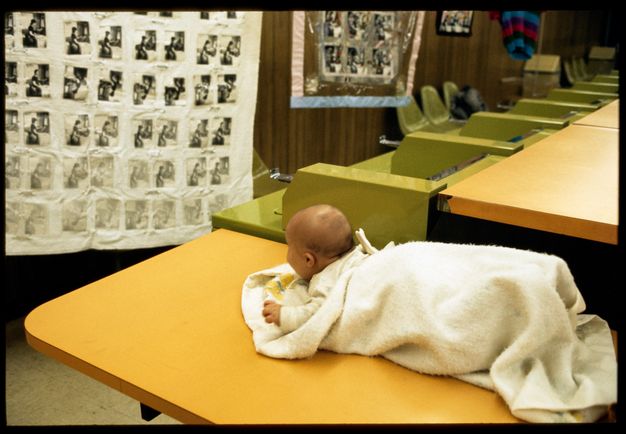
In a photograph taken in 1977, a baby wrapped in a white
blanket lies on its stomach atop a mustard-colored
laundry-folding table (fig. 1). Arms outstretched, head lifted, the child fixes his or her
gaze on a gridded black-and-white photographic artwork hanging
from a laundry line. The infant was among the audience members
present at a performance from the series
Laundry Works, which was staged in laundromats across
Los Angeles that year by the collective Mother Art. Founded at
the Los Angeles Woman’s Building in 1973, Mother Art brought
together a group of women artists struggling to balance the
demands of parenting with artistic practice. Helen
Million-Ruby, Suzanne Siegel, Laura Silagi, and Christine
(Christie) Kruse were the founding members, but additional
participants joined and departed over the course of two
decades. During this time, Mother Art collaboratively produced
installations, organized exhibitions, and staged performances
that drew attention to the invisible labor of women and
caregivers while engaging with issues surrounding public space
and access.
ExpandFig. 1. —Mother Art (US American, founded 1973).
Infant audience member at the performance
Laundry Works, 1977, Los Angeles, color slide
(detail), 5 × 5 cm. Los Angeles, Getty Research Institute,
2017.M.60. Photograph by Mother Art.
Although their exuberant performances and site-specific
artworks attracted local interest and attention from prominent
critics such as Lucy Lippard, toward the end of the 1970s
Mother Art became a scapegoat for politicians eager to cut
public funding to the arts and other social services deemed
wasteful. These heated reactions, which dominated the news
across California, emerged in the wake of a landmark
referendum in 1978 that lowered property taxes, thus
decreasing state revenue. The strong response to
Laundry Works and its reliance on a California Arts
Council grant contributed to an impassioned, city- and
state-wide debate about the value of art in public life.
Staged during the neoliberal turn of the late 1970s, which
catalyzed the dismantling of the postwar welfare state,
Laundry Works and the events and performances that
Mother Art organized in its aftermath raise urgent questions
that resonate today in light of the Trump administration’s
recent attacks on funding for art, research, and
education.1
Among them: How do gendered social-value systems inform access
to public resources, including support for art? How does state
funding legitimize certain artistic practices and sites while
marginalizing others? And how do feminist artistic
methodologies contribute to shaping the welfare state?
In this article, I reconstruct Mother Art’s most famous
project, Laundry Works, and the backlash that it
faced for its use of public funding. I argue that by
performing domestic labor in public spaces, Mother Art
highlighted the interdependent relationship between private
care and public infrastructure, revealing how both are fueled
by women’s unpaid and underpaid work. The collective’s
performances underscore capitalism’s reliance on social
reproduction—the labor involved in maintaining human life and
social relations across generations—a responsibility that has
historically fallen primarily on women.2
My research builds on historian Michelle Moravec’s narrative
chronology of Mother Art’s twenty years of operation and arts
researcher Elena Cologni’s recent interview with Mother Art,
which explores the collective’s experiences at the Woman’s
Building through the ethics of care.3
Like Moravec and Cologni, I draw from original and published
interviews with the artists. However, my study is primarily
rooted in archival materials donated by Mother Art to the
Getty Research Institute alongside documents held in the
Smithsonian Institution’s Archives of American Art and at
Bishopsgate Institute in London. Through close analysis of
these records—including photographs, printed ephemera, press
clippings, and newsletters—I trace Mother Art’s political
commitments, artistic process, and the contemporaneous
reception of their work, including the controversy it
confronted. These documents situate Mother Art’s work within a
wider historical context in which the social and economic
value of women’s labor was hotly contested. The intense yet
underexamined media furor surrounding
Laundry Works illuminates how debates about public
resources, art, gender, and labor were intersecting during the
period shortly preceding and following Ronald Reagan’s
presidential victory, an event that accelerated the
neoliberalization of American life.
Laundry Works and the discussions that engulfed it
reveal deeply gendered tensions between individualism and
community and the challenges of making room for difference in
the public sphere. While all of Mother Art’s members were
white, some came from working-class backgrounds, several were
single mothers, and at least two identified as lesbians. These
intersecting identities informed the way Mother Art
experienced the art world, the urban environment, and its
members’ roles as caregivers and creative practitioners. In my
analysis, I position Mother Art’s output within a tradition of
politicized second-wave feminist performance art exploring
domestic work, which raised public awareness of how divisions
of labor are gendered, classed, racialized, and informed by
sexual orientation.4
Artists performing domestic labor sought to challenge social
reproduction’s marginality by rendering this work visible and
material in public spaces. During the same period, feminists
and labor activists were similarly contesting the devaluation
of women’s work, and thus I read Mother Art’s performances in
dialogue with the welfare rights movement and the
International Wages for Housework Campaign. Placing the
collective’s work within this wider sociopolitical context
discloses how feminist artworks intervened in debates about
gendered labor and the social and economic value of
reproductive work. With their emphasis on the interconnections
between art, work, care, and citizenry, Mother Art’s domestic
labor performances illustrate the reverberant political impact
of feminist art presented in public.
Making Space at the Woman’s Building
Mother Art members met as participants in the first Feminist
Studio Workshop (FSW), an extra-institutional educational
program designed to train women artists in an environment free
from male influence. Initiated in 1973, the FSW was a
continuation of artists Judy Chicago and Miriam Schapiro’s
Feminist Art Program, which ran from 1970 to 1971 at Fresno
State College and from 1971 to 1975 at the California
Institute of the Arts (CalArts).5
The Feminist Art Program was a groundbreaking experiment in
offering a women-only curriculum in a higher-educational
setting, and it yielded the landmark feminist installation
Womanhouse (1972), created collectively by Chicago,
Schapiro, and their students in a dilapidated East Hollywood
Victorian mansion. However, Chicago soon grew disillusioned
with the male-dominated environment at CalArts and sought an
independent space where her program could operate
autonomously. In partnership with graphic designer Sheila
Levrant de Bretteville and art historian Arlene Raven, Chicago
cofounded the Woman’s Building, a multifunctional center for
feminist art initiatives, including educational workshops,
galleries, and a bookstore. The organization operated from
1973 to 1991, occupying a warehouse in an industrial area near
Chinatown for the majority of that period. In her study of
gender and neighborhood planning, historian Dolores Hayden
enthusiastically describes the Woman’s Building as a site
“designed to create a political and cultural bridge between
public and private life,” thus complicating gendered divisions
of labor.6
For artists working at the Woman’s Building, this approach was
foundational to feminist praxis, whose proponents heralded the
slogan, “The personal is political.” Many groups, including
Mother Art, treated the organization as an operational center
for a range of activities branching out into the city’s urban
sprawl.7
Although publicly accessible and open to new members, the
Woman’s Building was often viewed by outsiders as an enclave,
and its focus on “women’s culture” was fiercely contested by
feminists into the 1980s, with certain factions arguing that
such separatist projects sacrificed political action in favor
of lifestyle.8
Nonetheless, the mission of the Woman’s Building was rooted in
the belief that ending patriarchy would not be possible
without a feminist “cultural revolution,” as Raven described
it, with artistic production playing a key role.9
For organizers of the FSW, the curriculum presented an
opportunity to fuse feminist politics with artistic
methodology. Students met weekly in small
consciousness-raising groups, where they learned to connect
their personal experiences to societal systems of
oppression.10
The effect of consciousness raising on students was twofold,
according to instructor Ruth Iskin, who explains that group
discussion “frees the women to do work and provides material
from which work is made,” thus becoming a “technique” of
feminist artmaking.11
For members of the Woman’s Building, artistic practice and
political action were inextricable, and creative
self-expression represented a crucial channel for
communicating women’s experiences of oppression.
While many participants found the Woman’s Building to be a
transformative and generative space, Mother Art member
Million-Ruby recalls feeling alienated by its dismissal of
mothers and care work. She remembers a particularly painful
critique with Chicago in which the artist told Million-Ruby
that the only way in which the latter would succeed as an
artist would be by abandoning her husband and children, moving
to a loft downtown, and working on her own.12
It is unclear whether Chicago’s advice, as recalled by
Million-Ruby, was intended as a personal instruction or a more
general evaluation of the art world’s professional realities.
In any case, this recommendation reflects statements that
Chicago has herself made about her own experience, including
in her autobiography
Through the Flower: My Struggle as a Woman Artist of
1975, where she admits: “I felt convinced that the only way to
make any progress in the art world was to remain unmarried,
without children, live in a large loft, and present myself in
such a way that I would have to be taken seriously.”13
Here, Chicago echoes the era’s prejudice that, unlike
artmaking, motherhood could not be counted as a serious
activity. This stereotype led many women to feel they had just
two choices: forsake family life or drop out of the art world.
According to Mother Art, this binary mentality was reinforced
at the Woman’s Building, where they claim that children were
not always welcome. Million-Ruby, Siegel, Silagi, and Kruse
each remembered an FSW policy that permitted dogs in
individual artist studios but not children, who were
considered too disruptive.14
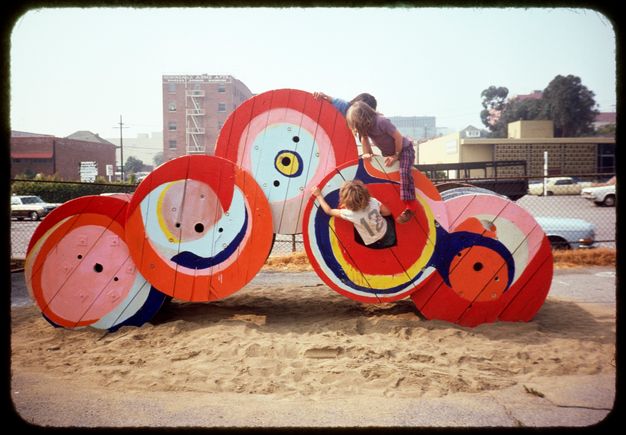
In response, Mother Art drew up plans for a playground in the
abandoned lot facing the building. Working collectively with
each other and their children, the artists used heavy
machinery to fabricate a structure made of recycled wooden
cable spools, on which they painted brightly colored circular
patterns (fig. 2).
The interactive installation, titled
Rainbow Playground (1974), carved out physical space
where artists and community members could gather with their
families. Situated close to the Woman’s Building yet
noticeably separate from it, the monumental construction made
visible in vibrant hues the exclusion of mothers from the art
center. Within the Woman’s Building, children were expected to
follow a strict code of conduct, including not touching
artworks. In contrast, outside of the building’s imposing
walls, Rainbow Playground invited visitors of all
ages to interact with the installation, blurring the
boundaries between artistic practice and care work, form and
function, and intellectual pursuit and leisure.
ExpandFig. 2. —Mother Art (US American, founded 1973).Rainbow Playground, 1974. Woman’s Building, Los
Angeles, color slide (detail), 5 × 5 cm. Los Angeles,
Getty Research Institute, 2017.M.60. Photograph by Mother
Art.
The same lack of consideration for mothers and children shown
by the Woman’s Building has long characterized the urban
design of Los Angeles and many other cities, as noted by
feminist geographers including Hayden, Linda McDowell,
Winifred Curran, and Leslie Kern, among others.15
Responsive at once to the Woman’s Building and the city’s
larger urban context, Rainbow Playground was a
utopian exercise in modeling the kind of support
infrastructure Mother Art wished existed in Los Angeles and
its arts institutions.16
The playground intervened into public space in an industrial
warehouse district near downtown Los Angeles, a part of the
city that most would not have associated with childcare.
Film and photographic documentation shows that the production
process was a collaborative effort involving the artists’
children, who were present while their mothers operated the
forklift, drilled cable spools together, and painted. In
contrast to many works of site-specific sculpture created in
early 1970s Los Angeles, Rainbow Playground was
constructed according to the needs of an unconventional
primary audience: young children. With its immediate utility,
the installation diverged from male-dominated traditions of
art in public space, which typically failed to challenge the
gender inequalities built into the urban fabric.17
Reflecting on the spatial experiments of women artists in the
latter half of the twentieth century, art historian Pamela Lee
notes that images of Los Angeles “tend to repress or
marginalize alternative visions of space produced by its
female inhabitants conventionally left out of the official
narratives of the city’s history.”18
Surrounded by concrete and fabricated from discarded
materials, Rainbow Playground appears unmonumental,
installed in a sand pit flanked by parking lots (see
fig. 2). If the
Woman’s Building represented an infrastructural effort by
feminists to challenge women’s exclusion from the artistic
profession, Rainbow Playground went further,
questioning the very definition of the artist’s purpose and
identity as an urban citizen.
When they joined the FSW, Mother Art’s members had hoped to
find a space where care responsibilities and creative practice
were intertwined, performed alongside one another rather than
rigidly separated. In reality, they were faced with an arts
center that ultimately differed little from the city’s more
established cultural institutions, which typically positioned
artmaking as disconnected from the socially reproductive work
integral to so many women’s lives. The lack of inclusion that
Mother Art members faced at traditional and alternative arts
spaces led the collective to seek opportunities in the wider
urban context beyond the gallery.
During the Wash and Dry Cycles
After producing Rainbow Playground and curating
several motherhood-themed exhibitions at the Woman’s Building,
Mother Art embarked on a new project proposed by Million-Ruby:
a series of public performances staged in laundromats across
the city. Although Million-Ruby found washing clothes to be
“the most boring thing in the world,” dreading her visits to
the laundromat, she recognized it as an important gathering
space for women, particularly those from working-class
backgrounds.19
Mother Art saw an opportunity to access wider audiences by
situating their work in an overlooked space associated with
women’s household labor. They decided to align the content of
their individual artworks with the site, focusing on cleaning
and washing to “make the invisible traditional domestic tasks
visible,” as Silagi recalls.20
Million-Ruby submitted a funding request to the California
Arts Council, which granted the project $700, and the
collective began preparing.21
Between 3 November and 1 December 1977, the group mounted
performances at five laundromats in lower- or mixed-income,
ethnically diverse neighborhoods spread throughout Los
Angeles.22
The artists selected laundromats that they regularly used in
their own neighborhoods, seeking permission in advance from
managers. This siting, across the city’s urban sprawl, was
rooted in the artists’ intimate relationships with their own
neighborhoods and activated what performance scholar Meiling
Cheng describes as the “multicentric” character of Los
Angeles. Analyzing the city’s histories of performance art,
Cheng argues: “The concept of multicentricity subverts the
existing power structure, which takes for granted the boundary
between the ‘majority’ and the ‘minority,’ between ‘dominant’
cultures and ‘marginal’ others. The multicentric paradigm
consequently has the potential to become a resistant strategy
for those who are involuntarily relegated to the margins by
the existing power structure.”23
While the performance series certainly did not extend to the
city’s expansive boundaries, its dispersed unfolding reached
some of the neighborhoods and communities often left out of
the city’s professional arts ecosystem. In this way, the work
functioned as an exercise in remapping Los Angeles’s creative
hubs through spaces associated with menial—rather than
artistic—labor.
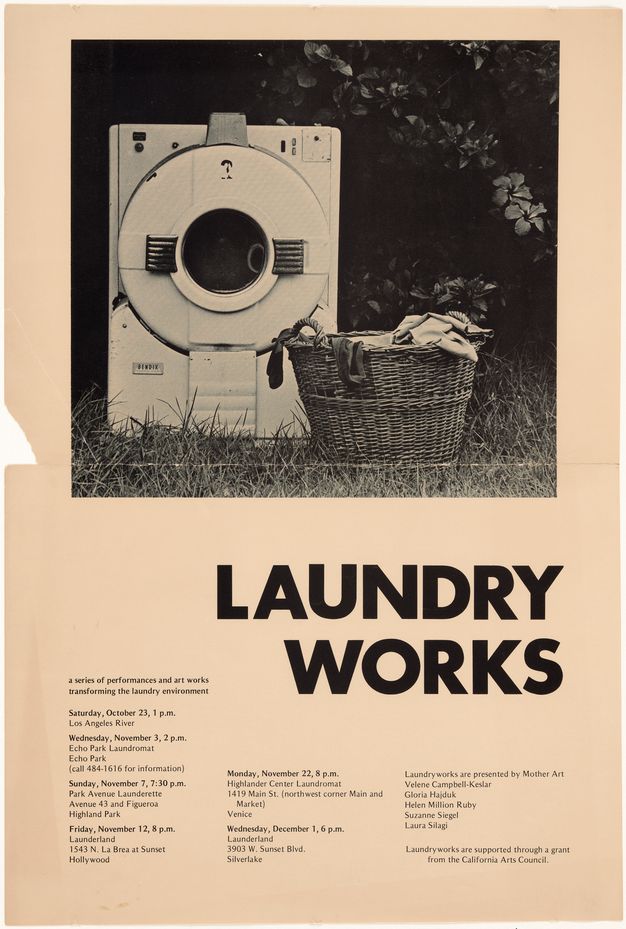
To advertise the series, Mother Art listed the full schedule
of performances on a black-and-white poster featuring a
close-up photograph of a washing machine and basket of laundry
on grassy terrain (fig. 3). The household apparatus installed at the center of a
bucolic scene absent of evident power outlets is at once
humorous and confounding. Dislocated from the domestic
environment and all possibilities of functionality, the
appliance becomes sculptural, recalling the industrial
aesthetic of minimalist art. Hung up in public spaces around
the city, the poster’s unusual composition would have likely
piqued the interest of passersby uncertain of what was being
marketed. Mother Art members recall, however, that they
primarily relied on friends, neighbors, and fellow artists to
publicize the event by word of mouth.24
ExpandFig. 3. —Mother Art (US American, founded 1973).
Poster publicizing Laundry Works, 1977, 28 cm ×
41.1 cm. Los Angeles, Getty Research Institute,
2017.M.60.
On the day of each performance, the group showed up shortly
before the official start time with artworks stashed in wicker
laundry hampers. As performances were tied to the single wash
and dry cycle, this limited the artists to a short window of
time ranging from between forty-five minutes to an hour and a
half. When the Mother Art members arrived at the laundromat,
they would start a load of wash, then jump onto the machines,
string up the clothesline, hang their work, interact with
visitors, and pass out their informational brochure before
taking everything down again after the dry cycle ended. Often
they remained at the laundromat following the performance to
continue conversing with their audience, which sometimes
numbered 150 people.25
Due to these spatial and conceptual constraints, the artworks
were modest in scale and easily transportable. Silagi printed
photographs of the ocean on diaphanous white fabric, which she
dipped in water and pinned up to dry in situ. Million-Ruby
took photographs of women doing laundry and placed them
alongside images of the objects laundered. Gesturing toward
the repetitive and draining experience of washing laundry,
Siegel created a portrait of herself as a washerwoman that she
faded by xeroxing it into oblivion. In a sculptural
installation, member Gloria Hajduk juxtaposed towel collages
with stuffed nylon stockings on which she printed clichéd
sayings about women and cleaning. And writer and member Velene
Campbell-Keslar stenciled lines of poetry onto pillowcases,
which she allowed audience members to select and hang
themselves, thereby producing unexpected combinations of text.
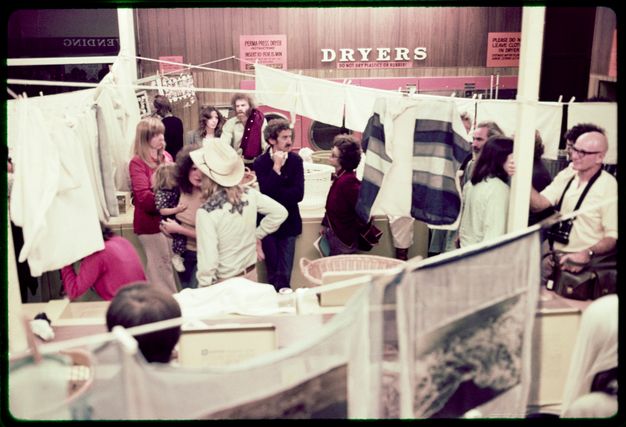
Most of the works were designed to be pinned up along a
clothesline that zigzagged across the laundromat, transforming
the already compact space into a labyrinthine environment (fig. 4). Chaotic and improvisational, the performative installation
rejected the organizational logic of the white-cube gallery
space. Instead, Laundry Works fostered a dynamic,
convivial atmosphere in which artists, audience members, and
launderers orbited close to the art.
ExpandFig. 4. —Mother Art (US American, founded 1973).
View of the performance Laundry Works, Highlander
Center Laundromat, Los Angeles, 22 November 1977, color
slide (detail), 5 × 5 cm. Los Angeles, Getty Research
Institute, 2017.M.60. Photograph by Mother Art.
Formally, the works on view were intimate in scale. They were
accumulative, individually created for the collective
installation. Most of the artists began with objects
associated with the domestic environment, including
pillowcases, fabric sheets, towels, and nylon stockings. By
employing textile materials, the artists created an immediate
relation between the artistic form and the site of its
reception. Contrasted with the industrial materials of
minimalist sculpture, which often referenced blue-collar
factory work, the objects produced by Mother Art incorporated
the softer materials of domestic labor and the home.
Similarly, the collective’s artworks were not designed for a
distanced, contemplative gaze but were handled like everyday
household textiles. The artists pulled their work out of a
laundry hamper, pinned the pieces up, took them down again,
and folded them away in a process that mirrored the actual
labor of laundering. The timing of the wash-and-dry cycle
structured each performance with a kind of score attuned to
the rhythms of housework. Laundry Works was staged at
a time when artists, including many engaging with feminist
politics, were producing performative artworks that
experimented with duration, repetition, and boredom. This
artistic centering of process has been widely understood as a
reaction to the commodification of the art object in a postwar
economy driven by consumer capitalism. Feminist artists such
as Mother Art and their colleagues at the Woman’s Building
were exploring process through the lens of gendered temporal
experiences and labor practices, such as performing household
work.26
In light of the public context in which
Laundry Works was presented, Mother Art endeavored to
make the series as accessible as possible to the laundromats’
unsuspecting clientele. The artists produced a multipage
brochure with a short introduction to the project in English
and Spanish in which they described the performances as an
exploration of “woman’s role in the community.”27
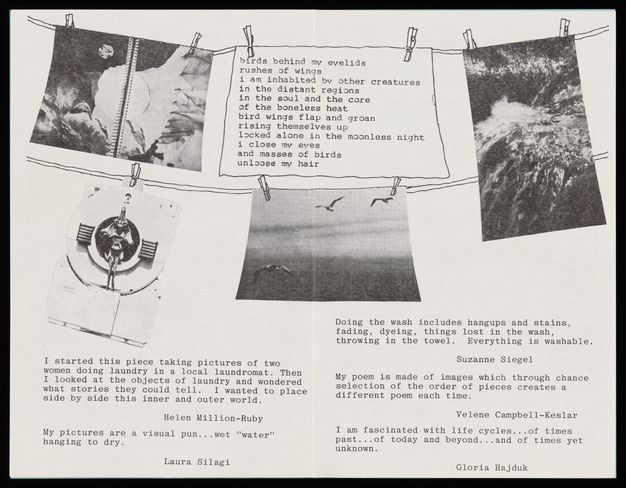
The brochure’s center spread featured concise individual
statements from each of the artists, coupled with images
playfully hung along a hand-drawn clothesline (fig. 5). While Siegel estimates that the majority of audience
members were there specifically to witness the performance, at
least a quarter of those present were just washing their
clothes.28
For those simply there to wash, the interpretive pamphlet
helped contextualize the performance within a conversation
about the forms of labor disproportionately performed by women
and working-class people and everyday experience. Members of
the collective handed out the texts themselves, as evidenced
in photographs that capture Million-Ruby smiling and chatting
with groups of individuals who hold pamphlets and bags of
laundry.29
These organic conversations, sparked by the artworks and the
brochure, were integral to the performance, which sought to
create discussion and solidarity.
ExpandFig. 5. —Mother Art (US American, founded 1973).
Interior spread of the brochure from
Laundry Works, 1977, 21.6 × 28 cm. Los Angeles,
Getty Research Institute, 2017.M.60.
Yet in a colorful review of the Venice performance, journalist
Barry Brennan notes that “not everyone was impressed.”30
He describes “a white robed swami” who ignored the performance
and continued washing his clothes while “calling on his
considerable powers of concentration to abstract himself from
what had become, in effect, an art opening.”31
Brennan’s observation underlines the tension between the
artists, the art-world audience, and the laundromat’s regular
customers, particularly along lines of racialization and
class. Although the performances took place in neighborhoods
where the artists lived, the collective invited a
predominantly white audience into spaces normally occupied by
diverse community members, which sometimes resulted in
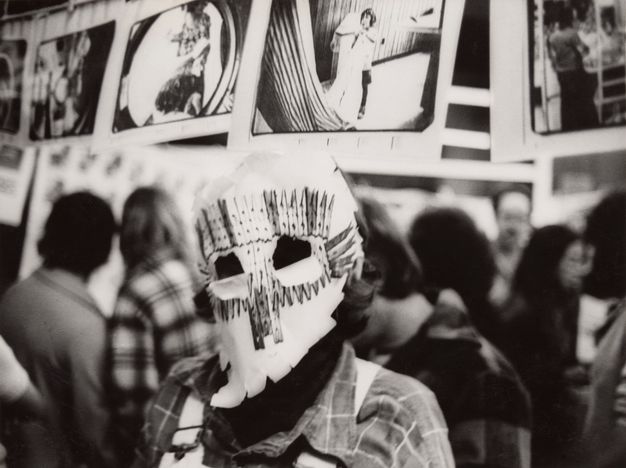
misunderstandings. For example, the collective initially wore
fantastical masks collaged with photographs of bones and
clothespins (fig. 6). However, they retired the masks after patrons at the Echo
Park Laundromat grew apprehensive, fearing the women were
planning to rob them. While the artists expressed a desire for
wider public outreach and democratization of art, a power
differential existed between them and the laundromat clientele
that remained unresolved.
ExpandFig. 6. —Mother Art (US American, founded 1973).
Mask worn during the performance of
Laundry Works, Echo Park Laundromat, Los Angeles,
3 November 1977, black-and-white photograph, 28 × 35.5 cm.
Photograph by Mother Art. Los Angeles, Getty Research
Institute, 2017.M.60.
While most participants reported enjoying the lively
atmosphere, the art objects were subject to criticism. In his
review, Brennan expresses enthusiasm for Mother Art’s
intervention into public space but quickly clarifies that,
“from a strictly esthetic point of view, ‘Laundryworks’
[sic] isn’t impressive.” He insists: “The imagery,
while personal, doesn’t rise above the derivative to achieve
the universal.”32
Brennan’s review is, ironically, derivative itself, parroting
one of the most repeated critiques of women’s artwork during
the 1970s: that it was lacking in quality. Like many male
critics of the time, he offers no definition of the “the
universal,” a concept that women and artists of color were
actively contesting for its normalization of a masculine,
middle-class, European and US American worldview. Whose work
is considered “universal” is deeply gendered, as art historian
Anna Chave construes in her analysis of minimalist art and
biography.33
Chave argues that in the 1960s, the predominant critical
paradigm shifted to deemphasize the artist as an
individual—yet this only applied to men’s work. In the rare
instances that women artists received critical attention,
their work was interpreted as autobiographical—the kind of
“personal” content that critics such as Brennan considered
lesser than, or “derivative.”
In fact, Mother Art arguably did see their work as manifesting
a kind of universality, although one arguably different from
that espoused by Brennan and other formalist critics. In
response to the survey question “What is feminist art?” that
curators Iskin, Lippard, and Raven circulated to hundreds of
women artists as part of their 1976 exhibition of the same
name at the Woman’s Building, the collective wrote: “As Mother
Art we remove the mask of invisibility, wipe away the strained
smile of forced roles. . . . We insist upon the
extraordinariness of the ordinary, the magic in the
commonplace. We invent our own myths of motherhood which
universally connect us to the past, the present and the future
through birth, growth, and death.”34
Even at the time, this mission statement would likely have
elicited accusations of essentialism from members of the
feminist art community who considered celebratory explorations
of embodiment—including pregnancy and motherhood—regressive.
While some feminist artists of the era were addressing female
experience through the figure of the primordial fertility
goddess, many others were deeply critical of embracing any
concept of so-called universal experience or values,
especially through figures and processes that rooted female
identity in the biological sense.35
As many feminists have pointed out, women and mothers are not
interchangeable categories. Still, art historian Rosemary
Betterton argues, “The maternal body is a symbolic construct
with enormous cultural resonance, systematically shaped and
produced through competing discourses and practices, yet at
the same time curiously unacknowledged in terms of its visual
history.”36
For Mother Art, motherhood served as a site for problematizing
the universal and exposing how this concept had been
historically mobilized to normalize a masculine worldview. At
the time of Laundry Works, definitions of motherhood
would have necessarily excluded men. For this reason, the
collective’s reference to the universal in their artist
statement is provocative and perhaps laced with irony,
revealing the limits of the claims to universality that
critics such as Brennan employed as legitimizing discourse.
It is evident that Mother Art also considered motherhood a
broadly accessible entry point for confronting systemic
inequalities, including the devaluation of socially
reproductive labor. As an experience shared by billions across
the world and throughout history, motherhood presented an
opportunity to produce affinities crossing boundaries of
class, race, sexual orientation, and national identity. In
Laundry Works, the artists and attendees met in the
laundromat as fellow mothers but also as fellow workers. The
artists emphasized this point in their brochure, which
featured a questionnaire designed to spark conversation. The
list ended with a question evocative of a workers’ inquiry or
management survey, asking audience members: “Do you feel
lonely, irritated, satisfied doing this job?”37
Here, Mother Art encouraged their audience to view laundering,
a household chore, as labor. This provocation reinforces
arguments by social reproduction theorists such as
International Wages for Housework Campaign cofounder Silvia
Federici, who maintains that recognizing and valuing domestic
labor as work—rather than as a selfless act of love—is a
precondition for resisting exploitative conditions.38
With Laundry Works, Mother Art insisted upon the
arguably universal truth that women’s care work has always
fueled the world, and, under capitalism, has been denied
visibility as labor.39
By siting their performances in locations connected to
household work, Mother Art highlighted how the overlooked
spaces of gendered labor are essential to the functioning of
both public life and the private sector.
A “Boondoggle” in the State Budget
Nearly half a year after Mother Art closed their final
performance of Laundry Works, the project became the
focus of delayed public attention beyond any of the artists’
expectations. In June 1978, California voters passed a
referendum that promised to drastically cut property taxes,
with enormous repercussions for the state budget. Widely
considered one of the most influential US American referenda
of the twentieth century, Proposition 13 won 65 percent of the
vote in a seismic “tax revolt” that rippled across the
country.40
Political sociologist Isaac William Martin argues that the
referendum’s success was part of a larger social movement that
portended Reagan’s landslide victory in the 1980 presidential
election, with effects felt to the present day.41
Although popular with the state’s voting public, the
proposition inspired intense debate, with opponents—including
unions, teachers, the Democratic Party, and the
Los Angeles Times editorial board—warning of
devastating impacts on social services. Once the referendum
passed, state legislators were forced to find ways to reduce
spending, and Mother Art became a target.
A little over a week after Proposition 13 was approved,
journalist W. B. Rood published an article in the
Los Angeles Times describing the need to “cut fat” in
the state budget. Rood lists a number of “wasteful”
expenditures as examples, including Laundry Works,
which he sneeringly describes as an attempt at “providing a
little culture for housewives.”42
These condescending remarks are rooted in a longer history of
discrediting mothers who claim public financial support, with
attacks frequently articulated in classist and racist
terms.43
Rood’s criticisms appeared at the same time as the
stigmatizing “welfare queen” stereotype was gaining traction
in the 1970s mass media. In response to these kinds of
derogatory judgments, welfare recipients—especially women of
color—publicly advocated for themselves, forming grassroots
groups such as the National Welfare Rights Organization
(NWRO).44
One of its leaders was the Los Angeles–based former laundry
worker Johnnie Tillmon, who compared welfare to an abusive,
controlling marriage in an influential 1972 article published
in the mainstream feminist movement’s flagship magazine
Ms.45
Directing her message at the periodical’s middle-class
readership, Tillmon challenges the framing of welfare
claimants as dependents of the state and instead situates
their underappreciated, often invisible work inside and
outside of the home as indispensable to the functioning of
society. Tillmon makes the case for a system that might today
be described as universal basic income, a proposition that
later feminist campaigns such as International Wages for
Housework would continue to develop.46
Nevertheless, in a newsletter of 1977, the Los Angeles Wages
for Housework Committee (LAWFHC) expressed disapproval of both
higher property taxes and cuts to public infrastructure,
arguing that the home is a workplace for women and, as such,
should not be taxed at a higher rate than businesses. It
contended: “The government is trying to make us pay—either
through higher taxes or cuts in services or both. By dividing
us into homeowners, renters, welfare mothers, suburban
housewives and city housewives, it has divided our struggle
and turned us against each other. While some of us are
fighting to cut the budget, others of us fight to increase
social services. We refuse to be divided against ourselves! We
are all housewives.”47
The LAWFHC considered the debate around Proposition 13
polarizing, splintering women as a political class. Instead,
the group advocated for increased taxes on corporations, which
they believed directly benefited from women’s work performed
in the private home and the public sector. When Rood dismissed
Mother Art and their audience as “housewives,” he ironically
reinforced the LAWFHC’s subversive claim that “we are all
housewives,” which the group treated as a feminist rallying
cry. The LAWFHC considered the housewife a symbol of women’s
oppression under capitalism, using the oft-belittled figure to
advocate for a diverse coalition of women and working-class
subjects united through the unpaid and underpaid domestic
labor they perform with little recognition.
Laundry Works sought to bring together this broad
base of community in physical space through a performative
intervention into the sphere of domestic labor, a project
critics such as Rood deemed insignificant.
While feminists including Mother Art envisioned a united
coalition of reproductive workers, they often overlooked
issues related to race. This oversight led International Wages
for Housework Campaign activists to form the subgroup Black
Women for Wages for Housework (BWFWFH), which maintained close
ties to the welfare rights movement. In her history of the
Wages for Housework campaign, historian Emily Callaci argues
that BWFWFH organizers considered their movement a
continuation of the Black freedom struggle, with leader
Wilmette Brown arguing that Black welfare mothers demanded
wages for housework “as damages; as back pay for all the
unpaid and unwaged work of plantation and domestic slavery; as
reparations.”48
As white women, Mother Art’s members would not have been the
primary targets of the “welfare queen” stereotype and the
state’s most violent and racialized policies, but they were
nonetheless implicated in the demonization of women who
deviated from the heterosexual nuclear family model,
particularly the collective’s members who were queer and/or
single parents. Mother Art members understood that an attack
directed at Laundry Works was an attack leveled at
all who performed low-status care and survival work.
The media scapegoating of Mother Art had longevity, and
references to the group appear in news articles into the early
1980s. Art historian Larne Abse Gogarty argues that the
backlash over Laundry Works illustrates how “the New
Deal consensus over the necessity for welfare and public
spending was largely diminished by the end of the 1970s, with
art positioned as especially wasteful when it sought to
address social need.”49
The controversy arguably reached its zenith when former
California Governor Reagan referenced Mother Art on a radio
commentary titled “Waste” in late 1978.50
Reagan apparently mentioned the collective again shortly
following his presidential inauguration in 1981, according to
an article by Los Angeles Times theater critic Dan
Sullivan, who detailed a phone conversation he had had with
Reagan. In the call, Sullivan recounts valiantly defending the
National Endowment of the Arts (NEA) while conceding that
public funding of Mother Art represented a budgetary
“boondoggle.”51
Sullivan refers to Laundry Works as “silly stuff” and
“a flaky project” while printing factual errors about the
work, including overstating the grant amount by more than
double and failing to clarify that the project was supported
by the California Arts Council (CAC), not the NEA.52
Alongside Reagan, Sullivan joins the chorus of ill-informed
critics who made no effort to learn more about the work,
instead quickly dismissing it as a “waste” of time and
resources, not even worth properly researching.
While they represented a frequent target in the firestorm
surrounding Proposition 13, the members of Mother Art were not
the only artists affected by discussions around funding. In a
state senate debate of 1978, Republican representative Dennis
Carpenter ripped into the CAC for supporting artists whom he
generalized as “the underbelly of society,” producers of
“trash” that “normal people” would not consider art.53
This kind of inflammatory language inspired Mother Art to join
forces with a group of other artists and cultural leaders to
co-organize an event they described as “an evening of open
dialogue about the arts.”54
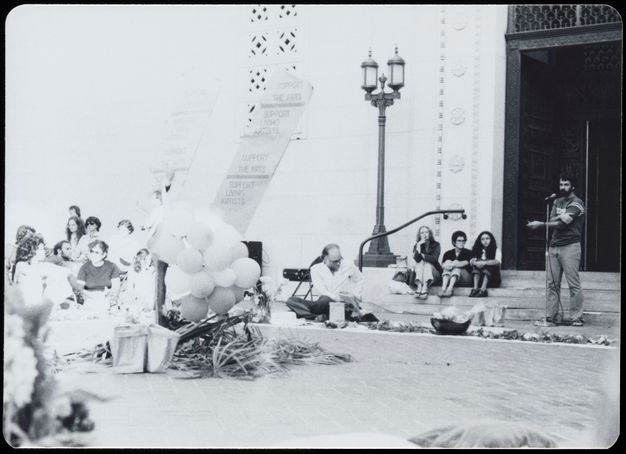
On 27 August 1978 a group gathered in the courtyard of the Los
Angeles City Hall for a convening called Art for Public
Consumption, which included music, performances, a group
dinner, and speeches by Million-Ruby and artists Judy Baca,
Suzanne Jackson, Allan Kaprow, Leslie Labowitz, and John
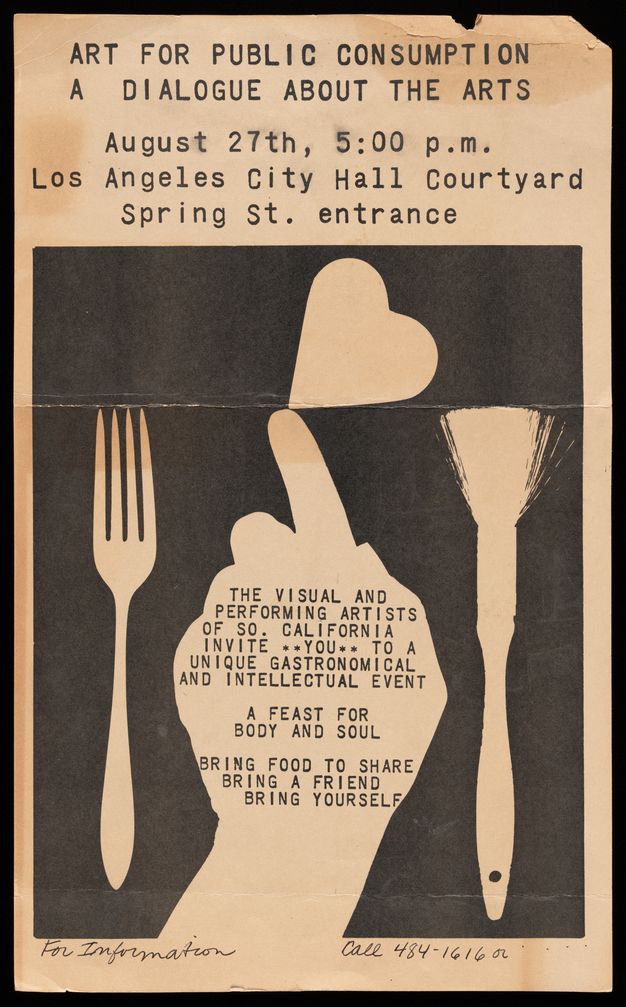
Outterbridge, among others (fig. 7). The flyer promised a “unique gastronomical and
intellectual event” and featured a black-and-white graphic of
a hand pointing up to touch the base of a heart and flanked on
either side by a fork and a paintbrush, suggesting that art,
like food, provides essential nourishment (fig. 8). The program was covered for the
Los Angeles Times by Suzanne Muchnic, an art critic
who was also listed in the program as a speaker. Muchnic
describes a relaxed and convivial atmosphere, which is
reflected in photographs of the event; she also recounts
participants engaging in serious debate about art’s role in
society.55
According to Muchnic’s account, Kaprow entreated his fellow
artists not to beg for handouts, which he considered
“demeaning,” while critic Peter Plagens professed that, in
artmaking, “public outcry is part of the territory,”
instructing his audience not to compromise their artistic
vision when faced with public pressure.56
Presenting a slightly more optimistic perspective, Hugh
Stevenson, aide to Councilman Joel Wachs, suggested that the
uproar surrounding Proposition 13 could present a starting
point for further discussion and encouraged artists to educate
public officials about their work. Even when confronting the
defamatory characterization of their work as waste, Los
Angeles artists responded by bringing their community together
in dialogue and solidarity. While legislators and critics in
the press accused them of squandering public funds, Mother Art
treated Art for Public Consumption as an opportunity to defend
the social value of creative and reproductive labor while
protesting the structural inequalities that underpin the
distribution of public funds.
ExpandFig. 7. —Documentation of Art for Public Consumption, an event
co-organized by Mother Art, 27 August 1978, Los Angeles
City Hall, black-and-white photograph, 12 × 9
cm.
Photographer(s) not identified. Los Angeles, Getty
Research Institute, 2017.M.60.ExpandFig. 8. —Flyer publicizing Art for Public Consumption, an event
co-organized by Mother Art, Los Angeles City Hall, 27
August 1978, 22 × 35.6 cm.
Los Angeles, Getty Research Institute, 2017.M.60.
Cleaning Up Real Waste
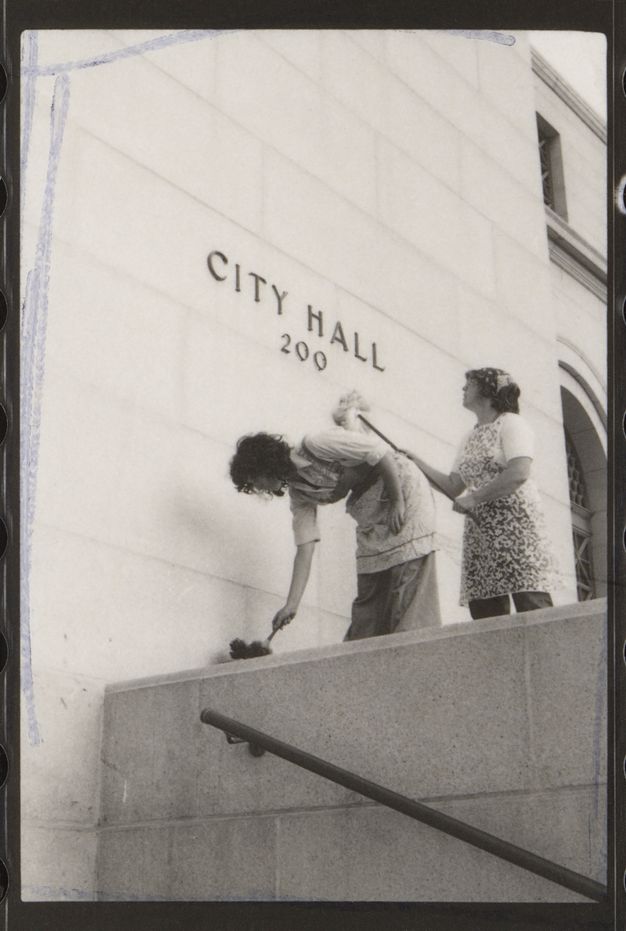
In addition to co-organizing Art for Public Consumption,
Mother Art fired back at their critics through a 1978
performance work titled
Mother Art Cleans Up City Hall, instigated in
response to Proposition 13 and the publication of Rood’s
Los Angeles Times article. The performance was the
second in a series; the first, titled
Mother Art Cleans Up the Banks, was produced in
connection with the College Art Association Conference of 1978
and involved Mother Art members cleaning the facades of two
financial institutions along Wilshire Boulevard. The second
performance took place at City Hall; Siegel, Silagi, and
Hajduk recall that it was primarily done for the purpose of
documentation.57
As in the earlier performance, Mother Art members brought an
assortment of cleaning supplies and proceeded to sweep, mop,
dust, and scrub the building’s stately exterior. The
performance pointed out the hypocrisy involved in singling out
a low-budget performance as waste when arts funding accounted
for only a miniscule portion of federal, state, and local
budgets. Real waste, Mother Art’s piece suggested, is
generated by corporate greed and the legislators who back
business interests over communities.
The photographs that capture the event highlight the
inefficiency of the artists’ efforts. In one image, Silagi
dusts the ground, while Million-Ruby attempts to wash the
building’s towering facade with a mop (fig. 9). The women are dwarfed by the vast expanse of wall
surrounding them, emphasizing the impossibility of their task.
Armed with meager feather dusters and tiny buckets, Mother Art
members clearly lack the appropriate tools to tackle the job.
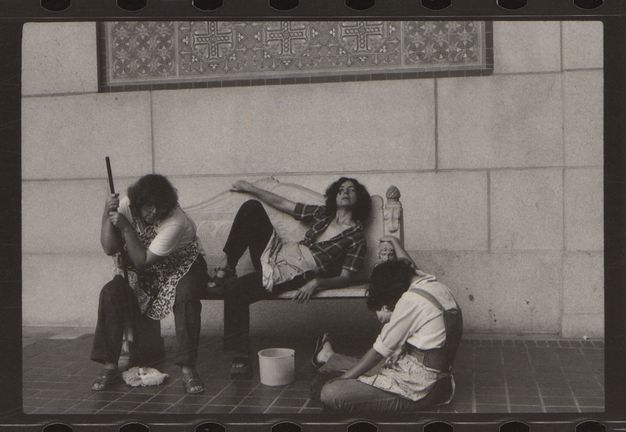
The artists appear to acknowledge the absurdity of their
situation; in one photograph, the three women slump at a
bench, with Million-Ruby and Silagi slouching over the
cleaning equipment while Siegel stretches back on the seat,
perhaps accepting defeat and indulging in a moment of rest (fig. 10). For Mother Art, the futility of these repetitive gestures
was meant as a metaphor, symbolizing “the lack of power women
have to affect [sic] changes in institutions.”58
Their seemingly pointless actions may also have served as a
humorous riposte to critics who accused the artists of
frivolity and flakiness. While undoubtedly satirical, Mother
Art insists that “these were critical gestures” pointing to
urgent political issues.59
The performance served as a powerful reminder that when public
spending is cut, additional unpaid labor falls largely on
women, who take on formerly state-supported, socially
reproductive work without compensation (for example, by
volunteering at understaffed schools). Art historian Andrea
Liss argues the performance was “simultaneously creating
commentary on real fiscal waste and articulating the powerful
bonds between women’s domestic and public spaces.”60
ExpandFig. 9. —Mother Art (US American, founded 1973).
View of the performance
Mother Art Cleans Up City Hall, 1978,
black-and-white photograph from contact sheet, 2.5 × 3.7
cm (image); 23.5 × 18 cm (sheet). Los Angeles, Getty
Research Institute, 2017.M.60.ExpandFig. 10. —Mother Art (US American, founded 1973).
View of the performance
Mother Art Cleans Up City Hall, 1978,
black-and-white photograph from contact sheet, 2.5 × 3.7
cm (image); 23.5 × 18 cm (sheet). Los Angeles, Getty
Research Institute, 2017.M.60.
Driven by a desire to link labor performed in private and
public spaces, Mother Art’s work contributed to a larger
movement of politicized feminist performance and institutional
critique that challenged sexist value systems. In a fall 1978
issue of High Performance, the collective reflected
on their Cleans Up performances, describing the
series as “a verbal and a visual pun about the role of women
as purifiers and domestic sanitation workers of the
world.”61
These comments situate Mother Art’s engagement with local
struggles within a broader, transnational context—or as the
artists term it, the world. Laundry Works and the
Cleans Up series align Mother Art with other
second-wave feminist artists exploring gendered divisions of
labor, including Mierle Laderman Ukeles, whose landmark
performances Touch Sanitation (1979–80) and
Washing / Tracks / Maintenance: Outside (1973)
“address the unrecognized labor of domesticity and sanitation”
(fig. 11).62
Ukeles is perhaps best known for coining the phrase
“maintenance art” in a manifesto of 1969, in which she
advocated an artistic practice eroding the binary split
dividing productive and reproductive labor, or “development”
and “maintenance,” as she describes it, using the New York
City Department of City Planning’s terminology.63
The feminist political investments articulated in performances
by Ukeles and Mother Art are reflected in numerous artworks
produced by women artists across different parts of the world,
demonstrating that Mother Art was not alone in probing issues
related to domestic labor and care. In France, Argentine
artist Lea Lublin installed a nursery at the Musée d’Art
Moderne de la Ville de Paris (City of Paris Museum of Modern
Art), where her performance
Mon fils (My son; 1968)
involved publicly caring for her infant son in the
gallery.64
In Poland, Anna Kutera dipped a broom in black paint and swept
it across a white canvas laid out on the floor of her studio,
a work she called Feminist Painting (1973). In Spain,
the feminist collective Les Nyakes scrubbed the floors at the
Primeres Jornades Catalanes de la Dona
(First Catalan Women’s Conference) in 1976, organized in
Barcelona shortly after dictator Francisco Franco’s death. In
Brazil, artist Letícia Parente filmed herself lying face down
on an ironing board while her maid ran an iron over her body,
a performance for the camera titled
Tarefa I (Assignment I; 1982).
Although these artists were not always aware of each other’s
work, transnational and transcultural exchanges did occur.
Mexican artist Mónica Mayer, a student at the FSW, wrote about
Mother Art in her master’s thesis in 1980.65
Three years later, Mayer went on to cofound the collective
Polvo de Gallina Negra (Black Hen Powder) with artist Maris
Bustamante in Mexico City, where they staged performances
exploring the labor of mothering, positioning domestic labor
as a political issue.66
Individually and, even more so, collectively, these
groundbreaking performances challenge perspectives that
consider social reproduction to be women’s biological destiny
rather than labor that supports capitalist production. Through
performative artworks often presented in public spaces,
feminist artists became agents of societal transformation,
working toward the as-yet-unrealized goal of ending labor
exploitation governed by patriarchal oppression.
When making Laundry Works and Cleans Up,
Mother Art was guided by an interest in questioning the very
meaning of public art, asking how the siting of artwork in
spaces of common use can inspire radical change to everyday
life. In his review of Laundry Works, Brennan
reassured his readers that the artists were not “wild-eyed art
revolutionaries,” yet his evaluation is belied by statements
that the artists made at the time as well as later, which
suggest that they saw their project as transgressive. In a
2005 interview, Mother Art reflected: “There was something
absolutely, wonderfully material about dealing with the sheer
transformation of dirty clothes—wet, dry and the cycle, the
literal revolution—and the metaphors are ripe for connections
with social revolution, perhaps even something unimagined,
perhaps utopian.”67
The seismic societal shifts Mother Art envisioned and sought
to enact through their work gesture toward a future in which
care and community are prioritized, a future yet to be
determined.
Lexington Davis is a writer, curator, and
lecturer at Leiden University’s Centre for the Arts in
Society, Netherlands.
Notes
Sincere thanks to Catherine Spencer, Kirsten Lloyd, Laura
Silagi, Glora Hajduk, Suzanne Siegel, and the anonymous
reviewers for their insights and suggestions. I presented this
research in 2025 at the Crystal Bridges Museum of American Art
in Bentonville, Arkansas, and would like to thank the
attendees for their valuable feedback. Additional appreciation
goes to the Getty Research Institute staff who provided
archival and editorial assistance, including Ariel Waitkuweit
and Lauren Gendler. This research was supported by funding
from the UK Arts & Humanities Research Council.
David Harvey argues that the “neoliberal turn” was
already in motion during the early 1970s but
acknowledges 1978–80 as a “revolutionary turning point”
in world history with the elections of Deng Xiaoping in
China, Margaret Thatcher in the United Kingdom, and
Ronald Reagan in the United States, coinciding with US
Federal Reserve Chair Paul Volcker’s influence on
monetary policy in this period. David Harvey,
A Brief History of Neoliberalism (Oxford
University Press, 2007).
↩︎
For more on the history of social reproduction in
feminist theory and practice, see Susan Ferguson,
Women and Work: Feminism, Labour, and Social
Reproduction
(Pluto Press, 2019); and Tithi Bhattacharya, ed.,
Social Reproduction Theory: Remapping Class,
Recentering Oppression
(Pluto Press, 2017).
↩︎
Michelle Moravec, “Mother Art: Feminism, Art and
Activism,”
Journal of the Motherhood Initiative for Research and
Community Involvement
5, no. 1 (2003): 69–77; and Elena Cologni and Mother Art
Collective, “Mother(ings): From the Home to the Planet.
A Dialogue Between Mother Art Collective and Elena
Cologni,” in Art for the Sake of Care, ed.
Merel Visse and Elena Cologni special issue,
International Journal of Education and the Arts
25, no. 1 (September 2024):
http://doi.org/10.26209/ijea25si1.6. ↩︎
Here I build on art historical studies on the treatment
of domestic labor in 1970s feminist performance,
including Helen Molesworth, “House Work and Art Work,”
October 92 (2000): 71–97; and Siona Wilson,
Art Labor, Sex Politics: Feminist Effects in 1970s
British Art and Performance
(University of Minnesota Press, 2015).
↩︎
When Chicago resigned from CalArts in 1973 to found the
Woman’s Building, Schapiro continued the Feminist Art
Program until she left the school in 1975.
↩︎
Dolores Hayden,
Redesigning the American Dream: The Future of
Housing, Work, and Family Life
(W. W. Norton, 1984), 223.
↩︎
Feminist Studio Workshop faculty member Suzanne Lacy and
artist Leslie Labowitz formed Ariadne: A Social Art
Network, an activist feminist group that advocated to
end violence against women. While at the Woman’s
Building, Lacy and Labowitz produced performances
protesting rape and gender-based violence, including
Three Weeks in May (1977) and
In Mourning and In Rage (1977). The performance
collective The Waitresses, founded in 1977 by artists
Jerri Allyn and Anne Gauldin, used their experiences in
food service as a starting point for addressing feminist
issues around working-class women’s labor.
↩︎
For more on the criticisms of “cultural feminism,” see
Alice Echols,
Daring to Be Bad: Radical Feminism in America
1967–1975
(University of Minnesota Press, 2019); and Andrea Long
Chu, “The Impossibility of Feminism,”
Differences 30, no. 1 (2019): 63–81.
↩︎
Arlene Raven, quoted in Ruth Iskin, “Feminist Education
at the Feminist Studio Workshop,” in
Learning Our Way: Essays in Feminist Education,
ed. Charlotte Bunch and Sandra Pollack (The Crossing
Press, 1983), 172.
↩︎
Judy Chicago,
Through the Flower: My Struggle as a Woman Artist
(Anchor Books, 1975), 41.
↩︎
Siegel, quoted in Moravec, “Mother Art, ” 70; and
Million-Ruby and Kruse, quoted in Laura Silagi, Deborah
Krall, and Suzanne Siegel, script for
Mother Art Tells Her Story, 1–2, 2011–13, Los
Angeles, Getty Research Institute (GRI), Mother Art
records, 1973–2017, 2017.M.60, box 1, folder 11. In an
interview from 17 July 2024 conducted over e-mail with
Siegel and Silagi, the artists confirmed their memories
of this policy, which they state was collectively
determined by women in the Feminist Studio Workshop, a
majority of whom were younger and did not have children.
Beyond the artists’ recollections, I have not located
documentation regarding specific rules about dogs or
children at the FSW. In her memoir of the Woman’s
Building, artist Terry Wolverton describes debate
erupting over male children being excluded from the
building and dogs not being permitted in the dorms.
Terry Wolverton,
Insurgent Muse: Life and Art at the Woman’s
Building
(City Lights, 2002), 33.
↩︎
See, for example, Dolores Hayden,
The Grand Domestic Revolution: A History of Feminist
Designs for American Homes, Neighborhoods, and
Cities
(MIT Press, 1982); Linda McDowell,
Gender, Identity and Place: Understanding Feminist
Geographies
(University of Minnesota Press, 1999); Winifred Curran,
Gender and Gentrification (Routledge, 2017);
and Leslie Kern,
Feminist City: Claiming Space in a Man-Made World
(Verso, 2020).
↩︎
Efforts to create care infrastructure in the urban
environment echo earlier initiatives by US American
women during the Progressive Era who saw the city as an
extension of women’s domain in the home. For more on
this movement to improve public sanitation, health, and
social welfare, which became known as municipal
housekeeping, see Ann Oakley,
Women, Peace and Welfare: A Suppressed History of
Social Reform, 1880–1920
(Policy Press, 2023).
↩︎
See Rosalyn Deutsche’s critique of urban geographers’
universalizing analyses of the postmodern city and its
visual representations: Rosalyn Deutsche,
Evictions: Art and Spatial Politics (MIT Press,
2002).
↩︎
Pamela M. Lee, “Construction Sites: Women Artists in
California and the Production of Space-Time,” in
Art/Women/California, 1950–2000: Parallels and
Intersections, ed. Diana Burgess Fuller and Daniela Salvioni
(University of California Press, 2002), 275.
↩︎
Silagi, Krall, and Siegel, script for
Mother Art Tells Her Story, 7, Mother Art
records, GRI.
↩︎
Silagi, Krall, and Siegel, script for
Mother Art Tells Her Story, 7.
↩︎
The series began on 23 October with a performance that
involved washing clothing in the Los Angeles River, a
51-mile-long engineered waterway for storm runoff. The
laundromat performances took place at Echo Park
Laundromat (3 November), Park Avenue Launderette in
Highland Park (7 November), Launderland in Hollywood (12
November), Highlander Center Laundromat in Venice (22
November), and Launderland in Silverlake (1 December).
↩︎
Meiling Cheng,
In Other Los Angeleses: Multicentric Performance
Art
(University of California Press, 2002), 13.
↩︎
Laura Silagi and Suzanne Siegel, e-mail interview with
the author, 17 July 2024.
↩︎
In his article for the Evening Outlook, Barry
Brennan claims more than one hundred fifty people
attended the Venice performance. Barry Brennan,
“Cleaning Up in the Art World,”
Evening Outlook, 27 November 1976, 7A. In an
unpublished letter to the editor of the
Los Angeles Times from 1978, Mother Art claims
that one performance had an audience numbering two
hundred. Gloria Hajduk et al., unpublished letter to the
editor of the Los Angeles Times, 18 July 1978,
Mother Art records, GRI, box 1, folder 5.
↩︎
See Alexandra Juhasz, “A Process Archive: The Grand
Circularity of Woman’s Building Video,” in
Doin’ It in Public: Feminism and Art at the Woman’s
Building, ed. Meg Linton, Sue Maberry, and Elizabeth Pulsinelli
(Ben Maltz Gallery; Otis College of Art and Design,
2012), 97–123.
↩︎
Mother Art, Laundry Works brochure, 1977, n.p.,
Mother Art records, GRI, box 2, folder 7.
↩︎
Silagi, Krall, and Siegel, script for
Mother Art Tells Her Story, 9.
↩︎
Still image in Silagi, Krall, and Siegel,
Mother Art Tells Her Story.
↩︎
“The Great Goddess Debate” of the 1970s and 80s
epitomized a perceived schism in the feminist art
community between an essentialist and
social-constructivist approach to gendered experience.
However, numerous art historians have criticized this
binary as an oversimplification of more nuanced
perspectives. See Molesworth, “House Work and Art Work”;
and Mira Schor, “Backlash and Appropriation,” in
The Power of Feminist Art: The American Movement of
the 1970s, History and Impact, ed. Norma Broude and Mary D. Garrard (Harry N.
Abrams, 1994), 248–63.
↩︎
Rosemary Betterton,
Maternal Bodies in the Visual Arts (Manchester
University Press, 2014), 1.
↩︎
In her 1975 pamphlet Wages Against Housework,
Federici writes: “They say it is love. We say it is
unwaged work.” Silvia Federici,
Wages Against Housework (Falling Wall Press,
1975), 1.
↩︎
Salar Mohandesi and Emma Teitelman, “Without Reserves,”
in Bhattacharya, Social Reproduction Theory,
43. ↩︎
See Arthur O’Sullivan et al.,
Property Taxes and Tax Revolts: The Legacy of
Proposition 13
(Cambridge University Press, 1995); and Isaac William
Martin,
The Permanent Tax Revolt: How the Property Tax
Transformed American Politics
(Stanford University Press, 2008).
↩︎
W. B. Rood, “Legislators Seek Ways to Cut Fat, Don’t
Have Far to Look,” Los Angeles Times, 12 June
1978.
↩︎
Perhaps the most infamous denunciation of mothers
receiving welfare was politician Daniel Patrick
Moynihan’s report
The Negro Family: The Case for National Action
of 1965, prepared for the US Department of Labor’s
Office of Policy Planning and Review, in which Moynihan
argued that single mothers were responsible for poverty
and crime in Black communities. Even though his analysis
received intense criticism, it had lasting impact on the
perception of women welfare recipients, particularly
mothers of color.
↩︎
For more detailed histories of the welfare rights
movement, see Premilla Nadasen,
Welfare Warriors: The Welfare Rights Movement in the
United States
(Routledge, 2004); and Priya Kandaswamy,
Domestic Contradictions: Race and Gendered
Citizenship from Reconstruction to Welfare Reform
(Duke University Press, 2021).
↩︎
Johnnie Tillmon, “Welfare Is a Woman’s Issue,”
Ms., Spring 1972, 111–16.
↩︎
In an interview in 2019, Wages for Housework leader
Selma James explicitly credits the welfare rights
movement with inspiring Wages for Housework. Ron
Agustin, “Beyond Boundaries: Selma James Interviewed by
Ron Agustin,” Monthly Review 71, no. 4
(September 2019): 64.
↩︎
Los Angeles Wages for Housework Committee, “A View from
the Kitchen: Property Taxes,”
Wages for Housework Newsletter: National Edition, spring 1977, 3, London, Bishopsgate Institute, Wages
for Housework Campaign Archive, 1970–2022, box 7.
↩︎
Wilmette Brown,
Roots: Black Ghetto Ecology (Housewives in
Dialogue, 1986), 14, cited in Emily Callaci,
Wages for Housework: The Feminist Fight Against
Unpaid Labor
(Seal Press, 2025), 199.
↩︎
Larne Abse Gogarty,
Usable Pasts: Social Practice and State Formation in
American Art
(Haymarket Books, 2023), 112.
↩︎
Ronald Reagan, “Reprint of a radio program titled
‘Waste,’” n.p., 29 November 1978, KABC Radio, Mother Art
records, GRI, box 1, folder 11.
↩︎
Dan Sullivan, “A Call from the President,”
Los Angeles Times, 18 March 1981, clipping from
Mother Art records, GRI, box 2.
↩︎
Larry Stammer, “Arts Council Under Fire in State
Senate,” Los Angeles Times, 26 August 1978,
B12. Carpenter does not name specific artists, at least
not according to Stammer’s report.
↩︎
Mother Art, program for “Art for Public Consumption,” 27
August 1978, Mother Art records, GRI, box 2, folder 10.
↩︎
Suzanne Muchnic, “Artists Take a Political Step,”
Los Angeles Times, 30 August 1978, part 4,
clipping from Mother Art records, GRI, box 2.
↩︎
Mierle Laderman Ukeles, “Manifesto for Maintenance Art
1969! Proposal for an Exhibition ‘Care,’” in
Institutional Critique: An Anthology of Artists’
Writings, ed. Alexander Alberro and Blake Stimson (MIT Press,
2011), 144–49.
↩︎
See Catherine Spencer, “Acts of Displacement: Lea
Lublin’s Mon Fils, May ’68, and Feminist Psychosocial Revolt,”
Oxford Art Journal 40, no. 1 (2017): 65–83.
↩︎
Mónica P. Mayer Lucido, “Feminist Art: An Effective
Political Tool” (master’s thesis, Goddard College,
1980).
↩︎
See Alberto McKelligan Hernandez, “Representing
Motherhood and Political Violence in Mexico: A
Transnational Feminist Analysis of
Más allá de la vanguardia: La transmaternidad
(Beyond the Avant-Garde: Transmaternity),”
Journal of International Women’s Studies 22,
no. 5 (2021): 38–56.
↩︎
Mother Art, interview by Andrea Liss, Los Angeles, 5
November 2005, quoted in Liss,
Feminist Art and the Maternal, 2–3.
↩︎