Guzmán / The Global System of the ArtsGetty Research Journal, No. 21 (2026)
Copied page section link to clipboard
Abstract
In 1898 a sepulchral monument for the late archbishop
Rafael Valentín Valdivieso (1804–78) was completed in the
Santiago Cathedral. This project was promoted by his
successor, Mariano Casanova (1833–1908), archbishop of
Santiago from 1887 until his death in 1908. Extant
documentation unveils the nature of the aesthetic,
iconographic, and technical decisions involved in the
commissioning of the work, in which those overseeing the
work considered it necessary to look in and beyond Chile
when selecting artists, workshops, and materials.
Reflecting on the process of this artistic commission at
the end of the nineteenth century as well as the
similarities between the final monument’s characteristics
and the ideas of the succeeding archbishop, this essay
situates Valdivieso’s sepulchral monument in Chile within
the global system of the arts of the last decades of the
nineteenth century, in which local skills and technical
specialities of Europe were brought together in a funerary
monument that evinces views on both ecclesiastical
doctrine and artistic creation.
Keywords
marble, stained glass, sculpture, mosaic, funerary
monument, commission, Chile, nineteenth century, Mariano
Casanova, Rafael Valentín Valdivieso, Archbishopric of
Santiago
Copied page section link to clipboard
Peer Review
Double anonymous, external
Copied page section link to clipboard
Cite
Chicago
Fernando Guzmán, “The Global System of the Arts at the End
of the Nineteenth Century and the Commissioning of a
Sepulchral Monument in Santiago, Chile,”
Getty Research Journal, no. 21 (2026),
https://doi.org/10.59491/OXWH9082.
MLA
Guzmán, Fernando. “The Global System of the Arts at the
End of the Nineteenth Century and the Commissioning of a
Sepulchral Monument in Santiago, Chile.”
Getty Research Journal, no. 21, 2026,
https://doi.org/10.59491/OXWH9082.
In 1887, Monsignor Mariano Casanova, archbishop of Santiago,
Chile, gave impetus to the project of constructing a
sepulchral monument destined for the Catedral de Santiago
(Santiago Cathedral) to honor the memory of his late
predecessor in the government of the archdiocese, Monsignor
Rafael Valentín Valdivieso (1804–78). Funding difficulties and
the complexity of the decisions to be made delayed the
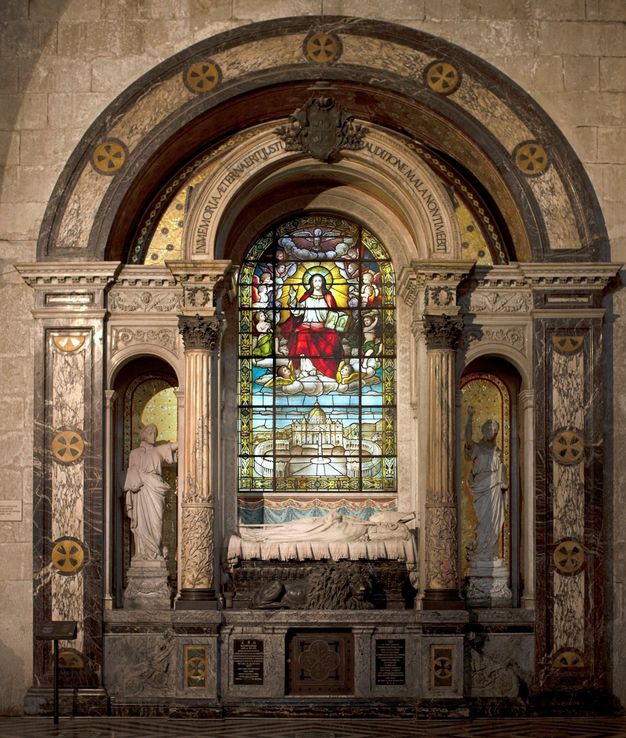
development of the work, which was completed in 1898 (fig. 1).1
The abundance of documentation in the Archivo Histórico del
Arzobispado de Santiago (Historical Archive of the
Archbishopric of Santiago) related to the commission of the
monument illuminates key mechanisms of the global system of
the arts in the last decades of the nineteenth century. This
essay considers the nature of the artistic choices that were
made, paying special attention to the selection of materials,
authors, and stylistic solutions. At the same time, the essay
unveils the logic of the iconographic program of the monument,
reflecting on the historical implications of its ultimate
configuration.
ExpandFig. 1. —Emilio Doyère (French, 1847–1918), architect.
Sepulchral monument for the late Archbishop Rafael
Valentín Valdivieso, 1898, marble, bronze, stained glass,
and mosaic, 820 × 723 × 185 cm. Santiago, Chile, Santiago
Cathedral. Photograph by Ulises Nilo, 27 July 2024.
Without a doubt, Valdivieso’s tomb is part of a broader
process. During the nineteenth century, the Chilean art scene
underwent significant changes. Some of the circumstances
driving the renewal were the founding of Chile’s Academia de
Pintura (Academy of Painting) in 1849, the arrival of foreign
artists and architects to Santiago of Chile, and the
importation of European paintings and sculptures.2
During the inauguration of the Academia de Pintura, its first
director, Neapolitan painter Alessandro Ciccarelli, expressed
his clear intention to bring Chilean art to the international
stage.3
At the same time, churches began to dispense with their
Baroque ornamentation and acquire contemporary religious art.
From 1857 on, Archbishop Valdivieso instigated a profound
transformation of the cathedral in Santiago.4
The original altarpieces, sculptures, and colonial paintings
were replaced by marble altars and works commissioned from
Italian, French, or Chilean artists trained at the
Academia.5
The erection of the funerary monument can be viewed in this
broader trajectory of change and incorporation into the global
arts arena.
In January 1887 Casanova became archbishop of the diocese of
Santiago. That same year he published a circular in which he
proposed the construction of a new tomb for the remains of
Monsignor Valdivieso, defining the characteristics it should
have.6
The urgency of the initiative indicates that this was an
aspiration that had germinated in his mind long before his
consecration. “The posthumous glorification of great men is a
duty of gratitude and a powerful stimulus for posterity,” the
circular states, especially when “they have consecrated a life
sown with virtues to the service of the Church and of
souls.”7
The text notes the existence of previous initiatives aimed at
the same end that did not prosper due to the difficulties
imposed by the war with Peru and Bolivia and, later, the
cholera epidemic that began in 1886.8
The circular anticipates the objections that some might raise,
such as the high cost or the inappropriateness of the
exaggerated tenor of the homage. Reminding the current
generation of ecclesiastical authorities of their duty to
glorify great men of the church and present the lives of those
figures to society as an example for new generations, the text
points out, “It is not necessary to have merited being raised
to the honor of the altars for the Church to decree their
posthumous glorification.”9
Casanova gives an example of the tombs of the noncanonized
pontiffs preserved in the Eternal City. In this way, he
justifies the work and anticipates possible objections to
dedicating resources to the project of honoring the archbishop
in this way by interposing an authoritative argument.10
The text of the circular instructs that a “monumental
sepulchre should be erected to keep the ashes of our
illustrious predecessor in a dignified manner.”11
In other words, Casanova was thinking of the impact of the
work’s characteristics on its observers. At the same time, the
circular contextualizes such a monument’s materiality: “Public
monuments perpetuate in bronze or marble the memory of those
who have exalted the people.”12
Reference to these materials was commonplace in the nineteenth
century; however, in the context of the circular, it can be
understood as the expression of a precise will: The tomb of
Archbishop Valdivieso was to be erected in marble and bronze,
as indeed it was. A preferred location was also established:
the last arch of the north aisle. But Casanova’s guidelines
were not restricted to monumentality, materiality, and
location. There seems to have been a certain artistic and
architectural program from the outset, ideas that made it
possible for Casanova to commission preliminary designs,
referred to in the circular as “various plans that we have
received from Rome.”13
These plans have not been preserved, but they must have been
drawn up in accordance with Casanova’s instructions.
For review, all of Casanova’s instructions were given to a
board, of which José Ramón Astorga, a priest who was a member
of Santiago Cathedral’s Ecclesiastical Chapter and general
vicar of the archdiocese, was appointed president.14
Astorga had participated in the opposition to Casanova’s
nomination as archbishop. After the death of Valdivieso in
1878, the liberal government appointed Francisco de Paula
Taforó as archbishop. The state of Chile was considered heir
to the royal patronage of the Spanish monarchy, a legal status
that allowed it, among other things, to appoint bishops.
Almost all the priests close to the late Archbishop Valdivieso
considered Taforó to be ignorant of theology, impious, and a
friend of the liberals. In light of the negative reports
coming from Chile, the Holy See never ratified him. After
eight years of the seat’s vacancy and acute tensions, the
government appointed the priest Mariano Casanova as the new
archbishop, an appointment that was ratified by the Holy See.
Nevertheless, Astorga and other priests considered the new
archbishop to be unreliable.15
In this light, the construction of a monumental tomb for
Valdivieso, along with the appointment of Astorga to the
presidency of the board that directed the works, can be
interpreted as a gesture by Casanova aimed at rebuilding trust
and closing a bitter chapter in the history of the Catholic
Church in Chile.
The file of the extant documentation on the sepulchral
monument cataloged in the Archivo Histórico del Arzobispado de
Santiago reveals a long silence of nearly six years between
the circular’s publication in 1887 and the first plans, dated
1893.16
It is very likely that this time was spent collecting funds, a
process about which no written record is preserved. What is
certain is that from 1893 onward, resources were available and
steps were taken to commission the design and execution of the
monument.
Progress of the Project and the Iconographic Program
The first plans for the new tomb as well as a document with
technical instructions were commissioned from Eduardo
Isenring, a German architect based in Chile.17
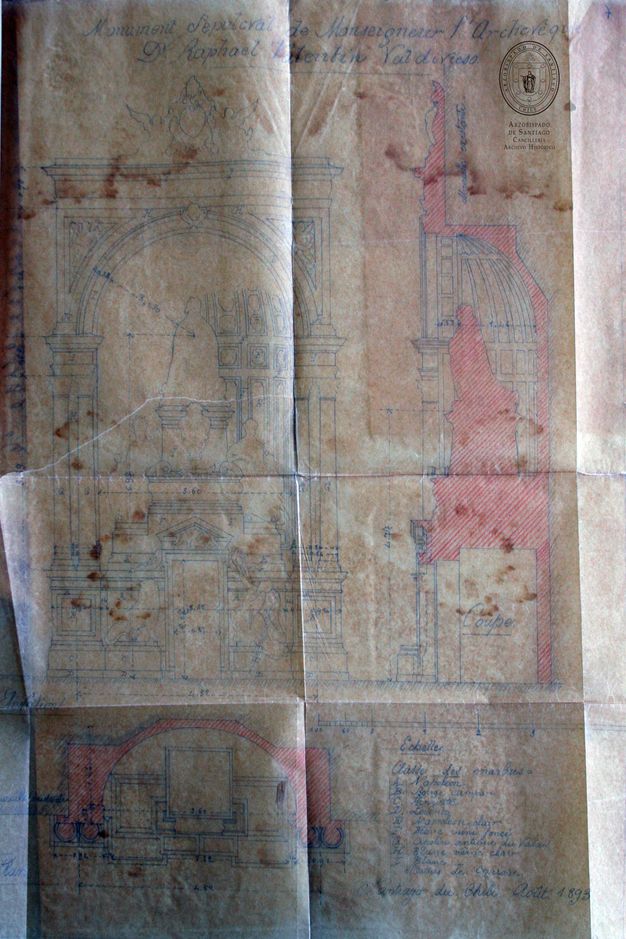
Both documents were intended to establish general guidelines
on the basis of which more detailed proposals from other
architects and artists would be requested (fig. 2). The plan legends and the text of the instructions were
written in French, thus facilitating the search for European
architects or artists to direct the work. The first design by
Isenring differs greatly from what was ultimately executed,
but it seems to contain a number of decisions that had an
impact on the final work. First, he proposed to use the entire
space of one of the chapels in the side aisles. Then, from an
iconographic point of view, he introduced the idea of
representing the allegories of Knowledge and Religion, and the
sculpture of a lion—a funerary symbol with a long
tradition—was incorporated. Other features of this first
proposal were not carried out, such as the representations of
the praying archbishop and the angel offering a laurel branch,
or the particularly invasive idea of opening up the wall to
build an apse to house the ensemble.
ExpandFig. 2. —Eduardo Isenring (German, active in Chile, life dates
unknown).
Plan for
“Monument sepulchral de Monseigneur l’archeveque D.
Raphael Valentín Valdivieso,”
1893. Santiago, Chile, Archivo Histórico del Arzobispado
de Santiago. Image courtesy of the Archivo Histórico del
Arzobispado de Santiago.
For the sculptures of Religion and Wisdom, the instructions
state: “In the center, the archbishop in a praying attitude is
accompanied by his virtues: on the left, religion, and on the
right, human knowledge.”18
The aim was to represent the virtues that those who
commissioned the monument wanted to emphasize as belonging to
the deceased. Casanova, in his first pastoral letter,
published in 1887, highlights the legacy of Archbishop
Valdivieso. He refers to “his firm and wise hand,” as well as
his authority, exercised from “the ascendancy of character and
the superiority of knowledge.”19
But, as well as highlighting the attributes of the late
archbishop, the completed sculptures seem to embody one of
Monsignor Casanova’s policies. In the same document he
outlines a program to articulate human knowledge and religion,
one of the premises of which is that “science is light and all
light leads us to God.”20
To this he adds the desire that all human progress “should be
matured by the sun of faith.”21
The dialogue between science and religion was a central
concern of the government of Casanova, the main manifestation
of which was the foundation, in 1888, of the Universidad
Católica de Chile (Catholic University). This harmony between
human and divine knowledge was expressed in the iconographic
program of the chapel of the archbishop’s palace, whose works
were under the direct supervision of Casanova. The paintings,
created during the last decade of the nineteenth century,
depict, among other themes, the figures of Science,
Literature, Art, Religion, and Faith.22
Input from a Chilean Painter and Diplomat via Paris
The next items in the archival file are the letters and
correspondence between Astorga and Chilean politician,
diplomat, and painter, Ramón Subercaseaux. Subercaseaux was
living in Paris at the time, a circumstance that, together
with his interest in artistic matters, made him the right
person to take on the task of finding the artist for the
sepulchral monument.23
The letters refer to practical issues and contain interesting
observations about the way in which such a commission was
handled as well as reflections on its architectural and
sculptural activity.24
One of the issues raised in the correspondence is that of the
direction of the work. For Astorga, whose views in this area
were influenced by the archbishop’s opinions, the overall
conception and coordination of the work was to be entrusted to
an architect. In one of the first letters he wrote to
Subercaseaux, he pointed out that it would be desirable not to
make any changes to Isenring’s plan, given that “it is a very
great advantage if the architect who drew up the plan is the
one who carries out the work.”25
Astorga implied that what was expected of the European
workshops was the manufacture of the components according to
the specifications sent from Chile. Subercaseaux, on the other
hand, held that “the sculptural part is so important that the
artist who undertakes it cannot be forced to adhere rigorously
to the lines specified.”26
He further proposed that the general conception of the
monument be given to sculptor Justin-Chrysostome Sanson: “In
the event of his [Sanson’s] proposal being accepted, the
detailed plans would be drawn, in agreement with him, by M.
Nenot,” a French architect.27
As such, the Chilean diplomat conceived that the work should
be designed and executed by a sculptor. As was customary in
the nineteenth century, architectural works were subordinate
to sculptural ones.28
Astorga’s stance could likely be explained by the usual
practice of commissioning an architect for altars. In a letter
at the end of 1893, Astorga pointed out to Subercaseaux that
the French sculptor ultimately hired would not be “obliged to
submit to the lines drawn on the plan,” recognizing a degree
of freedom but not acquiescing that the sculptor could
undertake the direction of the creation of the the
monument.29
A second aspect discussed in their epistolary exchange is the
decision about where in Europe the monument should be
produced. Both agreed that in order to ensure good-quality
marble work it was necessary to commission the work in Paris.
While Astorga points out, “At present better works in marble
are done in France than in Italy,” Subercaseaux adds that the
execution of the works in Paris would not imply an increase in
costs, since “what is cheap in Italy is the cheap stuff.”30
Both considered that Italy had lost its status as a supplier
of high-quality artistic works, including marble work. Astorga
complemented the conversation on this matter by adding that
the possibility of the cathedral undergoing a complete
artistic renovation, which would indeed happen a few years
later, was an additional reason for not commissioning “a
shoddy work sent to Switzerland or Italy.”31
However, Sanson himself recommended to Subercaseaux that the
architectural part be executed in the city of Carrara in order
to reduce costs.32
A final interesting point is Astorga’s concern about the
resemblance that the sculpture of Archbishop Valdivieso should
bear to his real appearance—a particularly sensitive matter
considering that many of those who knew him could judge how
well the sculpture resembled the man. In a letter sent to
Subercaseaux in August 1893, Astorga gave an account of the
precautions he had taken to resolve this point. “In addition
to the photographs I can send, I have a plaster death mask of
Sr. Valdivieso’s face taken from his corpse shortly after his
death and which is exactly as we knew it. The only defect is
that his eyes are closed.”33
It was common practice during the second half of the
nineteenth century to give photographs to painters or
sculptors who were to make a portrait of the deceased. The
making of death masks, for its part, had gained particular
popularity during the nineteenth century as another means,
complementary to photography, of remembering the departed.34
In this case, those in charge of the monument showed a special
concern for preserving Valdivieso’s likeness.
At the end of 1893 it seemed clear that the decision would be
to award the commission for the sepulchral monument to the
sculptor Sanson and the architect Henri-Paul Nenot. However,
in January 1894, Insenring and Chilean sculptor Virginio Arias
proposed to take charge of the work, for which they would make
a sketch that would later be used to commission its execution
in Paris. The work was attractive to both of them as a project
with available funding and a very high profile. Isenring’s
long association with the initiative, together with Arias’s
prestige, supported the reception of the proposal.35
Arias had won prizes at the Paris salons and had carried out
outstanding projects in Chile.36
Astorga immediately wrote to Subercaseaux, informing him of
the offer that the two had made. The board, faced with
equivalent offers, preferred “the sculptor Arias for two
reasons: 1, because he is Chilean and it is natural that he
should wish to be accredited in his country, doing work of
merit; 2, because, according to what he has discussed with me,
he accepts to be paid here in Chilean currency.”37
Payment in local currency made it possible to avoid
exchange-rate losses. Subercaseaux endorsed the board’s
decision, believing that “the choice of the sculptor Arias was
the right one, as he is undoubtedly a talented artist,”
expressing, however, his annoyance at the inappropriateness of
the change: “What I regret is that they didn’t decide this
earlier, so as to save the artists from doing useless
work.”38
In the end, the negotiations with Arias were not successful
for financial reasons, as Astorga explains in a letter of June
1895.39
During that year, the exchange rate became favorable to the
Chilean currency, and the decision was made to give a final
push to the project. Astorga insists to Subercaseaux that he
should trust in Isenring’s judgment to direct the work, and
announces the sending of a bill of exchange in his name for
the sum of seventy thousand francs. Subercaseaux’s response to
the board’s insistence is not preserved in the archive, but
subsequent events seem to indicate that Subercaseaux did not
continue to collaborate on the monument. The circumstances
likely reflect local tensions about how to promote artistic
development in Chile.40
The Final Contract
In April 1896 the junta sent Casanova a plan of the sepulchral
monument drawn up by Emilio Doyère, a French architect living
in Chile. In the letter attached to the designs, the junta
stated that it would “gladly see this monument executed in
accordance with the said plan.”41
There is no record of the reasons why Isenring was removed
from the project, even though he had been involved in its
development for years. Doyère, for his part, collaborated in
various works of the archbishopric and was in close contact
with Casanova. Among other responsibilities, he oversaw the
interior ornamentation of the Basílica del Salvador.42
On 11 May 1896 a contract was signed between Doyère and the
Arzobispado de Santiago (Archbishopric of Santiago) to
regulate the execution of the sepulchral monument.43
Although the plans for the monument are not preserved, it is
clear that the contract refers to the sepulcher that was
actually built. The work involved the coordination of
specialists in marble, sculpture, stained glass, and mosaics.
Doyère had trained at the École des Beaux-Arts in Paris and
had participated in the restoration of the Cathédrale
Sainte-Marie de Bayonne (Bayonne Cathedral) in France.44
He arrived in Chile in 1890, joining the Escuela de
Arquitectura (School of Architecture) at the Universidad de
Chile.45
The French architect’s project for the sepulchral monument
retained some of the elements designed by Isenring, such as
the large round arch enclosing the monument, the
representation of the lion, and the presence of the sculptures
of Faith and Science. However, the
architectural concept and the sculptural proposal were
significantly different. Doyère’s imprint can be seen in four
decisive features. The first is the removal of the apse, an
intervention that would have involved knocking down part of
the stone wall. He then structured the work around a large
round arch containing a second arch with the main iconography
and two niches to contain the complementary sculptures of
Faith and Science (see
fig. 1).
This solution forms a simulated building that frames and
contains the repertoire of images, subordinating the various
elements to the architecture. A third feature is the use of
different techniques and materials, transforming the work
through the presence of marble, bronze, stained glass, and
mosaic into a veritable showcase of visual languages. The
monument can be seen as a letter of introduction to the
ornamentalist architect Doyère. It should be noted that he was
also interested in taking charge of the general transformation
of the cathedral, a job that was finally entrusted to Ignazio
Cemonesi.
Doyère’s input is also reflected in the chromatic richness
obtained by the incorporation of stained glass and mosaic, as
well as by the use of marble of different colors and veins.
Nineteenth-century funerary monuments were usually made of
white or gray marble.46
However, examples of chromaticism can be found in the funerary
field, in some French episcopal tombs of the nineteenth
century, through both the use of different marbles and the
incorporation of other elements, such as bronze applications.
Some examples are the tombs of the archbishops of Paris
Jean-Baptiste du Belloy and Hyacinthe-Louis de Quélen, the
former erected in 1818 by Louis-Pierre Deseine and the latter
in 1852 by Adolphe-Victor Geoffroy-Dechaume.47
The Splendor of the Marbles
The choice of marble, described in detail in the contract,
merits a close look.48
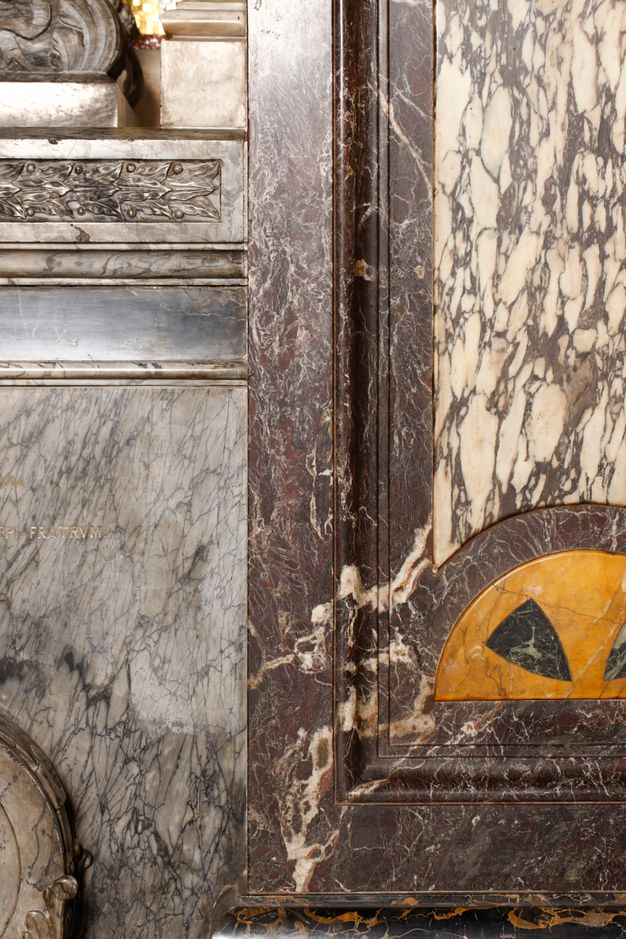
The great arch and the pilasters supporting it are made of
breccia marble in their centers and Rosso Levanto (often
marketed at the time as Polcevera) marble at their edges, with
large rosettes of green and ocher marbles spaced within. The
inner arch is done in paonazzo marble, and the niches in
veined Carrara. The three sculptures are in white Carrara,
while the coffin is in portoro. The base of the monument is in
flowered bardiglio, with black marble from Belgium used for
the inscriptions and portoro for the base molding (fig. 3). This is an extensive repertoire that adds color and
grandeur to the work. The diversity of marble links the tomb
to the most prestigious monuments of Roman antiquity as well
as to the wealth of materials of the Heavenly Jerusalem as
described in the Revelation of Saint John.49
It is quite likely that the desire to produce a lavish work
stemmed from Doyère. All the marbles had to be transported
from Europe to Chile, and some of them, such as portoro and
Polcevera, were scarce and expensive. The appreciation of
marble had begun to take root in Chile during the eighteenth
century with the new production of ecclesiastical furniture in
high-quality imitation marble.50
During the nineteenth century, the import of marble elements
for churches gradually increased.51
In this trajectory, the marble splendor achieved with the
funerary monument can be seen as the crowning achievement of a
long sequence of events.
ExpandFig. 3. —Detail of the marble of the outer arch of the
sepulchral monument for the late Archbishop Rafael
Valentín Valdivieso, 1898.
Santiago, Chile, Santiago Cathedral. Photograph by Ulises
Nilo, 12 December 2025.
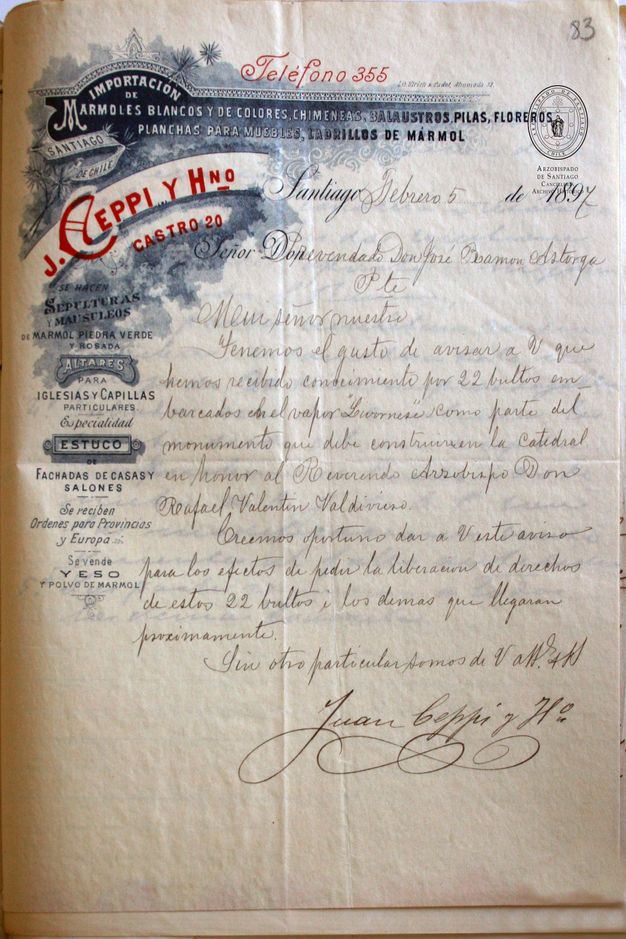
The management of the marbles was entrusted to the Sociedad
Juan Ceppi y Hermano (Juan Ceppi and Brother) (fig. 4). In the last decades of the nineteenth century, Juan Ceppi
y Hermano’s marble factory had a workshop in Santiago, about
two hundred hired workers, and a network of contacts in Italy
that afforded it a privileged position in the production and
sale of the material in Chile. The company was the
continuation of a workshop initially set up by Benedetto
Rossetti, the uncle of the Ceppi brothers, in Santiago in the
middle of the century.52
Importing companies such as Juan Ceppi y Hermano prospered due
to the scarce and intermittent extraction of marble locally.
The Ceppi marble factory, represented by Giacomo Ceppi,
appeared at the signing of the contract on 11 May with the
Arzobispado.53
In practice, Doyère and the Ceppi company were jointly
responsible for the correct execution of the works. The marble
company not only executed a central part of the funerary
monument but also provided its financial guarantee and its
networks to manage the elements that would be commissioned
from other workshops, such as the stained glass, the mosaics,
and the sculptural works.
ExpandFig. 4. —Invoice from Juan Ceppi y Hermano, 5 February
1897.
Santiago, Chile, Archivo del Arzobispado de Santiago.
Image courtesy of the Archivo Histórico del Arzobispado de
Santiago.
Enrico Butti’s Sculptures
One of the aspects on which Juan Ceppi y Hermano had a
decisive influence was the decision to entrust Enrico Butti
with the sculptural works. Butti was born in 1847 in the
Lombard town of Viggiù, known for its stone quarries. He was a
student and, later, teacher at the Accademia di Brera (Brera
Academy) in Milan. His work of 1887,
Il Minatore (The miner), a
plaster project for a sepulchral monument in Montevideo,
Uruguay, cast in bronze a few years later and exhibited at the
Paris Exposition Universelle, solidifed the fame of the
Lombard sculptor.54
The contract for the tomb of Valdivieso mentions as one of
Butti’s masterpieces the
Cristo crocifisso (Christ
crucified), completed in 1894, the plaster model for which is
kept in the Musei Civici Viggiutesi in Lombardy and the two
bronze versions in the Cimitero Vecchio di Viggiù (Old
Cemetery of Viggiù) and the Cimitero Monumentale di Milano
(Monumental Cemetery of Milan). In light of these works, the
choice of Butti seems quite natural, as he was a sculptor who
was well known at the end of the nineteenth century and who
had specialized in funerary works. In addition, the Ceppi
family’s home village, Morbio Superiore in Switzerland, is
just over twelve kilometers from Viggiù and less than sixty
kilometers from Milan. The elder brother, Pietro, had moved to
Chile in 1896, the same year of the contract’s signing.55
It seems reasonable that the Ceppi Rossettis maintained links
with Viggiù and Milan, and the mention in the contract of the
Cristo crocifisso shows that
someone in Chile was closely following the sculptor’s career.
This connection with the Italian art scene was already
preceded by important milestones, such as the arrival of the
Neapolitan painter Ciccarelli in 1848 and the acquisition of
Roman religious paintings and sculptures for churches in
Santiago since the mid-nineteenth century.56
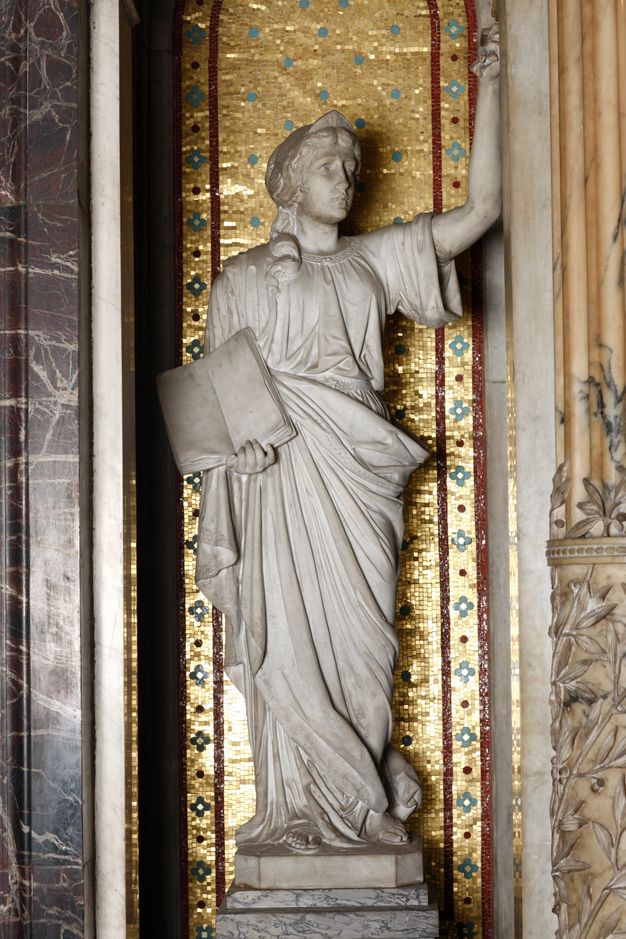
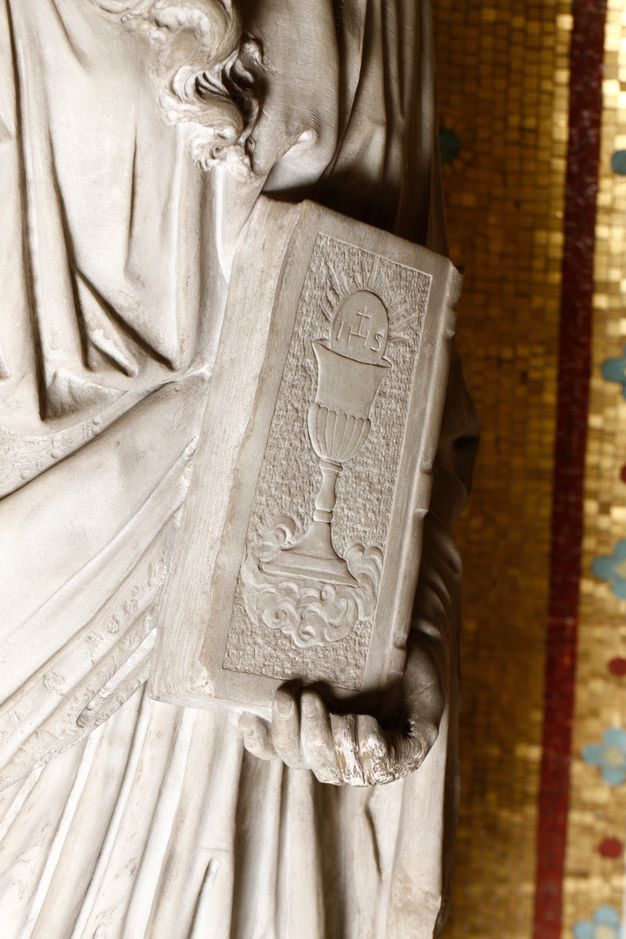
The commission awarded to Butti was not an isolated event.
In the completed sculptures, Science and
Faith are represented by standing female figures
looking and pointing upward. Science holds an open
book faced outward in her hand at waist level, while
Faith carries, at the same height, a closed book
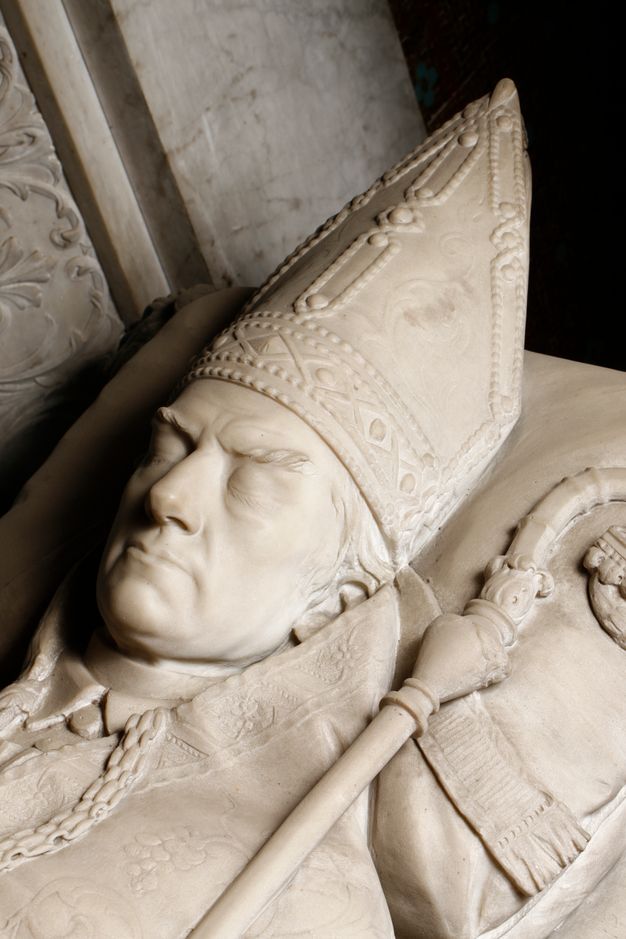
showing a chalice and a host on its cover (figs. 5, 6). At
the center of the monument, the archbishop is shown wearing an
alb and a pluvial cloak as well as the miter and crosier, the
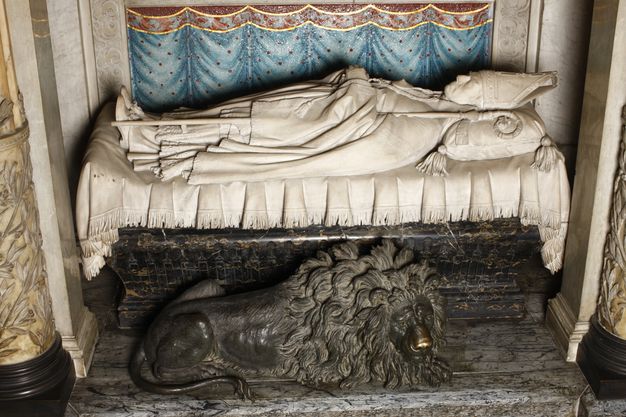
distinctive signs of his episcopal status (fig. 7). His recumbent posture, common in many funerary sculptures,
eloquently expresses that he has reached eternal rest. Below
him, a reclining bronze lion gazes at the viewer who stops in
front of the monument (fig. 8). The lion has a long tradition in the iconography of death,
but in this case seems to embody the virtue of fortitude.57
The decisiveness with which Valdivieso confronted tensions
with the state and the internal ecclesiastical crises during
his episcopacy would have made him worthy of this symbolic
relationship with the lion. It is worth mentioning that during
the nineteenth century, the figure of the lion was rejected in
Latin America due to its symbolic link with Spain.58
However, a decade after Valdivieso’s tomb was completed, two
public monuments bearing the image of the lion were erected to
mark the centenary of Chilean independence.59
There is no evidence that this iconography in the tomb caused
any controversy; therefore, it is likely that the lion was
interpreted as a funerary and symbolic reference.
ExpandFig. 5. —Enrico Butti (Italian, 1847–1932).Science, ca. 1895, Carrara marble, 220 × 90 × 55
cm. From the sepulchral monument for the late Archbishop
Rafael Valentín Valdivieso, Santiago, Chile, Santiago
Cathedral, 1898. Photograph by Ulises Nilo, 27 July
2024.ExpandFig. 6. —Enrico Butti (Italian, 1847–1932).Faith (detail), ca. 1895, Carrara marble, 220 ×
55 × 60 cm. From the sepulchral monument for the late
Archbishop Rafael Valentín Valdivieso, Santiago, Chile,
Santiago Cathedral, 1898. Photograph by Ulises Nilo, 27
July 2024.ExpandFig. 7. —Enrico Butti (Italian, 1847–1932).Archbishop Rafael Valentín Valdivieso Recumbent
(detail), ca. 1895, Carrara marble, 120 × 55 × 87 cm. From
the sepulchral monument for the late Archbishop Rafael
Valentín Valdivieso, Santiago, Chile, Santiago Cathedral,
1898. Photograph by Ulises Nilo, 27 July 2024.ExpandFig. 8. —Enrico Butti (Italian, 1847–1932).Archbishop Rafael Valentín Valdivieso Recumbent with
Lion Below, ca. 1895, Carrara marble, 120 × 55 × 87 cm. From the
sepulchral monument for the late Archbishop Rafael
Valentín Valdivieso, Santiago, Chile, Santiago Cathedral,
1898. Photograph by Ulises Nilo, 12 December 2025.
The Florentine Mosaics
Another of the decisions recorded in the contract was to cover
the panels of the back, sides, and ceilings of the monument
with mosaics. The contract specifies that the plans contain
the chosen ornamental forms, which will be executed “by giving
them the appropriate colors on a gold background.”60
The contract stipulates that the mosaics are to be made “in
the House of Florence where they are specialists in this
branch of art.”61
It is difficult to know if this refers to a specific workshop
or whether it is just a generic reference to ensure that the
work was made by Florentine craftspersons. The Opificio delle
Pietre Dure, a grand ducal workshop for inlaid stonework
founded by the Medici family in the sixteenth century, was a
state institution of recognized prestige that could have been
approached for the work. However, it is important to note that
during the second half of the nineteenth century, numerous
private mosaic workshops were newly established in Florence,
some of them with sales branches in London, Paris, or New
York. What is certain is that Doyère, with the intermediation
of the Ceppi family, selected the specialists who would
produce these ornamental panels in a city where the art of
mosaic was flourishing at the time.62
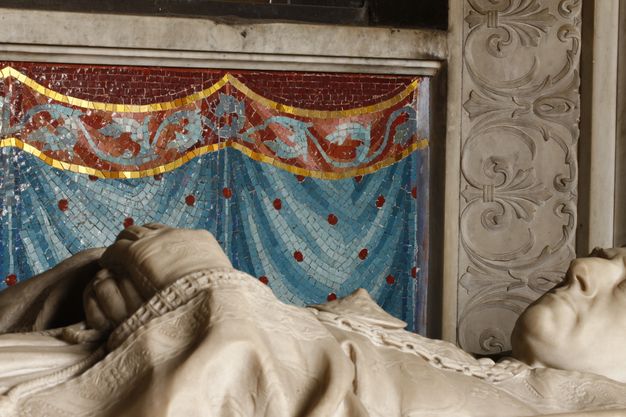
The shapes and colors provided by the mosaics emphasize the
architectural forms of the monument and highlight the
sculptures, particularly the recumbent archbishop, whose white
marble figure contrasts with the red, blue, and gold mosaic
materials that were inlaid to simulate fine drapery (fig. 9).
ExpandFig. 9. —Detail of mosaic drapery by an unknown Florentine
workshop behind Enrico Butti’s marble sculpture of
recumbent Archbishop Rafael Valentín Valdivieso, ca.
1895.
Santiago, Chile, Santiago Cathedral. Photograph by Ulises
Nilo, 12 December 2025.
The Symbolic and Aesthetic Keys of the Stained-Glass Window
At the center of the monument’s colorful marbles and mosaics
is the stained-glass window. The incorporation of stained
glass in funerary buildings was a common practice; an early
case in Chile can be found in the mausoleum of Francisco Garín
in the Cementerio General (General Cemetery) of Santiago,
whose stained-glass windows were made in Paris in 1871.63
The contract for the tomb of Valdivieso specifies that the
stained glass was to be made in the “workshops of Mayer in
Munich” based on a design exclusively for this work.64
Shortly before work began on the sepulchral monument, the
Iglesia de San Pedro de Alcántara (Church of San Pedro de
Alcántara) on Mac Iver street, built by Doyère between 1890
and 1896, received a set of stained-glass windows from the
workshops founded by Joseph Gabriel Mayer (1808–83).65
The French architect had experience with incorporating this
type of element into an architectural project as well as the
corresponding contacts with the Mayer’sche Hofkunstanstalt
(Mayer’s Court Art Institute, or Franz Mayer Company). The
choice of the German workshops was not coincidental; the
Bavarian house had begun producing stained glass and mosaics
in 1847, and by the end of the century, it enjoyed solid
prestige and sold work globally.66
From a stylistic point of view, most of the leading
stained-glass artists of the second half of the nineteenth
century were academically trained, so they conceived their
work in glass as monumental paintings.67
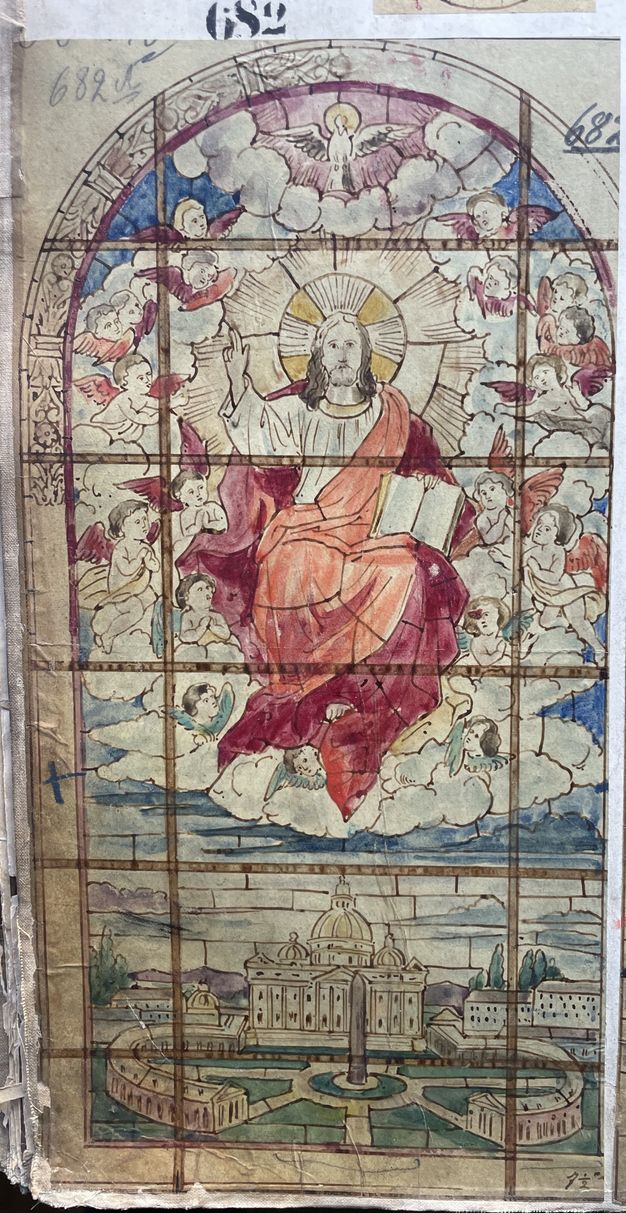
The sketch for the stained glass of the tomb monument of
Valdivieso is preserved in the archives of the Mayer’sche
Hofkunstanstalt in Munich.68
The sketch shows the pictorial concept of the work, onto which
is added the grid that would have allowed the image to be
transferred from paper to glass (fig. 10). This project must have been directed by Franz Borgias
Mayer (1848–1926), the founder’s son, who had received his
training in England. Most of the stained-glass windows
produced in Germany during the last quarter of the nineteenth
century are linked to the aesthetics of the Nazarenes, an
early nineteenth-century group of German Romantic painters who
emphasized Christian themes and medieval styles; the works of
the Mayer’sche Hofkunstanstalt were no exception.69
The stained-glass window made for Santiago Cathedral shares
the pictorical eclecticism of this group of artists. The
saturation of its colors, the play of light and shadow, and
the majestic character of the figure of Christ echo the
postulates of the Nazarenes.70
ExpandFig. 10. —Workshop of the Mayer’sche Hofkunstanstalt
(German).
Sketch for the stained-glass window of the sepulchral
monument for Rafael Valentín Valdivieso, ca. 1895,
watercolor on paper, 13.5 × 27.5. Photograph courtesy
Mayer’sche Hofkunstanstalt, Munich. Image may not be used
in any form without the written consent of Mayer’sche
Hofkunstanstalt GmbH/Mayer of Munich. The photograph is
protected by copyright, and commercial use for
reconstructions or restorations of historic windows is not
permitted without the prior written consent of the rights
holders.
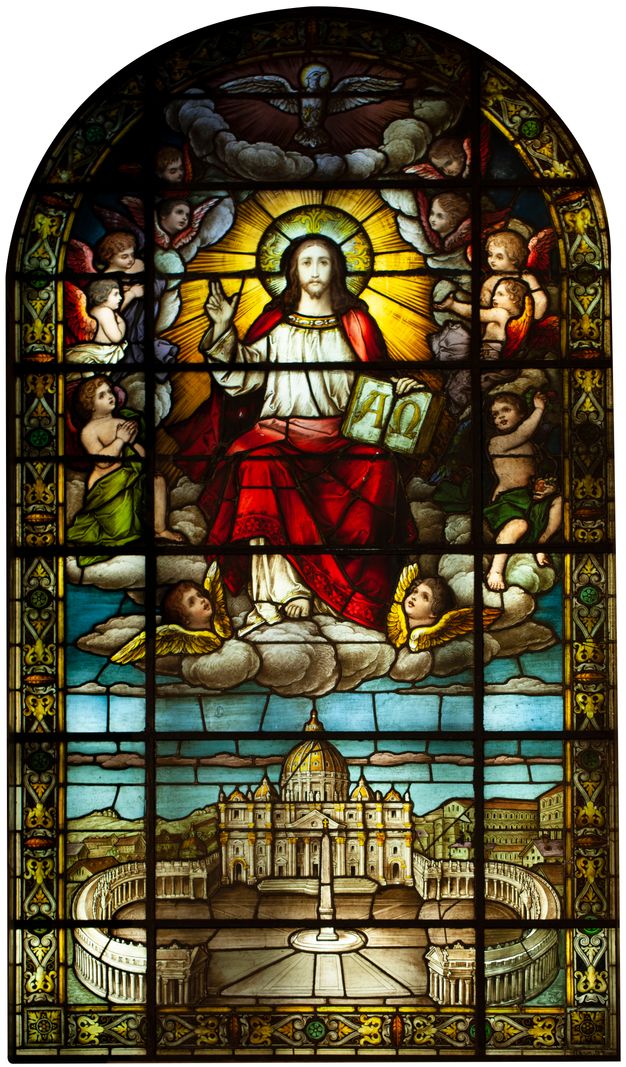
The stained-glass window made in Munich contains a central
depiction of Christ in Majesty surrounded by angels (fig. 11). He is giving a blessing with his right hand; in the other,
he is holding a book in which alpha and omega, the first and
last letters of the Greek alphabet, are inscribed. Above his
head is the figure of the Holy Spirit in the form of a dove.
At the foot of the theophany are Saint Peter’s Basilica and
Bernini’s Colonnade in stained glass. This monumental,
translucent image is meant to be read in relation to the
recumbent figure of the archbishop below it (see
fig. 8).
The ecclesiological message is clear: The vertical axis links
Valdivieso to the pope, and the pope to Christ. The image
alludes to Valdivieso’s time as archbishop, during which
historical circumstances and his own convictions led him to
emphasize the link with Rome.71
At the same time, this iconography is in harmony with the
views of Casanova expressed in the pastoral letter that he
published on the day of his consecration.72
ExpandFig. 11. —Workshop of the Mayer’sche Hofkunstanstalt
(German).The Holy Spirit and Christ over Saint Peter’s
Basilica,
ca. 1895, stained glass, 400 × 202 cm. From the sepulchral
monument for the late Archbishop Rafael Valentín
Valdivieso, Santiago, Chile, Santiago Cathedral, 1898.
Photograph by Ulises Nilo, 27 July 2024.
Valdivieso’s Burial and the Reception of the Monument
While work on the monument was in progress, a committee was
appointed to exhume the remains of Archbishop Valdivieso. On
23 July 1897 the coffin was removed from the side altar
dedicated to Saint John the Evangelist in Santiago Cathedral
and placed in one of the rooms off the courtyard. The metal
coffin was immediately opened so that the committee could
examine its contents. The minutes from that gathering record
the state of the archbishop’s remains upon inspection: “His
features, although disfigured by death and time, proved to be
the remains of the Most Illustrious Prelate.”73
The coffin remained in this provisional location for ten
months, until the inauguration of the monument and the
transfer of the remains on 23 May 1898.
In 1904 conservative politician Rafael Errázuriz Urmeneta
published an article in the
Revista católica (Catholic
journal) titled
“Monumento sepulcral del Iltmo. Y Rmo. Sr.
Valdivieso”
(Tomb of the Illustrious and Most Reverend Mr. Valdivieso).
The text was part of a dossier to celebrate the one hundredth
anniversary of the birth of the late archbishop. Errázuriz
Urmeneta provided historical background for the mausoleum and
offered aesthetic judgments on its final presentation. He is
emphatic in highlighting the excellence of the marble, the
Florentine mosaics, and the Bavarian stained glass as well as
the sculptures.
Toward the end of his article, Errázuriz points out that it is
an ensemble “in which sculpture and architecture compete in
rich profusion, or rather, combine in pleasant harmony,
bringing out each other’s beauty.”74
Delicately, he expresses concern about a certain excess in the
combination of elements, noting that, in the monument, “more
than the art itself, the dazzling effect of its materials”
predominates.75
For Errázuriz, the quality of the execution is exquisite, but
the result is too heterogeneous and saturated. He goes on to
explain that the configuration of the sepulcher departs from
classical moderation due to the taste of its authors, citing
the interest of the commissioners in “erecting a monument that
would stand out above all for its luxury, brilliance and
richness.”76
His analysis goes on to emphasize the architectural rather
than sculptural character of the ensemble, endorsing the same
tension between sculpture and architecture disclosed by the
correspondence between Subercaseaux and Astorga. As a result
of the monument’s architecture, it is impossible to appreciate
the quality of the recumbent archbishop’s sculptural
representation due to the height at which it was placed.
Errázuriz’s text ends with a brief testimony about his
personal contact with Valdivieso. Of his character and way of
life, Errázuriz emphasizes his extreme sobriety, in the last
lines highlighting the evident contrast between “such a
splendid burial” and the “extraordinary humility of his
character and soul,”77
evoking for his reader the inconsistency between the buried
man and his mausoleum.
Final Considerations
A first argument emerges clearly from the reflection on this
documentation, which is that the tomb of Archbishop Valdivieso
was a means used by his successor to solve ecclesiastical
problems and to emphasize his own doctrinal views. It allowed
Casanova to rebuild trust with the priests close to the late
prelate who were suspicious of his arrival at the helm of the
diocese. The monument itself contained two central elements of
Casanova’s discourse: on the one hand, the harmony between
rational knowledge and religious faith; on the other, the need
for the local Catholic Church to cultivate a strong link with
Rome.
Another dimension that emerges from the analysis of the
documentation on the tomb’s conception is the consistency of
the discussion about the processes of artistic creation and
the nature of aesthetic quality. A significant throughline is
the difficulty in establishing whether architecture should be
subordinate to sculpture or vice versa. This difficulty is
reflected in the tenor and content of the correspondence
around various monument designs. Other themes that arise are
artistic freedom, the expected character of a funerary
monument, and the need for sumptuous materials.
Finally, the process described above shows the global reach of
the commission. The available documentation reveals that those
involved in Chile perceived Europe as an artistic emporium in
which it was possible to choose from a wide repertoire of
technical specialities from every region of the continent. At
the same time, the commissioners considered the participation
of architects and sculptors who were active in Chile to be
necessary for the viability of the project. In this way, the
sepulchral monument could be a work in which local skills and
the choice talents of Europe were brought together to honor
the late archbishop.
Fernando Guzmán is professor of Chilean art
at the Universidad Adolfo Ibáñez, Santiago, Chile.
Notes
This work is a result of the Agencia Nacional del
Investigación y Desarollo (ANID) Fondecyt 1230525 research
project. Unless otherwise noted, translations from the Spanish
and the French are by the present author.
Rodolfo Vergara Antúnez,
Vida i obras del ilustrísimo y reverendísimo señor
doctor don Rafael Valentín Valdivieso,
vol. 2 (Imprenta Nacional, 1906), 339; Víctor Barahona,
“Las tumbas de la Catedral de Santiago de Chile,”
Boletín de la Academia Chilena de la Historia
12, no. 32 (1945): 69–78; and Alejandro Huneeus,
La catedral de la arquidiócesis de Santiago de
Chile: Sus principales objetos sagrados y
recuerdos
(Imprenta San José, 1968), 12.
↩︎
Marcela Drien,
“Júzguese por las copias: El conocimiento y
circulación de la pintura europea en Chile,”
Imagem: Revista de História da Arte
1, no. 1 (2022): 361–80; Marcela Drien and Katherine
Vyhmeister, “The 1875 Palacio de la Exposición in
Santiago: A Cosmopolitan Arena for Positioning the
Nation,” Nineteenth-Century Contexts 43, no. 1
(2021): 97–116; Juan Manuel Martínez,
“Francisco Javier Mandiola y la construcción de
relato visual en el sistema de las artes en
Chile,”
in
Monvoisin en América,
ed. Gloria Cortés and Jaime Cuevas (Subdirección de
Patrimonio, 2023), 56; Fernando Guzmán et al.,
“Roma y la renovación de la imagen y el espacio sacro
en Chile durante el siglo XIX,”
Historia
54, no. 2 (2021): 585–617; and Amarí Peliowski,
“Arquitectura, civilización y barbarie: Brunet
Debaines como comentador social a mediados del siglo
XIX en Chile,” Revista
180, no. 42 (2018): 76–87.
↩︎
Josefina de la Maza,
“Sobre la fundación de la Academia de Pintura,
estudio introductorio,”
in
La inauguración de la Academia
(Ediciones Universidad Alberto Hurtado, 2013), 11–12.
↩︎
María Angélica del Piano,
“Dos arzobispos creativos que perduran en la
historia,”
in
Iconografía, identidad nacional y cambio de siglo
(XIX–XX),
ed. Gloria Cortés et al. (Ril, 2003), 63–75.
↩︎
Fernando Guzmán,
De la madera al mármol: Arte religioso en Chile,
siglos XVIII y XIX
(Silvana, 2023), 79–99.
↩︎
On the role of public sculptures in nation building in
Chile, see Gloria Cortés,
“Monumento al roto . . . piojento: La construcción
oligárquica de la identidad nacional en Chile,”
Arbor: Ciencia, pensamiento y cultura
185, no. 740 (2009): 1231–41; Pedro Zamorano,
“Escultura en Hispanoamérica durante el siglo XIX: El
caso chileno,” Archivo Español de Arte
84, no. 333 (2011): 25–40; and Liisa Flora Voionmaa
Tanner,
Escultura pública: Del monumento conmemorativo a la
escultura urbana; Santiago 1792–2004,
vol. 1 (Ocho Libros, 2004), 128–55.
↩︎
Mariano Casanova,
Circular sobre la necesidad de erijir en la Iglesia
Metropolitana un monumento sepulcral en honor del
Illmo. I Rmo. Señor Dr. D. Rafael Valentín
Valdivieso
(Santiago, 1887), 4. Translations from this source are
by Fernando Guzmán and Sylvia Glover.
↩︎
Enrique Laval,
“El cólera en Chile (1886–1888),”
Revista chilena de infectología
20 (2003): 86–88.
↩︎
Casanova,
Circular sobre la necesidad de erijir
[. . .] un monumento sepulcral,
5. ↩︎
Casanova had seen the tombs during a trip to Europe when
he was a priest in his early thirties. Julio Retamal
Avila,
Monseñor Mariano Casanova Casanova 1886–1908,
tercer arzobispo de Santiago
(Editorial Salesiana, 1981), 12.
↩︎
Casanova,
Circular sobre la necesidad de erijir
[. . .] un monumento sepulcral,
6. ↩︎
Casanova,
Circular sobre la necesidad de erijir
[. . .] un monumento sepulcral,
4. ↩︎
Casanova,
Circular sobre la necesidad de erijir
[. . .] un monumento sepulcral,
7. ↩︎
Ignacio Ducasse,
Servidores del Evangelio: Los obispos de Chile
1561–2007
(Conferencia Episcopal de Chile, 2008), 90–91.
↩︎
Crescente Errázuriz,
Algo de lo que he visto
(Editorial Nascimiento, 1934), 371–81.
↩︎
Santiago, Chile,
Archivo Histórico Arzobispado de Santiago (AHAS),
Monseñor Valdivieso, Monumento sepulcral, 1887–1899,
legajo 59, expediente 28.
Hereafter
Monumento sepulcral. All AHAS
documents cited below are part of this archival file;
most of the documents are numbered.
↩︎
“Instructions pour la demande d’adjudication du
monument, Santiago du Chili, Août 1893,”
7–12, AHAS,
Monumento sepulcral. See also
Carlos Silva Vildósola,
Retratos y recuerdos
(Editorial Zig-Zag, 1936), 108.
↩︎
Mariano Casanova,
Pastoral del Illmo. Y Rvmo. Señor arzobispo don
Mariano Casanova en el día de su consagración
episcopal
(Santiago, 1887) 4, 5.
↩︎
Casanova,
Pastoral [. . .]
en el día de su consagración episcopal,
10. ↩︎
Casanova,
Pastoral [. . .]
en el día de su consagración episcopal,
11. ↩︎
Macarena Ibarra,
“Palacio arzobispal: El edificio, el conjunto y la
ciudad,”
in
Ofrenda y gracia: Proyecto de conservación y
restauración capilla sede arzobispal,
ed. Cecilia Beas and Elena Losón (Arzobispado de
Santiago, 2013), 43; and Daniela Lara,
“Análisis iconográfico de las imágenes,”
in Beas and Losón,
Ofrenda y gracia, 73–84.
↩︎
Ramón Subercaseaux,
Memorias de 50 años
(Imprenta y Litografía Barcelona, 1908), 433–531.
↩︎
For reflection on art in Chile, see Pedro Zamorano et
al.,
“Jose Miguel Blanco: Escritos de bellas artes,”
Alpha,
no. 37 (2012): 149–62.
↩︎
José Ramón Astorga, letter to Ramón Subercaseaux, 10
August 1893, 15, AHAS,
Monumento sepulcral.↩︎
Subercaseaux, letter to Astorga, 14 September 1893, 17,
AHAS, Monumento sepulcral.↩︎
Subercaseaux, letter to Astorga, 28 September 1893, 19v,
AHAS, Monumento sepulcral.↩︎
Rodrigo Gutiérrez Viñuales,
Monumento conmemorativo y espacio público en
Iberoamérica
(Cátedra, 2004), 36–66; and María José Redondo Cantera,
“Aproximación a la escultura funeraria española del
siglo XIX,” in
El arte del siglo XIX: II Congreso Nacional de
Historia del Arte,
vol 1 (Comité Español de Historia del Arte, 1978),
121–24.
↩︎
Astorga, letter to Subercaseaux, 13 November 1893, 22v,
AHAS, Monumento sepulcral.↩︎
Astorga, letter to Subercaseaux, 10 August 1893, 15v,
AHAS, Monumento sepulcral; and Subercaseaux, letter to
Astorga, 14 September 1893, 18, AHAS,
Monumento sepulcral.
↩︎
Subercaseaux, letter to Astorga, 28 September 1893, 20,
AHAS, Monumento sepulcral.↩︎
Subercaseaux, letter to Astorga, 28 September 1893, 19,
AHAS, Monumento sepulcral.↩︎
Astorga, letter to Subercaseaux, 10 August 1893, 15v,
AHAS, Monumento sepulcral.↩︎
Gorka López,
“Una genealogía de la máscara mortuoria: Tiempo,
imagen, presencia”
(PhD. diss., Universidad de Barcelona, 2016), 237–50.
↩︎
Zamorano,
“Escultura en Hispanoamérica durante el siglo
XIX,”
32–33.
↩︎
Enrique Solanich,
Escultura en Chile: Otra mirada para su estudio
(Ril, 2017), 31–32.
↩︎
Astorga, letter to Subercaseaux, 26 January 1894, 26v,
AHAS, Monumento sepulcral.↩︎
Subercaseaux, letter to Astorga, 25 March 1894, 28,
AHAS, Monumento sepulcral.↩︎
Astorga, official letter to Subercaseaux, 28 June 1895,
33, AHAS, Monumento sepulcral.↩︎
Josefina de la Maza,
“Por un arte nacional: Pintura y esfera pública en el
siglo XIX chileno,”
in
Ciencia-Mundo: Orden republicano, arte y nación en
América,
ed. Rafael Sagredo (Editorial Universitaria, 2010),
304–6; and Josefina de la Maza and Sandra Accatino,
“De espacios marginales y obras en tránsito: Una
lectura de interior del Louvre de Alfredo Valenzuela
Puelma,” Intus-Legere Historia
16, no. 2 (2021): 393–96.
↩︎
Junta, official letter to Mariano
Casanova, 14 April 1896, 39, AHAS,
Monumento sepulcral.↩︎
Emilio Doyère, letter to Mariano Casanova, undated
(probably mid 1890), AHAS,
Fondo de Gobierno, vol 164.
↩︎
“Contrato de construcción,” 11
May 1896, AHAS,
Monumento sepulcral.↩︎
Mirtha Pallares,
“La arquitectura religiosa en Santiago de Chile
1850–1950: Razones de las reminiscencias
góticas”
(PhD. diss., Universidad Politécnica de Madrid, 2015),
136. ↩︎
María Paz Valenzuela,
“La enseñanza de la arquitectura en Chile,”
Revista de arquitectura
20, no. 29 (2014): 54–55.
↩︎
Giovanna Capitelli,
Mecenatismo pontificio e borbónico alla vigilia
dell’Unità
(Viviana, 2011), 50–51, 80–81.
↩︎
Michael Camille,
The Gargoyles of Notre-Dame: Medievalism and the
Monsters of Modernity
(University of Chicago Press, 2009), 53–56; Isabelle
Saint Martin,
Art chrétien/Art sacré: Regards du catholicism sur
l’art; France, XIXe–XXe siecle
(Presses Universitaires de Rennes, 2014), 73; Michael
Preston Worley,
Pierre Julien: Sculptor to Queen Marie-Antoinette
(iUniverse, 2021), 124; Anne Marie de Lapparent,
Louis-Pierre Deseine (CTHS, 2013); and Ronit
Milano,
The Portrait Bust and French Cultural Politics in the
Eighteenth Century
(Brill, 2015), 154, 175–78.
↩︎
Cristina Casero,
“Viggiù terra di scultori: Enrico Butti e altre
personalità di rilievo nella seconda metà
dell’Ottocento,” in
Storia dell’arte a Varese e nel suo territorio,
ed. Maria Luisa Gatti Perer, vol. 2 (Insubria University
Press, 2011), 387. The later marble version, dated 1910,
is in the tomb of Juan Nicola in the Cementerio Central
(Central Cemetery) of Montevideo. A bronze copy is kept
in the Galleria d’Arte Moderna di Milano. The original
plaster model is kept in the Musei Civici Viggiutesi in
Viggiù, Italy.
↩︎
Ceppi de Lecco Lazo,
Cuatro constructores suizos en Chile,
68. ↩︎
Capitelli,
Mecenatismo pontificio e borbónico,
158–74.
↩︎
Francisco de Asís García García,
“El león,”
Revista digital de iconografía medieval
1, no. 2 (2009): 36.
↩︎
Ramón Gutiérrez and Rodrigo Gutiérrez Viñuales,
América y España, imágenes para una historia:
Independencias e identidad (1805–1925)
(Fundació MAPFRE, 2006), 15, 98–99.
↩︎
Fabio Bertelli and Federica Galora,
“I privati produttori di mosaico fiorentino nella
seconda metà dell’Ottocento e i loro rapporti con
l’Opificio delle Pietre Dure,”
OPD Restauro,
no. 18 (2006): 320–36.
↩︎
Patricio Díaz Silva,
Vitrales en Santiago de Chile: Obras conservadas en
iglesias y edificios civiles
(Ocho Libros, 2007), 40.
↩︎
Mirtha Pallarés Torres,
Templos católicos neogóticos
(Editorial Universitaria, 2018), 120–23; and Díaz Silva,
Vitrales en Santiago de Chile,
140–47.
↩︎
Bernhard Graf, “History,” in
Franz Mayer of Munich: Architecture, Glass, Art,
ed. Gabriel Mayer (Hirmer, 2013), 8–12; and Jasmine M.
Allen, “Stained Glassworlds: Stained Glass at the
International Exhibitions 1851–1900” (PhD diss., York
University, 2013), 159.
↩︎
Andrea Nilo and Elizabeth Stephens,
“Puesta en valor del Monumento Sepulcral Monseñor
Rafael Valentín Valdivieso,”
in
XX Encuentro Iberoamericano de Valorización y
Gestión de Cementerios Patrimoniales,
ed. Francisco José Rodríguez Marín (Universidad de
Málaga, 2019), 19. Much of the historical documentation
of the Mayer’sche Hofkunstanstalt in Munich was
destroyed during the Second World War. This particular
sketch is preserved in Skizzenbuch II within the
institution’s archival collection.
↩︎
Shirley Ann Brown, “The Influence of German Religious
Stained Glass in Canada 1880–1941,” RACAR 21,
nos. 1–2 (1994): 23.
↩︎
Similar characteristics can be seen in the paintings
Die klugen und die törichten Jungfrauen
(The parable of the wise and foolish virgins; 1813–16)
by Peter von Cornelius and
Der Ostermorgen (Easter
morning; 1818) by Johann Frederick Overbeck.
↩︎
Sol Serrano,
¿Qué hacer con Dios en la República? Política y
secularización en Chile (1845–1885)
(Fondo de Cultura Económica, 2008), 192–99.
↩︎
Casanova,
Pastoral [. . .]
en el día de su consagración episcopal,
9. ↩︎
“Traslación de los restos del señor arzobispo
Valdivieso,” Boletín Eclesiástico,
no. 13 (1895–97): 771.
↩︎
Rafael Errázuriz Urmeneta,
“Monumento sepulcral del Iltmo. Y Rmo. Sr.
Valdivieso,” Revista católica
7, no. 79 (1904): 457.
↩︎