Kleutghen / Adding Works to WordsGetty Research Journal, No. 21 (2026)
Copied page section link to clipboard
Abstract
In March 1769, Jean Joseph Marie Amiot, S.J. (1718–93),
the head of the French Jesuit mission in Beijing, penned a
letter about the Jesuit artist Jean-Denis Attiret, S.J.
(1702–68, Ch. Wang Zhicheng
王致誠). The Getty Research
Institute holds a copy of this letter, which is the most
comprehensive written source on Attiret and his decades in
China serving the Emperor Qianlong
乾隆 (r. 1736–95). Yet Amiot’s
letter is unillustrated, establishing a pattern of
studying Attiret more through written descriptions than
through his paintings. This essay reintegrates the French
and Chinese textual, visual, and material evidence of
Attiret’s transcultural exchanges, thereby working in the
same French Enlightenment modes in which Amiot wrote and
Attiret painted. By reading Amiot’s letter against
Attiret’s extant documentable oeuvre, the text acquires
additional value for what it omits as much as for what it
reveals.
Keywords
Jean-Denis Attiret, Jean Joseph Marie Amiot, Qianlong
emperor, Jesuit, China, Society of Jesus, Sino-French
relations, transcultural style, painting
Copied page section link to clipboard
Peer Review
Double anonymous, external
Copied page section link to clipboard
Cite
Chicago
Kristina Kleutghen, “Adding Works to Words: A Letter About
Qing Court Painter Jean-Denis Attiret, S.J. (1702–68) in
the Getty Research Institute,”
Getty Research Journal, no. 21 (2026),
https://doi.org/10.59491/REDD1799.
MLA
Kleutghen, Kristina. “Adding Works to Words: A Letter
About Qing Court Painter Jean-Denis Attiret, S.J.
(1702–68) in the Getty Research Institute.”
Getty Research Journal, no. 21, 2026,
https://doi.org/10.59491/REDD1799.
On the first of March 1769, Jean Joseph Marie Amiot, S.J.
(1718–93, Ch. Qian Deming 錢德明), the
head of the French Jesuit mission in China, penned a long
letter to sculptor Claude François Attiret (1728–1804) about
his cousin, recently deceased French Jesuit painter Jean-Denis
Attiret (1702–68, Ch. Wang Zhicheng
王致誠). One copy was deposited in the
Bibliothèque du Roi in Paris in 1775, which enabled the
letter’s republication in the original French several times
since the eighteenth century.1
The Getty Research Institute holds the second known copy,
which is now fully digitized and available online.2
The sixty-four-page handwritten letter describes Attiret’s
European training and work before and after joining the
Society of Jesus. It relates some of his experiences as a
court painter to the Emperor Qianlong
乾隆 (r. 1736–95), quotes Attiret’s own
letters about painting at the imperial Mountain Retreat for
Escaping Summer Heat (Bishushanzhuang避暑山莊) in summer 1754, and concludes
with the artist’s last days in Beijing at the
eighteenth-century height of the Qing dynasty (1644–1911). It
is the single most comprehensive written source on the life
and work of this artist. Yet despite more than thirty years in
Beijing painting for Qianlong, Attiret remains known less for
his art than for his letter of 1743 describing the Qing
imperial gardens, which had a profound influence on Chinese
taste in eighteenth-century European garden design.3
Attiret’s paintings and personal artistic style remain elusive
for several reasons. First, thanks to a longer career in China
and more extant signed work, Italian painter Giuseppe
Castiglione, S.J. (1688–1766; Ch. Lang Shining
郎世寧) has overshadowed the art
historical record of all other European artists serving the
Qing court.4
Second, European artists served Qianlong’s aesthetic
preferences at the expense of their own individual styles,
which poses challenges to reading Attiret’s work in China
within Jesuit accommodation practices.5
In the Qing court workshop system, any painting not meeting
imperial expectations was returned for revision or remaking.
Third, few extant works bear Attiret’s signature, and
collaboratively produced court workshop paintings were
typically unsigned. Each artist painted the components for
which they were the most skilled, and the archives of the Qing
imperial court workshop (Zaobanchu造辦處) rarely identify which artist
painted which elements.6
Finally, while Amiot’s letter is the most detailed source on
Attiret, Amiot does not provide a catalogue raisonné of
Attiret’s paintings, explaining that doing so would be
difficult for him and tedious for the reader because the
majority of them depicted Chinese subjects demanding
significant explanation.7
Amiot also admits that Attiret’s best work is inaccessible
inside the palace and therefore only describes the few
paintings that he had personally seen but does not include
either examples or illustrations of Attiret’s work.8
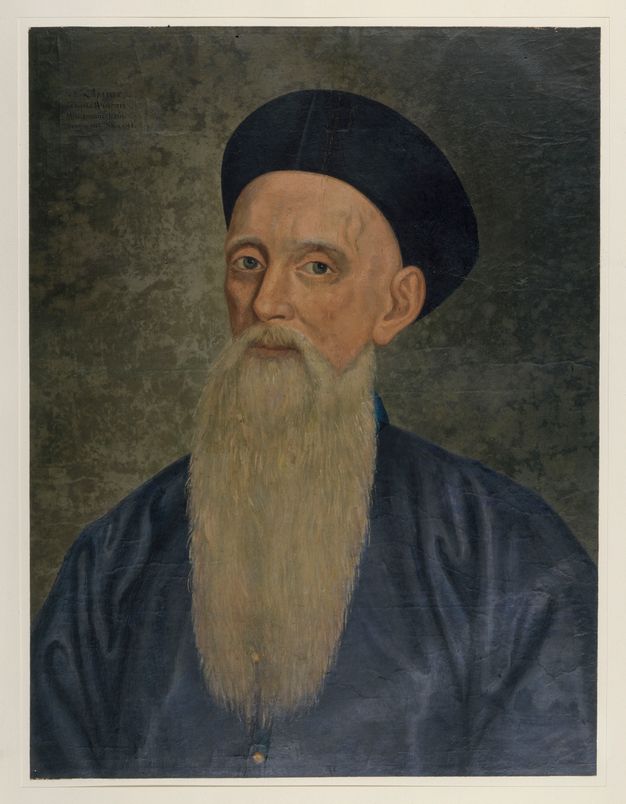
Father Amiot is an essential figure in the history of
Sino-French relations because of his writing about China and
his decades of experience there (fig. 1). Born in Toulon, Amiot joined the Jesuit novitiate at
Avignon in September 1737 and was ordained as a priest in
1746.9
He requested to serve overseas and in August 1751 arrived in
Beijing, where he gained command of both Chinese and Manchu,
the two key languages of the Qing court. These linguistic
skills not only earned him Qianlong’s respect and favor but
also enabled him to send original research on Chinese topics
as well as translations of Sunzi’s The Art of War,
imperial poems, and musical treatises to France for
publication.10
His work contributing information on China to France did not
cease after the Parlement of Paris expelled the Jesuits in
1762 and King Louis XV (r. 1715–73) abolished the Society of
Jesus in France in 1764. Quite the opposite: Louis recognized
the Jesuit mission’s significance as the key French source of
insight into China, and in 1765 sent two Chinese Christian
converts, Aloïs Ko and Étienne Yang, from France back to China
to serve as informants.11
Perhaps counterintuitively, the period from 1765 to 1792,
enduring through Pope Clement XIV’s formal suppression of the
Society of Jesus in 1773, marked “Amiot’s most fruitful period
as a writer” as well as the time in which he produced “the
greatest volume of correspondence in the history of the French
mission.”12
Father Amiot was the most influential contributor to French
statesman Henri-Léonard Jean-Baptiste Bertin’s (1720–92) major
publication projects intended to satisfy the French demand for
empirical observations and in-depth knowledge about China. Art
historian John Finlay has demonstrated that Bertin believed
words without accompanying illustrations to be insufficient
for understanding China, so Amiot sent many images of China
produced by Ko and Yang as well as Chinese prints and
paintings that later appeared in Bertin’s publications.13
Consequently, it is surprising that none of Attiret’s work
seems to have accompanied Amiot’s necrology for the artist,
especially during the precarious period when the Beijing
Jesuits were under pressure to demonstrate their continued
relevance by providing firsthand experience of and information
about China.
Amiot’s reliance on written words rather than Attiret’s own
works established a pattern that persists in modern
scholarship in which Attiret is considered predominantly
through written descriptions in European missionary letters or
factual records from the Qing imperial workshop archives.14
The sole Western-language monograph on Attiret uses only
European-language sources, omitting Chinese records entirely,
and therefore also leaves out several paintings not held in
European collections.15
Scholarship that seeks to balance writing about Attiret with
his own paintings is the exception rather than the rule.
Curator Anne Dary’s 2004 exhibition catalog and scholar Ming
Xiaoyan’s article of 2005 stand out for their efforts to
include Attiret’s works, but each of these uses only
scholarship and primary sources available in either French or
Chinese, respectively, not both.16
As a contribution to the significant body of scholarship that
now exists on art history of the global eighteenth century and
on Sino-French relations during that period, this essay asks
what can be learned about Attiret when his art is reintegrated
with Amiot’s letter as well as with primary textual sources in
French and Chinese. Paintings that were either signed by
Attiret or paintings for which we have documentary evidence
that firmly demonstrates his authorship provide a clear sense
of a painter meeting the very different demands of the
Catholic Church and the Qing court. Recovering Attiret’s works
of art not only follows the period practice of gleaning
knowledge directly from the source but also helps us to
understand the evolution of Attiret’s painting before and
after his arrival in Beijing. By reincorporating the French
and Chinese visual and material evidence of these moments of
transcultural exchange alongside written records in both
languages, the essay follows the French Enlightenment mode in
which Amiot wrote the letter as well as Attiret’s own
experience of working across French and Qing cultures.
Attiret’s Life and Work Before China
Attiret was baptized on 31 July 1702 as the son of
Claude-Françoise Guinard (life dates unknown) and Jean-Claude
Attiret (1669–1733), a painter and master carpenter active in
Dole.17
Born into an influential family of artists, artisans, and
architects, Attiret was educated in Jean-Claude’s studio,
after which his father’s patron, Claude-Joseph Froissard
(1657–1750), the marquis of Broissia, helped finance several
years of professional training in Rome. Although Amiot refuses
to discuss most work that Attiret completed prior to joining
the novitiate, he mentions a few portraits of area notables.
Several surviving paintings dateable to the early 1730s
include monumental history paintings depicting Old Testament
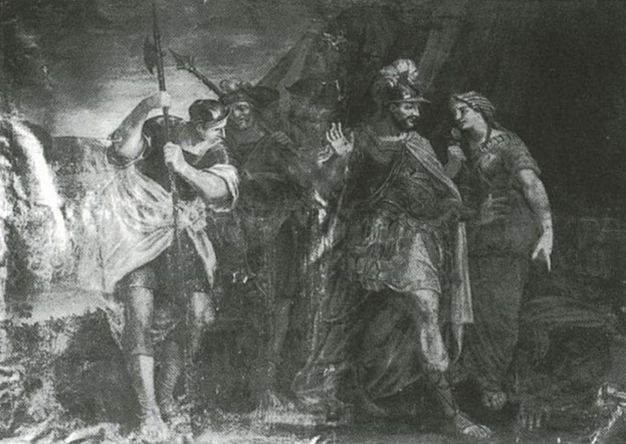
subjects such as Yaël and Sisera (fig. 2), Judith and Holofernes, and
The Adoration of the Golden Calf, all likely intended
for church decoration.18
The combination of personal portraits and large-scale figure
paintings for building decoration laid the foundation for some
of the genres that Qianlong would later demand of Attiret,
even if the finished works differed dramatically.
Attiret entered the Jesuit novitiate in Dole on 31 July 1735,
not long after one last intimate encounter with the secular
world: In February 1736, Attiret formally recognized his
illegitimate son, Jean-Claude, born to one Claude Perciot
(life dates unknown).19
Whether he told Amiot about his son is unknown, but Attiret
never mentions either the boy or his mother in surviving
letters, and Amiot’s inclusion of such a detail in the
necrology would not have supported Jesuit goals. While Amiot
offers no specific insight into what prompted Attiret to join
the church at age thirty-three, he differentiates Attiret from
other novices because of his age and maturity as well as for
the willing sacrifice of his established artistic talents and
future worldly fortune. Yet Amiot explicitly links two events
that ultimately resulted in both Attiret’s return to painting
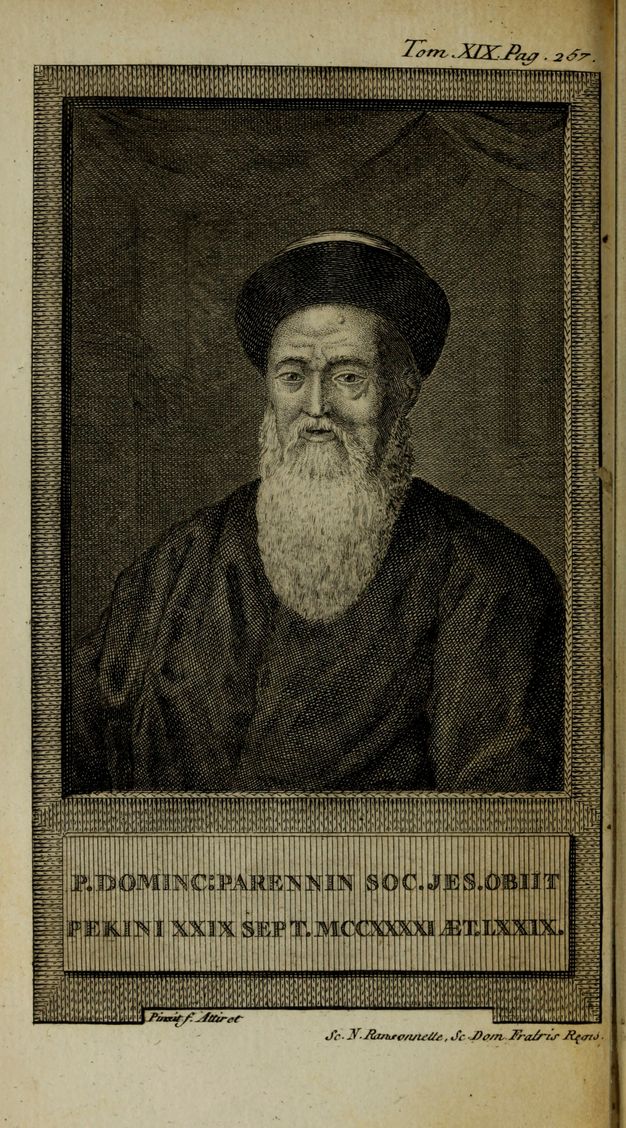
and his China posting. Writing from Beijing, Fathers Dominique
Parrenin (1665–1741, Ch. Ba Duoming
巴多明;
fig. 3) and
Valentin Chalier (1693–1747, Ch. Sha Ruyu
沙如玉) noted the Qing emperor’s
artistic regard for Castiglione, and thus for the Portuguese
mission in China, to which the Italian artist was attached.
The two Jesuit missions in eighteenth-century China—French and
Portuguese—competed actively for imperial attention and
resources. Consequently, Amiot reported, the French mission
requested that a French Jesuit painter be sent to Beijing to
increase French influence at the Qing court.20
Simultaneously, Amiot reported that the Jesuit Novitiate
Church of Saint-Louis in Avignon was negotiating with a local
artist to paint their early seventeenth-century chapel. The
artist questioned why the Jesuits wished to employ an outsider
when they already possessed a talented painter in Attiret, who
would also save them the cost of a commission from outside the
order. “It was like this,” Amiot wrote in the necrology, “on
the word of a great artist and for similar motivations, that
the Jesuits in Rome were once willing to consent to the famous
Pozzo giving the first evidence of a talent which has
immortalized his name.”21
By invoking the name of painter Andrea Pozzo, S.J. (1642–1709)
and his famed illusionistic ceiling in the Jesuit church of
Saint Ignatius of Loyola in Rome, which was established by the
Society of Jesus founder of the same name, Amiot compares
Attiret not only with the famed Pozzo but also implicitly with
Castiglione, who had claimed to follow Pozzo’s example in
painting similar illusions for Beijing churches.22
ExpandFig. 3. —Jean-Denis Attiret (French, active in France and China,
1702–68).Portrait of Father Dominique Parrenin (1665–1741),
engraving from
Lettres édifiantes et curieuses, écrites des missions
étrangères par quelques missionnaires de la Compagnie
de Jésus,
2nd ed., vol. 19 (Paris, 1781), opposite p. 257. Chestnut
Hill, Massachusetts, Boston College Libraries.
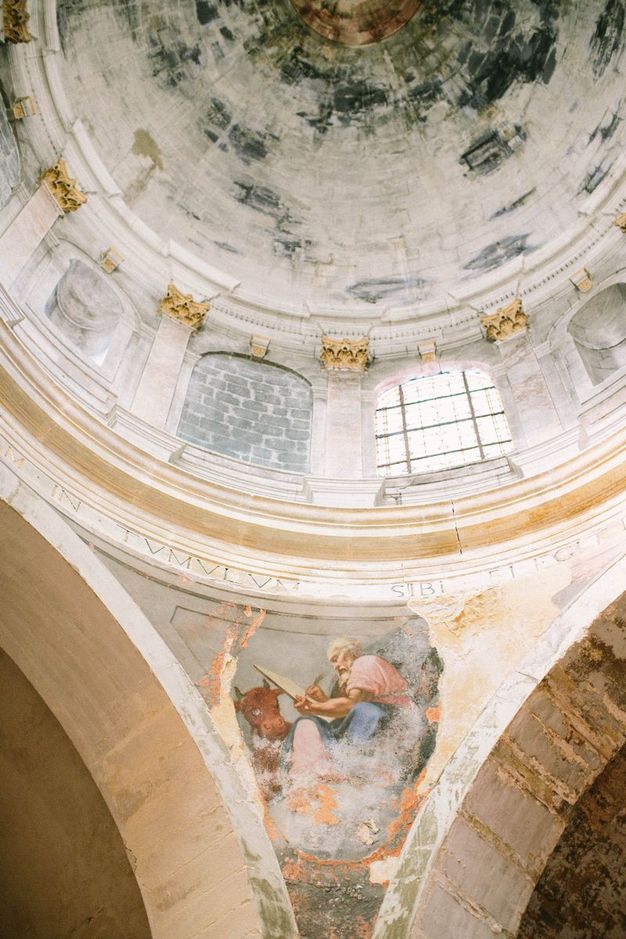
In the former Jesuit chapel in Avignon, Attiret’s frescoes on
the pendentives depict the Four Evangelists and their
symbols.23
His Saint Luke, patron saint of artists, is depicted as a
white-haired, vigorous man absorbed in sketching on a board
gripped in one muscular hand, forearm bulging from the effort
(fig. 4). Amiot
notes that during Attiret’s two years as a novice he also
painted episodes from the life of Christ, described as both
grisaille and chiaroscuro, which, together with the
pendentives, made the novitiate church a sightseeing stop for
travelers passing through Avignon.24
By increasing church visitation even during Attiret’s
lifetime, Attiret’s talents helped support the Jesuits and the
faith both at home and abroad. The chapel is now part of the
Hotel Cloître Saint-Louis, and the pendentive paintings are
mentioned in tourist guides for the city of Avignon.25
ExpandFig. 4. —Jean-Denis Attiret (French, active in France and China,
1702–68).
Saint Luke pendentive, ca. 1735–37. Avignon, Chapelle
Saint-Louis. Photograph by Studio Ohlala.
During the two years of his novitiate, Attiret continued to
paint for the Society of Jesus, dedicating himself to
portraiture and history paintings. In the autumn of 1737 Amiot
and Attiret overlapped briefly at Avignon, where Amiot began
his novitiate in September, a few months before Attiret
departed France forever for Beijing on 8 January 1738. But the
two men would meet again in 1751, when Amiot arrived in
Beijing, and they would work closely together at the small
French mission there for the rest of Attiret’s life.
Painting for the Qing Emperor
Attiret landed in Macao on 7 August 1738 and received the
order to travel to Beijing on December 2, finally reaching the
capital on 13 June 1739 in the company of other newly arrived
Jesuits serving either the French or Portuguese missions.
Attiret was formally introduced at court with the Chinese name
Wang Zhicheng, the first name Zhicheng
致誠 connoting the meaning of
“conveying sincerity” or “genuinely devoted” (in the sense of
dedicating efforts to a task). The identity of Attiret’s namer
is unrecorded, but Father Parrenin and his Beijing mission
colleagues Antoine Gaubil (1689–1759, Ch. Song Junrong
宋君榮) and Joseph-Anne-Marie de
Moyriac de Mailla (1669–1748, Ch. Feng Bingzheng
馮秉正) were all skilled Chinese
speakers who were well-read in Confucian classics, easily
capable of creating a meaningful and appropriate Chinese name.
Describing an introduction at court that he did not observe
firsthand, Amiot reports that Attiret presented Qianlong with
a painting depicting the Adoration of the Magi, which is an
appropriate subject for a Christian ruler but a bold choice
for a foreign emperor notably uninterested in
Christianity.26
Likely unaware of (or at least unconcerned by) the symbolism,
Qianlong accepted the painting into the palace and the artist
into imperial service, which marked the start of both
Attiret’s decades of court success as well as the bearing of
“his pains and his crosses” that made the position challenging
both personally and professionally.27
Attiret’s Chinese name first appears in the Imperial Workshop
(Zaobanchu) archives on 30 August 1739 in an order
sent to the Wish-Fulfilling Studio (Ruyiguan如意館), which housed Qianlong’s best
painters and artisans, including Castiglione. Attiret was
ordered to produce oil paintings of an unspecified subject on
a set of hanging scrolls for the Hall of Universal Peace (Wanfang anhe萬方安和), one of the named scenic
areas within the imperial Garden of Perfect Brightness (Yuanmingyuan圓明園).28
Work such as this, conducted deep inside the Yuanmingyuan
where the Wish-Fulfilling Studio was also located, led to
Attiret’s familiarity with the imperial garden and therefore
his famous letter describing its design. But this first
imperial order for oil paintings in the hanging-scroll format
also epitomizes the difficulty that Attiret faced in painting
across cultures. As he discovered after presenting the emperor
with his first work produced as a Qing court painter, Qianlong
required certain elements be added or removed and appreciated
neither “the shine of oil paints” nor “shadows, particularly
when they were a little strong, which seemed to him like
stains.”29
Nevertheless, the workshop archives record numerous orders for
Attiret to produce oil paintings (youhua油畫), including oil on glass and
mirrors, which historian Tang Kaijian has identified in the
Zaobanchu archives as one of several major categories
of imperial orders for Attiret that distinguished “oil
paintings” of many different subjects in addition to the
genres of animals, figures, “beautiful women paintings” (meirenhua美人畫), and “scenic illusion
paintings” (tongjinghua通景畫).30
This range aligns with the genres Amiot lists for much of
Attiret’s Chinese work: landscapes, battles, flowers, animals,
architecture, and interior decoration.31
While most modern scholarship in English, French, and German
treats Attiret as a portraitist, Chinese-language Imperial
Workshop archives reveal that most of his work for Qianlong
was in other genres.
Amiot spends several pages of his letter recounting how
Attiret learned to successfully paint Chinese and Manchu
women, a genre known as “beautiful women painting” that
depicted a feminine type more than individualized portraits
and which was typically only subtly erotic in its court
manifestations but could be quite sexualized in other
contexts.32
Attiret completed a work depicting Chinese women and their
attendants in a landscape, but Qianlong ordered the artist to
either change or repaint the figures because they looked like
European women wearing Chinese dress rather than Chinese
women. Later, a senior court painter explained that elite
women and ladies of quality must be differentiated from
servants by their visible “modesty, timidity, [and] sweetness”
but particularly by their pink hands, slender fingers, and
long pink-and-white fingernails with the pinky fingernail
longer than the rest.33
If Attiret wanted the emperor to appreciate this painting,
then he was advised by his colleague to “cover the necks of
these women up to the chin and their arms up to the wrists; a
collar and long sleeves will get you out of trouble for the
present; soften the colors of these faces; weaken their
brightness through half tones that allow barely any flush to
be seen; for we have a maxim that a woman who has a glowing
face is addicted to wine.”34
The colleague concluded with the assessment that Attiret would
likely be more comfortable painting either foreign or Manchu
women, as Manchu women only slowly adopted Chinese habits,
implying that Attiret’s representations of the Chinese and
Manchu women were not sufficiently delicate or reserved enough
to comply with Chinese taste. Yet Attiret absorbed this advice
so successfully that the Wish-Fulfilling Studio archives
include imperial orders for at least sixty paintings of
“beautiful women” between 1747 and 1767—more than any other
genre requested of Attiret.35
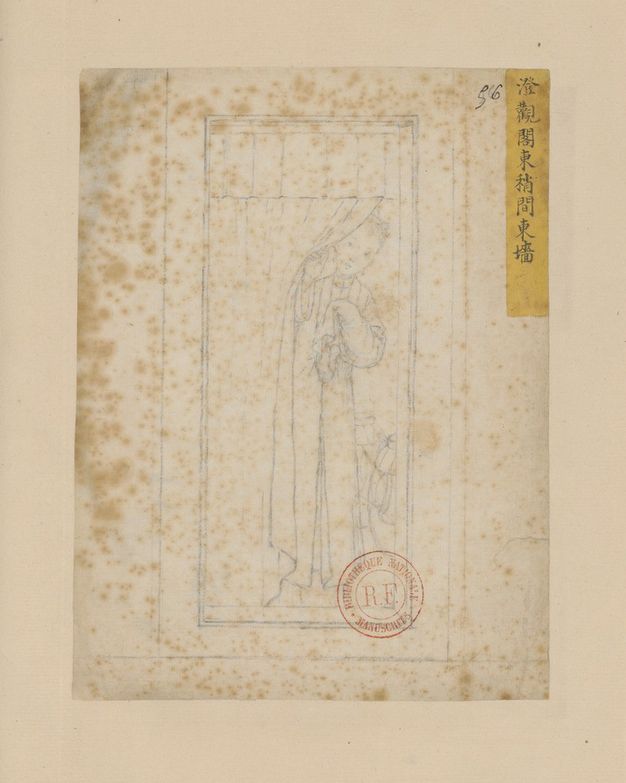
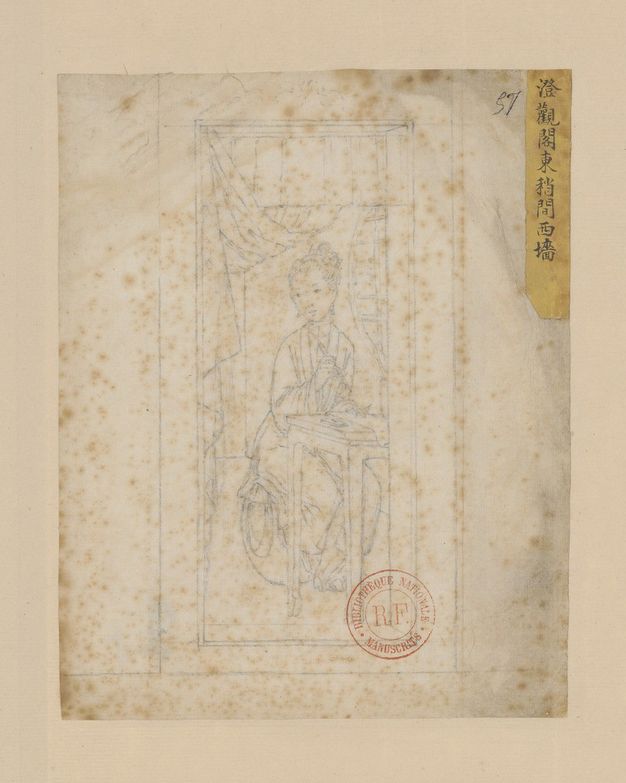
Two rare draft sketches for “beautiful women paintings”
testify to his abilities, depicting dainty young women in
high-collared, long-sleeved, Chinese-style robes engaging the
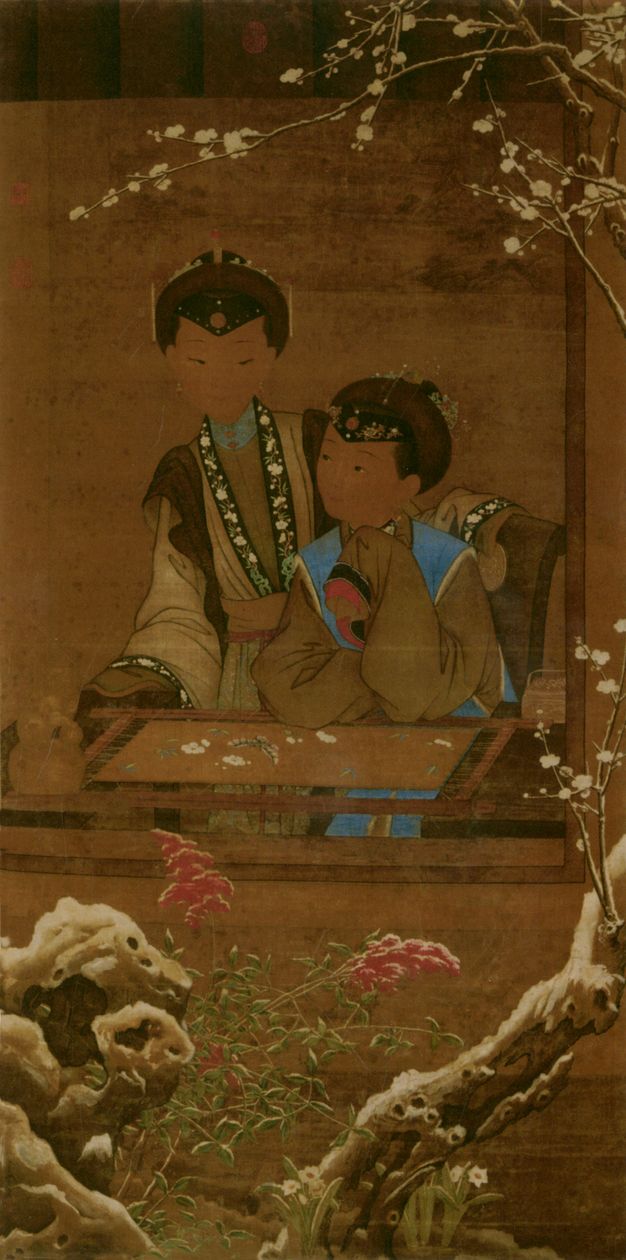
viewer from behind curtained doorways (figs. 5a, 5b). Wider
foreheads and pointed chins create heart-shaped faces with
delicate eyebrows and small mouths through ink line rather
than color or wash. The same treatment of the faces and
similar framing of the women within interior architecture are
also found in a work signed by Attiret and his Wish-Fulfilling
Studio colleague Zhang Tingyan
張廷彥 (1735–94) that bears three of
Qianlong’s seals (fig. 6).36
Just over 1.7 meters tall, this painting depicts a court woman
gazing downward with a knowing smile as she stands behind the
chair of another, while the seated woman looks up dreamily
from her ladylike occupation of embroidering flowers and
butterflies, together a symbol for heterosexual romantic love.
As in the sketches, these women are viewed as if through an
aperture, a common treatment suggesting that the viewer is
observing the women while remaining unobserved himself. I
believe that Attiret most likely painted these women’s faces
because of his talent for figures over other subjects as well
as the fact that Qianlong’s European artists regularly painted
faces in larger collaborative works, where their distinctive
volumetric, brush-concealing style is juxtaposed with the
visible Chinese brushwork surrounding those faces.37
The same contrast is found in this painting, where the women’s
faces are rendered in much finer, paler, and less conspicuous
brushwork than the dark ink lines of their clothing and the
boldly calligraphic strokes representing textile folds. Zhang
was known for landscape, architecture, and figures, but his
paintings of women’s faces retain firm, perceptible ink lines
more consistent with those used for their clothing.38
Furthermore, in this painting and Attiret’s sketches, all four
women’s faces share the same wider forehead and pointed chin,
and the eyebrow positioning, gaze direction, and subtle mouth
movement in otherwise unmodeled faces indicate thought and
emotion. Attiret may have been responsible for other areas of
the painting created with Zhang, but the faces are more likely
than not his work.
ExpandFig. 5A. —Jean-Denis Attiret (French, active in France and
China, 1702–68).
Draft sketch of young Chinese women for scenic illusion
paintings, dateable to 1759, ink on paper, 19.7 × 9.9
cm. From
Recueil de pièces diverses, rangées
chronologiquement de 1408 à 1845,
compiled 1892, Paris, Bibliothèque Nationale de France,
Département des Manuscrits, NAF 5371, fol. 56. Images:
BnF.ExpandFig. 5B. -Jean-Denis Attiret (French, active in France and
China, 1702–68).
Draft sketch of young Chinese women for scenic illusion
paintings, dateable to 1759, ink on paper, 19.7 × 9.9
cm. From
Recueil de pièces diverses, rangées
chronologiquement de 1408 à 1845,
compiled 1892, Paris, Bibliothèque Nationale de France,
Département des Manuscrits, NAF 5371, fol. 57. Images:
BnF.Figs. 5a, 5b. — Jean-Denis Attiret (French, active in France and China,
1702–68). Draft sketches of young Chinese women for scenic
illusion paintings, dateable to 1759, ink on paper, 19.7 ×
9.9 cm (each image). From
Recueil de pièces diverses, rangées chronologiquement
de 1408 à 1845, compiled 1892, Paris, Bibliothèque Nationale de France,
Département des Manuscrits, NAF 5371, fols. 56–57. Images:
BnF.ExpandFig. 6. —Jean-Denis Attiret (French, active in France and China,
1702–68) and Zhang Tingyan (Chinese, 1735–94).Beautiful Women, mid-18th century, hanging
scroll, ink and color on silk, 172.8 × 83.8 cm. Private
collection. From
Catalogue for The Imperial Sale, auction cat.,
Christie’s Hong Kong, 30 May 2005, lot 1217.
Both sketches bear yellow imperial paper slips (huangtiao
黃條) stating that the finished paintings were to be installed
in the Clear View Pavilion (Chengguan’ge澄觀閣) in the Eternal Spring Garden
(Changchunyuan長春園), next
to the Yuanmingyuan (see
figs. 5a,
5b).39
These slips, together with workshop records, help identify the
nonextant, final paintings for which the sketches were
destined as “scenic illusion paintings”
(tongjinghua), or monumental illusionistic works in
color on silk. Such works were produced by the Qing
Wish-Fulfilling Studio artists, who incorporated linear
perspective and volumetric representation to create life-size
works mounted on walls and ceilings, and were intended to
deceive the viewer, through placement and representational
techniques, into thinking that the painting subject and the
space depicted were real.40
Amiot describes one such painting by Attiret: approximately
five pieds (likely referring
to pieds du roi, “royal feet”)
by three-and-a-half pieds wide
(slightly more than 1.6 meters tall by 1.1 meters wide), it
depicted a woman adjusting a flower in her hair in front of a
mirror. While the subject falls squarely within the genre of
“beautiful women paintings,” Amiot’s description of the size
and deceptively realistic depiction of the space identifies it
as a scenic illusion painting: “The mirror is what is most
surprising in this painting. One would take it for a real
mirror, in which one recognizes everything in the apartment
that is within reach of being represented. The illusion is
perfect; art cannot go further.”41
Attiret is specifically named in at least eleven sets of
orders for scenic illusion paintings.42
But as an artist serving in the Wish-Fulfilling Studio, he was
likely involved in many more, confirming that beautiful women
and scenic illusions were both major categories of Attiret’s
Qing court oeuvre.
Portraits
Although court workshop archives record few specific orders
for Attiret to paint portraits, Amiot estimates that Attiret
painted more than two hundred oil portraits of sitters
including but not limited to “Manchus, Mongols, Tartars,
Chinese, men, women, children, emperors, princes, magistrates,
[and] warriors,” often as bust portraits.43
Ten or twelve portraits, Amiot notes, were life-size and
depicted the sitter in formal dress; sitters included the
emperor, a Tibetan lama, an unnamed princess, and Qianlong’s
brother, the fifth prince (likely referring to Hongyan
弘曕, the Prince Guo
果, 1733–65). Curiously, Amiot omitted
a very significant portrait from his list: On 29 May 1753
Attiret received an imperial order to paint the visiting
Portuguese ambassador, Francisco Xavier Assis Pacheco de
Sampaio; he would later produce two unofficial versions of
this portrait, including one for the French mission.44
In September 1754 Qianlong ordered that Pacheco’s portrait be
attached to a nine-panel screen in the Palace of Harmonious
Delights (Xieqiqu諧奇趣)
within the recently constructed European Palaces (Xiyanglou西洋樓) precinct of the
Yuanmingyuan.45
The fact that the Frenchman Attiret completed the Portuguese
ambassador’s portrait (rather than Castiglione, involved as he
was with the Portuguese mission and the Pacheco embassy) was
meaningful enough to the French Jesuits to earn a mention in
the 1758 volume of the first edition of the
Lettres édifiantes et curieuses, écrites des missions
étrangères par quelques missionnaires de la Compagnie de
Jésus
(Edifying and curious letters, written from the foreign
missions by some missionaries of the Society of Jesus),
a thirty-four volume set of letters written by Jesuits serving
in the French overseas missions and published in Paris between
1703 and 1776 for a broad audience.46
The inclusion of this event in the
Lettres, read widely both in France and across Europe, makes its
omission from Amiot’s necrology even more unexpected.
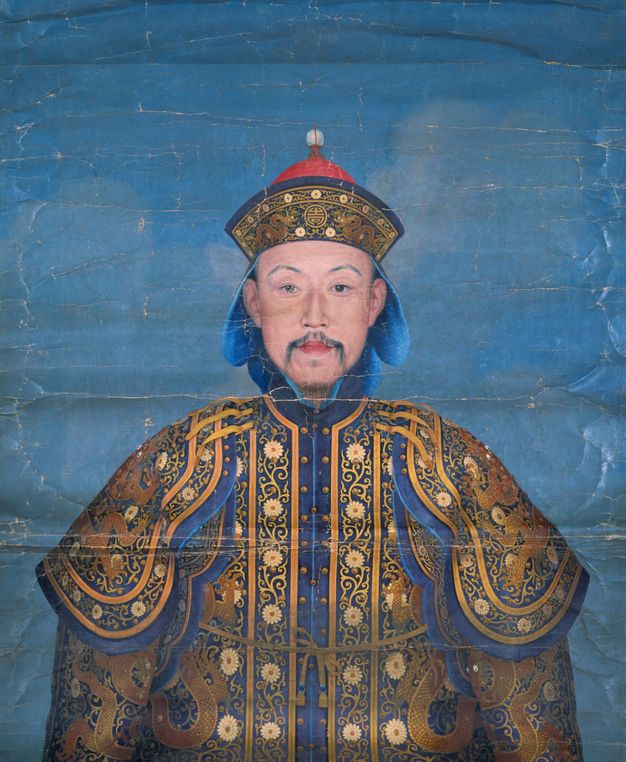
More than a dozen unsigned bust portraits in oil on Korean
paper depicting important Qianlong court figures still exist.
Korean paper (Gaoli zhi高麗紙) is a thick, sturdy paper made
of mulberry bark and heavily sized to minimize absorption,
which made it an ideal surface for oils.47
Until very recently, all were attributed to Attiret: two of
Qing court princes sold at Bonhams London on 7 November 2024;
eight of Mongol leaders held in the Ethnologisches Museum,
Berlin; one of a consort in the Musée des Beaux-Arts, Dole;
and, in the Musée Guimet, Paris, a bust portrait of Qianlong
(fig. 7) along with
one of a consort.48
All the portraits indicate trained European Jesuit
hands—either Attiret, Castiglione, or their colleague Ignatius
Sichelbarth, S.J. (1708–80, Ch. Ai Qimeng
艾啟蒙)—through confident use of color,
highlighting, and subtle shading (rather than Chinese-style
visible linework and brushwork) to create individualized faces
with mass and volume. More concrete attributions are
difficult, due in part to the fact that some (such as the
Mongol leaders) were painted outside of the palace workshops
at other imperial sites away from Beijing. Palace Museum
researcher Wang Youmin and Rijksmuseum curator Wang Ching-ling
have used various court documents other than workshop archives
to argue for reattributing the portraits’ collective
authorship away from Attiret, instead dividing it among the
three Jesuit painters serving the court at that time.49
Epitomized by the Musée Guimet portrait of Qianlong wearing
ceremonial armor, these paintings consistently position the
sitters frontally in the traditional poses of formal Chinese
portraiture, which emphasize the face for insight into the
person and use costume to mark status. However, all are set
against blue or gray backgrounds, a more European treatment
than unpainted grounds. Attiret took the same approach to his
portrait of Father Parrenin published in the second edition of
the
Lettres édifiantes et curieuses
(1780–83), only slightly angling the French mission-leader’s
body and face but retaining the bust length, dark ground, and
formal Chinese attire (see
fig. 3). Attiret
seems to have inaugurated this approach, which other
missionary artists continued, such as in the portrait
attributed to Giuseppe Panzi, S.J. (Ch. Pan Tingzhang
潘廷章) of Father Amiot circa 1789 (see
fig. 1).50
Attiret’s only signed portraits depict horses, which Qianlong
regularly received as tribute gifts. Bearing the signature
“Respectfully painted by the court servitor Jean-Denis
Attiret” (Chen Wang Zhicheng gong hui臣王志誠恭繪, using a variant of the
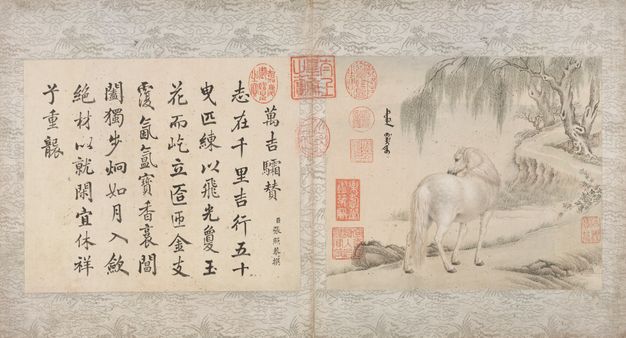
character zhi), Attiret’s album
Ten Fine Horses (Shi junma tu十駿馬圖) is the only work bearing his
signature that is both documented in the former imperial
painting collection and still held in the Palace Museum in
Beijing.51
Each painting in the album is inscribed with the horse’s name
in Manchu and paired with a leaf of Qianlong’s Chinese
calligraphy praising the creature. The horses are depicted in
landscapes but exist with greater solidity than their
surrounding environments, which often include a view into the
distance created by a curving path or body of water. In
The Fine Horse Myriad Auspiciousness (Wan Ji Shuang萬吉驦), the bend in the path repeats
the curve of the horse’s turned head, strengthening the
connection between the animal and its setting (fig. 8). The path extends vertically up the right side of the
composition, along an uptilted ground plane in the traditional
Chinese mode of representing distance, rather than with the
low horizon line and vanishing point of European geometric
linear perspective in which Attiret was originally trained.
The horses in this album do not cast shadows on the ground.
Yet the very subtle shading on their bodies, and slightly more
visible shading and highlighting on their hooves, reveals that
they were painted as if lit by a single light source. Their
muscles are visible through their coats, and the discernible
detail of the underlying anatomy combined with invisible
brushwork adds to the animals’ solidity in a landscape shaped
using Chinese texture strokes. This combination of European
and Chinese painting styles reveals not only how Attiret’s
skills expanded in court service but also the distinctly Qing
transcultural painting style that Qianlong expected of his
artists.
ExpandFig. 8. —Jean-Denis Attiret (French, active in France and China,
1702–68).The Fine Horse Myriad Auspiciousness (Wan Ji Shuang萬吉驦), ink and color on paper,
24.2 × 29.1 cm, from the album of paintings
Ten Fine Horses (Shi junma tuce十骏马图册), dateable to 1743.
Beijing, Palace Museum, 新00146057.
Image provided by the Palace Museum.
Each leaf is impressed with one or several of Qianlong’s
seals, which articulate and reiterate the emperor’s pleasure
in viewing and reviewing the works. His seal “Treasure of the
Retired Emperor” (Taishang huangdi zhibao太上皇帝之寶) is impressed across the
top of the written and painted leaves, permanently marking his
presence and approval. According to the third chapter (juan卷) of the
Precious Collection of the Stone Moat Second Series
(Shiqu baoji xubian石渠寶笈續編), part of the cataloging
project for the secular works in Qianlong’s imperial painting
collection, the album was stored in the Forbidden City’s
Palace of Tranquil Longevity (Ningshougong寧壽宮) where Qianlong originally
planned to retire.52
This further identifies the work’s significance as well as its
persistent appeal to the emperor over his lifetime.
Attiret at the Mountain Retreat for Escaping Summer Heat
The third section of Amiot’s letter focuses on events that
occurred between 1753 and 1760, which he describes as the
height of Qianlong’s reign for the return of various Mongol
tribes to the Qing fold and imperial military victories in
Central Asia.53
Future generations, Amiot predicts, will be equally impressed
by what occurred during this period as by “what painting will
put before our eyes,” implying Attiret’s role in that
success.54
This period is also when Attiret received the most
concentrated imperial favor and attention, beginning on 26
June 1754, when Qianlong ordered him to travel to the Mountain
Retreat for Escaping Summer Heat to record the celebrations
surrounding the submission of several thousand Dörbet Mongols
and their leaders.55
Attiret then spent two frenetic months painting at the Qing
imperial retreat in Hebei province, approximately 150 miles
away from the capital and north of the Great Wall, writing to
Amiot about his experiences in letters both excerpted in the
necrology and published in France.56
Although Attiret was not originally part of the entourage that
left Beijing, while en route Qianlong sent for him to join the
imperial progress, which arrived at the Retreat on 2 July.57
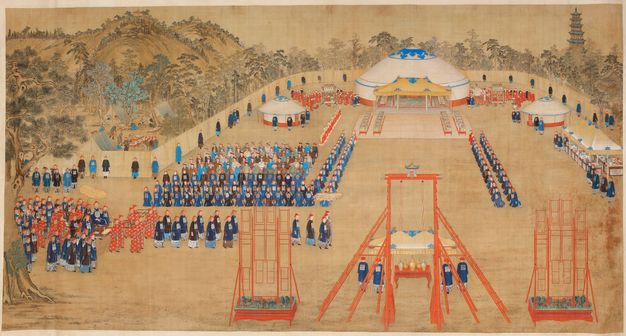
On 4 July 1754, Attiret recounted that a minister arrived at
11 p.m. with an order to paint the next day’s Great Banquet
(Da Yanyan大筵宴). Under
orders to produce a draft sketch for imperial inspection
before the banquet even occurred, Attiret chose the moment of
the emperor’s arrival at the ceremony, drafted the image that
same day as requested, and received imperial approval to
proceed with the painting. Although the draft has been lost,
the monumental finished work based on Attiret’s sketch,
Imperial Banquet in the Garden of Ten Thousand Trees
(Wanshuyuan ciyan tu萬樹園賜宴圖) was completed the next
year with the assistance of Castiglione and Sichelbarth (fig. 9).58
Scholars often praise the painting’s ability to communicate
imperial authority and a sense of truthful representation
through its blend of European linear perspective and Chinese
isometric perspective for the main scene and the surrounding
landscape as well as its identifiable portraits of the Mongol
leaders and the individualized faces of the major court
officials.59
These portraits are connected with those in Berlin, but far
more important for Attiret at the time was the fact that he
painted the emperor’s portrait as part of the banquet scene.
Continuing the system of imperial approvals practiced in the
Beijing palace workshops even while away from the capital,
upon inspection of the draft, Qianlong found that his figure
was leaning too far backward in his seat. To help Attiret
correct the problem, Qianlong posed for him. Due to the
extreme heat combined with Attiret’s persistent illness while
at the Mountain Retreat, the emperor not only allowed the
artist to remove his hat but also to sit. Attiret noted, “one
is always on his knees when one does something in the presence
of His Majesty,” marking these permissions as acts of
extraordinary favor.60
ExpandFig. 9. —Giuseppe Castiglione (Italian, active in Italy and
China 1688–1766), Jean-Denis Attiret (French, active in
France and China, 1702–68), and Ignatius Sichelbarth
(German-Bohemian, active China 1708–80).Imperial Banquet in the Garden of Ten Thousand
Trees
(Wanshuyuan ciyan tu萬樹園賜宴圖), 1755, hanging
scroll, ink and colors on silk, 221.2 × 419.6 cm. Beijing,
Palace Museum, 故00006275. Image
provided by the Palace Museum.
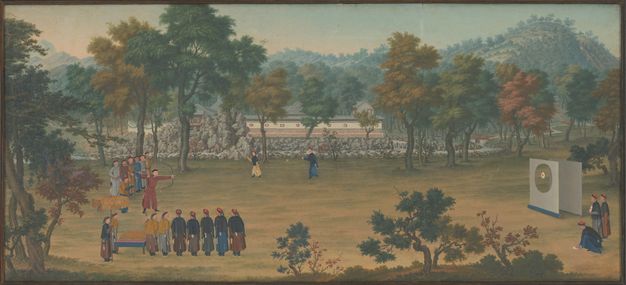
Qianlong’s satisfaction with this portrait led to an order to
depict him practicing archery at the Retreat, which Attiret
painted in oil on Korean paper (fig. 10).61
The emperor stands flanked by servants and officials while
preparing to release an arrow toward a suspended target. Large
rockeries, a stream, and a pavilion wall measure the
significant distance between the emperor and the target, while
colorful foliage in a mountainous setting identify the space
as the Mountain Retreat. On the back of the painting, an
imperial yellow slip reading “As-You-Like-It Island,
Double-Pine Study” (Ruyizhou Shuangsong shuju如意洲雙松書屋) identifies where in the
Mountain Retreat it originally hung.62
Attiret reported that Qianlong assessed his work as “very
good,” pairing a transliteration of the emperor’s “hen hao”
(很好) with its French translation
“très bien” in a rare use of the
Chinese language, with which Attiret struggled. Depicting the
emperor in action meant representing both his imperial visage
and skill in an activity essential to his Manchu cultural and
ethnic heritage. Attiret retained the blue sky, atmospheric
perspective, figural modeling with highlights, and oil paints
of his French training. Yet the uptilted ground plane,
landscape texture strokes, and complete lack of cast shadows
reflect his successful absorption of Qianlong’s preference for
blended European and Chinese techniques.
ExpandFig. 10. —Jean-Denis Attiret (French, active in France and
China, 1702–68).Qianlong Practicing Archery (Qianlong shejian tu乾隆射箭圖), dateable to 1754,
oil on Korean paper, 95 × 213.7 cm. Beijing, Palace
Museum, 故00008760. Image
provided by the Palace Museum.
Amiot only briefly mentions the events and characters that led
to Qianlong’s 1755–59 military campaigns in Xinjiang but
describes in detail the triumphal procession into Beijing in
1760 that he observed.63
That same year, Jesuits Attiret, Castiglione, and Sichelbarth,
together with the Augustinian Qing court painter Giovanni
Damasceno Salusti (1727–81, Ch. An Deyi
安德意), produced monumental paintings
of the battles and the victory celebrations; these were
installed in the Pavilion of Purple Splendor (Ziguangge紫光閣), west of the Forbidden
City.64
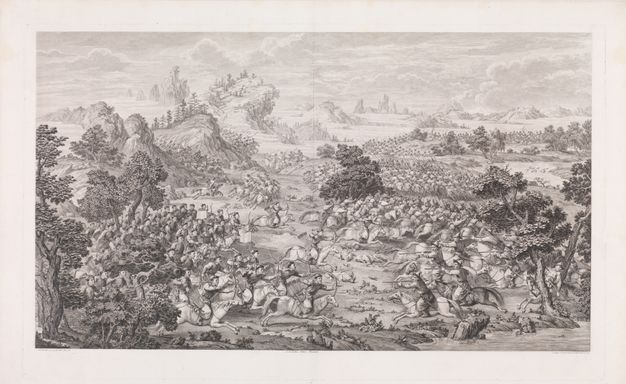
Only fragments of the paintings survive today, but the images
are better known through
Lesconquêtes de l’empereur de la Chine
(The conquests of the emperor of China), a series engraved and
printed in France in 1774 based on designs by European
artists. Attiret contributed three designs:
Le combat d’Arcul (The battle
of Arcul),La victoire de Khorgos (The
victory of Khorgos) (fig. 11), and
On offre les prisoners de la pacification des tribus
musulmanes
(Presenting the prisoners of the pacification of the Muslim
tribes).65
Researcher Niklas Leverenz argues that a group of draft
sketches held in the Tenri Central Library of Tenri University
in Japan are the preparatory images for these lost paintings,
one depicting the Qing victory at Khorgos with an imperial
yellow paper label identifying it as Castiglione’s work, and
another depicting the battle at Arcul that has lost its yellow
labels.66
Attiret is named as the designer for both of these images in
the engraved series, an incongruity that leads Leverenz to
suggest that Castiglione may have designed the original
painting while Attiret prepared the drawing sent for
engraving. Amiot does not mention Attiret’s designs for the
prints in his necrology; the sketches were only sent abroad
the year before his death and returned a decade later, so
Amiot could not have predicted the profound impact they would
have on both Paris and Beijing in the later eighteenth
century.
ExpandFig. 11. —Jacques Philippe Le Bas (French, 1707–83), engraver;
Jean-Denis Attiret (French, active in France and China,
1702–68), designer; and Charles-Nicolas Cochin II
(French, 1715–90), printer.La victoire de Khorgos
(The victory of Khorgos), etching and engraving, 100.7 ×
65.4 cm (sheet), from the series
Les conquêtes de l’'empereur de la Chine
(The conquests of the emperor of China), 1774. New York,
Metropolitan Museum of Art, 45.100.4, Harris Brisbane Dick
Fund, 1945.
Attiret’s last Wish-Fulfilling Studio order, dated 14 May
1768, was for a figure painting to be placed on the wall of a
palace building.67
He died shortly thereafter, on 8 December 1768, and was buried
in Beijing’s French Jesuit cemetery (Zhengfusi正副寺), which was destroyed during the
Boxer Rebellion (1899–1901).68
Qianlong provided two hundred silver taels for Attiret’s
funeral, equivalent to one thousand five hundred livres in
Amiot’s estimation.69
This was such a mark of honor that the imperial donation was
recorded in Latin and Chinese on his tombstone, now held in
the Beijing Stone Carving Art Museum.70
Conclusion
Using the language of art, Amiot describes his letter as a
portrait, but admits that it is “embellished by the colors of
friendship rather than traced lightly by the simple pencil of
truth.”71
He justifies its length as a means of conveying some of
Attiret’s thoughts on Chinese painting, which the painter had
hoped to publish as a text useful to artists and interesting
to curious Europeans. This emphasis on accurate empirical
observation and the suggestion of Attiret’s unfulfilled
publication aspirations reflect period European approaches for
firsthand information about China. But as the head of the
French mission in China in the precarious years immediately
after the Society of Jesus was abolished in and expelled from
France, Amiot would also have intended that this letter’s
publication would fuel eighteenth-century French fascination
with China and demonstrate the continued relevance of the
Jesuit mission in Beijing. By returning images of Attiret’s
works to the necrology, we not only fill in the visual gaps
but also meet the expectations of the letter’s own time.
When Attiret’s work in France and China is considered
holistically, it is clear that his paintings differed
dramatically depending on country, patron, and audience. While
those differences complicate efforts to pinpoint his style,
the flexibility revealed by the paintings is also the marker
of his success. Specifically, the ability to adapt European
styles and materials to Qing imperial demands was essential to
his continued court service and therefore his usefulness to
the Jesuit mission and to France. Read against Attiret’s
extant oeuvre, Amiot’s letter acquires additional value for
what it omits as much as for what it reveals. With the Society
officially dissolved at home, Amiot’s necrology for Attiret
navigates a balance between information about China and the
Jesuit painter’s biography and experiences. Amiot may have
described only paintings that he personally had seen, but in
doing so he epitomizes the eighteenth-century French
intellectual trend of empirical observation. When we
reintegrate extant paintings and Chinese archival sources with
Amiot’s letter, Attiret’s life and work contribute
meaningfully to the material and textual evidence of
eighteenth-century Sino-French cultural interactions.
Kristina Kleutghen is David W. Mesker
Associate Professor of Art History and Archaeology at
Washington University, St. Louis.
Notes
In 2013–14, the author was a Getty Research Institute–National
Endowment for the Humanities Postdoctoral Fellow in the Getty
Scholars Program, when the theme was Connecting Seas: Cultural
and Artistic Exchange. She is grateful to the Getty Research
Institute (GRI) staff for their support in accessing the
original letter soon after it was acquired; to the two
anonymous reviewers for their generosity in making suggestions
for improvement; and to Seth Graebner for clarifying some of
the finer points of translation from eighteenth-century
French. Unless otherwise noted, all translations from the
French and the Chinese are by the author. All transliterations
of Chinese are romanized using the pinyin system.
“Extrait d’une lettre de père Amiot du 1 mars 1769,
de Péking, content l’éloge du Frère Attiret,”
Journal de sçavans
(June 1771): 406–20;
“Jean Denis Attiret, peintre et missionnaire de la
Compagnie de Jésus. Lettre inédite du Père
Amyot,”
in
Collections de précis historiques, littéraires,
scientifiques
(Brussels, 1856), 437–53, 461–77, 485–500; Henri
Bernard, S.J.,
“Le Frère Attiret au service de K’ien-long
(1739–1768): Sa première biographie,”
Bulletin de l’Université l’Aurore
4, no. 1 (1943): 30–82; and Henri Bernard, S.J.,“Le Frère Attiret au service de K’ien-long
(1739-1768): Sa première biographie (Suite),”
Bulletin de l’Université l’Aurore
4, no. 2 (1943): 435–74.
↩︎
Jean-Joseph-Marie Amiot, letter to Claude-François
Attiret regarding Jean-Denis Attiret, 1 March 1769, Los
Angeles, Getty Research Institute (GRI), 2013.M.13,
http://hdl.handle.net/10020/2013m13. ↩︎
Jean-Denis Attiret,
“Lettre du Père Attiret, peintre au service d
l’empereur de la Chine, à M. d’Assaut, à Pékin, le 1er
novembre 1743,”
in
Lettres édifiantes et curieuses
[. . .], vol. 27 (Paris, 1749), 1–61; and Jean-Denis
Attiret,
A Particular Account of the Emperor of China’s
Gardens near Pekin
[. . .], trans. Sir Harry Beaumont (London, 1752).
↩︎
Marco Musillo,
The Shining Inheritance: Italian Painters at the Qing
Court, 1699–1812
(Getty Research Institute, 2016); and Marco Musillo,
“Reconciling Two Careers: The Jesuit Memoir of Giuseppe
Castiglione, Lay Brother and Qing Imperial Painter,”
Eighteenth-Century Studies 42, no. 1 (2008):
45–59.
↩︎
Jeffrey Muller, “‘My Eyes and Taste Are Grown a Little
Chinese’: Jean-Denis Attiret, SJ, Recognizes the Equal
Value of European and Chinese Art,” in
From Rome to Beijing: Sacred Spaces in Dialogue, ed. Daniel M. Greenberg and Mari Yoko Hara (Brill,
2024), 135–55; and Jeffrey Muller, “The Jesuit Strategy
of Accommodation,” in Jesuit Image Theory, ed.
Wietse de Boer, Karl A. E. Enenkel, and Walter S. Melion
(Brill, 2016), 461–92.
↩︎
For biographies of Amiot, see
“Le P. Jean-Joseph-Marie Amiot,”
in
Notices biographiques et bibliographiques sur les
Jesuites de l’ancienne Mission de Chine
1552–1773,
by Louis Pfister, vol. 2 (Shanghai: Imprimerie de la
Mission Catholique, 1932), 837–60; Yun Long
龙云,
Qian Deming: Shiba shiji Zhong-Fa jian de wenhua
shizhe钱德明: 18世纪中法间的文化使者
(Beijing Daxue chubanshe, 2015); and Michel Hermans,
“Appendix 2: Amiot’s Life,” in
The Mandate of Heaven: Strategy, Revolution, and the
First European Translation of Sunzi’s Art of War
(1772), by Adam Parr (Brill, 2020), 224–74.
↩︎
Yoko Nii, “The Jesuit Jean-Joseph-Marie Amiot and
Chinese Music in the Eighteenth Century,” in
Europe and China: Science and the Arts in the 17th
and 18th Centuries, ed. Luís Saraiva (World Scientific, 2013), 81–92; Kee
Il Choi, “Father Amiot’s Cup: A Qing Imperial Porcelain
Sent to the Court of Louis XV,” in
Writing Material Culture History, ed. Anne
Gerritsen and Giorgio Riello (Bloomsbury Academic,
2015), 33–41; Parr, The Mandate of Heaven; Xuan
Fang and Dorothee Schaab-Hanke, “Circulation That Had
Its Price: Roussier and His Role as an Early Recipient
and Disseminator of Amiot’s Knowledge about Chinese
Music,” Journal of Asian History 56, nos. 1–2
(2022): 159–86; and Peter Revers,
Jean-Joseph Marie Amiot in Beijing:
Entdeckung und Erforschung chinesischer Musik im
18. Jahrhundert
(Sächsische Landesbibliothek; Staats- und
Universitätsbibliothek Dresden, 2023).
↩︎
John R. Finlay,
“Ko and Yang and the Mission Française de
Pékin,”
chap. 1 in
Henri Bertin and the Representation of China in
Eighteenth-Century France
(Routledge, 2020), 8–39.
↩︎
George Gazier,
“Un artiste comtois a la cour de Chine au XVIIIe
siècle, le frère Attiret
(1702–1768),”
Mémoires de la société d’émulation du Doubs
6 (1911): 2–40; Jean Hézard,
“Jean-Denis Attiret, missionnaire comtois, Premier
peintre d’un Empereur de Chine
(1702–1768),”
Nouvelle revue franc-comtoise
4 (1954): 219–26; Jean Hézard,
“Jean-Denis Attiret, missionnaire comtois, Premier
peintre d’un Empereur de Chine
(1702–1768),”
Nouvelle revue franc-comtoise
5 (1955): 29–38; Deborah Sommer, “A Letter from a Jesuit
Painter in Qianlong’s Court at Chengde,” in
New Qing Imperial History: The Making of Inner Asian
Empire at Qing Chengde, ed. James Millward (Routledge Curzon, 2004), 171–84;
Wei Yu 韋羽, “Qinggong huajia
Faguo chuanjiaoshi Wang Zhicheng (Jean-Denis Attiret)
清宮畫家法國傳教士王致誠
(Jean-Denis Attiret),” Aomen lishi yanjiu澳門歷史研究 4, no. 12 (2005):
72–82; Léo Keller,
“‘Un pinceau utile pour la bien de la religion’: Jean
Denis Attiret (1702–1768), dit Wang Zhicheng, peintre
jésuite à la cour de Chine,”
in
La chair et le verbe: Les jésuites de France au
XVIIIe siècle et l’image, ed. Édith Flamarion (Presses Sorbonne Nouvelle,
2008), 47–74; Tang Kaijian
湯開建, “Qinggong huajia Faguo
yesuhuishi Wang Zhicheng zai Hua huodong kaoshu
清宮畫家法國耶穌會士王致誠在華活動考述,” Aomen ligong xuebao澳門理工學報 4 (2011): 190–201;
George R. Loehr,
“Der Künstler Jean-Denis Attiret und der Einfluss
seiner Beschreibung der kaiserlichen Gärten,”
in
George Robert Loehr Jr. (1892-1974) und die
forschung über die Pekinger jesuitenkünstler, ed. Hartmut Walravens (Books on Demand, 2019),
207–20; and Muller, “‘My Eyes and Taste.’”
↩︎
Violette Fris-Larrouy,
D’un soleil à l’autre: Jean-Denis Attiret,
missionnaire jésuite peintre de l’Empereur de
Chine
(Éditions de la Bisquine, 2017).
↩︎
Anne Dary, ed.,
Jean-Denis Attiret: Un dolois du XVIIIe siècle à la
cour de l’empereur de Chine
(Dole: Musée des beaux-arts, 2004); and Ming Xiaoyan
明曉豔, “Qinggong Yang huajia
Wang Zhicheng 清宮洋畫家王致誠,”
Wenhua zazhi文化雜誌 (Revista de Cultura) 57 (2005): 165–82.
↩︎
Bénédicte Gaulard,
“Une famille de peintres et de menuisiers: Les
Attiret à Dole de la fin du XVIIe siècle au milieu du
XVIIIe siècle,”
in Dary, Jean-Denis Attiret, 18–19.
↩︎
Catherine Scheck and Jacques Thuillier,
Musée des beaux-arts de Dole: XVIIe et XVIIIe
siècles; Peintures françaises
(Dole: Le Musée, 1995), 76–77. The reproduced image of
Yaël and Sisera from the Dole collection is the
best available; the work is in very poor condition and
cannot be rephotographed (author’s personal
correspondence with Samuel Monier, July 2025).
↩︎
Archives municipales de Dole, GG 89 Dole B.M.S.
1734–1737, cited in Anne Dary,
“De Jean-Denis Attiret à Wang Zhicheng,”
in Dary, Jean-Denis Attiret, 8.
↩︎
On Pozzo’s ceiling and Castiglione’s claim to follow
this model, see Kristina Kleutghen,
Imperial Illusions: Crossing Pictorial Boundaries in
the Qing Palaces
(University of Washington Press, 2015), 78–82. On the
Beijing churches, see Shin Ik-Cheol, “The Experiences of
Visiting Catholic Churches in Beijing and the
Recognition of Western Learning: Reflection in the
Journals of Travel to Beijing,”
The Review of Korean Studies 9, no. 4 (December
2006): 11–31; Anthony E. Clark,
China Gothic: The Bishop of Beijing and His
Cathedral
(University of Washington Press, 2019), 73–96; and Alan
Richard Sweeten,
China’s Old Churches: The History, Architecture, and
Legacy of Catholic Sacred Structures in Beijing,
Tianjin, and Hebei Province
(Brill, 2020), 71–147.
↩︎
Writing in the nineteenth century, Augustan Canron
suggested that Attiret painted only Matthew, Mark, and
Luke, and that a M. Mariotty fils painted John. Augustin
Canron,
Guide de l’étranger dans la ville d’Avignon et ses
environs
(Avignon, 1858), 75.
↩︎
Ruyiguan如意館 QL
4/7/27 (30 August 1739), in First Historical Archives,
Qinggong zaobanchu dang’an zonghui, vol. 9
[1739–41], 171–72. This site is the thirteenth depicted
in Forty Scenes of the Yuanmingyuan (Yuanmingyuan sishijing圓明園四十景; 1744), album of
forty paired leaves of calligraphy and painting, ink and
color on silk, painted by Shen Yuan
沈源 (act. eighteenth century)
and Tangdai 唐岱 (1673–1752?),
and now held in the Bibliothèque National de France,
Département des Estampes et Photographie, RESERVE FT
6-B-9,
https://gallica.bnf.fr/ark:/12148/btv1b550083263. ↩︎
Amiot, letter, GRI, 29–35; and James Cahill,
Pictures for Use and Pleasure: Vernacular Painting in
High Qing China
(University of California Press, 2010).
↩︎
These commissions are summarized in Tang, “Qinggong
huajia,” 194, 197.
↩︎
“Treasure of the Qianlong emperor” (Qianlong yulan zhi bao乾隆御覽之寶), “Precious
Collection of the Stone Moat” (Shiqu baoji石渠寶笈), and “Treasure of the
Painting and Calligraphy Room (Shuhuafang jiancang bao書畫房鑒藏寶).
↩︎
For example, Castiglione painted only Qianlong’s face in
the series of thangkas depicting him as the
Mañjughoṣa emperor. See Patricia Ann Berger,
Empire of Emptiness: Buddhist Art and Political
Authority in Qing China
(University of Hawaiʻi Press, 2003), 54–61.
↩︎
Jean Sylvain de Neuvialle,
Relaçaõ da jornada, que fez ao Imperio da China, e
summaria noticia da embaixada que deo na Corte de
Pekim em o primeiro de Mayo de 1753, o Senhor
Francisco Xavier Assiz Pacheco e Sampayo
(Lisbon, 1754), n.p. On the embassy, see Antonio Vilhena
de Carvalho, “In a Different World: Pacheco de Sampaio
in Qing’s China (1752–1753),” in
Three European Embassies to China, ed. Maria
Manuela d’Olivera Martins et al. (Fundação Oriente,
2018).
↩︎
Ruyiguan, QL 19/7/23 (9 September 1754), in
First Historical Archives,
Qinggong zaobanchu dang’an zonghui, vol. 20
[1753–54], 378.
↩︎
L. Patouillet,
“Épitre aux Jésuites de France,”
in
Lettres édifiantes et curieuses
[. . .], vol. 28 (Paris, 1758), vii–viii.
↩︎
Kee Il Choi, “Portraits of Virtue: Henri-Léonard Bertin,
Joseph Amiot and the ‘Great Man’ of China,”
Transactions of the Oriental Ceramic Society 80
(2015): 55n27; and Camille Schmitt,
La médecine de l’art: Conservation des
calligraphies et peintures chinoises en rouleaux à
partir des textes de la dynastie Ming, 1368–1644
(Éditions Philippe Picquier; Centre de Conservation du
Livre, Arles, 2011), 52–53.
↩︎
“Fine Chinese Art,” auction, Bonhams London, New Bond
Street, 7 November 2024, lots 141–42; Ethnologisches
Museum, Staatliche Museen zu Berlin, 22156, 22228,
22229, 22230, 22242, 24356, 31805; Dole Musée de
Beaux-Arts 2001.5.1; and Paris, Musée Guimet, MG 26504,
26588. For the eighth Berlin picture, see Wang Youmin
王幼敏, “Deguo Bolin cang Qingdai
Zhunga’er Menggu zu buluo shouling youhua xiang yanjiu
德国柏林藏清代准噶尔蒙古族部落首领油画像研究,” Gugong xuekan故宫学刊 20 (2019): 293–310. See
also Dary, Jean-Denis Attiret; and Martyn
Gregory Gallery,
In the Wake of the Indiaman: Historical Pictures by
Chinese and Western Artists 1770–1870
(London: Martyn Gregory Gallery, 2000).
↩︎
Wang, “Deguo Bolin”; and Wang Ching-Ling
王靜靈, “Bolin shoucang de
Ziguangge gongchen xiang jiqi xiangguan zuopin xin lun
柏林收藏的紫光閣功臣像及其相關作品新論,” Gugong xueshu jikan故宮學術季刊 34, no. 1 (2016):
153–214.
↩︎
Nie Chongzheng 聂崇正, “Wang
Zhicheng de ‘Shi Junma Tu’ ce
王致誠的
«十駿馬圖»
冊,” Zijincheng紫禁城 6
(1981): 38.
↩︎
On the Tranquil Longevity Palace within the larger
Qianlong Garden of the Forbidden City, see Nancy
Berliner, ed.,
The Emperor’s Private Paradise: Treasures from the
Forbidden City, exh. cat. (Peabody Essex Museum, 2010).
↩︎
Amiot, letter, GRI, 44–58; and James Millward,
Beyond the Pass: Economy, Ethnicity, and Empire in
Qing Central Asia
(Stanford University Press, 1998).
↩︎
The Ruyiguan order on QL 19/7/23 (9 September
1754) dates the order dispatching Attiret to the
Mountain Retreat as QL 19/5/7 (26 June 1754), in First
Historical Archives,
Qinggong zaobanchu dang’an zonghui, 20:377.
↩︎
Jean-Joseph-Marie Amiot,
“Lettre du père Amiot, missionnaire à la Chine, au
père de la Tour, de la meme Compagnie, 17 October
1754,”
in
Lettres édifiantes et curieuses
[. . .], vol. 23 (Paris, 1781), 302–68; see also the
partial translation in Sommer, “A Letter.”
↩︎
Amiot,
“Lettre du père Amiot . . . au père de la
Tour,”
315. ↩︎
Lucia Tripodes, “Painting and Diplomacy at the Qianlong
Court: A Commemorative Picture by Wang Zhicheng
(Jean-Denis Attiret),”
RES: Anthropology and Aesthetics 35 (Spring
1999): 185–200.
↩︎
Ruyiguan records for 3 June 1755 (QL 20/4/24)
date the order for the painting’s creation to 1 August
1754 (QL 19/6/13); Attiret’s letter quoted by Amiot
dates it to 29 July (Amiot, letter, GRI, 54–55). First
Historical Archives,
Qinggong zaobanchu dang’an zonghui, vol. 21
(1755–56), 301–2.
↩︎
Yang Boda 杨伯达, “‘Qianlong
shejian youhua guaping’ shu kao
«乾隆射箭油画挂屏»
述考,” Gugong bowuyuan yuankan故宫博物院院刊 1 (1991): 26–38.
The workshop archives document cited in this essay,
note 61, also records that the
painting was hung at the Mountain Retreat.
↩︎
Niklas Leverenz, “From Painting to Print:
The Battle of Qurman from 1760,”
Orientations, May 2010, 48–53; and Camille
Schmitt, “The Battle of Qurman: Restoration and
Remounting of a Qing Imperial Wall Painting,”
Orientations, May 2010, 53–54.
↩︎
Pascal Torres Guardiola,
Les batailles de l’empereur de Chine: La gloire de
Qianlong célebrée par Louis XV, une commande royale
d’estampes
(Musée du Louvre, 2009); Laura Newby, “Copper Plates for
the Qianlong Emperor: From Paris to Peking via Canton,”
Journal of Early Modern History 16 (2012):
161–99; Shiyi Liu, “Emperor Qianlong’s East Turkestan
Campaign Pictures: The Catalytic Role of the
Documentation of Louis XIV’s Conquests,”
Arts of Asia 47, no. 2 (April 2017): 82–97; and
Richard E. Strassberg, “War and Peace: Four
Intercultural Landscapes,” in
China on Paper: European and Chinese Works from the
Late Sixteenth to the Early Nineteenth Century, ed. Marcia Reed and Paola Demattè, exh. cat. (Getty
Research Institute, 2007), 88–137.
↩︎
Niklas Leverenz, “Drawings, Proofs, and Prints from the
Qianlong Emperor’s East Turkestan Copperplate
Engravings,”
Arts Asiatiques 68
(2013): 41.
↩︎
Ruyiguan QL 33/3/28 in First Historical
Archives,
Qinggong zaobanchu dang’an zonghui, vol. 31
(1767–68), 773.
↩︎
Ming Xiaoyan 明曉豔 and Jean-Paul
Wiest,
Lishi yizong: Zhengfusi Tianzhujiao mudi歷史遺踪: 正福寺天主教墓地 (Wenwu
Chubanshe, 2007).
↩︎