Metcalf / Becoming Simone FortiGetty Research Journal, No. 21 (2026)
Copied page section link to clipboard
Abstract
In this first-person, diaristic essay, an art historian
with a background in dance takes the reader through the
process of pursuing the material traces of performance in
the archive. Drawing from a narrow set of primary sources,
the narrative recounts how a surprise find at the Getty
Research Institute (GRI) in Los Angeles illuminates the
period between 1970 and 1972, when interdisciplinary
artist Simone Forti taught at the California Institute of
the Arts (CalArts) and staged multimedia performances at
the Pasadena Art Museum (today the Norton Simon Museum).
The essay demonstrates the ways that embodied knowledge
provided by practice—and foregrounded in dance,
performance, and museum studies—provides key insights into
art and generates new connections between artists,
mediums, and institutions. Simultaneously, the essay
reveals the losses that are inherent to the pursuit of
live forms from the past such as dance, and how such
losses are ultimately productive, a lesson that extends to
history writing in general.
Keywords
Simone Forti, dance, archives, performance studies,
Pasadena Art Museum, CalArts
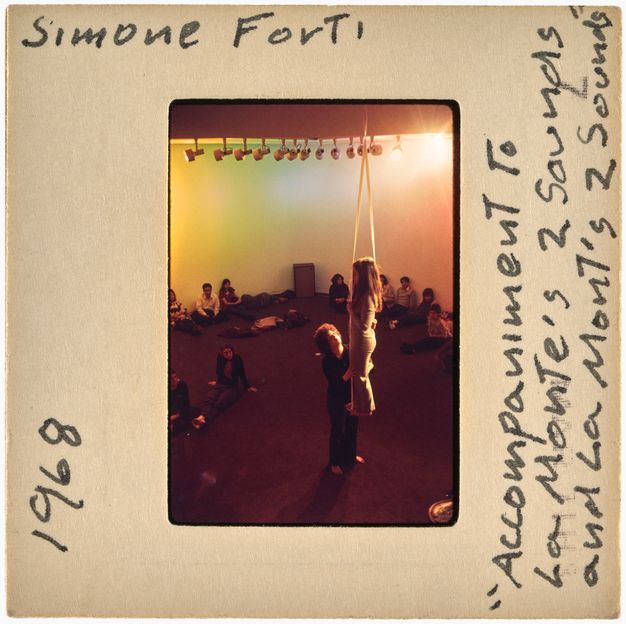
I am leaning over a slide at the light table. The familiar
handwriting of artist and dancer Simone Forti (b. 1935) on the
cardboard frame provides her name, a title—“Accompaniment to
La Monte’s 2 Sounds and La Monte’s 2 Sounds”—and a date: 1968
(fig. 1). This is
not the low, tight cursive of Forti’s in her twenties and
thirties but the clear, spacious printing that she developed
somewhat later, the same handwriting that appears in the
inscriptions of her books now on my office shelf. I suspect
the slide was labeled in the run-up to the acquisition of
Forti’s archive in 2019 by the Getty Research Institute (GRI),
or perhaps when the Museum of Modern Art (MoMA) in New York
was considering Forti’s earliest works, those that Forti
called “Dance Constructions” (1960–61), for its permanent
collection between 2009 and 2015.1
Now, seated in the Special Collections Reading Room at the GRI
in November 2024, I’m consulting the Simone Forti papers and
audiovisual materials, which have not yet been fully
cataloged, in hopes of finding images of the Dance
Constructions in the 1960s.2
After spending years researching in the artist’s personal
papers and in the collections of the New York Public Library
for the Performing Arts, I know that extant material from
Forti’s life and work in the 1960s, especially photographs, is
scarce. And indeed, just a brief look at the slide at the GRI
suggests it might instead depict a performance from 1971. The
false lead of the mislabeled date isn’t even momentarily
disappointing: I’m thrilled that what I’ve found could provide
more insight into Forti’s time in Southern California between
1970 and 1972, which I’ve long hypothesized was a pivotal
period for the artist.
ExpandFig. 1. —Color slide with handwritten label, “Simone Forti,
‘Accompaniment to La Monte’s 2 Sounds and La Monte’s 2
Sounds,’ 1968,” possibly 1971, 5 × 5 cm.
Los Angeles, Getty Research Institute, 2019.M.23.
Italian-born, Southern California–raised Forti was, until
recently, primarily known in US American and European dance
communities for her contributions to improvisational forms of
movement. In the early 2000s, art historians and museum
curators “discovered” that Forti’s artistic practice was
implicated in and foundational for a number of canonical
postwar movements—Happenings, Fluxus, and Minimalism, among
others—and that the artist had been making drawings, videos,
sculptures, music, and poetry in addition to performances for
decades. As part of my scholarly inquiry into the art world’s
fascination with dance, I’ve been tracking Forti’s transition
from dance-world legend to visual-art star; following the
artist and her works from her classroom in the dance
department at the University of California, Los Angeles
(UCLA), to personal and institutional archives, in
international galleries and museums and through publications.
Making sense of this trajectory requires weaving together
several different kinds of knowledge. I’m drawing on my bodily
experience from Forti’s classes and workshops, the data
provided by files and photographs in the archive, and my
evolving understanding of Forti’s creative and personal
relationships as well as the growing body of secondary
literature about Forti.3
This scholarly labor constitutes its own dance between the
methods of the art historian (which some might say overvalues
the archive) and the methods of the performance theorist
(which, in privileging oral history and bodily knowledge,
arguably undervalues the archive). My scholarship requires
both methodological approaches. As theater scholar Rebecca
Schneider has aptly pointed out, archival research on any
topic is an embodied endeavor: you show up, take stock of the
scene, pursue leads, dive in more deeply, get lost, begin
again, forge new paths.4
Today at the Getty, I’m letting the archive pull me along. My
query is strictly present tense and situated in the body, for
the most part ignoring what others have said (and might
think). If I’m paying close attention to what’s in front of
me, yet open to surprises, just one little clue can open up
whole new webs of relations and shed light on my own processes
and preconceptions—even the entire historical enterprise.
I place the loupe over the slide and draw a sharp breath: Is
that a child standing in the rope? With Forti beneath her? I
seem to recall a document in which Forti expressed a desire to
let children play with the plywood-and-rope equipment used in
her Dance Constructions. In this work,
Accompaniment for La Monte’s “2 Sounds” and La Monte’s “2
Sounds”
(1961; hereafter Accompaniment), a performer steps
into a long loop of rope hanging a few feet off the ground. An
assistant moves in close and winds the first performer up
tightly. As the assistant steps away, the rope uncoils, and
the person in it whips out in a spin, twisting one way and
then the other until the momentum runs out. It’s all conducted
to a recording of composer La Monte Young’s screeching
composition Two Sounds (1960) at an uncomfortably
loud volume, which contains the sound of metal scraped on
glass—and goes on for about twelve minutes.5
After a dramatic start, the majority of the piece consists of
the performer swaying slightly in the rope and the audience
members shifting subtly in their seats as they all endure
Young’s music. In Accompaniment, Forti’s use of a
singular gesture and limited movement to draw attention to the
presence and mechanics of the human body and the relationship
between audience and artwork is characteristic of all of the
Dance Constructions, which are still performed today.
In June 1968, Accompaniment was performed by visual
artist and musician Walter De Maria in an unfinished loft
studio space in New York City associated with Cornell
University’s College of Architecture, Art, and Planning. I had
hoped to find more photographs of De Maria, who appeared in a
number of dances by Forti and her Judson Dance Theater peers
in the 1960s, at the GRI. Forti used a black-and-white
photograph by Peter Moore of the 1968 performance to
illustrate Accompaniment in her autobiographical book
Handbook in Motion (1974).6
Written and compiled during a residency in Halifax, Nova
Scotia, in 1972–73, Handbook in Motion consists of
journal entries, drawings, ephemera, and photographs detailing
Forti’s artistic activities and influences up to that point. A
nonchronological narrative juxtaposes the artist’s early dance
training and performances in San Francisco and New York City
(1950s and ’60s) with her subsequent creative experiments in
Rome, upstate New York, and California (late 1960s to the
early 1970s). Since its publication in 1974, Forti’s account
of finding herself as an artist has been enormously
influential for dance practitioners.
The photograph by Moore from 1968 reproduced in
Handbook in Motion shows a blurry De Maria elevated
over checkered linoleum, but the color slide that I’m looking
at now in the GRI’s Reading Room is dominated by a dark carpet
(see fig. 1). A row
of old-school track lights dots the ceiling, while an
attentive seated audience lines the edges of the space. Just
off-center, the two female-presenting performers of
Accompaniment are brightly illuminated, seemingly at
the moment when the assistant winds up the person suspended in
the rope. A bulky speaker—likely from which Young’s recording
blasted—is in the corner where the rear walls meet. This is
clearly not the same occasion as the one that appears in
Handbook in Motion. Based on the color quality of the
slide and the outfits and haircuts of the people in it, I
think this is a concert of Forti’s Dance Constructions (in
which Accompaniment appeared) at the Pasadena Art
Museum in February 1971, almost ten years after the works’
first appearance in 1961.
Forti had returned to Southern California sometime in the late
summer or fall of 1970 and stayed until the spring of 1972, a
brief but productive period that is difficult to detect within
the archival record. I’m especially interested in a series of
informal jam sessions that Forti called “Open Gardenia,” which
Forti initiated at the California Institute of the Arts
(CalArts) soon after she arrived in California. I think these
sessions served as an engine for her modes of working and
creative output in the decades that followed. However, not
only was Forti’s artistic practice newly in formation in those
years but so too were the institutions with which she was
associated: CalArts and the Pasadena Art Museum (today the
Norton Simon Museum). Along with the usual problem of limited
(or no) photographs or film/video of performances and other
live events in the 1960s and 70s, the repositories where this
documentation might end up were not yet securely in place. The
processing and accessibility of Forti’s papers and audiovisual
materials at the GRI promises clues for finally constructing a
coherent narrative and stable timeline for the events and
artworks of 1970–72, enabling my art history to perform
certain certainties.
But dance in the archive—and Forti’s dance between 1970 and
1972—insists that some things will stubbornly refuse to reveal
themselves fully. Forti’s dances disrupt any final narrative,
and my experience pursuing their remnants attests above all to
the gaps, failures, fantasies, and desires that drive my
project—and may drive the writing of every history. Art
historian Carrie Lambert-Beatty has noted how many of the
performative works of the 1960s and 70s were “designed to be
lost,” leaving behind material testifying primarily to lack,
which compels the pursuit across contexts and time.7
Indeed, in the archive, the absence of live movement and the
performer’s enlivened body generates only more longing for
experiences forever out of reach or always slipping away. The
slide’s image of the 1971 performance illuminates so much
about the performers, the museum space, and even the
photographer—while provoking so many additional speculations.
I’m suspended between wanting to pin everything down and
wanting to let mystery remain.
Back at home, I hunt for a research photograph of a
typewritten text marked with the rusty residue of an old paper
clip. It’s an undated, untitled proposal about a workshop that
Forti wanted to teach at CalArts containing a lengthy
description of the concerts she had held at the Pasadena Art
Museum; I found it in Forti’s papers at her home in Los
Angeles around 2013, before they were acquired by the GRI.8
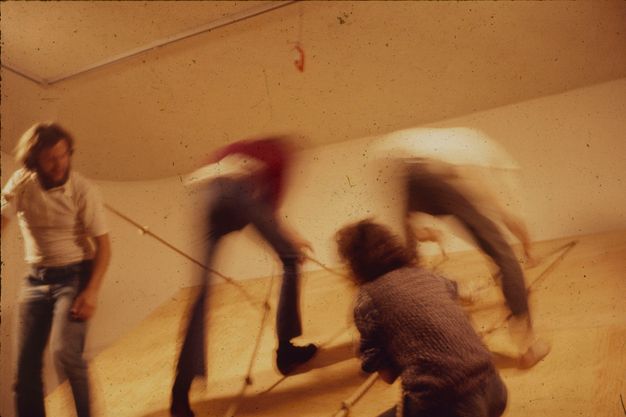
Writing at the conclusion of her museum performances, circa
spring 1971, Forti described how she and her collaborators
planned to install the wooden ramp with ropes required for
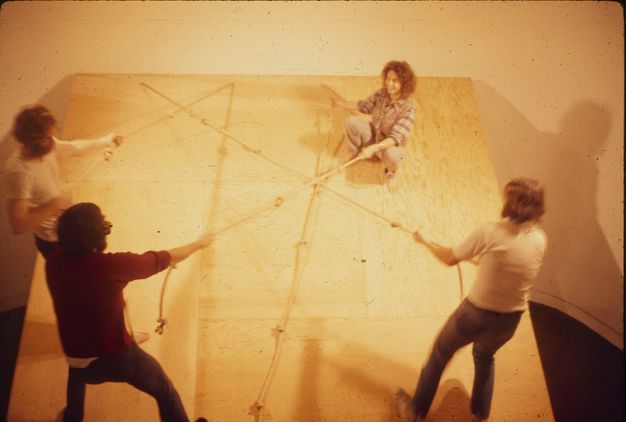
Slant Board (1961;
fig. 2), another
Dance Construction, on the CalArts campus in Valencia, then
still under construction, “so that anyone who is interested
will be able to play on it.”9
The proposal doesn’t mention children at all.
ExpandFig. 2. —Rehearsal for Simone Forti’s
Slant Board (1961) in “Two Evenings at the
Pasadena Art Museum,” February 1971, color slide, 5 × 5
cm (detail).
Photograph possibly by Serge Tcherepnin. Image courtesy of
the artist and The Box LA.
Another false lead—and I realize I have fallen into the trap
of Forti’s first historians, who linked the artist and her
early choreography to children’s games in order to explain
their radical simplicity, which had the effect of
infantilizing the artist herself.10
Sitting at my desk, now a little ashamed, I wonder if I’ll
ever be able to find out whether the “rope board” made it to
the CalArts campus, and who might have experimented with it? I
also wonder whether Forti was eventually hired to teach the
Gardenia Workshop that she outlined for the brand-new art
school, or if she even submitted the proposal at all? A copy
had remained in her files for me to discover more than four
decades later, after all.
Forti’s friend and colleague Allan Kaprow, who is credited
with inventing the Happenings in New York City in the late
1950s and early 1960s, enlisted Forti to cover his classes at
CalArts while he traveled to Cologne for an exhibition in
November 1970. At the school, Forti sought collaborators for
the kind of music and dance practice she had begun to develop
during her time living on communes in upstate New York in
1969–1970.11
She explains in her proposal for Gardenia Workshop how she had
organized the Open Gardenia jam sessions: “The more I talked
to people [at CalArts], the more I realized that there was a
common need for an open ended yet stable situation” in which
collaborations between artistic mediums and between people
could take hold.12
What resulted was “a kind of weekly festival in which everyone
who showed up was a welcome performer.”13
Forti found a regular time and place for these sessions on
Friday nights from seven to nine in the multimedia trailer (a
location suggested by faculty member and composer Serge
Tcherepnin) and arrived at the name Open Gardenia. She
describes participants in the jam sessions “dancing and making
sounds, working lights, or projecting live or recorded images”
and names some members of the ad hoc group, the most famous
among them Tcherepnin, Fluxus artist Shigeko Kubota, and
composer Charlemagne Palestine.14
Forti’s bid was simple: She wanted to formalize the Open
Gardenia activities in a class or workshop that, under her
direction, “would uniquely complement the studies which are
already offered at Cal Arts.”15
The overall image that Forti paints of the Open Gardenia
sessions in her proposal, in Handbook in Motion, and
in her contemporaneous notebooks is so evocative, yet certain
details remain maddeningly obscure.16
I’ve never found any photographs or film documentation of the
Friday night sessions at CalArts in 1970–71, and the organizer
herself admitted at the time: “I have no idea of all the
people who came and went.”17
Even if I had a recording, I still would never know what it
was like to be there on the interim campus in that “first,
famously chaotic year” of CalArts, when the previous Chouinard
Art Institute and Los Angeles Conservatory of Music converged
on the former Villa Cabrini Academy campus in Burbank in
1970.18
All of the documentation (and first-person recollections) in
the world could never convey the full range of the movement
and sounds, lights, and music in a dimly lit space filled with
incense and cigarette smoke. More to the point, I’d never be
able to smell the perspiration of the moving bodies in the
room, feel the creative, social, and libidinal energy flowing
between Open Gardenia’s participants, or join in their
spontaneous side conversations.
I know this is a fantasy. But I’m nonetheless convinced that
Open Gardenia’s powerful currents precipitated many of Forti’s
discoveries in dance, sound, and the visual arts since 1970.
With Palestine, Forti developed a collaborative,
improvisational movement and music practice, later called
“Illuminations,” which consisted of Forti drawing numbers and
spirals on paper and then following the patterns with her
entire body on a walk or run while Palestine sounded out tones
and extended drones on the piano and other instruments.19
The duo eventually performed all over the world. Likewise,
with CalArts printmaking professor and artist Peter Van Riper,
Forti developed Big Room (sometimes also called “Home Base”),
which paired her movement improvisations with Van Riper’s
musical improvisations, most often on the sopranino
saxophone.20
They married and appeared together in major art venues
nationally and internationally in the 1970s, 1980s, and
beyond.21
Forti’s extended, iterative collaborations with Palestine and
later with Van Riper combined spontaneous decision-making with
the shared knowledge acquired through working together
intimately over time: breathing, sounding, and moving together
in the spaces of rehearsal, performance, pedagogy, and
domestic life.
I can’t claim such an intimate association with the artist,
but I experience something similar with the fragments in the
archive, which I’ve been circling for almost fifteen years.
And I’m beginning to think that there are parallels between my
scholarly process and those in Illuminations and Big Room,
which developed slowly out of the artists’ personal
relationships, embodied knowledge, and happy accidents. The
names Illuminations and Big Room never marked an arrival or
enclosure but rather the continuity in the connections between
the performers and their respective mediums; each “work”
folded into the next, which folded into the next, which folded
into the next.22
Likewise, I’ve been constructing and reconstructing my
(hi)stories with ever-expanding knowledge about the events and
people with whom Forti was associated, against a backdrop of a
bodily understanding of some of Forti’s work and specters of
conversations and collaborations from the past that will never
be recovered. I’ve pursued the material traces of the artist’s
practice from her home to her gallery, The Box, in Los
Angeles, and now to the GRI, generating a continually evolving
picture of Forti’s body of work as well as its internal
connections. But whereas the notes, letters, sketches, and
other archival documentation that surround a painting or
sculpture point toward a securely tangible thing, the dance
configured by physical artifacts from the archive never takes
a final form. This makes my pursuit seem futile while keeping
me going—and keeping me humble in the knowledge that every
history is an approximation.
Forti was invited to share her work at the newly opened
Pasadena Art Museum in early 1971. She has written that she
“naturally turned to [her] Open Gardenia family” for
collaborators and performers.23
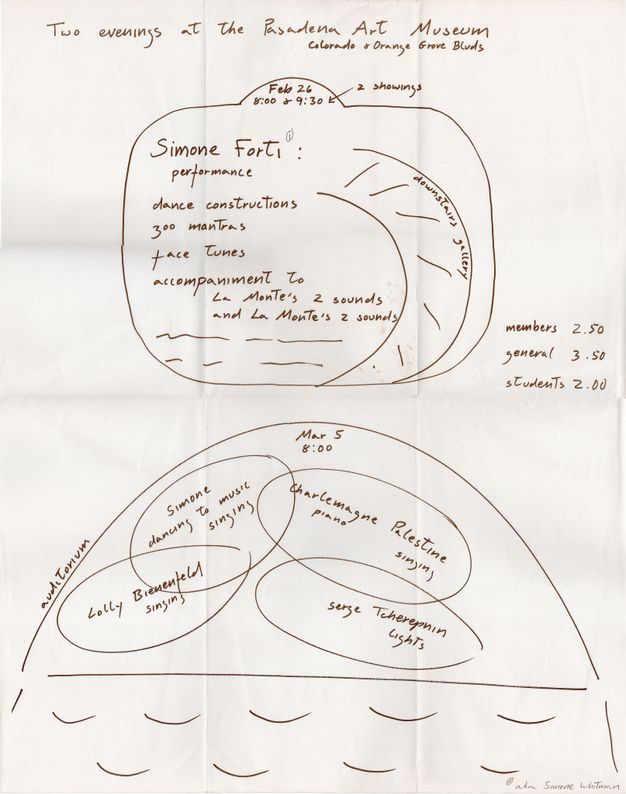
Forti divided the material she had into two separate occasions
and locations, which reflected the transition between the work
she had done to date and the work she would soon pursue with
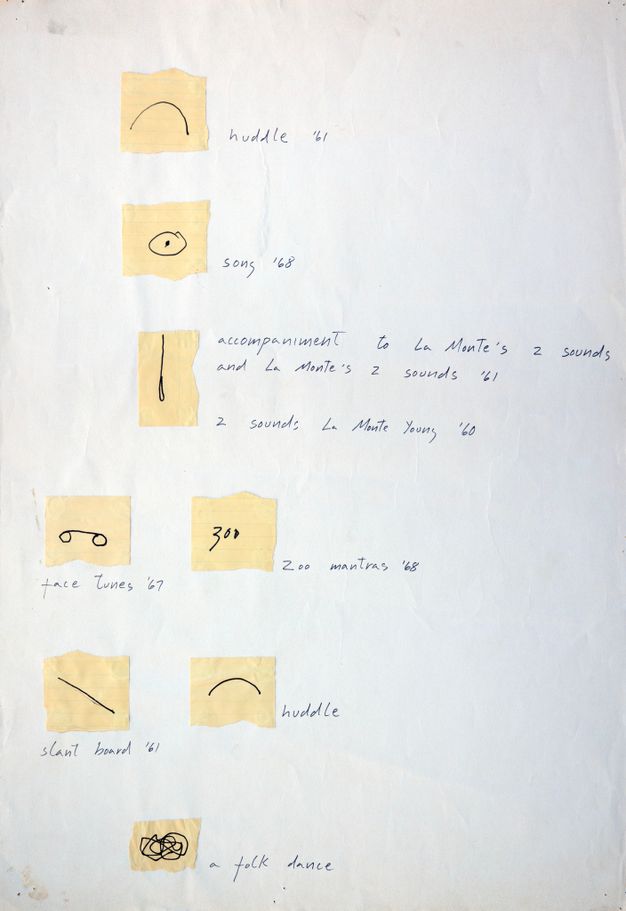
Palestine and Van Riper, and others (fig. 3). On 26 February, in a downstairs gallery with a spiral
staircase and dark carpet, Forti and her collaborators
performed three of the five Dance Constructions that had
debuted in downtown New York City in 1961 as well as a few
other works Forti developed later in the 1960s (fig. 4). The evening closed with all of the performers improvising
on “a folk dance,” an exercise that Forti has also called
“Droning,” “Buzzing,” or “Scramble” in other contexts.24
A week later, in early March, some of these performers—Forti,
Palestine, Tcherepnin, and musician Lolly Bienenfeld—presented
a collaboration of sound, movement, and lights in the museum’s
auditorium, likely along the lines of what they had been doing
together in Open Gardenia.25
Forti’s separation of her past work from present at the
Pasadena museum prefigured the retrospective look she would
soon take while preparing Handbook in Motion in Nova
Scotia. Made at a creative crossroads,
Handbook in Motion, the Pasadena concerts—and almost
certainly Open Gardenia—all signaled reckoning, rebirth, and
re-formation.
ExpandFig. 3. —Simone Forti (US American, b. Italy, 1935).
Poster for “Two Evenings at the Pasadena Art Museum,”
1971, 48 × 61 cm. Image courtesy of the artist and The Box
LA.ExpandFig. 4. —Simone Forti (US American, b. Italy, 1935).
Program for the 26 February performances of “Two Evenings
at the Pasadena Art Museum,” 1971, 48 × 61 cm. Image
courtesy of the artist and The Box LA.
Like Forti, the Pasadena Art Museum was also at a critical
juncture: Still developing its contemporary art collection
(and with limited funds), the museum featured music and other
live events as well as temporary, site-specific installations
to fill the galleries of a brand-new and largely reviled
building, which opened to great fanfare in January 1970.26
The institution itself was ultimately temporary, becoming
enfolded in what is today the Norton Simon Museum around
1974.27
Now fully processed and accessible to researchers, Forti’s
archive at the GRI will enable scholars to reconstruct
historic connections between institutions, artists, and
disciplines. Museums are composed of people, after all, and
performance research enables an understanding of the social
dimension of institutions, correcting old narratives and
long-held assumptions. Even still, I suspect that Forti and
her collaborators—and maybe all historical figures—will
continue to resist being captured definitively. And certain
episodes, like Open Gardenia, may in the end remain not fully
knowable, which is what makes them so appealing.
As I compare the color slide at the GRI (see
fig. 1) with a set
of scans from Forti’s gallery, it appears that the long-haired
figure in the rope at the Pasadena Art Museum might not have
been a child after all. Maybe it was just a person of small
stature photographed from above? And the short-haired person
winding her up was definitely not Forti, whose hair was longer
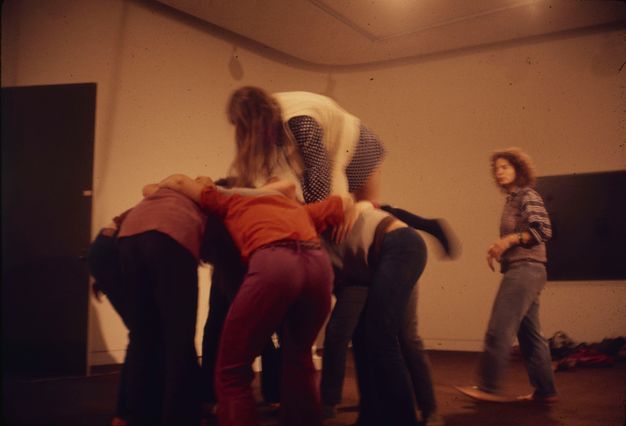
and lighter at the time (fig. 5). I wonder if I’ll ever be able to find out who these
performers were, or if I’ll ever get a view of the second
Pasadena performance? The images I have from The Box only
depict the first concert on 26 February, with its spectators
and special lighting, as well as a rehearsal of the Dance
Constructions. One of the rehearsal photographs of
Slant Board found its way into
Handbook in Motion, with a credit to Tcherepnin (see
fig. 2).28
My best guess is that if he took these photographs—there are
no images of “a folk dance,” in which he would have
participated—then he wouldn’t have been able to take photos of
the multimedia performance in the auditorium on 5 March, in
which he was performing. Who knows if anyone from the
now-defunct museum hired a contract photographer for the
evening, and if that person or their heirs would have any idea
today what the negatives depicted? (Related research in other
institutional archives tells me the answer is usually no, and
the remaining files at the Norton Simon are slim.)
ExpandFig. 5. —Rehearsal for Simone Forti’s Huddle (1961) in
“Two Evenings at the Pasadena Art Museum,” February
1971, color slide, 5 × 5 cm (detail).
Forti is standing at right. Image courtesy of the artist
and The Box LA.
Such a window onto the second Pasadena Art Museum performance
might finally provide my longed-for peek into Open Gardenia,
which exemplifies a heady moment in art and Southern
California history. But my singular focus may be clouding my
ability to see Open Gardenia elsewhere. Looking at the images
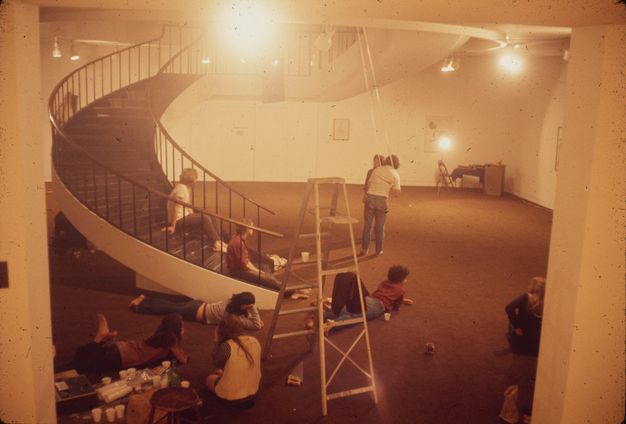
from The Box, I linger on those of the rehearsal, which had
full work lights, ladders for hanging the ropes from the
staircase, and a zone on the floor for cups with water or
coffee (fig. 6).
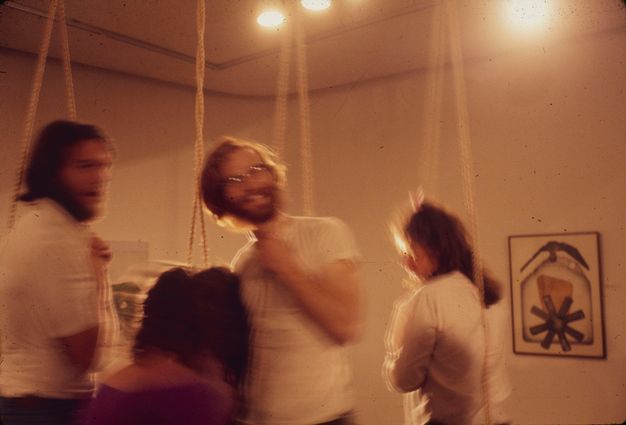
The dancers—like those I’ve been with in Forti’s classes, and
like those I’ve seen training for her performances around the
world—lounge on the floor and listen intently to the artist’s
instructions. They also laugh and goof around with each other
and with the artist (figs. 7, 8).
ExpandFig. 6. —Setup for “Two Evenings at the Pasadena Art Museum,”
February 1971, color slide, 5 × 5 cm (detail).
Image courtesy of the artist and The Box LA.ExpandFig. 7. —Rehearsal for Simone Forti’s
Slant Board (1961) in “Two Evenings at the
Pasadena Art Museum,” February 1971, color slide, 5 × 5
cm (detail).
Image courtesy of the artist and The Box LA.ExpandFig. 8. —Rehearsal for Simone Forti’s Hangers (1961) in
“Two Evenings at the Pasadena Art Museum,” February
1971, color slide, 5 × 5 cm (detail).
Image courtesy of the artist and The Box LA.
Forti, as both a collaborator and a director, not quite a
student and not quite a teacher, contributed to and benefited
from the energetic, interdisciplinary atmosphere that she,
CalArts, and the Pasadena Art Museum fostered in that moment
in the early 1970s. The chaotic, in-between, and only partly
knowable are what myths are made of. And these are likely the
qualities that made that period so productive for Forti and
her peers—and will keep it from full legibility in the present
and future. Of course I want to join them: It looks like
they’re having so much fun.
Megan Metcalf is assistant professor in the
Department of Art at New Mexico State University, Las
Cruces.
Notes
Special thanks to Mara McCarthy and The Box, Los Angeles, for
help with locating and reproducing the extraordinary slides
that illustrate this essay. Feedback from Claudia La Rocco,
three anonymous readers, and the editors of the
Getty Research Journal made this short text achieve
much more than I expected when I set out; thank you.
This essay treats the titles of works, series, and events in a
manner following the artist, as much as it can be known.
Italics indicate an artwork or piece of choreography
formalized into a discrete entity, often through the
publication of writing about that work. Titles capitalized
headline style and set in roman indicate a movement practice,
exercise, or ongoing series of events for which Forti arrived
at an identifying name. The boundaries between a practice and
a distinct work are especially unclear in improvisational
movement practices, which are driven by collaborative prompts
or scores rather than a desired outcome. Whether the naming
conventions Forti established for her works were intentional
or not, the precise handling of her titling appears not to
have mattered much to the artist and her collaborators; my
essay aims to honor the artist’s fluidity in this regard.
Calling the suite of works “Dance Constructions” follows
Forti’s example and preserves a sense of a category of
artworks; MoMA often italicizes the words, treating them
like a title for the suite. See Megan Metcalf, “Making
the Museum Dance: Simone Forti’s Huddle (1961)
and Its Acquisition by the Museum of Modern Art,”
Dance Chronicle 45, no. 1 (February 2022):
30–56; and Nancy Lim, “MoMA Collects: Simone Forti’s
Dance Constructions,”
Inside/Out (blog), Museum of Modern Art, 27
January 2016,
http://www.moma.org/explore/inside_out/2016/01/27/moma-collects-simone-fortis-dance-constructions. The museum’s conceptual and practical transformations
of Forti’s early works are the subject of Megan Metcalf,
Collecting Choreography: Simone Forti and Performance
in the Contemporary Art Museum
(University of California Press, forthcoming).
↩︎
I began taking Forti’s classes in improvisation at UCLA
in 2010, continuing until she retired in 2014; from 2009
until the present, I have attended Forti’s workshops,
performances, and talks all over the country. In 2011, I
performed in the Dance Constructions in Los Angeles,
and, in 2014, assisted Forti as she taught them to new
performers in Salzburg, Austria. Dancer Ann Cooper
Albright’s biographical book
Simone Forti: Improvising a Life (Wesleyan
University Press, 2024) is among the most recent
accounts of Forti’s practice, building on major
exhibitions of Forti’s work:
Simone Forti (2023) at the Museum of
Contemporary Art, Los Angeles, and
Simone Forti: Thinking with the Body, A Retrospective
in Motion
(2014) at the Museum der Moderne in Salzburg, Austria.
See also Meredith Morse,
Soft Is Fast: Simone Forti in the 1960s and After
(MIT Press, 2016).
↩︎
Rebecca Schneider,
Performing Remains: Art and War in Times of
Theatrical Reenactment
(Routledge, 2010), 104.
↩︎
“La Monte Young-Two Sounds,” YouTube video, 14:38,
posted by mishima, 1 January 2012,
https://youtu.be/t1ZF7jMK00w?si=Le_YVSJAfPuGRuTo. In general, only unofficial recordings of Young’s
work are available online. The harsh sounds—identified
variously as a mallet scraped on a gong, ashtrays
against a window, and tin cans on glass—were also used
in Merce Cunningham’s choreography
Winterbranch (1964). An analog recording is
available in the Simone Forti papers at the GRI: “La
Monte Young: Two Sounds, 1960 April,” audiotape reel, 13
min., Simone Forti papers, box 27, item D19,
https://primo.getty.edu/permalink/f/19q6gmb/GETTY_ROSETTAIE11313741. ↩︎
Simone Forti, Handbook in Motion (Nova Scotia
College of Art and Design, 1974), 65.
↩︎
Carrie Lambert, “Documentary Dialectics: Performance
Lost and Found,” Visual Resources 16, no. 3
(2000): 276.
↩︎
Simone Forti, untitled typewritten proposal for a
workshop at CalArts, circa spring 1971, with a photocopy
of the first page of Robert Morris’s published essay
“Notes on Dance,” Tulane Drama Review 10, no. 2
(1965) embedded in it, Simone Forti papers, GRI, box
139, folder 30.
↩︎
See, in particular, Don McDonagh,
The Rise and Fall and Rise of Modern Dance
(Outerbridge and Dienstfrey, 1970), 190–92; and Sally
Banes, Terpsichore in Sneakers (Wesleyan
University Press, 1987), 24–29.
↩︎
Forti describes this period at length in Forti,
Handbook in Motion, 15–27.
↩︎
Forti describes some of the motivations behind Open
Gardenia as well as its practicalities in Forti,
Handbook in Motion, 108–13; a notebook entry
that includes a drawing is reproduced on pp. 110–12.
Forti’s notebooks, which include additional
recollections of Open Gardenia, can be found in the
Forti papers, GRI, box 1, folders 2–3, 6; and box 2,
folders 1–6.
↩︎
“Charlemagne Palestine—Piano Piece for Simone (1971),”
recorded between October and December 1971, CalArts,
from Illuminations with Simone Forti, Youtube video,
11:57, posted by fascia lata, 1 August 2021,
https://youtu.be/v3yFC-nR7qw?si=SbPMS2MPWlQeWNVQ. Copies of this rare recording exist online, but not
as official recordings. Forti and Palestine issued a
vinyl record with these recordings in 2010 (Alga
Marghen), and various recordings of their sessions
together are now at the Getty. For example,
“Illuminations, Simone Forti and Charlemagne
Palestine, 1971,” computer disc, Forti papers, GRI, box
26, item CM177,
https://www.getty.edu/research/collections/component/26QTQC. Forti describes her work sessions and performances
with Palestine and includes some of her preparatory
drawings as well as photographs in Forti,
Handbook in Motion, 129–39. Forti’s text from
Handbook in Motion is reproduced in Sabine
Breitwieser, ed.,
Simone Forti: Thinking with the Body (Museum
der Moderne Salzburg, 2014), 199–203.
↩︎
Forti describes Home Base in the article Simone Forti,
“Home Base,” Contact Quarterly 5, nos. 3/4
(1980): 6–10, which was included in the second edition
of Handbook in Motion (Nova Scotia College of
Art and Design, 1980), 143–51.
↩︎
“Seeing Hearing Peter Van Riper/Simone Forti, c. 1992,”
Youtube video, 28:59, posted by Peter Van Riper
(username), 18 February 2013,
https://youtu.be/P3YVsYZGfkY?si=jxrWrWXUOkI8-Kzs. This would have been a very late collaboration
between Forti and Van Riper that took place not long
before his death.
↩︎
Forti’s Crawling (1972) consists of movement
evolving in part out of the Illuminations practice. See
“Simone Crawl, 1970s,” YouTube video, 3:20, posted by
Peter Van Riper (username), 3 June 2013,
https://youtu.be/h8oeyOeurCk?si=ZDVDCcVPBHmgAKoY. ↩︎
“a folk dance” is how Forti listed the final event in
the graphic program for the 26 February performances of
“Two Evenings at the Pasadena Art Museum,” 1971.
“Droning” and “droneing” is how she described it in her
preparatory drawings and notebooks (Los Angeles, The
Box, and Forti papers, GRI, box 1, folders 2–3, 6; and
box 2, folders 1–6). Forti provided a score for Buzzing
in the magazine Women’s Work edited by Alison
Knowles and Annea Lockwood in 1975. The Getty has a copy
of the facsimile edition of the two issues of the
original magazine: Alison Knowles and Annea Lockwood,
eds., Women’s Work (Primary Information, 2019).
↩︎
See Karen Jacobson, ed.,
Radical Past: Contemporary Art and Music in
Pasadena, 1960–1974 (Pasadena, CA: Armory Center for the Arts;
Art Center College of Design, 1999).
↩︎
See John Coplans, “Pasadena’s Collapse and the Simon
Takeover,” Artforum (February 1975): 28–45.
↩︎