Collins, Phillips, and Turner / “This Show Is So Metal”Getty Research Journal, No. 21 (2026)
Copied page section link to clipboard
Abstract
A conversation between the three curators of the
exhibition
Lumen: The Art and Science of Light held at the
Getty Museum from 10 September to 8 December 2024 as part
of PST ART: Art and Science Collide. Colleagues look back
on the planning, technical expertise, and creative
collaboration that went into the making and mounting of
the exhibition, illuminating the inspirations and
surprises that arose along the way.
Chicago
Kristen Collins, Glenn Phillips, and Nancy K. Turner,
“‘This Show Is So Metal’: The Curators of
Lumen: The Art and Science of Light in
Conversation,” Getty Research Journal, no. 21
(2026),
https://doi.org/10.59491/UUGP8217.
MLA
Collins, Kristen, et al. “‘This Show Is So Metal’: The
Curators of
Lumen: The Art and Science of Light in
Conversation.” Getty Research Journal, no. 21,
2026,
https://doi.org/10.59491/UUGP8217.
Although contemporary society separates science and
spirituality, in the medieval world the science of light was
harnessed by artists and theoreticians to better perceive and
understand the sacred. Focusing on the intersection of arts
and science in Western European art, this major exhibition,
which took place at the Getty Museum from 10 September to 8
December 2024 as part of PST ART: Art and Science Collide,
demonstrated how the study of light, vision, and the movement
of heavenly bodies was explored by Christian, Jewish, and
Muslim scholars and theologians during the “Long Middle Ages”
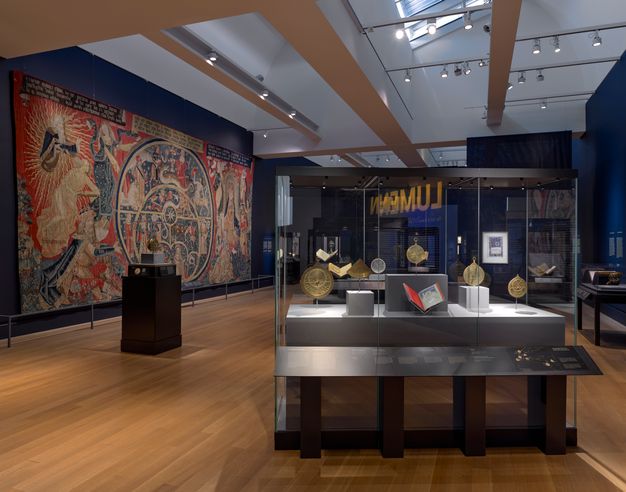
(about 800–1600 CE). With glimmering golden reliquaries,
illuminated manuscripts, rock-crystal vessels, early
scientific instruments, and other objects, the exhibition
showcased how the ancient sciences of optics, geometry, and
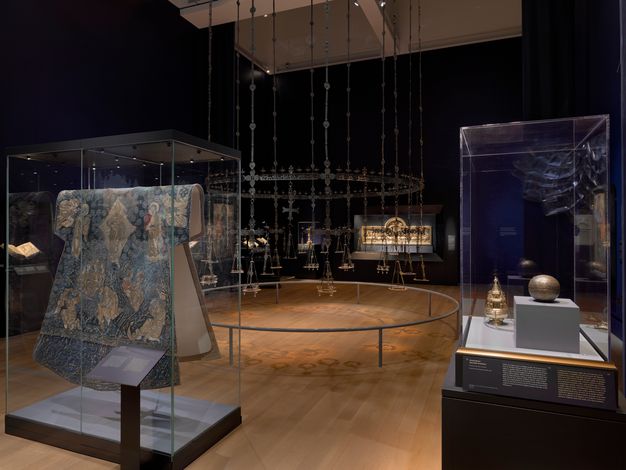
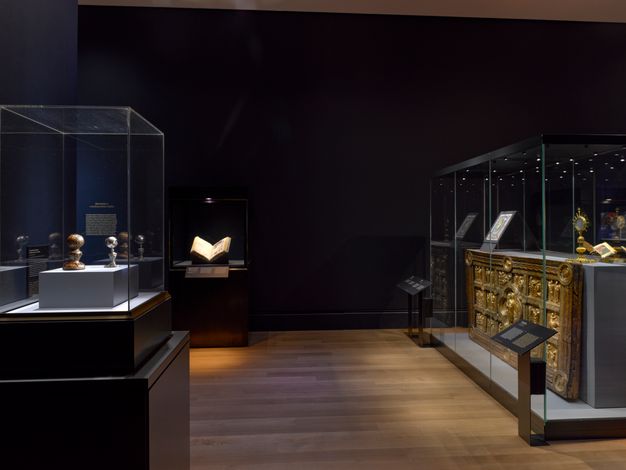
astronomy fed the poetry and artistry of this period (fig. 1). To convey the sense of wonder created by moving light on
precious materials, and to explore ongoing fascinations with
vision and perception as well as humankind’s place in the
cosmos, contemporary artworks were placed in dialogue with
premodern artworks. Here, the three curators of
Lumen: The Art and Science of Light discuss their
collaboration, which brought together the worlds of science
and religion and bridged the fields of medieval and
contemporary art.
—Kristen Collins, Nancy K. Turner, and Glenn Phillips
The conversation below took place in person in November 2024
at the Getty Center in Los Angeles. It has been condensed and
edited for length, repetition, and clarity. Italics and
underline have been added to capture words or phrases
emphasized in the original dialogue.
Kristen Collins: Should I start? Some
projects are ones that you start right out of the gate and
dive right into. This one was actually a concept that Nancy
Turner and I had put a pin in for quite a number of years.
We had talked about doing a relatively small exhibition on
light in the Manuscripts gallery accompanied by a
contemporary installation in a second gallery in the North
Pavilion. This was following experiences that we had many
years ago in the Sinai desert, when we were planning the
exhibition
Holy Image, Hallowed Ground: Icons from Sinai at
the J. Paul Getty Museum in 2006–7.1
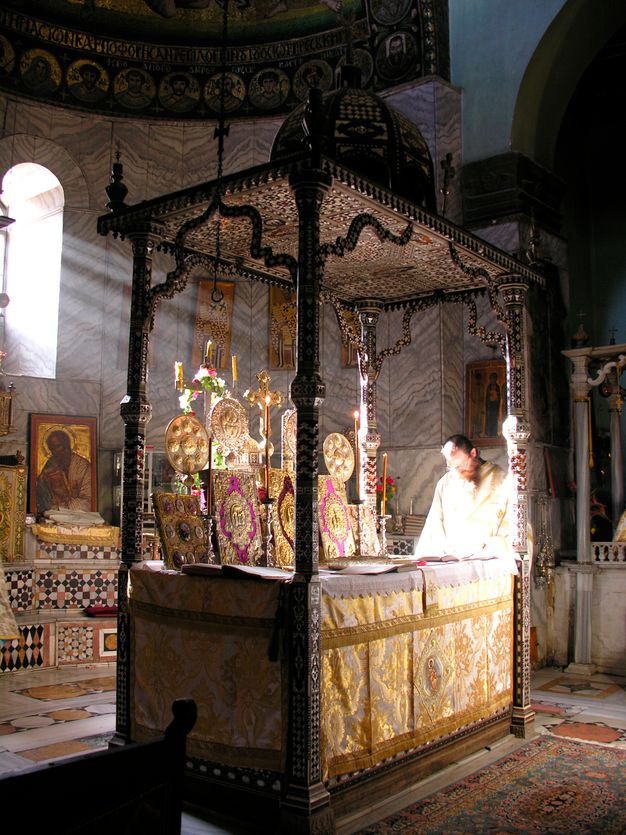
Over the course of researching that project, we attended
Easter and many other liturgies at the Monastery of Saint
Catherine at Mount Sinai, Egypt (fig. 2). There, we witnessed the effects of moving light in a
sixth-century Byzantine church. We noticed the way that it
moved the visitor to states of emotion and religiosity, and
we wondered if we could import some of that into the museum
environment.
ExpandFig. 2. —Easter Liturgy at the Holy Monastery of Saint
Catherine, Sinai, Egypt.
Photograph by Robert S. Nelson, 2005.
The germ of an idea for a Manuscripts [Department]
one-gallery show was a corrective view of light in medieval
spaces, and on medieval objects. Our manuscripts are
inherently haptic objects. They were meant to be handled;
their pages were meant to glitter in the light. And yet,
when we have them on display, they’re like butterflies
pinned inside a collector’s case. So that begged the
question: How do we convey some of the activation that
happens when you’re carrying objects through church spaces
or mosques? Or when you’re opening books, or looking at
light glittering on mosaic and gilded domes?
For our thought to have one contemporary art installation
across the way, one artist whom I just loved so much, Ann
Veronica Janssens, started the wheels turning on how a
contemporary installation could channel the medieval world.
She creates projections of light on mist. And one of the
things that had so captured me at Sinai was the projection
of sunlight and candlelight on clouds of incense hanging in
the air.
Nancy Turner: In a parallel fashion, I got
interested in the history of optics—the subject of the
exhibition’s eventual second section, “Light and
Vision”—because of the work I’d done on the use of metals in
manuscripts, on their pages. Originally it was just to
answer the basic questions: Is it gold leaf? Is it painted
gold? And I had done a small survey of a thousand years of
manuscript illumination (based on the Getty’s collection of
illuminated manuscripts), looking at how methods changed
over the centuries.2
The way illuminations engage the eye in different ways
really got me intrigued: How were people in the Middle Ages
talking about the eye? How were they talking about light?
And this led me to the history of medieval optics and some
of that scholarship.
KC: And so this idea, which was going to
come with the considerable expense of a contemporary
installation, sat on the backburner for a while until the
PST ART: Art and Science Collide theme was announced.3
And then it actually sat on the backburner for even a while
longer. [laughter] We were late to the game—we
joined the PST roster in 2021, when we were asked to pitch
an exhibition for the Special Exhibitions Gallery. We jumped
at the chance, because it seemed like such a great way to
expand that initial idea. At that point, we had to turn a
concept for a manuscripts show from our own collection into
a large special exhibition. Being a part of PST ART really
upped the ante as far as needing to engage with medieval
science as a discipline. The rubric for that first section
of the exhibition is “Astral Light,” and it is to Nancy’s
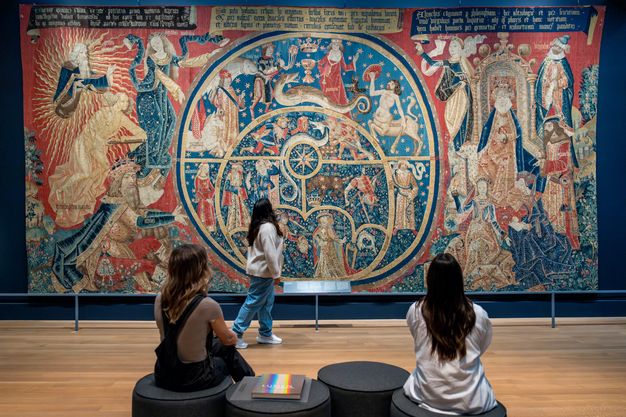
credit that we jump in with the giant
Tapestry of the Astrolabes (fig. 3), which she was convinced we could secure if only we could
find the curators in charge.
NT: We have to remember, this was all
conceived during the pandemic itself, in 2020–21, and we
weren’t able to start traveling until ’22. But some money
came up in early ’23 and we wanted to pursue the tapestry.
We really didn’t know whom to contact after I spotted it in
the catalog for
Circa 1492: Art in the Age of Exploration
(1991–92), an exhibition at the National Gallery in
Washington, DC, which listed Museo de Santa Cruz in Toledo,
Spain, as the lender.
While some asks were made over Zoom, the request for the
tapestry was made in person. We can’t say enough about
meeting with custodians of cultural treasures in person! And
it turned out that the piece was no longer in the museum
listed in the National Gallery catalog thirty years ago, as
it has since moved back to Toledo Cathedral, where it had
been since the early sixteenth century. My visit was this
classic curatorial scenario when you have only
one day to make the meeting happen, and you’re
sitting in the office of the museum director where the piece
isn’t, and having to ascertain where it is now
located and how to see it! The director of the Museo de
Santa Cruz, Antonio Dávila Serrano, kindly phoned the office
of the Patrimonio, the body responsible for the treasures of
Toledo Cathedral. Thankfully, María del Prado López from
that office at the cathedral answered the phone, and she was
able to meet me within the hour. She led me to a museum that
the cathedral operates in another part of the city. The
Tapestry of the Astrolabes is now housed at the
cathedral’s Tapestries and Textiles Museum [Museo de Tapices
y Textiles de la catedral de Toledo], which had been
shuttered since the Covid pandemic. She flips on the
lights—and there this glorious tapestry was. It was just
such a “wow!” moment, from out of the gloom and into the
bright light. Ultimately, after a protracted series of
e-mails, we were able to bring the tapestry here to Los
Angeles. But I think that first meeting, that in-person
connection with someone, was absolutely essential, no less
during the context of a global pandemic.
KC: Although, one of the formative meetings
that first kicked off this show for us in 2021 when we
joined PST ART was an online convening, “Intersections
2021,” co-organized by the National Academy of Sciences and
the Getty Foundation and held on a platform called
“ePosterBoards,” that brought curators together with
scientists. We were able to move through an online reception
and drop into a virtual table of neuroscientists who were
more than happy to talk about neuroscience and art and the
intersections thereof.
NT: It was a really inspiring session for
us. And likewise, they were thrilled to meet us too! It was
a wonderful and formative, dare I say, collision of
worlds. It was like speed dating in this sequence of Zoom
rooms, where we gave our minute-and-a-half pitch about the
Lumen show to all these neuroscientists, one after
the next.
KC: It turned out to be a very friendly way
to workshop ideas for the exhibition, which was really
valuable.
NT: And as a result, we developed the third
section, “Aura and Performance,” that includes the
neuroscience of light, both medieval and modern. There’s
also the complementary convening that Kristen organized at
the Getty, “Art, Science, and Wonder in the Medieval World,”
the second panel of which focused solely on the neuroscience
of light.4
KC: It was shortly after that formative
time early in the pandemic that we reached out to Glenn to
partner with him, because our concept was to include a
number of contemporary objects and installations, expanding
on the one immersive installation that we had originally
envisioned.
Glenn Phillips: So then I came in, I think,
probably a year and change after you were really deeply in
it.
KC: Yes, a very welcome addition.
NT: Very serendipitous, and you brought
amazing things to the show.
GP: I’m going to say actually it’s for the
best that you had the exhibition sketched out before we
could start thinking about adding contemporary art. If we
started trying to conceive it together, it maybe would have
been different, and not in the best way. Because I had to
start by learning the show. You had images of everything,
and the catalog was somewhat drafted, and so I could start
from a place of “What is the main narrative? What are the
main ideas? What are the images that you see recurring?” And
to then think where and how a contemporary work might
fit—like, what are the moments?
KC: Hearing that fills me with such relief
even now, as we’ve never talked about this! [group laughter]
KC: At the time, Nancy and I entered the
big project—the PST initiative writ large—very quickly. Then
we realized, you know, we need an expert. Some of my
contemporary colleagues commented, “Well, you’ve constructed
a show and now you want a contemporary curator?”
But Glenn coming on board even one year in helped us to
really sharpen the messaging and key points around the
exhibition. And some things were surprising!
NT: Yeah. And it was an evolution, too. I
mean, you didn’t have everything all sewn up right away. It
took a little bit—it took some time and some conversations,
right?
GP:[simultaneously with Nancy above] It took some
time, yeah.
KC: And, I mean, we flipped the order of
the show dramatically a few times while trying to
accommodate one piece that we ultimately didn’t bring in.
That exercise that the three of us went through together
with the designers to map out how this piece might fit,
which would have radically changed the flow of the show and
the way that the story could be told—that was a big
takeaway.
NT: Yes, definitely. [laughter]
KC: “If you want contemporary, you need to
make room for it!” [laughter]
GP: With this show and my job in general, I
work with a lot of installation artists, and I have, in part
through previous PSTs, worked a lot with Light and Space
art.5
And the exact same object succeeds or fails based on
everything else around it—how the museum presents it, the
amount of space they give it, how they light it, how they
allow people to approach it. A lot of that work is just
trying to preserve what the artist needs or what’s going to
make the piece look the best. That comes out during the
design phase. Because sometimes you can’t nudge the piece,
or it needs to be at a specific angle, or take up a certain
amount of space—that’s true of all artworks, but some works
need particularly close attention.
When pieces are not fully self-contained and have an
installation element, then the curator is the only person
who can really look out for them. The curator has to make
sure that the team understands that the space around the
piece is also the piece. The artist isn’t in those meetings.
And you can’t show up and change a design. Well, I mean, you
could, but it’s very hard. It’s even harder in a show that’s
filled with couriered objects.
KC: Absolutely. It was so helpful to have
Glenn advise where we shouldn’t skimp in certain areas.
Because, you know, resources are carefully budgeted, and
we’re always looking for ways to optimize the funds that we
have. For example, the Helen Pashgian installation wouldn’t
have been so sensorily disorienting and wonderful without
you advocating for the space to be painted all white.
GP: You can’t (or at least shouldn’t) just
say “because I said so.” The whole team needs to learn and
understand the why behind some of the visual and
construction decisions that might be significantly more
costly or labor intensive but that can also make all the
difference in the success or failure of a piece. I think
everyone was really supportive of this show, but we
definitely had to advocate for things like that. Likewise,
you were constantly advocating for some rather ambitious
loans, let’s say. [group laughter]
KC: Definitely. Our motto was “More is
more.” [laughter]
NT: More is better! [laughter] And
we knew we needed big, impactful things. The Special
Exhibitions Gallery is a huge space to fill. And we’ve done
other medieval shows of manuscripts where it’s all very low
to the ground, in object cases at eye level and lower. By
contrast, contemporary artworks bring your eyes upward. The
chandelier [Munich Choros, Byzantium, 13–14th
century] of course does this (see
fig. 1).6
The tapestry is also a big wow when you first walk
in (see fig. 3).
And, you know, it’s all working within the constraints of
the space. An exhibition gallery that has a corridor in
it—it’s a little hard to factor in. But that was a moment of
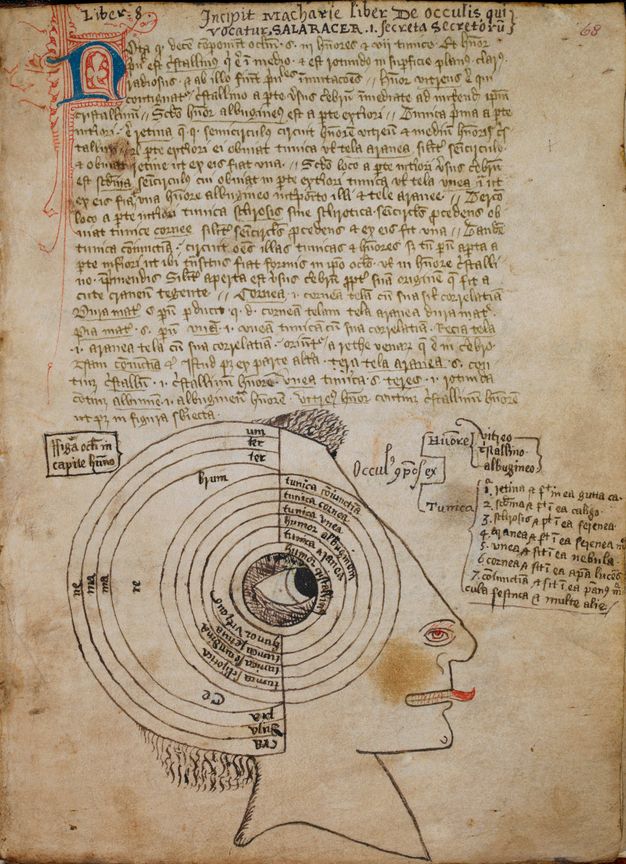
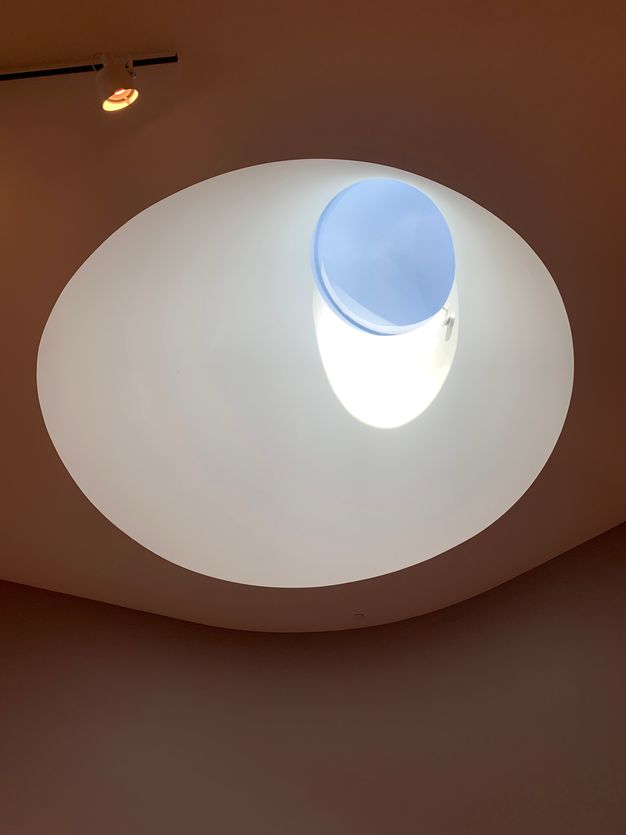
kismet, putting our eyeball diagrams in the space called the
“oculus” (figs. 4,
5). [laughter] We get
great humor out of that. [more laughter]
ExpandFig. 4. —Diagram of the Seven Tunics and Three Humours of
the Eye and the Skull
in Medical Miscellany, including the
Book of Macharias on the Eye Called Salaracer, or
the Secret of Secrets,
England, 1375–1425, ink on parchment, folio: 23 × 17
cm.
London, British Library, MS Sloane 981, fol. 68.
Photograph courtesy the British Library
collection.ExpandFig. 5. —View of the oculus in the Special Exhibitions
Gallery, Getty Center, Los Angeles.
Photograph by Kristen Collins, 2024.
KC: My cousin’s six-year-old child pointed
out on a tour that the oculus looks like an eye, had I
noticed? It was wonderful.
One of the things worth mentioning is that Nancy and I are
old school, and so when we laid the show out, we were doing
so with Post-its and little pasted pictures of the cases on
our gallery plan. And then we took that up to the space to
try to figure out where we could fit a giant chandelier.
And, you know, initially we had the show flipped—we were
going to walk into the big cube first, to open the show. And
we were going to close with the chandelier in the
rectangular gallery. But standing there we realized:
It’s not going to fit.
NT: That gallery isn’t high enough.
[laughter]
KC: The rectangular gallery has a lower
ceiling height. The giant chandelier [Munich Choros] would not fit without it trailing on the ground. So,
there were some very nuts-and-bolts ways that we began
laying out the show, shuffling Post-its on a plan while
sitting on the gallery floor.
NT: It required a complete 180-degree flip,
a wholesale rerouting of the show, which started with
astronomy in the “Astral Light” section, followed by “Light
and Vision,” and concluding with “Aura and Performance.” We
were making and accommodating the show in that way. That’s
why one of the installations that Glenn was going to bring
in didn’t fit. So he pivoted and found the perfect painting
instead—Vija Celmins’s Night Sky #4 (1992;
fig. 6).
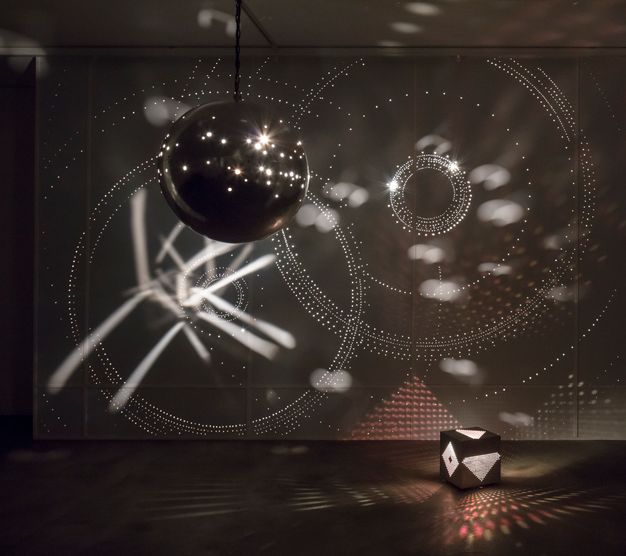
GP: We had gotten very far on plans for an
Otto Piene Light Ballet installation (fig. 7). It was one that includes a false wall covered in little
holes. The space behind the wall is illuminated, so those
holes turn into tiny points of light that are in a pattern
very reminiscent of the medieval nested spheres of the
universe. And then a series of kinetic sculptures in the
room cast changing, spinning points of light across the
space, with different elements of the installation
activating at different times. If you look at the whole
first gallery, almost every single piece is circular.
Whether circular astrolabes, depictions of the heavens, or
early mapping of the sky, everything is taking the same
form. And so I loved the idea, with the Piene, that you
would walk into this spinning galaxy and see the repetition
of these forms that you’re seeing everywhere else in the
gallery. But it was not meant to be.
[group laughter] I think we tortured the designers
in ten different ways trying to get this to fit, and they
really tried everything—
GP: They tried things I had never seen
before in that space, but it just couldn’t happen.
KC: We even made a short-lived bid for the
[museum] bookstore space that didn’t pan out.
GP: In the end, though, we replaced that
giant installation with the Vija Celmins painting—right
before our catalog was about to be locked down. We
negotiated that loan in forty-eight hours, and then I wrote
the catalog text in twenty-four hours. We just told
Publications, this thing has happened and, you know, in the
hopes of you agreeing, we’ve taken the liberty of writing a
new text.
So that happened within days. But I think Celmins’s painting
is so perfect in the space; I don’t know that we would’ve
needed a spinning galaxy, really, when what you’re walking
into is already so impressive. And the show has this nice
crescendo now. That first little moment with the Celmins,
it’s like a little jewel. It’s very quiet. Maybe not even
everybody notices it. But it’s a powerful moment in the show
(see fig. 6).
I guess my revelation is that I began by looking at all this
stuff as being so distant. It’s so long ago; it doesn’t look
like art now. I don’t understand what an astrolabe does, and
I never will. [group laughter]
You know—the celestial maps don’t match the way I think of
the heavens. And then I realized that the Vija Celmins sky
paintings are of star maps—actual star maps made by machines
that we send into outer space so that we can see farther
than we’ve ever seen. Because we have never stopped mapping
the stars. This is one of humanity’s continuous endeavors,
and it’s still happening very actively right now. That’s a
point of connection that someone might experience. Star
mapping is not so distant; it’s just that we do it with
different machines now. And we still have people copying
maps. You know, Celmins, she compares herself to a scribe.
Piene’s works are based on his having to stare at the night
sky for hours at a time when he was a gun operator during
World War II. So there was a morphological connection there,
but not as poetic in the long run. So sometimes things
happen that actually benefit the show, even though it feels
like something’s gone wrong.
KC: Our constellations of objects took on
power that we didn’t expect. The painting by Celmins, who
calls herself a scribe, is on view just steps away from the
Hildegard of Bingen Book of Divine Works (Liber divinorum operum, Germany, ca. 1210–40). And, you know, there is a little
image of Hildegard [in the lower-left corner of the
manuscript page] recording her vision of the
Lux Vivens (the living light
of God).7
But all of her visions are cast in cosmological imagery. She
sees herself or humankind as a microcosm of the larger
macrocosm that is the universe.
So you have something like that just steps from the Celmins,
and then steps away from there is a silk textile fragment
that is very similar to the Celmins in its dimensions (see
fig. 6). The textile fragment,
from either North Africa or Iberia [fourteenth century], has
a geometric pattern on it.8
We talk in the exhibition about how light traveled in lines
and rays, and how geometry was used as an expression of
light. This textile was embroidered with repeating star
patterns, to some extent representing the infinitude of the
universe. So, all of these things, you find them gelling in
ways that, yes, you planned for. But then when you do two
tours a day for three months, you find which stories are the
most powerful. And I think that cluster is really
powerful—it’s a little constellation.
NT: So, we’re delighted that there’s poetry
in a show that’s rooted in math and science, right?!
[laughter] Just to stand up for the
astrolabes—we’re manuscripts people, and we work with books
that are themselves instruments with spinning discs called
“volvelles.” And we just got super into these astrolabes,
while we freely admit that we cannot fully understand them!
[laughter] We had a tutorial from Taha Yasin
Arslan, an artist-scientist-maker who creates facsimiles of
astrolabes; two of them are included in
Wonders of Creation Art, Science, and Innovation in the
Islamic World, another PST ART exhibition at the San Diego Museum of
Art, and have since been accessioned into that
collection.9
But we just felt so strongly that to start with actual
astrolabes was a way to bring people right away into the
medieval scientific world that was so cross-cultural,
interdisciplinary, trans-religious. We have astrolabes that
are inscribed in Hebrew, Arabic, Persian, and Latin (fig. 8).
KC: Yes, we make the point in our tours
that science was the common language of the Middle Ages. We
say that though people may not have been reading the same
things all at the same time, they were drawing upon a common
corpus of ancient Greek scholarship that was then
translated, questioned, improved upon, and added to over the
course of the long Middle Ages.
NT: We really did pursue the brief of PST
ART to bring the art and the science together. I think the
first room of the exhibition, the “Astral Light” section,
does that in an impactful way.
KC: Nancy and I have always recognized our
limitations as scholars of the Latin West. We do not read
Arabic; we are not Islamicists. Happily, we know
Islamicists, and so early on we reached out to a group of
people who would form our scientific committee, and whom we
could bring into the project. This has become much more
common. I think that many people include a line item for
scientific committees in their grant proposals. It’s not
something that the Getty Museum has done before to my
knowledge, and so we’re very grateful that the Exhibitions
Department was able to fund this. We had at least a dozen
people on our scientific committee at various times, but it
kicked off with a series of online convenings. I think we
had about three or four meetings—
NT: On Zoom, in the fall of 2022.
KC: It was quite close to our deadline, I
would say, [laughter] because then we tapped many
of those people to be authors for the catalog—
NT: which was due like six months later! So
this whole ambitious project has been in high gear from day
one, really, because we were told by our administration to
go big [laughter]. More typically, curatorial teams
have about six years to work on these things—
KC: If not longer!
NT: And we basically had less than half
that time.
KC: I’d like to go on record as a proponent
for percolation time. Three years was a very tight
turnaround.
NT: And to really dive into the
literature—especially the scientific literature on optics
and astronomy—was really a big lift.
KC: I mean, the evolution of the object
list shaped our scholarship as well. The idea of being able
to have the monumental
Tapestry of the Astrolabes on view alongside some
of the greatest objects from the Oxford History of Science
Museum’s collection of instruments—astrolabes and one
quadrant [Quadrans vetus
Horary Quadrant, possibly France, ca. 1300] (see
fig. 8)—very much changed what we
were reading and how we were thinking about the exhibition.
NT: The exhibition checklist was constantly
iterative. We started with a very positive response from
Lucy Blaxland and other colleagues at the Oxford History of
Science Museum, and likewise a motivating and generous
response from Poul Grinder-Hansen at the National Museum of
Denmark for the Ølst Golden Altar (1200–1225). Lisa Woop and
her colleagues at the Optical Museum in Jena, Germany,
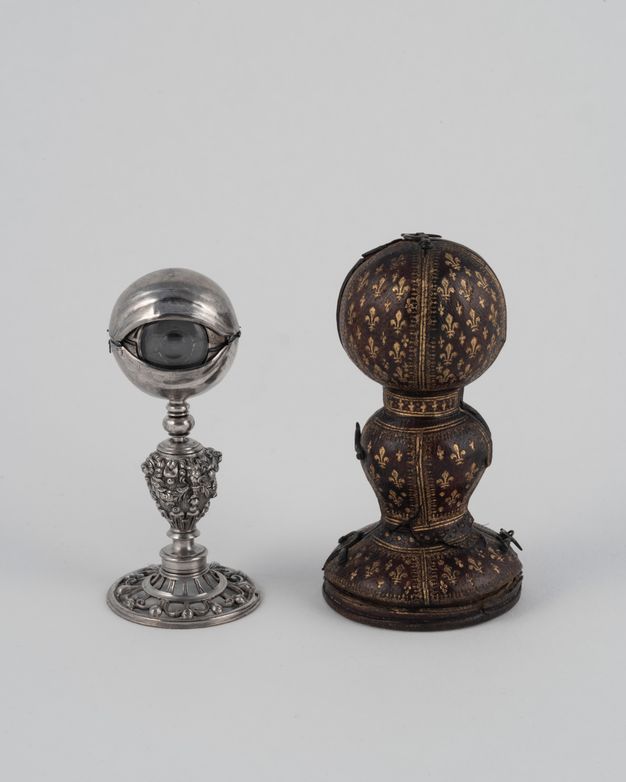
kindly lent us an anatomical model of an eye (fig. 9). So there were just certain things that fell into place
fairly early on and then other things that took longer for
us to get to.
KC: We were traveling for the show, as
Nancy said, and writing long-loan request letters from a
speeding train. I remember receiving our second
yes, for the eyeball [Eye model, France, before
1700] when we were in Florence, after we’d already received
a yes on the Golden Altar. And Nancy said, “Well,
we’ve got a golden altar and an eyeball. We have a show” (fig. 10). [group laughter]
GP: I mean, that’s pretty much the middle
section of the show, “Light and Vision,” right?
[laughter]
NT: Exactly.
KC: Yeah, little did we know that they
would ultimately be on display right next to each other, the
eyeball staring at the golden altar!
[group laughter]
GP: I would step back and add a word about
advisory committees, because I think that this is one of the
pillars of PST ART. The Getty Foundation always awards
support to curators to develop an advisory or scientific
committee. It’s so valuable for scholarship, but small
institutions can almost never afford them, and even at
larger institutions it’s one of the first thing to go when
you have to cut expenses.
We’ve seen over and over again through every version of PST
that being able to convene your peers and get the best
specialist knowledge improves exhibitions—it brings to light
potential loans; it brings catalog authors; and it benefits
everybody on that committee and not just the institutional
community. Anyone who has gotten one of these grants will
say that having an advisory committee changed the course of
their show.
NT: Oh, 100%, including this one. During
the initial phase, we had a very rough object list that we
shared in advance with all of our interlocutors on
PowerPoint. Then we met on Zoom with groups of them, and we
asked everyone to present objects that they thought would be
appropriate too. So they were making suggestions. That was
so helpful, to be directed to things we hadn’t been aware
of. And, likewise, for things that we had hoped to include
but had to be dropped for various reasons, many of these
works are still represented in the catalog essays because
the authors saw our very early PowerPoint.
KC: So at least they’re enshrined somehow.
As I mentioned before, the Islamicists and the historians of
science as well as the Byzantinists and Hebraists working
with us have been amazing. They have been our teachers as
well as our colleagues; they offered such deep field
knowledge that then went into the catalog. Even beyond that,
Margaret Gaida, one of our scientific committee historians
of science, and Megan McNamee, another member of the
committee who works on geometry and diagrams, read all of
our labels and commented on them—it was difficult and, in
many cases, new-to-us material. As Nancy mentioned, she’s
worked on optics, but the historians of science brought it
to the next level. I don’t think either one of us had done
much with astronomy since grade school days!
[laughter]
But as Nancy was describing before, the spatial constraints
of the interior architecture of our galleries shaped the
exhibition’s narrative; we go from astronomy in the first
section to optics in the second section, where you can use
the geometry of light as well as practical geometry to think
about the ways that ancient and medieval people thought
about the so-called pyramid of vision and how light enabled
sight, whether it was from light entering or exiting the
eye. From ancient times geometry was used for land surveying
or for the measurement of distances between heavenly bodies.
NT: Part of this project for us, the
medievalists speaking, is that we’re fundamentally
responding and reacting to the Enlightenment thinking that
we all have been schooled in, which says that science begins
with the Enlightenment thinkers and art begins with the
Renaissance in Italy. And we’re saying no, science has been
going on for thousands of years. Especially the astronomical
observations of the movement of the stars as well as
Renaissance perspective—these are coming out of a Euclidian
tradition that has a nearly eight-hundred-year history by
the time [Filippo] Brunelleschi comes along. We pop that
bubble of “These are the Dark Ages.” This is what has been
in the scholarship for decades, but it just hasn’t been
brought to light in a public forum like an exhibition. So
that was one of our major goals for the show.
KC: We still like our stories of individual
genius, but, you know, [Nicolaus] Copernicus did not come to
this idea of a heliocentric universe in a vacuum. He’s using
the math that Muslim astronomers in the Islamic sphere—the
great observatories of Samarkand, Damascus, Marāgheh, and
other places—were using and developing in order to better
understand the movements of heavenly bodies. He’s figuring
out where the previous mathematical models were falling
short and in need of refinement or rejection.
GP: Science is a way of representing and
figuring the world around us, so there’s a huge visual
component to that. And as I’ve learned more about these
objects, I’m seeing that on an astrolabe, you’re putting a
star map on top of a layer depicting where you are on the
planet. And you see that repeated on the
Tapestry of the Astrolabes. You see the bottom part
with the flowers, that’s the earth (see
fig. 3). And then there’s, a
little larger, the stars above. But the constellations are
on top of them, representing these higher worlds. And then
where do you go from there? It eventually gets you to the
heavens, or to God.
There’s this kind of ladder in our show that gets you from
hard science to religion. And so, for me, what’s striking as
we move into the second section about optics, is that
artists are now using the same scientific tropes to
represent ideas about God or happenings in the Bible. That
ladder that gets you from science to wonder is also, I
think, one of the narrative threads of the show, which
pushes you into, all of a sudden, these glorious, religious,
golden, amazing objects. It felt like every day during
install we were opening another crate full of gold.
NT: And how did E.V. [Day]’s friend
describe it?
KC: “This show is so metal.”
[laughter] Opening crates full of gold and, you
know, a little bit of rock and roll. But then there’s what
Glenn was talking about, this language of diagrams. We in
the Manuscripts Department at the Getty are nested in an art
museum, so naturally we like the gold, glittering,
scintillating objects; the diagrams were initially less
exciting. And yet, the more time that we spent with art
historian and historian-of-science friends and colleagues,
who spend their careers on these kinds of visual
constructions, we have come to look at our collection in a
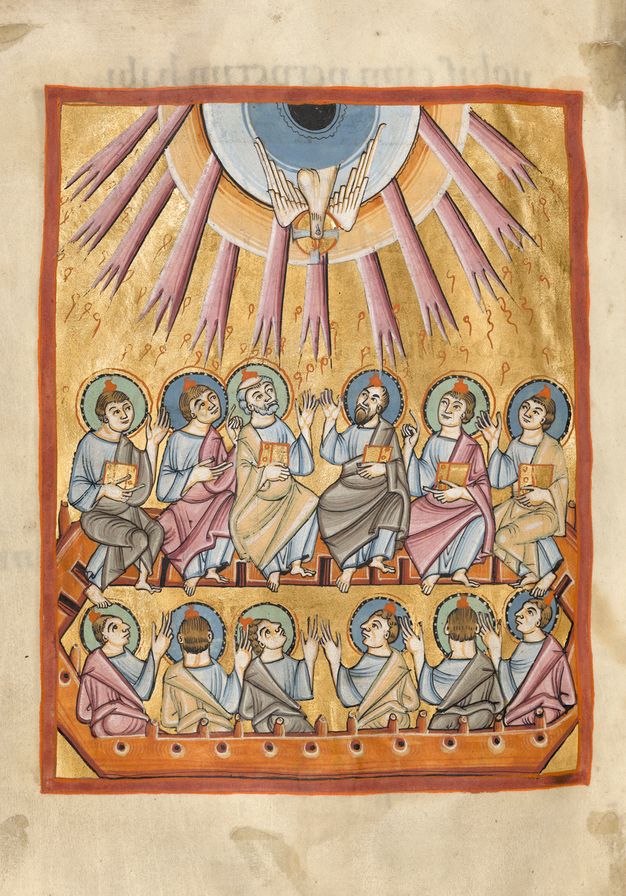
new way. For instance, there is this one late Ottonian
manuscript that has an image of a Pentecost (fig. 11). Glenn calls it his favorite manuscript. It’s of this
moment when the Holy Spirit, represented by a dove, descends
upon the apostles and flames appear above their heads, and
they are all given the power of speech. We placed it in the
exhibition’s section “Light and Vision” to illustrate
medieval ideas about light traveling in rays and lines. But
now when I look at it, and more generally at medieval
representations of the heavens, I will forever see diagrams
of the nested spheres of the universe. As Glenn mentioned,
the preceding section, “Astral Light,” included numerous
images of the spherical universe. Medieval people
represented planetary motion around the earth as concentric
circles, with each planet on its own track. In this case we
have only the lower half of the larger heavenly sphere
visible, but you could still interpret it as an echo of
scientific understandings of the cosmos.
ExpandFig. 11. —Miniature depicting Pentecost, from a benedictional
(text in Latin), Regensburg, Ottonian Germany, ca.
1030–40, tempera colors, gold, and ink on
parchment.
Los Angeles, J. Paul Getty Museum, Ms. Ludwig VII 1
(83.MI.90), fols. 47v–48. Photograph:
CC0 1.0.
NT: So, as Glenn mentioned, a big part of
this show is the very intertwined nature of religious
imagery and the diagrammatic language of science, the
knowledge that science was coming up with about sight and
light. And it’s like Kristen said: We’re seeing our own
collection in a new way. One pairing that really strikes me
is our English Apocalypse [The Twenty-Four Elders Pay Homage to the Throne of
God
in Getty Apocalpyse, possibly London, ca. 1255–60], which we
displayed right next to Roger Bacon’s
Geometrical Diagrams of Rays Entering the Eye and
Striking the Crystalline Humor
(1275–1300).10
Bacon was a Franciscan writing about light, and he was
quoting Ibn al-Haytham, Islamic polymath and scientist who
was writing in the 1030s or so. By Bacon’s time,
Al-Haytham’s text had finally been translated into Latin,
and Bacon was interpreting it in his own book on optics.
He’s a Franciscan, and he’s a teacher at Oxford University,
but at the same time he was adding to Ibn al-Haytham’s text,
talking about light operating as “species” and also how
light gets intensified when it goes through a small
aperture. And we have a picture of that in our English
Apocalypse: John the Divine seeing his revelations through a
little hole in the frame of the image itself. So we now read
it as his visionary experience of seeing the end times as
being intensified—like light—into his own eye.
KC: The final section of the exhibition is
“Aura and Performance,” and it contains the germ of our
initial idea to bring movement into people’s consciousness
within a museum exhibition space. Here we talked about
moving objects, moving light—whether the quick flicker of
artificial light like lamplight, or candlelight, versus the
slow sweep of sunlight over different kinds of medieval
environments, including the mosque. We looked at
architecture in the mosque. We became fascinated with
muqarnas, which are dimensional geometric forms that are
used to create the domes and squinches of mosque spaces and
Iberian synagogues. The light traveling through these
premodern spaces creates a lot of cast shadow, and so this
is a whole other dimension of light that we are looking at.
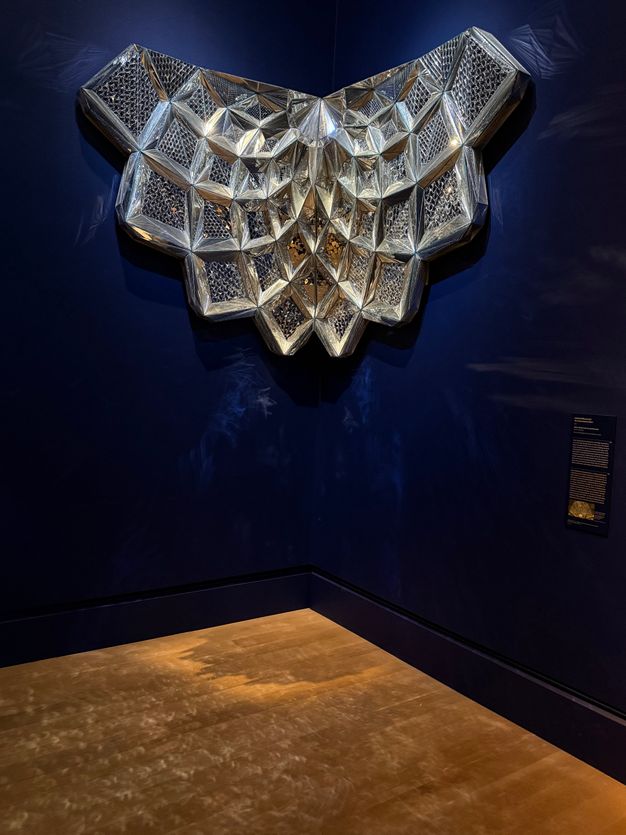
This might be a good time to mention Farmanfarmaian.
GP: Monir Shahroudy Farmanfarmaian was an
Iranian artist who had an incredible history. She was living
long stretches of her life in the United States and then
back in Iran. She had her first exhibition in the US in the
1950s and was friends with all the abstract expressionists,
and Andy Warhol, and so many other artists. She brought
artists like Robert Morris and Marcia Hafif to Iran and
showed them around in the late ’60s or ’70s, when she was
back living there. In parts of Iran, there is an incredible
architectural tradition with mosques that are encrusted in
mosaic mirrored surfaces, and they sometimes even include
reverse-painted glass. Monir incorporates both elements in
her own work, and our exhibition features a dazzling
corner-based piece [Untitled (Muqarnas), 2012] that
she made, I believe, when she was ninety years old, close to
the end of her life (fig. 12).
It’s definitely one of the great selfie opportunities in the
show. It sets you in motion: the more you move around it,
the more you perceive the light moving across the surfaces.
As I say during tours, sometimes the motion is you. It’s
your own actions that are making the light move.
NT: In that section we leaned into how
surfaces and materials performed in different kinds of
light. Among medievalists, there’s a phrase that has been
coined that talks about the “saturated sensorium,” and this
is where the neuroscience connection comes in, too.11
It’s the idea that light or sight is considered primary.
Sight is completely necessitated by light and contrast and
darkness, but then it goes in and gets processed in the
brain’s various chambers. According to how people in the
Middle Ages understood the brain, there was first the common
sense, the
sensus communis, at the
front of the brain, before the other chambers: the
imagination and then the memory. And today neuroscientists
have this phrase called “predictive processing” to describe
the brain’s process of anticipating perception based on our
memories of an experience. So we’re bringing all this
together for this last section on the “Aura and Performance”
of these objects.
KC: Yes, and Gabi [G. Gabrielle] Starr, a
specialist in cognitive neuroscience, was a member of our
scientific committee, and her initial discussion about the
conditions under which the brain experiences surprise as
something pleasurable was hugely formative. As she put it,
in earlier times, a surprise would be something that wanted
to kill you, or eat you, or possibly both. But the brain on
light in medieval spaces could create this sense of wonder
because it would have been, I don’t want to say disruptive,
but a marked change to come out of a personal space or home
lit by a single lamp made out of tallow or oil and walk into
a massive architectural space ablaze with artificial light.
Even throughout the liturgical year, it’s not something you
could predict because light was never stable. Some religious
feasts got two candles; some had more. So the element of
surprise would have added to the sense of wonderment and
religiosity.
In this section we also have one of the great reunions
within the exhibition, thanks to our colleagues Stefano
Roffi and Davide Gasparotto: Gentile da Fabriano’s
Coronation of the Virgin (ca. 1420) and
Stigmatization of Saint Francis (ca. 1420).12
These two halves of Gentile’s processional standard for the
church of San Francesco in Fabriano, Italy, had been
separated since at least the nineteenth century by the art
market. The works formed a two-sided panel carried in
procession. We [J. Paul Getty Museum] have the
Coronation of the Virgin, but the other side
depicting Saint Francis is in the Fondazione Magnani-Rocca,
outside of Parma. We were able to organize this loan and
bring the two of them temporarily back together once again,
back-to-back as they originally had been. This was how they
would have been experienced by viewers, when they were still
functional liturgical instruments. As Nancy has pointed out,
and as art historian Chris [Christopher R.] Lakey says in
the catalog, the very different surface treatments on each
side of this processional panel have drawn attention over
the years.13
The Coronation of the Virgin is much more detailed
versus the simpler and larger passages of gold on the Saint
Francis side. Some try to make a chronology argument or a
workshop argument to explain why this might be, but in his
essay, Chris argues that it was ultimately a product of
function: one side was meant to be viewed outside during
daytime feast day processions, and the other was displayed
on an altar by candlelight in an interior. So that’s just
one of the many works in the “Aura and Performance” section
that needed custom lighting treatments, to evoke these
different environments.
NT: You were going to talk about the
Stavelot [Retable]?
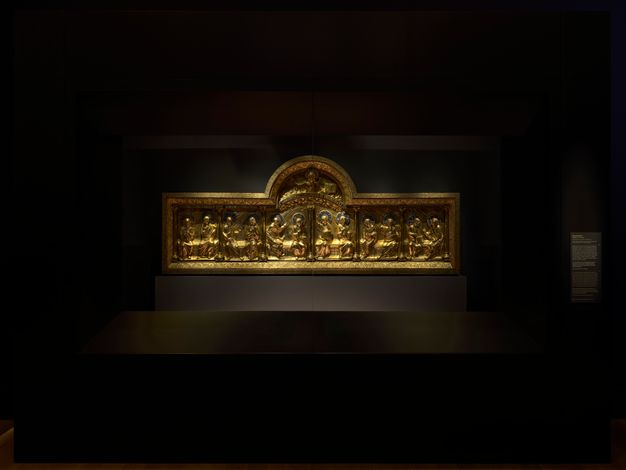
KC: The show ends with the Stavelot
Retable, a panel that would have sat along the back of the
altar table in the royal abbey of Stavelot in Belgium (the
abbey no longer exists) (fig. 13). It is a somewhat unusual Pentecost scene, in its
inclusion of Christ seated on a rainbow above, and has
golden rays descend to the apostles.14
It’s gilded copper repoussé, with the apostles, in quite
high relief. The altar is the subject of a study by Bissera
Pentcheva, who is a professor at Stanford University. She
has written about the optical and acoustic aura of the
Stavelot Retable and the way that it would have optically
shifted in different lights, with the figures’ features
shifting in the changing light throughout day and into the
evening.15
And so we had said early on that we did not want to activate
the show with artificial candles—
KC: And yet we decided that we would break
that rule just once, and with Glenn’s support, too.
[laughter] Early on [in the process of curating the
exhibition] he made a great statement about rules, that they
could be broken just once.
GP: You have to set rules when you’re doing
a show because you have to contain it in some way, but you
can always break them at least once.
[group laughter]
KC: We worked for the first time with this
amazing outside team of lighting designers, from a company
called Available Light.16
They were a great team who loved the narrative behind the
light. On the very last day of the installation, they
programmed the moving lights that give an impression of how
the Stavelot Retable would have looked over the course of
the day and into the evening, in a compressed two-and-a-half
minute span. And I said to one of the lighting designers,
Damien Perard, “I think we have a little too much
candlelight here. You know, candles were expensive. I’m not
sure even a royal abbey would have had a whole row of
candles all along the bottom of the altar.” He was like,
“Ok, this is good. The story is really important. We’ll dial
back on candles.” And I loved that. We appreciated working
with people who absolutely threw themselves into the
scholarship, particularly Pentcheva’s work, and came back
asking for more.
The retable is on display next to the whole row of
manuscripts that talk about the neuroscience of light. Our
way of bringing performance and the science of light
together is meant to slow the viewer down so they can
observe and let the optical changes brought about by light
seep into their mood and experience of the exhibition.
NT: We should add how essential the design
team (both our in-house designers headed by Alan Konishi and
the consulting lighting team that Alan brought in) was, and
the fact that the museum was so committed to the show to
bring in lighting specialists for the first time. They
realized, of course, if there was ever a show to have it, it
would be one about light—
KC: Light, right?
NT: Right. And these were professional
lighting designers who come from a theater background, and
they know how to create drama with lighting. Not to mention
the lighting is hidden in the incredible display case that
our own Preparations team built (with the lighting built
internally in the case). The case lighting is achieved by
little, computer-controlled LED lights—incredibly
sophisticated, the likes of which we’ve never done before.
But this [the Stavelot Retable] is an object that was
completely worth going to these extra lengths for,
activating what Bissera [Pentcheva] had written about and
illustrated in a journal essay and in the
Lumen catalog.17
So the fact that we could bring this to our audience—an
object with light raking across its surface, changing over
time—we want them to sit down and slow down long enough to
watch it.
KC: We were so lucky to have a designer who
has a background in architecture as well, because Alan
Konishi, in doing the design for that amazing case, was a
huge part of it. He, along with his colleague Chaya Arabia,
worked on two large and really ambitious contemporary
installations as well as all of the historical medieval art.
It was like conducting an orchestra—there were so many
moving parts involved. And speaking of orchestra conductors,
Amber Keller [Head of Exhibitions at the Getty Museum] was a
major factor in the success of this exhibition. When doing a
show on this scale you need, not just technical and
logistical support, but someone who believes wholeheartedly
in the project and knows what the team can accomplish.
GP: Maybe this is a good moment to address
the seven contemporary works in the show, plus an eighth
piece that we say is “emotionally included.” There are two
that are separate from the main part of the exhibition—in
the ideal situation, one will be the first piece you see,
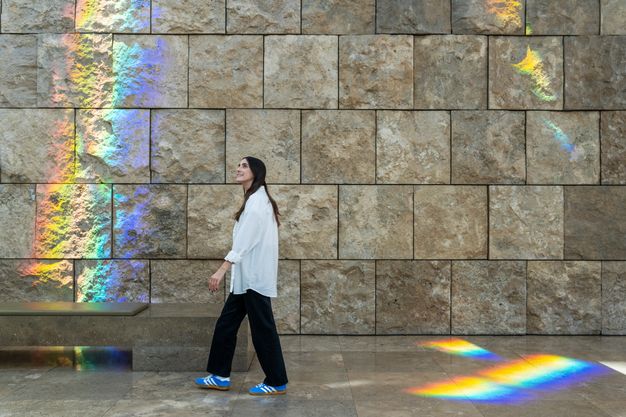
and the other will be the last. We do see the rotunda
commission as the first piece in the show, because you can’t
go into the show without walking through it; it’s a piece by
Charles Ross called Spectrum 14, and there are
fourteen of what may be the largest solid material prisms
ever fabricated mounted into our ceiling at very precise
angles (fig. 14). So any time
during daylight hours that you walk into that rotunda, you
will see at least one or usually quite a few spectral bands
of light hitting the floor, or the wall, or you, or other
spaces in there. It’s different every day because the sun
moves differently every day. And there are what Charles
refers to as summer prisms and winter prisms, because they
will only be hit at certain times of year.
GP: I had a feeling about how this piece
was going to work, and it’s turned out to be so different,
because the spectra moved way faster than we ever would’ve
thought. In the summer, they’re moving about six inches a
minute. Spectral light, because it is dispersed and covers
more ground, moves at twice the rate of a normal sunbeam. So
if you really slow yourself down and look at it, you can
actually see the movement. And that is the rotation of the
earth that you’re seeing. And when you come back the next
day at the exact same time, they are going to be in a
different place than they were the day before. When Charles
told me that, I was like,
Sure, by maybe millimeters or centimeters, but in
the summer—which, again, the summer is the most active, most
chaotic time—sometimes it was a difference of a couple feet.
They really, really change a lot, and that change
is the orbit of the earth around the sun. So, the piece is
measuring two types of planetary movement. One is something
that we can, if we slow down, perceive the first time we
visit it. The other you have to visit the piece over and
over again, over the course of a year, to really understand.
And there are multiple connections to the show. One: we
needed rainbows, basically. If you pay attention in the
show, in so many of the depictions of God, he’s either
sitting on a rainbow or surrounded by rainbows, or both. The
rainbows aren’t always in color; sometimes it’s just the
shape. Now that I know that, I see it everywhere. This
notion that a rainbow might be surrounding the divine and
pointing to it is so perfect because you can never get to
the rainbow, right?
Two, you walk into the show, the first things you see are
the devices that people used to help them know the date or
when sunrise or sunset is going to be, or to help them
navigate. Our predecessors, by necessity, had to be more
connected to the cycle of a day or the cycle of a season. We
don’t have to do any of that; we have phones in our pockets
that tell us. For someone who really wants to slow down and
give their attention, the piece will let you feel a little
bit more connected to what we now know as planetary motion
(back then it would have been considered the movement of the
sun). You then go in to the exhibition to see all the
centuries of achievements that led to that.
[Pause] So that’s the first one [contemporary work
in the show.] [laughter]
NT: Yes, just to say about rainbows,
besides God being surrounded by them, there’s also an active
scientific inquiry into their nature at this time. By 1300,
you already have diagrams of how light reflects and refracts
through and off the backside of a raindrop, as given in a
treatise on the rainbow by Theodoric of Freiburg.18
KC: And Theodoric was hugely important for
us because he’s how many hundred years—?
NT: Nearly three hundred and fifty.
KC:Centuries before Sir Isaac
Newton’s experiment with the prism.
KC: We have good old Theodoric doing his
experiment by filling glass globes with water and looking at
how light reflects through them, as if they were a single
droplet of water hanging in mist, forming the rainbow.
KC: Nancy always says, “He didn’t get it
quite right, but. . . .”
NT: He thought colors mixed in the eye,
which was very intriguing.
KC: Yeah. But these Enlightenment stories
that we’re told, they really obscure all of the ways that
medieval people, for centuries, were working on these
problems.
NT: Right. Like we have Witelo’s synthesis
on optics, the
Opticae thesaurus, from circa 1270. Witelo is also a Franciscan, and he’s
working at the papal court in Viterbo. He’s gotten his hands
on a copy of Roger Bacon’s
Perspectiva (dated 1267),
and he’s synthesizing Bacon along with much of the ancient
corpus on optics and geometry, along with a commentary on
Ibn al-Haytham’s treatise on optics. Witelo’s compendium was
such a great synthesis that it continued to be copied and
printed well into the sixteenth century, and we know that
Johannes Kepler studied it, and so did many of these much
later, early modern scientists and theoreticians.
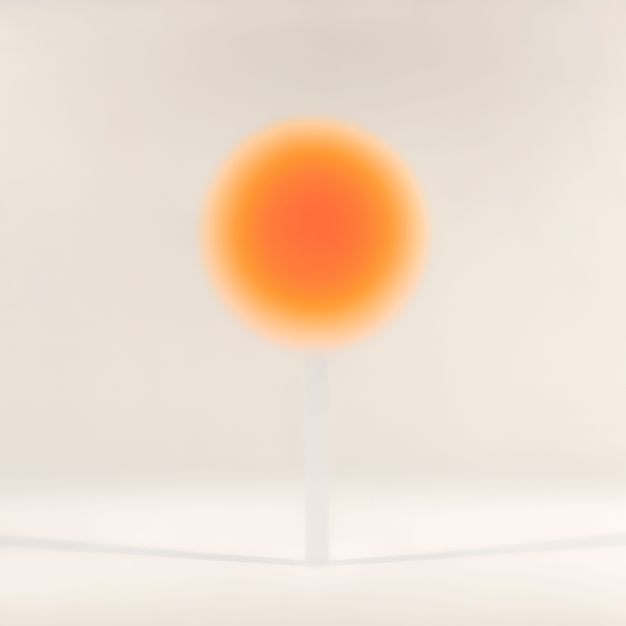
GP: Well, the final piece in the show is an
installation by Helen Pashgian. Kristen was talking about
the surprise of this transition of walking from your
everyday life into some enormous cathedral. We can bring a
lot of amazing things into the galleries, but a medieval
cathedral isn’t one of them. And so this final piece, it
accomplishes a lot of the same things (fig. 15). A transporting environment, but carried out through
opposite means. So instead of creating that wonder through
an accumulation of ornament and figuration, it’s done by
removing information. It’s incredibly minimal.
In the middle of the space, it’s a disc-shaped sculpture
whose edges are so thin that you can’t quite tell where the
sculpture ends and where the room begins. And then we’ve
removed the corners from the room, and we’ve removed the
join between the floor and the wall, so everything’s curved.
You lose your sense of depth because you can no longer tell
where the walls and floor actually connect. Pashgian says
that the eye is always searching for an edge, and when we
don’t find it, I guess there’s a bit of unease as we try to
locate ourselves. I think that’s the beginning of this
transporting experience. The lights in the room change. In
about a five-minute cycle, they get brighter and darker, and
they ultimately go almost totally dark. And as you’re
looking at this disc, you suddenly begin to see that it has
a halo, this sort of aqua-colored halo, that seems to be
moving. Every time you move your eye, it moves: that’s your
eye producing afterimages.
And so the piece is a communion. Part of what we see is what
is actually there. And part of what we see is our bodies’
own reaction to what we’re seeing. It was common with Light
and Space artists, pushing things to such a minimal extreme
that our own processes of perception become part of the
experience. That’s certainly the case here.
And then my big realization this week. In the middle of the
show, in the section about vision where there’s the
incredible Danish altar and then, on top of it, a
monstrance, Kristen and Nancy always talk in their tours
about the physicality of vision and how you could do ocular
communion. Helen’s piece is kind of that: it is an ocular
communion, and it is emphasizing this physicality of vision.
In the catalog I wrote that it’s pieces like Helen’s that
could help you realize why earlier scientists thought that
vision may be something coming out of the eye, that
afterimages could lead to ideas like that.
KC: Yeah, for us that piece so beautifully
captures some of that early experience that Nancy and I had
at Saint Catherine’s, where you had changing light moving
pretty quickly throughout the morning and shining through an
aperture onto an altar. It was obscuring or confusing your
vision as much as it was illuminating, because the dazzling
light was blurring edges of objects on the altar. And the
feelings provoked by watching light perform in that way were
quite powerful and, in many ways, akin to Light and Space
installations. When you are immersed in these environments
you get a little bit of that sensory confusion that the
medieval liturgy provided. So I think we knew that we had to
have at least one in the show that would provide the full
surround.
NT: Working with Helen was so great because
she is just across town in Pasadena and has a space built
out, just as Glenn described. We could go to see a whole
variety of discs in her studio of different hues, different
intensities. And we all discussed which one would be best
for our audience, people who would be popping in maybe even
before they see the exhibition. Of course, we wanted this to
be seen at the very end, so we went for the one with maximum
impact on the eye: a beautiful, big, bright-orange disc.
GP: This piece was a difficult build-out.
It’s hard to make a room with no corners, and our building
makes it even harder. There are structural aspects of our
building and the way our air-return system works that make
building inside of the gallery difficult. It’s partly that
it’s difficult anyway, and then it’s even more difficult
here. Ultimately, she said that it was the best build-out
that she’s been given. The only thing we did was listen to
her and do what she asked. That’s all we did. We listened to
the artist.
NT: It’s also worth saying here, both Helen
and E.V. [Day] were super excited about being included in a
show with historic works, because they’re usually in shows
with other contemporary artists. And so that was really
gratifying, to see how much they saw the resonance of their
works with historical pieces.
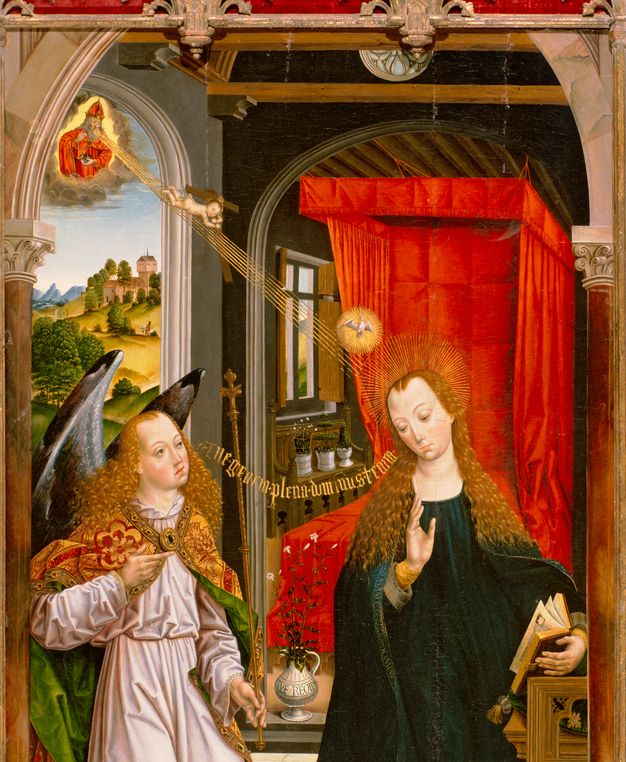
KC: A conversation with E.V. on opening
night had me thinking more clearly than previously about how
the language of diagrams infiltrates religious imagery.
Pointing to that Annunciation [The Annunciation,
late fifteenth century, Master of the Retable of the Reyes
Católicos, fig. 16],19
she was like, “It’s so naturalistic. It’s the highest degree
of naturalism for its time and yet you have these stylized
extraterrestrial laser beam rays. Why, why?” We were then
planning a program about medieval science with our colleague
Megan McNamee, who works on geometry in medieval manuscripts
and on diagrams. It created a nice prompt for further
messaging on the tours about this point that E. V. found so
fascinating—this supernatural radiance looks like medieval
diagrams of light, which was thought to travel in lines and
rays. And it has been really nice to point out to people
that we didn’t just leave geometry in the first section;
it’s here in these various religious artworks in “Aura and
Performance,” which many might see as the most overtly
“religious” section of the show.
ExpandFig. 16. —Master of the Retable of the Reyes Católicos
(Spanish, active ca. 1485–1500).The Annunciation (detail), late 15th century,
oil on wood panel, 153.7 × 94.3 cm. San Francisco,
California, Fine Arts Museums of San Francisco,
61.44.21.
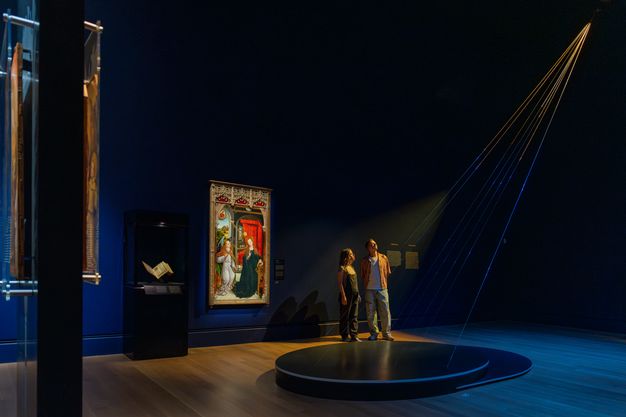
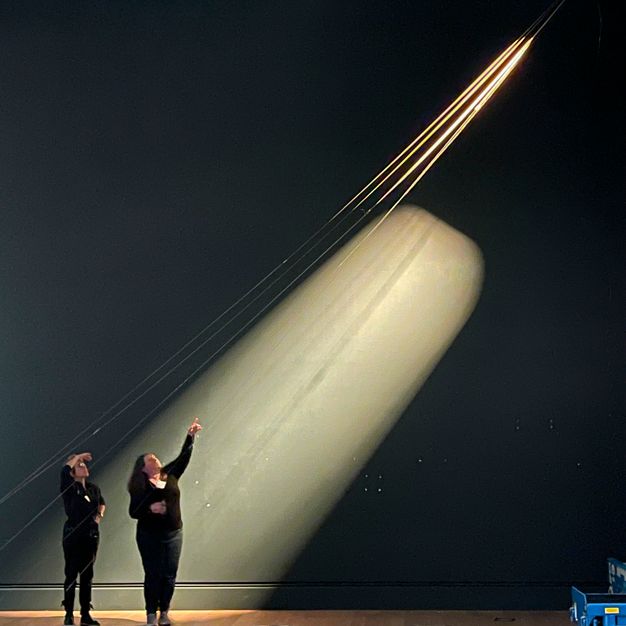
GP: The piece by E.V. Day, it’s the largest
in the show (fig. 17). It
recreates what the golden rays of an Annunciation might have
looked like if they were real. So, in this case, aircraft
cable has been gilded and connected to fiber optic
monofilament that from a distance becomes invisible. It’s
certainly our most dramatic sightline in the show, when you
have these golden rays descending over the section of the
show with all these incredible religious items.
KC: Well, that was a very fun one to
install, putting it into dialogue with the painting [The Annunciation]. We installed the painting the second day, and so E.V.
was gone by then. It was opening night when she finally saw
it.
GP: I was texting her pictures.
NT: That piece [Golden Rays / In Vitro] was also brought to life with the lighting-design team
from Available Light. They cast a really beautiful amber
light on the gilded wires that make them even more
scintillating and shimmering and visible from a distance.
KC: Nancy and I had looked at a variety of
Annunciation paintings, but this was a late loan decision
that came together. And so we secured the loan of this
painting after we’d been working with E.V. for a while, and
then E.V. found out which one it was, and it turns out this
painting was in her archive—her photo archive—as an image
that she had been interested in. Bringing those two
together, they had this zap of connection. They function
together as an installation.
GP: Her piece was first made in Rome when
she was artist in residence at the American Academy in Rome,
and she installed it in her studio, which is a very grand
space. The gold cables started inside and extended out her
window about another forty feet. So there were a lot of
steps involved in bringing it here.
I would credit E.V. for the extent of our lighting design,
since the work was really an outdoor nighttime piece
illuminated by flood lights below. Talking to her about the
piece, she said, “The context of Lumen is so
perfect for my Golden Rays installation. The cables are like
the body of God’s voice pulled out of the medieval
Annunciation painting in the show! It plugs right into that
whole shimmering machinery of devotion.” She said, “I would
love to do this—this is a dream, absolutely—but I need a
lighting designer. I think that’s the only way. The only way
I know how to do this piece is for it to be dark, and then I
just blast it with light from underneath.” And, I was like,
“Well, I don’t think you can blast anything in a gallery
full of medieval manuscripts!” And she said, “I also don’t
know where the shadows would land when contained by walls. I
would love to make this work, but I need professional
assistance to really get it to work in your gallery space”
(fig. 18).
GP: We were probably already talking about
a lighting designer at that point, but I’m sure that was
when I started thinking,
Oh god, actually everything in the show needs a lighting
designer. But that’s another case where we simply listened to the
artist. Unfortunately, that can be very rare, and it’s even
more rare with women artists. Often, they say exactly what
they want, and the institution starts trying to talk them
out of it, because it’s going to be more expensive, you
know. But that piece is so dependent on every little thing
being done perfectly—which of course the artist knows better
than anyone. You can’t bargain your way—well you’ll bargain
your way into a failure if you don’t give it what it needs.
KC: Yeah, we were lucky that the museum
went all in on this show and recognized that a show on light
needed the Available Light team! [laughter]
GP: Maybe this is a good opportunity to
circle back to the eighth contemporary work in the show, the
one I described as emotionally included. In the rotunda,
Charles Ross’s work is measuring two types of planetary
movement, right? The daily rotation and the yearly orbit.
But there’s a third type of planetary movement that he has
spent the last fifty years of his life trying to visualize.
If you’ve ever spun a top and then the top starts to
wobble—our planet does the same thing, and one wobble takes
twenty-six thousand years to happen. Charles has made this
incredible work of land art that helps to visualize this
phenomenon, which our medieval predecessors called the
precession of the equinoxes. I said it’s emotionally
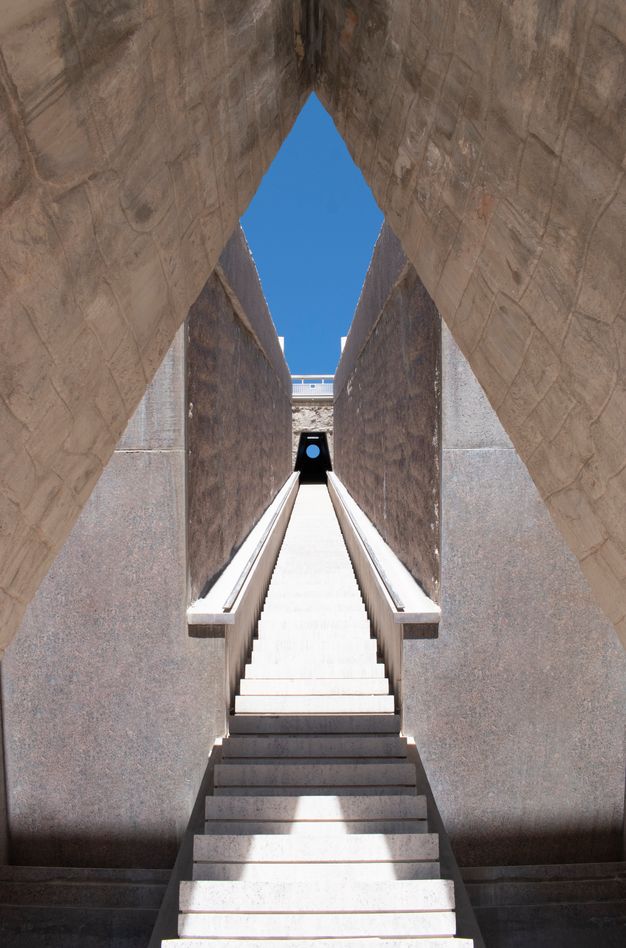
included in the show because it’s sitting on a mesa in New
Mexico (fig. 19).
[laughter] We can’t bring it here.
But it’s a moment in the show that I love because, at the
very center of the
Tapestry of the Astrolabes, there is the North
Star, Polaris represented with a little circle around it
(see fig. 3). Right next to that,
there’s a manuscript depicting a monk using a device called
a horologium nocturnum to
tell time at night.20
You point it at Polaris and then, based on where the stars
are around it, you can tell the time at night. And so
Star Axis by Ross is also a sighting tube that is
aimed at Polaris. It’s an eleven-story pyramid, and at the
top is an oculus that is framing Polaris directly. Each step
going up has two sets of dates engraved: a date in the
future and a date in the past, and so as you walk up, as you
approach the oculus, it’s getting larger in your field of
view. The perimeter of the oculus is framing how far Polaris
will move over the course of a night on the date that is
engraved on the steps. When you are at the bottom of the
steps, which is close to the present, the oculus is very
small, and indeed Polaris moves very little over the course
of a night right now, which is why it is our North Star. But
because of this twenty-six-thousand-year wobble, the North
Star changes over time. In a couple thousand years we’ll
have a different one, and then another one a thousand years
after that, and so on. As you walk the stairs and get closer
to the oculus, it gets larger in your field of vision,
showing you just how much our planet wobbles over time. So
you’re tracing geometry in time, and when you get to the
top, you witness the farthest that the wobble ever is.
When you’re at the very top, which is depicting the orbit of
Polaris thirteen thousand years in the future and thirteen
thousand years in the past over the course of one night, it
actually falls and goes below the horizon line at a certain
point, and comes back up. Just the process of climbing this
set of stairs allows you to visualize that
twenty-six-thousand-year cycle. The extent of that cycle
began to be discovered in the Middle Ages as astronomers
compared their measurements with Greek astronomy and
realized that the numbers were different. Enough time had
passed between ancient Greece and the Middle Ages that the
difference was now measurable. And they had so much respect
for their predecessors that instead of saying “their
measurements were wrong and ours are right,” they said, “The
entire planet must be moving”—and that was the right answer!
I remember vividly when I first brought Ross to Kristen and
Nancy’s attention, and they read about his work, Kristen’s
first reaction was, “He knows about the precession of the
equinoxes!”
KC: That was my fangirl moment!
[group laughter] I had a houseguest recently who
picked up my copy of Seb Falk’s
The Light Ages: The Surprising Science of Medieval
Science
(2020) and noticed my Post-its flagging the section on the
precession of the equinoxes. I remember absorbing all of
this astronomy for the first time. Then to be able to go to
a site where an artist had decided that this was the thing
that he would show generations of people to come is pretty
amazing: How this polestar that we call our true north, the
star by which we navigate, is not that. And then to
put you in this stairway and have you climb up through
time—one hand on a rail marking the past and one hand on one
inscribed with a year in the future—was a mind-bending
experience.
NT: Which had to be done in the pitch black
of night, right, so there’s no ambient light. This was even
before the moon came up, when we were there.
GP: And one at a time, because if anyone’s
ahead of you, they’re going to block the oculus.
NT: Charles [Ross] and his partner, Jill
[O’Bryan], said, “Let the polestar pull you up.” We could
hear our footfalls. We could hear each other’s breathing
because it was dead silent.
NT: But you don’t want to take your eyes
away from Polaris, because it’s above you and then it’s not.
You’re in this dark tunnel, and it’s a little freaky. And it
was just so moving emotionally. I mean, the artist spent
fifty years, his adult lifetime, building a pyramid to make
this point and physicalize it. And you feel this in your
body. I mean, he’s making this knowledge tactile.
GP: I think the whole perspective of the
show is really how much effort it took over generations for
humankind to figure this stuff out. That has always struck
me: the enormity of some of these achievements that we take
for granted, which now you can just tell somebody. Right?
All to each other: Right?
[laughter]
KC: But what a once-in-a-lifetime
experience that was! It took us from immersive environments
filled with light to extreme darkness with one little
pinpoint of light.
KC: It’s funny because, you know, so much
of the work that Nancy and I did on the last part of the
show on medieval sensoria involved being bombarded with
scent and sound and light. It was somewhat overkill, a
smorgasbord of sensory experience. And then to go into this
space that was like a sensory deprivation tank—that moment
when you’re in the viewing tube with only the pinpoint of
Polaris was, I found, a little scary in a delightful way; it
was a little overwhelming.
NT: Well, it was awesome! It really was
about the awe.
GP: Yeah.
KC: As we rode down the mountain, we all
ruminated on these moments in the careers of art historians
where we think of just how lucky we are that we work on this
stuff.
NT: Because the show has taken us in these
directions we could never have anticipated in the beginning.
KC: And I mean, every great project does
that, right? It surprises you somehow. I definitely feel
like this stretched us to take on science—so thank you,
Getty Foundation! [laughter] I still don’t know my
constellations, but I can recognize them in a medieval
manuscript. Out in the field, I’m a little more limited.
[chuckles] I feel like the catalog just scratched
the surface in so many ways. There was this whole field of
study that, because I was not good at math or science in
high school and earlier, I peeled out of it as soon as
possible in college. And there’s this whole area of our
collection that could use some amplification and study. It’s
fair to say, I’m not going to become a historian of science,
but there’s definitely cataloging work and further shows to
be done with this kind of material in the Getty’s
collection. So I’m looking forward to that, which is a hard
left from where I was before, the land of devotional
touching and kissing of medieval books.
GP: My feelings about incorporating
contemporary art into historical shows have changed a lot.
I’m always happy to see it, but if you think back to moments
when you’ve encountered it in shows, it’s not always as
successful as one maybe would hope. You can end up leaving a
project worried,
Oh, God, am I going to get clobbered? Because when
we see it not working as well as it could’ve. . . . Those
curators probably thought it was going to work, right? But
this project brought me to a place where I now feel that
there can be a kind of methodology to it, that there’s a
reason for it, and that there’s a way that it could be done—
KC: Done sensitively, right?—
GP: Done sensitively. I think if it’s a
historical show with contemporary art added, then the
primary needs to be the narrative of the main show, and the
contemporary pieces should not try to compete with it. And I
think sometimes that’s what happens—the newer work tries to
take over. We’re using the contemporary works in some cases
to bring a little bit of scale and wonder. But you should
want the things to play well together, and you should want
them to enhance the narrative. You want the pieces to make a
light bulb go off in somebody’s head, not a question mark.
Shows like this are not the moment for thwarting or twisting
or complicating the narrative. So I think finding the right
people who can help show that historical ideas are relevant
today, or that artists can use some of the same ideas is, in
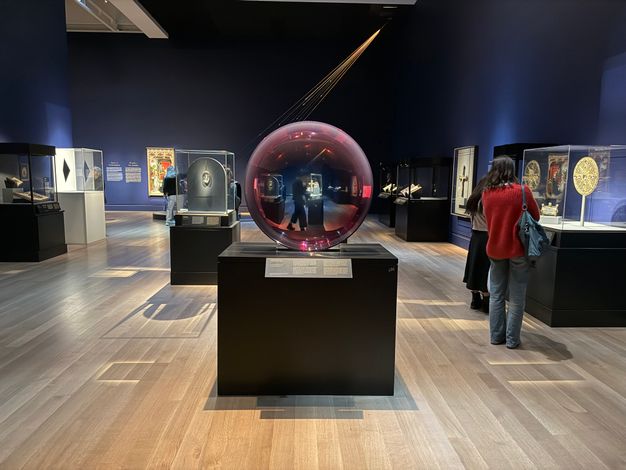
my opinion, how it can work. I think here of Fred Eversley’s
glorious lens sculpture in the show (fig. 20). It’s such a knockout object, but we placed it so that it
was reflecting, encompassing, and showcasing all of the
other amazing crystal objects in the show, and by the time
people reached this object they would (we hope) associate
the colors and form of the work with the nested spheres of
the universe that they had already encountered several
times. It felt harmonious, while also allowing for a great
moment of interactivity and wonder.
KC: I think having a full consideration for
ways that all of these works acted as lenses—lenses through
which you could better understand the larger narrative that
we’re trying to tell—was really important. They weren’t just
representational; they were didactic, helping us to tell a
story and prompt consideration of our themes.
GP: Most of the contemporary pieces are
completely abstract, except for one painting of stars. The
imperative was to use an object to create a perceptual
experience that is going to relate to what else is happening
in the room. Maybe the strongest example of that was Anish
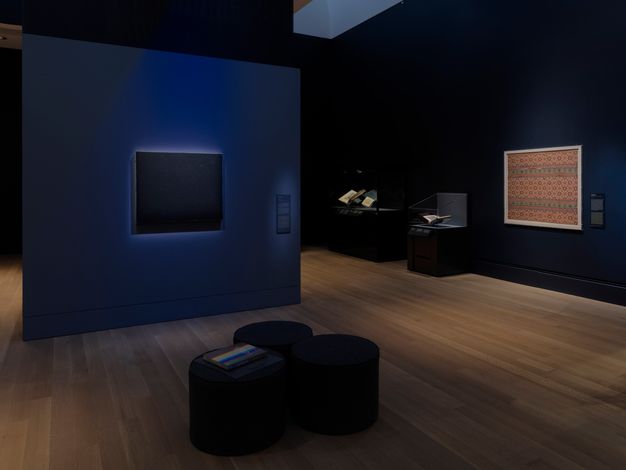
Kapoor’s Non-Object Black (2018) being placed in
the “Divine Darkness” section of the show.21
This was probably the most abstract and “difficult” section
of the show, asking visitors to think about the
impossibility of ever being able to comprehend the divine.
It’s something we can only glimpse in fragments at most. And
then we have this Kapoor sculpture coated in Vantablack, the
darkest substance on earth. It looks like a flat,
two-dimensional diamond shape, until you move around the box
and realize it actually protrudes into space. The sculpture
is so black that it has suppressed our ability to perceive
depth. So we have to undergo that same process of
apprehending something in bits to begin to understand its
true form. And then I only understood on our final tour of
the exhibition that the Kapoor work is also a reliquary,
just like the reliquaries that were near it. Once those
sculptures are coated in Vantablack, they get vacuum sealed
into that vitrine, and the vitrine can never be opened
again.
NT: As for Lumen’s afterlives,
I’ve gotten really interested in ocular communion and how
sight becomes tactile in the high and late medieval Latin
West. I’ve started looking at how pigments are also
medicinal and whether healing could be done through the
perception of colorants on the page. That’s what I’m
exploring right now, visual ingestion, visual healing
through these medicinals on the page. It’s bringing me back
to what I know best and the stuff that manuscripts are made
of.
GP: I feel like that’s a book that could be
really successful now, like if you tell people that using
inks made from these colorants could heal them.
NT: I gave two talks last year on this, so,
yeah, I hope that’s my next project to publish.22[chuckles] Thanks, everyone, for this shared
conversation! This was a snapshot, right? We’ve learned so
much since putting this exhibition together.
KC: That’s an important thing to be said,
particularly at a moment when symposium volumes are becoming
more infrequent. So often the really interesting stuff that
bubbles up through an exhibition you only come to after the
book is out. After you’ve been living with the show in the
galleries, and you’ve had these really rich conversations.
After you’ve had a study day and sensory activity led by
Barry Smith [professor at University of London and founding
director of the Centre for the Study of the Senses] while
smelling incense and hearing Hildegard Bingen in the
galleries! I think there are all kinds of exhibition
afterlives that continue to ripple, and it remains to be
seen how we capture them.
Kristen Collins is curator of manuscripts in
the Getty Museum.
Glenn Phillips is chief curator at the Getty
Research Institute.
Nancy K. Turner is conservator of manuscripts
at the Getty Museum.
Notes
Holy Image, Hallowed Ground: Icons from Sinai,
curated by Robert S. Nelson and Kristen Collins, Getty
Center, Los Angeles, 14 November 2006–4 March 2007. See
Robert S. Nelson and Kristen M. Collins, eds.,
Holy Image, Hallowed Ground: Icons from Sinai,
exh. cat. (J. Paul Getty Museum, 2006).
↩︎
Nancy K. Turner, “Surface Effect and Substance: Precious
Metals in Illuminated Manuscripts,” in
Illuminating Metalwork: Metal, Object, and Image in
Medieval Manuscripts, ed. Joseph Salvatore Ackley and Shannon L. Wearing
(De Gruyter, 2022), 51–110.
↩︎
Nancy Thompson, G. Gabrielle Starr, and Abbey
Stockstill, moderated by Barry C. Smith, “Art, Science,
and Wonder in the Medieval World (Panel 2: The
Neuroscience of Light),” Getty Center, Los Angeles, 10
November 2024,
https://youtu.be/vfl_6cNVuZ4?si=V72pZ6c-d0dYbyPe. ↩︎
Rebecca McGrew et al.,
It Happened at Pomona: Art at the Edge of Los Angeles
1969–1973,
exh. cat. (Pomona College Museum of Art, 2011).
↩︎
Kristen Collins and Nancy K. Turner, eds., with
contemporary contributions by Glenn Phillips,
Lumen: The Art and Science of Light, 800–1600
(J. Paul Getty Museum, 2024), 224, pl. 114.
↩︎
Collins and Turner, Lumen, 118–19, pl. 49; 112,
pl. 41.
↩︎
See, for instance, Hans Henrik Lohfert Jørgensen et al.,
The Saturated Sensorium, Principles of Perception and
Mediation in the Middle Ages
(Aarhus University Press, 2015).
↩︎
Collins and Turner, Lumen, 232–33, pls. 123,
124. ↩︎
Christopher R. Lakey elaborates in “Dazzling Splendor in
a Processional Standard by Gentile da Fabriano,” in
Collins and Turner, Lumen, 195–96.
↩︎
Pentcheva, “Optical and Acoustic Aura in the Medieval
Image”; and Bissera V. Pentcheva, “Radiant Light and
Sound in the Medieval Church,” in Collins and Turner,
Lumen, 187–93.
↩︎
Nancy K. Turner, “Pigments and Dyes, Medicine and
Healing: Finding materia medica in Manuscript
Illumination,” in
Visualizing Drugs & Dyes: Art and Pharmacology in
(Early) Medieval Worlds (600–1400), ed. Theresa Hollar, Matthew Griebeler, and Hannah
Baader (Brill, forthcoming); and Nancy K. Turner, “Sight
and the Healing Efficacies of Painting Materials as
Affective Pharmaka in Medieval Devotional
Manuscripts,” in
The Senses, Cognition, and the Body in Medieval
Devotional Practices, ed. Pieter Boonstra et al. (Brepols, forthcoming).
↩︎