Victorious Laughter: Satirical Photomontage in Brigade KGK’s
Photo Series
From the 16th to the 17th Congress of the All-Union Communist
Party (Bolsheviks)
Samuel Johnson
Johnson / Victorious LaughterGetty Research Journal, No. 20 (2025)
In 1934, the Soviet photo agency Soiuzfoto published an
illustrated version of Joseph Stalin’s “Report to the
Seventeenth Party Congress on the Work of the Central
Committee of the C.P.S.U.(B.),” comprising seventy-five
photomontages by a trio of young artists named Brigade
KGK. In this essay, I treat the satirical photomontages
that Brigade KGK created for Stalin’s report as a search
for a suitable artistic idiom of official humor. I argue
that Brigade KGK used stretched and distorted imagery to
demonstrate the comic possibilities inherent in
photography’s materiality, where others subordinated it to
the traditional art of drawing. The essay situates Brigade
KGK’s work in relation to debates in the final years of
the first five-year plan, at a time when supporters of
German artist John Heartfield criticized photomontage as a
purely mechanical technique and discredited its supporters
as petty-bourgeois formalists.
Chicago
Samuel Johnson, “Victorious Laughter: Satirical
Photomontage in Brigade KGK’s Photo Series
From the 16th to the 17th Congress of the All-Union
Communist Party (Bolsheviks),” Getty Research Journal, no. 20 (2025),
https://doi.org/10.59491/WGVY8306.
MLA
Johnson, Samuel. “Victorious Laughter: Satirical
Photomontage in Brigade KGK’s Photo Series
From the 16th to the 17th Congress of the All-Union
Communist Party (Bolsheviks).” Getty Research Journal, no. 20, 2025,
https://doi.org/10.59491/WGVY8306.
In 1934, Soviet artists Viktor Koretsky, Vera Gitsevich, and
Boris Knoblok created a series of photomontages under their
working name, Brigade KGK, to illustrate a major political
speech by Joseph Stalin. Of the three artists, the best known
today is Koretsky, a Kyiv-born graphic artist twice awarded
the Stalin Prize for posters he designed during World War II.
After completing his education in 1929 at the Moscow State
College of Visual Arts in Memory of the 1905 Uprising,
Koretsky worked intermittently with Gitsevich (his wife) and
Knoblok, creating stage designs for the realist theater of
Nikolai Okhlopkov and producing graphic design for the State
Fine Arts Publishing House, Izogiz.1
Brigade KGK achieved its greatest success in the field of
poster art, but
From the 16th to the 17th Congress of the All-Union
Communist Party (Bolsheviks),
finds them working in a new format. A sheaf of silver bromide
prints showcasing seventy-five photomontages captioned and
numbered sequentially was published by the agency Soiuzfoto in
an edition of five thousand, with an embossed red portfolio
available for separate purchase. The series represents a novel
type of Soviet print culture; part album, part filmstrip, the
mass-produced photo series could also function as a portable
exhibition in libraries, workers’ clubs, and other public
places, as book artist and curator Mikhail Karasik
explains.2
The editioned photo series therefore exemplifies an emerging
type of publication oriented toward informal public
exhibition, which photography historian Olivier Lugon first
identified in the postwar period.3
Among the most notable qualities of Brigade KGK’s
From the 16th to the 17th Congress is its comic mood.
Fifteen of the photomontages in the series—one fifth of its
contents—are satirical. The sheer frequency of Koretsky,
Gitsevich, and Knoblok’s attempts at humor allows us to
position their work within a cluster of debates in the 1930s:
on the nature and direction of photomontage, the aims and
possibilities of satire in an era devoted to socialist
realism, and the enjoyment of consumer goods in the Soviet
Union. Serguei Oushakine, one of the leading voices in recent
critical discussions of Soviet laughter, has stressed the
importance of visual representation to the comic milieu.4
Scholars of film, literature, and drama have recently expanded
our understanding of Soviet humor, but art historical studies
of official humor are still too rare.5
In this respect,
From the 16th to the 17th Congress serves as a
valuable case study.
The surprising range of photographic techniques exploited by
Brigade KGK also testifies to the persistence of a rich
photographic culture in the Stalin era. Surrounded by
experiments, Soviet critics of the mid-1930s complained that
“there is still no theory of photomontage,” even as they saw
the basis of a future theory with new clarity.6
Their dissatisfaction arose from the capacious and free use of
the term itself. Photomontage referred not only to
the serial, multipage layouts of illustrated magazines, which
preserved an individual photograph’s autonomy and documentary
value, but also to the satirical compositions that German
photomonteur John Heartfield created for the
Arbeiter Illustreirte Zeitung (AIZ; Workers’
illustrated news), which subordinated photographs to a simple
slogan-like message. As a result, Soviet critics maintained
that “one of the first tasks on the way to creating a theory
of photomontage is to clarify the genres, establish their
fundamental differences, sphere of application, etc.”7
The novel format and multifarious techniques of
From the 16th to the 17th Congress underscore the
currency of these concerns about genre. Brigade KGK freely
used photographs in statistical data visualizations,
monumentalizing socialist realist tableaux, and satirical
photomontages. In each of these genres, their work reveals a
new plasticity in the photograph. Nowhere is this quality more
striking than in their satirical montages, which rely on an
experimental technique to create distorted images. This essay
examines how this technique made photomontage intelligible in
relation to the other arts that contemporary critics regarded
as its models in the mid-1930s: drawing, painting, and
stage—or, more precisely, film—direction. It demonstrates that
concerns often understood in terms of medium alone were, for
artists and critics of the 1930s, ineluctably bound up with
questions of genre.
Imminent Victory
From the 16th to the 17th Congress is a little-known
intertext of a well-known speech: Stalin’s “Report to the
Seventeenth Party Congress on the Work of the Central
Committee of the C.P.S.U.(B.).”8
This long address, delivered at the so-called Congress of the
Victors on 26 January 1934 and published two days later in the
organ of the party’s Central Committee, Pravda,
celebrated the Bolsheviks’ triumph over internal dissent from
its left and right flanks as well as the continuing stability
of the USSR’s planned socialist economy against the backdrop
of the ongoing depression in the capitalist West. In the photo
series by Brigade KGK, the text of Stalin’s address maintains
a position of primary importance. The lengthy captions beneath
the photographs are taken directly from the published
Pravda transcript, and any deletions are duly marked
by ellipses. The illustrations also closely shadow Stalin’s
text, giving special emphasis to no single passage of the
speech. Even the visual humor in the montages receives textual
legitimation in a form recently analyzed by literary historian
Natalia Skradol: several captions contain the
Pravda transcript’s editorial interpolations of
laughter and applause from Stalin’s audience.9
Stalin would not utter his famous verdict that “life has
become better, life has become happier” until the final months
of 1935, but the jubilation it expressed originated in the
events of 1934. In his “Report to the Seventeenth Party
Congress,” he sought to clarify a widespread misconception
about the goals of economic planning. During the first
five-year plan (1928–32), massive industrial investment and
poor resource allocation had created runaway inflation, which
required food rations to be introduced for the first time
since the civil war. For some observers, the reappearance of
the centralized command economy and the disappearance of money
presaged an immediate transition to the producer-oriented
society of full communism. In his report of 1934, however,
Stalin announced that the second five-year plan would
eliminate rations, reminding those who had praised the ration
system for obviating money that “in the last analysis goods
are produced not for the sake of producing them, but for
consumption.”10
When he delivered his report, Stalin still hoped to end
rations in 1938, at the conclusion of the second plan period,
but by the end of 1934 he would abruptly change course.
Determined to tame the inflation that rations held at bay, the
Soviet State Bank advised a slackening of price controls on
some commodities, which would allow the state to absorb as
revenue the excess demand that bubbled up in underground
markets.11
The strategy was immediately successful, and by October Stalin
decided to eliminate rations before the year’s end. In
November he told the Central Committee that these reforms were
meant “to expand Soviet commerce, to strengthen the cash
economy.” He promised that “the value of the ruble will become
more stable, undoubtedly, and strengthening the ruble means
strengthening all of our planning and financial
accountability.”12
Rather than reflecting a turn to liberal laissez-faire, the
reintroduction of money as the central instrument of the
economy was part of a seismic shift toward a planned
mass-consumption sector.
The triumphant mood of the report was therefore anticipatory,
and Stalin continued to emphasize the need for vigilance
against the enemies of socialism. In both Stalin’s report and
the satirical photomontages of Brigade KGK, those who stood in
the way of the planned commercial-trade sector were subject to
merciless mockery. Stalin criticized two closely related
attitudes. On the one hand, he highlighted a widespread
“indifference to the demand for a greater range of goods and
to the requirements of consumers” among functionaries who
dreamed of direct, moneyless exchange.13
On the other, he reminded his audience that “there is still
among a certain section of Communists a supercilious,
disdainful attitude towards trade,” which is not the
perspective of true Bolsheviks but “impoverished aristocrats
who are full of ambition.”14
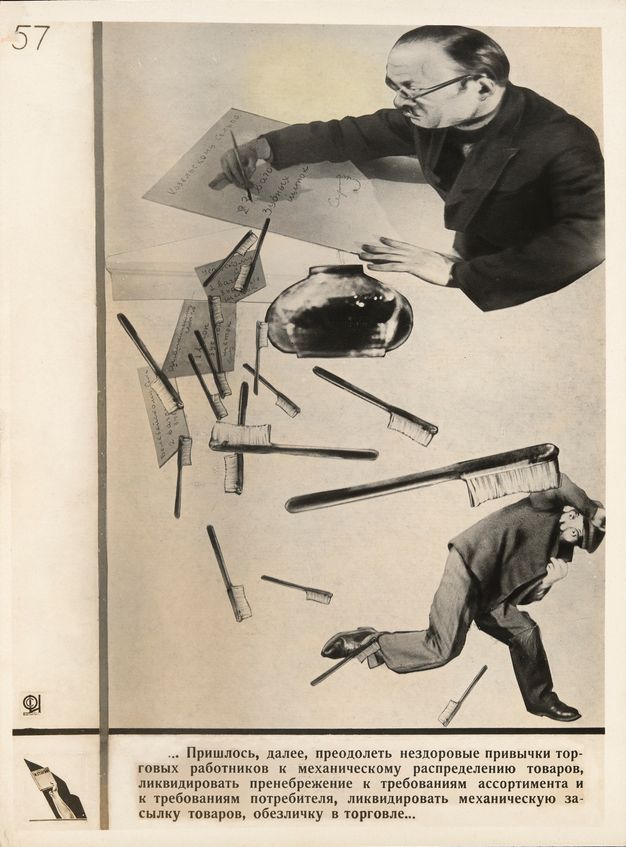
In the photo series, these internal political obstacles to
state trade are represented in a pair of montages. In montage
number fifty-seven, Brigade KGK portrays a helpless Soviet
consumer overwhelmed by toothbrushes that cascade from a
comically oversize document containing the orders of a myopic,
self-satisfied bureaucrat (fig. 1). The
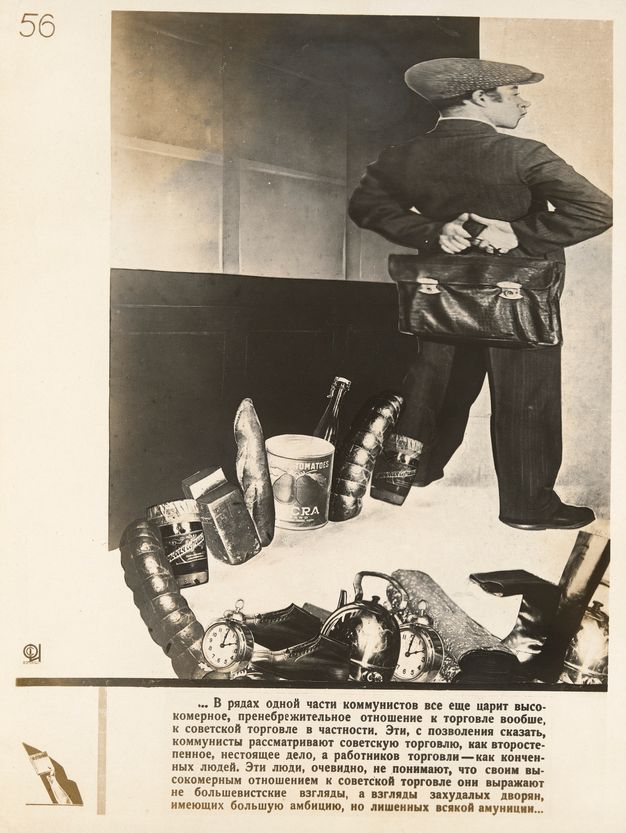
party’s own arrogance toward trade is lampooned in montage
fifty-six, which shows a young man turning his nose up at—and
turning his back on—the stream of goods awaiting future Soviet
consumers: tea kettles, alarm clocks, reams of fabric, leather
shoes, sausage links, bread, and canned goods (fig. 2). Amid this bounty, a can of tomatoes clipped from the
foreign press—a sign of the relative abundance enjoyed
abroad—gives indirect testimony of the continuing straits of
the Soviet consumer.
ExpandFig. 1. —Brigade KGK (Viktor Koretsky [1909–98], Vera Gitsevich
[1897–1976], and Boris Knoblok [1903–84]).
“We had to overcome among the people in charge of trade
the unhealthy habit of distributing goods mechanically; we
had to put a stop to their indifference to the demand for
a greater range of goods and to the requirements of the
consumers.”
From the 16th to the 17th Congress of the All-Union
Communist Party (Bolsheviks), 1934, no. 57, gelatin silver print, 22.7 × 17 cm. Los
Angeles, Getty Research Institute, 2014.R.25.ExpandFig. 2. —Brigade KGK (Viktor Koretsky [1909–98], Vera Gitsevich
[1897–1976], and Boris Knoblok [1903–84]).
“There is still among a section of Communists a
supercilious, disdainful attitude toward trade in general,
and toward Soviet trade in particular. These Communists,
so-called, look upon Soviet trade as a matter of secondary
importance, not worth bothering about.”
From the 16th to the 17th Congress of the All-Union
Communist Party (Bolsheviks), 1934, no. 56, gelatin silver print, 22.7 × 17 cm. Los
Angeles, Getty Research Institute, 2014.R.25.
The chaotic proliferation of consumer goods in these
compositions shows how Brigade KGK borrowed its models from
the previous generation of avant-garde artists and subtly
transformed them to meet new ideological demands. Of
particular relevance are the photomontages that the
constructivist Aleksandr Rodchenko created in 1923 to
illustrate Vladimir Mayakovsky’s new poem “Pro eto” (About
this).15
Art historian Chistina Kiaer has situated “Pro eto” in the
context of left-opposition leader Lev (Leon) Trotsky’s
campaign for a new way of life in the period of the New
Economic Policy (NEP), when the private enterprises of
so-called nepmen were permitted to compete with nationalized
concerns.16
For the lovelorn poet who is the protagonist of Mayakovsky’s
poem, the persistence of the old byt, or way of life,
under NEP stands in the way of a new, higher form of communist
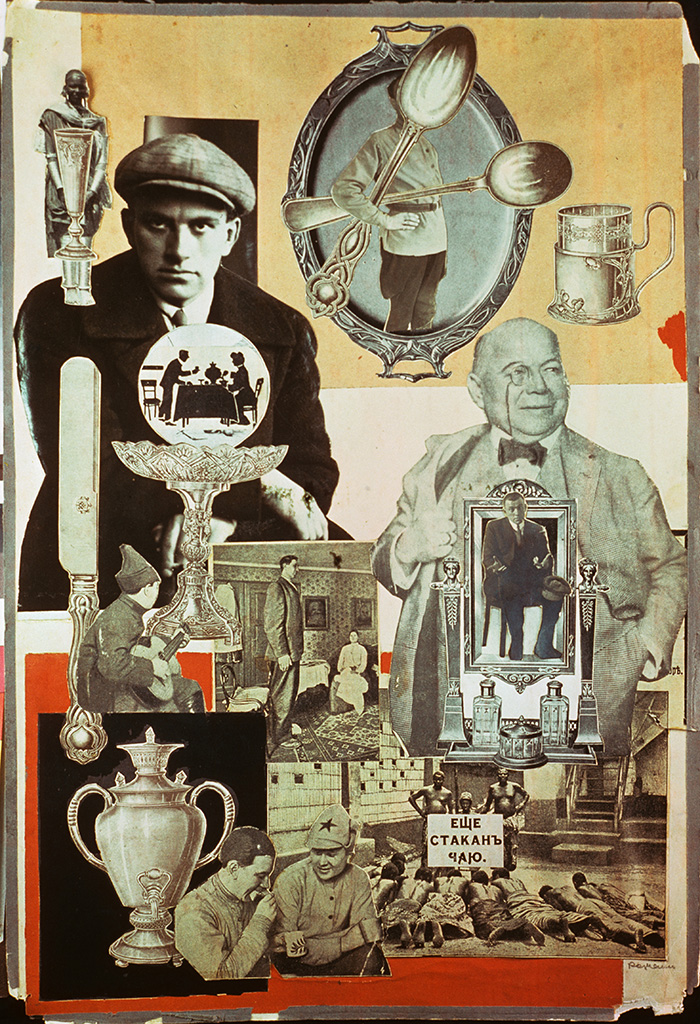
existence (bytie). One of Rodchenko’s illustrations
for the poem derides the paraphernalia of tea drinking as a
primitive fetish of the old, feminine-coded byt (fig. 3). It shows two photographs of the poet hemmed in on all
sides by precious silver, backed by a corpulent nepman. For
the NEP-era photomonteur, the overwhelming accumulation of
domestic goods represented an obstacle to communist
mobilization. A decade later, Brigade KGK used the same
compositional and stylistic principles to a different end.
Where the nepman represented an external threat, foreign to
the Soviet way of life, the traders targeted by Brigade KGK’s
montage were within the party—Communists, but in name only, as
Stalin stated.
The distance between these two eras can be gauged with a
passage from the popular satirical novel by Ilya Ilf and
Evgeny Petrov, Dvenadtsat’ stul’ev (1928;
The Twelve Chairs). The novel follows the
irrepressible Ostap Bender, a conman, master of the new
Bolshevik argot, and all around “smooth operator,” as he seeks
his fortune: a set of jewels that the mother of a provincial
noble sewed into the cushion of a dining chair as the
revolution unfolded around her. When Bender visits a poet
friend who sleeps on the floor of a communal apartment in
Moscow, the authors draw a stark contrast between the new
ethical existence pursued by young Communists and the familiar
comforts of the old way of life. In witheringly ironic
indirect discourse, Ilf and Petrov skewer the attitude of
vigilance against domestic comfort that motivates the
protagonist of Mayakovsky’s “Pro eto”:
A mattress is insatiable. . . . It needs a bookcase. It
needs a table with thick stupid legs. Creaking its springs,
it demands drapes, a door curtain, and pots and pans for the
kitchen. It shoves people and says to them:
“Go on! Buy a washboard and a rolling pin!”
“I’m ashamed of you, man. You haven’t yet got a carpet.”
A mattress remembers and does everything in its own way.
Not even a poet can escape the common lot. Here he comes,
carrying one from the market, hugging it to his soft belly
with horror.
“I’ll break down your resistance, poet,” says the
mattress.17
As Kiaer has argued, this kind of spontaneous “thing theory”
led Mayakovsky to repurpose the commodity fetish in his
advertisements for Bolshevik-made “comradely objects” during
Trotsky’s campaign for a new byt. The poet in
The Twelve Chairs is portrayed somewhat less
sympathetically than Mayakovsky’s poet; the former is an
idealist, a lover of Leo Tolstoy, and a vegetarian. Both
types, however, were targeted in the Stalinist campaign
against the left-wing ideology and Trotskyism. And, as Mikhail
Odesskii and David Feldman show in their critical introduction
to the text, this campaign underpinned Ilf and Petrov’s 1927
commission for a serialized novel from the monthly literary
journal 30 dnei (30 days).18
For this reason, literary scholar Maya Vinokur argues that Ilf
and Petrov’s novels mark the transition from a traditional
form of Russian satire exemplified by Gogol’s “laughter
through tears” to a new kind of Stalinist “laughter without
tears.”19
This new type of laughter, which rippled through the
auditorium as Stalin delivered his report, is what Brigade KGK
wanted their photomontages to provoke from the viewer.
Satire, a Realist Genre
Recently, a number of scholars have demonstrated that the
famously slippery definition of socialist realism did not
exclude satire. As art historian Annie Gérin argues, the
former commissar of education, Anatoly Lunacharsky, was
instrumental in reconciling these apparently distinct modes.
Speaking to the Union of Soviet Writers shortly before his
death in 1933, Lunacharsky explained that “in his struggle
with negative phenomena, the Socialist Realist may of course
resort to all sorts of hyperbole, caricature, and utterly
improbable comparisons—not to conceal reality but, through
stylization, to reveal it.”20
In 1934, when the founding editor of the satirical journal
Krokodil, Mikhail Koltsov, addressed the First
Congress of Soviet Writers, he stressed that satire was an
indispensable weapon in the struggle against the remnants of
capitalism. In contemporary examples of Soviet humor, Koltsov
perceived “strength and power, along with notes of severe
anger and superiority over the enemy.”21
But he also echoed Stalin’s criticisms of antitrade attitudes
within the party, asking, “Isn’t it possible that in
ourselves, in those who sincerely consider themselves new
people, devout Bolsheviks . . . that some old, petit bourgeois
poison remains?”22
This volatile mixture of triumphant ire and introspective
critique distinguishes the satirical sensibility of 1934 from
later developments in Soviet humor. As Oushakine points out,
in subsequent years the negative aspects of Soviet life would
be portrayed from the standpoint of positive comic heroes who
exuded an attitude of joy, calm, and confidence against the
backdrop of a stable socialist environment.23
These statements are exactly contemporaneous with publication
of From the 16th to the 17th Congress, but the
discussions of satire that most strongly shaped it began
several years earlier, when the first five-year plan was
drawing to a close. After a debate in 1929 about the purpose
of satire under socialism unfolded in the organ of the
Federation of Soviet Writers,
Literaturnaia gazeta (Literary gazette), Lunacharsky
created a Commission for the Study of Satirical Genres at the
Soviet Academy of Sciences, which would examine traditions in
Russia, Europe, and Latin America. In a notice published in
March 1931 in Literaturnaia gazeta, he highlighted
the need for a study collection and solicited contributions
from collectors of journals such as Punch,
Simplicissimus, Le charivari, L’assiette au beurre
(The butter plate), Kladderdatsch, and
L’asino (The donkey).24
For working artists, the living embodiment of this tradition
was Heartfield, the former dadaist who had contributed
stinging satirical photomontages to the Comintern-financed
workers’ newspaper AIZ since 1929. Heartfield even
visited the USSR in preparation for an exhibition of his work
in 1931 in Moscow, giving lectures and lessons in his
photomontage technique to an admiring public.
Heartfield’s impact in Moscow was as immediate as Moscow’s
impact on Heartfield. As art historians Hubertus Gassner and
Maria Gough have shown, the potent negativity characterizing
Heartfield’s anti-capitalist photomontages abated when he was
enlisted in the project of positively representing the Soviet
planned economy; at the same time, Soviet critics used his
work for AIZ to attack Soviet photomonteurs,
especially Gustav Klutsis, who responded by transforming the
field of poster art with a greatly simplified style.25
More recently, art historian Sabine Kriebel has reinterpreted
Heartfield’s humor in relation to the satire debates in
Literaturnaia gazeta, and literary historian Devin
Fore has linked Heartfield’s practice to socialist realism via
caricature. Yet both scholars treat Heartfield’s work in a
strictly German frame of reference: for Kriebel, the German
tradition of satirical magazines, or Witzblätter,
serves as a “buffer zone” shielding Heartfield from the heroic
optimism of official socialist realism, while in Fore’s view,
the highly developed media ecosystem of German capitalism
makes Heartfield a prototypical postmodern realist who mainly
used photographs as “reproductions stolen from other
sources.”26
This literature reveals a complex and influential artist, but
it pays surprisingly little attention to the warm reception
that Soviet artists gave to Heartfield’s signature trait: his
satirical negativity.
In this respect, it is instructive to consider the example of
one of Heartfield’s most gifted Soviet followers, Boris
Petrushansky, who worked under the pen name Boris Klinch. An
experienced caricaturist frequently published in
Krokodil, Klinch embraced photomontage in the rush of
excitement surrounding Heartfield’s visit to Moscow and
employed a method very similar to Heartfield’s, if not
directly modeled on it.27
In 1932, Klinch complained that satire is “one of the
strongest weapons in the struggle for socialist construction,”
yet “photo-satire is almost totally absent” from the arsenal
of the Soviet artist.28
To Klinch, Heartfield was primarily a master of comic genres.
Indeed, Klinch used the term
fotomontazh interchangeably with
fotosatira,fotokarikatura, and
fotosharzh, a term adapted from the French
portrait charge (itself a translation from the
Italian ritratti carichi, or “loaded portrait”).
The fotosharzhi that Klinch published in the
Soiuzfoto organ Proletarskoe foto (Proletarian photo)
in late 1932 testify to his belief that Heartfield had
“essentially laid the foundations of a great school of this
genre.”29
For the fifteenth anniversary celebration of the October
Revolution, Klinch created fotosharzhi of the British
and German conservatives Stanley Baldwin, Winston Churchill,
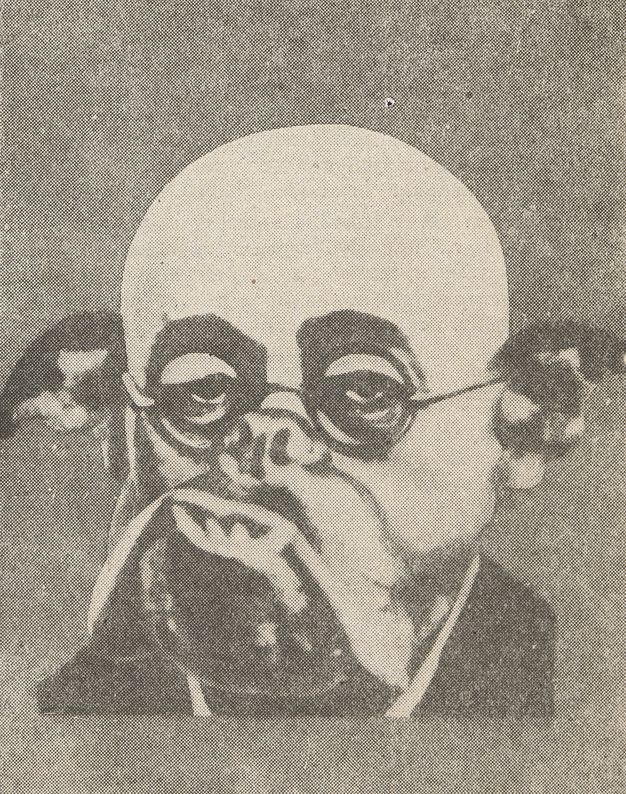
Gustav Noske, and Adolf Hitler. Klinch’s portrayal of Noske,
the conservative Social Democrat who forcefully suppressed the
Spartacist uprising in 1919, is particularly reminiscent of
the combination of animal physiognomy and verbo-visual puns
that Heartfield perfected in his photomontages of the late
1920s and early 1930s (fig. 4).
Motivated by the nickname “Bluthund” that Noske earned through
his taste for martial order, Klinch paired Noske’s
heavy-lidded eyes with the jowls of a dog. In Russian, the
verbal epithet maintains its organic connection to the image
through a rather literal transcription; Noske is revealed to
be a krovavaia sobaka (a bloody dog) rather than an
ishcheika (a bloodhound, or more literally, a
tracker). The vagaries of the translation are evident in the
visage of Klinch’s fotosharzh, which more closely
resembles a bulldog than a bloodhound. As Klinch’s penetrating
interpretation of Noske’s cold, indifferent gaze suggests,
this verbal image provides the montage with its visual logic.
ExpandFig. 4. —Boris Klinch (Russian, 1892–1946).
“Krovovaia sobaka,” Noske (“The bloody dog,”
Noske), photomontage, 1932. From
Proletarskoe foto, no. 11 (1932): 29. Los
Angeles, Getty Research Institute, 85-S956.
By emphasizing its natural affinity with the family of comic
genres, Klinch convincingly argued that photomontage could be
reconciled with the other major arts in the realist tradition.
He maintained that photomontage ought to be seen as “a
theoretical and practical solution to the problem of the
image” encountered by artists in all fields, even if its
material properties “make montage more akin to cinema than to
the other types of spatial art.”30
In Klinch’s view, photomontage and film shared the ability to
create an artistic image from mechanical impressions of the
external world. But he thought that these new arts were also
united with literature and painting by a problem of general
relevance: “‘Assembling’ [‘montiruia’] reality in his own way,
solving the problems of creative comparison, combining
individual uncoordinated photo-touches [foto-mazki] step by
step according to a plan previously drawn by consciousness, in
other words, ‘directing’ the unorganized ‘elements’ of the
montage, the artist-monteur solves the problem of the image
analogously to the easel painter or the satirist.”31
The linchpin of Klinch’s exposition is the artist’s conscious
plan, which organizes the disparate materials gathered by the
monteur into a meaningful order. The presence of this mental
image or idea gives the work artistic significance and
transforms the monteur into an “artist-monteur.” It is
regrettable, Klinch concludes, that this process is called
montage at all, for the term’s unavoidable connotation of
mechanical assembly tends to conceal the deep connection
between the artistic image assembled by the monteur and the
reality it discloses to the viewer.
A renewed assertion of artistic will was necessary, according
to Klinch, because artists and critics had come to treat
photography as “naked ‘factography,’” and in the process
forgot that “representation as a directly transcribed
[protokol’noe] reproduction of reality is only raw material
for the artist.”32
The model of “factography,” against which Klinch argues, was
popularized in the mid-1920s by the circle of artists and
writers associated with the journals Lef and
Novyi lef (New lef), who combined an interest in
photomontage with the range of genres they called the
literature of fact—diaries, letters, sketches, and minor news
reports. As painters picked up the camera, avant-garde writers
reinvented themselves as professional journalists issuing
communiqués from the field of class struggle. In this milieu,
according to art historian Kristin Romberg, the term
moving picture could be used to criticize a
documentary film because it implied (however subtly) that the
film subordinated photography to posed or staged actions, like
those encountered in painting and theater.33
Klinch simply reversed this charge by stressing that
photomontage is, in fact, a kind of picture making.
The automatic snapshot had been especially appealing to
photomonteurs seeking to replace traditional artistic skills
with new, rationalized procedures. Latvian artist Klutsis, who
claimed to have invented political photomontage independently
of Heartfield, articulated a strong defense of this position.
Klutsis maintained that “by replacing a drawing with a
photograph, the artist represents a particular moment more
truthfully, more vitally, more comprehensibly to the masses.
The meaning of this substitution,” he explained, “lies in the
fact that the photograph is not a sketch of a visual fact, but
its precise fixation.”34
As Gassner has shown, Klutsis’s valorization of these
mechanical processes was relentlessly criticized as a form of
petty-bourgeois formalism by members of the Russian
Association of Proletarian Photographers and the Russian
Association of Proletarian Artists (ROPF and RAPKh), who
considered his fragmented, repetitive compositions inferior to
the powerful simplicity of Heartfield’s work.35
But members of both camps saw promise in the mechanical aspect
of photomontage, ambivalent though they were. As one of
Klinch’s supporters pointed out, the assembly of readymade
clippings had a distinct advantage over traditional methods of
artistic representation because “it frees artists from the
need to make drawings,” something many artists already did
with the aid of photographs, he admitted.36
Klinch regretted the way critics portrayed photomontage as an
approach marooned “somewhere on the border between the drawing
and the photograph,” but this view has great explanatory
power.37
Heartfield’s method exploited both the credibility of the
photograph as an index of reality and the traditional artistic
skills that it was often said to replace. Photographer János
Reismann recalled taking custom photographs for Heartfield
“based on exact pencil sketches,” which then became the
subject of long critical discussions with the monteur, who
“insisted on nuances that I was no longer capable of
seeing.”38
The primacy of Heartfield’s artistic vision over the
mechanically produced photograph served as a powerful model
for Soviet artists. “Having determined the idea and theme,”
Klinch too prepared “a graphic sketch according to which he
selects photographic material,” which he then “enlarged or
reduced in the appointed sizes” and assembled.39
Even without the special photo shoots that Heartfield relied
on, this method required that the artist “know in
advance—definitely in advance, even if in general outline—what
kind of basic photographic material he will have at his
disposal.”40
As in Klinch’s remarks about the primacy of the image in
artistic creation, this outline is both a plan of action and a
drawing in the traditional sense of disegno.
This refashioning of the mechanical aspects of photomontage
into a more traditional guise soon became common in Soviet
criticism. In an entry for the
Great Soviet Encyclopedia written in 1934, a
chastened Klutsis admits that “photomontage as artistic
creation should be distinguished from photomontage in which
several photographs, or cut-outs of them, are mechanically
combined . . . which is not really art.”41
The first monograph devoted to Heartfield’s work, published in
1936 by Soviet writer Sergei Tretiakov, de-emphasizes the
mechanical side of photomontage in order to highlight the
genres that make its effects intelligible. In addition to the
“photomontage-sharzh,” Heartfield is presented in the
monograph as a creator of “photomontage-feuilletons” and
“photo-epigrams.”42
Tretiakov states that these exercises “do not demand from the
photomonteur the specialized knowledges of the artist or
draftsman—these are replaced by scissors—but in exchange grant
full freedom to the combinatory ability, taste and wit.”43
Scissors too are expendible, a mere implement. Tretiakov also
sees Heartfield’s combinatory wit in his staged photographs,
where “the moment of montage precedes the snapshot.”44
In the end, Tretiakov admits that the very skills the
photomonteur sets aside justify the new practice. He concludes
his text by stressing that “the feuilletonist is brought up on
photomontage,” and that “additions to the photograph are
educating the future draftsman or painter.”45
Evidently, photography and montage would not put an end to
traditional skills and genres, as some corners of the
avant-garde had loudly proclaimed, but would transform and
renew them.
A Truthful Distortion of the Facts
Closer attention to genre categories can help to elucidate the
technical and material aspects of Brigade KGK’s series
From the 16th to the 17th Congress. Consider the
distinction between sharzh and caricature. The
boundary between these genres is fluid, but it occasionally
emerges in sharp relief. Where sharzh concentrates on
individual physiognomy, caricature adds mise-en-scène, often
developing into complex multifigure compositions that rely on
situational humor. The former captures the quirks of public
personalities, while the latter extends its reach to
impersonal, abstract ideas. When Stalin’s report distinguishes
between the defeated nationalist foe and its lingering
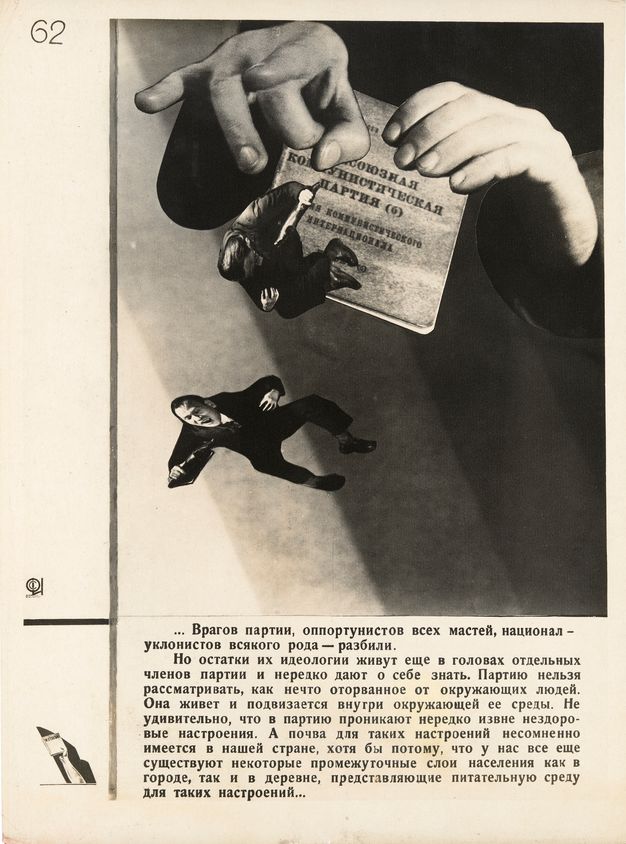
ideological effects, for example, Brigade KGK uses caricature
to show how the party, represented by a membership card, must
still be purged of alien ideas that cling to it like homunculi
(fig. 5). Indeed, owing to the dry,
policy-forward framing of Stalin’s report, pure
sharzhi (like that of Klinch’s portrait of Noske;
[see fig. 4]) are rare in the series.
In caricatures where sharzh does appear, Brigade KGK
takes an approach not seen in the work of Heartfield or
Klinch. They use an old darkroom trick to distort the faces of
its subjects into ridiculous, grimacing masks.
ExpandFig. 5. —Brigade KGK (Viktor Koretsky [1909–98], Vera Gitsevich
[1897–1976], and Boris Knoblok [1903–84]).
“We have smashed the enemies of the Party, the
opportunists of all shades, the nationalist deviators of
all kinds. But remnants of their ideology still live in
the minds of individual members of the Party, and not
infrequently they find expression.”
From the 16th to the 17th Congress of the All-Union
Communist Party (Bolsheviks), 1934, no. 62, gelatin silver print, 22.7 × 17 cm. Los
Angeles, Getty Research Institute, 2014.R.25.
Many of the most striking montages in the series exploit a
fun-house effect that can be achieved by using a curved
mirror, bending the photosensitive paper beneath the enlarger
or otherwise manipulating the photograph’s emulsion.46
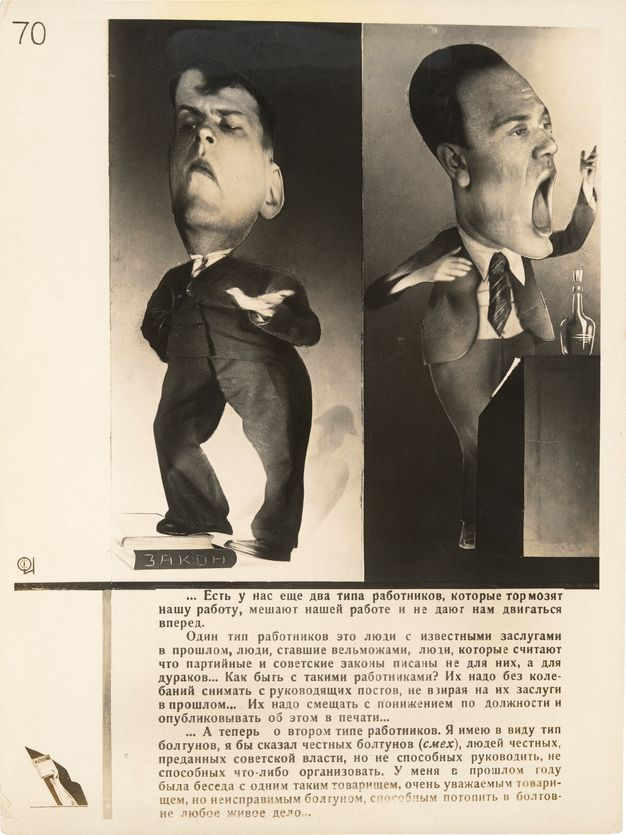
In montage number fifty-six (see fig. 2), the young man’s face has been subtly stretched to
emphasize his self-important expression. In montage number
seventy (fig. 6), this distortion is
used to even greater effect in the depiction of two
contemporary Soviet types highlighted in Stalin’s address: the
“bigwigs” who think they are above the law because of the
services they have performed for the party; and the “people
who are honest and loyal to Soviet power, but who are
incapable of leadership,” whom Stalin calls “honest
windbags.”47
In the caption of this image, the matter-of-fact parenthetical
inserted by editors at Pravda testifies to the
spontaneous laughter (smekh) that this remark
provoked at the congress. This spontaneous delight is neither
a sign of Stalin’s talent as a humorist nor of his audience’s
sycophancy. Instead, the laughter alerts us to the generic
quality of the mediocre joke, a mainstay of political
speeches.
ExpandFig. 6. —Brigade KGK (Viktor Koretsky [1909–98], Vera Gitsevich
[1897–1976], and Boris Knoblok [1903–84]).
“There are two other types of executive who retard our
work, hinder our work, and hold up our advance. . . .
People who have become bigwigs, who consider that Party
decisions and Soviet laws are not written for them, but
for fools. . . . And . . . honest windbags
(laughter), people who are honest and loyal to
Soviet power, but who are incapable of leadership,
incapable of organizing anything.”
From the 16th to the 17th Congress of the All-Union
Communist Party (Bolsheviks), 1934, no. 70, gelatin silver print, 22.7 × 17 cm. Los
Angeles, Getty Research Institute, 2014.R.25.
The “honest windbag” is a type expertly drawn in Ilf and
Petrov’s novel of 1931, Zolotoi telenok (The Golden Calf), which finds Ostap Bender pursuing another secret
fortune—this time, concealed by a minor bureaucrat. The
countless ineffectual officials Bender encounters in his quest
are typified by one Yegor Skumbrievich, who, like his
coworkers, turned his zeal for social work into a “universal
mutual fraud” that kept him out of the office at all
times.48
After finally locating Skumbrievich at the beach, Bender
subjects him to an interrogation at sea, which transforms the
“exemplary activist” into “a shapeless sack full of mustard
and horseradish.”49
The comedic effect of this image lies in its unexpected
verbo-visual illumination: the slippery fish Skumbrievich—his
name derives from the Russian word
skumbriia (Scomber, or mackerel)—is caught at sea and
turned into a tasty snack. As literary scholar Mark Lipovetsky
has shown, the methods that Bender uses to net his elusive
prey are borrowed from the Soviet secret police.50
Unlike the fotosharzhi by Klinch, which reveal the
true character concealed beneath appearances, these examples
from Brigade KGK and Ilf and Petrov rely on a different trope:
an endlessly changeable form that will readily adapt itself to
any content. The target of the humor here is appearance
itself, and our pleasure arises from the manipulation of this
empty, pliable, and ultimately insignificant material by a
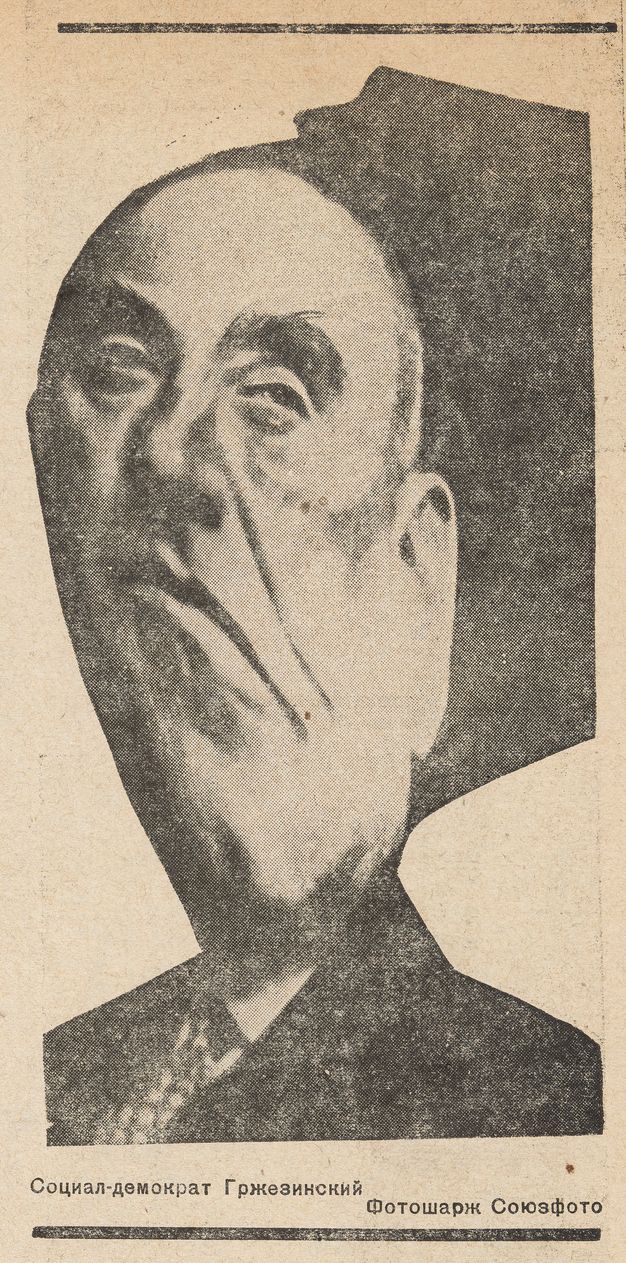
superior force. For a visual equivalent to these jokes about
windbags, Brigade KGK turned to an unsigned
fotosharzh published in 1932 that portrays Berlin’s
chief of police, German Social Democrat Albert Grzesinski (fig. 7). While serving as minister of the interior from 1926 to
1930, Grzesinski oversaw the suppression of Communist rallies
and the banning of the Rotfrontkämpferbund (Alliance of
Red-Front-Fighters), a paramilitary organization affiliated
with the German Communist Party. In the fotosharzh of
Grzesinski, the stretched face is less a means of amplifying a
suspicious sidelong glance than a visual equivalent of the
police violence exercised on German Communists, turned against
their political foe. When Brigade KGK adopts this device,
stretching and distorting the faces of windbags and bigwigs,
the same kind of visual violence is inflicted upon the
shiftless Soviet bureaucrat, a figure so insignificant that
the force required to reshape him amounts to nothing.
ExpandFig. 7. —Artist unknown. “The Social Democrat
Grzesinski,” from Proletarskoe foto, no. 3
(1932): 7. Los Angeles, Getty Research Institute,
85-S956.
This unsigned sharzh of Grzesinski can be linked in
turn to an earlier use of the same device in the Sovkino film
Kain i Artem (Cain and Artem) of 1929,
directed by Pavel Petrov-Bytov. Petrov-Bytov’s free adaptation
of story by Maxim Gorky follows Cain, a Jewish tradesman and
underground leftist living on the margins of a provincial
market town, as he experiences, first, persecution by, and
then comradely solidarity from the brawny Artem. After finding
Artem unconscious following an attempted murder by some petty
toughs (hired by an envious kulak), Cain nurses him back to
health and teaches him of the workers’ plight. Later, when
those same villains drunkenly force Cain to dance until he
loses consciousness, the enlightened Artem reemerges to exact
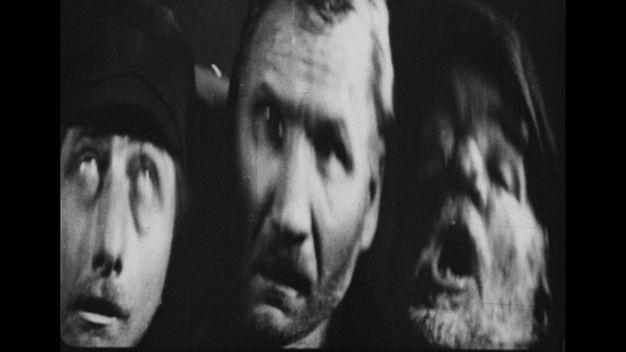
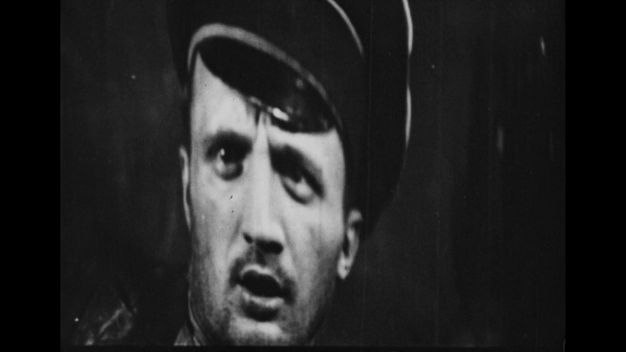
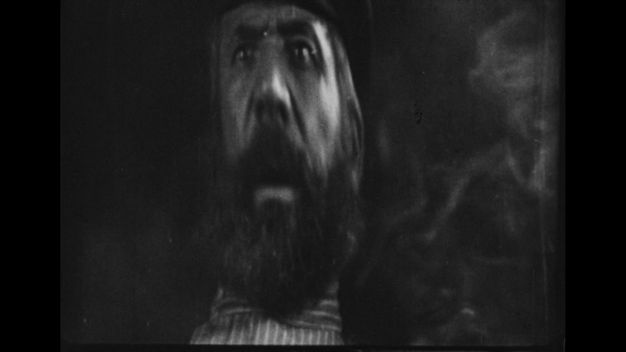
a satisfying vengeance. As the exhausted Cain falls to the
floor, he sees the faces of his tormenters contorted—by his
own failing senses and by their disbelief—into dreadful masks
(figs. 8a–c.). To the villains, Artem
has risen from the dead.
ExpandFig. 8A. —Pavel Petrov-Bytov (Russian, 1895–1960),
director.
Screen capture from the film Cain and Artem,
1929. Image courtesy University of California, Berkeley,
Berkeley Art Museum and Pacific Film Archive
Library.ExpandFig. 8B. —Pavel Petrov-Bytov (Russian, 1895–1960),
director.
Screen capture from the film Cain and Artem,
1929. Image courtesy University of California, Berkeley,
Berkeley Art Museum and Pacific Film Archive
Library.ExpandFig. 8C. —Pavel Petrov-Bytov (Russian, 1895–1960),
director.
Screen capture from the film Cain and Artem,
1929. Image courtesy University of California, Berkeley,
Berkeley Art Museum and Pacific Film Archive
Library.Figs. 8a–c. — Pavel Petrov-Bytov (Russian, 1895–1960),
director.
Screen captures from the film Cain and Artem,
1929. Images courtesy University of California, Berkeley,
Berkeley Art Museum and Pacific Film Archive
Library.
Although Petrov-Bytov’s film was almost overshadowed by the
ultraleft polemic he incited in the Leningrad journal
Zhizn’ iskusstva (The life of art) against the
pioneers of montage in Soviet film, Sergei Eisenstein and
Vsevolod Pudovkin, for making pictures that appealed to the
intelligentsia more than the masses, it was quickly pointed
out that his own films made brilliant use of the very
formalism he decried.51
In a review of Cain and Artem published in the daily
newspaper Izvestiia, Lunacharsky remarks that
“deformations of objects and human faces have nowhere been
used so masterfully, it seems to me. The drunk, brutal people
trying to torture Cain lose their human appearance. . . . Here
the unbelievably elongated, fantastically distorted faces are
full of a mortal fear, which cannot but infect the
viewer.”52
While he admits that the film takes too many liberties with
Gorky, Lunacharsky concludes that it “holds to the framework
of that realism, brought to an absolutely captivating
illusion, which made our best films so famous abroad.”53
In 1932, Petrov-Bytov’s film was kept in the public eye
throughout Soviet celebrations of Gorky’s fortieth year as a
writer and through the synchronized-sound version of the film
prepared in France by film director Abel Gance.54
Although Soviet critics were unanimously opposed to the French
version of Cain and Artem, its existence nonetheless
testified to an admiration first expressed by Lunacharsky:
“The collective that made this picture—first of all, probably,
the cameraman—genuinely knows how to make the photograph
speak.”55
Their claim to realism notwithstanding, the distorted
projections that we encounter in Cain and Artem and
From the 16th to the 17th Congress have a decidedly
mechanical quality. Indeed, it is possible that these images
were created with a new device that mechanized the
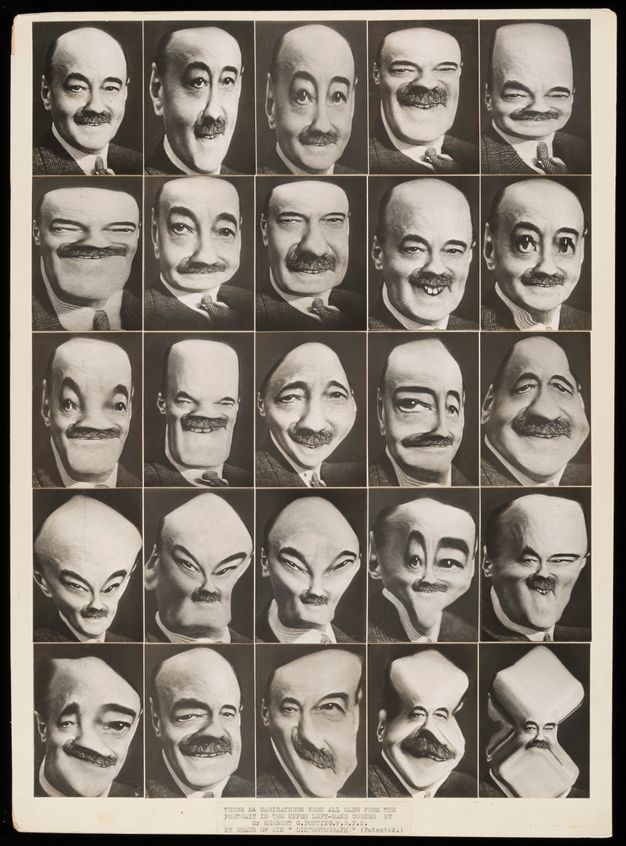
photographer’s know-how. In 1927, English photographer Herbert
George Ponting patented a device “for photographing in
caricature” that he called the “variable controllable
distortograph.”56
Using an irregular surface directly affixed to the lens of a
still or motion-picture camera, Ponting’s device made it
possible to create distortions of every conceivable variety,
from the amusing to the grotesque (fig. 9).
Ponting’s invention was available to Petrov-Bytov’s camera
operator in 1929, just as it was available to Soiuzfoto in
spring 1931, when the agency energetically pursued a policy of
full mechanization for its printing facilities. In keeping
with the goals of increased production under the first
five-year plan, the agency replaced its “old-fashioned
equipment” with new photographic enlargers and a range of
machines that automated the processes of printing, washing,
drying, trimming, and sorting.57
This new, rationalized production process was what allowed
Soiuzfoto to efficiently produce editioned series such as
From the 16th to the 17th Congress. The agency’s
first attempt at this format, brought out in October 1930 in
an edition of 1500, became so popular in workers’ clubs,
schools, and factory committees across the USSR that the
problem of assembling the prints into series “was sorted out
literally on the fly.”58
The fotosharzhi published in
Proletarskoe foto and
From the 16th to the 17th Congress were produced and
distributed by Soiuzfoto—first anonymously, and then, after a
protest from Klinch, with artist credits—only after its new
facilities had begun operating.59
Looking closely at the multiple vectors of distortion in the
bodies of the bigwigs and windbags in Brigade KGK’s
photomontage number seventy (see fig. 6), it is easy to conclude that something more than a convex
mirror is in play.
Distorted images like those we encounter in the series
From the 16th to the 17th Congress continued to
appear in the years after the publication of the portfolio,
even as they hewed more closely to Heartfield’s example. By
way of conclusion, I will highlight the next phase in the
history of the device in photomonteur Aleksandr Zhitomirsky’s
work for Front-Illustrierte (Front illustrated). This
newspaper was a Soviet propaganda leaflet published by the
chief political directorate of the Red Army during World War
II; it was distributed behind enemy lines and aimed to
undermine German morale. In many of Zhitomirsky’s montages,
Nazi propaganda minister Joseph Goebbels is depicted as a
subhuman creature spewing racial ressentiment. But in pivotal
works, the distorted image is transformed from an instrument
of visual violence to a supplementary means of
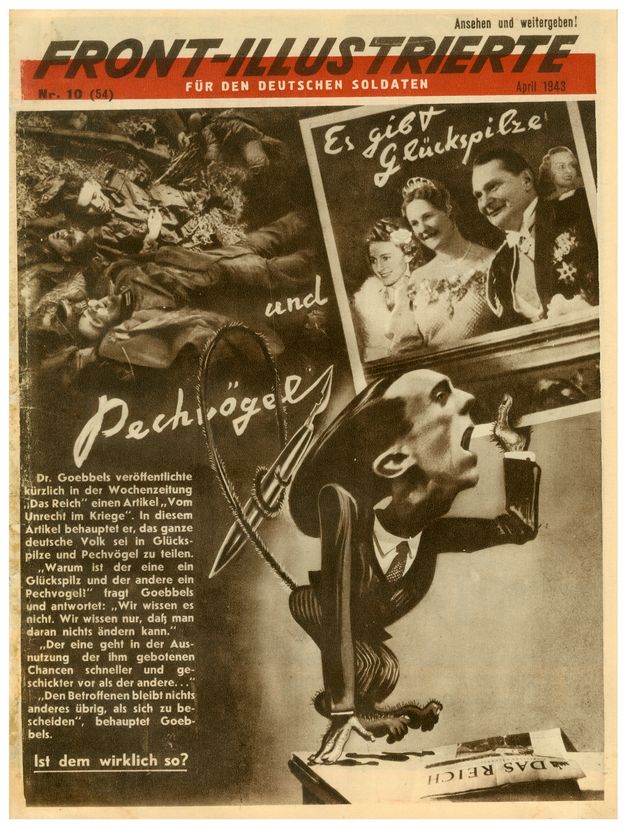
characterization (fig. 10). In a
front-page montage for an April 1943 issue of
Front-Illustrierte, captioned “There are lucky devils
and unlucky ones,” Goebbels’s distended face appears as a
documentary fact atop the hand-drawn body of a chimpanzee.
This distorted mechanical likeness still possesses its
iconoclastic power, but it also plays a supporting role as the
weight of characterization shifts to the larger
composition—from sharzh to caricature. In this
instance, Goebbels is characterized less by his face than by
his bodily attributes, which connect him to the surrounding
elements of the montage. Dressed in a suit, he balances on a
forelimb, rather than his feet, and holds forth on the
mysterious nature of luck before a photograph of a tuxedoed
Hermann Goering—the titular “lucky devil”—seated beside his
wife. Against the human attributes of culture and speech,
Zhitomirsky juxtaposes the racist’s bestial truth: behind his
back, Goebbels’s prehensile tail holds a pen that records the
fate of the “unlucky ones”—the German soldiers who must die in
the mud like animals.
This image of Goebbels as a chattering ape soon became
widespread in Soviet anti-Nazi propaganda, but the combination
of mechanical and manual techniques in “There are lucky devils
and unlucky ones” occurs in just a few of Zhitomirsky’s
montages. In subsequent examples, the anamorphic photograph of
Goebbels is replaced by a hand-drawn image of a chimpanzee’s
face, returning the caricature to the realm of traditional
manual skill. Indeed, as photography historian Erika Wolf has
shown, the art of drawing was central to Zhitomirsky’s
self-presentation throughout his career.60
Even so, his artistic development from the fragmented
cut-and-paste montage to neotraditional Heartfieldian
caricature was mediated by technical manipulations like the
distortions discussed in this essay.
From the 16th to the 17th Congress offers a striking
exhibit of novel technical experiments, repurposed avant-garde
tropes, and even some polished examples of heroic socialist
realism. The variety of approaches used in the series evinces
a robust period of photographic experimentation within the
prolonged gestation of socialist realism. Still, over the
course of the 1930s the photograph faced increasingly urgent
demands to serve the interests of the worker. While painting,
drawing, and cinema were celebrated for their narrative
capabilities, photomontage was portrayed as an imperfect and
increasingly inadequate means to express the proletariat’s
mastery over modern technology. The montage constructions in
Brigade KGK’s series show that they accepted many of the
arguments against the mechanical qualities of photomontage
even as they continued to explore technical effects unique to
photography.
When From the 16th to the 17th Congress appeared,
however, their position was in retreat. A large body of recent
scholarship has presented convincing arguments that Soviet
attitudes toward montage were transformed by Heartfield’s
subordination of the photographic medium to the singular
political purpose of his compositions. By 1936, when Tretiakov
argued that it was “Heartfield alone, as the pioneer of
Bolshevik photomontage,” who “pounded into the heads of
academics and art lovers that photomontage is a member of
equal rights in the order of the visual arts,”61
this opinion was widely accepted. Younger artists coming of
age in the 1930s, such as Koretsky and Zhitomirsky, saw
Heartfield as the official embodiment of committed Communist
art and quickly assimilated the principles of his method. In
his subsequent work as a poster designer, Koretsky professed
that “it is impossible to be satisfied with readymade
photographs.”62From the 16th to the 17th Congress, however,
demonstrates that the Soviet reception of Heartfield as the
master of satirical photomontage was far from straightforward,
and that his example was played against other anonymous and
half-forgotten figures who forced the photograph to speak in
ways that Heartfield never explored.
To a certain degree, art history has been the willing
inheritor of the conservative Soviet impulse to canonize
Heartfield as the paterfamilias of political photomontage. But
in many respects, a focus on comic genres rather than on
individual style grants a more accurate view of the
photomontage tradition. In his late writings, Lunacharsky
affirmed that “laughter is a tool—and a very serious tool—for
the social self-discipline of a class, or for [the exertion
of] pressure from one class onto other classes.”63
For him, satire was especially complex because it testified as
much to the insignificance of its target (always something
laughable, after all) as to the serious threat that the target
represents. Reflecting on the example of the European
bourgeoisie, Lunacharsky concluded that laughter is supremely
important in the infancy of a class, when both self-discipline
and merciless mockery of the class enemy are paramount. When
Brigade KGK created
From the 16th to the 17th Congress, the final victory
of the working class appeared imminent, but only in the
territories of the USSR, where the Bolsheviks’ enemies were
increasingly spectral and ideological. The effect of the pure
photographic distortion—at once captivatingly elusive and
utterly dehumanizing, as Lunacharsky pointed out64—suited the political needs of the moment. In subsequent
years, when internal threats had been eliminated, the
techniques devised to represent them were refashioned for use
in the international sphere, where the battle lines were still
very clearly drawn.
Samuel Johnson is associate professor of art
history in the Department of Art & Music Histories at
Syracuse University, New York.
Notes
This paper benefited enormously from an exchange with Jindřich
Toman at a panel for the Association for Slavic, East
European, and Eurasian Studies (ASEEES) Annual Convention in
2017, where I delivered a very early draft. Since then, many
conversations with Maggie Innes have deepened my understanding
of the issues addressed here. Unless otherwise noted, all
translations of quoted material from the Russian are mine and
use the Library of Congress system to romanize Cyrillic
letters. In the case of proper names, I have followed the
simplified transliterations introduced by previous authors,
eliminating soft signs and substituting “y” for “i” when it
occurs in the terminal position.
“Sezon teatra Krasnoi presni,”
Vecherniaia Moskva, 22 August 1934, 3. For a
brief overview of Koretsky’s career, see Erika Wolf,
Koretsky: The Soviet Photo Poster: 1930–1984
(New York: The New Press, 2012). Knoblok began a long
and successful career in the theater after the breakup
of Brigade KGK, while Gitsevich continued to design
posters under her own name into the late 1940s.
↩︎
Olivier Lugon, “The Ubiquitous Exhibition: Magazines,
Museums, and Reproducible Exhibitions after World War
II,” in The “Public” Life of Photographs, ed.
Thierry Gervais (Cambridge, MA: MIT Press, 2016),
123–24.
↩︎
Serguei Oushakine, “Laughter under Socialism: Exposing
the Ocular in Soviet Jocularity,”
Slavic Review 70, no. 2 (2011): 247–55.
↩︎
For a comprehensive survey focused on the Stalin period,
see Evgenii Dobrenko and Natal’ia Dzhonsson-Skradol’,
Gossmekh: Stalinizm i komicheskoe (Moscow:
Novoe Literaturnoe Obozrenie, 2022). For an excellent
art historical treatment of visual satire in the 1920s,
see Annie Gérin,
Devastation and Laughter: Satire, Power, and Culture
in the Early Soviet State, 1920s–1930s
(Toronto: University of Toronto Press, 2018).
↩︎
Viktor Afanas’ef, “Foto i fotomontazh,”
Sovetskoe foto, no. 11 (1935): 19.
↩︎
I. V. Stalin, “Otchetnyi doklad XVII s’ezdu partii o
rabote TsK VKP(b),” in Sochinenie, vol. 13
(Moscow: Gos. Izd. politicheskoi literatury, 1952),
282–379. English translation published as J. V. Stalin,
“Report to the Seventeenth Party Congress on the Work of
the Central Committee of the C.P.S.U.(B.),” in
Works, vol. 13 (Moscow: Foreign Language
Publishing House, 1955), 288–388.
↩︎
Natalia Skradol, “Laughing with Comrade Stalin: An
Analysis of Laughter in a Soviet Newspaper Report,”
The Russian Review 68, no. 1 (2009): 26–48.
↩︎
Stalin, “Report to the Seventeenth Party Congress,” 347.
↩︎
Oleg Khlevniuk and R. W. Davies, “The End of Rationing
in the Soviet Union, 1934–35,”
Europe and Asia Studies 51, no. 4 (June 1999):
563–64.
↩︎
Joseph Stalin speaking at the November 1934 Central
Committee Plenum, quoted in Oleg Khlevniuk,
Master of the House: Stalin and His Inner Circle, trans. Nora Seligman Fvorov (New Haven, CT: Yale
University Press, 2009), 115–16.
↩︎
Stalin, “Report to the Seventeenth Party Congress,” 348.
↩︎
Stalin, “Report to the Seventeenth Party Congress,” 348.
↩︎
See the illustrated translation: Vladimir Mayakovsky,
Pro Eto – That’s What, trans. Larisa Gureyeva
and George Hyde (Tormorden, UK: Arc, 2009).
↩︎
Christina Kiaer,
Imagine No Possessions: The Socialist Objects of
Russian Constructivism
(Cambridge, MA: MIT Press, 2005), 146–58.
↩︎
Ilya Ilf and Evgeny Petrov, The Twelve Chairs,
trans. John H. C. Richarson (Evanston, IL: Northwestern
University Press, 1997), 155.
↩︎
Mikhail Odesskii and David Feldman, “Legenda o velikom
kombinatore, ili Pochemu v Shankhae nichego n
sluchilos’,” in Il’ia Il’f and Evgenii Petrov,
Zolotoi telenok: Pervyi polnyi variant romana
(Moscow: Vagrius, 1997), 6–16.
↩︎
Maya Vinokour, “Books of Laughter and Forgetting: Satire
and Trauma in the Novels of Il’f and Petrov,”
Slavic Review 74, no. 2 (2017): 347.
↩︎
Anatoly Lunacharsky, “Synopsis of a Report on the Tasks
of Dramaturgy (Extract)” (1933) in
The Film Factory: Russian and Soviet Cinema in
Documents, 1896–1939, ed. and trans. Richard Taylor (London: Routledge,
1994), 327. For a discussion, see Gérin,
Devastation and Laughter, 184.
↩︎
Mikhail Koltsov, “Address to the First Congress of
Soviet Writers,” quoted in Gérin,
Devastation and Laughter, 186.
↩︎
Koltsov, “Address to the First Congress of Soviet
Writers,” in Gérin, Devastation and Laughter,
186. ↩︎
Serguei Oushakine, “Red Laughter: On Refined Weapons of
Soviet Jesters,” Social Research 79, no. 1
(2012): 207–9.
↩︎
Anatoly Lunacharsky, “Pismo v redaktsiiu,”
Literaturnaia gazeta, 6 March 1931, 4.
↩︎
Hubertus Gassner, “Heartfield’s Moscow Apprenticeship,
1931–1932,” in John Heartfield, ed. Peter
Pachnicke and Klaus Honnef (New York: Abrams, 1992),
256–90; and Maria Gough, “Back in the USSR: John
Heartfield, Gustav Klutsis, and the Medium of Soviet
Propaganda,” New German Critique, no. 107
(2009): 133–83.
↩︎
Sabine Kriebel,
Revolutionary Beauty: The Radical Photomontages of
John Heartfield
(Berkeley: University of California Press, 2014), 202;
and Devin Fore,
Realism after Modernism: The Rehumanization of Art
and Literature
(Cambridge, MA: MIT Press, 2012), 295, 246.
↩︎
For a brief discussion of Klinch’s work, see Jindřich
Toman, “The Real Reality: Notes on Boris Klinč and
Photomontage in the USSR,” in
Realisms of the Avant-Garde, ed. Moritz Bassler
et al. (Berlin: De Gruyter, 2020), 299–310; and Toman,
“From Carnival to Satire: Photomontage as a Commentary
on Photography,” History of Photography 43, no.
2 (2019): 144–55.
↩︎
Boris Klinch, “Fotosatiru v arsenal agit-massovoi
raboty,” Proletarskoe foto, no. 6 (1932):
24–25.
↩︎
Kristin Romberg, “Labor Demonstrations: Aleksei Gan’s
Island of the Young Pioneers, Dziga Vertov’s
Kino-Eye, and the Rationalization of Artistic
Labor,” October, no. 145 (Summer 2013): 51.
↩︎
Gustav Klutsis, “Fotomontazh kak novyi vid
agitatsionnogo iskusstvo,” in
Izofront: Klassovaia bor’ba na fronte
prostranstvennykh iskusstv, ed. P. I. Novitskii (Moscow: Izogiz, 1931), 120.
↩︎
Klinch, “Fotosatiru v arsenal agit-massovoi raboty,” 25.
↩︎
János Reismann (Wolf Reiss), “Als ich mit John
Heartfield zusammenarbeite,”
Internationale Literatur, no. 5 (1934): 189–90,
quoted in Gassner, “Heartfield’s Moscow Apprenticeship,”
261. ↩︎
Gustav Klutsis, “Fotomontazh,” in
Bol’shaia sovetskaia entsiklopediia, vol. 58
(Moscow: Ogiz RSFSR, 1936), 322–3. English translation
in Iveta Derkusova, ed.,
Gustavs Klucis: Complete Catalogue of Works in the
Latvian National Museum of Art
(Riga: Latvian National Museum of Art, 2014), 1:176.
↩︎
See the brief discussion of photographic caricature
techniques in Nikolai Tarabukin, “The Art of the Day”
(1925), trans. Rosamund Bartlett, October, no.
93 (2000): 72. Tarabukin prefers that photographers and
filmmakers use an anamorphic lens, a possibility I
discuss below.
↩︎
Stalin, “Report to the Seventeenth Party Congress,” 378.
↩︎
Ilya Ilf and Evgeny Petrov, The Golden Calf,
trans. Konstantin Gurevich and Helen Anderson
(Rochester, NY: Open Letter, 2009), 171.
↩︎
Ilf and Petrov, The Golden Calf, 178. Gurevich
and Anderson translate the name Skumbrievich as
“Sardinevich.” I have maintained the authors’ original
name here.
↩︎
Mark Lipovetsky,
The Charms of Cynical Reason: The Trickster’s
Transformation in Soviet and Post-Soviet Culture
(Boston: Academic Studies Press, 2011), 102.
↩︎
Pavel Petrov-Bytov, “We Have No Soviet Cinema” [April
1929]; and Adrian Piotrovsky, “Petrov-Bytov’s Platform
and Soviet Cinema” [May 1929], in Taylor,
The Film Factory, 259–63.
↩︎
Anatoly Lunacharsky, “Kain i Artem,” Izvestiia,
20 November 1929, 5.
↩︎
“K 40-letiiu literaturnoi deistvitel’nosti M. Gorkogo,”
Literaturnaiagazeta, 11 September
1932, 1. Critic K. Iukov complains that Petrov-Bytov
rewrites Gorky’s story according to the logic of cinema
in K. Iukov, “Tvorchestvo Gorkovo na ekran,”
Proletarskoe kino, nos. 17–18 (1932): 7–16.
↩︎
Lunacharsky, “Kain i Artem,” 5. For critical comments on
the sound version of Cain and Artem, see G.
Levkoev, “Opyt ozvuchaniia nemoi fil’my,”
Sovetskoe kino, no. 7 (1933): 57.
↩︎
Mia Fineman,
Faking It: Manipulated Photography Before
Photoshop
(New York: Metropolitan Museum of Art, 2012), 105.
↩︎
“Khronika Soiuzfoto,” Proletarskoe foto, no. 4
(1931): 50–51. The mechanization began with the purchase
of a German Bromograph machine said to expose, fix, and
wash prints, and a machine from the firm Marcelina that
could handle both drying and rolling. With the
Bromograph alone, it was reported that the work of
twelve men could be completed by just three.
↩︎
Erika Wolf, “Drawing as the Foundation of Zhitomirsky’s
Photomontage,” in her
Aleksandr Zhitomirsky: Photomontage as a Weapon of
World War II and the Cold War
(Chicago: Art Institute of Chicago, 2016), 92–95.
↩︎
Fig. 1. —Brigade KGK (Viktor Koretsky [1909–98], Vera Gitsevich
[1897–1976], and Boris Knoblok [1903–84]).
“We had to overcome among the people in charge of trade the
unhealthy habit of distributing goods mechanically; we had to
put a stop to their indifference to the demand for a greater
range of goods and to the requirements of the consumers.”
From the 16th to the 17th Congress of the All-Union
Communist Party (Bolsheviks), 1934, no. 57, gelatin silver print, 22.7 × 17 cm. Los
Angeles, Getty Research Institute, 2014.R.25.
Fig. 2. —Brigade KGK (Viktor Koretsky [1909–98], Vera Gitsevich
[1897–1976], and Boris Knoblok [1903–84]).
“There is still among a section of Communists a supercilious,
disdainful attitude toward trade in general, and toward Soviet
trade in particular. These Communists, so-called, look upon
Soviet trade as a matter of secondary importance, not worth
bothering about.”
From the 16th to the 17th Congress of the All-Union
Communist Party (Bolsheviks), 1934, no. 56, gelatin silver print, 22.7 × 17 cm. Los
Angeles, Getty Research Institute, 2014.R.25.
Fig. 4. —Boris Klinch (Russian, 1892–1946).
“Krovovaia sobaka,” Noske (“The bloody dog,” Noske),
photomontage, 1932. From Proletarskoe foto, no. 11
(1932): 29. Los Angeles, Getty Research Institute, 85-S956.
Fig. 5. —Brigade KGK (Viktor Koretsky [1909–98], Vera Gitsevich
[1897–1976], and Boris Knoblok [1903–84]).
“We have smashed the enemies of the Party, the opportunists of
all shades, the nationalist deviators of all kinds. But
remnants of their ideology still live in the minds of
individual members of the Party, and not infrequently they
find expression.”
From the 16th to the 17th Congress of the All-Union
Communist Party (Bolsheviks), 1934, no. 62, gelatin silver print, 22.7 × 17 cm. Los
Angeles, Getty Research Institute, 2014.R.25.
Fig. 6. —Brigade KGK (Viktor Koretsky [1909–98], Vera Gitsevich
[1897–1976], and Boris Knoblok [1903–84]).
“There are two other types of executive who retard our work,
hinder our work, and hold up our advance. . . . People who
have become bigwigs, who consider that Party decisions and
Soviet laws are not written for them, but for fools. . . . And
. . . honest windbags (laughter), people who are
honest and loyal to Soviet power, but who are incapable of
leadership, incapable of organizing anything.”
From the 16th to the 17th Congress of the All-Union
Communist Party (Bolsheviks), 1934, no. 70, gelatin silver print, 22.7 × 17 cm. Los
Angeles, Getty Research Institute, 2014.R.25.
Fig. 7. —Artist unknown. “The Social Democrat
Grzesinski,” from Proletarskoe foto, no. 3 (1932): 7.
Los Angeles, Getty Research Institute, 85-S956.
Fig. 8A. —Pavel Petrov-Bytov (Russian, 1895–1960), director.
Screen capture from the film Cain and Artem, 1929.
Image courtesy University of California, Berkeley, Berkeley
Art Museum and Pacific Film Archive Library.
Fig. 8B. —Pavel Petrov-Bytov (Russian, 1895–1960), director.
Screen capture from the film Cain and Artem, 1929.
Image courtesy University of California, Berkeley, Berkeley
Art Museum and Pacific Film Archive Library.
Fig. 8C. —Pavel Petrov-Bytov (Russian, 1895–1960), director.
Screen capture from the film Cain and Artem, 1929.
Image courtesy University of California, Berkeley, Berkeley
Art Museum and Pacific Film Archive Library.