In 1993, a painting ascribed to Mexican artist José
Clemente Orozco appeared in the exhibition
South of the Border: Mexico in the American
Imagination, 1914–1947
at the Yale University Art Gallery. Soon after the
opening, the present author, having organized the
exhibition at Yale, discovered that the work was in fact
by Bennett Buck, a little-known US American artist. This
essay—part memoir, part art historical analysis, part
detective story—revisits a curatorial lapse to recover the
meanings of Buck’s painting and its inclusion in the show
1938: Dedicated to the New Deal, held in the fall
of that year at Herman Baron’s American Contemporary Art
(A. C. A.) Gallery in New York. Rather than a fake, the
painting is a forgotten but important example of
proletarian art that confirms the influence of Orozco’s
New School and Dartmouth College murals on US American
artists of the 1930s. Connoisseurship—a close reading of
the painting and related documents—provides insight into
how and why the painting was given a false attribution and
provenance in the 1960s and 1970s.
Keywords
New Deal, proletarian art, misattribution, Mexican
muralism, provenance, José Clemente Orozco, Jay Chernis,
A.C.A. Gallery, connoisseurship
Peer Review
Single anonymous, external
Copied page section link to clipboard
Cite
Chicago
James Oles, “Bennett Buck’s Good Neighbor Policy:
A Case of Mistaken Identity,”
Getty Research Journal, no. 20 (2025),
https://doi.org/10.59491/OFRF8290.
MLA
Oles, James. “Bennett Buck’s
Good Neighbor Policy: A Case of Mistaken
Identity.” Getty Research Journal, no. 20, 2025,
https://doi.org/10.59491/OFRF8290.
For many scholars, times of quarantine during the COVID-19
pandemic encouraged the resolution of unfinished projects; in
my case, I turned my attention to a faded pink folder of
photocopies that I had kept close at hand through various
long-distance moves for more than a quarter century. Reviewing
and reconsidering those documents has generated a close
reading of a forgotten painting and its checkered history, in
which a failure of connoisseurship is offset by historical
recovery. At the heart of the matter is a case of willful
misattribution—rather than fakery—substantiated by documents
both falsified and misleading. This is a problem that still
plagues the field of Latin American art, where the need for
scholarly authentication can overwhelm the small number of
trained experts. But behind this “crime,” for which there was
neither trial nor confession, is an uplifting detective story
of rediscovering the truth, of bringing to wider attention a
neglected artist’s career, and of analyzing his most important
painting in its own context for the first time. My
recuperation of motive, means, and opportunity may be
speculative in parts, but the story can be told thanks to a
wonderfully rich dossier that was assembled decades ago to
give Mexican gravitas and compelling provenance to a forgotten
painting by an artist from the United States.
In the early 1990s, then a doctoral student at Yale
University, I was fortunate to curate my first exhibition,
South of the Border: Mexico in the American Imagination,
1914–1947,
which opened in September 1993 at the Yale University Art
Gallery. This project explored, for the first time in depth,
how Mexico generally, and Mexican art more specifically,
shaped the work of US American artists between the end of the
Mexican Revolution and the beginning of the Cold War. (Today I
wouldn’t be so quick to use the term American to mean
only residents of the United States.) The show featured
paintings, prints, and photographs by artists such as
Henrietta Shore, whose oil painting
Women of Oaxaca (1928) graced the catalog cover, and
Robert Motherwell, whose Mexican Notebook of
pen-and-ink drawings and watercolors (1941) closed the show.
Along with folk and decorative arts, and books and postcards,
the exhibition checklist included works by Mexican muralists
in order to demonstrate the profound impact that their
iconography, styles, and politics had on their
contemporaries.1
More specifically, I included Mexican paintings and prints
that revealed particular points of contact with the United
States: works made in the US or connected to it through
subject matter, prior ownership, or even exhibition history.
The exhibition included four major paintings by Diego Rivera
and, as I recall, none were particularly difficult to borrow.
Finding relevant works by his colleagues David Alfaro
Siqueiros and José Clemente Orozco was more complicated. Late
in the curatorial process, the Sala de Arte Público Siqueiros
in Mexico City denied (probably for conservation reasons) our
request to include Siqueiros’s
Birth of Fascism (1936), and the Museo de Arte
Moderno informed us they would only lend Orozco’s
Prometheus (ca. 1944) to our first two venues: Yale
and the Phoenix Art Museum.2
As a novice curator, I struggled to find replacements,
especially a signature painting by Orozco, for our final
venues, the New Orleans Museum of Art and the now-defunct
Museo de Monterrey in Mexico.
I was under time pressure, rushing to fill gaps with
last-minute loans, when Pilar García, now a curator at the
Universidad Nacional Autónoma de México’s Museo Universitario
Arte Contemporáneo, introduced me to two museum patrons in
Mexico City with a spectacular collection of works by Dr. Atl,
Joaquín Clausell, and Carlos Mérida.3
In their house in a quiet neighborhood near San Ángel, in the
south of Mexico City, I was shown a large and brilliantly
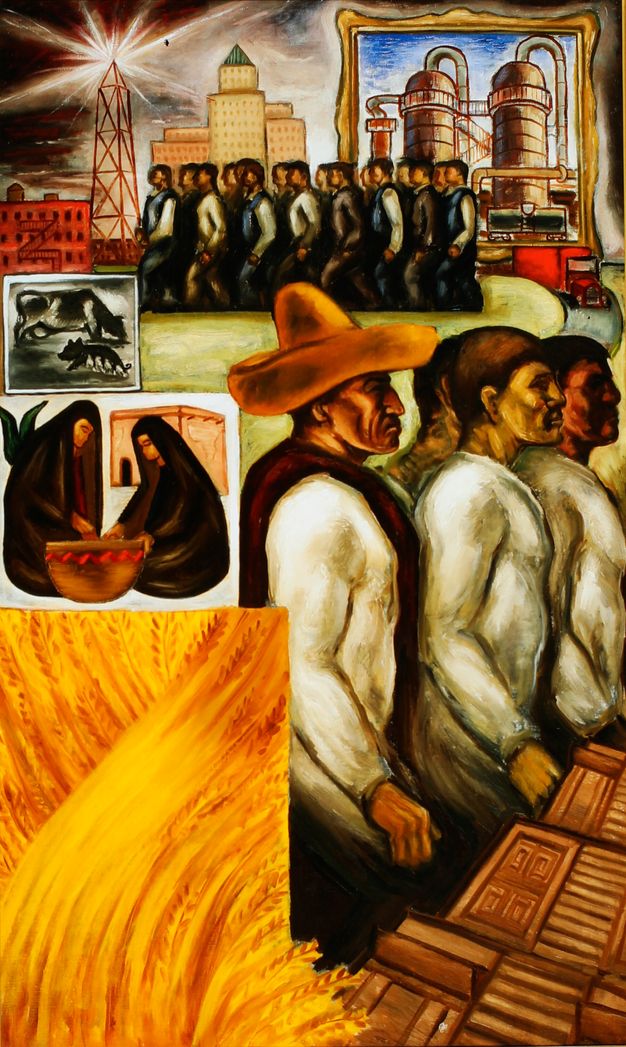
colored canvas measuring 150 by 90 centimeters (fig. 1). Although the work was unsigned, a shiny brass label
affixed to the frame listed both artist and title: José
Clemente Orozco,
Norte Sur (North South). Apparently, I had
found what I was looking for.
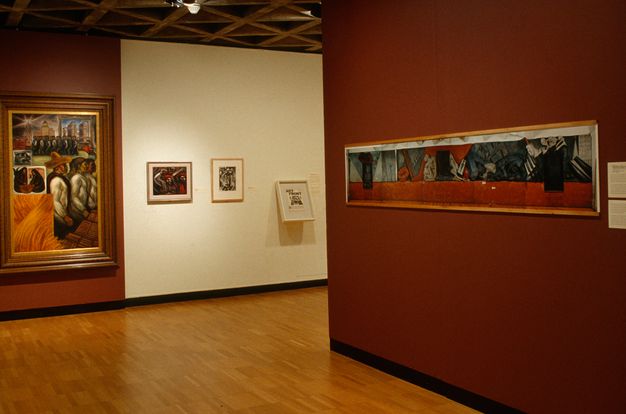
ExpandFig. 1. —Bennett Buck (US American, 1900–1982).Good Neighbor Policy, 1938, oil on canvas, 150 ×
90 cm. Private collection.
The oil painting in question consists of a montage of
different geographic and social spaces rendered at different
scales: meaning is generated through their abrupt
juxtapositions. Montage was a compositional strategy employed
by several muralists in the 1930s, including Thomas Hart
Benton and Rivera, but in this painting, the use of rigid
lines and overlapping elements brought to mind similar
features in Orozco’s mural cycle from 1930–31 at the New
School for Social Research in New York. In terms of
iconography, the painting juxtaposes an ancient and
traditional Mexican “south” with an industrialized US “north,”
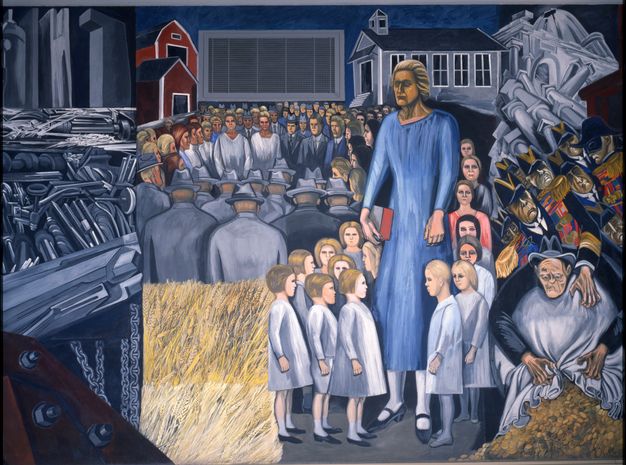
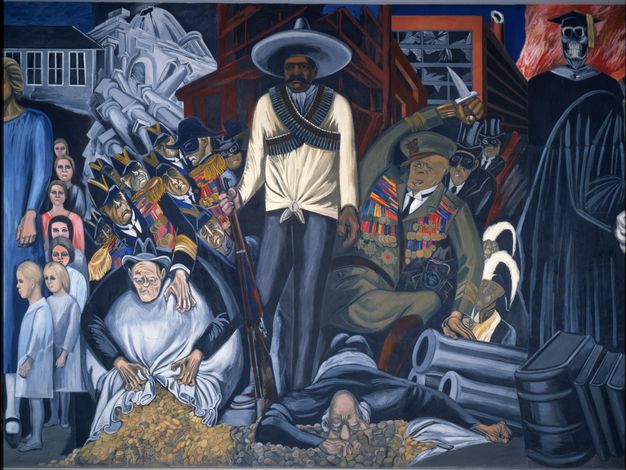
much as Orozco does in his
Epic of American Civilization, painted in the Baker
Library at Dartmouth College in 1932–34 (figs. 2, 3). In the painting, the contrast is
arranged vertically, and thus geographically, with north above
south, rather than horizontally. The stoic expressions and
massing of the four men wearing the white cotton clothing
typical of Mexico’s agricultural peasantry, who march in
profile at the lower-right side, resemble figures in Orozco’s
early frescos from 1923–26 in the Escuela Nacional
Preparatoria in Mexico City, and in the mural cycle at the New
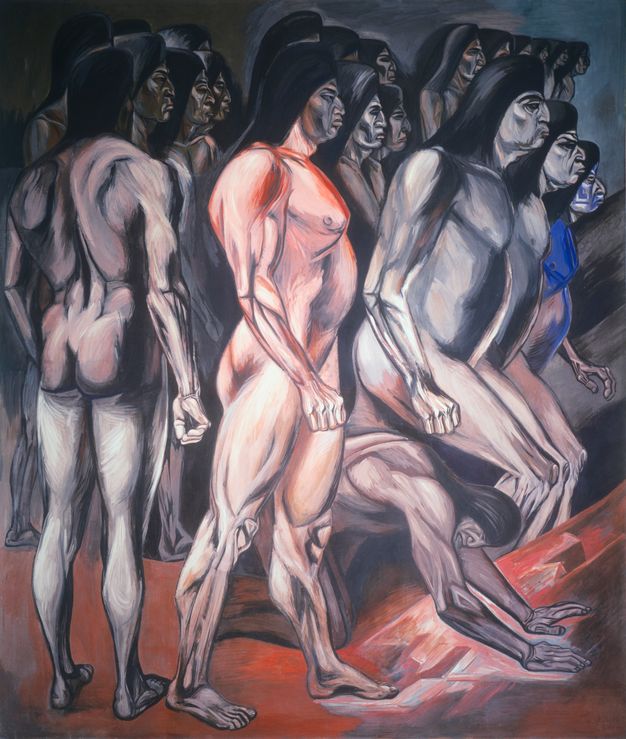
School. Most directly, however, they evoke the muscular bodies
of the Indigenous figures in Migration, the opening
panel of the Dartmouth cycle, albeit clothed and transported
from an ancient context to a contemporary one (fig. 4).
ExpandFig. 2. —José Clemente Orozco (Mexican, 1883–1947).
Panel 13, Anglo-America, from
The Epic of American Civilization, 1932–34,
fresco, 304.8 × 261.6 cm. Hanover, New Hampshire, Hood
Museum of Art, Dartmouth College, P.934.13.15.
Commissioned by the Trustees of Dartmouth College.ExpandFig. 3. —José Clemente Orozco (Mexican, 1883–1947).
Panel 14, Hispano-America, from
The Epic of American Civilization, 1932–34,
fresco, 304.8 × 302.3 cm. Hanover, New Hampshire, Hood
Museum of Art, Dartmouth College, P.934.13.16.
Commissioned by the Trustees of Dartmouth College.ExpandFig. 4. —José Clemente Orozco (Mexican, 1883–1947). Panel 1, Migration, from
The Epic of American Civilization, 1932–34,
fresco, 321.3 × 266.7 cm. Hanover, New Hampshire, Hood
Museum of Art, Dartmouth College, P.934.13.1. Commissioned
by the Trustees of Dartmouth College.
The pre-Hispanic pyramid shown in an oblique view in the
lower-right corner of the painting surely symbolizes the
modern nation’s ancient roots; its architectural details,
however, seem imagined rather than based on known structures
such as the Castillo at Chichén Itzá (which was abstracted by
Orozco in his panel Struggle in the Occident at the
New School) or the pyramids of the Sun and Moon at Teotihuacan
(which appear in Orozco’s Dartmouth cycle). The tightly
cropped field of wheat in the painting recalls a similar
depiction of wheat in the Anglo-America panel at
Dartmouth, though there the grain is directly tied to the
United States rather than Mexico (see fig. 2). A small inset image of two rebozo-clad women flanking a
ceramic vessel before a windowless house and small maguey
resembles the melancholic paintings and lithographs showing
scenes from rural Mexico that Orozco created during his
residence in the US between 1927 and 1934 (fig. 5).4
The upper third of the composition refers to the modern United
States. The striding Mexican figures are echoed by a larger
crowd of workers in blue overalls who march in the opposite
direction above, past a skyscraper or apartment block toward a
steel tower that radiates beams of light or electrical energy,
and a red-brick tenement at the left edge. To the right, a red
truck turns along a paved road. Strangely, as if hanging
against the dull gray sky, a curvilinear picture frame
surrounds an industrial landscape, featuring a pair of
crude-oil storage tanks and a rail tank car. This second
painting within a painting may reference the precisionism of
artists in the United States such as Charles Sheeler or Elsie
Driggs, or the machine-age imagery of Rivera’s US murals. An
image of a grazing cow and suckling sow is rendered in black
and white and delineated with a white border, as if to mimic a
gelatin silver photograph.5
Despite the implied depth of the overall composition,
fashioned with loose brushwork and a rather thick application
of oil paint, the rectangular vignettes, overlapping forms,
and sharp divisions emphasize the flatness of the pictorial
surface.
Even for a budding scholar, it was clear that the painting’s
formal qualities and iconography, as well as its somewhat
awkward title, were closely related to work Orozco had
completed during his extended residency in the United
States.6
To me, Norte Sur seemed to be a suitable and
perfectly portable example of Orozco’s interest in “American”
civilization. Even more importantly, the painting proved, in
bold visual terms, a main thesis of
South of the Border: that an idealized rural Mexico
served as a constant counterpoint to the anxieties of the
industrial nation to its north.
On that first visit, the owners showed me a sheaf of
documentation related to the painting, which I skimmed through
all too quickly, and flipped open a German book on Orozco to
show me a full-page color illustration of the same work.7
They mentioned that the late art historian Raquel Tibol—who
had written more than one book on Orozco—had seen the work and
given it her approval. I declared an end to my search and
wasn’t bothered when, at the very last minute, the loan of
Prometheus completely fell through, for now the
spectacular painting from the collectors in Mexico City would
be featured in all four venues—a curatorial victory at the
start of my career. South of the Border opened, and
the entire gremio of Latin Americanists came up from New York
to see it. No one said much about the “Orozco” hanging in one
gallery alongside works by Siqueiros (fig. 6). The exhibition catalog circulated widely at a time when
there were relatively few books on modern Mexican art, but I
had found Norte Sur too late to illustrate or discuss
in the book; if I had, this story might have been told long
ago.8
ExpandFig. 6. —Installation view of
South of the Border: Mexico in the American
Imagination, 1914–1947,
with works by Bennett Buck, David Alfaro Siqueiros, and
Isamu Noguchi (reproduction), September 1993, Yale
University Art Gallery, New Haven, Connecticut.
After the opening of the exhibition at Yale, I turned to my
dissertation. That November, I was working at the Archives of
American Art (AAA) in Washington, DC, searching through their
copious files for information on the US muralists who worked
in Mexico in the early 1930s.9
I remember rich conversations with art historian Andrew
Hemingway, who was then researching his book
Artists on the Left: American Artists and the Communist
Movement, 1926–1956
(2002), and have a sharp memory of some low file cabinets
that—today using the AAA digital catalog to jog my memory—held
its “Miscellaneous art exhibition catalog collection,
1813–1953.” My immediate focus was on the radical public art
of artists such as Philip Guston and Isamu Noguchi, but as I
surveyed the wealth of ephemera without really knowing what I
was looking for—often the best way to find things—I came
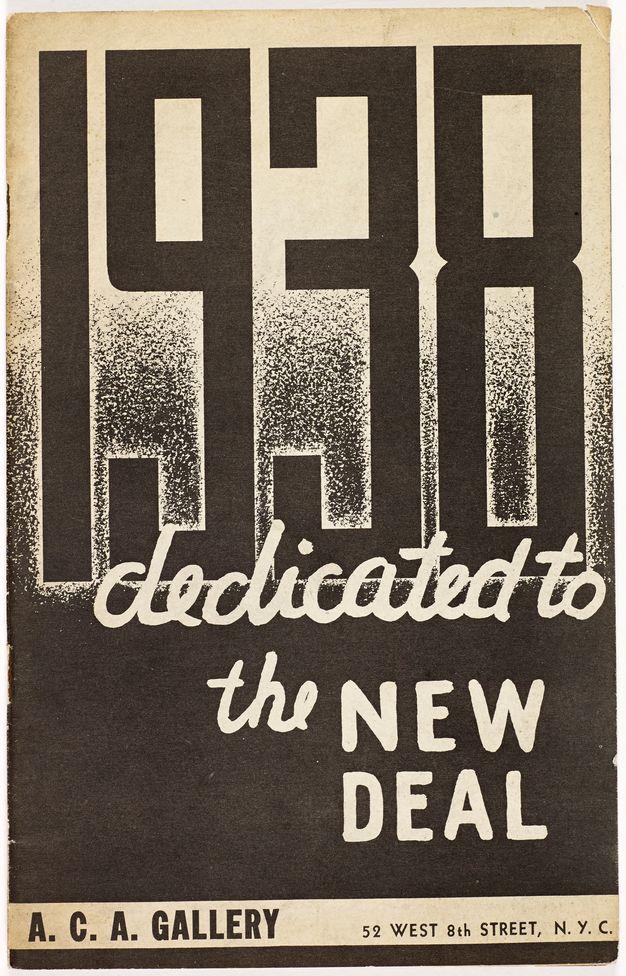
across a small stapled pamphlet for a show called
1938: Dedicated to the New Deal, held at Herman
Baron’s American Contemporary Artists (A.C.A.) Gallery in New
York City, then the leading space for what has been called
social or proletarian art (fig. 7).10
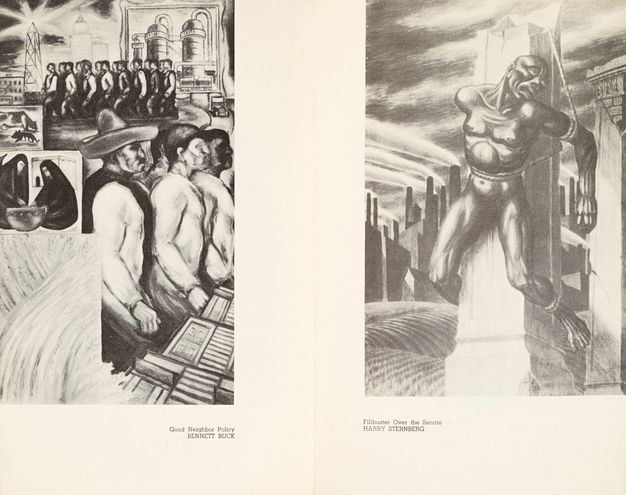
Flipping through the pages, I was shocked to find an
illustration of the same painting hanging back at Yale (fig. 8).
ExpandFig. 7. —Cover of 1938: Dedicated to the New Deal (New
York: A.C.A. Gallery, 1938).
Miami, Florida, The Wolfsonian–FIU, Gift of Francis Xavier
Luca and Clara Helena Palacio Luca, XC2014.03.1.9ExpandFig. 8. —Good Neighbor Policy (1938) by Bennett Buck
(US American, 1900–1982) and
Filibuster Over the Senate (ca. 1938, now lost)
by Harry Sternberg (US American, 1904–2001).
From 1938: Dedicated to the New Deal (New York:
A.C.A. Gallery, 1938). Miami, Florida, The Wolfsonian–FIU,
Gift of Francis Xavier Luca and Clara Helena Palacio Luca,
XC2014.03.1.9.
It wasn’t by Orozco. Instead, the painter was an unknown
figure named Bennett Buck, and the title of the work was
Good Neighbor Policy. It wasn’t a fake; it was an
homage to Orozco, and a rather good one at that. As Hemingway
has astutely noted, for leftist artists in the United States,
“it was Orozco, the most politically equivocal and pessimistic
of the [Mexican] muralists who offered the least problematic
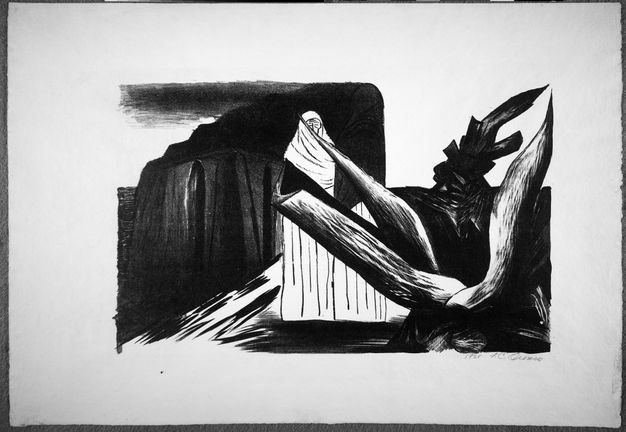
exemplar.”11
This was aided by several factors: Orozco’s murals in New York
and Hanover, New Hampshire, were easily accessible, and his
prints and paintings were widely exhibited and published; his
uncompromising, expressionist style was considered deeply
modern; and his themes—especially his skepticism about war,
ideology, and the machine age—resonated with the concerns of
many of his younger contemporaries.12
In fact, Buck’s painting would have served the thesis of
South of the Border even better as an homage to
Orozco painted by a US American artist, had I only known.
The serendipitous discovery at the Archives of American Art
led to a feeling of curatorial remorse, a sense that, through
the gallery presentation and exhibition checklist—but
fortunately, not through an illustration—I had deceived not
only myself but also my audience. Rather than pull the work
from the show, which was about to close at Yale, I simply
corrected the wall label for subsequent venues. I was not able
to convince the collectors to remove the brass plaque from the
frame, but if the conflict between the labels bothered any
viewers, I received no word of it. After
South of the Border closed in Monterrey in late
November 1994, Buck’s painting returned to the collectors’
home in Mexico City, and I’ve not seen it since.13
I had done a bit of research on Buck in the fall of 1993, but
a focus on my dissertation, and then my career, left the
project truncated, if not forgotten. Then, at my desk in
Mexico City during the pandemic in 2020, I decided to
reexamine the contents of that pink folder and write an essay
about Buck’s painting. This was possible, of course, because
research methodologies had changed so radically since the
early 1990s. Thirty years ago, travel—or at least moving
through a building—was the only way to gain access to books,
archives, or museum collections, and discoveries generally
required painstaking hours spent looking through the stacks,
archival boxes, or storage, to sometimes find nothing. Today,
while there is still no substitute for hands-on research,
digitization has facilitated everything; even the rare A.C.A.
catalog in which Buck’s painting first appeared is now
available online through the Wolfsonian Library at Florida
International University. We may rely too much on Google in
all its manifestations, including Gmail, Search, and Scholar,
but they allowed me to write the first draft of this essay
from my home in Mexico.
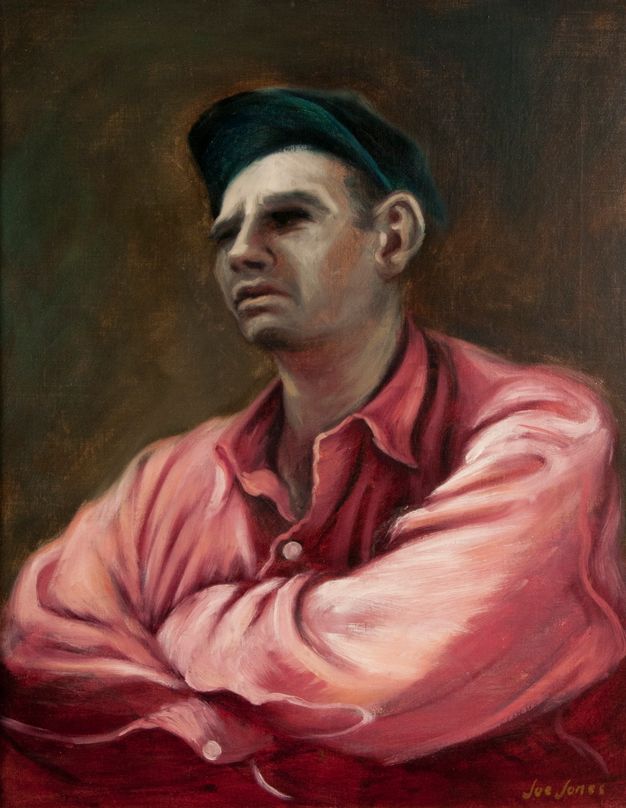
The 1938 exhibition at the A.C.A. Gallery included twenty-one
paintings and prints, several by major leftist artists,
including Philip Evergood, Harry Gottlieb, Eitarō Ishigaki,
Joe Jones, Walter Quirt, and Harry Sternberg. Each artist was
asked to submit a five-by-three-foot vertical panel; together,
the mural-sized works would have echoed the slightly larger
scale (seven by four feet) of those in the Museum of Modern
Art’s influential, albeit less radical, exhibition
Murals by American Painters and Photographers, held
in 1932.14
Although not all artists complied with the format requested by
the gallery, Buck’s painting hewed to the required dimensions
perfectly. Some artists, such as Jones, Julien Levi, and
Sternberg, portrayed individual workers as heroes or martyrs
(fig. 9), while others crowded their
compositions with as many figures as possible, employing
dramatic shifts of scale and breaking the laws of perspective.
ExpandFig. 9. —Joe Jones (US American, 1909–63).A Worker Again—On WPA (Self-portrait), ca. 1938,
oil on canvas, 68.6 × 83.8 cm. From the collections of the
St. Louis Mercantile Library at the University of
Missouri-St. Louis.
Hemingway provides the most complete analysis of
1938: Dedicated to the New Deal, arguing that while
it demonstrated support for President Franklin Delano
Roosevelt’s social agenda, it also “inadvertently revealed the
ambiguities of the Democratic Front,” given that several
artists created images deeply critical of conditions in the
United States.15
Indeed, some referred directly to pressing themes of the day,
including Arthur Emptage’s Half-a-Million Protests,
Quirt’s One-Third of a Nation, and Max Weber’s
The Forgotten Man. Some works employed irony, such as
Gottlieb’s Strength through Joy, which depicted a
bacchanal of capitalist excess, while others enlisted horror,
as in Sternberg’s Filibuster over the Senate, which
shows an African American man tied to a column as a victim of
lynching, which was a crime of urgent and intense concern to
those on the left (see fig. 8).16
Baron, who organized the show, noted in the introductory essay
for the catalog that the works shared a concern for “social
implications” but then suggested that not all might meet the
requirements of quality demanded by New York City critics:
The creative impulses of American art have been greatly
stimulated by the W.P.A. art projects and by all the
progressive forces which made the project possible. Those
who claim that the W.P.A. is responsible for too much bad
art, are needlessly worried. “Bad” art is an elastic term
and history supports the contention that future masterpieces
almost invariably are included in that class. As for the
real bad art, good quality eventually will reduce it to its
proper place. To advocate placing artists in the
professional category of doctors or architects is to fail to
understand the social service rendered by art.17
Judging from the black-and-white illustrations, communicating
a political message (what Baron refers to as a “social
service”) was sometimes more in evidence than formal elegance
or expertise. At the same time, Baron’s comment about the
label of “bad art” foreshadows the shifting political
realities of the Cold War, when the disdain for didactic
social realism, in favor of seemingly apolitical abstraction,
would cast a long shadow over the work of radical artists of
the 1930s and 1940s.18
Today, when the concerns of these same artists regarding
racial and economic inequity resonate deeply with current
debates, they may merit renewed attention, if not
archaeological recovery, however they are judged on aesthetic
grounds. Yet despite increased critical attention to this
period of US American art, only Evergood’s
The Artist in the New Deal has been the subject of
close study: apart from those by Buck and Jones, the paintings
from the 1938 exhibition are lost from public view, some
surely destroyed or painted over (as was the case with
Evergood’s submission), whether victims of Cold War politics
or just cumbersome and unsalable items.19
Buck (1900–1982) is one of several artists included in
1938 who have left scant traces in the historical
record, along with Hy Cohen, Emptage, Margaret Lowengrund, and
Abram Tromka. Born Henry Bennett Buck in Syracuse, New York,
he studied at the School of the Museum of Fine Arts in Boston,
then under Charles Guérin at the Académie Colarossi in Paris,
before acquiring blue-collar credentials back home by spending
“two years in the steel mills, doing his art work evenings and
at odd times.”20
Buck returned to Paris in the late 1920s, taking courses in
etching with Jean Antonin Delzers and briefly studying with
Fernand Léger and master printmaker Stanley William Hayter. He
returned to the United States “wholly preoccupied with what he
called the international scene in its labor aspects.”21
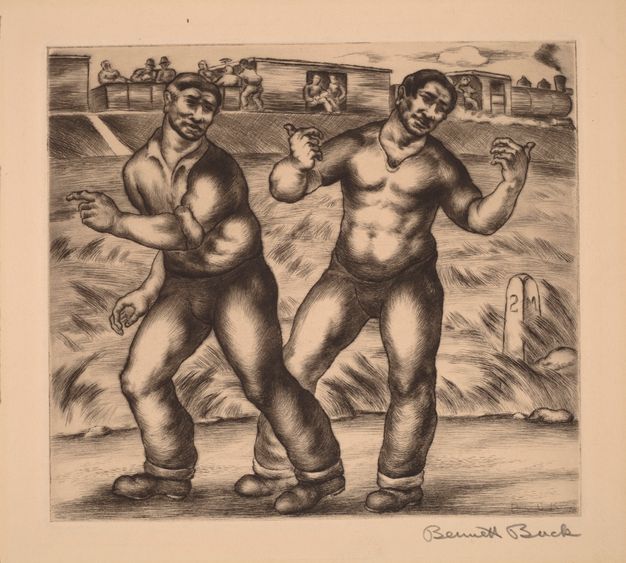
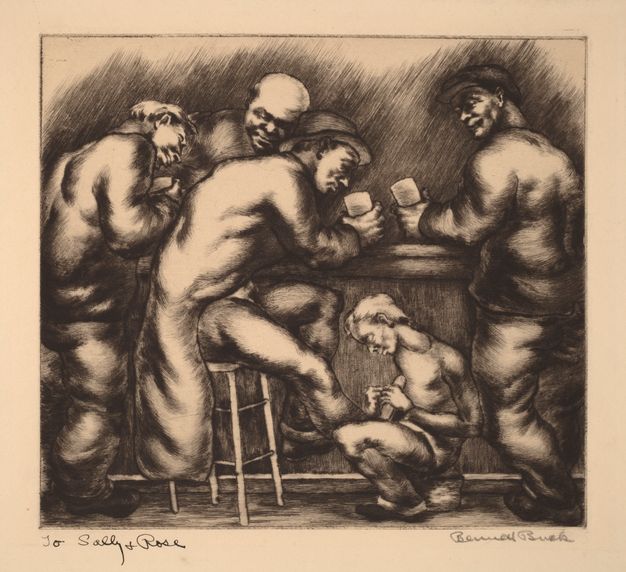
He taught etching in 1934–35 at the Syracuse Museum of Fine
Arts, where he produced several small prints featuring
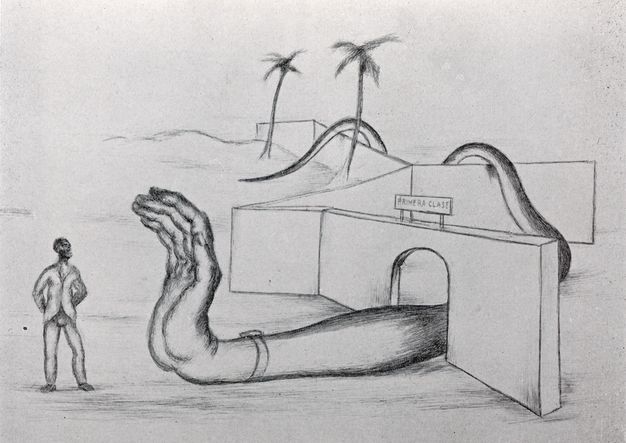
episodes in the life of the working class (figs. 10, 11). A solo show at the A.C.A.
Gallery in 1936 presenting drawings done on a trip to Puerto
Rico further revealed a concern with social justice through
works that sometimes veered into caricature (fig. 12).22
He was elected treasurer of the American Artists’ Congress and
around 1940 participated in the Federal Art Project in New
York, under the Works Progress Administration (WPA), when a
few of his antifascist paintings and drawings also appeared in
the press.23
After serving in World War II as a designer of camouflage
patterns, he settled in Connecticut (fig. 13). Like other artists of his generation, Buck eventually
abandoned socially concerned figuration for abstraction. A
show in 1966 featuring his recent “Hard-Edged Cubist style”
garnered minor and lackluster reviews, and then the record
trails off into oblivion, even after Buck’s death in 1982.24
ExpandFig. 10. —Bennett Buck (US American, 1900–1982).Untitled (Hitch Hikers), 1935, drypoint, 16.3 ×
18.2 cm (image). Washington, DC, National Gallery of
Art, 2008.115.1096. Reba and Dave Williams Collection,
Gift of Reba and Dave Williams.ExpandFig. 11. —Bennett Buck (US American, 1900–1982).Bar Room, 1935, drypoint, 16.3 × 18.2 cm
(image). Washington, DC, National Gallery of Art,
2008.115.1097. Reba and Dave Williams Collection, Gift
of Reba and Dave Williams.ExpandFig. 12. —Bennett Buck (US American, 1900–1982).The Color Line, ca. 1936. From
Puerto Rico: Twelve Reproductions of Original Drawings
by Bennett Buck
(New York: A.C.A. Gallery, 1936), 5. New Orleans,
Louisiana, Tulane University, Rare Books Collections,
Latin American Library. Image courtesy of the Latin
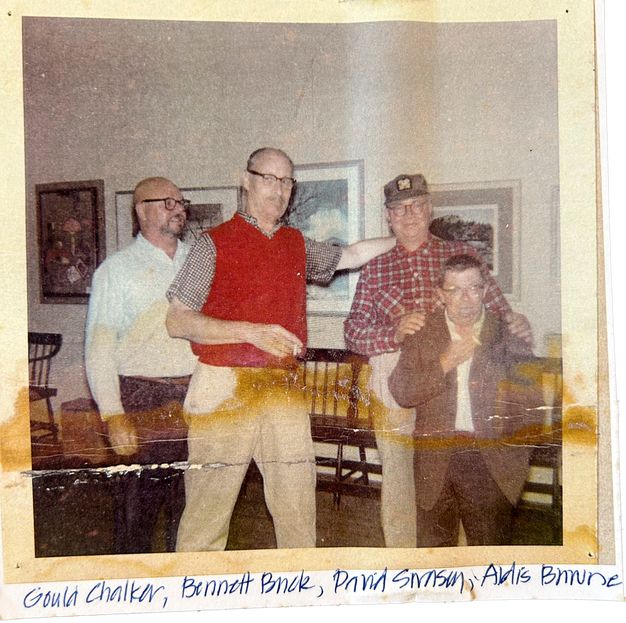
American Library, Tulane University.ExpandFIg. 13. —Photograph showing (left to right) E. Gould
Chalker, Bennett Buck, David (last name illegible), and
Aldis B. Browne at the Essex Art Association, Essex,
Connecticut, 1960s.
Photographer unknown. Courtesy Essex Art
Association.
The best indication of Bennett Buck’s aesthetic interests
emerges from his donation of almost one hundred works on
paper, mainly prints, to the Everson Museum of Art at Syracuse
University around 1977, by which time he had retired to St.
Petersburg, Florida. This eclectic gift included forty-nine of
Buck’s own works, including several of the Puerto Rico
drawings and some explicitly leftist or antifascist images,
along with prints and drawings by a wide range of European
artists, such as William Blake and André Masson. Buck also
gave the museum works by William Gropper, Levi, and Louis
Lozowick, all of whom had participated in the A.C.A.
exhibition in 1938, and a copy of Orozco’s 1929 lithograph
The Maguey (see fig. 5).25
The donation also contained prints by Mexican artists Leopoldo
Méndez, Roberto Montenegro, Gonzalo de la Paz Pérez, Everardo
Ramírez, and Siqueiros.26
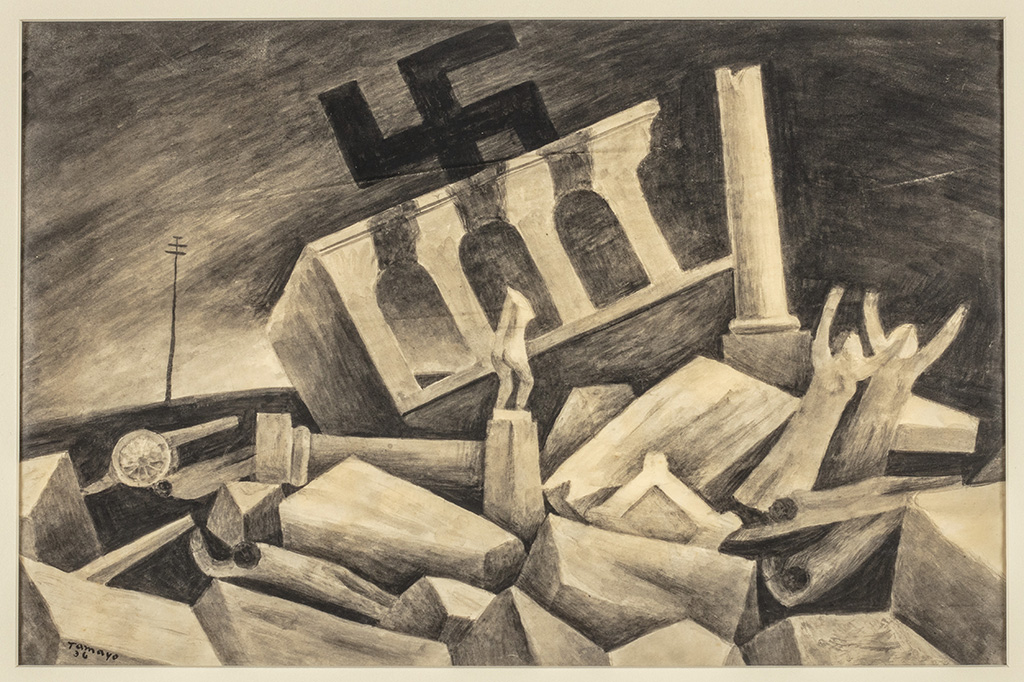
Buck also gave the Everson an ink-wash drawing by Rufino
Tamayo titled Fascism, one of very few explicitly
political works by the artist, perhaps done in New York at the
time of the American Artists’ Congress (fig. 14).27
Buck’s Good Neighbor Policy was the only painting
showcased in 1938 that directly referenced life
outside of the United States. The title refers to an official
policy announced by Roosevelt during his inaugural address of
March 1933, in which he called for nonintervention in Latin
America’s domestic affairs. Although there seems to be no
strict border between the lower “Mexican” section and the
upper “American” one, Buck’s painting lacks visual evidence of
cooperation or assistance, such as the embrace of a Mexican
and US worker that was a common topos in the period. The
oil-storage tanks in the background could reference Mexico’s
nationalization of foreign oil companies in March 1938, since
the resulting crisis put the policy in jeopardy, but here they
are placed in the upper “American” sector.28
Perhaps Buck’s idea of the Good Neighbor Policy was more
general or symbolic: as a tribute by a US American painter to
a Mexican colleague, the painting revealed a good
neighborliness that was artistic rather than political.
Buck’s painting is far more conciliatory than any of Orozco’s
works of this period. The Mexican workers, resting on—or
emerging from—archaeological and agricultural foundations,
turn their backs on the domestic, feminine sphere; in the
upper (or northern) section, industrial workers, equally
unified but now separated from nature and the past, surge
toward the light emitted from the electrified tower. The
representation of Mexico is granted greater space in the
pictorial field, but it gives way to a more modern—though
perhaps more tragically alienated—United States. In comparison
to other paintings in the A.C.A. show, and to most of Orozco’s
work, Buck’s ideological stance seems muted, even opaque—there
is no violence or oppression, no apparent suffering, only an
inexorable march toward the future.
Buck was not the only artist in the 1938 exhibition who
disclosed iconographic and compositional debts to Orozco,
although surprisingly, in his introductory essay, Baron
mentions only artists of the past (Francisco Goya and Honoré
Daumier) as providing models for expressing “social
ideals.”29
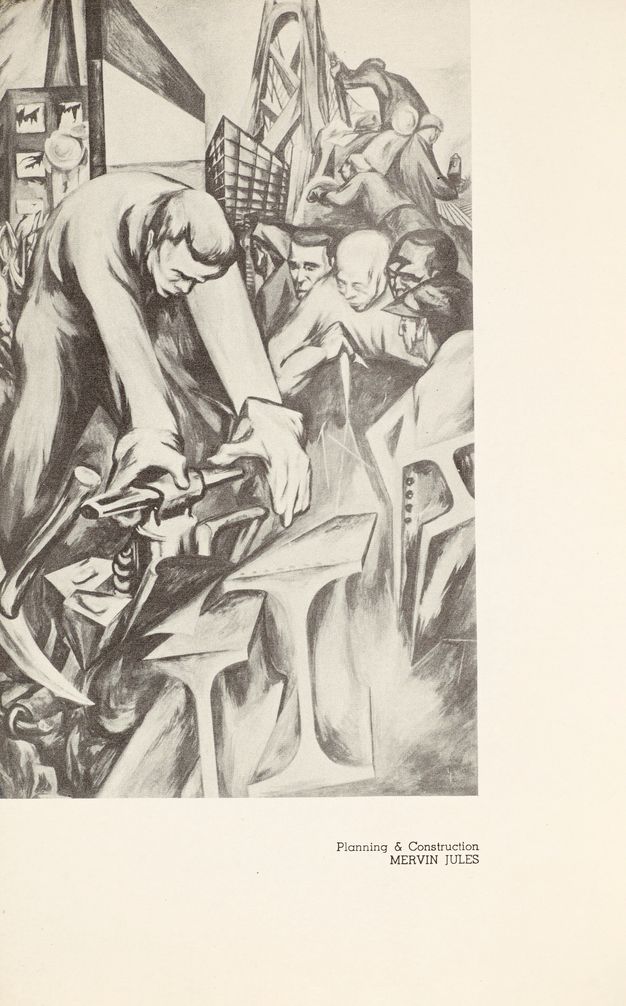
The building frames, broken windows, and I beams as well as
the dramatic diagonals in Mervin Jules’s
Planning & Construction (fig. 15) resonate particularly with Orozco’s fresco panels depicting
Hispano-America (see fig. 3)
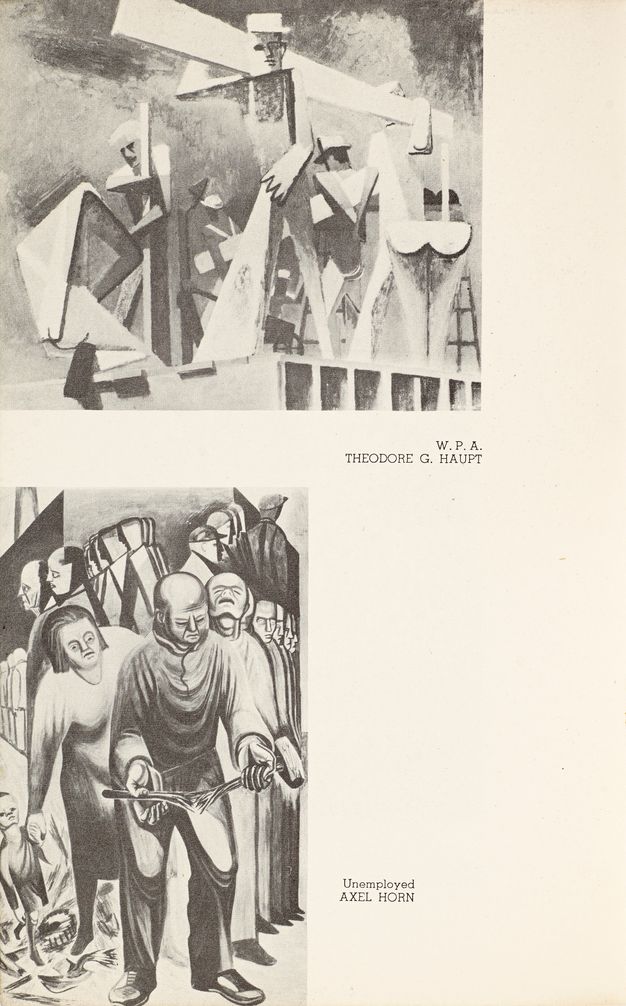
and Modern Industrial Man at Dartmouth, while Jules’s
angular figures and dense composition, also evident in Axel
Horn’s Unemployed (fig. 16),
recall Orozco’s work in general. Indeed, the exhibition
confirms the broad impact of Orozco on art produced during the
New Deal, as signaled by scholars such as Bram Dijkstra and
Hemingway, among others. But while Buck appropriated Orozco’s
iconography and brilliant coloration, he softened the
outlines, avoided dramatic diagonals, and beefed up the
muscles of the workers. Overall, his painting is less agitated
and less overtly expressionist than his model (or than the
paintings by Jules and Horn), which serves to heighten the
diplomatic benevolence of his theme.
ExpandFig. 15. —Planning & Construction (1938, now lost)
by Mervin Jules (US American, 1912–94).
From 1938: Dedicated to the New Deal (New York:
A.C.A. Gallery, 1938). Miami, Florida, The
Wolfsonian–FIU, Gift of Francis Xavier Luca and Clara
Helena Palacio Luca, XC2014.03.1.9.ExpandFig. 16. —W.P.A. (1938, now lost) by Theodore G. Haupt
(US American, 1902–90) and Unemployed (1938,
now lost) by Axel Horn (US American,
1913–2001).
From 1938: Dedicated to the New Deal (New York:
A.C.A. Gallery, 1938). Miami, Florida, The
Wolfsonian–FIU, Gift of Francis Xavier Luca and Clara
Helena Palacio Luca, XC2014.03.1.9.
In fact, when I look at Buck’s
Good Neighbor Policy today, I don’t see the evidence
of Orozco’s hand that I imagined in 1992. This clarity is
largely the result of three decades of increasing familiarity
with the artist’s varied stylistic innovations and extensive
production. Buck’s message is too optimistic, his paint is too
thickly applied, the forms are too rounded, and the collaging
of rectangular elements into the composition are too
obvious.30
There are unresolved incongruities, such as the framed
precisionist painting that hangs strangely against the
darkened sky, or the field of European wheat that overlaps a
Mesoamerican pyramid. Today it appears to me—and probably to
everyone else in my field—as exactly what it is: evidence of
Mexico in the (US) American imagination. But it was not simply
the iconography and direct references to specific murals that
made me think, back then, that I was looking at a painting by
Orozco.
Before South of the Border opened, I had only
summarily reviewed the documents the collectors had shared
with me, given that I had not questioned the painting’s
authenticity. After locating the A.C.A. Gallery catalog for
1938, however, I needed to discuss my findings with
the owners, and so I returned to their home to examine the
materials more closely (and fortunately, to obtain
photocopies). I learned that the owners had acquired this
particular work not from an established gallery or auction
house but from an informal dealer known in Mexico as a
cajuelero, someone who sells art without a permanent
space (literally, out of the trunk of a car).
Cajueleros are not prima facie dishonest, but they
may be sly and secretive. The works they offer are rarely
displayed publicly; their prices undercut those of
brick-and-mortar dealers but can also be inflated by unseen
intermediaries and agents awaiting a commission. Some offer
works of the highest caliber, while others are unscrupulous
peddlers of fakes and misattributions. The latter are known to
pressure even sophisticated collectors to make a fast decision
without due diligence, convincing buyers that they are getting
a bargain, but only if they act quickly.
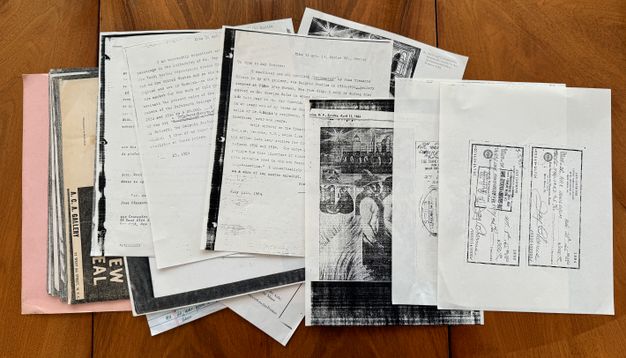
In this case, the collectors’ decision to purchase a painting
purportedly by Orozco—and my decision to include it in
South of the Border—was justified by an array of
documents and publications that seemed to prove that the work
was by the Mexican muralist (fig. 17).
These materials—fourteen pieces of evidence in all—fall into
two clusters of time—1964–66 and 1979–81—that reveal
successive attempts to create a false identity for the
painting, each building upon the last.31
Authentic letters in Orozco’s hand, published reproductions,
typed letters signed by key figures in his biography—Alma Reed
and Churchill P. Lathrop—and a certificate of authenticity
from an established society appraiser: viewed quickly, the
documents seemed to confirm Orozco as the author of the
painting. But close forensic and textual analysis—the kind of
work purchasers rarely have the time or inclination to
conduct, and that art historians and curators aren’t always
trained to conduct—reveals numerous imprecisions and
inconsistencies that should have cast doubt on the attribution
even without access to the A.C.A. Gallery catalog. As in any
good con, however, it is not always easy to separate fact from
fiction.32
ExpandFig. 17. —Photocopies in the author’s possession from collectors’
provenance dossier (current location of original dossier
unknown) supporting the misattribution of Bennett Buck’s
Good Neighbor Policy to José Clemente
Orozco.
From what I have been able to glean using the information at
hand, the story goes something like this. In the fall of 1938,
the A.C.A. Gallery exhibition traveled to the City Art Museum
in Saint Louis (today the Saint Louis Art Museum) and then to
the newly opened Washington Bookshop in Washington, DC.33
When the exhibition closed, the painting may have been
returned to the A.C.A. Gallery, or to the artist. The trail
then goes cold until 11 April 1965, when the painting and a
brief description appeared in The News, an
English-language newspaper published by the Mexico City daily
Novedades. This clipping—included in the
dossier—provides the earliest published evidence that Buck’s
painting had already been reattributed: “Another painting by
José Clemente Orozco has recently been discovered in New
York,” the short anonymous article read, concluding, “The
owner of this work painted in the early 30’s is Jay Chernis,
one of Hollywood’s best known composers of movie music
scores.”34
At that time, Buck was still alive, but his painting had
either been mistakenly assigned to Orozco, or—more likely in
my estimation—dishonestly misattributed by someone confident
that Buck would never see the false information planted in a
Mexican newspaper. The article may have launched an effort to
doctor the historical record, not unlike the ways in which
Dutch forger Han van Meegeren and English con artist John
Drewe manipulated archives in order to give forged paintings a
more lucrative provenance.35
The move may seem bold, but in 1965, Orozco had been dead for
almost twenty years, and no scholars, curators, or
collectors—especially in the United States—were familiar with
his entire oeuvre.36
“Best known” or not, Jay Chernis (1906–96) was indeed a
songwriter and composer, though only scant information appears
in his biographies online. He was born in Norwalk,
Connecticut, but lived most of his life in and around New York
City. He told people that the honorific Sir had been
granted to him by the Knights of Malta for his writing of
their anthem, but “Sir Jay” was just a corruption of his given
name, Sergei.37
He was also an art collector and private dealer, with a focus
on US American art and postimpressionism; online searches
reveal, however, that when paintings formerly in his
collection appear at auction, they are often merely “after” or
“attributed to” famous artists.38
In the summer of 1965, Chernis acquired, through his Little
Terrace Gallery in New Hope, Pennsylvania, a group of
authentic Mexican works from Max Honigbaum (1894–1966), who
had inherited them from his brother, fruit-packing magnate
Alfred Honigbaum (1882–1939), a leading collector in San
Francisco. A letter from Chernis to Max Honigbaum dated 22
January 1966—to be trusted, since it is still in the Honigbaum
archive—confirms the purchase amount (6,150 USD) and lists
sixteen works by Orozco, Rivera, and Siqueiros (plus twenty
prints by Robert Delaunay), but there is no mention of a large
mural study of any sort.39
Chernis then used this honest transaction to create a false
provenance for Buck’s work, which had already been published
in The News. In a deliberate act of fraud, Chernis
annotated the backs of the two checks (totaling $6,150) that
he had made out to Max Honigbaum the previous summer (and that
had been cashed and returned to him by the bank) to imply that
the large painting (the one by Buck) had been acquired with
the lot. Employing the same capital letters he had used on the
front of the checks, he wrote on one, dated 28 August 1965,
“On account for three Orozco gouache studies
and panel,” and, on the other, dated 8 September
1965, “Payment in full for following: (Balance) 12 Diego
Rivera watercolors, Delaunay lithographs Siqueiros ‘Mother and
Child’ Orozco panel (mural study).”40
Chernis also obtained a copy of a checklist for an exhibition
at the Colorado Springs Fine Arts Center, to which Alfred
Honigbaum had previously lent most of the purchased works,
scrawling “Bought by Sir Jay Chernis” or “Sir Jay Chernis
Purchase” by several entries.41
In his dealings with the Honigbaum heirs, Chernis also
apparently obtained (or stole) two brief but authentic letters
Orozco had sent to Alfred; neither mentions anything like a
large “mural study.”42
An unsuspecting buyer—or a green curator—might skim through
all this and erroneously conclude that Alfred Honigbaum had
once owned a large Orozco inspired by his frescos. A skilled
con artist takes advantage of the mark’s all-too-willing
suspension of disbelief.
Not surprisingly, the dossier also includes letters of
authenticity and related documents, typed on suspiciously
plain sheets of paper, not letterhead. The first is a letter
of authenticity dated 15 July 1964 that purports to be from
Reed, Orozco’s biographer and principal dealer in the 1930s.
The document references two works: a known oil painting titled
Mannequins (1930; now in a private collection) and a
“large panel owned by Mr. Jay Chernis” that is “perhaps the
most important of these studies [for Dartmouth] and depicts
all of the main elements used in the two fresco panels, ‘Latin
America’ and ‘Anglo-America.’” It concludes: “I unhesitatingly
identity [sic] this oil on canvas panel as a work of
the master muralist.” This is accompanied by a second letter
(25 July 1964), also apparently signed by Reed, that values
the first work at 5,000 USD and the “large panel—studies for
two fresco panels of the Dartmouth College (Hanover N. H.)
murals” at 20,000 USD. This letter concludes: “I know of no
other oil paintings by Orozco currently available at these
prices.”
The signatures on both letters are similar to Reed’s but are
not incontrovertibly authentic.43
Errors in syntax and spelling, as well as one handwritten
correction, raise additional suspicions about both
documents.44
If they were forged, then their dates are unreliable: they
seem to authenticate the work before its publication in
The News, but the letters might have been created
anytime, even after Reed’s death on 20 November 1966.45
Besides my inconclusive forensic evidence, I believe it to be
highly unlikely that Alma Reed—who knew Orozco’s work
intimately, surely better than any other critic or art
historian in the US—would have been deceived by the painting’s
superficial resemblance to the Dartmouth murals.46
A close reading of Reed’s letters, the publication of the
painting in The News in 1965, and Chernis’s dealings
with the Honigbaum estate in 1965–66 provide rather convincing
evidence that something crooked was afoot.
Mary-Anne Martin, a leading dealer who was then working in the
Modern Paintings, Drawings, and Sculpture Department at
Sotheby Parke Bernet (SPB) in New York, recalls that Chernis
tried to consign the large painting in the mid-1970s. She
visited his New York apartment to inspect it, but after she
found nothing similar in the few available books and sales
records on Orozco, she brought it to the attention of the
Orozco family in Guadalajara, who rejected it: “I had no
context for including it [in the sale],” Martin explained to
me recently, “and so I didn’t.”47
Deeper scholarship sometimes trumps the negative evaluations
of family members, who often have their own blind spots or
reasons for denying authenticity. But here, as Martin said,
there was insufficient information (or “context”) for the
auction house to risk selling what could easily be an
inauthentic work. Of course, I knew none of this when I
selected the painting for South of the Border.
Authentication often depends on the accumulation of evidence,
and it seems that the rejection by SPB led to a second burst
of activity by Chernis or someone else eager for a sale.
First, an image of the misattributed painting was somehow
placed in a German translation of Reed’s biography
Orozco, published posthumously in Dresden in 1979.
This version includes many more images than the first edition,
published in New York by Oxford University Press in 1956,
including a full page dedicated to Buck’s
Good Neighbor Policy, titled as
Nord- und Lateinamerika and described as an “idea
study for the frescos at Dartmouth College.”48
In 1993, when I first visited the collectors, this book
provided quite compelling proof that the painting was by
Orozco; in retrospect, I should have questioned the
reliability of a book on Mexican art published in East
Germany, where an inexpert editor might have easily
collaborated, consciously or not, in planting Buck’s image.
The dossier contains an additional letter of authenticity,
dated 7 July 1981, purportedly from Carroll Edward Hogan, an
independent appraiser who had been director of the Paintings,
Drawings, and Sculpture Department at Parke-Bernet from 1960
to 1965. It is odd that such an important attestation was
typed on a sheet of paper with no letterhead, although it does
include the signature of a notary public and a detailed
narrative: “I was present when she [Reed] inspected the
painting at the home of Mr. Jay Chernis in 1964, who purchased
it from Mr. Honnigbaum [sic]. She agreed to give a
certificate of authenticity at that time but no photo was
available. The certificate was written after she returned to
Mexico City.” The letter of 1981 thus takes greater pains to
authenticate Reed’s certificate of 15 July 1964 than to vouch
for the work itself, which Hogan never identifies, describes,
or titles (it could refer to one of the authentic works
Chernis acquired from Honigbaum). The dossier also includes a
Spanish translation of this letter and a copy of Hogan’s CV
(the only document in the dossier on letterhead).
It seems unlikely that Hogan’s letter is an outright forgery,
since he could easily have been contacted at the time it was
written. Hogan, however, was not the most reliable expert.
According to Martin, he might have carelessly authenticated
the painting without knowing much about Orozco’s work. But
there is also the possibility that the letter reveals Hogan’s
collusion in the owner’s scheme.49
Indeed, shortly after Hogan left Sotheby’s, his name was
linked to a famous case involving forged artworks that Algur
H. Meadows, founder of the Meadows Museum, had purchased in
1967.50
Another typed declaration, this one dated 9 July 1981, was
purportedly obtained from Lathrop (1900–1995), an emeritus
professor of art at Dartmouth College, who had been
responsible for Orozco’s mural commission there in the early
1930s. Despite its cautious tone, this letter implies that
Lathrop had actually seen the painting, or at least a
photograph: “I do see in this oil painting a number of
similarities in subject matter and way of painting to his
[Orozco’s] Dartmouth murals: especially the golden wheat; the
muscular men marching; and the treatment of hands and faces.”
He indicates that he knew Reed, recalls her asking Orozco “for
portable paintings to sell,” and that “perhaps this oil
painting was such a picture.” He ends by stating that “Alma
Reed’s endorsement of the picture is of great importance,”
implying that, if Lathrop actually wrote the letter, he relied
almost solely on what he believed was the honest opinion of a
recognized expert. The letter lacks a signature and instead
seems to be a transcription (in both English and Spanish) of
some original, typed up on a blank sheet of paper, using the
cursive script of an IBM Selectric typewriter, perhaps the
same one used to type the Spanish translation of Hogan’s
declaration. It warrants review by a typewriter expert.51
The last dated item in the dossier is a fragment of an article
that appeared in the Mexican newspaper Excélsior on
19 August 1981 illustrating a panel from the Dartmouth cycle.
The text refers to a loan of works to the Instituto Nacional
de Bellas Artes (INBA) and to the “stratospheric” prices that
museums were paying for works of art but makes no mention of
the Buck painting. Like the authentic Orozco letters, it is a
real document that seemingly supports the attribution without
actually proving anything.52
The collectors acquired the work sometime between that date
and 1992.
Knowing that the painting at the center of this tale is by
Buck has allowed me to see the dossier today as a treasure
trove of evidence documenting how a trap was carefully laid
over a period of at least fifteen years to mislead a future
buyer. Based on the documents—real or faked—it seems that
sometime before April 1965, when the painting appeared in
The News, Chernis had acquired a large and unsigned
painting that looked like an Orozco. He may have himself been
deceived by someone else, or he may have schemed from the
start, knowing that it was one of the many New Deal–era
paintings that had been inspired by Orozco, a type of art then
disdained if not forgotten. Whatever the case, by annotating
his canceled checks to Max Honigbaum with references to a
painting he had definitely not purchased in San Francisco,
Chernis launched a fraudulent attempt to authenticate it. Over
the years, he created a dossier that ultimately included
documents that were either entirely falsified or ambiguous to
a fault. The extent to which others were complicit, including
any links between Chernis and the cajuelero who
ultimately sold the work to the collectors in Mexico City, may
never be known. What I can say is that when the collectors
generously agreed to lend their painting to
South of the Border, they had no idea that it was
anything other than genuine: after all, they had the documents
to prove it.
Bennett Buck’s Good Neighbor Policy is a compelling
survivor from a time when the influence of Mexican modernism
on art in the United States was so great that an homage
painted by an obscure artist from Syracuse could be mistaken
for a major work by a leading muralist from Guadalajara. In
the period when Chernis was creating the dossier, a lack of
scholarship—both on Orozco and on proletarian art of the 1930s
in general—meant that the switch entailed relatively little
risk with a rather high chance of economic payout. And for
every expert—like Martin—who couldn’t be convinced, there was
a probably a collector or curator who could be. In the
mid-1960s, the Buck canvas was almost valueless; as an Orozco,
even if Mexican modernism hadn’t regained the prestige that it
held back in the 1930s, it was worth much more. Indeed, for
whoever has the picture today (the original owners having sold
it years ago), the correct attribution is no small matter: the
market value of Buck’s painting would be a fraction of that of
an equally large and compelling work by José Clemente
Orozco.53
At the same time, given renewed interest in leftist New Deal
art, the visual complexity of Good Neighbor Policy,
and, admittedly, the content of this essay, who knows how many
museums might fight for the chance to own it. After all, the
value of a work must also be measured in the tales that it
tells.
The positive side of this story is the recovery of an
important lost work that reveals the impact of contemporary
politics and Mexican muralism on artists of the 1930s; it is
also one of the few known survivors of a historically
significant exhibition in which it kept good company. Had I
not found that twenty-four-page A.C.A. Gallery catalog, I
might still have wondered what ever happened to that “Orozco”
that I had included in South of the Border, but there
would have been no reason to bring Buck out of the
shadows.54
The negative side is that Buck’s
Good Neighbor Policy serves as a warning that many
other fakes and misattributions, sometimes passed from one
mark to another, remain at large, contaminating the historical
record. Theory and philosophy help little in this regard, for
the only effective gatekeeper is the connoisseur—who not only
looks hard and long at works of art but at the documents that
accompany and purport to authenticate them. These are skills
many consider old-fashioned, outmoded, even politically
suspect, but they are essential skills nonetheless.
The most egregious fakes are often laughable, but even obvious
ones cast doubt, damaging an artist’s reputation, as in the
case of a pseudoacademic publication that slandered Frida
Kahlo a few years ago.55
And yet, it is very difficult to talk or write openly about
fake or even questionable paintings in an interconnected art
world, mainly because in so doing, we risk angering
stakeholders whose generosity we may need for future
projects.56
A broader discussion of this topic or a catalog of problematic
works is well beyond the contours of this essay. But I close
by noting that although very few false Kahlos or Riveras have
actually deceived leading curators or art historians,57
the case for Orozco is more complicated, partly because
scholarship on his paintings remains comparatively limited,
and partly because his expressionist style is rather easy to
imitate. The same is also true for late (and sometimes sloppy)
works by Siqueiros; by contrast, Rivera’s precise brushwork is
almost impossible to duplicate convincingly. Besides the
younger artists who sincerely copied Orozco’s expressionist
style—aside from those discussed above, Will Barnet and Arnold
Belkin come to mind—and whose work might be mistaken for their
mentor’s, there is evidence of at least one skilled forger out
there whose hand can be seen in paintings that have passed
through the most reputable auction houses, and that in some
cases remain ascribed to Orozco in both public and private
collections. Less ignoble are other cases of mistaken
identity, such as a brightly colored drawing of two men in the
collection of the Philadelphia Museum of Art, dated 1933 and
donated to the museum in 2019, that is old but definitely not
by Orozco.58
I leave it to my readers who jump to the endnote and follow
the link to judge if this account of Bennett Buck’s
Good Neighbor Policy might serve, ultimately, as a
cautionary tale.
James Oles divides his time between Mexico
and the United States, where he teaches part-time in the Art
Department at Wellesley College.
Notes
I wrote the first draft of this essay in Mexico City in July
2020 in the depths of the COVID-19 pandemic. I thank Jeffrey
Collins and Bonnie Gossels for their generous and careful
comments on earlier drafts, the two anonymous readers for the
Getty Research Journal for pushing me to refine my
arguments, and Lauren Gendler at the Getty Research Institute
for her sharp copyediting and fact-checking.
James Oles, with an essay by Karen Cordero Reiman,
South of the Border: Mexico in the American
Imagination, 1914–1947, exh. cat. (Washington, DC: Smithsonian
Institution Press, 1993). Some of these ideas were
revisited and expanded in Barbara Haskell, ed.,
Vida Americana: Mexican Muralists Remake American
Art, 1925–1945, exh. cat. (New York: Whitney Museum of American Art,
2020). See also James Oles, review of the exhibition
Vida Americana: Mexican Muralists Remake American
Art, 1925–1945,
Panorama: Journal of the Association of Historians of
American Art
6, no. 2 (Fall 2020),
https://doi.org/10.24926/24716839.10732. ↩︎
There are actually two versions of this painting in
Mexico’s national collections: a smaller one in the
Museo de Arte Moderno (dated 1930 by the museum but is
certainly later) and a larger one dated 1944 by the
Museo de Arte Carrillo Gil. Both revisit the central
figure in Orozco’s mural at Pomona College (Prometheus,
1930, Frary Hall), but reduce multitudes to just two
flanking figures. For images, see
La colección permanente: Museo de Arte Moderno de
México
(Mexico City: Consejo Nacional para la Cultura y las
Artes, 2006), 54; and Justino Fernández,
Obras de José Clemente Orozco en la colección
Carrillo Gil, México
(Mexico City: n.p., 1949), 39, pl. 59.
↩︎
Although my memory of the following events is sharp, my
documentation is sparse, and I kept no diary at that
time. Doubts throughout the essay are signaled by the
use of passive voice.
↩︎
Largely for economic reasons, Orozco moved to New York
in 1927, leaving his family behind in Guadalajara. He
was the first of the three leading muralists to seek his
fortune north of the border. He returned to Mexico in
early 1934. The bibliography on the artist has expanded
dramatically since the early 1990s: see Renato González
Mello and Diane Miliotes, eds.,
José Clemente Orozco in the United States, 1927–1934, exh. cat. (Hanover, NH: Hood Museum of
Art, 2002); Anna Indych-López,
Muralism without Walls: Rivera, Orozco, and Siqueiros
in the United States, 1927–1940
(Pittsburgh: University of Pittsburgh Press, 2009); and
Mary K. Coffey,
Orozco’s American Epic: Myth, History, and the
Melancholy of Race
(Durham, NC: Duke University Press, 2020).
↩︎
The representation of two paintings and a photograph
within the space of the canvas may indicate that the
artist wanted his own work to reference (or subsume)
multiple media, including prints, frescoes,
architecture, and industrial design.
↩︎
Orozco’s work was frequently seen in exhibitions in New
York and was well reproduced, albeit in black-and-white,
in Reed’s widely distributed
José Clemente Orozco (New York: Delphic
Studios, 1932).
↩︎
This book is discussed below; see this essay, note 48.
↩︎
The work is included in the checklist but not
illustrated. Before the digital revolution, there was an
even longer lead time for sending a final catalog to
press ahead of the opening of an exhibition,
especially—as in this case—when the book was printed
abroad (Hong Kong). Changes to the galleys were marked
by hand, sent by FedEx or fax, and often entailed
additional costs. When the catalog for
South of the Border went to press, I already
knew that the loan of Birth of Fascism had been
denied and had signaled this in the checklist, but I
still believed Prometheus would be exhibited at
the first two venues.
↩︎
South of the Border emerged from my
dissertation prospectus, but the dissertation itself had
a tighter focus. See James Oles, “Walls to Paint On:
American Muralists in Mexico, 1933–1936” (PhD diss.,
Yale University, 1996).
↩︎
The show ran from 15 August to 11 September 1938. Baron
(1892–1961) founded the A.C.A. Gallery in 1932 at 1269
Madison Avenue; by 1938 it had moved to 52 West Eighth
Street. His nephew Sidney Bergen (1922–2001) joined the
gallery in the 1950s (it remains in operation as the ACA
Gallery). After discovering the catalog, I wrote to
Sidney’s son Jeffrey Bergen in April 1994, hoping for
more information on Buck from the A.C.A. Gallery files.
I received no reply, and I did not follow up after
learning that their archive had been donated to the
Archives of American Art and mainly covers post-1938
activities.
↩︎
Andrew Hemingway,
Artists on the Left: American Artists and the
Communist Movement, 1926–1956
(New Haven, CT: Yale University Press, 2002), 28.
↩︎
A short conversation with one of the former owners in
2022 revealed that the painting has been sold to another
collector, and I have been unable to trace its current
whereabouts.
↩︎
Murals by American Painters and Photographers,
exh. cat. (New York: Museum of Modern Art, 1932).
Artists George Biddle, Philip Evergood, and William
Gropper participated in both projects.
↩︎
Hemingway, Artists on the Left, 136. See also
Helen A. Harrison, “John Reed Club Artists and the New
Deal: Radical Responses to Roosevelt’s ‘Peaceful
Revolution,’” Prospects 5 (1980): 241–68. For
contemporary reviews, see Elizabeth McCausland, “New
Deal Hailed in Show of Social Art,”
Sunday Union and Republican, 14 August 1938,
6E; M. U., “Artists Toying with New Deal,”
New York Sun, 20 August 1938, 21; Jacob Kainen,
“ACA Show on New Deal,” Daily Worker, 5
September 1938, 7; and Elizabeth Noble, “Art,”
New Masses, 6 September 1938, 30–31. None
discusses Buck’s painting.
↩︎
Sternberg made a lithograph with a similar composition
titled Southern Holiday (1935); Elizabeth Olds
also created a lithograph version of her painting
The Middle Class. For images of the two prints,
see Hemingway, Artists on the Left, 50, 137. An
oil sketch for Levi’s DockWorker has
appeared on the market: “American & European
Paintings and Prints,” Bonhams, Boston, 11 September
2009, lot 753,
https://www.skinnerinc.com/auctions/2470/lots/753. ↩︎
Herman Baron, untitled introductory essay in
1938: Dedicated to the New Deal (New York:
A.C.A. Gallery, 1938), n.p. The entire catalog is
available online at the Wolfsonian-FIU Library,
XC2014.03.1.9,
https://digital.wolfsonian.org/WOLF040195. ↩︎
See Bram Dijkstra, “Erasing a Movement,” chap. 1 in
American Expressionism: Art and Social Change,
1920–1950
(New York: Harry N. Abrams, 2003), 9–23. This book
discusses several of the artists featured in
1938: Dedicated to the New Deal, but it makes
no mention of Buck.
↩︎
Patricia Hills analyzes Evergood’s submission in “Art
and Politics in the Popular Front: The Union Work and
Social Realism of Philip Evergood,” in
The Social and the Real: Political Art of the 1930s
in the Western Hemisphere,
ed. Alejandro Anreus, Diana Linden, and Jonathan
Weinberg (University Park, PA: Penn State University
Press, 2006), 196–98. I searched as well as I could for
the other exhibited paintings but hit a digital dead
end. ↩︎
Biographical material for this essay was taken from a
short, unsigned statement, possibly by the artist
himself: “The Artist,” in
Puerto Rico: Twelve Reproductions of Original
Drawings by Bennett Buck, with a text by M. W. Royse (New York: A.C.A. Gallery,
1936), 26; and Peg Weiss, introduction to
H. Bennett Buck: An Artist’s Collection, exh.
cat. (Syracuse, NY: Everson Museum of Art, 1978), n.p.
↩︎
“The Artist,” 26. In the period, many artists in the US
padded their CVs with references to their studies
undertaken abroad, when what that actually entailed is
rather vague. In Buck’s case, the impact of Léger’s
modernism is unclear.
↩︎
See Anne Ziegler, “With an Itch to Etch: The Five Ediths
and the Syracuse Printmakers,” in
North American Prints, 1913–1947: An Examination at Century’s End, ed. David Tatham (Syracuse, NY: Syracuse University
Press, 2006), 134–35. The Puerto Rico drawings had been
shown previously at the Ateneo Puertorriqueño in San
Juan.
↩︎
When researching Buck in the mid-1990s, I found some
images in clippings in his artist’s file at the New York
Public Library, and though I failed to keep accurate
notes at the time, online research has allowed me to
fill in some details. A single photograph of a painting
(Steam Roller, 1940) indicates that Buck was at
least briefly employed by the WPA in New York City.
Archives of American Art, Federal Art Project,
Photographic Division collection, circa 1920–1965, bulk
1935–1942, box 3, folder 47:
https://www.aaa.si.edu/collections/federal-art-project-photographic-division-collection-5467/series-1/box-3-folder-47. Buck’s Undeclared (an antiwar painting) is
illustrated in Howard Devree, “A Reviewer’s Notebook: In
Galleries,” New York Times, 19 December 1937.
Buck is also mentioned in Isabel Cooper, review of
“American Cartoons between Wars,”
New Masses, 25 February 1941, 27.
↩︎
In 1946, Buck was a founding member of the Essex Art
Association (EAA) in Connecticut; materials in the EAA
archive include exhibition brochures from the early
1960s, but nothing related to his earlier New Deal
practice. I am grateful to Sarah Grote, EAA Gallery
director, for sending me the relevant digital files. The
quoted review appears in a short note in
Art News, May 1966, 15.
↩︎
See Clemente Orozco,
José Clemente Orozco: Graphic Work (Austin:
University of Texas Press, 2004), 42–43. The image
included in this essay is a different impression from
the same edition, identical to the one Buck owned.
↩︎
This gift was commemorated by the catalog published by
the Everson Museum,
H. Bennett Buck: An Artist’s Collection, cited
in this essay, note 20. In 1994 I obtained a checklist
from the Everson with fragmentary information and
several misspellings, but during the pandemic, Gina
Stankivitz, former assistant registrar, kindly provided
me with updated checklists of the works by Buck and the
artists from Mexico as well as a PDF copy of the 1978
catalog. It is unclear when or how Buck acquired these
works; they predate his two-year residence in
Cuernavaca, Mexico, in the 1950s, where he founded a
little-known school called Artes Contemporáneas. Buck
owned a copy of Siqueiros’s lithograph
Self-Portrait (1936); see John Ittman, “David
Alfaro Siqueiros,” in
Mexico and Modern Printmaking: A Revolution in the
Graphic Arts, 1920 to 1950, ed. John Ittman, exh. cat. (Philadelphia:
Philadelphia Museum of Art, 2006), 166, 169. In a clear
sign of admiration, Buck once depicted a studio interior
(perhaps his own) showing Siqueiros’s lithograph hanging
on the wall. My research folder includes a poor
photocopy of the image, but I have been unable to
retrace its source.
↩︎
Tamayo’s drawing has not been previously published. On
this period, see E. Carmen Ramos,
Tamayo: The New York Years (Washington, DC:
Smithsonian American Art Museum, 2017).
↩︎
The nationalization of oil in Mexico was widely
discussed in the press. See, for example, J. H.
Carmical, “Mexico’s Oil Move Hits U.S. Policies,”
New York Times, 27 March 1938, 41. Historians
have questioned whether the Good Neighbor Policy was
truly operative in the ensuing dispute over reparations.
Clayton R. Koppes, “The Good Neighbor Policy and the
Nationalization of Mexican Oil: A Reinterpretation,”
The Journal of American History 69, no. 1 (June
1982): 62–81.
↩︎
Baron, introductory essay in
1938: Dedicated to the New Deal, n.p.
Gottlieb’s Strength Through Joy, on the other
hand, makes reference to Orozco’s ink drawings from his
Horrors of Revolution series of the late 1920s.
For a discussion of this series, see Indych-López,
“Horrores,” chap. 2 in
Muralism without Walls.
↩︎
At the New School, geometric lines and rectangular
blocks separate different scenes or figures, but the
resulting montage is more subtle than in Buck’s
painting, especially because Orozco used color to unify
the composition and never resorted to such obvious
divisions as picture frames or graphic borders. See
Diane Miliotes, “The Murals at the New School for Social
Research (1930–31),” in González Mello and Miliotes,
José Clemente Orozco in the United States,
118–41.
↩︎
As prices for art increased in the postwar period, the
market demanded ever more documentation. Jonathon Keets,
Forged: Why Fakes Are the Great Art of Our Age
(London: Oxford University Press, 2013), 120.
↩︎
Here I should reveal that before I began the PhD program
at Yale, I received a JD from the University of Virginia
School of Law (1988), which might explain why at times
this essay reads more like a legal brief than art
history.
↩︎
“New Modern Art Works on Display at City Museum,”
St. Louis Star and Times, 28 September 1938,
https://www.newspapers.com/clip/10889490/the-st-louis-star-and-times/; and Robert Justin Goldstein, “Watching the Books: The
Federal Government’s Suppression of the Washington
Cooperative Bookshop, 1939–1950,”
American Communist History 12, no. 3 (December
2013): 240.
↩︎
Untitled clipping from The News, 11 April 1965.
I won’t gloss the interpretation of the painting except
to say that the text includes the phrase “Anglo-America
and Latin America,” which repeats the titles of Orozco’s
panels at Dartmouth. For the research in this essay, I
used only photocopies of the original documents; I am
unaware of the current location of the original dossier.
↩︎
See Laney Salisbury and Aly Sujo,
Provenance: How a Con Man and a Forger Rewrote the
History of Modern Art
(New York: Penguin, 2009). The bibliography on Van
Meegeren is too extensive to list here.
↩︎
There was, for example, no catalogue raisonné to consult
(there still isn’t one), and there were only a handful
of publications, mostly in Spanish.
↩︎
Email communication between Mary-Anne Martin and the
author, 23 July 2020.
↩︎
On 19 May 1966, Chernis wrote to Beatrice Kirshenbaum
(1908–92), who had inherited the Honigbaum estate (she
had a long and childless romantic relationship with Max
Honigbaum), about having purchased works from Honigbaum
and expressing interest in works in her collection to
resell at his gallery. This letter too remains with her
family. I thank Beatrice’s son, Noel Kirshenbaum, and
granddaughter, L. D. Kirshenbaum, for their assistance
in my research.
↩︎
Emphasis mine. In this essay, absent evidence to the
contrary, I assume Chernis is the sole protagonist in
the fraud.
↩︎
This printed checklist is not dated, but must be between
1936, when the Fine Arts Center was founded, and 1939,
the year of Alfred Honigbaum’s death. Chernis’s
annotations on this document indicate he acquired
Rivera’s ten watercolors of
Russian Army Scenes; Orozco’s Head and
Heads, both watercolors; and Siqueiros’s
Mother and Child (now lost). It is difficult to
identify the works by Rivera and Orozco. For the work by
Siqueiros, see Olivier Debroise, ed.,
Portrait of a Decade: David Alfaro Siqueiros,
1930–1940, exh. cat. (Mexico City: Museo Nacional de Arte,
1997), supp. cat. no. 16. Chernis’s letter of 22 January
1966 to Max Honigbaum and the annotations on the check
reference an additional watercolor by Orozco and two
watercolors by Rivera that are not present in the
Colorado Springs checklist.
↩︎
The first, dated 1 January 1934, includes polite but
unspecific news about working at Dartmouth. The other
(25 January 1936) was sent from Guadalajara: “As soon as
I can I will paint some small pictures and I will send
one to you.” This second letter came in a stamped
envelope addressed to Honigbaum. Photocopies from
now-lost collectors’ provenance dossier.
↩︎
I consulted a photograph of her dedication in a copy of
Alma M. Reed, The Mexican Muralists (New York:
Crown Publishers, 1960), listed for sale on AbeBooks in
July 2020.
↩︎
It seems strange that these letters “authenticate” two
very different paintings, but Chernis seems to have used
real works to lend credibility to other, more dubious
works. Mannequins (1930; also known as
Manikins or Mannikins) had been sold
by Reed to New York lawyer Charles Recht and was
supposedly purchased from Recht by Chernis in 1964. An
auction sale of the painting makes no mention of
Chernis’s ownership. See “Latin American Art,”
Sotheby’s, New York, 30–31 May 2007, lot 10,
https://www.sothebys.com/en/auctions/ecatalogue/2007/latin-american-art-n08324/lot.10.html. In the second letter, someone first typed the title
of another painting—Two Scholars in Discussion—which was then crossed out by hand and changed to
“Mannequins,” with the initials A. M. R., above. For
images of these two works, see González Mello and
Miliotes,
José Clemente Orozco in the United States, 257,
fig. 273 (Mannequins) and 300, fig. 38 (Two Scholars). ↩︎
The dates create a glitch in the chronology. Although
Reed’s letters do not actually state that she saw the
painting in person, any reader would assume she had; a
letter from appraiser Carroll Edward Hogan, discussed
below, implies that Reed had seen the panel in Chernis’s
New York apartment in 1964. Why, then, were the
annotated checks for its supposed purchase from the
Honigbaum estate not issued until more than a year
later? Fictions are filled with such mistakes.
↩︎
The leading experts at the time in Mexico would have
been scholar Justino Fernández (1902–72) and collector
Álvar Carrillo Gil (1898–1974), but in the 1960s, I
doubt any US collector would have even contemplated
getting their approval. Chernis misattributed the
painting while Reed was still alive, but I am sure she
was oblivious rather than complicit.
↩︎
Email communication between Mary-Anne Martin and the
author, 23 July 2020. Martin told me, however, that the
family’s opinion was not always reliable, and so when
she saw the work again in
South of the Border in 1993, she assumed that I
had proven that the work was indeed by Orozco!
↩︎
Alma Reed, Orozco, trans. Eva Schumann
(Dresden: VEB Verlag der Kunst, 1979), pl. 84 and 384
(checklist). Author’s translation from German. Most
image captions in this edition simply copy collection
information from Reed’s publication on Orozco from 1932
(see this essay, note 6) and were not updated. The
German edition also includes a contribution by Orozco’s
widow, Margarita Vallardes de Orozco (1898–1990),
translated from
José Clemente Orozco: Autobiografía (Mexico
City: Ediciones Era, 1970), though it is unclear to what
extent the family—or any scholar—supervised the
publication. I thank Barbara Bobak, art librarian at the
Staatliche Museen zu Berlin, and Ruth Halvey at the MoMA
Library, for confirming information from the German
edition via email. There was much interest in
postrevolutionary Mexican art from behind the Iron
Curtain, but how Chernis—or someone else—managed to get
a color plate inserted into the edition of 1979 remains
a mystery.
↩︎
Email communication between Martin and the author, 23
July 2020.
↩︎
See Paul Cummings, “Oral History Interview with Ralph F.
Colin,” 15 August 1969, transcript, Archives of American
Art, Smithsonian Institution, Washington, DC,
https://www.aaa.si.edu/collections/interviews/oral-history-interview-ralph-f-colin-12526; and Donald S. Vogel,
Memories and Images: The World of Donald Vogel and
Valley House Gallery
(Denton, TX: University of North Texas Press, 2000),
186. I recently discovered that Hogan was named a
codefendant in a lawsuit of 1971 filed in New York City
by two collectors who had purchased fake works ascribed
to Raoul Dufy at Parke-Bernet. The judge found Hogan
free of any personal liability:
Weisz v. Parke-Bernet Galleries, Inc. (325
N.Y.S.2d 576,67 Misc.2d 1077),
https://case-law.vlex.com/vid/weisz-v-parke-bernet-885707231. ↩︎
Confirmatory evidence might be found in Lathrop’s papers
at the Rauner Special Collections Library at Dartmouth.
The ambiguous language of both the Hogan and Lathrop
“certificates” lends credence to the idea that they are
authentic; a forger would arguably have come up with
some more convincing and assertive prose.
↩︎
In fact, such dossiers are often marked by “an abundance
of detail coupled with a certain overall vagueness.”
Salisbury and Sujo, Provenance, 119.
↩︎
The public auction record for works by Orozco remains
1,142,000 USD, achieved at Christie’s in May 2010 for
his oil-on-canvas painting The City (1929). See
“Latin American Sale,” Christie’s, New York, 26–27 May
2010, lot 54,
https://www.christies.com/en/lot/lot-5316895. ↩︎
As the years went by, it was increasingly unlikely that
any scholar who came across the image by Buck in the
catalog for 1938 would have tied it to
South of the Border.
↩︎
Barbara Levine and Stephen Jaycox,
Finding Frida Kahlo (New York: Princeton
Architectural Press, 2009). See also Jason Edward
Kaufman, “Finding Frida Kahlo: Controversy Calls into
Question the Authenticity of the Renowned Artists’s
Work,” IFAR Journal 11, no. 3 (2010): 18–25.
↩︎
For legal reasons, curators and other professionals need
to tread carefully in maligning works of art, and for
that reason, I hesitate to identify some of my suspects
here. See Patricia Cohen, “In Art, Freedom of Expression
Doesn’t Extend to ‘Is It Real?,’”
New York Times, 19 June 2012.
↩︎
One exception—that I am not sure has ever been noted in
print—is the Peasant with Sombrero that slipped
into an otherwise authoritative catalog on Rivera: Linda
Downs and Ellen Sharp, eds.,
Diego Rivera: A Retrospective, exh. cat.
(Detroit: Founders Society, Detroit Institute of Arts;
New York: W. W. Norton, 1986), 63, fig. 112. Like Buck’s
painting, it passed muster as a Rivera because it was
related to a well-known mural. When the show traveled to
Mexico, artist Jesús Ortiz Tajonar (1919–90) identified
it as his own work. I thank Mary-Anne Martin for
clarifying this detail.
↩︎
As of February 2025, this work (accession number
2019-123-1) remains listed as “possibly by” Orozco on
the Philadelphia Museum of Art’s online collection
database:
https://philamuseum.org/collection/object/346296. I notified the museum that, despite an apocryphal
signature, the work was clearly not by Orozco, but the
attribution sticks.
↩︎
Fig. 1. —Bennett Buck (US American, 1900–1982).Good Neighbor Policy, 1938, oil on canvas, 150 × 90
cm. Private collection.
Fig. 2. —José Clemente Orozco (Mexican, 1883–1947).
Panel 13, Anglo-America, from
The Epic of American Civilization, 1932–34, fresco,
304.8 × 261.6 cm. Hanover, New Hampshire, Hood Museum of Art,
Dartmouth College, P.934.13.15. Commissioned by the Trustees
of Dartmouth College.
Fig. 3. —José Clemente Orozco (Mexican, 1883–1947).
Panel 14, Hispano-America, from
The Epic of American Civilization, 1932–34, fresco,
304.8 × 302.3 cm. Hanover, New Hampshire, Hood Museum of Art,
Dartmouth College, P.934.13.16. Commissioned by the Trustees
of Dartmouth College.
Fig. 4. —José Clemente Orozco (Mexican, 1883–1947).
Panel 1, Migration, from
The Epic of American Civilization, 1932–34, fresco,
321.3 × 266.7 cm. Hanover, New Hampshire, Hood Museum of Art,
Dartmouth College, P.934.13.1. Commissioned by the Trustees of
Dartmouth College.
Fig. 6. —Installation view of
South of the Border: Mexico in the American Imagination,
1914–1947,
with works by Bennett Buck, David Alfaro Siqueiros, and Isamu
Noguchi (reproduction), September 1993, Yale University Art
Gallery, New Haven, Connecticut.
Fig. 7. —Cover of 1938: Dedicated to the New Deal (New
York: A.C.A. Gallery, 1938).
Miami, Florida, The Wolfsonian–FIU, Gift of Francis Xavier
Luca and Clara Helena Palacio Luca, XC2014.03.1.9
Fig. 8. —Good Neighbor Policy (1938) by Bennett Buck (US
American, 1900–1982) and
Filibuster Over the Senate (ca. 1938, now lost) by
Harry Sternberg (US American, 1904–2001).
From 1938: Dedicated to the New Deal (New York:
A.C.A. Gallery, 1938). Miami, Florida, The Wolfsonian–FIU,
Gift of Francis Xavier Luca and Clara Helena Palacio Luca,
XC2014.03.1.9.
Fig. 9. —Joe Jones (US American, 1909–63).A Worker Again—On WPA (Self-portrait), ca. 1938, oil
on canvas, 68.6 × 83.8 cm. From the collections of the St.
Louis Mercantile Library at the University of Missouri-St.
Louis.
Fig. 10. —Bennett Buck (US American, 1900–1982).Untitled (Hitch Hikers), 1935, drypoint, 16.3 × 18.2
cm (image). Washington, DC, National Gallery of Art,
2008.115.1096. Reba and Dave Williams Collection, Gift of Reba
and Dave Williams.
Fig. 11. —Bennett Buck (US American, 1900–1982).Bar Room, 1935, drypoint, 16.3 × 18.2 cm (image).
Washington, DC, National Gallery of Art, 2008.115.1097. Reba
and Dave Williams Collection, Gift of Reba and Dave Williams.
Fig. 12. —Bennett Buck (US American, 1900–1982).The Color Line, ca. 1936. From
Puerto Rico: Twelve Reproductions of Original Drawings by
Bennett Buck
(New York: A.C.A. Gallery, 1936), 5. New Orleans, Louisiana,
Tulane University, Rare Books Collections, Latin American
Library. Image courtesy of the Latin American Library, Tulane
University.
FIg. 13. —Photograph showing (left to right) E. Gould
Chalker, Bennett Buck, David (last name illegible), and
Aldis B. Browne at the Essex Art Association, Essex,
Connecticut, 1960s.
Photographer unknown. Courtesy Essex Art Association.
Fig. 15. —Planning & Construction (1938, now lost) by
Mervin Jules (US American, 1912–94).
From 1938: Dedicated to the New Deal (New York:
A.C.A. Gallery, 1938). Miami, Florida, The Wolfsonian–FIU,
Gift of Francis Xavier Luca and Clara Helena Palacio Luca,
XC2014.03.1.9.
Fig. 16. —W.P.A. (1938, now lost) by Theodore G. Haupt (US
American, 1902–90) and Unemployed (1938, now lost)
by Axel Horn (US American, 1913–2001).
From 1938: Dedicated to the New Deal (New York:
A.C.A. Gallery, 1938). Miami, Florida, The Wolfsonian–FIU,
Gift of Francis Xavier Luca and Clara Helena Palacio Luca,
XC2014.03.1.9.
Fig. 17. —Photocopies in the author’s possession from collectors’
provenance dossier (current location of original dossier
unknown) supporting the misattribution of Bennett Buck’s
Good Neighbor Policy to José Clemente
Orozco.