During the Third Republic, the French fine metalworking
firm Christofle et Cie remade two of their most
significant Second Empire projects, which had initially
been grandiose official commissions for huge metallic
table centerpieces. These works, both lost during the
violence and conflagrations that marked the end of the
Paris Commune, were revived in different material forms
and circumstances for similar purposes of mourning and
remembering. This article examines how the firm
reconstituted the objects to become material witnesses to
an era that was still familiar, if strongly reviled, in
the late nineteenth century. Martyred and venerated, the
two centerpieces in their remade forms actively negotiated
the social memory of the past and secured a prominent
place for the firm’s legacy in a nascent history of French
design.
Keywords
Christofle; memory; metalwork; Paris Commune
Peer Review
Double anonymous, external
Copied page section link to clipboard
Cite
Chicago
Amy F. Ogata, “Remembering and Remaking Christofle et
Cie’s Second Empire,” Getty Research Journal, no.
20 (2025),
https://doi.org/10.59491/KXFV2253.
MLA
Ogata, Amy F. “Remembering and Remaking Christofle et
Cie’s Second Empire.” Getty Research Journal, no.
20, 2025,
https://doi.org/10.59491/KXFV2253.
When we concentrate on a material object, whatever its
situation, the very act of attention may lead to our
involuntarily sinking into the history of that object.
—Vladimir Nabokov, Transparent Things, 1972
Late in the second half of the nineteenth century, the
Parisian fine metalworking firm Christofle et Cie embarked on
a project to remake some of its lost Second Empire objects.
This effort to reconstitute artifacts of the recent past
joined the firm’s ongoing interest in making goods for a
market of new consumers to ensure the commercial and
historical legacy of the firm. Although founded in the 1830s
by jeweler Charles Christofle, the company flourished in the
middle years of the nineteenth century, especially because of
its considerable favor under Emperor Napoléon III and his
government. The authoritarian and imperialist politics of the
Second Empire (1852–70), however, was anathema in the Third
Republic, which was established after the end of the
Franco-Prussian War and the Paris Commune. By the end of the
nineteenth century, the art of the Second Empire was also
aesthetically retardataire. When an installation of Second
Empire furniture was exhibited in 1900, one critic challenged
mocking spectators: “It is easy to laugh; nothing appears more
ridiculous than the styles of our fathers, nothing as old as
that which dates back thirty years.”1
Why, then, did Christofle lavish attention on the symbols of
power of an autocrat who was unseated in a humiliating defeat?
I argue that the reconstruction of two of the firm’s most
significant Second Empire commissions was both a process of
mourning and a mode of historical thinking embedded in the
larger project of writing a history of design in France.
Examining the ways in which the firm remade and remembered its
own products reveals the extent to which it understood the
agency of the objects to tell their own material histories. I
suggest that these works actively negotiated the social memory
of the violent end of the Second Empire, forming—in the
context of the Third Republic—a collective memory that turned
objects into witnesses and secured a place for the firm in the
history of design.2
The narrative of loss and recuperation that I trace animated
the two objects that were to different degrees lost in the
aftermath of the Franco-Prussian War and informed exhibition
and textual statements that recounted the history of French
orfèvrerie (fine gold- and silversmithing). Loss is a
sustaining theme of the historiography of metalwork, given
metal’s vulnerability to melting.3
Royal edicts mandating the confiscation of fine metalwork in
the name of patriotism ravaged collections for centuries. Even
without war, metalwork’s fortunes were always in doubt. The
long-standing French law of free coinage meant that anyone
with precious metals of silver and gold could take them to a
mint and demand their bullion weight in money. Yet, it was the
calamitous environment of mid-nineteenth century politics,
rather than direct monetary exchange, that unmade the two
works.
After the abdication of the emperor in the Franco-Prussian
War, a four-month siege of Paris ensued, which isolated the
city and starved its citizens. The initial government of the
Third Republic was the military Gouvernement de la Défense
Nationale headquartered in Versailles and led by Adolphe
Thiers, who negotiated humiliating concessions to Prussia,
including a large payment and a parade down the avenue des
Champs-Élysées. In the absence of an elected body to ratify
the Treaty of Paris, a call for elections inspired a popular
uprising that created the Paris Commune, a revolutionary
government modeled on socialist and anarchist principles, that
took over in March 1871. When the Versailles army marched on
the Commune in May 1871, a series of deliberately set fires
ravaged parts of the city. The already grim, and for many,
lethal, circumstances of the year 1870–71 gave rise to
catastrophic civic devastation, hasty trials, and punitive
executions of known and suspected Communards. In the wake of
these reprisals and political assessments, the makers of elite
metalwork embarked on a campaign to remember, if not exactly
to commemorate, the Second Empire. Art, architectural, and
design historians engaging with questions of materiality have
stressed that objects can help to trace deep, entangled
histories.4
In the case of Christofle et Cie, a preoccupation with the
material history of lost objects meant not only shaping
meaning from materials but remaking them once again in
potentially different material forms under different
historical circumstances. While this could be understood as a
politics of conservation, the process of restoration that it
involved subverts the norm of direct technical intervention;
instead, Christofle called on the circumstances of survival to
perpetuate cultural memory.5
Commemorating the Hôtel de Ville Centerpiece
A large and impressive album bound in crimson leather, the
cover stamped in gold, presents in images the various parts of
a large metallic table centerpiece, or
surtout de table, that was created for the Galerie
des Fêtes, a grand official reception and dining room at the
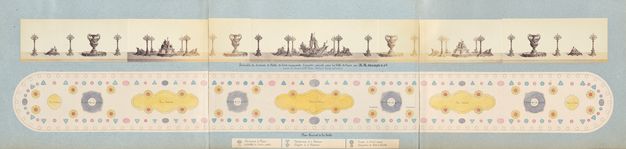
Hôtel de Ville (the main city hall) in Paris (fig. 1). The city of Paris, through its prefect of the Seine,
Georges-Eugène Haussmann, commissioned this work from the
goldsmithing firm Christofle to coincide with the completion
of the building’s renovation and the Paris Exposition
Universelle of 1867.6
The set was officially designed by the city architect Victor
Baltard, who completed additions to the Hôtel de Ville and was
also in charge of municipal ceremonies, including planning
state visits and banquets.7
The firm produced the central sculptural parts in cast bronze
electroplated with silver and gold along with twenty
candelabra and smaller compositions that embellished the ends
of the table. Four large ceramic vases executed by the Sèvres
manufactory were set in jardinieres and occupied either side
of the central group. Place settings for 150 guests along with
footed dishes for desserts and metallic baskets for flowers
completed the commission.
ExpandFig. 1. —Foldout, six-part photographic panorama and
hand-colored plan from
Surtout de table de la Ville de Paris, éxecuté par
Mrs. Christofle et Cie d’après les dessins de Mr. Vor.
Baltard, member de l’Institut, et détruit dans
l’incendie de l’Hôtel de Ville en mai 1871,
ca. 1872, albumen prints and watercolor.
Los Angeles, Getty Research Institute, 2023.R.7.
The service and other ornaments were added to the
long-standing expansion and restoration of the Hôtel de Ville,
which had begun in the 1830s. Under Baltard’s tenure as city
architect, he added new buildings to the complex, enclosed the
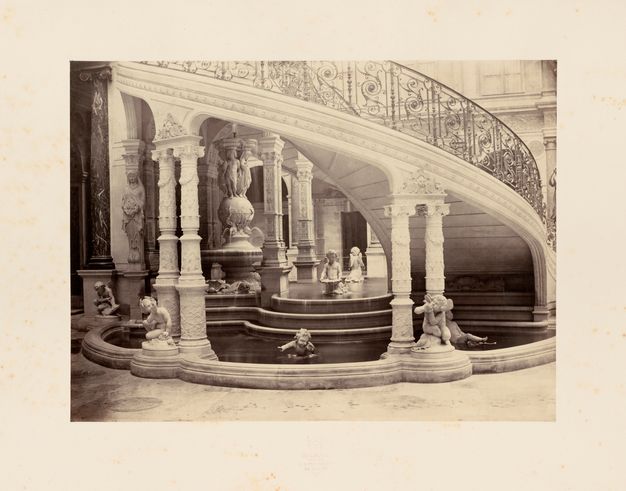
courtyard, and created the curving courtyard stair that
embraced a large fountain, which Baltard completed with Max
Vauthier and the sculptor Auguste Jean-Baptiste Lechesne in
1855 (fig. 2).8
The central figural group of the centerpiece, intended for the
table of the Galerie des Fêtes, reproduced in sculptural terms
the motto and coat of arms of the city of Paris:
Fluctuat nec mergitur, or “She is tossed by the waves
but does not sink.” The heraldic device appeared on coins and
seals from the thirteenth through the sixteenth centuries, but
Haussmann legally adopted it in 1853 to commemorate the first
year of Napoléon III’s rule. Rendered in three dimensions to
preside over the grand dining room, the seal imagery of vessel
and tower-crown were incorporated into the composition of the
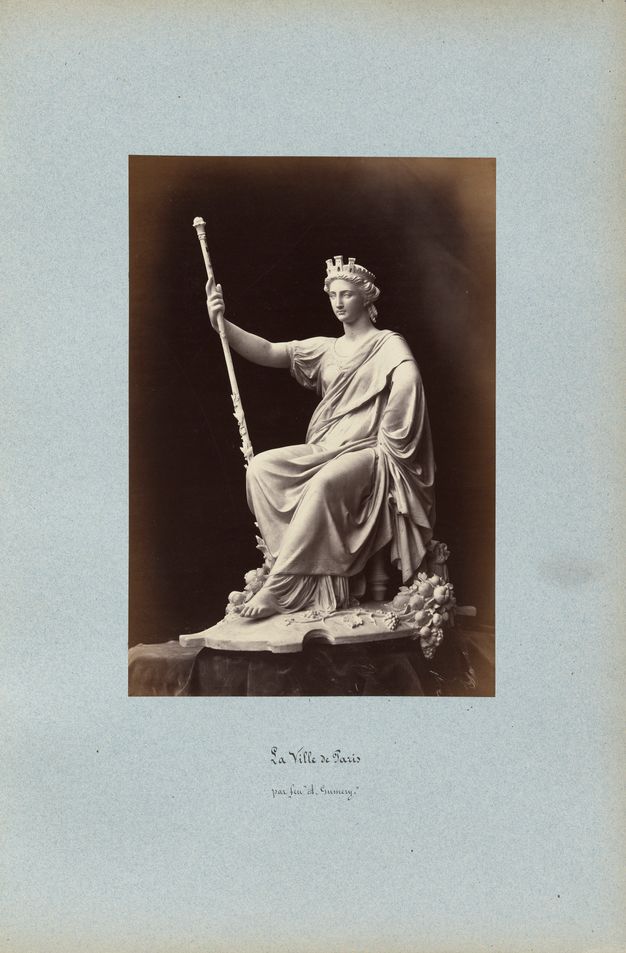
figural sculptures. A crowned, female allegorical figure of
the city of Paris is seated holding a scepter (fig. 3). In the full composition, she is elevated above a large
boat by two pairs of classical caryatids personifying on one
side Commerce and Industry, and on the other, Science and Art.
The figure of the city of Paris is accompanied on the boat by
the allegories of Progress, a male youth looking forward at
the prow, and Prudence, a woman seated behind, near the
rudder. This central group of figures gave physical form to
the ideal of good government using the imagery of classicism
and the language of allegory, which proliferated in official
commissions.
ExpandFig. 2. —Charles Marville (French, 1816–79).Interior of the Hôtel de Ville, l’escalier à double
révolution de la cour Louis XIV
(axial stair of the Louis XIV courtyard), ca. 1865,
albumen print from wet collodion negative, 27 × 36.5 cm.
Williamstown, Massachusetts, Clark Art Institute, lent by
the Troob Family Foundation, TR TR2012.36.1.ExpandFig. 3. —Charles Gumery (French, 1827–71), sculptor.La Ville de Paris (The city of Paris), from
Surtout de table de la Ville de Paris, éxecuté par Mrs.
Christofle et Cie d’après les dessins de Mr. Vor.
Baltard, member de l’Institut, et détruit dans
l’incendie de l’Hôtel de Ville en mai 1871,
ca. 1872. Los Angeles, Getty Research Institute,
2023.R.7.
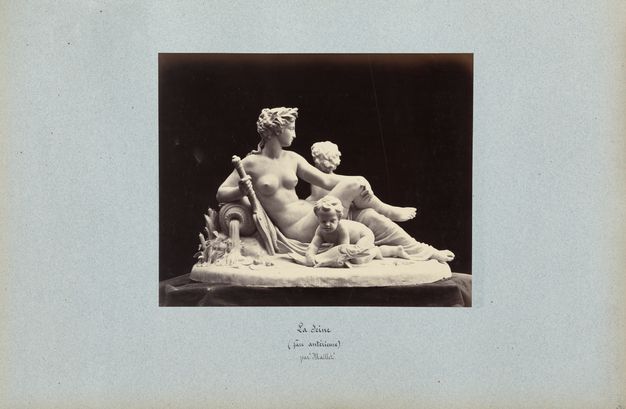
Lateral groups personifying the Seine and Marne Rivers
extended the civic imagery (fig. 4),
along with groups of the four seasons. Candelabra were placed
at intervals between the major figural groups, and clusters of
four accompanied each of the major ensembles. The theme of
water, embodied by the figures of the Seine and Marne, and the
frolicking tritons alongside the boat, continued in the
plateaux, or bases on which the sculptural forms were
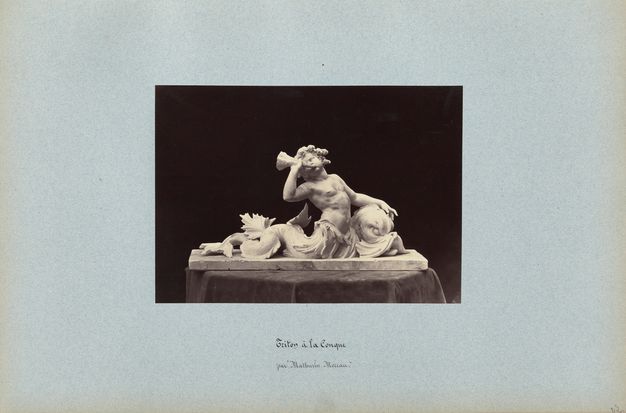
placed. Tritons and putti made indirect references to a long
history of French fountain sculpture, which was thoroughly
revived in the Second Empire (fig. 5).
Indeed, the fluvial theme of Baltard’s centerpiece directly
echoed the elaborate fountain, which the Hôtel de Ville
courtyard’s ceremonial double stair framed (see fig. 2).
ExpandFig. 4. —Jacques Maillet (French, 1823–94), sculptor.La Seine (face antérieure) (Seine River [front
side]), from
Surtout de table de la Ville de Paris, éxecuté par Mrs.
Christofle et Cie d’après les dessins de Mr. Vor.
Baltard, member de l’Institut, et détruit dans
l’incendie de l’Hôtel de Ville en mai 1871, ca. 1872. Los Angeles, Getty Research Institute,
2023.R.7.ExpandFig. 5. —Mathurin Moreau (French, 1822–1912), sculptor.Triton à la conque (Triton with a conch), from
Surtout de table de la Ville de Paris, éxecuté par Mrs.
Christofle et Cie d’après les dessins de Mr. Vor.
Baltard, member de l’Institut, et détruit dans
l’incendie de l’Hôtel de Ville en mai 1871,
ca. 1872. Los Angeles, Getty Research Institute,
2023.R.7.
The surtout served a long-standing purpose of using
sculpture to ornament the surface of the table, animating the
space of the room, especially for official ceremonial
purposes.9
The fine metalwork, or orfèvrerie, assembled the
multiple talents of sculptors, modelers, chasers, and other
essential contributors whose artistic and artisanal
intelligence together produced the surtout. The
Christofle company employed Prix-de-Rome sculptors, such as
Georges Diebolt, Charles Gumery (who modeled the figure of
Paris), Jacques Maillet, Jules Thomas, Mathurin Moreau, and
the finest modelers and chasers, who worked on this
commission. Although Baltard designed the central group of
Paris, it is likely that these artists interpreted his design
(as Lechesne had for the courtyard fountain), adding subtle
dynamism and probably the additional figures and the lively
undulating tritons, in contrast with the resolutely stable
image of Paris.
Napoléon III and others in his government and court prided
themselves on their patronage and sought lively adornments for
their well-appointed dining rooms where they held lavish
formal dinners. These objects served a larger ideological
purpose of conveying official support for the luxury arts
while flattering the regime. The central part of the table
centerpiece, featuring the figure of Paris, was on view at the
London Great Exhibition of 1862, and it presided over a table
in the Hôtel de Ville during the 1867 Exposition Universelle.
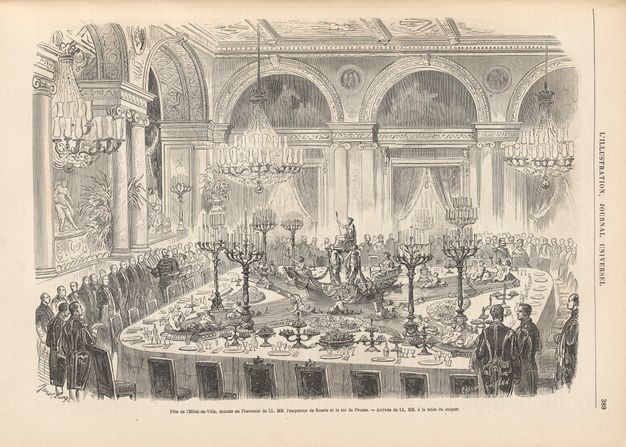
At a dinner in June 1867 honoring Alexander II, emperor of
Russia, and Wilhelm I, king of Prussia, the
surtout commanded the table, drawing attention to its
robust physicality and gleaming surfaces (fig. 6). Its main forms were depicted in careful, if exaggerated,
detail in wood engravings and disseminated in the popular
periodical L’Illustration.10
Like other Christofle creations for official purposes, the
Hôtel de Ville centerpiece was a manifestation of the official
dogma of the Second Empire and designed to impress both French
and foreign viewers.
ExpandFig. 6. —“Fête de l’Hôtel-de-Ville, donnée en l’honneur de LL.
MM. L’Empereur de Russie et le Roi de Prusse. Arrivée de
LL. MM. à la table de souper,” wood engraving from
L’Illustration, 22 June 1867, 399.
Los Angeles, Getty Research Institute, 84-S259.
The album, which exists in at least four versions, goes beyond
merely documenting the various parts of the centerpiece. It
also acts to preserve a historical memory of the table
service, for the metalwork disappeared along with the entire
contents of the building, which was burned on 24 May 1871. The
leaders of the Commune had assumed control over the local
seats of government—the mairies of Paris—and occupied
the central Hôtel de Ville in a symbolic act of claiming
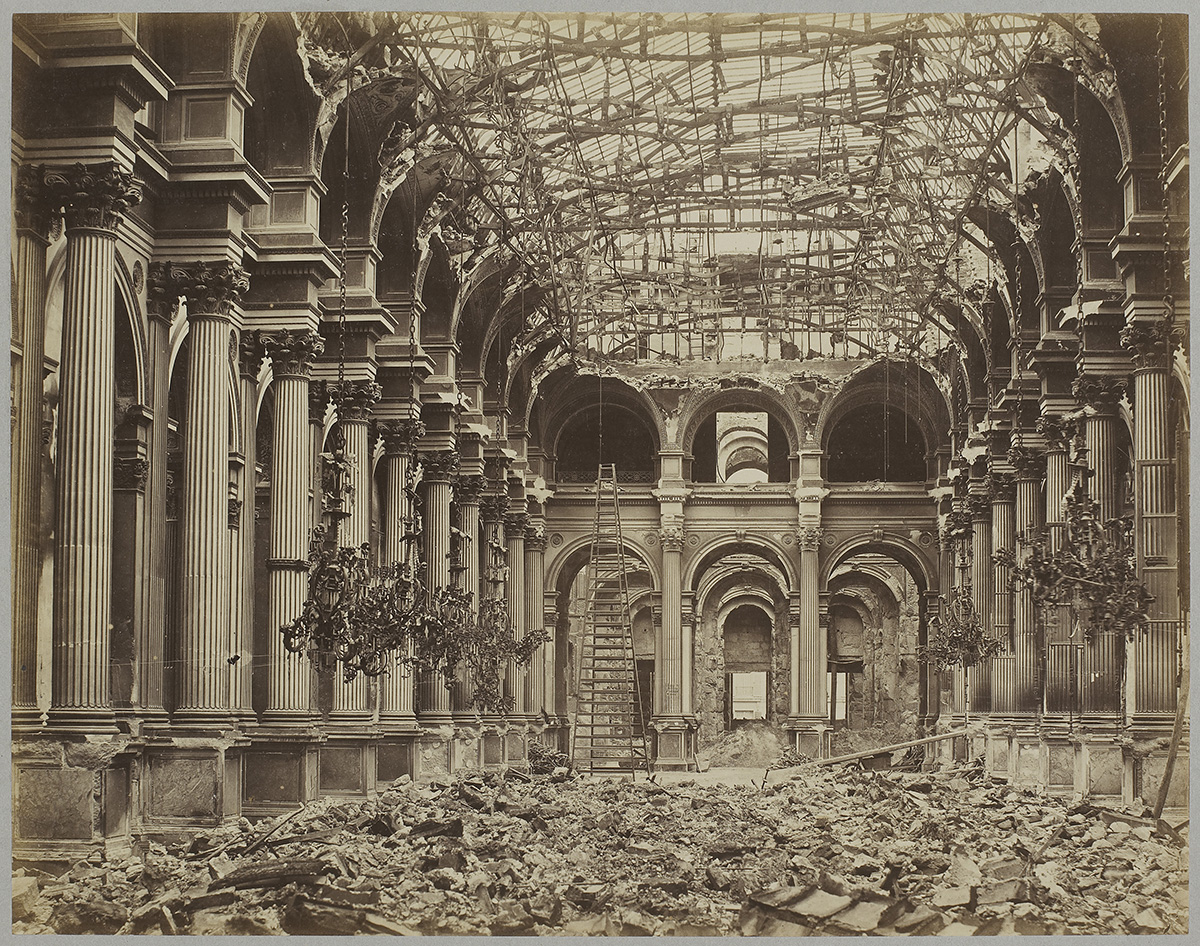
political authority. When the Commune was violently put down
by the advancing army from Versailles, fires were deliberately
set, destroying many official buildings, including the Hôtel
de Ville and its contents (fig. 7). The
album documents the main sculptural and decorative forms of
the service, but it has a curiously opaque history. Four known
copies share the same images and yet they are not
identical.11
All are albums of photographs depicting some original objects
and the plaster models that were probably used to cast the
figural groups, but some are bound in a different order, and
captions are written in different hands. Some have a long
watercolor foldout showing the intended arrangement for the
placement of each piece on the table. All indicate that the
surtout had been destroyed in the fire of 1871. Yet
the precise date and circumstances of the albums’ production
is unknown.12
The edition was small and luxuriously produced, and therefore
certainly intended for a limited audience that would
appreciate the cultural import of the commission.
ExpandFig. 7. —Jules Andrieu (French, 1816–after 1876).Disasters of the War, City Hall, Galerie des Fêtes,
ca. 1870–71, albumen silver print, 29.2 × 37.4 cm. Ottawa,
National Gallery of Canada, purchased 1975, inv.
20755.
As a portrait of a metallic object, the album’s images and
materials are surprisingly heterogeneous. Mounted on heavy
blue pages with each leaf captioned in a calligraphic
secretarial hand, the collection comprises different types of
images that together constitute, or reconstitute, the service.
There is no text aside from the inscription on the cover and
the short captions indicating the artist and subject of each
image. In the album held at the Getty Research Institute, like
the example in the collection of the library of the Hôtel de
Ville, the first page is a threefold watercolor drawing
showing a color-coded plan of the arrangement, including the
central grouping, and a hierarchical array of other parts,
including the candelabra, jardinieres and baskets, and
étagères and desserts. This plan is mounted beneath a
panoramic albumen photograph of an illustration showing the
setting in profile, indicating the various parts and their
precise placement on a long table, a visual relationship akin
to that of plan and elevation in architectural terms (see fig. 1). Individual photographs that depict each part of the
service in warm, velvety tones follow. Christofle had long
used photography to document its production and kept an
archive of glass negatives of their designs. These photos were
often of finished goods set against a blank backdrop or
mounted on boards with captions and numbers, some in the same
hand. Although photography was not an uncommon tool in
decorative arts industries, and the photographic album was
itself an invention of the Second Empire, the Christofle album
of the Hôtel de Ville commission goes beyond merely
documenting the parts of the destroyed centerpiece.13
Given the circumstances, I argue that Christofle purposefully
created the albums to portray the centerpiece as an affective
cultural artifact representing a shared sense of loss.
The album, like a collection of family photographs, depicts
the entire group and the individual parts that compose it.
Aside from the jardinieres and vases, the photographs show the
models for the service rather than the finished cast pieces.
The glowing white surfaces of the matte clay or plaster
figures are set against dark backgrounds, enhanced in the
photographic contrast, in line with the conventions for
photographing sculpture.14
The photographs show both sides of the allegorical groups.15
Further, the name of each sculptor is indicated as the author
of the composition. Thus, even though the entire commission
was an object of applied art with many designs of nonfigural
forms, including the ornamental friezes used around the foot,
the images in the album stress the commission’s sculptural
value. Recording the models with explicit attention to
authorship implies the significance of the artistic labor of
the sculptors who collaborated on the project and is in
keeping with Christofle’s efforts to promote the high artistic
merit of their work. Yet traces of manufacture remain. The
original forms were probably made in clay and then cast in
plaster, before being cast in bronze and then silvered. In
some cases, the models were sectioned for casting before they
were rejoined in the process of chasing. Other images in the
album indicate chips and cracks, suggesting that the plasters
had already been used at the time they were photographed. Even
though it depicts objects rather than people, this largely
photographic album adheres in its commemorative quality to the
conventions of a visual biography, in which a life is
constructed to engage viewers empathetically.16
Photography was widely deployed for commemorative and
persuasive purposes in the aftermath of the conflagrations of
1871. The images of ruins, especially Jules Andrieu’s
portfolio Désastres de la guerre (Disasters of the
war) (see fig. 7), are far different
from the elegant forms of the Christofle portfolio, but as art
historian Alisa Luxenberg has argued, the haunting
photographic documentation of the ruins of Paris was created
for multiple reasons and found a wide audience in France and
abroad.17
She observes, “photographs served as both historian and
souvenir, fact and memory.”18
Unlike other images post-1871, especially those of the burned
shell of the Hôtel de Ville itself, the photographs in the
Christofle albums show wear, not overt physical destruction.
Yet as ghostly models of a lost object, these images
nonetheless play on the emotions of viewers. Jill Bennett has
suggested that images possess a powerful experience of
collective “sense memory,” suggesting that cultural pain can
have a shared affect.19
Since the events of 1870–71 ruptured the social bond, the
trauma was collective and lasting. Although there are strong
overtones of mourning in the album, the preparatory forms of
these images also convey the potential of futurity and the
possibility of a version recast from original molds, which
focuses the viewer’s attention on artistic value rather than
politics. As a representation of a carefully constructed work
of art, the Christofle album is a collection of pictures that
enacts a collective sense of ownership.
The commemoration of this artifact was a potentially
complicated endeavor in the years following the Commune.
Christofle prided itself on its bourgeois patriotism. During
the siege, the firm shifted its atelier production to making
swords and bayonets, armaments to enhance street fighting.20
The Prussian military tactic was to isolate Paris, making the
city suffer and starving inhabitants of supplies from the
countryside while strategically bombing parts of the city.
Unemployment and raging hunger made the working classes the
most vulnerable. During this time, Christofle paid its workers
a minimal sum.21
Leaders of the firm later claimed that none of its employees
participated in the insurrection, which was otherwise strongly
supported by workers in the applied arts, especially those in
furniture industries as well as bronze and jewelry-making
foundries.22
Undertaking a memorial of this complex object during the Third
Republic was thus not an obvious response to the molten anger
of the early 1870s. While the centerpiece celebrated the
wounded city of Paris, it also implicated the deposed emperor
and the disgraced prefect. The centerpiece, like the urban
renovations of the city, stood for the reviled Second Empire,
which was notorious for its overspending and its affinity for
spectacle—and thus, moral associations of superficiality.
Since this album was created to honor the grandiose official
allegory that Baltard and Christofle had produced together,
the post-1871, anti-Communard politics of this position are
clear.
The album employed the tropes of martyrdom in its evocation of
the lost centerpiece, suggesting that the firm remembered its
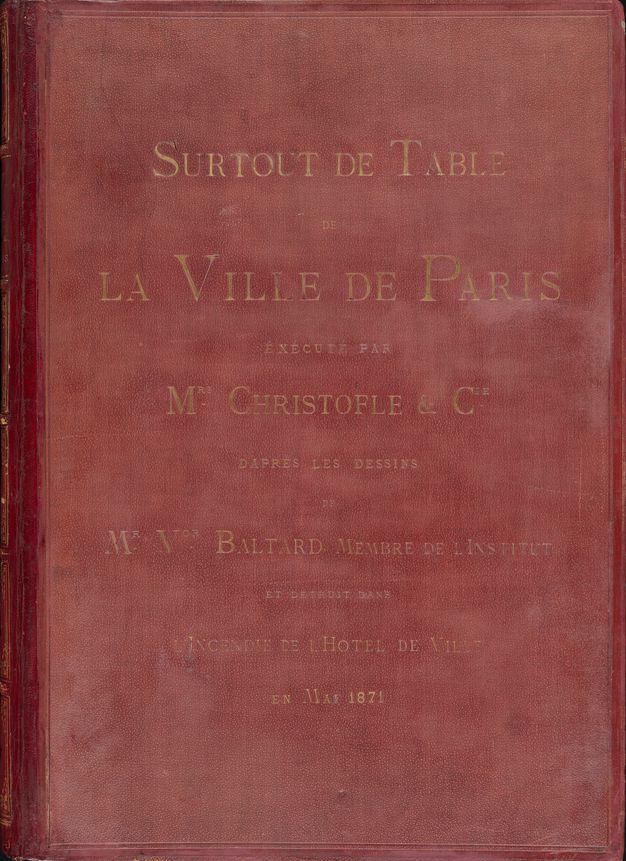
objects as victims. Bound in the rich crimson that dominated
interior decoration of the 1850s and 1860s, the covers of the
various copies read like a tombstone (fig. 8). The prominent designation of the object’s title, the firm
name, and the designer’s name, along with critical information
that the centerpiece was “destroyed in the fire of the Hôtel
de Ville in May 1871” all suggest the conventions of
memorialization.23
Beyond the cover, the painstaking reconstruction of the whole
and its parts in two-dimensional images bolsters the sense of
the grandeur and impressiveness of the lost work. The tenor of
recuperation and loss that underwrote the assembly of images
was no doubt a result of authentic feelings of shock and
dismay at the losses that mounted and the labor that was
sacrificed. The albums, however, joined other memorial
projects as part of an effort by Christofle to remember its
objects as witnesses.
ExpandFig. 8. —Cover of
Surtout de table de la Ville de Paris, éxecuté par
Mrs. Christofle et Cie d’après les dessins de Mr. Vor.
Baltard, member de l’Institut, et détruit dans
l’incendie de l’Hôtel de Ville en mai 1871, ca. 1872.
Los Angeles, Getty Research Institute, 2023.R.7.
Preserving the Tuileries Centerpiece
In the aftermath of the terrible year of 1870–71, Christofle
was also mourning the loss of another commission, one that had
even greater significance for the firm. Napoléon III,
following a long line of French kings and leaders, including
his own uncle Napoléon, took special interest in the applied
arts. He and the Empress Eugénie were keen patrons of fine
goldsmithing firms, which enjoyed the favor of vast imperial
commissions for the lavishly redecorated palaces. The
Christofle firm, moreover, was committed to the imperial
outlook of pursuing modern chemistry and technology alongside
venerable artistic tradition to create their works. A
commission of one hundred place settings and a central
grouping was destined for the Tuileries Palace, the official
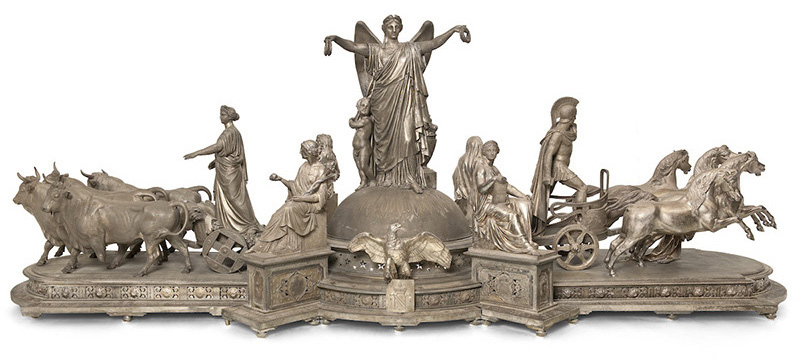
Paris residence of the emperor and empress. The design
centered the allegory of France raising two wreaths of victory
between figures of War in a chariot and Peace driving a group
of cattle (fig. 9). It also included
groups representing Justice, Concord, Religion, and Force, as
well as the major regions of France. Allegories of
Agriculture, Industry, Science, Art, History, and Victory
ornamented the candelabras and baskets that would have been
placed down the length of the thirty-meter table. The imagery
of a prosperous and victorious France was designed by
sculptors Diebolt, Pierre-Louis Rouillard, and François
Gilbert (who directed the project) to flatter the regime and
to claim for the firm a key place in the history of official
patronage. The Tuileries centerpiece, like the one created for
the Hôtel de Ville, was prominently exhibited at Second Empire
world’s fairs, which were opportunities for publicizing both
the regime’s priorities and the economic importance of French
luxury industries. This work, whose manufacture was covered in
the press, was displayed at the first French Exposition
Universelle in 1855 in Paris among a selection of fine objects
produced for the emperor’s household in the special rotunda
dedicated to the crown jewels, where it won a grand medal of
honor.
Along with the incineration of the Hôtel de Ville, the
imperial palaces were looted, ravaged, and burned in May
1871.24
Like the Hôtel de Ville, the Tuileries Palace was an existing
structure that became an object of Second Empire attention,
newly completed and, as a residential seat, furnished at great
expense under the budget of the Maison de l’Empereur.
Finishing the splendidly appointed Tuileries, the
long-standing residence of the French aristocracy, enhanced
the Second Empire claims to legitimacy. But this spectacular
effort, and its visibility as a symbol of the Second Empire
power, made it a primary target during the Commune.25
Communards claimed, “There is no filthier monument, one that
recalls more horrors and infamies” and called for its
destruction as a symbolic end to the Second Empire.26
This vicious enmity made the Tuileries and its showy decor an
obvious target. It was sacked and set ablaze in May 1871.
After a long debate that revisited the politics of the Commune
and the association of the Tuileries with monarchical and
imperial France, the ruined structure was deemed
anti-Republican and demolished in the early 1880s.27
Unlike the building itself, the central parts of Christofle’s
one-hundred place surtout de table executed for the
Tuileries Palace was ultimately saved from the wreckage and
restored. The architect Hector Lefuel, who had finished the
structure along with the new wings of the Louvre for Napoléon
III, combed through the smoking ruins to assess the damage. He
amassed thirty-two hundred kilos of metallic debris, which he
offered to Christofle; the firm bought most of it for ten
francs per kilo. The repossession of the remains of a work
that had bestowed exceptional prestige on the Christofle firm
in the 1850s was more than an effort to reclaim the valuable
raw materials. Using the gathered debris and the models in the
company archives, Christofle embarked on a process of
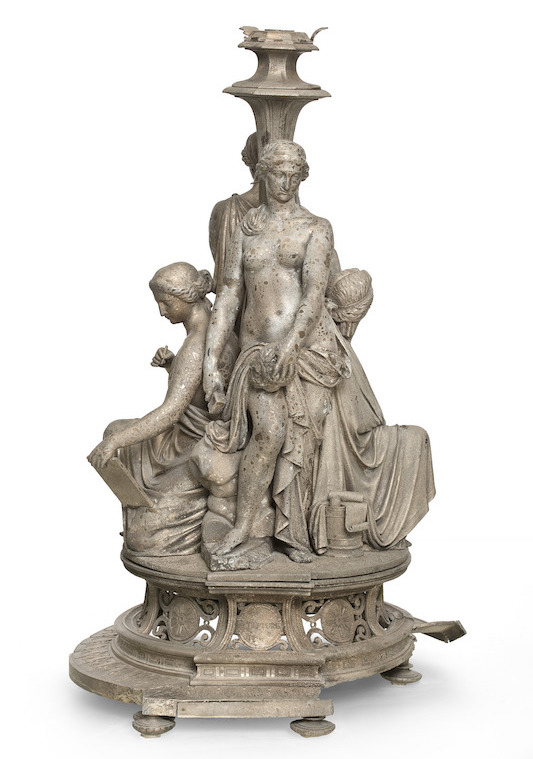
restoring parts of the Tuileries service. The company remade
some of the lost parts to join with the repaired and
resilvered central group, but they left visual evidence of the
damage (fig. 10). Some figures have
severed limbs, and most of the remaining candelabra have
puckered and darkened surfaces. The ornamental friezes of
their bases remain in a fragmented state with obvious losses
that were not concealed or replaced. These deliberate
artifactual traces bore witness to the high heat of the
destructive Tuileries fire. In addition, Christofle recast
some of the utilitarian serving dishes of the Tuileries
service. The expense of recuperation and the labor of remaking
was not slight. Like the album of the Hôtel de Ville
centerpiece, the firm’s efforts to remember and remake its
most glorious objects was also an attempt to collect and
secure its legacy in the shifting context of the Third
Republic.
The effort to preserve the Christofle artifacts was entangled
with the promotion of the history of French
orfèvrerie in the second half of the nineteenth
century. The key figure in this endeavor was Henri Bouilhet
(1830–1910). The Bouilhet family was closely aligned through
business and marriage with the Christofle enterprise. As an
orphaned nephew of Charles Christofle, Henri Bouilhet was
taken into the immediate family and ensured education and
training as an engineer-chemist under Jean-Baptiste Dumas at
the École Centrale des Arts et Manufactures and the Société
d’Encouragement pour l’Industrie Nationale. Bouilhet entered
the firm equipped with new scientific knowledge of
electrochemistry, which became a Christofle specialty. He
ascended through the company, by all accounts an intelligent
and hardworking figure dedicated to the firm and its founder.
After the death of Charles Christofle in 1863, his son Paul
Christofle and Bouilhet took over, as cousins, the shared
management of Christofle et Cie. The Second Empire, then,
marked not only the fortunes of the firm but also the career
of Bouilhet himself.
Bouilhet used his scientific knowledge to promote the use of
the new techniques of electroplating and electroforming
(galvanoplastie) and developed a process for casting
in the round that was used for monumental doors, large-scale
sculpture, and copies of artifacts. He was also a witness to
the company’s rising prospects under the patronage of Napoléon
III. Just two years after Bouilhet entered the firm in 1851,
Christofle was awarded its most important early commission,
the Tuileries surtout for Napoléon III, for which
some parts would be cast galvanically. The use of this process
tested the possibilities for the meeting of art and industrial
manufacture in a work of considerable public significance.
According to Victor Champier, art critic and Bouilhet’s
longtime friend and collaborator, Bouilhet’s attachment to
this commission was not just technical, for Bouilhet also
contributed sketches for some ornamental parts of the dish
covers. Champier recounts Bouilhet’s treatment of the debris:
“With a sort of piety, he applied himself to reassembling the
shapeless fragments, to restoring the missing parts of the
decoration fashioned in the past, and to bringing back to life
the most important pieces of this famous Napoléon III
centerpiece.”28
Witnessing Bouilhet in the process of reconstruction, Champier
recalled the care with which he assembled the parts and his
emotional attachment to the task:
I had the occasion to see the eminent engineer in his
ateliers in the rue de Bondy, while he presided over the
patient and careful reconstitution. . . . The task made him
radiant and reminded him of his ardor in his twentieth year.
His dark eyes so vivid shone with pleasure and he, who was
normally hardly loquacious, found ardent and colorful words
to explain to me in his deep and resonant voice the first
genesis of the work of his youth, which pleased him to bring
back to life.29
Champier’s repetition of Bouilhet’s devotion to bringing this
work “back to life” suggests how critically it figured in his
personal story. It also indicates that Bouilhet understood the
centerpiece to be animated, or reanimated, after its “death.”
Far from merely a technical intervention, then, the
restoration of the centerpiece was a labor of personal
conviction, and returning it “to life” was also an effort to
recognize the work of many esteemed contributors, and to
revisit the passage of time.
The restored Tuileries centerpiece, apart from commemorating
the fine workmanship, also embodied the firm’s own history.
The restoration of the remaining parts was likely completed by
the early 1890s, for it was donated in 1891 to the nascent
Musée des Arts Décoratifs to perpetuate the memory of Charles
Christofle. According to Champier (writing with or for
Bouilhet), the company “hoped to reconstitute some of the most
important pieces and to save from oblivion a work that had
been the glory of their father.”30
The twinning of the reconstituted historical artifact with a
commemorative effort to honor the deceased Charles Christofle
gave the Tuileries centerpiece a testimonial quality that
surpassed its association with the ignoble demise of the
Second Empire. Remade, the injured forms suggested the glory
of France and its tradition of fine metalworking, which, true
to their original purpose, continued to perform a splendid
public role.
Bouilhet’s part in the project of promoting the Christofle
firm dovetailed with efforts by others on behalf of the
applied arts in France, and specifically the increasingly
public outlook of the Union Centrale des Arts Décoratifs.
Formed in the 1860s, the Union Centrale had emerged from a
private organization of designers and manufacturers who
advocated for the interests of their members. Following the
British example of the Museum at South Kensington (now the
Victoria and Albert Museum), the organizers aimed to collect
and exhibit both contemporary and historical artifacts and to
create a library of design that would suit the interests of
skilled artisans. According to art historian Rossella
Froissart Pezone, those early ideas were transformed in the
late 1870s into a strategy for display that ultimately divided
Union Centrale leaders over whether to privilege the history
of a material (something the makers favored) or the uses to
which that material might be put, which the collectors
advocated.31
Debora Silverman has suggested that the organization, which
had changed its name from the Union Centrale des Beaux Arts
Appliqués à l’Industrie to the Union Centrale des Arts
Décoratifs in the 1880s, shifted its emphasis away from the
industrial manufacturing of the 1860s toward the investments
of government ministers, collectors, and elite producers to
venerate the ancien régime. A catalyst of this transformation,
she argues, was the artistic losses of 1870–71 and the
election, in 1874, of a new administrative council within the
Union Centrale, which included Bouilhet.32
Silverman stresses the resurgence of interest in works held in
private collections amid the campaign to create a museum for
the Union Centrale, yet, as she also documents, the group had
a long-standing interest in mounting retrospective exhibitions
dating to the mid-1860s.
As vice president of the Union Centrale, Bouilhet and his
colleagues pursued a series of retrospective exhibitions that
highlighted specifically French luxury industries, such as
costume (1874) and textiles and tapestry (1876). In the 1880s,
they held exhibitions on the elemental arts of metal; the arts
of wood and fabric (furniture and textiles); the arts of fire
(stone, ceramics, and glass); and a recapitulative exhibition
in 1887. The displays of techniques and juxtapositions of
contemporary and retrospective works in the 1880s included a
broad selection of French applied arts. While these
exhibitions garnered attention for manufacturers and created
cohesion among the collectors and supporters for the idea of a
museum of French design, the museum had yet to find a
permanent home. Before the Musée des Arts Décoratifs finally
opened in the Pavillon de Marsan in 1905, the grandest and
most thorough history of French design and manufacture to date
was presented in the temporary but widely viewed Musées
Centennaux et Rétrospectives (Centennial and Retrospective
Museums), a series of medium-specific exhibits, mounted in
conjunction with the Paris Exposition Universelle of 1900.
The impulse to display a national history of craft and
manufacture alongside the newest production owed to the
Janus-like sentiment of the turn-of-the-century fair, which
was poised to look both forward and backward from 1900. The
centennial exhibits were a cumulative material summary of the
previous one hundred years of French production, which was
presented in individual exhibitions of painting and sculpture,
photography, pharmacy, transportation, and especially the
applied-arts industries. In short, the classes of new objects
on view at the international exhibition had historical
counterparts in the Musées Centennaux. The displays were
intended to show the public “the product, its fabrication, and
its history.”33
François Carnot, a politically well-connected special
delegate, organized the displays, working with the French
juries of each class.34
Thus, the specialists of each material or type curated their
own selection and wrote the narrative of the historical works
in catalogs that each French jury published independently.
In addition to painting and sculpture, on view were
embroidery, costume and fashion, toys and dolls, lighting,
ceramics, photography, a survey of public life in Paris, and
public works.35
Several classes combined to produce a museum of furniture and
decoration that included full interiors, which art and design
historian Anca Lasc has argued acted as a series of immersive
period rooms.36
While some of the Musées Centennaux displays were included in
the French section in the Grand Palais, other classes, such as
furniture and silversmithing, were shown on the Esplanade des
Invalides. Together, these retrospective assessments claimed
for France the expertise and artistic lineage of manufacture
that served to polish its reputation internationally. Lasc has
argued that the furniture displays of the Musées Centennaux
constituted a visual argument for a nationalist rhetoric of
continuity in design, linking the past spatially with the
present. Shown under the banner of progress, a rhetorical
trope of nineteenth-century expositions, these displays also
made an argument for a history of French design that
transcended politics and time. The project of juxtaposing
exhibitions of both recent and historical objects surely
attracted consumer interest for the new goods on view, but
this endeavor to recount the history of French design was
undertaken above all with devotion to the memory of the past.
The centennial display of silver- and goldsmithing, Class
ninety-four, included more than eleven hundred objects from
the eighteenth century onward, with special emphasis on the
nineteenth century.37
Positioned behind the presentation of new work (by some of the
same firms), the historical forms were shown as the ancestors
of the present. The historical objects, however, were also
active and vigorous intercessors in a history of the material
and the politics of the age. Because some committees rejected
the premise that a survey of their medium could logically
begin in 1800, some classes instead anchored their exhibits in
earlier times. For the Class ninety-four displays, there was a
case of eighteenth-century girandoles and candelabras,
including works by the eminent father and son, both royal
silversmiths, Thomas and François-Thomas Germain. Neoclassical
vessels from the Empire period, a selection of Froment-Meurice
objects from the Louis-Philippe era, and a healthy selection
of Second Empire artifacts represented the mid-nineteenth
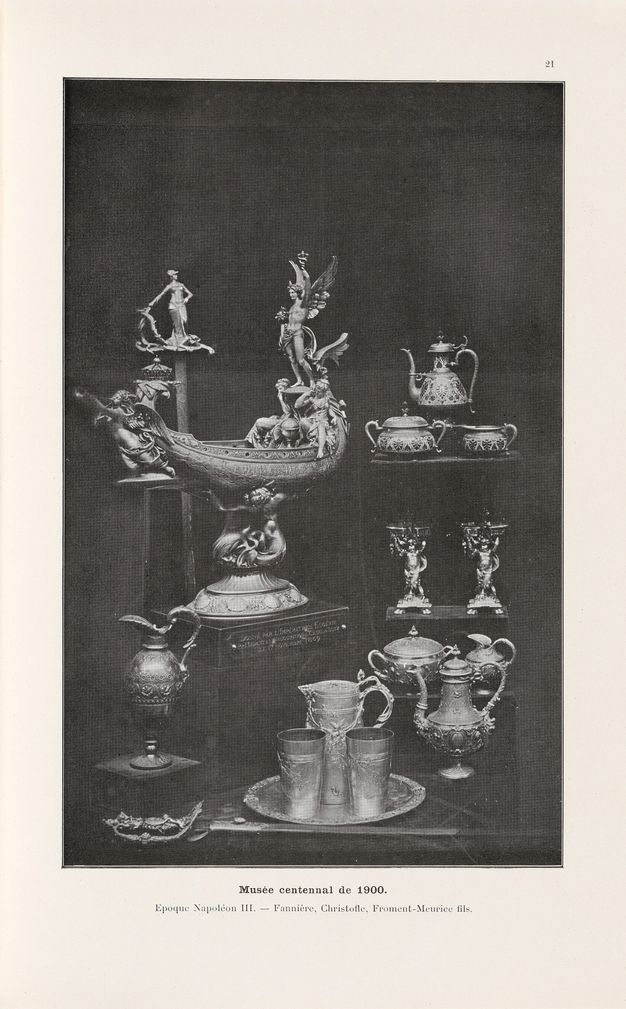
century. In the Second Empire display, the large silver
presentation cup in the form of a boat dominated. Commissioned
from Fannière Frères by Empress Eugénie, the cup was offered
to her cousin, the diplomat-turned-land-speculator Fernand de
Lesseps upon the completion of the Suez Canal in 1869 (fig. 11). The Second Empire display also included a group of objects
that Eugène-Emmanuel Viollet-le-Duc designed for the cathedral
Notre-Dame de Paris, which were executed by the religious
metalworking firm Poussielgue-Rusand. At the center of the
entire retrospective exhibit, on a large table, sat the
restored parts of the Tuileries centerpiece, lent by the Musée
des Arts Décoratifs. The effort to remake the centerpiece,
which bore the traces of its destruction, had preserved not
only the memory of the Second Empire and its material opulence
but also the preeminence of the firm and its place in a
history of French artistic production in metal. It joined the
Suez cup and the Notre-Dame reliquary as material witnesses of
important French monuments that gave the image of the Second
Empire a retrospective honor. Reconstituted and exhibited in
these circumstances, the centerpiece played a theatrical role
in the staging of French design as a collective national
endeavor that exceeded the artifacts of a deposed elite.
ExpandFig. 11. —“Musée centennale de 1900. Époque Napoléon
III—Fannière, Christofle, Froment-Meurice fils,” from
Henri Bouilhet,
L’orfèvrerie française aux XVIIIe et XIXe siècles
(1700–1900),
vol. 1,
L’orfèvrerie française aux XVIIIe siècle
(1700–1789)
(Paris: H. Laurens, 1908), 21.
Los Angeles, Getty Research Institute, NK7149.B76.
The historical sensibility that informed the Musée Centennal
exhibition project also prevailed in the images, reports, and
catalogs. Objects and displays from the Musées Centennaux were
featured in the Exposition’s illustrated portfolios called
Le Panorama, which was issued as a popular serial of
the official photographs.38
The final reports produced by each jury were far more
scholarly. Some of these were straightforward lists of objects
and their lenders, along with general descriptions of the
history of the subject. Others were lavish productions that
included extended essays, narrative histories, and
photographic images of the individual objects and their
display in 1900.39
The most ambitious texts went far beyond documenting works
produced between 1800 and 1900; they also expanded the
historical context to become standard historical works on the
subject.40
Bouilhet’s final report on the Centennial exhibition of Class
ninety-four was integrated into an exceptionally complete,
three-volume illustrated
L’orfèvrerie française aux XVIIIe et XIXe siècles.41
This effort dwarfed the exhibition itself and became a
definitive account of French metalwork and, beyond that,
Bouilhet’s own final contribution to the field of applied
arts.42
While the cover and title page of all three volumes indicate
that the text was written by Henri Bouilhet “after documents
gathered for the Musée centennal,” the scholarship was
nonetheless highly collaborative and intertextual. Bouilhet’s
narration of a history of French production drew from
firsthand knowledge as well as sources by critic Paul Mantz,
authors Henry Havard and René Ménard, and other histories of
metalwork that appeared in the second half of the nineteenth
century.43
Champier, secretary for the Union Centrale, a member of the
Musées Centennaux commission and of the jury for Class
ninety-four as well as editor of the
Revue des arts décoratifs, wrote long parts of the
text and managed its publication.44
This, then, was a collective effort to recover a history of
French metalwork from its origins to the present.
Beginning in the Roman Empire and the Middle Ages, the text
describes the historical uses of fine metalwork, its
techniques, and its patrons. It moves quickly to the
eighteenth century—by page forty of the first volume. Volumes
two and three comprise the period of 1800–1900, with the
Second Empire straddling these accounts. The story of the
Christofle firm is integrated into this history, and images of
its output dominate the illustrations of the final two
volumes. Some of the text is identical to sections published
elsewhere under Champier’s name and drafts in his archive.
These include the critical selections on Christofle that
Champier, rather than Bouilhet, penned.45
Bouilhet’s history of French orfèvrerie exploited
images and the possibilities of photomechanical reproduction.
The three volumes present a lavishly illustrated history,
incorporating line drawings, wood engravings, and photographs.
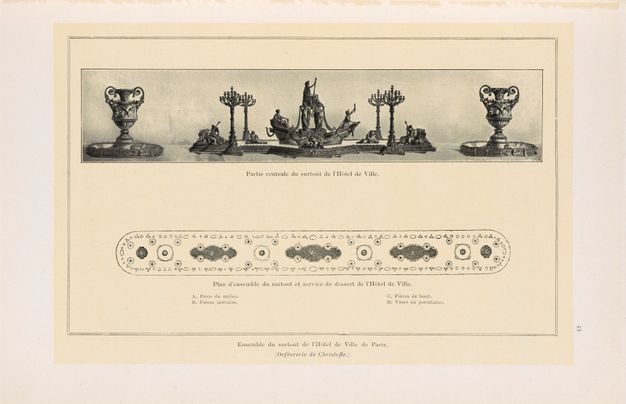
Along with an extensive description of the commission for the
Tuileries and Hôtel de Ville centerpieces, the catalog
includes images of these works in numerous successive,
full-page photographs (fig. 12). The
images of the Hôtel de Ville centerpiece are identical to
those that appear in the albums. The project of writing a
history of design in images and objects therefore preoccupied
the leaders of the Christofle firm who repossessed, remade,
and ordered the historical accounts of their objects.
ExpandFig. 12. —“Ensemble du surtout de l’Hôtel de Ville de Paris
(Orfèvrerie de Christofle),” from Henri Bouilhet,
L’orfèvrerie française aux XVIIIe et XIXe siècles
(1700–1900),
vol. 3,
L’orfèvrerie française aux XIXe siècle: Deuxième
période (1860–1900)
(Paris: H. Laurens, 1912), 43.
Los Angeles, Getty Research Institute, NK7149.B76.
Bouilhet’s efforts to write the history of his own métier
dovetailed with efforts to preserve French prestige in the
final years of the nineteenth century. From the vantage point
of 1900, with its resplendent art nouveau exhibits, the
historical trajectory of French metalwork seemed destined for
an optimistic future. Yet, even while reassuring readers and
exhibition viewers of continuity, the visceral upset of the
devastation of the 1870–71 era is unmistakable in the account
of fine metalwork production from the third volume of
L’orfèvrerie française:
It will be one of the astonishments of history, the
prodigious rapidity with which it arose from the disasters
of the terrible year. Disasters had piled up. To the ruins
and mourning of the most appalling of wars were added the
worst scourges: the tearing of internecine struggles, the
underlying anguish of the occupation by the German army of
the mutilated patrie, the obligation to pay the
victor an enormous indemnity of five billion, finally the
agitations of the political parties which could not bring
themselves to accept the Republic, as a system of government
succeeding the Empire. In the midst of such a troubled
situation, we saw, as if by magic, the luxury industries
flourish again. In the workshops, where the craftsmen,
returning from the battlefields, hastily resumed their
tools, there was a veritable fever of activity.46
Like the nationalist rebirth of the French patrie,
the dramatic return of the metalworking industry was
juxtaposed against disaster and ruins. By exhibiting and
writing their works into a history of French design, the
Christofle firm cast their lost objects in a discourse of
survival that ensured continuity of the firm’s reputation and
put it above the censured politics of the Second Empire. Well
aware of the historical potential of the object, Bouilhet
and/or Champier conclude their history with a suggestion of
the potential of metalwork to reveal something deeper about
the past:
The industry, whose history we have attempted to trace, and
the fluctuations of two centuries reflect perhaps more than
any other the physiognomy and the state of the soul of
successive generations whose needs it served. Art is the
powerful beacon that illuminates its route, regulates its
evolution, and transforms itself according to the changing
idea of society. . . . Aside from the general causes that
influence taste and fashion, and which determine the
principal character of decorative art of the time, one must
consider the quantity of smaller phenomena and secondary
causes, so to speak, whose succession and union create
little by little a larger movement and sometimes provoke
unexpected and decisive results.47
As artifactual witnesses, the two centerpieces and their
material journey can be read alongside this statement. The
damaged relics testified to the ostentatious fashion and
historicizing taste of their era as well as to the smaller
phenomena of specific artistic collaborations, and finally to
the brutal historical vicissitudes that ultimately required
remaking them once again. By remembering and remaking Second
Empire objects, whether in metal, in photographic albums, or
in text, Bouilhet and his colleagues reclaimed not only the
objects themselves but also their testimonial value. They then
deployed them to tell a history of their production that made
larger claims for a splendid French tradition of design and
craftsmanship, which they expected to persist. For the
Christofle company and for later scholars, a deliberative
regard—in line with the one evoked in this article’s epigraph
by Vladimir Nabokov—reveals how the circuitous histories of
material objects continue, like a mise en abîme, to inform our
own attempts to analyze and write histories of objects and
eras.
Amy F. Ogata is professor of art history at
the University of Southern California.
Notes
I began thinking about the material afterlife of the Second
Empire as a scholar at the Getty Research Institute (GRI) in
fall 2015 and thank the GRI Scholars Program for that
opportunity. All translations from the French are mine.
Musée Centennal des Classes 66, 69, 70, 71, 97:
Mobilier et Décoration à l’Exposition Universelle
Internationale de 1900 à Paris; Rapport de la
Commission de l’Installation
(Saint-Cloud: Belin, ca. 1900), 51,
https://archive.org/details/gri_33125009323458/mode/2up. ↩︎
Maurice Halbwachs, “The Reconstruction of the Past,” in
On Collective Memory, ed. and trans. Lewis A.
Coser (Chicago: University of Chicago Press, 1992),
46–51; and Éric Brian, “A Theorist of Collective
Memory,” in
The Anthem Companion to Maurice Halbwachs, ed.
Robert Leroux and Jean-Christophe Marcel (London:
Anthem, 2021), 5–16.
↩︎
Allison Stielau, “Liquid Metaphors and the Politics of
Melted Metal,” West 86th 28, no. 2 (2021):
319–26.
↩︎
See, for example, Anna Arabindan-Kesson,
Black Bodies, White Gold: Art, Cotton, and Commerce
in the Atlantic World
(Durham, NC: Duke University Press, 2021); Peter H.
Christensen,
Precious Metal: German Steel, Modernity, and
Ecology
(University Park, PA: Penn State University Press,
2022); and Helen Hills, ed.,
Silver: Transformational Matter (Oxford: Oxford
University Press, 2024).
↩︎
New attitudes toward conservation and its histories
underscore the ways in which cultural artifacts are also
products of technical interventions. See Peter N. Miller
and Soon Kai Poh, eds.,
Conserving Active Matter (Chicago: University
of Chicago Press, 2022).
↩︎
For the history and iconography of the commission, see
Claudia Kanowski, “Le surtout de table de la ville de
Paris,”
Paris et Île-de-France: Mémoires publiés par la
Fédération des Sociétés historiques et archéologiques
de Paris et de l’Île-de-France
44 (1993): 175–205.
↩︎
Christopher Curtis Mead,
Making Modern Paris: Victor Baltard’s Central Markets
and the Urban Practice of Architecture
(University Park, PA: Penn State University Press,
2012), 77.
↩︎
David Van Zanten,
Building Paris: Architectural Institutions and the
Transformation of the French Capital, 1830–1870
(Cambridge: Cambridge University Press, 1994), 91.
↩︎
Marcia Reed, ed.,
The Edible Monument: The Art of Food for
Festivals
(Los Angeles: Getty Research Institute, 2015).
↩︎
Some twenty candelabras, four large Sèvres vases, and
one hundred twenty pieces for flowers, fruits, and
dessert completed the ensemble. See Henri Bouilhet,
L’orfèvrerie française aux XVIIIe et XIXe siècles
(1700–1900), vol. 3,
L’orfèvrerie française aux XIXe siècle: Deuxième
période (1860–1900)
(Paris: H. Laurens, 1912), 42.
↩︎
Similar but not identical albums exist at the
Bibliothèque du Conseil de Paris, the Bibliothèque de
l’Hôtel de Ville, the Bibliothèque Forney in Paris, the
Christofle et Cie archives in Paris, and the Getty
Research Institute in Los Angeles.
↩︎
The depiction of plaster models in the photographs is
the greatest rationale for a post-1871 dating of the
extant albums, assuming the metallic object was
completely lost. Baltard, who died in 1874, is not noted
as deceased in the Getty album, but Diebolt (d. 1861)
and Gumery (d. 1871) are. Claudia Kanowski argues that
the slightly different text, and date of 1867, on the
cover of the version in the library of the Hôtel de
Ville indicate that it may have been a presentation
copy. Kanowski also suggests that the company sought a
second commission for the centerpiece in the 1880s to
replace the centerpiece lost in the fire. Kanowski, “Le
surtout de table de la ville de Paris.”
↩︎
Martha Langford,
Suspended Conversations: The Afterlife of Memory in
Photographic Albums
(Toronto: McGill-Queen’s University Press, 2021), 23.
↩︎
Sarah Hamill and Megan R. Luke, introduction to
Photography and Sculpture: The Art Object in
Reproduction
(Los Angeles: Getty Research Institute, 2017), 1–32.
↩︎
One side of the Summer and Winter composition is
depicted with a surface sheen, and could possibly be a
metallic object, or one of plaster with a coating of
graphite.
Surtout de table de la Ville de Paris, éxecuté par
Mrs. Christofle et Cie d’après les dessins de Mr. Vor.
Baltard, member de l’Institut, et détruit dans
l’incendie de l’Hôtel de Ville en mai 1871,
ca. 1872, GRI, 2023.R.7, unpaginated.
↩︎
Catherine Whalen, “Interpreting Vernacular Photography:
Finding ‘Me’—A Case Study,” in
Using Visual Evidence, ed. Richard Howells and
Robert W. Matson (New York: McGraw Hill, 2009), 78–94;
and Sarah Brophy and Janice Hladki, eds.,
Embodied Politics in Visual Autobiography
(Toronto: University of Toronto Press, 2018).
↩︎
Alisa Luxenberg. “Creating Désastres: Andrieu’s
Photographs of Urban Ruins in the Paris of 1871,”
The Art Bulletin 80, no. 1 (1998): 113–37. See
also Éric Fournier, “Les photographies des ruines de
Paris en 1871 ou les faux-semblants de l’image,”
Revue d’histoire du XIXe siècle 32 (2006):
137–51.
↩︎
Marc de Ferrière le Vayer,
Christofle: Deux siècles d’aventure industrielle,
1793–1993
(Paris: Éditions Le Monde, 1995), 215.
↩︎
Kristin Ross,
Communal Luxury: The Political Imaginary of the Paris
Commune
(London: Verso, 2015), 52–65. See also Gonzalo J.
Sánchez,
Organizing Independence: The Artists Federation of
the Paris Commune and Its Legacy, 1871–1889
(Lincoln: University of Nebraska Press, 1997), 78.
Sánchez indicates that 748 artisans were supporters of
the Commune and the artists’ federation.
↩︎
In the Hôtel de Ville copy, Baltard’s affiliation with
the Institut de France as a member of the Académie des
Beaux-Arts is noted, but unlike other copies where this
is indicated on the cover, it is in the text underneath
the plan of the table.
↩︎
Alexandre Gady, “La disparition des palais, 1870–1892,”
in
Palais Disparus de Napoléon: Tuileries, Saint-Cloud,
Meudon
(Paris: Mobilier National, 2021), 465–76.
↩︎
Quentin Deluermoz,
Commune(s) 1870–1871: Une traversée des mondes au
XIXe siècle
(Paris: Seuil, 2020), 233–38.
↩︎
Le Père Duchêne, no. 3 (10 Floréal An 79) (30
April 1871), 65.
↩︎
Louis J. Ianoli, “The Palace of the Tuileries and Its
Demolition,” The French Review 79, no. 5
(2006): 986–1008.
↩︎
Victor Champier, “La vie et l’oeuvre de Henri Bouilhet
1830–1910,” preface to L’orfèvrerie française,
by Bouilhet, vol. 3 (Paris: H. Laurens, 1912), xvi.
↩︎
Champier, “La vie et l’oeuvre de Henri Bouilhet
1830–1910,” xvi–xvii.
↩︎
Rossella Froissart Pezone, “Controverses sur
l’aménagement d’un Musée des arts décoratifs à Paris au
XIXe siècle,” Histoire de l’art 16 (1991):
55–65.
↩︎
Debora L. Silverman,
Art Nouveau in Fin-de-Siècle France: Politics,
Psychology and Style
(Berkeley: University of California Press, 1989),
109–33.
↩︎
Stéphane Dervillé, quoted in Henri Bouilhet,
Musée Centennal de la classe 94. L’orfèvrerie
française à l’Exposition Universelle Internationale de
1900, à Paris
[. . .]
Rapport du Comité d’Installation, M. Henri Bouilhet,
rapporteur
(Saint-Cloud: Belin, 1908), 2.
↩︎
François Carnot, engineer and cultural administrator,
was the son of Sadi Carnot, who was president of the
Republic between 1887 and 1894, when he was
assassinated.
↩︎
Since each class had its own retrospective exhibit,
there were also displays on the history of public works,
such as bridges and canals as well as railroads and
stations. See
Musée Rétrospectif de la Classe 29: Modèles, plans et
dessins de travaux publics à l’Exposition Universelle
Internationale de 1900, à Paris
(Saint-Cloud: Belin, ca. 1900),
https://archive.org/details/museeretrospecti00expo_0/mode/2up. ↩︎
Anca I. Lasc, “Paris 1900: The Musée Centennale du
Mobilier et de la Décoration and the Formation of a
National Design Identity,” in
Expanding Nationalisms at World’s Fairs: Identity,
Diversity and Exchange, ed. David Raizman and Ethan Robey (New York:
Routledge, 2020), 109–29.
↩︎
Le Panorama nos. 26–30 (1901) were devoted to
the Musées Centennaux. The masthead indicates that
issues grouped multiple classes together and lists them
as: No. 26 Les moyens de transport, les instruments de
musique l’alimentation; no. 27 Les tissus, soieries,
broderies, le mobilier de 1780 à 1880; no. 28 Le
mobilier (suite), les arts du métal, le chauffage,
l’agriculture; no. 29 Le costume de Louis XV à Napoléon
III, les parures de la femme et ses objets de toilette;
and no. 30 Les armes de guerre et de chasse, le
luminaire, la coutellerie, les jouets, la céramique et
la verrerie.
↩︎
Musée Centennal de la Classe 72: Céramique, à
l’Exposition Universelle Internationale de 1900 à
Paris, Rapport du Comité d’Installation
(Paris?, n.p., 1900),
https://archive.org/details/museecentennald00expo/page/n7/mode/2up;
Musée Centennal de la Classe 12 (photographie) à
l’Exposition Universelle Internationale de 1900 à
Paris: Métrophotographie & chronophotographie
(Saint-Cloud: Belin, ca. 1900),
https://archive.org/details/museecentennalde00expo/mode/2up; and
Musée Centennal de la Classe 87: Arts, chimiques et
pharmacie (matériel, procédés et produits) à
l’Exposition Universelle Internationale de 1900, à
Paris
(Saint-Cloud: Belin, ca. 1900),
https://archive.org/details/musecentennald00expo. One compilation examines the history of Paris rather
than applied arts: Charles Simond,
Paris de 1800 à 1900: Les Centennales Parisiennes;
Panorama de la vie de Paris à travers le XIXe
siècle
(Paris: Plon-Nourrit, 1903),
https://archive.org/details/lavieparisiennet02simo. ↩︎
See, for example the three-volume history of French toys
and games: Henry d’Allemagne,
Musée rétrospectif de la classe 100: Jeux
(Saint-Cloud: Belin, 1903).
↩︎
Bouilhet,
L’orfèvrerie française aux XVIIIe et XIXe siècles
(1700–1900),
3 vols. (Paris: H. Laurens, 1908, 1910, 1912).
↩︎
The final volume, which covered the years 1860 to 1900,
was produced and corrected by Bouilhet but was published
in 1912, after his death in 1910.
↩︎
Henry Havard, L’orfèvrerie (Paris: Delagrave,
1891); Henry Havard,
Histoire de l’orfèvrerie française (Paris:
Quantin, 1896); Paul Mantz’s series “Recherches sur
l’histoire de l’orfèvrerie française,” published between
1861 and 1863 in the Gazette des beaux-arts;
René Ménard,
Histoire artistique du métal (Paris: Rouam,
1881); and Ferdinand de Lasteyrie,
Histoire de l’orfèvrerie [. . .] (Paris:
Hachette, 1875).
↩︎
Victor Champier papers, Los Angeles, GRI, 940020, boxes
3 (manuscripts and notes on “Orfèvrerie”) and 6
(correspondence with Henri and André Bouilhet); see
finding aid:
http://hdl.handle.net/10020/cifa940020. ↩︎
Victor Champier papers, GRI, box 3, folder 7. Champier
collaborated with Bouilhet on Union Centrale des Arts
Décoratifs projects in the 1880s and onward.
↩︎
Fig. 1. —Foldout, six-part photographic panorama and hand-colored
plan from
Surtout de table de la Ville de Paris, éxecuté par Mrs.
Christofle et Cie d’après les dessins de Mr. Vor. Baltard,
member de l’Institut, et détruit dans l’incendie de
l’Hôtel de Ville en mai 1871,
ca. 1872, albumen prints and watercolor.
Los Angeles, Getty Research Institute, 2023.R.7.
Fig. 2. —Charles Marville (French, 1816–79).Interior of the Hôtel de Ville, l’escalier à double
révolution de la cour Louis XIV
(axial stair of the Louis XIV courtyard), ca. 1865, albumen
print from wet collodion negative, 27 × 36.5 cm. Williamstown,
Massachusetts, Clark Art Institute, lent by the Troob Family
Foundation, TR TR2012.36.1.
Fig. 3. —Charles Gumery (French, 1827–71), sculptor.La Ville de Paris (The city of Paris), from
Surtout de table de la Ville de Paris, éxecuté par Mrs.
Christofle et Cie d’après les dessins de Mr. Vor. Baltard,
member de l’Institut, et détruit dans l’incendie de l’Hôtel
de Ville en mai 1871,
ca. 1872. Los Angeles, Getty Research Institute, 2023.R.7.
Fig. 4. —Jacques Maillet (French, 1823–94), sculptor.La Seine (face antérieure) (Seine River [front
side]), from
Surtout de table de la Ville de Paris, éxecuté par Mrs.
Christofle et Cie d’après les dessins de Mr. Vor. Baltard,
member de l’Institut, et détruit dans l’incendie de l’Hôtel
de Ville en mai 1871, ca. 1872. Los Angeles, Getty Research Institute, 2023.R.7.
Fig. 5. —Mathurin Moreau (French, 1822–1912), sculptor.Triton à la conque (Triton with a conch), from
Surtout de table de la Ville de Paris, éxecuté par Mrs.
Christofle et Cie d’après les dessins de Mr. Vor. Baltard,
member de l’Institut, et détruit dans l’incendie de l’Hôtel
de Ville en mai 1871,
ca. 1872. Los Angeles, Getty Research Institute, 2023.R.7.
Fig. 6. —“Fête de l’Hôtel-de-Ville, donnée en l’honneur de LL. MM.
L’Empereur de Russie et le Roi de Prusse. Arrivée de LL. MM.
à la table de souper,” wood engraving from
L’Illustration, 22 June 1867, 399.
Los Angeles, Getty Research Institute, 84-S259.
Fig. 7. —Jules Andrieu (French, 1816–after 1876).Disasters of the War, City Hall, Galerie des Fêtes,
ca. 1870–71, albumen silver print, 29.2 × 37.4 cm. Ottawa,
National Gallery of Canada, purchased 1975, inv. 20755.
Fig. 8. —Cover of
Surtout de table de la Ville de Paris, éxecuté par Mrs.
Christofle et Cie d’après les dessins de Mr. Vor. Baltard,
member de l’Institut, et détruit dans l’incendie de
l’Hôtel de Ville en mai 1871, ca. 1872.
Los Angeles, Getty Research Institute, 2023.R.7.
Fig. 11. —“Musée centennale de 1900. Époque Napoléon III—Fannière,
Christofle, Froment-Meurice fils,” from Henri Bouilhet,
L’orfèvrerie française aux XVIIIe et XIXe siècles
(1700–1900),
vol. 1,
L’orfèvrerie française aux XVIIIe siècle (1700–1789)
(Paris: H. Laurens, 1908), 21.
Los Angeles, Getty Research Institute, NK7149.B76.
Fig. 12. —“Ensemble du surtout de l’Hôtel de Ville de Paris
(Orfèvrerie de Christofle),” from Henri Bouilhet,
L’orfèvrerie française aux XVIIIe et XIXe siècles
(1700–1900),
vol. 3,
L’orfèvrerie française aux XIXe siècle: Deuxième période
(1860–1900)
(Paris: H. Laurens, 1912), 43.
Los Angeles, Getty Research Institute, NK7149.B76.