Eastern State Penitentiary Historic Site, a decommissioned
state prison in Philadelphia that reopened as an
interpretive site in 1994, reflects what philosopher
Charles Taliaferro refers to as an open museum,
one that is concerned with dialogue on res publica. It is
also an example of how curators use material culture to
convey knowledge and foster such dialogue. This article
follows the curatorial progression at Eastern State, from
its initial preservation as a stabilized ruin to the
descriptive historical framing of the site, and
subsequently to the critical frameworks offered through
art installations and an interpretation center, all of
which unlock the heritage site from the past and bring it
to bear on contemporary issues of justice in the criminal
legal system. In following this progression, I find that
the particular effectiveness of Eastern State lies in the
way material culture suffuses and informs res publica, in
which a direct encounter with the historic site
distinctively shapes the public conversation.
Keywords
heritage preservation, dark heritage, open museum,
restorative justice, historical prison site
Peer Review
Double anonymous, external
Copied page section link to clipboard
Cite
Chicago
Rita Elizabeth Risser, “Unlocking Heritage at the Eastern
State Penitentiary,” Getty Research Journal, no.
20 (2025),
https://doi.org/10.59491/QXTI7000.
MLA
Risser, Rita Elizabeth. “Unlocking Heritage at the Eastern
State Penitentiary.” Getty Research Journal, no.
20, 2025,
https://doi.org/10.59491/QXTI7000.
Eastern State Penitentiary is a decommissioned state prison in
Philadelphia that opened in 1829, was registered as a US
National Historic Landmark in 1965, and closed its carceral
operations in 1971. The building and grounds subsequently sat
vacant before reopening as Eastern State Penitentiary Historic
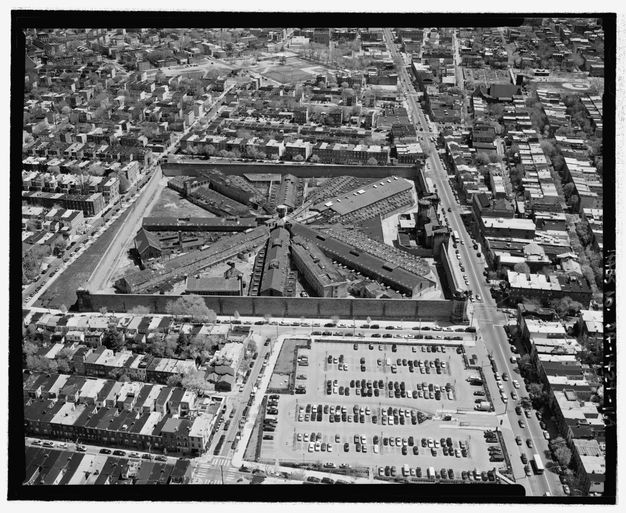
Site in 1994 (fig. 1). The site is
maintained as a stabilized ruin, with the building and grounds
preserved in some state of ruin rather than having been
restored to their original condition, which gives the site a
feeling of abandonment. However, the mission of Eastern State
is anything but abandonment, seeking instead “public
understanding of the criminal justice system and its impact on
the lives of those affected by it.”1
To this end, the “haunting world of crumbling cellblocks and
empty guard towers” has become a site for dialogue on the
legacy and reform of criminal-justice systems.2
The curators allow the stabilized ruin to speak for itself
while also framing it with descriptive, critical, and
conversational narratives, told through, respectively, an
audio guide and signage throughout the site; an innovative
program of temporary, site-specific art installations; and an
interpretation center. Each narrative, in its own way,
amplifies what the site has to say. The stabilized ruin and
its discursive framing weave together to create what
philosopher Charles Taliaferro refers to as an
open museum, modeled on philosopher Karl Popper’s
concept of the “open society,” one that commends “critical
reflection and dialogue on matters of value” such as the state
of justice within the criminal legal system.3
Eastern State’s curators use the past as a tool for excavating
the present, starting with the concrete past: the heritage
building and grounds themselves.
ExpandFig. 1. —Aerial view (looking east) of Eastern State
Penitentiary, 2125 Fairmount Avenue, Philadelphia,
Pennsylvania, after 1933. Photograph by Jack E. Boucher for the Historic American
Buildings Survey. Courtesy of the Library of Congress
Prints and Photographs Division, HABS PA–1729.
Material Evidence
A visit to Eastern State Penitentiary Historic Site begins
with a visual impression of the buildings and grounds. The
viewer will likely have some idea of what they are looking
at—for example, that it is a decommissioned prison. They may
also know that it was built for the solitary confinement of
its inmates. The penitentiary system was devised by
religious-minded prison reformers in the late eighteenth and
nineteenth centuries who modeled imprisonment on the monastic
practice of silent retreat. Each inmate was to be confined to
a single cell and not see or speak to other inmates or staff.
In the case of Eastern State, its architect, John Haviland
(1792–1852), designed the penitentiary to also prevent
clandestine communication between or outside the cells, and
the prison adminstrators required staff to make their rounds
in silence, even wearing socks over their shoes to dampen the
sounds of their footsteps. On the rare occasions that inmates
were taken outside of their cells, they were hooded to sustain
their isolation, which was intended to foster contemplation
and penitence—hence the name penitentiary. The
reformers believed that humans are inherently good even if
they have acted badly, and are therefore redeemable through
penitence. However, despite the well-meaning intentions and
optimism of reformers, it soon became apparent that prolonged
isolation—“this slow and daily tampering with the mysteries of
the brain,” as English writer Charles Dickens put it after a
visit to Eastern State in 1842—led not to redemption but to
mental breakdown.4
Well before the Philadelphia penitentiary was decommissioned
in 1971, the practice of solitary confinement had come to be
seen as pointless and cruel, and Eastern State had
discontinued the practice by 1913. Ironically, the prison was
subsequently used to incarcerate individuals serving life
sentences, a practice based upon the less-optimistic belief
that some humans are not inherently good or redeemable and
should be imprisoned—albeit not in solitary confinement—for
life. Over time, these early penitentiaries were either
refitted to accommodate new carceral practices or they were
decommissioned. Some of them, including Eastern State, became
historic sites, often referred to as
dark heritage for their association with human
suffering.
The designation of Eastern State as a heritage site and its
preservation as a stabilized ruin invite “attentive looking”
at the building and grounds, akin to how a viewer would look
at an artwork or a monument.5
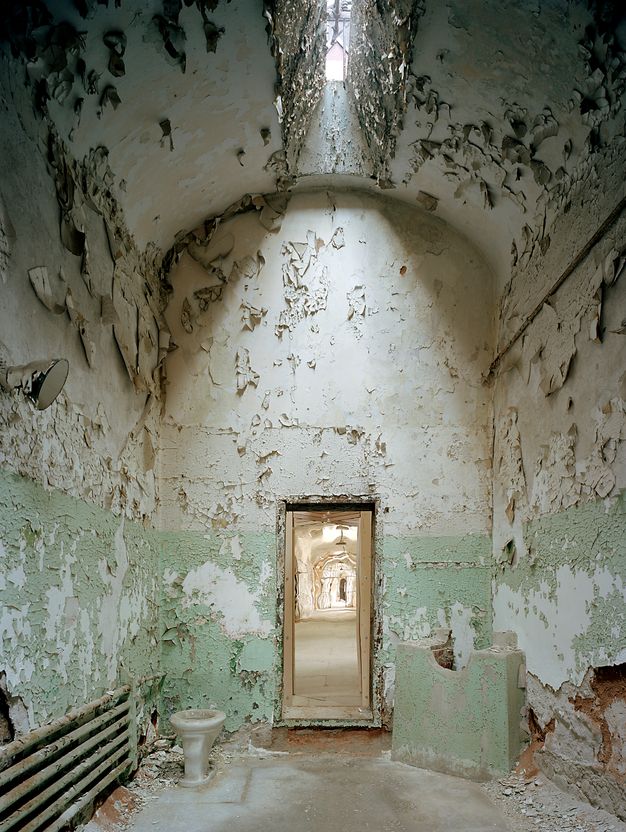
The building’s peeling paint and rusted metal, its crumbling
structures, and the encroachment of vegetation on the grounds
all reflect the abandonment of incarcerated life. At the same
time, the bulk of the building, though decaying, evokes the
oppressiveness of this life.6
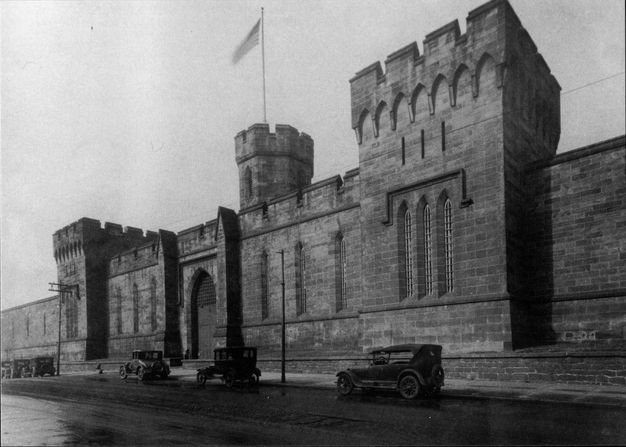
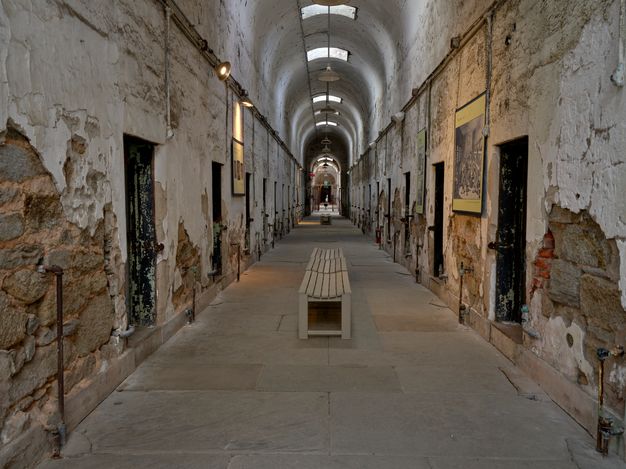
The foreboding Gothic Revival entrance facade adds to the
heaviness with its crenellated towers and barred lancet
windows, in contrast to the churchlike interior of the prison
with barrel vaults and skylights, presumably where redemption
takes place (figs. 2,
3). As criminology and criminal-justice
scholar Jeffrey Ian Ross aptly summarizes, “the building
speaks for itself.”7
ExpandFig. 2. —Eastern State Penitentiary, 1920s entrance facade
before the addition of a vestibule.
Photograph courtesy of Eastern State Penitentiary Historic
Site, Philadelphia, PA.ExpandFig. 3. —Cellblock seven at the Eastern State Penitentiary in
Philadelphia, Pennsylvania.
Photograph by Carol M. Highsmith, 2019. Courtesy of the
Library of Congress Prints and Photographs Division, Carol
M. Highsmith Archive, LC-DIG-highsm-56325.
Heritage preservation prioritizes the material-historical
identity of artifacts and sites. This is not to say that
conservators are reductive materialists, valuing heritage for
nothing more than its materials. If Eastern State’s building
and grounds had degraded into a heap of rubble, most would
agree that it is not the rubble as such but the penitentiary
that is worth preserving—the idea or plan. Thus, conservators
would likely be open to a reassembly of the rubble into the
penitentiary as it might have once looked, or even a modest
reconstruction using some new materials. However, they would
likely be far less open, if at all open, to replacing the
rubble with a replica of the penitentiary built from entirely
new materials. While the idea and plan of the penitentiary is
important, the material object, which would be lost with a
replica, also matters.8
Eastern State as a stabilized ruin may not look precisely as
it was originally planned and built, but it is at least the
authentic remains of the building and grounds, broken and
worn, with enough resemblance to the original plan to be
legible.
A harder question than how to preserve the ruin is whether and
why any version of Eastern State Penitentiary should survive
at all. Architect Rem Koolhaas notes that the kind and number
of artifacts and sites deemed worthy of preservation has
widened over time.9
Preservation “started logically enough with ancient monuments”
but has expanded beyond “sacred” structures to more
“sociological” ones, “to the point that we now preserve
concentration camps, department stores, factories and
amusement rides.”10
While Koolhaas finds it “slightly absurd” that “everything we
inhabit is potentially susceptible to preservation,”11
he also finds it promising, as a spur to overcome mediocrity
in the built environment. Be that as it may, there is an
argument to be made for allowing some cultural works to
expire. For example, architectural historian and Holocaust
scholar Robert Jan van Pelt wonders if it might be best, once
the last survivor of the World War II concentration camp at
Auschwitz has passed away, to let the buildings decay, return
to nature, and be forgotten, so that we “finally efface that
most unnatural creation of Man.”12
However, Van Pelt also thinks there is value in excavating the
evidence and conserving the history of Auschwitz, and he has
curated a number of important exhibitions on the subject,
including Seeing Auschwitz (2020–ongoing), curated in
partnership with Musealia and the Auschwitz-Birkenau Memorial
and Museum, initially exhibited at the United Nations
headquarters in New York and United Nations Educational,
Scientific and Cultural Organization (UNESCO) headquarters in
Paris and ongoing at various UN Information Offices
worldwide.13
Ross raises an additional concern about the preservation of
historic prisons. It normalizes prisons, according to him, and
as they become a familiar part of the cultural landscape, we
find ourselves not especially bothered by their existence.14
The curators of Eastern State Penitentiary address this
concern by framing the site in a way to disrupt, not entrench,
prison culture. The art installations, in particular,
question, rather than legitimize, criminal-justice
institutions and practices. Nevertheless, there is debate
about the wisdom of preserving dark and dissonant heritage.
Historian Steven Conn takes a moderate position, along the
lines of philosopher Paul Ricoeur, who, Conn notes, “wonders
whether and how we might achieve some sort of balance between
remembering and forgetting.”15
Conn elaborates: “The risk in our attempt to ‘never forget’ is
that our landscape, metaphorically and literally, becomes so
cluttered with our attempts to remember the past that they
crowd out our capacity to imagine the future.”16
While curators and conservators need not save absolutely
everything, then, they might at least preserve the heritage
artifacts and sites that contribute productively to the
cultural life in which they are rooted, in much the same way
that Eastern State Penitentiary is used to raise pertinent
questions on the justice of mass incarceration. Conserving
heritage artifacts and sites for their place in a cultural
ecology equally allows certain heritage objects to expire,
such as offensive monuments.17
It also allows for taking modest liberties with heritage
materials. For example, the art installations at Eastern State
require minor preparatory alterations to the material site.
All this is to say that the question before the curatorial
team at Eastern State is not how to preserve the heritage site
for its own sake but to ask in what way might the site be
relevant within its cultural milieu. Finding contemporary
relevance does not require the curators to hide the site’s
dark past, but rather, in the words of art historian Annette
Loeseke, to find a way to bring the “political inheritance” of
the site to bear on “contemporary contexts.”18
To use the heritage site in this way—to illuminate
contemporary conditions—requires moving beyond bare
preservation by framing the site with descriptive, critical,
and conversational narratives.
From Forensics to Narrative
There is a large literature on how best to stage or frame a
heritage site.19
Conn, for one, cautions against ambitious narratives that
eclipse the artifacts or site, subordinating them to the
narrative. This defeats what Conn calls the power of heritage
objects to, on their own, “convey knowledge, meaning, and
understanding.”20
Better, he suggests, to prioritize the heritage objects,
allowing a narrative to emerge from looking at and reflecting
on their strategic presentation. As art historian Alan Wallach
put it, “A successful exhibition is not a book on the wall, a
narrative with objects as illustrations, but a carefully
orchestrated deployment of objects, images, and texts that
gives viewers opportunities to look, to reflect, and to work
out meanings.”21
In line with this, the curators at Eastern State present a
light narrative touch, with minimal signage and an unobtrusive
audio guide. As I will show, so do the art installations and
the interpretation center rely on the material site to make
their critical points.
The curatorial program begins with a descriptive, self-guided
audio tour providing historical and contextual
information—straightforward facts about the site, such as its
construction details, and its history—to help the viewer
better understand what they are looking at. Impartial and
factual, a descriptive narrative may nevertheless shape
someone’s impression of a site. The more a viewer knows, the
more they may come to see and experience the site differently.
A challenge for curators of dark heritage is to frame that
heritage in such a way that elicits empathy. This is
especially challenging for the curator of a prison museum, who
must find a way to summon viewers’ empathy for not only what
prisons stand for—presumably the preservation of law and
social order—but also for those individuals formerly
imprisoned inside.
Any carceral institution—which includes prisons and jails,
prisoner-of-war and internment camps, gulags and so forth—is
susceptible to abuses of power. However, within liberal
democracies, state prisons are understood to incarcerate only
those who have violated commonly agreed-upon laws. In fact, a
justification for the practice of state punishment in liberal
democracies is that it preserves rule of law. As political
philosopher Thomas Scanlon argues, the threat of punishment
for breaking the law not only fosters compliance with the law
but also conveys the weightiness of the rule of law
itself.22
Prisons are also associated with the protection of citizens
from the harm of crime. Therefore, the visitor to a prison
museum may enter with a predisposed idea of the site and what
it represents, lacking, at first look, empathy for the
incarcerated.
Sometimes simply informing visitors of the historic realities
of life at a prison will provide a sobering perspective on the
prison in question. Learning, for instance, that a person was
incarcerated for breaking an outdated or unjust law will
likely evoke some sympathy for the inmate. In 1881, Eric Hall
was sentenced to eight years’ imprisonment at Eastern State
for what was at the time considered a crime: a consensual,
same-sex relationship between adults. Conveying knowledge
about the criminalization and imprisonment of people for
actions not considered transgressions today typically elicits
outrage on behalf of the incarcerated, not a sense of justice
served. Accordingly, Eastern State’s audio guide includes this
sort of humanizing historical information.23
Complicating matters, certain visitors to a site of dark
heritage may search for sensational stories of infamy or
titillation at the site, which can stifle viewer empathy.
Unlike experiences of empathy, which involve seeing others
through their own eyes, sensationalism is voyeuristic, with
the viewer looking at others from the outside, as props in a
story for their own thrill and gratification. Curators of dark
heritage may cater to these inclinations as a way of
attracting visitors while at the same time looking for ways to
temper sensationalism. The exhibitions at Eastern State, for
example, showcase celebrity inmates Al Capone and Slick Willie
Sutton but give more overall attention to the prison’s
majority, lesser-known inmates. It must also be said that
Eastern State does not put incarcerated people currently
serving prison sentences on display, as it once did in its
early days when national and foreign delegations visited,
eager to study the new prison system. The practice of putting
living inmates on display for the edification of the viewing
public, which is a dehumanizing and morally troubling
practice, continues at certain prisons to this day.24
Respectfully crafted, a biographical vignette such as the one
describing Hall’s time at Eastern State humanizes the
imprisoned, inviting the visitor to imagine a person—however
flawed—and to reflect on his or her path to imprisonment. Of
course, vignettes are not always a defense of those who were
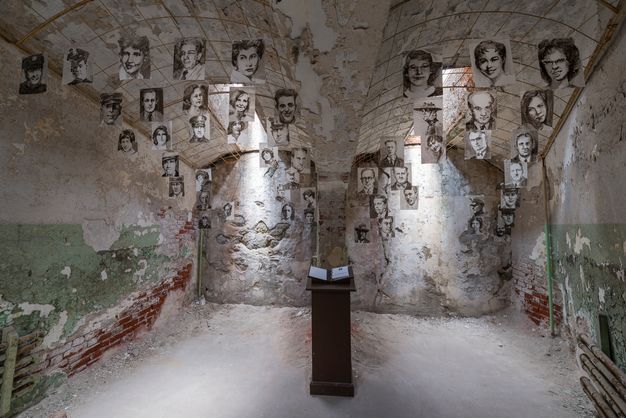
historically imprisoned. Philadelphia-based artist Cindy
Stockton Moore’s installation Other Absences at
Eastern State in 2014 featured portraits and biographical
vignettes of fifty individuals killed by former inmates of the
penitentiary (fig. 4). These vignettes
are a reminder of the harm and suffering borne by the victims
of crime. They, too, humanize the site. In either case,
humanizing vignettes are an attempt to recognize the interests
of all the stakeholders in the conversation on justice in the
criminal legal system—including the injured, wrongdoers, and
the public.
Although Eastern State Penitentiary Historic Site does not
advance any one theory of criminal justice over another, the
site is historically associated with Quaker thought and its
advocacy for prison reform. Contemporary Quaker thinkers,
along with those of other pacifist Protestant orders, who are
now aware of the harms of solitary confinement but still
committed to prison reform, have more recently taken an
interest in restorative justice.25
Restorative justice is a public-minded, social model of
criminal justice, carried out in forums where wrongdoers and
the injured, or their proxies, deliberate the appropriate
punishment for a crime. Like the penitentiary movement of the
past, restorative justice prioritizes rehabilitation. However,
the objective is no longer only to rehabilitate the individual
lawbreaker for reentry into society but also to rehabilitate
the community that has been damaged by the crime—or a society
that has been damaged by practices such as mass
incarceration—through dialogue on the appropriate response to
the crime or societal problem. By contrast, the more familiar
models of criminal justice, such as the deterrence and
retributive models, are not primarily concerned with the
rehabilitation of those who have committed crimes or the
impacted community. The more familiar models aim to protect
society, but not necessarily to restore it. Deterrence
justifies punishment as a way to deter future crime, and
retribution justifies punishment simply as just deserts for
committing a crime.26
Restoration, in addition to protection and justice, also aims
to restore the well-being of individuals and communities in
the aftermath of crime.
A central tenet of the restorative-justice movement is that
even wrongdoers are stakeholders in society, and while they
may be punished, they do not, as philosopher Jonathan Jacobs
put it, forfeit “the regard and treatment distinctive of the
civility of a liberal democracy.”27
That being said, the wrongfully injured are also stakeholders
in society. A criminal-justice system that does not recognize
the resentment of the wrongfully injured would likewise erode
that person’s dignity and standing in their community.28
This is the point of Stockton Moore’s installation,
Other Absences. Her work shows a small sampling of
the total number of murder victims associated with the
penitentiary but serves as a sufficient reminder that the
wrongfully injured—the victims who may not even live to see
the aftermath of a crime, and the families and communities who
do—are indelibly present in the conversation on crime and
punishment.
From Description to Interpretation
In the late Middle Ages (circa 1300–1500) in Europe, prisons
were meant for short-term detention, and were maintained as
rudimentary lockups where wrongdoers could be held until their
trial or punishment, which was likely to be the pillory or a
flogging or hanging.29
At times lockups also held debtors or dissidents for longer
periods, but these were not purpose-built prisons. They were
large rooms without amenities housed within castles,
gatehouses, or military complexes, in which unsupervised
prisoners lived communally and in squalid conditions. Early in
the modern era (circa 1500–1800), purpose-built prisons began
to appear, although they were still foul, chaotic places.
English reformers such as John Howard (1726–90) and Elizabeth
Fry (1780–1845) advocated for more habitable living conditions
in prisons as well as for more humane forms of punishment.
Eventually, the idea came about that imprisonment itself could
be used as a form of legal punishment. In Britain, the 1779
Penitentiary Act sanctioned imprisonment as an alternative to
traditional forms of punishment such as the pillory and
floggings. Imprisonment seemed on the surface to be a more
humane form of punishment, but nonetheless imposed a
sufficiently heavy penalty, considering the ever-increasing
value attached to individual liberty in the modern period. By
the late modern period (circa 1800–1945) a new type of prison
appeared, primarily in Europe and its colonies in the
Americas: the penitentiary, which was purpose-built for the
supervised detention of inmates in solitary cells—barren but
habitable—as a form of punishment.
There were variations in the penitentiary systems. The system
at Eastern State, known as the separate system, was rigorous
in keeping inmates isolated and separate from each other, and
it became a model for a number of other prisons that not only
emulated the penitentiary’s system but also its distinctive
radial plan, with long cellblocks arranged like spokes around
a central supervisory hub (see fig. 1).
All penitentiary systems were thought by reformers to convey
two benefits. First, it was believed that the isolation of
inmates from one another would prevent the spread of moral
corruption among inmate populations. The earlier lockups,
which housed all manner of offenders and lawbreakers in an
unsupervised common room, were described in 1884 by American
reformer Richard Vaux as “moral pest house[s].”30
Similarly, French civil servants Gustave de Beaumont and
Alexis de Tocqueville, after visiting Eastern State in 1831,
commended the new penitentiary systems for preventing the
“association of the wicked” and thus averting the blight of
criminality among prison populations.31
Second, cellular confinement would not merely punish and deter
crime—it would also be an instrument to reform the individual
criminal. Through solitude and contemplation, the wrongdoer
could repent and be rehabilitated as a useful member of
society. Solitary confinement, it was believed, would not
merely contain the spread of criminality but cure it.
This was the ideal; the historical record of how the separate
system performed in reality reveals disparities between theory
and practice. A state government report on the alleged
misconduct of Eastern State’s first warden, Samuel Wood,
describes many irregularities at the prison, including inmates
fraternizing with one another and with prison guests.32
Correspondingly, while Beaumont and Tocqueville find much to
admire in the new penitentiary systems, their report also
expresses misgivings. For one thing, the authors note that all
that is required of an inmate to survive a penitentiary system
is to display outward conformity to its penitential ideals,
without necessarily taking them to heart, which would seem to
foster hypocrisy as opposed to genuine penitence and
reform.33
After returning to France, Tocqueville went on to write
Democracy in America (1835–40), in which he
identifies the conditions necessary for democratic society to
flourish—conditions not found within the penitentiaries.34
For example, a penitent’s fixation on the self and isolation
from others dulled their faculty for the associational life
that Tocqueville thought central to democracy.35
The question that the writings of Beaumont and Tocqueville
raise is whether there is a better path to rehabilitation, one
that kindles rather than extinguishes the character required
for reentry into democratic society.
Eastern State now as a heritage site and museum poses a
similar question. Is there a way to present the heritage not
just as a historic site but as a living one that engages the
public on present-day issues, particularly mass incarceration
in the democratic state—which is a modern-day blight on
democratic society itself?36
It is increasingly apparent that, just as solitary confinement
was found to be unsuited to the objective of rehabilitation,
mass incarceration is proving to be unsuited to the objective
of deterrence, instead weakening social structures that might
be more effective in deterring crime. Accordingly, the
descriptive path through the prison and grounds leads to an
interpretation center in cellblock four, with a permanent
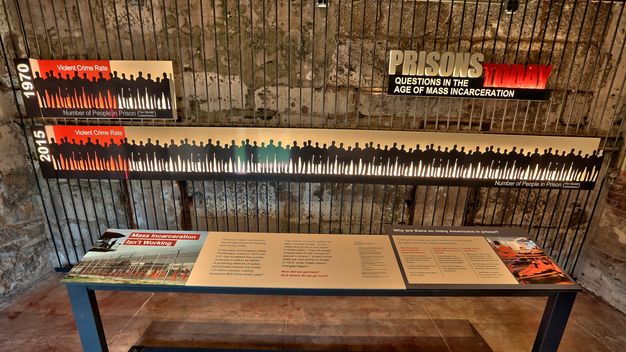
interactive exhibition opened in 2016 titled
Prisons Today: Questions in the Age of Mass
Incarceration
(fig. 5).37
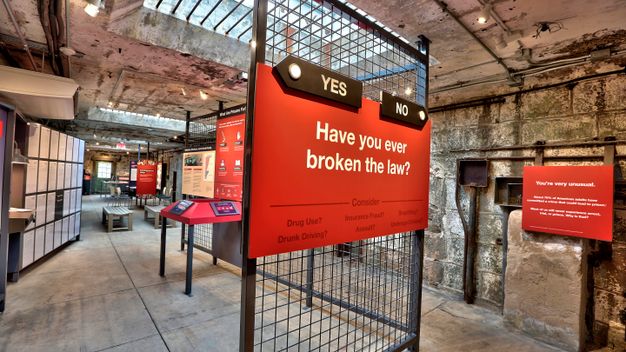
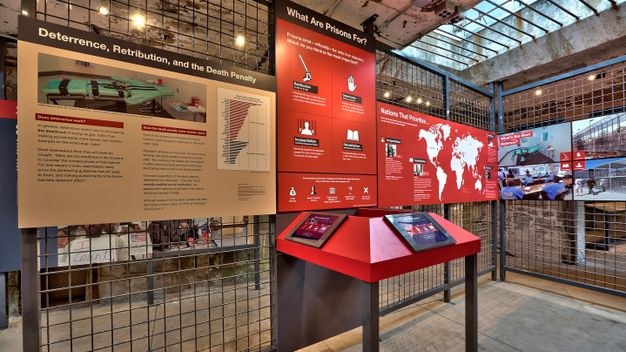
The minimalist approach to signage throughout the heritage
site is here set aside in favor of a comprehensive interactive
display consisting of educational graphics and didactics for
the viewer to navigate (figs. 6,
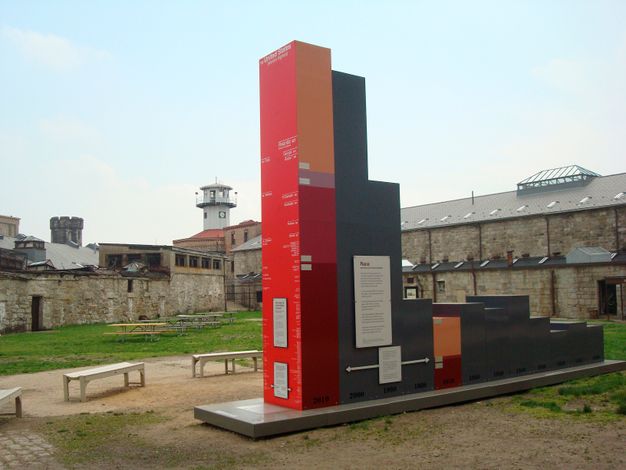
7). In the adjacent yard stands a
massive bar graph constructed of plate steel titled
The Big Graph, installed in 2014 and displaying
statistics updatable to 2030 based on national and world rates
of incarceration and policies on capital punishment (fig. 8). The east side of The Big Graph charts every
nation’s rate of incarceration, showing the United States with
the highest. The south side presents the growth in US
incarceration rates since 1900 and the marked increase since
the 1970s, precipitated by new laws and longer prison
sentences. The north side shows the racial breakdown of the US
prison population in 1970 and today, pointing to the
disparities in incarceration rates among different racial
groups over time. Essentially, The Big Graph is a
representation of the penal history and its outcomes, which
the visitor has just absorbed.
Both the state prison and the public museum have a mission,
broadly speaking, to inform individual and public thought in
the service of citizenship and nation building.38
As a penitentiary, the focus of Eastern State was on the
penitentiary inmate. As a public museum, its focus has shifted
to the viewing public, in which dialogue is no longer
suppressed but now encouraged. As a penitentiary, Eastern
State once relied on isolated contemplation to reform an
inmate’s thought and behavior before their release back into
society. As a heritage site, Eastern State now promotes open
dialogue on the realities of prison life and history so that
societal thinking may be deepened and possibly reformed on
justice in the criminal legal system.
ExpandFig. 5. —Exhibition didactic titled “Mass Incarceration Isn’t
Working,” part of the permanent exhibition
Prisons Today: Questions in the Age of Mass
Incarceration,
Eastern State Penitentiary Historic Site, Philadelphia,
2016–present.
Photograph by Darryl Moran, 2016. Courtesy of Eastern
State Penitentiary Historic Site, Philadelphia, PA.ExpandFig. 6. —Exhibition didactic titled “Have you ever broken the
law?,” part of the permanent exhibition
Prisons Today: Questions in the Age of Mass
Incarceration,
Eastern State Penitentiary Historic Site, Philadelphia,
2016–present.
Photograph by Darryl Moran, 2016. Courtesy of Eastern
State Penitentiary Historic Site, Philadelphia, PA.ExpandFig. 7. —Exhibition didactic titled “What Are Prisons For?,”
part of the permanent exhibition
Prisons Today: Questions in the Age of Mass
Incarceration, Eastern State Penitentiary Historic Site,
Philadelphia, 2016–present.
Photograph by Interactive Mechanics, n.d. Courtesy of
Eastern State Penitentiary Historic Site, Philadelphia,
PA.ExpandFig. 8. —The Big Graph installed in the prison yard
adjacent to cellblock 4, seen from the northeast,
Eastern State Penitentiary Historic Site, Philadelphia,
2014–present.
Powder-coated plate steel, 16 × 24 × 3 ft. Courtesy of
Eastern State Penitentiary Historic Site, Philadelphia,
PA.
The Conversational Frame
The viewing experience curated at Eastern State Penitentiary
Historic Site prepares visitors for the public work they are
asked to undertake when they arrive in the interpretation
center. For example, in the exhibitions, fostering empathy is
a first step toward informed and fair judgments on the issues
arising from the site and its presentation. Empathy allows
individuals to feel and understand what life is like for
others, and this helps them to grasp the full picture of all
those who are impacted by crime and punishment. Still,
something more than empathy is required for participation in
public affairs. It requires the informed and sympathetic
viewer to be more than a bystander—to be instead a witness,
someone who will report on what is observed, and who will say
something about, in this case, the principles, rules, and
practices of criminal justice.39
Although the exhibition didactics do not communicate how the
public ought to decide these affairs, they present mass
incarceration as a troubling issue and carry on the
conversation initiated by the reformers of the penitentiary
movement on the need for prison reform. As Sara Jane Elk, past
president of Eastern State Penitentiary Historic Site, put it,
rather than confirm settled viewpoints,
Prisons Today urges dialogue, in the form of “civil
and open interaction” across competing viewpoints.40
Nor are the exhibition didactics rigged for certain outcomes;
they merely lay the foundation for viewers to “think actively”
and to arrive at their own informed and fair conclusions.41
For all that, the exhibition is not, strictly speaking,
neutral. Eastern State balances impartiality and partiality by
taking a stand on the issue of mass incarceration, identifying
it as troubling, yet leaving it open to the public to decide
what to make of it.
The Critical Frame
The temporary art installations at Eastern State are
site-specific; they use the site itself to create art that
invites reflection on what the site is about. This is distinct
from other genres of art related to prisons and imprisonment.
There is, by contrast, art raising awareness about issues
related to incarceration created by artists working within the
art world but not tied to a prison site, such as the mural
Free Zehra Doğan (2018) on the Houston Bowery Wall in
New York by street artist Banksy.42
There is also the genre of outsider prison art, created by
prisoners but not always about prisons, and displayed within
or beyond a prison site.
Capitalizing on Justice, organized by the Urban
Justice Center and exhibited in 2019 at the Gallatin Galleries
at New York University, showcased work by artists incarcerated
across the United States who used the limited materials
available to them inside the prison sites to make their
art.43
The artists behind the installations at Eastern State,
departing from these models, create site-specific pieces that
reveal deeper truths about the historic prison. Although based
in history and fact, the installations cannot be misconstrued
as archival descriptions of the site. A video art installation
by Luba Drozd titled
Institute of Corrections (2016–17) makes use of
actual instructional videos created by the Pennsylvania
Department of Corrections for its employees at correctional
institutions.44
The instructional videos cover a range of topics on the
management of inmates, including the administrative tasks of
admitting and releasing inmates and the handling of
emergencies. Drozd reedits the footage to expose the subtext
of the videos, namely “the system behind incarceration and the
dialogue that goes on internally within the field of
corrections itself.”45
The reedited video is satirical and at times dark. At no point
would a viewer confuse it for a real instructional video in
use then or now. Compared to Eastern State’s informative but
also creative and engaging audio guide,
The Voices of Eastern State, which too incorporates
historical material including testimonies from staff and past
inmates as well as commentary from scholars who have studied
the site, the art installation brings into the room
uncomfortable truths through its artful transformation of the
source material.
A model of how the art installations at Eastern State function
to reveal underlying truths about the site is
Point—Counterpoint, created in 2005 by architects
Tricia Stuth and Ted Shelton, which formally intervenes with
the penitentiary architecture.46
The radial plan of Eastern State allowed staff in the central
hub to see along the cellblock corridors. However, staff could
not see inside each cell from the hub, and thus, inmates were
not under constant surveillance as they might be in a
panopticon. Conceived by English philosopher Jeremy Bentham in
the late eighteenth century, the panopticon is an
architectural plan for institutions with inmates, such as
prisons, hospitals, or schools.47
It is composed of a circular building with a watchtower at the
center, from which a single person can observe all the inmates
of the building without the individuals knowing whether or not
they are being observed. Bentham hypothesized that the mere
prospect of constant surveillance would lead inmates to
self-regulate their behavior. While Eastern State is not a
panopticon, strictly speaking, it was nonetheless a place of
surveillance, both by guardians—recalling that the
penitentiary system came about precisely to provide
surveillance as a corrective to the unsupervised lockups that
were thought to be moral pest houses—and by the inmates
themselves, as they self-surveilled their actions and moral
development as penitents. In Point—Counterpoint, the
architects amplify and upend the surveillance features of
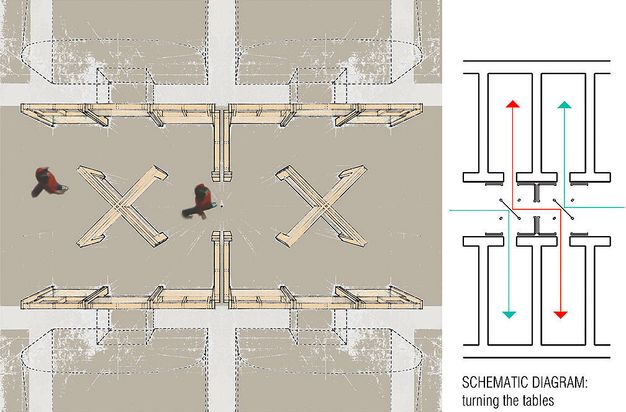
Eastern State. The installation consists of four large mirrors
placed at a forty-five-degree angle along the axis of
cellblock ten (fig. 9). From the
central hub, looking down the corridor of cellblock ten, the
mirrors block the normally unobstructed view of the corridor.
At the same time, the mirrors reflect the corridor into cells
five, seven, twelve, and fourteen. The mirrors, then, allow
the occupant of a cell, whose view was historically
obstructed, to see along the corridor (fig. 10). As Stuth and Shelton sum it up: “Thus, the view of the
guard is captured while the prisoners’ view is extended.”48
The installation is an inversion of the lived realities in the
prison. Point—Counterpoint does not describe how
things really were at the site; rather, it reverses how they
were, to reveal and question the surveillance dynamics built
into the prison structure.
Generally speaking, the installations at Eastern State animate
the site’s dark heritage without sensationalism. Consider, by
contrast, the animating strategy at some prison museums of
staging mock trials and punishments. Criminology and
criminal-justice scholars Kevin Walby and Justin Piché find
that, instead of deepening the visitor’s grasp of crime and
punishment, these mock events simply encourage visitors to
photograph themselves at play during the event, trivializing
and obfuscating the realities of prison life.49
Art installations such as Point—Counterpoint, by
contrast, do not distract from the site. In their
site-specificity, they encourage visitors to look closely at
the site in a forensic, rather than fictitious or imitative,
way. In doing so, such installations reveal rather than
obfuscate the realities of prison life.
Eastern State also hosts a mock event on Halloween, originally
called Terror Behind the Walls, in which visitors could
imagine themselves communing with uneasy prison ghosts. The
event was discontinued in 2020 due to the pandemic and then
reinstated in 2021 as Halloween Nights, running from the end
of September to the beginning of November, featuring haunted
houses, a flashlight tour, and beer gardens. The event is not
part of any curatorial program or meant to be educational like
the mock trials studied by Walby and Piché; it is an
unapologetic use of the heritage site for entertainment. As
German philosopher Friedrich Nietzsche argued in a short
treatise
The Use and Abuse of History for Life, history should
“serve life” and the present, rather than be pursued for its
own sake.50
We should feel free, therefore, to use heritage sites and
artifacts in a way that aligns with contemporary interests.
That said, Neitzsche thought of this service as ennobling
life, a model example of which is the way that the art
installations at Eastern State use the site to enlarge our
understanding of the penitentiary and prison life. Halloween
Nights, by contrast, is a glaringly voyeuristic event, at odds
with the core curatorial programing. Be that as it may, the
event fosters a visceral familiarity with the site. Granted,
this familiarity is different from the attentive looking
fostered by the curatorial programing as well as from the
critical engagement that Taliaferro imagines is at the heart
of an open museum, but in any case, the event is not presented
as a curatorial program, and it is arguably valuable in its
own way.
There is a difference between an open museum concerned with
res publica—public life and affairs—and a publicly accessible
space where people may gather for various reasons, such as a
museum, library, or shopping center. An open museum is not
only a place where people may gather but particularly a place
where people may gather as a public defined by a shared
interest in and varying stances on a public issue. Not all
museums are suited to be open museums in this sense. Even
those referred to as museums for the public good can be places
of entirely private contemplation and appreciation. As an
example, public gardens, which may be accessible to the public
and may attend to the interests and demands of their visitors,
are not necessarily places where public affairs and duties are
explored. Eastern State Penitentiary, given its inheritance,
calls for this exploration. Indeed, the public is often
conceived of as a body or sphere that checks the power of the
state, not the least of which is state-sanctioned punishment.
As political philosopher Jürgen Habermas envisioned it, the
public sphere consists of people freely gathering to identify
and deliberate public affairs precisely in order to influence
political action.51
The particular genius of Eastern State Penitentiary is the way
in which it brings material culture to bear on res publica. A
direct encounter with the historic site suffuses and
distinctively shapes the public conversation.
Thing Knowledge
The lack of consensus in heritage preservation on whether to
prioritize the plan of a site or its materials rests on a
conceptual distinction between the abstract work of
art—an idea or plan with purpose and meaning—and the concrete
art object—a specific set of materials given form at
a particular place and time.52
The architectural plan of Eastern State Penitentiary can be
distinguished from the materials used in its construction.
While the penitentiary stone may be icy cold to touch, the
radial plan as such cannot possess those physical qualities.
Conversely, while the Gothic Revival entrance may be
foreboding, the stone alone is not. The penitentiary as a
work, then, possesses representational and expressive
properties that its bare materials do not. An idealist would
insist that it is the work that matters more than its
materials. The materialist would disagree, stating that it is
not simply the non-spatiotemporal work that we value but the
concrete historical object(s). An abstract idea, it seems, is
found in thought and only then instantiated in materials,
whereas a concrete art object is produced with materials by
one or more artists working in a given time and place.53
By and large, conservators and curators lean toward
materialism, as do their audiences, all drawn to the
historical-material object. Even so, all are typically
sympathetic to aspects of the idealist position. Admittedly,
in the appreciation of heritage objects, viewers will
also attend to the abstract features of the work. It
is the penitentiary that they wish to see, not merely, in the
worst-case scenario, an unstructured pile of rubble from which
it was once constructed.
One reason for our captivation with the historical-material
object is offered by English writer Jeanette Winterson, who
explains her own love of a signed first edition of Virginia
Woolf’s essay A Room of One’s Own (1929) as the
psychometry of original editions.54
Reading Woolf’s purple-ink inscription, Winterson notes, “here
she is and here she was.”55
It is the indexical presence of Woolf “in your hands, a book
that was in their hands,” that gives the book “an extra
power.”56
Historical-material objects have indexical properties that
abstract objects, such as penitentiary plans and literary
works, do not. Audiences pick up on these indexical properties
as they wander through the abandoned corridors and cells of
Eastern State Penitentiary, sensing, for example, the
oppressiveness of the prison, all of which deepen their
sensitivity to the issues arising from prisons, such as the
toll solitary confinement takes on a human.
For Winterson the attraction to art objects is visceral and
emotional rather than strictly intellectual. To love a book as
an object is to love it not for its biographical, archival, or
even historical value but as, in Winterson’s words, a talisman
or doorway, as a genie bottle, or as a living thing.57
Heritage artifacts, then, have unique properties—indexical and
visceral—that are not available to those who only read about
these objects in books. This is not to diminish the value and
pleasure of knowledge acquired from books, which will shape
how a person sees and experiences a heritage artifact or site.
The point is only that direct acquaintance with a heritage
object is uniquely informative, and, in the case of Eastern
State’s stabilized ruin, indispensable in that it renders the
public conversation less abstract, balancing principles with
lived realities.58
While most scholars would agree that artifacts hold a wealth
of empirical information to be uncovered by those who study
these objects, or that they have unique properties (as
Winterson argues), philosopher Davis Baird goes further to
argue that artifacts may even hold knowledge.59
However, knowledge is typically understood to be a mental
object in the form of a belief held in the mind—specifically a
justified true belief, defined as a belief that is
justified with reason and evidence, and is also true—which
artifacts patently do not have. Baird does not reject the
traditional definition of knowledge but appends to it an
additional kind of knowledge that can be embodied in physical
objects. Whereas humans hold knowledge as a matter of
justified true belief, artifacts hold “thing knowledge” as a
matter of true performance.60
Baird proposes that an artifact can be shown to be true or not
in its functioning; for example, a “true wheel” is such when
it “spins properly, dependably, regularly,” and, in this way,
the well-balanced bicycle wheel successfully spinning on its
axis is true in performing its rotations. Further, in
“successfully accomplish[ing] a function” or in being true,
the “artifact bears knowledge.”61
Baird is particularly interested in the knowledge that
scientific instruments hold—although his argument is
applicable to other kinds of artifacts with comparable
functions. Not only are these artifacts instrumental to the
creation of new knowledge in their users, they hold their own
kind of thing knowledge “built into the reliable behavior of
[the] artifact.”62
Baird’s novel materialist epistemology can be applied to the
art installations at Eastern State. A prison is an instrument,
if you will, with a function, whether the rehabilitation of
criminals or the deterrence of crime or the exacting of
retribution. The installations ask, What thing knowledge does
Eastern State Penitentiary hold? The answer is found through
testing the instrument. Just as the knowledge a wheel holds is
found by spinning the wheel, the knowledge Eastern State may
hold is found by tinkering with and testing the workings of
the site. As Baird summarizes, “If I want to understand or,
more important, if I want to use or modify the knowledge an
artifact bears, I am better off attending to the material
thing itself.”63
All this is perhaps not so novel to curators who have long
focused on object-centered inquiry and knowledge acquisition.
That said, philosopher Amie Thomasson cautions against viewing
artifacts too narrowly as definitively functional objects,
suggesting that we view them instead more broadly, as
intentionally created objects with “some intended features,”
including structural and sensory features, as well as how the
object “is to be regarded” by audiences (receptive features),
but “which may or may not include an intended function.”64
Further, intended features are sometimes not enough to
classify an artifact, and we also rely on public norms, or how
an artifact will typically be treated irrespective of a
creator’s intentions. All this allows for “finer-grained
distinctions” in the classification of artifacts, enabling,
for example, the grouping of all prisons into a kind even when
they have different functions, or the grouping of
decommissioned prisons like Eastern State, now “intended ‘for
show,’” with their “working cousins.”65
Thomasson adds that the receptive and normative features of
artifacts highlight their public nature. A roadside sign, for
example, that is recognized as a stop sign (receptive feature)
and associated with established rules and expectations
(normative features) illustrates how artifacts can embody
social agreements and behavioral expectations beyond their
physical properties and why they are of such interest to
curators, historians, and social scientists. Artifacts are not
“mere things with certain physical-functional capacities”;
they are cultural, historical objects “infused with
significance” for ways of human life.66
The Open Museum
The depth of preparedness that a visit to Eastern State
Penitentiary provides to the participant in the conversation
on criminal justice is notable. The building and grounds
memorialize the lived experiences of solitary confinement and
provide material evidence for visitors to take into account in
their judgments on issues of imprisonment and criminal
justice. The audio guide frames and contextualizes the
evidence. The art installations turn the evidence over,
looking for truths about prison life and the separate system
held by the building and grounds. This discovery process is
then brought to bear on the rulings made in the interpretation
center. Therefore, the conversation at Eastern State on
criminal justice does not begin in the interpretation center.
It starts by stepping onto the grounds and looking at the
material remains of the penitentiary along a path through the
site, finding its denouement in the interpretation center.
Heritage sites, it seems, are integral to an open society. If
the point of an open society is to commend critical reflection
and dialogue on matters of value, then preparedness for such
reflection and dialogue through direct encounters with
heritage is indispensable.
Rita Elizabeth Risser, PhD, writes on the
history and philosophy of the arts and its institutions, and
was most recently assistant professor in the College of
Humanities at United Arab Emirates University in Abu Dhabi.
Charles Taliaferro, “The Open Museum and Its Enemies: An
Essay in the Philosophy of Museums,”
Royal Institute of Philosophy Supplements 79
(2016): 39. See also Karl Popper,
The Open Society and Its Enemies [1945], with a
new introduction by Alan Ryan and an essay by E. H.
Gombrich (Princeton, NJ: Princeton University Press,
2013).
↩︎
Charles Dickens, “Philadelphia, and Its Solitary
Prison,” in
American Notes for General Circulation [1842]
(London: Chapman & Hall, 1855), 68.
↩︎
Svetlana Alpers, “The Museum as a Way of Seeing,” in
Exhibiting Cultures: The Poetics and Politics of
Museum Display, ed. Ivan Karp and Steven D. Lavine (Washington, DC:
Smithsonian Institution Press, 1991), 27.
↩︎
On the spectacle of prison architecture, see Michelle
Brown,
The Culture of Punishment: Prison, Society and
Spectacle
(New York: New York University Press, 2009).
↩︎
Jeffrey Ian Ross, “Why and How Prison Museums/Tourism
Contribute to the Normalization of the Carceral/Shadow
Carceral State: The Primacy of Economic Realities,” in
The Palgrave Handbook of Prison Tourism, ed.
Jacqueline Z. Wilson, Sarah Hodgkinson, Justin Piché,
and Kevin Walby (London: Palgrave Macmillan, 2017), 960.
↩︎
Philosopher Nelson Goodman made the argument that
original materials hold valuable empirical information
that is invariably lost in a replica. Nelson Goodman,
“Art and Authenticity,” chap. 3 in
Languages of Art: An Approach to a Theory of
Symbols
(Indianapolis: Bobbs-Merrill, 1968). Viewers may not
immediately perceive this information—for example,
details about the artistic process or clues about the
object’s provenance—but it comes to light in the
fullness of time, told through the original materials.
Other scholars, however, are skeptical that what we
actually value in a heritage object is the minutiae of
the original materials as opposed to the original idea
or meaning represented by the object, which can be
evoked through a replica, in which case the replica is
preferable to a deteriorated original. And so the
disagreement goes.
↩︎
Rem Koolhaas, “Preservation Is Overtaking Us,”
Future Anterior 1, no. 2 (2004): xiv, 1–3.
↩︎
On the fate of offensive monuments, see Sanford
Levinson,
Written in Stone: Public Monuments in Changing
Societies
(Durham, NC: Duke University Press, 1998).
↩︎
Annette Loeseke, “Transhistoricism: Using the Past to
Critique the Present,” in
The Contemporary Museum: Shaping Museums for the
Global Now, ed. Simon Knell (London: Routledge, 2018), 142.
↩︎
See for example, Bruce W. Ferguson, “Exhibition
Rhetorics: Material Speech and Utter Sense,” in
Thinking about Exhibitions, ed. Reesa
Greenberg, Bruce W. Ferguson, and Sandy Nairne (London:
Routledge, 1996), 175–90.
↩︎
Conn, Do Museums Still Need Objects?, 7. See
also Laurel Thatcher Ulrich, Ivan Gaskell, Sara
Schechner, Sarah Anne Carter, and Samantha van Gerbig,
Tangible Things: Making History through Objects
(New York: Oxford University Press, 2015).
↩︎
Alan Wallach,
Exhibiting Contradictions: Essays on the Art Museum
in the United States
(Boston: University of Massachusetts Press, 1998), 121,
quoted in Conn, Do Museums Still Need Objects?,
7. ↩︎
Thomas M. Scanlon, “Punishment and the Rule of Law
[1999],” in
The Difficulty of Tolerance: Essays in Political
Philosophy
(Cambridge, UK: Cambridge University Press, 2003), 223.
↩︎
The original script for
Voices of Eastern State was written by Sean
Kelley in 2004. Kelley was program director and
subsequently vice president and director of
interpretation at Eastern State from 1995 to 2023. The
script was narrated by actor Steve Buscemi and included
oral histories from past wardens, guards, and prisoners
as well as commentary from experts on the history of
prison construction and administration. In 2019 the
script was updated by Annie Anderson with new
information regarding LGBTQ prisoners (see Peter
Crimmins, “Eastern State Penitentiary Casts a Light on
its LGBTQ History,” WHYY, 11 May 2019,
https://whyy.org/articles/eastern-state-penitentiary-casts-a-light-on-its-lgbtq-history/). Anderson was a researcher and subsequently a manager
for research and public programming at Eastern State
from 2011 to 2020. In 2021 the script was updated and
revised by Kelley and rerecorded by Buscemi, with
language more sensitive to the experience of the
incarcerated, and with additional perspectives on the
prison.
↩︎
The practice ranges from prison awareness programs
intended to deter those in at-risk populations from
prison sentences to programs for entertainment such as
the Angola Prison Rodeo in Louisiana and prison
reality-television programs. For a survey of these
practices, see Jeffrey Ian Ross, “Varieties of Prison
Voyeurism: An Analytic/Interpretive Framework,”
The Prison Journal 95 (2015): 405–9. For the
perspective of the objectified prisoner, see Craig W. J.
Minogue, “Human Rights and Life as an Attraction in a
Correctional Theme Park,”
Journal of Prisoners on Prisons 12 (2003):
44–57.
↩︎
See, for example, Howard Zehr,
The Little Book of Restorative Justice, rev.
ed. (New York: Good Books, 2015).
↩︎
Philosopher Erin Kelly argues that it is the prevalence
of retributive thinking in contemporary criminal
justice, and a diminished interest in rehabilitation,
that have led to the current state of mass incarceration
in parts of the world. Erin Kelly, “The Retributive
Sentiments,” in
The Routledge Handbook of the Philosophy and Science
of Punishment, ed. Farah Focquaert, Elizabeth Shaw, and Bruce N.
Waller (New York: Routledge, 2020), 102. See also Erin
Kelly,
The Limits of Blame: Rethinking Punishment and
Responsibility
(Cambridge, MA: Harvard University Press, 2018).
↩︎
Jonathan Jacobs, “Resentment, Punitiveness, and
Forgiveness: An Exploration of the Moral Psychology of
Punishment,” in
The Routledge Handbook of Criminal Justice Ethics, ed. Jonathan Jacobs and Jonathan Jackson (London:
Routledge, 2017), 73.
↩︎
Jacobs, “Resentment, Punitiveness, and Forgiveness,” 65.
See also Scanlon, “Punishment and the Rule of Law,” 234.
↩︎
Norman B. Johnston,
Forms of Constraint: A History of Prison
Architecture
(Urbana and Chicago: University of Illinois Press,
2000), 7–16.
↩︎
Richard Vaux, “The Pennsylvania Prison System,”
Proceedings of the American Philosophical Society
21 (1884): 651.
↩︎
Gustave de Beaumont and Alexis de Tocqueville,
On the Penitentiary System in the United States and
Its Application in France, trans. Francis Lieber (Philadelphia: Carey, Lea &
Blanchard, 1833), 21.
↩︎
Thomas B. McElwee,
A Concise History of the Eastern State Penitentiary
of Pennsylvania, Together with a Detailed Statement of
the Proceedings of the Committee, Appointed by the
Legislature Dec 6, 1834
(Philadelphia: Neall and Massey, 1835), cited in
Eastern State Penitentiary Historic Structures
Report, vol. 1, commissioned by the Eastern State
Penitentiary Task Force and the City of Philadelphia
(Philadelphia: Marianna Thomas Architects, 1994), 74–75,
https://www.easternstate.org/sites/easternstate/files/inline-files/history-vol1.pdf↩︎
Beaumont and Tocqueville,
On the Penitentiary System in the United States and
Its Application in France, 57–58.
↩︎
Alexis de Tocqueville, Democracy in America,
ed. Peter Bradley, trans. Henry Reeves (New York: Knopf
& Doubleday Publishing Group, 1994).
↩︎
For a survey of the issues of mass incarceration,
particularly as they arise in the democratic state, see
Albert Dzur, Ian Loader and Richard Sparks, eds.,
Democratic Theory and Mass Incarceration (New
York: Oxford University Press, 2016).
↩︎
Nathan Griffiths (reporting and interactive),
Prisons Today: Questions in the Age of Mass
Incarceration, virtual tour, The Associated Press, 6 May 2016,
https://interactives.ap.org/2016/prisons-today/. ↩︎
Sociologist Michael Welch notes that these institutions
are often located within the same vicinity of a city
plan. Michael Welch,
Escape to Prison: Penal Tourism and the Pull of
Punishment
(Oakland: University of California Press, 2015), 7–9.
For example, Eastern State Penitentiary Historic Site is
located about five blocks from the Philadelphia Museum
of Art. On the citizen-building mission of the public
museum, see also Tony Bennett,
The Birth of the Museum: History, Theory,
Politics
(London: Routledge, 1995); and David Carrier,
Museum Skepticism: A History of the Display of Art in
Public Galleries
(Durham, NC: Duke University Press, 2006).
↩︎
Sara Jane Elk, “Eastern State Penitentiary Historic
Site, Philadelphia, Pennsylvania,”
Revue Histoire Pénitentiaire 11 (2016),
republished in Criminocorpus, 24 March 2017,
https://criminocorpus.hypotheses.org/26013. ↩︎
For images of the installation, see Tricia Stuth and Ted
Shelton, “Point—Counterpoint: A Conversation with
Haviland,”
Journal of Architectural Education 59 (2006),
https://doi.org/10.1111/j.1531-314X.2006.00051.x. ↩︎
Jeremy Bentham, “Letter 1: The Idea of the Inspection
Principle [1787],” in
The Works of Jeremy Bentham, vol. 4,
Panopticon, Constitution, Colonies, Codification,
ed. John Bowring (Edinburgh: William Tait, 1843), 40. A
handful of panopticons were built in the nineteenth and
early twentieth centuries, but not always in their pure
form. The panopticon is better known as a model of
institutional power and social control, particularly
following Michel Foucault’s analysis in
Discipline and Punish: The Birth of the Prison,
trans. Alan Sheridan (London: Penguin, 1975).
↩︎
Kevin Walby and Justin Piché, “Staged Authenticity in
Penal History Sites Across Canada,”
Tourist Studies 15 (2015): 242.
↩︎
Friedrich Nietzsche,
The Use and Abuse of History [1873], 2nd ed.,
trans. Adrian Collins (Indianapolis: Bobbs-Merrill,
1957), 3. Nietzsche identified three approaches to
history: the monumental, which looks to great persons
and deeds in the past as either shining examples or
cautionary tales for the present; the antiquarian, which
preserves and reveres the stories and materials of the
past and their continuity with the present; and the
critical, which critiques past traditions in service of
present interests (Nietzsche,
Use and Abuse, 12, and sections 2 and 3). At
Eastern State, the monumental approach can be found in
the presentation of celebrity biographies; the
antiquarian approach is found in preserving the
material-historical identity of the site as well as in
the descriptive narrative framing the site; and the
critical approach is found in the art installations and
the interactive exhibition in the interpretation center.
↩︎
Jürgen Habermas,
The Structural Transformation of the Public Sphere:
An Inquiry into a Category of Bourgeois Society, trans. Thomas Burger with the assistance of Frederick
Lawrence (Cambridge, MA: MIT Press, 1991), 176.
↩︎
Peter Lamarque,
Work and Object: Explorations in the Metaphysics of
Art
(New York: Oxford University Press, 2010).
↩︎
For a fuller treatment of the distinction between
abstract ideas and concrete materials in the ontology of
artworks, see Amie Thomasson, “The Ontology of Art,” in
The Blackwell Guide to Aesthetics, ed. Peter
Kivy (Malden, MA: Blackwell, 2004), 78–92.
↩︎
Jeanette Winterson, “The Psychometry of Books,” in
Art Objects: Essays on Ecstasy and Effrontery
(London: Jonathan Cape, 1995), 119–32.
↩︎
Winterson, “The Psychometry of Books,” 132, 131.
Psychologists George E. Newman and Paul Bloom would
describe Winterson’s attraction to first editions as
symptomatic of the psychology of contagion, the belief
that subtle qualities can be transferred to an object by
physical contact. The authors contend that this belief
explains people’s preference for original artworks
delivered from the hand of the artist over replicas or
forgeries. See George E. Newman and Paul Bloom, “Art and
Authenticity: The Importance of Originals in Judgments
of Value,”
Journal of Experimental Psychology 141 (2011):
558–69.
↩︎
Parenthetically, the argument is for direct acquaintance
with the heritage object as a heritage work, and not,
say, as a haunted house or beer garden.
↩︎
Davis Baird,
Thing Knowledge: A Philosophy of Scientific
Instruments
(Berkeley: University of California Press, 2004). For
Goodman’s argument on empirical information and objects,
see this essay, note 8.
↩︎
Baird, “Thing Knowledge,” chap. 6 in
Thing Knowledge.
↩︎
Amie L. Thomasson, “Public Artifacts, Intentions, and
Norms,” in
Artefact Kinds: Ontology and the Human-Made World, ed. Maarten Franssen et al. (Cham, Switzerland:
Springer International, 2014), 58, 60.
↩︎
Thomasson, “Public Artifacts, Intentions, and Norms,”
61. ↩︎
Thomasson, “Public Artifacts, Intentions, and Norms,”
73, 59.
↩︎
Fig. 1. —Aerial view (looking east) of Eastern State Penitentiary,
2125 Fairmount Avenue, Philadelphia, Pennsylvania, after
1933. Photograph by Jack E. Boucher for the Historic American
Buildings Survey. Courtesy of the Library of Congress Prints
and Photographs Division, HABS PA–1729.
Fig. 2. —Eastern State Penitentiary, 1920s entrance facade before
the addition of a vestibule.
Photograph courtesy of Eastern State Penitentiary Historic
Site, Philadelphia, PA.
Fig. 3. —Cellblock seven at the Eastern State Penitentiary in
Philadelphia, Pennsylvania.
Photograph by Carol M. Highsmith, 2019. Courtesy of the
Library of Congress Prints and Photographs Division, Carol M.
Highsmith Archive, LC-DIG-highsm-56325.
Fig. 5. —Exhibition didactic titled “Mass Incarceration Isn’t
Working,” part of the permanent exhibition
Prisons Today: Questions in the Age of Mass
Incarceration,
Eastern State Penitentiary Historic Site, Philadelphia,
2016–present.
Photograph by Darryl Moran, 2016. Courtesy of Eastern State
Penitentiary Historic Site, Philadelphia, PA.
Fig. 6. —Exhibition didactic titled “Have you ever broken the law?,”
part of the permanent exhibition
Prisons Today: Questions in the Age of Mass
Incarceration,
Eastern State Penitentiary Historic Site, Philadelphia,
2016–present.
Photograph by Darryl Moran, 2016. Courtesy of Eastern State
Penitentiary Historic Site, Philadelphia, PA.
Fig. 7. —Exhibition didactic titled “What Are Prisons For?,” part of
the permanent exhibition
Prisons Today: Questions in the Age of Mass
Incarceration, Eastern State Penitentiary Historic Site, Philadelphia,
2016–present.
Photograph by Interactive Mechanics, n.d. Courtesy of Eastern
State Penitentiary Historic Site, Philadelphia, PA.
Fig. 8. —The Big Graph installed in the prison yard
adjacent to cellblock 4, seen from the northeast, Eastern
State Penitentiary Historic Site, Philadelphia,
2014–present.
Powder-coated plate steel, 16 × 24 × 3 ft. Courtesy of Eastern
State Penitentiary Historic Site, Philadelphia, PA.
Fig. 9. —Ted Shelton (US American, b. 1969) and Tricia Stuth (US
American, b. 1973).
Installation plan, 2005, for
Point—Counterpoint (2005). Courtesy of Ted Shelton
and Tricia Stuth.