The explosive growth in the recognition of photography as
an art form by museums and collectors in the United States
between the late 1960s and 1970s is often referred to as
the photography boom. In this period, the status of the
photograph evolved from functional image to valuable and
collectible fine-art object. This article addresses the
significance of the limited-edition portfolio during the
1970s in light of this phenomenon, considering, as a case
study, the portfolio
Lisette Model: Twelve Photographs. Published in
1976 by Washington, DC–based art dealer Harry Lunn, the
modern portfolio features Austrian-born US American
photographer Lisette Model’s street photographs and
portraits from the 1930s and 1940s printed by Gerd Sander
for the edition. Sander’s role as established professional
printer, in which he created an object for the market,
together with Lunn’s strategic capacity as photography
dealer, produced rarity—a key mechanism that generated the
collectability of modernist photography in the United
States.
Chicago
Audrey Sands, “Lisette Model: Twelve Photographs:
The Limited-Edition Portfolio and the Market for
Photographic Prints in the United States,”
Getty Research Journal, no. 20 (2025),
https://doi.org/10.59491/RPCU4653.
MLA
Sands, Audrey. “Lisette Model: Twelve Photographs: The Limited-Edition Portfolio and the Market for
Photographic Prints in the United States.”
Getty Research Journal, no. 20, 2025,
https://doi.org/10.59491/RPCU4653.
“I have no prints. There is nothing,” declared photographer
Lisette Model in the summer of 1975. She was sitting at the
café in the Museum of Modern Art (MoMA), New York, across the
table from Gerd Sander, established professional printer and
grandson of German photographer August Sander. Having recently
moved to the United States to open an art gallery in
Washington, DC, Gerd Sander had just told Model of his hopes
to open his gallery with a monographic exhibition of her work,
which would be her first solo gallery exhibition of works for
sale. Model was keen but insisted, “there is no work.”1
The problem was not that she truly lacked prints. Rather, what
she did have was more akin to artifacts—the remnants of a
process whose end goal was photomechanical reproduction on
magazine pages or custom sizes for temporary display at places
such as public libraries, camera clubs, photography-equipment
stores, or didactic and advertising spaces like Eastman Kodak
Company’s Colorama display on the eastern balcony inside New
York City’s Grand Central Terminal. In Model’s possession, by
contrast, were eight-by-ten-inch proof prints made in the
1930s–1950s, which she considered unfit for exhibition, and
even less fit for sale; these were things she kept bundled in
boxes under her bed or stuffed in the closets of her modest
West Village basement apartment. The prints were not aligned
with 1970s standards for objects of fine art.
Like many photographers, Model’s assignment work dwindled in
the 1950s with the decline of illustrated magazines in the US
such as Life and Look, so she ceased making
commercial work and paid her rent through teaching. Between
1951 and her death in 1983, Model was on staff at the New
School for Social Research and taught privately. Although she
maintained an active artistic practice during this time,
producing her extensive jazz series and photographs of Italy
and Venezuela, very little of the work from this period was
published or sold.2
Model was a household name in the photography scene, an iconic
figure; she was a former member of the Photo League, a
frequent exhibitor at MoMA, and the erstwhile private teacher
and confidante of the recently deceased photographer Diane
Arbus. Model’s work was included in photography trade journals
and museum surveys, and her perspective was invited at
convenings and symposia.3
She was, by any measure, one of the great photographic artists
of her time. And yet, as a magazine photographer turned
teacher who had grown her career at a time when there was no
defined market for photographs, the notion that she might have
some reserve of collectible prints was not in keeping with
contemporary practices in which prints were made for magazine
reproduction or exhibition.
Model’s predicament was typical of that of many magazine
photographers, or any photographer who had worked for hire but
was now being promoted to the inchoate art market for
photography in the 1970s. For Model in particular, the print
had never been precious; through the 1960s, prints rarely
sold, and when they did, prices were usually not more than $15
to $50—a minimal gain from the labor and expense of
printing.4
Following their meeting, Model delivered negatives to Sander,
who, from his home darkroom, printed them to her precise
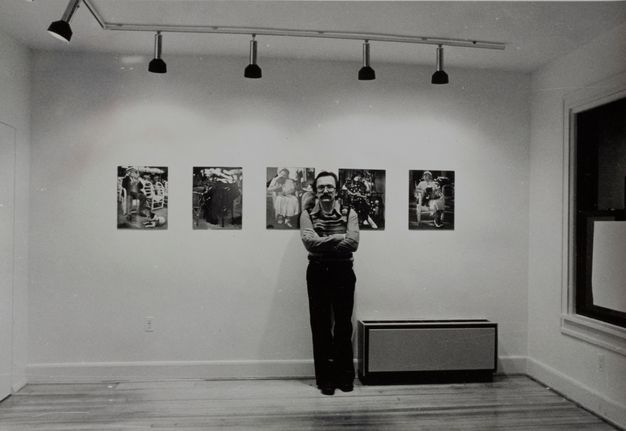
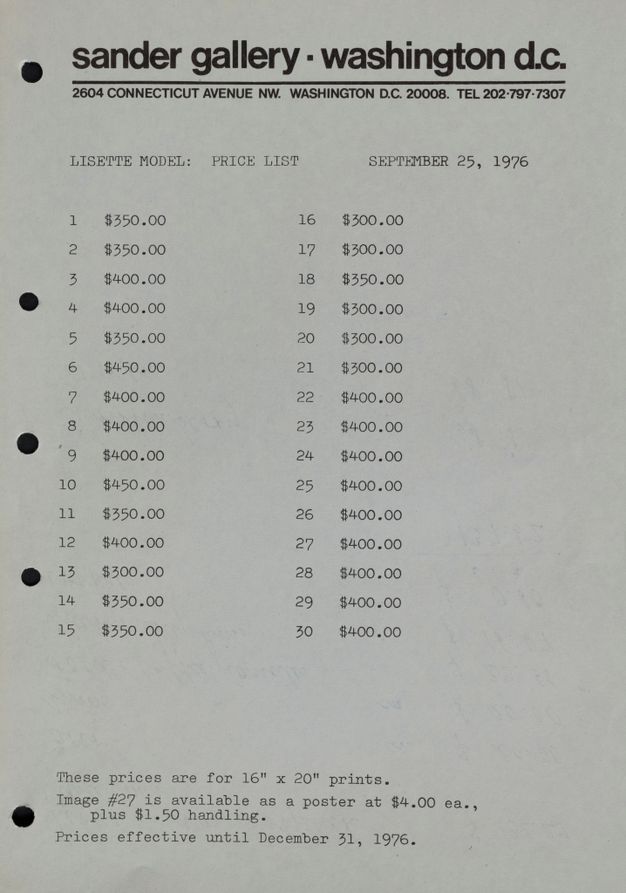
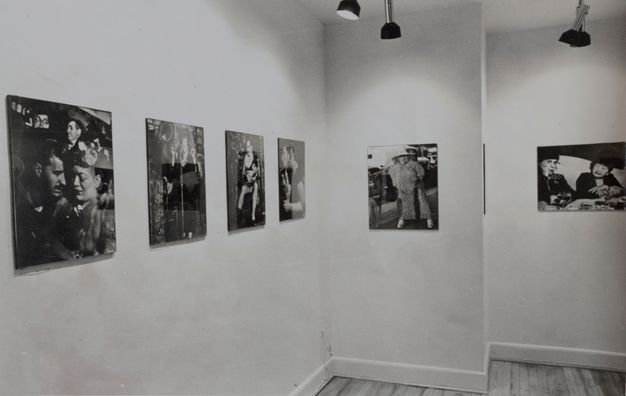
specifications. In September 1976, Sander Gallery opened with
a show of thirty of Model’s photographs, priced between $300
and $400 apiece for sixteen-by-twenty-inch prints (figs. 1, 2). According to an unsigned review
in Aperture, with the exhibition, “Lisette Model
reemerged from legend to the visibility of the gallery wall
and the scrutiny of the public eye.”5
The review commends the fact that, finally, “Model’s work is
being printed, exhibited, and published. The old negatives
. . . came out of storage and Sander carried them to
Washington. There he began to print as Model directed, ‘strong
and closed.’” Model’s satisfied response to Sander’s work is
quoted: “The prints are so much myself. They were a miraculous
kind of thing.”6
Despite broad publicity and positive reviews from art critics,
only one work sold.7
It was an image of Running Legs (a series she had
begun in the 1940s), which artist Allan Kaprow and his wife,
photographer Rachel Vaughan, ordered in a larger,
twenty-by-twenty-four-inch size for the price of $500. The
print-to-order and price-to-size sales model had been standard
for several decades, and while prices had risen considerably
since the 1950s, the days of $25 prints, the general marketing
structure remained the same, with exhibitions and catalogs
like menus from which buyers might order any number of items
for custom printing.
After the show closed at Sander Gallery, fellow Washington,
DC–based photography dealer Harry Lunn approached Sander for
help with another project to print Model’s work.8
Lunn was a former CIA agent turned dealer of fine-art prints
and photography. In 1968, Lunn had opened a graphic arts
gallery in the Capitol Hill area of DC that dealt in
nineteenth- and twentieth-century prints and drawings. But in
January 1971, after seeing the work of Ansel Adams, he began
selling photographs marked by an inaugural exhibition of
Adams’s Portfolio V.9
Quickly establishing himself as a groundbreaking photography
dealer whose impact on the market is still felt today, Lunn
made $10,000 in sales from this first show alone. In the early
1970s, he purchased inventories of thousands of prints from
the archives of Lewis Hine, Walker Evans, Adams, and Robert
Frank; he co-acquired, with Marlborough Gallery, the entire
set of prints Berenice Abbott had made from Eugène Atget’s
negatives, as well as Abbott’s own work; and he came to
exclusively represent Brassaï and the estate of Arbus.10
Lunn’s proposed project was a limited-edition, collectible
boxed-set portfolio of works by Arbus’s friend and teacher,
Lisette Model.
Custom-printed for this purpose, the portfolio, titled simply
Lisette Model: Twelve Photographs, contained a
selection of signed images that Model had made in the 1930s
and 1940s, printed uniformly at sixteen by twenty inches.11
Master printer Richard Benson, who had printed for Paul
Strand, Evans, and others, started production, but Model was
unhappy with the prints, so Lunn asked Sander to take
over.12
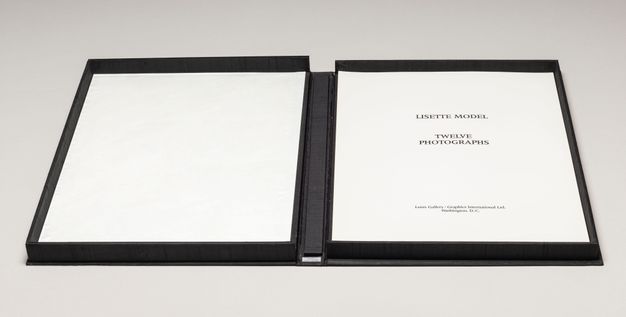
The portfolio was presented loose in a custom-designed,
silk-covered case and issued in a limited edition of
seventy-five identical sets, plus fifteen artist proofs, each
numbered (fig. 3). Fixing or “limiting”
the edition meant that, after the portfolio, no further prints
would be created from those negatives. This was a significant
break from the order-fulfillment model. The portfolio, Lunn
projected, would produce a new kind of collectability for
Model.
The challenge for Lunn was how to position a magazine
photographer without salable prints as a collectible artist.
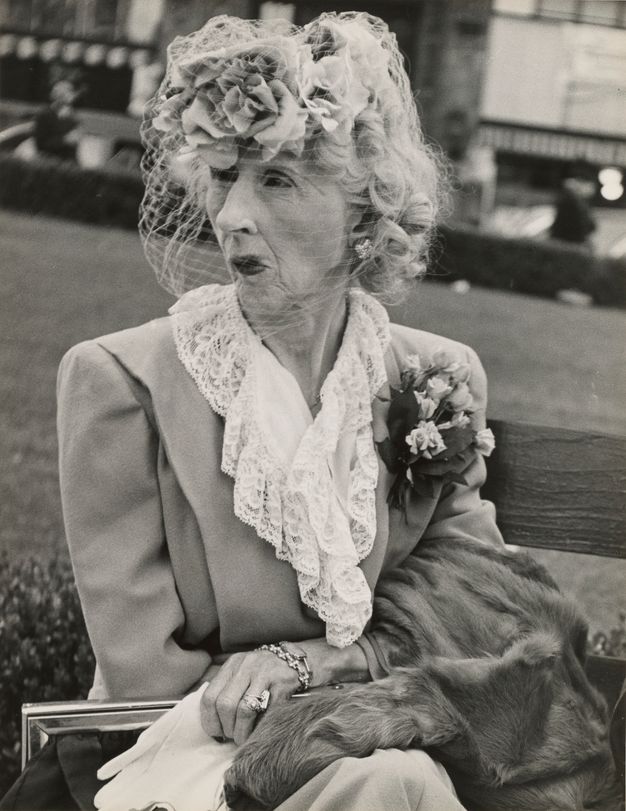
In 1956, pioneering photography dealer Helen Gee had sold a
nineteen-by-fifteen-inch print of Model’s photograph
Woman with Veil, San Francisco, of 1949, printed
sometime between 1949 and 1956, for $25.75 at Limelight
Gallery to US American arts patron and women’s rights advocate
Dorothy Meigs Eidlitz (fig. 4).13
In 2007, by contrast, a print of that same photograph,
described as vintage, sold at auction at Christie’s London for
£31,200 ($61,818)—more than three times the estimate,
surpassing any previous price for a print by Model.14
The vintage print, whose lower contrast and slighter
dimensions Model advocated moving away from in the 1970s,
would become prized by collectors. Model’s work gained
exponential value as the twentieth-century art market evolved.
In the following pages, I argue that the invention of the
limited-edition portfolio played a fundamental role in the
marketability of Model’s photography and, more broadly, the
rise of the photographic art market in the United States.
Using Model as a case study to address the question of how a
market was created for photographs, I will review some early
attempts to market photography in the United States prior to
the 1970s, when the print-to-order model dominated; discuss
the production and circulation of photographs in magazine and
museum contexts in this period; and consider theoretical
models on the nature of the commodity that link notions of
collectability and desire to the perception of scarcity. Two
fundamental and concurrent interventions, modeled by Sander
and Lunn respectively, transformed the US photography market,
helping it to effloresce ahead of markets in Europe and other
locations: first, modern printing—that is, later printing from
original negatives for the express purpose of sale; and
second, the creation of rarity, or the limitation of what
flowed into the market. In what follows, I present the
distinct roles Sander and Lunn played in reshaping Model as a
salable artist as well as their broader impacts on the
photography market, particularly the rise of the
limited-edition portfolio. Ultimately, and ironically,
although the production and sale of portfolios was intended to
build a market for photographic prints—which it did—what came
to be known as “vintage prints,” those that had been produced
for noncollecting purposes and showed signs of age and wear,
became the most sought-after, costly items; these were the
very same objects that Model had considered unfit for
exhibition.
The astronomical ascent of photography as a collectible art
form in museums and private collections in the last fifty
years, reflected in the climbing prices achieved at auction,
is a subject of increasing scholarly interest. Today, the
so-called photo boom of the 1970s is a dense and growing area
of literature in the field, yet the history of limited-edition
photography portfolios has yet to be situated in its broader
impact on the market. As the market for photographs
dramatically expanded, pioneering photography critic A. D.
Coleman, whose column Latent Image in the
Village Voice was published beginning in 1968,
offered leading analysis on developments in photography. His
writings from this period trace themes and trends such as
public funding for the arts, the fugitivity of Polaroids as a
problem for their collectability, the reception of color
photography by art critics, the hybridization of photography
and performance art, and the role of pornography in our
understanding and valuation of photography.15
Coleman only delves occasionally into themes such as
editioning; his texts focus on broad cultural trends without
isolating limited-edition portfolios as a subject of inquiry.
Art critic Andy Grundberg employs a similarly holistic
approach to historicizing the photograph in his book
How Photography Became Contemporary Art: Inside an Artistic
Revolution from Pop to the Digital Age
(2021).16
His broader overview of postwar artistic developments situates
the broader acceptance of photography and its shifting
artistic status with respect to its increasing presence in and
integration as a core component in conceptual and performance
practices from the 1970s onward; this focus prioritizes the
incorporation of photography into other art forms over
practices within historic photographic modes. Alternate
perspectives on the photography market have come from other
sources. A notable recent overview of its efflorescence and an
economic analysis of the photo boom has come from
auction-house expert Juliet Hacking, who was a longtime head
of the Department of Photographs at Sotheby’s in London. Her
book Photography and the Art Market of 2018 takes up
the economics of the art market for photographs from an
art-business perspective. While the book addresses editioning
and the difference between vintage and modern prints, it
doesn’t historicize these distinctions.17
Similarly, Denise Bethel, former chairperson of photographs at
Sotheby’s, continues to speak and write broadly in this
developing area of scholarship.18
Most recently, Molly Kalkstein completed her unpublished
doctoral dissertation “The Discerning Eye: Creating Value in
the 1970s American Market for Photographs,” which charts
several developments in the US and England between 1969 and
1980 that solidified the status of the photograph within the
art and museum worlds. Kalkstein’s is the first major study to
assess, from an art historical perspective, mechanisms such as
editioning and the notion of the “vintage print” in the
historic valuation of photographs.19
Still, with the exception of unpublished writings, there
remains a lacuna in the understanding of the crucial role
played by portfolios across this period.20
In this essay, to bridge that gap, I situate and historicize
the short-lived heyday of the limited-edition portfolio, the
figures behind its careful positioning as a market tool, and
the crafting of rarity that underpins the rise, fall, and
impact of this briefly dominant trend that pervaded the
photography market in the 1970s.
Photography without an Object
Since the invention of photography in the 1830s, practitioners
and enthusiasts alike had to fight for the medium to be
recognized as art. Yet it was not until the market boom of the
1970s that a solid collector base was finally secured for
photography as fine art in the United States. Dealers have
been lauded as visionary promoters of the aesthetic value of
photographs, yet studies are lacking that describe the precise
alchemy by which aesthetic value was translated into market
value with economic returns; this was an alchemy that in turn
shifted and, in many ways, flattened the at once multiple and
overlapping “discursive spaces” of photography that Rosalind
Krauss famously theorized.21
In the first half of the twentieth century, some prescient art
dealers recognized and advocated for the value of photographs.
Notable examples were Alfred Stieglitz, Julien Levy, and Gee,
each of whom exhibited photographs in their New York City
galleries.22
Although each project brought greater critical attention to
the medium, none succeeded in garnering a discrete collector
base. In 1905, Stieglitz, famed pioneer and promoter of
Pictorialist photography and leader of the Photo-Secession,
opened the Little Galleries of the Photo-Secession at 291
Fifth Avenue in New York. More commonly known as “291,” it
introduced the work of photographers alongside modernist
paintings and sculptures by international artists Paul
Cézanne, Henri Matisse, Pablo Picasso, and Auguste Rodin. The
fact that photographs failed to sell did not deter Stieglitz,
who remained committed to his cause, and from 1925 to 1929 he
ran the Intimate Gallery, dedicated exclusively to the
promotion of US American art. Finally, in late 1929 he opened
a third gallery devoted to US modernism, called An American
Place, at 509 Madison Avenue, where he presented monographic
shows of work by Paul Strand, Adams, Eliot Porter, and others,
again without sales, until his death in 1946.
In the 1930s, Levy, having spent time in Paris among the
avant-garde, returned to New York determined to promote
surrealism to an American audience.23
He believed in photography as a central medium of modernism,
and when he opened the Julien Levy Gallery in 1931 at 602
Madison Avenue, he showed photographic work by Man Ray, Henri
Cartier Bresson, Abbott, and Marcel Duchamp. It was only when
this work did not sell that he began to focus broadly on other
media, including painting, sculpture, and collage, showing
surrealist works by Max Ernst, Salvador Dalí, and Joseph
Cornell with great success. When his gallery closed in 1949,
Levy had amassed a spectacular private collection of
photographs that was eventually acquired for the Art Institute
of Chicago by photography curator David Travis in 1976.24
In 1954, Gee, a former student of Model’s, opened Limelight,
the first gallery dedicated exclusively to the exhibition and
sale of photography in New York.25
Located in the happening Greenwich Village neighborhood,
Limelight was a coffee house and diner with a devoted gallery
section in the back. In its six and a half years, Limelight
mounted sixty-one exhibitions of photographic work, featuring
Abbott’s prints from Atget’s negatives, the work of Brassaï,
Julia Margaret Cameron, László Moholy-Nagy, Stieglitz, Edward
Weston, and much more. The financial survival of Limelight,
however, was carried by food sales from the café. The
photographs, priced between $25 and $75, rarely sold. Although
it provided an important exhibition and gathering space for
photographers, the project was not viable financially, and Gee
ultimately closed the gallery in 1961.
Even at MoMA, the first major institution to collect
photographs, museum leaders tried to cultivate enthusiasm for
private collecting. In 1951, a decade after the founding of
its Photography Department,
A Christmas Sale of Photographs was staged at MoMA
“as an experiment to stimulate interest in the collecting of
original photographic prints.”26
Works by Weston, Aaron Siskind, Lotte Jacobi, Frank, and Model
were priced at $10 to $25 each. The organizers of the museum
sale promised that works would be custom-printed according to
demand. Unfortunately, the sale produced few buyers.
In spite of the increasing recognition by museums, the notion
of the photographic print as a privately collectible art form
had yet to catch on. Collectors did not perceive photography
as an aesthetic or financial investment, for it was entrenched
in utilitarian purposes such as advertising and journalism,
and its seemingly limitless reproducibility made it appear too
easily accessible.27
Never was that reproducibility more embedded in the
photograph’s identity than in the mid-twentieth century, a
moment when photography’s discursive field was driven by the
domain of the magazine page; it was rare to find sustainable
income as a photographer anywhere else.
The great image engines of New York—Life,
Look, Fortune, Vogue, and
Harper’s Bazaar—churned out new issues weekly,
biweekly, or monthly. The specific process by which a single
photograph or set would end up in the hands of millions of
readers around the country might vary slightly from periodical
to periodical, but in general, a photographer would shoot a
subject, develop the film, produce a contact sheet and sample
prints, and deliver these to the magazine. An editor would
select what they considered to be the best images for a story
or spread. These were sent to retouchers, then to a design
team for layout, montaging, and integration with text before
being shot for transfer to offset lithography plates. Original
prints were usually not returned, and if they were, they often
had cropping marks, touch-ups, editorial commentary, and
stamps all over them.28
It is easy to understand how prints from this period were
stashed away in boxes or lost to the cutting-room floor.
Throughout the 1950s and 1960s, MoMA employed an in-house
photographer to document exhibition installations and to make
custom prints for those exhibitions using on-site darkroom
facilities.29
Particularly under the stewardship of former magazine
photographer Edward Steichen, who served as director of the
Department of Photography at MoMA from 1947–61, photographs
were exhibited more for their design and image qualities than
for their value as objects, exemplified perhaps most
dramatically by the exhibition Family of Man.30
Original negatives or photographers’ prints were sent out with
orders for poster-size enlargements from Manhattan-based
printing companies including Compo-Photocolor and Modern Age,
and it was those enlargements that would be installed on
gallery walls. In such a print-to-order system, standard for
museums at this time, it was difficult to identify a single
collectible object.
Theories of Collecting in the Postwar Period
By the late 1960s, at the same moment that the first major
photography galleries to anticipate lasting success began to
open in New York and Washington, DC, scholars Jean Baudrillard
and Timothy Brock were publishing works in the fields of
sociology and psychology on the ways in which people value
objects. Baudrillard’s and Brock’s ideas about the nature and
status of commodities offer a useful lens for interpreting the
actions of gallerists. In his book of 1968,
Le système des objets (The System of Objects), French sociologist and cultural theorist Baudrillard, who
was incidentally also a photographer, argued that collected
objects are distinct from ordinary objects based on the nature
of their relationship to an owner.31
When individuals relate to an object through its function, he
explains, its status is simply that of a used thing. By
contrast, an object can only be regarded as “possessed” once
it has been “abstracted from its function and thus brought
into relationship with the subject.”32
In a section titled “The Non-Functional System, or Subjective
Discourse,” in which he devotes a subsection to what he terms
“a marginal system: collecting,” Baudrillard gives the
following example:
If I use a refrigerator to refrigerate, it is a practical
mediation: it is not an object by a refrigerator. And in
that sense I do not possess it. A utensil is never
possessed, because a utensil refers one to the world; what
is possessed is always an object
abstracted from its function and thus brought into
relationship with the subject.33
When considered in relation to photography, Baudrillard’s
thesis would imply that for the medium to be perceived as
collectible, it would first need to be disentangled from its
scientific, editorial, and advertising functions. Photographs
had to be redefined, essentially, as useless—as things whose
sole purpose is to be owned. In other words, the photograph
needed to be converted from a functional image into a
functionless object.
Working at the same moment as Baudrillard, Brock, a
psychologist, published his formulation of commodity theory in
1968.34
Brock was interested in psychological responses to scarcity,
and in particular how scarcity impacts perceptions of
commodity value. His fundamental argument was that scarcity
enhances the perceived value, or desirability, of anything
that can be possessed. In other words, the more restricted or
limited the availability of a good, the more people want it
and will be willing to pay for it. A century earlier,
economist Adam Smith had articulated a similar observation,
writing simply: “The merit of an object, which is in any
degree either useful or beautiful, is greatly enhanced by its
scarcity.”35
Following Baudrillard, such merit would only be enhanced if an
object was both beautiful and useless. Brock’s commodity
theory adds the implication that by modulating scarcity you
could influence behavior. Photography’s status as infinitely
reproducible was precisely what lay in the way of its
desirability as a commodity. In order to redefine the
photograph as collectible, it needed to be divested from its
function, made scarce, and perceived as rare.
Gerd Sander, Master Printer
In the late 1960s and early 1970s, the onus was on the dealers
to prove that photography could be a stand-alone object—a
print. For many living photographers, particularly those who
had primarily worked for magazines, they had no prints to
sell. A sudden need for quality prints led in turn to the rise
of the master printer.
Gerd Sander was born in 1940 in Cologne, Germany, to a family
of photographers. At the age of six, he received his first
photography lessons from his grandfather, August Sander, the
great German photographer known for his lifelong portraiture
project Menschen des 20. Jahrhunderts (People of the 20th Century), which documented, indexed, and classified the German
population.36
The family business was darkroom printing. Initially an engine
to support August’s work, printing operations were run by
August’s middle child and Gerd’s father, Gunther Sander.
Gunther eventually established his own commercial darkroom,
printing for publicity and advertising companies and making
oversize enlargements for trade fairs and film sets. In 1957,
at the age of seventeen, Gerd left school to work full time in
the darkroom, where he learned how to print to the
specifications of varied and demanding clients. After August’s
death in 1964, Gunther and Gerd continued printing from
August’s negatives for a variety of purposes, and these
posthumous prints can now be found in many museums around the
world.37
When he moved to Washington, DC, in 1975, Gerd Sander’s
reputation as a serious printer led him to several printing
jobs.38
He got his first job that year, working with Hungarian émigré
photographer André Kertész, then living in New York, who
needed help restoring damaged negatives from his series
Distortions of 1933. Sander meticulously cleaned them
and, using Kodak SO-15 direct reversal film, made duplicate
negatives from which to print Kertész’s book
Distortions (1976). For a second job, the National
Archives in Washington, DC, hired him for a large-scale
project to produce quality exhibition prints from their large
collection of negatives. And in 1975–76, Sander was hired by
Cohn Gallery to make portfolio prints of snapshots by German
painter George Grosz taken when he arrived on US shores as an
immigrant in 1932.39
The artist had been deceased for nearly two decades, and all
that were left were 35 mm contact sheets. Sander
rephotographed these with an eight-by-ten view camera to make
new copy negatives and print the editioned set of gelatin
silver prints.
The production of modern prints by patient and precise
darkroom printers was on the rise, to the great benefit of
artists who established continuing relationships with many of
them as their dedicated printers. The practice of artists
contracting with master printers became so ubiquitous that an
entire series of books could be devoted to documenting it. For
example, Sid Kaplan became Frank’s printer; Lucien Treillard
printed for Man Ray; George Tice for Steichen; Benson for
Evans; Gus Kayafas for Harold Edgerton; and Alex Jamison for
Fredrick Sommer. The Arbus estate gave exclusive printing
rights to Neil Selkirk. When Sander approached Model in 1975
about showing her work, he was not expecting to take over her
printing too, but it was not an altogether surprising
proposition.
Marketable prints for Model would be distinct from prints of
her earlier work; for one thing, they would be larger. As
early as 1964, Model had already started to reinterpret her
own works, updating her approach to printing. That year, she
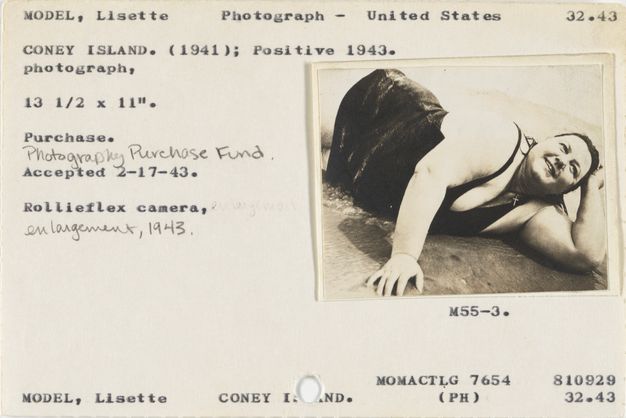
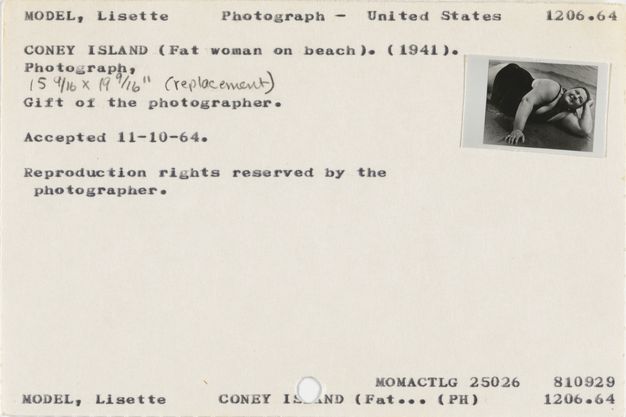
delivered to MoMA a box of six newly made
sixteen-by-twenty-inch prints—all larger and more attentively
printed duplicates of works the museum had acquired for
exhibition during the time when photographs were prized more
for their design elements than for their material features.
She explained that these were “replacement prints,” and asked
that they be kept and used instead of the older standard
eleven-by-fourteen-inch press prints, which the museum had
purchased in the early 1940s for $10–15 apiece (figs. 5, 6).40
The replacements from 1964 had clean edges and sharp, precise,
ninety-degree corners that suggest the use of a cropping
easel.
The core belief that a fine-art print should be distinct from
those made originally for other contexts informed the
specifications of the prints Model wanted from Sander. In
addition to setting the sixteen-by-twenty-inch sheet as her
new minimum size, Model wanted her new prints to have grit and
weight. Unlike the flattened, dull tones required for magazine
reproduction (a process that enhanced contrast through the
multiple states of reprinting), “she wanted her [new] prints
to have solidity, like a sculpture,” Sander said.41
Model was a photographer of people, and the weight and
solidity of their bodies had to be translated into the
printing, which meant that contrast was important. Rather than
an emphasis on middle-gray tones, Model wanted bright white
highlights to emphasize the forms, and deep, dark blacks to
help model and distinguish figures from the space around them.
Accordingly, Sander used 250-watt photoflood bulbs, which
produce intense white light, to render extremely sharp detail
and heightened contrast. “You saw every dot on it. Every grain
of the negative.”42
This produced the punch and character that Model sought.43
In addition, she wanted an extra-shiny effect, so Sander
printed on Agfa Brovira glossy paper, advertised for its
sparkling highlights, which he then air-dried, dry mounted on
archival board, and sandwiched under Plexiglas to be hung on
the wall (fig. 7).44
Photography collector Pierre Apraxine, who in the 1970s to
1990s amassed over eight thousand photographs for the Gilman
Paper Company Collection, once explained that a pristine
print, framed and hung on the wall, “raises them [photographs]
to the dignity of desirable and collectible objects.”45
But there were limits to the sustainability or success of a
system in which photographers and printers were fulfilling
orders from private collectors, dealers, or museums for only a
couple of hundred dollars apiece. Even the most beautiful
prints, made with care and precision, were not enough to sell
on their own. Despite the hundreds of catalogs sent out by
Sander Gallery, and the positive press garnered for them, only
one print sold.46
“The Creation of Rarity”: Harry Lunn and Strategies in the
Photography Market
As Sander perfected the art of modern printing, Harry H. Lunn
Jr., who held a degree in economics, came to the business of
selling prints with an eye toward financial systems. In the
1960s, while living in Paris, Lunn had become interested in
graphic prints and drawings, and had started collecting and
selling them. In 1971, a few years after opening Lunn Gallery
in Washington, DC, he championed the work of Adams and devoted
his business primarily to photography, quickly distinguishing
himself as one of the most influential photography dealers in
the United States.
In October 1978, photography dealers and curators gathered at
George Eastman House in Rochester, New York, for a symposium
that would plant the seed for the founding of the Association
of International Photography Art Dealers (AIPAD) and its
annual art fair. AIPAD was the first-ever professional
organization for photography dealers and is still active
today. The title of the weekend symposium in 1978 was
Photographic Collecting, Past and Present.47
On the last day, Lunn gave a talk candidly titled “The
Creation of Rarity,” in which he laid out a strategy of how
photography dealers could control market pricing. He began
with a story of a stamp dealer, who, “having acquired two
identical stamps worth one million dollars each, burned one in
order to charge three million [dollars] for the other.”48
Lunn then urged that similar actions be taken in the
photography market, given what he called the “relative
thinness of the market and the failure of photography to
attract a significantly wider group of collectors in recent
years.”49
For Lunn, if dealers wanted to elevate demand and prices, they
ought to cease the limitless availability of the
print-to-order system in favor of extreme limitation.
Lunn, of course, never set fire to any art, but achieved his
creation of rarity in a number of ways. He acquired exclusive
rights to facilitate the sale or printing of work by
photographers including Arbus, Frank, Evans, and Abbott, and
had the foresight to acquire their work inexpensively and then
construct greater market value for it. He acquired whole
estates and trickled prints onto the market sparingly, only a
few a year. He set limited-term pricing and warned of price
jumps after a certain deadline, guaranteeing immediate sales
at the lower prices and setting precedent for annual inflation
rates.
According to photography scholar Michelle Bogre, in 1974, Lunn
“practically cornered the market on Adams, purchasing 1,000
prints for around $300 each. Shortly thereafter, Adams stopped
making prints for private sale. Anyone wanting an original had
to deal with Lunn, and the prices skyrocketed.”50
In 1979, a print of Adams’s iconic
Moonrise, Hernandez (1941) that Lunn had purchased
for $300 sold at auction for $15,000; Lunn later remarked that
“the Ansel Adams phenomenon would not have occurred had he
continued to print individual orders without restriction.
Despite Adams [sic] perfectionism which makes his
prints individual hand made works, the collectors would have
continued to regard his prints as readily available and
without particular rarity.”51
“Harry gave photography a totally new reputation,” said the
dealer Howard Read. “In the early seventies, a picture was
something you kept in a drawer or in the attic. Harry changed
that into something you could trade, buy and sell. He created
a market.”52
The other way Lunn manufactured rarity was through the
publication of limited-edition photographic portfolios, each a
precious, collectible art object with a fixed limit imposed on
its quantity. Portfolios, particularly collections of prints,
hold a long history in the traditional graphic arts. But prior
to the 1970s, it was a relatively uncommon format in
photography, with notable self-published exceptions by Adams,
Weston, and Strand, many of which were targeted to book
buyers.53
In 1968 Tice self-published The Amish Portfolio, a
selection of twelve mounted prints in an edition of fifty,
which sold for $75 each. Shortly thereafter, Arbus first
conceived of her own self-published portfolio,
A box of ten photographs, of which four editions were
completed by the time of her death in 1971.54
In 1970, Richard Avedon’s Minneapolis Portfolio,
designed by Marvin Israel, was issued in tandem with Avedon’s
retrospective at the Minneapolis Institute of Art that year.
Also, in 1971 Evans published Fourteen Photographs in
an edition of one hundred with Ives-Sillman, in New Haven,
Connecticut. Seeing this trend and its salability to museums
inspired photography dealers to begin producing portfolios for
the artists that they represented.55
For Lunn, it was likely that his background as a print
specialist enabled him to recognize the portfolio as a
familiar and rich marketing opportunity—he referred to
portfolio production as a means of creating “the maximum
investment return.”56
Photography dealer Lee Witkin, whose eponymous New York
photography gallery also embraced portfolio production at this
time, describes its benefit in this way:
Usually presented in a box and accompanied by a foreword,
introduction, or similar text, a portfolio generally offers
collectors a mini-retrospective of a photographer’s career
or a selection of images on a theme for which the individual
is well known. . . . Most portfolios are initially sold at a
price lower than the sum total of the individual prints if
they were to be purchased separately. This saving, plus the
attractiveness of a “package,” makes portfolios appealing to
many collectors. Once purchased, portfolios can be split up
for display, for single-print sales, or for the sake of
joint owners.57
In 1974, published under his subsidiary company Graphics
International, Lunn released his first portfolio:
James Van Der Zee: Eighteen Photographs, printed by
Benson under the photographer’s supervision from a combination
of original negatives and copied vintage prints.58
Issued in an edition of seventy-five plus fifteen
“presentation copies,” the portfolio was priced at $2,000; the
negatives were permanently retired after its completion. After
the Van Der Zee portfolio, whose copies nearly all sold, Lunn
had proof of concept, and in the following five years alone he
began work on no fewer than eight photographic portfolios.
Lisette Model: Twelve Photographs, 1976
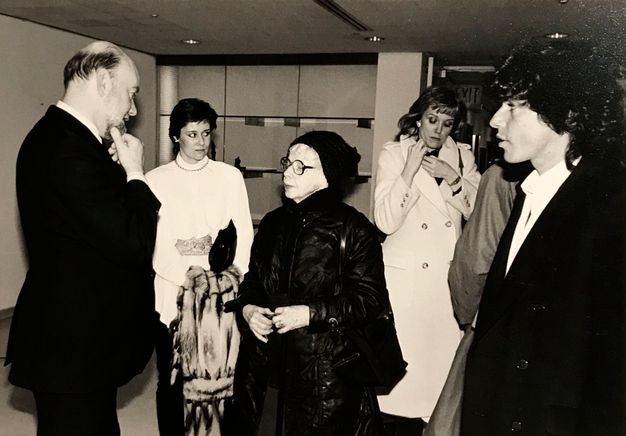
Lunn met Model in 1974, introduced by their mutual friend Gee
(fig. 8). It is possible that when Lunn
proposed the portfolio to Model, Lunn hoped to represent her
exclusively—an ambition that would have been complicated by
Sander’s connection to the artist around that same time.
Nevertheless, the resulting collaboration between Lunn,
Sander, and Model would benefit all three parties and
transform Model’s absence in the market into a place of
prominence.
ExpandFig. 8. —Harry Lunn (left) with Lisette Model
(center), ca. 1975, gelatin silver
print.
Photographer unknown. Cologne, Germany, August Sander
Stiftung.
The stunning result of nearly four years of collaboration
between these key figures,
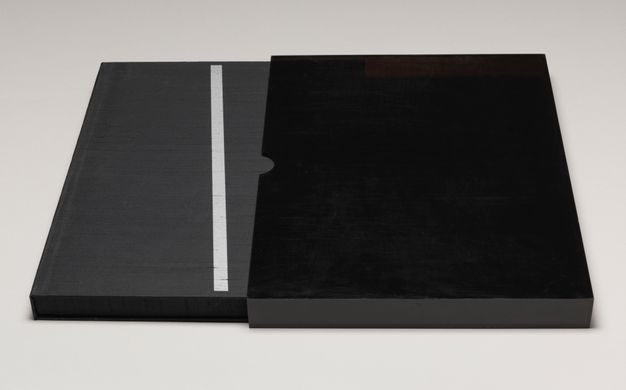
Lisette Model: Twelve Photographs is a deluxe, modern
object (fig. 9). Encased in a hard,
translucent, black Plexiglas slipcover, it can be slid
vertically into a large bookshelf for storage and display or,
more ostentatiously, laid flat as a singular object and housed
horizontally on a deep shelf or table. Out of the slipcover,
it is luxurious and minimal. Bound entirely in rich, knotted,
black raw-silk cloth, it is clean and monolithic, with only a
silvery-white silkscreened line slicing down the center of the
front cover at a subtle slant.
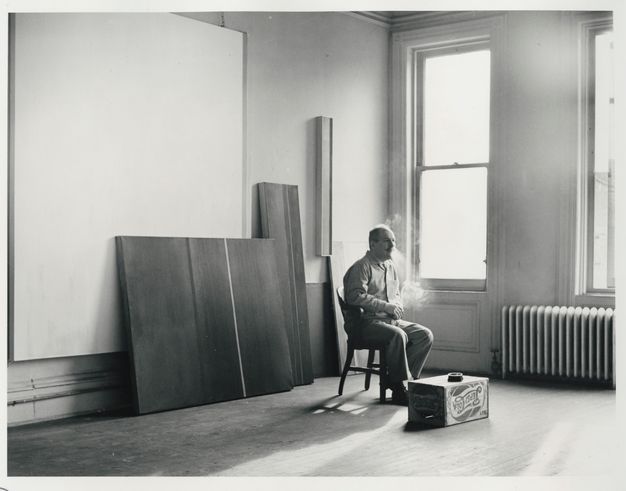
The diagonal line confronts the viewer as a direct aesthetic
proposition—entirely divested from the magazine origins of the
photographs contained within the case. Reminiscent of artist
Barnett Newman’s signature vertical band of color, the “zip,”
the single bisecting line aligns Model with the legacies of
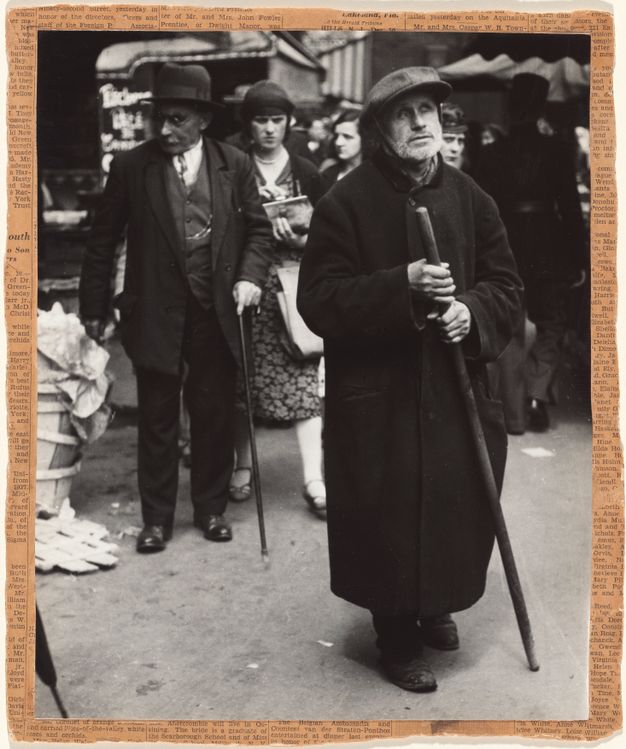
abstract expressionism and minimalism in the United States (fig. 10). In it, one might also recognize the diagonal line from her
photograph of 1933–38, Blind Man Walking, Paris, a
version of which was not selected for
Twelve Photographs—perhaps suggesting that, like the
blind man’s cane, her photographs, too, aid the unseeing to
perceive the world (fig. 11). A third
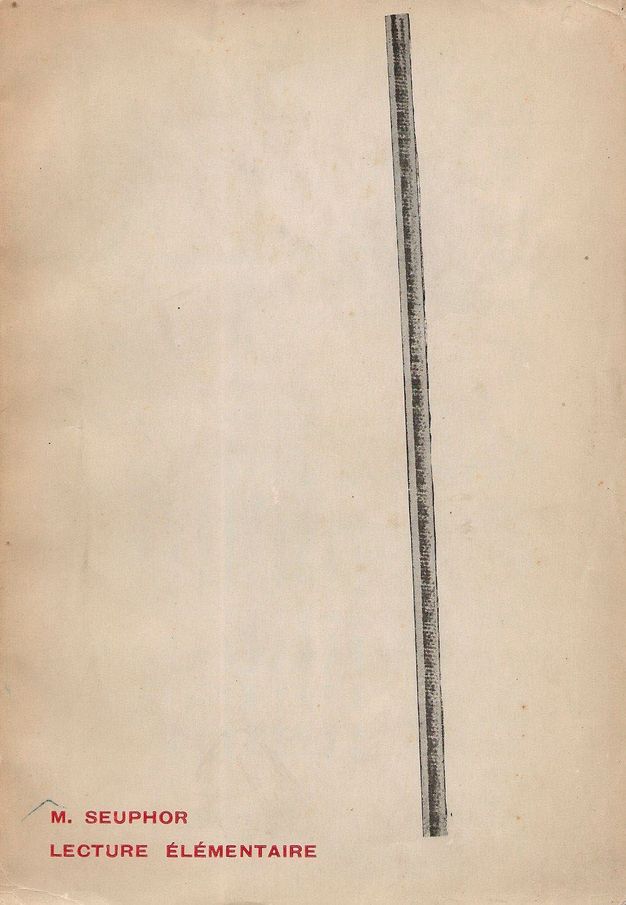
possibility is that Model’s inspiration came from a design
painted by her husband, Evsa, for the cover of a book
containing painter and critic Michel Seuphor’s lectures on
abstraction, published in 1928, the year Lisette and Evsa met
in Paris (fig. 12). The single slanted
line might be an adaptation or version of Evsa’s work.59
He died in October of 1976, just as the portfolio design was
being finalized.
Inside the box, a colophon insert specifies that the edition
includes “75 examples . . . with an additional 15 proof
examples,” and, without listing either Benson or Sander,
emphasizes the authenticity of the prints through the
statement that they “have been printed under the supervision
of the artist . . . and are signed on the verso in pencil.”
The signature further reifies the aura of collectability and
reinforces the nonutilitarian nature of the objects. To
further establish its rarity, in the colophon it is also noted
that “no further photographs will be made for sale from the
negatives.”60
Finally, on its own sheet before the prints, following the
colophon, a short essay by Abbott is included. Her words sound
a triumphant declaration of a battle hard won:
It is not often that a new form of expression comes along.
Niepce’s invention ushered in a baffling and deceptive
medium. To project the eye through a boxed-in lens was
considered a “mechanical” process. But if a camera, mindless
and heartless of itself, is a “machine,” certainly a piano
and violin are likewise, as well as the simpler brush and
pen. There can be as much magic in a photograph as there is
in a sonata.61
These words exemplify Abbott’s lifelong advocacy of the
medium. Underneath Abbott’s contribution lay the prints. In an
ultimate move to reclaim authorial control over her identity
as an artist, Model selected the photographs that most aligned
with her personal vision rather than those produced on
assignment. These twelve images have gone on to become Model’s
most canonical, most reproduced, and most familiar works.62
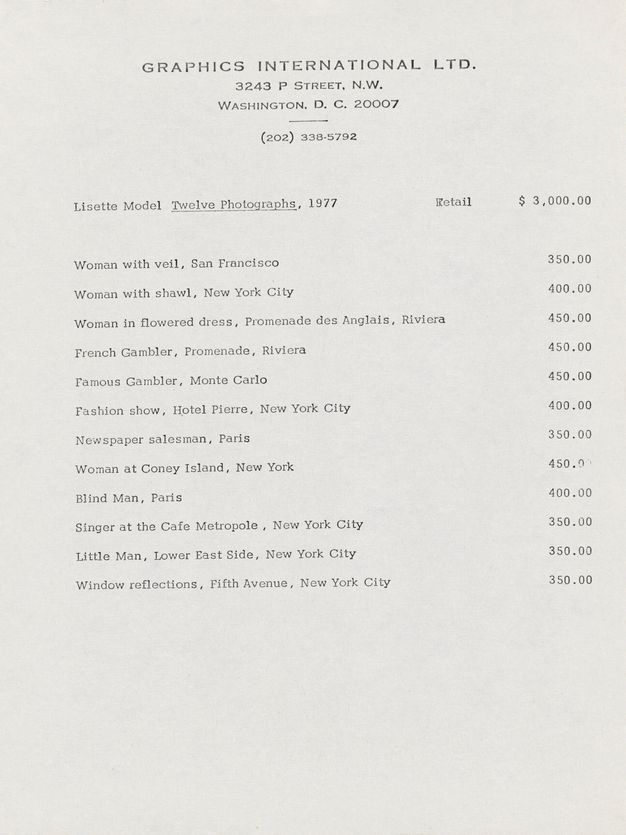
The portfolio, bearing a publication date of 1976, was
originally priced at $2,400 at issuance in early 1977, and by
the spring of that year, Lunn had spiked its cost. The price
sheet from late 1977, which lists the works in the order they
appear in the portfolio, showed how the edition offered
collectors a deal (fig. 13). For
$3,000, they could have twelve prints whose value, based on
individual pricing, exceeded that price by 50 percent, at
$4,750.63
With prices bumped up each year, and with each portfolio
bringing with it the potential to be split and earn profit
through resale, it is easy to imagine the photography market
chugging like a giant steam engine, growing stronger and
moving faster with each turn of the axle. Today, only a few
unsold copies remain in the inventories of the Sander and Lunn
families, and it seems likely that they may keep them, for
they have now become extremely rare.64
ExpandFig. 13. —Price sheet for
Lisette Model: Twelve Photographs (1976),
issued by Graphics International, Washington, DC, late
1977.
Los Angeles, Getty Research Institute, Harry Lunn papers,
2004.M.17.
Which brings me to one final achievement of the portfolios
more broadly: getting photography into museum collections.
Most of Model’s intact portfolios remain in museums today. The
prepackaged portfolio was attractive to smaller museums with
modest budgets for photography; for a reasonable price, they
could have all the greatest images by a single
photographer—enough to make up an entire one-room exhibition
or to seed a larger collection. Today, the portfolio remains
one of the primary means by which Model’s pictures are
represented in collections across the United States, including
the New York Public Library, the San Francisco Museum of
Modern Art (SFMOMA), the Library of Congress, the Spencer Art
Museum at the University of Kansas, the DeCordova Museum in
Lincoln, Massachusetts, the Center for Creative Photography in
Arizona, and the National Gallery of Art in Washington, DC. In
the 1970s, portfolios were also promoted as a tax incentive to
investors, who would buy a boxed set at a deeply discounted
price and in turn donate it to a museum, where they could
claim a large tax write-off for the full market value.65
This questionable system is no longer practiced, but it had
two outcomes: One, it served to place artists like Model into
museums that might not have otherwise had the resources to
invest in their work. Two, as Lunn himself once said,
“Whenever a photograph or anything else passes into a museum
that’s it. It’s off the market.”66
The transmission of portfolios into museums gave the market
yet another spike, augmenting rarity by limiting what was
available to private buyers, thus making the remaining
portfolios even more valuable.
The portfolio trend was by no means thanks to Lunn’s
initiative alone.67
Indeed, it swept through the entire photography market. In and
around the 1970s, several hundred photography portfolios were
published by galleries, museums, photographers, and printers
around the country. Most prolifically, Witkin, with his
partner, collector Dan Berley, published more than thirty
portfolios under the imprint Witkin-Berley of work by Abbott,
Brassaï, Francis Bruguière, Judy Dater, Frederick Evans,
Jacques-Henri Lartigue, W. Eugene Smith, and others. Other
portfolios were made and sold by Galerie Wilde, Time-Life
Books, Life Gallery, Lustrum Press, Double Elephant Press,
Vision Gallery, and Sonnabend Editions, among others. Sander,
too—having made portfolio prints for Horacio Coppola, Grosz,
Model, and Umbo (Otto Umbehr)—eventually got involved in the
practice of editioning and published Sander Gallery portfolios
of Marcel Broodthaers, William Christenbery, Walter Peterhans,
and ringl + pit.
As museums came into possession of artists’ negatives, they
too began to publish and sell portfolios. Celebrated examples
include the Metropolitan Museum of Art’s release of
Stephen Shore: Twelve Photographs to coincide with
its solo exhibition of the artist’s color work in 1974; and
A Portfolio of Sixteen Photographs by Alvin Langdon
Coburn
by George Eastman House, posthumously produced in 1963
following Coburn’s bequest of twenty thousand negatives, along
with cameras and correspondence.
The 1970s simultaneously saw the solidification of the art
market for photography—what came to be known as the photo
boom, during which dedicated photography galleries met with
success, auction sales hit record numbers, major private and
public collections emerged, and photography was adopted into
the programs of modern art gallery powerhouses. The legendary
Castelli Gallery, which included in its program blue-chip
artists such as Jasper Johns, Robert Rauschenberg, Frank
Stella, and Cy Twombly, was an early proponent of minimalist
artists, and it championed not only work by artists who
incorporated photography into their work (for example, Ed
Ruscha and Bruce Nauman) but also work by photographers Robert
Adams, Lewis Baltz, Ralph Gibson, and John Gossage.68
Dealer Larry Gagosian also expanded his program to include
photography in 1976, opening his Los Angeles space with a show
by Gibson. In the mid 1970s, Marlborough Gallery also expanded
its reach to exhibit photography. Between 1975 and 1977,
Marlborough installed more than ten photography shows
featuring work by Abbott, Avedon, Bill Brandt, Brassaï, Louis
Faurer, Frank, and Irving Penn.69
According to Grundberg, “In terms of impact on photography’s
artistic status, however, the gallery that most made its mark
is Sonnabend,” the extraordinarily influential contemporary
art gallery founded by Ileana Sonnabend.70
Among the photographers on its roster were Bernd and Hilla
Becher, Jan Groover, and Hiroshi Sugimoto. The validation that
these major international art dealers bestowed on photography
expanded its audience and reception to coveted art critics and
collectors, giving an unprecedented platform in the art world
to living photographers. Not only did photography enter the
art market during this time, but it fundamentally changed
it.71
As the photography market reached full stride by the late
1980s, the production of portfolios would begin to decelerate.
Rarity as a Source of Decline: The Lisette Model Portfolio
Today
In December 1975, New York’s free weekly newspaper,
The Village Voice, devoted a special section to the
photography scene titled “The Photography Generation Takes
Over.” In it, Norman Schreiber, a columnist for the paper,
surveyed a number of artists, photographers, curators,
historians and critics on the question, “Whom or What is the
Major Influence on Photography?”72
Andy Warhol answered in two simple words: “Art dealers.”73
The 1970s brought change not just for Model but for
photography writ large. Across the United States, photographs
began consistently selling for hundreds and often thousands of
dollars, at auction and privately, to individual collectors
and public institutions. The ascent of photography as an art
form, in the end, was not achieved in isolation. It was
ultimately a merging of museum endorsement; experimental
aesthetic approaches to the medium, including the adoption of
its use in conceptual artistic practices; and, crucially,
portfolio production, which, combined with the critical market
strategies of art dealers, transformed reproducible, prevalent
photography into something exceptionally limited.
As it turns out, the very feature that photographic portfolios
were designed to create—rarity—was the source of their decline
in value. The singular original print, made by an artist
shortly after the creation of the negative, was irrefutably
rarer than an edition of, say, seventy-five. On a recent visit
to the National Gallery of Art, I requested to see all the
works by Model in the collection. Senior curator of
photographs Sarah Greenough obliged my request with the caveat
that they “don’t have a lot of Model prints and many [of them]
are 70s [prints].”74
Upon my visit, the collections manager brought out twelve
sixteen-by-twenty-inch prints followed by the black
silk–covered box in which they had once been stored. It was a
complete portfolio set, numbered fifteen of seventy-five and
donated to the museum in 2002.75
Quick to bypass these, she then directed my attention to
something “really special,” and pulled out a small, hastily
trimmed vintage print by Model of a blind man walking in
Paris—one of very few prints that exist of this subject—likely
printed when she was still living in France in the late 1930s
and mounted soon after on a piece of a US newspaper (see fig. 11). Once the dismissed refuse that Model had kept stored away,
the print was sold in 2016 at auction in New York for $15,000
before being acquired later that same year by the museum.76
And, just a decade prior, when the sale of a print of Model’s
Woman with Veil, San Francisco, had set a record
price for the artist at £31,200 ($61,764), it was featured in
the catalog for the sale with a description of the rarity of
the type: “Large-format vintage prints of Model’s work, such
as the present lot, are exceedingly rare.”77
While there still remains a market for modern prints, vintage
prints—the most rare objects—are now privileged above all
else.
“Over the years,” writes Richard Blodgett in his book
Photographs: A Collector’s Guide of 1979,
“photographers have typically made prints only in direct
response to demand, and for that reason vintage prints of most
photographers’ work are scarce. . . . This is one of the great
ironies of the photography market: that a process which is
theoretically limitless actually has resulted in works of
considerable rarity.”78
Both Sander and Lunn eventually agreed. “After Lisette died,”
Gerd recounts, “I had access to the vintage prints and that
was what the market asked for.”79
In the late 1980s, Lunn expressed a similar sentiment:
“Vintage is sacred. . . . the finest vintage examples of an
artist’s work have increased in price by a significant degree
[more] than later prints of the same image.”80
Perhaps it was finally fair to say that photography had been
accepted by the market as art, with rarity as its North Star.
Audrey Sands is the Richard L. Menschel
Associate Curator of Photography at the Harvard Art Museums in
Cambridge, MA.
Notes
Research for this article was made possible by the generous
support of the Peter E. Palmquist Memorial Fund for Historical
Photographic Research; the Luce/ACLS Dissertation Fellowship
in American Art; the Tyson Scholarship in American Art at
Crystal Bridges Museum of American Art; the Josef Breitenbach
Research Fellowship at the Center for Creative Photography;
the Joan and Stanford Alexander Award from the Museum of Fine
Arts, Houston; the Chester Dale Fellowship at the Metropolitan
Museum of Art; and the Canadian Photography Institute Research
Fellowship at the National Gallery of Canada. An early version
of this paper was originally presented in February 2018 at the
conference Art With (or Without) the Art Market at the
Institut National d’Histoire de l’Art in Paris. Its
organizers, Franziska Wilmsen and Jérôme Glicenstein, and my
fellow presenters offered inspiring scholarship on this topic
and meaningful dialogue with my work. This article would not
have been possible without the tireless efforts of collections
custodians at MoMA, the Met, SFMOMA, the National Gallery of
Canada, the Getty Research Institute, and the J. Paul Getty
Museum. At the Met, I am indebted to Jeff Rosenheim and Karan
Rinaldo for their invaluable feedback and friendship
throughout my fellowship year and beyond. I am also grateful
to Tasha Lutek at MoMA for facilitating my access to rare
files. I am particularly indebted to Shawn Boisvert, Cyndie
Campbell, Philip Dombowsky, and Amy Rose of the National
Gallery of Canada, which houses the Lisette Model archive, and
especially to Ann Thomas, who has been a close thought partner
and mentor in my scholarship on Model for the past decade. I
extend my personal thanks to Carol Armstrong, Barbora
Bartunkova, Monica Bravo, John Jacob, Molly Kalkstein, Doug
Nickel, Becky Senf, and Brandon Weiss for their deep
engagement with drafts of this text, for their generous
feedback, and for their abiding support. I am also thankful to
the anonymous reviewers of the
Getty Research Journal as well as the journal’s
editors for their close reading and incisive suggestions.
Finally, I would like to extend my heartfelt thanks to the
family of Harry Lunn, and particularly Myriam Lunn and
Christophe Lunn, for inviting me into their personal archives
and regaling me with stories of the legendary Harry; to Julian
Sander for opening the Sander Gallery files to me on numerous
occasions and encouraging my research; and most especially to
the late Gerd Sander, for welcoming me into his home, granting
unparalleled access to his professional archives and
collection, sharing stories over years of correspondence, and
demonstrating his extreme generosity and contagious passion
for photography.
Gerd Sander, interview with the author, Normandy,
France, 25–29 July 2017; and Gerd Sander, email to the
author, 6 February 2018.
↩︎
For more on Model’s jazz series produced in the 1950s,
see Audrey Sands,
Lisette Model: The Jazz Pictures (New York,
Eakins Press, 2024).
↩︎
Model was included as a leading voice for the medium at
the MoMA symposium of 1951, “What is Modern
Photography,” moderated by Edward Steichen.
Transcriptions and discussions from the event were
published in Walter Rosenblum, “What is Modern
Photography?,” American Photography 45, no. 3
(March 1951): 153; and Lisette Model, “Picture as Art:
Instructor Defines Creative Photography as Scientific
Eye that Captures Life,” New York Times, 9
December 1951, n.p. Earlier that year, Model’s pivot to
teaching photography was publicized broadly; see
“Lisette Model to Teach,” New York Times, 28
January 1951, n.p. In 1952, Model’s photograph
Sammy’s Bar, New York (1940) was reproduced in
an essay by Minor White in the first issue of
Aperture that was broadly inspired by Model’s
course on photographing with the miniature camera at the
California School of Fine Arts in San Francisco. Minor
White, “Exploratory Camera: A Rationale for the
Miniature Camera,” Aperture, no. 1 (April
1952): 4.
↩︎
On the paucity of photography sales in the 1950s and
early 1960s, see price sheets and sales records from
Limelight Gallery, held at the Center for Creative
Photography (CCP), AG 74. For Limelight and the broader
market for photography prior to the 1970s, see Helen
Gee,
Limelight: A Greenwich Village Photography Gallery
and Coffeehouse in the Fifties: A Memoir
(Albuquerque: University of New Mexico Press, 1997).
According to Gee, the Lee Witkin Gallery, which opened
in 1969 in New York, was “the first photography gallery
able to sustain itself financially, independent of all
other means.” Gee,
Photography of the Fifties: An American
Perspective
(Tucson, AZ: Center for Creative Photography, 1980), 16.
↩︎
Sander, interview with the author, 25–29 July 2017. See
Mary Ann Tighe, “Lisette Model at Sander,”
Art in America 65, no. 1 (January–February
1977): 132; and “Lisette Model: Re-emergence from
Legend,” 4.
↩︎
For more on Lunn, see the Harry Lunn papers, 1855–1999,
Getty Research Institute (GRI), Los Angeles, 2004.M.17.
↩︎
In 1969, the Lunn Gallery moved to Georgetown. Following
the Adams exhibition, a subsequent photography
exhibition in 1971 showed work by Man Ray. According to
an unnamed reviewer for
The Photographic Collector, “There has hardly
been an article written about the art photography market
in America that hasn’t included Lunn’s name. Lunn’s
leadership began almost the very day he opened his first
exhibition of photographs in his Washington gallery in
1971. This was a show of ‘Portfolio V’ by Ansel Adams,
the photographer whose work first turned Lunn’s
imagination to the possibilities of the market for
photographs.” “Harry Lunn,”
The Photographic Collector 4, no. 2 (Autumn
1981): 151.
↩︎
Lisette Model: Twelve Photographs, with an
introductory essay by Berenice Abbott (Washington, DC:
Graphics International, 1976), printed from the original
negatives under the artist’s supervision by Richard
Benson and Gerd Sander, unmounted, each photograph
numbered and signed on the verso. The price at issuance
was $2,400; its value in late 1977 was $3,000.
↩︎
The publication date of the portfolio is 1976, but
printing of the full edition continued well into 1977.
According to photography curator and historian Ann
Thomas, Model initially became dissatisfied with
Benson’s contribution due to the inconvenient distance
of travel required to reach his studio from New York
City, where Model’s husband, Evsa, was ailing. Thomas
also cites a second reason: “In December of 1975, Model
wrote to Lunn that she would not accept the prints by
Richard Benson that she had initially received quite
positively. In January 1977 Sander took over the
printing, and by the summer the project was completed.
She had instructed Sander to print ‘closed and dark’
resulting in prints that are 16 × 20 inches (40.4 × 50.6
cm) in format, grainy, and with much more contrast than
the vintage prints she herself had been responsible for
printing.” Ann Thomas, Lisette Model, exh. cat.
(Ottawa: National Gallery of Canada, 1990), 161.
↩︎
Limelight Gallery 1956 sales record, Helen Gee /
Limelight Gallery Archive, CCP, AG 74. The print was
donated by Eidlitz to the National Gallery of Canada,
Ottawa, in 1968 with a large gift of US American
paintings and photographs.
↩︎
Most of these writings are compiled in A. D. Coleman,
Light Readings: A Photography Critic’s Writings,
1968–1978
(New York: Oxford University Press, 1979); and A. D.
Coleman,
Tarnished Silver: After the Photo Boom (New
York: Midmarch Arts Press, 1996).
↩︎
Andy Grundberg,
How Photography Became Contemporary Art: Inside an
Artistic Revolution from Pop to the Digital Age
(New Haven, CT: Yale University Press, 2021).
↩︎
Juliet Hacking,
Photography and the Art Market (London: Lund
Humphries, 2018).
↩︎
See, in particular, Bethel’s talk “From Book Object to
Art Object: Some Observations on the Origins of the
Photographs Market,” 9 May 2015, delivered as part of
the symposium Seen through the Collector’s Lens: 150
Years of Photography, presented by the Center for the
History of Collecting at the Frick Collection, New York,
YouTube video, 39:35,
https://youtu.be/1VoLAvqYoHM?si=M63Xuike621xpbyq. ↩︎
Molly Kalkstein, “The Discerning Eye: Creating Value in
the 1970s American Market for Photographs” (PhD diss.,
University of Arizona, 2022).
↩︎
Two notable studies to date have considered the
portfolio trend: Molly Kalkstein, “Inside the Box:
Photography and the Portfolio Format” (MA thesis,
Ryerson University, 2013), addresses the role of
limited-edition portfolios in the mid-twentieth century,
with an emphasis on those produced by artists themselves
rather than by photography dealers. In 2005, curator
Britt Salveson organized a small exhibition without a
publication at the Center for Creative Photography,
spotlighting the theme with objects from their
collection:
Boxed Sets: Portfolios of the Seventies, 11
March–29 May 2005, CCP, University of Arizona.
↩︎
See Rosalind Krauss, “Photography’s Discursive Spaces:
Landscape/View,” Art Journal 42, no. 4,
The Crisis in the Discipline, ed. Hernri Zerner
(Winter 1982): 311–19.
↩︎
Throughout the twentieth century, several commercial
galleries for photography emerged outside of New York
City and outside of the United States. Many of these
were short-lived and experimental in spirit, but several
founded in the 1970s and 1980s remained in operation for
decades and significantly shaped the international
market.
↩︎
See Julien Levy, Memoir of an Art Gallery (New
York: Putnam, 1977); and Peter Barberie and Katherine
Ware,
Dreaming in Black and White: Photography at the
Julien Levy Gallery
(Philadelphia: Philadelphia Museum of Art, 2006).
↩︎
David Travis,
Photographs from the Julien Levy Collection Starting
with Atget, exh. cat. (Chicago: Art Institute of Chicago, 1976).
↩︎
Gee affixed to the gallery wall a small black label that
read: “Limelight is dedicated to photography. Limelight
exists primarily to show the work of those
photographers, both known and unknown, who have made an
outstanding contribution through their serious creative
endeavor. We intend to present continuing shows, each
running six weeks, including the work of American and
European photographers. The public will have an
opportunity of purchasing the photographs on display.”
Limelight Gallery statement, 1954, Helen Gee / Limelight
Gallery Archive, CCP, AG 74. Briefly coexisting with
Limelight was photographer Roy DeCarava’s short-lived A
Photographer’s Gallery, which he operated from 1955 to
1957 out of his West 84th Street loft in Manhattan.
There, he echoed the spirit of Limelight by offering “a
place for serious photographers who produce and value
creative photography.” DeCarava, through the exhibition,
exposure, and sale in his space, sought to “encourage
and stimulate the serious photographer towards a more
productive and creative life, a life by which an eager
and perceptive public cannot help but benefit.” Roy
DeCarava, “Photography, Photographers, and a Gallery,”
typewritten document, 1956, Helen Gee / Limelight
Gallery Archive, CCP, AG 74.
↩︎
“Photographic Prints to Be Sold at Museum for
Christmas,” 30 November 1951, press release, Museum of
Modern Art, New York; “Christmas Photography Sale, Nov.
29, 1951–January 6, 1952: Checklist,” The Museum of
Modern Art, New York; and installation images of
Christmas Photographs, MoMA website,
https://www.moma.org/calendar/exhibitions/3281. ↩︎
Walter Benjamin, “The Work of Art in the Age of
Mechanical Reproduction,” [1935], in
Illuminations, ed. Hannah Arendt, trans. Harry
Zohn (New York: Harcourt, 1968), 224, emphasizes the
challenge the photograph poses to the “cult value” of
the work of art.
↩︎
Throughout the 1950s, Rolf Petersen was identified as
the printer in a number of object records in the MoMA
collection.
↩︎
The Family of Man ran from 24 January to 8 May
1955. See “Musuem of Modern Art Plans International
Photography Exhibition,” 31 January 1954, press release,
https://assets.moma.org/documents/moma_press-release_325966.pdf. See also Gerd Hurm, Anke Reitz, and Shamoon Zamir,
eds.,
The Family of Man Revisited: Photography in a Global
Age
(London: I. B. Tauris, 2018); and Eric J. Sandeen,
Picturing an Exhibition: The Family of Man and 1950s
America
(Albuquerque: University of New Mexico Press, 1995).
↩︎
Jean Baudrillard, The System of Objects [1968],
2nd ed., trans. James Benedict (London: Verso, 2005).
↩︎
Baudrillard, section B,
The Non-Functional System, or Subjective
Discourse, subsection II, “A Marginal System: Collecting,” in
The System of Objects, 91–113, 91 (quote).
Emphasis in original.
↩︎
Timothy C. Brock, “Implications of Commodity Theory for
Value Change,” in Thomas M. Ostrom,
Psychological Foundations of Attitudes, ed.
Anthony G. Greenwald and Timothy C. Brock (New York:
Academic Press, 1968), 243–75.
↩︎
Adam Smith, The Wealth of Nations (London: W.
Strahan & T. Cadell, 1776), 172.
↩︎
Sander (1876–1964) first conceived of his magnum opus
around 1922, a project intended to document the
diversity of the German people. It was first presented
as an exhibition in 1927, and a selection of images were
later published as Antlitz der Zeit (1929, Face
of our time), which was later confiscated and destroyed
by Nazis. Over the course of five decades, Sander
produced an archive of tens of thousands of negatives
for the project, although the project remained
incomplete at the time of his death in 1964. In 1963,
Sander first became involved in printing his
grandfather’s work for a major August Sander exhibition,
co-organized by Gunther and L. Fritz Gruber, curator and
founder of the Photokina photography fair in Cologne. In
2002, Gerd Sander collaborated with the August Sander
Archive (Cologne) and scholar Susanne Lange to edit and
publish a seven-volume collection comprising all 619 of
Sander’s photographs. Susanne Lange, Gabriele
Conrad-Scholl, and Gerd Sander, eds.,
August Sander: People of the 20th Century (New
York: Harry N. Abrams, 2002).
↩︎
In 2015 MoMA acquired the complete set of
People of the 20th Century, printed from the
artist’s original glass-plate negatives by Gerd Sander
and Jean-Luc Differdange between 1990 and 1999. “The
Museum of Modern Art Acquires Complete Set of August
Sander’s Landmark Achievement
People of the Twentieth Century, 1892–1954,” 5
June 2015, press release, MoMA website,
http://press.moma.org/wp-content/files_mf/sanderacquisitionpressreleasefinal.pdf. ↩︎
Sander, interview with the author, 25–29 July 2017.
↩︎
George Grosz,
Erste Landung, New York, 1932 (New York:
Kimmel/Cohn Gallery, 1977). Printed by Gerd Sander and
Igor Bakht from the original negatives.
↩︎
The following works by Model were purchased by MoMA from
the artist in the 1940s: Nice (1938), 80.1941,
$10; Reflections (1941), 81.1941, $10;
Coney Island (1941), 32.1943, $15;
Lower East Side (1943), 33.1943, $15;
World War II Rally, Lower East Side (1942),
34.1943, $15;
Gambler Type, French Riviera, (1938), 35.1943,
$15; Old Woman, Orchard Street (1942), 36.1943,
$15; and Sleeping on Montparnasse, (1938),
37.1943, $15. Cataloging sheets, Department of
Photography Files, MoMA, New York.
↩︎
Gerd Sander, interview with the author, Paris, France,
23 February 2018. Bracketed interpolation by the author.
↩︎
Sander, interview with the author, 23 February 2018.
↩︎
“She knew what she wanted, but she could not do it
herself.” Sander, interview with the author, 23 February
2018.
↩︎
Later, when he made the portfolio prints, Sander
purchased a ferrotyping drum to reduce his labor and
replicate the look of hand-treating the hundreds of
prints. Sander, interview with the author, 23 February
2018.
↩︎
Pierre Apraxine, quoted in Mark Haworth-Booth, “Wheeling
and Dealing at Rochester,” Aperture, no. 82
(Spring 1979): 4. Bracketed interpolation by the author.
The Gilman Paper Company Collection, containing more
than 8,500 prints dating largely from the first century
of the medium, was acquired by the Metropolitan Museum
of Art in 2005. “Metropolitan Museum Acquires
World-Renowned Collection of Photographs from The Howard
Gilman Foundation,” 16 March 2005, press release,
https://www.metmuseum.org/press/exhibitions/2005/metropolitan-museum-acquires-worldrenowned-collection-of-photographs-from-the-howard-gilman-foundation. ↩︎
Sander, interview with the author, 23 February 2018.
↩︎
Photographic Collecting, Past and Present in the United
States, Canada and Europe, organized by Yong-Hee Last,
International Museum of Photography/George Eastman
House, Rochester, New York, 12–14 October 1978.
Proceedings from the symposium are chronicled in Mark
Haworth-Booth, “Wheeling and Dealing at Rochester,”
Aperture, no. 82 (Winter 1979): 2–7.
↩︎
This story is the plot of “Night of the Piraeus,”
episode 19 from season 2 of the hit television show
Kojak, 26 January 1975, directed by Jerry
London.
↩︎
Harry Lunn, “The Creation of Rarity,” lecture given at
the symposium of 12–14 October, 1978, George Eastman
House, quoted in Dennis Longwell, “Creating Rarity:
Dealers and the Photography Market,”
American Art & Antiques, May/June 1979, 85.
↩︎
Michelle Bogre, “Harry Lunn,”
American Photographer, March 1987, 68.
↩︎
Harry Lunn, untitled and undated note, Lunn papers, GRI.
Very soon after this sale, in 1981, at G. Ray Hawkins
Gallery in Los Angeles, a thirty-nine-by-fifty-five-inch
print of Moonrise, Hernandez sold for $71,500,
the highest price ever paid for a black-and-white
photograph at the time. Philip Gefter, “Why Photography
Has Supersized Itself,” New York Times, 18
April 2004.
↩︎
Howard Read, quoted in “Harry Lunn: The Man Who Made
Mapplethorpe,” Knack Weekend, 1 April 1997,
Lunn papers, GRI.
↩︎
Ansel Adams produced several limited-edition portfolios
between 1927 and his death in 1984. The first was
Parmelian Prints of the High Sierras (San
Francisco: Jean Chambers Moore, 1927), comprising
eighteen gelatin silver prints in an edition of one
hundred fifty. Between 1948 and 1976 Adams produced
seven numbered portfolios, I-VII, reproduced in Ansel
Adams, The Portfolios of Ansel Adams (Boston:
New York Graphic Society, 1977). The inclusion of
Adams’s Portfolio V (New York: Parasol, 1970),
issued in an edition of 110, in Lunn’s first photography
exhibition likely sparked his inspiration to adopt a
similar model for other photographers. See also this
essay, note 9. Another notable early example was Paul
Strand’s The Mexican Portfolio (1940), offered
in a limited subscription of two hundred fifty, which
included photogravures produced under the photographer’s
supervision. See lot essay for lot 99 in the live
auction 9324, Photographs from the 20th Century,
Christie’s, Los Angeles, 17 January 2001,
https://www.christies.com/en/lot/lot-1978781. ↩︎
See John P. Jacob,
Diane Arbus: A Box of Ten Photographs (New
York: Aperture, 2018).
↩︎
Dealer Lee Witkin specifically mentioned Tice’s
portfolio as an inspiration. “I owe George a lot,”
Witkin said. “He was important in giving me an image of
a portfolio, of what it could be.” Quoted in Roberta
Faul, “For the Collector of Photographs,”
Museum News, 1 February 1976, 25.
↩︎
Harry Lunn, untitled and undated note, Lunn papers, GRI.
↩︎
Lee D. Witkin and Barbara London,
The Photograph Collector’s Guide (Boston: New
York Graphic Society, 1979), 277.
↩︎
James Van Der Zee: Eighteen Photographs
(Washington, DC, and New York: Graphics International
with James Van Der Zee Institute, 1974). Introduction
and chronology by Eugenia A. Perry.
↩︎
According to Sander, Model told him that her husband
designed the portfolio cover. Sander, interview with the
author, 23 February 2018.
↩︎
Lisette Model: Twelve Photographs, colophon. In
spite of claims that editions were fixed and finite, it
remained a concern for would-be collectors and remains a
complex issue today. See the case of William Eggleston’s
controversial consignment agreement with Christie’s in
2012 to create and sell digital reprints of a formerly
closed edition: “Photographer William Eggleston Beats
Claim by Collector for Creating New Prints outside of
Edition,” CDAS Insights (blog), 12 April 2013,
https://cdas.com/photographer-william-eggleston-beats-claim-by-collector-for-creating-new-prints-outside-of-edition-2/. ↩︎
Berenice Abbott, “Lisette Model,” October 1975, in
Lisette Model: Twelve Photographs.
↩︎
In sequence, they are:
Woman with veil, San Francisco;
Woman with shawl, New York City;
Woman in flowered dress, Promenade des Anglais,
Riviera;
French gambler, Promenade des Anglais, Riviera;
Famous gambler, Monte Carlo;
Fashion show, Hotel Pierre, New York City;
Newspaper salesman, Paris;
Woman at Coney Island, New York;
Blind man, Paris;
Singer at the Café Metropole, New York City;
Little man, Lower East Side, New York City; and
Window reflections, Fifth Avenue, New York City.↩︎
Price sheet for
Lisette Model: Twelve Photographs, issued by
Graphics International, Washington, DC, late 1977, Lunn
papers, GRI.
↩︎
“Dealers like Lunn and Light Gallery . . . beckoned
clients in search of tax shelters, organizing portfolios
suitable for museum gifts at an attractive discount to
the buyer.” Belinda Rathbone, “The Photography Market:
Image or Object?,”
Print Collector’s Newsletter 20, no. 1
(March–April 1989): 7.
↩︎
Harry Lunn, unpublished transcript of an interview for
The Wall Street Transcript, 2 December 1982,
22, Lunn papers, GRI.
↩︎
Some highlights of Lunn’s many portfolios are Berenice
Abbott, Portraits in Palladium (1989); William
Eggleston, Southern Suite (1981); Josef
Breitenbach, Seven Portraits (1976); Beaumont
Newhall, Beaumont Newhall Photographs (1981);
and perhaps most famously, Robert Mapplethorpe’s
X, Y, and Z portfolios (1978, 1978,
and 1981, respectively), published jointly with New York
dealer Robert Miller and London dealer Robert Self.
↩︎
Grundberg,
How Photography Became Contemporary Art, 93.
↩︎
For Marlborough’s photography years, see Audrey Sands,
“Photography at Marlborough Gallery,” in
Bill Brandt | Henry Moore, ed. Martina Droth
and Paul Messier (New Haven, CT: Yale Center for British
Art, 2020), 114–17.
↩︎
Grundberg,
How Photography Became Contemporary Art, 93.
↩︎
Grundberg expands significantly on this point in
How Photography Became Contemporary Art, in
which he historicizes the breakdown of distinctions
between photography and art and their respective markets
during the 1970s and 1980s.
↩︎
Norman Schreiber, “Whom or What Is the Major Influence
on Photography?—The Whats Have It; A Poll of People Who
Know a Thing or Two about Photography, with Surprising
Results,” The Village Voice, 8 December 1975,
special section, “The Photography Generation Takes
Over,” 89.
↩︎
Other interviewees included Smith, Cornell Capa, Elliott
Erwitt, Witkin, Beaumont Newhall, and Coleman.
↩︎
Sarah Greenough, email to the author, 31 August 2017.
↩︎
National Gallery of Art, Gift of Mr. and Mrs. David C.
Ruttenberg courtesy of the Ruttenberg Arts Foundation,
2002.152.9–20.
↩︎
Harry Lunn, quoted in Candelora Versace, “Harry Lunn
Gives Lowdown on Photography Market Finances,”
The Santa Fe New Mexican, 20 November 1992, 53.
Bracketed interpolation by the author.
↩︎
Fig. 2. —Price list for works in the exhibition
Lisette Model Photographs, Sander Gallery,
Washington, DC, 25 September 1976. Cologne, Germany, August Sander Stiftung.
Fig. 12. —Cover of Michel Seuphor,
Lecture élémentaire: Algèbre des facilités et tout le
roman des lettres
(Paris: Les Écrivains Réunis, 1928).
Based on a painting by Evsa Model (US American, b. Russia,
1899–1976).
Fig. 13. —Price sheet for
Lisette Model: Twelve Photographs (1976), issued by
Graphics International, Washington, DC, late 1977.
Los Angeles, Getty Research Institute, Harry Lunn papers,
2004.M.17.