This article restores an attribution for a sketchbook, now
in the collection of the Getty Research Institute, shared
by preeminent French woman artist of the nineteenth
century Rosa Bonheur (1822–99) and her father and teacher,
Raymond Bonheur (1796–1849). The sketchbook contains a
range of entries in different media, including landscape
studies by Raymond dating to the 1840s and drawings by
Rosa from the early 1850s. Reidentified as a collaborative
project spanning a period of two decades, the sketchbook
offers a new material context for the artistic
relationship between father and daughter as well as for
the origins of Rosa’s great Salon successes
The Horse Fair (1853–55) and
Haymaking in the Auvergne (1855).
Keywords
Rosa Bonheur; sketchbook; nineteenth-century art;
Horse Fair; Haymaking in the Auvergne;
attribution; drawing; studies
Peer Review
Double anonymous, external
Copied page section link to clipboard
Cite
Chicago
Alexandra Morrison, “Like Father, Like Daughter: A
Sketchbook Shared by Raymond and Rosa Bonheur,
Rediscovered,” Getty Research Journal, no. 20
(2025),
https://doi.org/10.59491/VWRT2755.
MLA
Morrison, Alexandra. “Like Father, Like Daughter: A
Sketchbook Shared by Raymond and Rosa Bonheur,
Rediscovered.” Getty Research Journal, no. 20,
2025,
https://doi.org/10.59491/VWRT2755.
In early June 1900, a two-week-long auction was coming to a
close at the Galerie Georges Petit but still drawing
crowds—everyone in Paris wanted to see the art hitherto cached
in the studio of Rosa Bonheur (1822–99).1
The painter had risen to great prominence in France, England,
and the United States with The Horse Fair (1853–55)
and filled her home and studio, the Château de By, with a
menagerie of animals that rivaled the zoo at the Jardin des
Plantes. The most successful woman artist of the century by
any measure, she had also expressly forbidden such a public
and large-scale sale.2
But shortly after Bonheur’s death in May 1899, the inheritor
of her estate, German-American painter Anna Klumpke
(1856–1942), caved to mounting legal pressure and enlisted
dealers Tedesco Frères to offer some two thousand paintings,
works on paper, and sculpture for sale to the public.3
Deprived of opportunities to see Bonheur’s work in France for
nearly fifty years, Parisians flocked to the gallery for the
chance to view, at last, the unseen oeuvre of the
chevalier turned officier of the Legion of
Honor.4
On Thursday, 7 June, or Friday, 8 June, an assortment of
sketchbooks went under the hammer.
There were sixteen in all, of varying sizes and origins.
According to the detailed auction catalog, whose essays and
lot notes were published in French and English, some were
curated volumes preserving selections of Bonheur’s sketches
from multiple decades. Others were carnets with
dedicated subjects, such as lot 1842, featuring lions. Most
bore the decorated artist’s monogram, but some carried that of
her lifelong partner Jeanne-Nathalie Micas (1824–89).5
One of the last sold was lot 1847, a “small notebook covered
with green corrugated paper, gilt-edged,” measuring 9.5 by
12.5 centimeters.6
The catalog provided the additional information:
Sixty-eight pages of sketches. This notebook which belonged
to Raymond Bonheur, the father of Rosa, and which contains
with [sic] autographic notes, pen drawings by him,
was also used by Rosa; the sketches by her therein are
numerous. The father owned the book when he lived rue
Rumfort [sic]; several drawings by Rosa are
probably of 1844.7
The dual authorship of this object has been lost in recent
history. Since its acquisition by the Getty Research Institute
(GRI), it has been mistakenly attributed to Rosa Bonheur alone
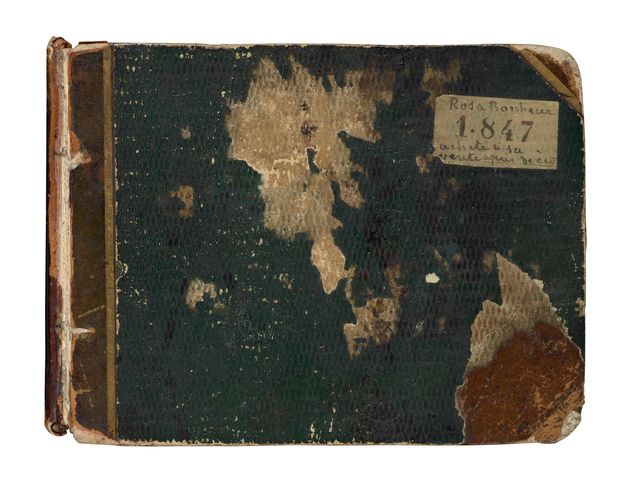
and dated as its lot number from the 1900 sale (fig. 1). One of four known sketchbooks shared by the artist and her
father, Raymond Bonheur (1796–1849), and the only of this kind
in a public collection, the volume is a unique material
document of their working relationship.8
A painter of modest renown, Raymond nurtured his eldest
child’s precocious talent and raised with a similar artistic
ethos her siblings Auguste (1824–84), Isidore (1827–1901), and
Juliette (1830–91), each of whom became artists in their own
right. Restoring the sketchbook’s dual authorship not only
sheds new light on the artistic rapport of father and daughter
but also provides context for the beginnings of Rosa’s great
Salon successes The Horse Fair and
Haymaking in the Auvergne (1855).
ExpandFig. 1. —Cover of a shared sketchbook belonging to Raymond
Bonheur (French, 1796–1849) and Rosa Bonheur (French,
1822–99), ca. 1835–55.
Los Angeles, Getty Research Institute, 850837.
A faint annotation in the final pages of the
sketchbook—“J’appartiens à R. Bonheur” (I belong to R.
Bonheur)—speaks to the volume’s dual authorship as well as the
challenge of retracing its origins and use by both Rosa and
Raymond Bonheur.9
Nevertheless, the Getty’s sketchbook may be definitively
identified as lot 1847 from Rosa Bonheur’s estate sale. Its
worn green cover with decorative edges and eighty-four
interior pages containing dozens of notes and sketches in
various media, mostly graphite and ink, correspond to the
auction catalog’s description. While none of the drawings or
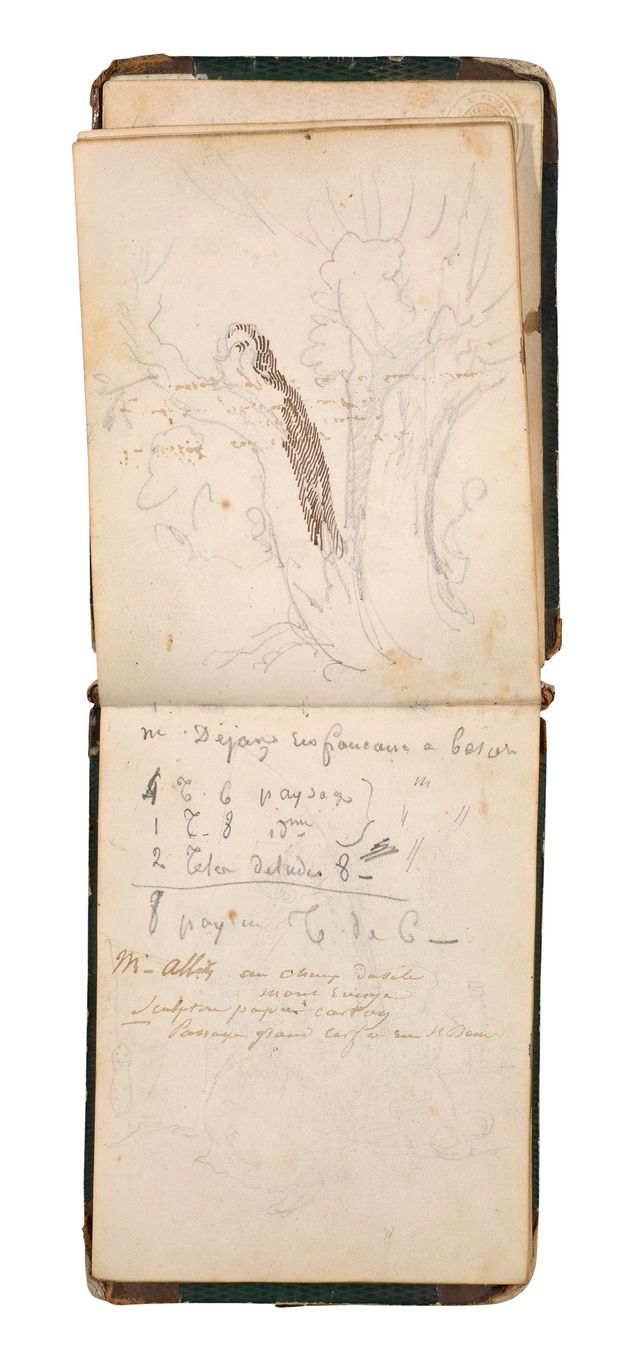
notes is signed, some evince multiple hands on the same page,
such as the two markedly different scripts juxtaposed on leaf
5r (fig. 2). The sticker affixed to the
front cover carries the lot number “1 • 847,” whose
inscription, “Rosa Bonheur, acheté à sa vente après décès”
(Rosa Bonheur, bought at her posthumous sale), suggests that
it may have remained initially in France after the sale in
1900.
ExpandFig. 2. —Rosa Bonheur (French, 1822–99) and Raymond Bonheur
(French, 1796–1849).
Shared sketchbook, ca. 1835–55, 4v and 5r. Los Angeles,
Getty Research Institute, 850837.
Little is known about the sketchbook’s provenance in the early
twentieth century or the circumstances that led to the loss of
its joint attribution. Retracing a timeline of its early
history, however, illuminates the nature of this object, its
use by the Bonheurs, and its significance to Rosa’s oeuvre. It
seems likely that the carnet was purchased by Raymond
before 1841—possibly as early as 1835—and that it was used
into the 1850s. A seal on the verso of the front free endpaper
indicates that it was produced by the book and stationery shop
Chartier, which operated at 117, rue du Faubourg Saint-Honoré,
the address partially legible at the stamp’s lower edge, from
1835 through the early 1840s.10
Corroborating this dating, the address “rue rumford 13,”
annotated below “I belong to R. Bonheur,” became the family’s
residence in 1841.11
A different inscription, in Rosa’s distinctive hand, points to
the sketchbook’s use into the 1850s: the name and address of
critic and writer Arsène Houssaye (1815–96), who in 1856
became inspector general for the fine arts.12
It is possible that the address’s notation coincided with his
new appointment to oversee the École de Dessin pour les Jeunes
Filles, which Raymond, and later Rosa, directed.
Establishing that this object was in use for a period of more
than ten years creates a framework within which to consider
its contents, both materially and iconographically. Drawings,
studies, and day-to-day notes are distributed throughout. The
bulk of blank pages fall in the middle, and the orientation of
entries on the leaves from the second half are often inverted.
The drawings are in varying stages of completion and detail in
ink, pencil, or watercolor. On the basis of style, subject, or
medium, some drawings may be identified as the work of father
or daughter. Taken together, the pages reflect two artists at
work simultaneously, unlike the other notebooks that Rosa and
Raymond Bonheur were known to have shared, which also appeared
at auction in 1900.
Rosa’s father emerges as the best candidate for the
ink-and-wash compositions in the sketchbook, as suggested by
the lot description in the auction catalog. Given the date of
the object’s manufacture, Raymond was most likely its first
owner. The inscription of its belonging to R. Bonheur and the
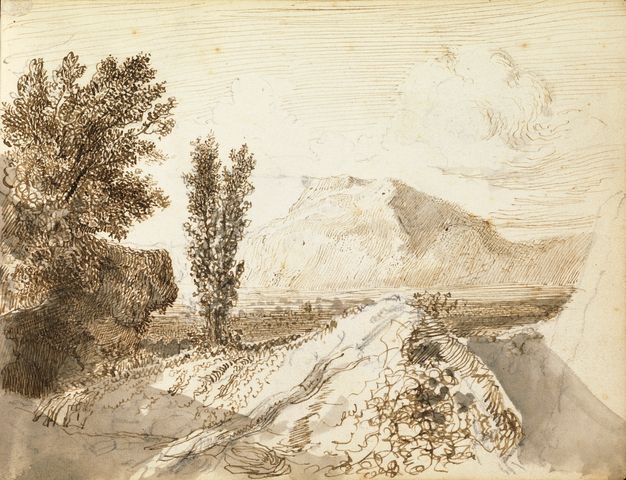
accompanying address suggest that leaf 83r was Raymond’s
starting point, further supported by the detailed landscapes
in sepia ink and wash that appear only in the second half of
the sketchbook, of which his composition depicting the
chiseled face of a mountain below a band of tall clouds on
leaf 81v is representative (fig. 3).
The foreground, a short incline bordered at the left by trees
and moss, creates the perch for this view. Although he was the
father and teacher of a peintre animalière (animal
painter), Raymond made his career with such vistas. The
construction of this landscape sketch is similar to that of
his painting Romantic Landscape (1834), now in the
collection of the Musée des Beaux-Arts in Bordeaux,
reinforcing the identification of Raymond as its author. In
one of the other shared sketchbooks sold at Rosa’s estate
sale, lot 1841, the sepia drawings were exclusively attributed
to Raymond. The catalog proposed that this album bearing the
equivocal monogram “RB” had originated as a gift for Raymond,
as it contained many sketches that the catalog dated to the
late 1820s and attributed to the Bonheur patriarch.13
ExpandFig. 3. —Raymond Bonheur (French, 1796–1849).
Ink-and-wash drawing of trees, a mountainscape, and clouds
from sketchbook shared by Rosa Bonheur (1822–99) and
Raymond Bonheur, ca. 1835–55, 81v. Los Angeles, Getty
Research Institute, 850837.
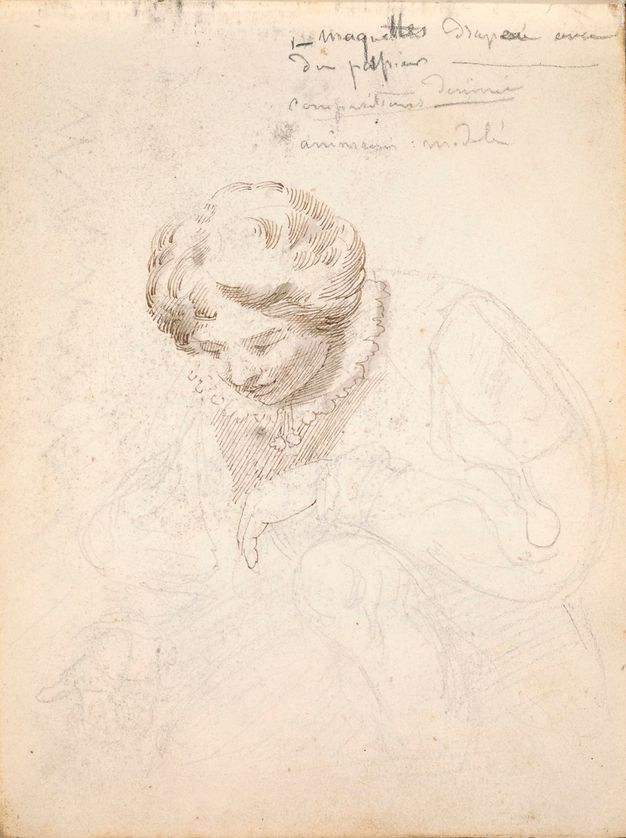
Raymond’s predilection for heightening pencil drawings with
ink recurs in a sketch on leaf 80v—a portrait of a child
greatly resembling Rosa (fig. 4).
Crowned by short curls and framed by a delicate lace collar,
the child’s rounded, youthful face turns downward. The
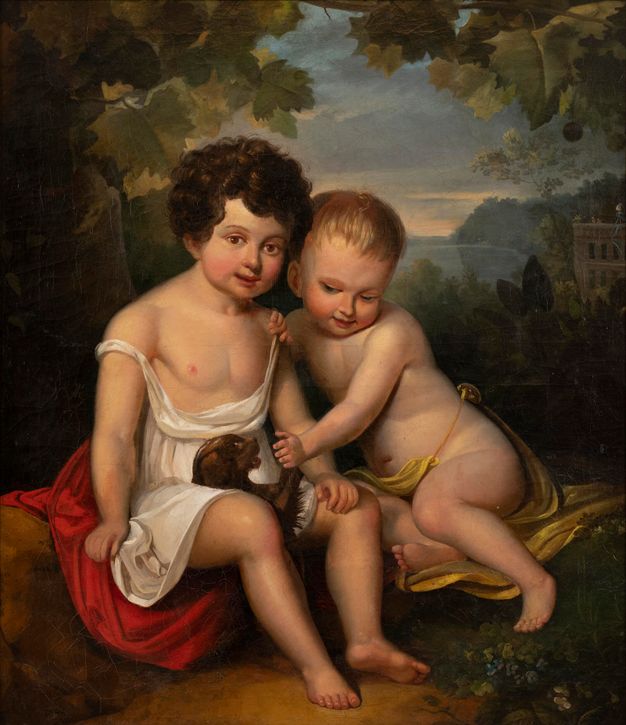
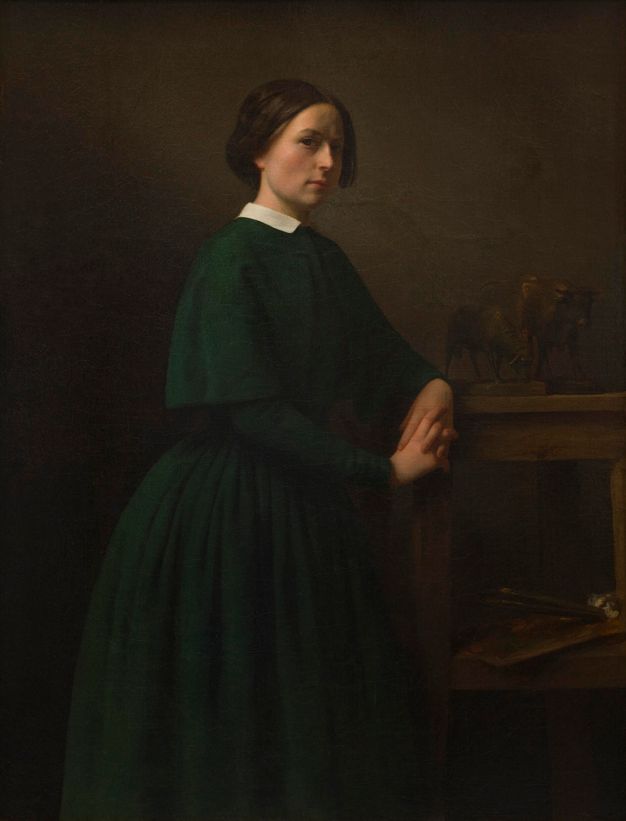
fullness of her face recalls Raymond’s portrait of Rosa as a
young girl with her brother Auguste (fig. 5), more so than that of a grown Rosa painted by Auguste years
later and exhibited at the Salon in 1848 (fig. 6).14
The figure in the sketchbook portrait crouches, her left arm
balanced on her knee, and outstretches her right palm, as
though to feed a small, unpictured animal. The mountainscape
and Rosa’s cameo support the assertion that this was
originally Raymond’s sketchbook, possibly one that he intended
to use for drawings in this medium, and also suggest that the
volume predates the family’s relocation to rue Rumford in
1841, when Rosa was nineteen years old.
If these pages may be attributed to Raymond on the basis of
their style, content, and media, then what is considered today
the first half of the sketchbook—filled with drawings in
pencil and watercolor and rendered in the opposite
orientation—seems to belong to Rosa. The first notable
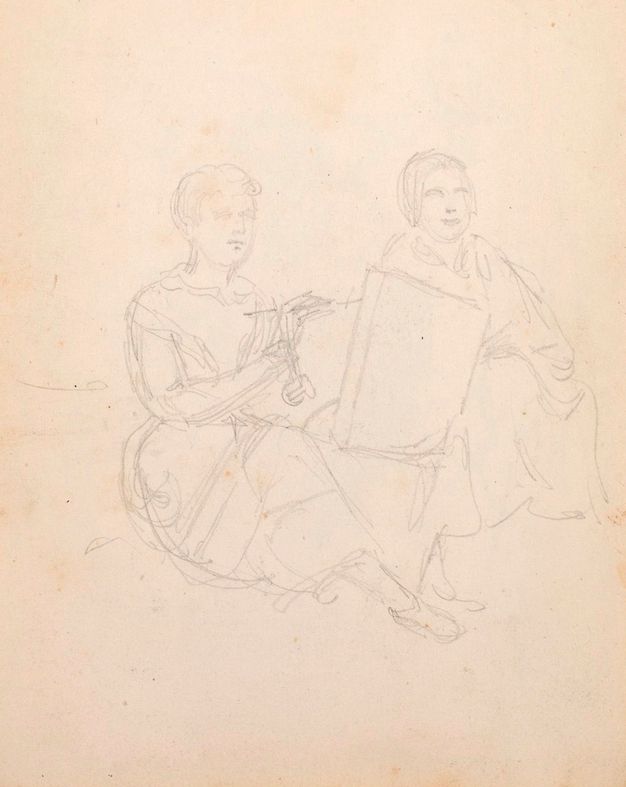
composition, a double portrait, supports this premise (fig. 7). Dressed in a bodice and skirt and seated on the ground,
the woman at the left steadies a paint or watercolor box with
an open lid between her knees. Her right hand holds a brush
pointed toward the canvas or notebook page that would be
fitted into such a lid’s interior frame. The figure to her
side seems to look on or out to the draftsperson. Two women
central to Rosa’s life, Jeanne-Nathalie Micas and her mother,
Henriette Micas (née Divalon), are likely the subjects in the
depiction. Jeanne-Nathalie, Rosa’s childhood friend who would
become her partner of fifty years, was also an artist and is
said to have assisted Rosa in the studio on occasion.15
She also served as a frequent subject for Bonheur: the profile
of the seated figure at left bears a strong resemblance to the
portrait of Jeanne-Nathalie made by Rosa around 1850, now in
the Musée National de Fontainebleau, and to more detailed
profiles filling a nearby page of the sketchbook.16
The Micas matriarch, as the probable contender for the other
seated figure, was a forceful presence in their lives; as
Rosa’s adopted mother, she resided at Jeanne-Nathalie and
Bonheur’s home, the Château de By, from 1860 until her death
in 1875.17
ExpandFig. 7. —Rosa Bonheur (French, 1822–99). Pencil
drawing of two seated figures from sketchbook shared by
Rosa Bonheur and Raymond Bonheur (1796–1849), ca. 1835–55,
2r. Los Angeles, Getty Research Institute, 850837.
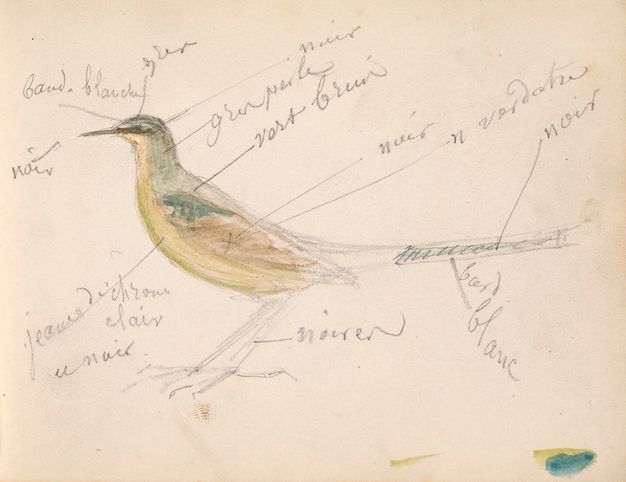
This impromptu portrait could have been made by Rosa as she
completed other studies in watercolor in plein air, such as
the detailed rendering of a bird on a subsequent page of the
sketchbook (fig. 8). The subject
required a dozen different colors, each of which is carefully
annotated in pencil. The scrupulous notes in Rosa’s
handwriting disclose a young artist learning to capture the
natural world on a two-dimensional surface or familiarizing
herself with the many shades of the medium. Numerous drawings
after other works of art, which a young Rosa would have made
in the Musée du Louvre or elsewhere, similarly capture the
hand of an artist in training. On other pages, she produced
pencil sketches of a decorative vase with figures in relief,
and a standing Egyptian statuary.18
ExpandFig. 8. —Rosa Bonheur (French, 1822–99).
Watercolor and pencil drawing of a bird, with annotations
for color, from sketchbook shared by Rosa Bonheur and
Raymond Bonheur (1796–1849), ca. 1835–55, 15r. Los
Angeles, Getty Research Institute, 850837.
The GRI sketchbook represents a working, functional object,
one that father and daughter could have exchanged, examined,
and discussed in their familial studio, distinct from the
other three shared notebooks sold at auction in 1900. The
auction catalog’s notes provide ample information that point
to the other three volumes having been assembled, rather than
used, by either Raymond or Rosa.19
The first to appear in the sale, lot 1839, contains nearly
sixty sketches by Raymond, some predating his daughter’s
birth, as well as drawings by Rosa made in the Louvre, likely
from the last years of the 1830s, based on her surviving
copyist registration.20
The second, lot 1840, bore Rosa’s baptismal name, “Rosalie,”
on the cover and comprised an assortment of thirty of her
drawings, apparently randomly chosen, in addition to a few
sepias and sketches by Raymond from the 1830s to 1840s.21
Lot 1841, a “very curious album,” was thought to have been
“offered as a gift to Raymond Bonheur” yet appeared to include
“several very old sketches by him.”22
The only other Rosa Bonheur sketchbook currently in a public
collection in the United States, lot 1836 from the auction of
1900, contains no drawings from Rosa’s father; rather, it
functioned as a curated repository for drawings by Rosa
alone.23
The sketchbook in the GRI’s collection is therefore the only
extant material document of Rosa’s artistic relationship with
her father.
As the only one of its kind in a public collection, and one
with connections to both artists’ Salon works, the GRI
sketchbook is also important for its drawings that relate to
Rosa Bonheur’s The Horse Fair and
Haymaking in the Auvergne. The drawings for her two
great successes on the preeminent Parisian stage, made
apparently from life, take on new meaning juxtaposed with her
father’s work. Raymond actively encouraged Rosa, from her
first days of artistic training, to surpass the achievements
of other women artists, particularly Élisabeth Vigée Le Brun
(1755–1842).24
In the wake of Raymond’s death, Rosa began two new monumental
compositions that would fulfill her father’s charge.
The Horse Fair and
Haymaking in the Auvergne represented a culmination
of years of study and active self-promotion. In December 1851
or January 1852, Rosa met with Charles de Morny (1811–65),
head of the Ministry of the Interior and by extension all fine
arts commissions.25
The French state wished to confer upon Rosa the honor of a new
commission, and de Morny was to determine a suitable subject.
Rosa, who had been contemplating a composition featuring
horses since 1844, proposed an equine project.26
Unconvinced of her ability, the minister dismissed the idea.
Together they agreed instead that the official commission
would be for a painting depicting haymaking, but, at Rosa’s
own request, the painter would defer the order and complete
the horse picture first.27The Horse Fair catapulted Bonheur to new heights in
1853; Haymaking in the Auvergne cemented her mark on
the French school at the Exposition Universelle in 1855.
A number of drawings provide compelling evidence that these
two paintings began, at least in part, in the sketchbook
shared with her father. Some drawings in the first fifty
leaves suggest that Rosa’s planning for this composition may
have started during Raymond’s lifetime, which would support
her biography’s mythologizing narrative that
The Horse Fair had been an idea since the early
1840s. Two notable studies of horses illustrate the subject’s
early evolution as a composition inspired by the Louvre’s Old
Masters and the Parthenon’s frieze.28
The first graces the pages amid the pencil sketches that Rosa
would have made in the Louvre in the late 1830s; it is drawn
directly from a work by one of the artists she recalled
admiring most: Landscape with a White Horse (ca.
1650–1700) by Dirck van Bergen.29
In Rosa’s rendering, the animal’s hindquarters are rendered
with short, emphatic strokes that stress its pronounced
musculature. Her horse assumes the exact stance of Van
Bergen’s primary subject, down to the exaggerated hip at the
left. Leaf 43v offers a concrete connection to one of the
earliest preparatory designs for The Horse Fair, now
in the collection of the Metropolitan Museum of Art in New
York (figs. 9,
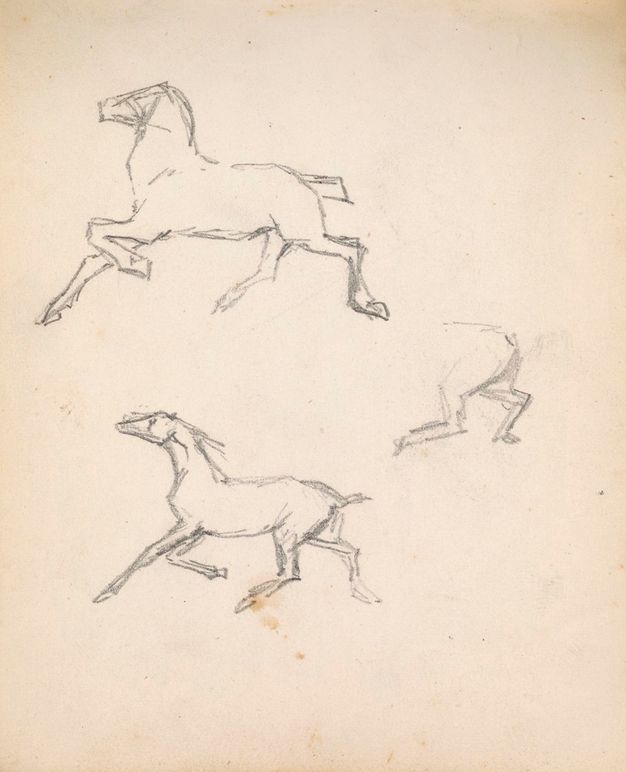
10). In the sketchbook, two geometric
outlines of horses and a partial third gallop across the page;
a similar rudimentary profile of a horse appears along the
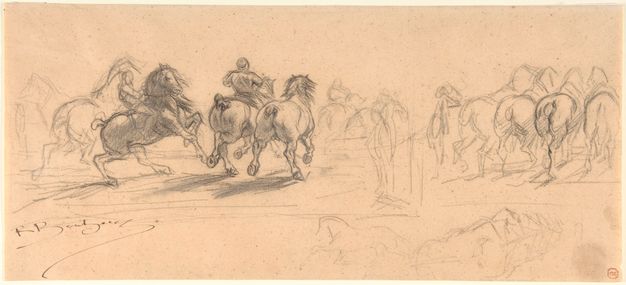
lower edge of the drawing at the Metropolitan Museum. Whereas
the studies are freely arranged on the sketchbook page, two
distinct compositions are framed on the Metropolitan Museum’s
sheet. That at the left side is framed by a horizontal line
below and vertical line at right and includes many elements
that would feature in the final Salon submission. On the same
page, at right, is a sketch of four grouped animals, likely
after Théodore Géricault’s
Five Horses Viewed from behind (1822), which Rosa
would have seen at the Louvre. The sketchbook page and the
preparatory drawing link Rosa’s studies in the museum to the
composition’s origins, responding to her father’s hope that
she would ascend to the French painterly pantheon that was the
Louvre.
ExpandFig. 9. —Rosa Bonheur (French, 1822–99). Pencil
drawing of horses from sketchbook shared by Rosa Bonheur
and Raymond Bonheur (1796–1849), ca. 1835–55, 43v. Los
Angeles, Getty Research Institute, 850837.ExpandFig. 10. —Rosa Bonheur (French, 1822–99). Sheet of
studies for The Horse Fair, ca. 1850, black chalk
and graphite on paper, 18.4 × 41.1 cm. New York,
Metropolitan Museum of Art, 1991.463. Gift of Alexander
Johnson and Roberta Olson, in honor of Jacob Bean,
1991.
To complete The Horse Fair, Rosa ultimately favored
studies from life. A carefully rendered head of a horse on
leaf 42r corresponds to the final stage of its compositional
development. In the final months of the painting’s preparation
and execution, Bonheur ventured to the horse market on the
boulevard de l’Hôpital in men’s attire to study her primary
subjects.30
Rosa’s pencil carefully shaded the horse’s muzzle, forehead,
and eyes, stopping short of its neck, crest, and mane. The
circumstances under which Bonheur made such studies have since
become historiographic fodder, but her commitment to working
after nature as the foundation of her practice placed the
artist in the company of numerous nineteenth-century
contemporaries from the Barbizon school and the Impressionist
circle.
Given the shared origin story for her major Salon submissions
in the early 1850s, it is hardly surprising that studies for
Haymaking in the Auvergne also appear in the
sketchbook. Outnumbering those related to
The Horse Fair, the drawings present the work’s
evolution from single figures to fully choreographed scene.
Women balancing bundles atop their heads, men carrying
scythes, and figures using pitchforks to load hay onto the
cart populate a half dozen leaves.31
Many of these figures were ultimately relegated to the wings
of the painting that Bonheur exhibited in 1855, allowing the
oxen and cart to take center stage. Drawings of heaps of hay
and their transport attest to a methodical exhaustion of
various compositional possibilities. For example, a drawing on
leaf 48v frames the profiles of two horses pulling a cart and
its contents against a haystack and hill beyond, grounding the
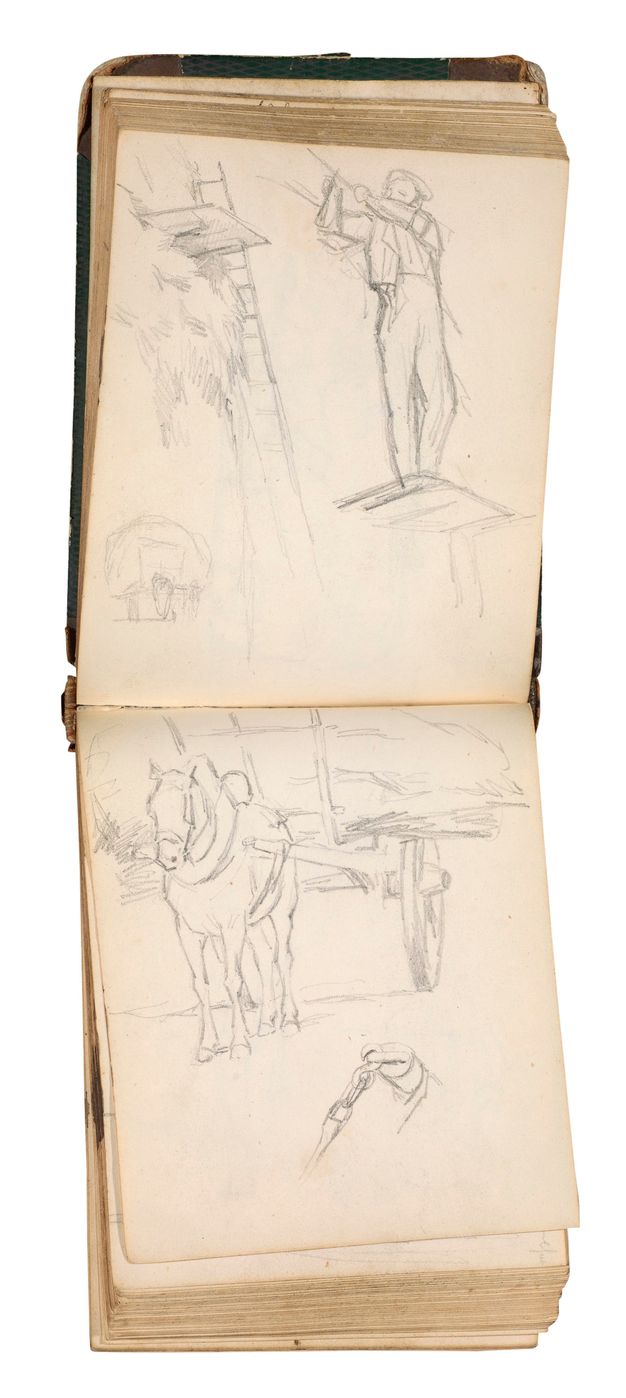
scene in a specific landscape. A sketch on leaf 49v,
meanwhile, focuses on the cart and the individuals tending to
its load of hay, whose massive scale is emphasized in relation
to the laboring animals and farmers. A leaf preceding these
pages shows a horse in three-quarter view, whose figure is
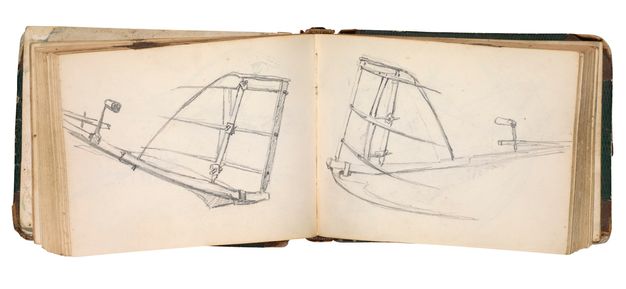
dwarfed by the haystack that exceeds the page’s margins (fig. 11). Meticulous attention to perspective and position is given
to a series of studies of cradle scythes on leaves 37r through
39r (fig. 12). With the precision of
technical drawing, the artist suspends the haymaker’s
implement in space to capture its construction in three
dimensions, rotating the tool to produce a schematic of every
bolt and pin that joins the blades to the wooden handle.32
In contrast to the drawings related to
The Horse Fair, the range of preparatory work for
Haymaking represents an exclusive allegiance to
working after life.
ExpandFig. 11. —Rosa Bonheur (French, 1822–99). Pencil
drawing of a horse and cart with additional studies from
sketchbook shared by Rosa Bonheur and Raymond Bonheur
(1796–1849), ca. 1835–55, leaves 47v and 48r. Los Angeles,
Getty Research Institute, 850837.ExpandFig. 12. —Rosa Bonheur (French, 1822–99). Pencil
drawings of a cradle scythe from sketchbook shared by Rosa
Bonheur and Raymond Bonheur (1796–1849), ca. 1835–55, 37v
and 38r. Los Angeles, Getty Research Institute,
850837.
The placement of these studies in an old, used sketchbook
purchased over a decade before, rather than in a new volume of
fresh pages, suggests that Rosa treated the development of
Haymaking as an extension of her father’s own
practice, literally and figuratively. Leaves 48v and 49v are
drawn in the same page orientation as Raymond’s landscape
studies in the second half of the album. Rosa’s sketches for
Haymaking, along with the drawings for
The Horse Fair, also fall between the successions of
blank pages in the middle of the object. Just as the final
works reflected Rosa’s bids to continue the familial artistic
lineage, the early drawings for them were executed in the
sketchbook in such a way that they seem to continue Raymond’s
contributions.
Ultimately, both paintings cemented Rosa’s position in the art
world. The Horse Fair heralded a lasting success in
England and the United States, thanks in part to its
purchaser, Belgian-born, London-based dealer Ernest Gambart
(1814–1902), who exhibited it widely in both countries. The
sale of the massive canvas brought Bonheur financial and
artistic independence, a feat rare among her male peers and
unprecedented among her fellow women artists.
Haymaking similarly confirmed her place as the
foremost animal painter on the international stage of the
Exposition Universelle. Thanks to these two paintings, which
continued the momentum set by her first state commission,
Ploughing in the Nivernais (1849), Bonheur enjoyed
numerous accolades in the latter half of the nineteenth
century.33
The appearances of The Horse Fair and
Haymaking in the Auvergne in the sketchbook that she
shared with her father offer a belated realization of
Raymond’s wish that she establish independent renown and
secure an artistic legacy for them both.
The sketchbook linking Rosa’s two works attests to the
artistic proximity between father and daughter at the end of
Raymond’s life during what were arguably the most important
years of Rosa’s career. Its jointly authored pages complicate
enduring narratives of artistic inheritance and Rosa’s own
lore, which she sought to perpetuate in her final years and
posthumously through Klumpke. Father and daughter emerge as
creative confidantes, whose relationship foregrounded Rosa’s
success and renown. As the only shared album known to have
survived, the restored dual attribution of the sketchbook
opens new lines of inquiry for the study of Raymond’s and
Rosa’s respective oeuvres, particularly her works
The Horse Fair and
Haymaking in the Auvergne. The identification and
recontextualization of their shared undertaking show how the
first thoughts for some of Rosa’s best-known works were
drafted on the pages of a sketchbook, side by side.
Alexandra Morrison holds a PhD in history of
art from Yale University and is a curatorial associate in the
Department of Painting and Sculpture at the Museum of Modern
Art, New York.
Notes
I thank Naina Saligram for her insightful reading and
intellectual generosity. Unless otherwise noted, translations
are mine.
The sale at Galerie Georges Petit began Wednesday, 30
May 1900, and ended Friday, 8 June 1900. See Léon
Roger-Milès, Atelier Rosa Bonheur, 2 vols.
(Paris: Georges Petit, 1900). For contemporary press
coverage of the sale, see La Rivaudière, “Notes d’un
curieux: Les aquarelles et les dessins de Rosa Bonheur,”
Le Gaulois, 3 June 1900, 3; and “Vente de
l’atelier Rosa Bonheur,” Le Radical, 3 June
1900, 2.
↩︎
Bonheur’s estate planning was the primary subject of one
of her biography’s final chapters. Bonheur told the sole
inheritor of her estate, Anna Klumpke, not to organize a
public sale; she advised selling a study if money was
scarce. Anna Klumpke,
Rosa Bonheur: Sa vie, son oeuvre (Paris:
Flammarion, 1908), 394.
↩︎
Dealer Giacomo Tedesco (1799–1870) had represented
Bonheur since the late 1840s. The patriarch left his
business to his sons, who rechristened the enterprise
Tedesco Frères in the 1870s. See Paul de Katow, “Rosa
Bonheur,” Gil blas, 27 March 1883, 3; and Paolo
Serafini, “Archives for the History of the French Art
Market (1860–1920): The Dealers’ Network,”
Getty Research Journal, no. 8 (2016): 114,
130nn13–14. Tedesco Frères had initially offered to buy
the contents of Bonheur’s studio for one million francs,
but public auction proved the most amenable solution.
For the history of the sale’s organization, see Klumpke,
Rosa Bonheur, 405–12.
↩︎
Bonheur was the first woman artist to receive the French
Legion of Honor, a distinction that was awarded by
Empress Eugénie herself in 1865. In 1893, following
success at the Universal Exposition in Chicago, Bonheur
was promoted to the rank of officer. A complete list of
Bonheur’s distinctions appears in Klumpke,
Rosa Bonheur, 300n3.
↩︎
The descriptions for lots 1837 and 1838, for example,
identify Micas as the sole author of those sketchbooks’
contents. Léon Roger-Milès,
Atelier Rosa Bonheur, vol. 2,
Aquarelles et dessins (Paris: Galerie Georges
Petit, 1900), 176.
↩︎
Roger-Milès, Atelier Rosa Bonheur, 2:79. Rosa
Bonheur sketchbook, Los Angeles, Getty Research
Institute (GRI), 850837, hereafter cited as Bonheur
sketchbook. The sketchbook is fully digitized and
available at
http://hdl.handle.net/10020/850837f5. The sketchbook was acquired from the McAlpine
Collection through the dealer Kenneth W. Rendell in
Newton, Massachusetts, in 1985.
↩︎
The other three sketchbooks shared by Raymond and Rosa
appeared as lots 1839, 1840, and 1841. Roger-Milès,
Atelier Rosa Bonheur 2:177–78. Their current
locations are unknown.
↩︎
Sébastien Bottin’s Almanach du commerce from
1833 records at this address as a joint enterprise,
“Meslin & Chartier.” By 1835, however, Meslin
disappears; A. Cambon’s
Almanach des commerçans de Paris from that same
year names only Chartier. One business directory
continues to place Chartier at 117, rue du Faubourg
Saint-Honoré through at least 1847, but Didot’s
Annuaire states that another paper shop named
Brunet was operating at this location starting in 1844.
Regardless, by 1854, Chartier had moved to 105, rue du
Faubourg Saint-Honoré. Sébastien Bottin,
Almanach du commerce de Paris, de la France et des
pays étrangers
(Paris: Bureau de l’Almanach du Commerce, 1833), 220; A.
Cambon,
Almanach des commerçans de Paris (Paris: Bureau
de l’Almanach des Commerçans, 1835), 668, 713; Sébastien
Bottin,
Almanach-Bottin du commerce de Paris (Paris:
Bureau de l’Almanach du Commerce, 1842), 267; E.-M.
Prétot,
Annuaire de la typographie parisienne et
départementale
(Paris: Pretot, 1847), 106; Firmin-Didot Frères,
Annuaire général du commerce, de l’industrie, de la
magistrature et de l’administration, ou Almanach des
500,000 adresses de Paris, des départements et des
pays étrangers
(Paris: Firmin-Didot Frères, 1844), 580; and Sébastien
Bottin,
Almanach-Bottin du commerce de Paris (Paris:
Bureau de l’Almanach du Commerce, 1854), 942.
↩︎
Bonheur sketchbook, 68v. Houssaye’s appointment was
widely reported. See, for example, “Faits divers,”
La presse, 31 January 1856, 2.
↩︎
Other drawings, however, postdate Raymond’s by at least
two decades, according to the lot notes. Roger-Milès,
Atelier Rosa Bonheur, 2:178.
↩︎
Explication des ouvrages de peinture, sculpture,
architecture, gravure et lithographie des artistes
vivants, exposés au Musée national du Louvre le 15
mars 1848
(Paris: Vinchon, 1848), 36, cat. no. 156.
↩︎
The sale of The Horse Fair in 1855 allowed
Bonheur to purchase the Château de By in 1860. Located
in the Parisian suburb of Thomery, the château comprised
apartments for living as well as a studio and menagerie
for her work. Klumpke, Rosa Bonheur, 243–45.
↩︎
Despite the shared sketchbook’s unorthodox organization
and perplexing use, there is no reason to doubt the
accuracy of the auction catalog. Although French art
critic Léon Roger-Milès is credited as the author of its
introductory essay, realistically only Klumpke could
have given such specific details about the sketchbooks
and their provenance. By the last year of the artist’s
life, Klumpke agreed, at the painter’s behest, to
steward her estate and publish a definitive biography,
which would appear in 1908. Whether in preparing this
manuscript, which oscillates between Klumpke’s
first-person narration and Bonheur’s own voice, or in
determining which works to include in the artist’s
bequest to the state, the pair had ample opportunity to
discuss the sketchbooks and their contents in the late
1890s. For Klumpke’s own recollection of this period,
see Klumpke, Rosa Bonheur, 101–26. See also
Gretchen van Slyke, “Reinventing Matrimony: Rosa
Bonheur, Her Mother, and Her Friends,”
Women’s Studies Quarterly 19, nos. 3/4 (1991):
69–72.
↩︎
Roger-Milès, Atelier Rosa Bonheur 2:177. Rosa’s
extant copyist registration dates to 9 August 1838.
Paris, Archives nationales, Registre des copistes,
Élèves (chrono) 1834–1840 (20150337/445, formerly LL06),
folio 108.
↩︎
Roger-Milès, Atelier Rosa Bonheur 2:176. This
sketchbook is in the collection of Transylvania
University, J. Douglas Gay Jr./Frances Carrick Thomas
Library Special Collections, Kentucky.
↩︎
Bonheur sketchbook, 9r. Among the Old Masters who were
“irresistibly fascinating” (“exerçaient . . . une
fascination irrésistible”) to the young artist was Van
Bergen. Klumpke, Rosa Bonheur, 165. For more
information on Van Bergen’s
White Horse in a Landscape, see the object page
(inv. 1035) on the Louvre website,
https://collections.louvre.fr/ark:/53355/cl010059279. ↩︎
Bonheur sketchbook, 42r. Bonheur’s masquerade was
reported even before The Horse Fair appeared at
the Salon in 1853. See Edmond Texier, “Les Peintres, les
ateliers et les modèles,”
Tableau de Paris, vol. 2 (Paris: Paulin et le
Chevalier, 1853), 46–47.
↩︎
For one of the first announcements of her induction to
the French Legion of Honor in the French press, see
“Chronique,” La comédie, 18 May 1865, 8. The
act of her induction was dated 8 June 1865. See J.
Cohen, “La décoration de Rosa Bonheur,”
La France (Paris), 12 June 1865, 1. The episode
is recounted by Klumpke, Rosa Bonheur, 264. See
also this essay, note 4.
↩︎
Fig. 1. —Cover of a shared sketchbook belonging to Raymond Bonheur
(French, 1796–1849) and Rosa Bonheur (French, 1822–99), ca.
1835–55.
Los Angeles, Getty Research Institute, 850837.
Fig. 2. —Rosa Bonheur (French, 1822–99) and Raymond Bonheur (French,
1796–1849).
Shared sketchbook, ca. 1835–55, 4v and 5r. Los Angeles, Getty
Research Institute, 850837.
Fig. 3. —Raymond Bonheur (French, 1796–1849).
Ink-and-wash drawing of trees, a mountainscape, and clouds
from sketchbook shared by Rosa Bonheur (1822–99) and Raymond
Bonheur, ca. 1835–55, 81v. Los Angeles, Getty Research
Institute, 850837.
Fig. 4. —Raymond Bonheur (French, 1796–1849).
Ink-and-pencil drawing of a crouching figure from sketchbook
shared by Rosa Bonheur (1822–99) and Raymond Bonheur, ca.
1835–55, 80v. Los Angeles, Getty Research Institute, 850837.
Fig. 7. —Rosa Bonheur (French, 1822–99). Pencil
drawing of two seated figures from sketchbook shared by Rosa
Bonheur and Raymond Bonheur (1796–1849), ca. 1835–55, 2r. Los
Angeles, Getty Research Institute, 850837.
Fig. 8. —Rosa Bonheur (French, 1822–99). Watercolor
and pencil drawing of a bird, with annotations for color, from
sketchbook shared by Rosa Bonheur and Raymond Bonheur
(1796–1849), ca. 1835–55, 15r. Los Angeles, Getty Research
Institute, 850837.
Fig. 9. —Rosa Bonheur (French, 1822–99). Pencil
drawing of horses from sketchbook shared by Rosa Bonheur and
Raymond Bonheur (1796–1849), ca. 1835–55, 43v. Los Angeles,
Getty Research Institute, 850837.
Fig. 10. —Rosa Bonheur (French, 1822–99). Sheet of
studies for The Horse Fair, ca. 1850, black chalk and
graphite on paper, 18.4 × 41.1 cm. New York, Metropolitan
Museum of Art, 1991.463. Gift of Alexander Johnson and Roberta
Olson, in honor of Jacob Bean, 1991.
Fig. 11. —Rosa Bonheur (French, 1822–99). Pencil
drawing of a horse and cart with additional studies from
sketchbook shared by Rosa Bonheur and Raymond Bonheur
(1796–1849), ca. 1835–55, leaves 47v and 48r. Los Angeles,
Getty Research Institute, 850837.
Fig. 12. —Rosa Bonheur (French, 1822–99). Pencil
drawings of a cradle scythe from sketchbook shared by Rosa
Bonheur and Raymond Bonheur (1796–1849), ca. 1835–55, 37v and
38r. Los Angeles, Getty Research Institute, 850837.