In conversation during the fall of 2023, visual artist
Felipe Baeza and scholar of performance and Chicanx
studies Laura G. Gutiérrez discuss art making, migration,
legibility, and belonging in the context of Baeza’s Public
Art Fund project Unruly Forms. On a walk through
Chicago’s Pilsen neighborhood, the two reminisce about
their similar experiences, both having immigrated to the
United States from Mexico as children, grown up in the
Catholic Church, come of age as queer adolescents in
Chicago, and followed professional trajectories as
cultural producers, which led ultimately to their meeting
while in residence at the Getty Research Institute in Los
Angeles. Baeza and Gutiérrez discuss the making and
reception of Unruly Forms, reflecting on the
political and existential realities of living and thriving
in the United States with undocumented or resident-alien
status.
Keywords
public art, bus shelters, memory, Pilsen, immigration,
Mexico, undocumented, queer identity, fragmentation,
community, fugitivity, Mesoamerican artifacts
Peer Review
Editorial
Copied page section link to clipboard
Cite
Chicago
Felipe Baeza and Laura G. Gutiérrez, “Belonging Elsewhere:
Felipe Baeza and Laura G. Gutiérrez in Conversation,”
Getty Research Journal, no. 20 (2025),
https://doi.org/10.59491/TEMQ1846.
MLA
Baeza, Felipe, and Laura G. Gutiérrez “Belonging
Elsewhere: Felipe Baeza and Laura G. Gutiérrez in
Conversation.” Getty Research Journal, no. 20,
2025,
https://doi.org/10.59491/TEMQ1846.
On 10 September 2023, I greeted Felipe Baeza in Chicago at the
National Museum of Mexican Art, a place that we had both
visited on countless occasions but, to the best of our
knowledge, never at the same time. The museum is in the Pilsen
neighborhood, which has been home to different waves of
migrants to the city, particularly people from Central and
Eastern Europe and Mexico. The museum’s building was a shared
point of reference, familiar to both of us as immigrants to
Chicago. We set out on a walking tour of Pilsen, where Felipe
and his family had lived for several years after their arrival
to the city. In our roaming, we walked to the different homes
in which he had lived on Eighteenth Place, had coffee at Café
Jumping Bean, and paused outside of the grade school he
attended—Orozco Community Academy, named after Mexican
muralist José Clemente Orozco. We lingered for a long while
before the images on the bus shelters at either corner of
Eighteenth Street and Damen Avenue. From August to November of
that year, Felipe Baeza: Unruly Forms, a project
presented by Public Art Fund, was featured at those two bus
shelters in addition to others throughout Chicago, New York,
Boston, and three cities in Mexico: León, Mexico City, and
Querétaro (figs. 1–3).
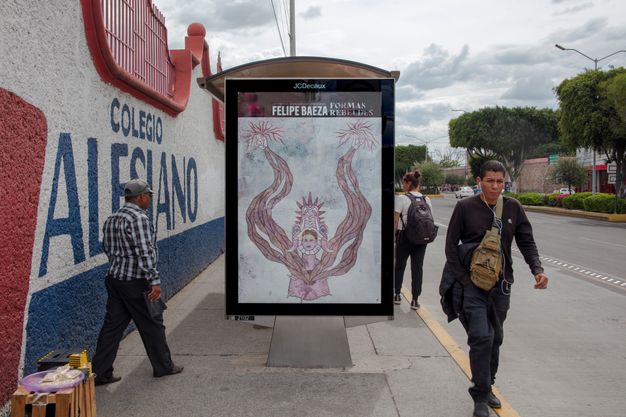
ExpandFig. 1. —Installation view of Felipe Baeza’s
Unruly Forms in Querétaro, Mexico,
2023.Unruly Forms, presented by Public Art Fund, is an
exhibition on more than four hundred JCDecaux bus shelters
and street furniture in New York, Boston, and Chicago in
the United States; and in Mexico City, León, and Querétaro
in Mexico, 9 August–19 November 2023. Photograph by Ramiro
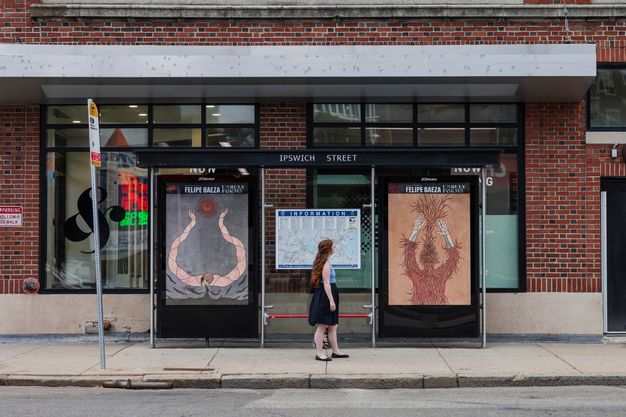
Chaves, courtesy Public Art Fund, NY.ExpandFig. 2. —Installation view of Felipe Baeza’s
Unruly Forms in Boston, 2023.Unruly Forms, presented by Public Art Fund, is an
exhibition on more than four hundred JCDecaux bus shelters
and street furniture in New York, Boston, and Chicago in
the United States; and in Mexico City, León, and Querétaro
in Mexico, 9 August–19 November 2023. Photograph by Mel
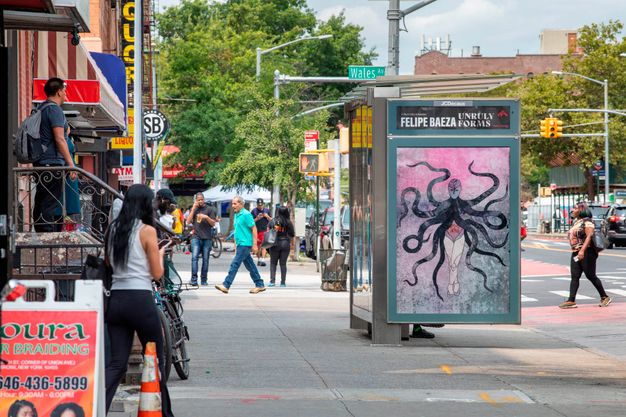
Taing, courtesy Public Art Fund, NY.ExpandFig. 3. —Installation view of Felipe Baeza’s
Unruly Forms in New York, 2023.Unruly Forms, presented by Public Art Fund, is an
exhibition on more than four hundred JCDecaux bus shelters
and street furniture in New York, Boston, and Chicago in
the United States; and in Mexico City, León, and Querétaro
in Mexico, 9 August–19 November 2023. Photograph by
Nicholas Knight, courtesy Public Art Fund, NY.
Although I had known of Felipe’s work and had seen it on
several occasions in group shows, the two of us did not meet
in person until September 2022, when we were both at the Getty
Research Institute as part of the Getty Scholars Program.
Felipe was the artist in residence, and I was a residential
scholar. The “and” in that year’s theme, Art and Migration,
describes at least one of the intersections that we both
inhabit, albeit differently: We both make our livings through
art, and we are both immigrants to this country. During our
stay in Los Angeles, we came to the awareness that we had both
immigrated to Chicago as children, but in different decades:
Felipe in the 1990s, and I in the 1970s. While art and
migration may define us, in our extended conversations,
including the one that we had in Pilsen, we bonded over the
complicated relationship to its two rubrics. In short, we
share side-eyed (some would say queer or antinormative)
approaches to the way that we represent and discuss migration
in art and scholarship, respectively; we prefer the oblique
and opaque. Meandering the streets of Pilsen, we were so
wrapped up in the conversation that we forgot to hit record.
Later, we met on Zoom to process our experience together on
that Saturday afternoon of September, and this time we did
record.
—Laura G. Gutiérrez
The conversation below took place in October 2023 on Zoom. It
has been edited for length, repetition, and clarity. Italics
have been added to capture words or phrases emphasized in the
original dialogue.
Laura G. Gutiérrez: I’ve been thinking a
lot about our visit to Chicago last September, which I would
like to bring into our conversation about your Public Art
Fund commission and the process of its making. I would love
to start by talking about what we saw on our walk through
the neighborhood of Pilsen, what we experienced that day,
and the complex feelings that came from that shared time
together.
Felipe Baeza: Meeting you in Chicago felt
amazing—a familiar landscape that each of us has a different
set of connections and attachments to. It was beautiful to
share that space with you, so much so that we forgot to
record our conversation on the ground that day! We were just
in the moment, so many things happening simultaneously. . .
.
My parents drove me to the Mexican Fine Arts Center [now
known as the National Museum of Mexican Art] before we met,
and somehow, we ended up inside the museum. I didn’t share
this with you at the time, but that was the first time I had
ever been to a museum with my parents. And just seeing how
uncomfortable they were in that space, despite the fact that
it’s a Mexican museum in an immigrant neighborhood and they
live nearby and know that building well—it threw me off.
But even so, that building has so many memories for me. It
was probably the first museum I ever went to as a kid
growing up in Pilsen. So they dropped me off, and then they
left. And then we met, and we decided not to walk the
museum, if I remember.
Laura: Yeah, I think the people working at
the museum were a little thrown off. Because I walked in to
join you, and then we walked out together!
[laughter]
Felipe: But yeah, I completely forgot to
share that. Because I was just very thrown off by that. And
I think everything happened organically then. Because then
we walked to the first bus shelter showcasing my Public Art
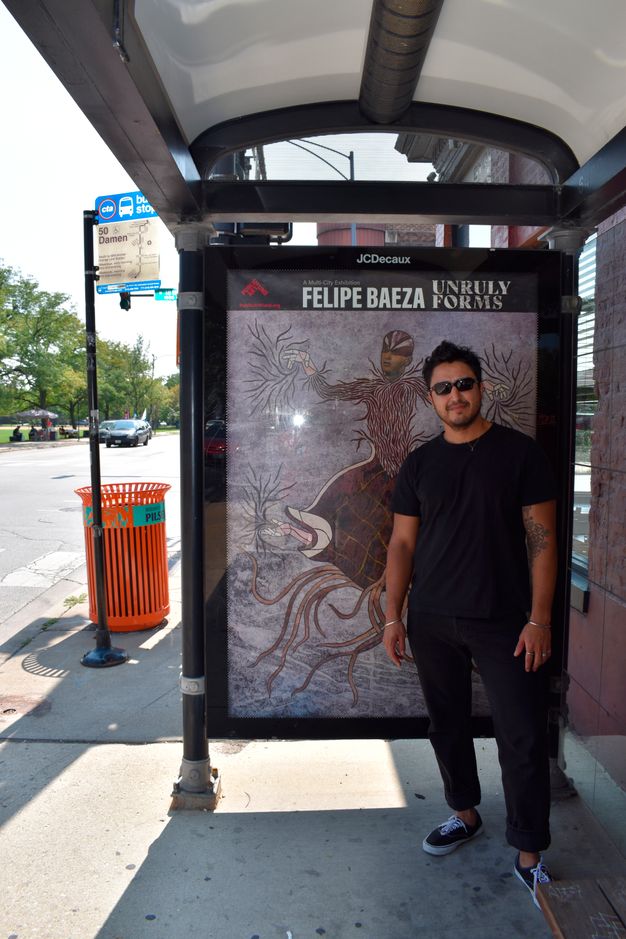
Fund Project (figs. 4,
5). And I think it was walking in a
landscape that I have, obviously, a lot of memories from. I
think it was just a full circle of going back there. And
then eventually we went to the same block where I grew up.
And I remember we walked through every house that I grew up
in.
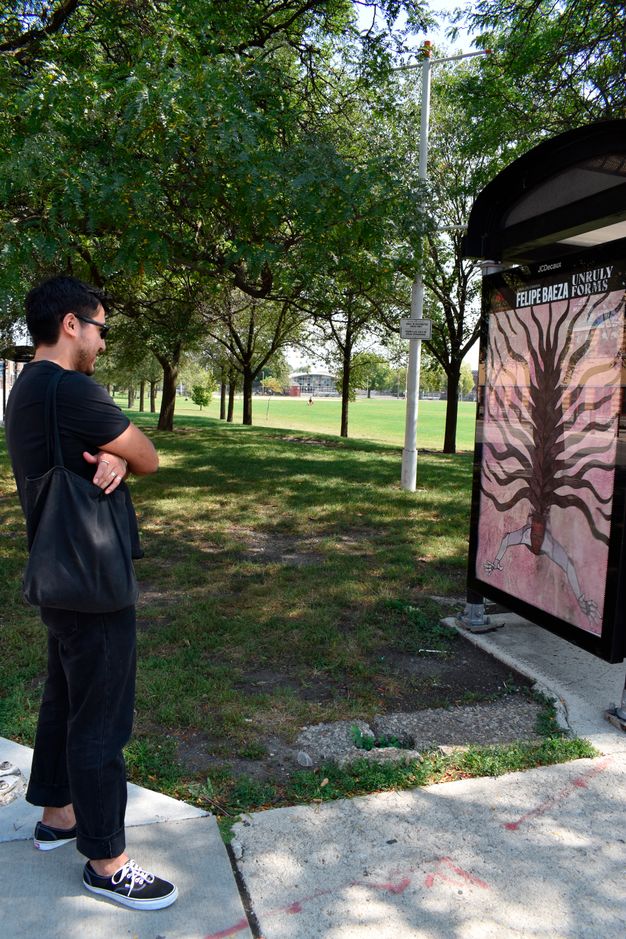
ExpandFig. 4. —Felipe Baeza viewing a bus shelter located at the
intersection of S. Damen and S. Blue Island Avenues in
the Pilsen neighborhood of Chicago featuring Baeza’s
Let yourself fall (2023), part of the
installation Unruly Forms.
Photograph by Laura G. Gutiérrez, September 2023.ExpandFig. 5. —Felipe Baeza at a bus shelter located at the
intersection of S. Damen Avenue and W. 18th Street in
the Pilsen neighborhood of Chicago featuring Baeza’s
to shape, shape self (2023), part of the
installation Unruly Forms.
Photograph by Laura G. Gutiérrez, September 2023.
Laura: Do you remember, I think we did it
inversely—we walked down the block first, and then we walked
to the bus stop.
Felipe: Oh, really? Yes! I mean, that whole
day was just—wow!
Laura: There were a lot a lot of feelings.
Felipe: Yeah, it was a lot of—yeah. Because
I mean, I had not been back to that block. I mean, obviously
I’d been back to Pilsen since then but probably hadn’t
returned to that specific block since we moved out of there.
So it felt so strange and so foreign. It didn’t obviously
feel the same.
Laura: And yet so familiar at the same
time!
Felipe: Oh right, because your family used
to live there too?
Laura: It’s so wild! I forgot to tell you,
I verified that my aunt and uncle’s house was across the
street from your childhood home! So I probably was there
when you were a little kid, I was already—
Felipe: —causing trouble?
[laughter]
Laura: But that was the moment in which we
were so immersed in the conversation that we forgot to
record. Because we were walking through the different houses
where you had lived, and your memories of them.
Felipe: Exactly, with the purpose of
recording, right? But I think it was good that we didn’t
record. We were just basically in the space and taking it
in, and it was special to share it with you. And to see your
connection to that landscape too; even though you didn’t
grow up in that neighborhood, you had also a strong
attachment to it. The landscape looks strange, but familiar,
and also very surreal. My time there feels like a dream
somehow, as if it never happened. But obviously it had such
an impact on me as a child that I have so many vivid
memories of that block and playing with all of my friends.
The neighborhood has changed so drastically. It seemed like
such a vibrant neighborhood back then, right?
Laura: Yeah, that’s why we would go to
Pilsen when I was a kid, because it’s where things were
happening—the culture, the food; I wanted to be immersed in
it. And as a young adult I wanted to be close to where
Mexican art and Mexican migrant experiences were not only
highly visible but were thriving.
Felipe: That’s how I remember it. I arrived
there when I was seven, about to turn eight. It seems so
surreal, but the transition from Mexico to Pilsen wasn’t so
harsh. It seemed like I was coming from one brown place to
another brown place. And it just so happened that a lot of
the brown people in Pilsen spoke English.
Laura: You have these enclaves.
Felipe: And I always say that I feel like I
never experienced Mexico until I left Mexico. And by that, I
mean that when I grew up there, Pilsen embodied this kitschy
idea of what Mexico is: murals everywhere, colors
everywhere, this hybrid, nostalgic outcome of a lot of
people trying to re-create home. I went through the public
school system, attended José Clemente Orozco Academy, and
literally 99 percent of my peers and faculty growing up were
Mexican—either first- or second-generation immigrants. And
there’s even a Benito Juárez High School close by. So it was
also surreal growing up there, especially coming from
Mexico. I just felt like I was transported to a different
Mexican city.
Laura: And an extension of Mexico, which
actually Pilsen is. But this Mexico is re-created through
these memories and nostalgia, this sense of “How do we sort
of make it feel and look like Mexico?” But that also ends up
serving as a mechanism to ground one in that space, doesn’t
it?
Felipe: Yes, exactly. It is another mode of
survival to re-create not necessarily home but that sort of
structure, right, that allows you to flourish. And I think,
as I said, sadly, this is only made possible by how
segregated Chicago is, which has allowed for certain
communities to stick together. I’ve been in New York since
2005, and it’s obviously a whole different landscape; you
just live where you can afford to, which doesn’t happen so
much in Chicago. But yeah, it was surreal going back to
Pilsen and doing the same walks that I did as a child—
Laura: With the added layer of surrealism—
Felipe: So many layers! That’s why it feels
so surreal, because I don’t have the language to describe
it. When you left that afternoon, I was like, “Wait, what
just happened? Was I just with Laura, hanging out in
Pilsen?”
Laura: But also you were walking through
streets you once knew well; you were in front of Orozco
Academy, which is kitty-corner to two bus stops where your
work is currently installed. Let’s talk about that?
Felipe: I’m sure those bus stops have
always been there, but to see my work in there was
[pauses]. . . . It still hasn’t hit me; I’m not
sure how to feel about it! Even though the project was also
installed in New York, I had only seen pictures sent by
friends or sent through social media before that trip to
Chicago. It was beautiful that the first time I saw it was
with my parents when they drove me to the museum to meet you
that day. It was surreal to see it through their eyes, and
it’s hard to describe that feeling or what that meant at the
time. But I couldn’t help imagining seven- or eight-year-old
Felipe walking in those streets and being able to see
something like those bus shelters. Even now that I’ve seen
it a couple of times in New York, I haven’t found the words
yet, beyond it feeling a bit cringey. [laughter]
From that bus shelter I recall we went to a well-known
neighborhood coffee shop, Café Jumping Bean, that was the
site of my first job.
Laura: And I was like wait, this is just
more than perfect!
Felipe: Like you, I was also someone who
was very much interested in making, even though I didn’t
have that concept of Art with a capital A.
I remember encountering that coffee shop as a kid for the
first time and thinking it was the coolest place ever.
Laura: I used to drive to Pilsen from the
North Side, just to go to that coffee shop, because it was
the coolest one in Chicago.
Felipe: There were so many writers and
artists hanging out there. And as a ten-year-old, that was
my only aspiration: I want to work here one day. I owe a lot
to that neighborhood. I’m sure you remember the Mexican Fine
Arts Center Museum used to have a program called Yollocalli
[Arts Reach], which I think still exists?
Laura: Oh, and the community radio for
youth?
Felipe: Yes, Radio Arte. And it used to be
on the corner of Blue Island and 18th, literally a block
away. And I was part of both. I think I was part of Radio
Arte for a minute, thinking that I wanted to be a radio DJ,
but that never happened. [laughter] But Yollocalli
was such a transformative space for me and so many kids in
the neighborhood. I took my first art class there, in
photography, an interest that later evolved into many other
creative languages. It was thriving; there was a huge
population of young kids who were all taking art classes
there, making together, and participating in Radio Arte.
There was another community center up the block called Casa
Aztlán.
Laura: Oh yeah, I remember Casa Aztlán.
Felipe: Yeah, which sadly doesn’t exist
anymore. But they had an amazing ceramic studio, which I was
also part of. I was always connected to making and fortunate
to have access to these classes and spend time with other
people, making. It was extremely transformative and provided
a community. I owe a lot to the many mentors and amazing
people along the way who guided me to be where I am now, in
this conversation with you.
Laura: I’m thinking of the generational
shifts that happened, maybe in the eighties or nineties,
that turned Pilsen into such a thriving arts community
beyond the commercial businesses that were always
successful. I remember my family would go there to get
Mexican bread at the panaderías, to attend mass, and to
visit relatives living there.
But in terms of the community art making, it was my
generation and maybe earlier ones that began to build the
infrastructure to get kids like you into those spaces, to
allow them to create. I saw that happening from a distance,
before my eyes, and now I see that you come out of that. It
wasn’t just Orozco Academy—all of Pilsen was your school,
with its murals and public art.
Felipe: Yeah, I mean, having access to all
that enriched my childhood. But things have changed with
gentrification—so many families have left, including mine. I
owe so much to those spaces that are no longer there. Casa
Aztlán and Radio Arte don’t exist anymore. As children
growing up in Pilsen in the late nineties, we had access to
so many things and a sense of community. I arrived there in
1995 and attended St. Ann School for third grade, which I
think you mentioned your cousin went to. The following year
I moved to a public school that was named after Peter
Cooper, the same founder of Cooper Union in New York, where
I earned my BFA.
Laura: So many layers–
Felipe: So many layers to this, which I
didn’t realize until later!
It’s surreal to go back to a place that has impacted my life
and see it again through a very different lens. And to
return with you this time, travel down memory lane with the
added layer of seeing my own work in that space—and try to
comprehend, what is going on? I mean, that whole day was a
lot of layers. Going with my parents to a museum for the
first time and seeing them walking and interacting with that
space.
It was quite emotional because I think they just felt
uncomfortable. And then I wonder where that’s coming from,
but I do know where that’s coming from, right? A lot of us
feel unwelcomed by those spaces, not really knowing how to
navigate them. I remember the first time I went to the MCA
[Museum of Contemporary Art] in Chicago—I must have been
eleven. I went by myself and had to figure out, “Wait, how
do I get in? Do I pay?” It was intimidating.
Laura: For me, it was the Art Institute [of
Chicago]. As a child, I wanted to go, but I was scared to. I
had the same feelings as you, I think in large part because
both of our families migrated to Chicago from rural Mexico
for economic reasons. Going to museums was not part of what
we did. The arts were not supposed to be part of our
trajectories. But to start seeking those spaces as kids, I’m
going to venture out and say something: Speaking for myself
at that age, I knew I was weird. But I didn’t know I was
queer in terms of sexuality. I was seeking out the kinds of
images that more or less fit with this little developing
queer in me; I was trying to find spaces.
Felipe: That was true for my weird queer
self too as a kid. For me it was a sort of doubleness. And
by that, I mean dealing with my status—that I had to come
out as undocumented, and also as queer. As kids we feel
weird and wonder, “Why am I feeling this way?” We don’t know
how to name it. But also there’s some shame in it as a
recovering Catholic.
Laura: Oh, yeah, for sure.
Felipe: But even before I arrived in
Chicago, my earliest experiences with that “weirdness” at
that age was going to church and noticing how beautiful
these bodies of crucified Jesus were, and feeling complete
euphoria. As you know, these images in Mexican churches are
so dramatic in their depiction and I was so attracted to
them. And I was just like, “Wait, what is going on?” Naming
it happened in Pilsen, years later. My first and closest
friend, Nicólas González-Medina, was an artist and also
queer. We never came out to each other, but we both knew
without speaking about it.
Laura: You had a different language that
wasn’t verbal.
Felipe: It was super nonverbal whatsoever,
and maybe that’s why we gravitated to each other. Even to
this day, as I get older, I start accepting parts of myself
that I never accepted about my queerness. I think as queer
folks, we’re just fragmented individuals. And as queer folks
of color, we shielded ourselves and performed other personas
as kids, didn’t we? To the point that we forgot what the
truth is? I think part of the process now is to shed those
layers and try to rediscover which parts are true and which
parts are not. There were other queer individuals in the
community in Pilsen, and even though we never named it, we
supported one another. I never feared rejection.
There were two visual markers for me during that period that
expanded on these ideas of fragmentation and performance.
One was Nahum Zenil. I’m not sure how I encountered his work
the first time, but it was extremely transformative.
Laura: I was going to ask you about that! I
could imagine Nahum’s work in one of the group shows at the
National Museum of Mexican Art. My own interest in
performance studies came from attending the different
performances that were curated and programmed through that
museum. I saw many artists there for the first time—like
Luis Alfaro. I think that there were people on the museum’s
curatorial or programming team that were queer and brought
queer visual or performance artists into that space. And I
will forever be grateful to whoever was doing that! But I
imagine Nahum might have been shown there, or maybe you saw
his work in an art or art history book. . . .
Felipe: I wouldn’t disregard it. But
whatever the source, those markers were quite important for
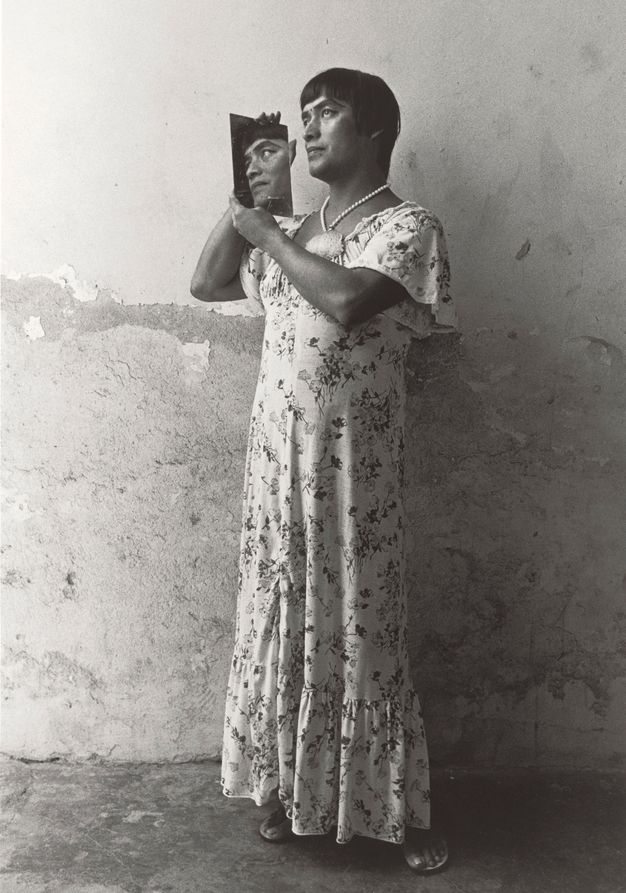
nine- or ten-year-old Felipe. Another influential image was
that amazing photograph by Graciela Iturbide of Magnolia,
which she took in Juchitán (fig. 6).
I saw myself reflected in that image but didn’t know how to
name it. It wasn’t obviously gay or queer in the
beginning—it was just the other. I didn’t know
anything about Graciela or this individual in the
picture—only that this person, who was living their true
existence, reflected me in ways that I didn’t have words
for.
So those were two visual markers that I encountered in
Pilsen that have had a lasting impact. It’s surreal to
consider the impact of my images that are publicly exhibited
right now through the Public Art Fund on other children
today. Certainly this is what attracted me to the power and
limits of art. Obviously as a kid I had no idea who Nahum
was, but encountering an image of his work has affected me
to this day—it made me stop and realize, “Wait, I want to do
whatever this person is doing. I want to spend the rest of
my life making worlds and images.”
Laura: Do you remember what Nahum image you
saw as a nine- or ten-year-old? Because I can picture
Iturbide’s Magnolia perfectly.
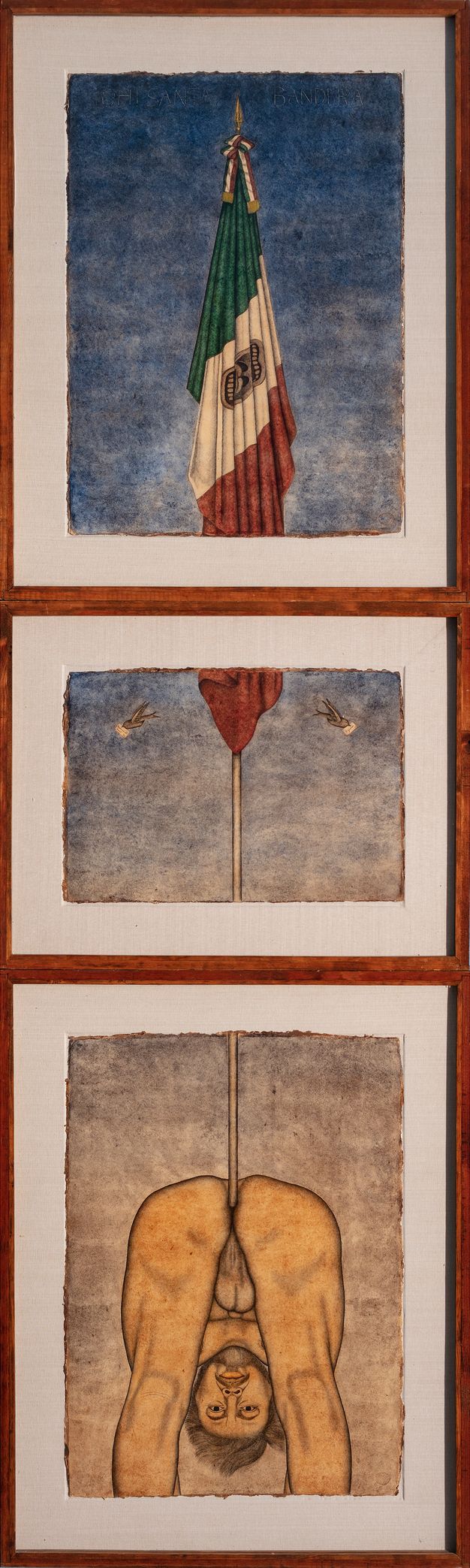
Felipe: Well, there’s two that I remember.
One is a triptych of him being penetrated by the Mexican
flag (fig. 7).
ExpandFig. 7. —Nahum B. Zenil (Mexican, b. 1947).
¡Oh, santa bandera! (A Enrique Guzmán) (Oh,
Holy Flag! [For Enrique Guzmán]), 1996, ink, acrylic,
and oil on paper, triptych: 238 × 71.5 cm. Mexico City,
Museo Universitario Arte Contemporáneo (DiGAV, UNAM).
Acquisition through funds from the Programa de Egresos
de la Federación, 2013. Photo by Francisco Kochen,
courtesy MUAC. By permission of the artist.
Laura: That’s the image that came to my
mind when you mentioned his name.
Felipe: Oh really!? That particular image
I’m sure I encountered way later. But the first image wasn’t
sexual at all; it was a self-portrait of him with thorns
around his head.1
Laura: Were you aware then that it was a
self-portrait?
Felipe: No, definitely not! I learned that
later on. As a child, I didn’t know that he was queer; there
was just something in the image that attracted me.
Laura: I’m totally geeking out here!
[laughter]
Felipe: Those images still have a very
powerful impact on me—especially in their representation of
a body and the possibilities of a body; that is important to
my work. Also the idea of queerness as fragmentation, as
incompleteness. We will never be complete individuals, but
the process of this life is to find those pieces and maybe
shed other pieces away. I could say that I acquired many
pieces of myself growing up in Pilsen.
Laura: I wanted to ask about the title of
your Public Art Fund project, Unruly Forms, because
what you’ve been saying makes me think of those two words
together. When we think of the word form, we think
of something that is perhaps fully formed with strict
contours and definition, and yet, when you put
unruly in front, it becomes unwieldy, right? What
are your thoughts around unruly bodies and queerness?
Felipe: Well, the title came in some way
from Gayatri Gopinath’s book
Unruly Visions: The Aesthetic Practices of Queer
Diaspora
[Duke University Press, 2018]. My language to describe what
I’m interested in has changed over the years, even though
the terms are very much connected. In the beginning, I
embraced the idea of illegality. Then, I began to work
through the idea of fugitivity and later modes of
suspension, though fugitivity is also a mode of suspension.
And then I explored waywardness. And now, I’m investigating
the unruly, though they are all very much the same.
Laura: They’re all connected.
Felipe: Right, they’re all connected. But I
think we always run at the risk of romanticizing fugitivity,
don’t we? It’s an extremely violent way of living—Black
radical thinkers like Fred Moten and Sylvia Wynter have
spoken to that. When you speak about fugitivity, you have to
be aware that it’s a very exhausting way of living because
you’re always on the run. But what I was very much attracted
to in the concept of fugitivity is this idea of
choosing not to belong, choosing to live outside,
while still within—how is that made possible?
And thinking through my own life experience, that I came to
this country at seven, and now I’m thirty-six. And I have
lived in some mode of fugitivity that entire time—I was put
outside by force, not by choice. At the same time, I’ve
learned to thrive within this country, but from the
outside—if that makes sense? And I think that’s very much in
connection to the unruly. How does one live outside
citizenship? Is that possible? And how does one live outside
of the norm? That’s what I’ve been trying to explore—not
just in my art practice, but in my day-to-day life. In terms
of citizenship, what does it mean to desire a country that
doesn’t desire you? As we know, Laura, citizenship does not
protect you.
Maybe I’m just jaded, but as we know, the American dream has
been the biggest scam. Before, I used to think, “I can’t
live like this anymore. I don’t want to live in this liminal
space for the rest of my life.” But since then, I’ve learned
to embrace it, asking instead, “How does one flourish in a
space that doesn’t allow you to flourish?” As we saw in
Pilsen, the possibility of flourishing is there. But it
means finding community and building the structures that
allow you to flourish.
So that’s what I mean when I speak about the unruly.
Embracing that unruliness in its many forms that allow for
survival in a landscape where one wasn’t meant to flourish.
And in that sense, it was beautiful to see the work that I’d
made for the Public Art Fund in Pilsen. Because everyone
that I grew up with in that neighborhood had very similar
experiences—of migrating to this country and trying to
envision a world where they were flourishing. I think that
is the power of the queer migrant imaginary, that you’re
able to thrive in conditions where you weren’t supposed to
thrive. And that’s what has shaped the work and its making.
Laura: Oh, yeah, you’ve just said so much!
I want to respond to everything.
Felipe: As people who flee home either by
choice or by force, it’s human nature to want to belong, to
be part of something. And I think for me, as I grow older,
I’m just starting to accept parts of myself but also reach
toward things other than citizenship and ideas of belonging.
Now I’m in this space where I choose not to belong. And I
think, ultimately, that’s how you attain freedom: you
realize you don’t belong anywhere. We’ve spoken before about
what it means to feel Mexican or not—and at some point I
decided that I honestly didn’t care.
Laura: Exactly. I have something to say
about that. We are so alike in that sense.
Felipe: But the outside world does care. As
I’ve been showing my work in different spaces, they
consistently label me as “Felipe Baeza, the Mexican artist.”
But never as “Felipe Baeza, the American artist.” That’s
another landscape to navigate, to observe from the outside.
But getting back to ideas of belonging, that’s also where
the unruly allows this choice of not being fixed as
something. Rather, you can choose to be legible on your own
terms, to select people. For example, with my childhood
friend Nicólas, we spoke in a coded language; we didn’t have
to name it, but we understood one another.
Laura: Or perhaps just remain illegible.
Not to romanticize that, but I don’t really care to be
legible. You can retain the power to just keep them
guessing.
Felipe: It’s true. Definitely—beyond
opacity, I think we’re refusing to be legible in the way the
state, the law, and even society demands. To be legible only
to those that you care about. That’s been a learning process
for me as I’ve grown up in this country, where I’m forever
foreign. I went back to Mexico for the first time in 2016,
when I was thirty, after having left when I was seven. So
that was surreal to experience, to go back to a place to
which I never thought I was going to return and see family I
thought I was never going to see again.
I bring this up because I also felt extremely foreign there.
But I’ve gone back many times recently, and every time, it’s
felt more like home—whatever home is! [laughter]
But it felt comfortable; I didn’t have to justify my
existence to anybody there. Maybe the process is to reject
the idea of belonging and legibility, and refuse to be
coherent for others.
Laura: Yeah, I am all for that! When my
family migrated across the border, I was two weeks short of
nine and remained undocumented for a few years after that.
But my circumstances were different than yours because at
that moment, we still had the Family Reunification Act.
Because my youngest sister was an anchor baby born in
Chicago, my family got our green cards. So for me, it’s
about choosing to stay in that limbo, not because I love
Mexico or want to be binational, but I embrace that
in-between space. It is a privileged limbo space since my
green card allows me mobility, but I also give the
government the power to track me as I cross borders and move
around. Nevertheless, I embrace my resident-alien status.
Felipe: I want to become a resident alien!
[laughter]
Laura: When my friends get residency, I
always say “Welcome to resident alienation!” I didn’t choose
that status; my parents embarked on the process for me, and
choosing to stay has been important for many reasons. But
I’ve consciously chosen not to become a US citizen because
the American dream is bankrupt for me—
Felipe: It’s a trap!
What you said about resident alienation reminded me of
Deferred Action for Childhood Arrivals (DACA), which came
out under President Obama, our Deporter in Chief. It was
started in 2012, but I didn’t apply until 2013. The
application process was extremely infantilizing and
dehumanizing: we had to provide every single address that
we’d ever lived at, basically tracking our location since we
stepped foot in this country. And of course there’s also the
concern: What happens if someone like Trump gets into office
and wants to cancel this program, when all of our
information is there?
I have to reapply for DACA every two years, providing
updated addresses and a new set of fingerprints. So as much
as I like to say that I live outside of the system, I’m very
much tracked within it. Under DACA, I have to apply for a
travel permit called Advance Parole every time I want to
leave the country.
Laura: Who comes up with these names, by
the way?
Felipe: Exactly! It’s such a broken system,
dehumanizing in so many ways. And while I don’t want to give
it credit, this “immigration protection” has allowed me
mobility—including returning to Mexico under very specific
conditions, though you’re not guaranteed re-entry to the US.
They could decide, you know what, we’re not going to let you
in. So there’s always that concern, but I obviously have to
learn to let that concern go. What’s the worst that can
happen? I can’t come back.
Laura: I think that’s really important to
lose the fear of not returning, to not give it so much power
over you—even while that fear is completely understandable.
This is what I stress to those I know who have DACA status,
including many of my students at UT Austin.
Felipe: The first time I traveled to Mexico
was just before Trump came into power, and I was worried. So
I made a point to return before he took office just to be
sure I’d make it back. But it’s vital to lose that fear and
take that power back from the oppressor. The ultimate
freedom is realizing you don’t belong anywhere. I have
nothing to lose, right? If anything, the only people I care
about who have a lot to lose are my parents—they are already
living a very different reality than I am.
I often think about their journey to this country. My mom
was in her late twenties, and my dad in his early thirties,
and they already had a life for themselves in Mexico. The
decision to embark on a journey to this unknown land,
whether by choice or by force, was quite powerful. As
immigrants, they had to have imagined that there was
something better out there, coming with this idea of the
American dream. But once you arrive here, you find a space
that mirrors where you left behind, or is even worse.
Now I’m seeing them getting older, and my mom has since
retired. In many ways she seems like a teenager to me
because she’s trying to discover herself, figuring out what
she likes and enjoys doing in her free time now that she’s
not constantly working.
Laura: That is beautiful though, and
equally sad.
Felipe: True, it’s beautiful but also sad
that she spent a significant part of her life working and
worrying about other things. Now she’s at the stage where
she has some time to attend to herself. And I’m seeing that
with my dad, too. Obviously, their bodies are changing. I
left Chicago when I was eighteen, and I feel that I’ve
missed out on so many things in their lives. Every time I
see them, they’ve gotten older. Ultimately, my only
responsibility is to give them the best life possible.
Right? Because I don’t think the answer for them is
returning to Mexico, to a landscape that is very unknown to
them now. And selfishly, I don’t want them to return; I just
want them in close proximity to me. But that’s where I’m
coming from, my only responsibility is to my parents and
otherwise I really have nothing to lose.
Laura: [Pauses] Wow—
Felipe: That was a lot! [laughter]
Laura: I’ve been thinking a lot about my
own parents in relation to these questions and have much
more to say. As you might remember, my father passed away
only a few months ago, after being sick for a few months, in
large part due to the lack of mobility caused by the
pandemic. To think that my dad’s biggest dream was to return
to our town in Durango, where I was born, is devastating. He
was never able to do that. I now want to do an action in our
town, an art intervention, as a way of honoring him and
bringing him back home.
But maybe this is a good moment to pivot back more directly
to your work?
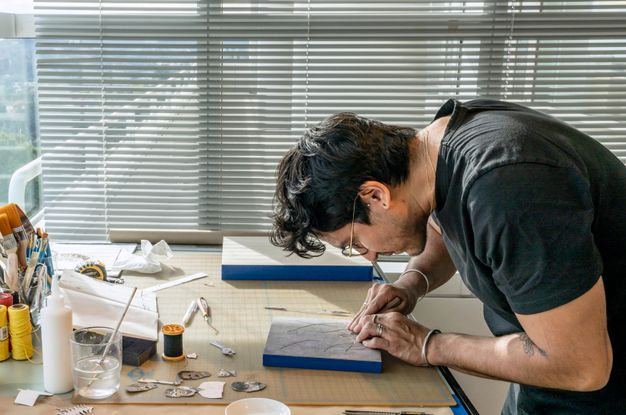
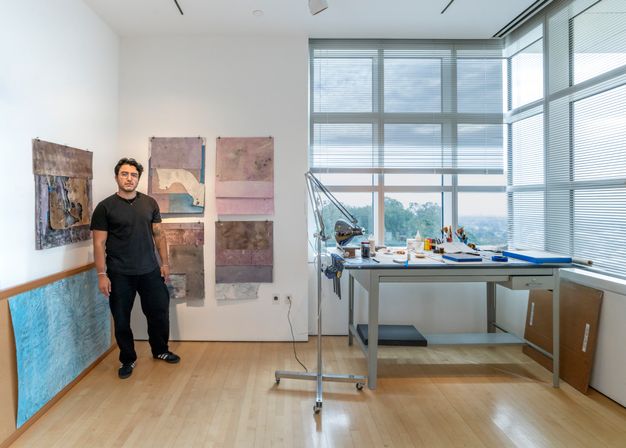
I was remembering our time at the Getty in Los Angeles, and
the privilege of being able to pop my head into your studio
and see your work in process (figs. 8, 9). After seeing you make work on
such a small, intimate scale, it’s surprising to see those
same works blown up and installed in bus shelters across six
cities in the United States and Mexico for this Public Art
Fund commission!
ExpandFig. 8. —Felipe Baeza working in his studio at the Getty
Research Institute, 2022.
Photograph courtesy the Getty Research Institute, Los
Angeles.ExpandFig. 9. —Felipe Baeza in his studio at the Getty Research
Institute, 2022.
Photograph courtesy the Getty Research Institute, Los
Angeles.
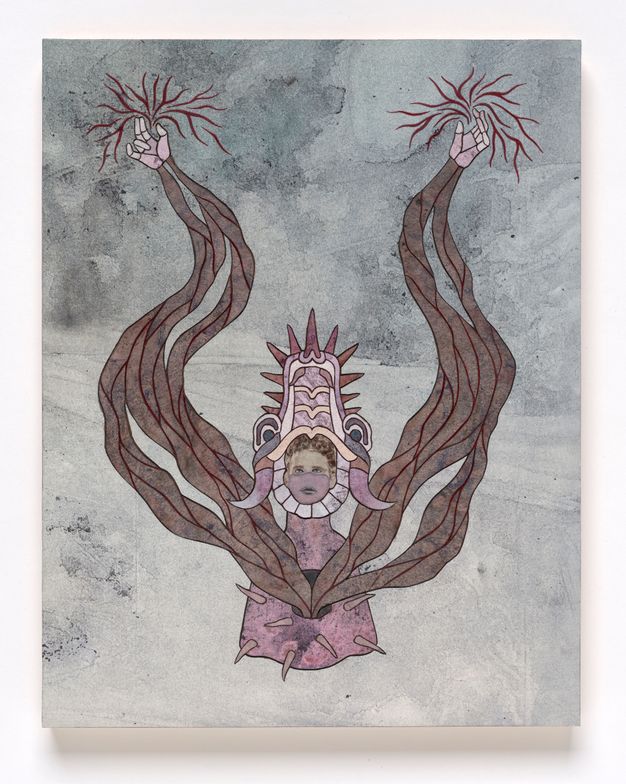
Perhaps we could start by talking about the Mesoamerican
artifacts these works were based on. Beyond specific
identifications of the objects, their references, and
symbolism, I’m interested in your own mythmaking with and
through them.
Felipe: More than answers, questions guide
my practice—and I think that is what makes the studio and
the process of making so important for me. I’m trying to
explore those answers through materiality. My interest in
Mesoamerican artifacts has changed over time.
For this commission, I looked primarily at objects from what
is now known as Mexico currently in the collections of the
Metropolitan Museum of Art in New York, the Museum of Fine
Arts in Boston, and the Art Institute of Chicago. These were
the three cities I was initially given by the Public Art
Fund, and I tried to unify them. Once I did some research,
it turned out that several Mesoamerican objects I’d been
attracted to for a long time happened to be in these three
museum collections.
Rather than tracing these objects back to their original
contexts, I’m interested in them as vehicles for broader
conversations about migration and displacement. How is
meaning added to objects? What does it mean for an artifact
to be taken far from of its original context and then fixed
in a very clinical state within a museum, where it’s never
meant to change?
Laura: There’s so much science around
defining the exact provenance, the location, date, the maker
if known, and all of that.
Felipe: It’s such a violent extraction.
This project attempts to imagine a liberatory force that
would allow this object to thrive in these displaced
conditions far from its place of origin, even while carrying
the name of a wealthy white donor for the rest of its life.
What if the object was never meant to be displayed? What if
it was meant to be buried for the rest of its life? I
believe these objects still carry so much energy; they’re
vessels of energy. As viewers, we sometimes struggle to
acknowledge that the object was made by a being, by a
person—we see it as an object, rather than a vehicle. For a
lot of cultures, not just Mesoamerican ones, mythmaking was
a way to create portals into the afterlife, a means of
survival and regeneration. We tend to think of living as
spanning from the moment we’re born until we die—but so much
of life happens beyond death, in giving life to other forms.
For me, that public commission expanded in so many
directions. Having time and space to research while in
residence at the Getty allowed me to take a deep dive into
this project. The process, as you know well, was very
layered and happened organically.
Laura: Your work is quite literally
layered, and also very minute in the details.
Felipe: A lot of the work that I’ve been
doing has addressed an erasure that removes voices from a
history of making. I’m deeply interested in archaeology,
which is an extremely problematic discipline. One example of
this is the Mexican National Anthropology Museum [Museo
Nacional de Antropología]: a violent, nationalist project
that has extracted so many objects from communities that are
still thriving across Mexico into a single location.
Laura: For those communities, the
“artifact” is not an artifact but a living object with a
spiritual function in the community. It’s not meant to be in
a museum, part of a national project.
Felipe: It’s an extremely violent
extraction. The answer for these objects that are in
collections in the States and all over the world is not to
repatriate them, because they will never be able to go back
to their original places. But this raises questions about
institutional responsibility to care for and contextualize
these objects. This is another way that my Public Art Fund
project opens up many more questions than answers.
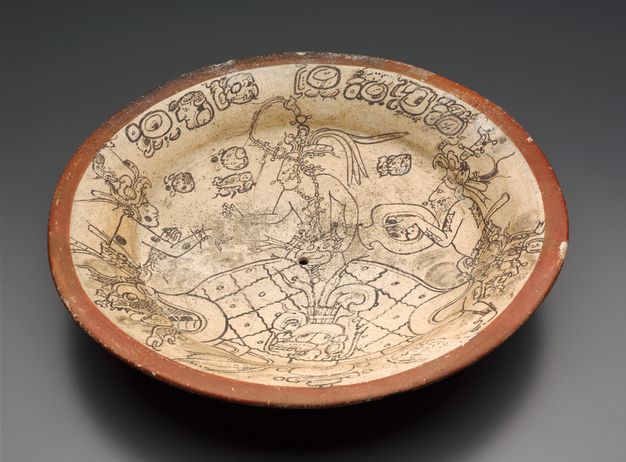
There is one object that I had been particularly obsessed
with: a Maya plate that turned out to be at the MFA in
Boston of all places, the only city of the initial three
that I had no personal connection to (fig. 10). Like many of the objects that I picked for this project,
this plate depicts transformation and regeneration. Here
it’s a maize god rebirthing from the shell of a turtle while
aided by an individual on each side. Together they make a
collective that allows you to come into existence, to be
present.
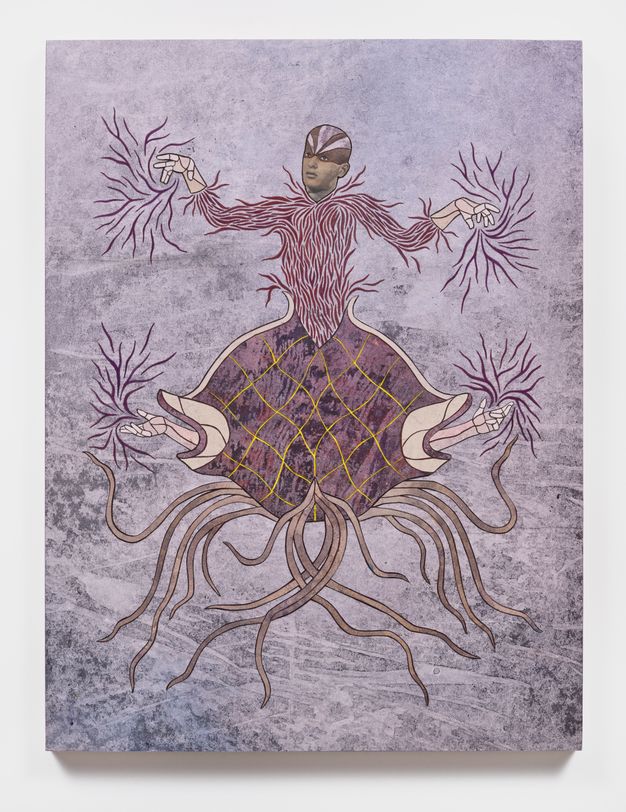
Laura: That’s one of my favorite images
that you work with. And it was mind-blowing to see
to shape, shape self (2023;
fig. 11) at a bus stop—you’re doing
a new kind of mythmaking, for a public audience (see fig. 5).
Felipe: Thank you for sharing that! It’s
been hard to take in this project when I see it firsthand on
the streets, but it’s beautiful to see it through the eyes
of friends and family, and to witness their excitement at
seeing an image in public made by someone they know.
As an artist, public art is an important responsibility, and
I haven’t fully absorbed or comprehended what it means. But
especially in the context of Chicago, I imagine my younger
self walking in that landscape, and imagine my work in that
public setting having an impact on someone. I like that
there’s no context to these images whatsoever—there’s really
nothing beyond the title of the project and my name.
Laura: Yes, but people are left to deal
with the image in their own way. Which is what happened that
evening after we met in Pilsen. I went to have dinner with
my sister and eleven-year-old niece on the North Side, and
we drove past some of the bus shelters where your project
was displayed. We stopped at one of them and got out of the
car. My niece was stunned and speechless for a bit as she
confronted the image. Then she commented, “Oh, it’s scary .
. . but I like it.” She examined it really closely, fixating
on certain details, and then pulled back and asked me to
take a picture of her and my sister in front of the work.
She had no idea about the artifacts the image was based on,
or who you were exactly, but nonetheless had to reckon with
the image.
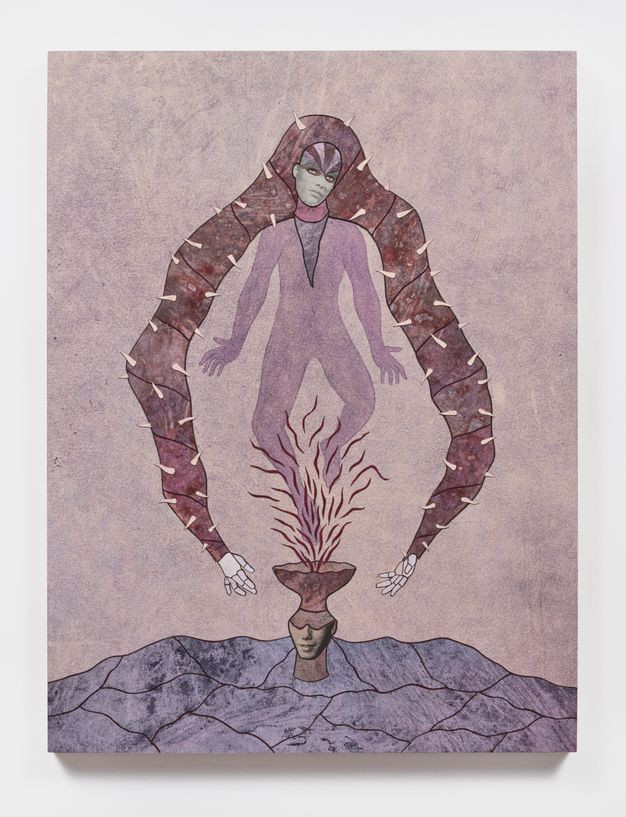
Felipe: Well, I want to return to what you
said about the work’s format and scale, because I agree that
the enlargement makes them feel very different. I worked on
these images at the Getty on a very different scale, as
panels—and the largest one was probably sixteen by twelve
inches, so very intimate (figs. 12,
13). I worked on them one by one.
And obviously I knew they were going to be enlarged and
printed. But I didn’t comprehend that scale until I got the
proofs. And I was like, “Whoa!” The prints take up space in
a very different way than the smaller ones; the images feel
so different.
And that was also my feeling when I first opened the
proofs—like your niece, I was like, “These are so scary!,”
but also beautiful in how they take up space and have
agency, as if to reclaim space: I’m here, and you’re forced
to deal with me. And I think that’s also why it was hard to
encounter them at first, hard to know how to respond to
them. I wondered if they were taking up too much space. . .
.
Laura: Because you’re a quiet person who
likes to hide in the corner! [laughter]
Felipe: I mean, that’s true! Because I
thought, “Oh my God, they’re out there. And they’re living
and they’re taking up space in a very different way than
they have in the studio!” In the studio they’re just so
intimate; only one person is able to view them at a time.
But on the subject of scale, this project situated in the
spaces of public transit felt important for me to do because
that’s also how I experienced Chicago and how I continue to
move around. I don’t drive; I never had a desire to learn
how to drive. So public transportation has always been my
mode of getting around, of learning my landscape and
discovering new ones. There’s a cycle of mobility and
waiting built into that experience, of riding one bus and
then waiting for the next one, pausing and then resuming
movement again. It’s a mode of bodily suspension. Hopefully
I’m not scaring a lot of individuals while they are waiting
for the bus! [laughter]
Laura: I loved observing passengers
inhabiting the bus shelter and moving through space—not just
because I’m interested in the body’s movement as performance
studies but also because I have a deep love and appreciation
for you and your work. As I stood there, I observed people
sitting on benches, standing, and leaning against the
shelters, and engaging with your images in various ways
until the bus arrived and they started piling onto it. It
felt deeply ritualistic, almost like I was attending church.
Through this project, you’re not just enacting new myths but
also new rituals.
Felipe: Religion has informed the work.
Growing up Catholic on one side of my family and evangelical
Christian on the other, I experienced two very different
types of interactions with images. Long before I first saw
the work of Nahum Zenil or Graciela Iturbide (see figs. 6, 7), church was the context in
which I first experienced the body in space or in a
landscape and reckoned with the power of the image beyond
desire. These issues are still very much at the forefront of
my work, which questions the possibility of the body, the
kind of energy the body carries, and the space it can
occupy. In a lot of my work, the body doesn’t have or even
inhabit a landscape—rather, the body itself is the actual
space, is the landscape itself. The body is a vessel that
carries energy. There have always been ritualistic aspects
of the work, as well as poetic ones. The bodies have become
more abstract and fragmented in embodying the refusal we
discussed earlier, but they also exist in their full
totality, despite this fragmentation. The work tries to
build back a history or myth, to reconstruct a unity that
will never be totally right, but the challenge is to learn
to sit with that and be OK with it.
Laura: The regeneration that you spoke
about earlier is key to this. But the other dimension of the
bodies depicted in your work that is equally important to me
is their appendages—roots, wings, or arms that reach out.
Almost like tentacles. And the teeth or thorns that grasp or
ground the bodies. As a viewer, I desire to be grabbed by
this body that is a vessel, to be pulled in through the
portal. I want to use these bodies as a vehicle for my own
journey into and through the work.
Felipe: Wow, thank you for that! I would
say that what I’m trying to do not just in my work but in my
day-to-day life is respond to a need and a desire to create
portals. To go back to our earlier discussion about not
belonging, maybe the essence of not just my practice but
also my very being is to belong—anywhere, everywhere, and
elsewhere, right? And I’m so thankful that I’m an artist,
because it has allowed me to figure all these things out for
myself. The journey of art making has been my exploration to
find my language. Making has allowed me to work out and
fully express these ideas in ways that words have not.
Materiality has been extremely important to this process,
and I’m interested in how materiality can also sit eye to
eye with the content.
I don’t work in a traditional manner; it’s a layered process
that I don’t fully comprehend and can’t control. When I walk
into the studio, I’m not in a comfortable state because it’s
always a space of failure. But I enjoy that failure because
it allows for so many surprises to happen. The studio
practice is fairly new to me. Every day, I confront that
fear of not having or knowing what freedom is. For a long
time, I couldn’t name it. And I was like wait, this is what
I’m able to do now. This is my space. I don’t have to
respond to anybody. I can just come to the studio and lose
track of anything and fully absorb myself in the making. And
yeah, and I’m still trying to figure that out for myself.
And I think sometimes there’s also that guilt, feeling like
it’s such a selfish practice.
Laura: Recovering Catholics!
[laughter]
Felipe: Guilt is still very much embedded
in there! Guilt that I get to do this, and trying to sit
comfortably with that. So yeah, there’s a lot of figuring
out happening.
Laura: OK, maybe this is a good moment to
pause.
Felipe: Thank you so much for that.
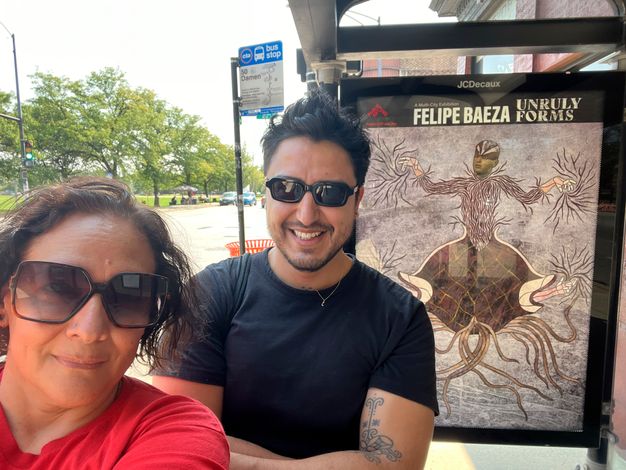
Felipe Baeza and Laura G. Gutiérrez at a bus shelter
located at the intersection of S. Damen Avenue and W.
18th Street in the Pilsen neighborhood of Chicago
featuring Baeza’s to shape, shape self (2023),
part of the installation Unruly Forms.
Photo by Laura G. Gutiérrez.
Felipe Baeza is a visual artist living and
working in the United States.
Laura G. Gutiérrez is an art critic and
performance curator based in Austin, Texas, and a professor
and administrator at The University of Texas at Austin.
Notes
Nahum B. Zenil (Mexican, b. 1947),
Self-Portrait with Thorns, 1992, oil on wood,
70 × 50 cm, private collection. An image of the work is
viewable on the website of the Grey Art Museum, New York
University, in the context of the exhibition
Nahum Zenil: Witness to the Self, 2 September
to 1 November 1997,
https://greyartmuseum.nyu.edu/exhibition/nahum-zenil-090297-110197/sec/images/. ↩︎
Fig. 1. —Installation view of Felipe Baeza’s
Unruly Forms in Querétaro, Mexico, 2023.Unruly Forms, presented by Public Art Fund, is an
exhibition on more than four hundred JCDecaux bus shelters and
street furniture in New York, Boston, and Chicago in the
United States; and in Mexico City, León, and Querétaro in
Mexico, 9 August–19 November 2023. Photograph by Ramiro
Chaves, courtesy Public Art Fund, NY.
Fig. 2. —Installation view of Felipe Baeza’s
Unruly Forms in Boston, 2023.Unruly Forms, presented by Public Art Fund, is an
exhibition on more than four hundred JCDecaux bus shelters and
street furniture in New York, Boston, and Chicago in the
United States; and in Mexico City, León, and Querétaro in
Mexico, 9 August–19 November 2023. Photograph by Mel Taing,
courtesy Public Art Fund, NY.
Fig. 3. —Installation view of Felipe Baeza’s
Unruly Forms in New York, 2023.Unruly Forms, presented by Public Art Fund, is an
exhibition on more than four hundred JCDecaux bus shelters and
street furniture in New York, Boston, and Chicago in the
United States; and in Mexico City, León, and Querétaro in
Mexico, 9 August–19 November 2023. Photograph by Nicholas
Knight, courtesy Public Art Fund, NY.
Fig. 4. —Felipe Baeza viewing a bus shelter located at the
intersection of S. Damen and S. Blue Island Avenues in the
Pilsen neighborhood of Chicago featuring Baeza’s
Let yourself fall (2023), part of the installation
Unruly Forms.
Photograph by Laura G. Gutiérrez, September 2023.
Fig. 5. —Felipe Baeza at a bus shelter located at the intersection
of S. Damen Avenue and W. 18th Street in the Pilsen
neighborhood of Chicago featuring Baeza’s
to shape, shape self (2023), part of the
installation Unruly Forms.
Photograph by Laura G. Gutiérrez, September 2023.
Fig. 7. —Nahum B. Zenil (Mexican, b. 1947). ¡Oh, santa bandera! (A Enrique Guzmán)
(Oh, Holy Flag! [For Enrique Guzmán]), 1996, ink, acrylic, and
oil on paper, triptych: 238 × 71.5 cm. Mexico City, Museo
Universitario Arte Contemporáneo (DiGAV, UNAM). Acquisition
through funds from the Programa de Egresos de la Federación,
2013. Photo by Francisco Kochen, courtesy MUAC. By permission
of the artist.
Fig. 8. —Felipe Baeza working in his studio at the Getty Research
Institute, 2022.
Photograph courtesy the Getty Research Institute, Los Angeles.
Fig. 9. —Felipe Baeza in his studio at the Getty Research Institute,
2022.
Photograph courtesy the Getty Research Institute, Los Angeles.
Felipe Baeza and Laura G. Gutiérrez at a bus shelter
located at the intersection of S. Damen Avenue and W. 18th
Street in the Pilsen neighborhood of Chicago featuring
Baeza’s to shape, shape self (2023), part of the
installation Unruly Forms.
Photo by Laura G. Gutiérrez.