Provenance research can take many forms and draw on a range of resources, from the predictable auction catalogue to the unexpected sticky note, and it may challenge even the most astute scholar to weigh the evidence and make sense of the gathered information.1 In this chapter, we offer a survey of resources and strategies that we have found useful for this work. We begin with the section “Scoping Your Project and Establishing Goals,” presenting an overview of key questions and the potential challenges that exist for any project. The second and third sections, “Assembling Provenance Information” and “Beyond the Institution,” consider the many sources one can consult, from the object itself to dealer archives. The last section, “Processing and Publishing Provenance Information,” addresses how your findings can be interpreted, processed, and shared. Case studies from the Getty’s collection throughout this chapter illustrate a variety of methodological approaches, but we hope they also make clear that provenance research is full of alternate routes, dead ends, parallel paths, and multiple destinations.2 For an overview and introduction to provenance research, we recommend the foundational text published by the American Alliance of Museums, The AAM Guide to Provenance Research,3 and we list additional resources and more recent provenance guides in our Appendix 1, “Annotated Resource Guide.”
The term “antiquities” encompasses objects from the monumental to the minute. Describing their respective ownership histories and object biographies within a provenance narrative (a structured description of an object’s provenance) is no simple task. Many ancient objects that survive today were deposited in funeral contexts, but others were hidden in antiquity for safekeeping, offered as votives, or discarded as refuse. Some remained above ground, adapted for other functions, like sarcophagi or statues reused as fountains,4 or were embedded as spolia into walls—and this kind of repurposing could take place on multiple occasions, further separating the object from its original context.5 Coins or gems, for example, may be reset into jewelry or other decorative arts, with multiple generations of settings accumulating or being replaced over centuries.6 Furthermore, the documentation of an object’s history—its findspot and its subsequent contexts—has been inconsistent over the centuries, and information about most Mediterranean antiquities on the market and in many museum collections is often lacking. Provenances often prove to be inconsistent patchworks, and this chapter provides concrete tools and strategies for researching and making these complicated data available. As a range of approaches may be required given project needs, subsequent sections of this chapter can be read as a step-by-step methodology or dipped into as need requires.
Unfortunately, there is no single road map or methodology for determining provenance that can serve every object, dissertation, or institution. One of the more elusive aspects of provenance research is luck. It can, to some extent, be fostered by developing your own databases of resources, flipping through every available auction catalogue, or combing through every photograph in an archive.7 But the survival of documents within an institution, the preservation of an old accession number in an image, or the existence of a citation in an article—none of these is guaranteed, and while opportune discoveries can reveal exciting new links in a chain of ownership, much more common are the thousands of negative results, where no information can be corroborated. These may be frustrating to the researcher and their importance hard to convey to the outsider, but they are no less important to document, so that the scope of past investigations can be revisited should new information arise in the future.
Luck and serendipity in discovery require opportunity, whether that comes from conversations with colleagues, from database updates that make alternate numbers searchable, or from dealer stickers described in online collection pages. Perhaps the most unexpected discovery for us was finding an Etruscan cinerary urn and lid (71.AD.293)8 for sale in an American department store. A colleague happened to share a Kaufmann’s department store advertisement from 1966 for an exhibition of Mediterranean antiquities, and, to our surprise, the illustration included the cinerary urn. This sighting opened up an unexpected chapter in its modern history, paving the way for us to reconstruct the urn’s journey across the United States in the 1960s (see the case study in this chapter).
This chapter is the result of over a decade of research at the Getty, but it is in reality much more than just the work of two researchers: it reflects the kind assistance of colleagues across the globe, who have shared their experiences, resources, and research, and who have contributed in both creditable and ineffable ways to our understanding of provenance. We hope that your project will likewise benefit from the ever-increasing number of colleagues working in this area—the most critical resource we can suggest.
Part 1: Scoping Your Project and Establishing Goals
Any provenance research project operates within three main parameters that help determine expectations and goals: volume of material, resources, and time. As part of initial considerations for outlining a provenance research project, you will further need to set goals, identify project stakeholders, determine the project’s scope, document assets, and keep records on the project’s progress.
Provenance research projects can span the documentation of a single object to a holistic review of every item in a collection. The latter allows for connections between disparate records and a better understanding of relationships between collectors and dealers, but this can be difficult to manage and maintain. Regardless of scope, it is helpful to designate and assess targeted groups of material for study. In assembling these, it is worth reviewing all related objects, including those deaccessioned, in case an individual record contains information that applies to the broader group. Possible object groupings include, but are not limited to:
those on display
specific object types
those scheduled for publication
-
those associated with a specific individual
-
those acquired before or after a certain date
possible Nazi-era concerns
claims or contested histories
In the case of researching the Getty’s antiquities collection of over 46,000 records, it took nine years and many researchers to complete a first review of every item.9 We started with the objects on display, recognizing that these were the most visible. We then turned to studying specific constituents (vendors, dealers, and collectors), which allowed for a more comprehensive understanding of trails of correspondence, as well as individual tastes and practices. As needed, we also addressed specific object groups that were slated for publication in collection catalogues, before finally reviewing any remaining records chronologically by year of acquisition.
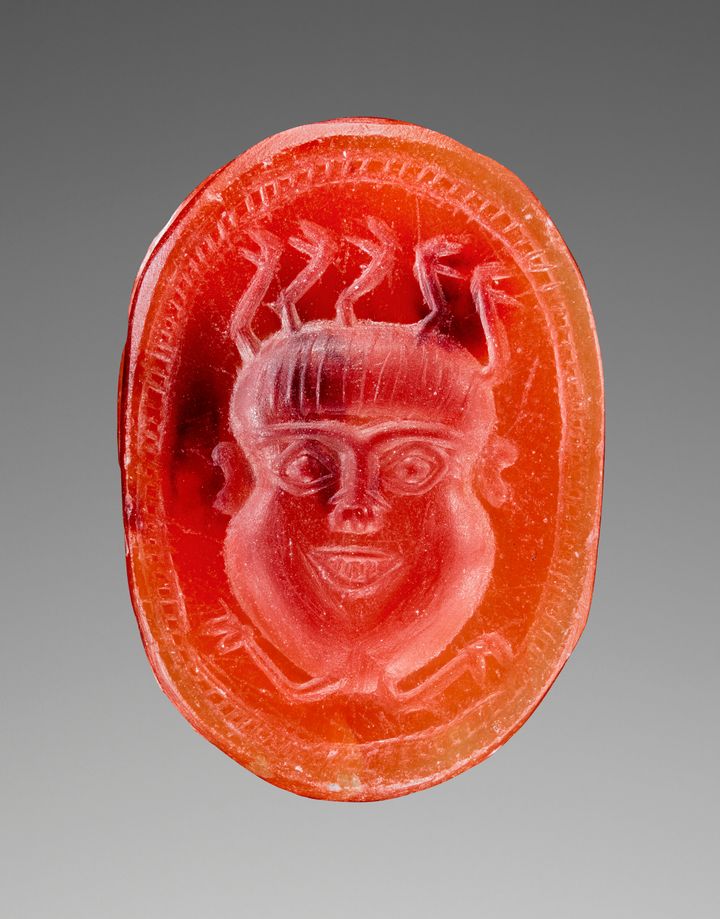
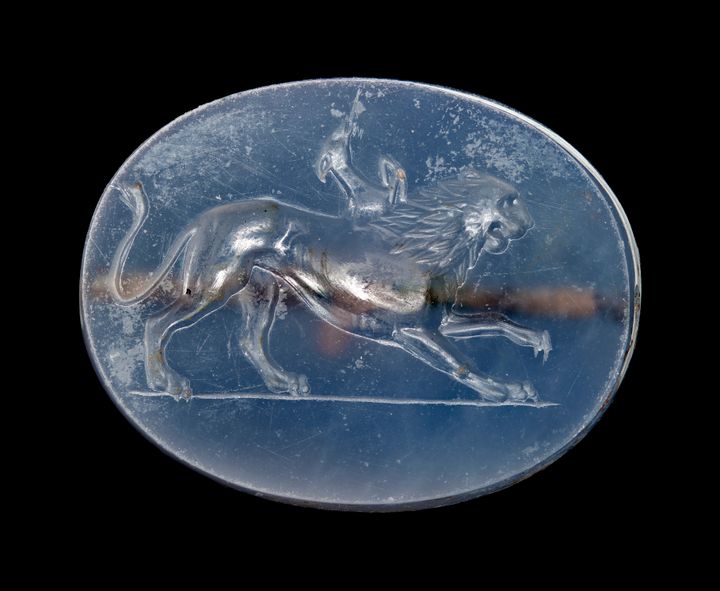
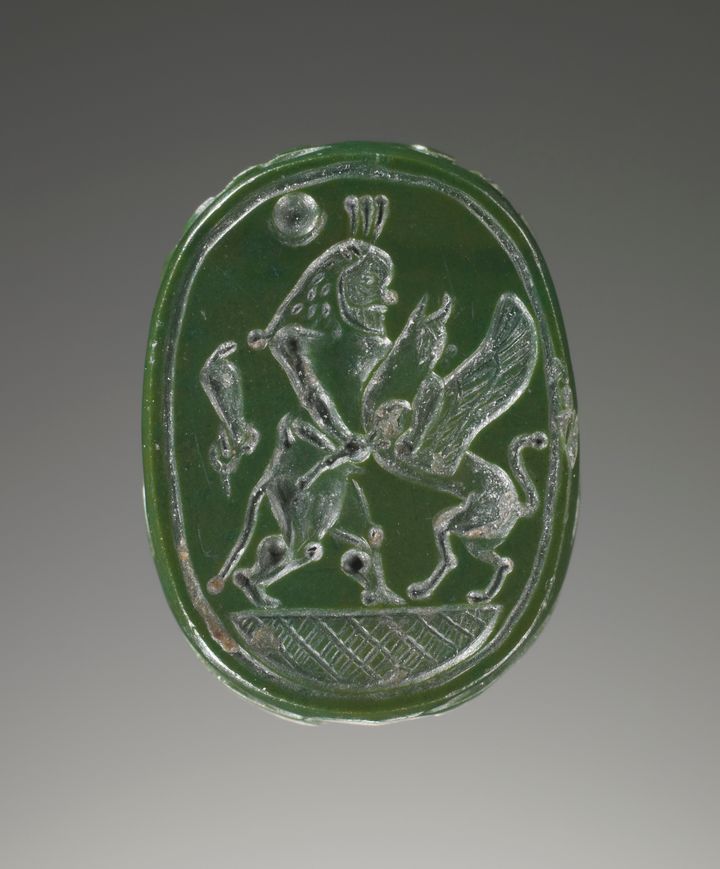
Your project might focus on a single object or on thousands, and volume can be difficult to quantify when working with large groups of material that may or may not be related. Objects could be parts of the same whole (e.g., a mosaic or fresco), related by find context (e.g., a coin hoard), or acquired together from the same dealer or collector. Each item might need to be researched individually, or studied and updated as a batch. For example, a group of 218 Greek, Roman, and Etruscan Engraved Gems and Rings (81.AN.76)10 acquired by the Getty in 1981 are catalogued under an umbrella group record, but the history of each gem had to be individually researched (fig. 6).
Resources for your project can range widely, especially depending on whether you are working within a collecting institution and have access to internal files, or are conducting research independently as a guest researcher or scholar. Financial resources, whether from institutional funding, a grant, or independent research, dictate allocated staff time, database infrastructure and support, and library and archival access. Equally important to consider are access to objects, documentary evidence, and related archives. Lastly, the time available for a project is rarely open-ended, and may be limited by academic schedules or other external deadlines. Even if the project has no end date, time commitments need to be planned and accounted for.
In considering the time frame of your project and both its short- and long-term objectives, it is important to keep in mind the continuing nature of provenance research, which benefits from periodic revisions and updates, and to build that into the way benchmarks are defined. Some objects have seemingly endless variables to explore, but at some point, the available evidence must be reviewed, summarized, and shared publicly. Nevertheless, just because a provenance has been shared, it should not be accepted as “complete,” since this type of research is highly iterative and rarely, if ever, finished. For objects that have spent any time on the market or in private ownership—even objects with documented findspots—gaps in knowledge about their movements and ownership changes are likely. The possible reasons behind those gaps are myriad, but so too are the research strategies required to fill them.
With your goals in mind, assess how research will be processed, where it will go, and in what form. A project plan should consider two likely types of output: the internal documentation of your work and its public-facing presentation; these are addressed in detail below under “Processing and Publishing Provenance Information.” It is critical to document the research process, including all lines of inquiry—even, or perhaps especially, the dead ends. Make plans for storing and ensuring accessibility to any digital materials produced, particularly study photographs of the objects and scans of primary documents. In addition, keep the requirement for any auxiliary updates in mind; provenance research often feeds into other key cataloguing fields, notably bibliographies, exhibition histories, and the documentation of labels and marks. Addressing these related changes to object records can be time-consuming, and this additional commitment should be considered in the initial project scoping plan.
In establishing the goals of your research, an important early step is to identify stakeholders, as these individuals or groups play a valuable role in establishing how research is documented, approved, and shared. Stakeholders could include those working directly on the project (such as a project manager, museum curators, registrars and collection managers, and digital support staff); those responsible for or sponsoring the project (the funding source, the donor, the museum’s legal staff or advisors, trustees, and board of directors); descendant communities; and the public. Recognizing all the interested parties and their expectations and balancing these priorities with your own objectives helps determine the scope and structure of your project, including which sections of the collection to target first, the depth of research, and the desired outcomes.
Part 2: Assembling Provenance Information
The Documents and the Object
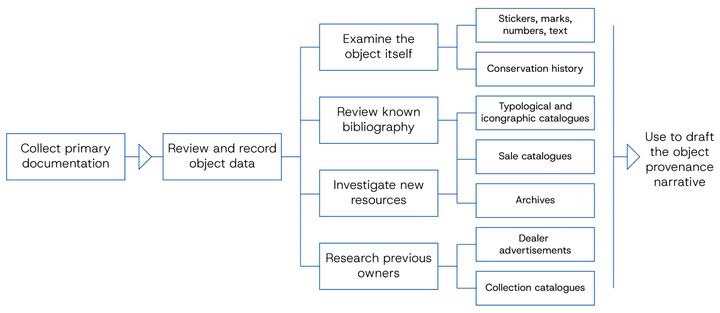
In this section we focus on gathering information from documentation found in the institution holding the object and from the object itself. While no single strategy can encompass all research inquiries, there are a number of considerations and questions to keep in mind. As a suggested workflow, first collect and review all available internal documentation and record object data (fig. 7). Some questions to ask about the documentation are listed below, and they apply to all types of materials one might reference, whether from sources generated by the institution or externally, such as dealer invoices. The authenticity of every document must be carefully assessed. Moreover, an authentic document does not guarantee the legitimacy of the information conveyed in it; the authorship of documents, their purpose, and the intended recipients should also be considered. Additionally, while not common, there are cases of criminals introducing forged documentation into archives, and further of tampering with archival documentation.11 Cross-referencing sources where possible remains essential. Even when the authenticity of documents is not in question, their interpretation can require further investigation.
Consider the author, audience, and purpose of the document:
What is its source?
Who was the intended audience?
Why was the document created?
Why was it sent or preserved?
-
What does it say about the ownership of the object, if anything?
Also ask about the document’s own preservation context:
-
How does it relate to the greater archival corpora? What documents are housed with it?
How are the documents organized?
Who organized them?
How and when were they preserved?
For photographs, in addition to the above questions, consider the photograph’s production and development:
When was the photograph taken?
Is there a credit line?
Is there an extant negative?
-
What type of image is it (e.g., Polaroid, transparency, photocopy, photocopy of the object itself, glass slide)?
-
Does the image type help date its production?
-
If a print, when and where was the print made?
-
How many prints or copies may have been made?
-
Are there any annotations or photographer stamps on the print?
-
If the photograph is part of a series or group, what is the context of the larger set?
-
What else do you know about the photographer or owner of the object?
-
For digital images, what metadata can be recovered?12
Regarding the photograph’s content and interpretation, ask the following:
What is in the background?
-
What is the state of the object in the photograph, and how does it differ from the state of the object today or in other documented photographs?
-
If the object in the image is not firmly identified, what criteria will you use to confirm its identity? What diagnostic points can be compared (e.g., damage, joins, patterns in the material)?
Locating and reviewing all the related paperwork might be difficult, even when working within your own institution, due to physical restrictions, processing delays, or access permissions. In planning a project, map out the potential resources across the organization and consider the amount of time and staffing needed to accommodate requests made to other departments. If working as an outside researcher, make a detailed request, giving background, objectives, and a timeline, as processing paperwork can be time-consuming. Be aware that sensitive information, such as the names of anonymous donors, addresses, shipping details, or prices, may be redacted, depending on institutional policy.
When evaluating sources such as acquisition proposals, invoices, correspondence, old photographs, or notes in files, carefully review and document everything. Information about an object might have changed following reattribution, conservation, or other interventions, so historical data (e.g., previous titles, dimensions) should be recorded as well. Keep in mind too that the documentary resources held by an institution are not neutral—unconscious biases and conscious decisions determine what is preserved or discarded. Furthermore, a healthy amount of skepticism is required concerning the paperwork that does exist. With provenance information, assertions and assumptions can easily take root as fact, so it is essential to question and, when possible, verify the author, date, and source of any statements. Here, “verify” means to cross-check with documentation from an unbiased third-party resource where possible (e.g., dated paperwork, publications, correspondence, public records). While confirming some details might be straightforward—like dealer addresses, life dates, and auction sales—quite often information cannot be cross-checked, and its unverified status should be acknowledged.
Working with internal documentation raises questions of transparency around research. What terms restrict accessing and sharing potentially sensitive information? For a provenance researcher, transparency works on two levels—between internal information and the researcher, and between the research findings and the public. The first level of transparency will vary depending on the museum, and even within a single organization different departments might have their own access policies and restrictions. For some public American institutions, full access to records might be determined by local and state laws, but in general a museum has some discretion over the information it shares. Publicly shared research that relies on internal documentation needs to balance transparency with conditions set by particular record holders, as for example restrictions on reproducing sensitive information. While respecting such restrictions, it is important to explain any conclusions based on the reviewed evidence.
Carefully consider the format and process for documenting your research. Ideally, your notes should be fully searchable, dated, and use consistent keywords. Alternate spellings for constituent names and open-ended questions should also be preserved. When multiple records have shared documentation (e.g., group acquisition paperwork or biographical notes on a dealer or collector for numerous objects), it is best to add those to one primary location and have subsequent related records cross-reference it, to streamline future updates. Provenance research is additive, often building on the work of multiple people conducted over many years. Future-proof your research by acknowledging those who have contributed in the past and framing your findings in terms that will be clear to researchers years from now. To the extent possible, ensure that any online documentation is preserved with screenshots and through the Internet Archive’s Wayback Machine.13 Printed copies of key documents, including emails and their associated attachments, and summaries should be added to any physical files where possible. Record sources consulted, as well as documenting any outstanding inquiries and additional lines of possible research. And again, negative results should be documented as well; this will prevent redundant research in the future, and a closed line of questioning may become open at a later date.
As mentioned, provenance research is rarely, if ever, complete, and it should be expected that findings will need to be revisited and revised. When developing a project plan, it is important for a provenance researcher to convey this to stakeholders in order to set and manage expectations. Because of the evolving nature of this work, preference should be given to documentation platforms that can be easily searched and updated. For example, if working within an institution, research should be summarized and preserved in the collection management system or other internal database, and any public-facing provenance summary should be added to its own searchable field. An independent or guest researcher should likewise store data in a searchable, sustainable format.
Collecting Internal Documentation
The first step for any project after its scope has been determined is to collect all internal documentation that might relate to the objects under review. The location of these materials may vary depending on the collection, but in museums, object-based files and other related files might be held by the curatorial department, registrar, administration, conservation, director’s office, or institutional archives. Documentation can take the form both of physical paperwork and of information stored digitally in the museum’s internal database. Similar documents may appear in multiple locations as carbon copies, drafts, or redacted versions, but it is worth cross-checking all versions for potential differences or added notes. Digitized data is usually drawn from the available paper records, but each resource can have information not preserved elsewhere. The process of digitizing records is often ongoing and uneven, and depending on the institution, resources may be held in different departments with varying levels of access. While the data’s organizational structure will vary, we see two distinct categories: before acquisition and after acquisition.
Before Acquisition
An object’s paper trail often begins long before it is acquired, when the object may be recorded in external archives (e.g., inventory lists, ownership statements, old invoices) and publications (e.g., auction and exhibition catalogues, advertisements, journals). Some of these resources might be preserved in museum documentation, having been gathered in curatorial research or provided by the previous owner.
The acquisition process itself can provide pertinent documentation, such as records of negotiation (e.g., pre-acquisition loan agreements, dealer photographs, invoices, curator’s reports, and correspondence with dealers, donors, galleries, and scholars); object movement records (e.g., shipping invoices, customs statements, object receipts, locations in storage); and object condition reports (e.g., photographs, conservation reports, material tests, notes on treatments, and documentation of old marks, numbers, and stickers that may have been removed on acquisition or during study). Documentation of the acquisition can be found in historical acquisition ledgers, the official record books for incoming objects, and records of meetings where acquisitions were proposed and approved. It is also important to note any pre-acquisition tracking information, including previous collection numbers, loan numbers, alternate accession numbers and, if made available, valuations. Related dealer or donor correspondence should also be checked in case the object, or a related object, was previously offered or discussed.
After Acquisition
Once accessioned, an object can be further studied, published, and exhibited, potentially leading to the discovery of more provenance information. This documentation might be preserved in correspondence with scholars who researched the object, memos or original research written by curatorial or conservation staff, exhibition and educational materials, or secondary sources (e.g., copies or offprints of relevant publications, newspaper clippings, exhibition catalogues).
For a work that is subsequently deaccessioned, see “Deaccessioned Works” below.
Examining the Object
Photographs, drawings, and descriptions are valuable, but it is essential that a researcher examine the object itself, or at the very least coordinate with collection staff to have the object checked for marks, stickers, and evidence of past restorations. Analyses of the object’s constituent materials by a curator or materials scientist can add important information. All of these afford the chance to confirm the description, title, and source culture of the object and are key to understanding how it was documented in the past as well as assessing avenues for further research. Legacy data can easily mislead a researcher working solely with a limited number of images or an incomplete or inaccurate description.
This section further explores the different types of information that might be discovered on close examination of an object, focusing first on what a provenance researcher can determine independently, then on findings that require the assistance of a conservator or materials scientist. Scheduling an in-person examination can be difficult, especially for objects that are on view, on loan, or held in inaccessible storage. For this reason, if working in a collection, it is important to be aware of any planned object movement or opening of display cases and to check objects as opportunities arise.
Marks of an object’s history take the form of inscriptions, numbers, labels, or stamps connected to previous owners or transactions, as well as evidence of repairs, restorations, and conservation treatments. As with any information used to establish provenance, these physical traces need to be considered critically, since they can easily be fabricated or misinterpreted.14 You should take detailed photographs and note any evidence of repairs or restorations to discuss later with a specialist. Historical and archival images of the object should also be reviewed for possible evidence. Note, however, that markings and labels are often located on the reverse, underside, or inside of an object and may not be visible in existing photography. Incised marks, which need raking light (lighting from an oblique angle that exaggerates subtle surface features) to be visible, are not always discernable in standard photographs.
Documenting Marks on the Object
Marks found on the object may include marks of previous ownership, stamps, seals, inventory numbers, export license numbers, previous sale or loan numbers, or previous cataloguing information. In describing extant evidence, note the following:
-
application method (directly on the surface, affixed label, or preserved with the object)
location
medium (e.g., pencil, ink, paint)
description (e.g., color, size)
-
script form (e.g., handwritten, stamped, typed)
-
content or description of preserved text, numbers, or marks
As temporary additions to objects, labels can easily be altered, with text added, partially ripped off, scratched out, and in some cases removed entirely, making it important to cross-check with early photographs and descriptive notes when available.
Where possible, details of marks of ownership should be made available in publications and in the object’s online record. On the Getty’s online collection pages, we provide the location of the mark, information on its source or clarification that the source and date are unknown, the material of the mark, and a transcription of any text or numbering, for example:
Attic Red-Figure Hydria (70.AE.105)15
Mark(s): Under the foot of the vase, old J. Paul Getty collection label, black ink: “I-58”Etruscan Beak-Spouted Oinochoe (71.AC.223)16
Mark(s): Underside, number of unknown date and origin, in pencil: “611” or “119”; sticker of unknown date and origin, white rectangle, written in blue ink: “104”; Royal Athena gallery sticker (text obscured)
Numbers
Inventory numbers on an object might relate to a prior collection, dealer, auction lot, acquisition group, or exhibition loan. Several labels with numbers and text were found on a marble Herm of Hermes (79.AA.132)17 when the J. Paul Getty Museum acquired it at auction in 1979. These were removed from the statue but preserved in its file. One label reads “Coll. Ernest Brummer 4732/P,” and a second “627.” These correspond, respectively, to the object’s Brummer Gallery inventory number and 1979 auction lot number (fig. 8). The meaning of other labels with the numbers and letters “2117” and “QS/TD/N” remain a mystery, but their presence was recorded, and descriptions of them appear in the Marks section of the object’s public online record.
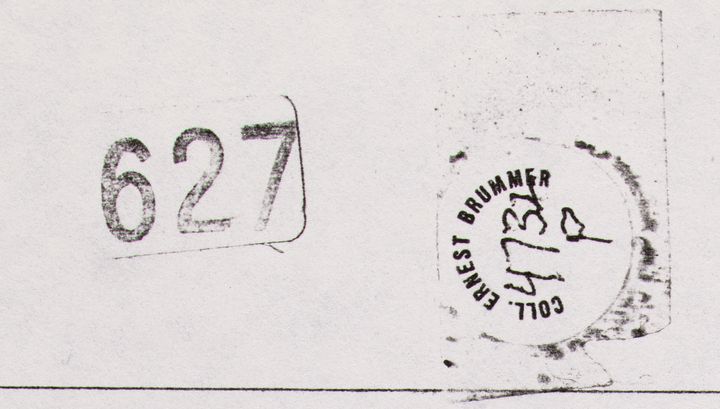
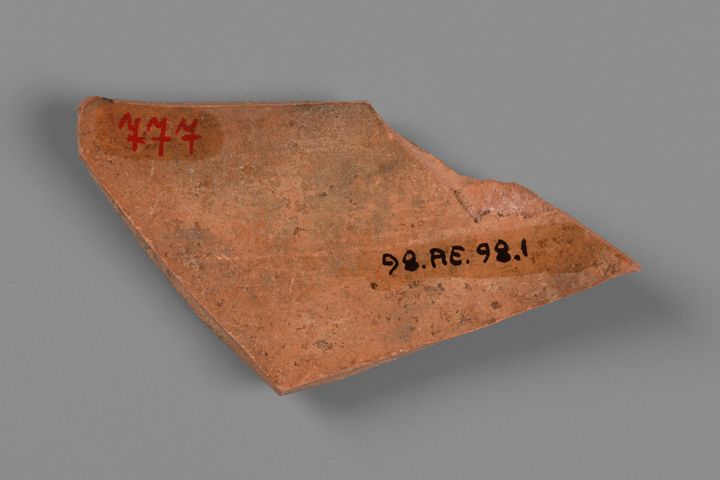
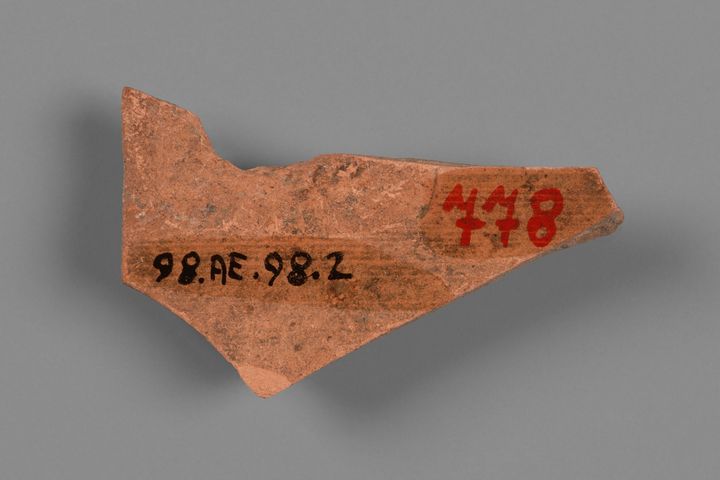
There is no existing authoritative guide to collectors’ numbers and marks on Mediterranean antiquities, though we provide some links to other mark compendia in Appendix 1, and searchable descriptions on museum collection pages increasingly allow for the discoverability of this information. Some collectors use a distinctive numbering style, favoring a certain color of ink, script, or label shape. For example, objects from Herbert A. Cahn’s collection, such as two Attic Red-Figure Psykter Fragments (98.AE.98.1 and .2; fig. 9),18 may have a three- or four-digit inventory number written in red ink directly on their surface.19
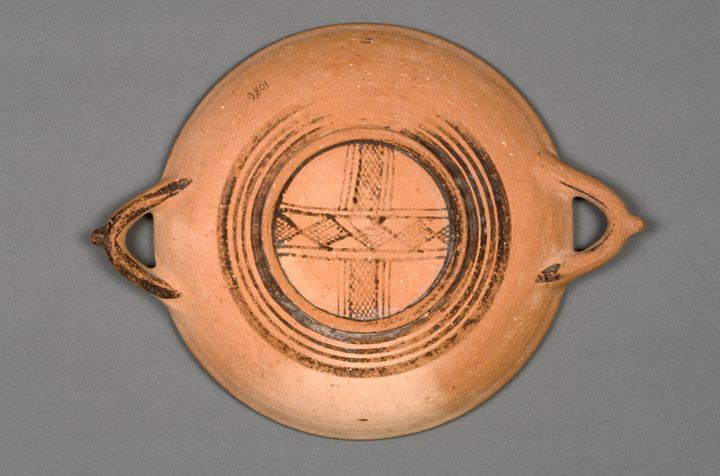
Export license numbers might be preserved on the object; for example, a Cypriot Black on Red Ware Plate (94.AE.114.2)20 has “2801” written in pencil on the underside. The origin of this number was confirmed by acquisition paperwork provided by the donor, which includes a 1957 export license from the Government of Cyprus Department of Antiquities with a matching inventory number for the object (fig. 10).21
Former loan numbers may include an institution’s name, the letter “L,” and/or a year. In the 1980s the Getty acquired a large group of Greek vases from Molly and Walter Bareiss, which they had lent to the Metropolitan Museum of Art, New York (the Met), for exhibition in 1969.22 When accessioned by the Getty many of these vessels retained their old loan labels and other collection stickers, as seen on the underside of an Attic Red-Figure Cup (86.AE.289).23 Elsewhere, on a label found on the inside of a Coniform Vase (81.AF.1),24 the preserved text, “M.F.A. / 55.11” indicates a loan to the Museum of Fine Arts, Boston (MFA), and the digits suggest two possible years, 1911 or 1955. Based on the known provenance and assistance from the MFA, it was possible to confirm the loan took place in 1911. But interpreting loan numbers is not always so straightforward, for many are simply a string of digits without context.
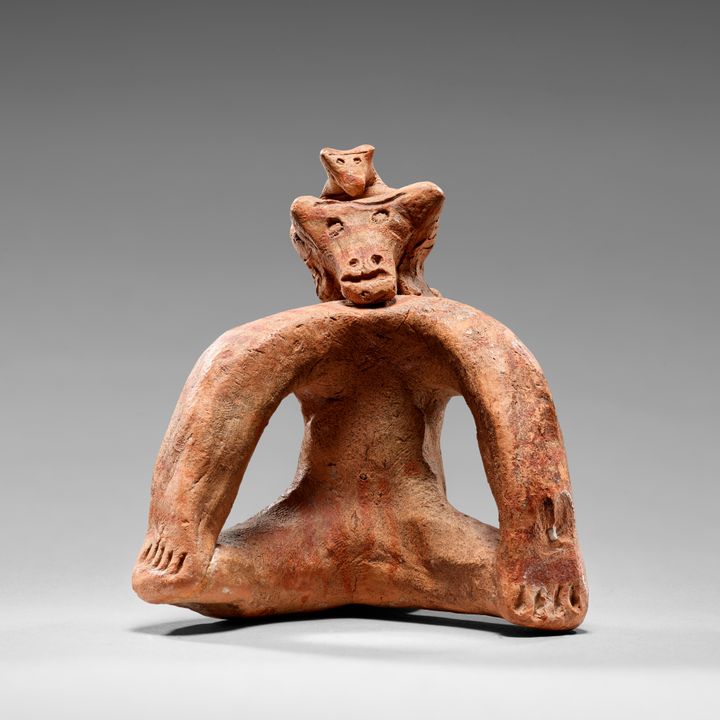
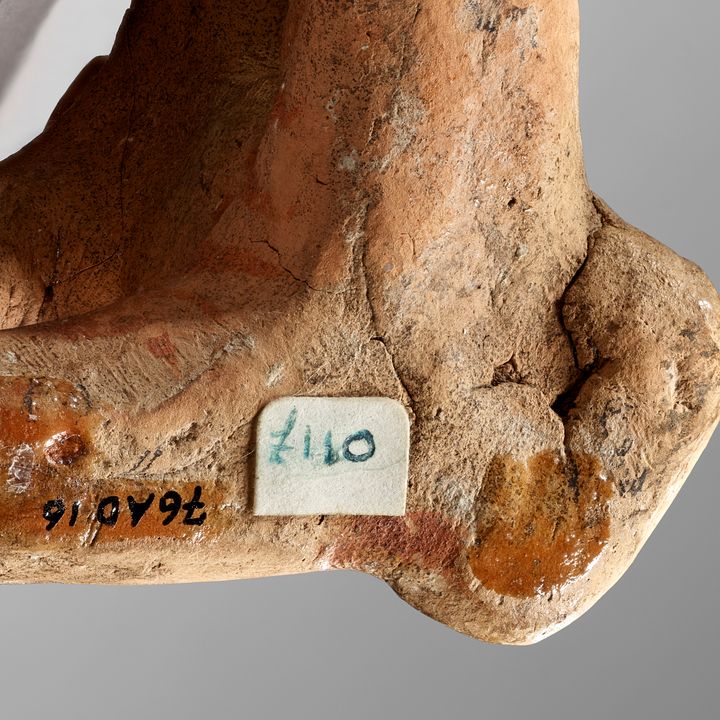
Finally, numbers might indicate the object’s purchase price or valuation, as with a Statuette of an Ape with Its Baby (76.AD.16),25 which has a price label that corresponds with the value given in a 1975 sales catalogue (fig. 11).26 In the absence of a currency symbol or secondary reference like a price list, a monetary value should not be assumed. Not all prices are numerical, since some values are recorded as a price code, a series of letters and/or numbers used by some dealers and auction houses to keep sensitive information, like purchase price, private.27
Text
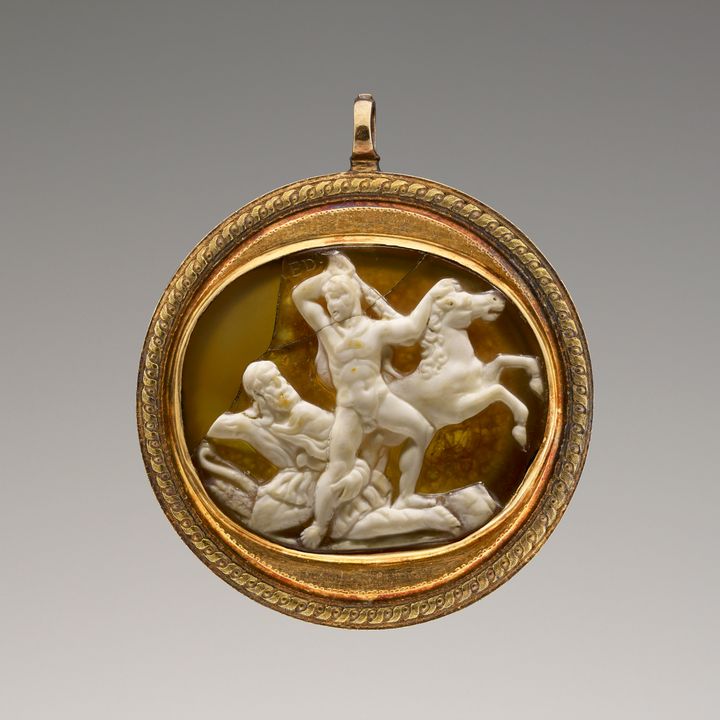
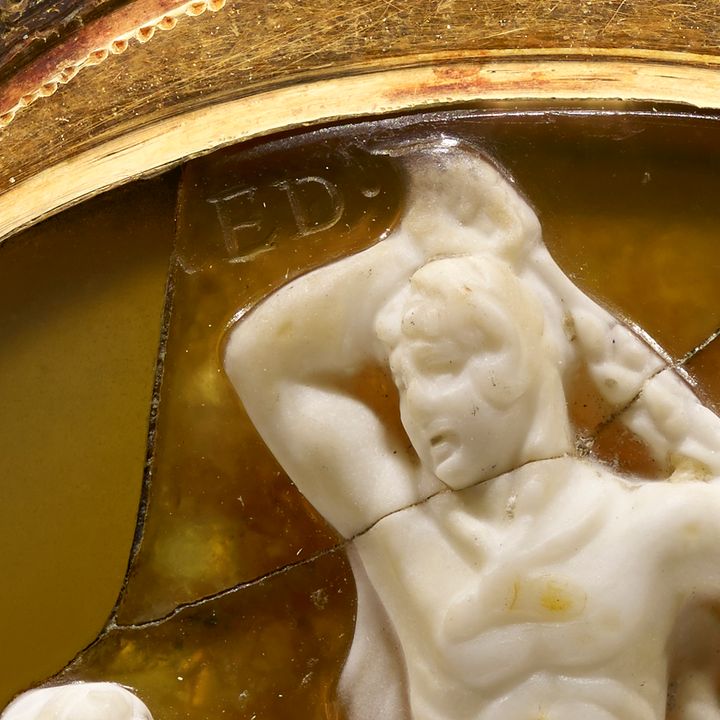
A previous owner may have marked an object with their full name, initials, or a monogram, often with an inventory number or cataloguing classification. An early example is a cameo gem with Hercules and Diomedes (2023.19), which preserves the last two letters of a distinctive ownership mark: engraved above Hercules’ club is a partial inscription ending in “ED.” (fig. 12).28 Although only part of the engraving survives, enough remains to reconstruct “LAV.R.MED.” likely signifying “Laurentius Rex Medices,” known from other gems and hardstone vessels owned by Lorenzo il Magnifico de’ Medici (1449–1492). This provenance is further confirmed by the gem’s appearance in an inventory of Lorenzo de’ Medici’s collection from 1492, held in the State Archives of Florence.29
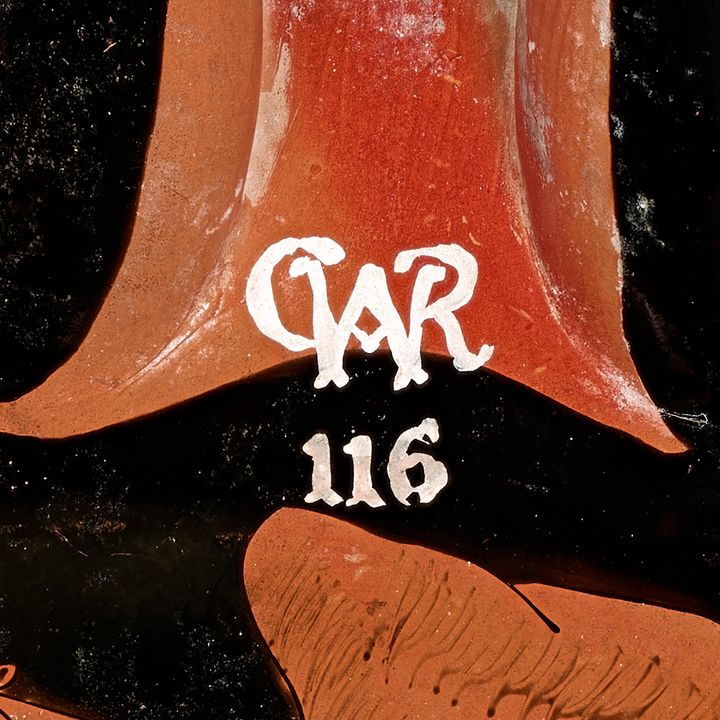
Monograms and ligatures (two or more letters combined into one symbol) can be difficult to decipher, but some are well documented. A monogram of “CAWR” and the number “116” preserved in thick white paint under the handle of an Attic Red-Figured Kylix (82.AE.42; fig. 13)30 identifies its previous owner, Sir Charles Alfred William Rycroft (1839–1884).31
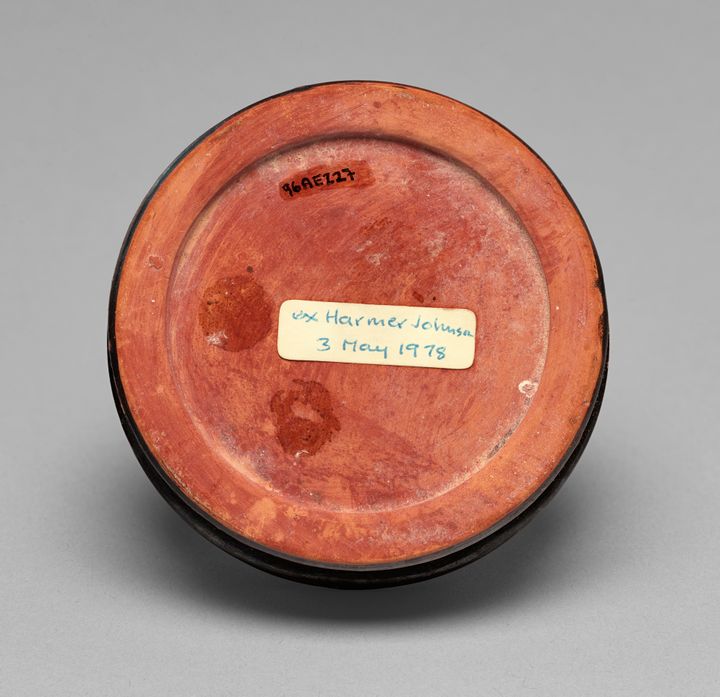
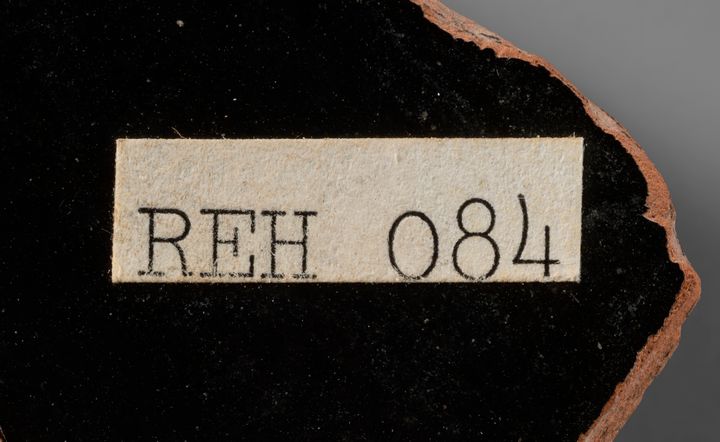
Text added by a former collector or dealer may also record cataloguing information or note the object’s ownership history. The Getty has more than two hundred object records connected to the Metropolitan Museum curator Dietrich von Bothmer, and more than fifty of these have his hand-written collection labels, either on the object itself or preserved in early photographs and conservation notes. These sometimes include clear statements of purchase history; for example, a small pitcher (96.AE.227)32 has a sticker on the underside with a note in von Bothmer’s handwriting: “ex Harmer Johnson 3 May 1978,” which allowed us to confirm that it had been sold in that 1978 sale (fig. 14). More often, however, von Bothmer used abbreviations to indicate the source, sometimes the month, and the year of purchase, as with a skyphos fragment (85.AE.446)33 that has a typed sticker reading “REH O84,” shorthand for Robert E. Hecht, October 1984 (fig. 15).34 Texts can also reveal past conservation campaigns or display history, as with an Egyptian Statuette of Bast in the Form of a Cat (55.AK.9),35 which has the note on the underside of the base: “Mounted By W.T. Ready, Novber 1892, 55 Rathbone Ple, London W.” This refers to William Talbot Ready (1857–1914), a British restorer and antiquities dealer.36
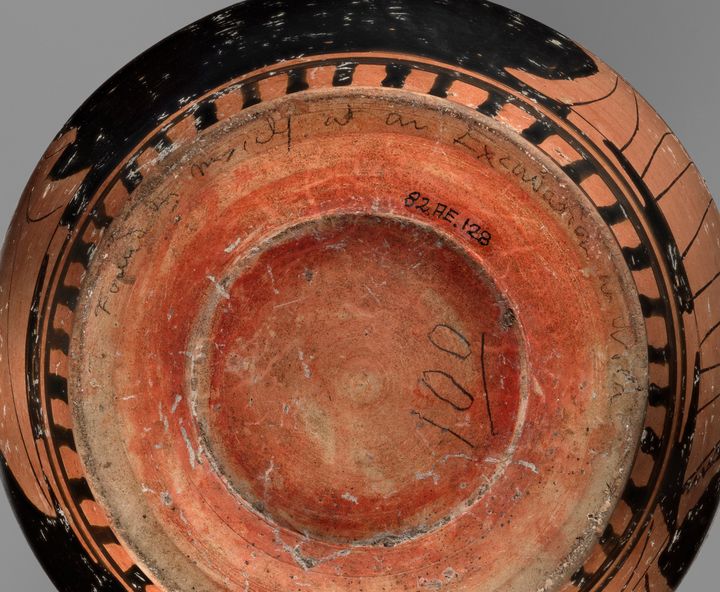
Text written on an object might even record its modern discovery. On a Campanian Neck Amphora (82.AE.128),37 an inscription in pencil on the underside reads, “Found by myself at an Excavation at Nola” (fig. 16). The note, identified as the handwriting of the former owner, Spencer Compton, 2nd Marquess of Northampton, confirms that the vase was acquired during his residence in Italy from 1820 to 1830.38 But this is an exceptional case. Rarely are the texts preserved on objects so informative.
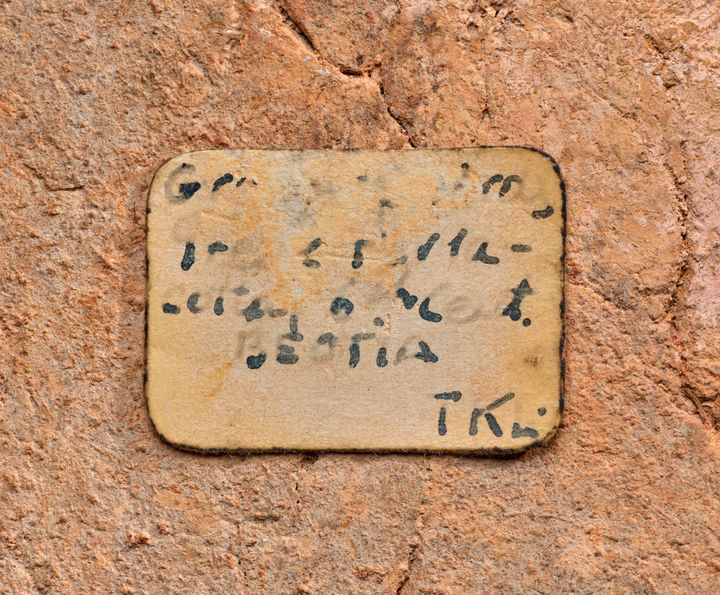
In other cases, marks or stickers on an object can be tantalizingly incomplete. A small sticker on the base of a Statuette of a Bird with Two Chicks (96.AD.228)39 can be partially deciphered, with “6th cent.” and “BEOTIA [sic]” still visible (fig. 17). But whether this sticker relates to J. J. Klejman, the dealer who sold the figure, and whether the rest of the text holds clues to the provenance or valuation, are still to be determined.
Stamps and Seals
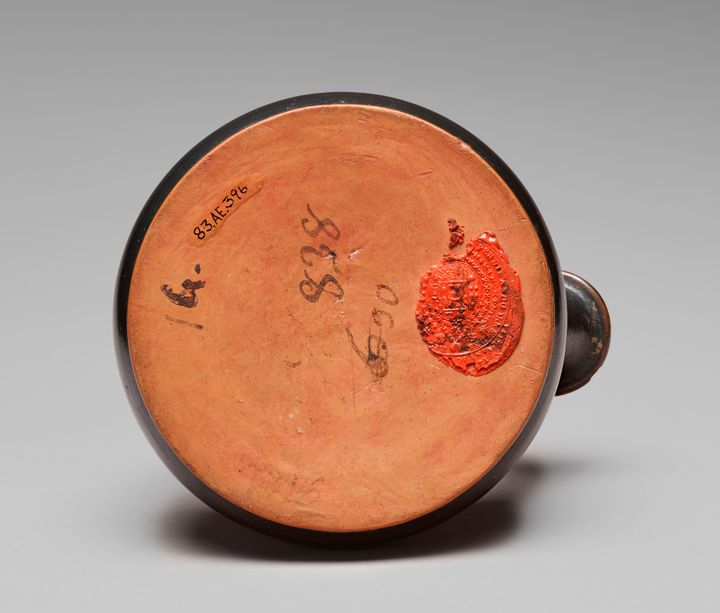
Stamps and seals might speak to an object’s prior ownership or movement, but these can be difficult to interpret without comparable examples. This was the case with a partially preserved red wax seal on the underside of an Attic Red-Figure Askos (83.AE.396).40 The seal has a coat of arms encircled by text that reads: “Ferdinando II Re del Re [. . .] di Antichità”; it was initially interpreted as a collection mark for King Ferdinand II of the Two Sicilies (1810–1859) (fig. 18). However, research revealed that it is in fact an export seal of the Commission of Antiquities and Fine Arts (Commissione di Antichità e Belle Arti) for the Kingdom of the Two Sicilies, which included Sicily, Naples, and much of southern Italy, issued during Ferdinand II’s reign, 1830–59.41 This seal dates to a period of formalized export procedures: the stamp design was standardized (with the Bourbon coat of arms and the name of the sovereign), and export-approved objects were recorded on lists provided to the customs office. These preserved inventory lists (currently unpublished) give only basic descriptions and dimensions, making the identification of specific objects difficult.42 While the identity of the nineteenth-century owner of the askos remains unknown, the export stamp establishes the latest year by which it could have left Italy.
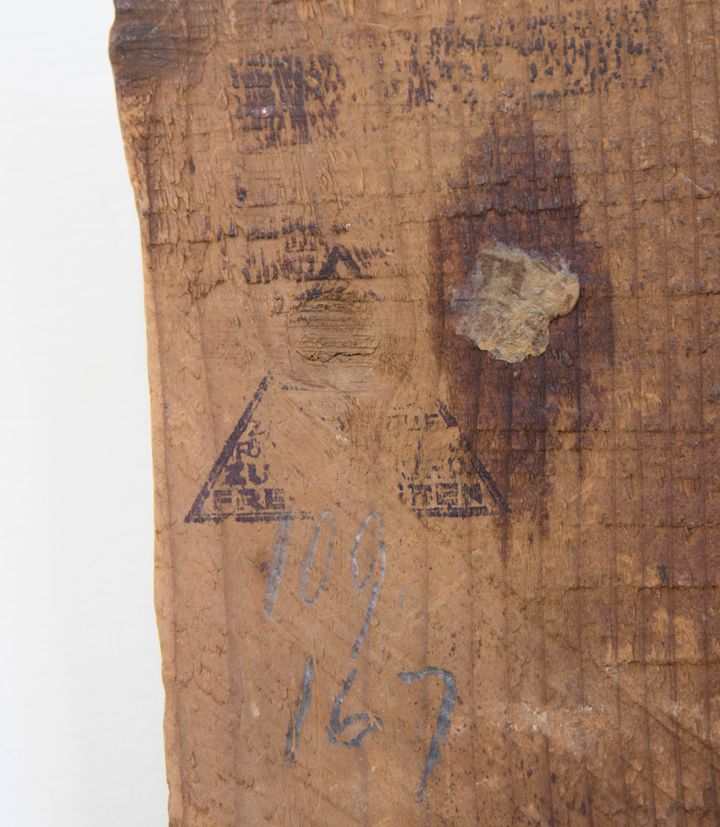
There are no databases of dealer stamps, stickers, and labels, but comparisons can fruitfully be made when these are documented in collection databases or publications (see also “Examining the Object” in this chapter for resources).43 Such is the case with a Romano-Egyptian funerary portrait painted on a wooden panel (79.AP.129)44 that has two partially preserved triangular stamps on its reverse (fig. 19). These were issued by the Bundesdenkmalamt of Austria and can be dated to between April 1939 and November 1942.45 In recent years, the APPEAR project (Ancient Panel Paintings: Examination, Analysis, and Research) has facilitated comparisons of stamps and markings, such as those associated with the dealer of Egyptian antiquities Theodor Graf (1840–1903).46 Ancient wooden panels are structurally similar to post-Antique panel paintings, and they often retain similar kinds of stamps and written text applied by dealers and collectors. Note, however, that any labels on an object are subject to concerns of authenticity and where possible should be confirmed against other sources.
Case Study: A Mystery Monogram
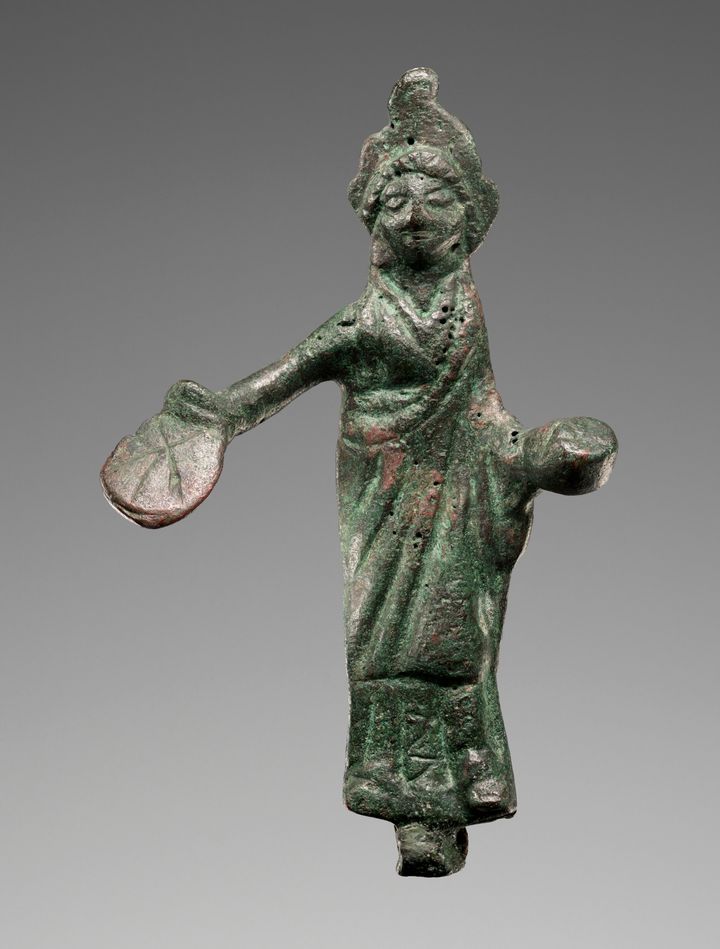
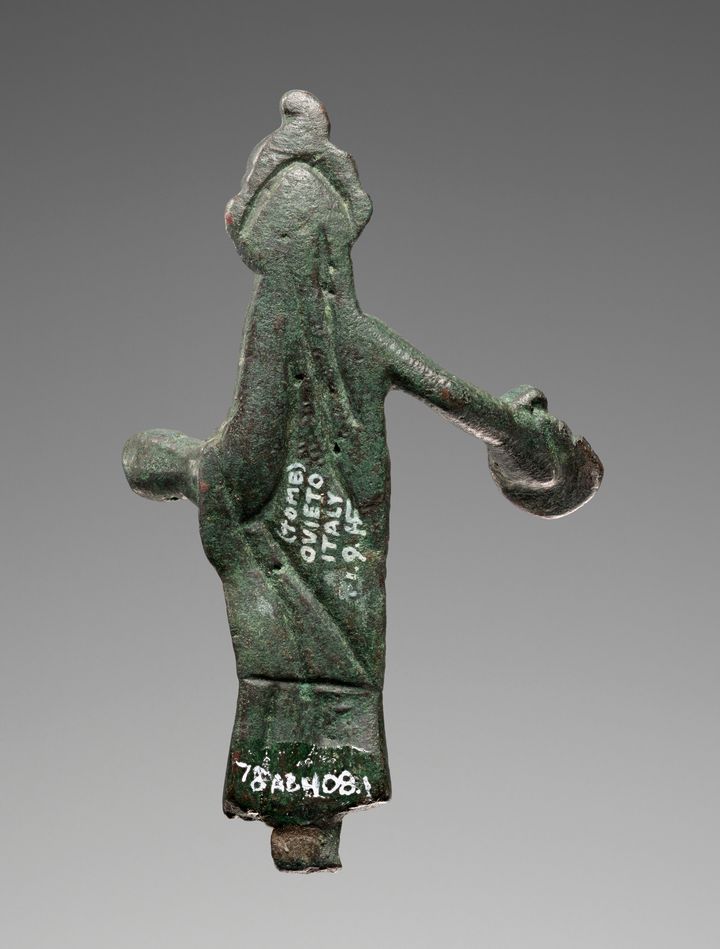
In 1978 Malcolm Wiener donated a group of nineteen objects to the Getty Museum that included five small Etruscan bronze statuettes (78.AB.408.1, 78.AB.408.2, 78.AB.408.3, 78.AB.403.4, and 78.AB.403.5).47 According to museum files, these statuettes had no provenance information and were unpublished. Black-and-white photographs of the objects, likely taken shortly after their acquisition, show one main view of each, with no noticeable labels or marks. However, on viewing these objects in storage, collector’s marks and notes, written in white ink, were discovered on the underside or reverse of four of the five statuettes (fig. 20).
Most of the inscriptions follow a similar form, with a location, some sort of inventory number including a letter and number (preserved examples are “I.9,” “Y.2,” and “RI.17”), and “HF” written as a ligature. None of the other objects in Wiener’s 1978 donation group had similar markings, suggesting that these were likely from an earlier collector. Tracking down the “HF” monogram proved surprisingly straightforward, thanks to a digitized resource available at the time. A Google Books search for “HF collector’s mark” brought up a catalogue of the Lord McAlpine collection with an introductory section on documented marks and labels, including an HF monogram in white ink.48 According to the McAlpine catalogue, the HF annotation was used by Dr. Hugh Fawcett (1891–1982), a collector of ethnological and archaeological objects.
This confirmed Fawcett as a prior collector of the four bronzes, but when did these bronzes enter and leave his collection? And what did Fawcett’s other annotations, such as place names and inventory numbers, mean? Is the note on back of the Statuette of a Sacrificing Woman, “(Tomb) Ovieto [sic] Italy” (fig. 20B), documenting a findspot or a later attribution? Over his years of collecting, Fawcett amassed more than 8,000 objects and periodically sold off redundant and lesser works through various auction houses in order to acquire specimens of higher quality.49 In 1980 he sold a majority of his collection to the Bristol Museum and Art Gallery in Bristol, England, which also holds his personal archives. In tracking down the sale of Fawcett’s surplus objects, we found that his name is linked to more than a dozen Sotheby’s auction catalogues from the late 1930s until the early 1980s. A review of the Fawcett material revealed a possible match in a 1963 antiquities sale: a group of bronze statuettes, including figures of a lion and dog with the same dimensions as the Getty objects.50 Providing further confirmation, our library copy of the auction catalogue includes a price list51 with the buyer names, revealing that the lot was sold to “Wiener, M. H.,” the same Malcolm Wiener who donated the bronzes in 1978 (fig. 21).

There are still unanswered questions, notably when and where Fawcett acquired this group of bronzes. According to the Fawcett collection archives in Bristol, the numbers, letters, and place names were part of his inventory system of letter codes to indicate the object type or culture, assigned provenance, and the specimen number, with additional notes written out in full, and an asterisk indicating a specific excavated context.52 Since none of the codes preserved on the Getty bronzes includes an asterisk, they were likely purchased on the art market. The Bristol archives preserves large numbers of receipts for purchases, and in 2022 the museum made some of this Fawcett Collection data publicly available through Open Data Bristol.53 A search of this database for the codes and place names preserved on the Getty bronzes revealed a possible connection between the bronze Statuette of the Sacrificing Woman and a 1944 Sotheby’s auction.54 This recently published database speaks to the constantly changing landscape of resources available to provenance research.
Conservation History, Restorations, and Material Analysis
An object’s conservation history might be discoverable on the object itself as repairs, fills, mounts, or restorations, and it may be recorded in reports, publications, or photographs. Over the centuries, there has been a shift from full restoration, which often prioritized completeness and aesthetic value, to conservation, which focuses on preserving and stabilizing the original work—and, in many cases, also preserving its historical restorations. When possible, a provenance researcher should work with a conservator or materials scientist to best interpret and date documented interventions. With the advance of analytical techniques, the study of the history of restorations has become a substantial field of research in itself, and the identification of specific materials or methods assists provenance research inquiries, especially when it can help to narrow down the date of a restoration or repair. Auction houses now frequently invoke old restorations or mounts as evidence for an object’s “documented” history, but such claims should be considered critically.
By far the largest body of literature on the history of restorations is dedicated to large-scale marble sculptures. These are often high-profile artworks, sometimes from renowned historical collections, and they may exhibit multiple phases of treatment; the essays gathered in the Getty’s History of Restoration of Ancient Sculpture provide a valuable introduction to the subject.55 Collection-specific studies, such as one on the sculptures in the Antikensammlung in Berlin,56 are useful means of discerning regional or chronological trends, and analyses of restoration practices often feature as a component in more general presentations of a particular collection, such as that on the Torlonia marbles.57 Recent years have seen a number of dedicated object studies, such as those on a statue restored as Bacchus in the North Carolina Museum of Art in Raleigh, and the Farnese sarcophagus at the Isabella Stewart Gardner Museum in Boston.58
For large-scale bronzes, which survive in much smaller numbers, the body of evidence regarding restorations is narrower and is concentrated on material from Pompeii and Herculaneum.59 The series of International Congresses on Ancient Bronzes, active since 1970, is a valuable resource for technical studies. The digitally published proceedings of the 2015 conference offer an accessible introduction,60 as does the thorough survey of bronzes in the Harvard Art Museums,61 with analytical results published on the museum’s online collection pages.
The study of painting materials has seen recent advances in the analysis of Romano-Egyptian funerary portraits, and these analyses can be fruitfully applied to modern interventions.62 For wall painting, there is—like large-scale bronze statuary—a heavy Neapolitan focus.63 In the last twenty years, significant attention has been paid to the reconstruction and restoration of Greek figure-decorated pottery, especially treatments undertaken or performed in the nineteenth century.64
In all media, the restoration of larger—or higher-value—objects has tended to receive more attention, at least in terms of publications. The treatment of smaller objects, such as statuettes or figurines, is, to our knowledge, less well documented, but similar materials and approaches to restoration may apply. Furthermore, there are valuable studies that document the use of technical methods in detecting fakes, forgeries, and pastiches, for example on Tanagra figurines at the Musée du Louvre in Paris,65 a Minoan ivory figurine in the Royal Ontario Museum, Toronto,66 and, from beyond the field of Mediterranean antiquities, a Zapotec urn likewise in the Royal Ontario Museum.67 On these themes more broadly, see the papers collected in Anthropology of Forgery: A Multidisciplinary Approach to the Study of Archaeological Fakes.68
The incomplete and fragmentary nature of ancient objects can result in complex provenances and restoration histories, and perhaps the most immediate example of this is ancient Greek pottery. A single vessel might be discovered in fragments (or possibly deliberately broken up, whether by looters or by dealers) and these disjecta membra (scattered parts) dispersed around the globe through a network of dealers and collectors.69 Complicating matters further, restorers have sometimes reassembled a pot using fragments of unrelated vessels. A case in point is an Attic Red-Figure Volute Krater attributed to the Kleophrades Painter (77.AE.11).70 The Getty acquired a number of fragments from the krater in 1977. These had first been published in 1972 while on the art market and were identified then as belonging with a group of fragments in the Louvre. The latter group had previously formed part of a large krater acquired by the Louvre as part of the Campana collection in 1863, which subsequent research identified as a pastiche made of fragments from three different ancient vases. The Louvre disassembled the composite Campana vase in the 1950s and, following the Getty’s 1977 acquisition, placed their related Kleophrades Painter fragments on long-term loan with the Getty. Today, all of these fragments are incorporated into the (reversible) reconstruction of the vessel at the Getty. Currently, the vase has a single provenance statement online, but this is a reflection of institutional cataloguing practices and database limitations; the separate histories of its individual fragments tell a far more complex story.71
In addition to determining conservation efforts and restorations, analysis of the object’s material composition by a conservator or materials scientist, when possible, can reveal additional information. Noninvasive analyses should be prioritized, including close examination of the object under raking light and high magnification. Multispectral imaging, a noninvasive technique that uses ultraviolet and infrared illumination to enhance certain types of pigments, can be employed to examine the surface of an object for decoration not visible to the naked eye. Visible induced luminescence (VIL), a specific type of imaging, allows for the detection of the pigment Egyptian Blue, first manufactured in Egypt during the second millennium BCE and used across the Mediterranean until the ninth century CE.72
X-ray fluorescence (XRF) analysis can be used to determine the elemental composition of an object, which is useful in identifying the geological sources of rocks and clays, or the makeup and alloy percentages of metals. This procedure does not date the object, but it can reveal a material’s origin or a likely period of production based on comparanda. For example, XRF was performed on a set of surgical instruments (79.AK.30.1–13)73 in 1985 after their bronze composition was questioned. They were found to be made of brass with a high percentage of zinc—more than would have been possible in antiquity but feasible by the early nineteenth century, indicating that the surgical instruments were not ancient.74 Accurate materials analysis usually requires a sample that is destroyed in the process of testing, so such tests are only ordered when deemed absolutely necessary, for example to prove or disprove a suspicion of forgery, and with careful consideration of the object’s safety, with a minimal number of samples taken from less visible parts of the object (e.g., the underside, the foot, the interior). However, the development of portable XRF (pXRF) spectrometers now allows for quick, noninvasive readings of an object’s surface composition, albeit with slightly less accuracy than tests that require a physical sample.75
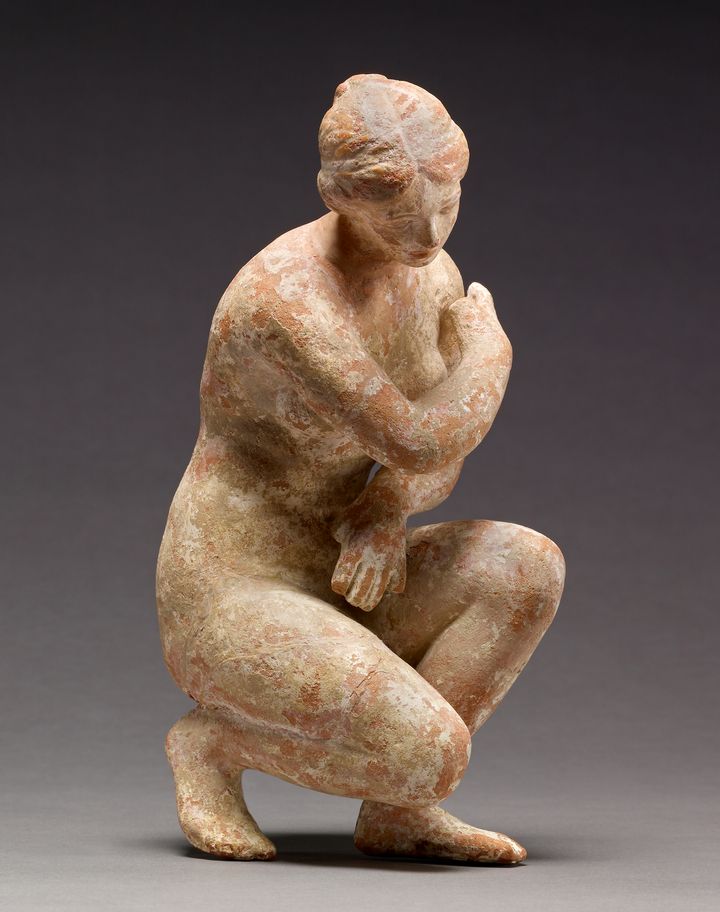
In addition to material composition, an object’s internal structure and evidence of past restorations can likewise be analyzed. Depending on the medium and what is being tested, conservators may employ endoscopic cameras, X-rays, and magnetic resonance imaging (MRI).76 Thermoluminescence (TL) testing requires the destruction of a small sample but can be used on fired ceramics (pottery, terracotta sculptures, and the clay casting core of bronze sculptures) to determine an approximate date range of manufacture and thus an ancient object’s authenticity. In 1957, J. Paul Getty acquired a terracotta statuette of Aphrodite (57.AD.9)77 and noted in his journal that antiquities expert Rudolph Forrer advised it was “unquestionably genuine” (fig. 22).78 The statue was widely published and remained on display for over thirty years. In the mid-1990s, around the time the entire antiquities collection was being reexamined in planning for the reinstallation of the Getty Villa, questions were raised about its authenticity, and a TL test conducted in 1999 confirmed its twentieth-century date.79
TL was just one of several testing methods used on the previously discussed Egyptian bronze cat (55.AK.9).80 It was mounted on its base by William Talbot Ready in the late nineteenth century and acquired for the museum by J. Paul Getty as an ancient object in 1955. In the early 1970s, based on its style and proportions, it was reclassified as a modern imitation. In 2019, however, a reexamination of the statuette revealed that it is in fact ancient, an assessment based on the results of X-rays, pXRF, surface analysis, and a TL test (performed on the preserved clay casting core).81 This discovery underscores the value of undertaking multiple scientific analyses whenever possible. In particular, TL tests should always be considered with other evidence, as forgers have found ways to manipulate TL results through artificial irradiation, or by inserting ancient materials into modern imitations in areas most likely to be sampled.82
In addition to analysis of the composition of the object itself, later interventions such as modern fills, varnishes, mounts, foreign materials introduced as part of restorations or discarded within objects during such work (e.g., newspaper or other ephemera) can also provide insights into the object’s past. For example, during the recent conservation of a Roman portrait head (2016.38),83 a paper note that reads “nose and eyes by t” was found embedded in a modern drill hole.84 More broadly, some fill techniques or paint compounds (e.g., chrome yellow, a nonancient pigment often found on vases restored in Naples in the early nineteenth century85) date from a specific period, allowing a terminus post quem for a restoration campaign.
The study of restoration and conservation practices substantively assists in documenting an object’s history, but provenance research can, in turn, support materials analysis—especially for categories of objects that cannot be dated through carbon-14 or TL testing. Such was the case for a gem depicting Mark Antony, long thought to be the work of Gnaios, an ancient Roman gem carver active during the first century BCE (2001.28.1).86 In the absence of organic material, required for carbon-14 dating, carving on gemstones cannot be dated scientifically, although anachronistic carving techniques or sources of stone provide clues to the time of their carving. In the case of the Getty Gnaios gem, which had long been accepted as genuine by specialists, questions were first raised in 2009 when it was displayed alongside three other Gnaios intaglios in the Getty exhibition Carvers and Collectors: The Lasting Allure of Ancient Gems.87 Gem specialist Gertrud Platz-Horster had just published a study on the gem engraver Giovanni Calandrelli (1784–1853),88 and in visiting the exhibition recognized the Getty Gnaios as possibly one of Calandrelli’s creations. Notably, Calandrelli had worked for Prince Stanislaw Poniatowski of Poland (1734–1833), whose collection was notorious for being composed of neoclassical imitations of ancient gems. Platz-Horster informed Getty curator Kenneth Lapatin, which led to a productive exchange of archival resources, photographs, and replicas, allowing them to establish that the Getty Gnaios gem is an exact match with a Calandrelli gem in the Poniatowski collection, known through its nineteenth-century plaster impression. With this link established, subsequent archival research revealed that Calandrelli’s inventory notebook includes a Mark Antony gem inscribed Gnaios, without specifying its medium or the year in which it was carved. Further confirmation of the gem’s identity was made through comparison to Calandrelli gems formerly with Poniatowski and ancient gems signed by Gnaios, proving that Giovanni Calandrelli had carved the Getty gem in the nineteenth century for the Poniatowski collection.89
Beyond the Institution
Thus far, we have looked at a methodology for approaching sources of information available within the holding institution, including the object itself. We now turn to researching the object through different types of primary and secondary sources—scholarly catalogues, archives, and auction and sales catalogues—while exploring the opportunities and challenges of consulting such documents.
Scholarly Catalogues
We define scholarly catalogues as publications that focus on typological or iconographic categories. These have a long history in the study of antiquities and can be uniquely helpful for provenance research since they bring together comparative examples from disparate sources, particularly when drawing from private collections or photographs in archives. They can also be useful for understanding the number of possible comparanda for an object or its iconography when other references or drawings are inconclusive.
For researchers new to a particular kind of object or area of study, object-focused resources, such as the Lexicon Iconographicum Mythologiae Classicae (LIMC)—a unique encyclopedic resource for researching Greek, Etruscan, and Roman objects with mythological scenes—offer a valuable starter kit for literature review, comparanda, and descriptive strategies unique to a given object type.90 Older publications, such as Bernard de Montfaucon’s early eighteenth-century L’antiquité expliquée et représentée en figures (1719–24), are still useful for research into ownership histories. Certain areas of study like epigraphy have a centuries-long history of documenting objects, although details about the design and condition of particular items are often scarce in early publications. Catalogues raisonnés, used heavily by art historians of later periods, do not exist in the same way for Mediterranean antiquities, where the dedicated study of a singular hand or workshop is limited.91
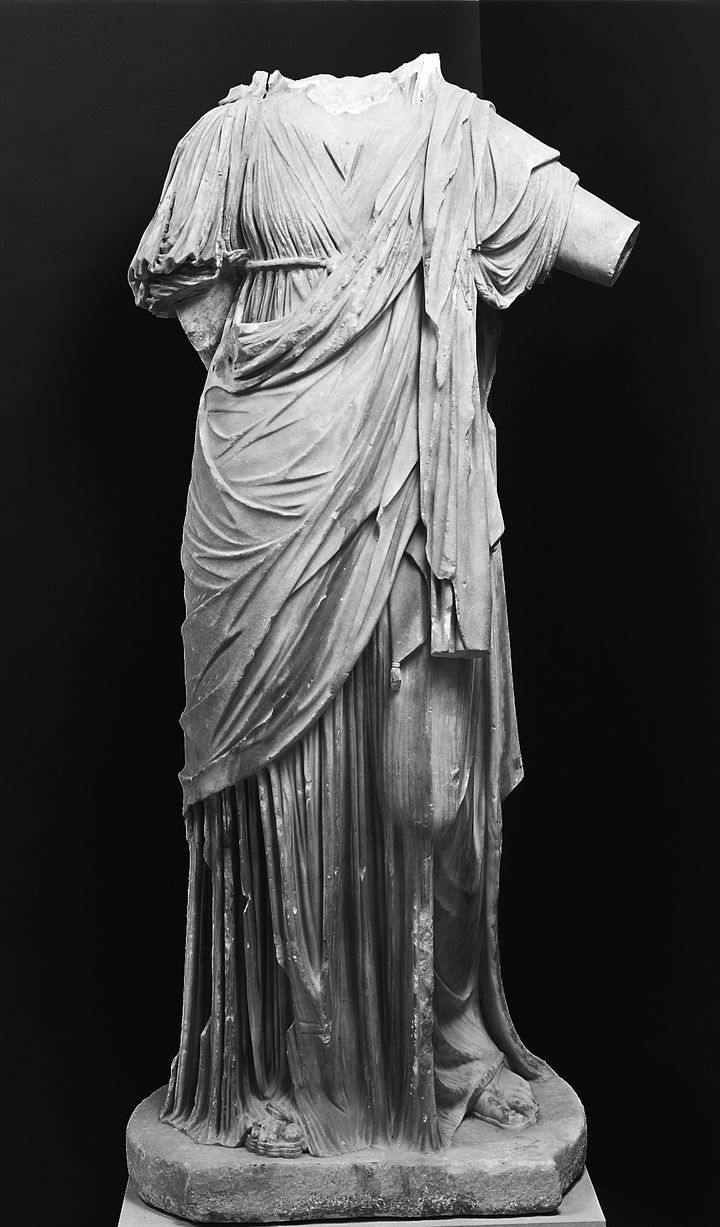
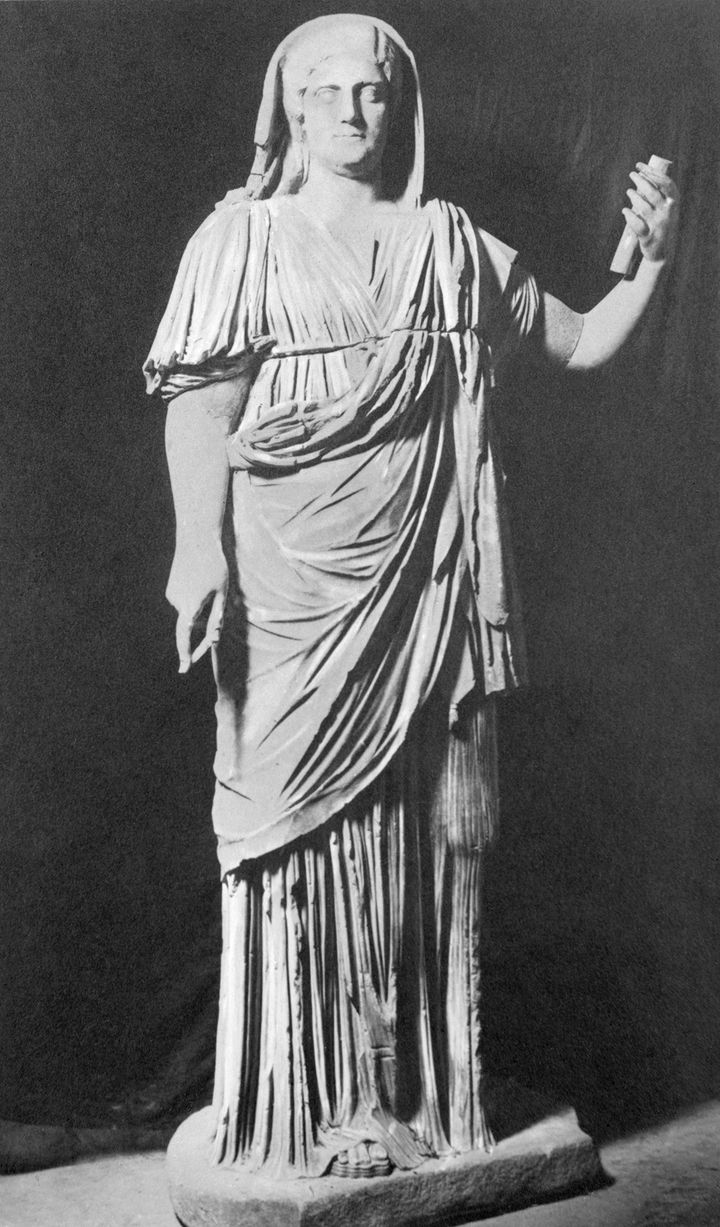
Because scholarly catalogues provide a wide perspective on a particular category of objects or medium, they can be utilized for specialized research questions, such as determining when a certain class of object first entered the market, or tracking the dispersal of related works. Similarly, the comprehensive nature of many scholarly catalogues captures a great deal of historical data, and they can be used to determine where and when a given object was first identified, or for documenting its prior condition. Many scholarly catalogues take the form of doctoral dissertations, although published copies of those may exist only in limited quantities and are not always easy to access.92 While rare today, earlier dissertations often engaged with and documented objects in private collections and on the market.93 Such was the case when a 1975 dissertation included the Getty’s Statue of a Draped Woman (72.AA.153; fig. 23A)94 in a historical photograph from the late nineteenth or early twentieth century. In this early image (fig. 23B), the seventeenth-century restorations of the arms were intact, but these had since been removed, along with the statue’s head, at some point prior to the Getty Museum’s acquisition of the torso in 1972. The author of the dissertation did not know of the statue’s current location at the Getty Museum, nor were Getty staff aware of the torso’s earlier history until this dissertation research became available.
In scholarly catalogues, provenance information and even findspot are not necessarily an authorial focus. In the case of epigraphic catalogues, for example, transcription and interpretation of the inscription tends to be the priority. Furthermore, the presentation of provenance data in these publications is far from standardized. Many scholarly catalogues usefully cite older manuscripts, but uncritically quoting outdated or unverified sources can perpetuate information that is decades out of date or otherwise erroneous. When these catalogues rely on a single earlier source, they can represent a point in time for the object in question: proof that it was known by a certain date, but not necessarily its contemporary ownership or its current location. In many cases, the authors were not working with the object directly but rather from earlier publications, photographs, or even casts and squeezes.
Case Study: A Cinerary Urn and Lid
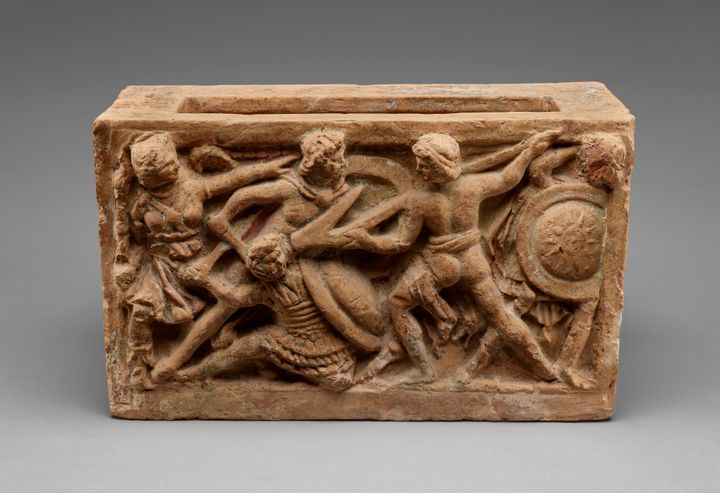
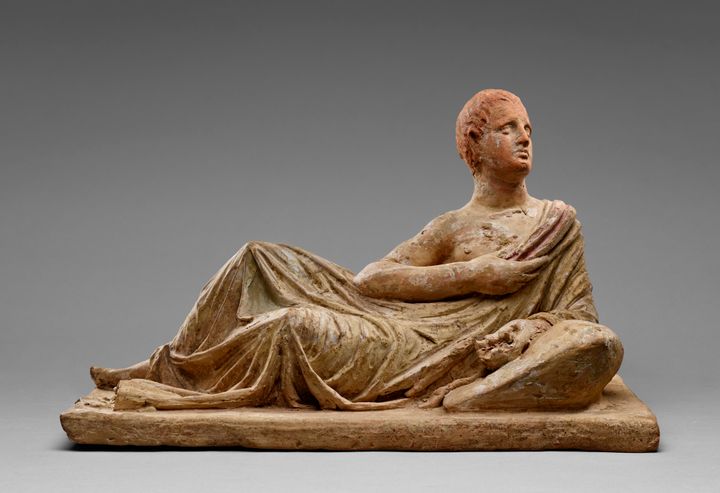
For an Etruscan Cinerary Urn and Lid (71.AD.293; fig. 24),95 an iconographical study proved critical in discovering a lost provenance. Because these kinds of objects were moldmade and mass-produced, identifying references to a single, specific example is a challenge. The urn and lid were sold to the Getty in 1971 without any provenance information, which was common for the time; they were acquired as part of a bulk purchase from the Royal-Athena Galleries in New York.96 Parallel searches into contemporary auction and exhibition catalogues had helped flesh out the urn and lid’s more recent history: they had appeared at auction in 1969 in New York along with many lots later sold in the same bulk purchase to the Getty, and both had been on view in Los Angeles in 1963 as part of an exhibition of Etruscan art through the Stendahl Art Galleries. This exhibition’s catalogue included a surprising provenance for the objects on view: it suggested that the Stendahl Art Galleries had received some from a museum in Rome in exchange for pre-Hispanic artworks.
But it was only through research into the urn’s iconography, a variant of the fairly common Hero and the Plow scene, that a key connection could be made. It led to an entry in Maurizio Sannibale’s Le urne cinerarie de età ellenistica (1994)97 that contained a footnote referencing an earlier article from 1962, Maria Teresa Falconi Amorelli’s “Urnette etrusche dalla Collezione Gorga.”98 Evangelista Gorga was a famous opera tenor and infamous collector in the early twentieth century; his eleven apartments in Rome were filled with thousands of artifacts drawn from many periods. Because Gorga continually added and subtracted objects from his collection, publications on Gorga himself provide valuable background about his life and tastes, but they could not substantiate details regarding this specific urn and lid.99 Falconi Amorelli’s article, however, included photographs of both the urn and the lid that proved decisive in confirming the identity of the Getty pieces.100
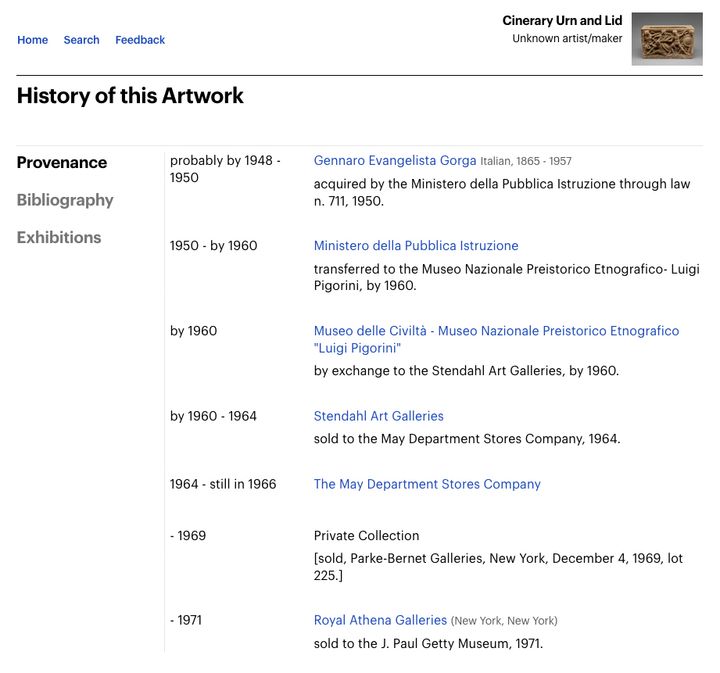
After the provenance for the urn and lid was first studied at the Getty in 2015–16, the Stendahl Art Galleries’ archive was acquired by the Getty Research Institute.101 This archive contains information long separated from the objects themselves: details about Earl Stendahl’s acquisition of the Gorga material in Rome in 1960, and documents confirming that Stendahl then sold the urn and the lid together in 1965 to the May Department Stores Company for a traveling exhibition that ran through the following year. Our records still have gaps: we do not yet know what happened to the urn and lid between 1966 and 1969, when they were next sighted on the art market in New York, nor how Gorga had acquired them in the first half of the twentieth century. But without these various kinds of sources—typological catalogues, collection-specific publications, illustrated auction and exhibition catalogues, and archival research—their provenance records would only convey the minimal information we had at the time of acquisition: “by 1971, Royal Athena Galleries, sold to the J. Paul Getty Museum, 1971.” Instead, their movements zigzagging from Rome across the United States in the 1960s are now available for further research (fig. 25).
Case Study: A Roman Situla
What are the best ways to acknowledge a reference that does not cite the object itself, but rather a drawing, cast, replica, or epigraphic quotation drawn from an earlier source? In many ways, drawings and casts can be more precise than written descriptions because they allow for more points of comparison with the original object.102 But the context of their creation is often unknown, and authors citing these secondary images but treating them like the object itself can complicate provenance research.
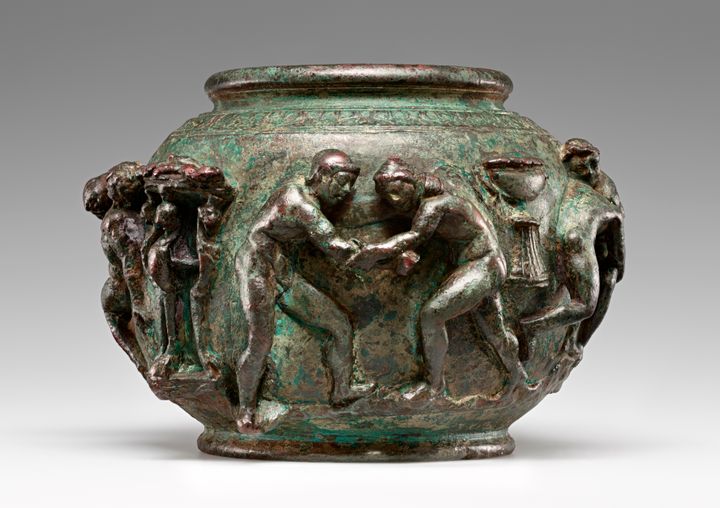
In 1996 the Getty acquired a Roman situla (a small bronze bowl) with an exterior frieze composed of pairs of pugilists and wrestlers (96.AC.41; fig. 26).103 A decade earlier, the situla had appeared on the market in London, where it was identified in an advertisement as once belonging to Charles Patin (1633–1693), having featured prominently in the frontispiece to the catalogue of his collection (fig. 27).104
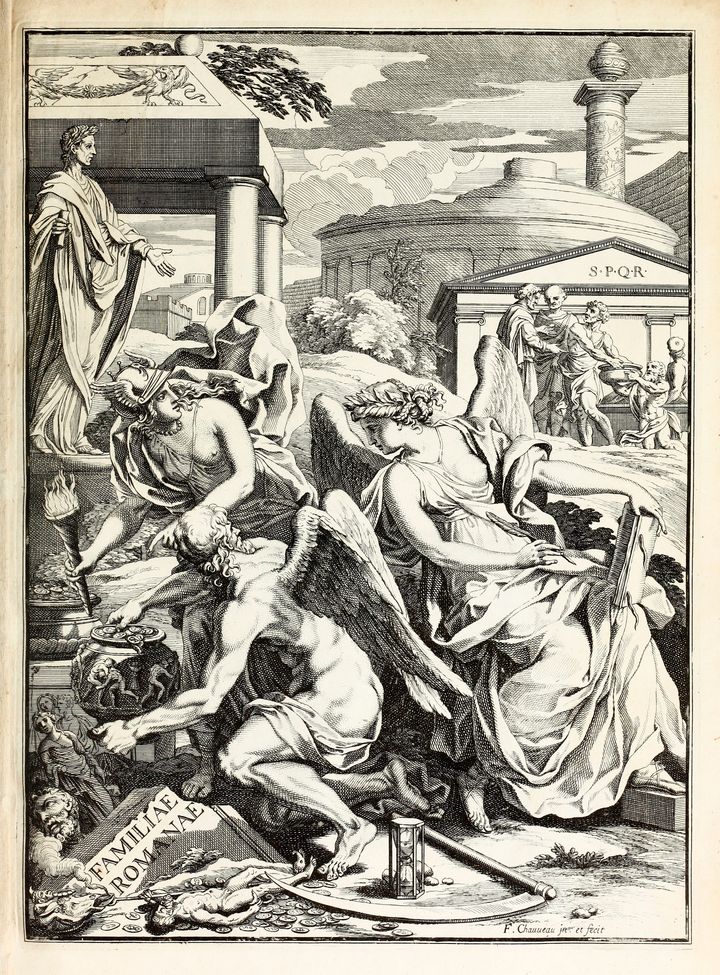
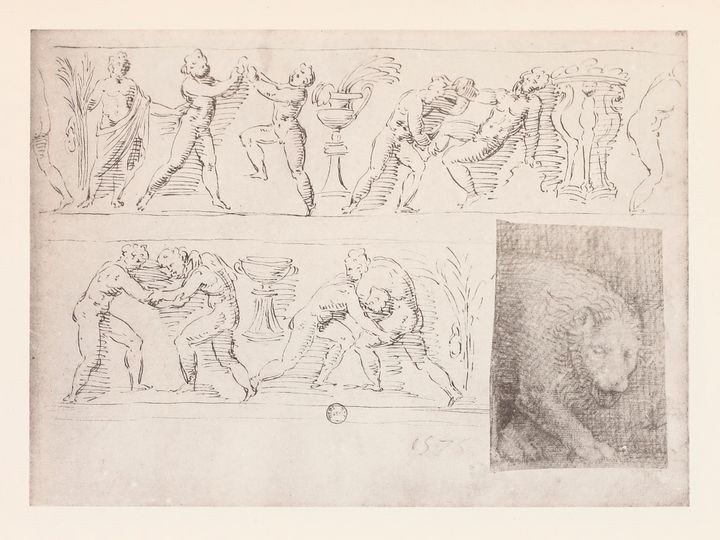
Patin was a famed French numismatist and collector who included detailed engravings of the bowl in several of his publications printed between 1663 and 1697. These engravings document the situla to an extent, but the information they offer about its location at the time is limited, and the dates of Patin’s ownership remain unclear. But they are not the only early evidence for the situla’s history. Unbeknownst to its twentieth-century owners, art historian Salomon Reinach had earlier connected the situla with a drawing made in the 1570s by artist Pierre Jacques (fig. 28).105 Jacques’s drawing shows a rolled-out illustration of the situla’s decorative frieze laid out over two registers. The drawing itself is undated and contains no further annotations, so it only establishes that the Patin situla was in Rome and accessible to Jacques in the late sixteenth century, decades before its prior known earliest documentation.
Tracing the situla’s history is further complicated by the existence of two modern replicas, which may have been patterned after the bowl itself or after one of the engravings of the bowl, such as those published by Patin or in Dom Bernard de Monfaucon’s more widely accessible 1724 volume Supplément au livre de l’antiquité expliquée et représentée en figures.106 One of these replicas, now at the Metropolitan Museum of Art, was previously part of the Irwin Untermyer (1886–1973) collection. By 1962 it was identified as the situla owned by Patin—but as a Renaissance original, and not an antiquity.107 Later, this replica was reattributed as an eighteenth- or nineteenth-century Italian bronze, its earlier history still unknown. A second copy after the ancient situla appeared at auction in 1974.108 Both replicas reproduce the Patin situla’s key features, namely the frieze and shape, but other details poorly rendered in the engravings are absent.
The case of the Patin situla illustrates several issues: the misattribution of ancient bronzes as modern, and vice versa; the challenges of interpreting visual sources in the pursuit of provenance research; and the existence of copies. An illustration of an object might not capture its most diagnostic characteristics, and the existence of replicas complicates working with nonphotographic documentation. However, the situla offers proof that revisiting the history of any ancient artwork, however well known or distinctive, can lead to new discoveries. There is sometimes a perception that an object with a publication history going back decades or even centuries has an ownership history that is as complete as it can be. Our experience does not bear this out, as references to these objects and their ownership can be fragmented as easily as those for any other work of art.
Archives
Archives are one of the most critical resources for provenance research. Broadly speaking, they are collections of records created by an institution or individual and preserved by the original creator, their heirs, a later collector, or by a separate institution.109 In many cases, a single archive will not address the entirety of an object’s history, and the scope and timeframe of archives that could prove relevant are endless. Consider how a single family’s collection might require looking at papers associated with Grand Tour dilettantes, families, wills and probate documents, World War II letters, and modern correspondence with dealers or scholars. Furthermore, the depth of archival possibilities may mean navigating collections that include publications, receipts, or correspondence files, and so the composition and organization of each archive needs to be carefully considered. Given that many archives are located in another country, with documents in multiple languages, the investment of time and resources, including the potential need for translation, will increase. Accordingly, you will want to assess any archives and their potential return on research time on a case-by-case basis.
Archival finding aids provide an outline or inventory of an archival collection. They contain contextual information about the archive they describe and an outline of its contents. Finding aids can catalogue material to varying degrees, whether at the collection, container, or folder level, but they are not designed to include every name or object addressed within a collection’s contents. Therefore, general searches, such as for inventories or correspondence by year, are more effective as a research strategy.
Materials in an archive have their own provenances, as discussed below, and they may determine the organization of the archival records.110 Collections like OCLC’s ArchiveGrid or the Online Archive of California (OAC) can help researchers search across finding aids and archives through aggregated collection descriptions.111 The Frick Collection’s online Archives Directory for the History of Collecting in America is specifically created for art researchers, incorporating finding aids and archival descriptions as well as other sources, like newspapers, union catalogues, and open-access publications.112
Using Archives: Research Concerns
Archives and their finding aids, like many other resources, are rarely structured with the needs of a provenance researcher in mind, and there is no unified approach to object-specific metadata in descriptions of their contents. Using these resources requires careful consideration of the ways in which an antiquity is described or observed throughout its modern history. It cannot be overstated that many finding aids do not enumerate or contain direct references to material on antiquities and other artworks. Furthermore, archives are not neutral, and the provenance of the archival materials themselves needs to be considered. Multiple actors may have shaped their composition through choices surrounding what to save or discard, and how these materials should be presented. In addition, correspondence between individuals is by nature fragmented and so may be disparately preserved, particularly over generations. Likewise, legal documents may be preserved by local or national archives, while other documents remain with a family or trust. In addition, recent scholarship emphasizes the absence of significant voices within these collections—what Dorothy Berry describes as “archival silences”—further influenced by the tone of “archival neutrality”113 regarding the ways archival collections are described. Archives are often places of trauma: the histories of archaeology and museums intersect with painful legacies, including slavery, colonial violence, Nazi-era war crimes, theft, and racism. Access to archives is further not equal for all researchers, and the impact of encountering such legacies should be acknowledged, as should the effect of sharing this information with visitors.
Although archives, or at least finding aids, are increasingly available in digital formats, many remain accessible only in person, and librarians or archivists should be consulted about their institution’s access policies and your research needs as early as possible. Some archives may have restrictions on access and reproduction; for readers unable to travel in person, the archive may be able to provide scans of material for a fee, or they may work with independent researchers who can provide this service. As with your own institutional object files, if you are incorporating information for public view you will need to take into account what restrictions apply to sharing this material; this will also require confirming permissions and copyright restrictions. Correspondence relating to permissions, payment, and restrictions should all be saved as part of your research records. For all archival material, develop a citation template for consistent use in your files and in any public provenance documentation. It is also valuable to maintain a record of the archival resources that have been checked. Unsuccessful searches or documents that are too vague to provide confirmation about a specific work of art should be noted as well—recording negative results is as important as recording positive ones.
Funding for research is an important consideration for project budgets, both internally and as part of grant proposals. Pay attention to any archive access fees. Some institutions allow for hiring the services of a local researcher in lieu of personal travel; many archives and research libraries maintain lists of local specialists for this purpose. Budgeting should also consider any translation services required. Microfilm or microfiche copies of archival material may be available for purchase or accessible through interlibrary loan. Sharing resources and access to scanned documents with colleagues, with the permission of the holding archive, can be another option to collaborate under reduced budgets.
Types of Archives
In collating information for our “Annotated Resource Guide” (Appendix 1), we have distinguished three types of resources: object-focused, event-focused, and individual-focused. Archives are included in each of these categories, and we acknowledge that their multifaceted nature means they often elude easy categorization. Object-focused archives pertain to a specific body of material and include the Beazley Archive’s databases on Greek pottery and gems, epigraphy databases, and the Deutsches Archäologisches Institut’s Arachne database of photographs and illustrations, which we examine in detail below. Event-focused archives are those relating to specific time-bound episodes, such as an excavation (which can be different from an excavator’s archive), a series of auctions, or a war or other conflict event. These archives may document an object or collection at a single moment in time. The final category, individual-focused archives, is the most wide-ranging. These relate to the activities of a specific person, family, firm, or institution, such as collectors, dealers, or art historians, and they may only tangentially reflect artworks in their possession or otherwise connected with them.
For our purposes, one of the most comprehensive individual-focused archives is the Brummer Gallery archive, which is now preserved at the Metropolitan Museum of Art and which is largely digitized.114 It undergirds many of the case studies in this book, and with good reason: the Brummers were a market force in Paris and New York for decades in the first half of the twentieth century, with art interests spanning nearly all media and millennia. The level of preservation of their records, scope of the records (partial sales ledgers, correspondence, photographs, inventory cards, and annotated catalogues), and the degree to which material is accessible makes the Brummer archive ideal for those new to researching dealer archives, the art market for antiquities, and particularly the state of the twentieth-century art market in an American context.
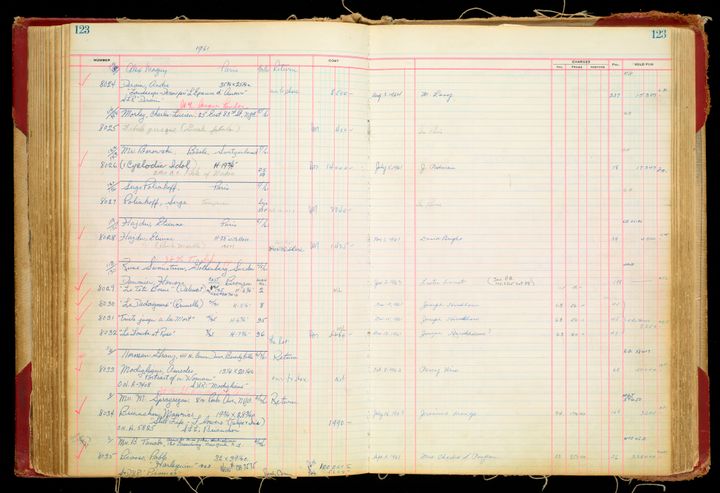
Similarly, we recommend exploring the archives of dealers such as Jacques Seligmann & Company.115 Seligmann did not usually handle antiquities, but comparing the structures of the archives, the language used by dealers and collectors, and differences in inventory practices can be instructive as a way of navigating other dealer archives and identifying the kinds of documentation relevant to your project. Dealer archives can also reveal the unexpected: the stockbooks of the Knoedler Gallery in New York, closely associated with the market for paintings and modern art, include some early consignments of Cycladic material at a time when these ancient figures were often paired with contemporary sculptures (fig. 29).116 With that said, these kinds of comprehensive archives remain unusual. Preserved dealer archives with a primary focus on Mediterranean antiquities are still rare, and it is unrealistic to expect this level of documentation for any given object.
Case Study: The Textile Museum’s Marble Head
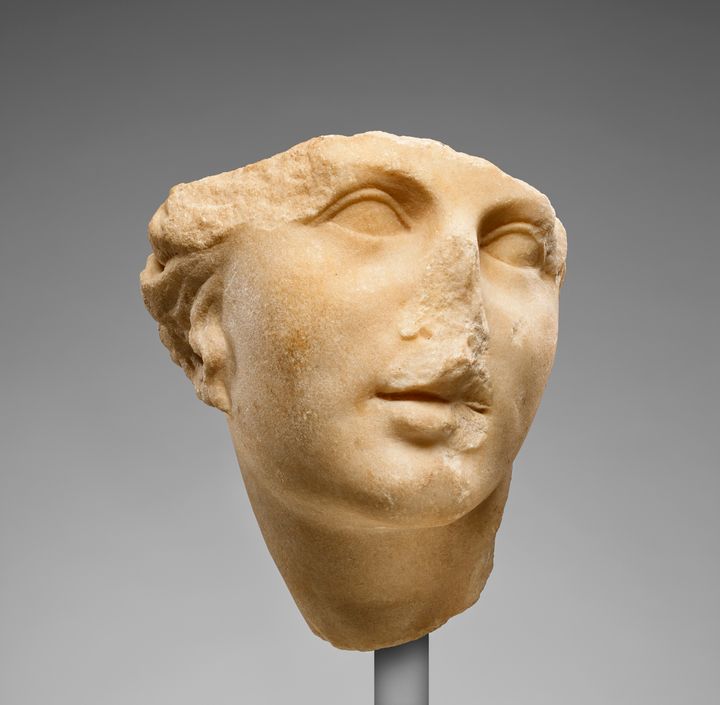
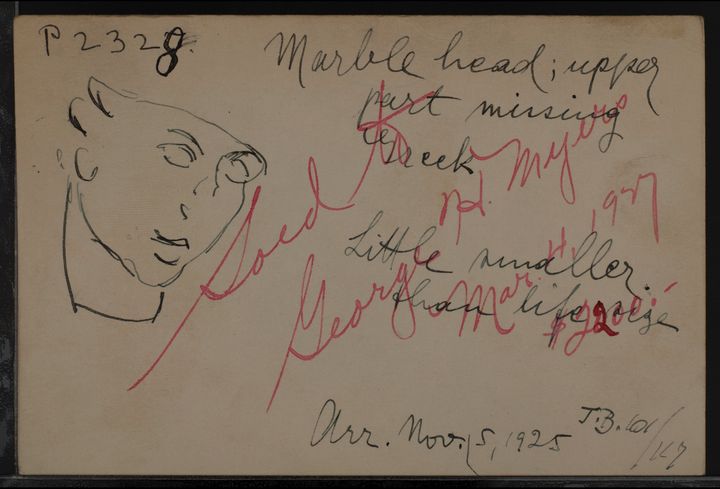
Archival evidence cannot always be interpreted in isolation; as with all research, different strands will inform each other. In the case of a marble head acquired by the Getty in 1973 (73.AA.125; fig. 30),117 the only provenance information available in the curatorial file when research began was limited to the name of the dealer, Elie Borowski, and the date of sale. However, documents relating to the head and its earlier twentieth-century provenance were held by two external archives—dots that we could only connect after first turning to a letter from Borowski in the Getty Museum’s archives. This had not been added to the object’s curatorial file, perhaps because it postdated the acquisition. In the letter, Borowski provided critical provenance information that was not part of the earlier sale documentation: the head had been deaccessioned from the Textile Museum in Washington, DC, whose founder had acquired it from Joseph Brummer in the early part of the twentieth century. We were thus able to link the head to the archives of the Textile Museum, where colleagues provided documents confirming the identity of the object, its acquisition from the Brummer Gallery, and its sale in 1973. A second strand of archival evidence came from the Brummer Gallery records, which preserve the head’s original catalogue card, documenting its date of purchase by the Brummers in 1925 and subsequent sale in 1927 (fig. 31). Without both the Textile Museum and Getty documentation, however, this individual catalogue card would have had limited value. It was illustrated with only a cursory sketch of the head, and the Brummers’ description, “Marble head; upper part missing; Greek,” would not have automatically pointed us to an object currently described as a Roman work from the first to second century CE and titled “Head from a Statue of the Crouching Aphrodite type.” Between the different sources provided by these three archival repositories, the head’s provenance between 1927 and 1973 is now almost entirely reconstructed, and these archives offer further avenues for researching the head’s history.118
Case Study: A Terracotta Horse and Rider
Personal archives might be incomplete and fragmented, depending on the way they were maintained, processed, and preserved. An archive might contain only one side of a correspondence, or documents relating to a single event may have been deposited at different collecting institutions. Such is the case with the Bernard and Rebecca Reis archive, which is held by both the Smithsonian Archives of American Art and the Getty Research Institute.119 For a group of antiquities with connections to the Reis collection, reuniting these disparate sources and connecting them to ongoing threads of research was essential to understanding their full history.
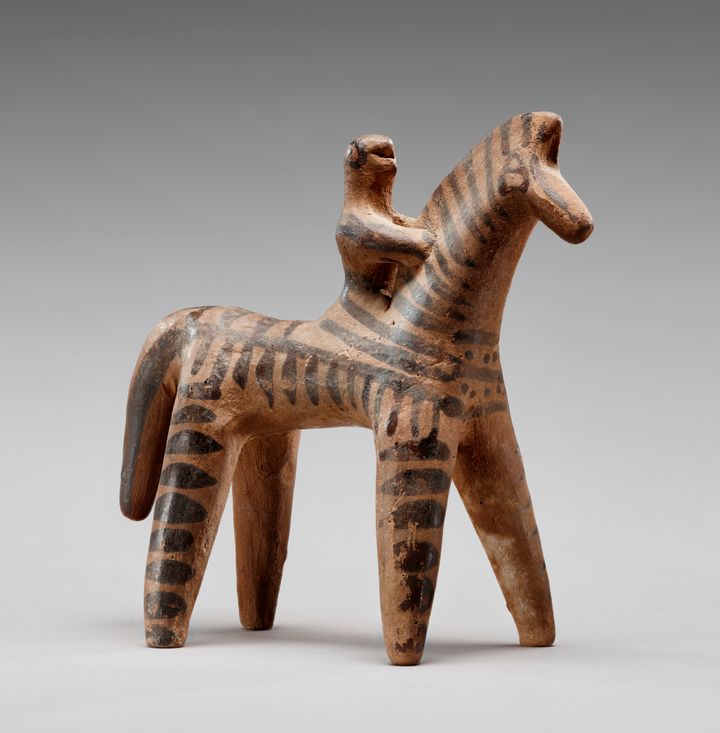
In 2002 Barbara Poe Levee (1922–2013) donated nine objects to the Getty Museum, including a terracotta statuette of a horse and rider (2002.85; fig. 32).120 Levee recorded in the donation paperwork that all of these objects were once in the collection of her father, Bernard Reis (1895–1978), a financial advisor in the 1950s New York art world who, with his wife Rebecca, collected modern paintings, sculpture, ethnographic objects, and antiquities. Although the provenance was highly plausible for the whole group, only two objects, a modern Cycladic violin figure (2002.80)121 and a small bronze kouros (2002.86),122 could be confirmed as coming from the Reis collection, having featured in an exhibition in 1954 and published accordingly.123 According to the exhibition catalogue, Reis had also lent seven other antiquities, but as the catalogue lacks illustrations and full descriptions, we could not match these firmly against Levee’s later donations to the Getty.
Upon reviewing conservation reports and the objects themselves, we found linen stickers of unknown date and origin, some with annotations, attached to mounts or documented with five of the objects, including the horse and rider.124 Simultaneous research in the microfiche records of the photographic archive of the Deutsches Archäologisches Institut Rom (DAI Rome) and digitized inventory registers (discussed further below) revealed that the terracotta rider had an even earlier collecting history, as it was photographed in Rome in 1934 as part of the Ludwig Curtius collection.125 So was the rider statuette’s linen sticker, which had the note “B-9 Lorna,” related to the Reis collection, the Curtius collection, or some other unknown owner?
Although an intriguing and informative lead, the DAI Rome records did not explain the enigmatic sticker. For this, we turned to physical archives held in the Getty Research Institute (GRI): the Bernard and Rebecca Reis papers, which preserves documentation of their personal collection, including assorted photographs and inventory lists from 1960 to 1980. These were donated to the GRI in 1990 but do not seem to have been consulted in 2002, and no copies of materials from the archive were in the curatorial files. A 1960 inventory clearly describes this terracotta rider statuette, confirming Reis’s ownership. And the sticker? Family letters revealed that Barbara Poe Levee’s daughter was named Lorna, and that the statuette had been given to her by 1981 but was transferred back to her mother in 2001. It was likely, therefore, that the other linen stickers also dated to the time of the Reis collection or after.
While the inventory lists allowed the identification of distinctive singular objects—including the horse and rider statuette, the Cycladic violin figure, and the bronze sphinx—without specific descriptions and dimensions, the other unpublished objects could not be verified as coming from the Reis collection. Fortunately, the archive preserves a few undated photos of Reis’s New York apartment. Although small objects are often blurry and difficult to decipher in these images, one photo clearly shows three Boeotian statuettes in the foreground, two of which exactly match the Getty figures. With the display context now known, these Boeotian statuettes could be identified in an inventory list. This left just three small bronzes (2002.79, 2002.83, and 2002.84),126 which were also likely part of the Reis collection but which still lack confirmation of this provenance. The portion of the Reis papers held by the Archives of American Art in Washington, DC, preserves materials similar to the Getty’s holdings, including object lists, correspondence, and photographs of the collection. While they did not answer questions of ownership history, these papers give a better sense of lived experience of the collection and the many tours and events hosted in the Reis residence, with some objects identified in lists and correspondence from collectors, museum curators, art dealers, and friends.
Exploring the Arachne Database
An invaluable resource, the Deutsches Archäologisches Institut’s (DAI) Arachne database (https://arachne.dainst.org) can be daunting to explore and difficult to understand.127 It is a portal to millions of digitized resources housed by the German Archaeological Institute (which operates departments in Germany, Italy, Greece, and Istanbul), including scanned book volumes, archival materials, and photographs.128 The photographic material stretches back into the nineteenth century, and in addition to documenting archaeological sites across the Mediterranean and beyond, comprises hundreds of thousands of images of objects from museum collections, the art market, and private collections. Many images in the online database are of the physical negatives, glass plate negatives, and photographic prints held in the DAI archives. The mounts for these negatives and prints are often captured in their digitized counterparts, and these can record additional annotations pertaining to ownership or location. As Arachne links records of individual collections, places, publications, statue types, and more, every object record is part of a great matrix of materials.
Given that Arachne is a gateway to overlapping and interconnected digitized records, there is no one way to use it, and often different routes of inquiry can lead to the same discovery. Multiple images of the same object are not always connected, nor are all records interconnected in the same way. That said, it is important to know what types of information might be preserved and how to construct searches. Of note, although the Arachne website is available in English, it is primarily a German language database, so the metadata, structured groupings, and keywords are mostly in German. Arachne records can serve as a repository for many kinds of data, including bibliographic citations and past locations; both the digital records and any digitized images (including mounts of photographs) may include additional information and should be reviewed carefully. Here, we outline three strategies for searching Arachne for information relevant to Barbara Poe Levee’s terracotta horse and rider (2002.85) that is discussed above (Case Study: A Terracotta Horse and Rider): (1) searching the DAI Rome Photo Archive with microfiche data, (2) using the inventory registers of the DAI Rome Photo Archive, and (3) searching by keyword across the whole Arachne database.
The DAI Rome Photo Archive (https://arachne.dainst.org/project/fotorom), an extensive photographic collection held at the German Archaeological Institute (DAI) in Rome, contains many useful comparanda images and no small amount of art market and private collection material.129 A microfiche of the DAI Rome Photo Archive was made in 1985, and its index, published in 1991, offers a comprehensive outline of the archive’s structure and the contents of microfiche cards.130 A basic understanding of the microfiche can be useful, since it informs the digital structure, metadata, and file names. For example, the statuette of a rider was first identified during a general review of the physical microfiche, and it appears on fiche card 1768, row D, column 14, which is reflected in its “Filmnummer” (Film number) in Arachne: 1768_D14.131 The digitized Arachne page also gives this photo’s “Negativnummer” (Negative number), “34.5865,” which corresponds to the year it was inventoried by the archive, 1934, followed by its photo number, 5865, as well as a scan of the microfiche image. The scan shows a mounted photo print, which includes notations on both the photo and its mount. For this record, these include the stamped year, 1934, the written photo number, and a stamp with “Privatbesitz” identifying the work as being in a private collection (fig. 33).
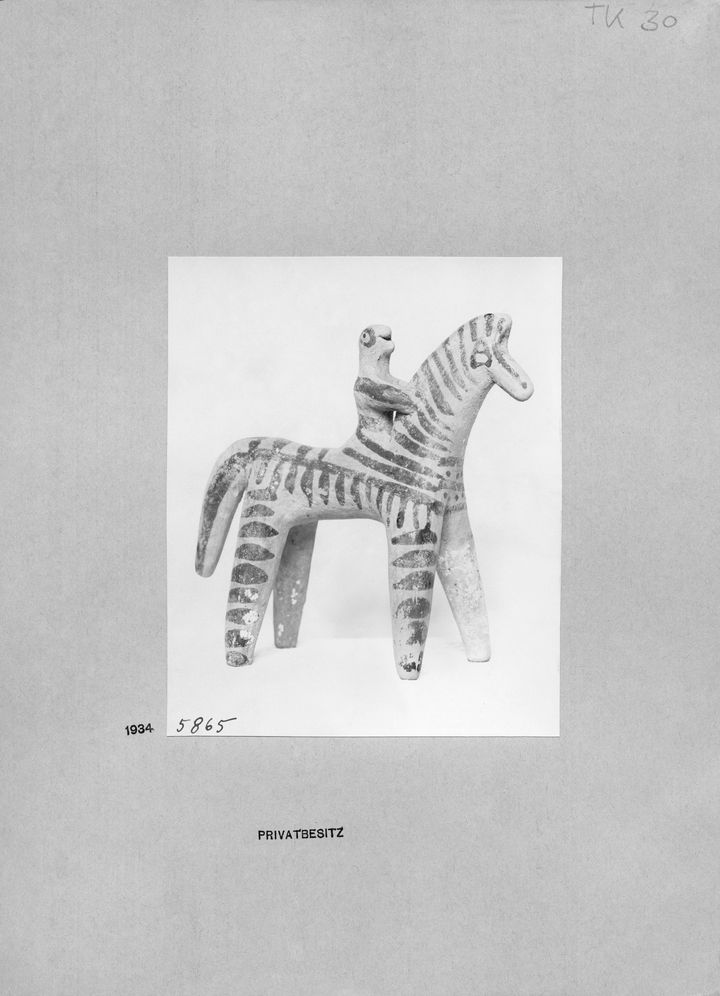
A second way to explore Arachne is through the scanned inventory registers of the DAI Rome Photo Archive, which served as the archive’s official intake record and contain information about the photograph itself (format, photographer or source, date inventoried) and the subject of the photo (its description, repository or type of location, and sometimes ownership information).132 Since these inventory books are only for the DAI Rome Photo Archive material, they represent a small subset of the total records available through Arachne, but are nevertheless valuable. These registers allow for connections to be made between images and original cataloguing data not preserved elsewhere. This vital resource requires some patience to navigate—entries are all handwritten; annotations might postdate the original entry; the registers for one year might be divided into separate volumes that are not clearly sequenced; some photos appear multiple times with different negative numbers; many years might be grouped together as part of one larger ledger; and not all negatives or photos have been digitized. Organized by year, some of the register page records have data under the “Negativ Nr.” column, at the far right of the register. While helpful, these numbers differ from the “Photo Nr.” (photo inventory number) written in red in the far-left column, and, confusingly, may or may not match the “Negativnummer” linked to a photo in the Arachne database. Publication information for these photos is often recorded, and the negative numbers for duplicate photos added in later decades are often added as annotations, so the same image of an object might be associated with multiple negative numbers, not all of which may be digitized. In many cases, the photographer is identified; some photos were also added from other archives.
To find the inventory record for the photograph of the rider statuette, we searched for its photo number, 5865, within all four inventory registers available for the year 1934.133 Some registers have cover pages with additional information, including the range of photo numbers and negative numbers contained within that volume, which allowed us to identify that the second volume for 1934 contained photo number 5865.134 It appears on page 93 of the register, where the source and format of the photo are provided, and the object within the photo is described as: “Spatgeometr. Terrakottapferdchen mit Reiter” (Late Geometric. Small terracotta horse with rider), with the collection information “Privatbesitz; L. Curtius” (Private collection; L. Curtius) (fig. 34).135
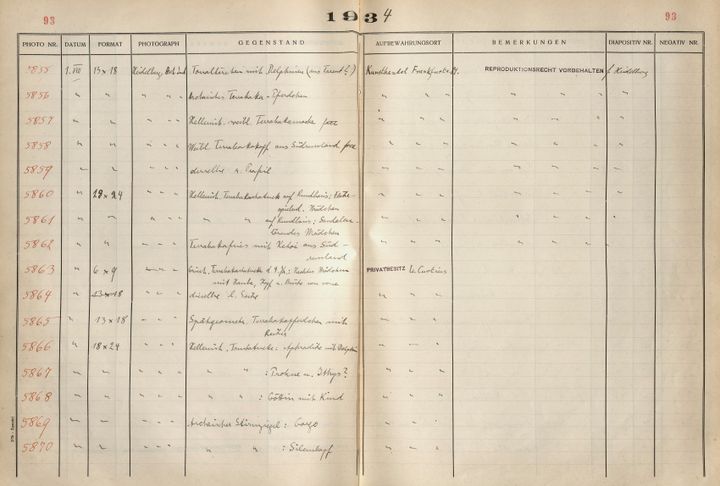
Looking beyond the DAI Rome Photo Archive and its inventory registers, Arachne can also be broadly searched by keyword across all types of digitized records—from book pages to drawings, photo records to objects. This third approach is perhaps the most intuitive for most users, but its usefulness depends on knowing search terms and the completeness of the digitized records. Keywords should be in German, and useful categories to consider might be statue and object type, current and past locations (which could include place names or general terms, such as “Privatbesitz” for private collection or “Kunsthandel” for art market), condition of object, and much more. Searching the digitized negative numbers can be particularly helpful for retrieving the original data and image where only a DAI negative number is cited. Additional kinds of metadata, including those gleaned from the photo mounts and inventory books, like statue type, medium, location, owner type (including on the art market or private collection) have not yet been systematically updated for every record, so a keyword search alone cannot be relied upon to retrieve all relevant results. For the terracotta statuette of a rider, if we did not have any identifying numbers but wanted to check Arachne for photographs, we could search by medium, object type, or culture. For example, searching “terrakotta” and “reiter” (terracotta rider) pulls up 171 records with images, including one of this statuette. Fortunately, the metadata is complete for this image, allowing it to be retrieved.
Case Study: Photographic Archives in Context
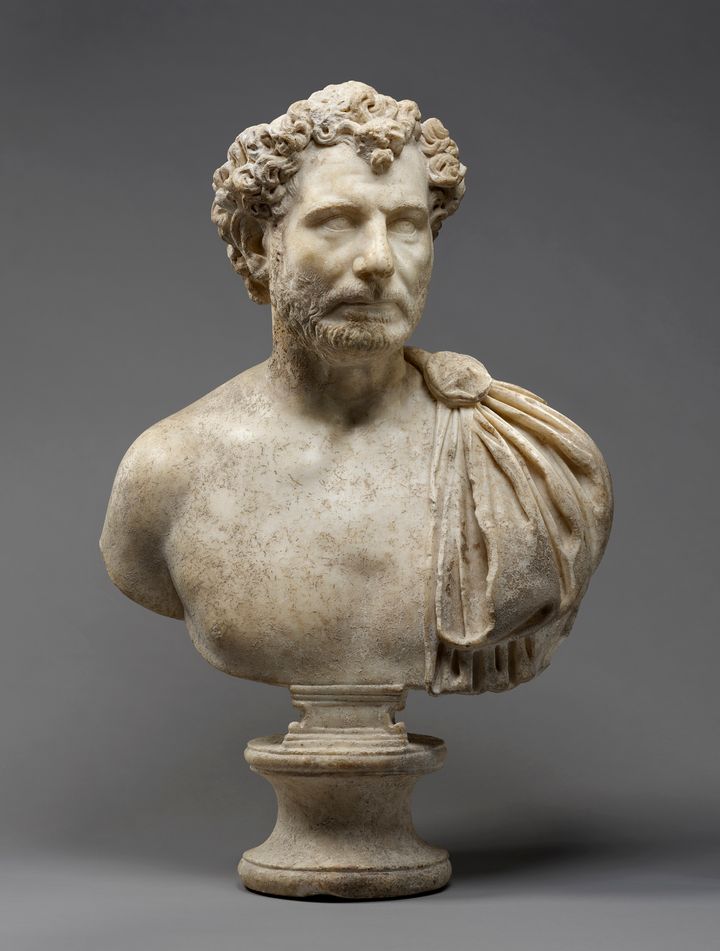
In 2018 the Getty acquired a Roman marble Portrait Bust of a Man (2018.31; fig. 35),136 which had first been published as a loan by dealer Adolph Loewi to an American exhibition in 1961. It was subsequently acquired by the Denver Art Museum but was later deaccessioned and sold at Sotheby’s in 2017. Archival photographs of the bust were identified by the time it appeared at auction. These had been taken by the photographer Johannes Felbermeyer (1903–1988) and made available through the photo archive of the DAI Rome. Some of Felbermeyer’s photos of this bust were entered into the DAI Rome’s Inventarbuch on December 12, 1960, with a location of “Rom Kunsthandel,” and, on another line, “Jetzt: Amerika, Priv.Besitz” (Rome, art market, and Now: America, private collection).137 So in 2017, when the bust was auctioned, its earliest known documentation was dated to 1960, as Felbermeyer’s photos were presumed to have been taken close to the time that they were added to the DAI Rome’s archive.
Archival photographs can enrich and inform provenance research, but they require careful interrogation. One of the largest holdings of Felbermeyer photos is the archive now held by the Getty Research Institute (GRI), including his famous series made at the Central Collecting Point, Munich, in the aftermath of World War II.138 But Felbermeyer had a long career before and after the war, photographing archaeological sites and artworks for the DAI Rome and later the American Academy in Rome. He also photographed ancient objects both on the market and in private collections, and copies of some of these were added to the DAI Rome’s photo archive, including the images of the Denver bust noted above. Some of Felbermeyer’s work was intended for specific projects, but for others their purpose is unclear. He did not organize or document his photographs chronologically, so no overall sequence of his postwar work can be reconstructed,139 and the distribution of his photos today is likewise unclear. One image of the Denver bust is held by the GRI, but it may be part of the same sequence as that in Rome.140
Felbermeyer’s photographs of a Portrait Bust of a Man show the figure with the same restorations that are extant today, but neither its location nor the purpose of the photos are clear. Here, examining the object itself led to a further discovery: a museum sticker on the underside of the bust near the rim, which records a loan made by Loewi to the Minneapolis Institute of Art (MIA) in 1958.141 This loan, otherwise unrecorded in the bust’s known provenance or publication histories, complicates the earlier understanding of the timeframe by which Felbermeyer’s photos were shared with the DAI Rome. The entry of the photographs into the DAI Rome’s files in December 1960 comes nearly three years after the object can now be documented in the United States. The actual date on which the photos were taken thus remains unknown.
The presence of photographs of the same object in the two different photographic archives is important: they provide a record of the bust’s condition, and document Felbermeyer’s access to the bust, perhaps in Rome. But without other sources of information, they remain incomplete records of its ownership, location, and—as the MIA sticker indicates—even chronology, which further research will hopefully elucidate.
Auction and Sales Catalogues
Here we include auction catalogues, dealer price lists, checklists, private treaty publications, and other documentary material, but we chiefly discuss auction catalogues, as these are a significant source of provenance information. While many readers are likely familiar with this material, we have found that auction and sales catalogues are rarely taught in archaeological curricula as a specific kind of document and that it is worth breaking down the basics here.
Auction catalogues of Mediterranean antiquities have been published since at least the seventeenth century.142 They are not always dated, although dealers occasionally use numbering systems for their own publications. When publication dates are lacking, library acquisition dates of the print material or cross-referencing known acquisition dates of objects within the catalogue can help date a specific publication.
Catalogues generally include a list of objects along with brief descriptions or descriptive titles and sometimes a list of prices or estimates. Individual lots can comprise large groups of items, and illustrations may be few or absent altogether. Many historic auctions had no associated publication, although print advertisements for the sale could include object descriptions among other details. As with today’s markets, antiquities may have been sold in their own specialty auction or grouped with, for example, natural history collections, decorative arts, or ethnographic materials, particularly in the case of large mixed sales from properties or family estates. Auction catalogues should not be taken as stand-ins for the actual auction, since they represent a singular, presale moment at the time of their printing. Not all auctions ended up being conducted on the listed day, and lots might have been withdrawn or added after the catalogue was produced,143 as is still common today. Comparing annotations in different catalogues, news reports on the auction, and printed postsale supplements like price lists can substantiate changes to the auction, but others may not have been documented. Note, too, that dealers and auction houses may operate multiple sales models, which may not be recorded in publications. Unsold objects could rotate through multiple price lists or auctions by the same dealer or through those of another firm.
For provenance research, the basic components of documenting an auction are simple: confirm the auction was held, the auction house or auctioneer involved, the dates of the sale, whether a lot was part of the sale, and whether it was sold. An object that was unsold or withdrawn from auction should still be documented and its publication recorded in some form in its collection record, even if the actual ownership of the object did not change. For those new to auction catalogues, we outline some basics below. As there is no single template for auction catalogues, this is intended as a broad overview.
Ownership
Generally, sellers are consigners and retain ownership while placing items up for auction with the auction house as agent. Ownership therefore rarely transfers to the auction house itself, although some firms run auctions involving their own stock or have ownership transferred before the sale. The auction house should not be included as the seller in a provenance unless this ownership is specified. Anonymity has been a common feature of auctions for centuries; owners may or may not be identified by name, by their heirs, or as an anonymous private collection, sometimes distinguished by a personal title or an owner location. Commonly, owners will be referred to with niceties like “Property of a Gentleman” or “Property of a Lady”; historical references include “A Man of Fashion” or “A Man of Title,” although these are equally ambiguous and should never be accepted as factual without additional confirmation.
Agents
Many buyers utilize agents, who are authorized to bid on their behalf. Agents may themselves be dealers working on behalf of clients, and in auction catalogue price lists and annotations it can be difficult to distinguish their own purchases from those conducted for a client.
Price
The starting price of an item is that at which bidding begins. The hammer price is that price gaveled in by the auctioneer during the auction. The final price paid by the buyer may reflect additional fees, including the buyer’s premium. Some auctions include special arrangements, such as a minimum price guarantee, where regardless of the outcome at auction, the auction house and any third parties involved in the contract agree to pay a minimum price to the seller.
Buying In, Not Meeting Reserve
When an item does not meet a given reserve (or minimum) price, the object remains unsold. This is sometimes referred to as “buying in” or “being bought in.” Reserve prices are usually confidential; some catalogues indicate which lots have no reserve. If an item is unsold or bought in, no transfer in ownership occurs. However, buying in can incur a commission or fee, and during some periods auction houses have represented bought-in lots as sales in price lists, sometimes with no distinction between these and true sales. In some cases, spurious buyer names or buy-in prices mask bought-in lots in price lists.144
Anatomy of an Auction Catalogue
Frontmatter
In general, if a print catalogue for an auction exists, the frontispiece and introductory pages will contain basic information about the sale itself. This can include:
Date In addition to the date or dates of an auction, confirming the date that a lot is to be sold is critical, as auction houses can mount multiple sales on the same day, and historic auctions could last months. Information about viewing items prior to the sale may be included.
Location Auctions could take place at the auctioneer’s premises, at a central auction location like the Hôtel Drouot in Paris, or at a third-party partner space like a hotel or department store. Even if held by auctioneers based in a specific city, sales can also take place at the location of the collection itself, a particularly common occurrence in sales of entire estates.
Personnel The personnel in charge of the sale may include an expert or subject specialist, and some auctions will indicate the author of lot descriptions, although experts might also remain anonymous.
Rules Auction catalogues usually include a standard rules list for prospective bidders and attendees of the sale, including the purchasing and removal of objects.
Owners and Kinds of Objects Represented Information about the owner or owners of the items for sale can appear in the title or frontispiece as well as in lot-by-lot subtitles. Although a single owner may be listed in an auction’s title, the sale might include additional lots from other owners; this should be confirmed on a sale-by-sale basis. As noted above, sellers are frequently anonymous. Where given, a lot’s prior provenance information may be limited and uncited; a frequent construction is the use of “with” to indicate that an object was in the possession of a dealer.
Introduction Catalogues may contain an introduction to the collection being sold or to the collector or collectors involved. These sometimes include provenance or findspot commentary not repeated in individual lot notes.
Lots
Items for auction are organized as lots, which may include a single object or a group of objects. If a lot contains multiple objects, the total number of pieces is sometimes indicated in the catalogue by a number in parentheses. Lot notes in the catalogue can include a basic title, descriptive title, and a description of the object and its condition. They may also provide the object’s measurements and information about the medium.
Sometimes these entries are derived from earlier publications of a collection and copy entire or partial descriptions or provenance data from these, however spurious and unsubstantiated that information may be. As in many areas of provenance research, repetition does not equal validity. In some cases, these earlier publications may have been written specifically for a prospective sale. Lot notes can describe a specific object’s condition, or there may be a collective disclaimer about the condition of ancient materials. Today, condition reports can be requested separately for each lot from most auction houses. The results of scientific tests, such as thermoluminescence (TL) or metallurgical analyses, may also be indicated.
Lots drawn from different owners may be grouped together under “Multiple Properties” or similar headings. Lots belonging to the same owner may appear in multiple sections within a larger sale (particularly if the sale is organized along cultural or geographic divisions), and they may also be spread out across multiple sales. An object unsold at previous auctions can reappear in successive sales with or without reference to those prior attempts.
Objects are sometimes suggestively grouped together in the same lot to suggest a shared ownership history, particular context, or findspot. This widespread practice should be regarded with extreme caution. Furthermore, these groups may be split up while on the market, segregating any evidence or paperwork from subsequent owners.145 One side benefit of publishing provenance data, however, is that groups once sold together and later dispersed on the market can be reconnected, at least virtually. References to the contents of these original market groups should be retained.
Lots may have price estimates listed, or an estimate list may be a separate supplement produced for the catalogue.
Results, or Prices Realized
Lists of results (also called prices realized) published by the auction house after the sale may be available as a separate print or digital supplement. These lists may reflect the hammer prices or the aggregate total, including any buyer’s premiums and other fees; it is wise to clarify with the auction house if unclear. Historically, some editions of catalogues were printed after the sale and incorporated final prices (as opposed to separately printed price lists); both these and catalogues with annotated prices can be referred to as “priced catalogues.”146 Price lists will also confirm whether a given lot sold at auction, as opposed to being withdrawn prior to the sale or bought in.
Auction houses rarely share details of withdrawn or unsold lots. However, annotated catalogues or news accounts of a given auction can include hammer prices along with other results, such as lots being bought in. Annotations—handwritten notes on individual copies of the catalogue—can include lot descriptions, lot additions or subtractions, buyers, and pricing. These might be written during the sale by auction staff, those directly involved with the sale as potential buyers or consigners, or by viewers of the sale. Annotations can also be later additions, as in the case of some museum copies of catalogues, where individuals have noted later locations and ownership histories for objects. Local library records for auction catalogues occasionally include details about these kinds of addenda. The WorldCat database sometimes ingests such annotation information from the local library record, and from the WorldCat record an interlibrary loan request can be submitted for a specific copy of a catalogue. Where possible, any annotation of price information or buyer name should be checked against additional annotated copies of the sale or other sources to confirm details, and your notes should reflect the location and source of the annotated copy referenced.
Auctioneers’ copies of catalogues will also record the final prices and can include buyer notes, although access to these generally depends on the institutional policies of the auction house.147
Additional resources include a subset of price lists printed separately with buyer names, most notably produced by Christie’s and Sotheby’s for sales in London in the early to mid-twentieth century.148 Like regular estimate and price lists, these are often pasted or added into auction catalogues where preserved. They contain the names of purchasers, who may be agents for the ultimate buyer.149 However limited and inconsistent, these price lists are invaluable research tools, particularly when used as a corpus to see broader patterns of purchasing and recurring names.
Archival correspondence between owners, buyers, and auction houses relating to auctions is sometimes preserved in personal copies of sales catalogues. This kind of correspondence may also feature in the personal archives of other individuals involved in a sale, such as the seller or an advising expert.
Auction houses may facilitate the sale of objects privately in what is called a private treaty sale. These sales are considerably harder to trace than public auctions, although promotional sales documentation or dossiers on the objects may have been compiled and made available to potential buyers prior to the sale. The same is true for private exhibitions held for the purposes of sales.
Using Auction Catalogues
Lot descriptions can be vague, cursory, or written by nonspecialists, resulting in confusing or erroneous accounts or attributions that make it difficult to identify an object. Dimensions may be incorrect, and photographs may not include mounts or supporting elements that could help to secure an identification. In the frequent event that an auction catalogue or a particular lot is unillustrated, identifying an object might require well-documented labels or stickers, prior publications, documentation connected to the purchaser, and in some cases, illustrations or photographs of objects in the auction made by researchers, agents, or other interested third parties. Cross-referencing a larger collection against other sources, like contemporary gem casts or earlier publications of the collection, can confirm the identity of a singular lot from that collection.
An unusual example of a third-party illustration comes from the artist Gabriel Saint-Aubin, who created small sketches of many lots in the margins of his copy of the auction catalogue for the sale of Pierre-Jean Mariette’s estate in 1776. Among them is a “cornaline” gem with “Sapho [sic]” and “Phaon,” which was acquired by the Getty in 2017 (2017.2)150 and is now identified as showing a scene of Venus and Anchises (fig. 36).151 Although the gem had previously been documented as part of Mariette’s collection, the sketch helped to confirm its identification in this auction. In a different copy of the sales catalogue, the annotation “Basan” next to the gem further indicates that the gem was retained by or sold to Basan, the auctioneer, but the end result is unclear, and this wording may also reflect that the gem was bought in.
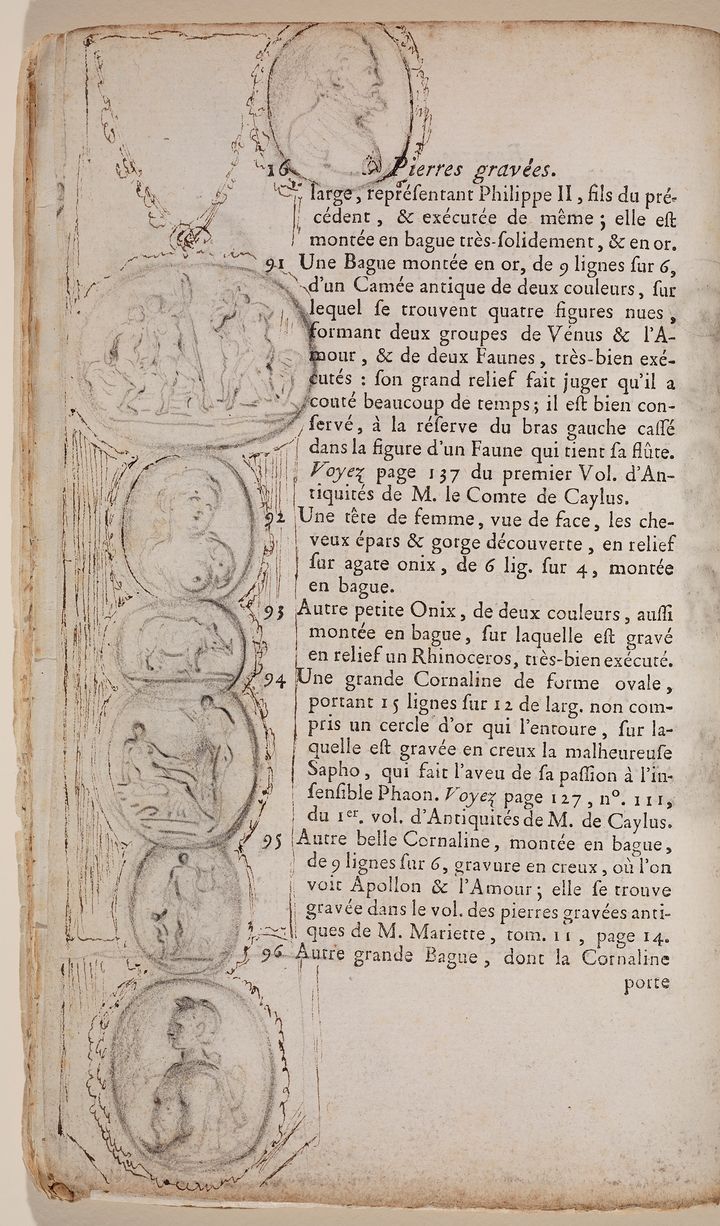
Photographs from auction catalogues should be considered as carefully as any other image, but they can be particularly instructive for objects that have undergone cumulative restorations or the removal of restorations. This is evident in the case of a Roman portrait (74.AA.63),152 which we identified by chance from an illustration in a 1905 auction catalogue while systematically reviewing auctions of antiquities (fig. 37).153 The auction catalogue’s photo shows the head inset into a later bust, which was inscribed with the name “Titus Annius Milo.” This bust had long since been separated from the head, and with it this identification; neither was documented as part of the head’s history at the time of acquisition by the Getty. Without the auction photograph, connecting the lot description alone—“Roman Bust. Very beautiful modelling. The head is a genuine antique, and the bust has been made afterwards”—to the actual head, stripped as it was of any record of a bust or inscription, would have been impossible (fig. 38).
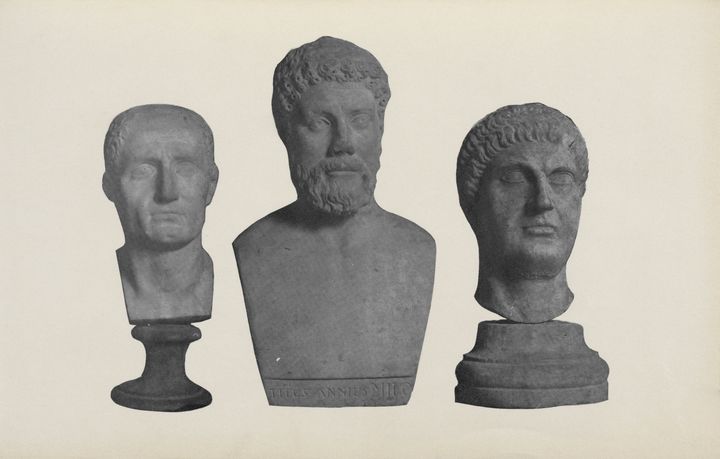
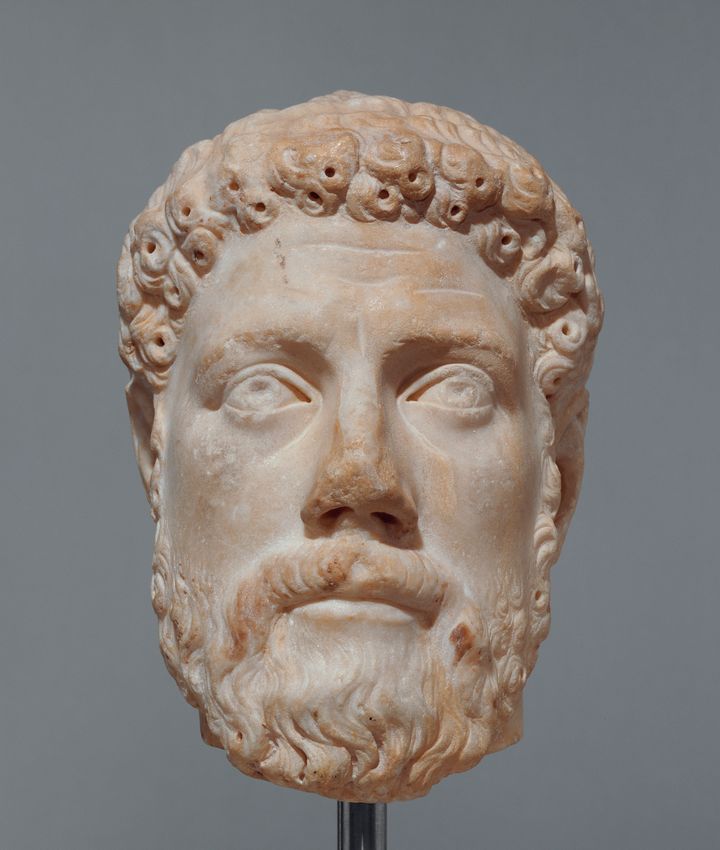
Given the quantity of unillustrated sales catalogues, identifying every ancient object sold at auction will never be possible. While recent projects have made great inroads in uniting past sales with the modern locations of objects, particularly in the dispersal of Attic vases on the market, this kind of reconstruction is the exception rather than the rule.154 Limited or inaccurate descriptions, a lack of illustrations, objects made in multiples, and the existence of large, poorly described lots are a reality that cannot be overcome by individual searches. Potential but unconfirmed matches should be noted in an object’s file for further research.
Identifying Individuals
Catalogues annotated by viewers at a sale (or people informed about the results) are a fundamental tool for identifying purchasers at auction. Such annotations document buyer names, sale prices, artwork commentary, and other relevant details, including references to sellers or consignors. Cross-check these annotations between different catalogues when possible and consider the source of the annotation where known. The annotation “buyer” can be misleading; these often reflect agents for dealers or private buyers, and common names prevent easy identification.
Buyer names and prices may be recorded in newspapers or trade publications reporting on the sale; however, privacy considerations of recent decades preclude this for contemporary sales. Still, reports on the art market can continue to inform on the sales room as well as any public information as to the buyer’s identity, trade, or collection location.155 Identifying the seller remains an arduous task, particularly with limited access to auction house records, although archival documentation of the sale in owner or scholar archives can help.
Art Market Provenance and Findspots
Poring over sales catalogues is a reminder that a complete record of an object’s ownership history or place of discovery was not a standard part of auction or dealer practice until recently, and the absence of information regarding prior ownership, auction sales, publications, or findspot in sales catalogues is extremely common. If you suspect an object has previously been offered at auction, a wholesale search is advisable, as missing provenance references do not necessarily indicate an actual lack of provenance.156 The absence of such information is compounded by what we term “art market provenances”—provenance or findspot data that are provided at the time of sale, but lack further documentation. These have often been written or repeated with an eye toward emphasizing an object’s value or prestige. Their sources are often unknown or absent, resulting in the common “said to be” formula, and they often lack details that would allow for their verification or interpretation.157 These statements may also conflate a stylistic attribution with a suggested findspot. For example, is “Said to be from Boeotia” a commentary on a terracotta object’s recent history, or a reflection of the fabric of the clay and the style of the artwork?158 At what point was it said to be from Boeotia, and by whom? Caution should likewise be applied to said-to-be information about groups of objects. Sellers, buyers, and dealers may split an associated group, but the market can also create false groups, whether on purpose (e.g., a purported tomb group) or through accidental association (e.g., gems grouped together with no actual shared provenance or findspot relationship.) While these relationships need to be preserved as part of object records, proximity cannot be taken as evidence for provenance. To complicate matters further, said-to-be information can be presented interchangeably with documented provenance and findspot information and falsely treated with parity. Unverified information can then be repeated or otherwise perpetuated (often without crediting the sales catalogue as the source) and stylistic said-to-be data gets further interpreted in place of securely documented provenance data.
“With” and “from” followed by an owner’s name often indicate that an object was owned by a dealer, although the dates and method of transfer may not be indicated or included. We cannot reiterate enough that auction catalogues (and the authors, consignors, or annotators represented therein) have not treated provenance in equal ways over the past four centuries; even lots or essays within the same sale may reflect separate sources and standards of information. Verification must draw on external publications or private paperwork, and auction houses or dealers may not retain or release records relating to earlier sales.
All this being said, omitting an art market provenance leaves an object’s biography incomplete and can close down the possibility of future research. Conversely, uncritically including such information risks giving it unwarranted validity. As noted above, the most pernicious aspect of said-to-be information is that it is often reproduced with the same level of trust as more reliably documented data. The passive construction (“said to be”) is often given without a source, and a tentative “said to be from Athens” can swiftly become the more definitive sounding “from Athens.” We suggest a consistent approach (as much as possible) to this kind of data, even as we recognize the challenge of retroactively redressing this within our own records. However and wherever you record said-to-be data, it should be cited with caution and with adequate explanation.
A Roman bronze handle (71.AC.356)159 offers an example of an object that had been separated from its auction history.160 At the time of its acquisition by the Getty in 1971, only a single sale was recorded: an auction in 1965.161 But while reading through an 1885 auction catalogue for the sale of the Julien Gréau collection, a match to the Getty handle was made with the etching of the auction’s lot 63, which described the handle as “trouvé dans le Nord de la France.” The full publication of Gréau’s collection—also published in 1885 but not cited by the sales catalogue of that year—gives a more precise findspot and an ownership history (although both await verification): “Trouvée en 1842 à Bouzi, pres de Landrecies (Nord). Ancienne collection de M. Failly.”162 This disparate treatment of information, even within the same volume or in works by the same author, demonstrates that all parts of an auction or collection catalogue should be examined.163
Documenting Auxiliary Information
When we began our provenance research project, unconfirmed auxiliary information like that published in auction catalogues was recorded in the Getty’s internal database but not publicly presented online. However, a Provenance Remarks field has now been added to our online collection pages, and this allows for expanded discussion of archival sources and other information that could not be accommodated in the standard listing of owner names. This is particularly helpful for making accessible undated archival information that cannot be connected with a known owner, rendering the information an orphan, in a traditional chronological and owner-focused provenance narrative. New syntaxes were also developed for the existing Source and Notes fields below each line of provenance, so that published but unconfirmed information, such as that found in auction catalogues, can be made publicly available and contextualized once each record is updated in the future. A case in point is a portrait bust of the Roman emperor Geta (78.AA.265)164 acquired in 1978. It had appeared at auction the year prior through Christie’s in London, where the lot text described it as “Found in Thames.”165 This was repeated in Getty publications without any assessment of its origins. In order to acknowledge the purported findspot, while making clear that its validity is uncertain, we have now added the following text to the head’s online record: “Provenance described in lot notes in Christie’s (1977) as ‘Found in Thames’; this has not been verified.”
Sources on Individual Collectors
The collecting habits of individuals defy typological groupings, and so research on collectors requires a broad range of materials and approaches, often going beyond traditional academic publications. Among the sources we have added to object records in the Getty collection are such varied things as rediscovered photographs of an owner riding a red marble statue of a centaur; stereoscopic tourist views of Lowther Castle (fig. 39); and archival newspaper clippings.166 Understanding the context of the collector in question is critical, as are the scale and scope of their collections over time. When and where did they live? Was the collector also active as a dealer? Was their collection known during their lifetime, or only posthumously? Are other objects from their collection known? How, when, and where were they dispersed? Why did these individuals collect? Some collections are static, with objects meticulously documented and dispersed only after the owner’s death. Others, like the Gorga and Fawcett collections discussed elsewhere in this chapter, reflect shifting financial or collection priorities over time.
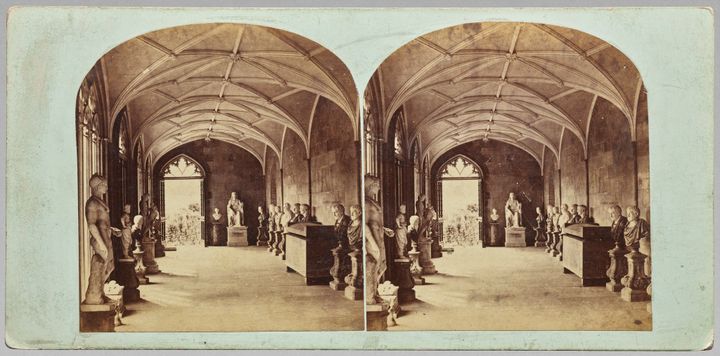
Consider collectors within their own networks. Was this a family collection, and if so, is there data on inheritance? Did the collection overlap with the owner’s interests? Did they make their collection accessible to scholars or friends? If so, were these individuals permitted to publish it, and how did they describe the collection? Other categories of documentation that invoke personal memories of a collector or their collection, like oral histories, interviews, or memoirs, can provide further context, but how will you vet and contextualize this kind of data that is once or twice removed from its source?167
Basic facts about a collector can be assembled using genealogical tools and databases, gravestone database sites, property histories, family photographs, insurance documents, and wills and bequests. But while these document the life of an individual, evidence of their collection is often more ephemeral. We discuss examples of collector archives in our “Annotated Resource Guide” (Appendix 1), but documentation may exist outside of a formal archival setting as well, such as in diaries or other personal notes retained by family. Do such records speak to where the collection itself was housed and displayed? How or where was it documented? Current privacy laws can restrict access to more recent documentation. How will your research account for this gap? Furthermore, not all owners or dealers will have received this kind of documentation. Married female collectors are often elided from provenances or rendered invisible through name changes, even for collections formed prior to their marriage or through their own inheritance.168 Where possible, including all names associated with a constituent over their lifetime will help make those records more accessible to researchers, who might know the constituent only through an alternate name.
Historical Documentation of Collectors
The history of collecting Mediterranean antiquities has been documented and examined for centuries, even millennia, if we include ancient sources mentioning their contemporary collecting practices. But these resources provide only a limited view of the documentation of collections over time, and they privilege elite private collections in western Europe. Many ancient Mediterranean objects first appeared on the market in the nineteenth and twentieth centuries without publication and thereafter circulated through collections at a variety of economic levels. It is the exception, not the rule, that private antiquities collections were comprehensively documented through publications or auction catalogues.
Even within the elite sphere, well-known collections, like that of Martine de Béhague, comtesse de Béarn (1870–1939) in Paris, were seen by relatively few contemporary scholars, and only a small portion was ever published in exhibition catalogues or in her commissioned collection catalogues.169 In contrast, some collections were notable tourist destinations, becoming objects of consumption—and documentation—through art checklists and souvenirs like stereoscopic views or postcards of interiors that were distributed widely.170 But foundational texts in the field of the history of collecting, like those by Adolf Michaelis on British collections, can be broad without being comprehensive. Michaelis’s narrow focus on ancient marbles provides expansive documentation of the location of many private collections in Britain, as well as limited provenance information for some sculptures, but he does not address with any detail the vases, gems, or some of the other works of ancient art held in those same collections.171 These treatments of private collections are the precursors for more recent publications like Elizabeth Angelicoussis’s work on reconstructing the Lansdowne collection,172 and the expansive treatment of the Ince Blundell collection.173 These publications, which make extensive use of archival resources documenting the context of an entire collection, show how this research continues to evolve.174
These elite collectors and collections have predominated in traditional academic studies, but they were not the only kinds of collections of ancient Mediterranean works of art. By the mid-nineteenth century, regional publications of antiquarian groups (particularly in England), auction catalogues, and a growing number of private collection exhibitions point to a well-to-do but diverse array of collectors and dealers beyond the nobility. The nineteenth- and twentieth-century markets for Mediterranean antiquities have yet to be fully mapped, but a wide ecosystem of markets supported a trade in ancient objects across the world.175 Nor was collecting limited to the wealthy, with minor works of art available at varying price points or deliberately collected where accessible.176 Sourcing evidence for the circulation of these objects requires a broader consideration of materials than traditional academic publications—newspaper articles, regional auctions, mail order catalogues, wills, family photographs, even letterhead. When collating sources in search of a particular collection or object, consider which of these types of media might be most relevant to your search. What was the media landscape in the area in which the collection was housed or where the collector lived?177
Collector Information in Exhibition Catalogues
As with auction catalogues, it has not been standard to record full provenance information for objects in exhibition catalogues,178 but their utility for provenance research is worth mentioning here. Although often obfuscated by the credit line “private collection,” sometimes with a city or country appended, objects can sometimes be identified in exhibition catalogues by their inscriptions, prior collecting or publication histories (where listed), or by illustrations. Archival images of past museum exhibitions may also be available, which can aid in identifying those objects not illustrated in exhibition catalogues.
Similar to exhibitions are long-term loans from private collectors or dealers to museums. Often lacking formal catalogues, these may be documented in publications such as academic articles, museum newsletters, or newspapers. Visitor photographs can also be a rewarding source of additional images. As discussed elsewhere, stickers or labels attached to an object can provide evidence for its prior long-term loan.179 Information concerning exhibitions or long-term loans does not always remain part of an object’s history during transfers in ownership. In some cases, it is possible to verify that an object was part of an exhibition by confirming with the host institution, although contractual or privacy issues may prevent them from identifying the lender.
Dealer exhibitions highlight works for sale through a gallery but can also include loans from other sources, which may or may not be for sale. A wide array of publications can accompany a dealer exhibition, from postcards and illustrated invitations to price lists and full catalogues. Dealer exhibitions were also published in some art trade publications and newspapers, which sometimes include additional lists of ongoing gallery exhibitions, reviews, or exhibition advertisements. These can confirm dates, themes, and objects if no full exhibition publications were produced. Dealer archives may retain valuable correspondence and photographs.
Case Study: A Statuette of a Nude Youth
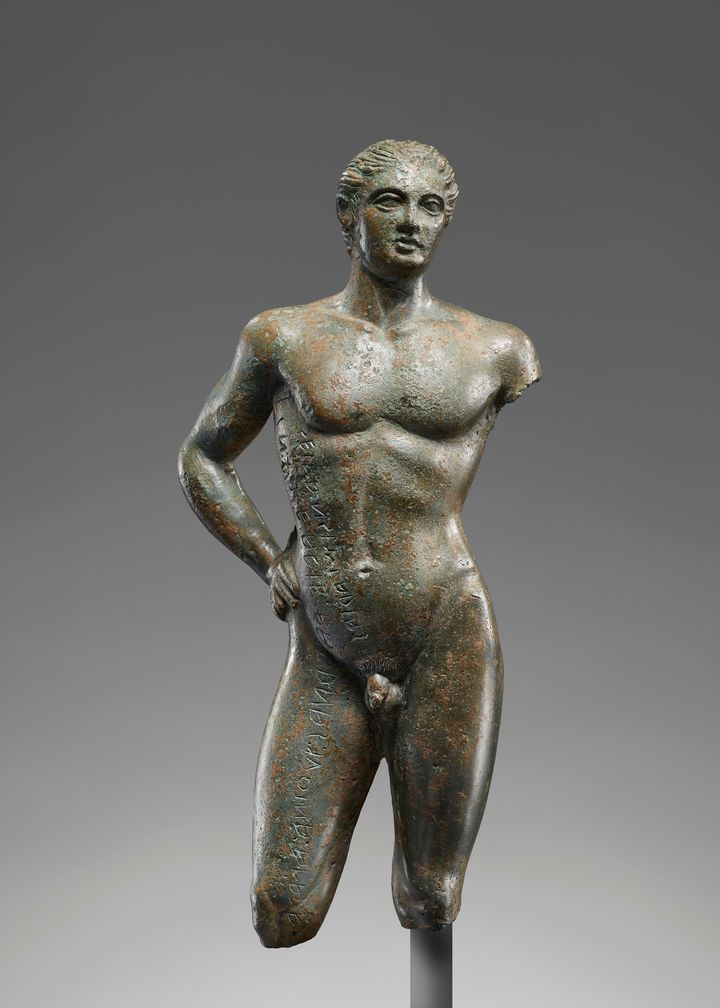
The Getty Museum acquired an Etruscan bronze statuette of a nude youth in 1996 (96.AB.35; fig. 40)180 as part of a large purchase from the Fleischman Collection in New York. At the time of acquisition, the figure’s earliest documentation noted only that it was previously part of the collection of “Melba Whatley.” No record of her ownership dates or any related information featured in ensuing publications of the statuette. However, in combing through exhibition files hosted by the Dallas Museum of Art, we discovered documents relating to a 1981 exhibition, Ancient and Medieval Art from a Dallas Private Collection. Although the owner was not named, at least two of the objects in this exhibition were later sold under the name Melba Davis Whatley, a noted Texas collector, with auction lot notes referencing their display in 1981.181 We were able to determine that the Getty statuette had also featured in this exhibition, as the Dallas Museum of Art’s online exhibition documentation includes a detail image of it from their Bulletin, as well as a checklist with an early translation of its dedicatory inscription. Not only did this allow us to confirm the statuette’s ownership history, but it provided documentation several years prior to what had been its earliest known scholarly publication in 1985. Although exhibitions are today often considered a critical aspect of an object’s history, they are frequently absent from earlier provenance statements or other documentation, and—as the case of this Etruscan statuette demonstrates—are easily severed from the object itself.
Case Study: The Medusa Cameo
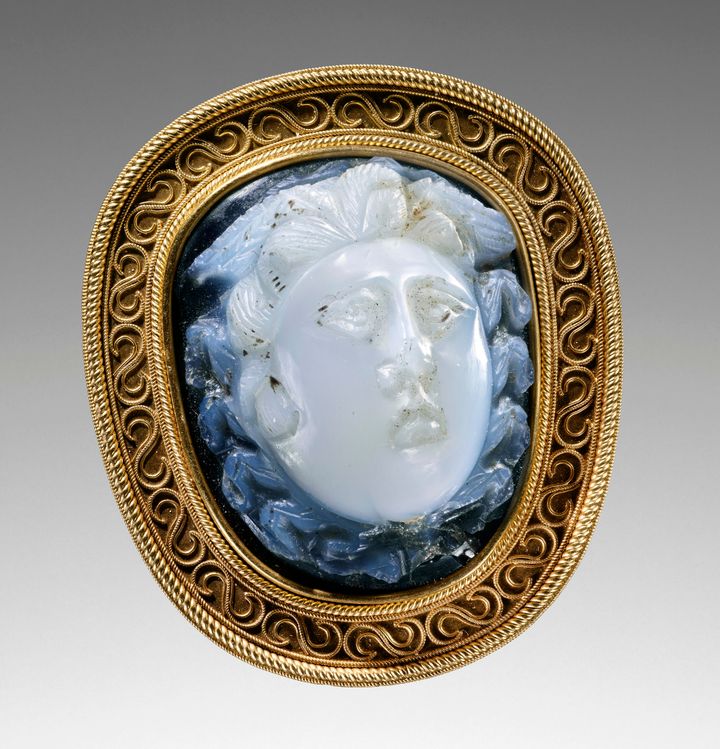
Identifying objects in unillustrated exhibition catalogues and checklists poses challenges. In 1872 Sir John Evans lent a cameo on red onyx with a head of Medusa “surrounded with gold ornament of elegant design and exquisite workmanship” to the South Kensington Museum, and it featured as no. 57 in the exhibition catalogue.182 In 2001 the Getty purchased a sardonyx cameo with a head of Medusa (2001.28.12; fig. 41),183 set into a gold mount “said to be” by Castellani. This had been a wedding gift from Evans to his wife, Maria Millington, in 1892, and was later given to their daughter, Dame Joan Evans. Is it the same cameo as the one Evans lent to the South Kensington Museum? Unfortunately, the description in the 1872 exhibition catalogue does not include any diagnostic details or measurements, so this remains unresolved. No further records as to when Evans had acquired the cameo are extant, and his collection lacks a comprehensive publication that could prove the identity of this object. Open questions like this are rarely part of public provenance display records, and defining the line between confirmed and potential exhibitions of an object remains a difficult gray area of information.
Dealer Advertisements
Dealer advertisements form another enormous corpus of material that reaches back over a century, but one that is often overlooked with respect to the market for Mediterranean antiquities. Advertisements by dealers, as well as auction firms, appear in trade and art market publications, but also in newspapers, orchestral programs, academic journals, and exhibition catalogues. Trade and specialty publications may offer regional advertisements tailored to subscribers in different print runs or through inserts. In some cases, antiquities feature as part of photo shoots or advertisements for other products, like Estée Lauder perfume, or in advertorial-style articles, such as Christmas gift guides.184
Information in the advertisements may be limited to the dealer’s address(es) and areas of specialty, but they can include images or drawings of objects, as well as descriptions or basic object data (fig. 42). The circumstances are often opaque. Is the listed dealer the owner, the consignee, or an agent? In the case of international firms, where is the object located? When was the advertisement submitted? Why was it advertised in a specific publication or in a specific month? Dealer advertisements, as with similar publications, serve only as a date by which a dealer may have been in possession of an object, not concrete evidence of the actual date of transfer (although they can help substantiate information from other sources). Even with these constraints, dealer advertisements can provide details otherwise unknown. One published in 1967 with a Roman bust of a Greek philosopher verifies that this bust was with the dealer Piero Tozzi some years prior to its sale to the Getty in 1973 (73.AA.45).185 Restoration or conservation efforts may also be evident in such publication photographs. Attributions and descriptions may be inconsistent with current research on the object, but these can be useful in understanding how an object was catalogued in contemporaneous publications. Advertisements can also help track the movements of gallery locations, transfers between gallery owners or staff changes, and changes to gallery specialties over time.186
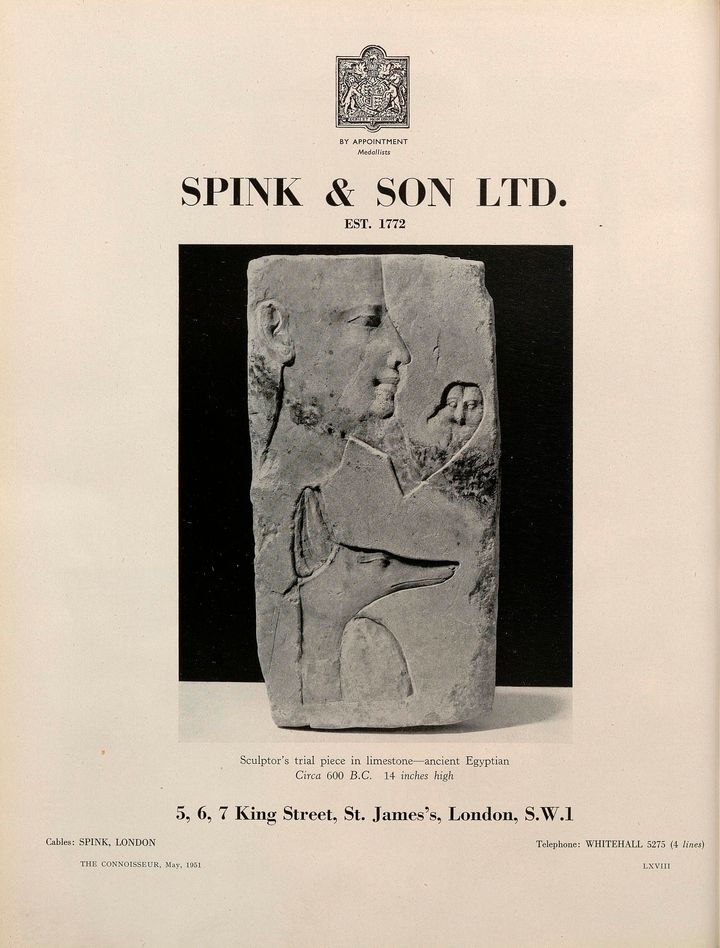
Interior Design Illustrations
The history of visitors to private houses publishing or illustrating details from those houses’ collections stretches back centuries.187 More recently, publications like House and Garden, Country Life, Vogue, and Architectural Digest highlight interior design and architectural advances while showcasing art collections (fig. 43). Real estate photography offers an additional resource. The owners might be dealers,188 celebrities,189 or private individuals,190 but they are often described in generic and anonymous terms, and the location of the collection may not be fully disclosed.191 Art collections visible in illustrations, but outside the focus of an article, may not be referenced within searchable text, and search strategies will need to accommodate this.
Part 3: Processing and Publishing Provenance Information
Thus far, we have discussed initial project considerations as part of your project’s methodology, as well as sources of provenance information. In this final section, we discuss assessing, processing, and publishing provenance data for use in different spaces.
As noted, some provenance projects will have a predetermined output format, with research designated for use within a specific catalogue or project. But all provenance research should be conducted with the understanding that it will be analyzed, reused, and reconsidered for decades to come. Rarely will it be utilized in a single format or for one project alone, regardless of its initial scope. Condensing complex research outcomes from decades of accumulated research into a single narrative and rendering these useful for diverse purposes poses many challenges, and it requires careful consideration of space, audience, and object needs.
Today, provenance information appears in myriad contexts in both museum and external spaces, tailored for different audiences and themes. The benefits of sharing this information are clear, but there are logistical issues involved. Whoever selects and edits the information will often not be the provenance researcher, and while an update to an object record is simple, rewriting a gallery label to accommodate provenance updates is less so.
The internal collection database of a museum—often referred to as its collection management system (CMS)—is usually the hub of provenance research. Ideally, it holds the most up-to-date information and allows for citing or linking to relevant sources. That said, outside researchers interested in an object should always confirm the latest version of its provenance with the relevant department. The internal collection database may feed into the online collection pages, which render collection data accessible to the public through museum websites and apps as well as through more advanced options like APIs (application programming interfaces).192 In addition to basic object information, the online collection page is traditionally where a full provenance narrative is presented, as discussed more fully below.
Publications offer another place for displaying provenance information. These exist in traditional print formats like scholarly books and articles, museum journals or member periodicals, or, less formally, as museum blogs, press releases, podcasts, and social media posts.193 Publications by authors not affiliated with the owning institution may not always be consistent with the museum’s provenance information, either because the author has neglected to consult the most up-to-date records, or, conversely, because their research has brought new information to light. Provenance might also be discussed in media outlets and involve conversations with museum staff or external researchers. Publications, both print and digital, are static markers of a provenance narrative at the time of publication; they rarely capture the ongoing nature of provenance research.
Within the physical space of the museum, elements of provenance information may be referenced in gallery texts, object labels, or resources, as well as online in digital exhibitions, tours, and educational material. Some special exhibitions or gallery spaces offer more interactive or expansive opportunities to explore elements of an object’s provenance,194 but given space constraints, these often privilege one section or theme in an object’s history. A notable exception was the 2019–20 exhibition Bouguereau & America, jointly organized by the Milwaukee Art Museum and the Memphis Brooks Museum of Art in Memphis, Tennessee, which included iPads that offered interactive provenance timelines for many of the artworks.195 Increasingly popular, provenance-themed exhibitions around dealers and collectors, excavations, cultural heritage, and heritage loss offer additional pathways for discussing provenance in museum galleries.196 Exhibitions like 2022’s Particular Histories: Provenance Research in African Arts at the Fowler Museum of Art brought together an exploration of a physical archive, objects, and provenance research with an in-gallery monitor allowing visitors to explore provenance-themed Story Maps.197
Making provenance data available in such formats means letting go. Because provenance can be shared in so many ways, and because it is relevant to so many departments and audiences, it is impossible for the provenance researcher to control how the data will be interpreted or reused. But by making your own research as clear and accessible as possible, you can ensure that there is a solid foundation for all parties to draw upon.
Consider the Mazarin Venus (54.AA.11; fig. 44),198 thought to have been found in Rome by 1510199 and on view at the Getty for seven decades. Throughout that time, its display, gallery labels, and audio guides have addressed different aspects of its lengthy ownership history. Notably, its sobriquet, the Mazarin Venus, reflects a said-to-be provenance: although associated with the Mazarin collection in Paris for over a century, no evidence for this has ever been discovered. But as the statue has been known by variants of the name “Mazarin Venus” since the 1800s, this historic association persists, despite being at odds with the documented provenance. In the gallery labels, preeminence instead has often been given to the earliest known depiction of the statue from 1509/10 by Giovanni Antonia da Brescia, even though this engraving is highly stylized and it both imagines and elides key elements of the statue as it appeared at the time of its discovery.
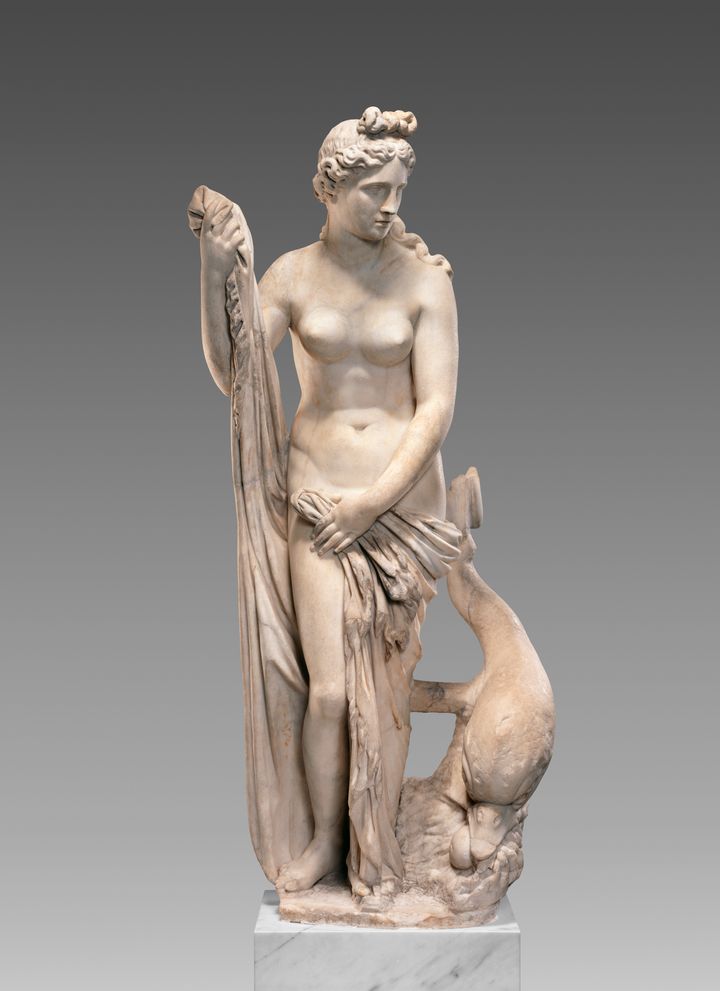
Viewers encountering the statue through the museum’s online collection pages will find extensive provenance information, which draws from our internal collection management system, The Museum System (TMS), and is regularly updated. In the public-facing Provenance field, we provide a chronological outline of the statue’s discovery and acquisition, structured according to an in-house syntax style that is explained on the museum’s website.200 But in the online record, Provenance is not the only place to look: references to the statue’s history appear in other sections, like the Description. Other fields from the database feed into the Provenance section online, such as Place Found and Date: Found In; and on the back end, other sections of the database such as Exhibitions and Bibliography, are all connected (fig. 45). Although these backend structures are largely invisible to outside viewers, they impact the way the data display. An in-house user of collection page data should make sure to include all of these related fields and must be aware that a change in one field may require changes in complementary fields.
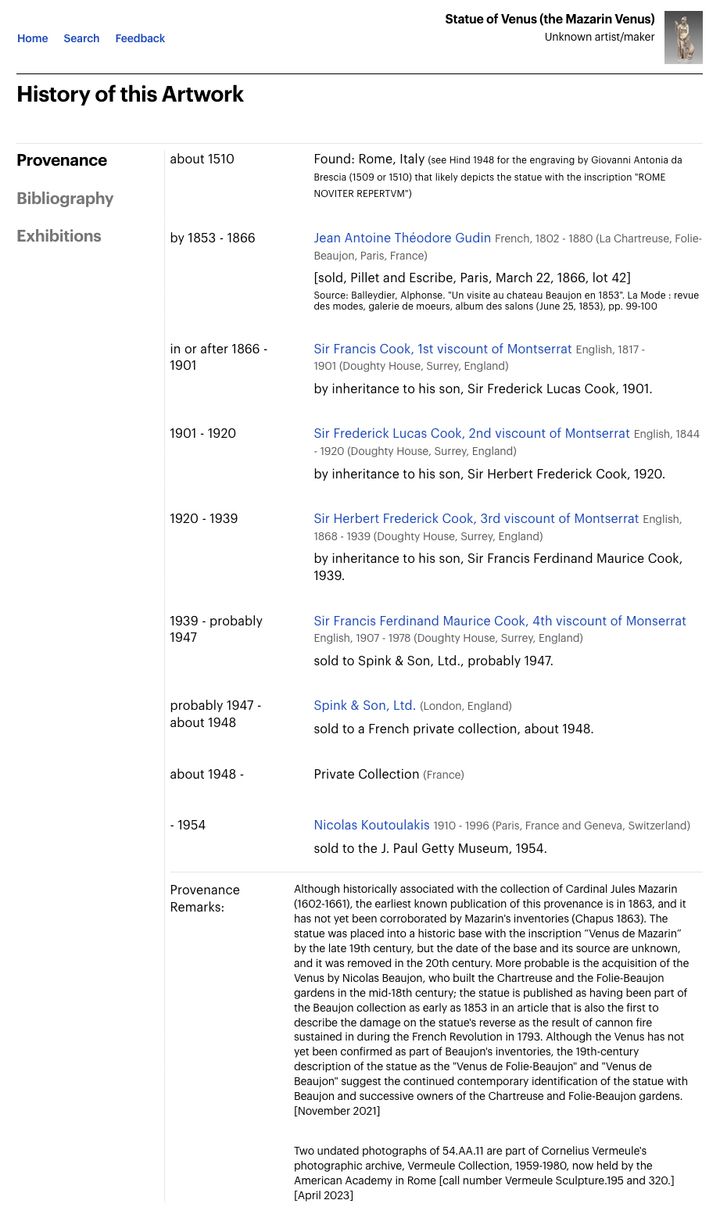
The collection page for each object thus collates many kinds of provenance information and, depending on the object in question, there may be links to in-house guidebooks, academic publications, newspaper articles, auction catalogues, audio guides, and more. But the collection page can still only tell a limited number of provenance stories; it cannot fully track changes to the object’s record or its label text over time, nor does it replace scholarly discussions of provenance as seen in publications like collection catalogues. Even within the display and collection pages for a single object in the museum, provenance is used and discussed in many ways.
Provenance Syntax
We use “provenance syntax” to describe the particular structure and language used for provenance narratives within a project or institution. Where possible, we encourage you to include a guide to provenance syntax as part of your project, particularly if it expands on existing institutional formats. This serves as a record of your research methodology and ensures that users will be able to better understand and analyze the resulting provenance. To that point, readers of provenances or those working with large provenance datasets should be aware that the way provenance research is conducted—and the way information is vetted, verified, and described—will also differ between institutions and even departments. Comparing provenances of objects in different collections requires consideration of the research from which the provenance narrative is distilled, as well as the way that narrative is formatted. There is no singular format or style guide for provenance, and institutions and researchers are free to choose the way in which they publish this information—although the general guidelines in the American Alliance of Museums’ AAM Guide to Provenance Research have been widely taken up as a set of best practices in U.S. institutions since 2001:
Provenance information should be presented in a clear and organized fashion and be as complete as possible. The sequence of ownership should be easily understood. The order of ownership may be earliest to latest owner, or the reverse, as long as the chronology is obvious. There should be some mechanism by which owners are distinguished from dealers or auctioneers. The sources of information about each owner or transaction should be documented. In publishing provenance information, the museum should include an explanation of its format.201
The AAM lays out a further list of twenty types of object and provenance data that should be accessible in order to aid in identifying objects; although written in the context of World War II–era research, it can be used more widely.202 Whatever shape your provenance narrative takes, easily accessible explanations of its syntax and formatting are key.
Many provenance style guides are focused on provenance—that is to say, a narrative structured around changes in ownership. For ancient objects, this means that syntax standards for provenience—information regarding an object’s documented findspot—have been largely overlooked and handled at an institutional, departmental, or ad hoc level. Other events that inform an object’s biography, such as restoration or modern fragmentation, are also often omitted from traditional provenance narratives.203 Few models exist for describing the provenance of an object where there are multiple histories for its different fragments, or where the object itself is but one known fragment of a since-dispersed original.204 Likewise, provenance narratives rarely capture data for associated objects, such as connected building fragments or documented tomb groups, although this data may be linked in other fields. Models like Fragmentarium, a digital laboratory reuniting manuscript fragments from all over the world, hint at new futures for structuring this research.205
If you are constructing a provenance syntax guide from scratch or looking to update an existing version, the Carnegie Museum of Art’s (CMOA) Provenance Standard offers an excellent model, bridging the semantic world of the CIDOC (Comité International pour la Documentation) Conceptual Reference Model (CIDOC-CRM) and traditional provenance narratives.206 The CMOA Provenance Standard is based on the punctuation format of provenance, which we return to below, and offers a cogent explanation of terms, usage, and linked data. Using structured data and incorporating Linked Open Data (LOD) as part of your records can be a challenge depending on your project and underlying database, but it provides benefits when considering provenance at a mass scale or when contrasting provenance between collections. Additional standardized syntax options for methods of acquisition can be explored through the Getty Research Institute’s Art & Architecture Thesaurus (AAT), a “structured vocabulary for describing and indexing the visual arts and architecture,” and as part of LOD projects, local terms and datasets can be reconciled by using the open-source tool Open Refine.207 The AAT section for Methods of Acquisition and other related terms can provide additional options for building out a provenance syntax.208
Punctuation Marks or Chronological Listing
One widely used format for presenting provenance information indicates ownership transitions and other data using punctuation marks. This method is outlined in the AAM Guide to Provenance Research, the IFAR Guide to Provenance,209 and other provenance manuals. It evolved in the 1970s and ’80s, but its application in publications of Mediterranean antiquities has been limited.210 A common element is the use of a semicolon to denote a direct transfer of ownership between two constituents, and a period in the same position to indicate a lack of evidence for a direct transfer, or a gap. Further iterations include the use of brackets for owner life dates and other contextual information. Commercial owners—as opposed to institutional or private owners—may be indicated through punctuation marks like parentheses and brackets, or otherwise denoted. Other kinds of punctuation, including question marks, are employed to indicate uncertainty or a lack of information. Footnotes provide space for source notes and explanatory text. Constituents can appear on separate lines, or, as in this example for a mosaic in the Getty’s collection (62.AH.2), run together in the text:
Albert Vassy [Vienne, France] and Claudius Guy [Vienne, France], 1911 - still in 1913.1 (Désiré Weidinger [Paris, France]); (Joseph Brummer [1883–1947]), 1927.2
- Vassy and Guy lifted the mosaics in 1912, and moved them to their property by 1913.
- The Brummer Gallery Records, Metropolitan Museum of Art, Purchase Book 1927–1928, p. 29, no. P4136.
The compact nature of this format is useful for many kinds of provenance narratives, particularly in publications in which the provenance of a number of objects is briefly referenced. But the need to understand what each punctuation mark denotes and the levels of provenance data encoded in these narratives (which differ even among similar institutions) leaves this format opaque to many nonspecialists. Some publications also use semicolons to indicate sequential ownership of objects without implying specific transfer details. To ensure clarity, refer to the institution or writer’s own guide to their usage and syntax.
Other institutions, including the Getty Museum, use chronological lists to present provenance information, with different circumstances of transfer explained using a standardized syntax system. Additional information can be supplied in a source note below the transfer within the overall narrative. Using this chronological system with the Getty’s own syntax, the provenance described above would look like this:
| Dates | Provenance Information |
|---|---|
| 1911 - still in 1913 | Albert Vassy (Vienne, France) and Claudius Guy (Vienne, France) lifted the mosaics in 1912, and moved them to their property by 1913. |
| - 1927 | Désiré Weidinger, French, (Paris, France), sold to Joseph Brummer, 1927. Source: The Brummer Gallery Records, Metropolitan Museum of Art, Purchase Book 1927–1928, p. 29, no. P4136. |
Because circumstances under which ownership or custody of an object is transferred can vary across a wide spectrum, so too do the forms of syntax used to document them. For instance, another mosaic now at the Getty (71.AH.106) was discovered but later reburied; the land, including the mosaic, was sold, and the mosaic only uncovered and lifted from the ground eighty years after its initial discovery.211 Capturing the complexity of this information while adhering to a standard syntax—particularly in the cases of complex objects with centuries of history, restoration, and reuse—can be a formidable task.
Whatever system you employ for your project, it will need to be flexible enough to encompass your dataset’s provenance needs, and it will also need to be compatible with any preexisting institutional formats or standards. As noted earlier, information relevant to an object’s provenance or findspot may appear in multiple places throughout the collection pages. Where published information on the object is dispersed across an institution’s website, we suggest compiling it and assessing whether there are ways to unite or document any provenance-related information together. Within an institution, past iterations of published provenance should ideally be tracked for reference.
Gaps in Provenance
That gaps exist in a provenance narrative is perhaps axiomatic—if this research were not still required, this publication and others like it would not exist. Gaps in a provenance may represent a lack of evidence, incomplete research, inconclusive documentation, or the existence of multiple possibilities. A gap can thus mark a true unknown or represent something as yet unexplored. In presenting provenance information, gaps are often implicit: when using the punctuation mark system, a period between two constituents indicates that it was not a direct transfer, or is simply a sequence of ownership dates that do not align. Any research that has sought to fill this gap does not usually appear in full in a provenance narrative, but it may be described in footnotes. Certain kinds of gaps, notably those for the years during World War II and the preceding Nazi era, may be flagged and searchable in a museum’s collection page, or presented separately.212
It is possible that the status of gaps in museum provenance information is at a turning point, as institutions create new syntax and technical solutions for making these “known unknowns” evident. For example, the Städel Museum in Frankfurt, Germany, has introduced the use of ellipses as a “placeholder” to acknowledge gaps in a provenance.213 Another option comes from the Hood Museum at Dartmouth, where some provenances begin with: “Collected by an unknown antiquities dealer, date unknown.”214 The Brooklyn Museum in New York uses “archaeological provenance not yet documented” for antiquities with “no recorded archaeological context.”215 The North Carolina Museum of Art in Raleigh uses syntax guidelines for antiquities that differentiate between “Provenience unknown,” “Possible Provenience,” “Provenience (recorded),” and “Provenience (excavated)”.216 These options acknowledge that an object’s modern discovery took place, even if the details are unrecorded or presently unknown, rather than defaulting to the first identified collector or dealer as the start of a provenance record.
Special Consideration for Antiquities: Assessing Findspot
Documentation
Apart from some gems, precious luxury objects, and a very small number of famous sculptures,217 the vast majority of Mediterranean antiquities preserved today spent centuries underground, whether through intentional deposition, a chance event like the volcanic eruption of Vesuvius in 79 CE, or passively over time. Even a general place of discovery can provide essential information about the object, such as its likely culture or date, and knowing a specific findspot can reveal more about its ancient use and context. Place of discovery is thus a critical element of an ancient object’s provenance, and some scholars use the specific term “provenience” to denote a findspot. Unfortunately, however, given centuries of illicit or poorly documented excavations, it remains hard, if not impossible, to trace every object’s history back to the point—in both space and time—that it was unearthed. Excavations also do not solely produce contextualized material. A collection associated with an excavation could still include surface finds, objects from spoil heaps, and other ancillary materials. Precision in labeling such circumstances will help clarify these factors for researchers.
In some cases, an object’s findspot is closely linked with its first owner. Some collectors acquired works from finds on their own property, such as Lucien Bonaparte, Prince of Canino (1775–1840), whose collection of Greek vases came primarily from his estate in Italy near ancient Vulci.218 Note, however, that the act of excavation is not always connected to ownership; excavators are rarely owners, even if, through affiliation, the excavation leader often appears as the only name in publications and provenances. Such a simplification often erases the number of individuals involved in an excavation, something increasingly being reexamined within museum settings. The practice of focusing on a singular excavator can also obfuscate the actual ownership of an object. One has only to look at the number of objects in twentieth-century auction catalogues that provide a provenance simply of “Petrie”—shorthand for Flinders Petrie, one of the most influential British Egyptologists of the nineteenth and early twentieth centuries—without further reference to site, excavation date, or the Egyptian Exploration Society. Here a connection to a “celebrity” excavator superseded all other data.219
Antiquities may be documented for the first time in a known place or at a secure date, but additional provenance data points, such as the exact location or ownership of the object at the time, may not be clear. For instance, the Grave Stele of Herophanta and Posideos (71.AA.288)220 was recorded at some point before 1715 by Paul Lucas. He viewed it while traveling in Smyrna, and later published a heavily stylized and somewhat incomplete rendering of the stele in 1720.221 The condition of the object, as well as the actual date of observation and its ownership, are all unknown. “Before 1715” serves as the earliest known date by which the stele was observed, but this should be distinguished from its (as yet unknown) date of discovery and not used to infer ownership. Other early eighteenth-century travelers like William Sherard recorded the stele’s inscription and its Smyrna locale, but without any description or depiction of the stele’s face.222 Nor is this truly findspot data, because the stele’s context—whether it was still partially buried, uncovered, reused, or moved—is likewise lacking from the text. What we know is only that it was visible in this place before a certain date. In the Getty’s database, we record this using the Place Found field, which is the closest match for this use case.
Documented and Said-to-Be Findspots
Depending on the year and location that an antiquity is found, officially excavated material typically remains in the country of discovery.223 Here, “officially excavated” refers to all legally sanctioned excavations, including those privately funded by or in agreement with the landowner, sponsored by the local or national government, or supported by foreign archaeological interest groups in partnership with local authorities. The excavations themselves might range from a quick rescue survey to a multiyear scientific excavation campaign.
For material from officially sponsored archaeological excavations, findspot data might be preserved in the object record, in unpublished archives, or in published excavation reports. The depth and completeness of such resources varies depending on the excavation year, location, object type, and the reason for the excavation (chance find, rescue excavation, or an academic expedition). Foundational collections of reports include the Bullettino dell’Istituto di Corrispondenza Archeologica (1829–80s), which focused on excavations and finds in Italy, the Archäologischer Anzeiger,224 and the Giornale degli scavi di Pompei (1850–79), which was incorporated into the Notizie degli scavi di antichità (1876–1930). These and similar archival materials are invaluable in reconstructing original tomb groups, associations, and other contextual information. There is a long history of scholarship investigating these resources to connect objects with their early descriptions.225
The Roman mosaics in the Getty collection present an instructive range of findspot data, from fully documented excavations to alleged origins.226 As an example of the former, a Mosaic Floor with Animals (70.AH.96)227 was discovered in 1938 during the Princeton University–led excavation of Antioch-on-the-Orontes (1932–39), a partnership between museums and the Syrian Antiquities Service.228 The excavations were documented and published, allowing for the Getty mosaic and others from the same bath complex, now dispersed, to be understood in their original spatial context.229 One panel of the mosaic even has its excavation cataloguing information handwritten on the reverse, “RM.2 b 367 143-E,” which corresponds with an Antioch find card in Princeton’s archives of the excavation.230
For finds made outside of official excavation expeditions, records of their discovery can often be found in antiquities periodicals, newspapers, or comprehensive object surveys in academic corpora and inventories. The Getty’s mosaic with Orpheus and the Animals (62.AH.2)231 was such a chance find, discovered in 1899 by a farmhand on private property in Saint-Romain-en-Gal, France. In 1911 the landowner sold the rights to fully unearth and lift any mosaics found on the property, and in 1913 they were excavated and ultimately sold. The finds were included in France’s official mosaic corpus publication as a recent discovery when still in situ, and once excavated, were published in archaeological periodicals and science association proceedings.232 Since its founding in the early twentieth century, the Gallia corpus—an ambitious French project documenting all known ancient mosaics in Gaul and Roman Africa—has published nearly three thousand mosaics from over a thousand sites.233 In recent years, especially as copyright protections on some publications expire and they enter the public domain, many of these resources and associated archives have been extensively digitized, allowing for the discovery of additional bibliography and information about the mosaics’ spatial context.234
Local cultural property laws at the time of discovery can account for the dispersal of objects originally discovered together. The Antioch Mosaic Floor with Animals (70.AH.96) left Syria through a partage agreement.235 Mosaics from the same bath complex were studied as a group and then systematically dispersed to museums in Syria and the United States. Conversely, the Orpheus mosaic (62.AH.2), lifted as part of a private excavation, was offered on the art market with other mosaics from the same villa, resulting in their poorly documented dispersal to both public and private collections over the course of several years. It is worth noting that partage objects, while generally well documented in their initial dispersal to private individuals and institutions, can likewise be poorly documented in secondary sale through the art market.236
In the case of the Mosaic of a Lion Attacking an Onager (73.AH.75),237 from Tunisia, there are two conflicting references to its findspot. Both date to the 1960s, nearly fifty years after the mosaic’s reported discovery. Its first publication, the thoroughly researched 1960 Inventaire des mosaïques gave the findspot in central Sousse, near avenue Tahar-Sfar (formerly avenue Marechal-Fochs). A 1961 Dijon newspaper also reported the mosaic’s discovery in Sousse. A copy of the newspaper clipping preserved in the Getty Museum object file, however, has an attached note, written in French, which specified an area in the outskirts of the city.238 These sources leave the mosaic’s exact place of recovery uncertain, and a similar scenario holds for numerous other objects whose findspot is not properly documented, is vague, or is prefaced by “said to be” or “allegedly.” Indeed, in many cases, the said-to-be information can be misleading. The Mosaic Panel of a Griffin (71.AH.113)239 was first published by the Getty in 1973 with a said-to-be findspot in an early Christian church in Homs, Syria. While possibly from Syria, the griffin is shown with the spoked wheel of the god Nemesis, an attribute not found in other representations of griffins from church contexts, making the purported findspot highly suspect. This detail seems to have been incorrectly attributed or invented by the dealer, who had offered and sold other mosaics for which a church context seems plausible, given their iconography and style.240
Said-to-be findspot information is often repeated by collectors and dealers without supporting documentation.241 The resale of ancient objects with invented or unconfirmed findspots is a practice dating back centuries,242 and findspots may be added as a false form of authenticity to infer a legal status or increase value, regardless of their veracity. A marble torso of Aphrodite (67.AK.12)243 has contradictory notes in our records that state “said to have been found in South Italy, in 1851 (?)” and “reputed to have been found in the sea at Anzio.” Both statements are false: the object is now recognized as a modern forgery and is identified as “Imitation of a Statue of Aphrodite, 19th century.”
Nevertheless, while a said-to-be findspot must certainly not be taken at face value, it remains valuable for research and for seeing market patterns over time, allowing for the possibility to connect objects or to provide a lead if new resources are made available. Thus, the said-to-be findspot should be fully researched, recorded, and then presented with necessary disclaimers. This takes up space, whether in a specialized publication or a dedicated gallery label, but museums have an ethical duty to the objects in their care to determine and document their histories, whether fabricated, problematic, well established, or unknown.
Terminology for Findspots
Below we lay out some terms applicable to the findspots of antiquities. These should be considered as options alongside the terminology suggested by the CMOA Provenance Standard, the AAT, and other existing provenance guides. For your own syntax guide you should work out details of how you want to implement and use the terms you choose.
Assumptions of an object’s place of discovery based on its style or its place of production should not be conflated with firm information relating to its findspot or place of first observation. Unconfirmed data from any source should be discussed as such, particularly if it has previously been published without context. If an object has previously published findspot information that has since been discarded or updated, this change should be indicated in records as well.
If working with a CMS or a project form that lacks clear fields for findspot, or if your findspot data will be entered as part of a free-form field together with provenance information, consider using notes and footnotes for any points of clarification. This kind of information may already be present as legacy data.244 Where possible, this should be revised to reflect the latest museum practices, since when left unchanged or unclarified, such legacy data can be misinterpreted as the current understanding of an object’s findspot.
Your syntax might consider the following terms for location-specific findspot references:
Place found Include this if the place that an object was found is documented in a concrete way. If the object was found in an ancient context and remains in place, not reused or moved in modern times, the term “in situ” may be included. Historical documentation of discovery or excavation is hard to confirm and may be limited to a broad geographic area rather than a specific location or context; documentation of the sources is particularly important here.245 If working with modern excavation data, some synthesis will be required if word limits exist on fields. Bibliography relating to the first documentation of (or reference to) the place found should be provided. Where possible, consider including references to publications of the excavation even if the particular object is not included there, so that the object’s history can be understood within this greater context. Unconfirmed or said-to-be “place found” information should not be treated as equivalent to a documented findspot or excavation.
Place observed in As noted in the case of the Grave Stele of Herophanta and Posideos (71.AA.288)246 seen in Smyrna “before 1715,” it may only be possible to locate the earliest record of an object at the place where it was first seen. This should not be conflated with place of discovery, unless there is evidence that they are the same.
Date discovered or observed These dates should be clearly documented and citations provided.
Act of excavation or removal The method and type of removal, if known, should be specified. Excavation implies a controlled or documented site recovery. If the method of removal is unknown but the act itself is clear, this should be apparent in your notes. As mentioned above, you should also indicate if information regarding an object’s excavation or discovery is lacking.
Reburial Once discovered, objects can also be reburied; this is particularly common with mosaics.247
Uncovered Objects can also be uncovered but left in situ, either partially or entirely exposed.
Beyond Provenance and Provenience
Other events following an object’s discovery are important for ascertaining its history, if not its provenance. These are separate from ownership transfers but may be part of the evidence you consider and include along with provenance data.
Object broken or fragmented Ancient breakage of objects can reflect anything from ritual processes to accidental breakage during deposition. Modern breakages resulting in the dispersal of related fragments from a single object should also be noted.248
Object interventions: Restoration and mounting Ancient objects are frequently palimpsests of restoration and conservation campaigns, which may themselves be ancient in date.249 Fragments from disparate ancient works may also have been recomposed into modern pastiches.250 How an object was fitted for a mount and the kind of mount itself can indicate a date, although this is circumstantial without external confirmation.251 The makers of many mounts are as yet unknown, although Kichizô Inagaki, who was active in Paris during the early twentieth century, stands out, in part due to several stamps associated with him (fig. 46).252 Alien restorations or mounts can also be documented at one point and later removed, while drilling for new mounts often eradicates evidence of earlier mounts or interventions.
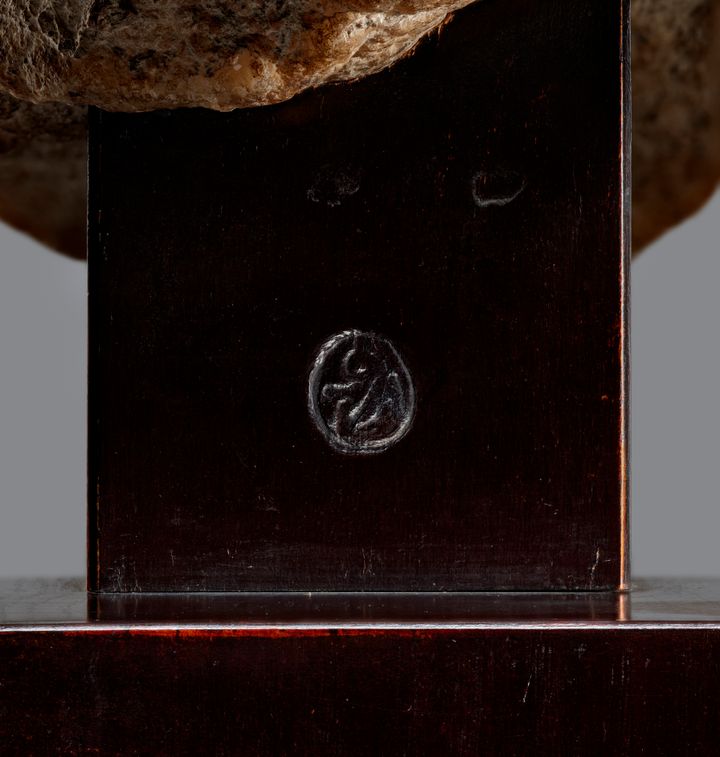
Credit Lines and Accession Numbers
Credit lines are often overlooked, are rarely explained, and may be misleading to museum visitors. They are public acknowledgements on labels or collection pages that indicate the donor of the work of art or funding source of its acquisition, as well as the kind of transfer involved: by exchange, gift, bequest, and so on. Despite their brevity, credit lines are complementary to provenance, but they should not be taken for a provenance narrative. The respective functions of the two diverge in significant ways, and they often fall within the purview of different museum departments. Credit lines may be more visible than provenance narratives, since institutional policies and legal contracts often mandate their use. They can also distinguish objects on loan from private collections and other institutions from those in a museum’s permanent collection, and they may embed further information on behalf of those institutions.
An accession number, the number assigned to each specific object in a collection, can likewise be conflated with provenance data. These numbers may or may not relate to the year of acquisition (though the first digits in the Getty’s accession numbers do) or serve to group a donation together. Numbering systems vary widely between institutions.
Processing: From Back End to Users
There are more than a dozen collection management systems (CMS) in use for museum collections around the world, including TMS, Embark, Mimsy, Emu, Collective Access, and Past Perfect, and they all process and present provenance in different ways. Even two museums using the same software may have radically different ways of fielding and presenting provenance data, both in-house and publicly. This bears stressing, as provenance formats and their appearance online are often governed by the format of the CMS, as well as by the interaction of the CMS with the public-facing collection pages.253
Provenance information may be documented in a CMS as a free-form text field, or, as at the Getty, in a variety of fields, including Place Found; Date Found In; Constituents; Curatorial Remarks; and Provenance Remarks (some of these are shown in fig. 47). Most of these fields in turn have separate subfield options nested beneath them, all of which appear online as a cohesive block.
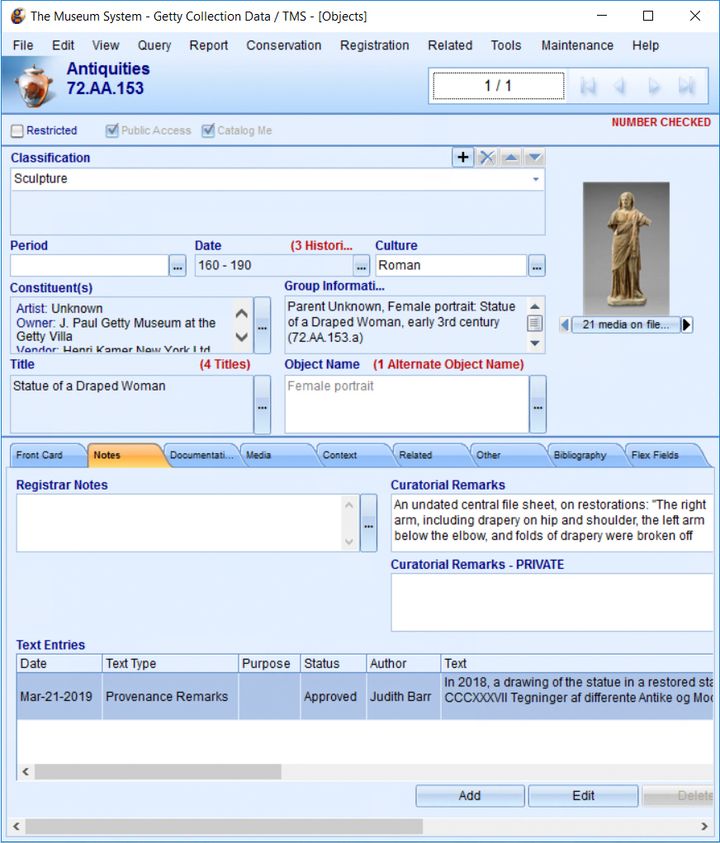
Because museum collection databases often need to accommodate a variety of collections, particularly in larger institutions, some have more robust fields relating to findspots (especially excavation data) and provenance than others, although not all may appear online. If you are creating or adapting a provenance syntax guide for a collection, you will need to map the relevant fields in both your current CMS and its public view.
Tracking Provenance Versions
The cyclical nature of provenance research, often conducted and revisited over years, is a critical dimension that is all too often absent from public presentations of provenance information. Because these necessarily present the most up-to-date research, any acknowledgment of older versions of the provenance text is frequently excluded. For those working in a collection database, few provenance syntaxes or CMS fields allow for the automatic inclusion of information about changes to a previously published provenance.254 These edits, as we see throughout this book, may have been made for any number of reasons—fixing typos, introducing new material, correcting an older error. The introduction of a Date last updated is one way to signal that research is ongoing, but this too can oversimplify the duration of research; it also does not report the scope of updates, only their occurrence. As a general practice, updates and changes should be documented as much as possible in internal notes. In our own records, we are working to include mention of unverified or erroneous provenance information that has been given in previous publications in order to clarify our current understanding of an object’s history.
Case Study: A Silver Bull Statuette
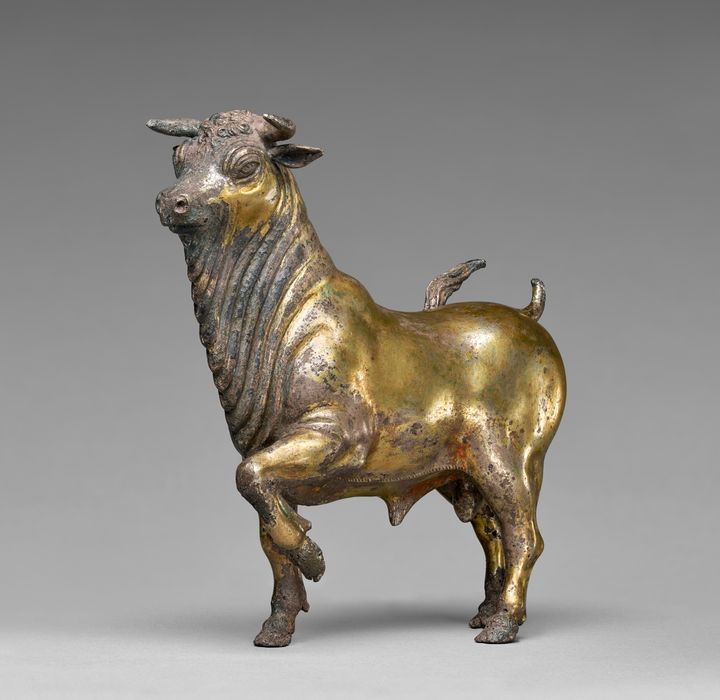
As noted at many points in this chapter, ancient objects often accrue said-to-be and other unconfirmed information about their manufacture, findspot, or provenance. Such information raises many questions, which can rarely be answered: Said by whom? When? Why? Unfortunately, said-to-be information is often treated as factual over time, regardless of its own provenance.255 Recording unconfirmed information offers an opportunity for understanding broader market or dealer patterns, but it should be clearly labeled and contextualized to prevent it from being read as likely or factual. Footnotes within a provenance narrative offer space to clarify these gray areas and document changes that have been made to an object’s provenance, but they do not capture all questions raised. The blurred lines between possibly verified, plausible, or doubtful evidence—and the challenges of presenting this information—are particularly evident in relation to a gilt silver Statuette of a Bull (2001.7; fig. 48),256 for which an exciting said-to-be provenance had been accepted at face value.
According to its 2001 acquisition report, this bull “was discovered in Pompeii between 1780 and 1790 and became part of the collection of Maria Christina of Savoy (1812–1835),” a history that has been repeated in subsequent publications and gallery labels.257 Popular for its high quality and apparent Pompeian origins, the statuette has been on display regularly since its acquisition and was among the first objects to have its provenance reviewed and approved for the Getty’s online collection pages in 2012. At that time, cross-checking Getty records with sales catalogues and genealogical records left no reason to doubt the given provenance. We have periodically revisited some of the earliest approved records since having “no reason to doubt” a statement is different from verifying it or determining it highly plausible through secondary sources. Where exactly did the story of its Pompeiian discovery and royal ownership come from?
The earliest known publication of the bull is a 1997 Christie’s sales catalogue, which gives the following provenance:
Said to have been found at Pompei circa 1780–1790, and later in the collection of Maria Cristina di Savoia. Subsequently inherited by Tomaso di Savoia, and then his daughter Maria Adelaide di Savoia. Later in the collections of Vgs Parsi di Londrone, a Swiss private collector, and Sogo Life K.K.
Complicating matters, Christie’s online record of the auction preserves a provenance statement that matches the print version except for its first sentence, which runs: “Found at Pompei circa 1780–1790 during excavations conducted at the request of Maria Cristina di Savoia, Queen of Naples.”258 A third provenance statement, in a Robin Symes exhibition catalogue entry, muddies things further: “Formerly in the collection of Maria Christina of Savoy, the silver figure was discovered in Pompeii between 1780–1790.”259
So, was the statue “said to have been found” or definitively “found” in Pompeii? And did Maria Cristina di Savoia request excavations that led to the bull’s discovery, or did it enter her collection sometime later? Clearly a full audit of the provenance statement was needed. The first step was to confirm the identities of the previous owners, their life dates, and the given line of inheritance. This research relied on online resources and published genealogies to build up a family tree for all possible constituents.260 This review revealed confusion over the identity of Maria Cristina di Savoia, who, based on lines of descent, is now recognized as Maria Cristina di Borbone-Napoli (1779–1849).261 There is still no secondary evidence confirming the early history of the bull, however; there is no mention of it in publications of Savoy family collections, nor in the Pompeiian excavation records that we have reviewed thus far.
We contacted Christie’s for additional information on the origin of the provenance statement and received confirmation that according to the object’s consignor, the bull was previously owned by Kojiro Ishiguro (1916–1992), who wrote a provenance statement similar to the one in Christie’s online auction record. If this statement was indeed drafted by Ishiguro, it would be the earliest version, written before his death in 1992, and thus before the Christie’s 1997 catalogue. A well-known antiquities collector and dealer in Japan, Ishiguro was active in Paris during the 1950s and ’60s and continued buying art until the end of his life.262 His collection has been published on a few occasions, but we have found no additional documentation of the silver bull.
Given the possible, but still unverified, nature of the silver bull’s provenance, how do we best serve the object and its history? Despite some initial genealogical confusion, the Savoy family line of inheritance checks out, and yet the earliest evidence is essentially hearsay—a consignor’s account of a deceased former owner’s statement. While valuable, this history is qualified on the object’s online collection page, with extensive provenance remarks explaining the Christie’s provenance statement, its possible interpretation, and the likely, but as yet unverified, earlier history.263 And in making these remarks searchable and public, we hope this provenance can be further scrutinized, researched, and revised as more resources become available.
Provenance Data beyond the Collection Management System
Publishing provenance data online is just one step toward making it accessible for research. Increasingly, institutions have hosted collection information as GitHub264 repositories of data and made APIs available for their collection databases. These tools allow interested parties to utilize provenance information for large-scale research into the art market and data mapping.265
If you are writing a provenance narrative or incorporating provenance data in different database fields, consider how that data will be split up and represented in these systems. Will the provenance data be included at all? Are there hyperlinks, source notes, or other internal links that are part of reading the provenance? Is provenance data contained in a single field, or is relevant material split across different fields? Is this clear in the output from these systems?
Likewise, users of this kind of dataset should confirm whether other applicable data exists elsewhere in the record. Information relevant to provenance may be fragmented across a single object’s collection record, so consider descriptions of marks, explanatory background present in the description, exhibition history, and bibliographic data, as well as any listed caveats. The technological or syntactical limitations of different database fields over time may contribute to this fragmentation, as the provenance narrative field rarely exists as a stand-alone dataset.
Information from different institutions will likely need to be standardized before these different models and syntaxes can be compared against each other. This is not to say that these datasets do not hold great promise for understanding the art market and different aspects of the development of museum collections, but understanding how museum methodologies differ from one another is an important part of this research.
Linking with Other Objects and Collections
Even in researching the provenance of just one object, the interconnectedness of object histories quickly becomes apparent. There exist many levels of networks, starting from the object itself, which may be fragmented or part of a whole, and extending to its discovery context, categorization, collecting history, display, exhibition, and current location. While these networks can connect objects in distant collections, visualizing these links can be difficult with current collection database systems.
Looking ahead, linking out and between collections is an area where provenance research has room to grow, in order to find solutions to the roadblocks of incomplete databases and broken links.266 Though a work in progress, hyperlinking to related records at other museums has been done on some Getty collection pages. One example is the Sarcophagus Panel with a Wool Merchant (86.AA.701),267 which is related to a panel in Stockholm’s Museum of Mediterranean Antiquities; this relationship is now indicated through a hyperlink in the object description online.268 In the meantime, putting all the identifying information about related objects in a public object record (and linking out to relevant resources, if possible) is a good start.
Deaccessioned Works
American museums and cultural institutions have been deaccessioning works from their holdings, including antiquities, for at least a century. This involves officially removing them from the collection and then disposing of them in whatever way is appropriate for their situation (though sometimes retaining them for another museum purpose outside of the permanent collection). There are many reasons for deaccessioning: an object is in poor condition; it no longer supports the mission of the museum; it has been determined to be a forgery; it has been identified as an illicit or unethical acquisition; it is being repatriated or restituted; or its sale could raise needed funds for future acquisitions or collection care.269 In the past, the deaccession process was less formalized than it is today, and even for deaccessioned collections sold at auction the name of the collection in question was not always given, and information about its provenance and reason for disposal may not have been specified.270 In some cases, records about past deaccessions and sales are accessible through the original institution, which may be able to share additional information. Those records may no longer exist, however, and in the absence of a photograph or detailed description, it is not always possible to confirm that the object in question is the one described. Where possible, past deaccession information should be included as part of an object’s current provenance, and any prior accession numbers or labels fully documented.
Institutions today are guided in the practice of deaccessioning by different organizational and professional guidelines. Many American museums follow the Association of Art Museum Directors (AAMD) policy on deaccessioning, released in 2010 and included in the Association of Academic Museums and Galleries’ updated 2022 Professional Practices in Art Museums.271 While the AAMD’s policy does not focus on the public presentation of provenance, part of its statement does include a provision that deaccessioned works, regardless of the reason they were deaccessioned, should be published on the museum’s website.272 Internal documentation of objects, including record retention, images of the object, and information about its disposal are likewise covered under the AAMD policy.273
Museums have developed various models for presenting information about deaccessioned works of art online, and the object’s provenance at the time of its deaccession may form part of this.274 The Cleveland Museum of Art provides a list of all works of art deaccessioned since 1998 together with their basic tombstone data on a dedicated page; likewise, the website of the Seattle Art Museum hosts a page with object number, title, and some thumbnail images.275 Currently, the Portland Museum of Art, Portland, Maine, provides some linked PDFs with works of art grouped by year of deaccession, and the Carlos Museum of Art at Emory University has presented some recent restitutions and repatriations with detailed discussions outlining the evidence for the return of the objects.276 Some museums, including the Museum of Fine Arts, Boston, and the San Antonio Museum of Art, continue to make the records for some deaccessioned objects available through their online collection pages together with expanded notices of provenance and an explanation of the method of deaccessioning.277 In 2025 the Getty likewise made records of deaccessioned objects from across the museum available through its online collection pages, with Antiquities deaccessions updated to include provenance information known at the time of acquisition.278 This myriad of choices in presenting deaccessions reflects an opportunity for sharing resources and developing best practices, but it also highlights the reality that different collections—including those not part of AAMD—will make differing choices around sharing deaccessioned data and its public presentation.
Conclusion
This chapter was born out of speaking with hundreds of students, visitors, docents, and colleagues, all eager to dive into provenance data from myriad angles. It is, in essence, the toolkit we wish we had had when embarking on our own project. What is clear is that what may seem basic to some can be revelatory for others, and that multiple research strategies are required for any project—as well as the acceptance of sometimes incremental, sometimes nonexistent research results. Often, miscommunication about the usage of provenance terminology or syntax, especially within museum database systems, has led to misunderstanding and confusion, and we hope that this chapter serves as a prompt to step back and consider how these can and should be used.
Our case studies involve objects acquired through the art market in some way, and even as we have chosen them to illustrate the possibilities of provenance research, many still have decades, even centuries, of unknown histories. But it is typical that many questions about an object’s history remain open-ended, and the absence of a complete history does not preclude their study from being useful. Likewise, many are minor objects, not masterpieces, but this too represents the reality of provenancing an entire collection.
Museums have a duty of care toward their collections, and dealing with these fractured histories must become something with which all collections of Mediterranean antiquities grapple. This work cannot take place in isolation, and as more information is documented and made available, our collective understanding of these objects and their often complex histories will grow exponentially.
Notes
-
On the distinction between “provenance” and “provenience” or “findspot,” see the Introduction. ↩︎
-
Getty Museum objects are listed with their accession number and a link to their online collection page record, where full bibliography and provenance statements can be accessed. All illustrated objects are in the J. Paul Getty Museum, Villa Collection, Malibu, unless otherwise indicated. Objects from other museums are listed with the holding institution’s name, the object’s accession number, and where possible a link to the collection page. ↩︎
-
Yeide, Nancy H., Konstantin Akinsha, and Amy Walsh. 2001. The AAM Guide to Provenance Research. Washington, DC: American Association of Museums.. Given the evolution of provenance research over the last thirty years, such guides have tended to focus on European paintings and decorative arts with special attention to World War II–era issues, but their recommendations are applicable to any object type and period. ↩︎
-
E.g., Front of a Garland Sarcophagus (72.AA.158; http://www.getty.edu/art/collection/objects/7008/). ↩︎
-
On the galleria lapidaria at the American Academy in Rome, see Ohl, Raymond T. 1931. “The Inscriptions at the American Academy in Rome.” Memoirs of the American Academy in Rome 9: 89–133.. ↩︎
-
E.g., Cameo with Bust of the Goddess Isis with Modern Mount (2019.13.16); https://www.getty.edu/art/collection/objects/336773/). ↩︎
-
This is not to understate the support that this kind of intensive research requires in terms of time, collection knowledge, and library and archival access. ↩︎
-
71.AD.293; https://www.getty.edu/art/collection/object/105XDH. ↩︎
-
For discussion of the composition of the collection and the provenance research project, see the Introduction, and also Saunders, David, Judith Barr, and Nicole Budrovich. “The Antiquities Provenance Project at the J. Paul Getty Museum.” In Hopkins, Costello, and Davis 2021, 207–19.. ↩︎
-
81.AN.76; https://www.getty.edu/art/collection/object/103TYX. ↩︎
-
On the forged export paperwork for a gold sarcophagus purchased by the Metropolitan Museum of Art, see Stapley-Brown, Victoria, and Nancy Kenney. 2019. “Met Hands Over an Egyptian Coffin that It Says Was Looted.” The Art Newspaper, February 15. https://www.theartnewspaper.com/2019/02/15/met-hands-over-an-egyptian-coffin-that-it-says-was-looted.; on the forged paperwork for the purchase of the Getty kouros, see True, Marion. 1993. “The Getty Kouros: Background on the Problem.” In Kokkou 1993, 11–16.. One in-depth case study on a forgery and its provenance is Sabar, Ariel. 2020. Veritas: A Harvard Professor, a Con Man and the Gospel of Jesus’s Wife. New York: Anchor Books.. On the notorious case of John Drewe, who was accused of creating false provenances for forged paintings in the late 1980s and early 1990s by, among other tactics, inserting forged documents into the archives of the Tate Gallery in London, see Riding, Alan. 1996. “Art Fraud’s New Trick: Add Fakes to Archive.” New York Times, June 19, section C: 11. https://www.nytimes.com/1996/06/19/arts/art-fraud-s-new-trick-add-fakes-to-archive.html.; Salisbury, Laney, and Aly Sujo. 2009. Provenance: How a Con Man and a Forger Rewrote the History of Modern Art. London: Penguin Press.. ↩︎
-
For an extended case study demonstrating the analysis of metadata through ExifTool, see Sampson, C. Michael. 2020. “Deconstructing the Provenances of P.Sapph.Obbink.” Bulletin of the American Society of Papyrologists 57: 143–69.. ↩︎
-
Wayback Machine; https://web.archive.org/. ↩︎
-
See Coote, Jeremy. 2023. “Captain Cook, Mrs. Taylor and a Mi’kmaw Quillwork Box: An Uncorroborated Inscription, an Unwarranted Assertion and an Imagined Collection.” Journal of the History of Collections 35, no. 1: 167–78.. ↩︎
-
70.AE.105; https://www.getty.edu/art/collection/object/103SQ8. ↩︎
-
71.AC.223; https://www.getty.edu/art/collection/object/105XC8. ↩︎
-
79.AA.132; https://www.getty.edu/art/collection/object/103TQG. ↩︎
-
98.AE.98; https://www.getty.edu/art/collection/object/108DEH. ↩︎
-
For additional discussion, see entry on Herbert Cahn in “Dealer Biographies” (Appendix 2). ↩︎
-
94.AE.114.2; https://www.getty.edu/art/collection/object/10409Z. ↩︎
-
On the history of the Cypriot Department of Antiquities, see http://www.culture.gov.cy/dmculture/da/da.nsf/DMLhistory_gr/DMLhistory_gr. ↩︎
-
See von Bothmer, Dietrich, and Jacob Bean. 1969. Greek Vases and Modern Drawings from the Collection of Mr. and Mrs. Walter Bareiss. Exhibition catalogue. New York: The Metropolitan Museum of Art.. ↩︎
-
86.AE.289; https://www.getty.edu/art/collection/object/103W7C. ↩︎
-
81.AF.1; https://www.getty.edu/art/collection/object/105YQX. We are grateful to Victoria Reed of the MFA for information regarding this loan. ↩︎
-
76.AD.16; https://www.getty.edu/art/collection/object/103T3X. ↩︎
-
Charles Ede Ltd. 1975. Greek and Roman Terracotta Sculpture: Greek and Roman Terracottas III. Auction catalogue. London: Charles Ede Ltd., no. 30. ↩︎
-
For a history of price codes, particularly with respect to the book trade, see Kidd, Peter. 2017. Chamberpot & Motherfuck: The Price Codes of the Book-Trade by Exhumation, 2nd ed., rev. and enlarged. Narberth, PA: Bruce McKittrick.. A fragmentary label on the base of a statuette of Asklepios (70.AA.102; https://www.getty.edu/art/collection/object/105X9P) includes on three lines “398/dzrr/ucrr,” likely a price code or similar reference. ↩︎
-
2023.19; https://www.getty.edu/art/collection/object/1146B1. See Spier, Jeffrey. 2014. “A Cameo from the Medici Collection.” Antike Kunst 57: 67–77. for further discussion, esp. 69 on the re-creation of the inscription as “Laurentius Rex Medices (or Mediceus).” ↩︎
-
Spier, Jeffrey. 2014. “A Cameo from the Medici Collection.” Antike Kunst 57: 67–77., 72. ↩︎
-
82.AE.42; https://www.getty.edu/art/collection/object/103VA6. ↩︎
-
Rycroft’s monogram is referenced in a collection of bookplates; see Franks, Augustus Wollaston, and E. R. J. Gambier Howe. 1904. Catalogue of British and American Book Plates Bequeathed to the Trustees of the British Museum by Sir Augustus Wollaston Franks. Vol. 2. London: William Clowes and Sons., no. 25822. ↩︎
-
96.AE.227; https://www.getty.edu/art/collection/object/107SAX. ↩︎
-
85.AE.446; https://www.getty.edu/art/collection/object/103VW7. ↩︎
-
Dietrich von Bothmer amassed a study collection of more than 16,000 fragments of Greek vases. On his death in 2009, these were bequeathed to the Metropolitan Museum, which accepted them with the approval of the Italian Ministry for Cultural Property and Activity. More than 300 objects from the Bothmer study collection were also donated to the Michael C. Carlos Museum at Emory University between 2002 and 2006. See https://www.metmuseum.org/about-the-met/collection-areas/greek-and-roman-art/bothmer-fragment-collection and https://collections.carlos.emory.edu/groups/bothmercollection. ↩︎
-
55.AK.9; https://www.getty.edu/art/collection/object/103SNG. ↩︎
-
On the mount inscription, see Maish, Jeffrey, Judith Barr, and Almoatzbellah Elshahawi. 2020. “The Odyssey of an Egyptian Cat Sculpture.” Getty News and Stories, March 24. https://www.getty.edu/news/hello-kitty-the-odyssey-of-an-egyptian-cat-sculpture/.. ↩︎
-
82.AE.128; https://www.getty.edu/art/collection/object/103VCR. ↩︎
-
Christie’s. 1980. Greek, Etruscan and South Italian Vases from Castle Ashby. July 2, 1980, auction catalogue. London: Christie’s., lot 19, mentions Compton’s note on the excavation, as does the entry in Jentoft-Nilsen, Marit R., and Arthur Dale Trendall. 1991. Corpus Vasorum Antiquorum. The J. Paul Getty Museum 4 (USA 27). Malibu: J. Paul Getty Museum., 35. Examining the object in storage revealed Compton’s note and the underlined number “100” also in pencil, which had not been previously documented and whose significance is currently unknown. The archivist at Castle Ashby, Philip Compton, confirmed that the handwriting matched that of Spencer Compton (P. Compton, pers. comm., email August 25, 2018). ↩︎
-
96.AD.228; https://www.getty.edu/art/collection/object/107SB2. ↩︎
-
83.AE.396; https://www.getty.edu/art/collection/object/103VHP. ↩︎
-
For detailed discussion of these seals, see Milanese, Andrea. 2014. In partenza dal regno: Esportazioni e commercio d’arte ed’antichità a Napoli nella prima metà dell’Ottocento. Florence: Edifir edizioni., fig. 5 and pl. III. ↩︎
-
The scope and contents of the unpublished lists are summarized in Milanese, Andrea. 2014. In partenza dal regno: Esportazioni e commercio d’arte ed’antichità a Napoli nella prima metà dell’Ottocento. Florence: Edifir edizioni.. During the years of Ferdinand II’s reign (1830–1859) there were about 4,500 “Vasi italo-greci” exported; see Milanese, Andrea. 2014. In partenza dal regno: Esportazioni e commercio d’arte ed’antichità a Napoli nella prima metà dell’Ottocento. Florence: Edifir edizioni., table 6. ↩︎
-
For one model, see the Metropolitan Museum web page “Archival Labels: A Selection of Archival Labels and Stamps Found on Works of Art in the Leonard A. Lauder Cubist Collection”: https://www.metmuseum.org/art/libraries-and-research-centers/leonard-lauder-research-center/research-resources/the-leonard-a,-d-,-lauder-cubist-collection-at-the-met/archival-labels/collectors. ↩︎
-
79.AP.129; https://www.getty.edu/art/collection/object/103TQE. ↩︎
-
The Federal Monuments Office of Austria, also called the BDA, issued these stamps; Barr, Judith. 2020. “From All Sides: The APPEAR Project and Mummy Portrait Provenance.” In Svoboda and Cartwright 2020, ch. 11., fig. 11.5; see also Bartoli, Antonia. 2021. “Revelations from the Reverse: The Stamp of a Nazi Looting.” Yale University Art Gallery Magazine, 10–13., fig. 1. Many thanks again to Anita Stelzl-Gallian of the Bundesdenkmalamt for this information. ↩︎
-
Barr, Judith. 2020. “From All Sides: The APPEAR Project and Mummy Portrait Provenance.” In Svoboda and Cartwright 2020, ch. 11.; APPEAR Project, https://www.getty.edu/projects/appear-project/. See also “Tracing the Path to the Museum” in Funerary Portraits from Roman Egypt: Facing Forward, from the digital exhibition, Harvard Art Museum, Cambridge, August 26–December 30, 2022; https://harvardartmuseums.org/tour/770/slide/12413. ↩︎
-
78.AB.408.1; https://www.getty.edu/art/collection/object/105Y7A. 78.AB.408.2; https://www.getty.edu/art/collection/object/105Y7B. 78.AB.408.3; https://www.getty.edu/art/collection/object/105Y7C. 78.AB.408.4; https://www.getty.edu/art/collection/object/105Y7D, 78.AB.408.5; https://www.getty.edu/art/collection/object/105Y7D. ↩︎
-
MacGregor, Arthur, and Ann Cynthia Brown. 1987. Antiquities from Europe and the Near East in the Collection of the Lord McAlpine of West Green. Oxford: Ashmolean Museum.. Notably, this book is no longer searchable online, so if this research were undertaken today, it would require a different approach. The unpredictability of access to online resources, especially copyrighted materials, is a frustrating reality of research. For this reason, we recommend archiving and preserving links, detailed notes, and screenshots of online resources. ↩︎
-
The Hugh Fawcett collection is well documented in Pearce, Susan. 2016. The Collector’s Voice: Critical Readings in the Practice of Collecting. Vol. 3, Modern Voices. Taylor & Francis: n.p.. ↩︎
-
Sotheby’s. 1963. African, Oceanic, American and Indian Art, Egyptian, Neolithic, Bronze Age, Near Eastern, Greek, Etruscan and Roman Antiquities. July 22, 1963, auction catalogue. London: Sotheby’s., lot 74. ↩︎
-
See the section in this chapter “Auction and Sales Catalogues” for additional discussion of price lists in auction catalogues. ↩︎
-
Additional information on Fawcett’s collecting practices and his archives was kindly provided by Gail Boyle, Senior Curator of Archaeology at the Bristol Museum & Art Gallery and caretaker of Fawcett’s collection since 1987, pers. comm., email September 14, 2017. ↩︎
-
“Dr. HA Fawcett Collection of Typology,” Open Data Bristol; https://arcg.is/0TDqnW. ↩︎
-
The database has an entry for “12 small bronze figurines” with the provenance “Roman, ovieto graves, Italy” acquired from Sotheby’s & Co. on June 16, 1944, lot 70b, but a matching sale catalogue of that date has not been identified, so the connection remains unverified. ↩︎
-
Grossman, Janet, Jerry Podany, and Marion True, eds. 2003. History of Restoration of Ancient Stone Sculptures. Los Angeles: J. Paul Getty Museum.. See further Scott, David A. 2023. “Ancient Marbles: Philosophical Reflections on the Restoration of Sculpture.” Studies in Conservation 68, no. 4: 388–406. for substantive consideration of the philosophies behind restoration decisions. ↩︎
-
Fendt, Astrid. 2012. Archäologie und Restaurierung: Die Skulpturen-Ergänzungen in der Berliner Antikensammlung des 19. Jahrhunderts. Berlin: De Gruyter.. ↩︎
-
Carruba, Anna Maria. 2020. “Research and Restoration of Stone Sculptures in the Collezione Torlonia.” In The Torlonia Marbles: Collecting Masterpieces, edited by Salvatore Settis and Carlo Gasparri, 302–15. Exhibition catalogue. Naples: Electa.. ↩︎
-
Rocheleau, Caroline M., ed. 2020. The Bacchus Conservation Project: The Story of a Sculpture. Raleigh: North Carolina Museum of Art.; Chloros, Jessica, Jerry Podany, and Holly Salmon. 2018. “A Material Biography of the Farnese Sarcophagus: From Original Manufacture to Modern Conservation.” In Life, Death and Revelry: The Farnese Sarcophagus, edited by Christina Nielsen, 100–118. Exhibition catalogue. Boston and London: Isabella Stewart Gardner Museum and Paul Holberton., respectively. ↩︎
-
See Mattusch, Carol C. 2005. The Villa dei Papiri at Herculaneum: Life and Afterlife of a Sculpture Collection. Los Angeles: J. Paul Getty Museum. and Lahusen, Götz, and Edilberto Formigli. 2007. Grossbronzen aus Herculaneum und Pompeji: Statuen und Büsten von Herrschern und Bürgern. Worms: Wernersche Verlagsgesellschaft.. Looking beyond Naples, see Risser, Erik, and David Saunders, eds. 2013. The Restoration of Ancient Bronzes: Naples and Beyond. Los Angeles: J. Paul Getty Museum. https://www.getty.edu/publications/resources/virtuallibrary/1606061542.pdf. and Descamps-Lequime, Sophie, and Benoit Mille, eds. 2007. “Bronzes grecs et romains: Études récentes sur la statuaire antique.” Special issue, Technè 45.; the latter considers ancient restoration techniques as well. ↩︎
-
Daehner, Jens M., Kenneth Lapatin, and Ambra Spinelli, eds. 2017. Artistry in Bronze: The Greeks and Their Legacy. XIXth International Congress on Ancient Bronzes. Los Angeles: J. Paul Getty Museum; Getty Conservation Institute. https://www.getty.edu/publications/artistryinbronze/.. ↩︎
-
Ebbinghaus, Susanne. 2014. Ancient Bronzes Through a Modern Lens: Introductory Essays on the Study of Ancient Mediterranean and Near Eastern Bronzes at the Harvard Art Museums. Cambridge, MA: Harvard Art Museums.; one example is the entry for Harvard Art Museums, inv. no. 2012.211; https://harvardartmuseums.org/collections/object/342292. ↩︎
-
Svoboda, Marie, and Caroline R. Cartwright, eds. 2020. Mummy Portraits of Roman Egypt: Emerging Research from the APPEAR Project. Los Angeles: J. Paul Getty Museum. http://www.getty.edu/publications/mummyportraits/.. ↩︎
-
On paintings in Pompeii, see D’Alconzo, Paola. 2002. Picturæ excisæ: Conservazione e restauro dei dipinti ercolanesi e pompeiani tra XVIII e XIX secolo. Studi della Soprintendenza Archeologica di Pompei 8. Rome: L’Erma di Bretschneider.; for the Museo Archeologico Nazionale di Napoli, see Prisco, Gabriella, ed. 2009. Filologia dei materiali e trasmissione al futuro: Indagini eschedatura sui dipinti murali del Museo Archeologico Nazionale di Napoli. Rome: Gangemi.. ↩︎
-
See Bentz, Martin, and Ursula Kästner, eds. 2007. Konservieren oder Restaurieren: Die Restaurierung griechischer Vasen von der Antike bis Heute. Beihefte zum Corpus Vasorum Antiquorum, Deutschland 3. Munich: C. H. Beck.; Bourgeois, Brigitte, and Fanny Matz, eds. 2010. “‘Une perfection dangereuse’: La restauration des vases grecs, de Naples à Paris, XVIIIe–XIXe siècles.” Special issue, Technè 32.; Bourgeois, Brigitte, and Martine Denoyelle, eds. 2013. L’Europe du vase antique: Collectionneurs, savants, restaurateurs aux XVIIIe et XIXe siècles. Rennes: Presses universitaires de Rennes.; Kästner, Ursula, and David Saunders, eds. 2016. Dangerous Perfection: Ancient Funerary Vases from Southern Italy. Los Angeles: J. Paul Getty Museum.. ↩︎
-
Bouquillon, Anne, Antoine Zink, and Elisa Porto. 2010. “The Louvre’s Tanagras in Light of Scientific Analysis: Authenticity, Materials, Provenances.” In Tanagras: Figurines for Life and Eternity. The Musee du Louvre’s Collection of Greek Figurines, edited by Violaine Jeammet, 228–31. Exhibition catalogue. Valencia: Fundación Bancaja.. ↩︎
-
Cooper, Catherine L. 2021. “Biography of a Bull-Leaper: A ‘Minoan’ Ivory Figurine and Collecting Antiquity.” In New Approaches to Ancient Material Culture in the Greek and Roman World: 21st Century Methods and Classical Antiquity, edited by Catherine L. Cooper, 79–100. Leiden: Brill.. ↩︎
-
Jennings, Justin, and Adam Sellen, eds. 2018. Real Fake: The Story of a Zapotec Urn. Toronto: Royal Ontario Museum.. ↩︎
-
Baggio, Monica, Elisa Bernard, Monica Salvadori, and Luca Zamparo, eds. 2019. Anthropology of Forgery: A Multidisciplinary Approach to the Study of Archaeological Fakes. Padua: Padova University Press.. ↩︎
-
“Disjecta membra” is a term used by the scholar of Greek vases Sir John Beazley in discussing joining fragments from different collections; see Beazley, John D. 1931. “Disjecta Membra.” Journal of Hellenic Studies 51, no. 1: 39–56.. ↩︎
-
77.AE.11; https://www.getty.edu/art/collection/object/103TA4. ↩︎
-
Saunders, David, Judith Barr, and Nicole Budrovich. “The Antiquities Provenance Project at the J. Paul Getty Museum.” In Hopkins, Costello, and Davis 2021, 207–19., fig. 10.1. The remaining fragments of the body are attributed to the Berlin Painter and are preserved as a single object with a single record (Louvre G 166.A; https://collections.louvre.fr/en/ark:/53355/cl010270060). Part of the foot was subsequently identified as belonging with a krater by Euphronios (Louvre G 103; https://collections.louvre.fr/en/ark:/53355/cl010269994). A photograph of the composite vase is part of 77.AE.11’s current display label at the Getty, and the Louvre loans are referenced in the online description and provenance remarks. ↩︎
-
Scott, David A. 2002. Copper and Bronze in Art: Corrosion, Colorants, Conservation. Los Angeles: Getty Conservation Institute.. ↩︎
-
See e.g., 79.AK.30.1; https://www.getty.edu/art/collection/object/106158. ↩︎
-
Bliquez, Lawrence J. 1986. “The Getty Instrumentarium: A Revised Opinion.” J. Paul Getty Museum Journal 14: 79–80.. ↩︎
-
The use of XRF continues to evolve; see Bezur, Anikó, et al. 2020. Handheld XRF in Cultural Heritage: A Practical Workbook for Conservators. Los Angeles: Getty Conservation Institute. https://www.getty.edu/conservation/publications_resources/pdf_publications/pdf/handheld-xrf-cultural-heritage.pdf.. ↩︎
-
Many of these techniques are used by the Getty Museum Conservation department; see Svoboda, Marie. 2017. “A Young Man’s Mummy Offers Clues to Cultural Exchange and Technology in Roman-Ruled Egypt.” Getty News and Stories, January 24. https://www.getty.edu/news/a-young-mans-mummy-offers-clues-to-cultural-exchange-and-technology-in-roman-ruled-egypt/.; Allen, Ruth. 2019. “Science Reveals New Clues about Mysterious Ancient Greek Sculptures of Mourning Women.” Getty News and Stories, March 12. https://www.getty.edu/news/science-reveals-new-clues-about-mysterious-ancient-greek-sculptures-of-mourning-women/.; Waldorf, Sarah. 2020. “Photos: Saving an Ancient Roman Sculpture, Step by Careful Step.” Getty News and Stories, February 3. https://www.getty.edu/news/photos-saving-an-ancient-roman-sculpture-step-by-careful-step/.. ↩︎
-
57.AD.9; https://www.getty.edu/art/collection/object/103SP6. ↩︎
-
Diary entry, April 26, 1957, J. Paul Getty diary (August 28, 1956–July 15, 1959). The Getty Research Institute, 2010.IA.16. ↩︎
-
Museum curatorial file. Subsequent research has linked the Getty statuette with the Italian forger Antonio Biondi (1887–1961), active in Centuripe, Sicily, in the early twentieth century. See Biondi, Giacomo. 2013. “In the Forger’s Workshop: Hellenistic Terracottas and the Mold-Made Fakes of Centuripe.” Newsletter of the Association for Coroplastic Studies 10. https://doi.org/10.4000/acost.756., fig. 10a. ↩︎
-
55.AK.9; https://www.getty.edu/art/collection/object/103SNG. ↩︎
-
Maish, Jeffrey, Judith Barr, and Almoatzbellah Elshahawi. 2020. “The Odyssey of an Egyptian Cat Sculpture.” Getty News and Stories, March 24. https://www.getty.edu/news/hello-kitty-the-odyssey-of-an-egyptian-cat-sculpture/.. ↩︎
-
See Brogi, P. 2005. “‘Antichizzavano’ i vasi con i raggi X.” Corriere della Sera, February 4, 52.; Vallini, N. 2005. “Brescia, in ospedale la ‘fabbrica’ di vasi antichi.” Corriere della Sera, February 4: 52.; Rossi, M. 2014. “Attic Red-Figure Kylix, Signed by Onesimos and Euphronios.” In Treasures and Tales of Italy’s Guardia di Finanza. Exhibition catalogue. Wilmington, DE: DeBooks, 257–59.. ↩︎
-
2016.38; https://www.getty.edu/art/collection/object/109MET. ↩︎
-
Stephan, Annelisa. 2016. “Surprises as an Ancient Statue Is Prepped to Receive Its Missing Head.” Getty News and Stories, December 15. https://www.getty.edu/news/surprises-as-an-ancient-statue-is-prepped-to-receive-its-missing-head/.. ↩︎
-
See Kästner, Ursula, and David Saunders, eds. 2016. Dangerous Perfection: Ancient Funerary Vases from Southern Italy. Los Angeles: J. Paul Getty Museum.. ↩︎
-
2001.28.1; https://www.getty.edu/art/collection/object/108HGJ; see also Jaskol, Julie. 2021. “A Gem of a Mystery.” Getty News and Stories, March 22. https://www.getty.edu/news/a-gem-of-a-mystery/.; Lapatin, Kenneth. 2022. “The Getty Gnaios: A Love Story.” Journal of the History of Collections 34, no. 1: 51–70. https://doi.org/10.1093/jhc/fhaa049.. ↩︎
-
See https://www.getty.edu/art/exhibitions/gems/. ↩︎
-
Platz-Horster, Gertrud. 2005. L’antica maniera: Zeichnungen und Gemmen des Giovanni Calandrelli in der Antikensammlung Berlin. Berlin: SMB Dumont.. ↩︎
-
Lapatin, Kenneth. 2022. “The Getty Gnaios: A Love Story.” Journal of the History of Collections 34, no. 1: 51–70. https://doi.org/10.1093/jhc/fhaa049.; “The Poniatowski Collection of Gems,” Classical Art Research Centre, https://www.carc.ox.ac.uk/carc/gems/The-Poniatowski-Collection/Introduction. ↩︎
-
Published in sixteen print volumes plus indices and supplements from 1981 to 2009. A digital database of objects in LIMC is available at https://weblimc.org; note that this does not contain the comprehensive essays or all photographs found in the print edition. ↩︎
-
For a consideration of the role of provenance in a catalogue raisonné, see Cooke, Susan J. 2020. “The Place of Provenance in the Catalogue Raisonné.” In Tompkins 2020, 117–23.. Athenian painted pottery has offered many opportunities for this kind of research; see, e.g., Padgett, J. Michael, ed. 2017. The Berlin Painter and His World: Athenian Vase-Painting in the Early Fifth Century B.C. Exhibition catalogue. Princeton: Princeton University Press., 373–403. Named artists and workshops can certainly be identified among extant glass, mosaics, gems, and sarcophagi, but these still constitute a minority of ancient art objects. ↩︎
-
In the U.S., dissertations are archived in university libraries and depositories; many are accessible through a subscription database such as ProQuest or on microfilm. British theses may be accessible through the British Library EThOS service or through respective universities. Publication or access embargoes may be enabled. ↩︎
-
E.g., 86.AE.65 (https://www.getty.edu/art/collection/object/103VZR) was published while in the Bareiss collection: Moore, Mary B. 1971. “Horses on Black-Figured Greek Vases of the Archaic Period, ca. 620–480 B.C.” PhD diss., New York University., no. A 790 bis. ↩︎
-
72.AA.153; https://www.getty.edu/art/collection/object/103QSQ. See further discussion below in note 204. ↩︎
-
71.AD.293; https://www.getty.edu/art/collection/object/105XDH. ↩︎
-
The purchase and the urn and lid are discussed in Barr, Judith. 2018. “The Pitfalls and Possibilities of Provenance Research: Historic Collections and the Art Market in the 20th Century.” In Carpino et al. 2018, 189–96.. ↩︎
-
Sannibale, Maurizio. 1994. Le urne cinerarie de eta ellenistica. Rome: L’Erma di Bretschneider.. ↩︎
-
Falconi Amorelli, Maria Teresa. 1962. “Urnette etrusche dalla Collezione Gorga.” Studi Etruschi 30, ser. 2: 321–33.. ↩︎
-
Falconi Amorelli’s article is itself a kind of typological publication, focusing on Etruscan urns once in the Gorga collection, which was at that time owned by the Italian state and housed in storage on the Palatine Hill in Rome. For additional background on Gorga and a comprehensive bibliography, see Lyons, Claire L. 2018. “Italian Antiquities to American Museums: Notes on Collecting at the Turn of the Twentieth Century.” In Carpino et al. 2018, 59–74.. ↩︎
-
Falconi Amorelli, Maria Teresa. 1962. “Urnette etrusche dalla Collezione Gorga.” Studi Etruschi 30, ser. 2: 321–33., 323–25, no. 4, fig. 6 (the urn, 71.AD.293.1) and 325–26, no. 1, fig. 8 (the lid, 71.AD.293.2). ↩︎
-
Stendahl Art Galleries records (Getty Research Institute, 2017.M.38, http://primo.getty.edu/GRI:GETTY_ALMA21177919370001551.). ↩︎
-
Cast collections are useful resources for provenance and for the history of restoration, as they may preserve prior alterations or restorations no longer extant on an object; see Frederiksen, Rune, and Eckart Marchand, eds. 2010. Plaster Casts: Making, Collecting, and Displaying from Classical Antiquity to the Present. Transformationen der Antike 18. Berlin: De Gruyter.. As some cast collections continued collecting examples into the twentieth century, they can also document art market movements of objects; e.g., a cast of the Grave Stele of Pollis (90.AA.129; https://www.getty.edu/art/collection/object/103WJ8) that was made for the Museum für Abgüsse Klassischer Bildwerke in Munich in 1988 provides the earliest record of the original. For more on historic casts, see Graepler, Daniel, and Jorun Ruppel, eds. 2019. Weiß wie Gips? Die Behandlung der Oberflächen von Gipsabgüssen. Wissenschaftliche Fachtagung Archäologisches Institut und Sammlung der Gipsabgüsse Göttingen, 13.–15. Oktober 2016. Göttinger Studien zur Mediterranen Kultur 10. Rahden: Verlag Marie Leidorf.. Casts of gems in plaster, sulfur, wax, and glass were frequently traded between scholars and collectors and used to form dactyliothecae (gem cabinets). These can be critical for gem studies, on which see more in the “Annotated Resource Guide” (Appendix 1). Inscriptions may also have been documented using rubbings or squeezes; for an overview on squeeze production and the historic use and preservation of squeezes, see Booth, Charlotte. 2018. “Excavating Paper Squeezes: Identifying the Value of Nineteenth and Early Twentieth Century Squeezes of Ancient Egyptian Monuments, through the Collections of Seven UK Archives.” PhD diss., University of Birmingham. https://etheses.bham.ac.uk/id/eprint/8715/1/Booth18PhD.pdf.. ↩︎
-
96.AC.41; https://www.getty.edu/art/collection/object/10402V. ↩︎
-
Jadis of London. 1985. Advertisement. Apollo 121, no. 276: 52–53.. ↩︎
-
The Rome sketchbook of Pierre Jacques of Reims (Bibliothèque nationale de France, Paris, Codex Remensis), fol. 60, published in Reinach, Salomon. 1902. L’album de Pierre Jacques, sculpteur de Reims, dessiné à Rome de 1572 à 1577: Reproduit intégralement et commenté avec une introduction et une traduction des “Statue” d’Aldroandi. Paris: Ernest Leroux.. This connection between the Jacques drawing and the Patin situla was later published in Untermyer, Irwin, and Yvonne Hackenbroch. 1962. Bronzes, Other Metalwork and Sculpture in the Irwin Untermyer Collection. New York: Metropolitan Museum of Art., regarding the replica now at The Metropolitan Museum of Art (see note 107). The Metropolitan’s replica, and thus the Untermyer and Hackenbroch reference, were not documented in Getty Museum records for 96.AC.41 until curatorial research in 2018. ↩︎
-
Montfaucon, Dom Bernard de. 1724. Supplément au livre de l’antiquité expliquée et représentée en figures. Vol. 3. Paris: Giffart., pl. 68. ↩︎
-
Metropolitan Museum of Art 64.101.1464 ; https://www.metmuseum.org/art/collection/search/203949; Untermyer, Irwin, and Yvonne Hackenbroch. 1962. Bronzes, Other Metalwork and Sculpture in the Irwin Untermyer Collection. New York: Metropolitan Museum of Art.. ↩︎
-
Christie’s. 1974. Fine Works of Art and Sculpture. April 30, 1974, auction catalogue. London: Christie’s., lot 148. Many thanks to Denise Allen from the Metropolitan Museum of Art (pers. comm., September 2019) for this information and for history on the situla. ↩︎
-
For a full consideration of “archives,” see the online Dictionary of Archives Terms, from the Society of American Archivists; https://dictionary.archivists.org/entry/archives.html. ↩︎
-
The Society of American Archivists’ Dictionary of Archives Terminology, under “Provenance,” says: “The principle of provenance or the respect des fonds dictates that records of different origins (provenance) be kept separate to preserve their context.” https://dictionary.archivists.org/entry/provenance.html. For a critical look at the role of provenance in archives, see Drake, Jarrett M. 2016. “RadTech Meets RadArch: Towards a New Principle for Archives and Archival Description.” On Archivy, 6 April. https://medium.com/on-archivy/radtech-meets-radarch-towards-a-new-principle-for-archives-and-archival-description-568f133e4325.. ↩︎
-
https://www.oclc.org/research/areas/research-collections/archivegrid.html; https://oac.cdlib.org/. ↩︎
-
Berry, Dorothy. 2020. “What’s in a Finding Aid and What’s Not.” In Dorothy Berry, Finding Your Way Through Finding Aids: Archives 101. The Hows and Whys of Finding Aids. https://scalar.fas.harvard.edu/finding-your-way-through-finding-aids/whats-in-a-finding-aid-and-whats-not., Missing: Not by Accident section; see also Brilmyer, Gracen M. 2022. “Toward a Crip Provenance: Centering Disability in Archives through its Absence.” Journal of Contemporary Archival Studies 9, article 3, 1–25. https://elischolar.library.yale.edu/jcas/vol9/iss1/3.. ↩︎
-
https://www.metmuseum.org/art/libraries-and-research-centers/watson-digital-collections/cloisters-archives-collections/the-brummer-gallery-records. ↩︎
-
https://www.aaa.si.edu/collections/jacques-seligmann--co-records-9936. ↩︎
-
https://www.getty.edu/research/special_collections/notable/knoedler.html. ↩︎
-
73.AA.125; https://www.getty.edu/art/collection/object/105XKE. ↩︎
-
Our thanks to the staff of the Textile Museum for their assistance with this research. For the Brummer Gallery Records, Metropolitan Museum of Art, catalogue card P2328, see https://libmma.contentdm.oclc.org/digital/collection/p16028coll9/id/26784. Handwritten on the reverse of the card is a note: “Marius Jandallo 10,000 lire”, documenting the head’s purchase in 1925; this is likely an alternate spelling of Mario Jandolo, a member of a large family of antiquities dealers in Rome. ↩︎
-
Bernard J. Reis papers, ca. 1913–1983. Archives of American Art, Smithsonian Institution, https://www.aaa.si.edu/collections/bernard-j-reis-papers-8398; Bernard and Rebecca Reis papers, ca. 1924–1985, Getty Research Institute, Research Library, Accession no. 900184, http://primo.getty.edu/GRI:GETTY_ALMA21119554670001551. ↩︎
-
2002.85; https://www.getty.edu/art/collection/objects/212678. The Levee donation also included two Boeotian statuettes (2002.81 and 2002.82), a modern imitation of a Cycladic violin-shaped figure (2002.80), several bronze objects including human figures (2002.83, 2002.84, 2002.86), a Scythian appliqué (2002.79), and a medieval sphinx (2002.87); for all of Levee’s donations: https://www.getty.edu/art/collection/person/10540T. ↩︎
-
2002.80; https://www.getty.edu/art/collection/object/10920W. ↩︎
-
2002.86; https://www.getty.edu/art/collection/object/10921A. ↩︎
-
Ancient Art in American Private Collections: A Loan Exhibition at the Fogg Art Museum of Harvard University, December 28, 1954–February 15, 1955. Exhibition catalogue. Cambridge: Fogg Art Museum., nos. 124 and 226. The only other object with a verified earlier published provenance at the time of donation was the bronze sphinx appliqué (2002.87; https://www.getty.edu/art/collection/object/10921D), which had been sold in the estate sale of Joseph Brummer in 1949. ↩︎
-
Two are blank (affixed to 2002.81 and 2002.82) and three have undated written annotations: “#R1” (on 2002.79), “R4” (on 2002.84), and “B-9 Lorna” (previously on 2002.85, removed during conservation). ↩︎
-
Index 1991, fiche 1768, D14; https://arachne.dainst.org/entity/710155. ↩︎
-
2002.79; https://www.getty.edu/art/collection/object/10920V. 2002.83; https://www.getty.edu/art/collection/object/109214. 2002.84; https://www.getty.edu/art/collection/object/109215. ↩︎
-
Arachne database (iDAI.objects arachne), https://arachne.dainst.org/. ↩︎
-
See the Arachne About page for the latest statistics, background, overview of the database’s contents, and information on how to use: https://arachne.dainst.org/info/about. ↩︎
-
To better understand the history and structure of the archive, see the German Archaeological Institute (DAI) Rome photo archive information page: https://arachne.dainst.org/project/fotorom, and categories of DAI Rome’s photo archive: https://arachne.dainst.org/project/fotoromcategories. ↩︎
-
Andreae, Bernard, Lilian Balensiefen, Sabine Faust, Martin Stadler, and Cornelia Weber-Lehmann, eds. 1991. Index der antiken Kunst und Architektur: Denkmäler des griechisch-römischen Altertums in der Photosammlung des Deutschen Archäologischen Instituts Rom: Begleitband, Register und Kommentar. Munich: K. G. Saur.. ↩︎
-
The physical microfiche contains 2,714 fiche cards, and each fiche contains up to seven rows of images (marked A–G) arranged in fourteen columns (numbered 1–14), preserving up to ninety-eight image thumbnails, although not all fiches use all spaces. The fiche card number, row letter, and column number become the “Filmnummer” in Arachne metadata; https://arachne.dainst.org/entity/710155. ↩︎
-
For additional background on the inventory registers: https://arachne.dainst.org/project/invbuecherrom. ↩︎
-
https://arachne.dainst.org/project/invbuecherrom/search?q=*. ↩︎
-
The cover page for the second volume of the 1934 inventory register (volume number 19) has a handwritten note at the bottom that reads, “Buchrücken: 19 1934 Phot. Nr. 4401-6740 Inst. Neg. 1001-1551.”, recording what is likely written on the spine (“Buchrücken”) volume: the volume number, year, photo number range, and negative number range. Inventarbuch 1934, Arachne ID: 15255, https://arachne.dainst.org/entity/15317. ↩︎
-
Arachne Inventarbuch 1934, 94, Arachne ID 1572804: https://arachne.dainst.org/entity/1572804. Ludwig Curtius (1874–1954) was a German archaeologist who served as director of the DAI Rome from 1928 to 1938; no complete inventory or catalogue of his collection is known. ↩︎
-
2018.31; https://www.getty.edu/art/collection/object/109P06. ↩︎
-
DAI Rome negative nos. 60.2432–34. ↩︎
-
Getty Research Institute, “Felbermeyer photographs for the Central Collecting Point, Munich,” N5740 .F45, Boxes 73–82, http://primo.getty.edu/GRI:GETTY_ALMA21143962670001551; and Getty Research Institute, “Felbermeyer photographs of antiquities and art in Italy,” N5740 .F45, http://primo.getty.edu/GRI:GETTY_ALMA21143962670001551. ↩︎
-
On the history of the Felbermeyer collection and its organization, see Blecksmith, Anne. 2012. “The Johannes Felbermeyer Collection at the Getty Research Institute.” Visual Resources Association Bulletin, vol. 39, no. 1, article 3, 1–6.. ↩︎
-
Getty Research Institute, “Felbermeyer photographs of antiquities and art in Italy,” N5740 .F45, Box 27, folder 3. This is undated and otherwise unlabeled aside from a piece of graph paper with an undeciphered word and “Hadrian?” written in green ink. It was reassociated with the bust in 2019. ↩︎
-
The sticker was discovered by Jens Daehner, curator at the J. Paul Getty Museum. ↩︎
-
E.g., the 1694 Biblioteca Wrightiana, a catalogue for a collection to be auctioned in Covent Garden, London, Bullord, John, and Hans Sloane. 1694. Bibliotheca Wrightiana, Being a Curious Collection of Philological Books, . . . [etc.]. London: John Bullord.. ↩︎
-
For an example involving manuscripts, see Kidd, Peter. 2021. “[The 1766 Rubempré sale, IV:] The Date of the Sale.” Medieval Manuscripts Provenance (blog), May 9. https://mssprovenance.blogspot.com/2021/05/the-1766-rubempre-sale-iv-date-of-sale.html.. ↩︎
-
This practice is noted in varying ways for different firms, particularly in the 1960s to 1970s; see Burnham, Sophy. 1973. The Art Crowd. New York: D. McKay.; Birmingham, Stephen. 1977. “The Auction Crowd.” New York Times, March 6, 40. https://www.nytimes.com/1977/03/06/archives/the-auction-crowd-the-auction-crowd.html.; Huda, Shireen. 2008. Pedigree and Panache: A History of the Art Auction in Australia. Canberra: ANU Press.. ↩︎
-
See e.g., a bronze belt buckle (71.AC.185; https://www.getty.edu/art/collection/object/103SR9) and two spoons (71.AC.340 and 71.AC.341; https://www.getty.edu/art/collection/object/105XEN and https://www.getty.edu/art/collection/object/105XEP), previously sold at Sotheby’s with a provenance suggesting the group be considered a single hoard with a probable shared findspot: ”The present owner discovered them in the roof of a shed.” This has not been verified and the current whereabouts of the other objects sold at the same time are unknown. ↩︎
-
For an example listing both buyers and prices, see The Hamilton Palace Collection: Illustrated Priced Catalogue. 1882. Paris and London: Librairie de L’Art and Remington.. ↩︎
-
These may further be described as “hand copies” and “protocol catalogues,” as in the corpus of auctioneer catalogues from the Hugo Helbing auction house (there, “Protokollkatalogs”); see https://www.arthistoricum.net/en/subjects/thematic-portals/german-sales/helbing/handcopies. ↩︎
-
Produced for Sotheby’s (London) by May 30, 1927, through October 28, 1974; for Christie’s (London), by February 20, 1959, through February 25, 1975. For an example from a smaller firm, see the auction of antiquities owned by the late Sir Henry Wellcome through Harrods in conjunction with Allsop & Company on February 28, 1939, Harrods Ltd. with Allsop & Co. 1939. Wellcome Collections, Alford House, Sale no. 21: Greek, Cypriote and Roman Antiquities. February 28, 1939. London: Harrods Ltd. https://wellcomecollection.org/works/j9jyq2jp., unnumbered pages between pages 8–9. Subscription package contents, including price result lists, vary by auction house. ↩︎
-
See the caveats above regarding buying in and prices not meeting a given reserve or minimum price. Consistency within and between lists is rare, as alternate spellings of names and obvious typos are common. ↩︎
-
2017.2; https://www.getty.edu/art/collection/object/109NAS. ↩︎
-
Basan, Pierre-François. 1775. Catalogue raisonné des différens objets de curiosités dans les sciences et arts qui composaient le cabinet de feu M. Mariette. Catalogue de vente 15 November 1775–30 January 1776. Paris: Basan., lot 94. The page is viewable online at https://collections.mfa.org/objects/446719/page-16-basan-catalogue-raisonne-des-differens-objets-de-c?ctx=bd3a9698-b425-435d-9701-6a6a6a41aefe&idx=14 (MFA, Boston 37.1713.16). ↩︎
-
74.AA.63; https://www.getty.edu/art/collection/object/103T09. ↩︎
-
Fifth Avenue Art Galleries. 1905. Greek Art: Fine Iridescent Glass, Greek Vases, Bronzes, Marbles, Terra-cotta Figurines and Groups, Rings, Necklaces, Scarf Pins, Beads, Scarabs, Coins, and Other Antiquities: The Collection of Azeez Khayat. November 30–December 2. Auction catalogue. New York: Fifth Avenue Art Galleries., lot 622, with illus. ↩︎
-
See Nørskov, Vinnie. 2017. “The Canino Auctions: The Unidentified Vases.” In Halbertsma 2017, 71–81.. The Institut National d’Histoire de l’Art (INHA) presents an exceptionally useful dataset of select nineteenth-century French antiquities auction sales, with a focus on the dispersal of Attic pottery; see https://ventesdantiques.inha.fr/ and also https://venteantique.hypotheses.org/cahiers-plaoutine. ↩︎
-
Pryor, Riah. 2024. “Powerful Privacy Rules Pose a Privacy Challenge.” The Art Newspaper, December, no. 373: 44.. ↩︎
-
For a prior case study, see Barr, Judith. 2018. “The Pitfalls and Possibilities of Provenance Research: Historic Collections and the Art Market in the 20th Century.” In Carpino et al. 2018, 189–96.. More recent cases include that of London-based dealer Gary Klesch, who sued Richard Green Fine Paintings in 2019 over auction results not included at time of sale; see Adam, Georgina. 2019. “London Art Dealer Richard Green Sued by US Tycoon over €5m Old Master Purchases.” The Art Newspaper, February 13. https://www.theartnewspaper.com/2019/02/13/london-art-dealer-richard-green-sued-by-us-tycoon-over-euro5m-old-master-purchases.. ↩︎
-
On the many considerations of “said to be” information, see Papamichelakis, Giorgos, and Colin Renfrew. 2010. “Hearsay about the ‘Keros Hoard.’” American Journal of Archaeology 114, no. 1: 181–85., 181–85, who analyze the market provenances of the so-called Keros Hoard, a group of Cycladic artifacts that started to appear on the market in the late 1950s and early 1960s, together with oral histories of the looting of the Dhaskalio Kavos site and of the more recent archaeological excavation. ↩︎
-
Segal, Phoebe. 2018. “‘Said to Be From’: Best Practices for Using Unscientific Findspot Information.” In Carpino et al. 2018, 241–52.. ↩︎
-
71.AC.356; https://www.getty.edu/art/collection/object/105XF5. ↩︎
-
See also the Herm of Hermes (79.AA.132; https://www.getty.edu/art/collection/object/103TQG). ↩︎
-
Sotheby’s. 1965. Egyptian, Near Eastern, Greek, Etruscan and Roman Antiquities, Roman and Syrian Glass and Islamic Pottery. May 17, 1965, auction catalogue. London: Sotheby’s., lot 160. ↩︎
-
Fröhner, Wilhelm. 1885. Collection J. Gréau: Catalogue des bronzes antiques et des objets d’art du moyen âge et de la Renaissance. Strasbourg: G. Fischbach.. “Found in 1842 at Bouzi, near Landrecies (North). Old collection of M. Failly.” For further context on the bronzes from the Gréau collection, see Lee, Mireille M., and Jean-Robert Gisler. 2018. “The Gréau Caryatid Mirrors: Constructions of Antiquity and Modernity.” Antike Kunst 61: 54–62.. ↩︎
-
See also the Grave Stele of Menekrates (71.AA.376; https://www.getty.edu/art/collection/object/105XFN), for which consultation of both the English and Latin versions of an auction catalogue proved critical in making an identification; Barr, Judith, Sandra van Ginhoven, Nicole Block, Carolyn Peter, Sally McKay, and Iñigo Salto-Santamaría. 2020. “Provenance Research Reaches across Getty in the Digital Age.” Getty News and Stories, April 8. https://www.getty.edu/news/provenance-research-reaches-across-the-getty-in-the-digital-age/.. ↩︎
-
78.AA.265; https://www.getty.edu/art/collection/object/103THD. ↩︎
-
Christie’s. 1977. Fine Antiquities. July 12, 1977, auction catalogue. London: Christie’s., lot 207. To date, no external evidence linking the bust to the Thames has surfaced. ↩︎
-
Centaur (82.AL.78; https://www.getty.edu/art/collection/object/103VAV): dell’Arco, Maurizio Fagiolo, and Beatrice Marconi. 1997. Musa, mecenate, pittrice: Cesarina Gualino e i suoi amici. Exhibition catalogue. Venice: Marsilio Editori.; Lowther Castle Cybele (57.AA.19; https://www.getty.edu/art/collection/object/103SPE; newspaper clippings of acrolithic head (74.AA.33; https://www.getty.edu/art/collection/object/103SZG) discussed in Saunders, David, Judith Barr, and Nicole Budrovich. “The Antiquities Provenance Project at the J. Paul Getty Museum.” In Hopkins, Costello, and Davis 2021, 207–19.. From outside of the Getty’s collection, see the decades-long series of advertisements for the Kahlua Corporation featuring pre-Hispanic cultural objects, Sund, Judy. 2000. “Beypond the Grave: The Twentieth-Century Afterlife of West Mexican Burial Effigies.” The Art Bulletin 82, no. 4: 734–67. https://doi.org/10.2307/3051420.; and Amlash artworks turned into film characters by their owner, in Amlash Enchanted Forest (1974). ↩︎
-
Examples of these include the Smithsonian Archives of American Art’s Oral History Program, which preserves thousands of interviews, many of which reference the art market and collectors in America; https://www.aaa.si.edu/collections/about-the-collections. Likewise, the Getty Research Institute holds more than a thousand oral history interviews relating to the visual arts; https://www.getty.edu/research/special_collections/oral_histories/index.html. ↩︎
-
For further background, see the Frick Collection’s series of discussions “Recovering Women’s Legacies: Artists, Dealers, Collectors, and Patrons”; https://www.frick.org/interact/miniseries/women_legacies. ↩︎
-
Recent scholarly attention has remedied this somewhat, with additional archival material brought to light; see Stasi, Laure. 2021. Martine de Béhague: Comtesse de Béarn (1870–1939): Le mécène oublié. Paris: Emilewen Editions.; Jumeau-Lafond, Jean-David. 2022. Martine de Béhague: Une esthète à la Belle Époque. Paris: Flammarion.. ↩︎
-
E.g., the Portrait Head of a Julio-Claudian Prince (71.AA.285; https://www.getty.edu/art/collection/object/105XDC) was documented as a photo postcard when part of the Lanckoronski family collection. Our thanks to Jörg Deterling for this information. ↩︎
-
See Michaelis, Adolf Theodor Friedrich. 1875. “Die Privatsammlungen antiker Bildwerke in England.” Archaeologische Zeitung 32: 1–70.; Michaelis, Adolf Theodor Friedrich. 1882. Ancient Marbles in Great Britain. Cambridge: Cambridge University Press.. Art historian, dealer, and curator Cornelius C. Vermeule later documented the dispersal of those storied British collections onto the changing art market in the early and mid-twentieth century: Vermeule, Cornelius C. 1955. “Classical Collections in British Country Houses.” Archaeology 8, no. 1: 10–17.; Vermeule, Cornelius C. 1955. “Notes on a New Edition of Michaelis: Ancient Marbles in Great Britain.” American Journal of Archaeology 59, no. 2: 129–50.; Vermeule, Cornelius C., and Dietrich von Bothmer. 1956. “Notes on a New Edition of Michaelis: Ancient Marbles in Great Britain, Part Two.” American Journal of Archaeology 60, no. 4: 321–50.; Vermeule, Cornelius C., and Dietrich von Bothmer. 1959. “Notes on a New Edition of Michaelis: Ancient Marbles in Great Britain, Part Three: 1.” American Journal of Archaeology 63, no. 2: 139–66.; Vermeule, Cornelius C., and Dietrich von Bothmer. 1959. “Notes on a New Edition of Michaelis: Ancient Marbles in Great Britain, Part Three: 2.” American Journal of Archaeology 63, no. 4: 329–48.. ↩︎
-
Angelicoussis, Elizabeth, with contributions by Andrew Stewart and Daniella Ben-Arie. 2017. Reconstructing the Lansdowne Collection of Classical Marbles. Munich: Hirmer.. ↩︎
-
Fejfer, Jane, and Edmund Southworth. 1991. The Ince Blundell Collection of Classical Sculpture. London: HMSO., Davies, Glenys. 2007. The Ash Chests and Other Funerary Reliefs: The Ince Blundell Collection of Classical Sculpture. Vol. 2. Mainz: Phillip von Zabern., Bartman, Elizabeth. 2017. The Ince Blundell Collection of Classical Sculpture. Vol. 3, The Ideal Sculpture. Liverpool: Liverpool University Press.. ↩︎
-
A key resource in considering the world of early Classical sculpture collecting in Britain is Coltman, Viccy. 2009. Classical Sculpture and the Culture of Collecting in Britain since 1760. Oxford: Oxford University Press.. ↩︎
-
A recent spate of publications on dealers in the late nineteenth and twentieth centuries shows the potential for further documenting these networks; see Galanakis, Yannis, and Stella Skaltsa. 2012. “Tomb Robbers, Art Dealers, and a Dikast’s Pinakion from an Athenian Grave.” Hesperia 81, no. 4: 619–53.; Petruccioli, Guido, ed. 2022. Ancient Art and Its Commerce in Early Twentieth-Century Europe: The John Marshall Archive. A Collection of Essays Written by the Participants of the John Marshall Archive Project. Oxford: Archaeopress.; Biro, Yaëlle, Christine E. Brennan, and Christel H. Force, eds. 2023. The Brummer Galleries, Paris and New York: Defining Taste from Antiquities to the Avant-Garde. Studies in the History of Collecting & Art Markets 17. Leiden: Brill.. ↩︎
-
For one early example of antiquities available through mail order, see Egginton, Heidi. 2017. “In Quest of the Antique: The Bazaar, Exchange and Mart and the Democratization of Collecting, 1926–42.” Modern British History 28, no. 2: 159–85.. On antiquities collected by Australian soldiers, see Donaldson, James, and Brit Asmussen. 2020. “Collecting Antiquities during Wartime: The First World War Antiquities Project.” Queensland Museum Blog, May 13. https://blog.qm.qld.gov.au/2020/05/13/collecting-antiquities-during-wartime-the-first-world-war-antiquities-project/.. Two Mediterranean antiquities, a fragmentary shabti figure and an engraved gem, were discovered in pre-1880 contexts in Sydney; Descœudres, Jean-Paul. 1989. “Preface: Australian and New Zealand Contributions to the Archaeology of the Mediterranean World—A Preliminary Sketch.” Mediterranean Archaeology 2: 1–8.. ↩︎
-
Local historical societies or public libraries may have specialists who can help in identifying relevant material. ↩︎
-
For in-depth analyses of the treatment of provenance in past exhibition catalogues, see Chippindale, Christopher, and David W. J. Gill. 2000. “Material Consequences of Contemporary Classical Collecting.” American Journal of Archaeology 104, no. 3: 463–511.; and Marlowe, Elizabeth. 2016. “What We Talk About When We Talk About Provenance: A Response to Chippindale and Gill.” International Journal of Cultural Property 23, no. 3: 217–36., a response to the former. ↩︎
-
See above on the label found inside the Coniform Vase (81.AF.1; https://www.getty.edu/art/collection/object/105YQX). ↩︎
-
96.AB.35; https://www.getty.edu/art/collection/object/104039. ↩︎
-
Sotheby’s. 2005. Antiquities. June 7, 2005, auction catalogue. New York: Sotheby’s., e.g., lots 8, 37, 42. We are grateful to Melba Whatley Davis (pers. comm., November 9, 2023) for information on her collecting and to the Dallas Museum of Art for confirming the loan data. ↩︎
-
South Kensington Museum, Science and Art Department. 1873. Catalogue of the Loan Exhibition of Ancient and Modern Jewellery and Personal Ornaments: MDCCCLXXII. London: John Strangeways.. ↩︎
-
2001.28.12; https://www.getty.edu/art/collection/object/108HGQ. ↩︎
-
An Estée Lauder ad in Connoisseur magazine (1986, 2–3), includes objects from the Royal Athena Gallery. A Coptic textile and Syrian glass vessel appear in “Weihnachtliche Geschenke” [Christmas Presents] in Die Kunst und das schöne Heim 1966, iss. 3, 37. See also the recurrent Vogue feature “More Art Than Money,” e.g., Vogue 1960, 134–37. ↩︎
-
Piero Tozzi Galleries. 1967. Advertisement. ARTnews 66, no. 5 (September): 11., 73.AA.45; https://www.getty.edu/art/collection/object/103SZ1. ↩︎
-
For instance, dealer advertisements for Mohammad Yeganeh from 1959 onward document several alternate spellings of his name (e.g., Mohammad Jägane), as well as gallery names and locations and other details; see entry in Dealer Biographies (Appendix 2). ↩︎
-
For examples from England, see Anderson, Jocelyn. 2020. “Visiting and Writing on Country House Art Collections in the Eighteenth and Nineteenth Centuries.” Art and the Country House. https://doi.org/10.17658/ACH/TE577.. ↩︎
-
The Athens house of Alexander Iolas, decorated with artwork dating from the ancient to contemporary periods, appears in a magazine article, Dorsey, Hebe. 1981. “Living: Where All That Glitters Is Gold.” Vogue 171, no. 12: 290–97, 332–33.. ↩︎
-
An array of objects is visible in an article on a property owned by singers Marc Antony and Jennifer Lopez in Bowles, Hamish. 2006. “Divine Intervention.” Vogue Living, special issue, fall/winter: 198–202.. ↩︎
-
Among many examples, see Aillaud, Charlotte. 1987. “Dressing Dreams: Costumier Umberto Tirelli’s Residences in Rome and Capri.” Architectural Digest, October: 140–45.. ↩︎
-
Nor can these articles be taken at face value. For a recent case study where disputed objects were digitally erased from published images, see Woodman, Spencer, Malia Politzer, Peter Whoriskey, and Nicole Sadek. 2022. “Magazine Spread of ‘Most Beautiful House in America’ Conceals Allegedly Stolen Cambodian Relics.” International Consortium of Investigative Journalists, August 15. https://www.icij.org/investigations/pandora-papers/lindemann-cambodia-relics-altered-photo-magazine/.. ↩︎
-
Application program interfaces, or APIs, provide direct access to the raw data used by applications. APIs can be accessed by advanced users for complex data analysis, or integrated into other software. E.g., a museum API can facilitate exporting accessible collections data from a collections database. For the Getty API, see https://data.getty.edu/museum/collection/docs/ and https://www.getty.edu/projects/open-data-apis/. ↩︎
-
One museum blog focused on provenance is Den of Antiquity, by Annie Shanley, the provenance researcher at the Michael C. Carlos Museum of Art at Emory University: https://carlos.emory.edu/den-antiquity. ↩︎
-
For discussions of two such exhibitions, see Karrels, Nancy. 2019. “Exhibiting Provenance in the University Museum: A Case Study.” In Milosch and Pearce 2019, 87–100. and Mallon, MacKenzie. 2022. “Discriminating Thieves: Exhibiting Nazi-Era Provenance.” Curator 65: 43–61.. Moving beyond a strict gallery installation, the 2023 exhibition Loot – 10 Stories at the Mauritshuis used VR narratives to explore the histories and possible futures of looted art. https://www.mauritshuis.nl/en/what-s-on/exhibitions/loot/#journey-through-history. ↩︎
-
See https://mam.org/exhibitions/details/bouguereau-and-america.php. The show also toured at the San Diego Museum of Art. ↩︎
-
Shaya, Josephine. 2021. “Lingering Tropes and Noteworthy Narratives in Recent Archaeology Exhibitions.” American Journal of Archaeology 125, no. 4: 639–55.. ↩︎
-
On the exhibition: https://fowler.ucla.edu/exhibitions/particular-histories/; for the Story Maps: https://storymaps.arcgis.com/collections/00b60a9fac234dfda9e02e58549ac5c7. ↩︎
-
54.AA.11; https://www.getty.edu/art/collection/object/103SNC. ↩︎
-
On the complicated histories of the provenance of the Mazarin Venus, see Barr, Judith. 2019. “Provenance as Palimpsest: The Mazarin Venus.” In Milosch and Pearce 2019, 113–25., as well as the discussion in the Provenance Remarks field of its Collection Page on the most recent research. ↩︎
-
Getty website, “Research on Museum Collection Provenance”: https://www.getty.edu/museum/provenance/index.html. ↩︎
-
Yeide, Nancy H., Konstantin Akinsha, and Amy Walsh. 2001. The AAM Guide to Provenance Research. Washington, DC: American Association of Museums.. ↩︎
-
American Alliance of Museums. 2013. “Recommended Procedures for Providing Information to the Public about Objects Transferred in Europe during the Nazi Era.” Washington, DC: American Alliance of Museums. https://www.aam-us.org/wp-content/uploads/2018/01/nepip-recommended-procedures.pdf.. ↩︎
-
One developing model, the Linked.Art data model, organizes information around events not owners, allowing for the creation of a complex map of information connected to an object. This includes, but is not limited to, provenance and provenience (findspot) data; see https://linked.art/model/. ↩︎
-
See 72.AA.153 (https://www.getty.edu/art/collection/object/103QSQ) and 2016.38 (https://www.getty.edu/art/collection/object/109MET), Statue of a Draped Woman and Head of a Veiled Woman, both discussed previously. The head had been removed from the torso while on the art market in the twentieth century, and it was acquired by the Getty Museum in 2016 and reattached to the torso. Their individual provenances diverged at some point between the Sciarra collection and 1971, and are each recorded in their respective records. Currently, the Museum database does not have a way to show both ownership histories as timelines in the provenance field of the primary record for the unified object (72.AA.153; https://www.getty.edu/art/collection/object/103QSQ), so further explanation is given in the description and provenance remarks. Discussed in Kilston, Lyra. 2016. “A Curator’s Keen Eye Reunites Statue’s Head with Body.” Getty News and Stories, July 27, 2016. https://www.getty.edu/news/a-curators-keen-eye-reunites-statues-head-with-body/.. ↩︎
-
http://www.museumprovenance.org/reference/standard/ and https://cidoc-crm.org/. The CIDOC-CRM provides “a common and extensible semantic framework for evidence-based cultural heritage information integration,” and it allows for a common structure of relationships in cultural heritage documentation. Linked.Art, discussed in note 203, is based on CIDOC-CRM. For an expansive body of research on structured provenance data, see the work of the Leuphana Provenance Lab: https://www.leuphana.de/en/institutes/ipk/provenance-lab.html. ↩︎
-
https://www.getty.edu/research/tools/vocabularies/aat/; https://www.getty.edu/research/tools/vocabularies/obtain/openrefine.html. Our thanks to Kelly Davis for this reference. Researchers might also use Wikidata to connect provenance data and events; see von Mering, S., E. Stolze, K. Kaiser, and M. Petersen. 2024. “Sharing data, caring for collections: Open data on collection agents affiliated with the Museum für Naturkunde Berlin.” Research Ideas and Outcomes 10: e118851. https://doi.org/10.3897/rio.10.e118851. for a useful case study. ↩︎
-
https://www.getty.edu/vow/AATHierarchy?find=methods+of+acquisition&logic=AND¬e=&page=1&subjectid=300417634. ↩︎
-
In 2024 IFAR announced it would shut down operations and move its archives and databases to a new organization. At the time of writing, some IFAR webpages are accessible through the Wayback Machine on Internet Archive, Provenance Guide (2024), https://web.archive.org/web/20250131082136/https://www.ifar.org/Provenance_Guide.pdf; IFAR landing page, https://web.archive.org/web/20250115093550/https://www.ifar.org/. ↩︎
-
See also Daly, Karen. 2020. “Provenance Research in Museums: An Overview.” In MRM6: Museum Registration Methods, 6th ed., edited by John E. Simmons and Toni M. Kiser, 68–81. Lanham, MD: Rowman & Littlefield., particularly table 3D.1 “Punctuation for Standard Provenance Format.” ↩︎
-
71.AH.106; https://www.getty.edu/art/collection/object/103SQM. ↩︎
-
For instance, both the Getty Museum and the Metropolitan Museum of Art provide a filter for searching flagged World War II gaps on their collection pages; see https://www.getty.edu/art/collection/search?nazi_era_gaps=true; and https://www.metmuseum.org/art/collection/search?searchField=All&showOnly=NEprovenance&sortBy=Relevance&pageSize=0. Yale University Art Gallery maintains a separate page for antiquities entitled “Antiquities and Archaeological Material with Provenance Documentation Gaps”: https://artgallery.yale.edu/provenance/antiquities. This material is defined as objects without complete “documentation that the object left its probable country of modern discovery prior to 1970 or was legally exported from the probable country of modern discovery after 1970.” ↩︎
-
Städel Museum, “About the Digital Collection”: https://sammlung.staedelmuseum.de/en/concept. ↩︎
-
Hood Museum of Art 2007.70.1; https://hoodmuseum.dartmouth.edu/objects/2007.70.1. ↩︎
-
https://www.brooklynmuseum.org/opencollection/research/provenance. ↩︎
-
Caroline Rocheleau, Director of Research and Curator of Ancient Collections, North Carolina Museum of Art, pers. comm., October 30, 2023. ↩︎
-
Famous examples that did not spend centuries underground include the Cameo of Chartres (Bibliothèque nationale de France, Paris: Camée.1) and the Equestrian Statue of Marcus Aurelius (Musei Capitolini, Rome: inv. MC3247); also see discussion of the quadriga horses of Venice by Rose, in this volume. ↩︎
-
Halbertsma, Ruurd, ed. 2017. The Canino Connections: The History and Restoration of Ancient Greek Vases from the Excavations of Lucien Bonaparte, Prince of Canino (1775–1840). Leiden: Sidestone Press.. ↩︎
-
For one example, see Stevens, J. C. 1917. A Catalogue of Curiosities Including Egyptian, Roman and Other Antiquities. London, March 20, 1917, auction catalogue. London: J. C. Stevens., lot 275: “Eleven Egyptian Scarabs from Dr. Petrie and Others.” ↩︎
-
71.AA.288; https://www.getty.edu/art/collection/object/103SSM. ↩︎
-
Lucas, Paul. 1720. Voyage du sieur Paul Lucas au Levant. Vol. 1. Amsterdam: Steenhouwer & Uytwerf., illustration. ↩︎
-
William Sherard (1659–1728), British Library Harley MS 7509, a collection of copies of Greek inscriptions made by Sherard in Asia Minor. ↩︎
-
For an informative look at the blurred roles of “private diggers” in nineteenth-century Greece, see Galanakis, Yannis. 2012. “Of Grave Hunters and Earth Contractors: A Look at the ‘Private Archaeology’ of Greece.” Center for Hellenic Studies Research Bulletin. November 15. https://research-bulletin.chs.harvard.edu/2012/11/15/of-grave-hunters-earth-contractors-a-look-at-the-private-archaeology-of-greece/.. ↩︎
-
The Bulletino was first published in 1829 by the Deutsches Archäologisches Institut (DAI) in Rome, and continued to be published until the 1880s when it was incorporated into the Mitteilungen des Kaiserlich Deutschen Archäologischen Instituts, Römische Abteilung; the Anzeiger was first published in 1889 and includes reports on excavations. For an overview of the history of DAI publications, see https://www.dainst.org/en/who-we-are/history/the-dais-history-of-publications. ↩︎
-
See, e.g., Bundrick, Sheramy. 2019. Athens, Etruria, and the Many Lives of Greek Figured Pottery. Madison: University of Wisconsin Press., Montanaro, Andrea. 2007. Ruvo di Puglia e il suo territorio: Le necropoli. Rome: L’Erma di Bretschneider.. ↩︎
-
All twenty-one mosaics were published in Belis, Alexis. 2016. Roman Mosaics in the J. Paul Getty Museum. Los Angeles: J. Paul Getty Museum. https://www.getty.edu/publications/romanmosaics/. with provenance and findspot information as known, specifying when the origins were unknown or unverified. ↩︎
-
70.AH.96; https://www.getty.edu/art/collection/object/103SQ4. ↩︎
-
Records of the excavations, including site photography and field notes, are held by Princeton University, Department of Art and Archeology archives, with many materials digitized and available online; http://vrc.princeton.edu/researchphotographs/s/antioch/page/introduction. ↩︎
-
See Belis, Alexis. 2016. Roman Mosaics in the J. Paul Getty Museum. Los Angeles: J. Paul Getty Museum. https://www.getty.edu/publications/romanmosaics/.. ↩︎
-
70.AH.96.5; https://www.getty.edu/art/collection/object/104HNM; Visual Resources Collections of the Department of Art and Archaeology, The Excavation of Antioch-on-the-Orontes, Find Number: b367-M143a-e, https://collections.visualresources.princeton.edu/Detail/objects/10784. ↩︎
-
62.AH.2; https://www.getty.edu/art/collection/object/103QSM. ↩︎
-
On the mosaic’s discovery and excavation, with full references, see Belis, Alexis. 2016. Roman Mosaics in the J. Paul Getty Museum. Los Angeles: J. Paul Getty Museum. https://www.getty.edu/publications/romanmosaics/., no. 3, and Budrovich, Nicole. 2019. “Digging in Digital Archives: Recovering Context for the Getty Museum’s Orpheus Mosaic.” In Milosch and Pearce 2019, 73–86.. The official mosaic corpus of France is the Inventaire des mosaiques de la Gaule et de l’Afrique, founded and first published in 1909. ↩︎
-
First published from 1909 to 1925 with recent supplements from 1957 to 2000. For a history of the French corpus of ancient mosaics, see Gallia: Archéologie des Gaules: https://gallia.cnrs.fr/en/issues/gallia-supplements/mosaics/. Other countries with well-established official mosaic corpora include Italy, Britain, Portugal, Spain, and Tunisia. For a full survey, see Roby, Thomas, and Martha Demas, eds. 2013. Mosaics in Situ: An Overview of Literature on Conservation of Mosaics in Situ. Los Angeles: Getty Conservation Institute. https://www.getty.edu/conservation/publications_resources/pdf_publications/pdf/lit_review.pdf.. ↩︎
-
In the United States, published works may be under copyright for seventy years after the death of the author, and ninety-five years after publication. For the most up-to-date bibliography of the Orpheus mosaic, see the collection page, https://www.getty.edu/art/collection/object/103QSM. ↩︎
-
Partage is the system that allowed for the division of finds between the local antiquities authority, foreign excavation teams, and sometimes the local landowner. The partage system was used across the Middle East and Egypt as a means of funding and promoting excavations in the late nineteenth and early twentieth centuries. Updated patrimony and cultural heritage laws have mostly ended the practice, requiring that excavated antiquities remain in their country of discovery. On the history of partage and Egyptian material, see Stevenson, Alice. 2019. Scattered Finds: Archaeology, Egyptology and Museums. London: UCL Press.. ↩︎
-
E.g., the 2014 sale of objects excavated by Flinders Petrie by the Archaeological Institute of America, St. Louis Chapter (see Archaeological Institute of America. 2014. “AIA Statement on the Recent Sale of Artifacts by the St. Louis Society.” October 9. https://www.archaeological.org/aia-statement-on-the-recent-sale-of-artifacts-by-the-st-louis-society/.), and a pair of antelope horns excavated at Amarna and deaccessioned by the Toledo Museum of Art in 1993 (see https://historical.ha.com/itm/judaica/archaeology/egypt-time-of-akhenaten-1353-1336-bce-a-pair-of-antelope-horns-from-amarna-excavations-total-2-items-/a/6170-52033.s). For a rediscovered excavation history of objects originally distributed through partage, see Green, Jack. 2024. “Ancient Egyptian Relief Fragments from Amarna Resurface at Art Museum.” Moments @ the Art Museum: Richard and Carole Cocks Art Museum Blog. March 1. https://sites.miamioh.edu/art-museum/2024/03/ancient-egyptian-relief-fragments-from-amarna-resurface-at-art-museum/.. ↩︎
-
73.AH.75; https://www.getty.edu/art/collection/object/103SYF. ↩︎
-
The note preserved in the Getty Museum object file is undated, unsigned, and typewritten in French, and states the mosaic was found at “Oued Kharroub,” a site on the outskirts of Sousse; this findspot information was repeated in some subsequent publications; see Belis, Alexis. 2016. Roman Mosaics in the J. Paul Getty Museum. Los Angeles: J. Paul Getty Museum. https://www.getty.edu/publications/romanmosaics/., no. 5, n. 1. ↩︎
-
71.AH.113; https://www.getty.edu/art/collection/object/105XAA. ↩︎
-
Belis, Alexis. 2016. Roman Mosaics in the J. Paul Getty Museum. Los Angeles: J. Paul Getty Museum. https://www.getty.edu/publications/romanmosaics/., no. 6, nn. 1 and 12. ↩︎
-
Marlowe, Elizabeth. 2013. Shaky Ground: Context, Connoisseurship and the History of Roman Art. Debates in Archaeology. London: Bloomsbury Academic. expands on this by framing objects as “grounded” vs. “ungrounded” to indicate whether an object’s archaeological context is known, regardless of its celebrity or its date of acquisition. ↩︎
-
See Williams, Dyfri. 1996. “Dale Trendall: The Eye of an Eagle.” Bulletin of the Institute of Classical Studies 41: 9–16. for a nineteenth-century account of reselling Tarantine finds as found in Greece, a more fashionable findspot designed to increase their value. ↩︎
-
67.AK.12; https://www.getty.edu/art/collection/object/105X9H. ↩︎
-
Legacy data refers to data from obsolete or older systems, here used for data holdovers from earlier databases that are not compatible with current methodologies or systems. ↩︎
-
For one example, see Barr, Judith. 2019. “Provenance as Palimpsest: The Mazarin Venus.” In Milosch and Pearce 2019, 113–25.. ↩︎
-
71.AA.288; https://www.getty.edu/art/collection/object/103SSM. ↩︎
-
Budrovich, Nicole. 2016. “How a Pair of Roman Mosaics Journeyed from Southern France to SoCal.” Getty News and Stories, July 6. https://www.getty.edu/news/how-a-pair-of-roman-mosaics-journeyed-from-southern-france-to-socal/.. Mosaics may be reburied as part of site a preservation plan; see Sivak, Alexandria. 2021. “Why Would We Rebury Ancient Sites?” Getty News and Stories, April 13. https://www.getty.edu/news/why-would-we-rebury-ancient-sites/.. ↩︎
-
See discussion of 72.AA.153 and its removed, then reunited, head 2016.38 in note 204. ↩︎
-
See Elston, Maya. 1990. “Ancient Repairs of Greek Vases in the J. Paul Getty Museum.” J. Paul Getty Museum Journal 18: 53–68.. On the different usage patterns of iron versus lead repairs in Athens and Etruria, see Bundrick, Sheramy. 2019. Athens, Etruria, and the Many Lives of Greek Figured Pottery. Madison: University of Wisconsin Press.. ↩︎
-
Examples of this can be seen in a diverse range of media, from Greek pottery (e.g., Attic Red-Figure Volute Krater 77.AE.11 discussed in this chapter) to marble statuary and Romano-Egyptian funerary portraits, but minute size is no impediment to this kind of re-creation: for an example, see Hardwick, Tom. 2021. “Things of Thread and Patches.” In Offerings to Maat: Essays in Honour of Emily Teeter, edited by Caroline M. Rocheleau and Tom Hardwick, 95–105. CIPEG Journal, special issue. Heidelberg: Propylaeum, Heidelberg University Library.. ↩︎
-
References to the age of mounts is more common in certain object categories, such as gems; for a case study on one collector’s mounts, see Heneage, Thomas. 2022. “Beckford’s Collection of Engraved Gems: Evidence and Hearsay.” Beckford Journal 22: 20–40.. ↩︎
-
Inagaki (1876-1951) was born in Japan and moved to Paris in 1906. By ca. 1911–12, he had begun to create mounts for dealers like Joseph Brummer—work that garnered the attention of Auguste Rodin in 1912. Inagaki continued to work on mounts for objects in private collections and on the art market for dealers like Dikran Kelekian, Joseph Altounian, and Charles Ratton, among many others. However, while Inagaki’s work is connected with a characteristic style, there is little contemporary documentary evidence of the objects he worked with, and instead several stamps are associated with his work. But there is no way to date these mounts beyond his known active dates, nor are there established typologies for the stamps he reportedly used. See Scott, David A. 2016. Art: Authenticity, Restoration, Forgery. Los Angeles: Cotsen Institute of Archaeology Press.; Mellor, Stephen. 2007. “From Delicious to Not Quite Right: Subtleties in Discerning the Authenticity of African Art.” Objects Specialty Group Postprints 14: 4–31.. ↩︎
-
For an excellent explication of the British Museum’s collections database and interface with the collection pages, see MacDonald, Isobel. 2023. “Counting When, Who and How: Visualizing the British Museum’s History of Acquisition through Collection Data, 1753–2019.” Journal of the History of Collections 35, no. 2: 305–20.. MacDonald usefully outlines issues around collections metadata pertaining to the British Museum and the field as a whole. ↩︎
-
See Force, Christel H. 2019. “Intellectual Property and Ownership History.” In Milosch and Pearce 2019, 17–36.. ↩︎
-
Barr, Judith. 2018. “The Pitfalls and Possibilities of Provenance Research: Historic Collections and the Art Market in the 20th Century.” In Carpino et al. 2018, 189–96.. ↩︎
-
2001.7; https://www.getty.edu/art/collection/object/108GSK. ↩︎
-
Marion True, Department of Antiquities, “Curator’s Report/Proposed Acquisition (January 12, 2001),” 2001.7 curatorial file. ↩︎
-
Such discrepancies between a printed record and online record are not uncommon, hence the importance of checking both the print and digital versions of sale catalogues when available (Christie’s. 1997. Fine Antiquities. May 20, 1998, auction catalogue. New York, Christie’s., lot 174; https://www.christies.com/lot/lot-227064/). ↩︎
-
Adams, Noël, and Kate Morton. 2000. Bull Leapers to Picasso, December 6–16, 2000. Exhibition catalogue. New York: Robin Symes Ltd.. ↩︎
-
A valuable resource is The Peerage, http://www.thepeerage.com, which unofficially collates various peerage texts. Wikipedia is useful for cross-referencing, and often the relevant country’s page (in this case Italy), will have more information and bibliography. A published genealogy for the Savoy family was also referenced in Sticca, Giuseppe. 1936. I Savoia. Vol. 3, Il Re. Florence: Novissima enciclopedia monografica illustrata.. ↩︎
-
There were several women named Maria Cristina in the Savoy family, but the supposed owner of the bull lived 1812–1835 and did not have a line of descent to its purported recent owner, Tommaso of Savoy (1854–1931). The statement likely refers to Maria Cristina di Borbone-Napoli (1779–1849), a Savoy through marriage with a roundabout line of inheritance to Tommaso. This Maria Cristina even had an antiquities collection; see Biancolini Fea, Daniela. 2001. Il Castello di Agliè: Gli appartamenti e le collezioni. Turin: Celid.. ↩︎
-
See the introduction in Ishiguro, Kojiro. 1976. The Mr. & Mrs. Ishiguro Collection of Ancient Art, I. Tokyo: Mikazuki.; other collection catalogues checked include a posthumous 1996 exhibition of his collection at Gallery Mikazuki. Ancient works from the Ishiguro collection have appeared on the art market since the early 2000s. Notably, in 2022 a marble Greek head that had been featured in the 1996 Ishiguro exhibition and later acquired by the Metropolitan Museum of Art (2012.479.10; https://www.metmuseum.org/art/collection/search/257883) was seized as part of an investigation into looted works of art and returned to Italy; see https://manhattanda.org/d-a-bragg-returns-58-stolen-antiquities-to-the-people-of-italy/. ↩︎
-
Earlier iterations of the provenance statement (from 2019 and 2020), are accessible through WayBack Machine, https://web.archive.org/, using the original URL: https://www.getty.edu/art/collection/objects/130351/unknown-maker-statuette-of-a-bull-roman-25-bc-ad-79/. ↩︎
-
See, e.g., https://metmuseum.github.io/. ↩︎
-
The Provenance Lab at Leuphana University has published extensively on using and creating structured provenance data; see Rother, Lynn, Fabio Mariani, and Max Koss. 2024. “Interpreting Strings, Weaving Threads: Structuring Provenance Data with AI.” Sammlungsforschung im digitalen Zeitalter: Chancen, Herausforderungen und Grenzen, edited by Katharina Günther and Stefan Alschner, 93–103. Kulturen des Sammelns. Akteure, Objekte, Medien 5. Göttingen: Wallstein Verlag.. ↩︎
-
One model for a pan-provenance database is Digital Benin, which brings together a digital listing of royal artifacts looted from the Kingdom of Benin, contextualized with archival sources, museum records, constituent biographies, oral histories, and more (https://digitalbenin.org/). ↩︎
-
86.AA.701; https://www.getty.edu/art/collection/object/103WER. ↩︎
-
Stockholm Museum of Mediterranean Antiquities, MM 1997:001; https://collections.smvk.se/carlotta-mhm/web/object/3102883. ↩︎
-
For the 2011 AAMD guidelines on deaccessioning, see Association of Art Museum Directors. 2022. “Professional Practices in Art Museums.” 2011 edition, revised 2022. https://cms.aamd.org/sites/default/files/document/Professional Practices 2011 rev 2.2.23_0.pdf.. On the vote to allow for such funds to include the ”direct care” of collection objects where previously they had been restricted to the acquisition of new collections objects, see Association of Art Museum Directors. 2022. “Membership of AAMD Approves Change to Deaccessioning Rule, Bringing Policy in Line with American Alliance of Museums (AAM) and Financial Accounting Standards Board (FASB).” “Press Releases and Statements,” Association of Art Museum Directors, September 30. https://aamd.org/for-the-media/press-release/membership-of-aamd-approves-change-to-deaccessioning-rule-bringing.. ↩︎
-
Nor are museums the only institutions to dispose of art objects or collections; see the anonymous educational institution discussed in Parke-Bernet Galleries. 1946. Egyptian, Greek and Roman Antiquities, Ancient Glass, Gothic and Renaissance Furniture and Works of Art, Persian and Mesopotamian Pottery, Persian Bronzes and Miniatures…Together with Property of…an Eastern Educational Institution. January 31–February 2, 1946, auction catalogue. New York: Parke-Bernet Galleries.. ↩︎
-
Association of Art Museum Directors. 2022. “Professional Practices in Art Museums.” 2011 edition, revised 2022. https://cms.aamd.org/sites/default/files/document/Professional Practices 2011 rev 2.2.23_0.pdf.. Provenance is briefly raised as part of the deaccession process in the latest AAMG Professional Practices document: https://www.aamg-us.org/wp/wp-content/uploads/2019/07/AAMG-Professional-Practices-2018-web-FINAL-rev043018.pdf. ↩︎
-
Association of Art Museum Directors. 2022. “Professional Practices in Art Museums.” 2011 edition, revised 2022. https://cms.aamd.org/sites/default/files/document/Professional Practices 2011 rev 2.2.23_0.pdf.: “F. A member museum should publish on its website within a reasonable period of time works that have been deaccessioned and disposed of.” ↩︎
-
Association of Art Museum Directors. 2022. “Professional Practices in Art Museums.” 2011 edition, revised 2022. https://cms.aamd.org/sites/default/files/document/Professional Practices 2011 rev 2.2.23_0.pdf., “VI. Documentation.” ↩︎
-
Nor is this static: The Dallas Museum of Art previously provided capsule histories of deaccessioned artworks on individual pages, but since 2023 these have been replaced by a list of deaccessioned objects with thumbnails, object tombstone information, and the reason for deaccessioning; see https://dma.org/art/deaccessioned-artworks. ↩︎
-
Cleveland: https://www.clevelandart.org/deaccessioned-art; Seattle: https://www1.seattleartmuseum.org/deaccessions. ↩︎
-
Portland: https://portlandartmuseum.org/collection/usingthecollection/#deaccessions/; Emory: https://carlos.emory.edu/italy-2023-repatriation; and https://carlos.emory.edu/greek-2024-repatriations. ↩︎
-
Boston: https://collections.mfa.org/search/Objects/deaccessioned%3Atrue/; San Antonio: https://sanantonio.emuseum.com/collections/33449/deaccessions/objects. The MFA, Boston also maintains a list of relevant case studies: https://www.mfa.org/collections/provenance/ownership-resolutions. ↩︎
-
https://www.getty.edu/museum/deaccessioning/; press release: https://www.getty.edu/news/getty-adds-deaccessioned-objects-to-online-collection-pages/. ↩︎