In creating this resource guide, we hope to provide some roadmaps for researching the provenance of specific objects or collections. This appendix is structured around four main sections, with an overview of literature and top-level resources, followed by a breakdown of archives as laid out in chapter 2: object-focused resources, event-focused resources, and individual-focused resources. Suggested literature is provided throughout. Further edits and updates will appear online through iterative versions of this appendix.
As discussed in chapter 2, many figures involved with Mediterranean antiquities have had overlapping roles: until recent decades, it was not unusual for an academic to have a private collection and also to be involved with auction houses or dealers. Likewise, few archives are exactly alike in structure and composition. We have organized resources here to the greatest possible extent but realize that many could be assigned to multiple categories.
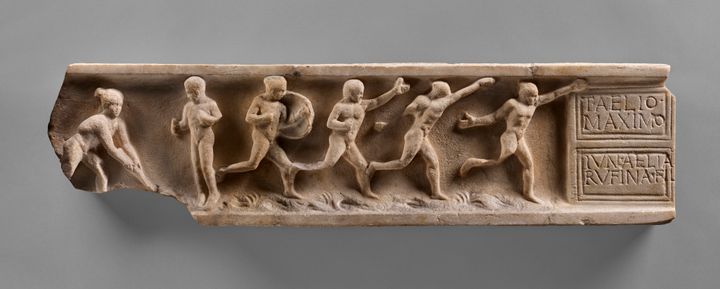
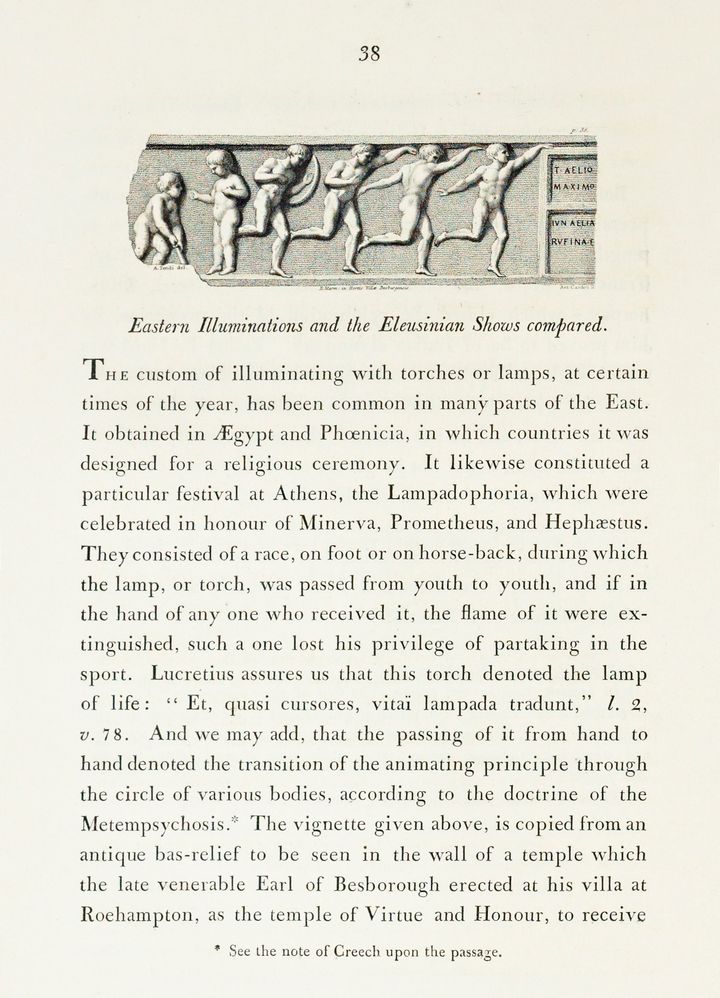
Because the afterlives of antiquities are rarely linear, successful searches relating to a single object may require approaching it through one or all of the three resource axes we use throughout this book: object-focused, event-focused, and individual-focused. Consider, for example, a fragmentary marble funerary relief, first documented in Rome by the end of the seventeenth century in a book of inscriptions; an etching of the relief by A. Tendi later appeared in a volume by James Christie, which located it as part of the Bessborough collection in Britain by the end of the eighteenth century (fig. 49; fig. 50).1 By the mid- to late nineteenth century, the relief had traveled to a different British collection at Lowther Castle, where it was documented in Friedrich Matz’s 1873 article on private collections of Mediterranean antiquities in England,2 and it was later published in an auction catalogue in the mid-twentieth century. One single relief’s provenance is therefore a constellation of information reconstructed over time from object-, event-, and individual-focused resources.
To aid in identifying resources, where possible we have noted contextual information about the date and scope of the collection, including information relevant to artwork from outside the Mediterranean, and additional user notes and literature. This guide is grounded in those resources that we have found most useful for working with the Getty’s collection; it cannot list every archive in every category and so it is intended more as an overview guide to types of resources, with specific archives or titles highlighted as examples. The particular dealers, donors, collectors, and academics most relevant to your search will guide your choices of archives.
Top Level Resources for Getting Started
Guidelines
Professional guidelines relating to provenance have, as outlined in previous chapters, proliferated since 1970, and the following list is only a partial reference point. However, it is worth noting that these guidelines form a patchwork: they discuss and treat provenance in very different ways, and researchers may be impacted by aspects of many different kinds of guidelines—or the lack of any—depending on the intended product of their research, such as an article, a collection database, or an acquisition recommendation. Many professional research organizations, including the American Society of Overseas Research, focus on the known provenance of objects that might be discussed in their conferences or publications, while guidelines governing an organization, like the Object Registry and Guidelines of the Association of Art Museum Directors, focus instead on acquisitions; the Archaeological Institute of America has policies pertaining to both. This patchwork leaves open many aspects of the practice of provenance research without clear guidelines or professional governance. Researchers should consult all applicable guidelines according to their field, professional affiliations, and institution.
Individual Membership Organizations
American Society of Overseas Research (ASOR)
[formerly American Schools of Oriental Research, until
2021]
Policy on Professional Conduct
https://www.asor.org/about-asor/policies/policy-on-professional-conduct/
Archaeological Institute of America (AIA)
AIA Policy on the Presentation and Publication of
Undocumented Antiquities
https://www.archaeological.org/about/pubpolicy/
https://www.ajaonline.org/submissions/antiquities-policy/
See also Resolution on the Acquisition of Antiquities by
Museums
https://www.archaeological.org/resolution-on-the-acquisition-of-antiquities-by-museums/
[1973]
Association of Art Museum Curators (AAMC)
AAMC Foundation Professional Practices for Art Curators
in Nonprofits
https://www.artcurators.org/page/ProfPractices
Association of Registrars and Collections Specialists
(ARCS)
Code of Ethics and Professional Practices for
Collections Professionals
http://www.arcsinfo.org/content/documents/code_ethics_collections_professionals_2021_02_24.pdf
Society of Biblical Literature (SBL)
SBL Policy on Scholarly Presentation and Publication of
Ancient Artifacts
https://www.sbl-site.org/assets/pdfs/SBL-Artifacts-Policy_20160903.pdf
Institutional Membership Organizations
American Alliance of Museums (AAM)
Ethics, Standards, and Professional Practices:
Archaeological Material and Ancient Art
https://www.aam-us.org/programs/ethics-standards-and-professional-practices/archaeological-material-and-ancient-art/
Association of Art Museum Directors (AAMD)
Object Registry
https://aamd.org/object-registry
2013 Guidelines on the Acquisition of Archaeological
Material and Ancient Art
https://aamd.org/standards-and-practices
International Council of Museums (ICOM)
ICOM Code of Ethics for Museums
https://icom.museum/wp-content/uploads/2018/07/ICOM-code-En-web.pdf
Literature
Provenance Research Guides
International Foundation for Art Research (IFAR).
“Provenance Guide.”
Organization ceased operations in 2025.
https://web.archive.org/web/20250131082136/https://www.ifar.org/Provenance_Guide.pdf
National Museum of Asian Art. “Guidelines and
Procedures for World War II Provenance
Issues.”
(July 2009, with updates August 2021)
https://asia.si.edu/wp-content/uploads/2023/04/Guidelines-Procedures-chapters_Updated-January-20221-1.pdf
German Museums Association. Guidelines for German Museums: Care of Collections from Colonial Contexts, 3rd ed. (Berlin: German Museums Association, 2021). https://www.museumsbund.de/publikationen/guidelines-on-dealing-with-collections-from-colonial-contexts-2/
Hartmann, Uwe, Maria Obenaus, Leonhard Weidinger, and Michaela Scheibe, eds. Provenance Research Manual to Identify Cultural Property Seized due to Persecution during the National Socialist Era (Magdeburg: German Lost Art Foundation, 2020). https://www.proveana.de/en/help/basic-documents
Mooren, Jana, Klaas Stutje, and Frank van Vree. Clues: Research into Provenance History and Significance of Cultural Objects and Collections Acquired in Colonial Situations. Dutch Pilotproject Provenance Research on Objects of the Colonial Era (PPROCE), Final Report (Amsterdam: Rijksmuseum, 2022). https://www.niod.nl/en/publications/clues-PPROCE
Schuhmacher, Jacques. Nazi-Era Provenance of Museum Collections: A Research Guide (London: UCL Press, 2024). https://www.uclpress.co.uk/products/238763
Tompkins, Arthur, ed. Provenance Research Today: Principles, Practice, Problems (London: Lund Humphries, 2020).
Yeide, Nancy, Konstantin Akinsha, and Amy L. Walsh. AAM Guide to Provenance Research (Washington, DC: American Association of Museums, 2001).
Some Suggested Reading
Ancient Mediterranean
Carpino, Alexandra, ed. Collecting and Collectors from Antiquity to Modernity. Selected Papers on Ancient Art and Architecture 4 (Boston: Archaeological Institute of America, 2018).
De Staebler, Peter D., and Anne Hrychuk Kontokosta, eds. Roman Sculpture in Context. Selected Papers on Ancient Art and Architecture 6 (Boston: Archaeological Institute of America, 2020).
Hopkins, John North, Sarah Kielt Costello, and Paul R. Davis. Object Biographies: Collaborative Approaches to Ancient Mediterranean Art (Houston: The Menil Collection, 2021).
Marlowe, Elizabeth. Shaky Ground: Context, Connoisseurship and the History of Roman Art. Debates in Archaeology Series (London: Bloomsbury Academic, 2013).
Marlowe, Elizabeth. “What We Talk About When We Talk About Provenance: A Response to Chippindale and Gill.” International Journal of Cultural Property 23, no. 3 (2016): 217–36. See also articles in response.
McAlpine, Lynley. Let Us Now Not Boast of Our Worldly Possessions: Provenance Stories from the San Antonio Museum of Art (San Antonio: San Antonio Museum of Art, 2022).
Milosch, Jane, and Nick Pearce. Collecting and Provenance: A Multidisciplinary Approach (Lanham, MD: Rowman & Littlefield, 2019).
Art Market Research
Journal of the History of Collections
https://academic.oup.com/jhc
Triannual publication with extremely broad remit, with
articles discussing collections from antiquity to the
present.
Journal for Art Market Studies
https://www.fokum-jams.org/index.php/jams/index
Open-access publication with past issue themes focused
on topics like Asian art, African art, museums and the
art market, and much more.
WorldCat
https://search.worldcat.org/
FirstSearch
https://firstsearch.oclc.org/
OCLC’s WorldCat is a global union catalogue of library
collections, presented as a public database; the
subscription search tool FirstSearch allows for more
complex searches. Because WorldCat is itself a database
of the catalogues of subscribing libraries and
institutions, it represents many, but far from all,
libraries and archives across the world, with notable
size and geographic biases. The holdings of specialized
libraries or library collections internal to some museum
departments may therefore be excluded from WorldCat.
WorldCat remains a powerful tool, with millions of books, archival records, and additional materials. Particularly relevant search features for provenance include the ability to search by publisher location and for references to annotations and price information recorded in local library catalogue records; often sections of annotated catalogues can be requested as scans.
The Sales Catalog Index Project Input Online (SCIPIO), a database of more than 300,000 auction catalogue records from twenty-five art libraries, has been incorporated into WorldCat and can be accessed via subscription through FirstSearch. Due to the nature of WorldCat, many titles will be represented by multiple catalogue records, and references to annotations and other items of interest will be in the language of the holding library. WorldCat records distinguish between print, microform, and digital versions of the same work. Work with your local interlibrary loan department to develop strategies given your location and level of access to various materials.
Provenance Research Organizations and Teams
Foundation for Ethical Stewardship of Cultural
Heritage (FESCH) and their project Mediterranean
Antiquities Provenance Research Alliance
(MAPRA)
https://www.fescheritage.org/
Nonprofit organization founded to help establish
resources and protocols for provenance research into
collections of Mediterranean antiquities, with a
particular focus on teaching students and creating a
database of unprovenanced objects held by American
universities.
International Arbeitskreis for Provenienzforschung
e.V. [Research Association for Provenance
Research]
https://www.arbeitskreis-provenienzforschung.org/en/about-us/
Pre-Hispanic Art Provenance Initiative
(PHAPI)
Getty Research Institute
https://www.getty.edu/projects/pre-hispanic-art-provenance-initiative/
PHAPI has supported numerous publications and
conferences on the art market for pre-Hispanic
antiquities in America, as well the Stendahl Gallery
archives (see below under “Individual-Focused
Resources”). While the primary focus is not
Mediterranean, many dealers and collectors, including
the Stendahls, handled Mediterranean materials as well.
The International Art Market Studies Association
(TIAMSA)
https://www.artmarketstudies.org/
An association formed in 2016 supporting research into
art market studies. A useful source for upcoming events
like lectures, as well as job postings, forthcoming
publications from members, and more.
Society for the History of Collecting
https://societyhistorycollecting.org/
A British-based society with local chapters in the
Americas, France, and Italy. Numerous events, both
in-person and online, on collecting from different eras.
Waystation Initiative
University of California, Los Angeles
https://ioa.ucla.edu/content/waystation-initiative
The Institute “organizes and facilitates the voluntary
return of international archaeological and ethnographic
objects to the nation or community of origin” as well as
providing training and certificate opportunities for
students and ongoing programming.
Provenance News and Events
Day of Provenance
https://www.arbeitskreis-provenienzforschung.org/en/international-day-of-provenance-research/
Annual day for highlighting provenance research, often
accompanied by local events, like lectures and tours,
together with publications and social media posts.
Events Related to the History of Collecting
https://piprod.getty.edu/starweb/events/servlet.starweb?path=events/events.web&id=events
Events calendar provided by the Getty Research
Institute.
LootedArt.com: The Central Registry of Information on
Looted Cultural Property 1933–1945
https://www.lootedart.com/
Commission for Looted Art in Europe, weekly newsletter
with updates on court cases, provenance resources,
conferences, and more.
Museum Archives
Museums may retain their own rich internal or institutional archives relating to the institution’s history, departments, or staff. In some cases, correspondence or other records pertaining to objects on the market offered by dealers and private collections are preserved. Access to these by researchers varies by institutional policy and use should be confirmed with the holder of the archives. Institutional archives and libraries can also be sources of museum publications, ephemera, and exhibition records. Note that the personal papers of museum personnel, with correspondence relevant to museum business, may also be preserved in other institutions.
Brooklyn Museum of Art
https://www.brooklynmuseum.org/opencollection/research/findingaids
A wealth of correspondence between curators, dealers,
scholars, and more pertaining to different departments
of ancient material.
Metropolitan Museum of Art
https://www.metmuseum.org/art/libraries-and-research-centers/museum-archives
Many archival holdings, including those of past
directors like Luigi di Cesnola and Thomas Hoving, with
finding aids available online. Some restrictions apply.
Dallas Museum of Art
Exhibition Records
https://texashistory.unt.edu/explore/collections/DMAEC/
A digitized repository of exhibition materials,
including some exhibitions of private collection
objects. Includes gallery images, ephemera, and more.
J. Paul Getty Museum
Art and Real Estate Holding Companies Records,
1939–1982
http://primo.getty.edu/GRI:GETTY_ALMA21135172620001551
Archives pertaining to the art collecting of J. Paul
Getty, both for his personal properties and some objects
that became part of the J. Paul Getty Museum holdings.
Some restrictions on access apply.
Harvard Art Museums, Harvard University
https://hollisarchives.lib.harvard.edu/repositories/9
Archives relating to the Fogg Museum, the
Busch-Reisinger Museum, and the Arthur M. Sackler
Museum, including collections of papers of individuals
associated with the Harvard Art Museums, including past
curators and directors.
Musée du Louvre
Centre d’études et de documentation – Antiquités
grecques, étrusques et romaines
https://www.louvre.fr/recherche-et-conservation/centre-d-etudes-et-de-documentation-antiquites-grecques-etrusques-et-romaines/fonds-documentaire
Centre d’études et de documentation – Antiquités
égyptiennes
https://www.louvre.fr/recherche-et-conservation/centre-d-etudes-et-de-documentation-antiquites-egyptiennes/fonds-documentaire-2
Holdings include department objects, correspondence,
photographs, and archives. The Département des
antiquités grecques, étrusques et romaines holdings
include the archives of collector and photographer Louis
de Clercq (1837–1901).
Wellcome Historical Medical Museum and Library
Archives
Wellcome Collection
https://wellcomecollection.org/works/k2fae5cz
Extensive digitized collections relating to the
formation of the Wellcome Historical Medical Museum.
Particularly useful as a source of dealer letterhead and
personnel information. Includes early twentieth-century
correspondence on acquisitions both proposed and made
for the Wellcome collection with private collectors and
dealers, as well as material on Wellcome collection
dispersals.
Union Catalogues of Archives
While no union catalogue of provenance-related materials exists, the National Union Catalog of Manuscript Collections volumes (https://www.loc.gov/coll/nucmc) can aid in identifying potential sources. The Frick Museum’ Archives Directory for the History of Collecting in America (https://research.frick.org/directory) offers a powerful database connecting archival resources relating to individuals and galleries from the American art market across different institutions, together with biographical data.
Regional and national database gateways like the U.K.’s National Archives Discovery Catalogue (https://discovery.nationalarchives.gov.uk/), the Online Archive of California (OAC; https://oac.cdlib.org/), and OCLC’s ArchiveGrid (https://researchworks.oclc.org/archivegrid/) offer additional options for more thematic searches. But bear in mind that many finding aids are not accessible externally (and so are not searchable directly online) and must be requested through the holding institution.
Newspapers
From local to international editions, newspapers are a fundamental resource. They are key repositories of centuries of genealogical data, confirming life events and locations for collectors and dealers. They may have published auction advertisements, showcases, and results; artifact and excavation discoveries; dealer and museum exhibitions with private collection material; local collector displays; and other relevant records of objects on the art market. Increasingly, back issues have been digitized and made accessible through subscription or governmental databases while local and regional papers may be available on microform or consulted through print copies. Some archives require subscription access, and date ranges often are limited; optical character recognition (OCR) and searchability vary considerably between papers.
There is substantial variability between countries in terms of access and databases of newspapers. Some key papers, like La Stampa in Italy or Türkiye’s Cumhuriyet, maintain searchable online archives, while many American newspapers, like The New York Times, maintain paywalls across their archives, and there is no complete national-level archive of U.S. historic newspapers. Other subscription options for accessing newspapers like The New York Times, such as Lexis Nexis and Proquest, may be missing images due to copyright issues. Image archives may be accessible through visual media companies like Getty Images. American local libraries and historical societies may offer subscription access to regional newspaper archives, but this often requires searching on-site. Consulting specialty research guides, such as https://guides.loc.gov/french-collections/newspapers-journals-womens-press, can help direct you toward the most relevant repositories for your subject or geographic area.
Some of the larger online repositories are listed here.
Australia
https://trove.nla.gov.au/
Europe
https://www.europeana.eu/en
France
https://www.retronews.fr/
https://gallica.bnf.fr
Germany
https://www.deutsche-digitale-bibliothek.de/newspaper?lang=en
Great Britain
https://www.britishnewspaperarchive.co.uk/
Italy
http://www.archiviolastampa.it/
Switzerland
https://www.e-newspaperarchives.ch/
Türkiye
https://www.gastearsivi.com/
https://gazetearsivi.milliyet.com.tr/
https://egazete.cumhuriyet.com.tr/en/publications
United States
https://www.newsbank.com/
https://www.newspapers.com/
These primarily cover the U.S. Both are
subscription-based; access packages vary.
https://chroniclingamerica.loc.gov/
Searchable resource of American newspapers, mostly small
and regional, from 1756–1963.
Art Law Research
See also “Legal Perspectives on Acquisition of Mediterranean Antiquities“ (chapter 3 in this volume).
International Foundation for Art Research (IFAR). Art
Law & Cultural Property
Ceased operations in 2025.
Prior to its closure, IFAR offered an expansive
educational resource for art law, presented in two
sections: International Cultural Property Ownership and
Export Legislation (ICPOEL) and Case Law and Statutes
(CLS), the latter specific to U.S. law. This includes
litigated cases and out-of-court settlements, as well as
a section on Cultural Property (Antiquities) Disputes
Over Non-United States Property, with case summaries and
links to U.S. statutes, foreign legislation, and court
records and filings. The future of this resource,
unavailable since 2025, is unknown. IFAR’s Publication
Collection has been archived through the Internet
Archive:
https://archive.org/details/ifarpublications?tab-collection.
American Bar Association’s Art & Cultural
Heritage Law Committee
https://www.americanbar.org/groups/international_law/about/committees/art-cultural-heritage/
An archive of the committee’s newsletter is provided.
Center for Art Law [U.S.]
https://itsartlaw.org/newsletter/
Nonprofit organization offering various art law
resources, including events and a newsletter, as well as
memberships.
Institute of Art & Law [U.K.]
https://ial.uk.com/
Educational organization offering courses, publications,
and events, as well as memberships.
Art Crime Research
Organizations and Projects
The Antiquities Coalition
https://theantiquitiescoalition.org/
Antiquities Trafficking and Heritage Anthropology
Research (ATHAR) Project
https://atharproject.org/
The British Museum. Circulating Artefacts
(CircArt)
https://www.britishmuseum.org/our-work/departments/egypt-and-sudan/circulating-artefacts
Trafficking Culture: Researching the Global Traffic
in Looted Cultural Objects
https://traffickingculture.org/
Art Theft Resources
Material from thefts—historic and recent—from documented collections can and do surface, but they are often hard to trace. There are few collations of every museum or storeroom theft over time, although some, like those during and after World War II, may be covered by country-based publications (and see the World War II section in Event-Focused Resources in this appendix). Others may be documented through case studies and academic publications. In some cases, these may be recorded in national or international databases (see below); others may be recognized via their prior publication, archival documentation, or marks of ownership. As reiterated throughout this publication, illicitly excavated material will, prima facie, not be documented in the same way as other materials, and sources documenting looted artifacts are rarely available for wide consultation. Given this, caution is warranted, as a looted ancient object may not appear in these resources nor in searches run through commercial art loss firms like the Art Loss Register (https://www.artloss.com/).
Case Studies on Wartime Theft
Maischberger, M., and B. Sporleder, eds. Konstantinopel – Samos – Berlin: Verpfändung, Fundteilung und heimliche Ausfuhr von Antiken am Vorabend des Ersten Weltkrieges (Heidelberg: Arthistoricum.net, Universitätsbibliothek Heidelberg, and Zentralarchiv Staatliche Museen zu Berlin, 2022).
National and International Resources
National Stolen Art File [U.S.]
https://artcrimes.fbi.gov/
Searchable database of stolen art and cultural property
maintained by the U.S. Federal Bureau of Investigation
(FBI).
The British Museum. Recovery of Missing Items
https://www.britishmuseum.org/our-work/departments/recovery-missing-items
Homepage for the Museum’s recovery project, including an
overview of missing items and updates on recent
progress.
Comando Carabinieri per la Tutela del Patrimonio
Culturale [Italy]
https://tpcweb.carabinieri.it/SitoPubblico/home
https://tpcweb.carabinieri.it/SitoPubblico/home/funzioni/ricerca-dati-immagini
Website with information on the cultural heritage
activities of the Carabinieri, as well as a database of
images of stolen works of art and additional resources.
Çalınan / Kaybolan Kültür Varlıkları
[Türkiye]
Kültür Varlıkları ve Müzeler Genel Müdürlüğü
https://kvmgm.ktb.gov.tr/TR-195649/calinan--kaybolan-kultur-varliklari.html
Lists of stolen and lost cultural assets from museums,
collectors, and others.
International Council of Musuems (ICOM). Red Lists
Database
https://icom.museum/en/resources/red-lists/
The ICOM Red Lists highlight categories or types of
cultural heritage objects vulnerable to illicit
trafficking and trade using catalogued examples held by
national collections.
INTERPOL. Stolen Works of Art Database
https://www.interpol.int/en/Crimes/Cultural-heritage-crime/Stolen-Works-of-Art-Database
https://www.interpol.int/en/Crimes/Cultural-heritage-crime/ID-Art-mobile-app
An application is required to become a registered user
of the INTERPOL database. Mobile users can download the
ID-Art app, which provides a searchable database of
stolen items and allows users to upload images of
objects to be visually searched.
Marks of Ownership
See also the discussion of “Stamps and Seals” in chapter 2.
Unfortunately, there are very few resources for documenting marks of ownership on Mediterranean antiquities. However, some comparative examples from across the art world are presented here.
Claims Conference – WJRO: Looted Art & Cultural
Property Initiative. Provenance Markings
Databases
https://art.claimscon.org/resources/overview-of-worldwide-looted-art-and-provenance-research-databases/#Provenance-Markings
A useful, updated list of resources for various types of
provenance markings, focused on World War II cases.
Staatliche Kunstsammlungen Dresden
https://skd-online-collection.skd.museum/Home/Index?page=1&k=WEB_PROV03
This database of more than a hundred illustrated
examples of ownership seals, labels, marks, and more
offers an excellent template for describing similar
examples and making connections.
Artefacts of Excavation: British Excavations in Egypt
1880–1980
https://egyptartefacts.griffith.ox.ac.uk/resources/object-marks
Though focused on Egyptian artifacts, a very useful
resource regarding object marks.
Object-Focused Resources
These resources pertain directly to the objects themselves, and are shaped by medium, typology, function, or decoration. They typically collate large bodies of material, allowing for comparison and contextualization.
Iconographic
Lexicon Iconographicum Mythologiae Classicae (LIMC).
Multiple volumes, 1981–2009 (Zurich: Artemis).
WebLIMC
https://weblimc.org/
A unique encyclopedic resource, available both in print
and online, for researching Greek, Etruscan, and Roman
objects with mythological scenes. LIMC essays,
written in English, French, Italian, or German,
incorporate material from museums across the world as
well as from private collections. Nonspecialists may
find it especially helpful in confirming the
iconographic identity of works of art and parallels for
a scene type. Lists of related literature in each entry
are particularly valuable, providing further keywords or
descriptive phrases to aid in searches. The online
database of objects complements the print volumes, but
many images are not yet accessible.
CENSUS: Census of Antique Works of Art and
Architecture Known in the Renaissance
https://www.census.de/en/home/
To search the database:
https://database.census.de/search
Database allowing cross-referencing of ancient works of
art that appear in Renaissance artworks and manuscripts
by attributes, style, provenance, and location.
Antiquitatum Thesaurus: Antiken in den europäischen
Bildquellen des 17. und 18. Jahrhunderts [Antiquitatum
Thesaurus: Antiquities in European Visual Sources from
the Seventeenth and Eighteenth Centuries]
https://thesaurus.bbaw.de/en/
To search the database:
https://db.antiquitatum-thesaurus.eu/
A rich database, still in production, which seeks to
connect prints and drawings from the seventeenth and
eighteenth centuries to the antiquities that are
depicted in them. The database presents the images
alongside additional context and information. These
sources include Montfaucon’s Papiers.
Object Type
An overview of all print corpora by object type is not possible to include in this appendix, which instead focuses on broader categories and the more widely accessible databases. However, in addition to the resources listed below, we note the work by Klaus Parlasca documenting Romano-Egyptian funerary (mummy) portraits both on the market and in collections (Mumienporträts und verwandte Denkmäler. Wiesbaden: Steiner, 1966; and Repertorio d’Arte dell’Egitto: Greco-Romano Serie B; Ritratti di Mummie. 4 vols. Palermo: Officine Tipo-Litografiche I.R.E.S., 1969–2003). There also are corpora that are ongoing or forthcoming to be aware of: the publications of the Corpus Speculorum Etruscorum (https://publications.dainst.org/books/dai/catalog/series/csedl) are documenting Etruscan mirrors in collections around the world; and forthcoming is a corpus of Palmyran portraits from the Palmyra Portrait Project (https://projects.au.dk/palmyraportrait).
Pottery
Beazley Archive Pottery Database
Classical Art Research Centre (CARC), Oxford
https://www.carc.ox.ac.uk/carc/pottery
https://www.carc.ox.ac.uk/carc/resources/Beazley-Archive-Contents
Contains records for more than 130,000 pieces of ancient
Greek painted pottery. Although grounded in Sir John
Beazley’s (1885–1970) original archive, the corpus has
continued to grow, with examples documented on the
market and in private and public collections.
Photographs can document changes in restoration history
over time. On-site archives include additional
photograph collections, including of vases on the London
market, correspondence files, and archival collections
from scholars such as Nicolas Plaoutine (1893–1942),
Elfriede (Kezia) Regina Knauer (1926–2010), among
others. This website also provides a point of entry for
the Corpus Vasorum Antiquorum online, which makes
accessible over a century’s worth of digitized
catalogues of museum collections:
https://www.carc.ox.ac.uk/cva/about.
AD Trendall Research Centre
https://www.latrobe.edu.au/research/centres/trendall
More than 40,000 photographs of South Italian and
Sicilian red-figured vases acquired by Arthur Dale
Trendall to support his vase publications, which
extensively document material both on the art market and
in private collections. The Trendall archive is
restricted to the vase images as Trendall did not retain
correspondence files. More than 400 duplicates of
Trendall’s images are held by the Getty Research
Institute as part of its Photo Archive:
https://primo.getty.edu/permalink/f/19q6gmb/GETTY_ALMA21132663900001551.
Sur la piste des œuvres antiques
https://ventesdantiques.inha.fr/
AGORHA
https://agorha.inha.fr/ark:/54721/47
The Institut National d’Histoire de l’Art (INHA) and the
Musée du Louvre have drawn these two resources from the
research project
Répertoire des ventes d’antiques en France au XIXe
siècle
(Register of antiquities sales in France in the
nineteenth century). The two databases bring together a
wealth of information on collectors, dealers, sales, and
objects on the art market in France in the nineteenth
century, with useful visualizations of the passages of
objects over time on the
Sur la piste des œuvres antiques site.
Epigraphic
A useful reference for epigraphic publications for Mediterranean inscriptions from the nineteenth and twentieth centuries, including both historic compendia by language, region, and subject, as well as current publication outlets, is J. Puhvel, “Epigraphy” (2022), Encyclopedia Britannica. https://www.britannica.com/topic/epigraphy.
Because the same inscription can be published in many different volumes, a new tool, the Inscriptiones Identifier Resolver (IDR), has been developed to help collate Trismegistos Identifiers and other digital identifiers using the Trismegistos TexRelations MatcherAPI, useful for large-scale epigraphy projects (https://id-resolver.inscriptiones.org/).
Corpus Inscriptionum Latinarum (CIL)
https://cil.bbaw.de/
iDAI: CIL Open Access
https://arachne.dainst.org/project/cilopac
Published from 1863 on, the CIL collects Latin
inscriptions from across the ancient world. The CIL is
itself published in Latin, and volumes are ordered and
organized by location. Entries are shown transcribed,
some with previous references to earlier manuscripts and
previous collections, as well as minimal descriptions.
Many volumes have now been digitized, for which see CIL
Open Access—a considerable aid to searching. The CIL
website linked above holds further information on the
archive, its history, and the database of materials.
Epigraphic Database Rome (EDR)
EAGLE: Electronic Archive of Greek and Latin
Epigraphy
http://www.edr-edr.it/en/Link_en.php
Part of an international federation of epigraphic
databases, with over 100,000 inscriptions to date.
Supplementum Epigraphicum Graecum (SEG) (Leiden:
Brill, 1923–)
Supplementum Epigraphicum Graecum Online (SEG
Online)
https://scholarlyeditions.brill.com/sego/
An annual collection of Greek inscriptions that have
been published in a single year. The project began in
1923, covering 1922 onward; the latest years are
available through a subscription with Brill publishers,
which also offers the SEG Online.
Packard Humanities Institute: Epigraphy Project.
Searchable Greek Inscriptions
https://epigraphy.packhum.org/
A resource for more than 200,000 Greek inscriptions;
only references and transcriptions are provided for each
entry.
Trismegistos
https://www.trismegistos.org/
Based on a corpus of papyrological documents from
Graeco-Roman Egypt, Trismegistos now includes a wider
range of epigraphic materials from 800 BCE to 800 CE
found across the ancient world. Requires a subscription
for full searching.
U.S. Epigraphy Project (USEP)
https://usepigraphy.brown.edu/projects/usep/about/
USEP documents thousands of ancient inscriptions in
Greek, Latin, and a sampling of other ancient languages
that are held by American collections, with some auction
additions. Entries include bibliography, images,
transcriptions, and translations.
Literature
Bodel, John P., and Stephen V. Tracy.
Greek and Latin Inscriptions in the USA: A
Checklist
(New York: American Academy in Rome, 1997).
Numismatics
American Numismatic Society
http://numismatics.org/archives/
American Numismatic Society on Internet
Archive
https://archive.org/details/americannumismaticsociety
Auction catalogues, coin files, and archival holdings of
historic dealers connecting sales of individual coins
across auctions. Many archival materials have been
usefully scanned and made available through the Internet
Archive; others are accessible only for in-person
research.
The Newman Numismatic Portal at Washington University
in St. Louis
https://nnp.wustl.edu/
Although primarily focused on American coinage, this is
a useful tool for searching numismatist and dealer
names, along with associated materials.
Gems and Seals
Beazley Archive Gem Database
Classical Art Research Centre (CARC), Oxford
https://www.carc.ox.ac.uk/carc/gems
In addition to the better-known pottery database, the
“Classical Art Research Centre” also hosts a gem
database, drawing on some of its extensive archival and
gem impression holdings—one of the largest in the world.
Photographs of historic gem impressions made by James
and William Tassie, Philipp Daniel Lippert, and Tommaso
Cades are represented, as well as photographs and
information relating to, for example, the Marlborough,
Poniatowski, and Piombino Boncompagni collections. A
“Summary Handlist of the Collections of Gem Impressions,
Casts and Replicas” is available (https://www.carc.ox.ac.uk/XDB/DMS/GemMasterCopyWord
for website.pdf).
Campbell Bonner Magical Gems Database
http://cbd.mfab.hu/
Database of approximately 5,600 records based on
monographs on ancient magical gems drawn from museums,
private collections, and on the international art
market.
Corpus der minoischen und mykenischen Siegel (CMS)
Databases
https://www.uni-heidelberg.de/fakultaeten/philosophie/zaw/cms/databases/databases.html
The CMS was a long-term project to publish all known
Aegean seals and sealings in archaeological collections,
museums, private collections, and on the art market from
1958 to 2011. Its digitized databases are accessible
through Arachne (https://arachne.dainst.org/).
Egyptian Artifacts
Egyptian material is often considered a corpus of its own, but given that Egyptian objects may feature in collections of Mediterranean antiquities, we have gathered some resources together here.
Literature
Hagen, Fredrik, and Kim Ryholt.
The Antiquities Trade in Egypt 1880–1930: The H.O.
Lange Papers
(Copenhagen: Det Kongelige Danske Videnskabernes
Selskab, 2016).
Stevenson, Alice. Scattered Finds: Archaeology, Egyptology and Museums (London: UCL Press, 2019; https://doi.org/10.2307/j.ctv550cxt).
Griffith Institute
The Digital Topographical Bibliography, The Griffith
Institute
http://topbib.griffith.ox.ac.uk//index.html
Griffith Institute Archive, Griffith Institute
Archive’s Online Catalogue
https://archive.griffith.ox.ac.uk/index.php/
The Griffith Institute’s Archive and Topographical
Bibliography publications include material either
documented in private collections or attested in public
collections having once been in private hands, including
some auction references. The Griffith Institute archives
also include numerous other resources, including scholar
archives like that of Jacques Jean Clère, which
documents material in private collections and on the
market (Clère MSS.:
http://www.griffith.ox.ac.uk/gri/4clerejj.html).
Artefacts of Excavation: British Excavations in Egypt
1880–1980
https://egyptartefacts.griffith.ox.ac.uk
A resource for objects dispersed internationally as part
of the partage and subscriber arrangements of the
Egyptian Exploration Society. Some objects were sent
directly to private collectors, while others have
entered the market following museum deaccessions. The
project includes a useful image gallery and guide to
object marks (https://egyptartefacts.griffith.ox.ac.uk/resources/object-marks).
Das Photoarchiv H.W. Müller der
Universitätsbibliothek Heidelberg [The Photo Archive
of Hans Wolfgang Müller at the University of
Heidelberg Library]
https://www.ub.uni-heidelberg.de/fachinfo/aegyptologie/HWMueller.html
https://www.ub.uni-heidelberg.de/cgi-bin/hwm/hwm01.pl
More than 8,000 photographs and negatives produced by
Egyptologist Hans Wolfgang Müller between 1931 and 1975
of sites, as well as objects in museums, private
collections, and on the market. Prints can be ordered
through the holding library; a microfiche set is also
available. A database with basic information for many of
the photographs is available through the University of
Heidelberg, although the photographs themselves have not
been digitized.
Das altägyptisch Totenbuch: Ein digitales
Textzeugenarchiv (Totenbuch-Projekt)
https://totenbuch.awk.nrw.de/
A database of nearly 3,000 records of Egyptian Book of
the Dead materials around the world, both on the market
and in private and public collections, grounded in
research conducted at Göttingen over the previous
decade. It usefully links fragmented manuscripts,
papyri, and mummy bandages divided between different
collections, along with relevant bibliography. The
website was launched in 2012 and there have been some
more recent updates.
Photo Archives
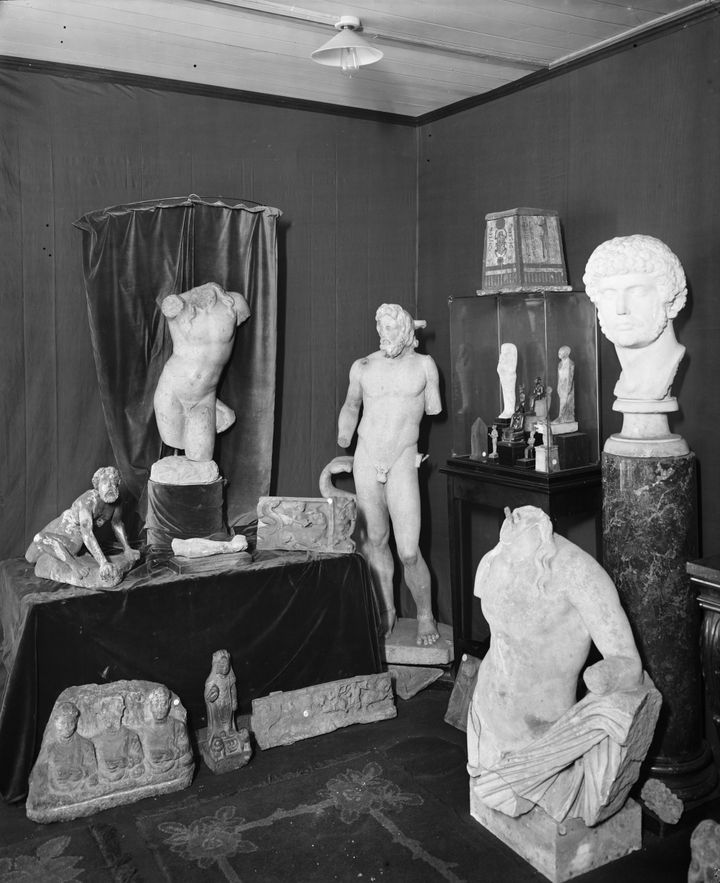
Photo archives can be essential tools in tracing an object’s ownership or conservation over time. Such an archive can, in the aggregate, also provide insight into owner collecting practices, even where images of a specific object are lacking. Even when ancient objects do not feature, as with the Frick Collection photo archive, they can provide useful comparative examples of photographer stamps and active dates, as well as further evidence of dealer and collector activities. National-level archives of photographs, like Historic England (https://historicengland.org.uk/images-books/) and the Médiathèque du patrimoine et de la photographie (https://mediatheque-patrimoine.culture.gouv.fr/) include images of objects, houses with private collections, and other photographs of interest—for example, a series of images of the showroom of Spink & Son in London, dating to 1918 and preserved by Historic England (fig. 51) (https://historicengland.org.uk/images-books/photos/item/BL24185/002).
DAI.objects Arachne
https://arachne.dainst.org/
Deutsches Archäologisches Institut
Hundreds of thousands of records, a large percentage
with digitized photographs, of archaeological sites and
objects held in private collections, museums, and on the
market from the late nineteenth century. Scanned
“Inventarbuch” pages provide further records on the date
by which the photographs entered the collection, the
photographer, and later publication records. Primarily
marble and stone works of art, with additional records
of pottery, jewelry, and other media. Includes scans of
all plates from the landmark series
Photographische Einzelaufnahmen Antiker Sculpturen
nach Auswahl und mit Text
(Munich: Verlagsanstalt für Kunst und Wissenschaft,
1893–), with images of objects in private collections
and on the art market across Europe (see also the
discussion of the DAI and Arachne in
chapter 2)
Getty Research Institute (GRI)
https://www.getty.edu/research/tools/photo/
The GRI’s Photo Archive encompasses millions of
photographs with subdivisions for Mediterranean
antiquities according to medium, culture, location, and
object type. Additional subsections of dealer or
individual-focused materials are addressed below.
Sections may contain additional photographs drawn from
the GRI’s French & Company and Mathias Komor
photographic holdings.
Fondazione Federico Zeri, Università di
Bologna
https://fondazionezeri.unibo.it/en/photo-archive
This photo archive includes a section on ancient
artworks, including some dealer photographs. Other
photographs provide useful comparanda for dealer and
photographer marks. The library also contains numerous
auction catalogues.
Literature
For more on the practices behind historic
dealer-created photography, see:
Norskov, Vinnie. “The Photographs in John Marshall’s Archive.” In Ancient Art and Its Commerce in Early Twentieth-Century Europe: The John Marshall Archive: A Collection of Essays Written by the Participants of the John Marshall Archive Project, edited by Guido Petruccioli, 54–57 (Oxford: Archaeopress, 2022).
Bärnighausen, Julia. “Bureaucratic Hybrids: Photographs from the Galleria Sangiorgi in Rome at the Kunsthistorisches Institut in Florenz.” Mitteilungen des Kunsthistorischen Institutes in Florenz 62, no. 1 (2020): 43–67.
See chapter 2 for our discussion of using photographs as an information source for antiquities and some cautions regarding their analysis.
Event-Focused Resources
Event-focused resources center around specific events or time periods, such as auctions or World War II.
Auctions
Open Access Digitized Auction Catalogues
Auction houses often maintain some recent auction information online, and many make available some information from sales from the past few decades. However, online lot information often excludes lots removed from sales, unlike print catalogues, and photographs and full sale information are often not available for older sales. Accessibility of catalogues in downloadable formats varies widely. Some smaller firms do not maintain online result lists or lot information, and access to past catalogues for regional auction houses is often quite limited (see also our discussion of auction and sales catalogues in chapter 2).
Bibliothèque de l’Institut national d’histoire de
l’art, collections Jacques Doucet
https://bibliotheque-numerique.inha.fr/
For scans of numerous auction catalogues into the
mid-twentieth century, often from microform, see under
“Catalogues de vente.”
German Sales Catalogues, 1900–1945
Universitats-Bibliothek Heidelberg. “Auction
Catalogues – Digitized”
https://www.ub.uni-heidelberg.de/Englisch/helios/digi/artsales.html
Kunstbibliothek of the Staatliche Museen zu Berlin,
Heidelberg University, and the Getty Research
Institute
https://www.smb.museum/en/museums-institutions/kunstbibliothek/collection-research/research/german-sales-1901-1945/
More than 8,700 searchable German language auction
catalogues, some annotated and with a number of “hand
copies,” editions with bidding and sale notes officially
recorded by the auction house, from the firm Hugo
Helbing.
Wellcome Collection, London
https://wellcomecollection.org/works/tmt535tq
Array of sales catalogues, some digitized, on different
collecting areas, including antiquities. Includes many
from smaller English firms.
Wildenstein Plattner Institute, New York
https://digitalprojects.wpi.art/library/search
Searchable database of more than 21,000 American and
European sales catalogues from the seventeenth century
to 1945; filter by sales catalogues.
Internet Archive
https://archive.org/
Increasingly, museums and archives have made scans of
auction catalogues available through the Internet
Archive. Particularly notable are the contributions of
the Metropolitan Museum of Art and the American
Numismatic Society, which include a substantial number
of annotated auction house catalogues from Europe and
the United States.
Subscription or Institutional Access
Art Sales Catalogues Online
https://brill.com/display/db/asco
Searchable database of thousands of historic art
auctions from 1600 to 1900, grounded in the
Répertoire des catalogues de ventes publiques
intéressant l’art ou la curiosité, assembled by Frits Lugt beginning in the 1930s.
Modern auction databases and aggregators such as Invaluable (https://www.invaluable.com/), the Artnet Price Database (https://www.artnet.com/price-database/), and Liveauctioneers (https://www.liveauctioneers.com/) (subscriptions or account creation may be required for full access) provide helpful insight into modern auctions, listed provenance data, and estate dispersals.
Printed Auction Catalogues
Print copies of catalogues may be located using the SCIPIO auction database (subscription required) through WorldCat (https://search.worldcat.org/). Further auction information may be available through the Getty Provenance Index (https://www.getty.edu/research/tools/provenance/search.html); although this was not designed to capture data pertaining to antiquities sales, it remains a useful resource for constituent information and sales data. Specialist institutions, such as the Corning Museum of Glass, maintain collections of catalogues tailored to support research in their field. Although uncatalogued and not accessible through WorldCat or other library databases, museum departments and archives may have additional holdings of auction-related materials. Check departmental or museum websites for specific instances; for one example, see https://specialcollections-blog.lib.cam.ac.uk/?p=23064.
Sotheby & Co. catalogues of sales
https://worldcat.org/en/title/70653365
A comprehensive collection on microform of scans of
Sotheby auction catalogues from London and New York,
1734–1990, created through the cooperation of the
Huntington Library, Sotheby Parke-Bernet, the British
Museum, and the University of Illinois. Many scanned
catalogues include annotations or price lists. The
prospectus for each part of the catalogue lists dates of
sales with key sellers and indications of type of
material covered per sale.
Auction House Archives
International
Many larger auction houses, including Sotheby’s, Christie’s, and Bonhams, maintain in-house archives of catalogues and other materials, which may include additional annotations for price codes, buyers, and sellers. Access by outside researchers is often limited, but the relevant department should be contacted for case-by-case information.3 Records for auction houses bought by another firm are sometimes retained, and the current owner should be contacted regarding access. See chapter 2 for discussion of published price and buyer lists.
France
For auctions in Paris, the Archives de Paris preserves a wealth of the procès-verbaux de ventes (auction minutes) from French commisaires-priseurs (auctioneers). See:
Les ventes d’antiques en France au XIXe siècle.
“Archives des commissaires-priseurs”
https://venteantique.hypotheses.org/archives-des-commissaires-priseurs
A detailed and useful summary of sources.
Archives des commissaires-priseurs parisiens
conservés aux Archives de Paris: Index
patronymique
https://francearchives.gouv.fr/fr/article/930253419
A listing by personal name of
commissaires-priseurs archives at the Archives
de Paris.
Literature
Rouge-Ducos, Isabelle.
Le crieur et le marteau: Histoire des
commissaires-priseurs de Paris (1801–1945)
(Paris: Editions Belin, 2013).
Saint-Raymond, Léa. À la conquête du marché de l’art: Le Pari(s) des enchères (1830–1939) (Paris: Classiques Garnier, 2021).
Germany
Arthistoricum. “Auctioneer’s Copies of the Catalogues
of the Auction House Hugo Helbing”
https://www.arthistoricum.net/en/subjects/thematic-portals/german-sales/helbing
More than a thousand auctioneer copies of catalogues
from the firm Galerie Hugo Helbing (Hugo Helbing; active
1885–1937 in Munich, Berlin, and Frankfurt) have been
digitized and made available. Annotations include sales
data such as reserve prices, consignors, buyers, and
indications of sales outside of auctions.
World War II
Given the large corpus of guides dedicated to provenance research concerning the years during and after World War II (see “Provenance Research Guides” above), this section will not seek to reproduce their efforts. However, as Mediterranean antiquities have not, to date, often been a focus of these investigations, gaps in an object’s provenance between 1930 and 1945 should be treated with the same diligence as for European paintings and sculpture. Mediterranean antiquities continued to be part of the European art market during the war, and were subject to seizure and forced sales, just like other material in private collections and galleries. Antiquities were also looted from museum collections and excavation stores, some of which have surfaced or been identified in more recent years.4 However, many countries have not yet made World War II–era archival information accessible.
Literature
New contributions to the literature on Mediterranean
antiquities during World War II have provided key
insights into relevant archives and the unique
challenges of researching this kind of material.
Bald Romano, Irene, ed. “The Fate of Antiquities in the Nazi Era.” Special issue, RIHA Journal. 2023. https://doi.org/10.11588/riha.2022.2.
Dunn-Vaturi, Anne. “Mind the Gap: Researching Ownership History of Ancient Artifacts during the Nazi Era.” RETOUR – Freier Blog für Provenienzforschende, April 14, 2021. https://retour.hypotheses.org/1460.
General Resources
LootedArt.com: The Central Registry of Information on
Looted Cultural Property, 1933–1945
https://www.lootedart.com
Provided by the Commission for Looted Art in Europe
Lost Art – Datenbank [Germany]
https://www.lostart.de
A German database of art confiscated between 1933 and
1945.
International Research Portal for Records Related to
Nazi-Era Cultural Property
https://irp2.ehri-project.eu/
National Archives and Records Administration (NARA).
“Holocaust-Related Records at the National Archives”
[United States]
https://www.archives.gov/research/holocaust
There is also a useful and comprehensive list of
country-based World War II resources compiled by The
Conference on Jewish Material Claims Against Germany
(Claims Conference) and the World Jewish Restitution
Organization (WJRO) maintained here:
https://art.claimscon.org/resources/overview-of-worldwide-looted-art-and-provenance-research-databases/#National-Databases.
This kind of country-based archival information includes
databases documenting material in national collections
with unknown or potentially problematic histories
between 1930 and 1945. A few examples are listed below.
However, not every country has created this kind of
resource to date.
Restitution-Art [Czech Republic]
https://www.citem.cz/holocaust/
Ministère de la Culture. “Mission de recherche et de
restitution des biens culturels spoliés entre 1933 et
1945” [France]
https://www.culture.gouv.fr/nous-connaitre/organisation-du-ministere/le-secretariat-general/mission-de-recherche-et-de-restitution-des-biens-culturels-spolies-entre-1933-et-1945
Managed by the Musées nationaux récupération (MNR)
Origins Unknown: Art and the Second World War
[Netherlands]
https://www.herkomstgezocht.nl/origins-unknown
Literature
Grimsted, Patricia Kennedy. “ERR Archival Guide:
Reconstructing the Record of Nazi Cultural Plunder: A
Guide to the Dispersed Archives of the Einsatzstab
Reichsleiter Rosenberg (ERR) and the Postwar Retrieval
of ERR Loot.”
Cultural Plunder by the Einsatzstab Reichsleiter
Rosenberg. 2011–22.
https://www.errproject.org/guide.php
Databases
Cultural Plunder by the Einsatzstab Reichsleiter
Rosenberg (ERR): Database of Art Objects at the Jeu de
Paume
https://www.errproject.org/jeudepaume/
Deutsches Historisches Museum. “Databases for
Provenance Research”
https://www.dhm.de/en/collection/research/provenance-research/databases/
Includes the Database on the Munich Central Collecting
Point, the Database on the “Special Commission Linz”,
and the Database on the “Collection Hermann Göring”.
Online Card Index of the Central Depot for Seized
Collections in Vienna
https://www.zdk-online.org/en/
Project of the Commission for Provenance Research and
the Archive of the Kunsthistorisches Museum Wien.
French Diplomatic Archives, Commission de
récupération artistique (Commission for Art
Recovery)
https://archivesdiplomatiques.diplomatie.gouv.fr/ark:/14366/xdm9rgwv5nt1
This new resource is the ongoing digitization of the
inventories and archival files of the French Diplomatic
Archives. Of particular note are the inventories of the
Einsatzstab Reichsleiter Rosenberg (ERR) (1940–59) and
the Albums de photographies (1940–50), preserving images
of family and institutional art collections, including
Mediterranean antiquities.
Individual-Focused Resources
As throughout the book, we define individual-focused resources as those primarily relating to the activities of a specific person, firm, or institution, such as a collector, dealer, art historian, or family; see the case studies in chapter 2 for additional references. Individual-focused resources might include dealer or collector memoirs, archives, study photograph collections, and exhibition or collection ephemera like checklists or advertisements. Collating references to individuals across multiple archives—for example, sporadic appearances of correspondence between collectors and dealers preserved in separate locations—is essential. For this, invaluable resources are projects like the Archives Directory for the History of Collecting in America (https://research.frick.org/directory) or union catalogues like the Kalliope Union Catalog (https://kalliope-verbund.info/en/index.html), which retains records relating to archives in Germany, Austria, Switzerland, and related material from other international archives. National archival repositories (e.g., https://www.nationalarchives.gov.uk/) often house family and business materials. There are too many relevant archives to enumerate here; the list below focuses on late nineteenth- and twentieth-century archives, with an emphasis on American archival sources.
A new subscription resource, the Bloomsbury Art Markets (BAM), contains authored essays on key art market figures, their active and/or life dates, biographical information, a select bibliography, and lists of relevant archival sources: https://www.bloomsburyvisualarts.com/bloomsbury-art-markets/. For the Italian market, the Fondazione Federico Zeri has also launched a detailed database “Il mercato antiquario in Italia tra Otto e Novecento” [“The antiques market in Italia between the 18th and 19th centuries”]: https://fondazionefedericozeri.github.io/Mercato_dell_arte/. This offers a trove of connected resources on Italian art market constituents with biographies, maps, bibliographies, family trees, and more.
Genealogical resources can be valuable tools here, though accessibility of personal data will vary by country. Accessing information on deaths and heirs also varies by country and largely requires in-person research. One excellent new resource for wills from England and Wales is Find a Will (https://probatesearch.service.gov.uk/), which for a fee provides digital copies of will or grant documents for persons from England or Wales and deceased since 1856.
Collectors
Where extant, archives of collectors’ materials may include sections dedicated to their art collections, or these may be preserved in separate archives. In other cases, this material may be distributed throughout their archives or not preserved at all. Archives may also be focused on the work of collectors, as with the example of the work of Frits Lugt, below. In many cases, collector archives preserve correspondence with dealers who have no extant archive of their own.
Collectors’ Marks on Prints and Drawings [Frits Lugt
1884–1970]
https://www.fondationcustodia.fr/Collectors-Marks-273
Collectors’ Marks on Drawings and Prints: New Version
of the Database
https://www.fondationcustodia.fr/New-version-of-the-database
Drawing on Lugt’s critical work
Les Marques de collections de dessins &
d’estampes
(1921) and later Supplément (1956), this
database is less critical for marks of ownership on
antiquities, which generally fall outside of its
parameters, than it is for its deep biographical
information on collectors who acquired antiquities along
with more modern artworks. Recent additions to the
database include collations of collector auction sales
and new research on individuals.
Mildred and Robert Bliss, Royall and Elisina
Tyler
Bliss-Tyler Correspondence
Dumbarton Oaks
https://www.doaks.org/resources/bliss-tyler-correspondence
A rich trove of letters between Mildred and Robert Bliss
and Royall and Elisina Tyler about mostly Byzantine,
medieval, and Islamic art market purchases for the Bliss
collection, 1901–53, annotated with biographical details
about dealers and collectors, links to referenced
objects, and other rich contextual details useful for
antiquities research on many fronts.
William Randolph Hearst (1863–1951)
WIlliam Randolph Hearst Archive
Long Island University
https://digitalcommons.liu.edu/post_hearst
The William Randolph Hearst Collection photographs
and acquisition records (microfiche)
https://www.jstor.org/site/artstor/WilliamRandolphHearstArchiveLongIslandUniversity-100146267/?so=item_title_str_asc&searchkey=1745368330169
The Hearst archive includes correspondence, auction
catalogues, and albums relating to Hearst’s vast and
myriad collecting interests. Antiquities are indexed
under many different subheadings. Some records have been
digitized. The microfiche edition includes a prospectus
providing background on Hearst’s collecting biography
and scope of contents of the records, which are limited
to a subset of Hearst’s overall collecting and later
sales. Records include purchase information,
photographs, buyer and agent names, and, where
applicable, date and method by which the object left
Hearst’s collection.
Literature
Levkoff, Mary L. Hearst the Collector.
Exhibition catalogue (New York: Abrams, 2018).
Carl Jacobsen (1842–1914)
Carl Jacobsens Brevarkiv / Carl Jacobsen’s
Correspondence Archive
Ny Carlsbergfondet, Copenhagen, Denmark
https://brevarkivet.ny-carlsbergfondet.dk/en
Correspondence archive of Carl Jacobsen, art collector
and founder of the Ny Carlsberg Glyptotek in Copenhagen.
The archive includes letters discussing works of art on
the market and much more. Some correspondence has been
transcribed; others are digitized but not searchable
yet.
Leon Pomerance (1907–1988)
Leon Pomerance Papers
University of Florida, Gainesville, Florida
https://findingaids.uflib.ufl.edu/repositories/2/resources/745
A broad archive with sections on Pomerance’s art
collection and its exhibition.
Brian B. Shefton (1919–2012)
Newcastle University (on loan), United
Kingdom
Currently offline, but archived here:
https://web.archive.org/web/20240212102929/https://www.storiesfromthearchive.org/the-archive.
Correspondence, auction catalogues, and more relating to
the collecting practices of Shefton (1919–2012), an
archaeologist whose collection of Mediterranean
antiquities is now housed at the Great North Museum,
Hancock, Newcastle.
Academics and Artists
Darrell A. Amyx (1911–1997)
Getty Research Institute
Darrell Amyx Papers
https://primo.getty.edu/permalink/f/ihvagq/GETTY_ALMA21193847810001551
Amyx Photographic Archive of Corinthian Vase
Painting
https://primo.getty.edu/permalink/f/19q6gmb/GETTY_ALMA21143930390001551
The Getty Research Institute holds both the papers of
Amyx and his personal photographic archive used in
preparation for the publication
Corinthian Vase-Painting of the Archaic Period
(1988). The photographs include objects from private
collections and on the market, as well as some notes and
annotations.
Paul Arndt (1865–1937)
Paul Arndt Archiv
Institut für Klassische Archäologie der
Friedrich-Alexander-Universität Erlangen-Nürnberg
(FAU), Antikensammlung
https://www.fau.eu/fau/history-and-remembrance/collections-and-museums/collection-of-antiquities/
The archives of Arndt contain extensive correspondence
with dealers and collectors, as well as photographs.
There is also a large dactyliotheca of plaster gem casts
from private collections and the market. Contact the
Institut for access. See also
https://codingdavinci.de/de/daten/goetter-und-helden-im-miniaturformat.
Johannes Felbermeyer (1903–1988)
Felbermeyer Photographs of Antiquities and Art in
Italy
Getty Research Institute
https://primo.getty.edu/permalink/f/19q6gmb/GETTY_ALMA21143962670001551
Perhaps best known for his work as chief photographer
for the Central Collecting Point, Munich, after World
War II, Felbermeyer was a photographer first for the
Deutsches Archäologisches Institut-Rom (DAI Rome) before
the war and, after 1950, at the American Academy in
Rome. Photographs largely represent site and
project-specific photography. However, as discussed in
“Case Study: Photographic Archives in Context”
in chapter 2, Felbermeyer’s subjects also included a
number of antiquities held in private collections or on
the art market; some of these photographs also became
part of the DAI Rome’s photo archive. Some photographs
preserve limited annotations, but they are largely
undated and unlabeled. Where preserved in the DAI Rome
archive, their “Inventarbuch” files provide some
additional data, such as the date the photograph entered
their records. See also
“Exploring the Arachne Database”
in chapter 2.
Literature
Blecksmith, Anne. “The Johannes Felbermeyer Collection
at the Getty Research Institute.”
Visual Resources Association Bulletin 39, no. 1
(2012): 1–6.
Paul Perdrizet (1870–1938)
Archives Paul Perdrizet
Université de Lorraine
http://perdrizet.hiscant.univ-lorraine.fr/
Correspondence, photographs, and other documentation of
Perdrizet’s research, including private collections,
notably that of Daniel Marie Fouquet.
Literature
Smotherman Bennett, Danielle. “Identifying Old
Collection Marks on Hellenistic and Roman Terracottas
Associated with the Collection of Daniel Marie Fouquet.”
Transfer: Zeitschrift für Provenienzforschung und
Sammlungsgeschichte | Journal for Provenance Research
and the History of Collection
2 (2023).
https://doi.org/10.48640/tf.2023.1.101806.
Salomon Reinach 1860–1932
Fonds Salomon Reinach
Institut national d’histoire de l’art, France
https://calames.abes.fr/pub/#details?id=FileId-3372
Particularly important for provenance research because
of its photographic holdings of ancient works of art.
The Reinach archival material also includes books,
correspondence, and much more.
Literature
Peyrard, Alix. 2021. “Les dons de Salomon Reinach à la
Bibliothèque d’art et d’archéologie.”
Bibliothèque d’art et d’archéologie Jacques
Doucet. April 24.
https://baadoucet.hypotheses.org/899.
Karl Schefold (1905–1999)
Nachlass Karl Schefold
University of Basel
https://kalliope-verbund.info/de/ead?ead.id=CH-002121-2-991170430451805501
Includes correspondence between Schefold—an academic and
art historian who worked on many exhibitions with
private lenders—and academics, dealers, and collectors,
particularly in Switzerland.
Conrad M. Stibbe (1925–2019)
Conrad M. Stibbe Photo Archive
Michael C. Carlos Museum, Emory University
https://archives.libraries.emory.edu/repositories/7/resources/4514
https://www.jstor.org/site/emory/conrad-m-stibbe-photo-archive/
Housed at the Carlos Museum, the Stibbe archive
preserves a large photographic corpus of Archaic-period
works of art produced in Sparta, Greece, as well as
Stibbe’s correspondence and other research materials. A
selection of photographs, to date primarily of decorated
pottery, is available through JSTOR.
Eugénie Sellers Strong (1860–1943)
Eugénie Sellers Strong Papers
British School at Rome
https://archive.bsr.ac.uk/repositories/3/resources/52
Photographs and papers relating to Strong’s work as an
archaeologist and art historian, including her research
into private collections.
Cornelius Clarkson Vermeule III (1925–2008)
Vermeule Collection, 1959–1990
American Academy in Rome
https://dhc.aarome.org/vermeule
Digitized collection of approximately two thousand
photographs, dating from 1959 to 1990, of Mediterranean
antiquities both in situ in private English collections
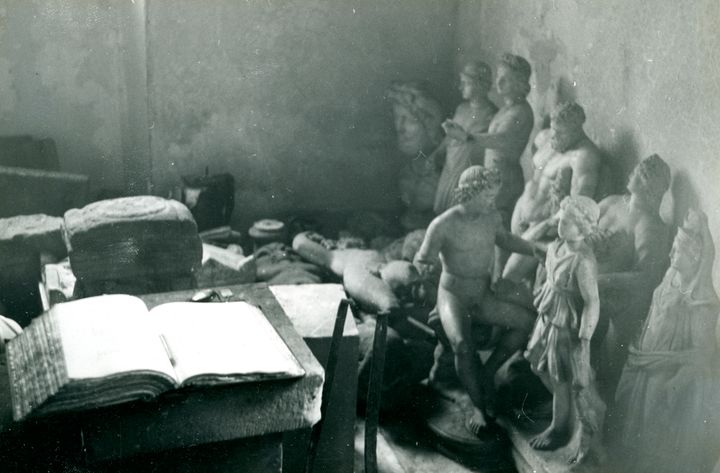
and on the English art market (fig. 52). The collection reflects Vermeule’s work with the art
firm Spink & Son, London, in the 1950s, as well as
his research into antiquities in English collections.
Dealers
See above under “Photo Archives” for additional resources in searching dealer material in these archives. See also Appendix 2, “Dealer Biographies”.
General
Archives Directory for the History of Collecting in
America
The Frick Collection
https://research.frick.org/directory
An exceptionally useful guide, with dealer names, brief
biographies, and collated archival references for
dealers and collectors across a wide array of American
archives.
Antique Dealers: The British Antique Trade in the
20th Century
University of Leeds
https://antiquetrade.leeds.ac.uk/
A useful compendium of dealers active in Britain in the
twentieth century, with some associated names and dealer
addresses indicated.
How to Research an Artist: Artist & Pamphlet
Files
New York Public Library
https://libguides.nypl.org/c.php?g=872748&p=6266002
Collection of dealer ephemera from New York City,
including exhibition opening announcements. Some
material relates to ancient objects. A useful source for
confirming gallery information and types of objects
handled.
Dealer Directories
Useful for comparing gallery locations and addresses over time, listed specialties, gallery personnel, and more, dealer directories are collated in diverse locations, such as tourist guides, collector manuals, and publications focused solely on this material. Where extant, illustrated advertisements provide further points of interest for researchers. One such publication, begun in 1952 and ongoing, is the International Directory of Arts, also known as: Internationales Kunst-Adressbuch; Annuaire international des beaux-arts; Annuario internazionale delle belle arti; and Anuario internacional de las artes.
Individuals and Galleries
Joseph Altounian (1889–1954) and Henriette Lorbet.
Altounian-Lorbet Antiquaires 1906–1954
Altounian-Lorbet Study Photographs of Sculpture and
Decorative Arts
Getty Research Institute
https://primo.getty.edu/GRI:GETTY_ALMA21139903660001551
While not the primary focus of the Altounian-Lorbet
gallery’s holdings, antiquities from the Mediterranean
constitute a notable portion of the thousands of
photographs held in the archive. Some photographs
contain further annotations and photographer stamps.
Kurt Walter Bachstitz (1882–1949). Kunsthandel Kurt
Bachstitz Gallery
Bachsitz Gallery Archive
RKD (Netherlands Institute for Art History)
https://rkd.nl/collections/558
A digitized card file and correspondence with
photographs and extensive annotations around object
movements, potential buyers, and more. Active primarily
in the Netherlands, with a gallery extension in New
York. Related Bachstitz archives are also held at the
Metropolitan Museum of Art, National Gallery of Art, and
St. Louis Art Museum. Additional material is located in
the Nachlaß Robert Zahn in Berlin.
Stefano Bardini (1836–1922)
Fondo Stefano Bardini
Florence, Archivio Fotografico Eredità Bardini
(AFEB)
Florence, Archivio Musei Comunali Fondo Stefano
Bardini (AMCFiFSB)
Archivio Storico Eredità Bardini (ASEB)
http://opacmuseicivicifiorentini.comune.fi.it/mcf/storico/archivio-storico.html
Bardini is best known as a dealer for medieval and
Renaissance Italian works of art, and access to his rich
archival materials remains limited. However, a wealth of
publications on the archive, particularly on his rich
photographic legacy, provide valuable insight and
evidence for its utility in provenance research for
Mediterranean antiquities.
Literature
Capecchi, Gabriella.
L’Archivio Storico Fotografico di Stefano Bardini:
Arte Greca Etrusca Romana
(Florence: A. Bruschi, 1993).
Catterson, Lynn. “Bardini, Stefano” (2003). Grove Art Online. https://doi.org/10.1093/gao/9781884446054.article.T006332.
Catterson, Lynn. “From Visual Inventory to Trophy Clippings: Bardini & Co. and the Use of Photography in the Late Nineteenth-Century Art Market.” Mitteilungen des Kunsthistorischen Institutes in Florenz 62, no. 1 (2020): 69–91.
Moskowitz, Anita F. 2018. “The Photographic Archive of Stefano Bardini: A Few Case Studies of Its Utility.” Source: Notes in the History of Art 37, no. 4: 237–45.
Tunesi, Annalea. “Stefano Bardini’s Photographic Archive: A Visual Historical Document.” PhD thesis, University of Leeds, 2014.
Alfredo Barsanti (1877–1946)
Barsanti Archive
British School at Rome
https://archive.bsr.ac.uk/repositories/3/accessions/4
Unprocessed archive of twenty-one boxes of photographs,
arranged by type, as well as some additional
photographic material. Access is currently restricted,
but a container-level list of materials is available
through the British School.
Julius Böhler (1860–1934). Kunsthandlung Julius
Böhler
Böhler research
Zentralinstitut für Kunstgeschichte, Munich
https://boehler.zikg.eu/
Object photographs, object catalogue cards, and cards
relating to the customers, business relationships, and
dealers of the Julius Böhler gallery in Munich.
Antiquities are a minor part of the firm’s holdings.
Joseph Brummer (1883–1947) and Ernest Brummer
(1891–1964). Brummer Gallery
The Brummer Gallery Records
Watson Library, Metropolitan Museum of Art
https://www.metmuseum.org/art/libraries-and-research-centers/watson-digital-collections/cloisters-archives-collections/the-brummer-gallery-records
As discussed throughout chapter 2 of this volume, the
Brummer Gallery records include catalogue cards,
stockbooks, correspondence, purchaser notes,
photographs, and much more relating to decades of
gallery activity, primarily in New York but with some
notice of their Paris activities as well.
Literature
Biro, Yaëlle et al., eds.
The Brummer Galleries, Paris and New York Defining
Taste from Antiquities to the Avant-Garde
(Leiden: Brill, 2023).
Galerie Demotte
Reconstitution du catalogue des ventes des
antiquaires Demotte (ca. 1900–1934)
Musée du Louvre
https://corpus.louvre.fr/s/galeries-demotte/page/accueil
Thousands of photographs of works of art handled by the
Galerie Demotte (Paris, New York) in the first third of
the twentieth century, primarily medieval and Persian
materials, but with Egyptian, Assyrian, Roman, and Greek
objects included as well.
André Emmerich (1924–2007). André Emmerich
Gallery
André Emmerich Gallery Records and André Emmerich
Papers, circa 1929–2009
Archives of American Art
https://www.aaa.si.edu/collections/andr-emmerich-gallery-records-6275
A vast archive of material covering 1929 to 2009; see
particularly sections on gallery purchases, sales, and
exhibitions. A few sections have been digitized.
Antiquities represent a small fraction of the gallery
holdings, with pre-Hispanic objects predominating; some
ancient Mediterranean purchases continued after the
1970s. Of particular note are the correspondence, sales
records, and photographs documenting the gallery’s
relationship with Herbert Cahn and Münzen und Medaillen
in Basel, resulting in a short series of exhibitions.
Dikran G. Kelekian (1868–1951)
Kelekian Archives
The Onassis Library for Hellenic and Roman Art,
Metropolitan Museum of Art
https://www.metmuseum.org/art/libraries-and-research-centers/the-onassis-library-for-hellenic-and-roman-art
Object photographs, correspondence, invoices, exhibition
material, and more. Includes material from the New York
and Paris galleries. Contact the library for access.
Literature
Anderson-Zhu, Lisa. “An Obscenely Humorous Sam Wide
Group Kylix at the Walters Art Museum.” Addendum:
Provenance.
Journal of the Walters Art Museum 76 (2023).
https://journal.thewalters.org/volume/76/note/an-obscenely-humorous-sam-wide-group-kylix-at-the-walters-art-museum/.
Mathias Komor (1909–1984)
Mathias Komor Photographic Archive, 1935–1978
Getty Research Institute
http://primo.getty.edu/GRI:GETTY_ALMA21134429650001551
This photographic archive represents both objects
handled by the gallery and additional comparative
material; it does not appear to be a complete record of
the gallery’s activities. The photographs are undated,
and there is no evident chronology; some have
photographer stamps and additional annotations,
particularly for the Egyptian section. Includes
antiquities from around the world.
Literature
Ogbechie, Sylvester Okwunodu. “Mathias Komor and the
Market for African Art in New York.” In
Acquiring Cultures: Histories of World Art on Western
Markets, edited by Bénédicte Savoy, Charlotte Guichard, and
Christine Howald, 167–88 (Berlin: De Gruyter, 2019).
John Marshall (1862–1928)
John Marshall Archive
British School at Rome
https://digitalcollections.bsr.ac.uk/Marshall-collection
The archive includes photographs, notes, and a card file
relating to the collecting practices of Marshall, a key
antiquities dealer and agent active in Rome in the early
twentieth century. Entries include references to current
holding institutions where known. Some entries link to
digitized related correspondence.
Literature
Petruccioli, Guido, ed.
Ancient Art and its Commerce in Early
Twentieth-Century Europe: A Collection of Essays
Written by the Participants of the John Marshall
Archive Project
(Oxford: Archaeopress, 2022).
Stendahl Art Gallery (ca. 1900–2017)
Stendahl Art Galleries Records
Getty Research Institute
https://primo.getty.edu/permalink/f/19q6gmb/GETTY_ALMA21177919370001551
The archive preserves the correspondence, photographs,
ephemera, and other documentation from generations of
the Stendahl Art Gallery in Los Angeles. Although
Mediterranean objects were only a small fraction of the
focus of the Stendahls throughout the twentieth century,
there is material relating to objects from Italy,
Greece, Egypt, and the Levant, as well as some Asian
material.
Raphael Stora (1887–1963). Stora Art Galleries; R.
Stora & Company
Stora Art Galleries Records, 1937–1963
Getty Research Institute
https://primo.getty.edu/permalink/f/mlc5om/GETTY_ALMA21125351270001551
Partially digitized; inventory sheets record
consignment, purchase, proposed buyers, and sometimes
additional provenance information.
Raphael Stora Negative Collection and Sales
Invoices
Metropolitan Museum of Art, Watson Library, Cloisters
Archives Collections
https://www.metmuseum.org/art/libraries-and-research-centers/watson-digital-collections/cloisters-archives-collections
https://libmma.contentdm.oclc.org/digital/collection/p15324coll6/id/1927/rec/1
Digitized collection of approximately a thousand
photographic negatives from the New York and Paris
dealer Raphael Stora, including a small number of
antiquities from many areas.
Piero Tozzi (1882–1974)
The Tozzi Archive
The Onassis Library for Hellenic and Roman Art,
Metropolitan Museum of Art
https://www.metmuseum.org/art/libraries-and-research-centers/the-onassis-library-for-hellenic-and-roman-art
Extensive archival holdings of Piero Tozzi, a dealer and
antiquarian active in both New York and Florence,
including correspondence with museums, dealers, and
collectors; shipping documentation; photographs; and
more. Tozzi handled Mediterranean antiquities in
addition to Renaissance and later works of art. Contact
the library for access.
Dieter Widmer (1918–2011), photographer for dealer
Elie Borowski
Dieter Widmer Photographs of Antiquities from the
Ancient Mediterranean World
Getty Research Institute
https://primo.getty.edu/permalink/f/19q6gmb/GETTY_ALMA21251920700001551
Based in Basel, Widmer was a popular photographer for
Swiss dealers, museums, and collectors throughout the
second half of the twentieth century. This collection of
more than 1,800 negatives preserves photographs taken
for the dealer Elie Borowski (1913–2003) between 1954
and 1982, each dated by month and year. See also
http://www.fotoarchive.org/_archive/widm/info.html.
Notes
-
71.AA.257. For the relief’s full provenance and bibliography references, see https://www.getty.edu/art/collection/object/103SSA. ↩︎
-
Matz, Friedrich. 1873. “Antikensammlungen in England.” Archäologische Zeitung 31., 30. ↩︎
-
Christie’s London had maintained a more public archive, but this was closed as of early 2021. https://www.theartnewspaper.com/2021/02/11/christies-closes-access-to-historic-archive-due-to-staff-cuts. My thanks to staff at Sotheby’s and Bonhams for their assistance. ↩︎
-
Some recent case studies: https://www.samuseum.org/press/press-release/-texas-collector-finds-roman-bust-missing-from-germany-since-world-war-ii-at-local-goodwill-store/; https://www.livescience.com/59333-lost-wwii-egyptian-artifact-returns-to-germany.html; https://www.theartnewspaper.com/2017/04/19/the-cleveland-museum-of-art-returns-bust-of-emperors-bloodthirsty-son-to-italy. ↩︎