In the late first century CE, the Roman poet Martial (Epigrams 9.43–.44) described a bronze statuette of Herakles that was made by the Greek sculptor Lysippos to be displayed on a table, hence its name of Herakles Epitrapezios.1 Martial carefully reviewed its history of ownership: “The table of the tyrant from Pella [Alexander the Great] . . . had this divinity. And the boy Hannibal swore by this statue at Carthaginian altars, and this divinity ordered harsh Sulla to put aside kingship. Offended by the haughty terrors of different royal courts, it now rejoices to inhabit a private house. As he was once the guest of pleasant Molorchus, so now the god wishes to be learned Vindex’s.”
In other words, Lysippos made the statue for Alexander of Macedon in the late fourth century BCE; it passed to the Carthaginian general Hannibal in the late third century BCE, to the Roman dictator Sulla in the early first century BCE, and finally into the collection of Vindex, a wealthy art patron at Rome, by the late first century CE. Such poems demonstrate that provenance research on Mediterranean objects is by no means a modern phenomenon but rather reaches at least as far back as classical antiquity, when the art market was, in many respects, just as energized as it is now.
In the course of this chapter, I discuss the significance of the art market, archaeological context, and provenance research prior to the twentieth century; I then turn to the interface of authenticity and legality within the sphere of cultural politics, ending with the shifting status of the 1970 UNESCO Convention in the twenty-first century. I prefer to use the word “findspot” for the place where an object was discovered (rather than “provenience”) and “provenance” to indicate an object’s history from the time of its initial discovery to the present.2
The earliest references to provenance often relate to triumphal commemorations, especially in the Near East, wherein the original context of the monument became a fundamental component of the overall triumphal statement. The twelfth-century BCE Elamite king Shatruk-Nahhunte I, for example, seized as booty the Akkadian victory stele of Naram-Sin (ca. 2250 BCE) and the Babylonian law code of Hammurabi (ca. 1750 BCE), adding to the former a series of inscriptions highlighting both the original and current provenance.3 What had once symbolized one state’s military and judicial achievements had been transformed by the new context and label into a representation of its defeat.
In classical antiquity similar contextual shifts yielded the same result: Alexander the Great’s first major victory over the Persians, at the Granicus River in 334 BCE, was memorialized as a bronze statuary group by Lysippos in the Macedonian city of Dion.4 After Rome’s defeat of the Macedonians in 148 BCE, the victorious commander Metellus took and installed the Granicus group in a new triumphal space, the Porticus Metelli, in the heart of Rome. The monument’s content was not altered, but the shift in context transformed what had been a Macedonian victory monument into one of Macedonian defeat.
This was one of many such plunderings during Roman military expansion in the Greek world during the third and second centuries BCE. The commanders regularly seized as war booty the highest quality sculpture and paintings they could find and featured them in Rome in old and new sanctuaries that functioned in many ways as museums of Greek art.5 All of these objects were regarded as spoils of wars that had recently been concluded, and as such, most of them tended to remain in their new installations. But works of art seized arbitrarily by powerful men who later became public enemies were occasionally treated differently. Such was the case with the statues seized by Mark Antony in the 40s BCE from a variety of eastern Mediterranean locales but subsequently repatriated by his victorious enemy Augustus, whose pride in the repatriation of private loot figured prominently in his public autobiography, the Res Gestae.6
The Late Republican and Early Imperial periods coincided with a dramatic increase in the art market, wherein dealers sought to satisfy the tastes of wealthy patrons by supplying sculpture, painting, and luxury arts for their increasingly palatial residences. Not all Greek sculpture was of equal value in the eyes of the Romans, however: the author and naturalist Pliny the Elder commented that “art stopped” (cessavit ars; HN 34.19.52) in 296 BCE at the death of Lysippos, which meant that the most desired sculptures were those of the Classical period, the fifth and fourth centuries BCE.
Some of these, such as the Granicus Group or the Vindex Hercules, had been shipped to Rome by victorious commanders; others were transported across the Mediterranean via the art market, as evinced by the two mid-fifth-century BCE Greek bronze statues that were discovered in the sea near Calabrian Riace in 1972.7 Given the difficulty in supplying enough statues of fifth- or fourth-century BCE date to meet collectors’ interests, it is not surprising that forgeries entered the market, with the Apollo from Piombino, now in the Louvre, serving as one of the more famous examples.8
During both the Greek and Roman periods, some temple “museums” held collections featuring objects that allegedly originated in a remote past. Many of these were said to have been possessed by heroes of the Trojan War, characters in Greek mythology, or rulers of great renown; consequently, their provenance conferred sanctity upon them. Athena’s temple at Lindos (Rhodes) reportedly contained the leather helmet of Paris, the bracelets of Helen, and the quiver of the Trojan archer Pandarus, while the Erechtheion on the Athenian Acropolis housed one chair made by the mythic Daedalus and another from the collection of the Persian king Xerxes.9
In the case of Lindos, a list of forty-five of the temple’s artifacts was inscribed on a stele in 99 BCE, together with citations from earlier books that mentioned those artifacts.10 In a sense, this may be our first museum catalogue with bibliography, wherein two proto-curators compiled notes on the objects’ histories. Where the exhibited objects actually came from is difficult to say; some of them may actually have been of Bronze Age date, discovered during later construction activities; but whatever their findspots, the illustrious history of origin and ownership to which they attested was used as a mechanism to unite the surrounding community.
One might expect that similar kinds of provenance research would have operated in medieval Europe, when trade in the relics of Christ and the saints became increasingly widespread. Certainly, there was suspicion, at least as early as the tenth and eleventh centuries, that some of the relics were forgeries, but this did not spur researchers to meticulously track the objects’ earlier movements. Stories of miracles effected by the relics were usually accepted as sufficient authentication, although in one case a fragmentary parchment label was inserted in the nostrils of a supposed saint’s skull as proof of authenticity, and at other times, especially during the Ottonian period (tenth/eleventh century CE), the examination might even involve trial by fire—only sacred bones were believed to be impervious to flames, and that in itself provided proof of authenticity.11
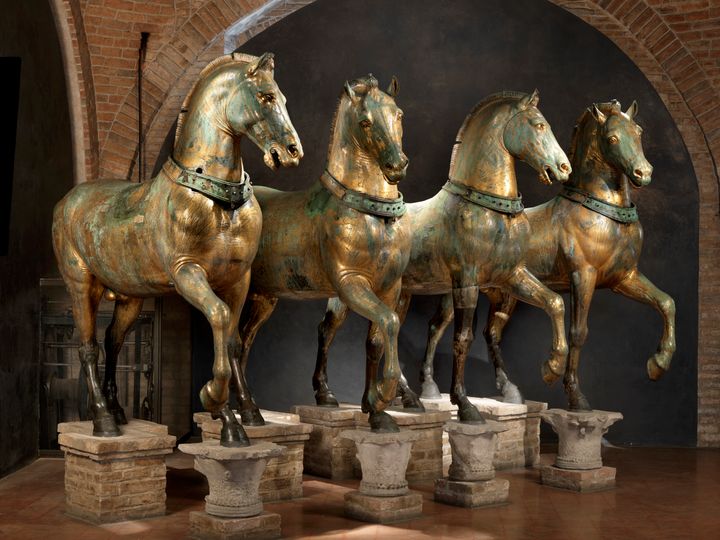
During periods of armed conflict in particular, medieval relics were remarkably peripatetic, as has been the case for objects in war zones ever since. The same was true for monumental works of art, with the four bronze horses of San Marco in Venice serving as an exemplary case (fig. 3). Originally belonging to a quadriga that crowned a triumphal arch in Rome, probably of second-century CE date, they were then shipped, or rather spoliated, in the early fourth century to Constantinople (Istanbul), where they appropriately topped the entrance to the Hippodrome.12 During the Fourth Crusade, in 1204, the Venetian conquerors took the horses from Constantinople to Venice, situating them as badges of empire above the entrance to the Basilica of San Marco, where they remained for six centuries. Napoleon took them to Paris in 1797 and installed them as the crowning element of his new Arc de Triomphe du Caroussel, but shortly after he fell at Waterloo in 1815, they were returned to Venice and again raised above the basilica. Ironically, after a truly Odyssean journey lasting over 1,500 years, the horses eventually returned to the peninsula from which they originally came.
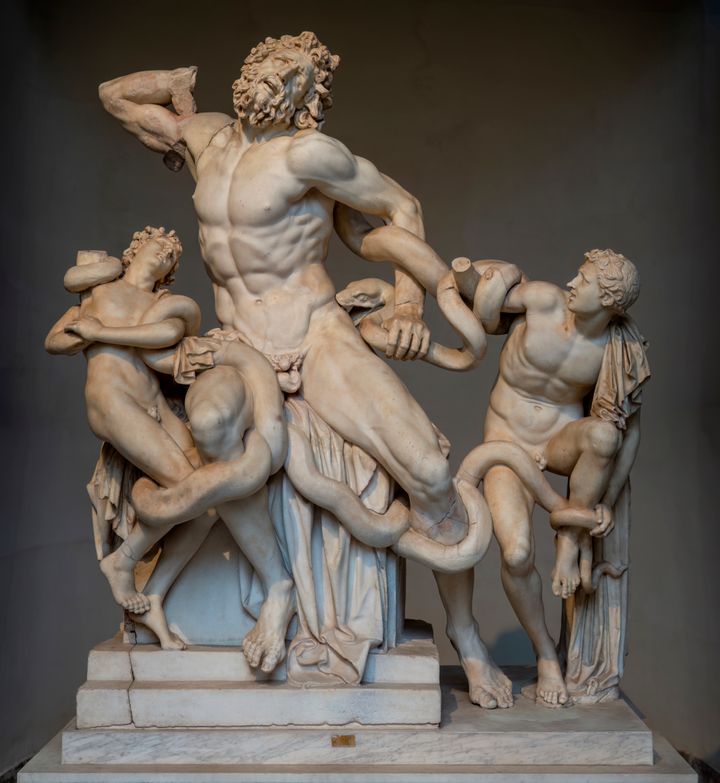
A new historical consciousness arrived in the fifteenth century, when a papal secretary and antiquarian named Flavio Biondo used three rubrics to describe the development of time: ancient, medieval, and modern (Renaissance), presenting the third as a revival of the first.13 As the fifteenth and sixteenth centuries progressed, a new group of antiquarians investigated the surviving remains of ancient Rome, recovering both knowledge and objects for themselves and their patrons. To that end, Pirro Ligorio, the architect of Pope Paul IV, began excavations at Hadrian’s Villa in Tivoli in the sixteenth century, while excavations occurred simultaneously in the Roman Forum and in Ostia.14 When the celebrated painter Raphael was appointed commissioner of Roman antiquities by Pope Leo X, he was involved in the restoration of the Laocoön statuary group after its chance discovery in 1506, using a passage in Pliny (HN 36.5) to identify its sculptors and provenance (fig. 4). Meanwhile, in the palaces and aristocratic houses of Europe, pieces of the ancient world began to be displayed in cabinets of curiosities or Kunstkammern, which could be considered the origin of the modern museum.15 In spite of this growing reverence for antiquity, and perhaps because of it, the collection and reuse of ancient architectural elements had become sufficiently widespread that Pius II (1458–1464) issued a papal edict threatening with excommunication anyone who demolished an ancient building in Rome, and similar bans continued to be issued through the sixteenth century.16
Excavations of the classical past in and around Rome between the fifteenth and seventeenth centuries were both sporadic and limited in scope, but this would change in the eighteenth century with the beginning of fieldwork in Herculaneum (1738) and Pompeii (1748), followed a few decades later at Hadrian’s Villa and Rome’s Via Appia.17 All of these field projects clarified a wide range of questions regarding public and private life in ancient Rome, but the main impetus was to acquire ancient works of art for sale to elite patrons, as art collections dominated by ancient sculpture increasingly developed into symbols of exalted status.18
Those symbols were just as eagerly sought by city-states and empires throughout western Europe, which created the first great public museums in the second half of the eighteenth century: the British Museum opened in 1753, the Vatican’s Museo Sacro in 1756, and the Louvre in 1793.19 Most of the new museums had a strong classical component that included Greco-Roman vases, bronzes, and marble sculptures, while newly excavated ancient buildings were sometimes transplanted in their entirety from their original findspots. But these collections of classical antiquities were also intended to be universal, showcasing the geographic scope of the related empire as well as the primary accomplishments of earlier “great” civilizations, thereby presenting the empire embodied by the museum as the culmination of past achievements.
Such didactic displays of ancient material culture were accompanied by a fascination with the rise, decline, and fall of the ancient cities and empires that were now being showcased. One of the most compelling writers amid this new intellectual environment was the German art historian Johannes Winckelmann, who applied a biological model to the development of art and culture, arguing that there are cycles of growth, maturity, and decline that can be tied to successive historical periods, such as Greek, Roman, and medieval.20 Edward Gibbon’s roughly contemporary Decline and Fall of the Roman Empire (1776–88) adopted a similar approach, privileging Greek art and culture over that of Rome.
This expanding fascination with classical antiquity yielded stronger protective measures for cultural property, the most notable example of which came in 1802, when Pius VII decreed that all excavations in Rome and the export of antiquities required papal authorization. This decree carried little weight, however, following the Napoleonic conquest of Italy in 1799. Wagons laden with paintings and sculptures, including the Laocoön, the Apollo Belvedere, the Dying Gaul, and the horses of San Marco, left Italy for Paris in a stunning reversal of the situation in the ancient Roman Republic when similar wagons with plundered art were just arriving in Rome.21 The banner that accompanied the Apollo Belvedere in the Parisian procession reportedly read: “Greece ceded them; Rome lost them. Their fate has changed twice; it will not change again,” thereby suggesting that an imperial destiny was tied to provenance.22
Nevertheless, two years later, many (but by no means all) of the paintings and sculptures plundered by Napoleon were returned to their homelands, and an article published in Paris and reprinted in London at the time is worth quoting. In this article, entitled “Adieu of the Bronze Horses to the Parisians,” the personified horses of San Marco vocally register their discomfort in departing: “We should not have acted in a manner becoming the place of our origin, which was one of the cities of Greece most renowned for its politeness, had not our residence among you taught us to regard it as a duty, not to leave you without returning thanks for the kind reception you have given us. . . . It was always with reluctance that we were transferred from Corinth to Rome, from Rome to Byzantium, from Byzantium to Venice, and from Venice to Paris.”23 Rarely do objects have the opportunity to deliver such speeches reviewing their history of ownership, although the conferral of agency on an artwork had been a feature of Archaic Greek sculpture and painting (e.g., “Amasis made me”). Speaking objects have appeared again in twenty-first century arguments for repatriation, which I address later in this chapter.
Shortly after Napoleon’s downfall, the political configurations of both Italy and Greece changed dramatically, as did viewpoints on the ownership and movement of cultural property. Greece achieved liberation from the Ottoman Empire in 1832, and the disparate states of the Italian peninsula were unified as the Kingdom of Italy in 1871. In both countries, one of the by-products of the growing spirit of nationalism was a new set of laws intended to prevent the unauthorized removal of antiquities beyond the newly established borders. This legislation, enacted in Greece in 1834 and in Italy in 1871, formed part of a larger movement that also included France, which formulated an antiquities law in 1887. To an extent, the United States was involved as well, in that the American Antiquities Act of 1906, signed by President Theodore Roosevelt, established protection of U.S. archaeological sites and the artifacts they contained.24
Meanwhile, the discipline of archaeology was undergoing a transformation just as dramatic as the shifting borders of Europe. At the beginning of the nineteenth century, the study of prehistory was still tied to a simple binary system of antediluvian and diluvian based on the flood account in Genesis, while Bishop Ussher’s argument that the world had been created in 4004 BCE continued to be influential.25 During the first half of the century, however, the nascent discipline of geology had cast doubt on these earlier classifications by clarifying the earth’s geological stratigraphy, which, in turn, had a profound effect on the development of archaeology.26 By ca. 1850, prehistory had acquired its own temporal stratigraphy, in that “Ages” of Stone, Bronze, and Iron were defined based on the changing materials of objects in use. Shortly thereafter, artifacts began to be arranged in typological sequence, largely due to the publication in 1871 of Darwin’s Descent of Man.27 Moreover, paintings, sculptures, and luxury arts no longer commanded the archaeologist’s full attention; objects such as loomweights, arrowheads, and grinding stones were now also retrieved and inventoried, while their contexts became fundamental to ascertaining the function of a particular room or building.
The second half of the nineteenth century witnessed the inauguration of large-scale German excavations at Olympia, Pergamon, and Troy, among other sites, with the multiperiod settlements at Troy in particular highlighting the importance of strata and their associated ceramics.28 Greek ceramics with painted figures began to be subjected to Morellian analysis toward the end of the century, wherein the idiosyncratic anatomical and decorative details on a painter’s vases were identified as characteristic traits of his style, thereby enabling vases with no context to be ordered chronologically with greater precision.29 This provided a much more stable foundation for the practice of connoisseurship, which had been and would continue to be the primary factor in judging authenticity.
Several of the newly excavated monuments were more peripatetic than one might have expected, especially those that lay within the borders of the Ottoman Empire. The most infamous example is the collection of architectural sculpture from the Parthenon that was acquired by Lord Elgin (between 1801 and 1812) from Sultan Selim III and eventually sold to the British Museum.30 Others were purchased in toto by the museum that had sponsored the associated field project: the British Museum took possession of the Nereid Monument from Xanthos and the sculptures from the Mausoleum of Halicarnassus; the Pergamon Museum in Berlin purchased the Pergamon Altar; and Vienna’s Kunsthistorisches Museum acquired the Parthian Monument of Lucius Verus from Ephesus.31
Many such antiquities entered European museums through the system of partage, wherein a project’s discoveries were split evenly among the host country, the sponsoring institution, and, often, the landowner, which in some cases was the host country.32 There was still a coordinate rise in antiquities smuggling throughout this period, the most notorious example of which was Schliemann’s theft of the Trojan Treasure of Priam, a hoard of Early Bronze Age gold, silver, bronze, and lapis that was ultimately acquired by the Königliche Museen in Berlin, only to disappear in 1945 during the Soviet sack of Berlin.33
Antiquities were leaving Türkiye, in particular, at an alarming rate, although this would begin to change with the appointment in 1881 of Osman Hamdi Bey as director of the Ottoman Imperial Museum.34 He immediately formulated new regulations establishing state control of all antiquities, which was strengthened even further in 1906 with the creation of a national ownership law forbidding the export of any antiquities from Ottoman lands.35 The arrival of Osman Hamdi Bey coincided more or less with America’s entry into the world of Mediterranean art and archaeology. The year 1870 witnessed the foundation of two American museums that aimed for a collection evincing an encyclopedic temporal and spatial scope: the Metropolitan Museum of Art in New York and the Museum of Fine Arts in Boston, both of which sponsored field projects with the intent of adding impressive discoveries to their new galleries through the partage system.36 Purchasing agents in Europe who were trained in Classics, such as Edward Perry Warren and John Marshall, also played significant roles in building the collections, as did Luigi Palma de Cesnola, who excavated at Cypriot Kourion while serving as U.S. consul in Larnaca and sold many of his finds to the Metropolitan Museum.37
There appears to have been relatively little provenance research conducted in the early twentieth century, which is somewhat surprising considering that forged antiquities continued to enter the market at a steady pace. Perhaps the most famous case involved three Etruscan-style terracotta warriors, allegedly dating to ca. 500 BCE, that had been purchased by the Metropolitan Museum between 1915 and 1921.38 Despite highly idiosyncratic styles and anatomical proportions, they were not universally accepted as forgeries until 1961, when chemical tests revealed the presence in the surface glaze of manganese, a chemical element that was never used in the classical Mediterranean.39 Scientific testing had not yet been enlisted as a tool to determine authenticity when the Metropolitan Museum purchased the warriors, although it would begin to acquire prominence shortly thereafter. In 1929, in the case of Hahn v. Duveen, the owners of a Leonardo da Vinci painting employed X-rays and pigment analysis to prove its authenticity (now doubted), and even though such testing was extremely rare at the time, it nevertheless signaled a turning point in art historical analysis.40
The next two decades and World War II brought archaeologists, curators, historians, and conservators together into a new configuration when they became members of the Monuments, Fine Arts, and Archives program operated by the U.S. Army’s Civil Affairs and Military Government Sections. These were the “Monuments Officers,” a community of humanists working in tandem with the military to identify, catalogue, and conserve cultural property looted by the Third Reich from conquered lands.41 Provenance research on a scale as massive as this was unprecedented, and it was further complicated by the continual movement of the artwork, the deaths of the original owners, and the shifting postwar borders in eastern Europe, as exemplified by several cities in Poland that became part of the Soviet Union after 1945.42
Another group that was formed to offer assistance was the Jewish Restitution Successor Organization (now the World Jewish Restitution Organization), founded in New York in 1947 to determine the provenance and logical destination of more than a quarter of a million looted books, Torah scrolls, textiles, and vessels.43 With such tremendous resources focused on the repatriation of looted cultural property, one might expect that such provenance research would only have strengthened during the next quarter century, but interest in Nazi-looted art and antiquities had largely disappeared by the mid-1950s and would not reemerge until the 1990s, nearly fifty years after the war had ended.44
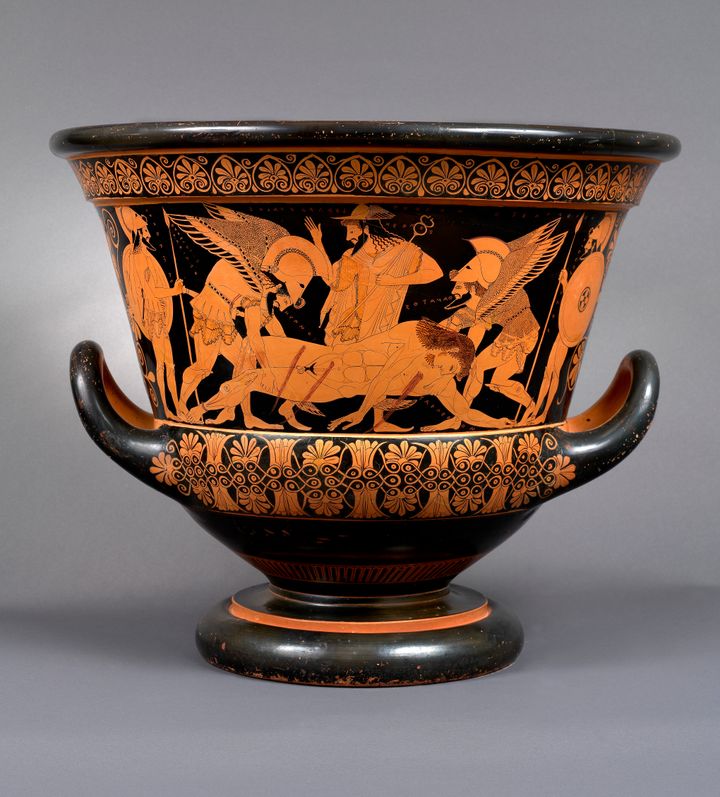
In the aftermath of World War II, wealthy individuals and institutions again turned to the art market to build or augment their collections, a trend that would continue for the remainder of the century. There were innumerable purchases of ancient Mediterranean art and artifacts during this period, but I note here some of the more famous examples. In 1966 the Metropolitan Museum purchased the “Lydian Hoard,” a group of gold and silver objects dating to the late sixth century BCE that was subsequently shown to have been plundered from Lydian tombs in western Türkiye.45 In 1972 the same museum made a second high-profile purchase of a krater (wine-mixing bowl), signed by the painter Euphronios, which had been plundered from an Etruscan tomb in Cerveteri, fifty kilometers northwest of Rome (fig. 5).46 A few years earlier the University of Pennsylvania Museum of Archaeology and Anthropology (the Penn Museum) had acquired a hoard of twenty-four pieces of Early Bronze Age gold jewelry that bore an astonishing resemblance to Schliemann’s Treasure of Priam, while the Museum of Fine Arts in Boston acquired an assemblage of 137 pieces of Early Bronze Age gold jewelry on the occasion of its centennial.47
The unusually high quality of these acquisitions immediately attracted public attention, along with a surfeit of concerns about their findspots, provenances, and authenticity. Some of these questions were now answerable by deploying a range of scientific techniques that could indicate forgeries and pinpoint times of production. Radiocarbon analysis became an indispensable dating tool for organic materials following World War II, while thermoluminescence dating, which also involves radiation, became available in the mid-1960s and helped to distinguish ancient from modern.48 Infrared spectroscopy had demonstrated the modern origins of the aforementioned Etruscan terracotta warriors, and it would prove invaluable in determining the proper conservation treatment of the 2,000-year-old Dead Sea Scrolls.49 By this point, then, the determination of authenticity required a three-pronged approach that comprised connoisseurship, provenance inquiry, and scientific analysis.
Coupled with the expanding art market and advances in scientific techniques was a new perspective on cultural heritage protection that would culminate in the 1970 UNESCO Convention on the Means of Prohibiting and Preventing the Illicit Import, Export and Transfer of Ownership of Cultural Property.50 There had been earlier initiatives in the United States to ensure the wartime protection of cultural property, especially during the administrations of Presidents Theodore and Franklin Roosevelt, followed by the 1954 Hague Convention for the Protection of Cultural Property in the Event of Armed Conflict, which became the first convention devoted exclusively to protecting cultural property.51 None of these initiatives, however, provided an international framework focused on the prevention of looting and the repatriation of stolen cultural property, which the UNESCO Convention was intended to address.52 The global impact of the Convention on museums, archaeologists, art historians, and learned societies has been monumental, and it would be fair to say that no museum’s acquisitions policy has remained unchanged as a result of it, although the responses to the Convention have been and continue to be highly idiosyncratic.53
Several museums, including the Penn Museum and the Field Museum of Natural History in Chicago, immediately adopted 1970 as a line in the sand regarding the purchase of unprovenanced art and antiquities, pledging that any potential purchase must have been documented outside the country of origin prior to 1970, or have been legally exported after 1970.54 The Archaeological Institute of America (AIA) immediately resolved to support the new UNESCO Convention and subsequently announced that the AIA’s Annual Meeting and its flagship journal, the American Journal of Archaeology, would no longer serve as the initial scholarly publication of an object acquired after 1973 unless its existence could be documented prior to that date, or proof of legal export from the source country could be demonstrated.55
One of the most prominent by-products of the Convention was the establishment in 1976 of the Stolen Art Alert by the International Foundation for Art Research, which would develop in 1991 into the Art Loss Register, an international database of lost or stolen cultural property.56 Needless to say, the effect of the Convention on provenance research was profound, although the acknowledgement of 1970 as a meaningful dividing line remained a subject of dissension, as it continues to be more than fifty years later.
The discussions leading to the 1970 UNESCO Convention commenced in 1964, and they were no doubt prompted by myriad factors but among them were surely the dramatic political and cultural changes that characterized the 1960s, especially in Africa. At the beginning of the decade, U.K. Prime Minister Harold Macmillan addressed the South African Parliament in a speech that acquired the name “Wind of Change,” wherein he highlighted the rise of nationalism and the disintegration of colonialist power in Africa.57 Similar decolonization movements had been sweeping through Asia, and as many as thirty-six former European colonies achieved autonomy or independence between 1945 and 1960.58 The newly independent nations became increasingly cognizant of the extent to which their cultural heritage had been appropriated by the colonizers, as well as the rapidity with which it continued to be looted, thereby prompting UNESCO to consider potential remedies.
Winds of change were also being generated within the discipline of archaeology itself, as feminist, Marxist, and postcolonial approaches to material culture became increasingly influential.59 All of these theoretical lenses would play significant roles in the development of post-processual archaeology during the 1970s and 1980s, which emphasized the subjectivity of archaeological analysis.60 Proponents argued that no object could be effectively examined from viewpoints of gender, class, or ethnicity, among others, unless its archaeological context was known and meticulously documented. One of the by-products of this highly charged environment was a rising disquiet in discourse involving museums, collectors, and archaeologists that still has not abated.61
Meanwhile, a series of armed conflicts continued across the globe throughout the 1970s, leading to the looting of tens of thousands of antiquities that gradually made their way to the art market. Shortly after the partition of Cyprus in 1974, four Early Byzantine mosaics were stolen from the church of Panagia Kanakaria in northern Cyprus and entered the United States, although they were repatriated fifteen years later.62 Looting in Afghanistan increased exponentially following the Soviet invasion of 1979, and the same was true for Cambodia and Lebanon during their respective civil wars.63
At the same time, eye-catching antiquities continued to appear in dealers’ catalogues and museum galleries. A Frankfurt dealer in 1981 acquired the upper half of a marble statue of Herakles, the lower half of which was found nine years later during the excavation of the Roman city of Perge in southwest Türkiye.64 This was followed in 1981/82 by the appearance on the art market of a group of sixteen silver vessels of third century BCE date, generally referred to as the Morgantina Treasure after the name of the Sicilian site from which it was later determined to be looted.65 Entering the collection of the Getty Villa in the mid-1980s was a two-meter-tall marble kouros whose authenticity is still unresolved, and a monumental late fifth-century BCE cult statue of a goddess that was later determined to have been looted from Morgantina as well.66 A hoard of Late Bronze Age gold jewelry and seals was plundered from a Mycenaean cemetery at Aidonia in Greece and appeared in 1993 for sale in New York.67
The new perspectives on cultural property in the 1970s admittedly had been groundbreaking, but they paled in comparison to the political, legislative, and social changes during the century’s final decade, which began with the fall of the Berlin Wall and the First Gulf War and concluded with the fall of the World Trade Center Towers and the U.S. invasion of Afghanistan. The decade debuted with a chain of events that thrust World War II back onto center stage after the passage of nearly fifty years. The chain began with the new spirit of openness that accompanied the collapse of the Soviet Union in 1991, during which Moscow’s Pushkin Museum revealed that the Treasure of Priam had been secretly stored there since the sack of Berlin in 1945. Previously believed to have been destroyed at the war’s end, the treasure’s rediscovery prompted repatriation requests from both Türkiye and Germany as well as a renewed examination of World War II booty.68
Augmenting these growing concerns was the publication of Lynn Nicholas’s book The Rape of Europa, which meticulously documented the extent of Nazi plundering in Europe’s occupied countries as well as the range of activities of the Monuments Officers.69 The reunification of Germany in 1990 facilitated archival research on the plundered collections, as did the founding of the Internet in 1994. This technological advance sparked an unprecedented revolution in provenance research: the movement of stolen property could now be tracked across the globe and histories of ownership reconstructed for immediate distribution.
A further boost came from the U.S. House Banking Committee under the direction of Representative James Leach, who focused on both bank accounts and cultural property that had belonged to Holocaust victims. This, in turn, led to a 1998 conference in Washington, DC, on Holocaust-era assets that yielded two fundamental results: a new set of guidelines from the Association of Art Museum Directors (AAMD) recommending research on the provenance of objects in their collections that might have been looted by the Nazis, and the American Alliance of Museums (AAM) Nazi-Era Provenance Internet Portal (NEPIP), which contained nearly 30,000 objects from 170 participating museums before its termination in 2024.70 These were late in coming, and it took the threat of government regulation to push them forward, but in the process, provenance research became an integral component of museum policy and practice.
The 1990s also witnessed an intensive crackdown on the looting activities of organized crime, coupled with several significant repatriations to Italy, Greece, and Türkiye. The Carabinieri raid on the Geneva warehouse of Giacomo Medici in 1995 yielded thousands of looted antiquities, together with photographic documentation of their findspots; those photographs had been taken with a Polaroid SX-70 camera, which debuted in 1972, thereby providing a convenient terminus post quem for the looting.71 The Lydian Hoard, having been plundered in 1966/67, was returned by the Metropolitan Museum following a six-year-long court case filed by Türkiye, while the Mycenaean artifacts from Aidonia were repatriated to Greece after a three-year lawsuit.72
In the wake of more aggressive litigation by Mediterranean countries, the Getty Museum altered and simplified its acquisitions policy in 1995, stating that acquisitions must come from well-documented (i.e., published) collections, although eleven more years would pass before the museum adopted 1970 as a criterion for determining whether an object would be acquired.73 Provenance research also became more comprehensive and analytical, as demonstrated by a study showing how the looting and forging of Early Bronze Age Cycladic figures, especially since 1945, have completely destabilized our understanding of their original function.74 Epistemological candor in the phrasing of object labels has also become a focus of attention, with straightforward terms such as “grounded” and “ungrounded” preferred over the more ambiguous “said to be,” “almost certainly,” and “allegedly.”75
The advent of the Iraq War in 2003 prompted a sea change in public attitudes toward the protection of cultural property, largely due to the looting of the Iraq Museum in Baghdad and the rampant destruction of Iraqi and Afghan archaeological sites. Safeguarding cultural heritage became an issue that united the museum and archaeological communities, both of which began to issue joint statements of concern and to provide cultural heritage protection briefings at U.S. military bases, not unlike the programs of the Monuments Officers during and after World War II.76 Perhaps the most significant development for the United States was the 2009 ratification of the Hague Convention by the U.S. Senate, fifty-four years after it had been initially formulated.
Not surprisingly, this period witnessed an acceleration in the return of antiquities to Mediterranean countries, including the Euphronios Krater in 2006 and the Getty’s Cult Statue of a Goddess in 2007.77 Both of these were repatriated to Italy along with more than seventy other antiquities, some of which were featured in a 2007–2008 Italian exhibition entitled Nostoi, the ancient Greek term for the Homeric heroes who arrived home after a series of labyrinthine wanderings.78 This signals yet another application of human agency to objects, not unlike the horses of San Marco in the nineteenth century, and the practice would not end there: the 2012 advertisements urging the return of the Parthenon sculptures to Greece featured the Erechtheion caryatid speaking in first person: “I am Greek and I want to go home.”79
By 2008 the AAMD and the AAM had issued new recommendations that member institutions require documentation demonstrating that an object considered for acquisition had left the probable country of its modern discovery by 1970. This involved the creation of a searchable Object Registry, with information supplied by member museums, that provided known provenance, exhibit, and publication records for objects in their collections that had been acquired after 1970. These are recommendations only, so the degree of compliance with the AAMD’s Object Registry varies widely among museums, but the year 1970 had finally been acknowledged, at least publicly, as a fixed line to consider in collection policies.80
Ironically, the 1970 standard is gradually losing the potency it once possessed in requests for repatriations, as demonstrated by a case at the Penn Museum in 2011. The aforementioned hoard of Early Bronze Age gold jewelry, purchased by the museum in 1966, was examined by archaeometallurgists in 2009 to determine whether every component of the assemblage was in fact ancient.81 Within a tiny loop of gold on one of the pendants were a few particles of soil that ranged from arsenic to zinc based on neutron activation analysis. The composition of this soil, which clearly related to the original burial, especially the high levels of arsenic, was consistent with the soil in the Trojan plain. Although the assemblage was acquired four years prior to the UNESCO Convention, Türkiye requested repatriation based on the 1906 Ottoman Antiquities Law and considered 1970 to be an irrelevant line. The return of the gold to Türkiye was eventually successfully negotiated, but the discussions highlighted the fact that in the case of some countries, we have moved beyond the relative security that the UNESCO Convention offered to museums with antiquities collections. Political factors have also come into play: in 2017 French president Emmanuel Macron proposed the repatriation of cultural property taken by France from its former African colonies, which would entail the scrutiny of archives reaching as far back as the nineteenth century.
In any event, the dramatic political, social, and legislative changes during the last three decades have propelled provenance research to the forefront of nearly every museum’s activities. The 2003 decision in the United States v. Schultz case demonstrated U.S. recognition of foreign laws criminalizing antiquities theft, which, in turn, reinforced the necessity of investigating an object’s context prior to acquisition.82 A provenance researcher position has been endowed at the Museum of Fine Arts in Boston, and many similar posts have followed, and the sharp increase in digital archives coupled with the accessibility of open-search software facilitates the scope and speed of research more than ever before.
At the same time, the plundering of cultural property has skyrocketed in areas of armed conflict, especially those that experienced the “Arab Spring” revolutions of the last decade, wherein both museums and sites were often deliberately destroyed in an attempt to mask the extent of the looting.83 Forgers of classical art have also become increasingly adept at imitating ancient styles and techniques, using marble from ancient quarries; lead from Roman Imperial buildings; or urine, acid, or whole-wheat spaghetti to facilitate the creation of an older looking surface.84 As a result, historians of ancient art still have difficulty distinguishing between ancient and modern in spite of the assistance provided by a range of sophisticated scientific techniques. The parade of scholars who participated in the 1992 conference on the kouros purchased by the Getty Museum in 1985 (85.AA.40)85 could not agree on its authenticity even though they were among the world’s leading experts on ancient Greek sculpture.86
Not surprisingly, the acquisition of ancient Mediterranean and Near Eastern art by American museums has decreased significantly: the last major artwork to have been acquired was the Metropolitan Museum’s gilded Ptolemaic sarcophagus in 2017, but the revelation of its forged export license led to its rapid repatriation to Egypt, while the vast majority of artifacts purchased by the Museum of the Bible in Washington, DC, in 2009 have been repatriated to Iraq and Egypt.87 In other words, the museum collections that have already been formed will probably not grow appreciably in size going forward; consequently, public interest in those collections will have to be generated by increasingly compelling narratives, and provenance research is one of the most effective means toward that end.
Notes
-
McNelis, Charles. 2008. “Ut Sculptura Poesis: Statius, Martial, and the Hercules Epitrapezios of Novius Vindex.” American Journal of Philology 129, no. 2: 255–76.. For assistance in the preparation of this chapter I gratefully acknowledge Patty Gerstenblith, Ann Kuttner, Cynthia Hahn, Lynn Grant, Robert Ousterhout, Steven Rosen, and Justin Ross Muchnick. ↩︎
-
On these terms, see Joyce, Rosemary. 2012. “From Place to Place: Provenience, Provenance, and Archaeology.” In Provenance: An Alternative History of Art, edited by Gail Feigenbaum and Inge Reist, 48–60. Los Angeles: Getty Publications.; Gerstenblith, Patty. 2019. “Provenances: Real, Fake, and Questionable.” International Journal of Cultural Property 26: 285–304.. ↩︎
-
Miles, Margaret M. 2008. Art as Plunder: The Ancient Origins of Debate about Cultural Property. Cambridge: Cambridge University Press.. ↩︎
-
Ridgway, Brunilde. 1990. Hellenistic Sculpture I. Madison: University of Wisconsin Press.. ↩︎
-
Rose, C. Brian. 2008. “Forging Identity in the Roman Republic: Veristic Portraiture and Trojan Ancestry.” In Role Models in the Roman World: Identity and Assimilation, edited by Sinclair Bell and Inge Hansen, 97–131. Ann Arbor: University of Michigan Press.. ↩︎
-
Res Gestae 24; see Miles, Margaret M. 2008. Art as Plunder: The Ancient Origins of Debate about Cultural Property. Cambridge: Cambridge University Press.. ↩︎
-
Braghò, Giuseppe, ed. 2017. I bronzi di Riace: Nei documenti ufficiali del ritrovamento. Tropea: Editore Meligrana.. ↩︎
-
Ridgway, Brunilde. 1967. “The Bronze Apollo from Piombino in the Louvre.” Antike Plastik 7, 43–75 (volume ed. W. H. Schuchhardt).; Lapatin, Kenneth, and Jens M. Daehner, eds. 2015. Power and Pathos: Bronze Sculpture of the Hellenistic World. Exhibition catalogue. Los Angeles: J. Paul Getty Museum.; Descamps-Lequime, Sophie, and Benoit Mille, eds. 2007. “Bronzes grecs et romains: Études récentes sur la statuaire antique.” Special issue, Technè 45.. ↩︎
-
Harris, Diane. 1995. The Treasures of the Parthenon and Erechtheion. Oxford: Oxford University Press.; Shaya, Josephine. 2005. “The Greek Temple as Museum: The Case of the Legendary Treasure of Athena from Lindos.” American Journal of Archaeology 109, no. 3: 423–42.; van Rookhuijzen, Jan Z. 2020. “The Parthenon Treasury on the Acropolis of Athens.” American Journal of Archaeology 124, no. 1: 3–35.. ↩︎
-
Shaya, Josephine. 2005. “The Greek Temple as Museum: The Case of the Legendary Treasure of Athena from Lindos.” American Journal of Archaeology 109, no. 3: 423–42.. ↩︎
-
Coulton, George Gordon. 1910. Life in the Middle Ages. Vol. 1. New York and Cambridge: Macmillan and Cambridge University Press.; Head, Thomas. 2004. “The Genesis of the Ordeal of Relics by Fire in Ottonian Germany: An Alternative Form of ‘Canonization.’” In Procès de canonization au Moyen Age: Aspects juridiques et religieux / Medieval Canonization Processes: Legal and Religious Aspects, edited by Gàbor Klaniczay, 19–37. Rome: École française de Rome.. ↩︎
-
Jacoff, Michael. 1993. The Horses of San Marco and the Quadriga of the Lord. Princeton: Princeton University Press.. ↩︎
-
Trigger, Bruce. 2006. A History of Archaeological Thought. Cambridge: Cambridge University Press.; Pontari, Paolo. 2016. “‘Nedum mille qui effluxerunt annorum gesta sciamus’: L’Italia di Biondo e l’Invenzione’ del Medioevo.” In A New Sense of the Past: the Scholarship of Biondo Flavio (1392–1463), edited by Angelo Mazzocco and Marc Laureys, 151–76. Leuven: Leuven University Press.. ↩︎
-
Palma Venetucci, Beatrice. 2003. “Pirro Ligorio and the Rediscovery of Antiquity.” In The Rediscovery of Antiquity: The Role of the Artist, edited by Jane Fejfer, Tobias Fischer-Hansen, and Annette Rathje, 63–88. Copenhagen: Museum Tusculanum Press.; Furlotti, Barbara. 2019. Antiquities in Motion: From Excavation Sites to Renaissance Collections. Los Angeles: Getty Research Institute.. ↩︎
-
Impey, Oliver, and Arthur MacGregor, eds. 2001. The Origins of Museums: The Cabinet of Curiosities in Sixteenth- and Seventeenth-Century Europe. London: House of Stratus.. ↩︎
-
Schnapp, Alain. 1997. The Discovery of the Past, trans. by Ian Kinnes and Gillian Varndell. New York: Harry N. Abrams.; Furlotti, Barbara. 2019. Antiquities in Motion: From Excavation Sites to Renaissance Collections. Los Angeles: Getty Research Institute.. ↩︎
-
Coates, Victoria C. Gardner, and Jon Seydl, eds. 2007. Antiquity Recovered: The Legacy of Pompeii and Herculaneum. Los Angeles: J. Paul Getty Museum.. ↩︎
-
Angelicoussis, Elizabeth, with contributions by Andrew Stewart and Daniella Ben-Arie. 2017. Reconstructing the Lansdowne Collection of Classical Marbles. Munich: Hirmer.; Bartman, Elizabeth. 2017. The Ince Blundell Collection of Classical Sculpture. Vol. 3, The Ideal Sculpture. Liverpool: Liverpool University Press.. ↩︎
-
McClellan, Andrew. 1999. Inventing the Louvre: Art, Politics, and the Origins of the Modern Museum in Eighteenth-Century Paris. Berkeley: University of California Press.; Paul, Carole, ed. 2012. The First Modern Museums of Art: The Birth of an Institution in 18th- and Early-19th-Century Europe. Los Angeles: J. Paul Getty Museum.. ↩︎
-
Winckelmann, Johann Joachim. 1764. Geschichte der Kunst des Alterthums. Dresden: Waltherischen Hof-Buchhandlung.; see further Schnapp, Alain. 1997. The Discovery of the Past, trans. by Ian Kinnes and Gillian Varndell. New York: Harry N. Abrams.; Fejfer, Jane. 2003. “Wiedewelt, Winckelmann, and Antiquity.” In The Rediscovery of Antiquity: The Role of the Artist, edited by Jane Fejfer, Tobias Fischer-Hansen, and Annette Rathje, 229–34. Acta Hyperborea 10. Copenhagen: Museum Tusculanum Press.; Trigger, Bruce. 2006. A History of Archaeological Thought. Cambridge: Cambridge University Press.. ↩︎
-
Ridley, Ronald. 1992. The Eagle and the Spade: Archaeology in Rome during the Napoleonic Era. Cambridge: Cambridge University Press.. ↩︎
-
Miles, Margaret M. 2008. Art as Plunder: The Ancient Origins of Debate about Cultural Property. Cambridge: Cambridge University Press.; Vout, Caroline. 2018. Classical Art: A Life History from Antiquity to the Present. Princeton: Princeton University Press.. ↩︎
-
Miles, Margaret M. 2008. Art as Plunder: The Ancient Origins of Debate about Cultural Property. Cambridge: Cambridge University Press.. ↩︎
-
Righter, Robert W. 1989. “National Monuments to National Parks: The Use of the Antiquities Act of 1906.” Western Historical Quarterly 20, no. 3: 281–301.. ↩︎
-
Daniel, Glyn. 1963. The Idea of Prehistory. Cleveland, OH: World Publishing.; Trigger, Bruce. 2006. A History of Archaeological Thought. Cambridge: Cambridge University Press.. ↩︎
-
Daniel, Glyn. 1963. The Idea of Prehistory. Cleveland, OH: World Publishing.. ↩︎
-
Trigger, Bruce. 2006. A History of Archaeological Thought. Cambridge: Cambridge University Press.. ↩︎
-
Daniel, Glyn. 1963. The Idea of Prehistory. Cleveland, OH: World Publishing.; Easton, Donald F. 2002. Schliemann’s Excavations at Troia, 1870–1873. Mainz: Phillip von Zabern.. ↩︎
-
Spier, Jeffrey. 1990. “Blinded with Science: The Abuse of Science in the Detection of False Antiquities.” Burlington Magazine 132, no. 1050: 623–31.; Trigger, Bruce. 2006. A History of Archaeological Thought. Cambridge: Cambridge University Press.; Watson, Peter, and Cecilia Todeschini. 2007. The Medici Conspiracy: The Illicit Journey of Looted Antiquities from Italy’s Tomb Raiders to the World’s Greatest Museums. New York: BBS Public Affairs.. ↩︎
-
Miles, Margaret M. 2008. Art as Plunder: The Ancient Origins of Debate about Cultural Property. Cambridge: Cambridge University Press.. ↩︎
-
Hodos, Tamar. 2015. “Lycia and Classical Archaeology: The Changing Nature of Archaeology in Turkey.” In Classical Archaeology in Context: Theory and Practice in Excavation in the Greek World, edited by Donald Haggis and Carla Antonaccio, 87–118. Berlin: De Gruyter.; Greenhalgh, Michael. 2019. Plundered Empire: Acquiring Antiquities from Ottoman Lands. Leiden: Brill., Greenhalgh, Michael. 2019. Plundered Empire: Acquiring Antiquities from Ottoman Lands. Leiden: Brill.. ↩︎
-
Cuno, James. 2008. Who Owns Antiquity? Princeton: Princeton University Press.; Özel, Sibel. 2010. “Under the Turkish Blanket Legislation: The Recovery of Cultural Property Removed from Turkey.” International Journal of Legal Information 38, no. 2: 177–84.; Greenhalgh, Michael. 2019. Plundered Empire: Acquiring Antiquities from Ottoman Lands. Leiden: Brill.. ↩︎
-
Tolstikov, Vladimir, and Mikhail Treister. 1996. The Gold of Troy: Searching for Homer’s Fabled City. New York: Ministry of Culture of The Russian Federation, A. S. Pushkin State Museum of Fine Arts, in association with H. N. Abrams.. ↩︎
-
Holod, Renata, and Robert Ousterhout, eds. 2011. Osman Hamdi Bey and the Americans: Archaeology, Diplomacy, Art. Exhibition catalogue. Istanbul: Pera Museum Publications.. ↩︎
-
Özel, Sibel. 2010. “Under the Turkish Blanket Legislation: The Recovery of Cultural Property Removed from Turkey.” International Journal of Legal Information 38, no. 2: 177–84.. ↩︎
-
Curran, Kathleen. 2006. The Invention of the American Art Museum: From Craft to Kulturgeschichte, 1870–1930. Los Angeles: Getty Research Institute.. ↩︎
-
Sox, David. 1991. Bachelors of Art: Edward Perry Warren and the Lewes House Brotherhood. London: Fourth Estate.; Hermary, Antoine, and Joan R. Mertens. 2014. The Cesnola Collection of Cypriot Art: Stone Sculpture. New York: Metropolitan Museum of Art.. ↩︎
-
Richter, Gisela M. A. 1937. Etruscan Terracotta Warriors in the Metropolitan Museum of Art. New York: Metropolitan Museum of Art.. ↩︎
-
von Bothmer, Dietrich, and Joseph Veach Noble. 1961. An Inquiry into the Forgery of the Etruscan Terracotta Warriors in the Metropolitan Museum of Art. New York: Metropolitan Museum of Art.; Parsons, Harold W. 1962. “The Art of Fake Etruscan Art.” Art News 60, no. 10: 34–37.. ↩︎
-
Merryman, John Henry, Albert Edward Elsen, and Stephen K. Urice. 2007. Law, Ethics, and the Visual Arts. Alphen aan den Rijn, Netherlands: Kluwer Law International.; Brewer, John. 2009. The American Leonardo: A Tale of Obsession, Art and Money. Oxford: Oxford University Press.. ↩︎
-
Nicholas, Lynn H. 1994. The Rape of Europa: The Fate of Europe’s Treasures in the Third Reich and the Second World War. New York: Knopf.; Edsel, Robert, and Bret Witter. 2009. The Monuments Men: Allied Heroes, Nazi Thieves, and the Greatest Treasure Hunt in History. New York: Center Street.. ↩︎
-
Nicholas, Lynn H. 1994. The Rape of Europa: The Fate of Europe’s Treasures in the Third Reich and the Second World War. New York: Knopf.. ↩︎
-
Nicholas, Lynn H. 1994. The Rape of Europa: The Fate of Europe’s Treasures in the Third Reich and the Second World War. New York: Knopf.. ↩︎
-
Two legal cases from this interim period are relevant. Kunstsammlungen zu Weimar v. Elicofon in 1966 involved two Dürer portraits stolen from Schwarzburg Castle at the end of the war that reappeared in the United States in 1966; the case was not settled until 1981. The second was Menzel v. List, also in 1966, involving a Chagall painting that was stolen by the Nazis in 1941 and reappeared in New York in 1955; this was settled in 1969; Merryman, John Henry, Albert Edward Elsen, and Stephen K. Urice. 2007. Law, Ethics, and the Visual Arts. Alphen aan den Rijn, Netherlands: Kluwer Law International.. ↩︎
-
Özgen, Ilknur, and Jean Öztürk. 1996. Heritage Recovered: The Lydian Treasure. Istanbul: Ugur Okman for Republic of Turkey, Ministry of Culture, General Directorate of Monuments and Museums.. ↩︎
-
Hoving, Thomas. 1993. Making the Mummies Dance: Inside the Metropolitan Museum of Art. New York: Schuster and Schuster.; Watson, Peter, and Cecilia Todeschini. 2007. The Medici Conspiracy: The Illicit Journey of Looted Antiquities from Italy’s Tomb Raiders to the World’s Greatest Museums. New York: BBS Public Affairs.. ↩︎
-
Bass, George F. 1970. “A Hoard of Trojan and Sumerian Jewelry.” American Journal of Archaeology 74, no. 4: 335–41.; Meyer, Karl E. 1973. The Plundered Past. London: Hamish Hamilton.. ↩︎
-
Aitken, Martin J. 1985. Thermoluminescence Dating. London: Academic Press.; Taylor, R. E., and Ofer Bar-Yosef. 2014. Radiocarbon Dating: An Archaeological Perspective. Walnut Creek, CA: Left Coast Press.. Thermoluminescence tests carried out on a group of Neolithic Hacilar (southern Türkiye) figurines at Oxford revealed that nearly seventy-three percent of them were modern; Chippindale, Christopher, and David W. J. Gill. 1993. “Material and Intellectual Consequences of Esteem for Cycladic Figures.” American Journal of Archaeology 97, no. 4: 601–59.. ↩︎
-
Derrick, Michele R., Dusan Stulik, and James M. Landry. 1999. Infrared Spectroscopy in Conservation Science. Los Angeles: Getty Conservation Institute.. ↩︎
-
UNESCO Convention on the Means of Prohibiting and Preventing the Illicit Import, Export and Transfer of Ownership of Cultural Property. United Nations Educational, Scientific and Cultural Organization, Convention on the Means of Prohibiting and Preventing the Illicit Import, Export and Transfer of Ownership of Cultural Property, November 14, 1970, 823 U.N.T.S. 231 (entered into force April 24, 1972). https://www.unesco.org/en/legal-affairs/convention-means-prohibiting-and-preventing-illicit-import-export-and-transfer-ownership-cultural.. ↩︎
-
Nicholas, Lynn H. 1994. The Rape of Europa: The Fate of Europe’s Treasures in the Third Reich and the Second World War. New York: Knopf.; Miles, Margaret M. 2008. Art as Plunder: The Ancient Origins of Debate about Cultural Property. Cambridge: Cambridge University Press.. ↩︎
-
Gerstenblith, Patty. 2013. “The Meaning of 1970 for the Acquisition of Archaeological Objects.” Journal of Field Archaeology 38, no. 4: 364–73., Gerstenblith, Patty. 2019. “Provenances: Real, Fake, and Questionable.” International Journal of Cultural Property 26: 285–304.. ↩︎
-
The U.S. Senate voted to ratify the UNESCO Convention in 1972, although the implementing legislation did not go into effect until 1983. Many market nations refrained from ratifying the Convention until the late 1990s or 2000s, and some have still not ratified it, although there are now 140 State Parties to the Convention, including most of the market states. ↩︎
-
Field Museum of Natural History. 1971. “Policy Statement Concerning Acquisition of Antiquities.” Curator: The Museum Journal 14: 232–35.; Penn Museum. 1980. “The Pennsylvania Declaration.” Expedition 22: 3. https://www.penn.museum/sites/expedition/the-pennsylvania-declaration/.. ↩︎
-
Carter, Jane. 2020. “A Letter from the Editor-in-Chief: Revised Editorial Policy on the Publication of Unprovenanced Antiquities.” American Journal of Archaeology 124, no. 2: 175–77.. ↩︎
-
Watson, Peter, and Cecilia Todeschini. 2007. The Medici Conspiracy: The Illicit Journey of Looted Antiquities from Italy’s Tomb Raiders to the World’s Greatest Museums. New York: BBS Public Affairs.. As of this writing, the database contains more than 700,000 entries. While the ALR remains active, in 2024 IFAR announced it would shut down operations and move its archives and databases to a new organization. https://www.artnews.com/art-news/news/art-authentication-nonprofit-ifar-to-shut-down-1234718928/. ↩︎
-
Butler, Larry, and Sarah Stockwell, eds. 2013. The Wind of Change: Harold Macmillan and British Decolonization. New York: Palgrave Macmillan.. ↩︎
-
Lawrence, Adria K. 2013. Imperial Rule and the Politics of Nationalism: Anti-Colonial Protests in the French Empire. Cambridge: Cambridge University Press.. ↩︎
-
Renfrew, Colin. 1980. “The Great Tradition vs. The Great Divide: Archaeology as Anthropology?” American Journal of Archaeology 84, no. 3: 287–98.; Lyons, Claire L. 2002. “Objects and Identities: Claiming and Reclaiming the Past.” In Claiming the Stones / Naming the Bones: Cultural Property and the Negotiation of National and Ethnic Identity, edited by Elazar Barkan and Ronald Bush, 116–37. Los Angeles: Getty Research Institute.; Trigger, Bruce. 2006. A History of Archaeological Thought. Cambridge: Cambridge University Press.. ↩︎
-
Trigger, Bruce. 2006. A History of Archaeological Thought. Cambridge: Cambridge University Press.. ↩︎
-
Cuno, James. 2008. Who Owns Antiquity? Princeton: Princeton University Press.. ↩︎
-
Chippindale, Christopher, and David W. J. Gill. 1993. “Material and Intellectual Consequences of Esteem for Cycladic Figures.” American Journal of Archaeology 97, no. 4: 601–59.. ↩︎
-
Stein, Gil. 2015. “The War-Ravaged Cultural Heritage of Afghanistan: An Overview of Projects of Assessment, Mitigation, and Preservation.” Near Eastern Archaeology 789, no. 3: 187–95.; Tahan, Lina. 2017. “Trafficked Lebanese Antiquities: Can They Be Repatriated from European Museums?” Journal of Eastern Mediterranean Archaeology and Heritage Studies 5, no. 1: 27–35.. ↩︎
-
Chippindale, Christopher, and David W. J. Gill. 2000. “Material Consequences of Contemporary Classical Collecting.” American Journal of Archaeology 104, no. 3: 463–511.. ↩︎
-
Watson, Peter, and Cecilia Todeschini. 2007. The Medici Conspiracy: The Illicit Journey of Looted Antiquities from Italy’s Tomb Raiders to the World’s Greatest Museums. New York: BBS Public Affairs.; Povoledo, Elizabeth. 2010. “A Trove of Ancient Silver Said to Be Stolen Returns to Its Home in Sicily.” New York Times, December 5. https://www.nytimes.com/2010/12/06/arts/design/06silver.html.. ↩︎
-
Kokkou, Angeliki, ed. 1993. The Getty Kouros Colloquium. Athens: Kapon Editions.; Felch, Jason, and Ralph Frammolino, 2011. Chasing Aphrodite: The Hunt for Looted Antiquities at the World’s Richest Museum. Boston: Houghton Mifflin Harcourt.. ↩︎
-
Chippindale, Christopher, and David W. J. Gill. 2000. “Material Consequences of Contemporary Classical Collecting.” American Journal of Archaeology 104, no. 3: 463–511.. ↩︎
-
Tolstikov, Vladimir, and Mikhail Treister. 1996. The Gold of Troy: Searching for Homer’s Fabled City. New York: Ministry of Culture of The Russian Federation, A. S. Pushkin State Museum of Fine Arts, in association with H. N. Abrams.. ↩︎
-
Nicholas, Lynn H. 1994. The Rape of Europa: The Fate of Europe’s Treasures in the Third Reich and the Second World War. New York: Knopf.. ↩︎
-
Wechsler, Helen J. 2005. “U.S. Museums and the Nazi-Era Assets Issue.” In Vitalizing Memory: International Perspectives on Provenance Research. Washington, DC: American Association of Museums.. For NEPIP, see https://www.aam-us.org/programs/the-nazi-era-provenance-internet-portal-nepip-archive/. ↩︎
-
Watson, Peter, and Cecilia Todeschini. 2007. The Medici Conspiracy: The Illicit Journey of Looted Antiquities from Italy’s Tomb Raiders to the World’s Greatest Museums. New York: BBS Public Affairs.. ↩︎
-
Özgen, Ilknur, and Jean Öztürk. 1996. Heritage Recovered: The Lydian Treasure. Istanbul: Ugur Okman for Republic of Turkey, Ministry of Culture, General Directorate of Monuments and Museums.; Chippindale, Christopher, and David W. J. Gill. 2000. “Material Consequences of Contemporary Classical Collecting.” American Journal of Archaeology 104, no. 3: 463–511.. ↩︎
-
Chippindale, Christopher, and David W. J. Gill. 2000. “Material Consequences of Contemporary Classical Collecting.” American Journal of Archaeology 104, no. 3: 463–511.; J. Paul Getty Trust. 2006. “J. Paul Getty Museum Announces Revised Acquisitions Policy.” Press release. Getty News and Stories. https://media.getty.edu/Text/00ae0cba-827f-5f1a-877e-86468937f24a.pdf/.. ↩︎
-
Chippindale, Christopher, and David W. J. Gill. 1993. “Material and Intellectual Consequences of Esteem for Cycladic Figures.” American Journal of Archaeology 97, no. 4: 601–59.. ↩︎
-
Marlowe, Elizabeth. 2016. “What We Talk About When We Talk About Provenance: A Response to Chippindale and Gill.” International Journal of Cultural Property 23, no. 3: 217–36.. ↩︎
-
Rose, C. Brian. 2007. “Talking to the Troops about the Archaeology of Iraq and Afghanistan.” In Rhodes 2007.. ↩︎
-
Watson, Peter, and Cecilia Todeschini. 2007. The Medici Conspiracy: The Illicit Journey of Looted Antiquities from Italy’s Tomb Raiders to the World’s Greatest Museums. New York: BBS Public Affairs.. ↩︎
-
Godart, Louis, and Stefano de Caro. 2007. Nostoi: Capolavori ritrovati. Rome: Segretariato Generale della Presidenza della Repubblica.. ↩︎
-
Kotseli, Areti. 2012. “‘I Am Greek and I Want to Go Home’: Movement for the Repatriation of Looted Greek Antiquities.” Greek Reporter, August 5. http://greece.greekreporter.com/2012/08/05/i-am-greek-and-i-want-to-go-home-movement-for-the-repatriation-of-looted-greek-antiquities/; https://www.youtube.com/watch?v=7swmq0VROUk.. Another case in point is the application of the word “orphan” to antiquities purchased by private collectors after 1970, which many museums are reluctant to accept as acquisitions; Chippindale, Christopher, and David W. J. Gill. 2000. “Material Consequences of Contemporary Classical Collecting.” American Journal of Archaeology 104, no. 3: 463–511.; Berman, Russell. 2006. “Met Chief Defends Museums’ Pursuit of Antiquities.” New York Sun, April 18.. ↩︎
-
https://aamd.org/object-registry. See further Gerstenblith, Patty. 2013. “The Meaning of 1970 for the Acquisition of Archaeological Objects.” Journal of Field Archaeology 38, no. 4: 364–73.; Gerstenblith, Patty. 2019. “Provenances: Real, Fake, and Questionable.” International Journal of Cultural Property 26: 285–304.. ↩︎
-
Rose, C. Brian. 2017. “Beyond the UNESCO Convention: The Case of the Troy Gold in the Penn Museum.” Journal of Eastern Mediterranean Archaeology and Heritage Studies 5, no. 1: 87–91.. ↩︎
-
Watson, Peter, and Cecilia Todeschini. 2007. The Medici Conspiracy: The Illicit Journey of Looted Antiquities from Italy’s Tomb Raiders to the World’s Greatest Museums. New York: BBS Public Affairs.; Gerstenblith, Patty. 2009. “Schultz and Barakat: Universal Recognition of National Ownership of Antiquities.” Art, Antiquity, and Law 14: 29–57.. ↩︎
-
Zraik, Karen. 2019. “Now for Sale on Facebook: Looted Middle Eastern Antiquities.” New York Times, May 9. https://www.nytimes.com/2019/05/09/arts/facebook-antiquities-syria-iraq.html.. ↩︎
-
Chippindale, Christopher, and David W. J. Gill. 1993. “Material and Intellectual Consequences of Esteem for Cycladic Figures.” American Journal of Archaeology 97, no. 4: 601–59.; Kaye, Brian H. 2008. Science and the Detective: Selected Readings in Forensic Science. Weinhein: Wiley-VCH.; Amineddoleh, Leila. 2015. “Purchasing Art in a Market Full of Forgeries: Risks and Legal Remedies for Buyers.” International Journal of Cultural Property 22: 415–35.; Subramanian, Samanth. 2018. “How to Spot a Perfect Fake: The World’s Top Art Forgery Detective.” Guardian, June 15. https://www.theguardian.com/news/2018/jun/15/how-to-spot-a-perfect-fake-the-worlds-top-art-forgery-detective.. ↩︎
-
85.AA.40; https://www.getty.edu/art/collection/object/103VNP. ↩︎
-
Kokkou, Angeliki, ed. 1993. The Getty Kouros Colloquium. Athens: Kapon Editions.. ↩︎
-
Moynihan, Colin. 2019. “Met Museum to Return Prize Artifact Because It Was Stolen.” New York Times, February 15. https://www.nytimes.com/2019/02/15/arts/design/met-museum-stolen-coffin.html.; Crow, Kelly. 2020. “Hobby Lobby President to Return 11,500 Antiquities to Iraq and Egypt.” Wall Street Journal, March 27. https://www.wsj.com/articles/hobby-lobby-president-to-return-11-500-antiquities-to-iraq-and-egypt-11585324494.; https://www.museumofthebible.org/newsroom/update-on-iraqi-and-egyptian-items. ↩︎