Over a century and a half ago, long, thin linen strips inscribed with ritual spells from the Egyptian Book of the Dead were removed from the mummified remains of three individuals whose subsequent fate is unknown. The wrappings were divided up, transported out of Egypt, and entered into a variety of European collections over the course of the nineteenth century. Today, they can be found all over the world—California, New Zealand, Australia, England, Italy, Belgium—in collections both public and private. One group of twelve, dating to the third to first centuries BCE and all mistakenly thought to come from a single mummified individual, was donated to the J. Paul Getty Museum in 1983 (83.AI.47; fig. 1)1. Their first documented appearance was as part of the collection of Sir Thomas Phillipps (1792–1872), an obsessive English collector of books and manuscripts. Following his death, the wrappings passed through the family and various booksellers in England and thereafter were sold, in 1977, to Hans P. Kraus in New York. Kraus and his wife, Hanni, donated them to the J. Paul Getty Museum six years later.
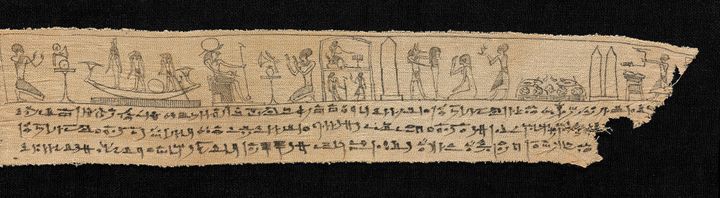
The research process for studying the provenance—the ownership history—of these Ptolemaic wrappings may appear straightforward: distinguishing between what is known, what remains unknown, and what is still to be confirmed. But the undocumented removal of the bandages from three deceased individuals and the character of their dispersal cannot be considered in a neutral manner. How should we acknowledge the loss of the ancient bodies, and the splintering of the wrappings through subsequent sales? How might we best convey the interventions of successive collectors and the different ways in which they studied, handled, and valued these wrappings? How to articulate these events within the standardized format for provenance in a database record, which defaults to treating the bandages as objects subject to ownership transfers over time?
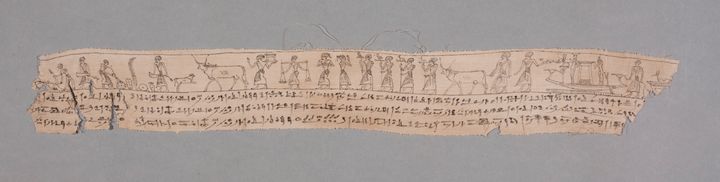
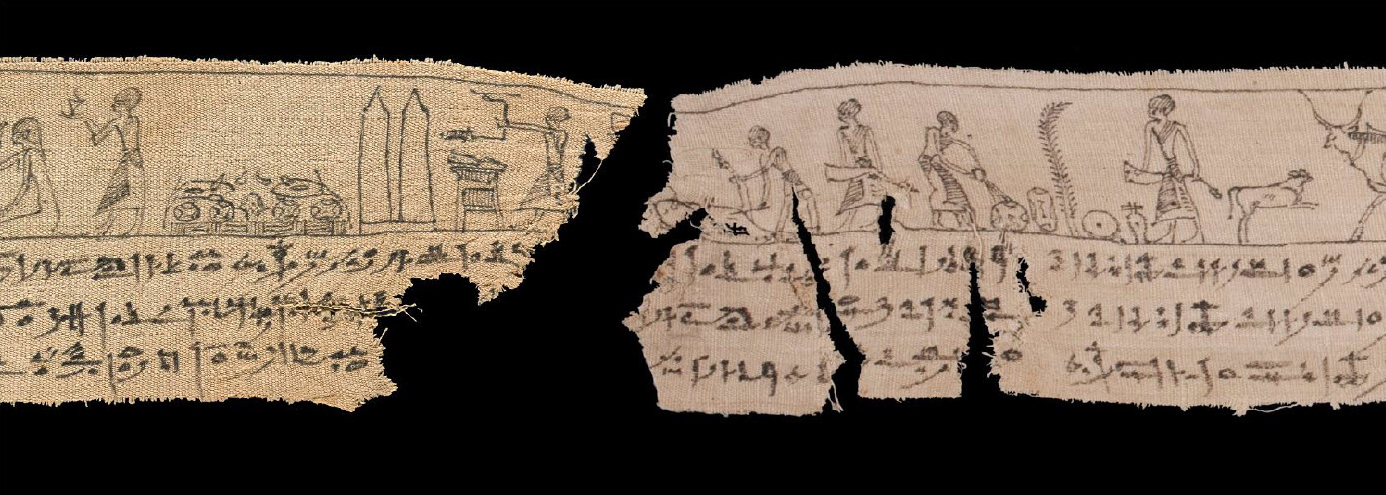
Even a brief consideration of these funerary wrappings makes clear that provenance research entails not only the documentation of previous owners but also the positioning of that information within much broader histories of collecting, display, and scholarship. Furthermore, these inquiries must also recognize the ancient individuals with whom these artifacts were connected—in this case, physically enwrapped. Although the bandages were torn and cut up, some preserve the names of the deceased, and recent research has allowed us to retitle them in our records, thereby acknowledging the identities of the individuals for whom they were prepared: Petosiris, son of Tetosiris; Petosiris, son of Nanesbastet; and Nanefbastet, son of Taneferher. In turn, through collaboration with institutions that hold joining fragments, we can begin to digitally unify the separated elements in order to reconstruct them as a set (fig. 2).2
But how to embark upon this work? What are the most effective ways to track down fragments that have been scattered around the world, or conveyed along branches of a family tree with scarcely a mention? What are the challenges and opportunities particular to working with Mediterranean antiquities? As the linen wrappings demonstrate, these are objects that have been collected for centuries and are entangled in the overlapping—and sometimes conflicting—domains of scholarship, archaeology, and museum practice. Ethical standards and legal precedents have fallen in and out of step, and evidence for illicit looting and calls for repatriation influence both teaching priorities and public perceptions. When we began a sustained project to document the Getty Museum’s antiquities collection in 2012, there was no convenient handbook for navigating these many fields. To that end, we have developed this publication to provide a compendium of materials and strategies that we have found useful. We do not presume to prescribe best practices, but over the course of numerous conversations with colleagues and students, we believe this resource meets a significant need.
For the purposes of this volume, we use “Mediterranean antiquities” to cover Greek, Etruscan, and Roman artifacts that date prior to ca. 500 CE, preferring it to the value-laden “Classical.” However, the Getty’s antiquities collection also includes objects from Egypt (such as the wrappings discussed above), South Arabia, central Asia, and Spain. The art market has typically been even less rigidly defined, and auction sales of “antiquities” or “ancient sculpture and works of art” may include Egyptian, Near Eastern, and Byzantine objects. With this in mind, we acknowledge the limits of our experience and expertise but anticipate that many of the methods and approaches addressed in this volume can be fruitfully applied to material beyond Greece, Etruria, and the Roman Empire.
The Antiquities Provenance Project at the Getty
Our project began in 2012 as part of a broader institutional initiative to render our collections and their documentation more accessible. The Getty’s return of objects to Greece and Italy in 2007 was the impetus to prioritize provenance research for its collection of Mediterranean antiquities. Yet there was at that time little in the way of a practical framework for doing this work. In comparison to our peers researching World War II-era provenance or those following protocols established by the North American Graves Protection and Repatriation Act (NAGPRA), we lacked the web portals, digitized archives, agreed-upon standards, and effective means of sharing information with colleagues. Granted, there was already a rich tradition of study that addressed the history of collecting, and extensive bibliography existed for many Grand Tourists who traveled in Italy and sometimes farther east, but objects from their renowned collections often stand, like the Getty Museum’s Lansdowne Herakles (70.AA.109),3 as exceptional, precisely because of their well-documented histories. Far less easy to track are smaller or less distinctive objects, such as terracotta figurines, gemstones, or pottery and glass vessels. Furthermore, while there is substantial scholarship on the market for Mediterranean antiquities during the eighteenth and nineteenth centuries, the twentieth century, and particularly its second half, remains relatively underexplored. This is precisely the period in which the Getty and many other North American museums were actively collecting and will be the particular focus of this book.
Our brief was to undertake a complete review of the collection—which, if counted piece by piece, numbers more than 45,000 items.4 With the benefit of hindsight, the experience might be compared to excavating at a vast site that had been poorly dug decades previously: stratigraphies of information were disordered, records scanty or altogether lacking, and conjectures and assumptions had long taken root. In short, we inherited the judgments, speculations, and obfuscations of our predecessors and were tasked with piecing together paper trails that had long been dispersed, or, worse, that had never existed. There is, admittedly, much about the Getty that is exceptional and idiosyncratic, but a brief overview of its collecting practices is instructive, for it not only informs our priorities in preparing this book but can also draw attention to some of the trends and key events that have shaped other collections of Mediterranean antiquities.
The Getty’s Antiquities Collection
J. Paul Getty (1892–1976) stands squarely within the tradition of wealthy North American collectors. The dispersal of European, and especially British, estates between World Wars I and II offered rich pickings to buyers who were flush with funds, keen to assert their cultural standing, and entranced by the art and history of the ancient Mediterranean. Getty’s interests were narrow, primarily spanning European old master paintings, furniture and decorative arts, and Greek and Roman antiquities. Even within these categories, his tastes were limited, and his earliest purchases—starting in 1939 and resuming after World War II—were mostly of Roman sculpture, often depictions of women or goddesses. Marbles from well-known collections, such as those of Lords Lansdowne and Elgin, brought an obvious cachet, and one that Getty prized. Through time spent in Italy, he was able to buy from dealers in Rome, but the bulk of his early purchases came from established firms in New York and London, such as Spink & Son, the Brummer Galleries, and French & Company. In 1954, having established the J. Paul Getty Trust the previous year, he opened the J. Paul Getty Museum in his Ranch House, his residence in Malibu (today the Pacific Palisades), and the same year marked the first of what would be many purchases from the Paris- and Geneva-based dealer Nicolas Koutoulakis.5 From here on, most of Getty’s acquisitions were intended for the museum’s collection, and in fact he had left the United States for Europe in 1951, never to return to California. Acquisitions continued, albeit sporadically, during the 1950s and ’60s, advised by specialists such as Burton Fredericksen, Bernard Ashmole, and Jean Charbonneaux. But the decision in 1968 to build the Getty Villa prompted a major shift, with a dedicated building to fill and a desire to present a more comprehensive array of ancient Mediterranean art. The expanded scope brought with it new approaches to collecting (notably the purchase of the entire stock of Royal Athena Galleries in 1971), and new sources, including donations. From his appointment as curator of antiquities in 1973, Jiří Frel was the motivating force behind acquisitions, especially following Getty’s death in 1976. Frel’s disregard for documentation, coupled with a desire to establish both himself and the still-young collection, during a period in which the looting of archaeological sites in Italy and other source countries was rampant, saw the collection grow exponentially.
Frel obtained much of this material—particularly in the form of large batches of pottery fragments, terracotta figurines, and coins—through a scheme involving inflated appraisals.6 Increased scrutiny of the museum’s acquisitions during the early 1980s prompted Frel’s dismissal and, in turn, the development of a policy for collecting that was adopted in 1987.7 In addition to relinquishing the institution’s right to protection under the statute of limitations, this required the Getty to notify foreign governments of an acquisition so that they could establish a claim, compare the proposed acquisition against the International Foundation for Art Research’s database of stolen and missing objects, print an illustrated entry in the next acquisitions supplement of the museum’s journal, and publish a scholarly study of the object within a year of acquisition or as soon as possible thereafter. Vendors were required to warrant that they had good title, free from any claims or disputes about ownership; that the object had been legally exported from its country of origin; and that all other customs and patrimony laws of relevant countries had been met. This policy was revised eight years later under Marion True, then curator of antiquities, committing the museum to purchasing objects that had been published prior to 1995 and that were part of “established, well-documented collections.”8 The museum framed these reforms as positive steps, building also upon its engagement in researching and returning material from the extensively looted site of Francavilla Marittima in southern Italy, which had been acquired during the late 1970s and early ’80s.9 But the changes fell short of the revision’s first draft, which had stipulated 1972 as the key date—following the Archaeological Institute of America’s recognition of the 1970 UNESCO Convention on the Means of Prohibiting and Preventing the Illicit Import, Export and Transfer of Ownership of Cultural Property.10
The museum continued to add to its collection, notably with the acquisition of the collection of Barbara and Lawrence Fleischman in 1996, but the discovery of the “organigram” in 1995 proved transformative for many museums and collectors, and the Getty in particular.11 This chart, hand drawn by an Italian antiquities dealer, documented a network of middlemen and tombaroli (Italian for “tomb-robbers”) who were supplying the market, and led to a raid on the storage space of Giacomo Medici at the Geneva Freeport on September 13, 1995. A dossier of photographs and documentation furnished critical evidence that many museums and collectors had obtained objects illicitly and occasioned a series of legal cases and restitutions. Following the conviction of Medici in 2004, Marion True was charged in Italy with receiving stolen antiquities and conspiring with Medici and the dealer Robert Hecht (the trial was abandoned in 2010 following the expiration of the statute of limitations on the charges).12 In 2006, in the course of negotiating the return of objects to Italy, the Getty revised its acquisition policy again, identifying the signing of the 1970 UNESCO convention as the decisive date for determining whether an object could be considered for acquisition.13
Investigations and raids on the premises of other prominent figures in the market during the past twenty-five years, notably Gianfranco Becchina, Robin Symes, Shelby White, and Michael Steinhardt,14 have further increased the scrutiny of existing collections, as well as items appearing at auction. Throughout this period the Getty has continued to return objects, whether as a result of research by curatorial staff, the presentation of new evidence by scholars, officials, and archaeologists, or, most recently, in cooperation with investigations pursued by the Manhattan District Attorney.15 Concurrently, we have—in the course of our Antiquities Provenance Project—studied the ownership history for every object in the collection and published information online.16 The fruits of this research have also appeared in articles,17 online blogs,18 collections catalogues,19 conference sessions and workshops, and, during the reinstallation of the Getty Villa between 2015 and 2018, the development of a gallery dedicated to Collecting Histories.20
We see this publication as another step in this project and draw upon our experiences of working with the Getty’s collection to provide a set of strategies and resources for researching the provenance of Mediterranean antiquities. We hope that these provide a tool kit for anyone working with similar material—especially those doing so for the first time, who may find themselves faced with a bewildering variety of institutional policies, professional guidelines, and publishers’ stipulations. Nor is this research solely the purview of museum staff, scholars, or students. Dealers and collectors should be aware that the provenance of ancient objects for sale on eBay or at Renaissance fairs requires diligent analysis and verification, just as it does for artworks that are famous bequests or that are sold at major auction houses. Anyone engaged with material culture should query where an object has come from and what information surrounds its history, and these questions lead to consideration of legal frameworks, ethical practice, scholarly critique, and public debate.21 These are themes that will be variously addressed by contributors to this volume; for the remainder of this introduction, we turn to some key themes in provenance research.
On “Provenance” and “Provenience”
We use “provenance” to indicate an object’s history of ownership but recognize that the word’s meaning is highly variable and dependent on context (e.g., it can be used when describing a geographical source of marble or clay). As an art historical term, it can also fall short for antiquities, as it may only encompass an artifact’s modern history and not its ancient production and use. Furthermore, by focusing on the chain of possession the term privileges a particular set of events and individuals in an object’s history and risks overlooking its broader “cultural biography” or “object itinerary.”22 This is especially pertinent for an ancient object, which may have functioned in many different ways before its deposition.
Confounding matters further, “provenance” is sometimes seen along with the similar sounding “provenience.” The latter refers to an archaeological object’s findspot and thus references a singular event; as Rosemary Joyce summarizes, “provenience is a fixed point, while provenance can be considered an itinerary that an object follows as it moves from hand to hand.”23 Yet despite the clarity of this distinction, “provenience” is still often perceived to be a dialectical variant or specialist term and remains only in sporadic use. As such, we prefer to use clearer language in this volume, such as “excavated in,” “place found,” or “findspot.” And just like any other facet of ownership history, this kind of information is susceptible to doubt when documentation is lacking. Anyone undertaking research on Mediterranean antiquities will soon encounter a “said to be” or “reportedly,” and—in part to address this—Elizabeth Marlowe has proposed two alternative terms: “grounded” and “ungrounded.” Objects with a known findspot are “grounded”; anything else is “ungrounded.” An object may have centuries of recorded ownership, but if its place of discovery is not recorded or verifiable, it should not be considered in the same way as a find from a documented excavation, whose authenticity is assured and whose context furnishes a secure basis for interpretation.24
The 1970 UNESCO Convention and Guidelines for Provenance
Research
Newspaper exposés from the 1960s to the early 2000s brought to public attention the rampant market for Mediterranean antiquities and the looting that often fueled it,25 and Marlowe’s approach is rooted in a rigorous concern not only for the intellectual consequences of the antiquities trade but also for its material effects. Fundamental in this regard is the 1970 UNESCO Convention on the Means of Prohibiting and Preventing the Illicit Import, Export and Transfer of Ownership of Cultural Property,26 which is discussed in detail in the essays by C. Brian Rose and by Stephen Clark and Stephen Urice in this volume. For present purposes, we note that while 1970 is now established in museum policies and professional guidelines as an important line in the sand when assessing provenance information, the date may have only limited significance. Ratification and implementation of the UNESCO Convention varies by country (in the United States, the Convention on Cultural Property Implementation Act was only passed in 1982 and signed into law in 1983), and even if 1970 is seen as a watershed moment for acknowledging the need to protect cultural heritage, there had long been calls for the recognition of the consequences of looting, particularly in regional newspapers and by concerned archaeologists.27 Furthermore, archaeologically rich countries have invoked national patrimony laws that substantially predate 1970 in making claims for restitution (see Rose, in this volume), while a recent collection of essays on the fate of Mediterranean antiquities during World War II highlights the need to determine an object’s whereabouts between 1933 and 1945.28
In addition, while the 1970 UNESCO Convention serves as a basis for acquisition guidelines established by the likes of the American Alliance of Museums (AAM, formerly the American Association of Museums) and the Association of Art Museum Directors (AAMD), it does not entail retrospective surveys of existing collections. In this it differs from the 1990 North American Graves Protection and Repatriation Act (NAGPRA) and 1998 Washington Principles on Nazi-Confiscated Art, both of which have had profound effects on the methods and resources applied to provenance research—at least for those who work with materials that fall under their purview. NAGPRA requires that museums and other institutions receive federal funds to inventory Native American human remains, funerary and sacred objects, and items of cultural patrimony, while the Washington Principles, although nonbinding, have fostered the establishment of searchable databases, the digitization of archival materials, and the creation and funding of research projects. We note these here in part to make clear that such frameworks, resources, and requirements have not been established for Mediterranean antiquities, and also to acknowledge the precedents and expectations they set.
A case in point is the publication of research guides. For American audiences perhaps the most formative has been The AAM Guide to Provenance Research (2001), which has served as a blueprint for treatments of provenance methodology, the development of “red flag” name lists, and resources guides.29 Published soon after the 1998 Washington Conference, the AAM Guide is primarily concerned with tracing European works of art during the Nazi era and thus has only indirect applications for Mediterranean antiquities. Other research guides for specific categories of objects have followed, together with studies dedicated to aspects of provenance research and outlines for best practices promulgated by professional bodies (detailed here in Appendix 1). All provide useful strategies, case studies, and resources, but none has focused on Mediterranean antiquities.
Moreover, at the time of writing, there are no formal American organizations for provenance research, and so there are no guidelines produced by the practitioners of this work.30 Whereas some countries have robust national initiatives for provenance projects, in the United States the field is fragmented across public and private organizations that do not (with the exception of collections under the scope of NAGPRA) fall under a federal umbrella of research. So there are no American equivalents to the 2018 Sarr-Savoy report on the restitution of African cultural heritage objects in France,31 or to the joint Franco-German Fund on the Provenance of Cultural Objects from Sub-Saharan Africa (2024),32 or to government restitution bodies for World War II art cases.33 Provenance research in American museums has thus been shaped by the character of individual collections, institutional priorities, and the availability of resources, and while professional bodies such as the AAM and AAMD provide guidelines, there are overlapping and sometimes conflicting interpretations as to how provenance research should be practiced and implemented. This means that while the acquisition or publication of Mediterranean antiquities may be tightly regulated,34 research—particularly as a retrospective project for existing collections—is not. This disparity is all the more striking given the sheer quantity of Greek, Roman, and Etruscan material that has circulated over the past five centuries. The scale of this market is challenging to comprehend, and while there are case studies that map and quantify many aspects,35 there is little that weaves these threads together to produce a holistic overview of the modern trade in Mediterranean antiquities. Researchers seeking clear and complete documentation of who was selling and buying which kinds of objects and where are likely to have to survey gallery guides, exhibition catalogues, legal documents, archival sources, and dealer ephemera (see Barr and Budrovich, in this volume)—a patchwork of evidence reliant on published materials that still fails to provide a comprehensive record of the actual markets involved.
Provenance in the Public Eye
Advocacy around the protection of cultural heritage over the past fifty years has profoundly—if slowly and sporadically—changed the course of museums, their acquisitions, and their displays.36 Even over the time that we have been preparing this book, many institutions have established new roles for research specialists or expanded the responsibilities of existing staff.37 Outreach—through exhibits, blogs, permanent gallery installations, and social media—has paved the way for greater dialogue, and these trends are also apparent in academia, where provenance, once largely the realm of cultural heritage classes, has now become a subject for dedicated study.
Individuals and communities have also adapted to this changing landscape, whether in collaboration with museums or through grassroots movements to advocate for the return of their cultural patrimony.38 General audiences are coming to museums with a new vocabulary around provenance and restitution, and while the Elgin Marbles remain perhaps the best-known case, visitors are familiar with a much richer and broader picture. The “Killmonger” scene from the 2018 movie Black Panther—in which the film’s antihero reminds a curator of the violence of colonial collecting before forcibly removing an African object from a museum display—has become a familiar point of reference and provides just one basis for new generations of visitors to question how and why museum collections were formed, the agency of objects, and who has the right to display cultural artifacts.39
Using This Book
The preceding paragraphs merely scratch the surface of this rapidly evolving field, and more detail on many of the topics considered here can be found throughout the following chapters. Taking advantage of the publication’s online format, and recognizing that readers will approach it with different needs and levels of experience, each chapter can be read independently, but together they complement one another. C. Brian Rose’s essay, “Mediterranean Archaeology and Provenance Research: A Diachronic Perspective,” presents the longue durée, drawing from his own experiences as a scholar, archaeologist, and curator. His survey spans triumphal commemoration in the ancient Near East and the Roman taste for Greek antiquities, the burgeoning interest in the Greco-Roman past during the Renaissance, and the development of archaeological methods and the founding of the first museums, through to the legal cases, scholarly studies, and shifting ethical norms that have shaped where we stand today.
The second chapter, “Methods and Resources,” moves from survey to practice and forms the heart of the book. Judith Barr and Nicole Budrovich provide a structured guide to initiating a project, undertaking research, and processing and documenting the information that results. They articulate the many—and sometimes unexpected—sources of information that an effective provenance researcher may need to consider, such as abbreviated markings on the objects themselves, variant titles and descriptions in scholarly discussions, or glimpses of objects in the pages of high-end lifestyle magazines. The authors detail ways of working with these diverse materials, for example how to manage correspondence and paperwork that is split between different archives and then triangulate that information with a note from a conservator in the object file. Throughout, Barr and Budrovich use examples from the Getty collection to highlight the types of discoveries that can be made, but also the challenges and complexities involved. These case studies have been selected to call attention to a specific research strategy or to demonstrate how a single link in the chain of ownership history was verified, and a number of the objects still have unresolved gaps in their provenance histories. They are presented not with an intent to elide these unknowns but to call attention to the difficulties posed by objects acquired on the art market. Furthermore, while some of the case studies do bring to light lost information and demonstrate the potential of work that is often time-consuming and resource-intensive, others complicate matters, bringing into question a seemingly well-established provenance, or leading to negative results or dead ends. But these uncertainties are just as necessary to document and share, for what is not known is just as consequential as what is.
The “Methods and Resources” chapter is supported by two appendices that provide additional information and resources to facilitate and expedite research. Appendix 1, “Annotated Resource Guide,” begins with the top-level resources that are essential for getting started and then collates material under three broad themes: object-focused, event-focused, and individual-focused. Entries under these headings provide a short overview of the content of each archive or database, accompanied by suggestions for further reading. These resources are hyperlinked whenever possible. Appendix 2, “Dealer Biographies,” provides a list of dealers whose names we have regularly encountered during our work with the Getty’s collection. These individuals can be considered significant players in the market for Mediterranean antiquities during the twentieth century, at least in Europe and North America, and each entry is supported by a short description of their activity and references for further reading.
In assembling these resources, we do not seek to provide legal guidance in any form, and broader institutional priorities and prerogatives will shape how a researcher might act on their findings. But an awareness of historical legal standards can, for instance, clarify why certain questions were or were not asked at a particular time, and Stephen Clark and Stephen Urice, in “Legal Perspectives on Acquisitions of Mediterranean Antiquities” (chapter 3), offer an analysis of the legal perspectives that govern acquisitions of antiquities in the United States. The authors provide definitions of relevant legal terminology, review statutes that inform U.S. law, and address acquisition policies and their legal and ethical considerations.
Each chapter in this publication approaches provenance research in distinct ways, looking back across centuries of collecting, deeply into the lives of objects and their owners, or forward to prospective acquisitions. In this, they reflect the training and priorities of their authors, but all demonstrate how much this work is shaped by change. Standards and policies have evolved, ethical concerns and legal norms are in constant dialogue, and digitization projects and Linked Open Data (LOD) models herald remarkable opportunities to access archives and understand the market in innovative ways. This is a highly dynamic field, one that we believe is both indispensable and invigorating. Provenance research should be not only a reactive undertaking—a belated endeavor to rectify historical wrongs—but a proactive initiative that recognizes diverse understandings of objects and their histories, as well as the many individuals they may have encountered.
Notes
-
83.AI.47; https://www.getty.edu/art/collection/object/105Z4V. ↩︎
-
See further Scalf, Foy. D. Forthcoming. The Getty Book of the Dead: Ancient Egyptian Manuscripts in the Getty Museum. Los Angeles: J. Paul Getty Museum., and an online discussion between Judith Barr and Heba Abd el Gawad, “‘Unwrapping’ the Book of the Dead at the Getty,” on January 26, 2024; https://www.youtube.com/watch?v=enL-UWsHZ9k. Three of the wrappings were featured in the Getty Villa exhibition The Egyptian Book of the Dead (November 1, 2023–January 29, 2024; March 4–November 30, 2026); https://www.getty.edu/art/exhibitions/book_of_dead/. ↩︎
-
70.AA.109; https://www.getty.edu/art/collection/object/103QSP. ↩︎
-
About 20,000 of these are pottery fragments, 8,700 are coins, and 1,000 are mosaic tesserae; approximately 1,200 items are on view at the Getty Villa. ↩︎
-
The first being the Mazarin Venus (54.AA.11; https://www.getty.edu/art/collection/object/103SNC), on which see Barr, Judith. 2019. “Provenance as Palimpsest: The Mazarin Venus.” In Milosch and Pearce 2019, 113–25.. ↩︎
-
See Felch, Jason, and Ralph Frammolino, 2011. Chasing Aphrodite: The Hunt for Looted Antiquities at the World’s Richest Museum. Boston: Houghton Mifflin Harcourt.. ↩︎
-
See True, Marion. 2000. “Refining Policy to Promote Partnership.” In Antichità senza provenienza: Atti del colloquio international. Suppl. to Bollettino d’Arte 101–2: 137–46. Rome: Ministero per i beni culturali e ambientali., and https://www.documentcloud.org/documents/97242-1987-acquisition-policy. ↩︎
-
Quoted from J. Paul Getty Trust. 2006. “J. Paul Getty Museum Announces Revised Acquisitions Policy.” Press release. Getty News and Stories. https://media.getty.edu/Text/00ae0cba-827f-5f1a-877e-86468937f24a.pdf/.. ↩︎
-
See further van der Wielen-van Ommeren, Frederike, and Lucilla de Lachenal, eds. 2007–2008. La dea di Sibari e il santuario ritrovato: Studi sui rinvenimenti dal Timpone Motta di Francavilla Marittima. Vols. 1.1 and 1.2. Rome: Istituto poligrafico e Zecca dello Stato, Libreria dello Stato.. ↩︎
-
The AIA would pass their official Resolution on the Acquisition of Antiquities by Museums on December 30, 1973: https://www.archaeological.org/wp-content/uploads/2019/05/Resolution-on-the-Acquisition-of-Antiquities-by-Museums.pdf; on UNESCO, see UNESCO Convention on the Means of Prohibiting and Preventing the Illicit Import, Export and Transfer of Ownership of Cultural Property. United Nations Educational, Scientific and Cultural Organization, Convention on the Means of Prohibiting and Preventing the Illicit Import, Export and Transfer of Ownership of Cultural Property, November 14, 1970, 823 U.N.T.S. 231 (entered into force April 24, 1972). https://www.unesco.org/en/legal-affairs/convention-means-prohibiting-and-preventing-illicit-import-export-and-transfer-ownership-cultural.. ↩︎
-
See Watson, Peter, and Cecilia Todeschini. 2007. The Medici Conspiracy: The Illicit Journey of Looted Antiquities from Italy’s Tomb Raiders to the World’s Greatest Museums. New York: BBS Public Affairs.; https://traffickingculture.org/encyclopedia/case-studies/organigram/. ↩︎
-
See Eakin, Hugh. 2007. “Treasure Hunt: The Downfall of the Getty Curator Marion True.” New Yorker, December 17. http://www.newyorker.com/reporting/2007/12/17/071217fa_fact_eakin.; Eakin, Hugh. 2010. “Marion True on Her Trial and Ordeal.” New Yorker, October 14. http://www.newyorker.com/online/blogs/newsdesk/2010/10/marion-true.html.. ↩︎
-
See J. Paul Getty Trust. 2006. “J. Paul Getty Museum Announces Revised Acquisitions Policy.” Press release. Getty News and Stories. https://media.getty.edu/Text/00ae0cba-827f-5f1a-877e-86468937f24a.pdf/.. For the current acquisitions policy, see https://media.getty.edu/Text/00ae0cba-827f-5f1a-877e-86468937f24a.pdf. ↩︎
-
On Becchina, see https://traffickingculture.org/encyclopedia/case-studies/gianfranco-becchina/. On Symes, see Swains, Howard. 2017. “London’s Loot: The Legacy of Robin Symes.” Medium, September 24. https://howardswains.medium.com/robin-symes-looted-antiquities-9e4dc232059d.; the Museum of Ancient Art and Archaeology at Aarhus University has undertaken a project to research approximately 1,500 South Italian vase fragments from Symes’s Geneva warehouse: https://antikmuseet.au.dk/en/research/apulian-pottery-from-the-antiquities-market. On White, see Bowley, Graham, and Tom Mashberg. 2023. “At the Met, She Holds Court. At Home, She Held 71 Looted Antiquities.” New York Times, July 18. https://www.nytimes.com/2023/07/17/arts/design/shelby-white-the-met-antiquities-investigation.html.. On Steinhardt, see Mashberg, Tom. 2021 “Michael Steinhardt, Billionaire, Surrenders $70 Million in Stolen Relics.” New York Times, December 7. https://www.nytimes.com/2021/12/06/arts/design/steinhardt-billionaire-stolen-antiquities.html.. ↩︎
-
Press releases documenting these returns are archived on the Getty website at “Antiquities: Working Toward a Just Resolution”; https://www.getty.edu/news/antiquities-working-toward-a-just-resolution/. On the legal rulings and arguments regarding ownership of the bronze Statue of a Victorious Youth (77.AB.30; https://www.getty.edu/art/collection/object/103QSX), see https://www.getty.edu/news/talking-about-the-getty-bronze/ and Li, Luis, and Amelia L. Sargent. 2017. “The Getty Bronze and the Limits of Restitution.” Chapman Law Review 20, no. 1: 25–50. https://digitalcommons.chapman.edu/chapman-law-review/vol20/iss1/2.. In April 2025, the Getty Museum began to make records for deaccessioned works available through the Museum’s online collection pages, with additional records forthcoming, see https://www.getty.edu/museum/deaccessioning. ↩︎
-
See further https://www.getty.edu/museum/provenance/index.html. ↩︎
-
E.g., Barr, Judith. 2018. “The Pitfalls and Possibilities of Provenance Research: Historic Collections and the Art Market in the 20th Century.” In Carpino et al. 2018, 189–96.; Cole, Sara E., Judith Barr, and Roselyn Campbell. 2018. “‘A Man in His Duty’: An Ushabti of Neferibresaneith and a Case Study in the Dispersal of Egyptian Antiquities.” Getty Research Journal 10: 191–206.; Barr, Judith. 2019. “Provenance as Palimpsest: The Mazarin Venus.” In Milosch and Pearce 2019, 113–25.; Budrovich, Nicole. 2019. “Digging in Digital Archives: Recovering Context for the Getty Museum’s Orpheus Mosaic.” In Milosch and Pearce 2019, 73–86.; Barr, Judith. 2020. “From All Sides: The APPEAR Project and Mummy Portrait Provenance.” In Svoboda and Cartwright 2020, ch. 11.; Saunders, David, Judith Barr, and Nicole Budrovich. “The Antiquities Provenance Project at the J. Paul Getty Museum.” In Hopkins, Costello, and Davis 2021, 207–19.; Lapatin, Kenneth. 2022. “The Getty Gnaios: A Love Story.” Journal of the History of Collections 34, no. 1: 51–70. https://doi.org/10.1093/jhc/fhaa049.; Lyons, Claire L. 2023. “A Goddess of the Night, a Roman Gem, and the Bachstitz Gallery.” In Bald Romano 2023.. ↩︎
-
E.g., Budrovich, Nicole. 2017. “100 Years Later: The Hope Collection from London to Los Angeles.” Getty News and Stories, July 25. https://www.getty.edu/news/100-years-later-the-hope-collection-from-london-to-los-angeles/.; Barr, Judith. 2018. “The Voyages of a Crouching Venus.” Getty News and Stories, April 24. https://www.getty.edu/news/the-voyages-of-a-crouching-venus/.; Budrovich, Nicole. 2018. “Framed and Fabulous: An Ancient Tondo Returns to View.” Getty News and Stories, April 17. https://www.getty.edu/news/framed-and-fabulous-an-ancient-tondo-returns-to-view/.; Budrovich, Nicole. 2020. “From Ancient Scotland to Online Auctions: A Tale of Roman Nails.” Getty News and Stories, January 15. https://www.getty.edu/news/from-ancient-scotland-to-online-auctions-a-tale-of-roman-nails/.; Maish, Jeffrey, Judith Barr, and Almoatzbellah Elshahawi. 2020. “The Odyssey of an Egyptian Cat Sculpture.” Getty News and Stories, March 24. https://www.getty.edu/news/hello-kitty-the-odyssey-of-an-egyptian-cat-sculpture/.. ↩︎
-
E.g., Belis, Alexis. 2016. Roman Mosaics in the J. Paul Getty Museum. Los Angeles: J. Paul Getty Museum. https://www.getty.edu/publications/romanmosaics/.; Tsiafakis, Despoina. 2019. Corpus Vasorum Antiquorum, The J. Paul Getty Museum 10 (USA 40): Athenian Red-Figure Column- and Volute-Kraters. Malibu: J. Paul Getty Museum. https://www.getty.edu/publications/cva10/.. ↩︎
-
See Clements, Jacquelyn. 2018. “Connecting the Provenances of Antiquities Collections.” Getty News and Stories, July 31. https://www.getty.edu/news/connecting-the-provenance-of-antiquities-collections/.. ↩︎
-
See, e.g., Rhodes, Robin F., ed. 2007. The Acquisition and Exhibition of Classical Antiquities: Professional, Legal, and Ethical Perspectives. Notre Dame: University of Notre Dame Press.; La Follete, Laetitia. 2017. “Looted Antiquities, Art Museums and Restitution in the United States since 1970.” Journal of Contemporary History 52, no. 3: 669–87.; Hopkins, John North, Sarah Kielt Costello, and Paul Davis, eds. 2021. Object Biographies: Collaborative Approaches to Ancient Mediterranean Art. Houston: Menil Collection.. ↩︎
-
On these terms, see Gosden, Chris, and Yvonne Marshall. “The Cultural Biography of Objects.” World Archaeology 31, no. 2: 169–78. and Joy, Jody. 2009. “Reinvigorating Object Biography: Reproducing the Drama of Object Lives.” World Archaeology 41, no. 4: 540–56.. ↩︎
-
Joyce, Rosemary. 2012. “From Place to Place: Provenience, Provenance, and Archaeology.” In Provenance: An Alternative History of Art, edited by Gail Feigenbaum and Inge Reist, 48–60. Los Angeles: Getty Publications.. ↩︎
-
See Marlowe, Elizabeth. 2013. Shaky Ground: Context, Connoisseurship and the History of Roman Art. Debates in Archaeology. London: Bloomsbury Academic., noting that both categories “contain within them a long, sliding, epistemological scale” (6). In Marlowe, Elizabeth. 2016. “What We Talk About When We Talk About Provenance: A Response to Chippindale and Gill.” International Journal of Cultural Property 23, no. 3: 217–36., a “grounded” object is one whose findspot is “specific, reliable, documented.” ↩︎
-
See esp. Watson, Peter. 1997. Sotheby’s: The Inside Story. New York: Random House.; Watson, Peter, and Cecilia Todeschini. 2007. The Medici Conspiracy: The Illicit Journey of Looted Antiquities from Italy’s Tomb Raiders to the World’s Greatest Museums. New York: BBS Public Affairs.; Felch, Jason, and Ralph Frammolino, 2011. Chasing Aphrodite: The Hunt for Looted Antiquities at the World’s Richest Museum. Boston: Houghton Mifflin Harcourt.. ↩︎
-
See above, n. 10. ↩︎
-
Soon followed by popular trade and academic publications; see Meyer, Karl E. 1973. The Plundered Past. London: Hamish Hamilton., one of the first book-length treatments of the subject. ↩︎
-
Bald Romano, Irene, ed. 2023. “The Fate of Antiquities in the Nazi Era.” RIHA Journal special issue. https://journals.ub.uni-heidelberg.de/index.php/rihajournal/issue/view/5439.. Between 1933 and 1945, many artworks and collections were sold under duress, confiscated, stolen, or otherwise taken by the Nazis. ↩︎
-
Yeide, Nancy H., Konstantin Akinsha, and Amy Walsh. 2001. The AAM Guide to Provenance Research. Washington, DC: American Association of Museums.. Here, “red flag” names are those that warrant further research when they appear as part of a provenance; Yeide, Nancy H., Konstantin Akinsha, and Amy Walsh. 2001. The AAM Guide to Provenance Research. Washington, DC: American Association of Museums.. ↩︎
-
Compare, in Germany, the Arbeitskreis Provenienzforschung e. V.: https://www.arbeitskreis-provenienzforschung.org/en/home/; and in France, the newly formed Collectif pluridisciplinaire de recherche de provenances (CPRProvenances): https://cprprovenances.eu/. ↩︎
-
Sarr, Felwine, and Bénédicte Savoy. 2018. Rapport sur la restitution du patrimoine culturel africain: Vers une nouvelle éthique relationnelle / The Restitution of African Cultural Heritage: Toward a New Relational Ethics. Trans. Drew S. Burk. Paris: Ministère de la Culture and CNRS. https://web.archive.org/web/20190328181703/http://restitutionreport2018.com/sarr_savoy_en.pdf.. ↩︎
-
See https://cmb.hu-berlin.de/presseartikel/provenance-research-fund-launch-event-of-the-franco-german-fund-on-the-provenance-of-cultural-obejcts-from-sub-saharan-africa/ ↩︎
-
Such as those in Germany, the Netherlands, and the United Kingdom; see, respectively, https://kulturgutverluste.de/en/press/some-193-million-euros-provenance-research-area-nazi-looted-cultural-property; https://www.restitutiecommissie.nl/en/; https://www.gov.uk/government/groups/spoliation-advisory-panel. ↩︎
-
In 2020 the Archaeological Institute of America revised its policy on the publication of undocumented antiquities in their American Journal of Archaeology, one of the leading journals for the study of Mediterranean antiquities in the United States. In addition to restrictions on what can be published in the journal, there are also stipulations on the information that authors need to provide when citing an object; see https://www.ajaonline.org/submissions/antiquities-policy. ↩︎
-
See, e.g., Elia, Ricardo. 2001. “Analysis of the Looting, Selling, and Collecting of Apulian Red-Figure Vases: A Quantitative Approach.” In Trade in Illicit Antiquities: The Destruction of the World’s Archaeological Heritage, edited by Neil Brodie, Jennifer Doole, and Colin Renfrew, 145–53. Cambridge: McDonald Institute for Archaeological Research.; Nørskov, Vinnie. 2002. Greek Vases in New Contexts: The Collecting and Trading of Greek Vases. An Aspect of the Modern Reception of Antiquity. Aarhus: Aarhus University Press.; Angelicoussis, Elizabeth, with contributions by Andrew Stewart and Daniella Ben-Arie. 2017. Reconstructing the Lansdowne Collection of Classical Marbles. Munich: Hirmer.; Furlotti, Barbara. 2019. Antiquities in Motion: From Excavation Sites to Renaissance Collections. Los Angeles: Getty Research Institute.. ↩︎
-
For perspectives of those within museums, see Hoving, Thomas. 1993. Making the Mummies Dance: Inside the Metropolitan Museum of Art. New York: Schuster and Schuster.; True, Marion. 2000. “Refining Policy to Promote Partnership.” In Antichità senza provenienza: Atti del colloquio international. Suppl. to Bollettino d’Arte 101–2: 137–46. Rome: Ministero per i beni culturali e ambientali.; Vikan, Gary. 2016. Sacred and Stolen: Confessions of a Museum Director. New York: Select Books.. Insightful also are oral interviews conducted during the 1990s with key figures in the fields of Mediterranean antiquities and museums, available as digital transcripts; see, e.g., Boardman, John. “Evidence, Interpretation, and Accident in Archaeology.” Art History Oral Documentation Project, compiled under the auspices of the Getty Center for the History of Art and the Humanities. Los Angeles: J. Paul Getty Trust. https://archive.org/details/evidenceinterpre00boar.; Vermeule, Cornelius C. 1997. “Antiquities at the Boston Museum of Fine Arts.” Art History Oral Documentation Project, compiled under the auspices of the Getty Center for the History of Art and the Humanities. Los Angeles: J. Paul Getty Trust. https://archive.org/details/antiquitiesatbos00verm.; von Bothmer, Dietrich. 1997. “Competition and Community: Building the Antiquities Collection at the Metropolitan Museum of Art.” Art History Oral Documentation Project, compiled under the auspices of the Getty Center for the History of Art and the Humanities. Los Angeles: J. Paul Getty Trust. https://archive.org/details/gri_33125015889328.. ↩︎
-
Among these in the United States are the Metropolitan Museum of Art; the Art Institute of Chicago; Yale University Art Gallery; Princeton University Art Museum; San Antonio Museum of Art; Denver Museum of Art; Brooklyn Museum of Art; the Michael C. Carlos Museum at Emory University; the National Museum of Asian Art; and the Worcester Art Museum. Internationally, see provenance roles at the Victoria & Albert Museum (United Kingdom), the Allard Pierson Museum (Netherlands), the Royal Ontario Museum (Canada), and Antikenmuseum Basel und Sammlung Ludwig (Switzerland), among others. ↩︎
-
The International Inventories Programme, which researched and documented Kenyan objects around the world, and the India Pride Project, the work of Nepalese activists, stand out among many examples. See https://www.inventoriesprogramme.org/ and https://www.artnews.com/art-news/news/repatriation-looted-artifacts-activists-social-media-campaigns-1234646757/. ↩︎
-
See https://news.artnet.com/art-world/black-panther-museum-heist-restitution-1233278. ↩︎