Climate action in the arts is on the rise among museums, galleries, artists, and other non-profit professionals. Among the areas of focus is exhibition-making, which like many other types of human activity, produces emissions and waste. Reducing these environmental pollutants hinges on measurement: you can’t manage what you don’t measure.
Presently there is little standardized measurement of the climate impact of exhibition practices. So, Getty and its local arts partners wondered: what if we engage the collective efforts of the Southern California arts community to start measuring climate impact and embed climate action more deeply in our approach to exhibitions? The latest version of Getty’s landmark art event PST ART provided just such an opportunity.
“We’re all a part of dreaming a healthy climate future.”
—Armory Center for the Arts
Getty’s PST ART unites cultural institutions across Southern California to present thematically linked exhibitions and public programs. For the most recent edition of PST ART, Art & Science Collide (October 2024–February 2025), which included 67 exhibitions across the region, we inaugurated the PST ART Climate Impact Program (CIP) to address the carbon impact of exhibition-making. Working with dozens of partners and the climate strategy firm LHL Consulting, the PST ART CIP was the first-of-its-kind collaboration to integrate climate strategy and cross-sector support into a multi-partner art exhibition series. Together we developed shared goals that foregrounded learning and data-gathering in order to help organizations increase climate action on an ongoing basis.
Our Objectives
-
Build climate knowledge, confidence, and capacity for staff at PST ART participating organizations
-
Measure the climate impact of individual PST ART exhibitions
-
Create a community of climate action across a large, dispersed network of partners
-
Generate aggregated baseline data for PST ART to make recommendations for the future
Participation
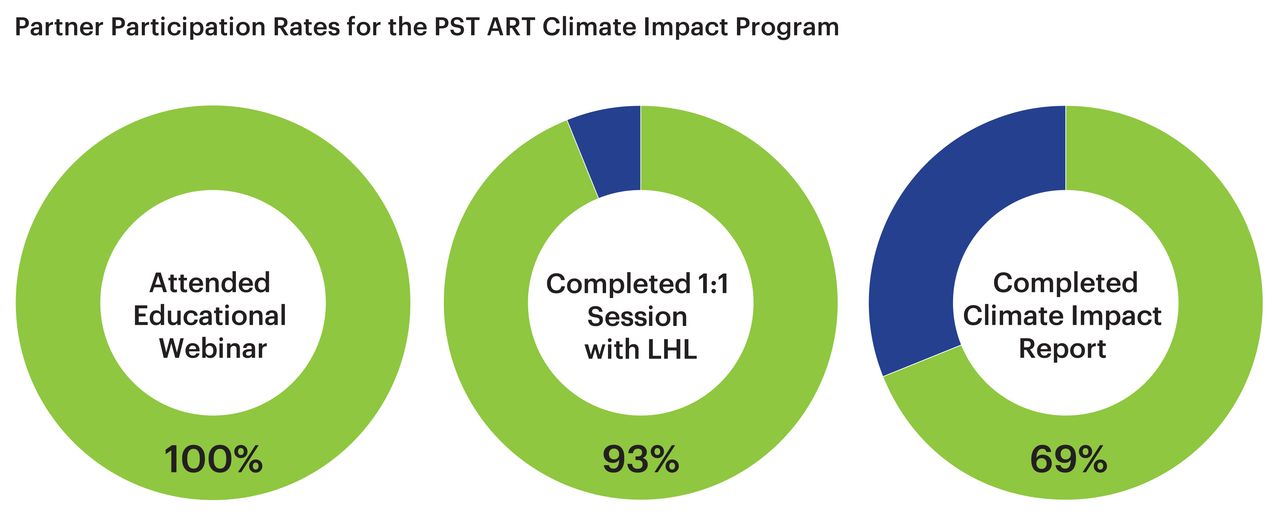
Each edition of PST ART includes at least fifty partner organizations, and for this inaugural CIP, all partners were invited—not required—to participate. Getty and LHL Consulting encouraged organizations to do what they could, prioritizing inclusivity and flexibility to meet participants where they were since 80% of them were reporting on climate impact for the first time. Every partner venue participated in the program in some way, with forty individual Climate Impact Reports eventually created for PST ART exhibitions. Together these reports form the largest dataset of exhibition-making emissions to date.
Data Highlights
Art museums have the highest average energy consumption of all cultural institutions in the United States according to the 2023 Culture Over Carbon report, with building energy, business travel, and art shipping as the three largest areas of emissions. Data collected on PST ART exhibitions through Climate Impact Reports affirms the same areas of high emissions that could be targeted for future reduction.
-
Flights had the highest emissions of the required reporting categories, followed by air freight. Business class flights for couriers to transport loaned artworks were the highest type of flight emissions, despite only a few projects reporting these.
-
33 air freight shipments travelled across domestic routes that presumably could have travelled via road freight, which would have prevented 63.55 tCO2e in emissions. For overseas freight, switching from air to sea transport would have saved 387.98 tCO2e and reduced the total PST ART emissions by nearly 18%.
-
Building energy was beyond the scope of required reporting but was often a top emission area if reported.
-
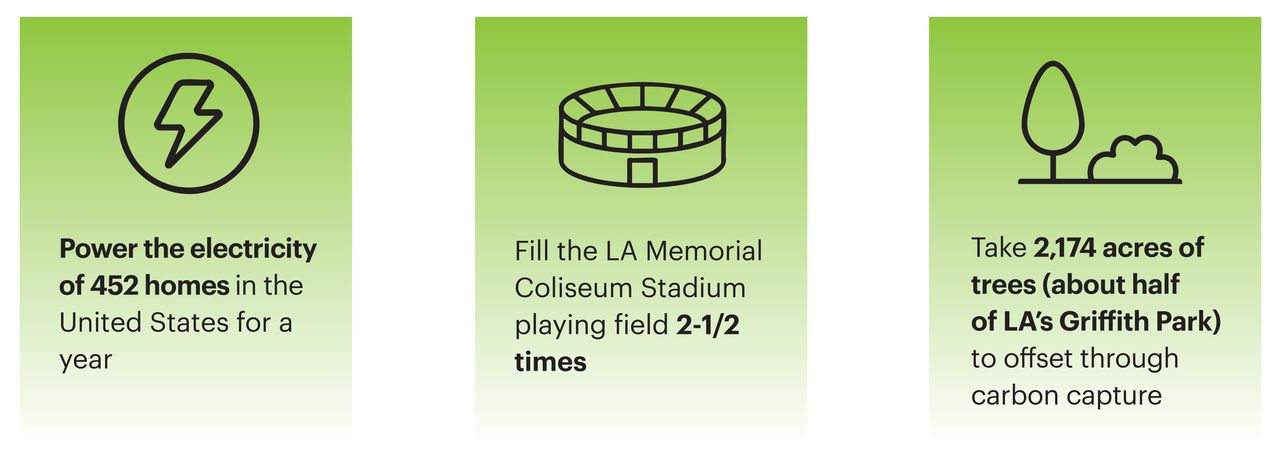
The total carbon emissions with just over half of all PST ART projects reporting is 2167 tCO2e (metric tons of carbon dioxide equivalent, a standard unit for counting greenhouse gas emissions). For context, this amount of carbon dioxide would:
-
The CIP became a catalyst for institutional change as participants prepared their exhibitions, even though it was not an explicit goal to reduce PST ART’s carbon footprint. Along the way partners made more climate-aware decisions, including:
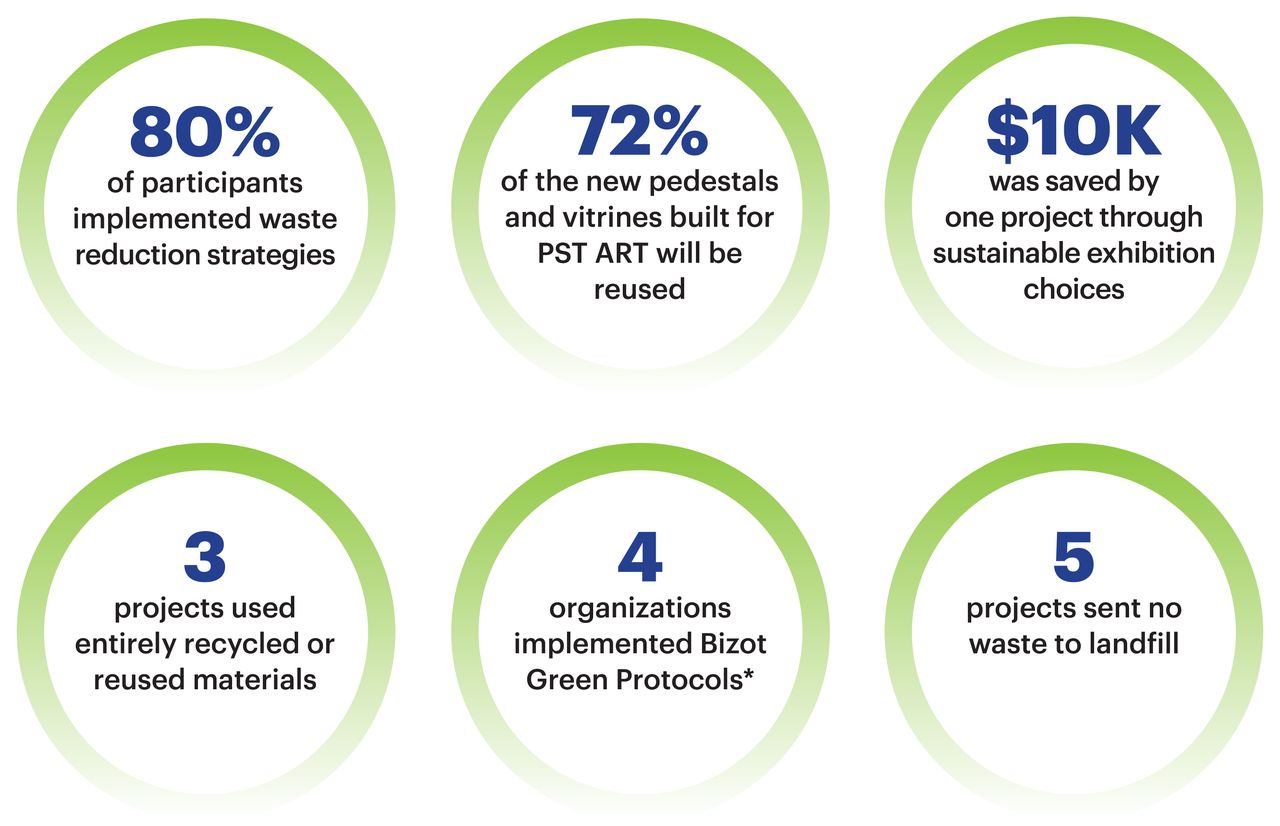
Guidelines for sustainable practices in museums issued by the Bizot Group, an international network of art museum directors from major institutions
“We chose to extend the length of our exhibition, which reduced the overall carbon footprint of museum operations through less travel, shipments, materials, and waste.”
—LACMA
Conditions for Success
There was no existing model for the PST ART CIP, but it is clear from participant reporting and feedback that several characteristics contributed greatly to its success.
-
Getty and LHL Consulting emphasized process over perfection, recognizing that people want to do this work but don’t always have the tools or capacity.
-
The CIP incorporated community-based leadership which was essential in gaining trust.
-
Centralized funder support was an effective strategy to amplify climate action and build communities of practice.
Program Impact
Overall, the CIP achieved these outcomes:
-
The PST ART community collectively improved the climate impact of their exhibitions.
-
Their work initiated a lasting ripple of climate action across Southern California art spaces, ushering in greener operations ranging from extending exhibition duration and recycling exhibition components to choosing more sustainable materials.
-
The reach of the Climate Impact Program expanded beyond partner institutions to engage their extended communities and networks.
-
Getty and the PST ART cohort created the largest dataset to date of exhibition-based Climate Impact Reports for comparative analysis.
“The highlight of the experience was the collaboration and discussions.”
—Self Help Graphics & Art
Looking Ahead
2030 is an important year for climate action advocacy. It is also when PST ART will return to Southern California. PST ART: Art & Science Collide generated critical climate impact data and benchmarks through the inaugural Climate Impact Program, while simultaneously highlighting community-created solutions for sustainable exhibition-making across institutions of varying type and size.
There are also clear areas of improvement that are within museums’ grasp. For example, using virtual courier technologies such as location trackers and video streaming software would reduce courier emissions—PST ART’s highest emissions area—to zero. Going forward the cultural sector is well-positioned to contribute to climate solutions within and beyond our own doors, and Getty will continue to support this work with its PST ART partners into the future.