What does it mean to track emissions for museum activities and where do you begin? Since the PST ART Climate Impact Program was opt-in, Getty invited participants to consider what they could do, rather than provide restrictive guidance or regulations on what they should do. This required some extra data cleanup to systematize results. However, Getty and LHL agreed this was worthwhile to encourage participation and provide statistically relevant data for the overall climate impact of PST ART.
Deciding What to Measure and Tools to Use
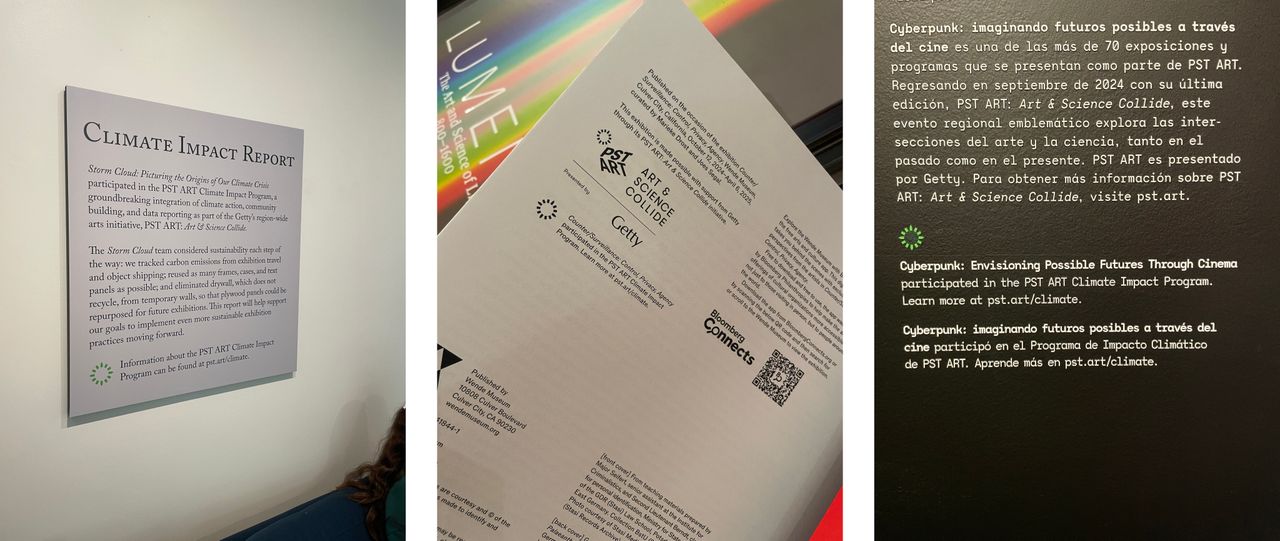
One of the first steps was to identify data collection methods. We decided our primary source for quantitative data would be the Climate Impact Report (CIR), an assessment and report used internationally in the art world to measure key areas of climate impact related to a specific project or exhibition. CIRs provide consistent data across different institutions and projects, help institutions understand the climate impact of their decision-making, and build transparency among staff and with the public. For PST ART, we adapted a template initially developed by LHL Consulting for Artists Commit. Examples of CIRs can be found in the Artists Commit Climate Impact Report database at artistscommit.com/reports.
CIRs included a project questionnaire on basic reporting metrics; comprehensive line-item reporting on travel, shipping, material use, and more; and narrative reflections about key outcomes. The reports were as simple or extensive as each team’s capacity allowed, often focusing on a specific area that the project team was most excited to explore. This flexible approach differentiated the PST ART CIP from a strictly data-driven climate action program. We understood that the smallest institutions were often the most stretched for capacity, while the largest often had complex processes to approve participation in the program, especially if it had required public reporting. In the end, many that didn’t expect to participate found the process more approachable than they initially anticipated.
LHL also deployed two other data-collecting efforts during the program: preliminary reports and praxis interviews. Preliminary reports gathered information on institutional policies and climate action history, providing information on each institution’s existing state of engagement in this work. The praxis interviews collected qualitative data on what project teams were most excited about for the CIP, stakeholder ideas for action, and key challenges and priorities. One critical outcome from this “pre-program” data collection was partners’ desire to elevate the visibility of their climate impact work. In response, we created a section of the PST ART website describing the CIP, issued a press release that generated media coverage,1 and designed a green sundial based on the PST ART logo that partners could use in their exhibition materials (online, in-print, and in galleries) to raise awareness.
Calculating and Standardizing Data
Although Getty grants for PST ART exhibitions occurred in two phases, the primary focus for data collection was on the implementation phase when organizations saw the highest volume of travel, shipping, and material waste for the build out, installation, and deinstallation of their exhibitions. LHL advised CIP participants to include all travel, shipping, or material waste that was part of their PST ART project, regardless of whether it was paid for by Getty grants to reflect the full climate impact of the project. Most teams completed the data tracking to the best of their ability for the required emission data categories: flights, airfreight, sea freight, and long-haul road freight. Information on publications and research travel was optional.
Once organizations had compiled all the emission data, they needed to run carbon footprint calculations. To reduce error and encourage data standardization, LHL suggested that partners use the GCC Carbon Calculator developed by the Gallery Climate Coalition.2 Some institutions reported emissions that were provided directly by a vendor or other online tool. LHL verified all emissions data submitted by partners and used the GCC Carbon Calculator to standardize data calculated by alternative tools.
Notes
-
Read press release here: https://www.getty.edu/news/getty-inaugurates-pst-art-climate-impact-program/ ↩︎
-
In fall 2024, the GCC Carbon Calculator was revamped. Some PST ART projects had already started working with the earlier version, so GCC made both versions of the Carbon Calculator available to PST ART projects for reporting. To provide more direct comparisons for analysis, LHL recalculated and verified all data using one version for each emissions category. LHL used the GCC Carbon Calculator 1.0 for long-haul freight, local freight, and publications; they used the GCC Carbon Calculator 2.0 for flights, airfreight, and sea freight. ↩︎