PST ART: Art & Science Collide (October 2024–February 2025) was the third edition of Getty’s landmark art event, with more than 70 thematically-linked exhibitions and hundreds of programs throughout Southern California. Previously known as Pacific Standard Time, this regionwide collaboration of cultural institutions large and small is the largest art event in the United States and is made possible by grants from the Getty Foundation.1
This was the first edition of PST ART to include a dedicated Climate Impact Program (CIP). Led by LHL Consulting, in partnership with Getty Foundation staff and dedicated collaborators,2 the CIP provided participating organizations with the education, resources, and tools to understand the impact of exhibition-making on the climate as well as a framework for completing climate impact reports related to PST ART exhibitions.
The goals of the CIP were to:
-
Build climate action fluency and capacity of PST ART project teams
LHL Consulting developed educational programs and resources to help participants (1) understand the major drivers of climate impact in exhibition-making; (2) learn about strategies to address these key areas; and (3) gain tools and knowledge needed to quantify and report climate impact. -
Measure the climate impact of individual PST ART exhibitions
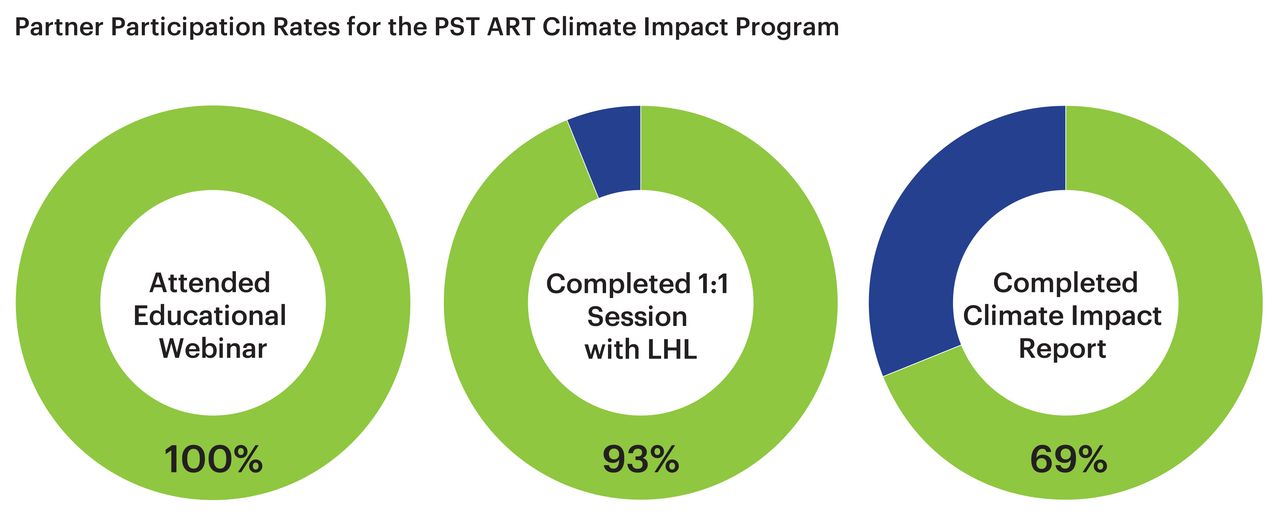
A mantra of LHL Consulting is you can’t manage what you don’t measure. To help partners with this work, LHL offered 1:1 consultations to all participating PST ART partners, produced educational webinars and workshops on different climate impact reduction tactics, updated existing emissions tracking tools for partner use, and provided technical support to all partners to complete Climate Impact Reports. -
Create a community of arts professionals committed to climate action
PST ART provided a unique opportunity for collaboration among dozens of Southern California’s cultural institutions. In the end, we hoped the program would create a sense of collective effort to implement ongoing climate impact mitigation strategies across the visual arts. -
Generate aggregated baseline data for the PST ART initiative
Baseline data would make it possible for Getty and its partners to establish climate impact targets for the next installment of PST ART opening in fall 2030 and onboard new partners that join each edition of the initiative.
The CIP unfolded over two years with LHL offering educational events, individual or small group support, resources, and reporting tools at all stages. The program’s guiding principles were flexibility and process over perfection, since this was the first time undertaking climate tracking for 80% of the partners. Although participation in the CIP was self-directed and voluntary, all PST ART partner venues participated at some level, with the majority of organizations opting to complete climate impact reporting.
This report summarizes the structure of the Climate Impact Program, outcomes of the work, and data from participating PST ART partners about the climate impact of their exhibitions. It represents the largest single dataset of climate impact from exhibition-making to date and details the steps that participating organizations took to lower their carbon emissions and material waste for PST ART and that many are now adopting as part of their regular operations.
Notes
-
Prior editions of PST ART included Pacific Standard Time: LA/LA (September 2017–January 2018), which presented a paradigm-shifting examination of Latin American and Latinx art, and Pacific Standard Time: Art in L.A. 1945–1980 (October 2011–March 2012), which rewrote the history of the birth and impact of the Los Angeles art scene. More information is available at http://www.pst.art. ↩︎
-
Complete lists of the Climate Impact Program advisors circle, participating organizations, and sector colleagues are included as appendices in this report. ↩︎